Browse by city
Date range
Search help

Search titles, summaries, topics and stored transcripts together. Keywords may match separately; put the whole query in double quotes for a phrase. Matching follows word analysis, so punctuation is not exact. Both dates are included. Documents are not searched.

SHOWING 41–50 ENTRIES
41
OCT 20, 2026 · NEW YORK CITY, NEW YORK · CITY COUNCIL
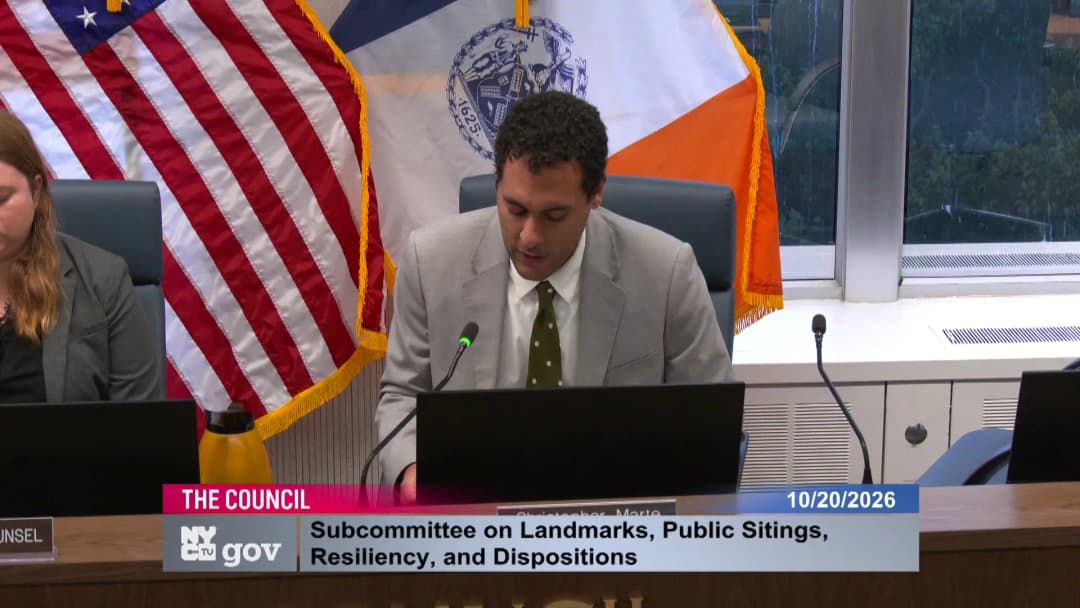
Landmarks Subcommittee Vote on 48-50 Convent Avenue - October 20, 2026

The New York City Council Subcommittee on Landmarks, Public Sitings, Resiliency and Dispositions convened on Tuesday, October 20, 2026, at 10:00 AM, in a hybrid format. Chaired by Councilmember Christopher Marte, the subcommittee held a single vote on two Land Use applications (LU 0129-2026 and LU 0130-2026) for the 48-50 Convent Avenue cluster under HPD's Affordable Neighborhood Cooperative Programs (ANCP). Discussion Items - Chair Marte introduced the applications for a vote, noting the subcommittee had heard them at a meeting the previous month. The two items seek an Urban Development Action Area Project (UDAAP) approval and a 40-year Article XI Real Property Tax Exemption to facilitate the preservation of four buildings. Chair Marte stated the project will include 77 home ownership units and that the majority leader of Manhattan's Council District 7 supports the application. No further discussion or debate occurred among subcommittee members before the vote. Key Outcomes - The subcommittee voted unanimously to approve LU 0129-2026 and LU 0130-2026. The roll call vote yielded 5 affirmatives (Councilmembers Marte, Avilés, Hanks, Nurse, and Thomas-Henry), 0 negative votes, and 0 abstentions. Councilmembers Feliz and Ossé were absent. The items were adopted and referred to the full Land Use Committee.

PROCEDURAL 100%
42
OCT 19, 2026 · NEW YORK CITY, NEW YORK · CITY COUNCIL
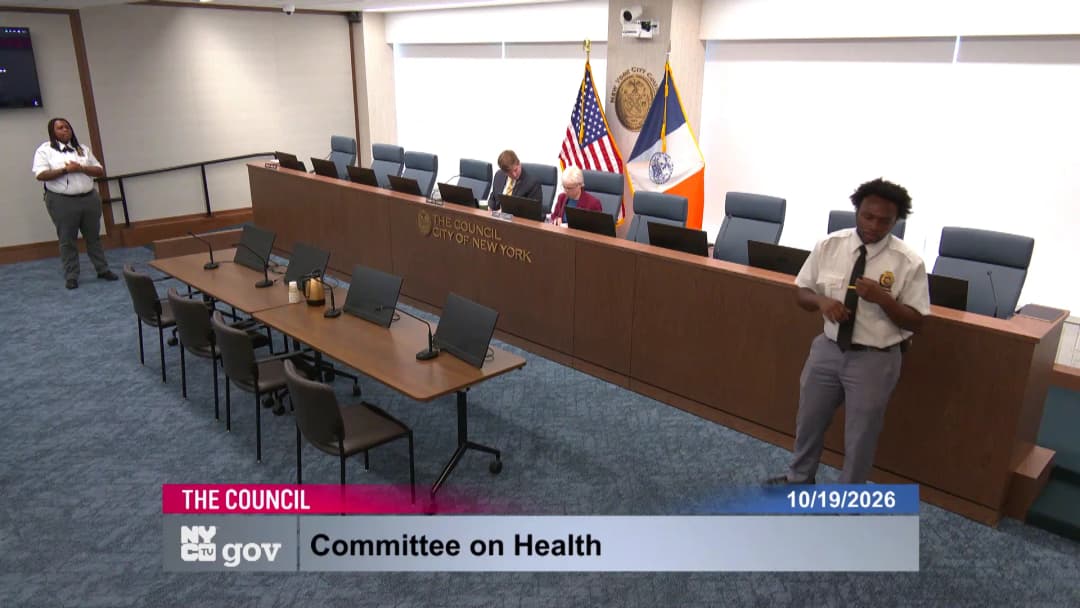
NYC Council Committee on Health: Food Service Inspection Oversight and Legislation – October 19, 2026

The New York City Council Committee on Health, chaired by Councilmember Lynn C. Schulman, convened at 10:00 AM in Hearing Room 2 at 250 Broadway on Monday, October 19, 2026, for an oversight hearing on food service establishment inspections in New York City and to consider six introductions and one resolution. Members present: Schulman, Ariola, De La Rosa, Epstein, Marte, Narcisse, and Wilson; Councilmember Gennaro was absent and Councilmember Felder was excused for medical reasons. Deputy Commissioner Corinne Schiff testified for the Department of Health and Mental Hygiene (DOHMH), joined by Assistant Commissioner Kim Kessler, Dr. Achala Talati (Director of Tobacco Policy and Programs), and Vasuda Reddy (Deputy Director, Bureau of Communicable Diseases). All legislation considered was laid over by the committee without final action. Oversight: Food Service Establishment Inspections Chair Schulman reported that council analysis of DOHMH data showed average monthly inspections rose from approximately 1,400 in the final quarter of 2023 to nearly 2,200 by June 2024, reaching just under 2,700 by August 2026. She noted the entry-level public health sanitarian workforce has not returned to pre-COVID levels, and that facility/equipment maintenance and pest presence/prevention account for nearly half of all violations. DOHMH testimony and Q&A highlights: - About 90% of restaurants post an A grade, up from 85% in FY12; the program celebrated its 15th anniversary in July 2025. - DOHMH regulates about 40,000 food service establishments, roughly 30,000 of which are restaurants; inspections are unannounced and randomized. - Inspections totaled just over 20,000 in FY24, almost 21,000 in FY25, and nearly 21,400 in FY26 (just over 16,000 initial inspections, almost 6,000 re-inspections, and just over 250 compliance inspections). - Per the Fiscal 2026 Mayor's Management Report, DOHMH inspected 71% of restaurants, below the 100% target; about 8,800 restaurants were not inspected in FY26, and just under 500 had gone two or more years without an inspection. - The food safety bureau budget is about $25 million, about $20 million for personnel; DOHMH stated hiring, not funding, is the main barrier to full staffing. - DOHMH trains about 35,000 food protection certificate (FPC) holders per year; the in-person course costs $114, the online course is free, and the review course and exam cost $24. In FY26 it issued about 2,800 violations for no FPC holder on site and just over 870 grade-posting violations. - DOHMH maintains an ombudsperson and customer service office for restaurant owners and agreed to share outreach materials with council members. Legislation Considered - Int. 0189-2026-A (photo/video documentation of violations): Would require notices of violation issued during food service inspections to include photographs or video recordings of each cited violation when an inspection results in 14 or more points (the cutoff for an A grade). DOHMH expressed concern that photographing and video-recording violations would lengthen inspections and require significant data storage and record retention resources. Local 768 called the mandate impractical, redundant, and a risk to inspector safety. The committee amended the bill and laid it over. - Int. 0405-2026-A (children's meal nutrition standards): Would set nutrition standards and beverage options for children's meals served in chain restaurants, including at least one non-juice fruit serving, one serving of non-deep-fried vegetables, reduced juice serving sizes, and limits on calories, sodium, and saturated fat. DOHMH expressed support, noting whole milk is appropriate for children ages 1–2 and flagging concerns about added sugars in flavored milk. The American Heart Association supported the bill but objected to whole milk and flavored milk being included as options, arguing this would weaken the existing default beverage standard. The committee amended the bill and laid it over. (Note: the transcript once refers to this bill as "504A"; the agenda and minutes identify it as Int. 0405-2026.) - Int. 0908-2026 (digital FPC verification): Would require DOHMH to create and maintain a digital database of food protection certificate holders and consult it during inspections before penalizing a restaurant for lacking a physical certificate. Sponsor Councilmember Santuso said the bill closes a bureaucratic loophole hurting restaurants. DOHMH supports the intent but cited operational hurdles, including records currently deleted after 10 years and the scale of maintaining decades of records for about 35,000 new certificate holders per year. Laid over. - Int. 0947-2026 (tobacco bar transfers): Would allow a qualifying tobacco bar experiencing financial hardship to seek a one-time transfer of its registration and tobacco retail dealer license to a new location. DOHMH opposed the bill, stating it would undermine the attrition purpose of the Smoke Free Air Act; it testified that five tobacco bars currently operate in the city, down from eight when the law was enacted. The American Cancer Society Cancer Action Network also opposed it. Christina Danson testified in support, arguing the government should regulate rather than ban lawful businesses. Laid over. - Int. 1094-2026 (Legionella reporting): Would require building owners to report Legionella test results of at least 10 colony forming units per milliliter (CFU/mL) to DOHMH. Chair Schulman noted the 10 CFU/mL metric has been used successfully in Canadian jurisdictions. DOHMH said its corrective-action requirements already begin at the same low level and looked forward to discussing the reporting requirement. Laid over. - Int. 1124-2026 (FPC recertification): Would require individuals managing or supervising food service establishments to renew their food protection course certification every five years. DOHMH said it supports the intent and would work with the council on implementation. Laid over. - Res. 0152-2026 (state food additives legislation): Would call on the New York State Legislature to pass, and the Governor to sign, S.1239A/A.1556A, prohibiting certain food additives, prohibiting the sale of food containing certain color additives at schools, and restricting substances "Generally Recognized as Safe" unless reporting requirements are met. Laid over. Public Comments & Testimony - Carmen Deleon, President, Local 768: Representing public health sanitarians, cited a shortage of sanitarians and salary concerns and said Intro 189 is impractical and redundant with existing processes. - Charlton Smith, Executive Vice President, Local 768: With 24 years of DOHMH service, raised serious concerns about Intro 189, including administrative burden, privacy risks, inspector safety, and data storage demands, and urged the council to reconsider the mandate. - Michael Divoli, American Cancer Society Cancer Action Network: Opposed Int. 947 as undermining the Smoke Free Air Act, noting more than 12,000 New Yorkers die annually from tobacco-related illness and that the city has more than 6,000 licensed tobacco retailers; he said the market now has six tobacco bars (a figure that differs from DOHMH's count of five). He also expressed support for the school food additives resolution. - American Heart Association representative: Supported Int. 405-A, citing that nearly 40% of New York City public school children in grades K–8 are overweight or obese and fewer than one in five children ages 5–13 consume recommended fruit and vegetable servings per day; raised concerns about whole milk and flavored milk in the bill and opposed Int. 947. - Christina Danson: Testified in favor of Int. 947, citing the 1942 New York State Supreme Court decision Good Humor v. City of New York holding that the city cannot ban a lawful licensed business where regulation would suffice. - Virginia Villa, Deputy Research Director, Hotel and Gaming Trades Council: Supported Int. 1094, describing a hotel where Legionella levels below the 1,000 CFU/mL reporting threshold went unreported; a later test showed density increased fourfold to over 700 CFU/mL, and workers and guests learned of the risk only after the union became involved and arbitration secured remediation. - Philip Stewart White, independent consultant and former co-designer of Vancouver's cooling tower registry: Supported Int. 1094 and suggested requiring every monthly test result to be reported, not only those at or above 10 CFU; he reported that Vancouver reduced elevated results from repeat systems by 86% in four years through targeted follow-up. - Ian Horn, President, Cooling Technology Institute: Opposed lowering the reporting threshold to 10 CFU/mL, stating that no single Legionella concentration has been demonstrated to reliably predict human illness and that the focus should remain on comprehensive water management programs; he offered CTI as a technical resource. Key Outcomes - The oversight item (T2026-2545) was filed by the committee. - All six introductions and the one resolution had hearings held and were laid over; Int. 0189-2026-A and Int. 0405-2026-A were amended by the committee before being laid over. - DOHMH committed to provide follow-up data, including a list of regulated establishment types, inspector job descriptions, data on takeout vs. sit-down restaurant inspections, salary comparisons with other jurisdictions, FPC fee revenue, and record retention periods. - Written testimony may be submitted to testimony@council.nyc.gov within 72 hours of adjournment.

PUBLIC HEALTH 60% · FOOD SAFETY 13% · PROCEDURAL 10% · PUBLIC ENGAGEMENT 7%
43
OCT 19, 2026 · NEW YORK CITY, NEW YORK · CITY COUNCIL
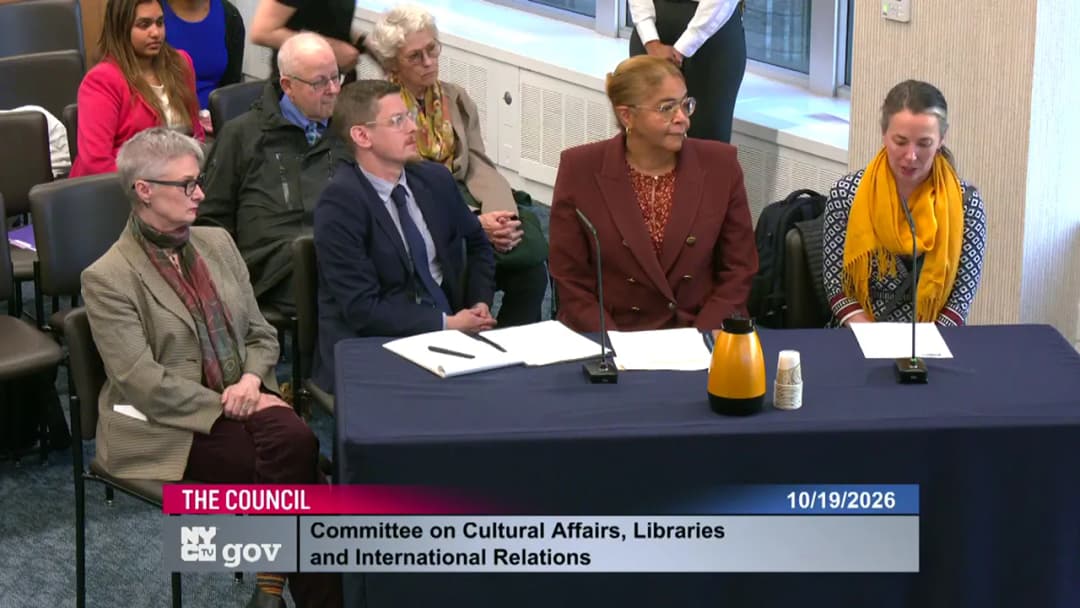
NYC Council Cultural Affairs Committee CreateNYC Oversight Hearing and Cultural Resolutions, October 19, 2026

The New York City Council Committee on Cultural Affairs, Libraries and International Relations, chaired by Deputy Speaker Nantasha M. Williams, convened a hearing on October 19, 2026, at 1:00 PM. The primary focus was an oversight review of the 2017 CreateNYC cultural plan, evaluating its accomplishments and shortcomings. The committee also heard testimony on four resolutions designating cultural observances. Committee members present included Councilmembers Louis, Maloney, Ossé, Stevens, and Ung. Councilmember Hudson was absent. Public Comments & Testimony - Expert Witness (Penn SIAP): Mark Stern and Susan Seaford testified that cultural equity in New York has not meaningfully improved as economic inequality has deepened the "new geography of exclusion." They identified "civic clusters" in low-income neighborhoods as models for building community well-being from strength, recommending DCLA adopt a neighborhood lens and cultivate horizontal networks alongside vertical ones. - Expert Witness (IBO): Arden Armbrewster reported that CDF funding remains heavily concentrated in Manhattan, with 60% of grantees based there receiving 63% of funds. He noted small grantees (budgets under $500,000) are highly dependent on city funding and that organizations serving underserved communities were often the most financially vulnerable. - Public Testimony (Resolutions): Gregorio Mayers (Panama 507 Round Table) strongly urged passage of Res 0625-A (Reggaeton Heritage Month), detailing the genre's origins in Afro-Caribbean Panama and its evolution in New York. - Public Testimony (CreateNYC): Mauricio Delfin and Gonzalo Casals (CAP Institute) proposed separating CreateNYC into a DCLA capacity-building plan and a citywide shared cultural agenda. Lucy Sexton (NY4CA) called for legislation to make a cultural advisory group permanent, portable health benefits for teaching artists, and passage of artist preference housing legislation. - Public Testimony (Equity): Lisa Gold (A4) noted only 5% of CDF funding reaches AAPI-led organizations despite the population being 18%. Adam Odsess Rubin (National Queer Theater) requested $5 million baseline funding for queer arts. Chivelle Dixon (Pan African Solutions) urged extending CDF eligibility to mission-driven for-profit MWBEs. - Public Testimony (Space & Workforce): Randy Berry (Indie Space) urged land trusts, acquisition funds, and 20+ year leases. Esther Robinson (Art Built) called for a cultural production infrastructure fund. Kimberly Olson (NYC Arts in Ed Roundtable) highlighted the lack of certified arts teachers (69% of 8th graders not meeting state requirements) and the need to update CASA grant administration. - Public Testimony (Disability Access): Beth Prevor and Cindy Vandenbosch criticized the lack of transparency and accountability of the Disability Forward Fund, calling for disabled artists to be included in decision-making and for cultural organizations to be required to report on access data. Discussion Items - Oversight Hearing – What's Next for CreateNYC: Chair Williams opened by questioning whether the 2017 plan's promise of cultural equity had been kept. Commissioner Dea Vidge (DCLA) provided a comprehensive report, highlighting successes (CDF expansion by over $30M, DEI plans for all 39 CIGs, the Create in Place program, 568,000 Culture Pass reservations) and failures (lack of progress on living wages, weak support for individual artists, incomplete data tracking). Councilmember Stevens pressed on the lack of outcome data for the CUNY Cultural Corps (1,100 interns tracked anecdotally, not systematically) and the absence of measurable goals for CIG DEI plans besides their self-assessments. Chair Williams criticized the delays in submitting mandated reports to the Mayor and Speaker and the incomplete online data dashboards (stopping at FY22, updated just before the hearing). Councilmember Maloney, via written question from Councilmember Marte, challenged DCLA on the location of the Elizabeth Jennings Graham monument by Grand Central, geographically removed from the historic site of her protest. Key Outcomes - All four resolutions (Res 0163-A, 0164, 0186, 0625-A) were laid over by the committee without a final vote. - DCLA committed to submitting overdue progress reports to the Mayor and Speaker and to completing the appointment of the Cultural Affairs Advisory Commission within one month. - The committee broadly signaled a need for the next iteration of the city's cultural plan to include enforceable metrics, dedicated funding, and a broader "shared agenda" framework with cross-agency accountability, moving beyond DCLA alone. - No legislation was advanced to a full council vote from the hearing.

ARTS AND CULTURE 61% · PUBLIC ENGAGEMENT 7% · DISABILITY RIGHTS 4% · PROCEDURAL 3%
44
OCT 16, 2026 · NEW YORK CITY, NEW YORK · CITY COUNCIL
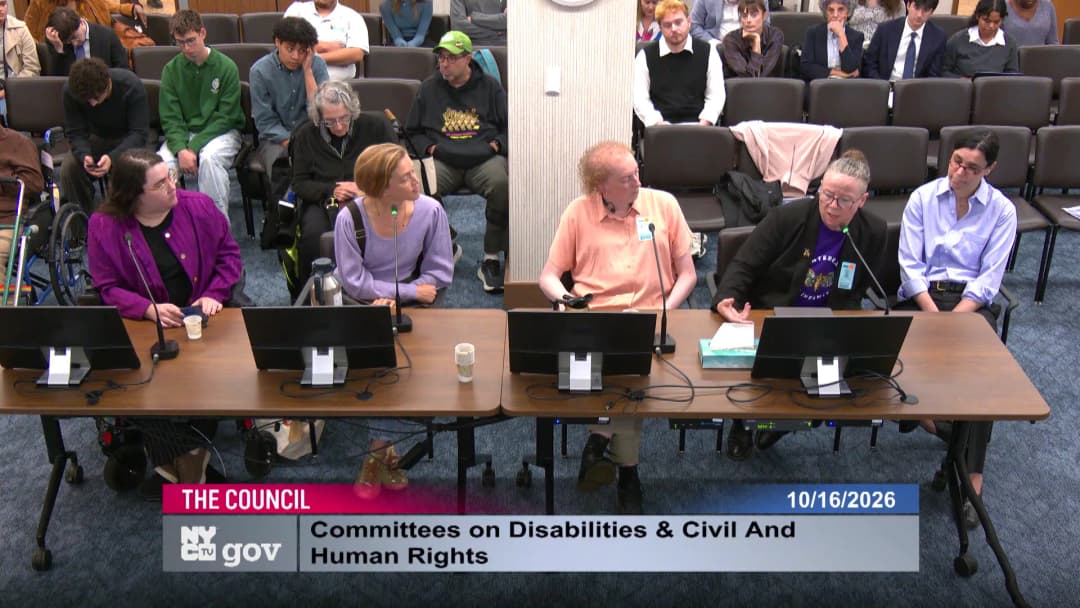
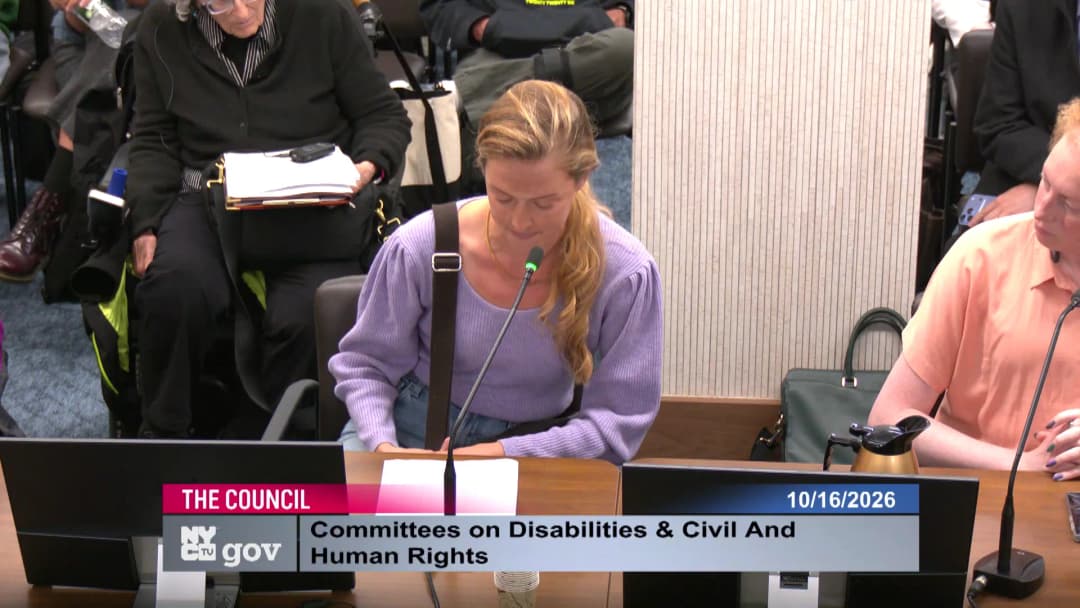
New York City Council Joint Committees on Civil and Human Rights and Disabilities Hearing on Disability Enforcement and Legislation - October 16, 2026

The joint oversight hearing, chaired by Councilmembers Sandy Nurse and Shahana Hanif, examined disability discrimination enforcement trends at the New York City Commission on Human Rights (CCHR) and considered several legislative items. The hearing featured testimony from CCHR and the Mayor's Office for People with Disabilities (MOPD), as well as extensive public testimony from disability rights advocates, intersex community members, and service animal handlers. No final votes were taken; all bills and resolutions were laid over by committee. Public Comments & Testimony - Clement So (Metropolitan Asian Deaf Association) urged CCHR to establish a direct video phone line for ASL users and improve data collection on disability violations. He expressed strong support for Intro 1107 (service animal guidance) and Res 0665 (UN CRPD ratification). - Jean Ryan (Disabled in Action) described a four-year unresolved complaint against a grocery store that locked its gate during business hours, blocking wheelchair users. She also criticized CCHR's handling of a group complaint against Uber, where the case was closed without explanation after years of inaction. - Gary Owie Steven (CUNY student) testified in support of Res 0510 (Autistic Pride Day), sharing personal experiences of being excluded as an autistic and intellectually disabled individual from multiple communities. - Madeline Reichman (Legal Aid Society) highlighted endemic disability discrimination in homeless shelters and urged increased funding for CCHR enforcement, noting that CCHR is often the only option for tenants with disabilities who cannot afford private attorneys. - Evan Yankee (Brooklyn Center for Independence of the Disabled) supported Intro 1107 but stressed that MOPD must receive adequate funding. He also called for stronger enforcement against ride-hail services that illegally deny service animal users. - Intersex community members (Erica Lorshbough, Alicia Roth Weigel, Liat Feller, Jennifer Levine, Alistair Ittelson, Alyssa Ball, Briani Price, others) uniformly expressed strong support for Intro 0131, sharing experiences of discrimination in employment, housing, healthcare, and public accommodations. They emphasized that explicit statutory protections are needed to ensure permanence and public awareness, especially given federal rollbacks. - Shauna Kniznik (ACLU, intersex woman) supported Intro 0131 and stressed the need for public education so intersex New Yorkers know their rights. - Kathleen Collins (congenital quadruple amputee) testified that CCHR's website lacks a clear way to file a formal complaint, risking missed legal deadlines. She called for fixed deadlines and better digital accessibility. - Jillian Miano (autistic woman) supported Intro 1107 but raised privacy concerns about the emotional support animal documentation process. She also supported Res 0665. - Sayer Russell (Autistic Adults NYC) supported Res 0510, emphasizing that autistic voices must be centered in decisions affecting the community. Discussion Items - Oversight of Disability Enforcement at CCHR: Chair Hanif opened by noting that disability is the most common basis of claims filed with CCHR. She highlighted a tragic case where a tenant died waiting years for a ramp. Chair Nurse stressed that CCHR is a small agency with a large mandate and that justice delayed is justice denied. - CCHR Deputy Commissioner Joanne Kamuf Ward testified that disability claims comprised the most common type in FY26 across employment, housing, and public accommodations. She described CCHR's enforcement tools, including pre-complaint interventions (PCIs), Project Equal Access (which has 3 staff), and testing. She noted that CCHR recently reorganized to move more staff into enforcement, creating non-attorney investigator roles and a monitoring clerk. - MOPD Deputy Commissioner Balkeese Marig stated MOPD does not enforce discrimination complaints but refers callers to CCHR. MOPD receives hundreds of calls per month, but only recently began tracking referral outcomes. Since July 2026, MOPD referred at least 22 alleged discrimination claims to CCHR, mostly housing-related. - Source of income discrimination: Assistant Commissioner Stephanie Rivera reported that in FY26, CCHR resolved 152 lawful source of income matters via pre-complaint intervention, with average closure under 30 days. Councilmembers questioned how cases involving both disability and source of income are tracked. CCHR acknowledged disability often overlaps with other protected categories and agreed to follow up with data. - Case backlog and reorganization: CCHR stated the reorganization took effect July 1, 2026. The InfoLine team doubled to 16 members, and a new case management system is being procured. The agency retained an internal guidance for housing case resolution within two years but aims to reduce that timeline. - Testing: CCHR conducted 197 disability-related tests in public accommodations in FY26, down from 390 in FY25, due to shifting resources to other protected classes like salary transparency. Chair Nurse noted the decline and questioned whether more resources are needed. - Intro 0131 (intersex protections): Councilmember Cabán sponsored the bill to explicitly include intersex traits in the definition of gender. CCHR supported the bill, noting it aligns with existing interpretation. Public testimony overwhelmingly supported it, with proposed technical amendments from Fordham Law clinic to define "intersex traits" and clarify the phrase "regardless of sex assigned at birth." - Intro 1107 (service animal guidance): CCHR supported the intent but noted the administration is still reviewing which agency should implement it. Public testimony highlighted widespread denials of service animal access, including in restaurants and grocery stores. - Res 0510 (Autistic Pride Day): Councilmember Julie Won's statement was read, noting the resolution was sparked by self-advocate Gary Owie Steven. Public testimony supported the resolution as a step toward celebrating neurodiversity. - Res 0665 (UN CRPD ratification): CCHR and public testimony supported the resolution, calling on the U.S. Senate to ratify the convention. Key Outcomes - Oversight T2026-2549: Hearing held and filed by committee. No further action. - Int 0131-2026: Hearing held, laid over. Councilmember Cabán indicated she will incorporate technical amendments proposed by the Fordham Law clinic. Committee chair expressed intent to pass the bill. - Int 1107-2026: Hearing held, laid over. CCHR and MOPD committed to continued review. No timeline set. - Res 0510-2026: Hearing held, laid over. Expected to pass with broad support. - Res 0665-2026: Hearing held, laid over. Committee chair expressed support. - CCHR agreed to provide follow-up data on case breakdowns by disability type, source of income intersections, and referral outcomes from MOPD. - No votes were taken on any item during the hearing.

DISABILITY RIGHTS 49% · LGBTQ+ 20% · PUBLIC ENGAGEMENT 5% · PROCEDURAL 5%
45
OCT 16, 2026 · NEW YORK CITY, NEW YORK · CITY COUNCIL
Committee on Disabilities Joint Hearing on CCHR Enforcement - October 16, 2026

The New York City Council's Committees on Disabilities and Civil and Human Rights held a joint oversight hearing on October 16, 2026, to examine disability discrimination enforcement trends at the New York City Commission on Human Rights (CCHR). Chaired by Councilmembers Shahana K. Hanif and Sandy Nurse, the hearing addressed four legislative items, including bills on intersex protections (Int 0131), service animal guidance (Int 1107), Autistic Pride Day (Res 0510), and UN CRPD ratification (Res 0665). The committee scrutinized CCHR's case backlog, enforcement capacity, and collaboration with the Mayor's Office for People with Disabilities (MOPD). Public Comments & Testimony - Clement So of the Metropolitan Asian Deaf Association urged CCHR to implement direct ASL video intake for complaints and supported the service animal guidance and CRPD resolutions. - Jean Ryan of Disabled In Action expressed severe frustration with CCHR, stating a 4-year-old case involving a locked grocery store gate had not been resolved and that the agency had become "irrelevant" to the disability community. - Michael Ring and Massum Mista supported the service animal public education bill, with Mista reporting routine denials of entry with her guide dog and emphasizing the need for mandatory handler input on materials. - Madeline Reichman of the Legal Aid Society called for increased CCHR funding, highlighting systemic disability discrimination in homeless shelters despite ongoing class action litigation. - Evan Yankee of the Brooklyn Center for Independence of the Disabled supported Int 0131 and Int 1107, criticizing CCHR for inaction and advocating for stronger enforcement and increased funding for MOPD. - A large coalition of intersex advocates and organizations (Interact, Interconnect, Fordham Law Clinic, ACLU, Outright International) unanimously supported Int 0131. They shared experiences of forced medical procedures, employment discrimination, and healthcare barriers. They argued explicit statutory language is essential to protect against potential future administrative rollbacks and recommended specific amendments to the bill's text. - Gary Owie Steven and Sayer Russell of Autistic Adults NYC passionately supported the Autistic Pride Day resolution, advocating for a shift from deficit-based narratives to community-led celebration and inclusion. - Several other speakers addressed inaccessible city services, high unemployment for people with disabilities, and privacy concerns regarding emotional support animal documentation. Discussion Items - CCHR Restructuring & Case Processing: CCHR detailed its July 2026 reorganization, which moved resources to the new Office of Civil Rights Enforcement, doubled the InfoLine to 16 staff, created non-attorney investigator roles, and hired a legal technology director. The internal case processing goal was acknowledged as two years due to case complexity, though the agency aims to improve this through expanded pre-complaint intervention. The Project Equal Access team grew to three staff. - MOPD Collaboration: MOPD has made at least 22 discrimination referrals to CCHR since July but does not systematically track case outcomes. Councilmembers urged closer loop-closing on referrals. MOPD described its role as a referral hub and is forming an interagency working group on elevator outages. - Source of Income & Disability: The committee highlighted the disproportionate impact of source of income discrimination on New Yorkers with disabilities. CCHR confirmed it evaluates these claims under both protected categories. Councilmembers requested specific data and a report on this intersection. - Service Animals (Int 1107): CCHR supports the bill's intent but noted the administration is still reviewing which agency should lead implementation. MOPD and CCHR already conduct trainings and have existing posters. Coordination with the Mayor's Office of Animal Welfare was noted. - Intersex Protections (Int 0131): CCHR explicitly supports the bill, confirming it aligns with its current enforcement guidance. The discussion focused on making protections explicit in statute to withstand political changes. - Testing & Enforcement: Disability-related testing decreased in FY26 due to resource shifts to salary history and fair chance housing topics. CCHR has a small testing team. Penalties for repeat offenders can reach $250,000, but CCHR is exploring increasing this cap to improve deterrence. A new monitoring clerk position was created to ensure compliance with settlements. - Accessibility Delays: Councilmembers probed the systemic delays causing multi-year waits for basic accommodations like ramps. Challenges include uncooperative landlords, DOB permit delays, and landmarking requirements. - Federal Context: CCHR stepped away from its EEOC dual-filing contract to protect New Yorkers' data from federal access. The agency will continue pursuing disparate impact cases under the city's broader protections. Key Outcomes - Hearings Held and Laid Over: Hearings were held for the oversight item and all four pieces of legislation. Int 0131, Int 1107, Res 0510, and Res 0665 were laid over by the committee for future action. The oversight resolution was filed. - Data Commitments: CCHR and MOPD committed to following up on numerous data requests, including breakdowns of referral outcomes, cases involving both disability and source of income, testing results, and average processing times. - Legislative Refinement: The committee received specific proposed amendments to Int 0131, including defining "intersex traits" and clarifying the scope of the "regardless of sex assigned at birth" phrase. Councilmember Cabán expressed intent to incorporate these. - Policy Directives: The committee urged CCHR to produce a report on the intersection of source of income and disability discrimination and to explore a system for emergency accessibility repairs. MOPD was directed to improve case tracking from its referrals. - Further Action: The bills will proceed to the full City Council. The agencies are expected to provide the requested data and continue collaborative efforts on systemic issues like elevator outages and service animal education.

DISABILITY RIGHTS 47% · LGBTQ+ 20% · PUBLIC HEALTH 5% · PUBLIC HOUSING 4%
46
OCT 16, 2026 · NEW YORK CITY, NEW YORK · CITY COUNCIL
NYC Council Civil Service & Labor Committee Oversight: Municipal Retention Strategies - October 16, 2026

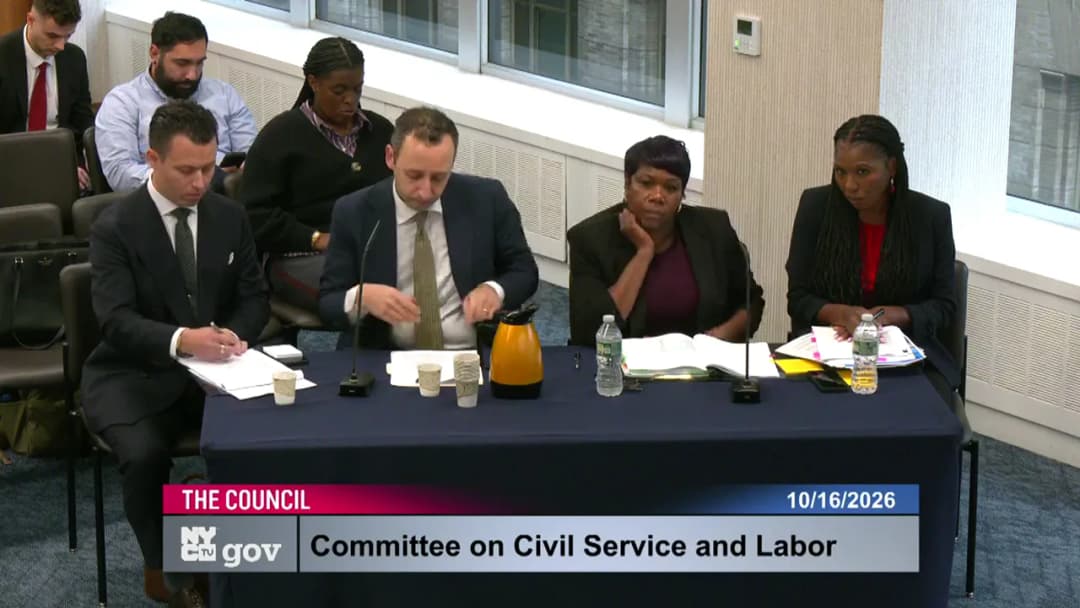
On Friday, October 16, 2026, the New York City Council Committee on Civil Service and Labor, chaired by Councilmember Shirley Aldebol, held an oversight hearing examining municipal retention strategies. The hearing featured testimony from the Department of Citywide Administrative Services (DCAS), the Office of Labor Relations (OLR), and public witnesses. Key topics included the city's 85% retention rate, a 3.8% vacancy rate, the departure of over 32,000 employees in FY2025, and initiatives to improve career development, benefits communication, and workplace culture. Public Comments & Testimony - Rose Lavaglio-Miller, Associate Executive Director of District Council 37 (DC 37), representing over 90,000 municipal workers, expressed that the city focuses heavily on recruitment but not enough on retention. She noted that many employees are unaware of available benefits, that wage increases (16.21% over five years) have been outpaced by inflation (21% in the metro area), and that affordable housing remains a critical issue. She called for a municipal housing program, opposed reclassifying competitive titles to non-competitive (which reduces leave rights), and urged a genuine partnership with labor. - Catherine Vaughan, Co-founder and Co-Executive Director of Abundance New York, highlighted that 60% of resigning employees in FY2024 had served less than five years, and turnover is acute in frontline roles (e.g., 295 child protective specialists resigned from ACS in FY2025). She proposed four priorities: (1) retain employees through the first five years; (2) recognize that paying to retain costs less than replacing (citing EMS: training a new EMT costs $42,000, and overtime grew 40% as attrition increased); (3) plan for predictable departures; and (4) improve data transparency by publishing vacancy/attrition data by title and agency, and by creating agency dashboards. - Matthew Lee, a legislative fellow for Councilmember Narcisse, noted that early turnover and lack of benefit awareness are key issues. He suggested simple, tangible benefits like free transit access for city employees could improve retention and morale. Discussion Items - DCAS Testimony (Katrina Porter, Deputy Commissioner): Reported an 85% retention rate (similar to NY State and federal government), median employee tenure of 9 years (three times the private sector), and a 3.8% vacancy rate (down from 8.4% in 2021). Highlighted initiatives: Little Apple free child care center (40 slots, 37-family waitlist, vendor-operated), Mayor's Scholarship expansion (91 applicants from 21 agencies for undergraduate programs), NYC Learn training platform (20,000+ participants, up from 13,000), citywide employee viewpoint survey (16,000 responses, 10% response rate among 169,000 non-DOE/H+H employees), and exit survey programs. Noted that career development is the top reason for departure among employees with 0-4 years of service. - OLR Testimony (Dan Pollock): Described collective bargaining achievements: 16% wage increases over five years, flexible work pilot (extended through June 2027), and equity funding to target high-attrition titles (e.g., lifeguards, 911 operators, caseworkers, school safety agents). Noted that benefits include health plans (new NICE PPO), WorkWell NYC wellness program (60,000+ participants), and Employee Assistance Program (EAP). Acknowledged the need to improve communication about benefits and noted the recent creation of an OLR communications division. - Councilmember Questions: Included inquiries about survey participation rates, breakdown of retention by agency, training cost transparency (courses up to $1,900, paid by agencies, not employees), effectiveness of outreach, promotional exam scheduling (data-driven, not influenced by OMB budget cycles), exit survey response rates (only 80% of departures were resignations in FY25, up from 71% in FY24), work-life balance (35% of employees felt emotionally drained), the pay equity analysis (vendor contracted, first report due May 7, 2027), and the Civil Service Modernization Advisory Committee (convened two meetings, recommendations due by end of 2026). - Municipal Housing: Both DC 37 and councilmembers raised the lack of affordable housing as a major retention barrier, particularly for employees with a two-year residency requirement. DCAS noted the child care pilot as a step but acknowledged housing is not within its direct purview. Key Outcomes - The hearing was held as an oversight session, with no votes taken. - The committee filed the oversight (T2026-2618) as recorded in the minutes. - Chair Aldebol committed to following up with DCAS on specific data requests (retention rates by agency, exit survey completion rates, employee training participation by title, and the number of employees who have “availed themselves” of wellness programs). - Councilmembers expressed interest in legislative solutions to improve data transparency (e.g., mandating agency dashboards) and to support civil service modernization efforts. A briefing from the Civil Service Modernization Advisory Committee was requested. - Public testimony was officially entered into the record, with the option for written submissions within 72 hours.

PERSONNEL MATTERS 39% · CIVIL SERVICE REFORM 21% · WORKFORCE DEVELOPMENT 20% · PROCEDURAL 8%
47
OCT 16, 2026 · NEW YORK CITY, NEW YORK · CITY COUNCIL
New York City Council Committee on Technology Hearing on AI Risks, October 16, 2026

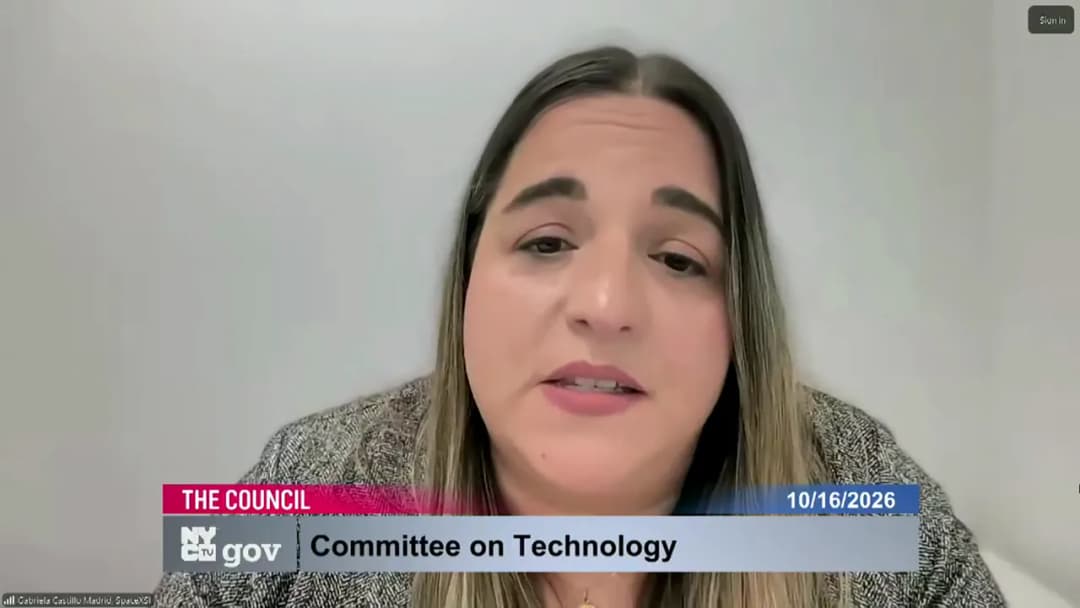
On Friday, October 16, 2026, at 10:00 AM in Council Chambers at City Hall, the New York City Council Committee on Technology held oversight hearing T2026-2684, “Continuing Discussion about the Risks Posed by Artificial Intelligence.” Chair Carmen De La Rosa presided; Speaker Julie Menin attended, along with Councilmembers Gutiérrez, Narcisse, Maloney, and Wong. Councilmembers Riley and Won were absent and Councilmember Hanif was medically excused. No legislation was voted on; the committee heard testimony from SpaceX AI, former xAI safety executive Devin Kim and his attorney, and members of the public. Opening Statements - Speaker Menin said New York City is growing as an AI capital with over 400,000 jobs, praised AI’s potential for research, medicine, and economic growth, and rejected the idea that AI companies should self-regulate. She said the city has proposed bills requiring independent third-party validation free from conflicts of interest, a first-in-the-nation whistleblower incentive, and a plan for an AI hack of city systems. She compared AI safety to FDA, FAA, and SEC oversight and said federal inaction makes city leadership necessary. - Chair De La Rosa said last week’s Committee of the Whole heard from nearly 100 witnesses and that the testimony showed the pace of frontier AI poses risks. She stated that a framework where companies with competing motives regulate themselves is wholly insufficient, and that federal, state, and municipal intervention is needed to protect civil rights, safety, and privacy. Testimony of SpaceX AI - Gabriela Castillo Madrid, senior manager of global government affairs at SpaceX AI, testified under oath. She described SpaceX’s work in rocketry and Starlink broadband across over 160 countries, the acquisition of xAI, and the company’s stated safety-first approach, including pre-training evaluation, monitoring, model cards, and at least annual risk assessments. - In response to questions, Castillo Madrid repeatedly said she was not aware of specific incidents, cases, or figures, and pledged to provide follow-up information. She said SpaceX AI does not release models it believes are unsafe, is working on partnerships with independent external evaluators, and follows existing laws; she said using AI would never be a legal defense. - Asked about a reported Dario Amodei warning that AI agents could take over the internet, she said SpaceX AI takes risks seriously and is optimistic about superintelligence. Asked about Elon Musk’s response, she said Musk has been an early voice warning about AI risk. - Speaker Menin cited reports that GROK generated millions of sexualized images of women and children, including roughly 23,000 images that appeared to depict young children. Castillo Madrid said that conduct is not acceptable, that GROK prohibits CSAM and non-consensual intimate imagery, and that the company reported over 100,000 cases to the National Center for Missing and Exploited Children and helped lead to almost 300 arrests. - Speaker Menin then testified that she and her staff had asked the regular GROK app for a sexualized image of herself that morning and found one within 30 seconds, and that GROK allowed prompts to make it more sexualized. Castillo Madrid apologized and said the company would have its safety team look into the specific instance. - Castillo Madrid said she was not aware of the circumstances of Devin Kim’s termination; could not provide the number of safety-dedicated employees; did not know whether the company has catastrophic-risk insurance; could not list government or New York City contracts; said she believed all infrastructure is in the United States; and said she was not aware of any XAI agents going rogue. - On medical use, Castillo Madrid said GROK is not meant to be a clinician, users can choose whether conversations are used for training, and private chat data is deleted from the company’s systems within 30 days. - On litigation, she said the company supports measures against harmful synthetic media, and she described the Minnesota challenge as a concern that the law reaches lawful content, not as opposition to banning non-consensual deepfakes. She would not predict additional lawsuits over the reported $530 million reserve for AI-related litigation. - Chair De La Rosa and Speaker Menin criticized the testimony. Chair De La Rosa said the company’s answers eroded public trust, called it shameful that the council had to use subpoena power to compel testimony, and said the company’s safety claims were not credible when a sexualized image of an elected official could be produced in seconds. Whistleblower Testimony of Devin Kim and Ella Jum - Devin Kim, president of the Center for AI Safety and one of the first employees at xAI, testified that he is suing xAI for retaliation. He said beginning in January 2025 he raised concerns that GROK could assist with bomb and bioweapon creation; his supervisor responded that AI safety was useless and that AI would kill everyone anyway. He said models launched without requested biorisk safeguards, he was pressured to circumvent European safety regulations in August 2025, and he was fired in September 2025, the same week he was scheduled to present safety findings to leadership. He added that most of the safety team resigned afterward. - Kim said that during his tenure there were only three employees working on AI safety while the technical staff involved in model development numbered in the 200s. He described xAI’s stated standard as allowing what the company called tasteful nudity, with no clear person defining the line, and said the sexualized images shown to the council were not tasteful. - Kim recommended that the council protect people who report dangerous conduct even before it is illegal, and that loss of control or unauthorized access count as reportable incidents before someone is killed or injured. He noted that under the RAISE Act, an incident only counts after injury or death, which would exclude incidents like the Hugging Face breach or the Australian Medicare breach. - Ella Jum, Kim’s attorney at a national civil rights and public interest litigation firm, urged the council to establish three safeguards for AI whistleblowers: strong anti-retaliation protections with meaningful remedies, secure reporting mechanisms, and financial rewards. She cited federal SEC whistleblower incentives and California’s SB 53 as models. - Councilmembers thanked Kim for his testimony and said it stood in sharp contrast to the company’s testimony. Public Comments & Testimony - Bryce Rogers of the RAD Collective recommended narrowing a councilmember’s chatbot privacy bill to focus on affirmative consent for data collection, storage, use, and sale, and expanding coverage to agentic AI. Rogers said RAD wants AI tools to be safe and wants to slow the pace of frontier AI advancement. - Megan Lagerquist of the RAD Collective supported Speaker Menin’s third-party validation bill, arguing that evaluators need guaranteed access to models, documents, and model architecture, and that models failing New York’s safety threshold should not be sold to New Yorkers. She also said the city should invest in the Office of Technology and Innovation. - Kalima of Demilitarize Brooklyn Navy Yard said the city should not lease public land to tech companies working with the U.S. military, including a tenant she identified as using AI to develop alloys for hypersonic missiles. She said AI is another tool of the rich to exploit and surveil people, and that the tech industry cannot regulate itself. - An individual who said he had previously sent out an automated call mimicking the president’s voice warned that the harms seen today were preventable three years ago, and that safeguards must try to predict future misuse. - Sophie Ko, testifying over Zoom, said the harms of AI to women are demonstrated by SpaceX AI and that the company gives other AI labs cover by comparison. She asked the council to make New York City a beacon in taking power away from the men who control AI companies. - Ajit Singh, a physician, informaticist, and public health practitioner in the H safety net system, said generative AI systems have enabled deepfakes, CSAM, manipulation, and disinformation. He called SpaceX AI a bad actor, expressed support for some council proposals, and warned that individual legal remedies can be out of reach. He also noted that the council had tasked the administration with building an Office of Algorithmic Accountability by June of that year. - Chowdhury Mahmoud, a permanent FDNY employee in the Bureau of Enterprise Technology, said AI tools are already deployed by private contractors in emergency dispatch and call centers, handling 911 call data, EMS patient records, and fire marshal investigative information, without an AI governance policy, civil servant review, or public disclosure. He asked the committee to require a public AI tool registry, audited sign-off before using PII, PHI, or public safety data, and explicit AI governance disclosure. Key Outcomes - No bills were voted on; the oversight hearing was filed by the committee, according to the minutes. - Councilmembers said they expected SpaceX AI to provide written follow-up answers on safety staffing, independent evaluators, insurance, government contracts, and other unanswered questions. - Speaker Menin said SpaceX AI’s testimony was wholly unsatisfactory and not credible, citing the sexualized-image demonstration and the company’s inability to explain Devin Kim’s termination. - The committee said it will continue moving AI legislation, including third-party validation and whistleblower protections. Written testimony for the record was accepted for 72 hours after the hearing via testimony at council.nyc.gov.

TECHNOLOGY AND INNOVATION 38% · PUBLIC SAFETY 33% · DATA PRIVACY AND SECURITY 17% · PENDING LITIGATION 3%
48
OCT 15, 2026 · NEW YORK CITY, NEW YORK · CITY COUNCIL
NYC Council Sanitation Committee Hearing on Waste Equity, October 15, 2026

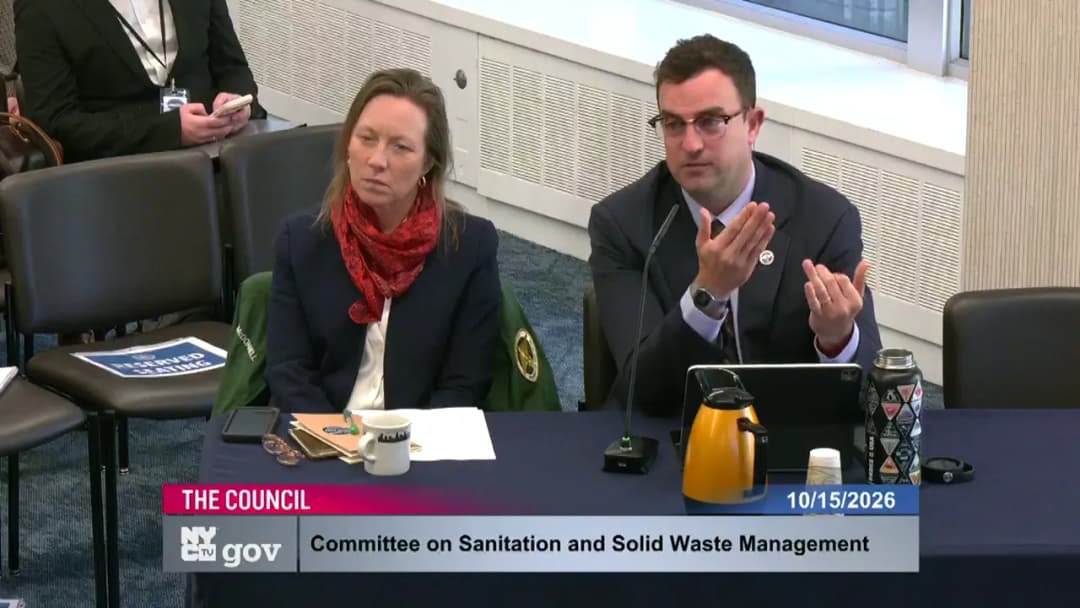
The New York City Council Committee on Sanitation and Solid Waste Management, chaired by Council Member Justin E. Sanchez, met on Thursday, October 15, 2026, at 1:00 PM at 250 Broadway, 8th Floor Hearing Room 1, for an oversight hearing on waste equity and environmental justice and to consider five local law introductions. Members present included Hankerson, Louis, Maloney, Thomas-Henry, Wilson, and Zhuang; Santosuosso and Ung were absent; Hanif and Vernikov were excused on medical leave. Council Members Epstein and Restler also attended. Oversight: Waste Equity and Environmental Justice - Chair Sanchez said the committee has seen a 15% citywide reduction in permitted transfer-station capacity but stated that none of the four community districts designated under Local Law 152 of 2018 had achieved full compliance with the law's required reductions: Brooklyn CD1 was required to cut 50% but is at 35.8%; Queens CD12 and Bronx CDs 1 and 2 were required to cut 33% but are at 23.9%, 14.8%, and 21%, respectively. He also said about 74% of citywide throughput remains concentrated in those four districts. - Chair Sanchez expressed concern that reductions have targeted mostly unused capacity and that two Waste Management stations in Bronx CD1 and Brooklyn CD1 appear to have had no reduction. DSNY Commissioner Gregory Anderson responded that the law has been fully implemented as written and as analyzed in the environmental review, with exemptions under Local Law 152 for demonstrated recycling/organics processing, construction and demolition debris beneficial use, and facilities exporting most waste by rail; he said the two Waste Management facilities export nearly all waste by rail. - DSNY reported that reductions cut not only permitted capacity but also actual throughput and truck traffic, and that the commercial waste zones program under Local Law 199 of 2019 is expected to cut commercial waste truck traffic by 63% and more than 18 million vehicle miles traveled annually when fully implemented. The FY26 Commercial Waste Zones annual report, released two weeks before the hearing, documented six operational zones, 192,000 outreach activities, and 2,581 employee trainings. - DSNY said it will provide the council with records of exemptions and capacity-increase determinations, and will analyze 311 complaint/service-request volume in environmental-justice versus non-environmental-justice communities. - Discussion also covered marine transfer stations, possible commercial waste use of municipal marine transfer stations, enforcement against illegal dumping, and the department's inability to measure actual truck-traffic changes until commercial waste zones are fully implemented. Legislation Considered - Int 0030-2026 (sponsored by Majority Leader Abreu and Council Member Louis) would require a program for city-owned non-residential buildings to use stationary on-street waste containers. DSNY said city agencies are already required to containerize trash, and adding Empire bins at every city facility could divert resources from the residential containerization rollout to 2031, but the department is open to continued talks. - Int 0987-2026 (Abreu and Restler) would allow block associations and nonprofits to request stationary on-street containers. DSNY noted an existing application process for shared Empire bins in Brooklyn CD2 and said it looks forward to further discussions. - Int 0352-2026 (Council Member Nurse) would require DSNY to plan for safe disposal of rechargeable batteries from powered mobility devices. DSNY described existing special waste drop-off sites and safe-disposal events, and said battery manufacturers should bear primary cost; the state's extended producer responsibility program is being expanded to e-mobility batteries, though retailer take-back of those batteries remains voluntary. DSNY said added sites and event collection would require substantial additional funding. - Int 0401-2026 (Restler) would require DSNY to install 25 public organic waste receptacles per community district. DSNY opposed the bill at this time, citing a 42% decline in smart compost bin utilization from FY25 to FY26, the mandatory curbside composting program, and the cost of installing and servicing additional bins. - Int 1041-2026 (Council Member Hankerson) would bar DSNY from removing public litter baskets solely because of illegal dumping, require notification to council members and community boards at least 10 business days before removal, and require reporting. Commissioner Anderson said he has not removed a litter basket since taking office in March 2026, but argued the department should keep removal as a last resort; DSNY recently began updating the litter basket inventory on open data monthly. Public Comments & Testimony - Joyce Bialik, Manhattan Solid Waste Advisory Board Plastic Task Force, testified for WE ACT for Environmental Justice and supported Int 1041. She cited a 2023 study finding East Harlem had 69 litter baskets versus 260 in the Upper East Side, with 17% versus 95% of four-corner intersections having baskets and 51% versus 6% dirty blocks on Madison Avenue, and urged hearings on plastic-related bills. - Alia Sumro, New York League of Conservation Voters, supported Int 0030 and the intent of Int 0352, and said the city should tailor battery legislation to the state's new extended producer responsibility law signed in December 2025. - Damon Gilbert, New York Lawyers for the Public Interest, described Redfern Houses residents in Far Rockaway living across from the Inwood Material Terminal in Nassau County, which processes construction and demolition debris. He supported Int 0367 (not on today's agenda), Int 0987, and Int 0030, and called for sidewalk accessibility in containerization plans. - An Uprose representative from Sunset Park supported the bills before the committee, adding that one barge can replace about 96 long-haul truck trips, and urged passage of Int 0367 and use of marine/rail transfer stations for commercial waste. - Shravanti Kaneka, NYC Environmental Justice Alliance, said 75% of privately managed waste is still trucked through five community districts; she urged full implementation of commercial waste zones, passage of Int 0367, and opposed expanding anaerobic co-digestion at wastewater resource recovery facilities. - Mary Ellen Sullivan, Brooklyn Solid Waste Advisory Board, supported public organic waste receptacles with community composters involved, and urged stationary bins for recyclables and organics as well as trash. - Rhonda Kaiser, Cafeteria Culture, described Harlem students diverting almost one metric ton of cafeteria food scraps to a local composting partner and urged policies that support local, non-truck-based composting. - Christopher Leon Johnson supported Int 0352 and called for stricter enforcement against modified e-bike batteries, including confiscation of dangerous batteries. - Claire Mifflin urged expanding on-street containerization to all waste streams and warned that maintenance-agreement requirements make it difficult for block associations and small buildings to participate. - Eric Goldstein, Natural Resources Defense Council, urged support for Int 0367, expansion of NYCHA composting programs, and action to avoid renewing contracts with the Essex County and Chester incinerators when they expire in 2032. - Haley Miranda, a South Bronx youth organizer, described family experiences with asthma and urged passage of Int 0367, reduced truck traffic, and caution about anaerobic digestion. - M. Blaze Backer, a Fort Greene resident and former BID director, testified that the shared-container maintenance arrangement is a heavy lift for small buildings and recommended including recycling and compost containers. Key Outcomes - The committee filed the oversight item T2026-2585. - Hearings were held on Int 0030-2026, Int 0352-2026, Int 0401-2026, Int 0987-2026, and Int 1041-2026; all five introductions were laid over by the committee without a vote. - DSNY committed to provide exemption data and to follow up on data requests, including an analysis of 311 volumes by environmental-justice status. - The chair asked DSNY to prioritize the remaining environmental-justice community districts in future containerization rollouts; DSNY said it would consider the request and noted that Bronx CD2 is among the next districts scheduled.

SANITATION AND SOLID WASTE MANAGEMENT 70% · ENVIRONMENTAL PROTECTION 17% · RACIAL EQUITY 3% · PUBLIC HEALTH 3%
49
OCT 8, 2026 · NEW YORK CITY, NEW YORK · CITY COUNCIL
New York City Council Stated Meeting, October 8, 2026

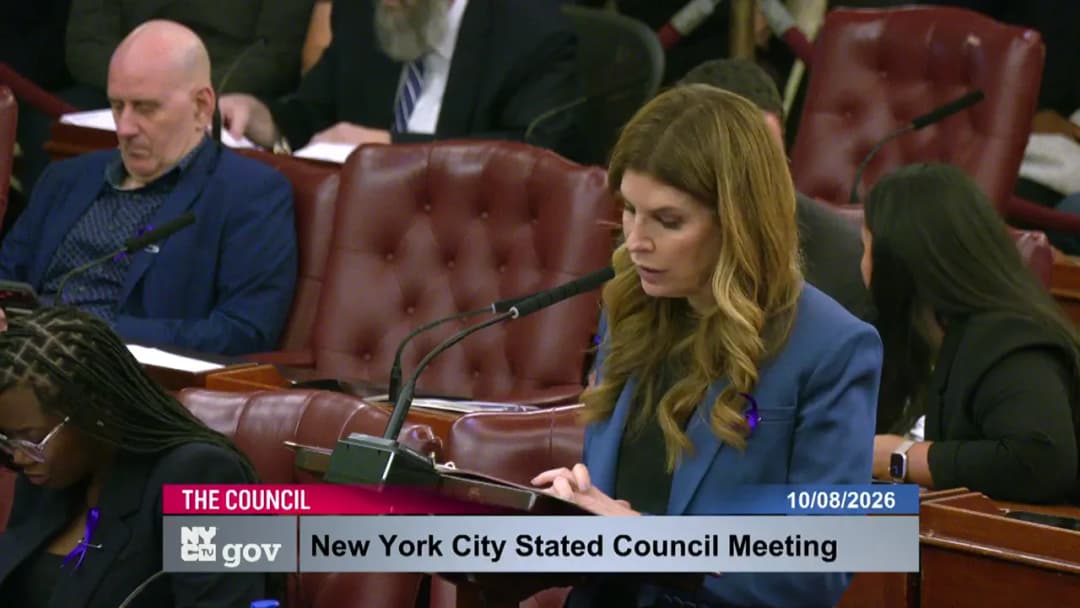
The New York City Council convened its Stated Meeting on Thursday, October 8, 2026, at 1:25 PM in the Council Chambers at City Hall. Acting President Pro Tempore Shekar Krishnan presided over the session. A quorum was established with 47 out of 51 members present. The agenda encompassed the adoption of previous minutes, land use call-ups, approval of committee reports, extensive voting on zoning and text amendments for multiple rezonings across the boroughs, and the introduction of 31 new bills and resolutions. Consent Calendar - Adoption of Minutes of September 24, 2026 were adopted as printed. - Commissioner of Deeds appointment approved. - Reports of Standing Committees: Adopted by consent roll call. This included the Reports of the Committees on Education (Int 0684-A), Finance, Land Use, Public Safety (Int 0489-A), and Small Business (Int 0799-A). - Coupled on General Orders Calendar: A block of 47 items was adopted by a vote of 47 in the affirmative and 0 in the negative. Item Int 0489-A (Towed Vehicles) was separated from this block for an individual vote. Public Comments & Testimony - No members of the public gave testimony during the stated meeting. Per Council rules, only members of the Council may speak during the formal meeting. Several delegations of students and international visitors were welcomed in the chamber. Discussion Items - Communication from the Speaker: Speaker Julie Menin delivered a wide-ranging address. She reflected on the Council's recent Committee of the Whole hearing on AI safety, where whistleblowers testified about existential risks. She announced the expansion of a nonprofit grant program to serve over 800 organizations, stating it cut payment timelines by around 300% on average. The Speaker also detailed a new initiative installing panic buttons and security cameras for small businesses to combat retail theft. She commemorated the third anniversary of the October 7th attacks, recognized Italian Heritage Month, Indigenous Peoples Day, World Teachers Day, and National Domestic Violence Awareness Month, noting that nearly 40% of felony assaults are classified as domestic violence. - Land Use Overview: The Speaker highlighted several key rezonings including the Sojourner Truth-Mapes Rezoning (457 units of 100% affordable housing), Fort Hamilton Mews (292 units), Park Avenue Brooklyn and 289 Kent Avenue (over 700 combined units and 2,500 school seats), and several others. Many applications were modified by the Council to require deeper affordability standards. - Statements on Legislation: Council Member Susan Zhuang urged support for Int 0684-A, a study on language access and geographic barriers to gifted and talented programs. Council Member Inna Vernikov championed the towed vehicles database (Int 0489-A), calling the current system "outdated and non-functional". Council Member Lincoln Restler spoke in favor of two rezonings in his district, stressing the addition of school seats and housing units. Council Member Oswald Feliz recounted a personal anecdote of his car being moved to illustrate the need for the towed vehicle database. - General Discussion & New Bill Introductions: Council Member Farah Louis highlighted the uterine fibroid crisis among Black women (over 80% incidence by age 50). Council Member Lynn Schulman introduced a bill requiring renewal of food protection certifications every five years. Council Members Virginia Maloney and Kayla Santosuosso introduced bills related to AI safety and transparency. Council Member Frank Morano introduced a bill requiring community impact statements for transient hotels. Council Member Harvey Epstein introduced bills to inform youth of their rights in the criminal legal process and to reclassify probation officers as uniformed officers. Council Member Amanda Farias introduced a bill to expand NYPD domestic violence reporting. Council Member Lincoln Restler introduced a resolution affirming support for Canada. Council Members David Carr and Rita Joseph spoke on Down syndrome awareness and transparency in school-based disability services. Council Member Yusef Salaam urged support for his legislation on business tax credits and construction support funds. Key Outcomes - Land Use Call-Up (Studio 54, M 0092-2026): Adopted by a vote of 46-0, initiating Council review of the City Planning Commission's action. - Zoning and Text Amendments: Several rezonings were approved with modifications, including Fort Hamilton Mews, Park Avenue Brooklyn, 289 Kent Avenue, and 69-67 108th Street. The Sojourner Truth-Mapes rezoning was coupled on General Orders. - Res 0328-2026 (Infrastructure Tax Credit): Adopted by voice vote. - Res 0458-2026-A (Little Yemen Cultural District): Adopted by voice vote. - Res 0646-2026 (Hindu American Awareness Month): Adopted by voice vote. - Int 0489-2026-A (Towed Vehicle Database): Passed by a vote of 46 in the affirmative, 0 in the negative, with 1 abstention (Council Member Chi Ossé). - Bills Introduced (Int 1100-1130, Res 0663-0668, LU 0146-0154): 31 new items were introduced and referred to their respective committees. Key themes included artificial intelligence regulation, worker and consumer protection, health equity, and government transparency. - Next Steps: The next Stated Meeting is scheduled for Thursday, October 22, 2026. The meeting was adjourned by Speaker Menin.

PROCEDURAL 23% · PUBLIC SAFETY 14% · TECHNOLOGY AND INNOVATION 9% · ZONING AND LAND USE 8%
50
OCT 8, 2026 · NEW YORK CITY, NEW YORK · CITY COUNCIL
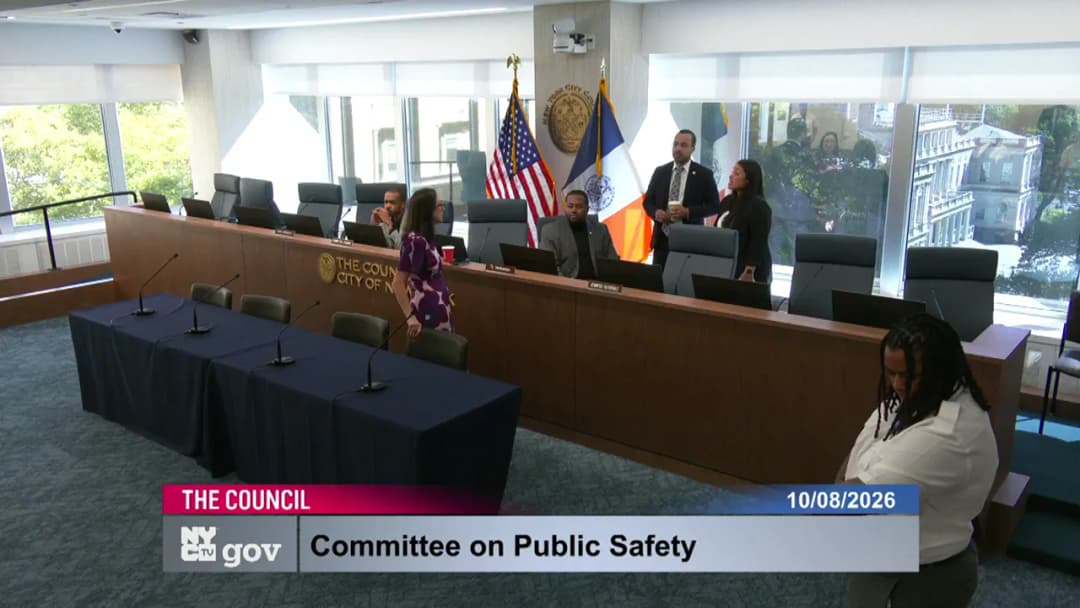
NYC Council Public Safety Committee Votes on Towed Vehicle Database Bill – October 8, 2026

The New York City Council Committee on Public Safety, chaired by Councilmember Oswald J. Feliz, convened on Thursday, October 8, 2026, at 10:45 AM in Hearing Room 1 at 250 Broadway to vote on Proposed Int. No. 489-A (Int. 0489-2026), sponsored by Councilmember Ina Vernikov. The bill would amend the administrative code of the City of New York to require the creation of a centralized online database and notification system for towed vehicles and repeal section 20-528 of the code, relating to notification of a towed vehicle to a local police precinct. Meeting Attendance - Present: Chair Feliz and Councilmembers Banks, Gutiérrez, Hankerson, Hanks, Sanchez, and Wong - Absent: Councilmember Nurse - Excused (medical): Councilmember Ariola - Other Council Member attending: Councilmember Vernikov (bill sponsor) Discussion Items - Chair Feliz explained that the bill requires the City to create and maintain a centralized online database allowing the public to search for information on vehicles towed from public or private property by the City or a licensed private tow operator, replacing existing procedures that often frustrate vehicle owners, who must search competing databases or contact the local police precinct. The database would also allow owners to opt in to a notification system alerting them if their vehicle information is entered into the towing database. - Councilmember Vernikov said she was thrilled the bill was up for a vote, describing it as the result of bipartisan cooperation, many meetings, work by numerous agencies and towing businesses, and many drafts. She thanked Speaker Menon, Chair Feliz, members of the Public Safety Committee, NYPD, DCWP, the Department of Finance, senior legislative attorney Josh Kingsley, Minority Delegation Executive Director Peter Spencer, her legislative director Troy Olsen, and members of the public and the towing industry who contributed input. - Councilmember Hankerson expressed strong support, stating he loved the bill and needed it two years ago. Chair Feliz recounted that he could have used the bill roughly a year ago when his car disappeared and he had no idea where it went. Key Outcomes - The committee approved Proposed Int. No. 489-A by a vote of 7 in the affirmative, 0 in the negative, with no abstentions. Voting in the affirmative: Feliz, Banks, Gutiérrez, Hankerson, Hanks, Sanchez, and Wong. Councilmember Nurse was absent and Councilmember Ariola was excused on medical grounds. - According to the meeting minutes, the introduction was heard by the committee, an amendment was proposed and adopted, the bill was amended by committee, and the amended introduction was approved by committee. The bill requires agency rule-making. - Chair Feliz stated the vote would be held open for a few minutes for additional council members who would join.

PUBLIC SAFETY 52% · PROCEDURAL 26% · TECHNOLOGY AND INNOVATION 22%
OPENPUBLICA · PUBLIC MEETING INDEXUPDATED DAILY · openpublica.com