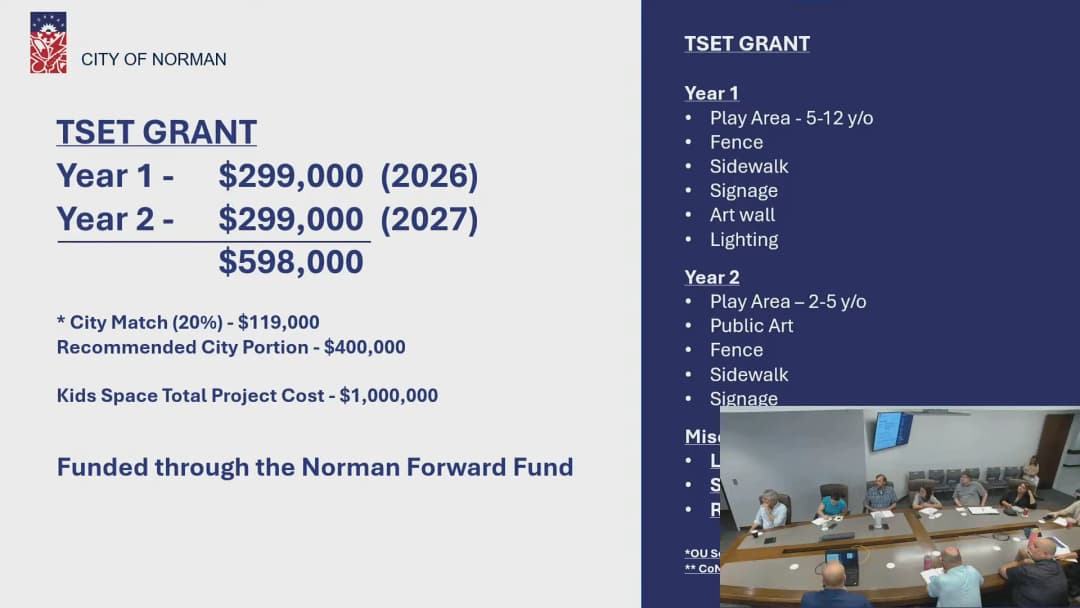
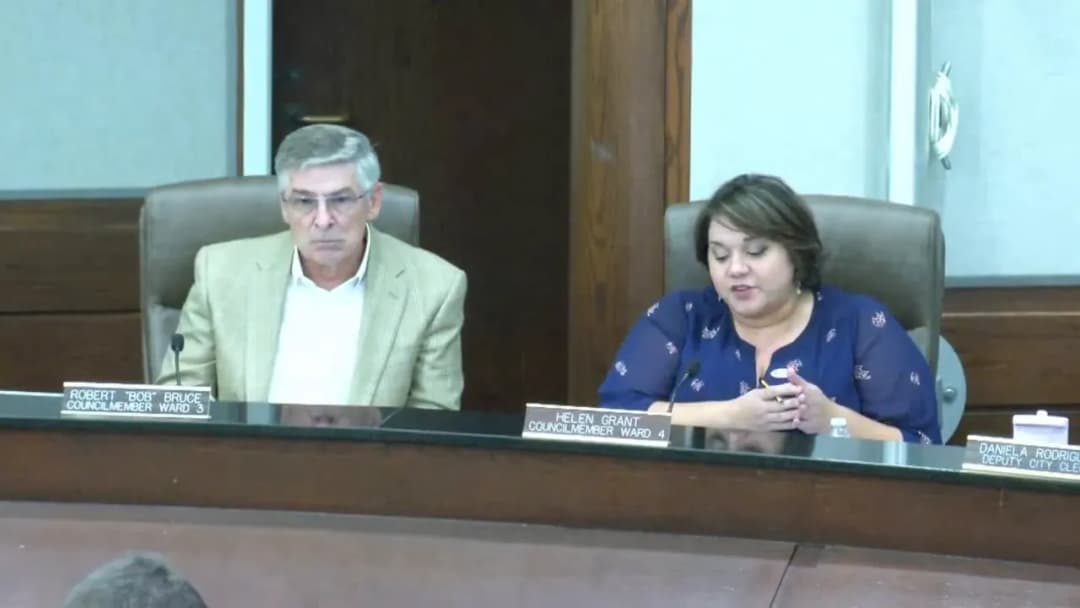
The transcribed meeting begins at 22:06:22 UTC on September 1, 2026; no end time was recorded. No agenda or minutes were provided, so this summary is based only on the raw transcript. The session covered the Kid Space playground rebuild funding and design, and ended with a motion into executive session. Discussion Items - Kid Space rebuild plan. Staff presented a two-year Reese Park project to demolish the existing Kid Space playground, begin demolition in November with the OU School of Architecture, begin site work in 2027, and hold a week-long community build in March, similar to the original 1999 community build. Year-one work would include the 5-to-12 play area, fencing, sidewalks, lighting, and signage; year-two would include the 2-to-5 tot lot, public art, and finishing site work. The goal is to complete phase one before the April Medieval Fair. - Funding request and figures. Staff requested a one-time $400,000 city contribution through Norman Forward, with Tset grant funds and a 20% minimum city match of $119,000, for an approximately $1 million total project. The transcript also contains some conflicting or fragmented funding figures, including references to $299,000 per year, $519,000 total, and a later reference to $600,000 from Tset. - Amenities and design features. Planned amenities include solar lighting, three small shelters made from recycled Kid Space wood, a large shelter with the OU School of Architecture, a new donor wall next to the original donor wall, and a new restroom building with seven family-style single-occupancy ADA restrooms, including one with an adult changing table. Staff said the restroom project was previously over budget and will be rebid, with completion targeted by April. - Site preservation and landscaping. Staff said most existing trees would be preserved; some invasive lacebark elms may be removed, with replacement trees planted. Parking on the south side of the drive would be removed. A future splash pad is planned adjacent to the project but is not included in this scope. Landscaping work would emphasize native, drought-resistant, and butterfly-friendly plantings. - Council questions and positions. One councilmember asked whether the $400,000 ask was a one-time amount; staff confirmed it was. That councilmember also tied it to previously discussed extra Norman Forward funds, and staff said the Tset grant reduced an earlier $1 million project figure to a $400,000 request. Another councilmember expressed a desire to keep the old swing set just north of Kid Space, calling it the last piece of the original playground. Another councilmember asked about preserving Kid Space towers or slides; staff said safety standards make playground reuse unlikely, but features could potentially be used as public art, and the original 1999 build would be memorialized, possibly using old tiles. Councilmember Gansberg asked for a wheelchair-accessible swing access; staff committed to including one. Staff also said the playground would be highly accessible, with a poured surface rather than wood chips. Staff expected to return with the finalized playground design in 30–45 days. Key Outcomes - The council approved the contract for the Kid Space project. The motion passed by voice vote, with no opposition heard. - The council voted to adjourn out of the special session and convene into executive session under Oklahoma Statutes Title 25, Section 307(B)(4), to discuss the pending investigation and claim regarding the Young Family Athletic Center. The motion passed.
Public Meetings - Norman, Oklahoma
Public Meetings - Norman, OklahomaThe Norman City Council, Norman Utilities Authority, Norman Municipal Authority, Norman Tax Increment Finance Authority, and Norman Parking and Transit Authority met jointly on August 25, 2026, in a session that continued into the early morning of August 26. The council approved routine consent items, several zoning and land-use requests, and the Salvation Army’s special use plan; postponed two contested land-use matters; and rejected a resolution concerning Oklahoma Turnpike Authority interchanges. Consent Calendar - Minutes from the June 16, 2026, City Council study session; May 7, 2026, Business and Community Affairs Committee; and May 14 and June 11, 2026, Oversight Committee meetings were approved unanimously. - Items 2 through 21 were placed on the consent docket and approved unanimously. Public Comments & Testimony - On the JAG grant item, Ward 4 resident Stephen Ellis asked about the crime-scene scanner, forensic video analyst training, and internal police-department signage; Support Bureau Major Chad Benson explained each use. - On the East Robinson PUD/A2 item, property owner/applicant Mr. RC objected to the revocation, saying he had lost his business and did not consent; he said he had received conflicting legal advice and supported postponement. City Attorney Knighton described pending municipal and district court cases and said a return to A2 could resolve most issues. Planning staff said a corrected or amended site plan could still go back to the Planning Commission. - On the Lindmark/SPUD item, Fiddler’s Green residents and others overwhelmingly opposed the proposed two 400-square-foot digital billboards while supporting the business itself. Concerns included driver safety, light pollution, impact on the Oliver Biological Survey/OU wildlife area, property values, precedent, and the SPUD process. One resident said 44 of 58 Fiddler’s Green houses had filed protests. Several speakers asked for the billboard to be removed, future digital upgrades banned, and only static, proportional signage allowed. - On the Salvation Army item, public comment was supportive, with Ward 3 resident Rob Norman calling the community kitchen an important transitional step for shelter and homeless services. - On the OTA resolution, roughly 20 public speakers, mostly Ward 5 residents and rural landowners, opposed the interchanges, arguing they would encourage development, harm the Lake Thunderbird watershed, increase crashes, and reward an untrustworthy agency. A few speakers, including a former Norman police traffic accident investigator and an EMS veteran, described public-safety tradeoffs; one former AIM transportation committee chair said interchanges are important if the turnpike is inevitable. Discussion Items - Item 22 – JAG Grant: The city opened a public hearing and accepted $55,456 from the U.S. Department of Justice Bureau of Justice Assistance Edward Byrne Memorial Justice Assistance Grant Program, with Norman’s portion $35,330 for NPD forensic equipment, training, digital signage, and related uses. It passed unanimously. - Item 23 – 3766 East Robinson Street PUD Revocation: The council discussed the request to repeal a 2021 planned unit development and rezone the property to A2 rural agricultural district. The applicant’s history included a denied permit, unpermitted construction, a stop-work order, an injunction, and pending court cases. The council voted 8–1, with Councilmember Dixon opposed, to postpone to November 24, 2026, to allow the applicant, staff, and legal counsel to pursue an amended site plan or another resolution. - Items 24 & 25 – Van Buren Self-Storage Special Use and Preliminary Plat: The applicant presented a 3.5-acre, 80,200-square-foot, 588-unit climate-controlled storage facility at 1 Van Buren Street. The special use permit and preliminary plat were approved unanimously. - Item 26 – Bob Moore Farms Rezoning to A2: The council approved unanimously the second and final readings removing tracts from RM-6, R-1, and A-1 districts and placing them in A-2, west of I-35 and south of West Lindsay Street. The applicant’s attorney said a license agreement with the city was near completion to preserve the white fence along Lindsay. - Item 27 – Lindmark SPUD at 801 South Canadian Trails Drive: Representatives proposed reusing the former Foodline/ATT building for Lindmark’s billboard-wrap and light-manufacturing headquarters, and adding a digital billboard. After extensive discussion and public opposition, the council postponed action to September 8, 2026. Councilmembers Steele and Gandisbury opposed the postponement; the transcript’s vote tally is unclear because it names two no votes while stating a seven-to-one count. Staff and applicant noted agreed changes including a 55-foot west-side setback, 8 a.m.–6 p.m. trash compactor restrictions, an evergreen buffer, and a 242-square-foot-per-side billboard size matching Norman Regional’s actual sign. - Item 28 – Salvation Army SPUD at 314 East Hay Street: The Salvation Army’s simple planned unit development for a community kitchen and remodel of the existing shelter was approved unanimously. The project adds four beds, for a capacity change from 34 to 38, and creates a multi-use dining and emergency shelter space. The council was told this is not a 100-bed expansion and no capital funding exists for a larger future shelter project. - OTA Interchange Resolution: The council debated a resolution expressing support for Oklahoma Turnpike Authority interchanges at Tecumseh Road, Alameda Street, and Edawa Road, and requesting sound barriers, enhanced landscaping, and land, funding, or equipment to assist first responders. Councilmember Steele led opposition, citing contradictions in the resolution, public-safety resource strain, lack of legally binding protection, and harm to Ward 6. Other council members raised concerns about rural character, watershed protection, future corridor overlays, and the absence of funded road-widening plans. The resolution failed 4–5. Key Outcomes - Approved minutes and consent docket unanimously. - Approved JAG grant and budget appropriation unanimously (Item 22). - Postponed East Robinson PUD/A2 matter to November 24, 2026, by an 8–1 vote, with Councilmember Dixon opposed. - Approved Van Buren Self-Storage special use and preliminary plat unanimously (Items 24–25). - Approved Bob Moore Farms A2 rezoning unanimously (Item 26). - Postponed Lindmark SPUD to September 8, 2026, with Councilmembers Steele and Gandisbury voting against postponement. - Approved Salvation Army SPUD unanimously (Item 28). - Rejected the OTA interchange resolution by a 4–5 vote, with Councilmembers Gandisbury, Grant, Dixon, and Bruce voting in favor.
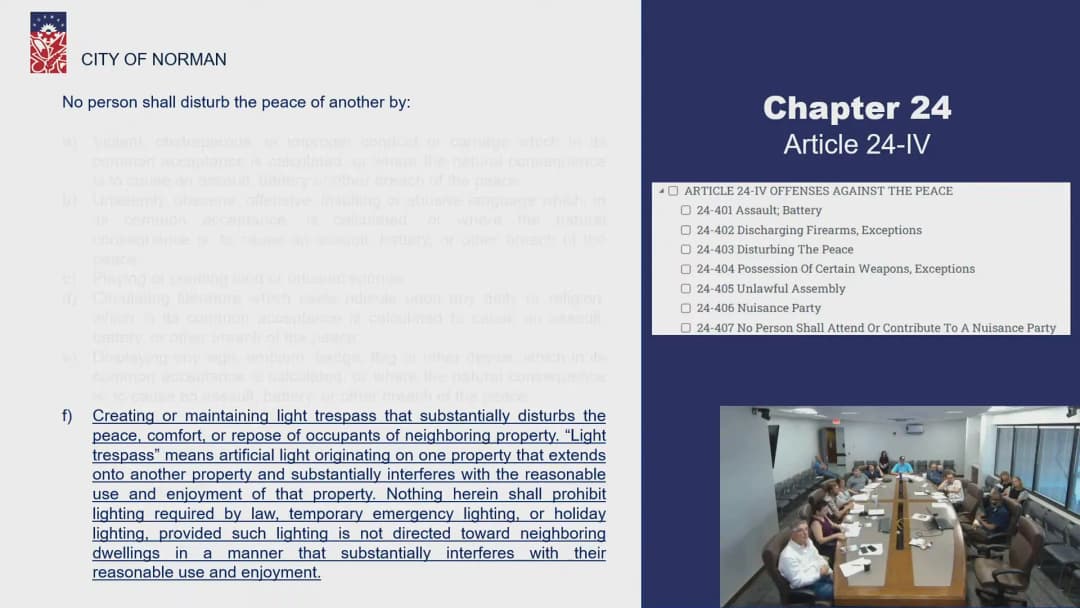
The City Council met on August 25, 2026, to continue a discussion on a proposed residential outdoor lighting ordinance. The focus was on how to address light trespass from residential properties, building on the existing commercial lighting ordinance. The City Attorney presented a history of efforts dating back to 2006 and proposed an alternative approach using the existing disturbing the peace ordinance with mediation, rather than a code enforcement model, due to resource constraints. Consent Calendar - No consent calendar items were considered. Public Comments & Testimony - No public comments were recorded; however, the Council noted that residents of the affected neighborhood (3500 Canyon Grand Drive) were present, and the discussion was informed by their complaint. Discussion Items - History and Context: City Attorney Reese reviewed prior attempts to regulate residential lighting: a 2006 proposal was deemed too broad and difficult to enforce; a 2011 commercial lighting ordinance was successfully implemented (e.g., mediation resolved a complaint against Larry Spencer Chevrolet); a 2019 residential lighting proposal was not adopted. - Current Catalyst: A resident at 3500 Canyon Grand Drive presented an example of aggressive neighbor lighting shining into their bedroom window, prompting renewed discussion. - Enforcement Challenges: The Council discussed that the Code Compliance department has only four officers (same as in 2006) and does not have night-time staff. Adopting a code-based enforcement would require pulling an officer from day duties for night investigations, which is inefficient given their current workload (e.g., annual Airbnb inspections). - Proposed Alternative: Instead of a new code section, staff recommended amending the existing disturbing the peace ordinance (Section 15-??? C) to add a subsection addressing light trespass. The proposed definition: "Light trespass means artificial light originating from one property that extends onto another property and substantially interferes with the reasonable use and enjoyment of that property." Exemptions include lighting required by law, temporary emergency lighting, and holiday lighting not directed at neighbors. - Mediation Emphasis: The City Attorney explained that citations under the disturbing the peace ordinance go to municipal court and are typically referred to mediation. This approach aims to resolve underlying neighbor disputes more quickly and collaboratively than the 30-day code enforcement process. - Council Questions and Comments: - Councilmember Steel expressed support, noting that the commercial ordinance controls lighting during construction but that residential issues are often post-construction personal choices. He endorsed the mediation-focused approach. - Councilmember Gandisberry clarified that police would enforce the ordinance and have discretion; citations can be issued and later reviewed by the prosecutor. Mediation is used extensively in Norman for neighbor disputes. - Councilmember Kirby asked about enforcement on private roads and anonymous complaints. The City Attorney responded that the ordinance applies within city limits regardless of road ownership, but anonymous complaints cannot establish probable cause; the affected resident must be willing to be a witness. Mediation can also be initiated directly by citizens. - Councilmember Kirby also inquired about a past night-time code enforcement officer who handled noise complaints and whether a similar position could be revived. Staff noted that such a position existed but was eliminated; the cost of a code officer is less than a police officer. Future review of police time spent on lighting complaints could justify hiring a night-time code officer. - No Vote Taken: The Council reached consensus to move the proposed amendment forward to a future agenda for formal reading and a vote. Key Outcomes - The Council gave staff direction to prepare a formal ordinance amendment to the disturbing the peace ordinance to include light trespass, with the enforcement pathway through municipal court and mediation. - Staff will bring the ordinance for a first reading at the next City Council meeting (date not specified). - Council members encouraged residents to resolve lighting disputes with neighbors directly before involving law enforcement. - A future review of enforcement costs and police time was suggested to evaluate the need for a night-time code officer.
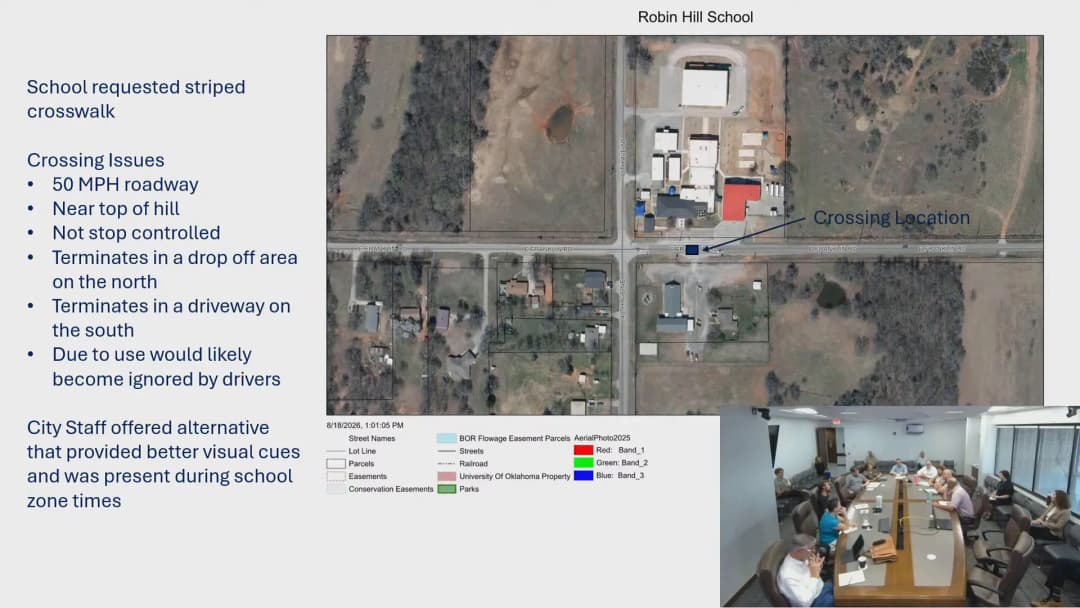
The Norman City Council held a special meeting on Tuesday, August 18, 2026, to discuss pedestrian crossings at Robin Hill Public School and a proposed ad hoc committee to review police and fire department needs. No consent calendar or public comments were on the agenda. The meeting concluded with a motion to enter executive session to discuss litigation and a potential property sale. Public Comments & Testimony - No public comments or testimony were presented during the open portion of the meeting. Discussion Items Item 1: Pedestrian Crossing at Robin Hill Public School - Scott Sturritz, Public Works Director, presented staff’s analysis. He explained that the school initially requested rumble strips, which were deemed unsuitable on a 50-mph roadway due to noise and safety concerns. City staff instead installed additional crossing signs and provided cones to create a temporary highly-visible path. The school then requested a crosswalk, but staff recommended against it because: - The roadway is 50 mph (school zone reduces to 25 mph), and the Federal Highway Administration advises against mid-block crosswalks above 40 mph. - The location is near the crest of a hill, and the 85th percentile speed is well above 40 mph. - The crossing would connect a driveway to a drop-off area, creating ambiguity and potential dangers from distracted parents. - Over‑familiarity with signs (like deer crossing signs) may cause drivers to ignore them. - Long-term proposed solution: Install a sidewalk and ADA‑accessible route from the south driveway down to the stop‑controlled intersection at 48th Avenue, with a continental crosswalk. Estimated cost: $100,000. This project ranked 43rd out of 52 sidewalk projects due to lack of sidewalk connectivity. - Councilmember Green asked about grant eligibility (e.g., ACOG’s Schools and Arterials program). Mr. Sturritz confirmed the project would qualify, typically an 80/20 split, and could be funded with about one year of ACOG funding (typically $100,000–$120,000). Councilmember Green expressed interest in exploring grants and potential school/church partnerships. - Councilmember Steele suggested partnering with the school to reduce costs and asked for a breakdown of sidewalk projects connected to schools. Councilmember Kirby noted heavy traffic growth in the area and observed drivers running the stop sign; he supported the sidewalk solution and asked about extending the 40 mph zone east of the school. He also asked whether the school could request flashing school‑zone lights during after‑hour events. - Councilmember Gansbury thanked staff for quick action and requested the sidewalk project be prioritized and moved up the list. He asked about lowering the speed limit without a study; City Attorney noted that deviating from the MUTCD could waive liability under the Tort Claims Act. - Councilmember Bruce asked about the stop sign at 48th and Franklin; staff confirmed they painted new stop bars to increase visibility. Councilmember Dixon inquired about parking patterns (mostly staff and buses at the church). - Councilmember McGrant supported the sidewalk project and requested speed studies on Franklin Road and evaluation of flashing lights for school events. He also asked staff to provide school‑specific rankings within the sidewalk program. - Mayor and council consensus: Direct staff to gather ranking data for schools, evaluate speed study options, investigate grant opportunities, and report back at a future study session. Item 2: Ad Hoc Committee on Police/Fire Needs Assessment and Funding Strategies - Mayor opened discussion on creating a 9‑member committee (one per ward plus an at‑large member) to review the Matrix study for fire and the forthcoming police space‑needs assessment, and to recommend funding strategies (e.g., bonds, sales tax, or combination). The committee would also consider related public safety needs such as IT/cybersecurity, animal welfare expansion, and emergency management. - Councilmembers discussed scope: - Councilmember Grant supported including evolution of emergency management and animal welfare departments. - Councilmember Steele preferred focusing first on capital improvements (e.g., fire station 11) so facilities are ready when staffing funding becomes available. - Councilmember Gansbury emphasized letting the committee study the data thoroughly before rushing to recommendations, and requested regular updates via pre‑council conferences. - Councilmember Birch cautioned against diluting the committee’s focus with IT policy, but agreed capital needs and staffing for IT could be included. - City Manager noted that a bond for IT infrastructure could be included in a general obligation bond, and that the committee’s work could align with the potential expiration of existing public safety sales tax and transit tax decisions (One Transit vote possibly in February 2027). - Mayor proposed appointing the committee on September 8, 2026, with an anticipated one‑year term meeting monthly (more if needed). Applications remain open until Monday, August 24, 2026. - Councilmember asked about ballot timelines; staff will provide a list of available election dates. Committee would ideally deliver a recommendation by December 2026 to target an April 2027 ballot, though June 2027 is also possible. Key Outcomes Pedestrian Crossing at Robin Hill School - No formal vote taken; council directed staff to: - Provide the school‑specific ranking of sidewalk projects in the Schools and Arterials program. - Conduct speed studies on Franklin Road to evaluate lowering the speed limit. - Explore whether the school can activate flashing lights for after‑hour events. - Investigate grant opportunities and potential cost‑sharing with the school and church. - Report back at a future study session for possible inclusion in the sidewalk program. Ad Hoc Committee on Public Safety Needs & Funding - Council agreed to create a 9‑member ad hoc committee (one from each ward plus one at‑large) to review fire and police needs assessments and recommend funding strategies, including bonds, sales tax, and other options. The committee will also consider IT, animal welfare, and emergency management capital needs. - Applications for committee seats will remain open until Monday, August 24, 2026, at 5:00 PM. Council will review applicants and potentially appoint the committee at the September 8, 2026, meeting. - The committee is expected to meet monthly for approximately one year, with regular updates to council via pre‑council conferences. Executive Session - The council voted to adjourn the special meeting and convene into executive session under Oklahoma statutes to discuss potential litigation regarding right‑of‑way acquisition for the 36th Avenue/Flood Project Phase 3 and the possible sale of real property at 668 East Lindsay Street. No further action was taken in open session.
The Norman Planning Commission met on August 13, 2026 at 5:30 p.m. with all nine commissioners present. The meeting covered consent items, a rezoning, a determination on outdoor storage uses in the I-1 district, a request to remove an age restriction from a PUD, and postponements of two other items. Commissioners voted on several items after hearing staff presentations, applicant testimony, and public comments. Consent Calendar - Approved unanimously (9-0) the minutes of the July 9, 2026 Planning Commission meeting, preliminary plat PP-2627-2 for Lux Nova LLC, and Norman Rule Certificate of Survey COS-2627-2 for Cheyenne Estates. No items were removed from the consent docket. Public Comments & Testimony - Item 4 (Rezoning at 404 East Sims): No audience comments. - Item 5 (Outdoor storage in I-1 district): John Proctor, a 50-year Norman resident and property owner, expressed support for allowing third-party outdoor storage on gravel behind an opaque fence, stating that current code forces such storage outside city limits and that gravel parking is preferable due to permeability and reduced runoff. - Item 6 (Juniper Sage at Cobblestone Creek – age restriction removal): Multiple residents of the senior apartment complex spoke in opposition: - Linda Wright (apartment 2212) noted the complex was marketed as 55+ and expressed concern about lease flexibility and rent increases. - Eldie Lois Morris (apartment 511) raised concerns about parking capacity, rent increases despite bundled utilities, and doubted that younger tenants would materialize. - Lori Mouse (apartment 3101) questioned the transparency of the process, noting she learned of the change informally, and requested that verbal promises of lease flexibility be put in writing. - Kissy Mouse (apartment ?) stated she signed a lease on July 15, 2026 without knowledge of the pending change and feared safety issues with younger residents and children. - Bonnie Holmes (apartment 6203) argued that students could afford the rent through grants/loans and worried about children in common areas. - Tim Shannon (4704 Augusta Drive), owner/operator of Cobblestone Creek golf course, spoke in support, noting the positive impact of intergenerational living and the need for the complex to succeed financially. Discussion Items 1. Item 4 – Rezoning from C2 to R3 (404 East Sims): Staff presented that the property is split-zoned (C2 and Porter Overlay) and the applicant seeks to rezone to R3 multifamily. The applicant, Phil Hollingsworth, provided a backstory about the property's history. No discussion, motion passed 9-0. 2. Item 5 – PCR-2627-1: Determination on outdoor storage and gravel surfaces in I-1 district: Staff asked the Commission to make two determinations: (a) whether outdoor storage of third-party vehicles/equipment is similar in character to permitted I-1 uses, and (b) whether gravel parking surfaces are acceptable in I-1 when not adjacent to residential zoning. Discussion centered on screening language, dust concerns, and the need for clear definitions. Commissioners modified the proposed language by replacing "completely screened by an eight-foot tall opaque fence" with "screened by ornamental fences, walls, or evergreen planting that cannot be seen from a public street." The motion passed 8-1 (Commissioner Jablonski dissenting). 3. Item 6 – Ordinance 0-2627-2: Removing age restriction from Juniper Sage PUD (4403 12th Avenue SE): The applicant requested removal of the 55+ age restriction due to sustained low occupancy (57% after 5 years) and financial losses. The complex has 168 units (128 one-bedroom, 40 two-bedroom). The applicant stated rents range from $1,400 (one-bedroom) to $1,900 (two-bedroom) and include most utilities. The applicant offered lease flexibility (60-day exit notice, month-to-month options) and noted they would not rent by the bed or accept parent guarantees. Commissioners discussed fair housing implications, the possibility of deferring the change, and the need for communication with current residents. The motion to approve passed 9-0. 4. Items 7 & 8 – Postponements: Items 7 and 8 (rezoning and preliminary plat for Cedar Lane near 12th Avenue SE and Cedar Lane Road) were postponed to the September 10, 2026 meeting at the applicant's request. (Note: The transcript at one point incorrectly stated September 10, 2026 for the motion.) Unanimous 9-0. 5. Item 9 – Postponement: Item 9 (rezoning at 7327 East Franklin Road to spUD) was postponed to the December 10, 2026 Planning Commission meeting. However, the motion in the transcript states "December 10th, 2025" – likely a verbal error; the clerk's record may correct this. The Commission voted 9-0. Key Outcomes - Consent Calendar: Approved 9-0. - Item 4 (Rezoning to R3): Approved 9-0. The ordinance will proceed to City Council with a recommendation for approval. - Item 5 (Outdoor storage in I-1): The Commission determined that outdoor storage of third-party vehicles/equipment is a similar character use, and gravel parking is acceptable, subject to screening requirements (ornamental fences, walls, or evergreen planting not visible from a public street). Motion passed 8-1 (Jablonski opposed). - Item 6 (Age restriction removal for Juniper Sage PUD): Approved 9-0. The Commission recommended approval to City Council. No changes to the site plan were proposed. Verbal commitments by the applicant regarding lease flexibility were noted but not mandated. - Items 7 & 8 (Cedar Lane): Postponed to September 10, 2026 unanimously. - Item 9 (East Franklin Road): Postponed to December 10, 2026 (date discrepancy noted) unanimously. - Staff announced updates to the Norman Development Code website (NormanDevCode.com).
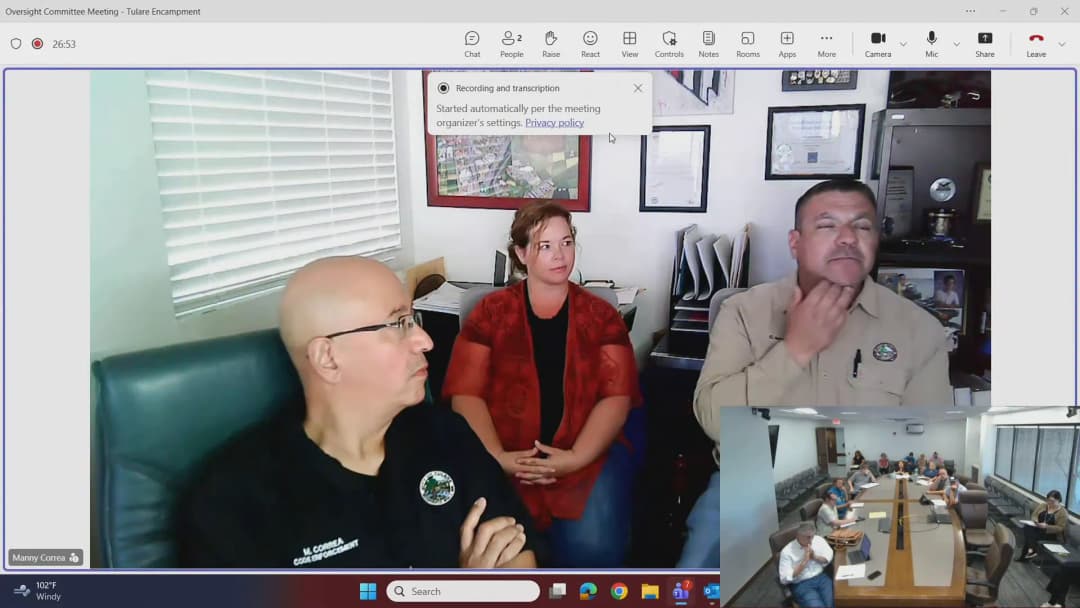
The City Council Oversight Committee met to discuss three items: a presentation on the homeless response program from the City of Tulary, California; a proposed immigration resolution; and a potential charter amendment requiring a supermajority vote for future tax increment finance (TIF) proposals. No votes were taken on any agenda item. Discussion: Tulary Care's Homeless Response - Presenters: Tiffany (Administrative Assistant), Carlos (Community Maintenance Manager), and Manny Correa (General Services Director) from the City of Tulary, California. - The city opened a temporary encampment on two acres of purchased land in 2021 after receiving numerous complaints about homeless encampments. The site can accommodate up to 220 guests; current occupancy is 77. - Funding: A $1.5 million grant (mostly post-COVID funds) covered land, tents, picnic tables, grills, etc. Ongoing operations (approx. $700,000–$800,000 per year) now come from general funds. - Cost Reductions: By replacing a towed shower trailer with an on‑site unit, costs dropped from $31,000/month to $6,000/month. Switching to a single roll‑off trash bin saved $4,000/month. Security was changed to a more effective company, and in‑house staff replaced outside cleaning crews. - Rules and Enforcement: Guests sign a 14‑page liability agreement. A 5 p.m. visitor curfew reduced gang violence. Temporary exclusion (90‑180 days) and a probation system (allowing second chances) are used. Background checks for sex offenders and violent crimes are performed; those with such records are not accepted at the permanent shelter. - Permanent Shelter: A new indoor shelter (operated by Lighthouse Rescue Mission) will open soon, with a proposed budget of $3.5 million (currently under budget due to delays). It will have 16 units for families. The county will hold 25% of beds for county residents. A new “public camping” ordinance will prohibit camping in any public area once the shelter opens. - Residency: To use the city’s shelter, individuals must have been residents of Tulary for at least two years. Non‑residents may access county‑reserved beds or be sent to other resources and are given two weeks to decide before being subject to the camping ban. - Community Relations: Presenters emphasized the importance of building trust and offering water, cooling towels, etc. Volunteers (14 of the 77 guests) help with chores. The team noted that 80% of probationary placements succeed. Discussion: Immigration Resolution - Presenter: Rick (City Attorney) presented proposed changes to a draft resolution originally submitted by Councilmember Grant. - The resolution aims to provide information to immigrant residents about resources, civil rights, and city policies regarding immigration enforcement. - Key Points of Discussion: - Concern about using the term “immigrant civil rights” because it is not a discrete body of law; the proposed revision instead directs residents to local immigration attorneys. - The Human Rights Commission lacks subpoena power and cannot force private individuals to comply; complaints may be better directed to federal agencies (e.g., EEOC). - Reporting ICE activity: The original draft called for the city to publish verified ICE enforcement activity. Councilmembers debated the difficulty of verifying such activity and the risk of spreading misinformation. A revised version (Option 5) limits reporting to correcting inaccurate information about the Norman Police Department’s involvement in federal immigration enforcement. - Councilmember Bruce expressed concern that the resolution could be seen as “aiding and abetting” illegal immigration, but others argued the purpose is to ensure all residents, regardless of status, feel safe reporting crimes. - Outcome: No decision was reached. Some members requested consulting the state Attorney General’s office; others opposed that step. The matter will be brought back after further review. Discussion: Supermajority Vote for Future Tax Increment Finance (TIF) Proposals - Presenter: Catherine Walker (City Attorney’s Office) reviewed options for requiring a supermajority vote (6 of 9 members) to approve TIF ordinances. - Background: The city charter currently requires a simple majority. A 1966 Norman case allows charter amendments to require higher votes for zoning, but state law (Local Development Act) explicitly requires only a majority for TIF approvals. A charter amendment would likely be challenged as a matter of statewide concern. - Options Presented: 1. Require six votes for any ordinance creating a TIF that apportions more than a certain percentage of city sales tax. 2. Empower the council to enact ordinances imposing a supermajority (similar to the planning commission model). - Council Views: - Councilmember Dixon opposed supermajorities in general, arguing they diminish representation. - Councilmember Steele preferred requiring six votes for all ordinances to encourage consensus. - Councilmember Bruce noted that the UNP TIF (60% sales tax diversion) passed 5‑4; a supermajority rule would have killed it. - Outcome: The item was tabled due to time constraints and the absence of two members. The committee will revisit after gathering additional information.
The City Council of Norman, Oklahoma, met on August 11, 2026, for a joint meeting of the City Council, Norman Municipal Authority, Norman Tax Increment Finance Authority, and Norman Parking and Transit Authority. The meeting began with a proclamation for World Humanitarian Day, followed by council announcements, unanimous approval of a consent docket, and extensive public comment and council discussion regarding the Oklahoma Turnpike Authority (OTA) and proposed interchanges on the Southern Extension. Proclamation - Mayor Holman read a proclamation declaring August 19, 2026, as World Humanitarian Day in Norman. Amberley Schroyer, age 13, accepted the proclamation on behalf of the Norman Human Rights Commission, describing her humanitarian work including birthday celebrations for people experiencing homelessness and a bookshelf at the Share Center. Council Announcements - Councilmembers thanked volunteers for storm debris cleanup (especially along Garrison near Alcott Middle School). - Storm cleanup statistics: approximately 47,000 cubic yards collected since July 9, 2026 (enough to cover one football field 22 feet deep, or over 2,000 truckloads). Cleanup is ongoing seven days a week in 100+ degree heat. - Councilmember Blodgett reported a successful school supply drive for Madison and Reagan Elementary, in partnership with Alpha Gamma Delta and Crocs, with supplies delivered August 12. - Councilmember Grant announced an ad hoc committee for public safety to oversee the matrix study for police and fire capital projects; a web form for ward resident applications will open soon. - Committee meeting schedules updated: BACA (first Thursday at 4 p.m.), Oversight, Finance, and Community Planning & Transportation (second, third, and fourth Thursdays at 5 p.m.). - Councilmember Steele recognized Kelly Freeman (ADA Citizens Advisory Committee) and Romina Navarro Vega (Human Rights Commission) appointments. - Mayor Holman noted that FEMA reimbursement for storm cleanup is not received upfront; the city must spend first and seek reimbursement later. Consent Calendar - Items 2 through 26 were placed on the consent docket and approved unanimously. No council member requested separate discussion. Item 27 (Postponed) - Agenda item 27 was postponed by the applicant until October 13, 2026. Public Comments & Testimony (Miscellaneous Comments) - Multiple residents from Ward 5 and other wards spoke against the OTA, the Southern Extension, and proposed additional interchanges. Key themes: - Amy Serrato and others argued that OTA cannot be trusted, citing lack of environmental permits, illegal survey tactics by Oklahoma Highway Patrol, and unethical right-of-way negotiations. - Speakers stated that the turnpike is primarily for economic development, not safety, and that additional interchanges would increase crashes, light pollution, and environmental damage to Lake Thunderbird. - Cheryl Hoggett and Tracy Williamson emphasized the loss of homes, wildlife, and way of life; they urged council not to negotiate with OTA. - Rick and Julie Sondag called for more imaginative transit solutions like commuter rail and criticized the council for perceived indifference. - Kelly Wilson (Ward 6) highlighted that OTA does not reimburse local emergency services for turnpike crashes, straining police and fire resources. - Dan Munson criticized a $1 million ARPA contract with NECD for a job incubator that has not opened on time, and urged tightening contract terms. - Jeffrey Arse criticized City Manager Darrell Pyle for lack of updates and inaccessible meetings. - Amanda, a first-time attendee, expressed disappointment that some council members were on their phones during public comments. - Mayor Holman reminded that there will be a public hearing in two weeks before any vote on a resolution regarding OTA interchanges. Discussion Items (Council Comments and Responses) - Councilmember Grant asked for clarification: the city does not have a partnership agreement with OTA, only contracts; OTA derives authority from the legislature and has Oklahoma Supreme Court approval for the projects. - City Attorney Knighton explained that a resolution is non-binding and expresses council opinion; a subsequent contract would be required for enforceable obligations. Council could decline to enter a contract if terms are unsatisfactory. - Councilmember Kirby argued that continuing to discuss interchanges constitutes negotiation, contrary to promises made to residents not to negotiate. He stated that once negotiations start, it becomes harder to exit. - Councilmember Blodgett expressed support for public transit and mitigation measures such as sound barriers, but acknowledged the council cannot stop the turnpike. She noted that interchanges might be leveraged for a new fire station (Station 11) to improve east side response times. - Councilmember Dixon (Ward 7) thanked speakers and affirmed her opposition to OTA, having voted against the substation. - Councilmember Steele invited Kelly Wilson to speak after the meeting. - Councilmember Deck noted that OTA's authority trumps municipal authority as a state agency. Key Outcomes - No vote was taken on any resolution regarding OTA interchanges; a public hearing is scheduled for the next regular meeting in two weeks (anticipated around August 25, 2026). - Consent docket (items 2-26) approved unanimously. - Item 27 postponed to October 13, 2026. - An ad hoc committee for public safety sales tax oversight will be formed; ward residents can apply via a web form soon. - Council directed city staff to provide data on prior resolutions requiring environmental studies from OTA.
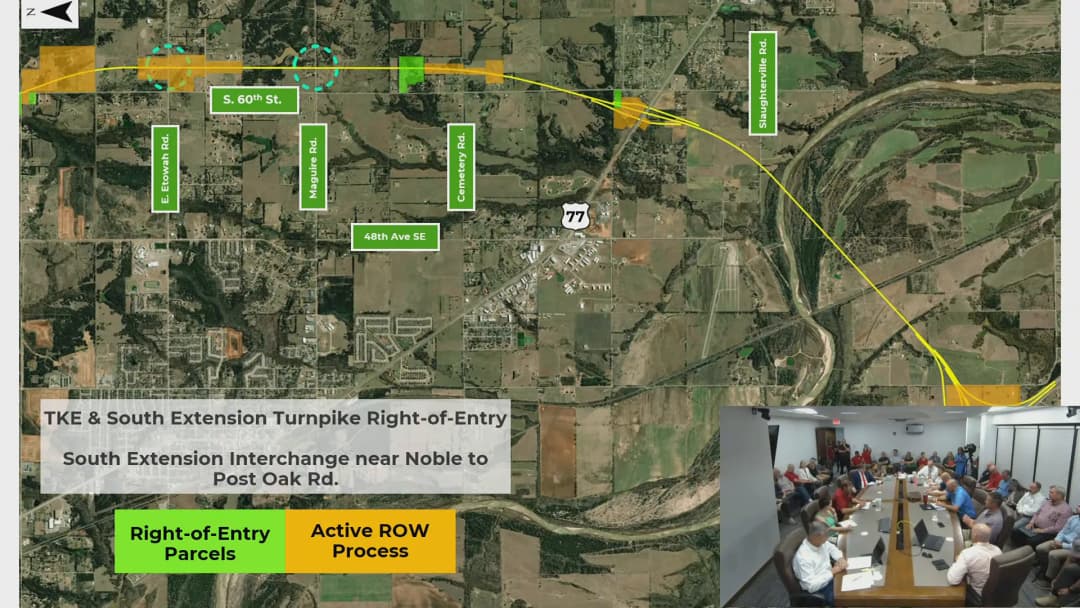
The Norman City Council held a meeting on August 11, 2026, to discuss potential interchange locations along the South Extension Turnpike, planned by the Oklahoma Turnpike Authority (OTA). OTA representatives provided an update on the Access Oklahoma program and presented two proposed interchanges at Alameda Street and Tecumseh Road, while also addressing questions about the Etowa Road interchange partially within Norman city limits. Councilmembers raised concerns about property acquisition, environmental impact studies, public safety, and fire response times. OTA Project Update Trenton January, OTA Chief Engineer, provided an overview of the Access Oklahoma program, an $8.2 billion investment. He reported that as of August 2026, OTA has spent or has under contract $1.63 billion across the program. Regarding right-of-way, OTA is actively working with 408 parcels and has closed on 219 parcels program-wide. On the Toby Keith Expressway (East-West Connector), OTA is working with 124 parcels and has closed on 118. January highlighted construction progress, including the Canadian River bridge (beams hung, completion expected 2028, westbound bridge open by end of 2027) and the 10-Mile Flats Creek area (40% construction complete, targeted spring 2027). Upcoming projects include the Western Avenue interchange (September 2026, $50 million), grade drain/surface from Santa Fe to South Telephone Road (October 2026), and several bridges on the Toby Keith Expressway ($151 million total investment for 2026). South Extension Interchange Discussion Director E. Kelly presented the proposed interchanges for the South Extension. The alignment was moved west from an earlier route near Lake Thunderbird due to Bureau of Reclamation restrictions. Kelly explained that the turnpike's primary purpose is moving freight and providing an alternative to I-35. Two interchanges are under consideration: at Alameda Street and at Tecumseh Road. OTA emphasized that these interchanges would require additional land acquisition but would not impact additional houses beyond those already identified for the mainline alignment. A "tight diamond" design would minimize footprint. OTA also noted that interchanges at Lindsey Street and Franklin Road were ruled out due to proximity to Highway 9 and the Toby Keith interchange, respectively. The city's feedback is sought on whether to proceed with these interchanges. Etowa Road Interchange (Norman-Noble Border) The proposed interchange at Etowa Road lies partially within Norman city limits (north half of the road). OTA indicated that Noble has requested a split interchange, and the design should fit within previously identified property takings without additional homes. Council acknowledged that Norman would need to pass a resolution supporting this interchange as it affects a city street. Councilmember Curtis pointed out that a home and shop on the north side of Etowa are being taken and that property owners are not cooperating. Public Safety and Fire Response Concerns Councilmember Steele questioned OTA about emergency response on turnpikes. OTA confirmed that fire services would be provided by local departments, and OTA pays for call-outs for grass fires but does not typically fund equipment. Fire Chief King and Fire Chief Foster stated that a recent third-party study recommended interchanges at Highway 9, Alameda, and Tecumseh to improve response times. They noted that current fire stations (Station 6 on East Alameda, Station 9 on East Alameda) could access these interchanges, and a proposed Station 10 at 36th and Highway 9 and a future Station 12 at 108th and Franklin would further improve coverage. OTA offered to consider providing emergency access gates and median crossovers if interchanges are not built, but acknowledged these are less safe. Councilmember (unidentified) asked if OTA could help with land for a fire station near Tecumseh and 24th, and OTA responded that there might be room within acquired right-of-way. Councilmember Concerns and Opposition Councilmember Curtis voiced strong opposition to OTA's land acquisition practices. He stated that OTA has not provided requested environmental impact studies, has used law enforcement to enter properties without court orders, and has shown disrespect to landowners. He emphasized the historical and emotional significance of the land, including his own family's dairy farm that was forced out by Lake Thunderbird. He challenged OTA's claims of no additional house impacts, arguing that taking land destroys wildlife habitats and that the process is unjust. He also referenced a lawsuit between Catoosa and Claremore where turnpike commitments were not honored, questioning OTA's reliability. Key Outcomes - No formal votes were taken during the meeting. - The council discussed the need for a resolution supporting the Etowa Road interchange; OTA requested city input on the Alameda and Tecumseh interchanges. - The fire department's study supports interchanges at Highway 9, Alameda, and Tecumseh for improved emergency response. - OTA indicated willingness to discuss partnerships for fire equipment or station placement on acquired right-of-way. - Council expressed significant concerns about property rights, environmental impact, and the process of land acquisition, with some members opposing the current approach. - The city will likely continue discussions with OTA and may bring resolutions for consideration at a future meeting.
The Board of Park Commissioners met on August 6, 2026, to approve minutes, receive annual reports from the Firehouse Art Center and Westwood Golf, discuss the Norman Forward program's excess funding and prioritized project recommendations, and hear division updates. One public comment was received regarding historical interpretation at Atkins Crossing Park. Consent Calendar - Unanimously approved the minutes of the regular meeting held on May 7, 2026. Public Comments & Testimony - Michael Givell (Ward 2) requested that the historical marker at Atkins Crossing Park be updated to include accurate information about First American history related to the 1889 Land Run. He noted that the current marker, erected by the Cleveland County Historical Society in 1978, celebrates the land run but does not acknowledge that the unassigned lands belonged to the Creek (Muscogee) and Seminole nations. He asked for a timeline for updating the marker. The Board took the comment under advisement. Discussion Items - Consideration of Previously Approved City Council Items: Staff summarized council actions from June and July 2026, including budget adoption, proclamations (Juneteenth, LGBTQ+ Pride Month, Parks and Recreation Month, Purple Heart month), contracts for playgrounds, a sales agreement for the Norman Ford Canadian River Trails Park property east of I-35, branding of the Lindsay Street water tower with Dr. Pepper, engineering for the homeless shelter, and delays to camping ordinances in parks (postponed to October/November for a study session). - Annual Report from the Firehouse Art Center: Director Annie presented. Key highlights: 43 summer camps (a record), partnerships with Red Earth (indigenous artist workshops), Prairie House (architectural tours), School of Visual Arts (new sculpture, ceramic residency), Art Sparks program serving all 1,200 fifth graders in Norman Public Schools (with a study from the Rainbolt School of Education), a pollinator garden (funded by Kirkpatrick family fund and an $8,000 grant from Partners of Fish and Wildlife), building expansion plans in conjunction with a potential Norman Forward 2, and a first annual fundraiser honoring founders on August 22, 2026. The Board voted unanimously to submit the report to City Council. - Annual Report from Westwood Golf and Maintenance: PGA Professional Rick Parrish reported FY25 revenue of $1,179,327.12 and expenses of $646,793.88 (including $374,000 payroll and $175,000 supplies, of which $156,000 was pro shop merchandise). Pro shop sales were $204,000 in FY25 and $254,000 in FY26. Rounds played increased from 32,828 in FY25 to over 41,000 in FY26 (aided by greens recovery and competitor course closures). The 51st Westwood Invitational featured a $1,000 cash prize for the championship flight winner (sponsored by Heck Insurance) and $500 for the Masters flight winner (sponsored by Allen Mills Lynde and Simpson Law Firm), with 23 senior flight players added. Youth programs include free junior clinics, junior academy (90 kids), and First Tee OKC (50 kids per session). Superintendent Paul Kraut reported on maintenance: weed control, tree management from three storms (worst on July 4th, closing the course for nearly a week), and the driving range renovation (sprigged in early May, opened last week of June). The Board voted unanimously to submit the report to City Council. - Norman Forward Program – Financial Status and Project Recommendations: Staff presented the projected ending fund balance of Norman Forward sales tax collections (through 2030, with debt service through 2032). After remaining projects, approximately $11 million in excess funding is estimated. Staff recommended a prioritized project list to City Council: 1) Andrews Park – pond, spillway, restroom, and stormwater improvements ($2.25 million total for design, pond construction, and restroom); 2) KidSpace at Reese Park (including a $500,000 TSEC grant match); 3) Adult Wellness & Education Center gym expansion; 4) Griffin Park – fully accessible playground and public restroom ($750,000); 5) Miracle Field at Reese Park – an ADA-accessible baseball field ($1.5 million); 6) Weight room at Young Family Athletic Center (contingent on matching funds); 7) Park signage package for community and neighborhood parks ($550,000). The Citizen’s Finance Oversight Board had already unanimously supported this list. The Board voted unanimously to send the recommendations to City Council. - Division Updates: - CAPRA Update: Most chapters of the accreditation self-assessment are complete; review process has started. Draft due by October 31, 2026. - Norman Forward Update: Playground ribbon cuttings at Sutton Place, Eagle Cliff, and Northeast Lines completed. Blue Stem Park (newest park) will open fall 2026. Land purchase for Norman Ford River Trails Park is in due diligence; a trail master plan to connect to Saxon Park and Clear Bay is anticipated. Saxon Park construction plans are delayed pending utility and road work. The weight room at YFAC may be part of Norman Forward 2. - Parks Division (Wade Thompson): Focus on tree cleanup from the July 4th storm, which generated an estimated 800,000 cubic yards of debris citywide. Citywide public infrastructure damage is approximately $12 million (surpassing FEMA thresholds for state and county assistance). Staff worked 12-hour days; a contractor (TFR) with up to 8 trucks is mulching at a DEQ-approved site. A second sweep for upper canopy damage is underway. Normal operations are expected to resume in about two months. - Park Development (James Briggs): Repairs to fencing at YFAC and Westwood from storm damage (sand volleyball and pickleball courts reopened). A new bike rack sculpture for America 250 was dedicated at Reaves Park. Blue Stem Park construction ongoing (shelter on order, trails and sand volleyball finishing). Bishop Creek Eco Park targeting an October opening. A median landscape project on Main Street (near Quick Trip) includes native plantings and a possible 60–70-foot flagpole. Invasive species control continues at Sutton Wilderness. McGeorge Park playground installation completed. CDBG-funded musical flowers at Graft Park. Land deal for South Lake Park (final new neighborhood park of Norman Forward) is closing. Assisting with landscape for the Gray Street two-way project. - Recreation Division: Reported summer programming: Fishing Derby, June Teenth at Reaves Park, Fourth Fest, home run derby, outdoor movies (Captain America), Fourth of July 2.0 (with local performer Carter Elliott), adult night at Westwood, lifeguard games, and National Parks and Recreation Month activities (playful skits, tunnel walks, Sasquatch searches, snow cones). After-school programs starting in August; upcoming events include adult night (August 7), outdoor movie (Minecraft, August 21 at Lions Park), and Nerf Night (August 28 at 12th Avenue). Key Outcomes - Approved minutes of the May 7, 2026 regular meeting (unanimous). - Accepted the Firehouse Art Center annual report and directed staff to submit to City Council (unanimous). - Accepted the Westwood Golf annual report and directed staff to submit to City Council (unanimous). - Approved the staff recommendations for Norman Forward excess funds project list and directed staff to submit to City Council for consideration (unanimous). - Public comment regarding the Atkins Crossing Park historical marker to be reviewed by staff.
The meeting was called to order at 4:00 PM on August 6, 2026. The committee received a detailed presentation on visitation, special events, and tourism metrics, followed by a discussion on economic development program strategies, and a discussion on potential residential outdoor lighting regulations. No formal votes were taken, but direction was given on next steps for both the economic development advisory board and a lighting ordinance amendment. Discussion Items Report on Special Events and Visitors - Visitation Data: Jason Olson, Director of Parks and Recreation, and Dan Shim from Visit Norman presented visitation data from the past five and a half months. A chart showed a consistent blue line representing residents and an orange line of out-of-town visitors with spikes corresponding to festivals and football games. A notable low in January 2021 was attributed to a snowstorm. Park usage data: Griffin Park saw over 400,000 visitors in the past 12 months with steady growth. Reeves Park showed a large spike for the Medieval Fair. Westwood Aquatic Center had around 5,000 pass holders last year due to cool June weather, rebounding this year. Young Family Athletic Center hosts weekend tournaments year-round. - Festival Attendance: Medieval Fair 94,000; Norman Music Festival 62,000; Pride Festival at Andrews Park 2,900; Norman Arts Festival 6,500; Jazz in June 6,800; Juneteenth at Reeves Park 3,600. Fourth Fest: 13,000 on July 4 before cancellation due to storm; makeup day 9,200. - Concessions Revenue: The city took over concessions nearly a year ago, generating approximately $400,000 in revenue, with a profit margin around 30%. - Shopping District Visits: University Town Center remains one of the most visited shopping centers in the state. Downtown Norman saw an increase of approximately 400,000 visitors over four years. Campus Corner and other districts showed growth. - Guest Tax Revenue: FY25 ended with a 15% increase; FY26 up another 12%, attributed to SEC impact. Voters recently increased guest tax to 10% effective July 1, 2026. - Hotel Data (from Dan Shim): Occupancy for all Norman hotels (12-month avg) is 41.3%, but without the Postal Training Center (NCD) it rises to 54.2%. Key data hotels (top branded properties) show 58.3% occupancy with Average Daily Rate (ADR) $150 and RevPar $87. A new downtown hotel, The Graduate (Hilton flag), is planned with 120 rooms and a five-story parking garage. - Marketing: Normans new visitor guides distributed to 70,000 locations. A USA Today contest recognizes Norman as one of the best college game-day towns (currently 5th). Digital ads target specific events and markets. - Council Questions: Councilmembers inquired about out-of-town visitor tracking (cell phone data), concessions performance, drivers of downtown growth (e.g., new businesses, Winterfest, Fall Fest), spending data availability, hotel occupancy comparisons with Oklahoma City, leakage to other cities during football season, and the impact of the planned downtown hotel. Discussion Regarding Economic Development Program - Overview: The city manager and staff outlined components of an economic development program: strengthening fiscal capacity, creating quality jobs, and addressing disparities. Current investment includes one employee and a $208,000 budget for community and business relations (retail recruitment, special events). Additional staffing for employer recruitment/expansion could be funded using the $125,000 normally contributed to the Norman Economic Development Coalition (NEDC). - Quality Jobs Definition: Jobs paying $17.50/hour plus benefits are considered quality jobs. - Incentives: The existing Economic Development Incentives Policy (2013) targets specific industries but has no dedicated funding. Past deals like Immuno-Mycologics (Emmy) used TIF funds. There is no retail incentive policy; a recent request from Sooner Mall highlighted the need. - EDAB (Economic Development Advisory Board): Currently seven members, at least four with relevant expertise. Proposed expansion to nine members, with at least five having specialized knowledge and representation from each ward (or eight wards plus at-large). The board would work on policy development. - Other Tools: Center City TIF for infrastructure, parking authority, transportation bonds, transit sales tax, federal affordable housing funds. Consideration of a Cleveland County Economic Development Coalition membership (hybrid model), urban renewal authority, film-friendly city designation, sports tourism tied to 2028 Olympics in OKC, and micro-business incubators. - Council Positions: Multiple councilmembers expressed support for expanding EDAB to nine members with ward representation and not removing current members. Support for requiring quality job thresholds in incentives. Interest in incentivizing redevelopment of vacant buildings (e.g., using county property tax abatement or mini-TIFs). A cap on tax incentives (e.g., 70% city share, 30% immediate benefit) was suggested. The mayor emphasized public infrastructure improvements (like TIF) as a primary incentive and the need for measurable outcomes from any county coalition membership. Councilmember Barry (Ward 6) supported exploring arts and culture, film-friendly policies, and SEC city collaboration. - Next Steps: Staff will bring forward an ordinance to update the EDAB structure (increase to nine members, adjust qualifications). EDAB will be tasked with developing specific economic development policies for council consideration. Discussion Regarding Potential Regulations Related to a Residential Outdoor Lighting Ordinance - Background: City Attorney presented history: attempts in 2006 and 2019 failed. A current complaint at 3500 Grand Canyon Drive involves extremely bright lights (photos shown). A 2011 commercial lighting ordinance exists. - Proposed Approach: Two options: a freestanding code enforcement ordinance (burden on code compliance with four inspectors, nighttime enforcement) or an amendment to the existing disturbing the peace ordinance (Article 24) to include light trespass. The city attorney recommended the latter, using a definition: "light trespass" means artificial lighting extending beyond property boundaries that substantially interferes with reasonable use and enjoyment of neighboring property. Enforcement would be by police via citizen complaints, with mediation encouraged. - Mediation Benefits: Examples cited: barking dog case resolved by neighbor communication; commercial lighting case at a car dealership mediated successfully. This approach avoids criminalizing neighbor disputes and fosters amicable solutions. - Council Positions: Councilmember Kirby provided the photos and noted the lights also affect public safety on roadways. Councilmember Ward (Ward 3) supported the Article 24 approach, emphasizing reasonableness and cut-off lighting. Councilmember Bruce (Ward 4) agreed, noting the lights appeared intentional and egregious. Councilmember Renn (Ward 6) asked about applicability to HOAs, mixed-use PUDs, and public safety; requested language addressing lights that impede driving. Councilmember Stadt (Ward 5) supported public safety language. Multiple councilmembers favored the reasonableness standard to avoid over-enforcement. - Next Steps: City attorney will draft an ordinance amending Article 24 (disturbing the peace) to include light trespass, with potential public safety provisions, and bring it to the full council for consideration.