Browse by city
Date range
Search help

Search titles, summaries, topics and stored transcripts together. Keywords may match separately; put the whole query in double quotes for a phrase. Matching follows word analysis, so punctuation is not exact. Both dates are included. Documents are not searched.

SHOWING 71–80 ENTRIES
71
FEB 26, 2026 · OLYMPIA, WASHINGTON · CITY COUNCIL & COMMISSIONS
Community Livability and Public Safety Committee Meeting - February 26, 2026

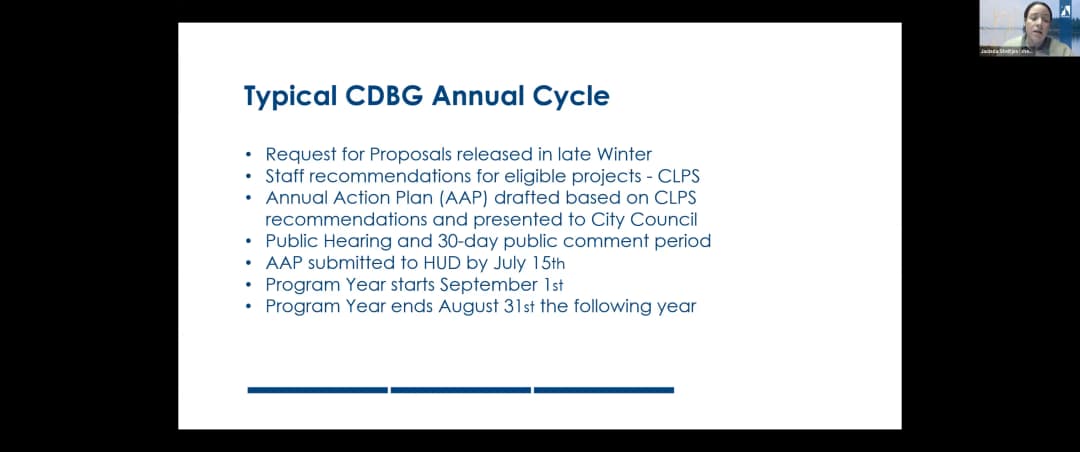
The Community Livability and Public Safety Committee (CLPS) met to receive updates and take action on the Olympia Youth Council work plan, discuss recommendations for City Council-appointed advisory bodies, and hear the Community Development Block Grant (CDBG) program-year 2026 funding proposal. All three committee members were present. Note: The meeting minutes and transcript list the meeting as Wednesday, February 25, 2026, at 5:30 p.m., but the provided metadata indicates the meeting took place on February 26, 2026; this summary follows that date. Call to Order and Roll Call Chair Dani Madrone called the meeting to order. Present were Chair Madrone, Committee Member Kelly Green, and Committee Member Yến Huỳnh. Consent Calendar - The committee approved the meeting agenda as presented. - The committee approved the January 28, 2026 meeting minutes. Public Comments & Testimony - Beth Henriquez, Executive Director of Enterprise for Equity, spoke in support of the city's decision to join the Turner v. State legal action regarding CDBG funds. She expressed gratitude to Anastasia and Jacinda (CDBG staff) for their transparency and support to sub-recipients during the past year. Discussion Items - Olympia Youth Council Update and Proposed 2026 Work Plan: Youth Council Liaison Susan Grisham, Youth Council Co-Chair Donovon Jojoba, Policy Subcommittee Co-Vice Chair Shruthi Lingam-Nattami, and Youth Councilmember Anika Parabakar presented updates including the council's mission, accomplishments (e.g., PSA on Narcan/overdose, joint meeting with Lacey Youth Council), and the proposed 2026 work plan. The work plan includes transit PSA development, a youth summit, third places for youth, and mental health resources. The committee asked questions about youth engagement. Committee Member Green moved to approve the work plan and forward it to the City Council; Chair Madrone seconded. The motion passed unanimously (3-0). - Consider Recommendations Related to City Council Appointed Advisory Bodies: Assistant City Manager Stacey Ray and Consultant Genevieve Canceko-Chan presented two scenarios: (1) improvements to the current advisory body system (e.g., shifting recruitment to fall, standardized onboarding, clearer relationships with council, regular audits) and (2) a re-envisioned, multifaceted engagement approach (community connectors, collaborator networks, community academies, reorganization of bodies around comprehensive plan focus areas). Members discussed the options, with Committee Member Huỳnh expressing strong interest in scenario two, while Green saw merit in both. Staff noted that scenario two would be more involved and that advisory body chairs had generally positive reactions to reorganization ideas. The committee directed staff to develop additional detail on the recommendations, to include input from advisory body chairs and vice chairs at a future CLPS meeting, before taking the item to a full City Council study session. - Community Development Block Grant (CDBG) Program-Year 2026 Funding Proposal Approach: Housing Manager Jacinda Steltjes explained the status of the current program year, including delays caused by federal executive orders and the city's decision to join the lawsuit (King County et al. v. Turner et al.). She proposed for program-year 2026 to not issue an RFP, to directly award funds to existing 2025 subgrantees (Rebuilding Together Thurston County, Habitat for Humanity, Enterprise for Equity, and city administration), and to not fund public services to avoid exceeding the 15% public services cap and failing the timeliness test. Committee members expressed support for the approach, acknowledged the impact on service providers, and raised questions about lingering projects and expectations of another delay. No formal action was required; staff will return in May with dollar amounts. Reports and Updates - Assistant City Manager Stacey Ray discussed upcoming advisory body interviews. Committee members agreed to send interview questions to interviewees in advance, with the timing set for Monday before the interviews. Key Outcomes - The committee approved the 2026 Olympia Youth Council Work Plan to forward to the full City Council (3-0). - The committee directed staff to prepare additional detail on advisory body recommendations for a future CLPS meeting that includes chairs and vice chairs, then to bring the item to a full City Council study session. - The committee endorsed the CDBG program-year 2026 funding proposal approach presented by staff; staff will return in May with specific funding recommendations.

COMMUNITY ENGAGEMENT 36% · PUBLIC ENGAGEMENT 13% · COMMUNITY DEVELOPMENT 11% · PROCEDURAL 10%
72
FEB 26, 2026 · OLYMPIA, WASHINGTON · CITY COUNCIL & COMMISSIONS
Heritage Commission Meeting Summary - February 26, 2026

Note: The meeting minutes indicate a date of February 25, 2026, but the source instructions specify February 26, 2026. This summary uses the instructed date but notes the discrepancy. The Olympia Heritage Commission met on February 26, 2026, at 5:34 PM in Room 207 of City Hall. Chair Garner Miller presided. The meeting focused on housekeeping items, annual planning, recruitment, budget discussions, and annual elections for Commission leadership. Consent Calendar - The February 25, 2026 meeting agenda was approved by consensus. - The minutes from the January 28, 2026 Heritage Commission meeting were approved by consensus. Public Comments & Testimony - None. Discussion Items - Housekeeping (Item 6A): Staff and commissioners reviewed the annual calendar, including outreach for new commissioner recruitment, CLG compliance, a Certified Local Government training on June 8, 2026, and other planned events (Arbor Day, Arts Walk, Heritage Month, neighborhood outreach). Discussion included the Commission’s lack of a dedicated budget, limitations on accepting donations, and possible avenues for funding through partnerships or grants. Commissioners agreed to keep the calendar as a monthly review item. - Election Nominations (Item 6B): The Commission discussed election procedures for Chair and Vice Chair positions for the upcoming year. After discussion, a motion to hold voting immediately was made by Commissioner Patrick, seconded by Commissioner Stedman, and passed unanimously. Nominations were then opened: - Chair: Commissioner Cotter was nominated and elected unanimously. - Vice Chair: Commissioner Bowman was nominated and elected unanimously. - The Commission also agreed to skip the March 2026 meeting, with a motion made by Commissioner Shepard, seconded by Commissioner Bowman, passing unanimously. Key Outcomes - Commissioner Cotter elected as Chair of the Heritage Commission for the upcoming year. - Commissioner Bowman elected as Vice Chair. - The March 2026 meeting is canceled; next meeting will be in April 2026, where new commissioners are expected to join and committee assignments will be made. - Staff will follow up on budget inquiries and continue planning for the June 8 training and other calendar events.

HISTORIC PRESERVATION 31% · COMMUNITY ENGAGEMENT 24% · BUDGET EQUITY ANALYSIS 11% · PERSONNEL MATTERS 10%
73
FEB 25, 2026 · OLYMPIA, WASHINGTON · CITY COUNCIL & COMMISSIONS
Olympia City Council Regular Business Meeting - February 25, 2026

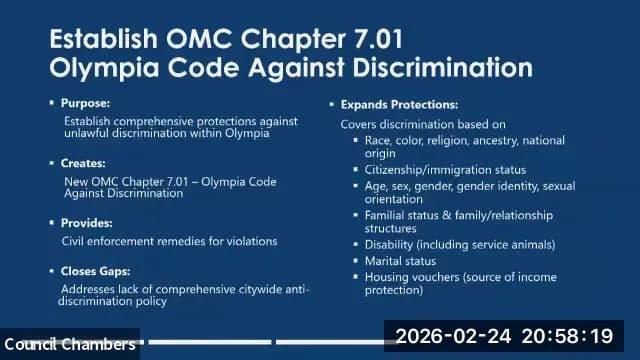
The Olympia City Council held a regular business meeting on February 25, 2026, addressing a wide range of topics including community recognition, public comments, and multiple legislative actions. Key agenda items included amendments to urban village development standards, termination of the Briggs Urban Village Development Agreement, and the adoption of ordinances protecting diverse family structures and prohibiting discrimination. The council also acted on resolutions related to immigration enforcement and city property use by federal agents. Consent Calendar - Resolution 4G: Approved a resolution calling for an end to dangerous immigration enforcement tactics by ICE and CBP, urging protection of constitutional rights, and requiring guardrails on DHS funding. (Councilmember Gilman sponsored) - Ordinance 4H: Approved an ordinance enacting OMC Chapter 12.75, prohibiting the use of city-owned or controlled property for civil immigration enforcement activities by federal agents, with an emergency clause. (Mayor Payne introduced) Public Comments & Testimony - LED Street Lights: Christina Townsend of the Soft Lights Foundation expressed concerns about LED light pollution, citing increased cancer, cardiac, and stroke risks, and urged enforcement of the city's light policy. - Abandoned Vehicles: Edith Hewlett reported abandoned vehicles on Woodard Green Drive, many left for years, creating traffic hazards. - Briggs Village Grocery Store: Multiple residents (Rick Bird, Brian Fowler, Linda Shotwell, Debbie Carter, Tom Culhane, Andrew Peterson, Franklin Wilson, Ika Peterman, Betty Bailey, and others) spoke in support of a minimum 12,000 sq ft grocery store, emphasizing the original master plan's promise of a walkable community with a full-service grocer. They opposed reducing the requirement to 9,200 sq ft and expressed concerns about parking, traffic, and developer accountability. - Diverse Family Structures: Jessa Davis, Rosalyn Erlewine, Tyson Holman, Dave Carlson, and Riven Beagle thanked the council for passing protections for diverse family structures, sharing personal experiences of discrimination and emphasizing the importance of civil protections for polyamorous, queer, and non-traditional families. - Flock Cameras / Surveillance: Several speakers (Nova Stewart, David Webb, Jeff Thomas, VL Huntington Bradley) praised the council for suspending the Flock camera contract and urged against replacing it with other ALPR vendors, calling for regulation of private surveillance and ring cameras. David Webb also raised concerns about police accountability and his unlawful arrest. - Ice Enforcement: Speakers supported the anti-ICE resolutions but called for stronger action, including abolition of ICE and DHS, and urged the city to enforce sanctuary policies. Discussion Items - 6A – Urban Village Development Standards (OMC 18.05): Senior planner Jackson Ewing presented proposed amendments to reduce required commercial space, increase residential density, and set a minimum grocery store size of 9,200 sq ft. Extensive council debate ensued on: - The appropriate minimum grocery size (9,200 vs. 12,000 sq ft). - Whether to allow the grocery requirement to be met by multiple small food shops (e.g., butcher, bakery) instead of a single store. - Building height for mixed-use buildings facing the town square (45 ft vs. 50 ft). - The inclusion of open space in calculating commercial square footage requirements. - Parking concerns, especially related to the YMCA and increased residential density. - Councilmember Madron noted the market study supported 9,200 sq ft as the maximum supportable size; others argued it excluded future residents. Councilmember Gilman emphasized the historical promise of a single grocery store. Councilmember Green raised concerns about market viability. Councilmember Barron proposed amendments to calculate commercial space based on the entire village acreage (passed) and to set a minimum of 12,000 sq ft for grocery with a provision to build down to 9,200 sq ft if a grocer was under contract (failed). Councilmember Green proposed allowing the 9,200 sq ft to be split into multiple food store tenants (failed). Councilmember Madron proposed increasing building height to 50 ft (passed). The original motion, as amended, passed. - 6B – Termination of Briggs Urban Village Development Agreement: Presented by Jackson Ewing. The agreement, which caps residential units at 810, is proposed to be terminated to allow increased housing density and support commercial development. The council approved the termination unanimously, noting that the agreement's provisions are now largely covered by the city's urban village code. - 6C – Unfair Housing Practices (Diverse Family Structures): City Manager Jay Burney presented an ordinance amending OMC 5.80 to add protections for traditional and non-traditional family structures and consensual relationship structures. Councilmember Vanderpool, the prime sponsor, emphasized the community's lived experience and the need for civil protections. The ordinance passed unanimously. - 6D – Code Against Discrimination (OMC 7.01): Presented by Jay Burney, this new chapter establishes comprehensive protections against discrimination, closing gaps in state law and adding family/relationship structure as a protected category. Councilmember Wynn moved to approve as amended (to include a drafting correction in section .040 and to expand the policy declaration to include persons employed or visiting). The ordinance passed unanimously. Key Outcomes - Vote on 6A (Urban Village Amendments): Passed with amendments: - Commercial floor space minimum calculated as 500 sq ft per acre of the entire village (including open space/ critical areas). - Maximum building height for mixed-use buildings facing the town square increased to 50 ft. - Grocery store minimum set at 9,200 sq ft (no multiple tenant option). - Vote on 6B (Termination of Development Agreement): Approved unanimously. - Vote on 6C (Unfair Housing Practices – Diverse Family Structures): Approved unanimously. - Vote on 6D (Code Against Discrimination): Approved unanimously on first reading, as amended. - Note: The meeting date per the transcript is February 24, 2026, but the provided instruction specifies February 25, 2026. This summary uses the instructed date.

LAND USE PLANNING 34% · COMMUNITY ENGAGEMENT 13% · URBAN DESIGN 12% · LGBTQ RIGHTS 9%
74
FEB 24, 2026 · OLYMPIA, WASHINGTON · CITY COUNCIL & COMMISSIONS
Olympia Finance Committee Meeting – February 24, 2026

The Olympia Finance Committee met on February 24, 2026, at 4:30 PM to discuss the Fire Department's capital facilities plan, a quarterly budget spotlight, and proposed updates to the city's investment policy. The committee voted unanimously to forward an updated investment policy to the full City Council. Consent Calendar - The agenda was approved. - Minutes from the November 19, 2025 special meeting and the January 26, 2026 regular meeting were approved. Public Comments & Testimony - Michelle Ryder, a noxious weed inspector, urged the City Council to adopt an ethical investment policy. She stressed the moral imperative of aligning public funds with human rights and environmental protection, citing examples from Portland, ME; Alameda County; and St. Louis. She asked Olympia to avoid investing in fossil fuels, tobacco, immigrant detention, mass incarceration, and weapons. Discussion Items - 6A: Olympia Fire Department Capital Facilities Plan Funding Discussion - Fire Chief Matt Morris and Fleet Operations Supervisor Adam Cummings presented the department's capital needs. The fleet's average age is 21 years, with two engines on order (delivery expected by end of 2028) and a need for two more apparatus (third and fourth engines). The department currently budgets about $500,000 annually toward engine payments, but an additional $500,000/year would be needed to order the next two. Fire stations are aging: Station 2 (west side) requires relocation or major modernization due to location, capacity, and slow response times; Station 3 lacks sprinklers and has a residential electrical system. Other needs include battalion chief apparatus, SCBA replacements (seven-figure cost within 2–5 years), and facility upgrades like station alerting and exhaust extraction systems. The discussion was informational, and the City Manager noted it will continue at the Council's March study session. - 6B: Budget Spotlight: Quarterly Report Items - Senior Budget and Finance Manager Joan Lutz outlined the quarterly financial early-warning system used by the City Manager. Key expense items tracked: Nisqually jail costs (budget increased by $900,000 for 2026), Municipal Court contract costs (new contract with Thurston County), public safety overtime (driven by staffing shortages and minimums), and worker's compensation legacy claims. Revenue items: sales tax performance, B&O tax collection after rate changes, Basic Life Support reimbursement, building permit fees (development fee fund currently below 85% cost recovery, with $1.3 million general fund support allocated), and housing sales tax. The City Manager explained that tracking these items led to the 2025 spending freeze and will inform the 2027 budget. - 6C: Approval of City Investment Policy Update Recommendation - Mitch Henke of Government Portfolio Advisors presented two proposed changes to the City Investment Policy: (1) an ethical investment statement to elevate ESG criteria for corporate bonds, and (2) an increase in the total portfolio weighted average maturity from 2.0 to 2.5 years to allow better alignment with the benchmark during low-cash periods. Currently, the city holds only two corporate bonds (Apple and Walmart, totaling $2 million, maturing July 2026 and August 2027). The change will have minimal impact on earnings. Portfolio value as of January 2026 was $162.8 million, with an average maturity of 1.77 years. Key Outcomes - Motion to approve the draft City Investment Policy update recommendation and forward to the full City Council for consideration passed unanimously (3–0: Chair Gilman, Committee member Green, Committee member Vanderpool). - The Fire Department discussion was completed with no formal action; the conversation will continue at the March 2026 Council study session. - The budget spotlight discussion was informational. - Finance Director Mike Githens reported that a recent Department of Revenue audit of city sales tax collection was helpful in guiding staff on state changes; some minor corrections were found, but the audit was productive.

FIRE STATION FACILITIES 21% · CAPITAL FACILITIES PLANNING 15% · FISCAL SUSTAINABILITY 15% · PUBLIC SAFETY 13%
75
FEB 18, 2026 · OLYMPIA, WASHINGTON · CITY COUNCIL & COMMISSIONS
Land Use & Environment Committee Special Meeting – Hearing Examiner Candidate Interviews – February 18, 2026

This was a special meeting of the Olympia Land Use & Environment Committee (LUEC) to interview two candidates for the position of city hearing examiner. The hearing examiner conducts quasi-judicial land use hearings and appeals under Olympia Municipal Code Chapter 18.82. The committee interviewed incumbent Mark Scheibmeir and Phil Olbrechts, the only two applicants. The LUEC will deliberate at a later regular meeting and make a recommendation to the full City Council, which will vote on a contract (and a separate pro tem contract) expected in March 2026. Overview of Selection Process Community Planning & Economic Development Director Tim Smith explained the process: the city issued a Request for Qualifications, screened responses, and the LUEC conducted interviews using a set of eight questions. The interviews were approximately 45 minutes each. Staff noted that the position was advertised through the Seattle Business Journal and the Washington State Association of Hearing Examiners, resulting in two applicants – a reflection of limited availability of hearing examiners. Candidate Interview: Mark Scheibmeir Experience and Background - Incumbent hearing examiner for Olympia since 2013, with 45 years of law practice and 30 years as a hearing examiner for roughly 25 jurisdictions (three counties and 20 cities), including Tumwater, Lakewood, Gay Harbor, Issaquah, Yelm, and others. Retired from private practice at the end of 2025 but continued with long-time clients. Most Difficult Decisions - Two cases: (1) Denying shoreline permits for a coal port in Longview (a billion‑dollar project, upheld by the Court of Appeals). (2) The “mistake on the lake” office building on Olympia’s isthmus, which resulted in a hearing from 6 PM to 2 AM with disruptive public testimony. Both decisions survived court review. Public Hearing Principles - Emphasizes neutrality: “I check my beliefs at the door” and applies each jurisdiction’s policies. Allows 10 minutes per public speaker (vs. typical 3 minutes) to reduce anxiety. In pre‑COVID in‑person hearings, he builds one‑on‑one rapport with speakers. He is exploring hybrid formats post‑pandemic. Responding to Community Opposition - Explains that he lacks equitable powers; he must follow the code. If a project meets code, he cannot deny it based on popularity. He acknowledges Olympia’s active neighborhood associations but clarifies he is not a policy maker. Conflicts of Interest - Has been challenged on appearance of fairness due to his former law firm’s association with the Lewis County Chamber of Commerce. He maintains no personal memberships in organizations that could imply bias. He proposed a policy for pre‑hearing disclosure of potential conflicts, though it hasn’t yet been used in Olympia. Expectations of City Staff - Called Olympia staff “the finest” and encourages them to maintain professional distance (no post‑hearing pleasantries) to avoid appearance of closeness. Uses Olympia staff reports as templates for other jurisdictions. Mentorship - Noted the challenge of finding new hearing examiners because the profession lacks a pipeline. The two typical sources are former city attorneys and associates in land use firms, but pay is often lower. He plans to eventually mentor a successor in his office. He is open to a pro tem arrangement to help train someone. Interest in Pro Tem Role - Yes, if not selected as primary examiner, he would serve as pro tem. Candidate Interview: Phil Olbrechts Experience and Background - Hearing examiner for about 32 communities since 1989. Most notably Mason County Hearing Examiner since 1995. Former partner at Ogden Murphy Wallace (15‑city practice). Also teaches a webinar for the Municipal Research Services Center and previously taught at the University of Washington. Most Difficult Decision - A current ongoing case where a citizens group claims a planner prepared an environmental checklist after the threshold determination. Testimony from the planner suggests sincerity, but metadata appears contradictory. He is considering suggesting the parties hire a forensic computer expert. Public Hearing Principles - Aims to make hearings accessible to the public, explaining technical terms like “SEPA” and summarizing how codes address community concerns. He often writes decisions with an overview explaining how state and local regulations already mitigate impacts. He sees his role as a translator of law. Responding to Community Opposition - Explains that if a project meets code, it is an entitlement; denial would be reversed in court and could cost taxpayers. He notes that the place for policy change is with the City Council, not the hearing examiner. Conflicts of Interest - Stresses the importance of appearance of fairness. Has only recused himself once (due to prior litigation with an expert witness). He pushes back on claims that being paid by the city creates a conflict, citing the doctrine of necessity and his incentive to make decisions that are upheld in court. Expectations of City Staff - Wants staff reports that identify code criteria and explain how the application meets them. This aids the public understanding and provides a clear basis for his decisions, which also aids appellate review. Mentorship - Focuses on mentoring planning professionals who later become hearing examiners, as they bring wisdom from long careers. He occasionally hires University of Washington students and plans to transition to a younger lawyer in about 10 years. Interest in Pro Tem Role - Yes, he is willing to serve as pro tem. Next Steps The committee will discuss the interviews at a regular LUEC meeting and vote on a preferred candidate. That recommendation will go to the full City Council for contract approval, anticipated in March 2026.

PERSONNEL MATTERS 33% · PUBLIC ENGAGEMENT 25% · PROGRAM MANAGEMENT 12% · PROCEDURAL 11%
76
FEB 11, 2026 · OLYMPIA, WASHINGTON · CITY COUNCIL & COMMISSIONS
Olympia City Council Study Session on Climate Program Update - February 10, 2026

The Olympia City Council held a study session on February 10, 2026, to receive an update on the city's Climate Program from Climate Program Manager Dr. Pamela Braff. The presentation covered recent accomplishments, ongoing work, challenges, and next steps, including a discussion on a proposed home energy score policy, the SHARE accelerator pilot, and climate resilient design guidelines. The council also held an executive session on litigation. No formal votes were taken. Discussion Items - Climate Program Overview: Dr. Braff presented a new slide deck titled "From Commitments to Impact," highlighting Olympia's long history of climate leadership, including the 2018 Thurston Climate Mitigation Plan, the Climate Inheritance Resolution, and the 2045 Comprehensive Plan with its first climate element. She noted that greenhouse gas emissions in Thurston County have risen post-pandemic and that the city is not yet on track to meet its 2040 net-zero goal. - Building Blocks to Net Zero: The city's goals include producing 100% renewable energy, adding 17.6 megawatts of rooftop solar, electrifying and improving efficiency of 100% of buildings, reducing vehicle miles traveled by 20%, electrifying 100% of remaining passenger vehicles, and reducing solid waste generation by 50%. - Energize Olympia/Thurston Program: Since 2023, the program has installed 228 heat pumps and 21 heat pump water heaters in Olympia. 61% of installations were fully or partially subsidized, nearly 150 households gained access to cooling, and the program is expected to reduce nearly 3,000 metric tons of CO2e over 15 years. The city contributed $200,000 in Community Development Block Grant funds, leveraged $1.3 million in state and federal grants, and an additional $620,000 in savings through negotiated discounts, rebates, and incentives. - Land Use and Transportation: The city is focusing on strategic infill development in high-density neighborhoods, middle housing code amendments, and transportation improvements such as transit signal prioritization on Martin Way and in-lane bus stops. The Transportation Benefit District, funded by a 0.1% sales tax, generates $3.1 million annually for pedestrian, bike, and roll projects. - Electric Vehicle Infrastructure: The city is installing EV chargers at multifamily housing with grant funding and developing a citywide multifamily EV charging strategy. EV-ready parking standards were adopted for new construction. Future work includes evaluating pole-mounted EV charging and bike parking requirements for e-bikes. - Community Preparedness: The city adopted a Sea Level Rise Response Plan in 2019 and has completed 86% of near-term actions. A collaborative of seven agencies is working on long-term adaptation through 2040 and 2100. Other efforts include wildfire and drought maintenance protocols and updated street tree maintenance. - Home Energy Score (HES) Policy: Dr. Braff discussed the proposed HES policy, which would require disclosure of a home energy rating at time of sale. The city has been working regionally with Thurston County, Lacey, and Tumwater. Thurston County will hold a public hearing on February 17, 2026, and Tumwater has a work session on February 24. Lacey has not yet decided. The city council discussed timing: some members preferred to wait for at least one partner jurisdiction to act, while others emphasized the need for local leadership. The item is scheduled for council consideration in March 2026. Councilmembers expressed varying positions: Councilmember Green wanted at least one partner, Councilmember Barrett suggested a contingency, Councilmember Madrone preferred the council make the decision directly, and Councilmember Gilman noted the five-year process and eagerness to decide. The city manager noted that the budget assumed partner participation. Dr. Braff estimated the assessment cost to sellers at $150–$350, with subsidies for low-income sellers. - SHARE Accelerator Pilot: The Safe Housing and Rental Efficiency (SHARE) program aims to improve health, safety, and energy efficiency in affordable rental housing. Initial funding from a Department of Energy prize was received in 2023, but additional federal rounds are no longer available. The program has been scaled back and is expected to launch in 2026, with a call for interested landlords by the end of March. - Climate Resilient Design Guidelines: The city is developing guidelines for capital projects to ensure infrastructure can withstand future climate hazards, in collaboration with Public Works and Parks. Completion is expected within the year. - Funding Needs: Dr. Braff emphasized the need for predictable, sustainable funding beyond grants, as grant dependence creates risk of gaps. The city manager noted that the climate program was cut in the last budget and that additional staffing may be needed for both program implementation and measurement. The council discussed potential local funding sources, including the Climate Commitment Act (which is designed to sunset) and future bond opportunities. - Measurement Challenges: Councilmember Gilman questioned the lack of outcome metrics, such as the total number of heat pumps installed citywide or progress toward milestones. Dr. Braff explained that measuring community-wide indicators is difficult due to permit data limitations and resource constraints. The city is working on modifications to the permit system to track future installations. Councilmember Vanderpool suggested that the home energy score policy could help gather data. A community survey was discussed but deemed insufficiently granular. Dr. Braff noted that rooftop solar installations are already trackable and appear on track. - PSE and Electricity Costs: Councilmember Green raised concerns about electricity costs from Puget Sound Energy (PSE) and the impact on electrification. Dr. Braff acknowledged the complexity and noted that heat pumps are far more efficient, so bills may not increase despite higher electricity rates. She also mentioned data centers as a significant factor in rising electricity prices, separate from electrification. Key Outcomes - No formal votes were taken during the study session. - The council discussed the Home Energy Score policy and agreed to bring it forward for a decision in March 2026, with the understanding that at least one partner jurisdiction (Thurston County or Tumwater) appears likely to act concurrently. - The council acknowledged the need for long-term, sustainable funding for climate programs and will continue to explore options, including potential local funding sources and future budget discussions. - The meeting recessed at 7:20 p.m. for an executive session pursuant to RCW 42.30.110(1)(i) (litigation and potential litigation), which lasted from 7:26 p.m. to 8:04 p.m. No decisions were made, and the meeting adjourned at 8:04 p.m.

CLIMATE ACTION PLANNING 53% · ENERGY MANAGEMENT 15% · AFFORDABLE HOUSING 7% · ACTIVE TRANSPORTATION 4%
77
FEB 10, 2026 · OLYMPIA, WASHINGTON · CITY COUNCIL & COMMISSIONS
Olympia Planning Commission Meeting January 26, 2026: Work Plan Discussed, Officers Re-elected

The Olympia Planning Commission met on January 26, 2026, to discuss the draft 2026-2027 work plan, hear a report on neighborhood grants, and re-elect officers. The meeting was held online with six commissioners present. Consent Calendar - Approval of the agenda. - Approval of the November 17, 2025 meeting minutes. Commissioner Grubb abstained. Public Comments & Testimony - None. Staff Announcements - Next meeting: February 23, 2026. - Upcoming briefings on possible ordinances, with staff reports to be provided as soon as possible. - Changes to city council committee assignments, particularly the Land Use and Environment Committee and Community Livability and Public Safety Committee. - Evaluation of advisory committees, including scope of work and public engagement, with recommendations expected in March and April. - Two vacant planning commission seats are being filled; interviews will be set by April 1, 2026. Discussion Items - Draft 2026-2027 Planning Commission Work Plan: Presented by Associate Planner Casey Schaufler. Topics included: minor code amendments, capital facilities plan review, subdivision code update (middle housing), sidewalk repair policy, commercial parking standards (state law driven), critical areas ordinance update, manufactured home communities preservation, sub-area neighborhood plans (Plum Street corridor), small commercial uses, urban forest management plan update, and a commission retreat. Commissioners discussed the need for a timeline of must-hit dates and deliverables. A subcommittee to develop future work plan topics for council consideration was proposed. The work plan will be adopted at the next meeting on February 23, 2026. Reports - Vice Chair Daniel Garcia reported on a Council of Neighborhood Associations forum for Neighborhood Matching Grants. Key community ideas included: pedestrian safety (lighting), sidewalk improvements, and creation of more third spaces (parks, corner stores). Key Outcomes - Work Plan: Discussion held; adoption postponed to February 23, 2026. - Officer Elections: Motion to re-elect Chair Greg Quetin and Vice Chair Daniel Garcia passed unanimously. - Next Meeting: February 23, 2026, at 6:30 p.m. online.

LAND USE PLANNING 23% · PROGRAM MANAGEMENT 22% · PROCEDURAL 15% · CLIMATE ACTION PLANNING 7%
78
FEB 4, 2026 · OLYMPIA, WASHINGTON · CITY COUNCIL & COMMISSIONS
Olympia City Council Regular Business Meeting - February 4, 2026

The Olympia City Council met on February 4, 2026, for a regular business meeting. The meeting included a proclamation for Black History Month, which was disrupted by a speaker, followed by public comments on climate policy and library funding, approval of the consent calendar, council reports, and an executive session on personnel matters. Special Recognition - Proclamation Recognizing Black History Month: Councilmembers read a proclamation declaring February 2026 as Black History Month. The proclamation honored the contributions of African Americans, including Dr. Maxine Mims, and highlighted a February 20, 2026 event at the Washington Center for the Performing Arts hosted by the Hawk Foundation in partnership with Olympia School District. - Disruption: Javon Byrd, executive director of the Hawk Foundation, delivered remarks critical of systemic racism and white supremacy, accusing council members of disrespect. Mayor Payne and several councilmembers expressed anger and disappointment, stating the comments were disrespectful and derailed the celebratory moment. Mayor Payne apologized to the council and reaffirmed the city's commitment to Black History Month. Public Comments & Testimony - Tom Crawford (Thurston Climate Action Team board member): Urged adoption of a residential energy performance rating and disclosure policy, arguing Olympia should lead regionally without waiting for other jurisdictions. - Llewlyn (born and raised Olympian): Supported immediate adoption of the home energy score ordinance, citing it as a key part of the 2021 Thurston Climate Mitigation Plan. - Kyle McQuarie: Addressed Timberland Regional Library budget cuts and layoffs, asking the council to engage with the library board to preserve jobs and services, noting the local economic impact. - James O'Bar: Supported the home energy audit ordinance, linking climate action to the ongoing struggle for racial justice. - Terry Ballard: Raised concerns about county debt, capital planning, and the location of a new sheriff's building, referencing George Washington Bush's lack of recognition in Black history. Discussion Items - Consent Calendar (Items 4A through 4I): The council approved the following without separate debate: - Minutes of January 27, 2026 - 2026 work plans for the Community Livability and Public Safety Committee, Finance Committee, and Land Use and Environment Committee - Amendment to the design-build agreement with FORMA Construction for the Hands On Children’s Museum Expansion Project - Resolution declaring an emergency for flooding at 28th Avenue - Ordinance vacating an alley right-of-way south of Legion Way (second reading) - Emergency ordinance terminating Olympia Municipal Court and amending parking codes to support transition to Thurston County District Court (first and final reading) - The motion carried 7-0. - Committee Work Plan Highlights: - Community Livability & Public Safety: Focus on PBIA evaluation, pedestrian safety tools (referred by Councilmember Green), and advisory body appointments. - Finance: Priority-based budgeting, 2025 year-end review (April), capital facilities plan (August), special fund analysis (September), revenue discussion (October), and budget recommendations (November). - Land Use & Environment: Hearing examiner interviews, manufactured home preservation, Plum Street/Southeast Annexation (sequencing dependent on study session), sidewalk repair policy, land banking, Black Home Initiative, urban forestry, small-scale commercial standards, and downtown vacancy. - Council Reports & Referrals: - Mayor Payne reported on the city's first legislative advocacy day in Olympia, supporting Deschutes Estuary Restoration, progressive revenue, housing/homelessness operating funds, and sit-lie ordinances. He also attended the Olympia Downtown Alliance awards dinner. - Mayor Payne requested the city manager research banning ICE federal agents from city property, citing Seattle's recent action. Councilmembers unanimously supported this direction. - Councilmember Vanderpool requested that feedback from the Council of Neighborhood Associations (127 responses) be presented at a future council meeting; it will be scheduled through agenda setting. - Councilmember Berendt shared experiences from the Point-in-Time homeless count, noting behavioral health challenges among those interviewed. - Councilmember Gilman expressed strong support for Mayor Payne's leadership on anti-racism and belonging initiatives. - Councilmember Madrone reported on CLIPS committee: recommendation to approve Rebecca Howard Park development plan, PBIA evaluation by Uncommon Bridges (recommendations to increase rates, restructure administration via third-party operator, and consider equitable rate models), and liaison role with police auditor. - Councilmember Vanderpool reported on Regional Housing Council: concerns about potential 30% federal funding cut to Continuum of Care program (affecting 3,000 people), and delays in permanent supportive housing due to ILA concerns with Lacey. Key Outcomes - Consent Calendar adopted unanimously (7-0). - Mayor Payne directed City Manager Burney to research and propose a ban on ICE agents from city property, with council consensus. - Neighborhood feedback presentation will be scheduled at a future agenda setting meeting; councilmembers expressed interest in receiving it this year but noted it may inform 2027 planning. - Executive Session: The council recessed at 7:44 p.m. for a personnel matter (City Manager’s performance evaluation) under RCW 42.30.110(1)(g), lasting from 7:50 p.m. to 9:20 p.m. No decisions were made. The meeting adjourned at 9:20 p.m.

RACIAL EQUITY 32% · PROCEDURAL 17% · COMMUNITY ENGAGEMENT 13% · HOMELESSNESS 12%
79
JAN 30, 2026 · OLYMPIA, WASHINGTON · CITY COUNCIL & COMMISSIONS
Olympia Community Livability and Public Safety Committee Meeting - January 30, 2026

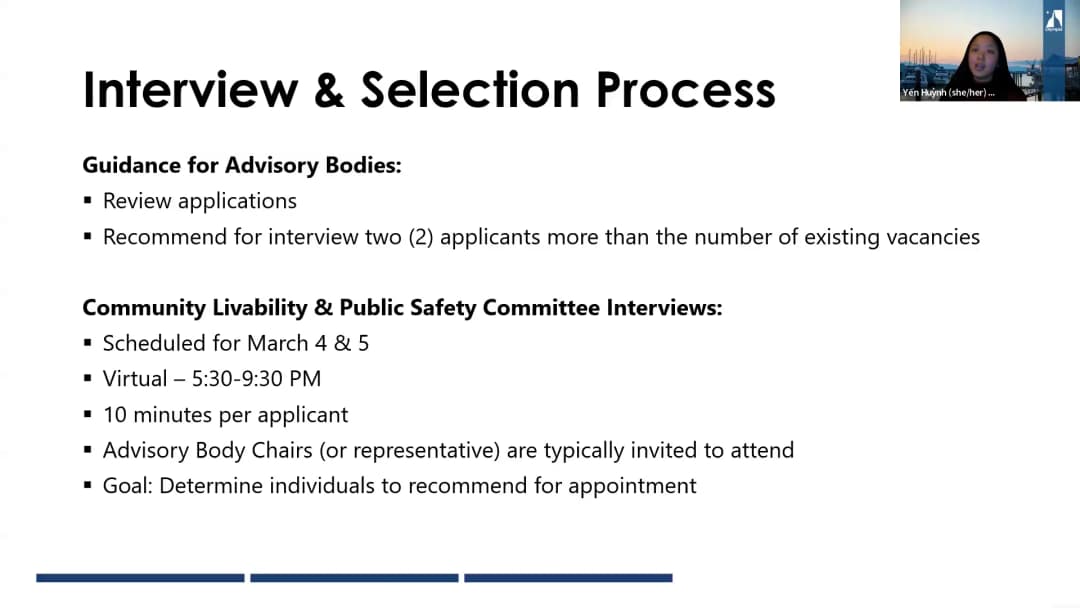
The Olympia City Council Community Livability and Public Safety Committee met to review the Rebecca Howard Park development plan, receive a preliminary evaluation of the Parking and Business Improvement Area (PBIA), hear an update on advisory body recruitment, and approve the committee's 2026 work plan. Chair Dani Madrone presided with Committee Members Kelly Green and Yến Huỳnh. The source record shows the meeting convening at 5:31 p.m. and adjourning at 8:21 p.m. Note: the minutes and transcript date the meeting as January 28, 2026, while the supplied meeting timestamp is 2026-01-30 13:30 UTC; this title uses the supplied date, and the summary otherwise follows the source record. Consent Calendar - The agenda was approved by motion. - The October 15, 2025 Community Livability and Public Safety Special Meeting minutes were approved by motion. Public Comments & Testimony - Colin Bartlett, co-owner of Wobbly Cup Cooperative Roasters, Thurston County Planning Commissioner, and former unhoused Olympian, expressed support for the city's commitment to a Housing First policy that centers unhoused Olympians as decision-makers. He said solutions to encampments and no sit/no lie ordinances should meet unhoused people's self-identified needs, including long-term stability independent of government whims, freedom from paternalistic scrutiny, connection to found family, and daily agency. He offered to work with the city on these issues. Discussion Items Rebecca Howard Park Development Plan Recommendation - Associate Planner Sarah Giannobile presented the proposed plan. The site was purchased in 2018, shifted from housing to healing during 2020 Black Lives Matter protests, transferred to Olympia Parks in 2021, named after Rebecca Howard, and developed through a steering committee and three phases of community engagement. - The design includes a large lawn and stage, community hub with cafe and multi-purpose room, quiet garden, gathering circle, festival street on 9th Avenue, and connections to the downtown library with a reading nook. Art and storytelling would draw on Black history, including Dr. Thelma Jackson's book, and art would appear in pathways, seat walls, sculptures, wayfinding, plant ID signs, and murals. - Sustainability elements include solar and rainwater reuse options, drought-tolerant and pollinator-friendly plants with Black cultural significance, tree preservation, and pedestrian and bike-friendly infrastructure. - The consultant cost estimate breaks construction into three phases. The lower-end total is about $5.5 million and the higher-end total about $6.5 million, escalated to January 2027 dollars. Art and signage are not included; funding would use the 1% for arts program and grant opportunities. - Community design advocates Shawna Hawk and Stephanie Cholmondeley voiced support. Hawk said the project was a promise being kept and noted the design uses the Black liberation flag rather than the Pan-African flag for crosswalks. Cholmondeley described segregated parks from her childhood, including Paradise Park in Florida, and stressed the importance of a park created by and for Black community members. - Committee members praised the plan. Discussion covered removable bollards or planters for festival-street closures, a third-party cafe operator model, preserving mature fruit trees, and the future of the downtown library site. Kelly Green noted the Parks and Recreation Advisory Committee and RS Commission unanimously supported the project. - Staff recommended developing the first phase of Rebecca Howard Park before Lily Road Neighborhood Park and Skocks Park Inclusive Playground because of the project's significance and the need for visible progress. Committee members expressed agreement. - Motion: Kelly Green moved, seconded by Yến Huỳnh, to approve the recommended Rebecca Howard Park Development Plan and forward it to the full City Council. The motion passed unanimously. Parking and Business Improvement Area Preliminary Evaluation - Economic Development Director Jennica Machado and Uncommon Bridges Founding Partner Brian Scott presented a briefing. The PBIA was formed in 2005, represents about 520 businesses in three downtown zones, and collected about $114,000 in 2024. The council assessed zero dollars in 2025 and 2026 while the evaluation was completed. - Scott reported that assessment rates have not changed since 2005; adjusting the 2024 collection for CPI from 2005 to 2025 would make it about $190,000. He described the tenant-based structure as difficult to administer because there is no reliable business list. A recent effort to create a property-based district was unsuccessful. - His preliminary recommendations included maintaining stable place-management funding, making a property-based assessment the long-term goal, collecting more from the existing PBIA through a public hearing process, transferring day-to-day administration from city staff to a nonprofit program manager, and substantially increasing rates and budgets. He also said residential properties are assessed far less than in comparable districts and should be part of the system. - Scott explained national best practice as a three-part structure: the city council authorizes and collects the assessment; a ratepayer advisory board sets priorities and monitors performance; and a nonprofit operating entity carries out day-to-day services. The Olympia Downtown Alliance was cited as a proven possible operator, but had not agreed to take on that role. - Committee discussion included compliance and collections, possible district boundary changes, the PBIA board's future role, and affordability concerns for downtown renters. Scott said assessment amounts are small relative to rent and that districts often consider discounts for nonprofits or affordable housing, but added that complex formulas can make administration harder. Machado said staff would meet with the city's housing manager to align recommendations with affordable housing goals. - The committee received the information without formal action. It was agreed that staff would take the preliminary recommendations to the PBIA advisory board, return to this committee with a fuller recommendation, and then send a committee recommendation to the full City Council. Advisory Body Recruitment Process Update - Assistant City Manager Stacey Ray reported that the current recruitment cycle closed December 12 after launching in October. There were 62 applications for 19 vacancies, after a newly announced Planning Commission vacancy increased the original 18 total. - Advisory bodies are reviewing redacted applications and recommending two more applicants than their number of vacancies by February 13. Committee interviews are scheduled for March 4 and 5, 2026, virtually from 5:30 to 9:30 p.m., with 10 minutes per applicant. - Committee members agreed to receive all 62 applications rather than only the advisory bodies' recommended lists, and to have names redacted for the committee as well to reduce bias. They also agreed not to hold a separate February committee meeting to select interviewees; staff would collect preferences and notify applicants before the March interviews. - The committee discussed taking formal action on appointments after the March 5 interviews if consensus can be reached, with a March 31 City Council action and proclamation honoring outgoing advisory body members also scheduled. Ray said applicant expectations and the advisory body guidebook would be shared with applicants before interviews. 2026 Community Livability and Public Safety Committee Work Plan - Assistant City Manager Debbie Sullivan presented the draft 2026 work plan. Changes included moving some topics to full Council study sessions, including reimagining public safety, the Thurston County District Court interlocal agreement, and the emergency management briefing; removing the Council Advisory Guidebook because it was completed in May 2025; rescheduling the April 22 meeting; and moving the advisory body work plan review to March 25. - Committee members asked to schedule the park naming process, actions to strengthen the Sister City relationship with Kato, Japan, and the Olympia Strong implementation strategy. They also requested that the traffic safety referral be broadened beyond enforcement cameras to include other pedestrian safety tools, and that staff explore whether an update could come before August. - The work plan was approved by motion and will be forwarded to the full City Council for approval. Key Outcomes - Approved the Rebecca Howard Park Development Plan recommendation for full City Council consideration, with a goal of scheduling council action in late February or early March 2026. - Received and discussed the PBIA preliminary evaluation; directed staff to return after PBIA board feedback for a formal committee recommendation. - Set advisory body recruitment logistics: see all 62 applications with names redacted, no February selection meeting, interviews March 4-5, and appointment recommendations to move forward afterward. - Approved the 2026 Community Livability and Public Safety Committee Work Plan and forwarded it to the full City Council. - Adjourned at 8:21 p.m.

PARKS AND RECREATION 18% · ECONOMIC DEVELOPMENT 18% · PERSONNEL MATTERS 16% · BUSINESS LICENSING 12%
80
JAN 28, 2026 · OLYMPIA, WASHINGTON · CITY COUNCIL & COMMISSIONS
Olympia City Council Meeting - January 28, 2026: School Levy, Park Renamings, and Public Comment

The Olympia City Council met on January 28, 2026, starting at 6:00 PM. The meeting included a public hearing on a resolution supporting the Olympia School District's technology and capital projects levy, a large public comment period, and the unanimous approval of new names for three park properties. The mayor also opened with statements condemning recent federal immigration enforcement actions and clarifying that no decisions have been made about closing the last encampment, known as 'the Jungle.' Consent Calendar - Approval of January 13, 2026 Meeting Minutes (Item 4.A) - Approval of 2026 Council Meeting Calendar and Committee Assignments (Item 4.B) - Authorization of Grant Agreement with Washington State Department of Ecology for Stormwater Permit Compliance (Item 4.C) - Authorization of Grant Agreement for Puget Sound National Estuary Program Stormwater Strategic Initiative Lead for a Peak Flow Reduction Project (Item 4.E) - Authorization of Agreements with Forma Construction Company and Saybr Contractors Inc. for Job Order Contracting Services (Item 4.D) - Approval of Ordinance Amending OMC for Development Code Updates to Support Urban Agriculture (Item 4.F) – adopted on second reading. - Approval of Ordinance to Vacate an Alley Right-of-Way South of Legion Way (Item 4.G) – approved on first reading, moved to second reading. The consent calendar was adopted unanimously (7-0). Public Hearing: Olympia School District Proposition 1 – Technology and Capital Projects Replacement Levy - Assistant City Manager Debbie Sullivan presented an overview: Proposition 1 is a replacement levy (not a new tax) estimated to raise $72.9 million over four years, funding technology, safety improvements, and capital projects. The public hearing was opened at 6:07 PM and closed at 6:18 PM. - Speakers: - Patrick Murphy (Superintendent, Olympia School District): Expressed gratitude for city partnership and highlighted levy benefits, including maintaining technology and safety improvements. - Terry Ballard: Noted that the school district has $192.165 million in outstanding debt, as per the Thurston County Treasurer's website, and questioned fiscal management. - Erica Larry (Board member, OSD for All): Stated she would vote for the levy but criticized the district for prioritizing fiscal solutions over student-centered ones, citing lack of support for special needs students and program cuts. - Ryan Betz (Chair, Olympia Citizens for Schools): Expressed full support for the levy, emphasizing the importance of safe and healthy schools. - Councilmember Kelly Green spoke in full support, noting the levy is not a new cost and that quality education benefits the entire community. - Vote: Motion to adopt the resolution passed unanimously (7-0). Public Comments & Testimony (Approximately 30 speakers) - Tree Ordinance: Multiple speakers (Heather Pence, Lynn Fitzhugh, Charlotte Persons, Natasha Hayes, Teresa Jennings, Maryanne Thompkins) urged the city to update the 1991 tree ordinance to protect mature trees, especially in the context of development. They highlighted the climate benefits of trees (carbon sequestration, stormwater retention, energy savings) and noted that the Thurston Climate Mitigation Plan includes a tree code update. Speakers requested that the work be moved up from the planned fall start. - Harm Reduction Center: Barbara Davis and others expressed concerns about increased antisocial behavior and public health issues near the Franklin Street harm reduction center, asking the city to either relocate the center or change its operations. Councilmembers responded by acknowledging the concerns and noting that the center is a private business, not a city operation, but that they are working to address community needs with dignity. - Park Naming: Many speakers (Dwayne Slate, Sam Hunt, Karen Fraser, Doug Levy, Krag Unsoeld, Julie Frick, Sue Leen, and others) spoke in favor of renaming the Olympia Armory to the Daley Arts Center (honoring former Mayor Bill Daly), Yelm Highway Community Park to Jolene Unsoeld Community Park (honoring former U.S. Representative and state legislator), and Kaiser Woods Park to Marj Yung Park (honoring former Thurston County Commissioner). They shared personal stories and detailed the legacies of all three individuals. The speakers were overwhelmingly supportive. - Jungle Encampment: Several speakers (Mag Pollicino, Jaden, Colin Bartlett, David Webb) expressed opposition to any forced displacement of residents at the 'Jungle' encampment. They urged the city to directly engage with residents, meet their stated needs (weatherproof tents, medical supplies, dumpsters, etc.), and ensure that any planning includes community consent. Councilmembers responded that no decisions or timelines have been set, that planning is in early stages, and that the city intends to work compassionately with the county and service providers. - Other Topics: Grace Fletcher invited participation in the Council of Neighborhood Associations' community priorities survey (open through February 1). Victoria Harmon shared a library customer service survey. Terry Ballard and others raised concerns about Thurston County debt and fiscal management. David Webb alleged unlawful arrest by Olympia Police and interference with his right to record police. Discussion Items - Park Naming Approval: Director of Parks Planning & Maintenance Laura Keehan presented the three recommended names, following a public process and committee review. The names were recommended by the Community Livability and Public Safety Committee. Councilmembers expressed strong support, sharing personal memories and historical context. Councilmember Paul Berendt moved to approve the names; the motion carried unanimously (7-0). - Council Response to Public Comment: Councilmembers Madrone, Vanderpool, Gilman, Green, Mayor Pro Tem Huỳnh, and Mayor Payne responded to public comments on the tree ordinance, the jungle encampment, the harm reduction center, and immigration. They emphasized the city's commitment to collaborative, compassionate planning, and noted that work on the tree ordinance is on the work plan for fall 2026. The city manager clarified that the jungle planning process is expected to take 18 months to two years. Key Outcomes - School Levy Support: The council unanimously adopted a resolution supporting Olympia School District Proposition 1 (Technology and Capital Projects Replacement Levy). - Park Renamings: The council unanimously approved the official names: Daley Arts Center (formerly Olympia Armory), Jolene Unsoeld Community Park (formerly Yelm Highway Community Park), and Marj Yung Park (formerly Kaiser Woods Park). - Consent Calendar: All items on the consent calendar were adopted unanimously. - Public Hearing: The public hearing on the school levy was closed without further action. - Next Steps: The city manager will coordinate with the county and other partners on a long-term plan for the Jungle encampment. The tree ordinance update is scheduled for the Land Use and Environment Committee's work plan, with a public discussion expected in October 2026.

PUBLIC ENGAGEMENT 16% · PARKS AND RECREATION 14% · HISTORIC PRESERVATION 12% · PUBLIC SAFETY 8%
OPENPUBLICA · PUBLIC MEETING INDEXUPDATED DAILY · openpublica.com