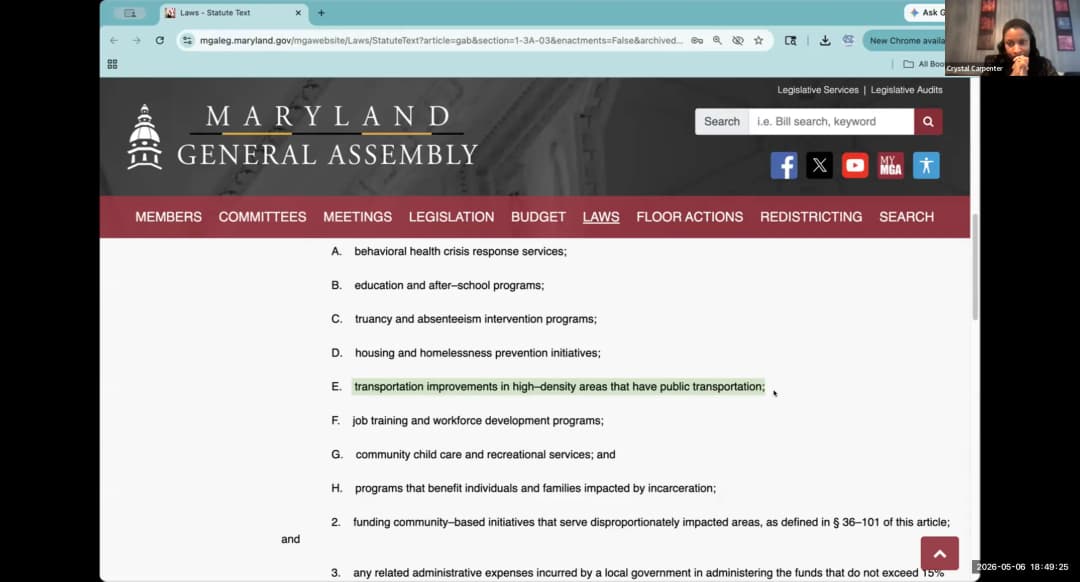
The Cannabis Reinvestment and Restoration Board met on May 7, 2026 (the transcript references May 6, 2026, but the official date used is May 7, 2026 per the instruction). The meeting was called to order at 5:38 PM with quorum. Members present: Dr. Rachel Jordan, Natalie Doris, Dr. Ron Garrett, Crystal Carpenter, Andrew Pierce, and later Bianca Mills joined. The board approved previous meeting minutes, discussed legal requirements for fund use, administrative expenses, community engagement plans, and formed subcommittees for grant categories. Consent Calendar - Approval of Meeting Minutes: Motion to approve the previous meeting minutes was made and seconded. No opposition. Minutes were approved as submitted. Discussion Items - Legal Requirements for Fund Use (Zip Codes): Mr. Maddox presented the legal basis for the fund, citing Maryland Code section 1-3A-03 and 36-101. The fund may only be used for community-based initiatives serving disproportionately impacted areas (DIAs), defined by the Office of Social Equity as 18 specific zip codes in Prince George’s County. The board clarified that the recipient organization does not need to be located in those zip codes, but the services must be provided there. Members discussed whether to prioritize Prince George’s County-based businesses and whether the DIA zip codes cover all low-income communities. Mr. Maddox confirmed that the law requires funds to be used only for those 18 zip codes; any other interpretation is not permissible. The board noted that Prince George’s County has 18 impacted zip codes, indicating a high level of historical impact from cannabis enforcement. - Administrative Expenses and Grant Administration: Andrew Pierce presented draft language for administrative expenses, proposing that the board be supported by a county executive designated agency. The original draft mentioned the health department, but after discussion, the board preferred to keep the language broad. Dr. Garrett and others urged that the board should separately recommend that the council’s grants office administer the funds, to avoid delays. Ms. Rogers (grants office) confirmed her office has capacity to handle grant administration, with a typical 6–8 week cycle. The board agreed to move forward with legislation that allows administrative expenses (up to 15% of annual revenues, $2M) and to submit a separate recommendation to the county executive to designate the grants office. - Community Engagement and Public Hearings: The board discussed holding public town halls to gather community input on fund priorities, as required by legislation. Members favored hybrid (in-person and virtual) sessions, with at least three meetings across the county. Dr. Jordan suggested a soft structure for the hearings to keep focus on the board’s mission. Ms. Rogers offered to coordinate scheduling via the county’s tech team. The board agreed to finalize dates by email and to develop a presentation outline for the next meeting. Concerns about potential conflicts with primary election season were noted. - Subcommittee Categories: The board debated the grant categories used by other counties (Anne Arundel and Montgomery). After discussion, members voted to approve six categories for Prince George’s County: 1) Mental Health and Substance Use Services, 2) Education, Youth Enrichment, and After-School Activities, 3) Housing and Homeless Prevention Services, 4) Workforce Development and Employment Training, 5) Justice Involved, and 6) Accessibility and Public Transportation. The motion carried unanimously. Key Outcomes - Vote: The board voted unanimously to approve the six subcommittee categories as listed above. - Subcommittee Leads Assigned: - Mental Health and Substance Use: Dr. Rachel Jordan - Housing and Homeless Prevention: Natalie Doris - Justice Involved: Bianca Mills - Accessibility and Public Transportation: (volunteer from the board, later assigned to Crystal Carpenter? Actually, the transcript shows Crystal Carpenter offered to help with communications, and the lead for accessibility was taken by a member – unclear who. The summary can state that leads were assigned, but not all named. To be accurate, we note that leads were assigned for most categories, with workforce development and education remaining open. The board agreed to contact missing members. - Next Meeting: Scheduled for May 20, 2026 at 6:00 PM. The board discussed shifting to a later time (6:00 PM) to accommodate members. - Administrative Legislation: The board agreed to proceed with draft legislation that allows administrative expenses from the fund, with the administering agency designated by the county executive. A separate recommendation to designate the council’s grants office will be submitted. - Financial Disclosure: Members expressed difficulty with the online financial disclosure system. Ms. Rogers offered to provide a contact person for assistance. - Meeting Adjourned: 7:09 PM.
Public Meetings - Prince Georges County, Maryland
Public Meetings - Prince Georges County, MarylandNote: The transcript of the meeting indicates the chair stated the date as Wednesday, May 6, 2026, but the meeting date provided for this summary is May 7, 2026. This discrepancy is noted. The second meeting of the Streamlining Development Review Work Group focused on the subdivision review process, efficiency improvements, concurrency, and an update on a regional analysis of development review processes. The chair reiterated the goal of streamlining development without sacrificing community voice. Presentations and discussion covered the subdivision process, challenges, opportunities, and comparisons with neighboring jurisdictions. Discussion Items - Presentation on Subdivision Review Process: Sherry Connors, Division Chief of the Prince George's County Planning Department, presented an overview of the subdivision process under Subtitle 24. She explained the steps: pre-application conference, pre-application neighborhood meeting, application submittal, completeness check, staff review, and planning board hearing. She highlighted statutory timelines (e.g., 70-day review period, extendable to 140 days) and noted that applicant responsiveness significantly impacts overall duration. Case studies showed timelines ranging from 6-8 months for responsive applicants to over two years for those with delays. She discussed challenges such as conflicting agency comments, inexperienced applicants, and the trade-offs of requiring more detailed upfront information. Opportunities included concurrent review, applicant assist tools, and expanding minor subdivision applicability. - Discussion on Efficiency and Timing: Work group members raised several points. Malik Jordan noted the high cost (up to $100,000) for small developers to prepare plans and the problem of conflicting comments from different agencies. He suggested better inter-agency coordination. Greg Smith emphasized the importance of meaningful community input, noting that community members are volunteers and often face steep learning curves. He cautioned against sacrificing community engagement for speed and suggested restoring conceptual site plans for certain cases. He also questioned whether the review process itself is the primary cause of delays. Mr. Copeland proposed a designated liaison within the planning department to serve as a single point of contact for developers, reducing the burden of wrangling multiple agencies. Victoria Bostall asked about the trade-offs of concurrent review for stormwater management plans and confirmed that prior to the new subtitle, stormwater concept approval was not always required upfront. - Update on Regional Development Review Processes: Jim Campbell provided an update on his analysis of neighboring jurisdictions. He reported that Arlington County’s process is approximately 9 months, Fairfax County targets 90 days for first cycle review, Montgomery County around 11 months, and Howard County between 8 to 14 months. He noted difficulty in obtaining precise timeframes due to variables. He is continuing to gather data on the number of agencies involved, community engagement practices, and public access to information. Victoria Bostall clarified that these timelines are for entitlements, not permitting, and that engineering and permitting are separate processes that can run concurrently. Key Outcomes - The work group identified several priority areas for recommendations: early engagement of agencies and community, a designated liaison at the planning department to coordinate across agencies, and a guidebook to bridge knowledge gaps between developers and community members. - The chair summarized these priorities and asked members to submit additional recommendations via an Excel spreadsheet or survey. - The next meeting is scheduled for May 13, 2026, at the same time, to discuss detailed site plan review. - No formal votes were taken; the meeting was a discussion and information-gathering session.
On May 6, 2026, at 9:30 AM, Prince George's County Zoning Hearing Examiner Maureen McNeil conducted a virtual hearing on case ERR-001-2026. The applicant, Eucharia Ogu, requested validation of two permits issued in error: Permit No. 31752-2020-RGU (building addition) and Permit No. 41406-2018-RGW/01 (fence and ramp) for property at 6313 Joyce Drive, Temple Hills, Maryland, in the RSF-95 (Residential Single-Family) zone. The permits enabled the construction of a 2,460-square-foot addition and a six-foot-high perimeter fence for a congregate living facility (assisted living) currently serving up to eight residents. The applicant seeks validation to move forward with a special exception to expand the facility to accommodate up to 20 residents. Public Comments & Testimony - One member of the public, Ms. Jackson, attended but stated she was only listening and had no comments. Discussion Items - Applicant's Testimony (Eucharia Ogu): She purchased the property in 2018 and has operated an assisted living facility with eight residents since 2018. The addition and fence were built based on permits that were issued after county staff instructed her architect to remove references to the assisted living use from the applications. The addition (costing $300,000–$500,000) is complete but vacant pending the special exception. The fence (costing $13,000–$14,000) was installed for resident safety due to nearby busy roads. No citations or community complaints have been received. - Architect Testimony (Darren Comedy, DC Design Group): He confirmed that the original commercial permit application (filed and reviewed as a congregate living facility) was canceled at the recommendation of county planning staff. A new residential permit was issued after removing all references to assisted living, with commercial fees transferred. The building was designed for 20 residents, and all parties knew a special exception would be required. The fence was six feet high as needed for safety, but the zoning code requires 48 inches in certain areas. The building addition setback is 10 feet instead of the required 20 feet for residential or commercial use. - Opposing Counsel (Stan Brown, People's Owning Council): He argued that the hearing should focus solely on validating the permits for the residential structure and fence—not on the future assisted living use. He noted that the fence is in prohibited side and front yards and that a variance from the Board of Appeals could have been sought. He also stated that the building itself is a non-conforming structure due to insufficient setback. - Hearing Examiner's Clarifications: She asked for a revised site plan without references to the special exception, a statement explaining why the case proceeds under the prior zoning ordinance (since the special exception was filed before the zoning code change), and documentation of fence expenses. She noted that the record would remain open for submission of these items. Key Outcomes - The hearing examiner left the record open for the applicant to submit: (1) a revised site plan showing the building addition and fence without references to the special exception; (2) a revised statement of justification explaining why the case is under the prior zoning ordinance; and (3) receipts or documentation for fence expenses. The record will close upon receipt of these documents, and a decision will be rendered shortly thereafter. - No votes were taken; the hearing was evidentiary in nature.
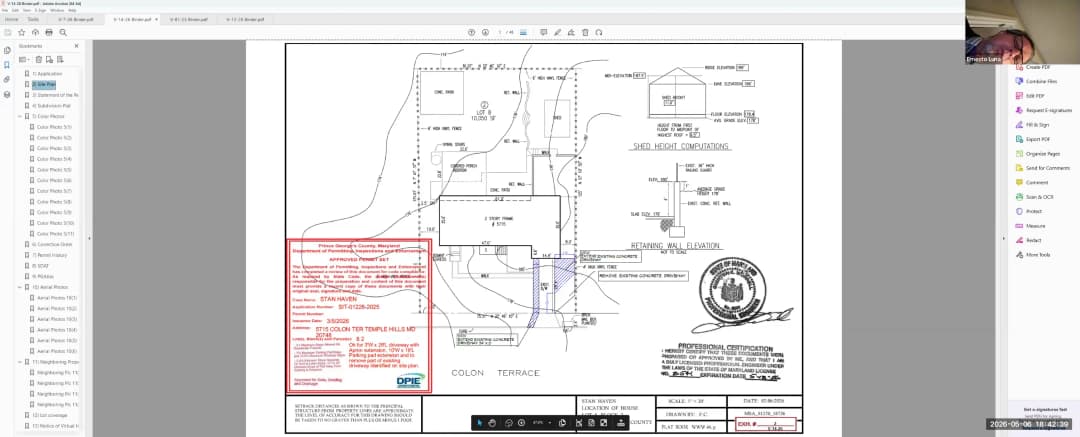
The Prince George's County Board of Appeals held a virtual hearing at 6:00 PM on May 6, 2026. The board considered three variance applications and one zoning appeal, all related to property modifications. The meeting was chaired by Chair Bulware, with Vice Chair Johnston and Board Member Stanton present. The board approved two variances, denied one, and affirmed a county violation notice. The meeting adjourned at 8:17 PM. Consent Calendar - Minutes from April 22, 2026: Approved unanimously (3-0). Public Comments & Testimony - V-14-26 (Arevalo): Neighbors Edith Moore and Karen Ross testified in opposition. Moore cited unauthorized modifications, room rentals, and safety concerns; Ross argued the driveway widening would create a safety hazard and eyesore. Applicant's daughter Marisa Arevalo testified in support, stating the driveway was damaged and that neighbors were unfriendly. - V-12-26 (Jones): Neighbors Edward Stonework and Cheryl Johnson testified that the Jones' fence encroached on their properties. Stonework presented surveys showing encroachment of up to 9.4 feet (later reduced); Johnson presented a survey indicating 7 feet of encroachment. Discussion Items - V-7-26 (Cardenas): Kenia Cardenas requested variances of 1,500 sq ft net lot area, 15 ft lot width, 8 ft front yard depth, and a parking waiver to validate an existing driveway extension. Inspector Swan confirmed a site road approval was on file. The board noted the property was subdivided in 1941 and has extreme narrowness and sloping. No public opposition was heard. The variance was approved. - V-14-26 (Arevalo): Blanca Arevalo requested variances for net lot area, lot width, lot coverage, and a waiver for an unauthorized driveway extension (3'x28' extension and 10'x18' parking pad). She stated she repaired a damaged driveway to address water runoff and was unaware of permit requirements. Her daughter testified that neighbors were unfriendly. Inspector Swan described the work as an extensive expansion, not a simple repair, and noted potential runoff impacts. The board concluded the difficulty was self-inflicted and that strict application of zoning provisions would not cause peculiar hardship, especially given opposition from neighbors. The variance was denied. - V-81-25 (Mukum): Donatus Mukum requested variances of 656 sq ft net lot area, 4.8 ft lot width, and 12.2% lot coverage to validate existing conditions and build a roof over an existing masonry porch. Architect Jonathan Campbell explained that the contractor failed to obtain permits and the lot occupancy was already exceeded. The city of Capitol Heights submitted a letter of support. No public opposition. The variance was approved. - V-12-26 (Jones): Glenn and Muriel Jones appealed a violation notice requiring them to move a 6-foot fence that the county determined encroached on neighboring properties. The county presented an independent survey showing 4.3 and 6.7 inches of encroachment. The Joneses argued their own survey (by Soltez) placed the fence entirely within their property, and they submitted a woodland conservation plan that they claimed confirmed the fence's location. Chief Inspector Bridingham noted Soltez declined to re-survey with county witnesses. The board found the county's independent survey credible and affirmed the violation notice. Key Outcomes - V-7-26: Motion to approve (made by Vice Chair Johnston, seconded by Member Stanton). Carried 3-0. - V-14-26: Motion to deny (made by Member Stanton, seconded by Vice Chair Johnston). Carried 3-0. - V-81-25: Motion to approve (made by Vice Chair Johnston, seconded by Member Stanton). Carried 3-0. - V-12-26: Motion to affirm the county's violation notice (made by Vice Chair Johnston, seconded by Member Stanton). Carried 3-0. - Minutes: Approved 3-0.
This was the inaugural meeting of the Black Maternal Health Fund Advisory Group, established by CR99 2025. The group met to address the urgent need to allocate the remaining $250,000 in the Black Maternal Health Fund before the end of the fiscal year (June 30, 2026). Key participants included Dr. Diane Young (Health Department), Ariana Beat (Council Legislative Director), Dr. Lewis (UM Capital Region Medical Center), representatives from Child Resource Connect (Jennifer Iverson, Tamara, Natalie Coward), and committee staff. The group discussed potential uses of the funds and outlined next steps for finalizing recommendations. Discussion Items - Funding Urgency and Constraints: Dr. Young explained that the fund is a lapsing appropriation; funds must be spent (not just encumbered) by June 30. She noted that many community-based organizations lack existing county contracts, making it difficult to disburse funds quickly. She proposed using a prime contractor (HCDI) that already has a contract with the county to subcontract with multiple organizations, thereby rapidly expending the money. - Potential Expenditure Ideas: The group brainstormed a wide range of spending options: - Doula Services: Dr. Young recommended using up to $10,000 to cover two months of salary and fringe for a doula the Health Department had already identified. - Postpartum Education Series: Online/web-based sessions contracted through a vendor. - Tangible Items: Blood pressure cuffs for every delivering patient (Dr. Lewis advocated for universal distribution), postpartum kits, and other equipment. - Mental Health Support: Contracts with a bilingual therapy provider (McGuire Therapy) for group and individual sessions, including childcare and transportation (e.g., Uber codes) for participants. - Language Access: Funding for language lines or interpreters. - Childcare/Respite: Providing childcare during sessions to remove barriers. - Awareness Campaign: An event or campaign to promote existing maternal health resources in the county. - Barriers to Rapid Spending: Jennifer Iverson (Child Resource Connect) noted that her organization is already strained financially, awaiting payment from the county, and cannot take on cost-reimbursable work without upfront funding. She suggested that a prime vendor like HCDI could hire staff and manage subcontracts to overcome this. - Legal and Procurement Considerations: Ariana Beat confirmed that funds must be paid out for goods/services by June 30, not merely encumbered. Dr. Young noted that while the legislation requires funds go to nonprofits, the current budget line item was labeled a "maternal health program" rather than a fund, providing some flexibility for the Health Department to directly use the money (e.g., for the doula) after consulting with Chair Oriata. - Future Planning: The group discussed avoiding similar timing issues in FY27 by planning earlier. They also noted the existence of a separate maternal health work group (also created by CR99 2025) that can continue making recommendations regardless of fund availability. Key Outcomes - The group agreed to compile a comprehensive list of spending recommendations, with Dr. Young taking the lead to document ideas and send them to Ariana Beat for review by Chair Oriata (who was absent). - A follow-up meeting will be scheduled for the week of May 6–7 (or as soon as possible) to vote on final recommendations. Because the group operates under Robert's Rules and votes must be public with cameras on, an electronic vote was not feasible. A doodle poll will be circulated to find a time. - The group emphasized the need to prioritize Prince George’s County-based organizations and to ensure equity and community needs are met.
The Prince George's County Council, sitting as the Committee of the Whole, convened on Tuesday, May 5, 2026, at 1:53 PM and adjourned at 3:26 PM. The meeting included budget worksessions for multiple agencies, the deferral of a resolution on the FY27 Annual Action Plan (CR-022-2026), and discussion and a vote on a contract approvals resolution (CR-036-2026). Council Member Fisher took a point of personal privilege to commemorate the birthday of her late friend, Mr. Joseph Lin Kitchen. Budget Worksession - Redevelopment Authority (BU 2026-16) - Staff presented the FY27 CIP overview: the Redevelopment Authority manages seven projects totaling $20.5 million within a $207.6 million portfolio, with 65.8% of funding from the state. Key projects include Chevrolet development (accelerated), county revitalization, and the old Fairmount High School site. Delayed projects include Addison Road/Capitol Heights, Glen Arden, Suitland Manor, and Upper Marlboro. - Executive Director Perry Paylor noted two groundbreakings and a grant award expected in the next four to six weeks. Aviation Landing is in preliminary plan review (submission expected mid-July). RFP for 6700 Riverdale Road was issued April 24 with responses due July 10. The Addison Road/Capitol Heights project has closed and is being removed from the delayed list, with a groundbreaking anticipated at the end of May. The Chevrolet site preliminary plan hearing is scheduled for May 14. Budget Worksession - Revenue Authority (BU 2026-27) - Staff reported no new capital funding for FY27. Highlights include Suitland Scattered Sites (largest initiative), Creative Suitland (demolition anticipated FY27), and the Agricultural Food Security Innovation Center feasibility study (ongoing, ends February 2027). - Executive Director Judith Danso discussed public safety (parking management division) and economic development (Suitland, Bowie State University project solicitation). Discussion covered a joint MOU with Redevelopment Authority and the commercial vehicle parking lot, with a task force focusing on data-driven site selection (districts 5-7, non-residential zones). Council Member Burroughs requested a meeting about redevelopment in District 8. Budget Worksession - Office of Information Technology (BU 2026-31) - Staff presented an $11 million total project cost for FY27, with $3 million allocated for strategic IT initiatives. Director Vennard Wright noted a balanced approach using evaluation criteria to prioritize projects across government. Budget Worksession - Prince George's Community College (BU 2026-17) - Staff reported a proposed CIP budget of $2 million (all Geo Bonds): $1.5 million for college improvements (Largo campus) and $500,000 for the new Southern Campus site in Clinton (250 acres owned, curriculum to be determined). - President Dr. Falecia Williams highlighted the Southern Campus as a 50-year aspiration, requiring seed money for analysis. Budget Worksession - Memorial Library System (BU 2026-18) - Staff presented a $6.565 million CIP budget: $1.3 million for Hillcrest Heights branch replacement (construction expected FY2030), remainder for standard renovations. - CEO Dr. Mark Winston discussed three pipeline projects. Council Member Fisher expressed frustration about the Langley Park Library (urging a land transaction this calendar year) and raised concerns about library worker pay (UFCW collective bargaining mediation). Chair Oriadha and Vice Chair Olson previously met with leadership to clarify funding for pay increases. Budget Worksession - Department of the Environment (BU 2026-49) - Staff reported total project costs of $358.2 million for six projects. The FY27 CIP is $2.0 million for the organic facility (scales, bunker systems, wood turnover replacement, fire suppression tanks). No funding for the North County Animal Shelter (cost increased from $7.1M to $18.8M). The solid waste fund has a structural deficit (unrestricted balance projected at -$92.5 billion in FY27). Stormwater and water quality funds also have deficits; no fee increases have been enacted. The landfill gas-to-energy P3 project is in solicitation. - Director Dr. Samuel Moki noted the fee issue requires political will; surrounding jurisdictions have raised stormwater fees. The county is on track to meet state water quality mandates. Council Member Olson inquired about hot stones at the animal shelter—Director Moki was unaware and will look into it. Budget Worksession - Department of Public Works & Transportation (BU 2026-50) - Staff presented a $2.2 billion total CIP (53 projects) with $150.1 million in FY27 expenditures. No new or deleted projects. Highlights include: Green Street Improvements accelerated; Sunday bus service launching June 2026; pavement condition index data collection; thin lift pilot for cul-de-sacs; and a $25.5 million baseline for road rehabilitation. - Director Mike Johnson emphasized a "fix it first" approach, leveraging external funding (only one-third from county Geo Bonds). Sidewalk assessment data is being cleaned (1,878 miles of sidewalk). Bus shelter partnership with Arts and Humanities Council is near construction. Council Member Dernoga requested the road paving list (Director Johnson will resend). Budget Worksession - Fire/EMS Department (BU 2026-48) - Staff reported a $4.67 million FY27 capital expenditure budget across four projects (total project cost $105 million). Projects include Hydesville Station 801 and systemwide renovations (structural, mechanical, plumbing, roofs, storage tanks). - Chief Deputy BJ Harris noted 17 county-owned and 27 volunteer-owned stations. Council Member Olson raised HVAC issues at Riverdale Heights volunteer fire department; Harris will add to the list. Legislation - CR-036-2026: Contract Approvals - This resolution, introduced May 5, approves multi-year contracts (goods/services over $500,000; personal services over $100,000) for FY27. Staff noted the list was received at 4:00 PM on May 4, prompting concerns about timing and transparency. Several contracts were listed as "TBD" (to be determined) vendors; administration clarified those represent budget allocations for future solicitations, and approved contracts will return to the council. - Associate Council Administrator Karen Zavakos outlined the legal process: the April 1 deadline for transmittal was missed; the council has the option to move the resolution with no recommendation to allow a public hearing and maintain the budget adoption schedule (now May 27). Chair Oriadha noted the council has authority to disapprove any or all contracts. Key Outcomes - No votes were taken on any budget worksession items; all budgets were discussed only. - CR-022-2026 (FY27 Annual Action Plan) was deferred and removed from the agenda. - The additions package (including CR-036-2026) was accepted by a 6-0 vote (Oriadha, Olson, Blegay, Burroughs, Dernoga, Ivey aye; Adams-Stafford, Fisher, Harrison, Hunter, Adams absent). - CR-036-2026 was reported out of committee with no recommendation by a 6-0 vote (Oriadha, Olson, Burroughs, Dernoga, Ivey, Adams aye; Adams-Stafford, Blegay, Fisher, Harrison, Hunter absent). This allows a public hearing on May 26 and a final budget adoption vote on May 27. - The meeting adjourned at 3:26 PM by unanimous vote.
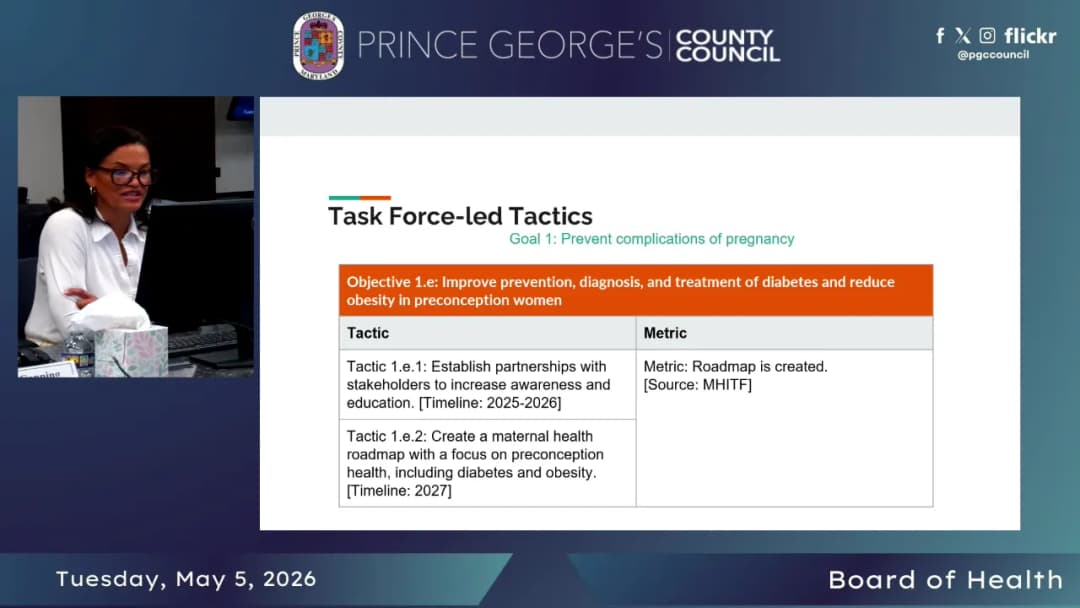
The Prince George's County Council, sitting as the Board of Health, convened on Tuesday, May 5, 2026, at 11:43 a.m. in the Council Hearing Room in Largo, Maryland. The meeting focused on a single briefing item: the Maryland Maternal Health Improvement Strategic Plan, presented by Dr. Donna M. Neale, Chair of the Maryland Maternal Health Improvement Task Force. The meeting adjourned at 12:38 p.m. Discussion Items - Opening Remarks & Staff Introduction: Chair Krystal Oriadha highlighted the importance of maternal health, especially Black maternal health, and referenced transformative legislation passed in 2025. Senior Advisor to the Board of Health, Anya Makarova, provided context on maternal and infant health disparities in Prince George's County, noting that Black and Hispanic mothers are most likely to give birth with late or no prenatal care. She introduced Dr. Diane Young and Dr. Andrew Ballard from the Prince George's County Health Department, and Jennifer Iverson from Child Resource Connect, which conducts approximately 700 home visits annually through a postpartum home visiting program at University of Maryland Capital Region Health. - Presentation by Dr. Donna M. Neale: Dr. Neale presented the Maryland Maternal Health Improvement 2025 Strategic Plan on behalf of the state task force. She reviewed maternal mortality rates (MMR) over three time periods: - 2009–2013: U.S. MMR 19 per 100,000 births; Maryland 24.5 per 100,000. - 2014–2018: U.S. 21 per 100,000; Maryland dropped to 18.4 per 100,000. - 2019–2023: U.S. 24 per 100,000; Maryland 21.4 per 100,000. Disparities persist: Black non-Hispanic mothers in Maryland have significantly higher MMR than white non-Hispanic mothers across all periods. The leading cause of pregnancy-related deaths is behavioral mental health conditions. Severe maternal morbidity rates (per 10,000 deliveries) show increasing trends for Black, Hispanic, and Asian/Pacific Islander women. The task force developed a strategic plan with four goals: 1) prevent complications of pregnancy; 2) improve maternal mental and behavioral health; 3) support women and families with comprehensive services; 4) improve data collection and utilization. Objectives include increasing postpartum care attendance (two visits within 12 weeks), creating a preconception health roadmap, and training the perinatal workforce in mental health support. Metrics and tactics are defined for each objective. The task force is leading four tactics and partnering on six others. Key initiatives include convening stakeholders to ensure two postpartum visits, developing a maternal health roadmap (building on the Maryland Maternal Resource Map), and conducting a needs assessment for perinatal mood and anxiety disorder treatment. Key timeline: July 2026 – first draft of work plans; October 2026 – second draft; January 2027 – final plan; then two years of implementation; analysis by July 2030; reporting to federal government by end of 2030. - Council Member Questions and Comments: Vice Chair Eric Olson asked about postpartum depression follow-up. Dr. Neale emphasized training the perinatal workforce to identify and refer. Council Member Jolene Ivey shared personal experience with home visiting programs and asked about investment levels across jurisdictions. Jennifer Iverson noted that Frederick County invested $5–8 million in ARPA funds into postpartum home visiting, and that the Family Connects program costs $700–900 per family. Council Member Shayla Adams-Stafford inquired about using technology (hotlines, tele-visits) for postpartum support, education for partners on postpartum depression, pain management in hospitals, and preconception fitness programs. Dr. Neale responded that technology must be used critically (e.g., live human interaction vs. robocalls) and highlighted a postpartum hypertensive program at University of Maryland Capital Region that reduced readmissions by 30% and is exploring tele-visits. Dr. Neale also supported ideas for retreat-style postpartum stays and community-building initiatives. Chair Oriadha noted a Mother's First initiative in the county, a Black Maternal Health Bill of Rights passed in 2025 with $250,000 investment, and advocacy for more state-level funding. Key Outcomes - The briefing on the Maryland Maternal Health Improvement Strategic Plan was presented and discussed. No formal votes were taken on the plan. - Council members expressed support for collaboration and alignment with county-level advisory board efforts. - A motion to adjourn was made by Vice Chair Olson, seconded by Council Member Hunter, and carried unanimously at 12:38 p.m. - The council planned to convene in executive session after the meeting. - Next steps include ongoing advocacy for funding, potential expansion of home visiting programs, and alignment of county resources with state strategic plan objectives.
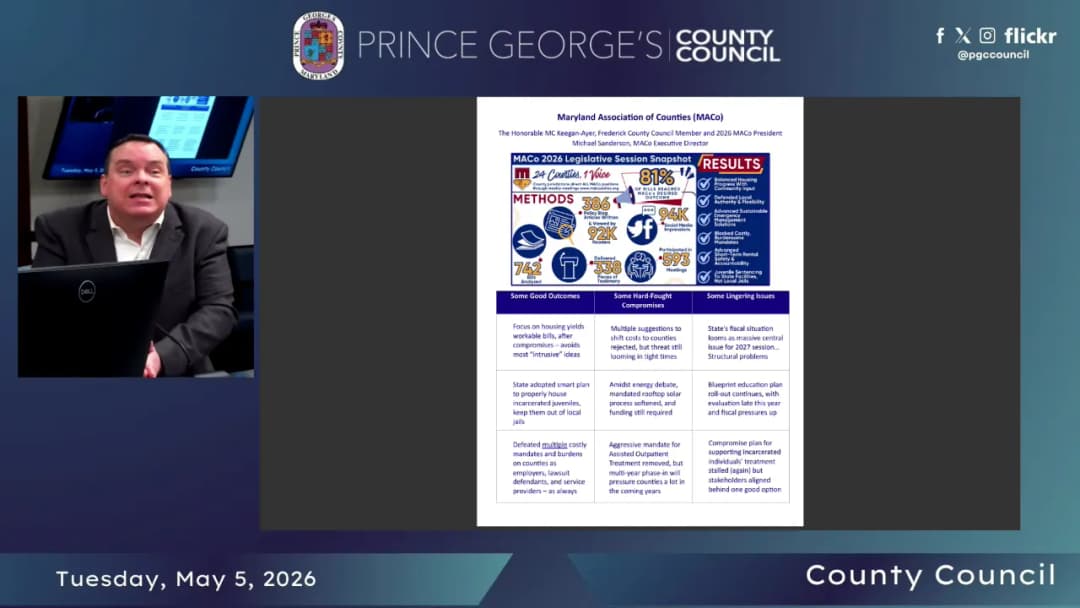
The Prince George's County Council met on Tuesday, May 5, 2026, starting at 10:00 AM and reconvening after a recess at 3:33 PM. The meeting covered consent agenda, second readings, a public hearing, resolution adoptions, a briefing from the Maryland Association of Counties (MACo), an executive session, and final correspondence. Key actions included enactment of a motor vehicle takeover bill and appointment of an Integrity and Compliance Officer. Consent Calendar - Approved the minutes of the April 28, 2026, regular meeting and the 6 PM session. - Presented and referred CB-038 (Impersonation of Utility Companies and Government Agencies) to the Public Safety, Health and Human Services Committee. - Presented and referred CB-039 (Election Day Holiday) to the Government Operations and Fiscal Policy Committee. - Introduced CR-033 (Quantum Science Workforce Development) and referred it to the Education and Workforce Development Committee. - Introduced CR-034 (Stop Sign Monitoring Systems – City of New Carrollton) and referred it to the Transportation, Infrastructure, Energy and Environment Committee. - Introduced CR-036 (Contract Approvals) and referred it to the Committee of the Whole. The consent agenda was adopted by a vote of 11-0. Public Comments & Testimony - Hamani Wilson (Fort Washington resident) described a flooding problem caused by city drain pipes, stating that repeated reports to 311 over years led to delayed action and ongoing damage to his home’s foundation. He requested assistance and raised broader concerns about resident communication and resolution for similar issues. - Sherman Hardy (community member) accused county government of nepotism, cronyism, and lack of transparency, citing specific examples including councilmember family appointments, campaign donations, and the absence of a county auditor for 176 days. He called for accountability. Discussion Items - Second Reading of CB-020 (Pre-Application Neighborhood Meetings – Transparency in Land Use): The PHED Committee report noted that the bill requires the Planning Department to publish a searchable online database of pre-application meeting notices and ensure ADA accessibility. The committee voted 4-0 favorably with amendments. The bill was introduced with multiple co-sponsors. - Second Reading of CB-025 (Responsible Pet Ownership Act): The TIEE Committee reported that draft two removes the term "custodian" from the licensing ban and increases civil fines to a range of $1,000 to $5,000 per violation, with waiver provisions. The committee voted 4-0 in favor. The bill was introduced with multiple co-sponsors. - CB-030 (Charter Amendment – Repeal At-Large Council Members): The chair announced the item was deferred from the agenda. - Public Hearing on CB-012 (Motor Vehicle Takeovers and Unlawful Speed Contests): No one signed up to speak. The public hearing was held. Council Member Fisher moved enactment, seconded by Vice Chair Olson. The bill was enacted with a vote of 10-0 (Council Member Burroughs absent). Council members praised the legislation as a regional first to address safety concerns. - Resolutions CR-025 (District Council Rules) and CR-026 (County Council Rules): After committee reports, CR-025 was substituted with draft two (10-0) and then adopted (10-0). CR-026 was adopted (10-0). Both create a limited exception for excused absences in unforeseen urgent circumstances while allowing remote participation. - Introduction and Adoption of CR-035 (2013 Central Branch Avenue Corridor Revitalization Sector Plan – Minor Master Plan and Sectional Map Amendment Initiation): The Council suspended the rules (10-0) and then adopted the resolution (10-0) to initiate amendments incorporating the Medical Innovation Campus Feasibility Study and remove policies already inserted in the 2014 Southern Green Line Station Area Sector Plan. - MACo Annual Visit Briefing: MC Keegan-Ayer (MACo President, Frederick County Council Member) and Michael Sanderson (MACo Executive Director) presented on state fiscal challenges, including a projected $2.5 billion structural deficit for FY28, teacher pension cost shifts to counties, and the disparity grant program. Discussion covered housing affordability, energy grid pressures from data centers, and child care costs. Council members asked about GDP growth (Maryland ranks among slowest), energy generation, microgrids, and accessory dwelling units. No formal action was taken. - Executive Session (1:33 PM – 1:41 PM): The Council met in closed session under §3-305(b)(1)(i) to discuss the appointment of the Integrity and Compliance Officer. A subsequent vote (9-0) appointed Curtis Carr, Jr. to that position for Prince George’s County Public Schools. Key Outcomes - Enacted CB-012 (Motor Vehicle Takeovers and Unlawful Speed Contests) with 10-0 vote (Burroughs absent). - Adopted CR-025 (District Council Rules of Procedure) with 10-0 vote after substituting draft two. - Adopted CR-026 (County Council Rules of Procedure) with 10-0 vote. - Adopted CR-035 (Central Branch Avenue Corridor Plan Amendment Initiation) with 10-0 vote after suspending rules. - Appointed Curtis Carr, Jr. as Integrity and Compliance Officer for Prince George’s County Public Schools by a 9-0 vote in executive session. - Authorized a letter to the County Executive and Board of Education Chair transmitting the appointment (vote 6-0). - CB-030 (Charter amendment) was deferred to a later date.
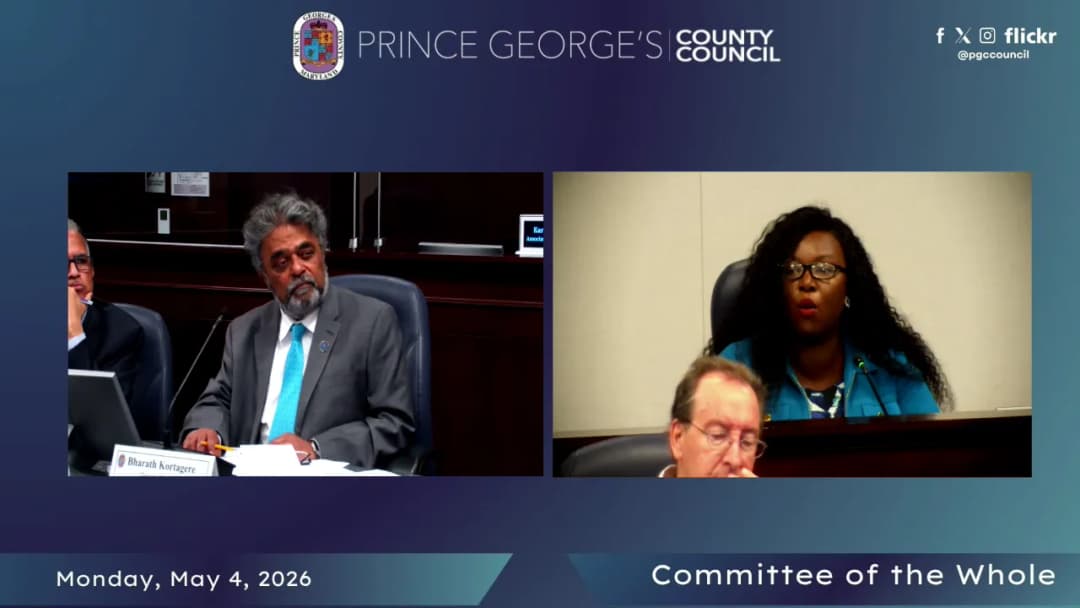
The Prince George's County Council, sitting as the Committee of the Whole, convened on Monday, May 4, 2026, at 1:51 PM (scheduled for 1:30 PM) and adjourned at 3:21 PM. The meeting included a briefing on the PGCPS Strategic Plan Update and budget worksessions on the Capital Improvement Program (CIP) for the Office of Central Services (OCS) and the Health Department. No votes were taken on the budget items; the meeting adjourned with a unanimous vote. Discussion Items PGCPS Strategic Plan Update - Dr. Shawn Joseph, Interim Superintendent, presented the "Forward by Design: Acceleration 2029 Strategic Plan," which aims to scale excellence system-wide through disciplined focus on high-quality instruction, equity, and resource alignment. The plan was informed by extensive community engagement, including surveys, focus groups, and 22,000 student voices. Key priorities include: student success (literacy, math, special education, multilingual learners), staff and leaders (talent pipelines, professional development), expanding access to programs (dual enrollment, career credentials), family partnerships, and organizational culture. - Council members asked questions and expressed positions: - Councilmember Adams-Stafford praised the literacy focus and inquired about HR pipeline challenges. Superintendent Joseph noted a new HR director and earlier hiring practices but acknowledged ongoing budget constraints. - Councilmember Fisher requested data on truancy, with Dr. Collins reporting highest truancy at high school level and a root-cause approach. - Councilmember Ivey raised concerns about specialty programs; Dr. Joseph clarified that immersion programs at Paint Branch, Greenbelt, Largo, and Capital Heights were resolved with board funding, but some IB programs were eliminated due to low enrollment and cost-ineffectiveness (less than 100 students for $3 million). Dr. Joseph emphasized shift to dual enrollment at all high schools. - Councilmember Burroughs supported the data-driven decision regarding IB versus dual enrollment. - Councilmember Adams focused on mental health and wellness; Dr. Joseph highlighted telehealth, anti-bullying programs, and a grant from Children's National Hospital. - Councilmember Harrison pressed on fiscal sustainability, with Dr. Joseph warning of a $100 million budget gap next year and a structural deficit; he noted lack of actuarial projections and suggested hiring a specialist ($250,000). - Councilmember Fisher emphasized equity in specialty programs, ensuring benefits reach students in the community. - Councilmember Dernoga discussed cost-streamlining for immersion; Dr. Joseph explained challenges with whole-school programs but confirmed resolution. - No vote was taken; the discussion was held for informational purposes. Budget Worksession - CIP for Office of Central Services - Sylvia King, Senior Legislative Budget Officer, presented the FY 2027–2032 CIP overview: total $4.1 billion for 359 projects (18 fewer than previous cycle). OCS CIP: $1.4 billion for 56 projects, including corrections, police, fire/EMS. New projects: public safety infrastructure, community recreation renovations, and local government energy modernization. Three project delays: District 6 police station, Laurel Fire/EMS 849, and Shepherd School Family Shelter. Two projects on hold: Warm Nights Homeless Shelter (due to community opposition in Brentwood) and Oxon Hill Fire/EMS (debt affordability). - Director David Byrd and Deputy Director Bharath Kortagere addressed questions: - Councilmember Harrison urged finding alternatives for Warm Nights, suggesting southern county sites. Staff noted feasibility studies underway (Brentwood, possible fire station on Addison Road). - Councilmember Oriadha requested stakeholder engagement for any seat Pleasant fire station activation, not to proceed without community input. Staff committed to collaboration. - Councilmember Ivey suggested adding capacity at Shepherd's Cove shelter; staff confirmed exploring expansion (family shelter, women's shelter, kitchen). - Councilmember Dernoga sought data on total homeless bed needs; staff deferred to Health and Human Services but estimated 1,000 unsheltered from point-in-time count. He also raised concerns about hotel-based shelter in his district and economic impact. - Councilmember Dernoga asked about District 6 police station status; staff reported ongoing negotiations with Conterra and temple group for land, and noted a potential purchase of a building on Ammendale Road ($8.6 million). - No vote was taken. Budget Worksession - CIP for Health Department - David Noto, Budget and Policy Analyst, presented the Health Department's proposed CIP: FY 2027 budget of $9.14 million, total project cost $125.9 million over six years, with four projects (over 99% from general obligation bonds). Projects include upgrades to Dyer Regional Health Center (security, plumbing, HVAC) and Cheverly Clinic (electrical repairs). - Dr. Toyin Opesanmi, Health Officer, and other officials were present for questions. No council members had questions, so the presentation concluded. - No vote was taken. Key Outcomes - No votes were taken on the PGCPS Strategic Plan Update or the CIP worksessions; all were discussion only. - Council members were reminded to submit any new CIP projects for the budget by the end of the day. - The meeting adjourned at 3:21 PM via a motion by Vice Chair Olson, seconded by Councilmember Dernoga, which carried unanimously.
The Planning, Housing and Economic Development (PHED) Committee of the Prince George's County Council held a budget worksession on Monday, May 4, 2026, at 10:15 AM (called to order at 10:15 AM) in Committee Room 2027. The meeting focused on the Maryland-National Capital Park and Planning Commission (M-NCPPC) FY2027 budgets for the Commissioner's Office, Central Administrative Services (CAS), and the Planning Department. Chair Wala Blegay presided, with Vice Chair Krystal Oriadha, Council Members Thomas Dernoga, Eric Olson, and Shayla Adams-Stafford (arrived at 10:26 AM) present. Staff and commission leadership presented the budget overview, followed by committee questions and discussion. No public testimony was heard. The committee did not vote on the budget; the meeting was adjourned by a unanimous motion. Discussion Items - Budget Overview: Committee Director Rana Hightower presented the staff review. Total FY2027 revenue for the Administration Fund is projected at $88.02 million (8% increase, $6.56 million over FY2026). Proposed expenditures are $98.6 million (16% increase, $13.68 million over FY2026), driven by a one-time capital projects fund transfer. The budget uses $10.68 million from fund balance to cover the shortfall. The Commissioner's Office requests $6.3 million (58% increase, $2.33 million) for 9 new positions. CAS requests $28.9 million (1% increase, $15.2 million county share). The Planning Department requests $57.371 million (no net increase from FY2026, but adds 18 positions) and proposes three new divisions (Design, Placemaking, and Policy; Natural and Cultural Resources Planning; Multimodal Transportation and Facilities) while eliminating the countywide planning division. The Planning Department continues to struggle with vacancies (49 vacancies as of June 30, 2025, up from 26 in FY2024) and underspends contractual services by over $2.5 million annually. - Project Charges and County Executive's Letter: Council Member Olson and Dernoga questioned the proposed reduction of project charges (e.g., zoning enforcement, DPI permits, DPW&T engineering) from FY2026 levels back to FY2025 levels, totaling roughly $7.5 million. The county executive's April 1 letter recommended restoring the $5.5 million decrease. Commission representatives stated the FY2026 increases were seen as one-time adjustments and that they were not comfortable with the new values without further validation. Council Member Dernoga noted that if approved, the county would have to absorb the costs. The committee discussed the lack of prior agreement with the county executive on the reductions. - Fund Balance and Projections: Council Member Dernoga observed that the commission's conservative budgeting led to a smaller-than-expected fund balance drawdown ($10 million versus $30 million anticipated) and that the trend of adding $5-7 million to fund balance is expected to continue. He suggested that room exists to accommodate some project charges within the current budget. - Agricultural Programs and Land Access: Council Member Dernoga raised concerns about the commission's agricultural land being underutilized for minority farmers. Acting Planning Director James Hunt described ongoing work with the University of Maryland Extension, Soil Conservation District, and others to develop a food systems planning program that will increase access to land and fresh produce, including potential partnerships with the Department of Parks and Recreation. Chairman Barnes added that the commission is exploring a butcher shop and other initiatives. - Housing Pipeline and Entitlements: Council Member Dernoga and Chairman Barnes discussed the large gap between approved housing units (395 entitlements since 2023) and actual construction. The planning department is reaching out to developers to identify barriers (funding, tariffs, permitting process). Interns are analyzing the data. The department aims to streamline the development review process, and a white paper with recommendations is expected later in May. - New Positions and Planning Department Restructuring: Council Member Adams-Stafford asked about skill gaps the new positions would fill. Director Hunt cited needs in human resources, fiscal/procurement, urban design studio (to improve design review), and support for the county executive's permit rapid response team. The department is also assigning planners per district to assist with master plan implementation and cross-agency coordination. - Recreation Center Funding and Services: Vice Chair Oriadha expressed concern that the budget prioritizes top-level positions and vanity projects (e.g., the $195 million building) over basic services like recreation center hours, free swimming classes, senior field trips, and transportation for after-school programs. She noted that many rec centers lack microphones, have reduced weekend hours, and that her office funds programs that should be covered by the commission. Parks and Recreation Director Darius Stanton responded that a system-wide assessment tool is being developed, and that some programs (e.g., free swim classes, senior programming) do exist but may not be well-advertised. He acknowledged the need for better data to align spending with community needs. Chairman Barnes reiterated that the FY2027 budget is his first and that he is open to negotiations, and that the commission is employing nearly 3,000 summer youth workers. Key Outcomes - The committee held a worksession and received extensive testimony from M-NCPPC leadership. No formal vote on the budget was taken. - A motion to adjourn was made by Chair Blegay, seconded by Vice Chair Oriadha, and carried unanimously (5-0). - The committee is expected to consider the budget further at the Committee of the Whole meeting, where changes to reflect council priorities (e.g., restoring project charges, increasing recreation center funding) may be proposed. - Vice Chair Oriadha signaled that the council will make significant changes to the budget to ensure taxpayer dollars directly benefit residents, particularly in underserved communities.