Browse by city
Date range
Search help

Search titles, summaries, topics and stored transcripts together. Keywords may match separately; put the whole query in double quotes for a phrase. Matching follows word analysis, so punctuation is not exact. Both dates are included. Documents are not searched.

SHOWING 161–170 ENTRIES
161
MAY 4, 2026 · PRINCE GEORGES COUNTY, MARYLAND · COUNTY COUNCIL & BOARDS
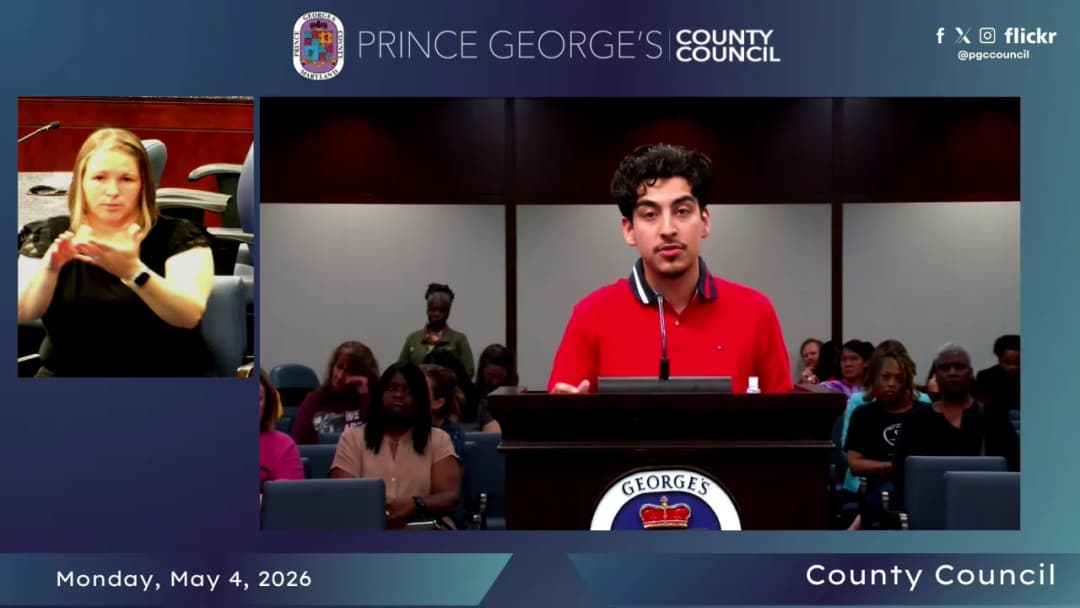
Prince George's County Council Public Hearing on FY 2027 Budget – May 4, 2026

This was the second and final public hearing on the proposed FY 2027 Operating Budget, Six-Year Capital Program (including the Capital Improvement Budget), the Prince George's County Board of Education portion of the FY 2027 Operating Budget, the proposed budgets of the Redevelopment Authority and Revenue Authority, and the Constant Yield Tax Rate. The hearing was convened at 6:18 PM and concluded at 8:33 PM, with 8 of 11 Council Members present. Chair Krystal Oriadha presided. Public Comments & Testimony Over 60 individuals signed up to speak, with a two-minute limit per speaker. Testimony focused overwhelmingly on education funding, along with requests for animal welfare, nonprofit grants, environmental programs, and disability services. Key positions included: - Education Funding (PGCPS): Numerous speakers urged the Council to fully fund the Board of Education's request for an additional $50 million (beyond the $20 million proposed by the County Executive for special education). Speakers included educators, parents, students, and community members. They highlighted the impact of cuts on class sizes, special education services, language immersion and IB programs, teacher staffing, and school facilities (citing an electrical fire at Cesar Chavez Elementary, vermin, mold, and aging infrastructure). Specific speakers: Dr. Donna Christie (PGCEA President) stated the funding shortfall is $30 million after $146 million in cuts; Dr. Annette Jones (PGCEA Vice President) asked for the full $30 million; Piper Kerr (8th grade student) urged full funding; Timothy Meyer argued the county could raise an extra $30 million through a 0.1% income tax increase. Many others echoed these points. - Animal Welfare: Melissa Schweisguth, Lea Shuler, Amy Pergosky, and Jennifer Wells advocated for increased funding for the county animal shelter, including spay/neuter programs, after-hours staffing, and facility improvements (e.g., removing rocks from play yards). - Nonprofit & Community Grants: Representatives from Liberty's Promise (Dr. Robert Ponichtera and several students) requested restoration of a $130,000 non-departmental grant cut for two consecutive years. Yolanda Johnson (CASA Prince George's County) requested support to reduce a waiting list of 40 youth. Ruby Stemmle (Ecolatinos) and Dr. Teresa Ramirez requested grant funding for environmental training and youth summer camps. Edda Richmond (Passion and Compassion) urged food security funding. Kit Slack (Streetcar Suburbs) requested a $60,000 grant for local news. - Disability Services: Jamia Caraway, Jacqueline Randall, and Tina Teasley (speaking with photos) urged increased funding for Direct Support Professionals (DSPs) and services for individuals with intellectual/developmental disabilities. They requested raising DSP funding from $4.6 million to $6.9 million. - Environmental & Infrastructure: Gyasi Gomez (Sierra Club) recommended shifting mowing funds to native vegetation, accelerating green street implementation, and addressing Brandywine Landfill contamination. Many speakers requested road resurfacing, trail construction, and park improvements. Key Outcomes - The public hearing was declared held after all registered speakers testified. - Legislative Attorney Leroy Maddox read into the record a list of potential Capital Improvement Program (CIP) projects for each district (including school rebuilds, road resurfacing, park facilities, and library feasibility studies) – this step is required by charter to allow future negotiation; inclusion does not guarantee funding. - No votes were taken on the budget itself. The meeting adjourned at 8:33 PM by unanimous motion (Vice Chair Olson motioned, Council Member Dernoga seconded). - The Council will now deliberate and adopt the final FY 2027 budget following the public hearing process.

EDUCATION POLICY 37% · PUBLIC WORKS 18% · BUDGET EQUITY ANALYSIS 7% · DISABILITY RIGHTS 6%
162
MAY 4, 2026 · PRINCE GEORGES COUNTY, MARYLAND · COUNTY COUNCIL & BOARDS
Joint Public Hearing on Historic Site Designation for Weinstein House/Harry's Market - May 4, 2026

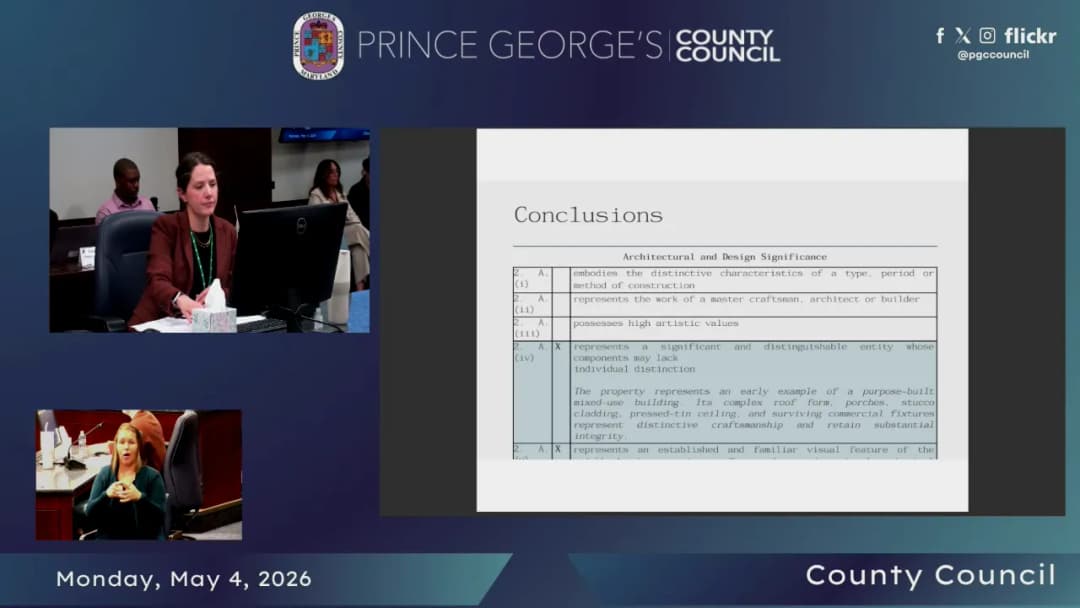
This was a joint public hearing of the Prince George's County Council (sitting as the District Council) and the Prince George's County Planning Board to receive testimony on the proposed historic site designation of the Weinstein House/Harry's Market at 4221 31st Street in Mount Rainier. The meeting was called to order at 5:55 p.m. (agenda listed 5:30 p.m.) and adjourned at 6:06 p.m. Six council members and all five planning board members were present. Staff Presentation - Kacy Rohn, Planner III in the Historic Preservation Section of M-NCPPC, presented a summary of the property's history and significance. The property consists of a mixed-use complex: a commercial store (Harry's Market, built c. 1920) attached to a 2.5-story multi-unit dwelling (Weinstein House, built c. 1924). It is located on a 0.196-acre triangular lot. - Staff concluded that the property meets four of the nine designation criteria under Subtitle 29-104(A): - 1A3: Associated with a group (District Grocery Stores Cooperative) that influenced society. - 1A4: Exemplifies the cultural, economic, and historical heritage of the county (immigrant entrepreneurship, streetcar suburbs, transition to supermarkets). - 2A4: A significant and distinguishable entity whose components may lack individual distinction (purpose-built mixed-use, craftsmanship, integrity). - 2A5: An established and familiar visual feature of the neighborhood (community landmark since at least 1960). - The Historic Preservation Commission held a public hearing on February 17, 2026, and voted 6-0 to recommend designation under those criteria. Public Comments & Testimony - No members of the public signed up to speak, and no oral testimony was offered. Written comments will be accepted through the close of business on Tuesday, May 19, 2026. Key Outcomes - The joint public hearing was declared held after the presentation and the absence of public speakers. - The record will remain open for written submissions until May 19, 2026. - The Planning Board will review the testimony and forward a recommendation to the District Council, which will take final action within two months of receiving that recommendation. - A motion to adjourn by Vice Chair Olson, seconded by Council Member Burroughs, passed unanimously. Note: The meeting date is Monday, May 4, 2026 (per agenda and minutes), though the transcript incorrectly states "Tuesday, May 4th."

HISTORIC PRESERVATION 74% · PROCEDURAL 26%
163
APR 30, 2026 · PRINCE GEORGES COUNTY, MARYLAND · COUNTY COUNCIL & BOARDS
Prince George's County Council Public Safety, Health and Human Services Committee Budget Worksession - April 30, 2026

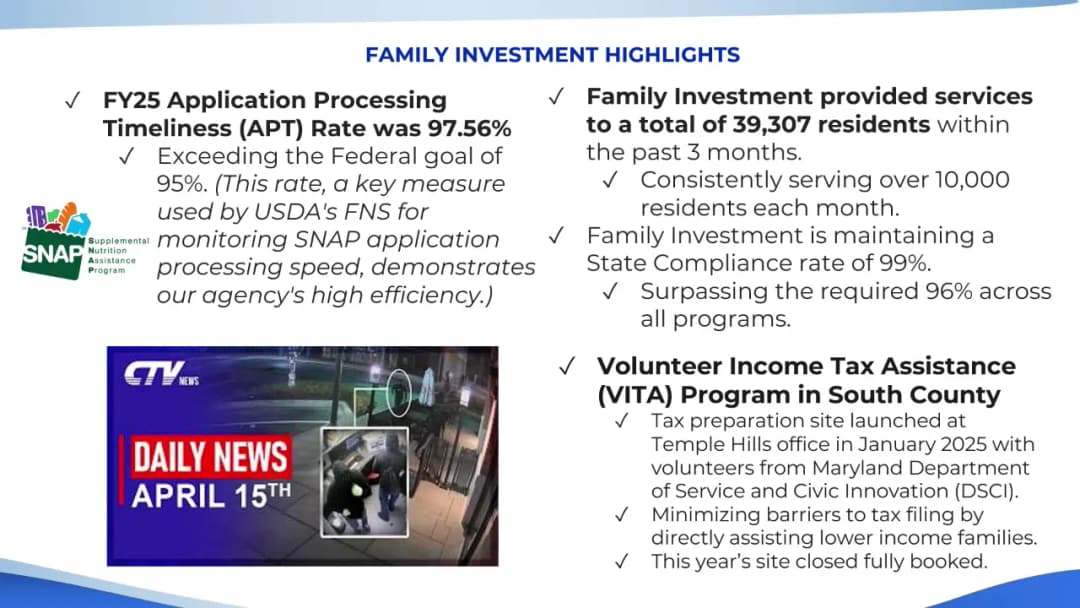
The Public Safety, Health and Human Services Committee of the Prince George's County Council convened on Thursday, April 30, 2026 at 1:42 PM and adjourned at 3:49 PM. The committee held a worksession on the Fiscal Year 2027 proposed budgets for the Administrative Charging Committee, the Fire/EMS Department (including the Volunteer Fire Commission), and the Department of Social Services. No votes were taken on any of the budget items. Public Comments & Testimony - Donald Wells, President of the Prince George's County Volunteer Fire Rescue Association, expressed support for the current fire chief, stating she has been receptive and willing to work with volunteers. He noted that volunteers were overlooked in past administrations. - Chief Janet Tamaran, of Volunteer Marine Fire Rescue, echoed support for the chief and urged the council to address barriers to volunteer recruitment, such as limited evening physicals and insufficient station funding. She emphasized that volunteers need to feel valued. - Grant Walker, President of the Prince George's County Professional Firefighters and Paramedics Association (Local 1619), stated that the budget does not go far enough to hire enough personnel. He noted that roughly 10 firehouses are out of service daily due to staffing shortages, and called for significant investment in personnel, facilities, and apparatus to address the county's growing call volume. Discussion Items BU 2026-46 Administrative Charging Committee (ACC) - The proposed FY2027 budget for ACC is $1.4 million, a 7% decrease from FY2026. The general fund portion is $1.3 million (a 3.4% increase), funding 8 full-time positions. Grant funding compensation decreased 50% due to reductions in violence intervention programs. - Key concerns include vacancies awaiting approval, insufficient funding for administrative law judges, expiring grants, increasing case volume, and cases resulting in reduced penalties. - Director Isabel Williams requested assistance with IT interns to support a new case management system (federal funding sunsets in 2027) and expressed a long-term need for a full-time analyst to identify trends in police misconduct. - The committee noted that one investigator position is vacant and several citizen committee appointments are expiring. BU 2026-48 Fire/EMS Department (including Volunteer Fire Commission) - The proposed FY2027 budget is $325.9 million, a 12.1% increase. 96.8% of funds are from the general fund. The department anticipates a supplemental request of approximately $1.5 million. Staffing increases include 22 civilian positions and 46 sworn positions. There are currently 149 general fund vacancies. - Fire Chief Michelle Liddell highlighted accomplishments including reducing mandatory overtime by shifting 35% of sworn personnel from civilian roles, launching a driver risk intervention program, and increasing recruiting. She emphasized the need for more civilian employees to return sworn personnel to fire stations. - Discussion focused on cross-training for firefighter/paramedics, hiring timelines (currently about nine months), retention through salary and deferred retirement options, and recruitment of volunteers. Chief Deputy BJ Harris noted that 71 members are retirement-eligible in the next 12 months. - Volunteer Fire Commission: The proposed budget is $20.5 million (1.5% increase). There are 36 volunteer corporations with 1,168 volunteer personnel. Concerns include aging facilities, declining volunteer numbers, and equipment replacement. Assistant Fire Chief Michael White noted the LOSAP (Length of Service Award Program) had setbacks but a new administrator was hired. - Council members expressed interest in increasing the sworn complement and addressing disparities in pay and benefits. BU 2026-47 Department of Social Services (DSS) - The proposed FY2027 budget is $27.9 million, a 6.8% decrease primarily due to reduced grants in the Community Services Division. Only 4% of the department's 685 authorized positions are county-funded. - Director Jennifer Omaña Thompson outlined strategic priorities: improving culture, using data, and enhancing partnerships. The department serves about 350,000 residents, with 500 staff across five locations. - Key achievements include exceeding 95% payment timeliness for SNAP, launching an after-hours unit for child/adult protective services, and increasing internship programs. - Vacancies dropped from 39% to 18% in FY2025. Risks from vacancies included staff burnout and quality concerns. - Discussion covered coordination with schools (community advocates in 20 middle schools), services for unsheltered residents, and the impact of federal changes from a "housing first" to a "treatment first" model for HUD funding. The committee urged DSS to provide direct contact for constituent services and to address drug addiction and homelessness on University Boulevard before the Purple Line opens. - The Community Services Division (including homeless shelters and food pantries) is transitioning to the County Executive's Office. Key Outcomes - No votes were taken on any of the three budget items; discussions will inform the full Council's budget deliberations. - The committee will follow up on: an advertisement for citizen committee vacancies for ACC; details on the Volunteer Fire Commission appointments; a strategic plan from DSS regarding changes in federal funding; and a site visit to address homelessness on University Boulevard within 30 days. - The committee expressed interest in increasing the sworn complement for Fire/EMS and exploring parity with the police department on deferred retirement options.

PUBLIC SAFETY 42% · GOVERNMENT OPERATIONS 21% · HOMELESSNESS 12% · PERSONNEL MATTERS 6%
164
APR 30, 2026 · PRINCE GEORGES COUNTY, MARYLAND · COUNTY COUNCIL & BOARDS
Prince George's County GOFP Committee Budget Worksession - April 30, 2026

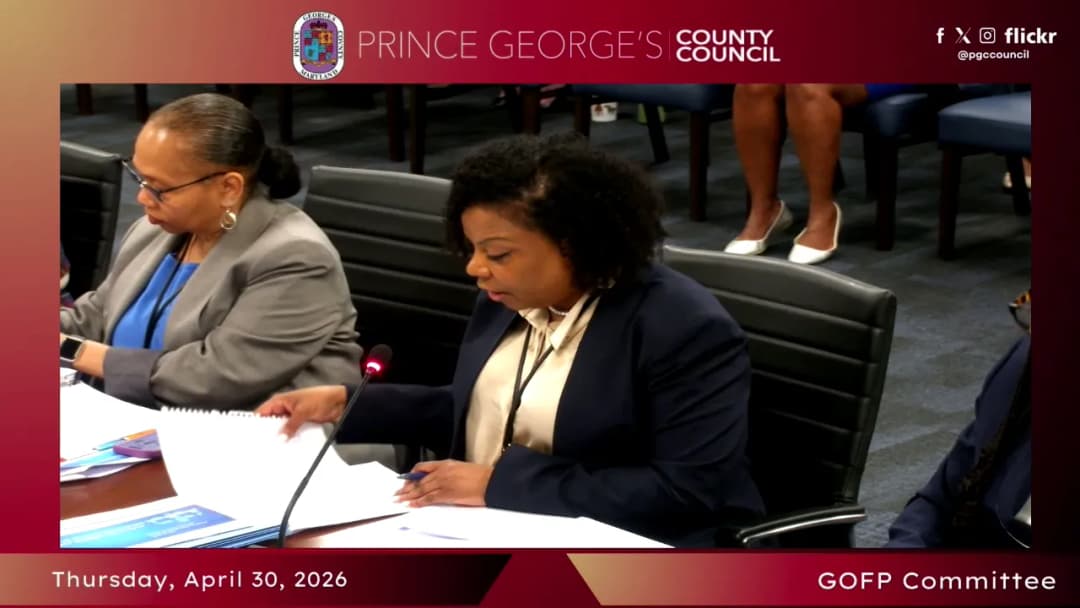
The Government Operations and Fiscal Policy (GOFP) Committee met on April 30, 2026, from 10:00 a.m. to 11:52 a.m. to review proposed Fiscal Year 2027 budgets for five county agencies: Office of Central Services (OCS), Office of Procurement (OOP), Office of Human Resources Management (OHRM), Office of Management and Budget/Non-Departmental (OMB), and Office of Information Technology (OIT). The meeting was chaired by Edward P. Burroughs III, with council members Timothy J. Adams, Wala Blegay, Jolene Ivey, and Krystal Oriadha present. No votes were taken; the session was informational. Discussion Items Office of Central Services (OCS) – BU 2026-35: Director David Byrd and staff presented. The FY27 proposed budget is $47.3 million, an increase of $904,000 over FY26. Key challenges include high retirement-eligible staff (27 vacancies, 9 funded), and recruitment difficulties for specialized positions (e.g., locksmiths, mechanics). OCS is partnering with automotive technical schools to build a talent pipeline. The Capital Improvement Program (CIP) for FY27–32 totals $1.4 billion across 56 projects, with three new projects. The agency manages 135 county-owned buildings, 4,000+ fleet vehicles, and 4.7 million square feet of property. Office of Procurement (OOP) – BU 2026-34: Director Alice Williams and staff presented. The FY27 proposed budget is $7.2 million, a 15.8% increase ($990,000) over FY26, driven by training, contracts, and IT costs. Staffing remains at 39 positions. The office highlighted achievements: centralization of procurement under Executive Order 44-2025, certification of over 1,000 businesses, and creation of a vendor assistance center. The Supplier Diversity program reported 308 county-based and 878 reciprocal certifications. Director Williams noted counseling over 100 vendors personally. Office of Human Resources Management (OHRM) – BU 2026-36: Director Stephanie Bridgeforth and staff presented. The FY27 proposed budget is $10.98 million, up 5.6% ($580,300) from FY26, entirely funded by the general fund. Staffing includes 73 full-time positions. The office reported reducing the average time-to-fill from 104 days in 2023 to 42 days as of March 2026, exceeding the county executive's 40-day goal. The Summer Youth Enrichment Program (SYEP) plans to place 2,126 youth in 2026, with $1 million in non-departmental funding. Council members encouraged exploring partnerships with Parks and Recreation to expand youth employment. Office of Management and Budget/Non-Departmental (OMB) – BU 2026-37: Director Angela Fair Baker and staff presented. OMB's FY27 proposed budget is $5.2 million, an 11.6% increase ($541,300) over FY26. The office manages the county's financial planning, revenue forecasting, and capital improvement plan. Proposed FY27 general fund revenues are $5 billion, up 3.2%. Key revenue sources: outside aid (40% for Board of Education), property taxes (26%), and income taxes ($950 million). The county's bond rating remains AAA from Fitch and S&P, AA1 from Moody's. Non-departmental budget is $500.6 million, including $42 million for school construction, $46 million for retiree benefits, and $218.3 million for debt service. OMB noted a negative fund balance of $215 million, with $10.4 million allocated to reduce it. Debt service is projected to exceed the 8% policy limit in FY28, but the county plans to manage prudently. Office of Information Technology (OIT) – BU 2026-31: Director Vennard Wright and staff presented. The FY27 proposed budget is $69.2 million, a 3.9% increase ($2.5 million) funded by the internal service fund. Staffing includes 75 full-time and 1 part-time positions. OIT outlined five strategic pillars, including strengthening local tech ecosystems, transforming government with AI, and cybersecurity. Key initiatives: SAP HANA migration (by December 2027), ADA compliance for citizen-facing applications (DOJ mandate), and deploying Zscaler for remote access. OIT is partnering with Bowie State University and the Summer Youth Program to host interns, and has hosted hackathons with Microsoft and plans others with AWS and Capital Technology University. Key Outcomes No votes were taken on any of the five budget items; the committee conducted informational worksessions. All budgets will continue through the budget process. The committee received agency presentations and asked clarifying questions on vacancies, youth programs, technology initiatives, and fiscal challenges. Council members expressed appreciation for OMB's work in addressing the structural deficit and for OCS's pipeline programs for skilled trades. The committee plans to remain in communication with agencies throughout the remainder of the budget process. The meeting adjourned at 11:52 a.m. following a motion by Council Member Ivey, seconded by Council Member Blegay.

BUDGET EQUITY ANALYSIS 24% · GOVERNMENT OPERATIONS 19% · PROCUREMENT 10% · WORKFORCE DEVELOPMENT 9%
165
APR 29, 2026 · PRINCE GEORGES COUNTY, MARYLAND · COUNTY COUNCIL & BOARDS
Streamlining Development Review Work Group First Meeting – April 29, 2026

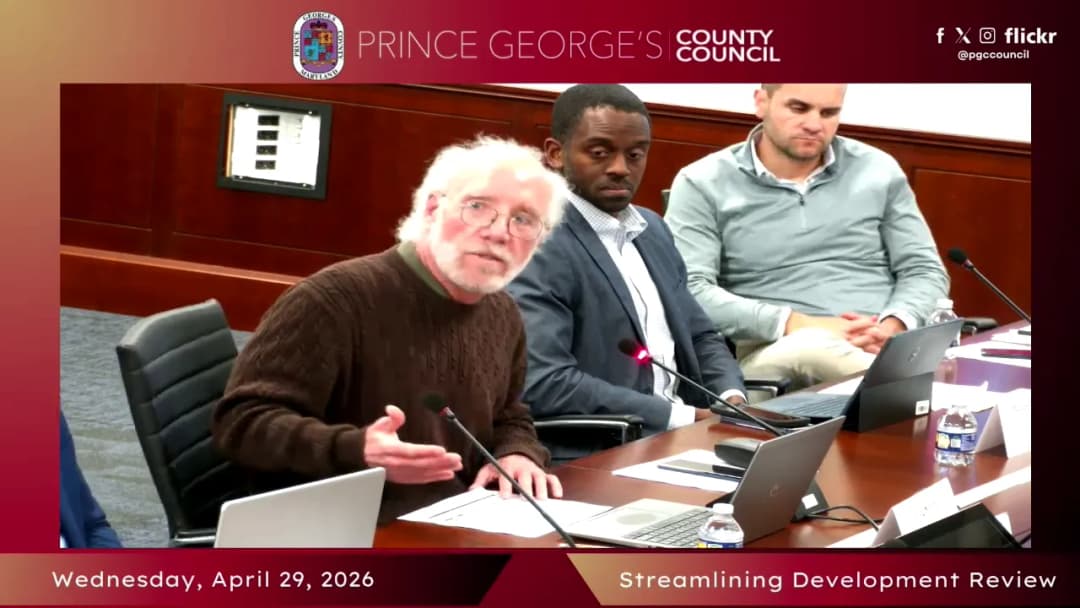
The Streamlining Development Review Work Group convened for its first meeting on April 29, 2026, at 2:00 PM in Committee Room 2027. The meeting was called to order by the Chair, who emphasized the goal of balancing competitive efficiency with community voice. The work group is tasked with producing tangible legislative recommendations within a 30‑to‑60‑day fast‑track timeline, with a target adjournment date of June 26, 2026 (subject to extension). The primary agenda item was an overview of enabling legislation CR‑014‑2026 and a detailed presentation on regional development review processes. Consent Calendar - No consent calendar items were presented. Public Comments & Testimony - Greg Smith (environmental activist) raised concerns about public access to documents, stating that the DAMS (Document Access Management System) often falsely indicates no relevant documents are available. He criticized the “tyranny of the 70‑day calendar,” noting technical staff reports are frequently filed too late for meaningful public review, and urged better transparency and earlier community engagement. - Parker (speaker) asked for details on how community engagement metrics were determined for each jurisdiction and contrasted the limited pre‑application neighborhood meetings in Prince George’s County with the robust, continuous community engagement in Arlington County. - Matthew Tedesco (land‑use attorney) acknowledged that some applicants do conduct genuine community outreach and urged the work group to recognize good actors, not just failures, and to create uniform standards. - Marcus Wannaw (planning department) offered to provide staff to clarify the process flowchart and to share a collection of 260 comments from land‑use attorneys and developers gathered during a February trip. Discussion Items - Overview of Enabling Legislation (CR‑014‑2026): Staff (Josh Hamlin) explained that the resolution formed this work group to review Prince George’s County development review processes and propose solutions. A weekly meeting schedule (virtual after the first in‑person meeting) was discussed and agreed upon. - Regional Development Review Process Analysis (James Campbell): James Campbell, land‑use development specialist for the county council, presented a comparative analysis of five counties: Arlington (VA), Fairfax (VA), Howard (MD), Montgomery (MD), and Prince George’s (MD). Key points included: - Common path: concept, application, agency review, public input, decision, permitting, construction, close‑out. - Arlington County: Collaborative, design‑focused, community‑driven with robust early public engagement; final decisions by elected county board. - Fairfax County: Board‑centric, structured, predictable workflow; moderate public engagement; conditions often drive post‑approval steps. - Howard County: Engineering‑focused, emphasizes environmental protection and stormwater; county council not involved in process. - Montgomery County: Master‑plan‑driven, planning‑board‑centric; projects must align with long‑range plans; parallel reviews to improve efficiency. - Prince George’s County: Two‑layer decision structure (Planning Board and District Council) adds legal complexity; described as linear and compliance‑driven but with moderate iteration and predictability medium. - Timeline and Staffing Comparisons: Several members (Matthew Tedesco, Brad, Parker) requested data on actual processing times, staffing levels, number of agencies involved, and project throughput to understand why Prince George’s process takes 24–36 months despite similar on‑paper steps. - Community Engagement: Members debated how community input is solicited across jurisdictions. The Chair noted that the required pre‑application neighborhood meeting is often the only formal public touchpoint before hearings, and that uniform standards are needed to prevent inconsistency between council districts. - Next Steps and Work Group Logistics: - A recommendations spreadsheet (Google Sheets/Excel) was distributed for members to submit proposals offline. - The group agreed to meet weekly virtually, starting after a survey to prioritize “pain points” in the process. - Future meetings will be structured around each of the nine steps identified in the presentation, with deep‑dives into best practices, agency coordination, and public engagement. - Staff will circulate a proposed meeting schedule and the entitlement/permit schedule published by Park and Planning and DPI (November 2024) as a common framework. Key Outcomes - No formal votes were taken; the meeting was informational and organizational. - Action Items: - Staff to email members a proposed weekly meeting schedule and a poll to rank the most significant process pain points. - James Campbell to gather additional data on timelines, staffing levels, and number of agencies per jurisdiction. - Planning department to offer personnel to clarify the process flowchart and share the 260‑comment collection. - Members are encouraged to pre‑fill recommendation forms to expedite discussion at subsequent meetings. - Next Meeting: To be scheduled virtually within the next week; topic will be determined based on the pain‑point survey (likely inviting the Maryland Building Industry Association to present).

DEVELOPMENT REVIEW PROCESS 60% · COMMUNITY ENGAGEMENT 27% · PUBLIC ENGAGEMENT 6% · PROCEDURAL 3%
166
APR 29, 2026 · PRINCE GEORGES COUNTY, MARYLAND · COUNTY COUNCIL & BOARDS
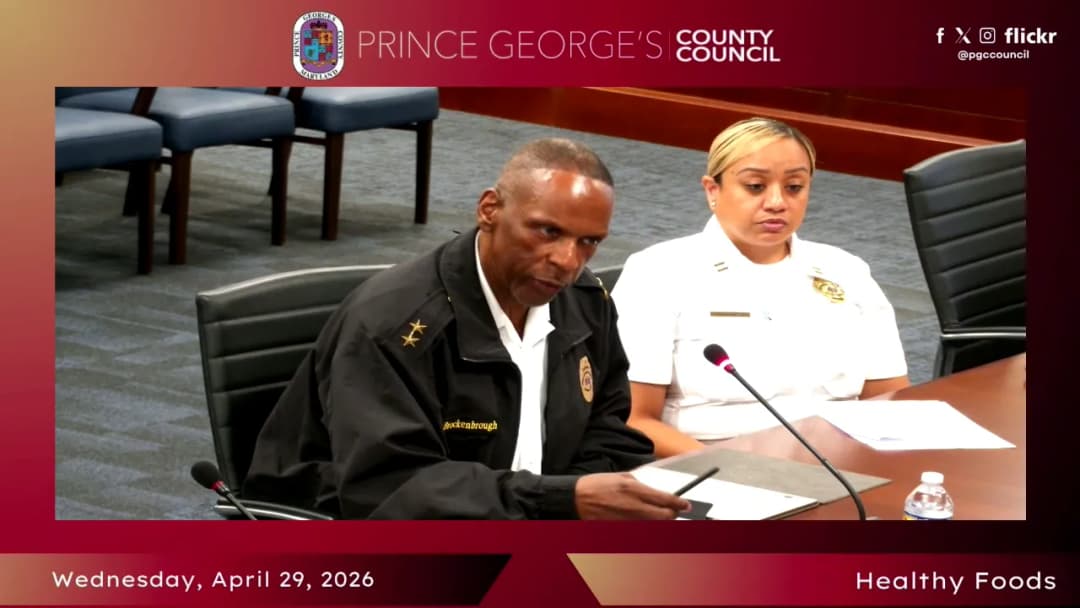
First Meeting of the Healthy Food in Prince George’s County Correctional Facilities Task Force – April 29, 2026

On April 29, 2026, at 10:00 a.m., the newly formed Healthy Food in Prince George’s County Correctional Facilities Task Force held its inaugural meeting in person at the Wayne K. Curry Administration Building, Largo, MD. The meeting was also live-streamed. Council Chair was absent due to another meeting. Attendees included task force members, legislative staff, and representatives from the Department of Corrections. Introduction and Member Introductions - The meeting was called to order by the facilitator, who welcomed members and asked each to introduce themselves. - Members present: Willie Hamilton (Life After Release), Denise Weir (Prince George’s Community College), Ramon Gonzalez (legislative attorney), David Williams (Budget and Policy Analysis, DOC), Rodney Brockenbrough (Deputy Director for Operations, DOC), Captain Monica Pena (DOC). Review of Task Force Charge and Legislation - The facilitator reviewed the enabling legislation: CR6 (2024) established the task force; CR89 (2025) extended its deadline to November 30, 2027, due to the late start. - The task force’s charge is to recommend nutritional food safety and other standards for correctional facility meal programs that support health, well-being, and religious/cultural identities, aligned with the Center for Good Food Purchasing’s Good Food Purchasing Program. - The legislation mandates minimum meal standards: - At least one plant-based main course option per meal - At least three servings of minimally processed raw fruit per day (all fresh) - At least three servings of minimally processed dark green vegetables per week (at least one raw) - At least three servings of minimally processed red and orange vegetables per week (at least one raw) - The task force must produce a report within two years addressing: 1. Partnering with hospitality, culinary arts, and agricultural training programs for detainees to reduce recidivism 2. Feasibility of a central dining area 3. Introducing nutrition/health education 4. Creating a long-term procedure for detainee feedback on food Department of Corrections Update - Rodney Brockenbrough stated the DOC is fully on board. They have already taken proactive steps: - Issued a new solicitation about a year ago requiring elimination of most processed foods and increased fresh fruits/vegetables. - Selected a new food service vendor that has met these deliverables in its first year. - Added approximately $1 million to the food service budget to cover the cost of fresh, non-processed items. - The vendor currently uses local farmers (mostly in Northern Virginia) but is prepared to transition to Prince George’s County growers. - The Good Food Purchasing Program will soon provide a list of local growers/aggregators. - DOC has discussed growing vegetables on-site (e.g., hydroponic farming) and is seeking partnerships. - The facilitator noted that the DOC’s efforts were encouraging and suggested contacting the local soil conservation district. Discussion - Denise Weir (Prince George’s Community College) highlighted existing programs: harvest walls in the culinary arts center, a community garden, and a farm‑to‑kitchen program (Planet Pick It, Learn It, Serve It) that links food education to health. - She offered the college as a resource for nutritionists/dietitians and asked whether all task force seats were filled. The facilitator indicated that membership is complete but would reach out if needed. - Willie Hamilton commended the DOC for its proactive steps. Key Outcomes - The task force will continue with additional members (14 total) in future meetings. No votes were taken. - Next steps: DOC will receive the local grower list from the Good Food Purchasing Program and share it with their vendor. The task force will await the full membership to begin formal recommendations. - The meeting adjourned without further business.

FOOD SECURITY 64% · AGRICULTURAL PROMOTION 16% · EDUCATION AND WORKFORCE DEVELOPMENT 13% · PROCEDURAL 7%
167
APR 28, 2026 · PRINCE GEORGES COUNTY, MARYLAND · COUNTY COUNCIL & BOARDS
Prince George's County Council Committee of the Whole: BOE CIP, Health Atlas, Housing Action Plan - April 28, 2026

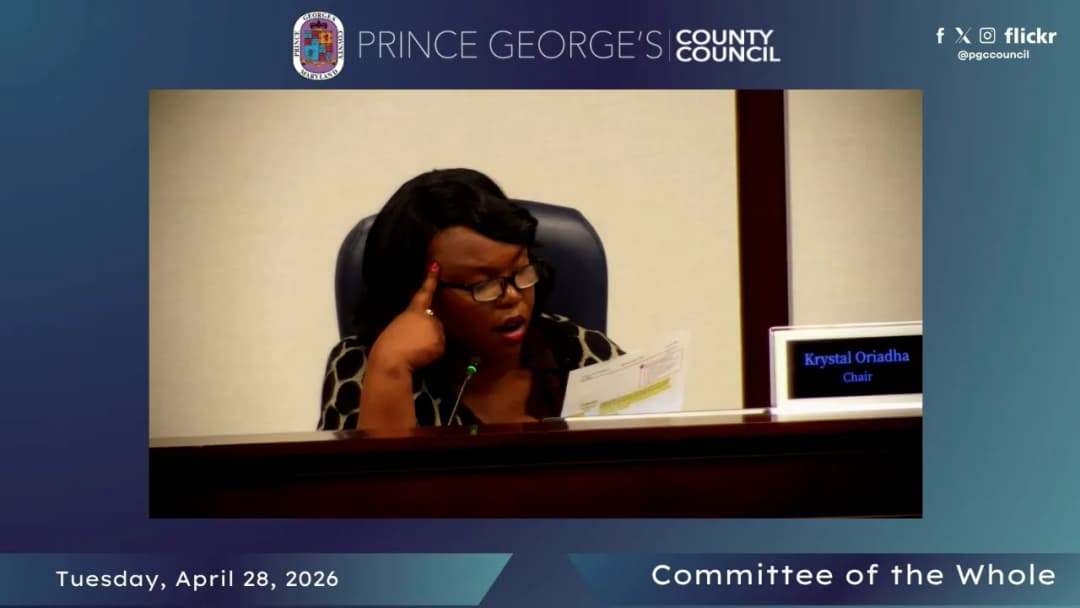
The Prince George's County Council, sitting as the Committee of the Whole, convened at 2:11 p.m. on Tuesday, April 28, 2026, in the Council Hearing Room at the Wayne K. Curry Administration Building in Largo, MD. Chair Krystal Oriadha presided; 10 members were present at various points (Oriadha, Olson, Adams-Stafford, Burroughs, Dernoga, Fisher, Harrison, Ivey, Hunter, and Adams), with Council Member Wala Blegay absent. The meeting covered three items: the FY 2027 Board of Education Capital Improvement Program (CIP) budget worksession, a briefing on the Prince George's County Health Atlas study, and CR-022-2026, the FY 2027 Annual Action Plan for Housing and Community Development. The meeting adjourned at 3:49 p.m., with a public hearing on the county budget, CIP, and Board of Education scheduled for 6 p.m. that evening. Note: the agenda and minutes list the Health Atlas briefing before the budget worksession, but the transcript clearly shows the Board of Education CIP was presented first. Budget Worksession: FY 2027 Board of Education CIP (BU 2026-56) Staff from the Education and Workforce Development Committee (Dr. Arun Puracken, director, and Caleb Callender, budget and policy analyst) presented the Board of Education's proposed FY 2027 CIP, followed by comments from Interim Superintendent Dr. Shawn Joseph, Chief Operating Officer Dr. Charoscar Coleman, and PGCPS capital programs staff. Key figures presented: - Overall CIP funding is down approximately $2 million compared to FY 2026. GO bonds make up approximately 75% of FY 2027 funding at $148.2 million; state funding is down $14.5 million (approximately 22.5%) from FY 2026. - Unspent funding includes 38% of state funding from 2023, 30% of county funding from FY 2024, and 26% of county and 34% of state funding for FY 2025. End-of-year unspent capital funds were $499.6 million in FY 2024, $489.2 million in FY 2025, and $443.4 million in FY 2026 (through March 3, 2026), which PGCPS stated have trended downward. 54% of unspent funds are tied to major modernization and renovation projects; the remaining 46% is associated with capital maintenance projects scheduled for summer and fall construction. - Notable total project cost changes from FY 2026 to FY 2027: Cool Spring Judith Hoyer modernization increased $14.3 million due to inflation and design refinements (completion expected FY 2030, FY 2027 expenditure projection $27 million); Riverdale Hills Early Childhood Center increased $3.1 million due to inflation (completion expected FY 2028, FY 2027 expenditure projection $6.3 million); High Point High School increased $69.1 million due to inflation and revised cost estimates (completion moved up to FY 2032, FY 2027 expenditure projection $2.2 million); New Northern Adelphi area high school increased $45.5 million driven by market escalation, site-driven redesign due to updated stream buffer requirements, and scope refinement including special education program alignment and full build-out of CTE pathways; Suitland Annex replacement increased $22.6 million due to a 589-day permit delay and stormwater management work not in the original scope (completion moved up to FY 2028); William Schmidt Educational Center increased $9 million (completion expected FY 2027); and William Wirt Middle School decreased $10 million, with funds transferred to William Schmidt planning and design and central garage/roof replacement. - The FY 2027 request totals approximately $216 million within a six-year spending plan of approximately $1.6 billion. Major projects account for more than $130 million of the requested funding. The request also includes approximately $20 million in envelope replacement projects (10 window and door replacements and 2 roof replacements) and approximately $28 million in countywide investments supporting ADA improvements, code corrections, HVAC and plumbing upgrades, security enhancements, stadiums, playgrounds, and other facility repairs. - Alternative Construction Financing includes $19 million in GO bond capital funds and $42 million in the non-departmental operating budget. Other items: approximately 110 schools countywide require lead remediation; FY 2027 proposes $4 million in HVAC upgrades (all GO bonds), $5 million in major repairs, $7.17 million for roof replacements with no specific schools listed, $9 million for stadium upgrades including continued work at Duvall High School, and $1.2 million for the aging schools program (Akiak Academy, Charles Herbert Flowers High School, James Harrison Elementary, and Capitol Heights Elementary). - 59.8% of total active CIP projects are deemed substantially complete or in final completion. Superintendent Joseph stated that 17 new schools or major modernizations have been delivered, with 9 additional schools scheduled to open in the next 24 months, together representing 26 facilities, more than 1.5 million square feet, and approximately 22,400 students. He acknowledged community concerns that investment has not always felt evenly experienced across the county, particularly in the southern portion, and announced that a new 10-year educational facilities master plan will be developed over the next 18 months with deeper engagement. Council Member Dernoga expressed strong disagreement with the decision to design High Point High School for 2,600 students and to build the New Northern Adelphi high school (2,000 comprehensive seats plus 600 CTE seats), arguing that two high schools costing over $300 million each would divert resources from aging schools. He cited the High Point catchment area extending 6.6 miles to the school while Northwestern (3.1 miles), Parkdale (5.8 miles), and Bladensburg (5.9 miles) are closer, and said 10-year enrollment projections show declining high school enrollment in the area. He urged boundary adjustments and spreading investment across more schools. PGCPS staff defended the design, citing safety considerations, building management challenges, and cost estimates that did not support designing for 2,000 with a later 600-seat addition. Council Member Fisher asked whether New Northern remains on the same track as High Point; PGCPS stated High Point is designed for completion by 2031, and if projects are daisy-chained, New Northern would be pushed to 2035. Fisher expressed concern that facilities in her district are consistently built too small for the population's needs, citing the Hyattsville Library as an example. Council Member Adams-Stafford asked about renewable energy and geothermal investments. PGCPS reported over $10 million in utility rebates from sustainability and resilience work and $3–5 million in expected IRA tax credits this fiscal year. Staff also explained the Suitland 589-day permit delay occurred during the initial permitting phase; a streamlined platform with county agencies now meets bi-weekly. Adams-Stafford also asked about co-location; PGCPS is co-locating Dor Kennedy French Immersion and John Hanson Montessori at the Robert Goddard site. Council Member Adams raised safety and security concerns at Bowie High School (built 1965, addition 1968), noting the county's average facility age is over 45 years and Maryland now has the third-oldest school inventory. Staff reported approximately $28 million invested in the Bowie Annex, a new AI-capable camera system, and replacement of hard-key locks with cipher locks and scan cards. Chair Oriadha asked about the artificial turf field maintenance MOU with parks and planning (parks and planning maintains existing and new turf fields under phase 1; phases 2 and 3 have not been executed), FY 2027 playground upgrades (Samuel Massey Elementary School; also Francis T. Evans, Fort Foote, and Seabrook this summer), and the Riverdale Hills Early Learning Center, which is pivoting from pre-K seats to a therapeutic pre-K program with the Lori Center (currently operating at Highland Park Elementary, with a site visit scheduled the next day). Oriadha noted that school-hours-only child care does not match the schedules of working parents. Council Member Hunter asked about William Wirt Middle School HVAC noise (resolved; sound readings were within code compliance and a backwards valve was replaced), Parkdale and Duvall stadium fields (Parkdale's field was completely redone and is in its first full grass season; Duvall remains playable with a comprehensive stadium renovation upcoming), and an erosion issue at Parkdale requiring collaboration among PGCPS, parks and planning, and the county. Briefing: Health Atlas Introduction (BR 04282026) Anya Makarova, Senior Advisor to the Board of Health, introduced the Health Atlas, authorized by CR 54-2025 (proposed by Chair Oriadha and co-sponsored by sitting council members) to support implementation of the county's General Plan (Plan 2035) and data-driven policymaking. The project is a collaborative effort led by the Prince George's County Planning Department with the Health Department and Board of Health, executed by consultant Health Management Associates. Shaquan Smith (Planner IV, M-NCPPC) and Madeleine Shea, PhD (Project Principal, Health Management Associates) presented the seven-month timeline (March–September 2026): the first four months focus on agency, municipality, and community engagement; the online platform will be reviewed this month; stakeholder and community listening sessions occur in May and June; a soft launch of the online platform and draft report are scheduled for July; the final platform and report are due in August; findings will be presented to the council in September. The tool will be public-facing, mobile-friendly, and will visualize disparities and equity needs across six pillars: 1) access to care and community resources, 2) food and nutrition, 3) economic opportunity, 4) transportation and the built environment, 5) environment and climate resilience, and 6) equity and community well-being. Council Member Harrison asked whether the Health Atlas would inform district council cases, citing an example of 14 fast food restaurants within a three-mile radius in his district. Staff confirmed the data would support legislation and future planning processes, including sector plans, sectional map amendments, and master plans. Chair Oriadha requested that council and Board of Health staff coordinate offline on community engagement for the project. Legislation: CR-022-2026 FY 2027 Annual Action Plan for Housing and Community Development Rana Hightower (PHED Committee Director) presented CR-022-2026, which would approve and adopt the county's FY 2027 Annual Action Plan for Housing and Community Development, including federal funding applications for CDBG, HOME, and emergency shelter assistance programs. A public hearing was held April 21, 2026; the county executive submitted a letter requesting favorable consideration. Four public comments were submitted, all four requesting continued funding for the first-generation college-bound program. If adopted, the resolution would provide the Department of Housing and Community Development with $10,547,183 in federal grant funding and requires a $493,358 county match. The plan aligns with Plan 2035 and the FY 2026–2030 consolidated plan, prioritizing affordable housing, economic development, rental assistance, and homeowners assistance. Director Jonathan Butler (DHCD) explained that a final HUD allocation increased the figures in proposed draft 2: approximately $340,000 increase in CDBG (equally allocated among already recommended awardees), $48,063 in HOME, and $16,991 in ESG, raising the total allocation from approximately $8.5 million to $8.9 million. Council Member Olson confirmed that draft 2 simply adds the new federal funding to the same awards as draft 1. A motion by Council Member Burroughs, seconded by Chair Oriadha, to hold the resolution carried by a vote of 8–0 (Oriadha, Olson, Burroughs, Dernoga, Harrison, Ivey, Hunter, and Adams). The minutes record Adams-Stafford, Blegay, and Fisher as absent for this vote. Key Outcomes - The FY 2027 Board of Education CIP worksession was held; council members raised questions about project scope, capacity decisions, equity, sustainability savings, and facility maintenance, with outstanding follow-ups to be addressed offline. - The Health Atlas briefing was held; council and Board of Health staff will coordinate on community engagement, and a council regional conversation on the topic was suggested by Chair Oriadha. - CR-022-2026 was held by a vote of 8–0, pending further review of the draft 2 changes. - The meeting adjourned at 3:49 p.m. by unanimous vote (motion by Council Member Harrison, seconded by Council Member Dernoga); the council reconvened at 6 p.m. for a public hearing on the county budget, CIP, and Board of Education.

EDUCATION AND WORKFORCE DEVELOPMENT 19% · INFRASTRUCTURE 16% · PUBLIC HEALTH 10% · EDUCATION POLICY 8%
168
APR 28, 2026 · PRINCE GEORGES COUNTY, MARYLAND · COUNTY COUNCIL & BOARDS
Prince George's County Council Legislative Day 14 Meeting – April 28, 2026

The Prince George's County Council held its Legislative Day No. 14 meeting on Tuesday, April 28, 2026. The meeting was scheduled for 12:00 p.m. and convened at 1:17 p.m. in the Council Hearing Room of the Wayne K. Curry Administration Building, Largo, MD. Ten members were present at roll call; Council Member Wala Blegay participated remotely and Council Member Sydney J. Harrison arrived at 1:22 p.m. Chair Krystal Oriadha presided. The agenda included a consent calendar, a briefing from the 2025-2026 Charter Review Commission, second reading of CB-021-2026, and public hearings on bond legislation and motor vehicle takeovers. Consent Calendar - Approved the minutes of the April 21, 2026 County Council meetings (regular and 6 p.m.). - CB-035-2026, concerning day care center use regulations, was presented by Chair Oriadha and referred to the Planning, Housing and Economic Development (PHED) Committee. - CB-036-2026, concerning women's health workplace protections for employees with severe menstrual or uterine fibroid-related symptoms, was presented by Council Member Blegay and referred to the Public Safety, Health and Human Services (PSHHS) Committee. - CR-030-2026 (fibroid healthcare support) and CR-031-2026 (insurance and healthcare access for fibroids) were introduced and referred to PSHHS; CR-032-2026 (County Council budget parity) was introduced by Council Member Ivey and referred to the Government Operations and Fiscal Policy (GOFP) Committee. - An additions package adding CB-037-2026, the Apprenticeship Incentive Program bill, was accepted by an 11-0 vote. CB-037-2026 was presented by Council Member Adams-Stafford and referred to the Education and Workforce Development (EWD) Committee. - The consent agenda was adopted by an 11-0 vote. Public Comments & Testimony - No requests by members of the general public to address the Council at the start of the meeting. - At the public hearing on CB-012-2026 (motor vehicle takeovers and unlawful speed contests), Assistant Deputy Chief Travis Rickert of the Prince George's County Police Department testified in support of the legislation. He said the department had responded to 38 events, made 20 arrests, and recovered 13 handguns and 3 rifles, and called the regional problem alarming because it is occurring outside the usual summer months. He also referenced an incident in Howard County that left one person dead and five injured. The hearing was continued to May 5, 2026 at 10 a.m. - No speakers signed up for the public hearing on CB-004-2026. Correspondence / Administrative Officer's Report - The Council authorized a letter to Dr. Shawn Joseph, Interim Superintendent of Prince George's County Public Schools, supporting FY 2026 Board of Education Transfer Request 2, by a 10-0 vote (Council Member Ivey absent). Dr. Arun Puracken, EWD Committee Director, reported the transfer would increase the operating budget by approximately $36.6 million, drawing about $38.8 million from the fund balance, bringing the total FY 2026 operating budget to $2,995,312,763. He also noted the fund balance was projected to decline from roughly $217 million at the end of 2025 to about $77-78 million by the end of 2026. The EWD Committee had voted 4-0 to recommend approval. Discussion Items - Camille A. Exum, Chair of the 2025-2026 Charter Review Commission, presented the Commission's final report and recommendations, joined by Senator Gloria Lala as transcribed. Established under Charter Section 1106, the Commission made five recommendations: (1) technical charter amendments to Sections 308 and 406 on compensation to comply with state law; (2) amendment to Section 814 to allow county executive approval of certain appropriation transfers, with transfers exceeding $1.5 million requiring Council approval; (3) amendment to Section 908 to add arbitration and Federal Mediation and Conciliation Service language for collective bargaining disputes; (4) amendment to Section 602 to grant the purchasing agent full signature authority; and (5) amendment to Section 603 to streamline competitive bidding and add requests for quotations. It also urged gender-neutral language in the charter. Council Member Dernoga raised a past redistricting resolution issue and suggested a charter cleanup. No formal vote was taken. - CB-021-2026, concerning community resources information in Fire/EMS ambulances, received its second reading. Council Member Fisher reported the PSHHS Committee's favorable 3-0 recommendation. The Office of the County Executive supported the bill's intent but suggested a QR code alternative; no amendment was needed because the draft language allowed flexibility. The bill was introduced with sponsors Council Members Olson, Oriadha, Adams, Hunter, Dernoga, Fisher, and Adams-Stafford. Public Hearings and Enactments - CB-004-2026, an emergency act authorizing the issuance and sale of general obligation and stormwater management bonds, was enacted after a public hearing that convened at 1:50 p.m. and at which no one spoke. The authorization is for up to $751,371,000 in general obligation bonds, $152,452,000 in general obligation stormwater management bonds, and up to $903,823,000 in bond anticipation notes. The emergency was declared to take advantage of 2026 interest rate market conditions. The vote was 9-0, with Council Members Burroughs and Ivey absent (the roll call was initially announced as 8-0 before being corrected). - CB-012-2026's public hearing convened at 1:52 p.m. and was continued to May 5, 2026 at 10 a.m.; Council Member Burroughs was added as a co-sponsor. Key Outcomes - Consent agenda adopted 11-0. - Letter to PGCPS supporting FY 2026 BOE Transfer Request 2 authorized 10-0. - CB-004-2026 enacted 9-0. - CB-021-2026 introduced; further committee process will follow. - CB-012-2026 public hearing continued to May 5, 2026. - Charter Review Commission briefing held; recommendations received for Council consideration. - The meeting recessed at 1:56 p.m. to the Committee of the Whole; a separate 6:00 p.m. budget public hearing was also scheduled.

GOVERNMENT OPERATIONS 30% · EDUCATION POLICY 22% · PROCEDURAL 15% · PUBLIC SAFETY 12%
169
APR 28, 2026 · PRINCE GEORGES COUNTY, MARYLAND · COUNTY COUNCIL & BOARDS
Prince George's County Public Safety Committee FY2027 State's Attorney Budget Work Session – April 28, 2026

The Public Safety, Health and Human Services Committee of the Prince George's County Council met on Tuesday, April 28, 2026, at 11:30 a.m. in Committee Room 2027 of the Wayne K. Curry Administration Building in Largo, Maryland, for a budget work session on BU 2026-42, the FY 2027 Proposed Budget for the Office of the State's Attorney. The meeting was called to order at 11:35 a.m. with three members present: Chair Wanika Fisher, Council Member Danielle Hunter, and Council Member Krystal Oriadha. Vice Chair Wala Blegay and Council Member Edward Burroughs were absent. Chair Fisher recused herself from chairing the work session on the advice of the Office of Ethics and Accountability because she is a filed candidate for office; Council Member Oriadha chaired the session. No vote was taken on the budget item. Discussion Items - Committee Staff Presentation: David Williams of the Budget and Policy Analysis Division presented the FY 2027 proposed budget for the State's Attorney's Office. The proposed budget is approximately $34 million, a 9.9% increase over the previous fiscal year. The office's grant allocation is proposed at $3.5 million, a 28.8% increase. Committee staff reported 15 full-time vacancies, unchanged full-time and part-time staffing allocations, and an increase of two limited-term positions. Additional concerns identified by staff included workload, infrastructure, and the need for more office space in the county administration building. - State's Attorney Tara H. Jackson presented the office's priorities, including holding violent and repeat gun offenders accountable, preventing financial crimes and scams, holding youth accountable, engaging with businesses, and increasing internal accountability and transparency through the office's first crime data dashboard. - Jackson highlighted accomplishments since taking office in June 2025, including 44 new hires, 12 vacancies expected as of May 2026, partnerships with the county's 23 municipal police departments, the largest Back on Track program graduation with 16 graduates none known to have recidivated, the RISE truancy initiative funded by a nearly $1 million federal grant, a formalized conviction integrity referral process with the Mid-Atlantic Innocence Project, an inaugural Academy of Law and Public Policy Youth Council, and homicide convictions in every case tried by the Special Victims Unit since June 18, 2025. - Council Member Hunter asked about diversion programs. Jackson described the Back on Track program as an 18-month diversion for low-level offenders with accountability and expungement upon completion, and the RISE truancy initiative, which partners with nonprofits and uses two in-house case managers. Jackson acknowledged the office had not maintained data on Back on Track outcomes but is working to improve data collection before publishing it. - Council Member Hunter asked about the youth council's structure. Jackson stated that the goal is to include youth who have been involved in the juvenile system, not only well-connected youth, while ensuring the setting is comfortable for all participants. - On discovery and evidence management, Jackson and deputies stated that the State's Attorney's Office needs the Axon discovery management system, not merely licenses to access the police department's system. The current system is antiquated, and the office regularly crashes the county I-drive when transmitting large discovery files. The FY 2027 budget as submitted does not include the approximately $400,000 per year for the office's own Axon system; it was submitted as an enhancement request. The office is seeking a countywide solution and has been in discussions with the police chief and OIT. - Council Member Fisher asked about the conviction integrity unit and the Mid-Atlantic Innocence Project MOU. The unit still exists under new leadership. The formalized referral process allows the Innocence Project to investigate actual innocence claims and return findings; the State's Attorney's Office would agree or disagree and could file a writ of actual innocence or other motion if warranted. - On vacancies, Jackson said there are currently 17 vacancies with five accepted offers, leaving 12 vacancies as of May; an OHRM report from March 9 listed 23 vacancies, and the difference reflects the fluid nature of hiring. Exit interviews show departures are largely due to federal government recruitment, higher-paying county positions, and the transition that occurred when the former State's Attorney became County Executive. - Council Member Fisher raised the salary scale passed by the council for assistant state's attorneys. The HR director said most new hires and promotions are being placed on the scale, with the next wave expected to be completed by May, and OMB will receive the final calculation to determine the additional FY 2027 funding needed for the remaining staff. - Fisher also asked about dismissal rates. The office reported 7,300 outright dismissals in district court and estimated, conservatively, that about 25% were due to discovery-related issues. Jackson stated the office is improving data collection and will provide reliable data on requests rather than relying on previously insufficient records. - On victim witness coordinators, the office has 15 coordinators with two vacancies, down from about eight when Jackson took office; the two vacancies are expected to be filled in May, making the unit fully staffed. - Jackson noted that new state juvenile jurisdiction legislation effective October 1 will send more gun and first-degree assault cases directly to juvenile court, which has a 30-day trial clock. She said the office is requesting more resources to handle the increased workload and expedited discovery needs. Key Outcomes - No motion or vote was taken on BU 2026-42 during the work session. - Council Member Fisher requested follow-up data on dismissals, pleas, and the reasons for dismissals; the State's Attorney's Office agreed to provide reliable data and to continue discussions on the Axon discovery management system. - The committee adjourned by a 3-0 vote on a motion by Council Member Hunter, seconded by Council Member Oriadha, with Fisher, Hunter, and Oriadha voting in favor.

PUBLIC SAFETY 42% · PERSONNEL MATTERS 13% · YOUTH PROGRAMS 10% · TECHNOLOGY AND INNOVATION 9%
170
APR 28, 2026 · PRINCE GEORGES COUNTY, MARYLAND · COUNTY COUNCIL & BOARDS
General Assembly Committee Briefing on 2026 Legislative Session and Budget – April 28, 2026

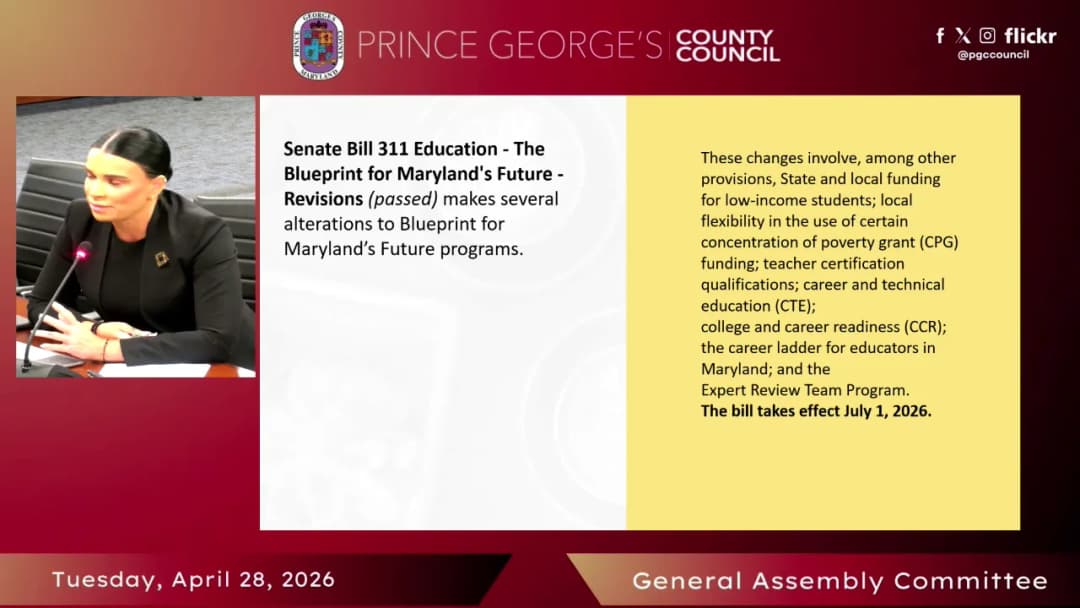
On Tuesday, April 28, 2026, at 9:00 AM, the Prince George's County Council's General Assembly Committee convened an informational briefing in Committee Room 2027 of the Wayne K. Curry Administration Building in Largo, Maryland. Chair Wanika Fisher presided; Vice Chair Shayla Adams-Stafford, Councilmember Danielle Hunter, and Councilmember Thomas Dernoga were present, and Councilmember Sydney Harrison was excused. The committee received presentations from lobbyists on the 2026 Maryland General Assembly session and the fiscal 2027 state budget. No votes were taken. Budget Overview (Fiscal 2027 State Budget) - Roger Mano of Mount Associates presented the county's state budget outcome. The county began with a $660 million capital priority list and significant operating priorities amid a structural deficit. - The county secured approximately $2.21 billion in total state operating and capital aid, including roughly $2.052 billion in direct operating aid and about $160 million in retirement support. Capital impacts ranged from $250 million to $400 million, with over $200 million in direct capital funding; Prince George's County ranked second among Maryland jurisdictions, behind Baltimore City. - Operating aid grew by $92–100 million (4–5%) over FY26. Education aid totaled about $1.8 billion (roughly 81% of total aid) and grew 5–6%; community colleges grew about 3%; health funding increased 20%; transportation declined 10–12%. - Capital investments included $150–250 million for school construction, over $50 million for higher education (including $10 million for UMD's Quantum Initiative and $20 million for INQ), $18 million for healthcare (including $10 million for Doctors Community and $8 million for MedStar Southern Maryland), over $20 million for economic development and Blue Line TOD projects, and over $35 million for infrastructure (including $12 million for Port Towns watershed). - Education facility capital included $17 million for Cool Spring Elementary and $6.3 million for Riverdale. - Statewide programs benefiting county residents included the autism waiver at about $62 million and child care scholarships totaling $414 million statewide. - Disparity grants totaled $56.9 million for FY27, down $11.4 million (17%) from FY26's $68.3 million, which had been a temporary enhancement; the FY27 amount is 24% below full formula funding and equals about 2.5% of total state aid. - The teacher pension shift splits pension cost growth 50/50 between the state and counties, adding $5.7 million in annual obligations. The state still provides about $160 million in retirement support, covers 96% of pension costs, and the added cost is about 3.5% of retirement support received. - Questions and follow-ups: Vice Chair Adams-Stafford requested a detailed breakdown of Bowie State capital funds, including transportation funding outside general capital dollars. Chair Fisher asked about Maryland Transit Authority police for the Purple Line (opening in 2027), specifically whether an MOU with Metro Police is planned; Mano said he would provide that information within the week. Legislative Consultant Reports - Derek Green (Green Consultants) reported on alcohol and public safety legislation. Successful bills included HB 443 (Class B small event center licenses) and HB 406 (multiple alcohol licenses; includes a prohibition on wine festival licenses in state legislative district 24). Failed bills included HB 415 (grocery store beer/wine licenses), HB 421 (speed monitoring on Route 210), SB 173/HB 249 (automated enforcement reciprocal agreements), and SB 138/HB 84 (domestic violence as a mitigating factor). Cigar lounge legislation did not pass; discussion focused on the need for a state license to combine cigar and liquor sales and a possible Office of Law opinion. - Lorenzo Bellamy (Bellamy Gen Group) said his firm tracked over 100 bills. Passed legislation highlighted included bans on machine-gun conversion devices (SB 334/HB 577), youth charging reform (SB 323/HB 409), police face covering ban (SB 1/HB 155), housing voucher anti-discrimination (SB 355/HB 315), the Maryland Certainty Act (SB 325/HB 548), the Maryland Transit and Housing Opportunity Act (HB 894/SB 384), Patuxent Research Refuge protection (HB 1267), Prince George's County TIF expansion for entertainment venues (HB 1247, the “Sphere bill”), and a personal property tax exemption for small manufacturers (HB 1243). He noted the Suitland Development Authority bill (HB 1452/SB 552) passed without Prince George's County Council representation after an amendment. The Voting Rights Act of 2026 (SB 255/HB 350) was signed as an emergency bill on April 28, 2026, allowing the Attorney General to challenge local election systems that dilute minority voting. The 287(g) bill (SB 245/HB 444) prohibiting local law enforcement agreements with ICE also passed. - Teresa Hessler (Ashler Government Relations) summarized education, environment, energy, health, and tax legislation. The session was characterized by fiscal constraint, with many proposals scaled back to studies, pilots, or reporting requirements. The Blueprint education funding revisions passed and take effect July 1, 2026. A commission was established to investigate the House of Reformation and Instruction for Colored Children (SB 776/HB 552), with reports due at the end of 2027 and 2029. HB 1532, the Utility Relief Reducing Energy Load Inflation for Every Day's Family Act, passed with energy and utility provisions. Tax legislation extended business tax credits (SB 88/HB 898) and expanded nonprofit housing tax exemptions (HB 571). Local bills included HB 423, providing free drink-spiking and drug-detection products in public high schools, while HB 1223 (farmers market/street vending work group) and HB 1224 (vacant and abandoned property tax rate) did not pass. Hessler recommended beginning interim planning in early summer 2026 for the 2027 session. Key Outcomes - No votes were taken; the meeting was informational. - The committee received comprehensive briefings on the county's $2.21 billion state aid package, capital project ranges, and major legislative wins and losses. - Follow-ups were directed: a Bowie State capital breakdown; Purple Line police/MOU status; an Office of Law opinion on cigar lounge authority; an OMB review of the Maryland Certainty Act's potential commercial impact on the county's bond rating; and a planned virtual evening briefing for residents. - Director Jabari Cooper was recognized on his last committee meeting; the committee will not meet again until after the MACo summer conference, with interim planning to resume before the 2027 legislative session.

ECONOMIC DEVELOPMENT 17% · FUNDING ALLOCATION 16% · LEGISLATIVE IMPACT 13% · GOVERNMENT OPERATIONS 12%
OPENPUBLICA · PUBLIC MEETING INDEXUPDATED DAILY · openpublica.com