Browse by city
Date range
Search help

Search titles, summaries, topics and stored transcripts together. Keywords may match separately; put the whole query in double quotes for a phrase. Matching follows word analysis, so punctuation is not exact. Both dates are included. Documents are not searched.

SHOWING 11–20 ENTRIES
11
JUL 7, 2026 · RALEIGH, NORTH CAROLINA · CITY COUNCIL
Raleigh City Council Meeting - July 7, 2026: Public Comments on Zoning, Noise, Youth Summit, and Community Events

The Raleigh City Council held a public comment period on July 7, 2026, with 10 speakers signed up. No other agenda items or council discussions were recorded. The meeting adjourned after hearing from all speakers. Public Comments & Testimony - Octavia Rainey spoke about four issues: (1) too many ABC permits in Glenwood South, calling it an "Apple Hall haven"; (2) the need for a youth summit, noting that under Chief Dolan two summits drew over 2,000 kids, and criticizing the city for not listening to youth after the Riley North incident; (3) that the city’s missing middle housing policy does not address children’s needs; (4) urged the council to hear from kids and take a holistic view. - Horace Clemens raised noise issues from Pratt Industries on Departure Drive, stating that the new noise ordinance eliminated all provisions protecting residential areas from commercial noise. He provided a draft amendment and requested feedback; if not addressed, he said he would reconsider his approach. A council member indicated staff would reach out. - Alicia Drees (same neighborhood as Horace Clemens) described severe noise from Pratt Industries affecting quality of life, property values, and outdoor activities. She noted equipment installed in the early 1980s is now failing, and operations run 7 a.m. to 11 p.m. Decibel readings reached 55 dB during the day, and a grinding sound at night is particularly disruptive. - Richard High represented the Oberlin community (founded 1858, second oldest African-American community in Raleigh). He announced a community cookout on July 18 from 3:30–7:30 p.m. at JC Park and requested a city proclamation for a tour of historical black churches (Oberlin Baptist Church and Wilson Temple United Methodist Church). The council responded that Wilson Brown in the mayor’s office would work on the proclamation. - Mamakai Sanders asked whether the city budget can be amended after passage and under what circumstances. She also expressed frustration that her emails about a child’s negative experiences with park staff went unanswered. She referenced a child named Wisdom who spoke at a previous meeting and stressed that families should rely on park staff for safe environments. - Larissa Green voiced concerns about development priorities, criticizing high-density projects that prioritize profit over livability. She cited rezoning case Z-4325, noting this was the 19th and 20th public comment on that case. She alleged that meeting agendas and PowerPoints were changed after upload, deadlines manipulated, and public hearings canceled without rescheduling. She asked the council to consider childhood memories when making decisions. - Philip Brown (multi-generational Raleigh native and fourth-generation homeowner on Lichford) opposed rezoning case Z-4325. He argued that the process is unfair: residents must comment before a binding site plan is released, notification area is too small (500 feet), public comment time is limited, and deadlines are enforced unequally. He noted that public records requested over a month ago have not been produced. He described the proposal as 47 units on 3.79 acres, saying it would transform the neighborhood and that Johnsdale Road (17 feet wide, no curb, gutter, sewer, or sidewalks) lacks infrastructure to support additional density. He asked the council to deny the rezoning, citing compatibility, infrastructure before density, and transparency. Key Outcomes - Adjourned – The meeting concluded after public comments with no council votes or decisions recorded. - Staff action items: (1) Staff will reach out to Horace Clemens regarding noise ordinance amendments. (2) Wilson Brown’s office will work on a proclamation for the Oberlin community cookout and historical church tour. - No other actions or referrals were noted.
PROCEDURAL 28% · YOUTH PROGRAMS 15% · COMMUNITY ENGAGEMENT 15% · ENVIRONMENTAL PROTECTION 13%
12
JUN 16, 2026 · RALEIGH, NORTH CAROLINA · CITY COUNCIL
Raleigh City Council Meeting – June 16, 2026: Proclamations, Zoning, Affordable Housing, and Water Restrictions

This regular meeting of the Raleigh City Council took place on June 16, 2026, and included a proclamation for National Waste and Recycling Workers Week, public comments on children's rights, redevelopment, and housing conditions, and action on multiple rezoning, annexation, and affordable housing items. The council also received updates on Sister Cities, water restrictions, and transit performance. Consent Calendar - The consent agenda was approved with no items pulled. - Meeting minutes from earlier in June were approved unanimously. Public Comments & Testimony - Mamakai Sanders cited Governor Stein's Whole Child Health and Well-Being Month proclamation, providing statistics: 63% of NC children experience health problems; only 37% of 3–5 year olds are ready for school; 41% of fourth graders read at grade level; NC ranks 32nd in the 2026 Kids Count data book. She urged council to consider the impact of city policies on children. - Wisdom (child) described being told to leave his non-electric kick scooter outside city buildings, while his mother's cart was allowed. He stated he felt disrespected by security and staff, and requested better training on respecting children. - Jason Cross expressed interest in serving on the Planning Commission, Design Review Committee, or Board of Adjustment, noting his background as a town planner. - Octavia Rainey called for a reevaluation of redevelopment areas, stating that infill development has produced $500,000+ homes in areas originally torn down for redevelopment, with no affordable housing. She said she is taking concerns to a meeting with the Black Caucus in DC. - Athena Wallen advocated for protecting creeks and natural ecosystems, warning that development up to easements, tree removal, and impervious surfaces harm water quality and wildlife. She urged immediate attention to riparian buffers. - Nikki W. described unsafe conditions at The Studios at 2800 (Junction Point COS), stating she was served an eviction notice after speaking publicly. She said she was placed in a unit between drug dealers and faced smoke and safety issues. She called for accountability and noted that she was told to return to shelters she had left. Discussion Items - Sister Cities Update (Symmetria Jones, Mary Claire Freeman, Minu Lee): Staff proposed four recommendations: modify affiliation process, adopt criteria for new partnerships, evaluate current five partnerships, and establish a Sister City Board Commission. The organization also requested approval of a work plan and formalization of a partnership with Gangseo District, Seoul, South Korea. Council debate focused on the board commission recommendation; some members preferred to separate that item. A motion to approve the work plan, adopt Gangseo as the next sister city, and adopt all recommendations except the board commission (which was removed as a friendly amendment) passed 5–3. - East Cabarrus Redevelopment Affordable Housing (Pat Dawson): Local Post selected to develop 28 affordable units on city-owned sites, with units at 60% AMI or below. Total city subsidy of $1,239,762. Council unanimously authorized conditional commitment, budget transfer, and a 75-year ground lease. - Water Restrictions Update (City Manager): Stage 1 restrictions were issued April 20; May compliance was good, but June usage is trending above limits. If non-irrigation day use continues to exceed targets, staff will ask the council on July 7 for authority to move to Stage 2 (which prohibits hand watering). Staff noted that some neighboring communities have already enacted Stage 2. - Raleigh Transit Authority Annual Report (Jen Truman): The FY26 report showed a 42% ridership increase (1 million more trips than 2019), 137 miles of frequent service, and recognition as the 2 mid-size transit agency by APTA. The FY27 work plan includes safety, policy reviews, and performance monitoring. Council approved the report and work plan unanimously. - Raleigh Convention Center Naming Rights (Mara Kraft): A 15-year agreement with Atlantic Union Bank worth approximately $9 million. The bank has branches in Raleigh and plans more. Council approved unanimously. - TEFRA Hearing – Briar Creek Apartments (Scott Brimer, Kristen Kirby): A 291-unit 100% affordable project at 60% and 80% AMI financed with tax-exempt bonds. The city has no financial obligation. Council gave the required approval unanimously. - Street Name Change: The portion of Church at North Hill Street will become The Bridge at North Hill Street, effective Dec. 31, 2026. - Public Nuisance Abatements: Three properties (1316 Carp Road, 2351 Maybrook, 227 South Person Street) had nuisance abatement liens confirmed. Unanimous approval. - Annexations: Four parcels were annexed: 204 Chatterson Drive (AX 826), 3027 Rock Quarry Road (AX 1026), and 69/69.50 Blue Run Lane (AX 1126) – all with effective date June 16, 2026, and approved unanimously. - Rezoning – 319 Hex Street (Z 3925): Continued from May 19. Applicant revised conditions but later requested deferral to August 18 to address height/setback questions. Council granted deferral with 4 minutes of public comment per side upon return. - Annexation & Rezoning – Jones Ridge Trail (AX 3725 & Z 4425): Requested deferral to July 7 to add conditions for fire department contribution and tree planting. Council agreed. - Rezoning – UNC Rex Hospital (Z 4825): Campus master plan rezoning on 60+ acres; reduces maximum entitlement from 24 million to 9.7 million sq ft, with heights ranging from 7 to 20 stories. First projects: heart and vascular tower and central energy plant. Approved unanimously. - Rezoning – West Jones & Glenwood (Z 326): Two parcels rezoned from OX-3 to DX-20 to complete an assemblage. Removes North Boylan NCOD. Planning Commission recommended 8–2. Council approved unanimously, deeming it an amendment to the future land use map. - Rezoning – New Bern Avenue Assemblage (Z 526): Multiple motions were required. Motion 1 (1313 New Bern – Richard B. Harrison Library): Denied unanimously (current zoning allows up to 3 stories + TOD bonus). Motion 2 (325 East Edenton Street): Denied 5–3. Motion 3 (Remaining HOD properties: 307 and 311 East Edenton, 100 North Person, 15 South Bloodworth): Motion to deny failed (5 nays), then a motion to approve passed 7–1. Motion 4 (All remaining parcels not previously addressed): Approved unanimously. Key Outcomes - Unanimous approval of consent agenda, meeting minutes, and numerous routine items. - Sister City partnership with Gangseo District, Seoul, South Korea, approved (5-3). - Affordable housing project at East Cabarrus Street authorized with $1.24 million city subsidy. - Water restrictions: Council will consider Stage 2 authority at the July 7 meeting. - Raleigh Transit Authority FY27 work plan approved. - Convention Center naming rights agreement with Atlantic Union Bank approved. - TEFRA approval for Briar Creek Apartments. - Multiple rezonings approved, with specific denials for Richard B. Harrison Library and 325 East Edenton. - Deferrals granted for 319 Hex Street (to Aug. 18) and Jones Ridge Trail annexation/rezoning (to July 7). - Council will explore a civility policy and report on urban renewal areas. - Closed session held for an honorary award; nothing to report.

ENGINEERING AND INFRASTRUCTURE 23% · MISCELLANEOUS 16% · COMMUNITY ENGAGEMENT 16% · PROCEDURAL 10%
13
JUN 16, 2026 · RALEIGH, NORTH CAROLINA · CITY COUNCIL
Raleigh City Council Work Session on Data Center Infrastructure - June 16, 2026

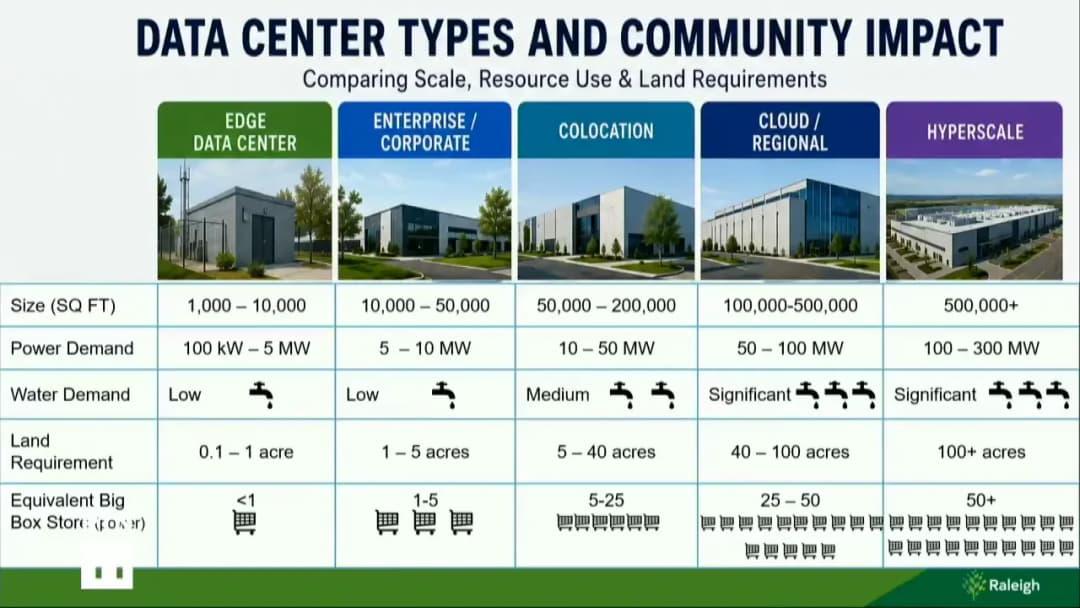
The Raleigh City Council held a work session on June 16, 2026, at 4:30 PM to discuss the expansion of data centers, their impacts on the community, zoning regulations, utility considerations, and potential policy responses. The presentation was a collaborative effort between the Office of Sustainability, City Attorneys, Information Technology, Planning and Development, and Raleigh Water. No formal votes were taken, but council members raised questions and requested follow-up information. Discussion Items - Data Center Overview: Mark Wittenberg (IT) explained the types of data centers: edge (small, low power/water), enterprise/corporate (medium), co-location/cloud regional (larger), and hyperscale (large, high power/water). He noted that Raleigh currently has no hyperscale data centers or pending requests. Data centers are driven by cloud computing, digital services, cybersecurity, autonomous systems, and artificial intelligence. - Community Benefits and Challenges: Benefits include increased tax base, municipal service efficiency, utility revenue growth, and support for research/technology. Challenges include land use ratios, obsolescence (equipment replaced every 2-3 years), noise from cooling systems, energy consumption, and water use. - Cooling Systems: Closed-loop systems (air-cooled) use less water; open-loop evaporative cooling uses more water but is cheaper. Emerging liquid/immersion cooling may reduce water use. - Zoning Regulations: Pat Young (Planning) explained that small-scale edge centers (under 20,000 sq ft, <5 MW) are classified as minor utilities and allowed by right in all zoning districts. All other data centers are major utilities, limited to IX (Industrial Mixed-Use) and IH (Heavy Industrial) districts, and require a special use permit from the Board of Adjustment. Staff noted that high land values in Raleigh make hyperscale centers economically unlikely. State law (2024) restricts downzoning, limiting new zoning standards for AI data centers. - Water Utilities: Witt Wheeler (Raleigh Water) reported existing data centers use <25,000 gallons per day. The city’s reclaimed water system has about 2 million gallons per day of capacity available. Data centers would be classified under industrial water rates (same as pharmaceutical or manufacturing plants), and system development fees are state-regulated. The city is working on a revised fee schedule for the next budget. - Energy Considerations: Duke Energy provided data: 4.8 gigawatts in new large customer contracts, expected $3.6 billion in benefits supporting residential customers, and an estimated $5–$6 reduction in residential bills over 15 years. They offer power curtailment clauses and do not have discounted rates for data centers. Duke expects data center peak demand to grow from <1% to 13% by 2030. - State Legislation: Senate Bill 730 (Ratepayer Protection Act) applies to data centers 100 MW, requiring site assessments, water use standards, and prohibiting local incentives/eminent domain. - Future Monitoring: Staff will monitor technology advances (e.g., chips with better heat dissipation, edge computing), vendor sustainability goals, and state/federal regulations. Council Questions & Staff Responses - Councilmember Silver asked for a map of IX/IH districts and whether data centers can go vertical. Staff replied that data centers typically stay single-story due to equipment weight/costs, but will provide maps. - Mayor Pro Tem Harris raised concerns about customer bills, water safeguards, environmental impacts, clean energy, and frontline communities. She mentioned other communities enacting moratoriums. City Attorney noted moratoriums are allowed under state statute to develop criteria, but staff believes current zoning and water standards protect public interest. Councilmember Fort suggested closed session discussion for moratorium. - Councilmember Patton asked about water table connectivity (Jordan Lake vs. Falls Lake), waste byproducts from evaporative cooling (no contamination expected), and water rate classes. Staff explained industrial rates will be proposed next budget; residential use is majority. - Councilmember Silver followed up on proximity: hyperscale centers in Southeast are rural, while regional edge centers (100,000 sq ft, 10-20 MW) may appear in metro areas needing proximity to users. - Councilmember Fort asked about coordination with six other municipalities served by Raleigh Water; staff confirmed discussions and capacity limitations. - Councilmember Jones asked about tracking impact of city’s AI use (e.g., Ask Raleigh) on communities; staff said it’s not possible due to cloud computing load balancing. She also asked about long-term side effects; staff mentioned working with NVIDIA, Dell, Microsoft on chip efficiency and e-waste recycling. - Councilmember Harris requested a map showing industrial zones near residential areas and locations of reclaimed water lines relative to zoned sites. Staff agreed to provide details. - Councilmember Branch noted data centers in RTP (water from Durham/Cary) and asked about building reuse due to shorter tech cycles. Staff responded that cooling systems will need upgrades, but buildings themselves can be reused. Key Outcomes - Staff will provide council with maps of IX/IH zoning districts, total land area, and proximity to residential areas. - Staff will follow up on Duke Energy’s projected $5–$6 residential bill reduction. - Council will consider whether to pursue a moratorium on high-impact data centers in a future closed session. - No formal votes or decisions were made; the session was informational.

TECHNOLOGY AND INNOVATION 39% · ENGINEERING AND INFRASTRUCTURE 27% · ENVIRONMENTAL PROTECTION 20% · PROCEDURAL 10%
14
JUN 9, 2026 · RALEIGH, NORTH CAROLINA · CITY COUNCIL
Raleigh City Council Public Comment Session - June 9, 2026

The meeting began with the mayor clarifying the procedural status of the Lichford Road rezoning case (Z4325). Due to a published notice error on June 2, the council had two options: reschedule the public hearing or refer the case back to planning commission. The council chose the latter, allowing residents two additional opportunities for public comment. The remainder of the meeting consisted of public comments on various topics. Public Comments & Testimony - Eugene Myrick requested a traffic light on Crosslink Road, citing multiple accidents, and asked for security cameras in Biltmore Hills Park. He expressed safety concerns after witnessing an incident in the park. - Keisha Monk criticized the installation of bike lanes in Biltmore Hills despite community opposition, stating they created dangerous conditions. She urged residents to remember which council members dismissed their concerns in upcoming elections. - Octavia Rainey celebrated her neighborhood's first "First Night" event and criticized infill development that erases Black neighborhoods, specifically mentioning the old YMCA site at Swain and Hoggett Streets. She announced a July tour to highlight these issues. - Lisa Hewitt called for clearer, more accessible affordable housing metrics on the city's website, noting that the current dashboards are misleading and data is buried in work sessions. She requested an update to the city's affordable housing rezoning condition to reflect current figures. - Chris Crew opposed Missing Middle zoning, arguing it leads to demolition of naturally occurring affordable housing and erodes historic character. He cited a property on East Lane Street that appreciated dramatically after zoning changes. - Alex Lewis presented survey results from the Roanoke Park Historic District showing that the removal of minimum parking requirements for Trophy Brewing has caused parking shortages, increased speeding, and safety hazards for pedestrians and children. - Whitney Hill advocated for a "growth should pay for growth" policy, emphasizing the need for truly affordable housing for working families and preservation of existing affordable stock. She called for real public benefits from rezonings. - Mama Kai Sanders thanked the council for their service and urged civility during the upcoming election season. She expressed frustration that her comments often do not lead to change but pledged to continue advocating. - Matthew Brown criticized a development on East Lenore Street where two historic affordable houses were demolished to build condos, with only two units designated as affordable. He argued the city's density bonuses incentivize destruction of affordable housing. - Curtis Casefang introduced Preservation Raleigh, a nonprofit offering fact-based preservation advocacy and support to the Historic Districts Commission. - Leon Reich opposed the Lichford Road rezoning (Z4325), citing potential privacy invasion, environmental disruption, and incompatibility with the existing covenant-protected neighborhood. - Seth Wells opposed the same rezoning, describing its proximity to his home and family, and requested council members visit the site before voting. He highlighted traffic and safety concerns on Johnsdale Road. - Eva Ferlenden opposed Z4325, expressing concerns about stormwater runoff contaminating wells and septic systems, and the destruction of mature oak trees. She noted the high cost of connecting to city water and sewer. - Vicki Reich opposed Z4325, quoting the city's comprehensive plan on respecting neighborhood scale and requiring adequate infrastructure mitigation. She urged denial based on policy. - Lorraine Snyder (last public comment) opposed Z4325, emphasizing the loss of mature oak trees, increased stormwater issues, and incompatibility with the neighborhood. She stated that even the existing R4 zoning is out of scale and urged denial. - Nikki W. complained about conditions at Junction Point Studios (studios at 2800), citing roach infestation, harassment, and lack of safety despite the city's ownership. She argued that affordable housing must include maintenance and security. Discussion Items - The mayor opened the meeting by explaining that the Lichford Road rezoning public hearing was invalidated due to a newspaper notice error. The council voted to refer the case back to planning commission, providing two future opportunities for public comment (planning commission and council). Key Outcomes - The public comment session concluded. No votes or decisions were taken during this meeting. The council is expected to schedule further proceedings on the Lichford Road rezoning after planning commission review.

COMMUNITY ENGAGEMENT 22% · AFFORDABLE HOUSING 19% · ENVIRONMENTAL PROTECTION 15% · HISTORIC PRESERVATION 12%
15
JUN 9, 2026 · RALEIGH, NORTH CAROLINA · CITY COUNCIL
Raleigh City Council Work Session on Economic Development – June 9, 2026

On June 9, 2026, the Raleigh City Council held a work session focused on economic development. The meeting featured a presentation from Kyle Touchstone, Director of Raleigh Economic Development (RED) at the Greater Raleigh Chamber of Commerce, who provided an overview of recent recruitment, retention, and expansion activities, as well as future strategies. Council members engaged in detailed Q&A, discussing project pipelines, incentive policies, workforce issues, and regional competitiveness. Discussion Items - Raleigh Economic Development (RED) Overview: Kyle Touchstone explained that RED is funded entirely by the City of Raleigh (with in-kind support from the Chamber) and operates with a team of two. The current budget is allocated as follows: just under 40% on marketing/PR, approximately 24% on project development/management, and the remainder on employee expenses. - Project Pipeline: RED is currently working on 20 active economic development projects (within the last 60 days) representing a potential $3 billion in capital investment and 8,600 new jobs. 45% of these projects are in manufacturing, 25% in headquarters, 25% in engineering services/aviation/other, and 5% in technology. Since October 1, 2025 (start of their fiscal year), RED has handled 47 projects representing 13,000 potential jobs and $16 billion in capital investment. These include large advanced manufacturing projects in robotics and autonomous vehicles. - Return on Investment: Since RED returned to the Chamber in 2021, eight projects have been announced (starting December 2023), adding 1,487 jobs and $139.8 million in capital investment. The total RED budget over that period is just over $1.6 million, yielding a 1.2% return on investment. - Existing Industry Support: RED conducted 39 retention/expansion meetings this year and provided 21 technical assistance interactions (e.g., helping companies navigate permitting, pothole repair, or contracts with rail companies). Touchstone highlighted collaboration with city staff like Daniel Stiegall. - Marketing Strategy: RED relies heavily on digital marketing and a national PR campaign with French West Vaughan. A new regional video was shown that emphasizes the broader Raleigh-Cary-Durham-Chapel Hill area (2.3 million population). Touchstone noted that RED competes with much larger metros (NYC, Dallas, Chicago) and must be creative. Future plans include a revamped tech strategy (AI, quantum) and a targeted marketing campaign with the Research Triangle Regional Partnership and Wake County Economic Development. - Business Investment Grant (BIG): Touchstone reported that the incentive thresholds currently favor manufacturing and need revisions to be more accessible for office projects. He indicated that revised recommendations would be brought to council after the summer break. Council Questions and Feedback - Councilor Jones asked about integrating child care (e.g., Tri-Share program) into recruitment efforts. Touchstone said it is discussed but legally limited; he agreed to follow up with data on Tri-Share participation. - Councilor Silver asked for feedback from site selectors on areas for improvement. Touchstone cited transit (Bus Rapid Transit was praised), affordable housing, and the perception of downtown density. He noted that downtown investment (Omni Hotel, Convention Center, Red Hat Amphitheater) is drawing attention, but Raleigh is “25 years behind Nashville, 50 years behind Austin” in population growth. - Councilor Jones raised concerns about North Carolina being “dead last in workers’ rights” and wage policies. Touchstone responded that such issues rarely come up directly but acknowledged state policy context; he said RED does not turn away businesses but works to connect them with workforce training. Jones also questioned how many new jobs are filled locally vs. relocating workers. Touchstone said companies come for the talent pool and that RED does not track that specifically. - Councilor Lambert Melton critiqued the marketing video’s line “you’re never a sardine on a subway,” arguing it undercuts transit investments. She urged highlighting transit and density, especially given that companies want a dense downtown. Touchstone acknowledged the feedback, explaining the video aimed to contrast with larger cities. - Councilor Patton asked about industry diversification. Touchstone highlighted the region’s mix of tech, life sciences, and manufacturing, noting that the pandemic-era economy was stabilized by life science manufacturing. He also discussed corporate philanthropy (“civic rent”) and the importance of headquarters for community investment. Patton requested that the Business Investment Grant include a salary floor, not just an average. Touchstone said only one grant (Gilead) has been paid out this year, but he would provide historical data on fulfillment. - Councilor Ford asked whether RED tracks long-term compliance with job creation and salary promises over a five-year period. Touchstone confirmed they do and agreed to provide a summary. - Councilor Branch asked about support for small businesses. Touchstone noted RED works with companies of all sizes and partners with organizations like Wake Tech and the SBTDC, but startup capital is a common challenge. He shared a personal story of his father’s small business benefiting from large company recruitment. - Mayor (and others) thanked Touchstone and noted the importance of bold investments (Dix Park, downtown projects) and partnerships with NC State. Key Outcomes - No formal votes were taken; the work session was informational. - Touchstone committed to providing follow-up data on: Tri-Share program uptake, quarterly numbers of projects, compliance history for Business Investment Grant recipients, and a revised BIG proposal after summer break. - Council feedback will inform revisions to the Business Investment Grant and future marketing strategies. - The next public hearing was scheduled for 7:00 PM the same day (noted at meeting close).

ECONOMIC DEVELOPMENT 93% · TRANSPORTATION SAFETY 3% · COMMUNITY ENGAGEMENT 2% · WORKFORCE DEVELOPMENT 1%
16
JUN 8, 2026 · RALEIGH, NORTH CAROLINA · CITY COUNCIL
Raleigh City Council Budget Work Session – Leaf Out Tree Program & FY27 Budget Adoption – June 8, 2026

The Raleigh City Council held a budget work session on June 8, 2026, focusing on the Leaf Out tree planting program and the adoption of the Fiscal Year 2027 operating and capital improvement budgets. Stephen Bentley, Director of the Raleigh Parks Department, presented the Leaf Out initiative, which aims to plant 24,000 trees over seven years. The council also unanimously adopted the FY27 budget package, including municipal service district ordinances and the Greater Raleigh Convention and Visitors Bureau budget. Leaf Out Tree Planting Program - Stephen Bentley introduced the Leaf Out program, emphasizing that it is not just about trees but also promoting native plants and limiting invasive species. The program includes a plant list for developers and a native plant list for residents, with cross-departmental coordination. - A federal grant (passed through the state) of an unspecified amount must be spent within two years on tree maintenance (pruning/removal) and tree planting. The grant does not cover staffing, outreach, or education. - The city will use contractors to install larger caliper trees on city-owned properties and develop a grant program for community partners, aiming to launch by FY2028. - Targeted strategies include planting at least 1,000 trees in year one (confident to exceed), not including an estimated 2,000 trees annually from the real estate development process. - A summary table projected at least 3,300 trees planted annually through grant funding, development, street tree funds, and supplementary planting. - Funding sources for tree planting include payment-in-lieu of tree conservation fees, payment-in-lieu of tree ordinance fees, donations, and grants. - Recommendations presented: reallocate a 25-hour permanent part-time position (with benefits) to initiate and scale the program, reallocate existing operating funds for office/vehicle needs, and use $100,000 from payment-in-lieu tree conservation area funds to add 500–1,000 more trees annually (contingent on tree size). - Councilor questions covered: - Tree maintenance does not include invasive species removal (separate CIP funding of $300,000–$500,000 every other year). - The city purchases larger trees and uses smaller seedlings for community giveaways (survival rate 70% for city programs). - Community partners (e.g., Audubon, Trees Across the Triangle, Plant it Forward) will help with private land planting; a GIS tool will track all trees planted. - Citizen pruners and volunteer training are in early pilot stages (invasive species). - The grant program structure is not yet fully defined; it may serve as a fiscal agent for multiple nonprofits or fund individual projects. - The $100,000 reallocation is new money added to existing tree planting efforts, not a diversion from land acquisition. - The part-time position (25 hours/week) provides benefits and retirement; it mirrors the approach used for the community gardens program. Councilor noted potential need for full-time staff as the program grows. - An update on Leaf Out progress is requested for January 2027, possibly at the council retreat, to track tree count increases beyond baseline. - Councilor Jones requested ongoing information cadence (e.g., every council retreat) to ensure community awareness over the seven-year program. FY27 Budget Adoption - Nick Sadler, Budget and Management Services, presented the ordinance package for adoption, including the FY27 operating budget (effective July 1, 2026), capital improvement budget (with five-year CIP plan), municipal service district tax rates for Hillsborough Street and Downtown, and the Greater Raleigh Convention and Visitors Bureau budget. - Next steps: continued meetings on June 15, 22, and 29, with final adoption required by June 30. - A motion was made (by Councilor Silver, noting it would be his last city budget) and seconded to adopt the proposed operating and capital improvement budgets along with accompanying ordinances. The motion passed unanimously. Key Outcomes - The council unanimously adopted the FY27 operating and capital improvement budgets, including municipal service district ordinances and the Convention and Visitors Bureau budget. - The Leaf Out program recommendations (part-time position, reallocated funding, $100,000 additional tree planting funds) were accepted as part of the budget conversation; no separate vote was taken. An update is scheduled for January 2027.

PARKS AND RECREATION 92% · FISCAL SUSTAINABILITY 8%
17
JUN 2, 2026 · RALEIGH, NORTH CAROLINA · CITY COUNCIL
Raleigh City Council Meeting – June 2, 2026: Proclamations, Public Hearing, Heat Resilience, Traffic Calming

The Raleigh City Council met on June 2, 2026, at 1:00 PM for a regular session that included a Pride Month proclamation, a public hearing on the city's consolidated housing plan, multiple rezoning referrals, an urban heat resiliency update, and policy changes to the traffic calming program. The council voted unanimously on the consent agenda and approved two key traffic calming reforms. The meeting concluded with a closed session regarding a potential claim. Proclamation - Pride Month 2026: Mayor Janet Cowell proclaimed June 2026 as Pride Month in Raleigh, recognizing the 57th annual Pride celebration and the contributions of the LGBTQIA+ community. The proclamation was presented to a representative from the LGBTQ Center of Raleigh. Consent Calendar - The consent agenda, which included five annexation public hearing dates for June 16, 2026, was approved unanimously (all in favor, none opposed). Public Comments & Testimony - Octavia Rainey (public speaker): Criticized the city's NRSA (Neighborhood Revitalization Strategy Area) plan, stating it "sucks" and that the city does not enforce the Fair Housing Act. She referenced a 2007 Southeast Raleigh Assembly plan that did not include the NRSA. She alleged unfair treatment of Black communities, citing a $500,000 house built by Cliff Zenna on Newbern Avenue and infrastructure disparities. She requested a $500,000 project on Newbern Avenue using bond dollars for College Park and Memorial Garden, and demanded the consolidated plan's citizen participation plan regarding relocation. - A second speaker (Kimberly Wright) was not present, so the public hearing was closed. Discussion Items - Planning Commission Report: - Rezoning Z-46-25 (West Street): Request to increase height from 5 to 7 stories in downtown mixed-use district to finish existing mezzanine space. Planning commission recommends approval; public hearing set for July 7, 2026. - Rezoning for Rex Hospital (Blue Ridge Road at Lake Boone Trail): 61 acres from office mixed-use to campus special district. Planning commission recommends approval; council voted to move the public hearing to June 16, 2026. - Rezoning on Lichford Road (just over 20 acres to R6 with conditions): Recommends approval, public hearing July 7. - Rezoning Z-112-26 (Stratford Court): Less than an acre from R2 to R4 for greater density. Recommends approval, public hearing July 7. - Council discussion: Councilmember Jones proposed and council approved moving all rezonings and annexations on July 7 to the 1:00 PM slot instead of 7:00 PM. The Rex Hospital rezoning was moved to June 16 at 7:00 PM. - Councilmember Lambert Melton questioned why a rezoning was needed to finish an existing mezzanine, suggesting a code fix may be warranted. - City Manager's Report – Urban Heat Resiliency: - Megan Anderson (Sustainability) presented an update on urban heat initiatives. Key points: - Over 40 city departments and community organizations participated in a Heat Tabletop Exercise, one of the first in the country to include community-based organizations. - Objectives: shared understanding of heat impacts, stronger communication channels, long-term mitigation strategies. - Key takeaways: clear, accessible, culturally informed communication; immediate community needs; building long-term resilience. - A short video highlighted community partners. - Next steps: surveys for the strategic plan, informing the 2050 comprehensive plan, working with Duke University on a heat-ready framework, and continuing partnerships with Wake County on cooling centers. - Councilmember Silver emphasized street trees for shade. Councilmember Patton questioned cooling center resilience (backup generators) and employee heat protection. Staff clarified the difference between cooling centers (normal hours) and emergency shelters (backup power). - Committee Reports – Transportation and Transit: - Councilmember Patton reported on the committee's discussion of traffic calming policy updates. - Two policy recommendations: 1. Delegate approval of speed limit reductions, line-of-sight changes, and multi-way stop sign implementations to the Transportation Director (currently done via consent agenda and neighborhood ballot). Staff noted 700 speed limit reductions with only 2 failing the ballot. 2. Eliminate the neighborhood ballot for traffic calming projects that meet objective safety thresholds; community engagement (e.g., surveys) would still occur. - Council discussion: Councilmember Ford raised concerns about a three-year waiting period to remove installed devices, citing safety issues on Martin Street (temporary installations) and State Street (community not fully informed). Transportation Director Will Shoemaker clarified the three-year wait applies only to a full neighborhood ballot for removal, not to immediate safety fixes. Councilmember Branch noted communication challenges. Council requested an immediate review of Martin and State Street, and a manager's update on pros/cons of shortening the removal waiting period. - Motions: First motion to delegate authority to Transportation Director (speed limit, line-of-sight, stop signs) – approved unanimously. Second motion to eliminate neighborhood ballot for projects meeting safety thresholds – approved unanimously. Key Outcomes - Consent Agenda: Approved unanimously. - Public Hearing: Heard testimony from Octavia Rainey; no further action recorded. - Rezoning Schedule: Moved all July 7 afternoon items to 1:00 PM; Rex Hospital rezoning moved to June 16 public hearing. - Traffic Calming Policy: Two motions passed unanimously (see above). Further staff action on Martin Street, State Street, and potential reduction of removal waiting period to be reported. - Closed Session: Council voted unanimously (all in favor) to enter closed session to consult with the city attorney regarding a potential claim (City of Raleigh vs. Crossings Company Limited Partnership). No action reported after closed session. - Future Item: Mayor Pro Tem Harris proposed a discussion in August on drinking water supply, quantity/quality, including a post-incident report on the Turkey Creek wastewater spill. City Manager will determine if it should be a work session or committee item. - Appointments: - Board of Adjustment alternate: Nomination of Ralph Puccini to be considered at next meeting. - Police Advisory Board alternates: Clinton Jones (6 votes) and Victoria Melburn (5 votes) appointed. - Raleigh Historic Development Commission: Three nominees (Ian Dunn, Christian McKay, and another) for two vacancies to be considered next meeting. - Design Review Commission: Kate Charlin elevated to regular member (motion approved). Two alternate vacancies remain. - City Attorney: Welcomed summer associate Grace Anna McCray from NCCU School of Law. - City Clerk: Minutes of May 19, 2026 regular session approved unanimously.

MISCELLANEOUS 39% · PROCEDURAL 18% · ENVIRONMENTAL PROTECTION 11% · TRANSPORTATION SAFETY 8%
18
JUN 2, 2026 · RALEIGH, NORTH CAROLINA · CITY COUNCIL
Raleigh City Council Public Hearing on FY27 Budget and Zoning Case – June 2, 2026

The Raleigh City Council held a public hearing on June 2, 2026, to receive comments on the proposed Fiscal Year 2026–2027 budget and to consider a zoning amendment for Martin Street. The meeting began with an announcement that the News & Observer had failed to properly notice two zoning cases (Creedmoor Road and Lichford Road), so no formal decisions could be made on those items. The council voted to send the Lichford Road case back to the Planning Commission and set the Creedmoor Road case for July 7, 2026, at 1:00 p.m. Public Comments & Testimony - Octavia Rainey: Criticized the $100 million bond, calling for a review of redevelopment areas since 1980 and alleging displacement of Black residents. Asked for a hold on infill development in the inner city and requested access to the community development portfolio, which she stated was not shared. - Kate Dixon (Chair, Sustainability Wildlife and Urban Trees Committee): Advocated for the 24,000-tree campaign (Leaf Out program), proposing $224,000 in FY26–27 for nonprofit partners to plant 1,000 trees and launch an education campaign, plus a community forester position in the Parks Department. - Unnamed speaker: Opposed the proposed property tax increase, noting that a $25–$100 monthly rent increase would burden renters already facing cost burdens, and asked for more transparency on combined tax and utility increases. - Brian Scott: Put the mayor and council on notice for civil rights violations, alleging bullying and intimidation by a Wake County employee. Gave 30 days for contact before pursuing legal action. - Matthew Cooper (President, Raleigh Police Protective Association): Supported the budget’s infrastructure improvements and new officer hires, but noted that until new officers complete training, existing staff face increased workload (e.g., Stanley Cup security). Called for consistent pay raises and expansion of the take-home vehicle program. - Jordan Chester (Secretary, Counselor Jones' Lead Collaborative): Praised the budget for investing $11.6 million in affordable housing, an 11% increase in transportation, $3 million for stormwater, and $150,000 for citizens' advisory councils. Noted the tax increase averages $67/year for homeowners, keeping Raleigh’s rate among the lowest in Wake County. - Ian Burnett: Proposed creating a new Office of Safe Streets to consolidate Vision Zero and traffic safety positions across departments, arguing that safe streets require a systemic solution involving multiple agencies. - Grady McCauley (Policy Director, North Carolina Conservation Network): Supported the Leaf Out program, citing studies that trees reduce stormwater runoff (10–20% interception), mitigate extreme heat, and reduce heat-related deaths. Noted a 2.2% loss of tree canopy in Raleigh from 2011 to 2021. - Brittany Jackson (Social services professional): Urged maintaining the full penny for affordable housing, sharing a story of an unsheltered individual signing his first lease. Argued that affordable housing funding directly alleviates human crises. - Sterling Bowen (23-year resident): Asked for level funding of affordable housing programs, emphasizing the need to support homeowners through repair programs and renters through new units and preservation of naturally occurring affordable housing. - Ray Leake (Habitat homeowner): Described how homeownership provided stability for her family, especially her child with special needs. Asked the council to continue prioritizing affordable housing. - Patricia Birch (CEO, Habitat for Humanity Greater Raleigh): Thanked the council for the dedicated penny for housing and supported the $101.5 million affordable housing bond. Noted that 69% of Habitat homebuyers in Raleigh use down payment assistance. Discussion Items - Zoning Case Z0126 (Martin Street): Staff presented revised conditions for a downtown mixed-use rezoning. The new language preserved masonry and fenestration on the most prominent facade (Martin Street) but did not include alleyway and Commerce Place sides, as requested by the Raleigh Historic Development Commission. The applicant, Jamie Schwedler, explained that the compromise balanced preservation with development needs, noting the building had no historic protections before the conditions. The council adopted the consistency statement and approved the zoning amendment unanimously. Key Outcomes - Lichford Road case (Z-43): Sent back to Planning Commission due to major changes and potential new conditions (vote: unanimous). - Creedmoor Road case (TC-0226): Set for July 7, 2026, at 1:00 p.m. (vote: unanimous). - Budget public hearing: Concluded without a vote; comments will inform final budget decisions. - Martin Street rezoning (Z0126): Approved unanimously with conditions as revised.

AFFORDABLE HOUSING 24% · HISTORIC PRESERVATION 17% · TRANSPORTATION SAFETY 13% · FISCAL SUSTAINABILITY 10%
19
JUN 1, 2026 · RALEIGH, NORTH CAROLINA · CITY COUNCIL
Raleigh City Council FY2027 Budget Work Session - June 1, 2026

The Raleigh City Council held a budget work session on June 1, 2026, to discuss three budget notes: a permanent band stage and public art at City Plaza, the urban tree canopy (Leaf Out) program, and solid waste services. Staff presented cost ranges, funding options, and comparative data. Council members debated priorities and funding mechanisms, with decisions deferred on some items pending further detail. Discussion Items 1. Permanent Band Stage and Public Art at City Plaza - Staff Presentation: Options range from $2 million for a permanent uncovered stage with low-level art ($1.85M for stage, $150K for art) to $3.6 million for a covered stage with high-level public art ($2.85M for stage, $500K for art). - Councilmember Lambert Melton clarified that the request originated from the Economic Development Innovation Committee, not personally, and noted the Downtown Raleigh Alliance's interest. He suggested a covered stage for dual use as seating. - Councilor Potton favored programming the item into the FY2028 budget rather than reprogramming the current budget. - Council Branch agreed with FY2028 and asked about partnerships and sponsorships to offset costs. She also supported moving forward with public art sooner, possibly funded from FY26 fund balance. - Sarah Powers (Office of Raleigh Arts) explained the history of empty pedestals and the limitations of loaned art. Options for public art range from pre-made structures ($150K) to custom interactive installations ($500K). - Council consensus: Defer the band stage to FY2028; direct staff to return in fall 2026 with more detailed public art options and a funding mechanism. 2. Urban Tree Canopy (Leaf Out Program) - Staff Presentation: The Leaf Out program, aimed at planting 24,000 trees by 2032, has a first-year cost of $650,000. The city manager's recommended budget did not include funding. A $1 million state grant is approved but not yet finalized; it can only be used in certain census blocks and has three buckets: tree care, removal, and planting. - Mayor Pro Tem Harrison stressed the need for dedicated staff and immediate funding. He made a motion to fund the $650,000 for FY2027. - Councilor Patton seconded the motion but preferred funding without raising taxes, suggesting cuts elsewhere. - Councilor Lambert Melton opposed a tax increase and was unwilling to vote without a clear funding source. - Councilor Ford agreed, noting lack of funding plan. - Council Branch asked about a $500,000 capital budget item for urban tree canopy improvements, which staff clarified is separate (CIP) and could be leveraged. - City Manager proposed bringing back detailed options for funding at the next work session (June 8), using the grant, CIP funds, and departmental budget adjustments. - Outcome: Mayor Pro Tem Harrison withdrew his motion. Council directed staff to return on June 8 with specific funding sources and a breakdown of the grant's impact. 3. Solid Waste Services - Staff Presentation: Provided a list of comparable services from other NC cities, a 10-year rate history showing gradual increases (intentional to avoid spikes), and the split of general fund vs. user fees. Raleigh funds 99% of solid waste via user fees; other cities range from 17% to 99.7%. - Councilor Silver asked about compost programs; staff noted Cary has a food collection service through Compost Now, wrapped into fees, but promised further detail. - No action taken; information was for council reference. Key Outcomes - Band Stage: Deferred to FY2028 budget; public art options to be revisited in fall 2026. - Leaf Out Program: Motion withdrawn; staff to present funding options at the next budget work session on June 8, 2026. - Solid Waste: Information received; staff to follow up on compost program comparisons. - Next Steps: Public hearing on FY2027 budget on June 2, 2026; budget adoption deadline June 30, 2026; additional work sessions each Monday in June.

PARKS AND RECREATION 40% · ARTS AND CULTURE 23% · WATER AND WASTEWATER MANAGEMENT 19% · ECONOMIC DEVELOPMENT 5%
20
MAY 28, 2026 · RALEIGH, NORTH CAROLINA · CITY COUNCIL
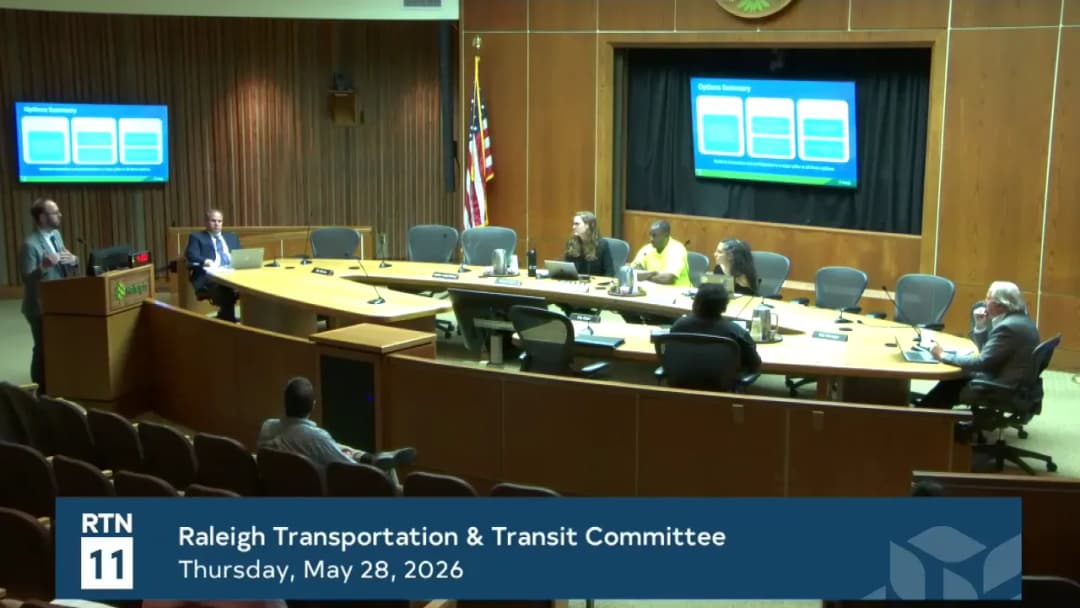
Transportation and Transit Committee Meeting - May 28, 2026

The Transportation and Transit Committee met on May 28, 2026, at 8:00 PM to discuss updates to the Neighborhood Traffic Management Program (NTMP) and traffic schedule authority. The committee heard a presentation from Will Shoemaker of the Transportation Department and received public comment before recommending policy changes. Public Comments & Testimony - Mike Provosnik, advocacy chair and vice president of Oaks and Spokes, expressed full support for option three (automatic projects), arguing that safety should not be subject to neighborhood balloting. He also suggested expanding the toolkit and using quick-build projects, citing the example of Clark Avenue. Discussion Items - Neighborhood Traffic Management Program (NTMP) Policy Options: Staff presented three options: (1) no change, (2) two-tiered approval with automatic projects for excessive speeding/crash problems and balloting for others, (3) automatic projects for all qualifying streets with resident engagement on design but no ballot. Staff noted that option two offers no efficiency gains, while option three could reduce project timeline from three to two years. Councilmembers asked about engagement, design process, and the ability for residents to request removal after three years. After discussion, all present councilmembers expressed support for option three. - Traffic Schedule Authority: Staff presented three options: (1) no change (request-based with balloting), (2) remove balloting for local speed limit reductions but still require council approval, (3) delegate authority to the Transportation Director for speed limit reductions, stop signs, and intersection sight lines. Staff recommended option three for efficiency and proactive implementation. Councilmembers supported option three, emphasizing the need for a clear communication strategy and phased approach. - Partnership and Future Projects: Staff highlighted the Quail Hollow Green Street project (phase one expected August/September 2026) and the Eastgate Dam project, which will integrate traffic calming, green stormwater infrastructure, and pedestrian improvements. Councilmember Branch requested continued community engagement, especially with Oaks and Spokes. Key Outcomes - The committee voted unanimously to recommend option three for the NTMP (automatic projects, removing the neighborhood ballot) to the full City Council. - The committee voted unanimously to recommend option three for traffic schedule authority (delegation to the Transportation Director) to the full City Council. - Staff will develop a strategy for proactive speed limit reductions, prioritizing high-risk areas, schools, and community centers, and report back to the committee.

TRANSPORTATION SAFETY 69% · PROCEDURAL 15% · COMMUNITY ENGAGEMENT 14% · INFRASTRUCTURE 2%
OPENPUBLICA · PUBLIC MEETING INDEXUPDATED DAILY · openpublica.com