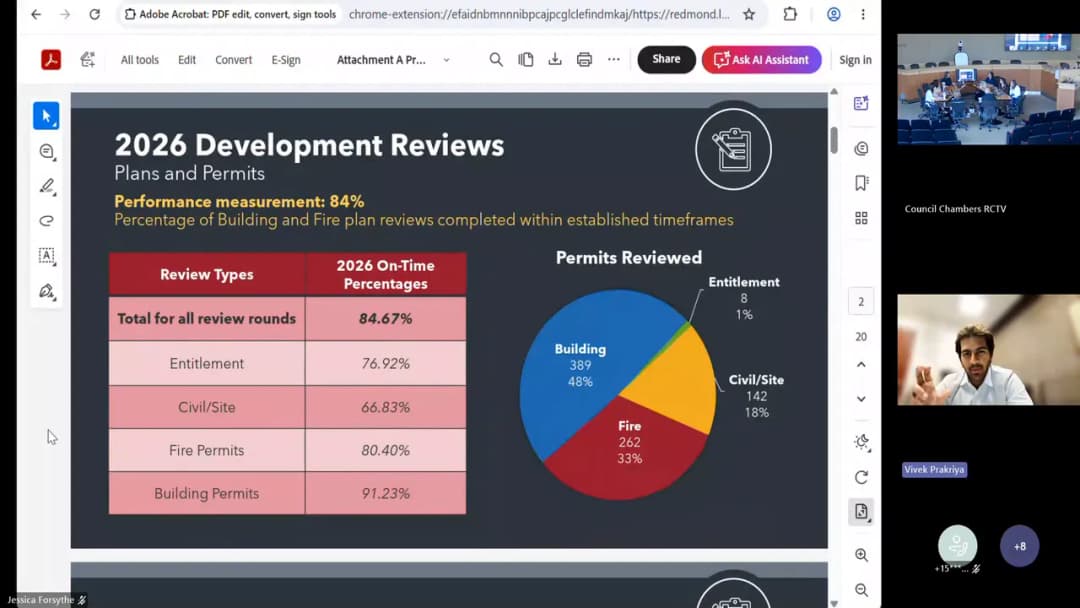
The Committee of the Whole for Planning and Public Works met on August 3, 2026, with all council members present. The agenda included three items: renewal of an interlocal agreement with King County Fire District 34, the 2026 annual code cleanup, and a performance data update from the Fire Department. Consent Calendar - Interlocal Agreement with King County Fire District 34 (CM 26-4791): The committee approved sending a 10-year renewal of the agreement for fire inspections in King County Fire District 34 to the September 1 consent agenda. The agreement authorizes Redmond Fire to conduct annual life safety inspections in permitted businesses and multifamily complexes within the district. Council members asked about King County's authority to reverse decisions (never happened in 10 years) and whether the contract would change (no substantial changes anticipated). No objections were raised. Discussion Items - 2026 Annual Code Cleanup (CM 26-4781): Staff presented minor zoning code amendments including typos, reference corrections, and clarifications. The Planning Commission recommended approval on July 22. Councilmember Stewart noted the addition of two youth advisors to the Planning Commission. Councilmember Kritzer asked about food truck hour limits (8 hours/day, 4 days/week in residential zones) and whether changes to sustainability references were substantive (clarified as cleanups only). Councilmember Soni asked if open space requirement clarifications would apply retroactively (no, only future developments). Staff will follow up on two questions via email; if no further issues, the item will go to consent on September 15. - 2026 Q1 Q2 Fire Prevention Performance Data (CM 26-4801): Fire staff reported that overall performance targets are being met or exceeded in development review, annual inspections, and fire life safety. Councilmember Parsi noted consistent underperformance in the system reliability program (tracking building owner testing) since 2022; staff explained the increase in monitored systems (from 300 to 3,400) and that the missing target is due to building owners not fulfilling testing responsibilities. Staff will consider differentiating building owner compliance from staff performance in future reports. Councilmember Prakriya asked about fire's role in development review timelines; staff described concurrent reviews with no additional time added. Councilmember Kritzer praised fire containment rates and noted an increase in cooking fires, possibly due to increased reporting in multifamily buildings. Councilmember Parsi asked for clarification on the "occupancy rate post-fire" metric; staff explained it measures displacement 24 hours due to fire damage, not suppression effects, and they are tracking a broader displacement metric for future reporting. Key Outcomes - Interlocal Agreement: Approved for consent on September 1. - Annual Code Cleanup: To be placed on consent on September 15 after email follow-up on two questions from Councilmember Kritzer. - Fire Performance Data: Received as informational; no action taken. Staff committed to refining the system reliability metric to separate owner compliance from staff performance and to continue analyzing cooking fire trends. - Youth Advisors: Noted that two youth advisors have been added to the Planning Commission, with training this month and service starting in the fall.
Public Meetings - Redmond, Washington
Public Meetings - Redmond, WashingtonOn Tuesday, July 28, 2026, at 7 p.m., the Redmond City Council held a study session with all council members and Mayor Bernie in attendance. The agenda covered: (1) 2026 amendments to Redmond Municipal Code 3.38, the multifamily housing property tax exemption (MFTE); (2) a budget process update including the utility rate study, long-range financial strategy, and fiscal policies; and (3) council talk time. No separate written agenda or minutes accompanied the transcript. Multifamily Housing Property Tax Exemption (RMC 3.38) - Staff presented proposed amendments to add a 12-year extension option to the existing MFTE programs in three residential targeted areas: Merrymore, mixed use, and Overlake. The downtown Faith/neighborhood residential targeted areas would not be affected, and the new tool would supplement rather than replace existing MFTE programs. - The proposal was based on a 2026 analysis conducted with the Regional Coalition for Housing (ARCH). The exemption would not trigger until a building is complete and receives a certificate of occupancy, with the exemption starting the following year. - Council discussion clarified that the tax exemption applies to all residential units but only to the assessed value of the improved property, not the land or mixed-use components. Redmond's affordable units remain affordable for the life of the project through legal covenants, even after the exemption period ends. - Staff cited fiscal context: the community cost is roughly $45 per household annually, about $575,000 in foregone taxes, 258 affordable units produced since the program began in 2017, and a $5 million figure representing the broader staff cost of the community and economic development program rather than this amendment alone. - Staff explained that the 20-year transit-oriented development MFTE option is not being recommended now because state Department of Commerce guidance on deeper affordability requirements is unclear. Staff plan to seek a legislative trailer amendment and could revisit the 20-year option before the 2029 deadline, noting the city does not want to become a litigation test case. - On occupancy validation, staff said ARCH units are generally oversubscribed and that occupant qualifications are rigorously monitored through the MFTE process and city covenants. - Staff shared pilot program learnings from 2023: the 12-year program requires a 20% affordable set-aside; two developments opted in and two did not during volatile 2023–24 market conditions. - Outcome: Council directed staff to prepare the ordinance and place it on the consent agenda for the August 3, 2026 business meeting; no objections were raised. Utility Rate Study and City Utilities - Public Works staff described the three core utility systems: water service to more than 20,000 homes and businesses, nearly 360 miles of water main, five city-owned wells, regional wastewater conveyance, and stormwater management of approximately 11 billion gallons of rainfall annually through about 200 miles of pipe. The utilities represent roughly $3.5 billion in public infrastructure. - Staff explained that utilities are enterprise/proprietary funds that must be self-sustaining. Rate pressures come from King County wastewater treatment and Cascade Water Alliance water supply costs. The City of Redmond's growing customer base — around 4–5% annual growth since 2019–20, compared with about 1.25% historically — helps absorb cost increases. Redmond produces about 40% of its water through local wells, which helps offset reliance on regional supplies. - The Novelty Hill area faces higher rate increases because its customer base is built out, small, and served by relatively new infrastructure with high depreciation costs. - Staff presented preliminary rate expectations and said final numbers would be ready at the end of September. Rate smoothing was explained as using reserves, timing of expenditures, and debt coverage strategies to reduce sharp rate jumps while still meeting financial tests. - Council members requested options for rate smoothing, an affordability analysis, commercial versus residential rate breakdowns, and details on utility assistance programs. Staff noted existing programs include a 50% low-income discount for seniors/disabled residents and assistance through Hopelink. - Council President Stewart cited affordability as a top resident concern and referenced regional rate increases of 12.75% for each of the next six years. Councilmember Forsyth noted that pandemic-era rate freezes contributed to the larger increases now being seen. - Staff said general fund capital support for utilities is allowable but is not currently planned because of competing general fund capital needs. Regional partnership agreements with King County and Cascade Water Alliance were discussed as providing treatment capacity and buying power that the city could not achieve on its own. - Outcome: Staff will return in September with final forecasts, rate design recommendations, cost-of-service results, affordability analysis, and options for council consideration. Long-Range Financial Strategy and Fiscal Policies - Asset management strategy: Council supported adding an asset management strategy to the long-range financial strategy. Staff will add broad language now and work with council over the next year to develop a detailed strategy, with emphasis on critical assets that are largest, most valuable, and present the greatest risk. - Budget contingency plan: Council supported developing a formal budget contingency plan, with a target completion by the end of the second quarter of 2027. The plan is expected to address reserve use, service priorities, communication with the community, and policy choices such as furloughs versus staffing reductions during downturns. - Community strategic plan: Council decided to replace the fiscal policy reference to the community strategic plan with a reference to the Comprehensive Plan. Council also agreed to continue a separate conversation about creating a short-term, public-facing priorities tool that is more digestible than the full Comprehensive Plan. - Community Results Team: Council majority supported continuing and upgrading the team, including a possible budget offer in the non-budget year to proactively recruit a diverse group of community participants and give them budget education before the 2027–28 budget cycle begins. - General obligation bond 50% policy: Council retained the existing 50% borrowing limit for now. The policy will be revisited in 2027 with additional data, peer-city comparisons, and possible consideration of adjusting the percentage. - Operating reserves: Council directed maintaining the 12% operating reserve target. The current reserve level is 9%; reaching 10% in the 2027–28 budget would require about $4.1 million. Policy language will be revised to remove the point-in-time “currently 9%” reference and instead describe a gradual increase each biennium until 12% is reached. - Community investment rate: Staff presented the metric showing city revenues as a share of community personal income. The council-approved target is 5.2%–5.5%. Historical averages have declined: 29-year average 5.04%, 15-year average 5.16%, 10-year average 4.95%, 5-year average 4.53%, 3-year average 4.35%, and a 2026–32 forecast of 3.68%. Staff outlined options including no change, revenue-led decisions, service-led corrections (not recommended), and recalibrating the target. Council made no change tonight and will revisit after 2026 actuals are available, likely before the end of the second quarter of 2027. One councilmember flagged a possible slide math error, and staff said they would review the calculation. Council Talk Time - Council recognized the retirement of Chip, the IT and meeting-production staff member, with thanks for his years of service. - Announcements included a special meeting on Monday, August 3, 2026, followed by recess until Tuesday, September 1, 2026; National Night Out; Rockets on the River concerts on August 5, 12, and 19; a retirement celebration for Director Hallen on August 18; and ongoing recruitment for a legislative coordinator. - Councilmember Procrea announced work in Washington, D.C., on AI policy for the U.S. Senate under Senator Cantwell, with no conflict with city duties. - Councilmember Sony discussed the recent Seattle Center incident and called for strengthening youth safety, prevention strategies, and regional partnerships; a human services budget review is planned for the fall. - Councilmember Forsyth reminded the public that primary ballots are out, highlighted the state Supreme Court races, and recommended using drop boxes. - The meeting was adjourned. Key Outcomes - Directed the MFTE 12-year extension ordinance to the August 3, 2026 consent agenda. - Directed staff to return in September with final utility rate forecasts and rate options. - Added asset management and budget contingency planning as strategies to develop over the next year. - Replaced the community strategic plan reference with the Comprehensive Plan in fiscal policies. - Retained the GO bond 50% policy for now, to be revisited in 2027. - Maintained the 12% operating reserve target with revised language to avoid a point-in-time reference. - Made no change to the community investment rate target; scheduled further discussion after 2026 actuals are available.
The Redmond Committee of the Whole for Parks and Environmental Sustainability met on July 28, 2026, at 4:30 PM to discuss seven agenda items: a park impact fee update, a 4Culture art grant, e-mobility implementation, tree canopy expansion, parks signage standards, the events innovation fund, and the teen center project. All council members were present. Park Impact Fee Schedule Update (Action Item) Staff presented a standard-based 20-year methodology. Development community feedback supported fees based on residential square footage for predictability. Council requested a draft ordinance for review at the September 22 committee meeting, with final adoption bundled with other impact fee updates in November. Staff will provide detailed calculations and clarify non-residential fee categories. 4Culture Art Grant Approval (Action Item) Staff requested authorization to accept a $72,000 grant from 4Culture for cultural arts projects, including the downtown Redmond Art Walk. The item was moved to the consent agenda for the September 1 regular business meeting. Environmental Sustainability Action Plan E-Mobility Update (Informational) Staff reported 6,000 electric vehicles registered in 2025, projected to reach 16,000 by 2030. The e-bike rebate program received 367 applications; 60 standard ($500 each) and 40 income-qualified ($2,000 each) rebates were issued. A curbside charger pilot in Marymoor Village with PSE awaits installation. City fleet charging ports are being installed. Council discussed emissions from the electric fire truck charged off-site, timing for a second EV fire truck, and the charging infrastructure gap (needing 875 Level 2 stations by 2030). Staff will provide a follow-up at the September quarterly implementation update. Tree Canopy Expansion Update (Informational) The tree code update continues; two drafts have been published for public comment. The second annual tree giveaway increased to 750 trees (from 500); 300 have been claimed as of the meeting. Targeted outreach using a tree equity map prioritized areas with higher need. Aerial imagery for updated canopy data will be analyzed by fall. Budget requests for an urban forestry program administrator and an urban forest management plan have been submitted. Council noted opportunities for riparian planting along the Sammamish River and discussed barriers for renters in receiving trees. Parks Signage and Wayfinding Standards and Strategy Plan (Informational) Staff presented the final design standards, developed with engagement including the Snoqualmie Tribe. Councilmember Forsyth raised concerns about color palette accessibility for red-green colorblind users and suggested using color-coded wayfinding for language accessibility. She also urged alignment with East Rail branding. Staff committed to follow up with consultants and noted iconography and QR codes for translation. Councilmember Prakriya questioned budgeting without a full sign inventory. Implementation funding is in the current CIP. Events Innovation Fund Update (Informational) The new grant program awarded $23,000 to five organizations: Green Stage, Falunco Sports, Turkish Women's Charity, One Redmond, and Bigfoot Kids Book Festival. Councilmembers Kritzer and Forsyth expressed that the program did not fully meet the intent to support very small nonprofits, noted overlap with World Cup watch party grants, and suggested revisiting eligibility and gathering community feedback for the next biennium. Staff highlighted an alternative community contractor process for programming space. Teen Center Project Update (Informational) Staff reported unanimous Project Review Committee approval for progressive design build delivery. The RFQ published July 27 closes August 24; shortlist target is November 4. A $35 million placeholder budget was set for validation. Pre-engagement listening sessions with teens and the community will begin before the design-build team is selected. Council discussed budget escalation from earlier estimates, the need for clear communication on engagement schedules, and the trade-off between expedience and robust engagement. The conservative timeline estimates completion by 2031, with potential acceleration. Key Outcomes - Park Impact Fee: Staff will present a draft ordinance at the September 22 Committee of the Whole meeting; final adoption in November bundled with other impact fees. - 4Culture Grant: Moved to consent agenda for September 1 regular business meeting. - E-Mobility: Staff to provide update on EV fire truck emissions and charging at September quarterly meeting. - Tree Canopy: Budget requests for urban forestry administrator and management plan submitted; continued outreach for tree giveaway. - Signage: Staff to incorporate feedback on color accessibility and East Rail branding; final manual to be completed. - Events Innovation Fund: Program to be re-evaluated for next biennium based on council feedback. - Teen Center: Pre-engagement sessions to launch; RFQ closes August 24; shortlist by November 4; validation phase to begin in mid-2027.
The Redmond Planning Commission held a hybrid meeting on July 22, 2026, from 7:00 PM to approximately 8:50 PM. The agenda included approval of the June 24, 2026 meeting minutes, a public comment period, approval of the 2026 Annual Code Cleanup report, briefings on the Tree Code Update and the Southeast Redmond Manufacturing and Industrial Market Study, and a study session on the Planning Commission Rules of Procedure. Commissioners also received staff and city council updates. Consent Calendar - Approved the agenda and the June 24, 2026 meeting minutes unanimously. - Approved the 2026 Annual Code Cleanup report and recommendation to City Council unanimously. Public Comments & Testimony - David Morton (Redmond, 98053) spoke during Items from the Audience. He suggested three focus areas for the August 12 Tree Code study session: 1) timing of the Let's Connect questionnaire relative to version two, 2) appreciation for retaining the shoreline master program definition for significant trees, and 3) requested worked examples of tree credit calculations for typical Redmond lot types. He also encouraged early release of questionnaire results before the August 12 packet. Discussion Items - Tree Code Update Briefing: Staff (Lauren Anderson and Cameron Zapata) presented an overview of the project history, key changes, and timeline. The code update began in 2020, was paused due to Kirkland litigation, and restarted to address middle housing mandates. Key changes include updated definitions, tree credit calculations, enforcement, and replacement standards. Community engagement included four learning sessions, two office hours, and a Let's Connect questionnaire (35 responses as of the meeting). Commissioners requested: focus on scenarios (e.g., hazardous trees, development, views), maps of urban forest heat islands, examples for different lot sizes, science behind conifer replacement, and clarification on culturally modified trees. A commissioner noted the omission of data centers from the SE Redmond market study and requested policy clarity. - SE Redmond Market Study Briefing: Staff (Lauren Alpert) presented the study background, key findings, and strategies. The Southeast Redmond Manufacturing and Industrial Center (SEMIC) is approximately 375 acres. Key findings: overall vacancy rate of 3.4% (below healthy 5–8%), flex space vacancy of 10% (mismatch of supply and demand), energy constraints, and opportunities in advanced manufacturing, e-commerce, and legacy businesses. Strategies include zoning incentives, business recruitment, infrastructure coordination, and funding mechanisms. Commissioners raised concerns about data centers (lack of mention), definition of mixed-use, flex space mismatch, parking requirements, and transportation solutions (e.g., private shuttles). A commissioner emphasized that distribution does not qualify as manufacturing or industrial. - Planning Commission Rules Update Study Session: Staff (Jeff Churchill) introduced draft updated rules focusing on independence, public participation, and records. Key points: communications about commission business should be on the record; avoid serial meetings; refer council member inquiries to staff; use city email for commission business. Commissioners discussed attendance policy clarification, interactions with council at events, and personal memos to council. Two issues were added to the matrix: attendance definition and guidance for events. Key Outcomes - Votes: Unanimous approval of the agenda, June 24, 2026 meeting minutes, and the 2026 Annual Code Cleanup report. - Next Steps for Tree Code: Two study sessions on August 12 and September 23, 2026; public hearing on October 14, 2026; additional study sessions on November 2 and 28, 2026; final report approval anticipated December 12, 2026; city council process January–March 2027. - Next Steps for Rules Update: Continuation on August 12, 2026; possible recommendation to city council that night or at a later meeting (August 26 or September 9, 2026). - Staff Updates: City council received a presentation from Cascade Water Alliance, adopted temporary non-commercial science regulations, and held a public hearing on drone ports with no changes to the moratorium. New youth advocates will start in September; two interns from Western Washington University will join for urban mixed use zone master planning.
This special meeting was held on July 21, 2026, to interview a candidate for the Human Services Commission. The sole agenda item was the interview of Austin Ash and Brenner, a senior pastor at Redmond Presbyterian Church who lives outside city limits but works in Redmond, as allowed by the commission's ordinance for up to two non-resident seats. Council members asked questions about the candidate's motivations, community needs, equity principles, and youth perspectives. No formal vote was taken; the council indicated they would consider the appointment at the next business meeting. Discussion Items - Candidate Interview: Councilmembers questioned candidate Austin Ash and Brenner about his interest in commission service, community needs, and decision-making approaches. - Motivation: The candidate expressed a desire to serve the community and learn about neighbors' stories, citing his role as a faith leader whose congregation largely resides in Redmond. - Pressing Needs: He identified food insecurity, affordable housing (noting Plymouth Housing supportive housing efforts), and a “loneliness epidemic” as key priorities. - Serving Diverse Populations: When asked about ensuring fairness while supporting underserved groups, he emphasized intentional listening, building relationships, and paying attention to smaller or niche nonprofits that may be overlooked. - Youth Perspective: Drawing on past youth ministry experience, he stressed that young people need to be seen and heard as current contributors, not just future ones, and that youth are leading indicators of community issues. - Decision-Making Principles: When faced with competing priorities and limited resources, the candidate said he would rely on the commission's collective wisdom, slow down to avoid rushing, and focus on goals and missed opportunities. - Council Feedback: Councilmember Kritzer praised the candidate's involvement in the food box program. Councilmember Prakriya (a former youth advisor on the commission) noted appreciation for his willingness to serve. Key Outcomes - No vote taken at this special meeting. The council scheduled a decision for the next business meeting, with councilmembers signaling positive sentiment (nods and smiles). Mayor Birney stated, “We hope to see you there… we look forward to having you join our commission.”
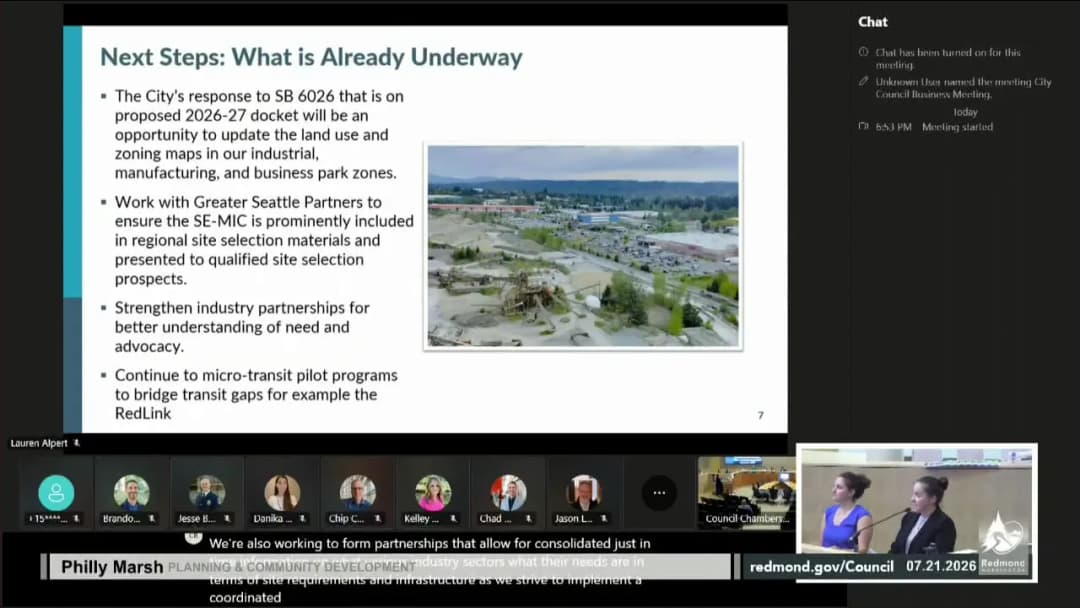
The Redmond City Council held a regular business meeting on Tuesday, July 21, 2026, at 7:00 PM at City Hall (15670 NE 85th St) and remotely. The meeting included presentations from Cascade Water Alliance and a Vision 2050 award, public comments on tree enforcement, signage, safety, and Flock cameras, a public hearing on commercial drone land uses, staff reports on the tree code update and the Southeast Redmond Manufacturing and Industrial Center (MIC) strategy, and a vote to terminate the Flock ALPR contract. All votes were unanimous (7-0) on major actions. Consent Calendar - Items Approved: The consent agenda (items 1-6, 8) was approved by a 7-0 voice vote. These included approval of minutes from July 7, 2026, payroll/claims checks, a construction contract with Earthworks Solutions for the Willows Road Watermain Extension ($1,323,740), a final contract with Coast to Coast Turf for synthetic turf replacement ($1,595,835), a services agreement with Technical Systems Inc. for control system upgrades ($2,409,370), Budget Adjustment 7 (Ordinance 3262), and the collective bargaining agreement with Teamsters Local No. 117 (Ordinance 3264). - Item 7 (Temporary Non-Commercial Signs): Pulled by Councilmember Kritzer for discussion. Staff clarified that no permit is required for temporary non-commercial signs, the restrictions on affixing signs to poles/trees are existing code, and sight-line restrictions are also existing. The ordinance goes into effect January 1, 2027. A communications plan includes newsletters, press releases, and a 30-day hold for illegally placed signs. The item was later approved by a 7-0 roll-call vote (Ordinance 3263). Public Comments & Testimony - Tree Code Enforcement: Jay Hill and Catherine Moya (Marcrest neighborhood) highlighted a gap: tree code enforcement is unavailable on weekends, allowing unchecked tree removal. They requested an on-call enforcement system or a ban on weekend tree removal. Councilmember Prakriya noted the issue and staff confirmed a GIS permit tracking layer is being developed. - Signage and Free Speech: Max Ruhlman and Wolf Adriatico urged caution on the sign ordinance, arguing it could restrict free expression and disproportionately affect individuals and small groups. They emphasized that government should protect speech, not limit it. - Public Safety Concerns: Aaron Hamilton, a transgender resident, expressed feeling unsafe in Redmond, criticizing a recent survey that dismissed the 1% of residents who feel very unsafe. He shared personal experiences of harassment and noted the survey's demographic breakdown may underrepresent marginalized communities. - Flock ALPR Cameras: Garrett Wilkes spoke against the cameras, citing ongoing distrust and fear of misuse among community members. - Pickleball Court App: Prav Iyengar requested a 30-day pilot for a free crowd-sourcing tool for public pickleball courts (at Perigo Park, Meadow Park, and Municipal Campus) to help players find open courts. The mayor directed staff to follow up. - Southeast Redmond MIC: David Morton requested baseline PFAS testing at the Evans Creek relocation site before construction and explicit consideration of aquifer recharge area overlaps in the zoning update docket. - Public Hearing on Commercial Drones (Ordinance 3265): - Adam Reinicke (homeowner) supported drone delivery cautiously, asking the council to steer drone ports to locations near highways to avoid traffic concentration and to act quickly before drones launch from outside city limits. - David Morton supported the ordinance but requested direct stakeholder notification for residents near potential drone zones, precise definitions, early coordination with the FAA, and environmental review for sensitive areas. - Katie Kendall (attorney for Zipline) expressed commitment to working with the city and suggested a temporary pilot program with a temporary use permit to gather real-world data for permanent regulations. Discussion Items - Cascade Water Alliance Presentation: CEO John Taylor and economist Andy Baker presented the Cascade Supply Program (connecting Tacoma water to King County over 40 years, $1.1-1.3 billion) and the proposed 2027-2028 budget. Rate increases of 9.5% in 2027 and 2028 were proposed to fund the program, translating to $0.33/CCF in 2027 and $0.35/CCF in 2028. Councilmembers questioned impacts on multifamily residents, water chemistry (blending Seattle, Tacoma, and groundwater), and the methodology for regional capital facilities charges. Vice President Nuevacamina highlighted that the alternative (sticking with Seattle) offered less water security. Councilmember Forsyth asked about inviting other jurisdictions; staff noted emergency access points are planned. - Tree Code Update (Staff Report): Senior Planner Lauren Anderson and Senior Park Planner Cameron Zapata updated on the tree code revision, noting the current code is from 1998. The update aims to balance tree protection with state-mandated growth (population up 46% since 1998). Key changes include updated definitions, tree credit refinements, strengthened enforcement, and a tree protection zone. The timeline: public comment through July 31, 2026; Planning Commission review and public hearing October 14, 2026; Council adoption expected March 2027. Councilmembers urged sticking to the timeline, asked for a comparison to the 2022 draft, and raised concerns about weekend enforcement (staff confirmed a GIS layer is in development and cross-departmental discussions on enforcement are ongoing). - Southeast Redmond MIC Strategy Guide (Staff Report): Deputy Director Serafie Allen, Senior Planner Lauren Alpert, and Economic Development Manager Philly Marsh presented findings from a market study. The MIC has a 3.6% vacancy rate (healthy is 5-8%), and there is strong demand for flexible industrial space. Power constraints are a concern. Strategies include zoning updates via SB 6026, partnering with Greater Seattle Partners, and exploring funding for vocational schools and city-owned property for makers. Council President Stewart emphasized the importance of economic diversification and asked about vocational school outreach. Councilmember Kritzer noted the need to accommodate businesses displaced from Marymoor. The next update will be October 6, 2026, with zoning docket items expected summer 2027. Key Outcomes - Consent Agenda: Approved 7-0, including all routine items and payables, with Item 7 (Sign Ordinance) pulled for discussion and later approved 7-0. - Ordinance 3263 (Temporary Non-Commercial Signs): Approved 7-0 on a roll-call vote, effective January 1, 2027, with no permit required for non-commercial temporary signs. - Ordinance 3265 (Commercial Drone Land Uses): After a public hearing, the ordinance affirming the interim moratorium on drone ports was approved 7-0. The interim control prohibits drone port land uses for one year while permanent regulations are developed (by April 2027). - Flock ALPR Contract Termination: Council voted 7-0 to terminate the contract with Flock for automated license plate readers. The program has been paused since November 2025, and no additional financial obligation is incurred. The state grant funds are not required to be returned. - Closed Session: The council adjourned to closed session under RCW 42.30.140(4)(b) for labor negotiations.
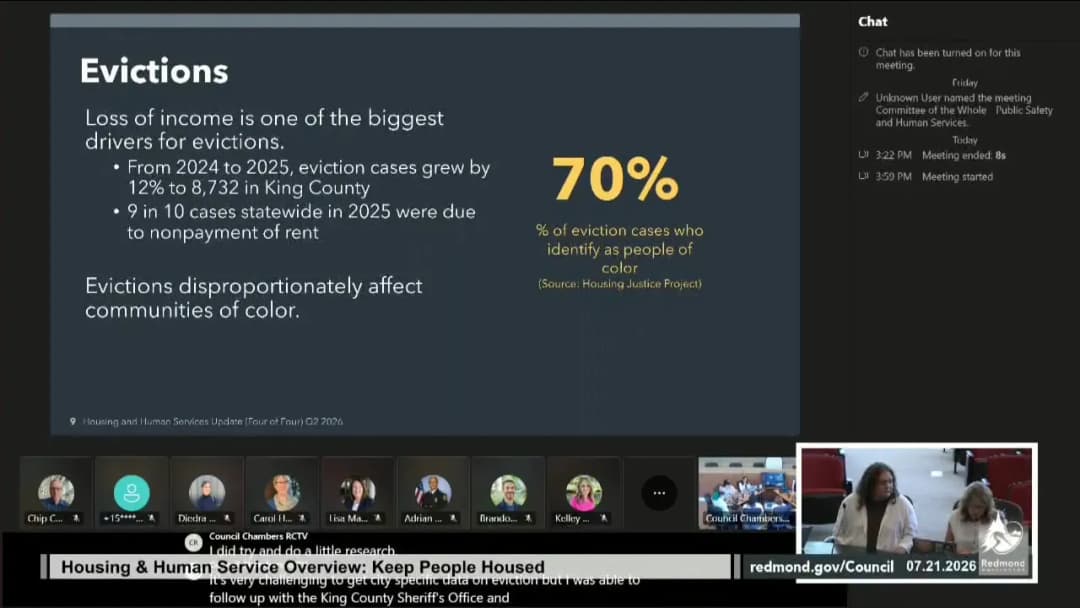
The Public Safety and Human Services Committee of the Whole met on July 21, 2026, at 4:30 PM. The packed agenda covered four action/informational items: the proposed 2027 CDBG funding allocation, the LWSD School Community Resource Officer contract renewal, the Low-Altitude Radar System and Office of Airspace Management, the Redmond Police Department Q2 2026 Activity Report, a housing stability presentation, and read-only Q2 Capital Investment Program updates. The meeting adjourned at approximately 5:30 PM. Consent Calendar - Proposed King County Community Development Block Grant (CDBG) 2027 Funding Allocation Plan (CM 26-4591): Staff presented the proposed allocation of estimated CDBG funds. The city leverages funds with ARCH for regional housing projects. Contingency plan covers proportional increases/decreases based on final award. Council Vice President Nuevacamina noted timely submission; Councilmember Soni asked about scope of work and metrics—quarterly reporting will occur. The item was moved to consent for the September 1 business meeting (no vote taken). - Lake Washington School District 2026-2027 School Community Resource Officer Contract Agreement (CM 26-4672): Chief Lowe presented the renewal with no significant changes. Councilmember Forsythe requested the dashboard be reshared before the final vote. The item was moved to consent for the August 3 business meeting (no vote taken). Public Comments & Testimony - None were made or noted during the meeting. Discussion Items Low-Altitude Radar System & Office of Airspace Management Chief Lowe presented: The city applied for congressionally directed spending (accepted, awaiting House Ways and Means Committee approval) to fund hardware and first-year software. The system provides operational awareness of airspace below 400 feet (where the DFR program operates). No regulatory authority—city would monitor and report violations to FAA. The Office of Airspace Management would serve as an ombuds point of contact; no additional staffing requested at this time. Councilmembers raised concerns: Council President Stewart noted council was not involved in the grant application; Vice President Nuevacamina worried about vendor creating a surveillance network; Councilmember Parsi questioned the purpose given drones have collision avoidance; Councilmember Kritzer requested a study session for more detail; Councilmember Forsythe asked about tracking identifiers and implications of federal grant—Chief Lowe answered no on both. The committee agreed to move this item to a future study session. Redmond Police Department Q2 2026 Activity Report Chief Lowe reported: Drone as First Responder program: 1,500 calls year-to-date, 90-second response time, 20% cancel ground response, 84.5% first on scene. Calls for service up 3.5% (14,400+ year-to-date). Arrests up 17.8%. Auto thefts down 65% (27 year-to-date vs. 77 in 2025, high of 168 in 2024). Residential burglaries down 8%+. Shoplifts down 17.5%. Traffic collisions up 15%. Property crimes down 34.5%. Violent crime down 64.5%. Assaults up 8.1%—50% domestic violence related. Primary collision factors: speeding and distracted driving. Emphasis patrols ongoing. Councilmember Soni asked about geographic clusters of burglaries—Chief Lowe said they move; crews come and go. Also asked about proactive drone patrols—not allowed. Councilmember Kritzer inquired about speed trailers and school zone cameras—preliminary warnings, data not yet substantive. Vice President Nuevacamina noted correlation between declining crimes and increased arrests due to good police work. No action taken. Housing and Human Services Overview: Keep People Housed (Presentation 4 of 4) Brooke Buckingham, Ian Lefcourt, and new Homeless Outreach Administrator Xavier Wright presented. Key themes: Housing stability is affected by rising costs (rent up 50% since 2015, home prices doubled). Nearly 1 in 4 households is cost-burdened (over 30% income) or severely cost-burdened (over 50%). City contracts with Eastside Legal Assistance: 268 hours to 52 households in 2025. Rental assistance: $286,000 in human services grants; Hope Link reported serving 1 household for every 112 unable to help per month. Evictions: King County Sheriff served 177 writs of restitution in Redmond in 2024-2025 (150 in 98052 zip code). Councilmember Parsi asked about fixed-income seniors—Ian Lefcourt noted they struggle to downsize, need home rehabilitation, and face trip hazards. Xavier Wright observed many elderly clients facing financial trouble and scams. Council President Stewart highlighted the Capella pilot success (40 households housed) and requested tracking evictions prevented. Councilmember Kritzer noted the staff already function as a housing ombuds. No action taken; further study session scheduled September 22, with strategic plan adoption expected October 2026. Capital Investment Program (CIP) Project Updates Q2 2026 (Read Only) Tess Wilkinson, Steve Gibbs, and Chris Danger answered questions. Council President Stewart requested a future highlight on ADA curb ramp program and pavement condition index. Councilmember Kritzer expressed excitement about Bell-Red buffered bike lane and asked about Idlewood Park parking lot expansion—contract award later this year with construction early next summer. Councilmember Parsi asked about teen center design progress—staff reported engaging design-build teams, state board approval expected Friday, October stakeholder engagement still on track. Councilmember Stewart noted that teen center item would be on the next week's Parks and Human Services committee agenda. Key Outcomes - CDBG Allocation Plan: Moved to consent agenda for September 1, 2026 business meeting. - LWSD CRO Contract: Moved to consent agenda for August 3, 2026 business meeting. - Low-Altitude Radar System: Referred to a future study session; no vote. - Q2 Police Report: Received as information; no action. - Housing Overview: Received as information; upcoming milestones: Let's Connect survey closes August 12, draft strategic plan to PWS committee September 2, study session September 22, adoption early October, funding recommendations October 27. - CIP Updates: Received as information; future update on ADA curb ramps requested.
The Redmond City Council held a study session on July 14, 2026, beginning at 7:00 PM. Mayor Angela Birney was absent. At staff request, agenda items two and three were flipped, so the order was: 2026 Annual Community Survey Results, Recreation Program Plan Overview, Pavement Management Program Update, Tenant Protections Update and Discussion, and Council Talk Time. No consent calendar or formal public comment period was on the agenda. 2026 Annual Community Survey Results - EMC Research Senior Principal Sarah Labatt presented the city’s annual resident survey, conducted April 6–May 3, 2026, with 528 random-sample interviews and a margin of error of plus/minus 4.3 percentage points. It was offered in English, Spanish, Chinese, and Hindi and used mail, text, email, and phone outreach. - Quality of life remained high: 81% rated Redmond excellent or good, including 32% excellent, the highest excellent rating measured in some time. - The most frequently cited community problems were affordability/cost of living/taxes, growth/overdevelopment, and traffic; affordability was the top concern in all three geographic regions (downtown, east, west). Concern about growth was 7 points lower than in 2025. - 67% rated the city’s overall job performance excellent or good. Ratings of the police and fire departments improved, with police excellent ratings rising from 24% to 33%. - 90% of residents said they feel safe in Redmond and walking alone in their neighborhoods. - A performance-versus-importance gap analysis showed managing police services and utilizing community feedback remain areas for improvement, while the pedestrian/bike-safety gap narrowed by 6 percentage points. - Councilmembers asked for demographic crosstabs (notably for safety data), neighborhood-level detail, and future disaggregation of the affordability/cost-of-living/taxes category. The decrease in newsletter reach was attributed partly to the survey’s broader outreach methods. Recreation Program Plan Overview - Parks and Recreation Director Lorene Hamilton introduced the department’s first-ever Recreation Program Plan, developed with PROS Consulting; the contract was approved in May 2025 and the project began in June 2025. - The plan was informed by staff focus groups, stakeholder interviews, a project website, an open-access online survey (over 333 responses), and a statistically valid resident survey focused on recreation (just over 400 responses). - Key findings: 94% of residents visited a park or recreation facility in the past year; 39% participated in a program (above the 36% national average); and 61% visited the city’s recreation website but only 39% registered, creating an activation/conversion gap. - The city has more than 240 distinct recreation offerings. Identified service gaps included adult programming, fitness and wellness, outdoor recreation/nature/environmental education, aquatics, youth sports, cultural/multicultural programming, and geographic gaps in Idlewood and Overlake. - The plan is organized around five strategic pillars: growing/refining the program portfolio; improving access and discoverability; investing in facilities and infrastructure; addressing service gaps through partnerships and expanded programming; and modernizing staffing, training, and organizational tools. - Councilmembers discussed how to evaluate underperforming programs while protecting programs that serve unique populations, and noted strong community interest in adult fitness/wellness and outdoor activities. No formal action was taken. Pavement Management Program Update - Interim Deputy Public Works Director Brandon Bueller and Senior Engineer Adnan Shabir presented the new Pavement Strategic Plan and Implementation Plan. The funding strategy will come with the mayor’s 2027–2028 budget in fall 2026. - Pavement Condition Index (PCI) measures street surface health from 0 to 100. Of the city’s 362 lane miles: about 7% (25 lane miles) are in excellent condition (PCI 86–100); roughly half (150 lane miles) are PCI 71–85; about 14% are in poor condition (PCI 41–55); and about 1% (4 lane miles) are near failure (PCI 20s). Residential streets average PCI 71; arterials average PCI 64 and are declining faster. - The city has invested about $1.7 million per year over the last six years and delivered about 21 lane miles of paving; meeting adopted level-of-service goals would require roughly 12 lane miles per year. - The plan recommends a dedicated annual paving investment of $5 million beginning in 2027, escalating by $250,000 per year to about $8 million by 2039. Without increased funding, the network PCI could fall to about 54 within seven years. - Staff described a new delivery model: separate utility contracts completed before paving projects, the capital division managing paving from project start, annual arterial rehabilitation, and expanded preventative maintenance on residential streets. - Councilmembers requested additional budget scenarios, cost-avoidance estimates, and discussion of transportation benefit district revenues and regional coordination. No vote was taken. Tenant Protections Update and Discussion - The Tenant Protection Subcommittee (Councilmembers Prakriya, Kritzer, and Forsyth) presented options for policy and budget decisions. Staff-drafted amendments to Chapter 9.54 of the Redmond Municipal Code included clarifying rent-increase notices, distributing tenant-rights information with leases, fee-transparency and limits, and an opportunity-to-correct provision. - The subcommittee reported that feedback identified concerns: removing the 180-day notice for rent increases over 10% could roll back protections because the new state law applies only to buildings 12 years or older; fee language needed clarification, particularly the difference between fees and penalties; and the opportunity-to-correct provision could be less effective if landlords repeatedly correct violations. - Additional policy options included a rent-fixing software ban modeled on King County’s 2025 ordinance and updates to business-license posting requirements. The subcommittee recommended waiting on the rent-fixing ban until the King County executive’s enforcement report is available. - Budget options discussed included a dedicated FTE/contractor for tenant assistance and enforcement, a funded work-plan item for planning staff, a renter’s handbook, and expanded tenant-rights communications. - Councilmembers expressed support for meaningful, enforceable, non-adversarial tenant protections and for renter stability. Councilmember Nuevacamina emphasized the importance of renters’ civic voice; Councilmember Sony raised concerns about repeated violations under the opportunity-to-correct rule; Councilmember Parsi asked what provisions were not included and why. Council Talk Time - Planning and Community Development Director Helen gave a verbal update on the Interlake Sporting Association (ISA) business license renewal, which has been pending for more than a year. The renewal required more rigorous code compliance, including a surveyed range plan; ISA resubmitted materials in October 2025. After earlier consultant searches found no range examiner, the police department contracted a range examiner in June 2026 and is awaiting a schedule. The city attorney’s office will oversee remaining re-licensing work and potential code updates after Director Helen’s departure. - Council also discussed the Flock automatic license plate reader contract. The requested closeout agreement had not been received. Councilmembers agreed to schedule a vote at the next business meeting to end the contract with Flock. Key Outcomes - Tenant protections: Council directed the subcommittee to continue work on a comprehensive policy package (Option D), to explore a dedicated FTE/contractor and work-item funding (with possible provisos), and to work with communications staff on improving tenant-rights website content, flyers, and FAQs. No code amendments were adopted. - Flock contract: Council agreed to place a vote on ending the Flock automatic license plate reader contract on a future business-meeting agenda, likely the next business meeting. - Pavement management: Staff will bring the funding strategy forward as part of the mayor’s 2027–2028 budget in the fall; additional budget and cost-avoidance scenarios were requested by councilmembers. - Survey, recreation plan, and pavement update: These items were informational study-session presentations; no formal votes were taken.
The Committee of the Whole met on Tuesday, July 14, 2026, at 4:30 PM to discuss seven items including budget adjustments, insurance membership, budget process updates, technology projects, the REDI program, communications strategy, and regional animal services licensing. The meeting was presided over by Vanessa Kritzer with all council members present. Consent Calendar - Budget Adjustment 7 (minus one item): Moved to consent on July 21 after council agreed to remove the downtown Redmond Link RCC landscaping improvements transfer pending further information. - WCIA Pre-Membership Agreement: Moved to consent on August 3 after discussion clarifying that pre-membership has no upfront cost and only charges for services used if the city does not join. - Budget Ground Rules: With minor grammatical edits proposed by Council President Stewart, the ground rules were scheduled for adoption on consent at a future business meeting. Discussion Items - Budget Adjustment 7 (Item A1): Finance Director Kelly Cochrane and Haley Zercher presented the regular cleanup adjustment. The item in question was a transfer of rental income for downtown Redmond Link RCC landscaping improvements, which had not yet been presented to council. Council decided to delay that transfer until the next adjustment after hearing more at the upcoming CIP update. Council President Stewart noted the adjustment also included acceptance of a "Connecting Housing to Infrastructure" grant supporting Bellwether’s 330 units of deeply affordable housing in Overlake. - WCIA Pre-Membership (Item A2): Director Cochrane and program manager Kelly Shee introduced the Washington Cities Insurance Authority option, which would replace the city’s current boutique carrier. Shee highlighted benefits including larger risk pool, pre-defense legal support, training, and better response times. Councilmember Prakriya asked about WSIA (Washington Self-Insurers Association); WCIA Deputy Director Rob Roscoe clarified WSIA is only for workers’ compensation. Councilmember Sony asked about performance metrics; Shee said response time and training resources would be key. Council President Stewart expressed support, noting the proposal offers more coverage at a slightly lower price. Cost clarification: no upfront fee for pre-membership; only pay for services used if not joining. - Budget Process Update (Item B): Director Cochrane reported on the long-range financial strategy, fiscal policies, and budget ground rules. The updated matrix was sent July 13; Councilmember Prakriya requested more time for review and public posting of attachments (staff confirmed they are on the FAC agenda). Councilmember Stewart asked that item 17 (on civic results and public participation) be added to the July 28 study session. Council agreed. The budget ground rules, with minor changes (meeting length from max 3 hours to 2–3 hours, and clearer process for proposing new funding), were moved to consent. - Finance BTIP Projects Update (Item C1): Project manager Wanda Norman reported that the ACFR software (ClearGov) is live, saving $45,000 in consultant costs for the 2025 audit cycle, saving over 280 staff hours, and projected to save 520 hours annually. The KeyBank Automated Payables project will offer ACH to vendors, reducing check fraud. Councilmember Parsi asked to quantify savings in dollars and about fraud reduction; staff said fraud savings are hard to quantify but ACH is more secure. Councilmember Prakriya asked about cost of ClearGov ($28,000) and whether a public-facing transparency portal is planned; staff said a dashboard project is starting in August. - REDI Program Update (Item C2): Deputy Director Zach Hoovener introduced new REDI Program Administrator Teresa Lee. Lee shared her background (Fred Hutch, education) and commitment to the REDI strategic plan. Councilmembers welcomed her and expressed interest in supporting her role in the upcoming budget. - City Communications Strategy Update (Item C3): Communications Manager Kelly Schutz presented the 2027-2028 Comprehensive Communications Plan, documenting existing practices, formalizing social media strategy, and rebuilding equity/accessibility sections. Communications project requests increased 37% from 2024 to 2025 (1,099 to 1,504). Council generally praised the plan but noted the lack of a section on council communications with the public. Councilmember Prakriya highlighted that a recent council conversation event was not posted on Instagram. Council agreed to schedule a separate discussion on council communication tools later. - Regional Animal Services Licensing Update (Item C4): Chief Policy Advisor Amy Sai and Norm Alberg (King County RAS) presented two initiatives: a $10 increase in pet licensing fees (first in 18 years, would raise $500,000) and using rabies vaccination data to identify unlicensed pets. Alberg noted current licensing rate is only 20–24% despite 80% vaccination. Councilmember Sony raised concerns about socioeconomic impact on low-income pet owners. Councilmember Nuevacamina preferred an educational approach rather than fee increases, citing rate increase fatigue. This was informational only; feedback will be taken to the King County Executive. Key Outcomes - Approved to consent: Budget Adjustment 7 (minus the landscaping transfer) on July 21; WCIA Pre-Membership on August 3; Budget Ground Rules (with minor edits) on a future consent agenda. - Pulled from adjustment: Downtown Redmond Link RCC landscaping improvements transfer will be re-presented at a later budget adjustment after more information is provided. - Study session added: Item 17 on long-range financial policy (civic results and public participation) will be discussed at the July 28 study session. - Further discussion: Council agreed to schedule a future meeting to discuss council communication needs and tools. - Next steps for RAS: Redmond’s feedback on fee increase and vaccination data approach will be submitted; county executive decision expected in September.
The Redmond City Council met on Tuesday, July 7, 2026, at 7:00 PM at City Hall. The meeting included a proclamation for Parks and Recreation Month, public comments from nine individuals, approval of a consent agenda, ombudsperson and committee reports, and a closed session for labor negotiations. Proclamation - Mayor Angela Birney proclaimed July 2026 as Parks and Recreation Month, citing the city's commitment to parks, trails, tree canopy (goal of 40% coverage by 2050), and community events. Green Redmond Forest Stewards Alex Ku and Irene Ku spoke, describing their volunteer work restoring Smith Woods over three to seven years, noting a reduction in invasive Himalayan blackberry and increased native plants. Public Comments & Testimony - Nine speakers addressed the council. The majority spoke about the Interlake Sporting Association (ISA) shooting range and proposed hour restrictions. - Nathan Gibbs (ISA President): Expressed that falsehoods about the club are being repeated; argued that proposed hours (10 AM to 2 PM on Saturdays) are unjustified and urged a compromise of 10 AM to 6 PM on Saturdays with sound mitigation paid for by ISA. Noted ISA's exemplary safety record over 80 years. - Casey Gilliam (ISA member): Clarified that ISA has reduced operations, including suspending Project Appleseed and trap programs, to be good neighbors. Described the stringent membership intake process emphasizing safety. - Nathan Parker (ISA member): Pointed to other suburban ranges that use physical sound mitigation (earthen berms) without reducing hours. Stated ISA has completed sound studies, engineering plans, and geological surveys, awaiting council support. - Pedro Lopez (ISA member): Urged the council to slow down and consider alternatives like staggered hours, paper-target-only times, or subsonic/suppressed firearm periods. Emphasized that the proposed hours would make the club unusable for working people. Noted that ISA is a member-run nonprofit, not a business. - Peter Jarvis (ISA member): Described 40 years of voluntary operational restrictions as neighborhoods built up around the range. Cited past collaboration with the city and a recent shift in staff attitude. Thanked Councilmembers Pauley, Parsi, and Prakriya for recognizing the club's value. - Aaron Hamilton (trans community member): Spoke about feeling less safe as a trans woman in Redmond, citing threats of violence and a lack of ally action. Expressed frustration over failing to protect a safe space for trans youth. - Olu Zhu (ISA member): Described ISA as a community similar to a church, and argued that restricting hours is not a practical solution compared to sound mitigation. Noted that as a working parent, ISA is a vital retreat. - Wolf Adriatico (non-ISA member): Expressed support for ISA, stating that neighbors who moved in near a long-standing shooting range should bear responsibility. Also reminded the council of a promise to involve teens in building a new teen center. - David Morton (Green Redmond Forest Steward): Flagged four gaps in the tree code update draft: the in-lieu fee rate (still a placeholder of $800–$1,000 per tree), baseline minimum tree credits table (still being tested), undefined term "significant tree," and placeholder enforcement provisions. Asked for these to be prioritized before the planning commission process in August. Consent Calendar - The consent agenda was approved unanimously by voice vote. Items included: - Approval of minutes from June 16, 2026. - Approval of payroll and claims checks (June 25 and July 7, 2026). - Vision Blueprint 2050 – Capital Investment Strategy. - Updated On-Call Legal Services Agreement with Baker, Sterchi, Cowden & Rice, LLC (not to exceed $200,000). - Consultant agreement with Shrewsberry & Associates for Overlake Area Bicycle and Pedestrian Project (not to exceed $971,278). - Feasibility study for Fire Station 11 with TCA Architecture + Planning ($125,000). - Acceptance of Safe Streets For All (SS4A) Grant from FHWA. - Memorandum of Understanding with Eastrail Regional Advisory Council. - MOU for Behavioral Health Crisis Intervention Services. - Resolution No. 1630 amending Resolution No. 1503 to add grant contract threshold and authority. - Councilmember Parsi noted that the bottom of the checks register was missing vendor information and requested it be filled in; the item was not pulled. Ombudsperson Reports - Councilmember Soni (June ombuds): Reported few emails, including one opposing zone exclusions and MFTE amendments. Met with Washington Multi Family Housing Association and a Zipline team member. Also received emails about visa issues needing immediate assistance. - Councilmember Parsi (July ombuds): Received emails about zoning for affordable senior housing, renters' rights, and positive feedback on bike lanes. During office hours, heard about expanding bike lanes, public transportation, engagement in the budget process, and senior lunch program expansion. Also spoke with Issaquah Fish about city engagement. - Councilmember Forsythe: Had conversations about noise ordinance, ICE presence in Redmond, an invitation to a women's bazaar (including a children's entrepreneurial bazaar), and community concerns about sidewalk grinding. - Councilmember Kritzer: Office hours covered trans rights and safety, parking policy and ADA issues, incentivizing light rail use, land use policy, the 172nd gate project traffic calming, tenant protections, and concerns about ICE. Also noted Cascade Bicycle Club tabling at light rail stations. - Councilmember Prakriya: Attended the AWC annual conference with Councilmembers Soni, Stewart, and Mayor Birney; favorite sessions were on AI and municipal debt limits. - Council President Stewart: Mentioned awaiting a close-out agreement from Flock (ALPR vendor); distributed a note to neighboring jurisdictions about commercial drone delivery land use issues; the Sound Cities Association's caucus of city administrators has taken interest. Also reminded council that the noise ordinance item is now quasi-judicial (appearance of fairness doctrine applies). Councilmember Parsi clarified she knocked on doors before receiving that memo. Committee Reports - Councilmember Forsythe: Attended Eastrail Planning Meeting (regional meeting end of July, in-person); disability board meeting approved reimbursements for retired public service members. - Councilmember Prakriya: Tenant protections subcommittee will present at study session on July 14; will attend Sound Cities Association Public Issues Committee as alternate in Kirkland. - Councilmember Kritzer: LTAC and TPA (Tourism Promotion Area) approved proposed shared investments; LTEC budget will come to council. - Council President Stewart: Attended Regional Water Quality Committee (affordability of wastewater system) and AWC legislative priorities committee (discussed progressive revenue tools for cities; legislators present including Representative April Berg). - Councilmember Soni: One Redmond Foundation meeting lacked quorum; at AWC conference, did mobile tours of stormwater facilities and Kaiser Aluminum facility (discussed PFAS issue). - Councilmember (unidentified): Appointed to executive's housing revenue task force; also part of a housing group working with AWC on housing options with the state. Key Outcomes - Consent agenda approved unanimously. - Resolution No. 1630 (grant threshold and authority) adopted unanimously. - The council will discuss the Flock ALPR close-out agreement at Council Talk Time next week. - The council will consider the noise ordinance (ISA-related) under quasi-judicial rules; council members reminded to adhere to appearance of fairness. - The council went into closed session for labor negotiations (RCW 42.30.140(4)(b)) after the business meeting adjourned. - Next steps: Study session on July 14 (tenant protections), upcoming committee meetings, and continued work on housing, revenue, and tree code.