The Active Transportation Commission of Sacramento met on December 19, 2019, at 6:00 p.m. in City Hall Council Chamber. The meeting covered consent calendar approvals, election of officers for 2020, approval of the 2020 meeting calendar, a review of 2019 accomplishments, a preview of 2020 projects, and a discussion of potential active transportation improvements under the Affordable Housing Sustainable Communities (AHSC) grant program. One public comment raised concerns about leaf debris in bike lanes. Consent Calendar - Item 1: Approved meeting minutes of November 21, 2019, with one abstention (Commissioner Berdugo). - Item 2: Received and filed the Active Transportation Commission Log. Staff Reports - Item 3 – Commission Staff Report: Staff congratulated Commissioners Hopp and Haim for perfect attendance in 2019. Commissioners were reminded to submit stipend forms. Discussion Items - Item 4 – Election of Chair and Vice-Chair: Commissioner Haim was nominated and elected as Chair (unanimous). Commissioner Ward Waller was nominated and re-elected as Vice-Chair (unanimous). - Item 5 – Approve 2020 Commission Calendar: Staff noted that the July 2020 meeting must be canceled due to renovations in the council chamber and hearing room. A motion to approve the calendar with the July meeting removed was passed unanimously. - Item 6 – 2019 Review (Drew Hart): - Bike Parking: 97 bike racks installed year-to-date; the city will cross the 100-rack threshold by year-end. - Complete Streets Policy: Adopted by City Council on December 10, 2019, formalizing existing practices. - Pedicabs on Sidewalks: City Council voted on December 10 to prohibit pedicabs from sidewalks (driving, riding, or parking). Enforcement begins January 10, 2020. - Commissioners discussed related topics: bicycles on sidewalks (allowed citywide unless prohibited on specific blocks meeting criteria) and shared rideable drop zones. - Item 7 – Upcoming 2020 Items (Drew Hart): Staff previewed items for 2020: shared rideables six-month check-in, 2020 grant application strategy, Stockton Boulevard corridor study, Pocket/Greenhaven neighborhood transportation plan, Transportation Master Plan, General Plan mobility element update, work zone detour policy update, and bike parking updates. Commissioners requested emphasis on safety and equity, and asked for recommendations to the state on MUTCD updates and work zone detour guidance. - Item 8 – AHSC Program Active Transportation Potential (Jennifer Donlon Wyant): - The AHSC grant (cap-and-trade funded) supports affordable housing near transit and active transportation improvements within a half-mile of the project. The current opportunity involves the Twin Rivers area (Districts 3 & 4). - Eligible improvements must be in an approved plan and have CEQA/NEPA clearance. The city is considering: pedestrian-scale lighting on 12th Street, extending the 12th Street cycle track from C to D/E/F, and a 15th Street parking-protected bikeway. Budget is approximately $2–2.5 million. - Commissioners supported exploring all options and noted the tight timeline (grant deadline February 2020). Staff will report back on the final decision in January. Committee Comments, Ideas, Questions, and Meeting Reports - Commissioner Hopp reported on the Great California Delta Trail planning (December 5 stakeholder meeting) and urged city involvement. He also highlighted the Sacramento Waterfront project’s proposed Class I bike trail through Old Sacramento as a safety improvement. - Commissioner Pollins raised the veto of SB 127 (statewide complete streets bill) and asked if the commission could advocate for similar legislation. Staff noted the city supported SB 127 and would bring future efforts to the commission. Public Comments – Matters Not on the Agenda - Ally Dore Westbrook (Marshall School neighborhood resident): Expressed concern about large leaf debris piles in bike lanes, especially on 8th and H streets, and frustration with generic 311 responses. She requested the commission advocate for better enforcement of street sweeping and leaf removal during leaf season. - Commissioners agreed to add a discussion item to the commission log regarding leaf debris in bike lanes and invited Solid Waste division staff to present. They also noted the issue of 311 response tracking. - Commissioner Hopp suggested moving public comment earlier in the agenda to allow more timely input; staff will follow up with the clerk’s office. Key Outcomes - Elections: Chair Haim and Vice-Chair Ward Waller elected for 2020. - 2020 Calendar Approved with July meeting canceled. - Staff to follow up on leaf debris (add to log, invite Solid Waste), 311 response process, and earlier public comment placement. - AHSC Grant Discussion: Staff will proceed with project selection and report back in January. - Commission Log Items: Added Morrison Creek project follow-up, Delta Trail presentation, and Waterfront plan presentation. - Next Meeting: January 16, 2020, in council chambers.
Public Meetings - Sacramento, California
Public Meetings - Sacramento, CaliforniaThe Sacramento Preservation Commission held its regular meeting on Wednesday, December 18, 2019, at 5:30 PM in the City Hall Council Chamber. The meeting, which adjourned at 7:20 PM, included approval of consent calendar items, a public hearing on a historic landmark nomination, and a discussion on city policies regarding deferred maintenance of historic properties. Commissioners also received public comments on the condition of Old Marshall School. Consent Calendar - Item 1 – Approval of November 20, 2019 Minutes: Approved by a vote of 5-0-2 (Commissioners Bowns and Miller-Cruiess absent). - Item 2 – 2020 Preservation Commission Meeting Calendar: Approved by a vote of 6-0-1 (Commissioner Miller-Cruiess absent). Public Hearings - Item 3 – 1121 Swanston Drive Historic Landmark Nomination (Welch House): Staff presented the nomination, noting the property is an excellent example of Art Moderne style with International and Art Deco influences, eligible under Criterion 3. Public comments by William Burg (Preservation Sacramento) and Bruce Marwick (Sacramento Art Deco Society) expressed strong support. The commission voted 6-0-1 (Miller-Cruiess absent) to recommend City Council approve the landmark designation. Discussion Items - Item 4 – City Policies Regarding Deferred Maintenance of Historic Properties and Potential Maintenance Incentives: Staff reviewed existing code enforcement tools, incentives (Historic Places Grant Program, Mills Act), and past ad hoc committee recommendations. Public comments from eight speakers focused on the demolition-by-neglect situation at Old Marshall School (Sacramento City Unified School District), urging the commission to send a letter of concern. Commissioners discussed potential improvements, including better code case tracking, owner education (e.g., postcards), and increased collaboration with code enforcement. No formal action was taken; staff will report back at the January meeting on what actions the commission may appropriately take regarding Marshall School. Key Outcomes - Vote on Item 3: Unanimous recommendation to City Council for landmark designation (6-0-1). - Consent items approved as listed. - Discussion on deferred maintenance: Staff directed to report at the January 2020 meeting on whether the commission can formally address Marshall School concerns. - Commissioner comments: Requested that future agendas include clearly numbered items for public comment, commissioner comments, and director’s report. Staff acknowledged a templating issue. - Director’s Report: Announced personnel changes (Ryan DeVore departed, Tom Pace interim CDD, Greg Sandland interim planning director); upcoming chair/vice chair elections in January; and plans to promote the Historic District Plan at the 2020 California Preservation Foundation conference.
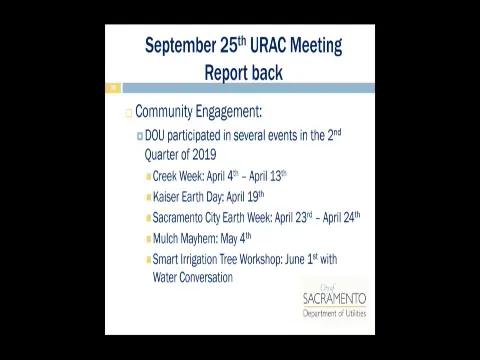
The Utilities Rate Advisory Commission met on December 11, 2019, at 5:30 p.m. in Council Chambers. The commission approved previous meeting minutes and received a quarterly update from the Department of Utilities on accountability, finances, water conservation, and rate assistance programs. Consent Calendar - Approval of Minutes for September 25, 2019: The commission unanimously approved the minutes. Discussion Items - Department of Utilities Accountability Plan Update: Business Services Manager Ryan Pham presented the quarterly update. Key components: - Community Engagement: The Consumer Confidence Report was released ahead of schedule. Construction began on the Third Street sewer upgrade in October 2019. Staff participated in multiple summer and fall events (e.g., First Friday, Chalk It Up, POPs in the Park, High Water Jamboree, Water Discovery Day). - Finance: Water capital finance includes a $173.1 million state revolving fund loan at 1.7% (accelerated water meter program), $62.6 million Series 2017 bonds (100% expended), and $32 million Series 2019 bonds at 2.91% (of which $13.6 million expended and $85,587 encumbered as of June 30, 2019). All three utility funds (water, wastewater, storm drainage) are projected to meet the minimum 120 days of working capital. - Director’s Report: Director Bill Busath responded to prior commissioner requests: - Rate Assistance Program (SURI): Enrollment stands at 8,500 customers (approximately 55% of eligible). An additional 300 customers are being enrolled. Staff are verifying about 5,000–6,000 SMUD program customers to improve accuracy. - Rebate and Leak Programs: For the third quarter of 2019, leak letters, investigations, and site visits were detailed. The Leak-Free Sacramento program completed 18 projects in disadvantaged communities, saving an estimated 9 million gallons annually. For calendar year 2019, total estimated water savings from rebate activities (turf replacement, smart controllers, toilets, etc.) is about 30 million gallons. - Water Loss: Total water loss is 8.3% of water produced (approximately 2.2 billion gallons annually). Most loss occurs before the meter; post-meter leaks are billed and not counted in this figure. The loss rate is below the industry average of 10%. - Reserves: Staff are considering three additional reserves (capital, emergency, major equipment) beyond the existing operating capital reserve. - Benchmarking: A survey of 12 other utilities on rate assistance programs yielded responses from 5–6 agencies. Common eligibility is 200% of the federal poverty level. Staff plan to study a more sustainable assistance model (e.g., income-based percentage) and bring a recommendation to City Council by June 2020. - Commissioner questions included: clarifying data on the finance slide (encumbered amount corrected), requesting written inclusion of working capital in future reports, exploring whether Leak-Free program assists leak letter recipients, and confirming that water loss excludes post-meter leaks. Key Outcomes - Approved the September 25, 2019 minutes. - Received and filed the Department of Utilities Accountability Plan Quarterly Update. - Director Busath committed to including days of working capital in the written report for future meetings. - Staff will further investigate restructuring the rate assistance program and present a proposal to City Council by June 2020. No public comments were made. The meeting adjourned without member comments or additional business.
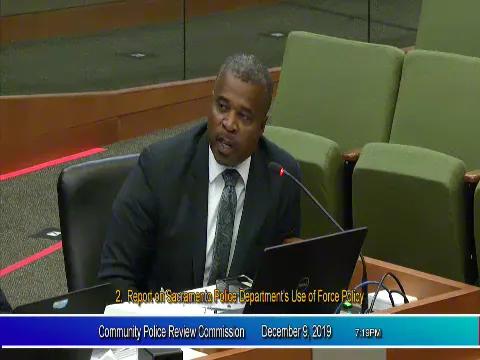
On Monday, December 9, 2019, the Sacramento Community Police Review Commission convened at 6:02 p.m. in the City Hall Council Chamber. The meeting included the introduction of the interim Director of the Office of Public Safety Accountability, Kevin Gardner, and a detailed report on the Sacramento Police Department's Use of Force Policy. The commission approved the dissolution of its ad hoc committees and received multiple reports, with significant discussion on policy definitions and community concerns. Consent Calendar - Item 1: Dissolution of Ad Hoc Committees - The commission unanimously approved dissolving the Use of Force, Body Worn Camera, and Mental Health Ad Hoc Committees. The motion was moved by Commissioner Guerrero and seconded by Member Zamora, with all eight present members voting in favor (Members Elkarra and Sabeniano were absent). Discussion Items - Item 2: Report on Sacramento Police Department’s Use of Force Policy - Deputy Chief Kathy Lester presented an oral report detailing how the new policy (adopted September 18, 2019) incorporates AB 392 requirements. The policy, which is 17 pages long, merges previous use of force and firearm discharge policies and emphasizes de-escalation, proportionality, and the sanctity of human life. City Attorney Susana Alcala-Wood and Deputy City Attorney Kurt Wenliner were present to address legal questions. Commissioners raised concerns about missing definitions (e.g., 'necessary'), the use of the term 'peace officer' versus 'police officer,' and the continued authorization of carotid restraints. Deputy Chief Lester stated the policy is compliant with the law and that the department mirrors the statutory language for clarity. - Item 3: Follow-Up Log - The commission received and filed the follow-up log. Commissioners added requests, including a crosswalk between AB 392 and the policy, updates on LGBTQ relations and media policy, and a future presentation on the Mobile Crisis Intervention Team. Public Comments & Testimony - Claudia B. spoke on behalf of the League of Women Voters of Sacramento County, expressing support for the full implementation of AB 392 and for the commission's recommendations, stating that the commission is a key voice in the adoption and monitoring of the use of force policy. Key Outcomes - The commission voted to dissolve the three ad hoc committees. - The commission received and filed the Use of Force Policy report and the Follow-Up Log. - The city attorney's office agreed to provide written responses to commissioner questions, including clarification on the definition of 'necessary,' the standard under Graham v. Connor, and the treatment of carotid restraints. - Interim Director Kevin Gardner committed to conveying the commission's concerns to the mayor and city council in his upcoming meetings. - Commissioners planned to individually meet with council members to advocate for action on their recommendations. Commissioner Comments & Ideas - Commissioners proposed forming new work groups for the coming year, including a use of force work group, media work group, LGBTQ work group, mental health work group, and an accountability work group. - Commissioner Guy reported that the commission's recommendations were scheduled for the city council's consent calendar on December 10, 2019, at 2 p.m. - Commissioner Falcon highlighted attendance at a transformational policing course and suggested more community-friendly scheduling for such opportunities. Adjournment The meeting adjourned at 7:43 p.m.
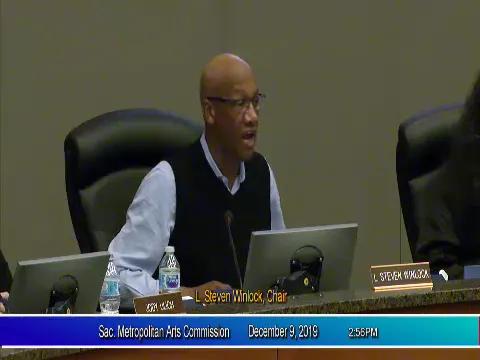
The Sacramento Metropolitan Arts Commission (SMAC) held its final meeting on December 9, 2019, after 42 years of service, transitioning to the new Sacramento Arts and Creative Economy Commission. The meeting included a special presentation, approval of consent calendar, approval of multiple grant programs (Cultural Arts Awards, Creative Economy, Cultural Equity, and Cultural Equity Investment), oral reports, public comments, and commissioner reflections. Consent Calendar - Approval of Commission Meeting Minutes (November 14, 2019): Approved unanimously. Special Presentation - Director Jody Ulich presented each commissioner with a plaque by artist Chris Lango, featuring a headline from the November 26, 1906 Sacramento Union: "Art is a pervading influence in the environment of Sacramento." The presentation recognized the commissioners' passion and service. Discussion Items - Cultural Arts Awards (CAA) Funding for Calendar Year 2019: Staff recommended third-year allocations of $493,000 in general operating support to 57 organizations. Approved unanimously. - Creative Economy 2020 Grant Program: Staff reported 186 applications started, 108 finalized, requesting over $6 million total. Thirteen grants were recommended: 10 at $25,000 and 3 at $15,000 (total $300,000). Commissioner Maya Wallace (panel member) noted rigorous review of all 108 applications. Public speaker Ed Fletcher (unsuccessful applicant) expressed concern about a disproportionate number of educational components and lack of film projects. Public speaker Mina Perez (Visa de Odo Foundation) thanked the commission, noted her organization was unsuccessful but learning, and highlighted their Taco Festival. Another public speaker criticized the lack of funding for entrepreneurs and questioned the grant to Ali Yosefi, stating his father is wealthy. Motion to approve the funding and list passed unanimously. - Cultural Equity 2020 Grant Program: Staff reported 44 applications started, 29 completed, requesting $1.7 million total. Thirteen grants recommended: 10 at $10,000 and 3 at $5,000 (total $115,000, $15,000 above the original $100,000 allocation). Commissioner Maya Wallace noted improved breadth of cultural community representation. A motion to approve all except the Camellia Symphony Association passed unanimously. The Camellia Symphony Association grant was then voted on separately and approved. - Cultural Equity Investment 2020 Grant Program: Staff reported 31 applications started, 11 completed, requesting $1.4 million total. Three grants at $75,000 each were recommended, plus a year-long mentorship with Estella Sanchez. Commissioner William Ishmael asked about the high drop-off rate (31 started, 11 finished); staff explained that the application required a higher level of organizational maturity. Motion to approve the mentor and three grant awardees passed unanimously. - Update on the Cultural Plan: Director Jody Ulich reported that the approved grants are a direct outcome of the Creative Edge Cultural Plan, calling it a "job well done." - Arts Consortium Update: Chair Steven Winlock reported that the consortium continues to meet, focusing on arts education support. Friends of Sacramento Arts raised funds for grants to school districts for transportation, art supplies, and instruments. - Advocacy and Outreach Committee Report: Commissioner Jason Silva noted the committee did not meet, but he stressed the importance of ongoing advocacy to secure consistent funding for the arts, urging the new commission to prioritize outreach. - Grants and Education Committee Report: Commissioner Veronica Delgado was absent due to impending childbirth. Chair Winlock thanked her for her guidance. - Art in Public Places Committee Report: Commissioner William Ishmael highlighted 42 years of accomplishments, including 650 public artworks, and noted ongoing funding through 2% of capital improvement projects. He praised staff Linet Eller and Donald Ginsler. - Director’s Report: Jody Ulich announced the search for a Creative Economy Manager (with national firm ACG, expected hire by April–May 2020); Jennifer West as new Film Office Manager (starting January); and Jennifer Singer as new Public Information Officer (started that week). - Chairperson’s Report: Steven Winlock summarized SMAC’s 42-year history of supporting and promoting arts and culture, emphasizing cultural equity, and urged the new commission to honor past commissioners and continue the work. Public Comments – Matters Not on the Agenda - Sarah Lane (Unleash Productions, Atrium, Upcycle Pop): Thanked commissioners, noted the fight for the budget, and suggested creative economy boot camps to help organizations write better grants. - Lily Williams (Sacramento Guitar Society): Thanked the commission for grants, highlighted the new “Strum for Fun” program at five libraries, and invited attendees to a holiday concert. Key Outcomes - Consent Calendar: Meeting minutes approved. - Cultural Arts Awards (CAA) 2019: Approved ($493,000 to 57 organizations). - Creative Economy 2020 Grants: Approved (13 grants, $300,000 total). - Cultural Equity 2020 Grants: Approved (13 grants, $115,000 total, with separate vote for Camellia Symphony Association). - Cultural Equity Investment 2020 Grants: Approved (3 grants at $75,000 each plus mentor Estella Sanchez). - All oral reports were received and filed. - Meeting adjourned with a group photo of commissioners and staff. The meeting marked the formal conclusion of the Sacramento Metropolitan Arts Commission after 42 years, with the new Sacramento Arts and Creative Economy Commission to be seated thereafter.
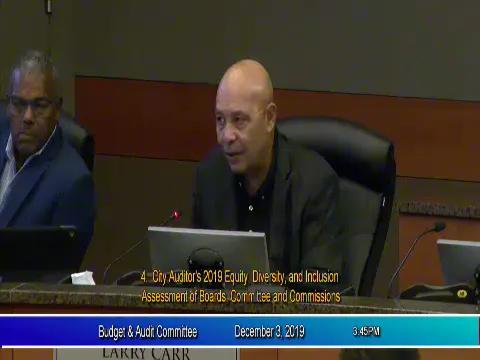
The Sacramento City Council sitting as the Budget and Audit Committee met on Tuesday, December 3, 2019, at 3:05 p.m. in the City Hall Council Chamber. Mayor Darrell Steinberg chaired the meeting, which adjourned at 3:56 p.m. The committee reviewed four items related to the City Auditor's office, all of which were forwarded to the full City Council for approval. Consent Calendar - Item 1: City Auditor’s Activity Report for the 1st Quarter of Fiscal Year 2019/20. The committee voted unanimously to accept the report and forward it to City Council. The motion was made by Member Harris and seconded by Member Warren. Members Ashby and Hansen were absent for this vote. Discussion Items - Item 2: Audit of Retiree Health Benefits. Assistant City Auditor Lynn Bashaw presented the audit. The audit found that the Human Resources department administers health benefits for approximately 3,500 retirees under SCERS or CalPERS. Key findings included: (1) the need to strengthen internal processes and IT data management to minimize data errors; (2) inadequate dependent verification processes – a 2017 contracted review by HMS found 27% of dependents were not successfully verified, with the Sacramento Police Officers Association having the lowest compliance rate at 39% and the Western Council of Engineers the highest at 96%; 1,362 dependents remained unverified. If 5% of unverified dependents were ineligible, the city could save $150,000–$200,000 annually; if 15%, savings could reach $450,000–$600,000 annually. For retirees, removing one ineligible dependent could save up to $780 per year based on a maximum city contribution of $65. The audit also found the city may have paid over $140,000 in dental benefits for deceased retirees dating back to 2006, and over $800,000 in retiree health benefit revenue should be reimbursed to the risk management fund. The committee accepted the audit and forwarded it to City Council; the motion passed unanimously. - Item 3: City Auditor’s Whistleblower Hotline Activity Report for April 2019 through September 2019. The Auditor's office reported closing 73 cases and substantiating 6 during the period. The committee accepted the report and forwarded it to City Council; the motion passed unanimously. - Item 4: City Auditor’s 2019 Equity, Diversity, and Inclusion Assessment of Boards, Committees, and Commissions. City Auditor Jorge Oseguera and staff presented the assessment. The analysis covered 278 city and non-city appointed seats, of which 228 were city seats and 215 were filled. Comparing 2017 and 2019 data, the percentage of white non-Hispanic board members dropped from approximately 61% to 53.3%, while female representation stood at 47% in 2019 compared to 51% of the city population; 1% of members identified as nonbinary. Of 160 members responding, 18 (11.25%) identified as LGBQ+, compared to a 4.5% national Gallup estimate. Council District 4 had the most mappable members (44), followed by District 5 (25) and District 3 (16); Districts 8 (6) and 2 (9) had the fewest. 18 members lived outside the city. The presentation also introduced a new online ethnic and gender diversity dashboard for city employees using eCAPS data. Councilmember Ashby, Hansen, and others discussed the need for more outreach and recruitment to improve diversity, particularly for out-of-city appointees and underrepresented districts. The committee accepted the assessment and forwarded it to City Council; the motion passed unanimously. Public Comments & Testimony - No public testimony was offered on any agenda item. Key Outcomes - All four items were accepted by the committee and forwarded to the full City Council for final approval. - For the Retiree Health Benefits audit, the Auditor's office will follow up every six months on recommendations until all are implemented. - The committee discussed potential citywide recruitment efforts for boards and commissions, and the City Clerk's office was encouraged to explore additional outreach strategies, including leveraging planning academy graduates and offering board/commission training.
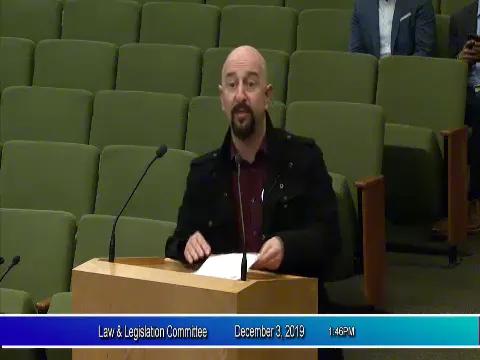
The Law and Legislation Committee met on December 3, 2019, to consider several items including an ordinance on hotel worker protection, the city's state and federal legislative platform, and updates to historic district plans. All items were forwarded to the City Council with unanimous votes. Consent Calendar - Approved Items 1–3: Legislative Advocacy Correspondence (2019-00800), Law and Legislation Log (2019-00801), and an Ordinance Amending Sections 8.132.030 and 8.132.050 Relating to Illegal Cultivation of Cannabis (2019-01710). These routine items were passed unanimously by motion. Public Comments & Testimony - Item 6 (Historic Districts Plans): - William Berg (President, Preservation Sacramento) expressed strong support, noting the plans reduce risk and remove ambiguity for property owners and builders. - Jackie Whitelam (Chair, Preservation Commission) urged adoption, correcting misperceptions that the plan would impede infill housing or circumvent SB 330, explaining the timeline predated the state law. - Karen Jacques (longtime central city resident and former Preservation Commission chair) supported, citing decades of need for clarity. - Gregory Van Acker spoke in favor. - John Marshack (Boulevard Park Neighborhood Association) supported but requested a change to a height guideline, asking that new construction not exceed the tallest contributing resource on the block. - Deborah Condon opposed, arguing the plan contains subjective standards that could expose the city to litigation and that the emergency ordinance to avoid SB 330 is unwarranted; she urged objective standards and a timeline for changes. - Vickie Villeen (Midtown resident, Preservation Sacramento board) supported, asking for passage. - Bay Miri (developer) supported, stating the plan will reduce ambiguity for developers. - Craig Houseman (architect) supported, saying the plan provides a clear and fair path for development. Discussion Items - Item 4: Ordinance Relating to Hotel Worker Protection – Staff presented the ordinance adding Chapter 5.78 to the City Code, requiring panic buttons and sexual harassment policies for hotel workers. Councilmember Guerra moved to forward with an amendment changing the implementation date to six months after council passage to give industry time to comply. Councilmember Hansen seconded. Discussion clarified enforcement (annual fire department inspections, fines via administrative penalties). All members voiced support. Vote: unanimous. - Item 5: Review and Approval of City’s State and Federal Legislative Platform – State lobbyists Will Gonzalez and Ross Buckley reviewed 2019 highlights and 2020 outlook (homelessness, housing, water, climate). Councilmember Hansen proposed changing the phrase “local control” to “local values” to avoid negative connotations and called for a more coordinated, proactive work plan with regional partners. Councilmember Harris supported and added a request to track legislation on homeless encampments on levees. Councilmember Guerra seconded, emphasizing support for illegal grow house enforcement and the California Mobility Center. Chair Schenirer added a request to include federal cannabis decriminalization. Motion passed unanimously to approve the platform as amended. - Item 6: Historic Districts Plans and Updates to the Sacramento Register – Staff presented the final draft, which includes updated surveys and district-specific infill guidelines. The plan clarifies contributing/non-contributing properties, reduces risk, and will streamline staff-level review for many projects. Public testimony was predominantly supportive, with one speaker raising concerns about objective standards and the emergency ordinance. Councilmember Hansen moved to forward to council, praising the balance between preservation and infill. Councilmember Harris seconded, noting the plan will reduce appeals and uncertainty. Vote: unanimous. Key Outcomes - Item 4: Motion passed unanimously to forward the Hotel Worker Protection ordinance to the City Council with the amendment (implementation six months after council adoption). - Item 5: Motion passed unanimously to approve the Legislative Platform with amendments: replace “local control” with “local values” and add federal cannabis decriminalization. - Item 6: Motion passed unanimously to forward the Historic Districts Plans, related resolutions, and ordinances to the City Council for consideration. - All items were approved by unanimous votes of the committee members present (Chair Schenirer, Member Hansen, Member Harris, Member Guerra). No abstentions or opposition recorded.
The Active Transportation Commission met on Thursday, November 21, 2019, at 6:00 p.m. in the City Hall Council Chamber. The commission approved consent items, received a staff report on shared rideables enforcement, discussed the draft Pedestrian Crossing Guidelines, and heard presentations on the Broadway Complete Streets and Central City Mobility projects. No votes on the two mobility projects were required as they were information items. Consent Calendar - Approved the meeting minutes of October 17, 2019 and the Active Transportation Commission Log. Three commissioners abstained because they were not present at the previous meeting. Public Comments & Testimony - Dan Allison, a member of the public, commented on the draft Pedestrian Crossing Guidelines. He expressed general support for the document but raised concerns about undefined terms such as "infeasible," "outcome of traffic investigation," and "prohibited pedestrian crossings." He warned that "infeasible" could be misused by engineers and referenced research by Zegeer indicating that crosswalk removal is rarely justified. He also recommended adding raised intersections, protected intersections, and exclusive pedestrian phases to the treatment application guide. Discussion Items Staff Report (Item 3) - Staff provided updates on shared rideables enforcement. Enforcement began Tuesday, with citations issued for sidewalk riding and for devices obstructing pedestrian paths. Over 20 parking obstruction citations were issued at $27.50 each; the sidewalk riding citation is $207. Over 1,600 calls to 311 regarding shared rideables were received in the past month. Staff encouraged operators to educate users and noted the goal is behavior change, not citations. Pedestrian Crossing Guidelines (Item 4) - David Edrosolan, Interim City Traffic Engineer, presented the draft Pedestrian Crossing Guidelines and Treatment Application Guide. The documents were developed to address Vision Zero Action Plan Item 5.2 and incorporate best practices from NACTO, FHWA, NCHRP, peer agencies, and a stakeholder group including the Vision Zero Task Force. The guidelines cover evaluating crossing locations, selecting treatments, existing crosswalk evaluations, and removal processes. - Commissioner discussion included questions about the meaning of "infeasible," the use of systemic safety analysis, equity implications, crosswalk spacing criteria, art crosswalks, and the process for updating the document. - Commissioner Haupt moved to forward a recommendation to City Council for approval of the Pedestrian Crossing Guidelines with the addition of a means for amending/updating the document. The motion passed unanimously. Broadway Complete Streets Project (Item 5) - Megan Johnson, Senior Engineer, presented the Broadway Complete Streets Project, covering approximately two miles of Broadway. The project proposes reducing travel lanes from four to two, adding a two-way left-turn lane, buffered bike lanes, intersection improvements, and pedestrian safety enhancements. It also includes circulation changes: converting one block of 16th Street from one-way to two-way, constructing a one-block segment of 29th Street, and eliminating slip lanes. Construction funding is partially secured through ATP Cycle 3 and Cycle 4 grants, with construction targeted for 2022. - Commissioners asked about coordination with the Broadway Bridge project, outreach to residents on W and X streets, impacts on transit ridership, and business community support. They expressed strong support for the project and requested ongoing engagement. Central City Mobility Project (Item 6) - Megan Johnson also presented the Central City Mobility Project, expanding protected bikeways on 9th/10th Streets to Broadway, P and Q Streets from 15th to 21st, and 19th/21st Streets to Broadway. The project includes two-way conversions on 5th and I Streets, reduced travel lanes on a segment of I Street, and new protected bikeway features such as left-side alignment, widened buffers for residential bin/leaf placement, bend-in intersections, and protected corners. Funding is from SB1, Valley Rail, and Affordable Housing and Sustainable Communities grants. - Commissioners expressed enthusiasm and asked about bin pick-up logistics, resident education, and route integration. No formal action was required. Key Outcomes - Approved consent calendar items (minutes and log) with three abstentions. - Adopted a motion recommending City Council approval of the Pedestrian Crossing Guidelines with an added provision for future amendments/updates. - Received and commented on the Broadway Complete Streets and Central City Mobility projects; both are information items with no formal vote. - Identified follow-up items: request a presentation on citywide traffic signal timing/controller changes; continue outreach on bike parking map; and arrange a future update on the tree planting along the Sacramento Northern Bike Trail. - The next meeting is scheduled for December 19, 2019.
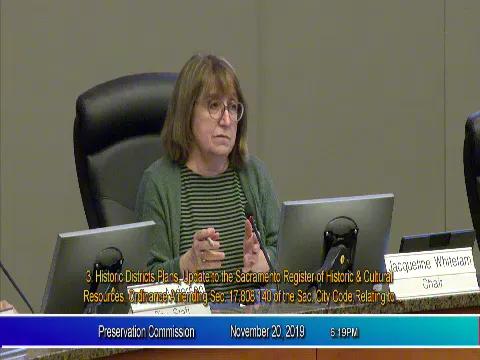
The Preservation Commission held a public hearing on the Historic District Plans, an update to the Sacramento Register of Historic and Cultural Resources, and an ordinance amending Section 17.808.140 of the City Code to reduce the level of review for some projects within historic districts. The meeting convened at 5:35 p.m. and adjourned at 6:32 p.m. Commissioners Bowns, Carter, Miller, Lemon, Valania, and Whitelam were present; Commissioner Miller-Cruiess was absent. The consent calendar was approved unanimously. Consent Calendar - Item 1: Approval of meeting minutes of October 16, 2019 and October 23, 2019 — Approved (6:0:1, Miller-Cruiess absent). Chair Whitelam recommended future minutes use the wording “Items reviewed and comments received from the Commissioners.” - Item 2: Approval of meeting minutes of October 23, 2019 — Approved (moved as part of Item 1). Public Comments & Testimony - William Burg (representing Preservation Sacramento, also a resident of the Boulevard Park Historic District and owner of a contributing property) expressed full support for the Historic District Plans, stating they reduce risk, remove ambiguity, and provide clear infill guidelines. He urged approval of both elements. - David Herbert (Board Chair, Boulevard Park Neighborhood Association) expressed support for adoption as an emergency measure but urged greater prescriptive and enforceable standards for site plan and design review. He noted that moving non-contributing parcel review from director to staff level results in no advance notice, no public hearing, and no appeal opportunity. He highlighted that SB 330 (Housing Crisis Act of 2019) would prevent adoption after January 1, 2020 for five years, and recommended adding objective design standards after adoption. - Eric Knutson expressed general support but reservations about design standards. He noted that with the repeal of the listed structures plans, standards for landmarks outside historic districts will be only the Secretary of the Interior standards, which may be insufficient. He recommended the city adopt objective design standards under SB 330. - Jon Marshack (20-year resident of Boulevard Park, former Preservation Commissioner, Preservation Committee Chair of Boulevard Park Neighborhood Association) applauded staff work but raised two concerns: (1) the height limit for additions and infill in Boulevard Park (allowing 150% of contributing structure height) would allow structures 50% taller that visually compete and are not subordinate; he urged amending to “within the range of the heights of nearby contributing resources.” (2) The character-defining features table incorrectly states “generally larger houses south of G Street—three stories … is common”; he requested correction to “generally larger homes south of G Street—two story houses with or without a basement is common.” - David Mandel (resident of a 27-year-old development in Southside Park area) expressed confusion about why some homes in his development were listed as contributing and others as non-contributing. He asked for more explanation and requested a meeting with preservation staff to understand the implications. Discussion Items - Staff Presentation: Carson Anderson, Preservation Director, and Sean de Courcy, Associate Preservation Planner, presented the Historic District Plans. Key points: The plans clarify contributing vs. non-contributing resources, provide design standards for infill, and reduce uncertainty. Public outreach began in May 2018 with over 450 comments. The plans are a pro-housing approach supporting preservation and new infill. The recommendation includes adoption of emergency ordinances to comply with SB 330 (which requires adoption before January 1, 2020 to avoid a five-year ban on non-objective standards). - Commission Questions: Chair Whitelam asked about corrections to the 1200 Q Street landmark ordinance (the nomination date error—staff confirmed it would be corrected before council). She also requested a reduction in the level of review for non-contributing properties from director to staff level, with a regular monthly report to the commission on projects reviewed. Staff agreed to produce such a report. Commissioner Valania noted that the plans are long overdue and provide clarity; she supported the recommendation. - Commissioner Discussion on Height Limits: Staff responded to Jon Marshack’s concerns about Boulevard Park height limits, explaining that the district is eclectic and that applying a “within the range” standard could make infill problematic. They noted that discretion remains: if a project is inappropriately scaled, it can be elevated to director hearing. Staff also confirmed that the “three stories” description in Boulevard Park would be corrected to “two stories with or without a basement” before council. Key Outcomes - Motion: Commissioner Valania moved to approve staff’s recommendation to the City Council, seconded by Commissioner Carter. The motion passed unanimously (7:0:1, Miller-Cruiess absent). - Staff Recommendation Endorsed: The Commission recommended that the City Council: 1. Adopt a resolution concluding the project is within the scope of the Master EIR and no new mitigation is required. 2. Adopt an emergency ordinance enacting the Historic District Plans and repealing the Preservation Area Plan, Residential Listed Structures Plan, and Non-residential Listed Structures Plan (2/3 vote required). 3. Adopt an ordinance amending Ordinance 85-076 for 20 listed historic districts. 4. Adopt an ordinance listing 1200 Q Street as a Landmark. 5. Adopt ordinances amending Ordinance 2004-009 (Bungalow Row and Capitol Mansions), Ordinance 2004-048 (Alkali Flat districts), and Ordinance 2007-094 (Oak Park Historic District). 6. Adopt an ordinance amending Section 17.808.140 of the City Code (reducing director-level review for projects on non-contributing parcels in historic districts following design standards and requesting no deviations). - Next Steps: The Commission’s recommendation will go to City Council in December 2019. Staff committed to providing a regular monthly report to the Commission on projects reviewed at staff level within historic districts. Minor corrections (1200 Q Street nomination date, Boulevard Park character-defining features language) will be made before council adoption.
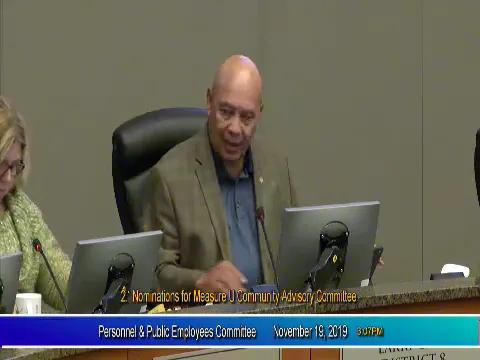
This special meeting of the Personnel and Public Employees Committee was called to order at 3:06 p.m. on November 19, 2019, in the Sacramento City Council Chamber. The committee, comprised of Chair Larry Carr (District 8), Vice Chair Steve Hansen (District 4), and Member Angelique Ashby (District 1), unanimously approved one consent item and forwarded nominations for three advisory bodies. The meeting adjourned at 3:09 p.m. Consent Calendar - Approval of Meeting Minutes (October 22, 2019): The committee unanimously approved the minutes from the previous meeting. (Motion: Carr/Hansen, vote 3-0). Discussion Items - Measure U Community Advisory Committee – Seat L (ages 16–24): Chair Carr moved to nominate Khalil Ferguson, who was selected after interviews held at the prior meeting. The motion was seconded and passed unanimously (3-0). The nomination was forwarded to the Mayor for appointment (per the agenda) or to the City Council (per the minutes; the source documents contain a discrepancy regarding the appointing authority). - Sacramento Disabilities Advisory Commission – Seat I (disability group representative): Member Ashby moved to nominate the incumbent, Mousumi Crowley, for reappointment. The motion was seconded and passed unanimously (3-0). The nomination was forwarded to the Mayor (agenda) or City Council (minutes). - Utilities Rate Advisory Commission – Seats D and E: Member Hansen moved to nominate Connie Gutowski (Seat D) and P. Anthony Thomas (Seat E). The motion was seconded by Member Ashby and passed unanimously (3-0). The nominations were forwarded to the Mayor (agenda) or City Council (minutes). Key Outcomes - All four nominations were approved unanimously (3-0) and forwarded to the appointing authority. - No public comments were made on matters not on the agenda. - The committee introduced a new staff member, Sarah, from the Department of Utilities, attending her first meeting. The meeting adjourned at 3:09 p.m.