Browse by city
Date range
Search help

Search titles, summaries, topics and stored transcripts together. Keywords may match separately; put the whole query in double quotes for a phrase. Matching follows word analysis, so punctuation is not exact. Both dates are included. Documents are not searched.

SHOWING 21–30 ENTRIES
21
OCT 22, 2026 · SAN ANTONIO, TEXAS · COUNCIL COMMITTEES
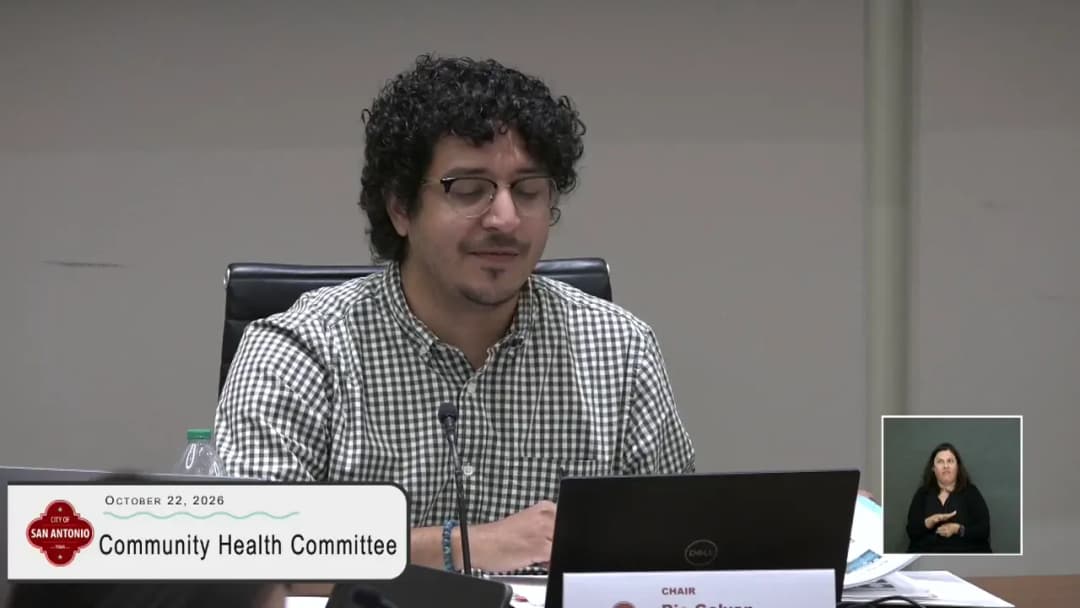
San Antonio Community Health Board Meeting - October 22, 2026

The Community Health Board met on October 22, 2026, with a full quorum present. Agenda and minutes were not available in the source material, so this summary is based on the meeting transcript. The meeting opened with public testimony, unanimously approved the previous meeting's minutes, and included presentations on food insecurity, the 2026 poverty report, and the Financial Empowerment Center. The meeting was adjourned at 11:39 a.m. Consent Calendar - Members unanimously approved the minutes of the last meeting. No opposition or abstentions were recorded. Public Comments & Testimony - Tyler Ferguson, executive director of Blueprint Ministries and a Metro Health partner, described how the Metro Health Equity Network helps organizations collaborate on food and housing security. He said clients are forced into impossible choices, such as repairing a home, buying children's clothes, or taking medication. He encouraged the city to continue supporting equity-network models so public investments go further. - Gudelia Ramón, director of Family Services, said the equity network helped her agency build relationships and create more resources for San Antonio. She cited produce markets that served 167 ZIP codes over four events, with a grant from Blue Shield supporting a more sustainable model. She called attention to food deserts and the need for affordable, nutritious food. - Jenny Castro, executive director of Powerhouse, said her organization serves girls and families who must choose between food, rent, and medicine. She expressed support for the health equity network as a way to reduce barriers, connect families to resources, and create collective change. - Mario Obledo, representing the San Antonio Food Bank, said the food bank is part of a safety net covering 250 counties through 20 food banks in Texas. He noted rising demand, praised city departments and volunteers, and said the food bank responds to both daily poverty and natural disasters. - Mercedes Briston, executive director of the association for grandparents raising grandchildren, said kinship caregivers are often overlooked. She noted that for every child in foster care, 120 are in informal kinship care, and many families visit multiple food banks weekly to cover meals. She described taking 160 grandparents to the state capital over three legislative sessions and urged continued collaboration instead of working in silos. Food Insecurity Presentation and Discussion - Metro Health staff presented the city's coordinated food insecurity strategy. The speaker reported that food insecurity was one of four CHIP priorities at 22.6% in 2024 and that trends are moving in the wrong direction. - New Feeding America data were cited showing that one in four Texas children, one in seven older Texans, and one in three Black Texans experience food insecurity. - SNAP participation was approximately 33% and has fallen by more than 20% since September. The speaker noted that the USDA stopped producing national food insecurity reports for 2026, making local data collection more important. - Bexar County ALICE data show that 44% of residents are living below the threshold needed to cover basic needs. The city's stated goal is to reduce food insecurity by 20 points by 2030. - The presentation described distribution efforts, including more than 50,000 pounds of fruits and vegetables, over 70 community partners, and work to coordinate referrals, SNAP enrollment, and benefit access. - Council members asked about rising SNAP delays and the relationship between food insecurity and economic empowerment. Some members called for stronger state and federal advocacy on SNAP processing times and for connecting residents to living-wage jobs. 2026 Poverty Report Discussion - Laura Serrano, chief demographer of the Department of Human Services, presented the 2026 poverty report. She said the official poverty measure undercounts hardship in San Antonio. - About 250,000 San Antonio residents live below the federal poverty line. 32% of census tracts within the city have high poverty rates, and most have been persistently poor for three decades. - San Antonio has the second-highest poverty rate among large Texas cities, after Houston. Dallas was cited as a city that measurably reduced poverty. - The report used United Way's ALICE framework to show that many families earn above the official poverty line but still cannot cover basic needs. In Bexar County, a family with a young child was said to need about $54,000 to cover basic needs, far above official poverty thresholds. - Housing costs were cited as a major driver: homebuying costs rose 24.5% from 2019 to 2024 while incomes grew only 0.4%. Half of renters pay more than 30% of income for housing, and one in four pays more than 50%. - Poverty disproportionately affects children under five, older adults, single-mother families, women, Black residents, and people with no more than a high school diploma. The report noted that 87% of single-parent families are headed by single mothers, women earn about 81 cents for every dollar men earn, 23% of Black residents live in poverty, and 65% of people in poverty have no more than a high school diploma. - DHS recommendations included strengthening coordination among programs, prioritizing services by vulnerability, using flexible funding, and applying a collective-impact approach to reduce poverty. Financial Empowerment Center Presentation - Department of Human Services staff presented the city's Financial Empowerment Center, a national model launched in New York City in 2008 under Mayor Bloomberg and expanded in 2013 to five cities, including San Antonio. The program now operates in 52 communities, with additional sites in Waco, Dallas, and Houston. - The center provides confidential one-on-one financial counseling in four areas: building credit, reducing debt, accessing safe financial resources, and long-term planning. Counselors are certified, complete 24 hours of practical training, 30 hours of continuing education, and one hour of ethics training, and must pass an exam. - Since 2013, the center has worked with more than 28,000 clients and helped reduce $45.9 million in debt. Recent 2026 figures included more than $767,000 in debt reduction. - Planned 2027 outreach focuses on older adults, Head Start families, college students, and partnerships with other city departments and community organizations. - Council members discussed expanding services to the east and south sides, working proactively with employers and credit unions, and helping residents avoid predatory financial products. Key Outcomes - The board unanimously approved the previous meeting's minutes. - Council members requested that food insecurity and poverty data be brought to a city council "Session B" briefing and asked for ALICE data by council district or neighborhood. - A council member said she and Councilmember Mesa González plan to partner with a nonprofit to measure the collective impact of city-funded programs and ensure tax dollars are used strategically. - Officials agreed to explore closer coordination with housing, neighborhood services, and strategy departments on poverty and housing programs. - The Financial Empowerment Center will continue expanding outreach to vulnerable populations and community partners.
FOOD SECURITY 33% · POVERTY 21% · FINANCIAL EMPOWERMENT 11% · PUBLIC HEALTH 10%
22
OCT 22, 2026 · SAN ANTONIO, TEXAS · COUNCIL COMMITTEES
Summary: San Antonio Community Health Committee Meeting - October 22, 2026

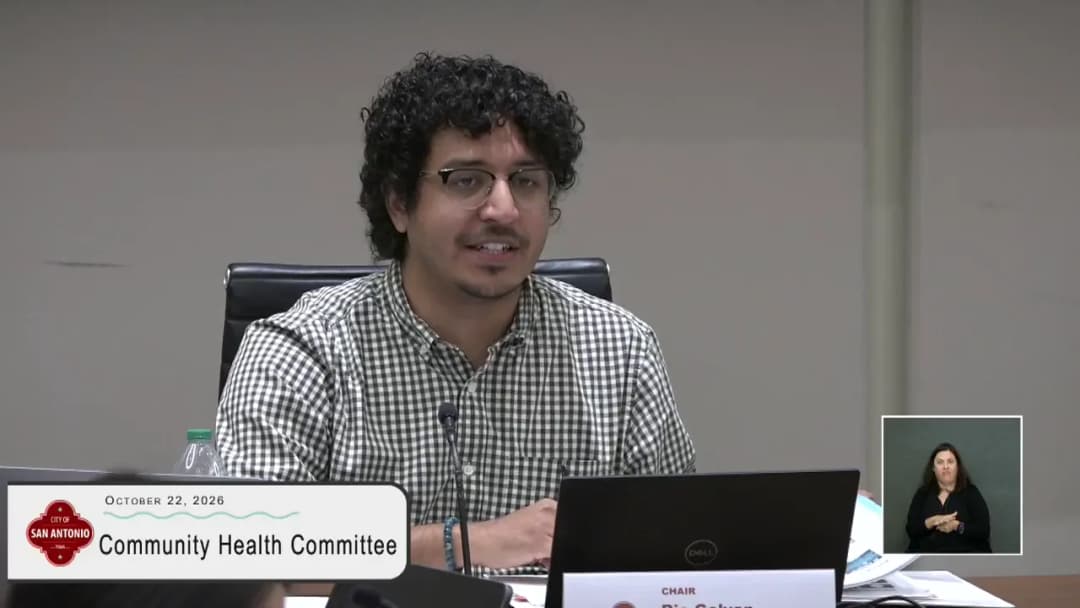
Community Health Committee Meeting Summary - October 22, 2026\n\nThe Community Health Committee convened on October 22, 2026, to receive presentations and discuss the city's food security strategies, the 2026 Status of Poverty Report, and the Financial Empowerment Center program. The meeting featured extensive public testimony supporting the Health Equity Network (HEN) and deliberations on how city policies and external economic factors intersect to drive poverty and food insecurity.\n\n Public Comments & Testimony\n- Tyler Ferguson (Blueprint Ministries/HEN Housing Work Group): Expressed support for HEN's collaborative model, urging the city to invest in collaborative efforts over individual organizations, stating that coordinated investments achieve more than individual organizations working alone.\n- Gudelia Ramon (Family Service/HEN): Described the HEN as a vital resource for partnerships, highlighting a pop-up market initiative serving 167 zip codes. Argued everyone deserves access to nutritious and affordable food.\n- Jenny Castro (Empower House/HEN): Stated the HEN expands her organization's reach, connecting clients to resources like the Food Bank and YWCA, helping families avoid impossible trade-offs between food and rent.\n- Mario Boledo Jr. (San Antonio Food Bank): Acknowledged rising food insecurity and demand, thanking city staff and committing to partnering with the HEN.\n- Mercedes Bristol (Texas Grandparents Raising Grandchildren): Emphasized the HEN breaks down silos for kinship caregivers, supporting advocacy and addressing harsh trade-offs like cutting medications to afford grandchildren's needs.\n\n Discussion Items\n\nFood Security Public Health Strategies\n- Presentation: Dr. June DeWu (Metro Health) presented a roadmap showing food insecurity rose from 14% (2021) to 20.6% (2024). Key data included 1 in 4 Texas children and 1 in 3 Black Texans being food insecure, a 16% decline in SNAP participation in Bexar County, and 44% of households living under the ALICE threshold. The USDA stopped its national food security tracking in September 2025. The response relies on collective impact via the HEN and Phase 4 data collection.\n- Deliberation: Councilmember Adorata Gavito asked why local metrics worsened despite efforts. Dr. DeWu cited national economic instability and SNAP erosion outweighing local interventions. Councilmember Castillo connected food insecurity to stagnant wages and SNAP barriers, suggesting exploring community benefit agreements for micro food hubs. Councilmember White linked long-term solutions to economic development and financial empowerment. Chair Galvan inquired about local data collection to fill the federal gap and requested comprehensive tracking for budget decision impacts.\n\nStatus of the Poverty Report\n- Presentation: Laura Serrano (DHS) reported a 17.1% poverty rate (250,000 residents). 32% of census tracts have high, persistent poverty (30 years). Unlike other major Texas cities, San Antonio has no statistically significant poverty reduction. Housing costs (buying) rose 24.5% compared to 0.4% income growth (2019-2024). 51% of renters are cost-burdened. Older adult poverty is rising; children's poverty is falling but remains high. Single mothers represent 86% of single families in poverty.\n- Deliberation: Councilmember Adorata Gavito requested the report be presented to the full Council. Councilmember Castillo asked how the elimination of public housing by Opportunity Home is factored into projections, arguing it will increase cost-burdened renters. DHS committed to exploring the impact. Councilmember White questioned service duplication across departments; DHS cited partnerships and holistic funding reviews. Chair Galvan requested ALICE data be disaggregated further if possible.\n\nFinancial Empowerment Center Program\n- Presentation: Jessica Dovalina (DHS) detailed the evidence-based model (local since 2013). Since inception, over 20,000 clients have reduced debt by $45.9M and built $8.7M in savings. In FY26, nearly 600 residents were served, reducing over $767,000 in debt. New legacy planning (wills, healthcare) was added. Future strategies focus on older adults, college students, and social program clients.\n- Deliberation: Councilmember Castillo shared an example of a local employer (Ramon Demolition) providing financial education to employees, suggesting a partnership model. She connected the program to the need for living wages in city contracts. Chair Galvan requested client data broken down by council district and asked about the "Bank On" partnership with River City Federal Credit Union. Richard Keith confirmed the partnership guides residents away from predatory lending.\n\n Key Outcomes\n- Minutes Approved: Unanimous approval of prior meeting minutes.\n- Staff Directives:\n - Provide district-level breakdown of Financial Empowerment Center clients.\n - Explore the impact of Opportunity Home redevelopment on poverty metrics.\n - Provide granular ALICE data if available.\n- Policy & Next Steps:\n - Councilmember Adorata Gavito will work with the IGR committee to advocate for reducing SNAP delays at the state level.\n - Committee recommends presenting the Status of Poverty Report to the full City Council in a B Session.\n - Continued emphasis on aligning direct services (Financial Empowerment Center, food programs) with long-term economic mobility strategies and coordinating across departments to maximize impact in a constrained budget environment.

POVERTY ANALYSIS 20% · PUBLIC HEALTH 17% · FOOD SECURITY 15% · FINANCIAL EMPOWERMENT 15%
23
OCT 21, 2026 · SAN ANTONIO, TEXAS · BOARDS & COMMISSIONS
Historic and Design Review Commission Meeting Summary - October 21, 2026

The Historic and Design Review Commission met on Wednesday, October 21, 2026, at 3:01 PM, with Commissioner Jeffrey Fetzer serving as Acting Chair. A quorum was present. The meeting covered the approval of previous minutes, a consent agenda for routine approvals, and a major discussion on a certificate of appropriateness case for 326 Garfield. Consent Calendar The commission unanimously approved the meeting minutes from October 7, 2026. The consent agenda, comprising items 1 and 3 through 8 (item 2 at 3331 Roosevelt was withdrawn by the applicant and will return at a future date), was approved unanimously with all staff stipulations. Approved projects included River Walk improvements from East Houston to Lexington, 518 North Hackberry, 504 North Hackberry, 1232 Virginia Boulevard, 1020 Burnett, 502 North Cherry, and 340 East Walsh. Public Comments & Testimony No public speakers signed up for any items on the agenda. Discussion Items Case HDRC-2026-272: 326 Garfield The applicant, Susan Haime of J Construction and Design, along with owner Mr. Carlos and architect Marisela La Casanova, requested a Certificate of Appropriateness for a project involving three components: 1) repair and maintenance scopes (composite siding, front door, composite shingle roof, and painting); 2) modification of the historic structure's roof form by removing the original side-gabled profile; and 3) construction of a rear addition with two- and three-story elements. The applicant argued that the surrounding neighborhood context has significantly changed with new two-story and four-story developments across the street, and that the proposal would allow a long-vacant historic property to become a functional family home. They presented two designs: a preferred design and an alternative design developed in response to staff concerns. Staff recommended approval of item 1 with stipulations regarding the siding finish and door profile, but recommended denial of items 2 and 3 based on guidelines requiring preservation of historic roof forms and subordinate additions. Staff confirmed the rear addition that was constructed circa 2011 is non-original and will be removed. Commissioners expressed various concerns. Commissioner Velasquez noted the renderings did not align with submitted drawings. Commissioner Garcia emphasized the historic structure was sufficiently intact to merit preservation and that the addition should respect its scale, describing the house as a little gem. Commissioner Group raised questions about roof transitions, lot lines, and specific door placement. Commissioner Galloway inquired if the alternative design resolved staff's objections, but staff stated they had not yet formally reviewed it. Key Outcomes Commissioner Group moved to refer the case to the Design Review Committee (DRC) for further discussion and refinement. The motion was seconded and passed unanimously (8-0). This referral allows the applicant to work in a smaller setting with staff and commissioners to develop a proposal that meets preservation guidelines. No final decision was made on the application; the case must return to the full commission for a vote.

HISTORIC PRESERVATION 79% · PROCEDURAL 17% · ZONING AND LAND USE 4%
24
OCT 21, 2026 · SAN ANTONIO, TEXAS · CITY COUNCIL
San Antonio City Council Approves 2027-32 Bond Process Ordinance on October 21, 2026

On Wednesday, October 21, 2026, the San Antonio City Council met at 9:03 a.m. with a quorum to consider an ordinance related to the 2027-32 bond process. No agenda or minutes were available; this summary is based on the raw transcription. Mayor Jones introduced proposed co-chair appointments, council members discussed their authority and possible conflicts, and the ordinance was passed before the meeting adjourned at 9:22 a.m. Discussion Items - Mayor Jones praised the three proposed co-chairs and read their qualifications, including one with 37 years of government leadership, experience as executive president of CPS, and involvement in more than $1 billion in capital improvement projects; Mario Bledo Junior, credited with serving 100,000 individuals across 21 South Texas counties and with public service and advocacy; and Jim Birchback, the third co-chair. The mayor also read a statement describing Port San Antonio as a destination for advanced aerospace, infrastructure, defense, manufacturing, and trade, with 19,000 employees and an estimated $20 billion economic impact across the region and state. - Councilmember Castillo expressed support for the ordinance as presented, saying the city has never needed this capacity more and stressing collaboration, a voice for every district, and accountability for public tax dollars. - Councilmember Maggie Rodríguez asked why the process was starting from scratch rather than confirming the mayor's three appointees. A staff response said the ordinance reflects the mayor's memorandum and that Councilmembers Kerr and Villagrán would start a new review process and make recommendations to the full council, not necessarily including the three named individuals. - The mayor explained that the co-chairs would be an extension of the council: they would not decide which projects are included in the bond, but would provide continuity, engage the community, and lead fundraising after a bond election was called. - A council member recalled that an earlier proposal involving PBC and 35% of bond capacity did not advance because the council declined to go in that direction, and asked whether the tri-chair leadership could supersede council decisions. The mayor said they would not be allowed to supersede the council. - A council member expressed skepticism, saying the city did not yet know final bond amounts and calling the focus a tontería (foolishness) that prolonged the process and created conflict. Another council member agreed with Jolie, saying the city should finish the meeting and focus on other matters, including hearing how people from PSE feel about saving the $35 million invested in their streets and sidewalks. - Jim Birchback, the third co-chair, acknowledged the conflict-related email sent at 5 p.m., said he did not believe his role presented a conflict, and committed to recuse himself from Port San Antonio-related bond matters when appropriate so he could help the city fairly. Key Outcomes - A motion was made and seconded to approve the ordinance. The motion passed; the transcript does not include a numerical vote tally. - The council will proceed with the new co-chair review process led by Councilmembers Kerr and Villagrán. - Jim Birchback pledged to recuse himself from relevant Port San Antonio bond projects as needed. - The meeting adjourned at 9:22 a.m.

ECONOMIC DEVELOPMENT 58% · PROCEDURAL 24% · GOVERNANCE 18%
25
OCT 21, 2026 · SAN ANTONIO, TEXAS · COUNCIL COMMITTEES
San Antonio Governance Committee Meeting Summary: October 21, 2026

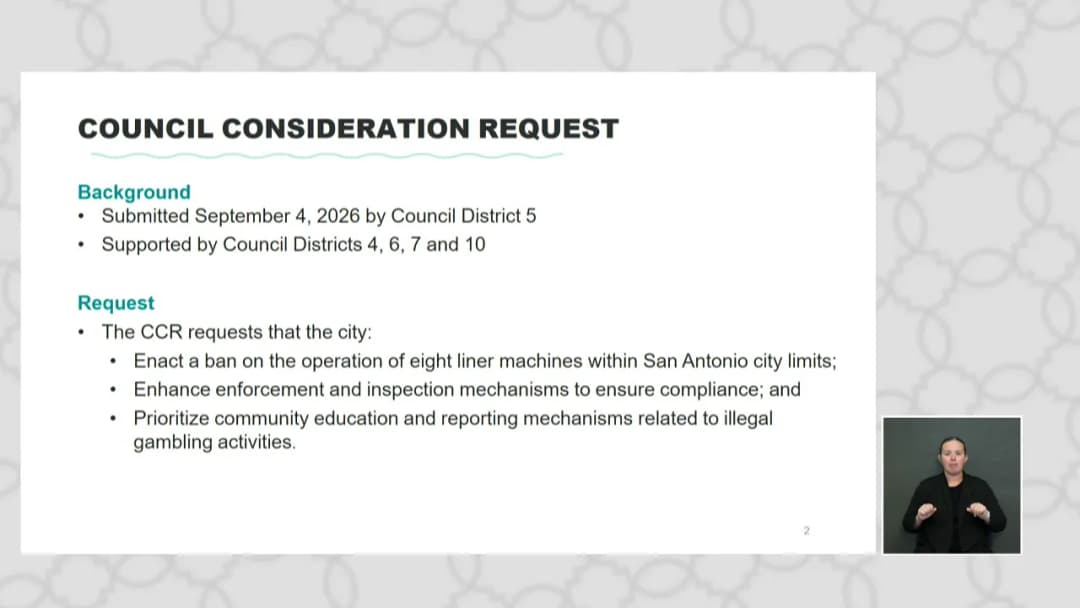
The Governance Committee met on Wednesday, October 21, 2026, from 11:04 a.m. to 12:11 p.m., with Mayor Jones presiding and a quorum present. The committee approved the prior meeting minutes, heard two public speakers on charitable bingo and illegal gaming, and acted on council consideration requests (CCRs) concerning a shovel-ready site pilot, a centralized public data dashboard, and a proposed eight-liner ban. Consent Calendar - Approval of minutes from the previous meeting: approved by voice vote after no corrections or edits were offered. Public Comments & Testimony - Ronnie Baker, sales manager for All Saints Bingo, said he has worked in charitable gaming for 40 years and represents the American Legion and Knights of Columbus. He stated Texas charitable bingo nonprofits fell from 1,800 to fewer than 900, and warned that after the Pennsylvania Supreme Court outlawed 80,000 sweepstakes and skill-based machines, those machines may be sent to Texas. He described a proliferation of illegal game rooms and said his team helped Nueces County/Corpus Christi close more than 100 game rooms after COVID. He said charitable bingo paid about $28 million in winners' fees, with 2.5% going to the state and 1.25% each to the city and county, and that San Antonio and Bexar County each receive more than $1 million a year from those fees, while illegal game rooms contribute nothing. He cited crimes associated with game rooms, including money laundering, human trafficking, murder, rape, arson, and burglary, and urged the city and county to help craft regulation to permit, regulate, or close illegal game rooms. Position: support for regulation and closures. - Eddie Heinemeier, a designated agent under the Bingo Enabling Act who works with more than 40 bingo halls, supported Baker's testimony. He said licensing in Nueces County reduced game rooms from more than 100 to fewer than 10, and that illegal game rooms provide no income to the state, county, or city. Position: support for action against illegal game rooms. Discussion Items Shovel Ready SA Site Readiness Pilot Program - Economic Development Director Brenda Hicksorenson presented a CCR submitted August 20, 2026, by Councilmember Mark White (District 10). The proposed pilot would identify two or three sites and examine legal and funding vehicles, including Chapter 380 agreements and type A or B development corporations; infrastructure needs such as CPS Energy and SAWS utilities; acquisition and carrying costs; and operational responsibilities for a shovel-ready program. - Staff said a site readiness assessment by Global Location Strategies completed in July 2026 evaluated 13 sites, eliminated 3 after desktop review, and advanced 10 for deeper review and site tours. Staff are working with partners on two or three sites, with a follow-up meeting in November. A 2023 EDC site effort was not pursued because acquisition and infrastructure costs would have required about $2 billion, so the city shifted toward private-sector partnerships. Greater SATX is also developing a site-readiness program based on Site Selectors Guild criteria. - Councilmember White expressed support, saying speed, certainty, and readiness are defining factors in corporate location decisions and are needed to create revenue and jobs. Position: support for the CCR. - Several committee members supported the concept but asked the EWDC to avoid duplication, consider commercial versus industrial uses, ensure public investment is not captured by private landowners, emphasize high-wage jobs, address utility and permitting delays, and evaluate return on investment and tax abatement implications. The EWDC chair said the review will incorporate direction such as the IEM example, where infrastructure improvements were made but no tax abatement was given. - The committee approved referral to the Economic and Workforce Development Committee with that direction. Centralized Public-Facing Data Dashboard - Staff, including Integrated Community Safety Office Director Maria Vargas Yates, presented a CCR submitted in August 2026 by Councilmember Mark White (District 10) and Councilmember Marina Aldarete Gavito (District 7). The request was to create a single web page as a central directory for all public dashboards and datasets, organized by policy and service area, with periodic reviews to archive or remove outdated, duplicative, or inactive content. - Staff recommended a 90-day review to inventory existing data sets, dashboards, annual reports, and data stories; conduct community and stakeholder engagement, including a draft survey; and develop a city data and insights concept for a centralized portal. Staff would return to the Governance Committee with findings and recommendations. - Councilmembers expressed support, with emphasis on mobile-friendly design, accessibility for residents who use phones, inclusion of partner-agency public documents and open records, improved usability of tools such as the Infrastructure Management Program and bond maps, and stakeholder input from senior residents, HOA leaders, and data users. One councilmember asked for a cost comparison with outside vendors and case studies from other cities. The mayor asked staff to incorporate lessons from recent emergency communication needs, using the West Side storm as a case study. - The committee approved the staff recommendation. Proposed Ban on Eight-Liner Operations - SAPD Assistant Director Rick Riley presented a CCR submitted September 4 by Council District 5 and supported by Council Districts 4, 6, 7, and 10. The CCR requested a ban on eight-liner machine operations within city limits, enhanced enforcement and inspection mechanisms, and community education and reporting related to illegal gaming. Staff recommended referral to the Public Safety Committee. - Police and legal staff said the legality of machines depends on design, payout method, and the mix of skill and chance; the latest Texas Attorney General opinion suggests any element of chance may make a device a gambling device. Litigation is heavily fact-specific, and a Texarkana appeals decision on predominantly skill games does not apply to San Antonio and is not being appealed. No state legislation has been filed yet, but staff can monitor it. - Councilmember McKee Rodriguez said she would not sign or support the ban, arguing the city should not become the morality police, should instead enforce existing laws, educate business owners and residents, and use zoning and land-use authority rather than new bans. She cited the prohibition era and warned of overpolicing vulnerable communities. Position: opposition to the CCR. - Other committee members voiced support for further study, wanting to distinguish legal permitted games from illegal cash or cryptocurrency payouts, review permitting and revenue options, improve education for businesses and residents, and monitor other Texas cities' legislative efforts. Position: support for continued review rather than an immediate referral. - A motion to continue the item for 60 days was made and seconded and passed by voice vote, so the CCR was not referred to the Public Safety Committee at this meeting. Key Outcomes - Approved the previous meeting minutes by voice vote. - Approved referral of the Shovel Ready SA CCR to the Economic and Workforce Development Committee with direction by voice vote. - Approved the 90-day staff review for the centralized public-facing data dashboard by voice vote. - Continued the eight-liner ban CCR for 60 days by voice vote instead of referring it to the Public Safety Committee. - Meeting adjourned at 12:11 p.m.

ECONOMIC DEVELOPMENT 31% · DATA ANALYSIS 28% · COMMUNITY ENGAGEMENT 11% · GAMING REGULATION 9%
26
OCT 21, 2026 · SAN ANTONIO, TEXAS · COUNCIL COMMITTEES
San Antonio Junta de Gobierno, October 21, 2026: Minutes, Shovel-Ready Pilot, Data Portal, and 8-Liner Gaming

The Junta de Gobierno (Governance Committee) met on October 21, 2026, from 11:04 a.m. to 12:11 p.m. Mayor Jones and council members Mickey Rodríguez, Villagrán, Munguía, and Spears established a quorum. The written agenda and minutes were not available; this summary is based on the meeting transcript. The committee approved prior minutes, heard public comment about illegal gaming rooms, discussed a shovel-ready site pilot, a central data dashboard, and a request regarding eight-liner gaming machines. Consent Calendar - The committee approved the minutes of the previous meeting by unanimous voice vote. Public Comments & Testimony - Baron Bairr, a charity-bingo representative speaking with time yielded by Chris Kelly, urged the city and county to act against illegal game rooms. He said charity bingo contributes 2.5% to the state, 1.5% to the city, and 0.5% to the county, producing more than $1 million annually for Bexar County, while illegal game rooms pay nothing. He described about 80,000 illegal gaming devices being shipped to Texas, rooms with 25–100 machines in gas stations and convenience stores, and his role in drafting Corpus Christi regulations that closed more than 100 game rooms. He cited crimes including cartel activity, human trafficking, robberies, rapes, and murders, and mentioned a $250,000 charity donation for Kerrville flood recovery. - Eddie Heinmer, identified as an agent/accounting professional with 40 bingo halls, echoed Bairr. He said he helped the county judge, police, and fire department remove more than 100 game rooms in Corpus Christi and that licensed locations fell below ten before beginning to rebound. He said charities are losing revenue because illegal game rooms compete without paying the city or county, and he asked for prompt assistance. Discussion Items - Shovel-Ready Site Preparation Pilot (Councilman Mark White): Brenda Hicks Sorensen, Deputy Director of Development, presented the request to create a pilot program preparing two or three sites for corporate/industrial investment. The review would consider Chapter 380 agreements or Type A/B development corporations, infrastructure costs (including CPS Energy and SAWS), city and private funds, and operational and evaluation responsibilities. Staff said a site-readiness assessment completed in July 2026 eliminated 3 sites, reviewed 10 more, and identified 2–3 sites for deeper work, and recommended referral to the Economic Development and Workforce Committee. Councilman White supported the pilot, saying speed and certainty matter in competition with other cities for jobs and business investment. Council members discussed avoiding duplication with 2023 efforts and SATX work, forming partnerships with private landowners, utility lead times, commercial versus industrial uses, ensuring landowner/company buy-in, and aligning projects with good wages. A motion to approve and refer with direction was made. - Central Data Dashboard (Councilmen White and Anderete Gravito): Staff, including the City's Chief Data Officer, presented a request submitted August 26, 2026, to create a central data page or dashboard, maintain department dashboards, and archive or remove unneeded data. Staff recommended a 90-day evaluation, public input, and a concept for a central data portal, returning later to the committee. Council members supported transparency and easier navigation, including public data on 2017 bond completion, and stressed mobile-friendly and accessible design, links for council members, GIS integration, and cost comparison with vendors such as ClearGov or OpenGov. The recommendation was approved by unanimous voice vote. - Eight-liner Gaming Machines (Councilwoman Teri Castillo): Note: the transcript labels this item as 'eight-wheel tanker truck operations,' but the discussion concerns eight-liner gaming machines; this summary follows the substance discussed. The request, dated September 4, 2026, from District 5 and supported by Districts 4, 6, 7, and 10, was presented by Assistant Police Chief Rick Large. Castillo was not present; her statement was on file. Large said the request would prohibit noncompliant eight-liner machines and prioritize community education, and staff recommended referral to the Public Safety Committee to assess safety and enforcement consequences. One council member opposed creating a new prohibition, arguing existing laws should be enforced and residents, property owners, and operators educated, and drew an analogy to alcohol regulation. Another supported public-safety review and wanted permitting-gap analysis. A council member expressed concern about cash and cryptocurrency payments, fraud, state litigation, and the upcoming legislative cycle. Councilman Mickey Rodríguez asked for identification of permitting gaps, revenue opportunities, and a public-education campaign. The committee voted to pause and continue the item for 60 days, after the chair corrected 'six weeks' to '60 days.' Key Outcomes - Minutes of the previous meeting were approved unanimously. - A motion to approve and refer the shovel-ready pilot request to the Economic Development and Workforce Committee was made; the committee then continued to the next agenda item. - Staff will conduct a 90-day study and return with recommendations for a central data portal. - The eight-liner gaming item was continued for 60 days for further discussion. - The meeting adjourned at 12:11 p.m.

ECONOMIC DEVELOPMENT 23% · PUBLIC ENGAGEMENT 22% · GAMING REGULATION 13% · PUBLIC SAFETY 9%
27
OCT 21, 2026 · SAN ANTONIO, TEXAS · CITY COUNCIL
San Antonio City Council Special Session on Bond Tri-Chair Appointments - October 21, 2026

The San Antonio City Council held a special session on October 21, 2026, to debate and vote on an ordinance that would change the approval process for the 2027 municipal bond tri-chairs, moving the final selection of appointees from the Mayor to the full City Council with a review by a subcommittee. The meeting featured debate on the roles of the tri-chairs and the necessity of the session itself. Discussion Items - Mayor Jones presented her three nominees for bond tri-chairs: Jelynn LeBlanc-Jameson, Mario Ableto Jr., and Jim Pershbach. She detailed their extensive professional backgrounds and community service records, describing them as "the perfect leaders for this" process and expressing full support for their qualifications. - Councilmember Castillo, reading a joint statement with Councilmembers White and Alderete Gavito, argued that bringing the tri-chair appointments before the full council ensures every district has a voice and is core to good governance and responsible stewardship. He explicitly expressed support for the ordinance. - Councilmember McKee Rodriguez questioned the need for the special session and the ordinance, arguing it created a new process from scratch rather than reviewing the Mayor's existing appointees. He pressed for clarification on the tri-chairs' role, characterizing it as largely outward-facing and lacking tangible decision-making authority. He concluded the session represented a "manufactured conflict" and was "silly." - Councilmember Galvan expressed agreement with McKee Rodriguez, stating the council had more important topics to address, such as investments in streets and sidewalks funded through the PFC. Key Outcomes - The motion to approve the ordinance altering the 2027 bond tri-chair selection process was seconded and carried. - The meeting was adjourned at 9:22 a.m.

BUDGET 75% · GOVERNANCE 15% · ECONOMIC DEVELOPMENT 10%
28
OCT 20, 2026 · SAN ANTONIO, TEXAS · BOARDS & COMMISSIONS
San Antonio Zoning Commission Meeting – October 20, 2026

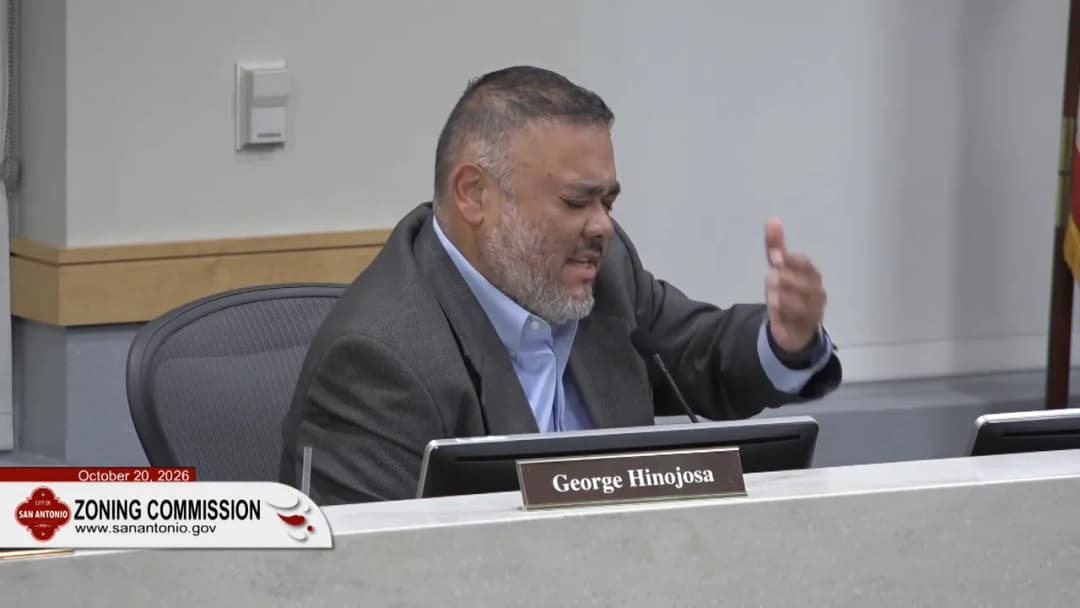
The San Antonio Zoning Commission met on October 20, 2026, at 1:00 PM, chaired by John Bustamante. The meeting covered multiple zoning cases and a major discussion on proposed Unified Development Code (UDC) amendments for data centers. Votes and decisions are summarized below. Consent Calendar - Items 7 through 12 were combined and approved unanimously (9-0). - Item 7: Rezone at 538 & 524 W. Woodlawn Ave. (C2/C1 to IDZ1HL). 33 notices mailed, 0 favor, 0 opposed. Alta Vista NA in favor. - Item 8: Rezone at 2401 W. Woodlawn Ave. (C3 to RM6). 33 notices, 0/0. Cable Westwood NA no response. - Item 9: Rezone at 7800 Callaghan Rd. (C3 to RM6). 33 notices, 0/0. - Item 10: Rezone at 525 W. Magnolia Ave. (R6 to RM6). 34 notices, 0/0. Alta Vista NA no response. - Item 11: Rezone at 1719 Goliad Rd. (I1 to C2, amended to C2NA). 17 notices, 0/0. Highland Hills NA no response. Applicant's amendment accepted. - Item 12: Rezone at 436 W. Craig Pl. (R6 to R6HL). 28 notices, 1 favor, 0 opposed. Alta Vista NA no response. - Items 5 and 6 were continued to the November 17, 2026 meeting. Public Comments & Testimony - Item 3 (15838 N US Hwy 281): Robin Thompson, a neighbor, expressed support after the applicant agreed to fix longstanding water drainage issues. Rachel Haynes (Policy Director, Greater Edwards Aquifer Alliance) opposed, stating C3 is incompatible with the North Sector Plan and the Edwards Aquifer recharge zone. - Item 1 (4400 block Nyato Dr.): Amelia Peacock (Paloma resident, veteran) opposed, citing lack of specific development proposal, concerns about traffic, and infrastructure adequacy. Joe Most (Paloma resident) opposed, noting proximity to existing homes and property value impact. - Item 4 (3460 Martin Luther King Dr.): Joe A. Rogers Howard (neighbor) opposed the car lot but was open to C2 commercial, citing school expansion and safety. Applicant Samonita Johnson expressed willingness to drop the car lot request for straight C2. - Item 13 (Data Center UDC): Multiple speakers: - Caroline McDonald (property owner) supported Option 1 (by-right with conditions), arguing Option 2 treats data centers more restrictively than heavy industrial uses like rock crushers. - Stephanie Reyes (RECA President/CEO) urged support for Option 1 to maintain consistency and attract investment. - Rob Killen (attorney) requested robust nonconforming use protections for existing data centers. - Rachel Haynes (GEAA) supported Option 2 (specific use authorization) for flexibility and public input. - Dee Dee Belmas (Public Citizen) supported Option 2, citing community concerns about noise, light, and lack of notification. - Evan Gray (Bear Data Center owner) asked for a small-scale exception to avoid regulating micro data centers. - Bill Kaufman (industry representative) argued 500-foot setback is excessive compared to other uses (e.g., 30 feet for outdoor amusement parks, gun ranges). - Dale Hanson (IBEW Local 60) and Mike West (Local 142) supported Option 1 for job creation. Discussion Items - Item 3 (15838 N US Hwy 281): Applicant Octavio Montes proposed C3 on the front 1.247 acres and C2CD (construction trade contractors) on the rear 2.61 acres. Staff recommended denial due to incompatibility with adjacent single-family homes. SAWS condition required 65% pervious cover and a 60-foot buffer around a solution cavity. After public comment, Commissioner Duval moved to approve as amended with conditions: hours M–F 8–5, Sat 8–1, height limit 20 ft, downward lighting. Motion passed 9-0. - Item 1 (4400 block Nyato Dr.): Applicant Bruce Cash (developer of Paloma subdivision) sought C2 (later amended to C2NA) to unify zoning on a parcel split between C2, NP10, and MXD. Staff recommended approval. After two motions (denial failed 5-4, reconsideration passed, then approval failed 3-6), no recommendation was sent to City Council; the applicant may choose to proceed or withdraw. - Item 2 (142 Gembler Rd.): Applicant (Vanessa Wertzer) request from C2 to IDZ3 for uses including parking, animal services, entertainment, and farm equipment storage. Amended site plan included a 25-foot buffer. Staff recommended denial due to industrial encroachment, but Planning Commission recommended approval. No public comment. Motion to approve with amended site plan passed unanimously. - Item 4 (3460 Martin Luther King Dr.): Applicant Samonita Johnson sought C2CD for a motor vehicle sales lot. Staff recommended denial but supported straight C2. Neighbors opposed car lot but open to C2. After discussion, Commissioner Losef moved to continue to November 17 to allow further community engagement. Motion carried 6-3. - Item 13 – Data Center UDC Amendments (Major Agenda Item): - Staff (Logan Sparrow) presented three options for regulating data centers: Option 1 (by-right in C3/industrial with conditions), Option 2 (specific use authorization required for all), and Option 3 (Mayor's proposal with additional requirements). - Discussion covered definitions, setbacks, nonconforming uses, environmental concerns, and water/energy impacts (deferred to SAWS and CPS). - After extensive debate and multiple motions, a final motion by Commissioner Pana (amended by consensus) was approved 8-1 (Witsett opposed). The recommendation to City Council includes: - Data centers allowed in C3, L (Light Industrial), and BP (Business Park) only with a Specific Use Authorization. - By-right permission in I1 and I2 districts if all conditions are met. - Minimum 350-foot separation from residential uses, schools, hospitals, etc. - 100-foot setback from property lines. - Downward lighting and screening of on-site chillers/generators from public view. - Use of Councilman White's definition for data centers, excluding small server rooms ancillary to a principal use. - Nonconforming use protections modeled after metal recycling facilities. Key Outcomes - Items 7–12: Approved unanimously (9-0). - Item 3: Approved as amended with conditions (9-0). - Item 5 & 6: Continued to November 17, 2026 (unanimous). - Item 1: No recommendation; applicant may choose path forward. - Item 2: Approved with amended site plan (unanimous). - Item 4: Continued to November 17, 2026 (6-3). - Item 13: Recommendation approved (8-1) for a hybrid regulation: by-right in I1/I2 with conditions; specific use authorization required in C3, L, and BP; 350-foot setback; 100-foot property setback; downward lighting; screening of chillers/generators; nonconforming protections. Staff will draft formal language for City Council consideration on October 29, 2026. - Minutes: Approved from October 4, 2026 meeting. - Meeting adjourned at 7:04 PM.

ZONING AND LAND USE 60% · DATA CENTERS REGULATION 26% · PROCEDURAL 5% · PUBLIC ENGAGEMENT 2%
29
OCT 20, 2026 · SAN ANTONIO, TEXAS · COUNCIL COMMITTEES
San Antonio Education Opportunities Committee Meeting - October 20, 2026

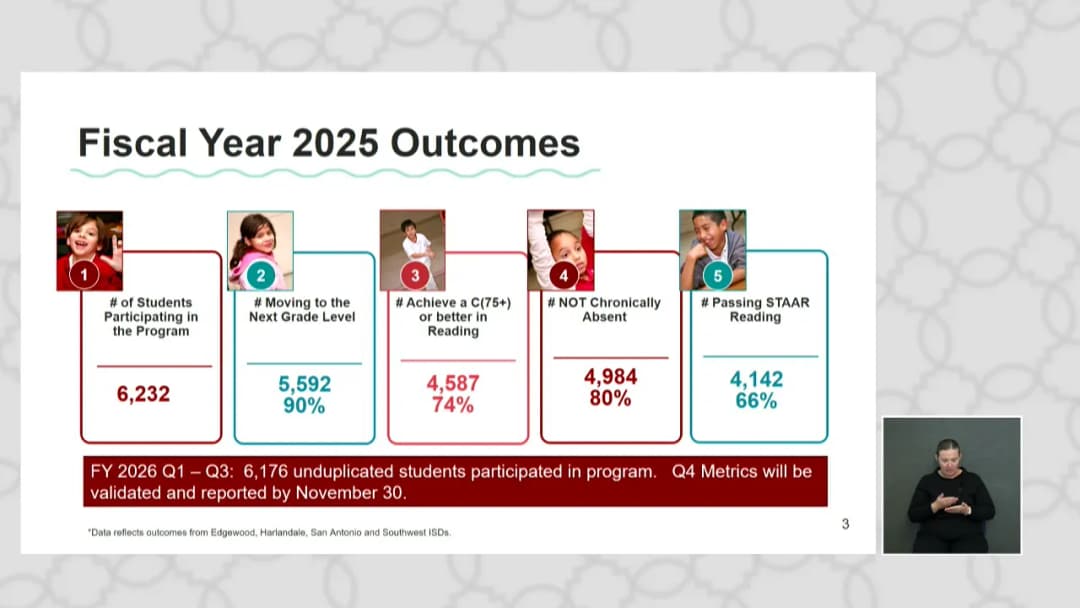
The Education Opportunities Committee met on October 20, 2026, to discuss three major agenda items: a proposed Ambassador Internship Pilot for opportunity youth, a presentation on student chronic absenteeism, and an overview of the After School Challenge Program. Chair Galvan presided, and discussions included presentations from city staff and community partners, followed by committee direction on data collection, program metrics, and interdepartmental coordination. Consent Calendar - The committee voted unanimously to approve the minutes from the previous meeting. - No public comment was offered. Ambassador Internship Pilot for Opportunity and Justice-Involved Youth Rebecca Flores, Education Programs Administrator for the Department of Human Services, presented an 8-week paid internship pilot for 25 disconnected youth (ages 16-24). The pilot prioritizes foster youth, those experiencing housing instability, LGBTQ+ youth, and youth with court involvement. It would be funded by reallocating $200,000 from the Ambassador Summer Internship Program, reducing its university cohort from 200 to 150 interns. - Councilmember Castillo expressed strong support, citing the need to address youth justice involvement at its root. She requested data tracking on participants with incarcerated parents and a post-program follow-up system. - Councilmember Coor supported the proposal but requested a formal control group for the pilot evaluation and targeted outreach in areas with the highest concentrations of opportunity youth. - Councilmember Mungia supported the fund reallocation, noting that the existing Ambassador program's college enrollment requirement excludes many disconnected youth. - Chair Galvan asked about staffing (temporary full-time positions) and employer interest (some employers are already engaged). - Outcome: Staff will return to committee in December or January with a refined data collection plan (including a control group) and a targeted outreach strategy before seeking full City Council approval. Student Attendance and Chronic Absenteeism Julia, from the Barricade Education Coalition, presented on the distinction between chronic absenteeism and truancy, the negative impact of attendance-based school funding in Texas, and tiered strategies from the Attendance Playbook. She highlighted the influence of after-school programs, transportation (VIA pilot), safe school routes, health services, and home visits. - Councilmember Mungia discussed holistic approaches, including incentives, laundry services at schools, and improved safe walking routes. - Councilmember Coor advocated for linking city investments in housing, sidewalks, and delegate agencies to attendance data. She requested a future presentation from Public Works on prioritizing sidewalk funding specifically around schools. - Councilmember Castillo raised infrastructure barriers (potholes, railroad crossings) and the impact of police presence, asking about the effectiveness of incentive programs and career technical education. - Chair Galvan called for better interdepartmental and ISD communication modeled on a children's cabinet and for disaggregated data on the root causes of absenteeism (health vs. disengagement). - Outcome: The committee discussed broad strategies to connect city investments to attendance outcomes and requested improved interagency coordination and data sharing. After School Challenge Program Melody Weasley, Human Services Director, provided an overview of the 30-year-old program. In FY26, it served 6,176 students across four ISDs (SAISD, Harlandale, Edgewood, Southwest) with a $2.1 million general fund budget. FY25 metrics showed 90% grade promotion, 74% achieving a C or better in reading, and 80% not chronically absent. Parent fees generate roughly $336,000. - Councilmember Mungia suggested reinvesting fee revenue into the program and making increased funding for Southwest ISD permanent. - Councilmember Castillo requested a breakdown of programming types and average attendance per school district. - Councilmember Coor expressed strong concern about the metrics (10% not promoted, 20% chronically absent), stating they appeared low without a comparison group. She demanded year-over-year data and demographic breakdowns. - Councilmember McKee Rodriguez requested comparative data for challenge vs. non-challenge students to properly evaluate the program's impact. - Chair Galvan recommended standardizing program names across campuses for public clarity and linking program outcomes to specific academic gaps. - Outcome: DHS will provide a detailed follow-up memo with improved metrics, comparative data, demographic details, and fee structure analysis. Key Outcomes - Ambassador Pilot: The committee supports the pilot and fund reallocation concept. Staff is directed to return in December or January with a refined data and outreach plan before a full Council vote. - Attendance: Staff will explore how existing city investments (transportation, housing, public works, delegate agencies) can be better linked to school attendance, and how to improve interagency communication between the city, ISDs, and partners. - After-School Challenge: Staff will produce a follow-up memo with year-over-year metrics, comparative data against non-participants, demographic details, and an assessment of the parent fee structure.

YOUTH PROGRAMS 47% · PUBLIC EDUCATION 41% · EDUCATION PARTNERSHIPS 2% · WORKFORCE DEVELOPMENT 1%
30
OCT 20, 2026 · SAN ANTONIO, TEXAS · COUNCIL COMMITTEES
San Antonio Public Safety Committee Meeting - October 20, 2026

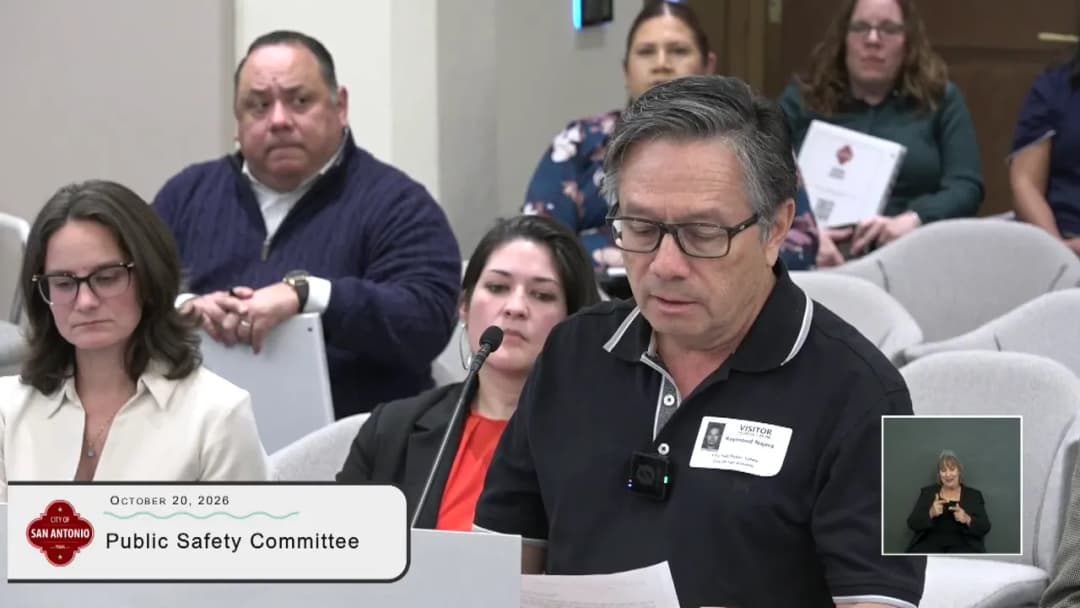
The Public Safety Committee met on October 20, 2026, at 2:38 PM with quorum present (Councilmembers Maki Rodríguez, José Castillo, Spears, White, and Chief Core). The committee reviewed multiple agenda items including Animal Care Services (ACS) performance, domestic violence data, the Good Neighbor Program, crime statistics, and the Dart property abatement program. No agenda or minutes were available beyond the transcript. Consent Calendar - Minutes Approval: The committee unanimously approved the minutes from the September 23 meeting without opposition. Motion by Councilmember Castillo. Public Comments & Testimony - Paul: Addressed spay/neuter data. Emphasized the need for better reporting by species and gender, noted that contracts often miss goals, and advocated for mobile clinics citing experience in Houston (23 surgeries per day). - Vicky Sturman: Expressed frustration with stray dogs and criticized ACS for partnering with Best Friends, which she claimed promotes leaving dogs on streets. Urged implementation of a strategic plan focused on dangerous dogs. - Jennifer Mate: Represented a dog rescue organization. Described a critical problem of stray dogs creating dangerous conditions. Criticized ACS for lack of enforcement and specifically condemned the arrest of 71-year-old Olga García, who was trying to help dogs. Asked for policies that prioritize real animal cruelty cases and support for rescuers. - Tina Castro: Given six minutes; echoed concerns about stray dogs and the criminalization of those who help animals. Called for justice and better collaboration. Discussion Items Animal Care Services (ACS) FY2026 Report - Presentation by Deputy City Manager John Gary and ACS Director. Key data: 5.6% fewer animals in shelter vs. FY2025; 18,932 stray dogs (lowest in 10 years); 26% increase in adoptions; live release rate declined due to a distemper outbreak that forced euthanasia of 7 dogs and testing of 200+ dogs (16 positive, 2 new cases). Spay/neuter surgeries increased by 7,000 with two new clinics, but cancellations and no-shows (42.5% average) remain a challenge. Comparative analysis with Austin, Dallas, Houston showed San Antonio has the most incoming animals and highest enforcement actions. - Council Questions: - Councilmember White probed policies on picking up stray dogs – ACS admitted they lack personnel and prioritize aggressive/injured animals; cannot respond to every report. Requested cost recovery data. - Councilmember Maki Rodríguez asked about spay/neuter costs per species, contracts vs. in-house, and requested a budget follow-up memo. - Councilmember Castillo inquired about outcomes of ambassador program, no-show costs (none currently), and urged better coordination with county. - Councilmember Spears emphasized need for a concrete plan to reduce stray dogs, not just incremental steps. Called for aggressive metrics, free adoptions, and better recruitment of veterinarians. Domestic Violence Update - Presentation by María (CCBD) and Judge Díaz. Data: 42% of children and 29% of adults reported witnessing domestic violence (up from 2023). 1,907 connections to services via United Way (5/day), 13,500 visits to assistance centers (27/day). 58,000+ emergency calls (7/hour). 28 family violence homicides (down from 2020 peak); 13 intimate partner homicides (low compared to Travis and Harris counties). 1,579 protective orders issued. 900 people received shelter, 20,000 received advocacy services. A 5-year prevention plan is mid-implementation focusing on communication, evaluation, and youth education. - Council Discussion: Councilmember White asked about measuring long-term stability of survivors – services include residential and crisis management for up to two years. Councilmember Castillo requested breakdown of shelters by agency and noted difficulty for some victims to access shelters (e.g., missing birth certificates). Councilmember Maki Rodríguez asked about the 800 cases received vs. 1,000 served – many do not need extra support; requested more granular data. Good Neighbor Program - Presentation by María Vargas Yates (Office of Integrated Community Safety). Program addresses chronic nuisance properties. Since 2023, 56 cases identified (37 active). Proposed ordinance: properties with 16+ calls in 365 days become eligible; owners/tenants must register and complete a reduction plan; failure to comply results in a $500 fine. Implementation 90 days after council approval. - Public Comment: Raymond Nájera shared personal story of a fatal dog attack after repeated unheeded calls. Urged better coordination and accountability. - Council Discussion: Councilmember White asked about criteria (16 calls) and fine collection rates – staff admitted no historical data but promised follow-up. Councilmember Castillo noted concern about repeat offenders and wanted support for the lone program manager (Megan). Councilmember Maki Rodríguez questioned about linking to other city services. A motion to advance the ordinance to full council was made and approved without opposition. Crime Statistics Update - Presentation by Chief Core or staff. Highlights: Homicides down 40% (national trend); property crimes down; increases in kidnapping/human trafficking due to proactive operations with US Marshals (45 exploited individuals identified); robberies and vehicle thefts slightly up. Response time at lowest ever. Staffing: 360 officers deployed but ideal is 383; more detectives needed for special victims unit. - Council Questions: Councilmember White asked about proactive patrols in hot spots – confirmed 85-90% coverage. Councilmember Maki Rodríguez requested context for increased kidnappings (linked to trafficking operations and revenge porn cases). Follow-up requested on ideal staffing by substation. Dart Program (Dwelling Abatement Review Team) - Presentation by staff. FY26: 40 inspections (down from 57 in FY25) due to voluntary resolutions and staffing constraints. 27 cases rejected for incomplete documentation. 9 properties in compliance, 17 pending hearings, 1 in litigation, 13 under special circumstances (elderly, disabled, family disputes). Successful case: removal of microplastics illegally stored near aquifer. Councilmember Castillo asked about recidivism (estimated 25-30%) and cost recovery opportunities. Councilmember Maki Rodríguez thanked the team and expressed interest in participating in inspections. Key Outcomes - Motion Approved: The Good Neighbor Program ordinance will be forwarded to the full City Council for consideration, including a parallel ordinance for administrative hearings and appeals. The motion passed unanimously. - Directives: - ACS to provide a follow-up memo on spay/neuter costs, cost recovery per service, and a plan to increase veterinarians and surgeries. - Staff to prepare a presentation on ideal police staffing levels by substation and unit. - Domestic violence presenters to provide more detailed data on case management and outcomes. - Referrals: Councilmember White requested cost recovery data from all departments given fiscal constraints. Councilmember Maki Rodríguez asked for a strategic plan update for ACS with aggressive targets. - Next Steps: The committee will reconvene in November for further discussions on crime trends and police staffing.

ANIMAL WELFARE 31% · GOOD NEIGHBOR PROGRAM 18% · PUBLIC SAFETY 15% · DOMESTIC VIOLENCE PREVENTION 12%
OPENPUBLICA · PUBLIC MEETING INDEXUPDATED DAILY · openpublica.com