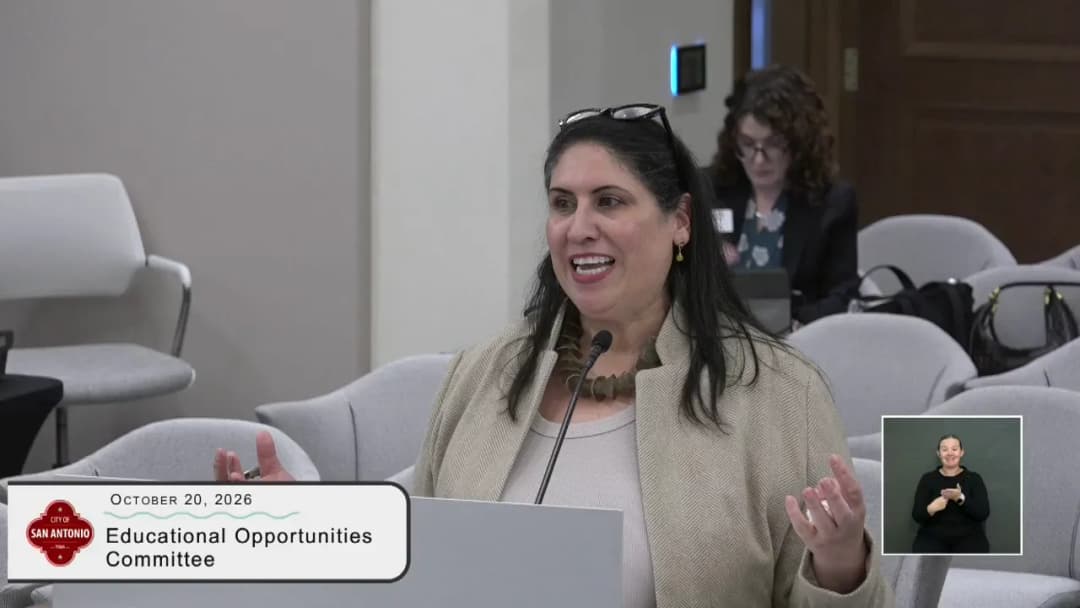
On October 20, 2026, the Educational Opportunities Committee of the San Antonio City Council convened to review three key agenda items: a proposed youth internship pilot for justice-involved and disconnected youth, chronic absenteeism in local schools, and the city's after-school program. Presentations were given by Rebeca Flores (Human Services), Julia (Human Services), and Melody (Human Resources). Councilmembers engaged in detailed discussion on metrics, funding, and alignment with city investments. Consent Calendar - Approval of the minutes from the last meeting was moved and passed unanimously. Discussion Items 1. Youth Internship Pilot Program (Presenter: Rebeca Flores, Educational Programs Administrator, Human Services) - The program is an 8-week paid internship pilot for disconnected youth ages 16–24, with priority for those in foster care, LGBTQ+, and those involved with the justice system. - The model is based on best practices from Chicago, Boston, and New York. It includes 2 weeks of training and 6 weeks of hands-on experience, with intentional mentorship, trauma-informed supervision, and six months of post-program support. - The budget proposal is approximately $200,000, which would require redirecting funds from the existing Ambassador program (currently serving 200 college-aged youth). This would reduce Ambassador slots to 50 for summer 2027. - Councilmember Castillo expressed strong support for the program, emphasizing the need to invest early in youth to avoid higher costs later. Councilmember Core suggested using a control group (youth who apply but are not selected) to measure impact and requested longitudinal follow-up. Councilmember Munguía noted the program's value for youth not in college and stressed the need for community partners in underserved areas like the South Side. - The committee asked staff to bring back a detailed outreach plan, control group design, and demographic data before proceeding to City Council in December or January. 2. Chronic Absenteeism (Presenter: Julia, Human Services) - Julia presented on the scope of chronic absenteeism (missing 10% of school days), noting Texas tracks it more broadly than truancy. Post-pandemic rates remain high, especially among economically disadvantaged, special education, and English learner students. - Key causes: illness/medical appointments (most common), mental health issues, transportation barriers, lack of engagement, and caregiving responsibilities (e.g., older students missing 11+ days to care for siblings). - The presentation highlighted successful interventions: summer/after-school programs, school-based health clinics, incentives (e.g., zoo tickets, music programs), vocational training pathways (e.g., Harlandale ISD's career tracks), and infrastructure improvements (safe sidewalks, school zone improvements). - Councilmembers discussed the need for local data, coordination with school districts, and leveraging existing city investments (housing stability, bond programs) to improve attendance. Specific ideas included using city sidewalk funds to prioritize school routes, expanding laundry services in schools, and better data sharing via platforms like PurpleSense. - The committee agreed to work with Alex and department heads to connect city investments to attendance outcomes and to request a detailed data report from districts. 3. After-School Program (Presenter: Melody, Human Resources) - The program has operated for over 30 years, originally run by Parks & Recreation, now under HR with a contract model. It serves 6,176 students across four school districts: SAISD, Harlandale, Edgewood, and Southwest ISD. - Current budget: $2.1 million from the general fund, with an additional $336,000 in fee revenue (families pay a small fee based on income). The average cost per student is $105. - Metrics for the 2025–2026 school year: 90% promotion rate, 74% attendance (75% or higher attendance), and 80% of participants were not chronically absent (compared to 24% chronic absence district-wide). - Councilmember Core questioned the promotion rate, noting that 90% seemed low for grade-to-grade promotion. The committee requested historical data (six years) and more context (e.g., comparison to non-participants) to better evaluate effectiveness. Councilmembers also raised concerns about fee waivers and equity. - The committee directed staff to provide detailed demographic, income, and outcome data, and to explore aligning after-school with other city programs (parks, libraries) to improve academic results. Key Outcomes - The committee gave direction to staff to refine the youth internship pilot with a control group, targeted outreach in high-need areas, and a plan for longitudinal tracking. Staff will return to the B Session of City Council in December or January 2027. - For chronic absenteeism, the committee will coordinate with school districts and city departments (Public Works, Housing) to prioritize school-based infrastructure (sidewalks, safe routes) and to collect data on how city investments affect attendance. - For after-school programs, staff will provide a comprehensive data report including six years of metrics, demographic breakdowns, and comparison to non-participants. A follow-up discussion will occur before the next budget cycle to assess program effectiveness and potential adjustments. - The meeting adjourned at 12:06 PM.
Public Meetings - San Antonio, Texas
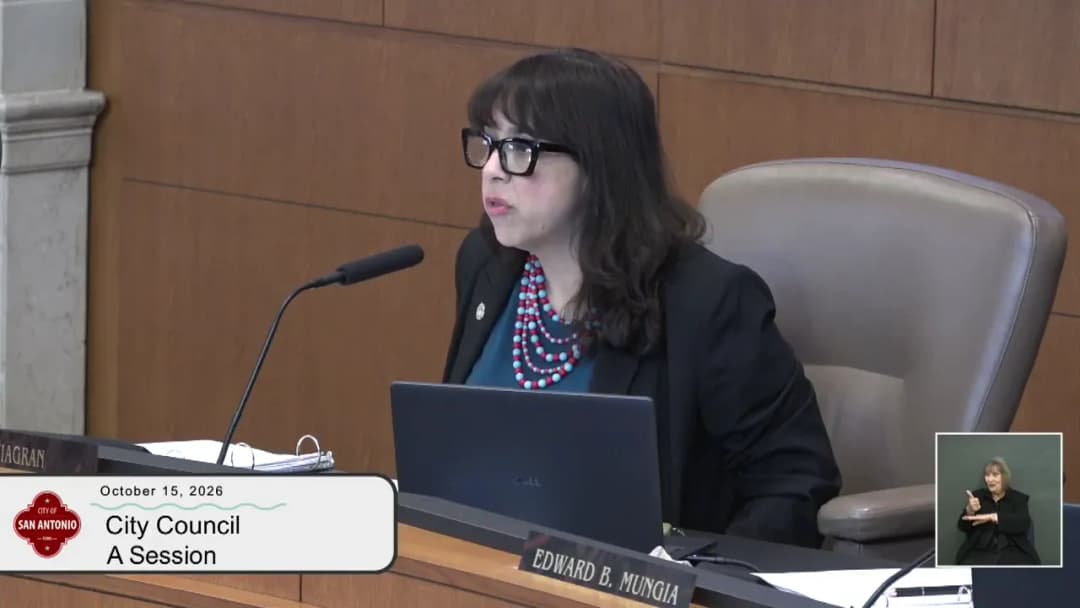
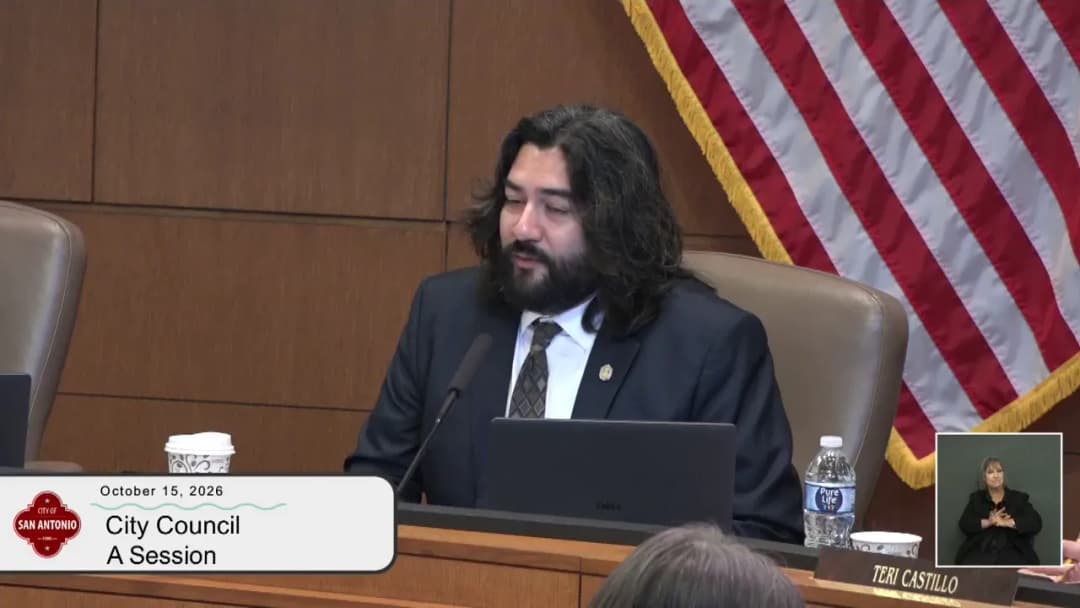
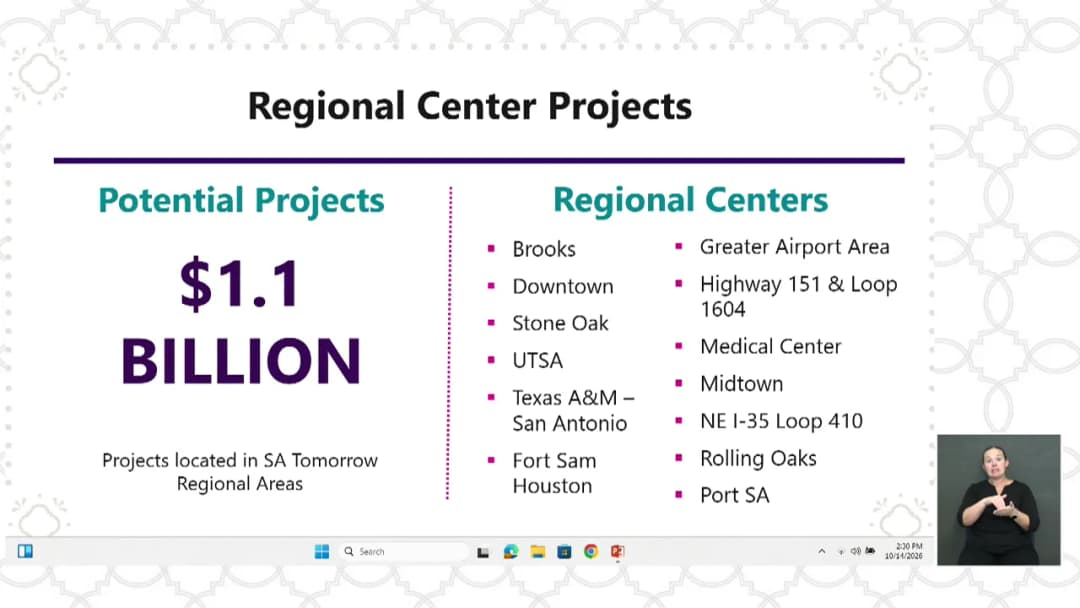
Public Meetings - San Antonio, TexasThe San Antonio City Council convened at 9:07 AM on October 15, 2026, under Mayor Ron Jones. The meeting featured ceremonial recognitions, public comment, and votes on a resolution opposing an ICE detention facility and a contract to upgrade police Tasers. City Council also received a briefing on the updated economic development strategic framework and proposed incentive guidelines. Consent Calendar - Approved minutes of the previous meeting (motion and second, carried). - Approved the consent agenda (items 8-16) as a group, with item 8 (Axon contract) pulled for separate discussion. Item 16, a affordable housing project with rent restrictions for households at 60% or less of area median income, capped at 30% of income, for 40 years, was highlighted by Councilwoman Villagran as a positive addition. Public comment by Jack Finger opposed the project, calling it "welfare housing." Public Comments & Testimony - Jack Finger spoke against consent agenda item 16, arguing that affordable housing is a burden on taxpayers and disincentivizes self-sufficiency. - On item 5 (ICE resolution), two speakers addressed the council: - Alessandro Carrasco expressed full support for the resolution, condemning ICE's brutality and the proposed detention facility as a "prison camp." He praised the council for taking a stand, regardless of legal outcome. - Jack Finger opposed the resolution, asserting U.S. sovereignty and the need to enforce immigration laws. He characterized the council's efforts as political theater and a waste of resources. Recognitions and Proclamations - The council celebrated the 251st birthday of the United States Navy. Rear Admiral Walter Bradford noted that naval forces make up approximately 15% of active duty forces in the San Antonio area. A cake-cutting ceremony followed. - Councilman White recognized Ellian Solis, a young man who helped neighbors evacuate during house explosions in April 2026, presenting a certificate of appreciation. - Councilwoman Villagran recognized Urban October and the work of Dr. Dyer and communications director Adenelli Moreno Soto in developing a citywide data center survey with over 1,200 responses. - Councilman Korr recognized Chef Seth Snyder and his son Tristan for winning the Pro Chef Division at the Texas Food Championships, representing San Antonio. City Manager's Report - City Manager Eric reported on the Terminal C topping off ceremony at the airport, noting the building will be enclosed by the end of the calendar year. - He highlighted the San Antonio Neighbors Together event, designed to strengthen community-police connections. - A video showcased Andres Torres, a fleet maintenance advisor, emphasizing the importance of preventive maintenance for police vehicles and cost competitiveness. Discussion Items - Item 5 (ICE Detention Facility Resolution): The council considered a resolution directing the city manager and city attorney to take all lawful actions to prevent a large ICE detention facility (1,500 beds) in the urban core. After extensive debate, an amendment offered by Mayor Jones extended the directive to also address newly signed 15-year leases at Brooks that could support ICE operations. Supporters (including Councilmembers McKee Rodriguez, Castillo, Villagran, Alarcon Gavito, Korr, Mesa Gonzalez, and Mungia) argued the facility would harm the community, citing ICE's record and the chilling effect on economic development. Opponents (Councilmembers White and Spears) characterized the effort as political theater and an overreach of local authority. The resolution as amended was approved. - Item 8 (Axon Taser 10 Contract): Councilman McKee Rodriguez pulled the item, raising concerns about the lack of public process (the contract was not competitively bid and was exempt from typical oversight), the cost escalation from $824,000 to over $2 million annually, and the 10-year term. He argued that the city had tied itself to a single vendor (Axon) and called for more scrutiny. In response, the chief of police and city manager defended the upgrade, noting that the Taser 7 is obsolete, the Taser 10 offers increased range (45 feet vs. 25) and reduced voltage for less harm, and the suite of Axon products (body cameras, evidence management) is integrated with the criminal justice system. They also stressed that other major Texas cities have already transitioned to the Taser 10. After discussion, the motion to approve the contract (first-year cost $1,300,077.68, estimated total $22,575,980, with optional bundles up to $31,972,276) carried. - Items 6 & 7 (Economic Development Strategic Framework Update and Incentive Guidelines Briefing): Staff from the Economic Development Department and TIP Strategies presented an update to the 2022 framework and proposed changes to the city’s incentive guidelines. Key highlights included: - Since 2022, over $1 billion was paid to small businesses via the Sabata program (14% increase), $7.5 billion in corporate investment (more than double the prior period), and over 15,000 jobs created. - The framework retains three goals (innovation, global investment, and economic mobility) with new emphasis on placemaking, site readiness, and the "Level Up" implementation task force. - A concept design for the Nelson W. Wolf Stadium redevelopment was presented, featuring mixed-use development (single-family housing under $250,000, medical office, light industrial, retail, community recreation, senior housing) with phased construction from 2029 to 2046. - Proposed incentive guideline revisions include: switching to quarterly census of employment wages (QCEW) for wage data; a fixed 3% annual wage increase (instead of indexing); reducing the minimum job threshold from 50 to 25; lowering the wage requirement (80% of QCEW up from 80% of ACS); creating an Economic Mobility Fund (5% of tax revenue collected instead of 10% direct employee investment); and introducing a transit-oriented development (TOD) incentive (up to 50% abatement for projects over $5M near transit corridors, with 20% enhancement for small business support). - Council members offered varied perspectives: Councilman Galvan expressed strong support for the Wolf Stadium plan; Councilman McKee Rodriguez called for a master plan with clearer ROI metrics; Councilwoman Castillo raised concerns about displacement and economic mobility for justice-involved individuals; Councilwoman Corr advocated for missing middle housing at Wolf Stadium and a combined housing/economic development incentive for TOD; Councilwoman Spears supported the flexibility; Councilman White stressed the need to address issues identified in the TIP report, such as administrative responsiveness and site readiness. No votes were taken; the framework and guidelines are expected to return for adoption on November 5, 2026. Key Outcomes - Approved minutes of previous meeting. - Approved consent agenda (items 9-16) with item 8 pulled. - Approved resolution (item 5) to prevent an ICE detention facility, including a directive to also address similar 15-year leases at Brooks. - Approved item 8, authorizing a 10-year contract with Axon for the Taser 10 upgrade, with first-year cost of $1,300,077.68 and total estimated cost of up to $31,972,276. - Received and filed the briefing on the economic development strategic framework and incentive guidelines; staff to return for formal adoption in November.
San Antonio City Council Meeting Summary - October 15, 2026\n\nThe San Antonio City Council convened on October 15, 2026, for its regular session A. The meeting included ceremonial recognitions, debate and a vote on a resolution opposing an ICE detention center in the urban core, approval of a new TASER contract for the police department, and informational briefings on the Nelson Wolff Stadium redevelopment and proposed updates to the city's economic development incentive policies.\n\n Opening & Ceremonial Items\n- The council celebrated the 251st anniversary of the U.S. Navy, joined by Admiral Walter Matford, who highlighted the naval community's role in San Antonio and the city's strong support for military members.\n- The council recognized Elion Solís, a young resident of District 10, for his heroic actions during a house explosion and fire on Preston Hollow Drive in April 2026. Solís went door-to-door helping elderly neighbors evacuate.\n- Chef Snyder and his son Tristan were recognized for winning a culinary competition in Corpus Christi, representing San Antonio's status as a UNESCO Creative City of Gastronomy.\n- The council acknowledged Urban October and recognized the sustainability and resilience team for their work.\n\n Consent Calendar\n- The minutes from the city council meetings of September 30 and October 1, 2026, were approved unanimously.\n- The consent agenda was approved with the exception of Item 8 (TASER contract), which was pulled for separate discussion.\n- Item 16 (Affordable Housing): Public speaker Jack Finger spoke against Item 16, characterizing it as establishing "welfare or subsidized housing" for families earning 60% or less of the area median income, with rents restricted to 30% of income for 40 years. He argued that such policies provide no incentive for residents to improve their economic standing. Councilwoman Villagrán expressed strong support for the project, stating it helps people when they need it so they can rise up, and expressed interest in working with Opportunity Home in the future.\n\n Discussion Item: Resolution Against ICE Detention Center (Item 5)\n- Public Testimony: Multiple speakers addressed the council. Alessandra Carrasco characterized ICE detention practices as brutal, describing lack of water and food, and urged the council to stand against the facility. Jack Finger argued the resolution was an attempt to obstruct federal immigration law enforcement and characterized it as a political effort against President Trump's agenda.\n- Council Debate:\n - Support: Councilmembers Villagrán, Maggie Rodríguez, Castillo, Gavito, Mungía, and others supported the resolution. Villagrán framed it as a public safety issue, citing patterns of abuse by ICE, lack of transparency, and the fear created in the city's Latino community (64.6% of the population). Castillo noted ICE has a $10 billion budget and argued the facility would harm local economic development. Maggie Rodríguez stated her office had been working with advocacy groups since February to stop the facility, calling for coordination with other agencies.\n - Opposition: Councilmembers White and Spears opposed the resolution. White called the effort a "waste of time and common sense" and "political theater," arguing it misuses taxpayer dollars against federal law enforcement and urged the council to focus on city services and safety. Spears echoed concerns about spending city funds on federal jurisdiction issues and questioned the rationale behind the environmental study.\n- Amendments and Vote: Councilwoman Maggie Rodríguez proposed an amendment adding a section to explicitly address and work to prevent or delay the 15-year lease at Brooks. After debate on the amendment's scope, it was approved. The main resolution, as amended, directing the City Manager and City Attorney to take actions to prevent the ICE detention center from locating in the urban core and to coordinate community legal efforts, passed.\n\n Discussion Item: TASER 10 Contract Update (Item 8)\n- The council debated a contract modification with Axon Enterprise Inc. to upgrade the police department's TASER 7 program to the TASER 10. The cost for the first year is $1,300,077.68, with a total estimated contract base of $22,075,980 over 10 years. An optional addition for up to 100 TASER 10 packs per year totals $9,396,296, bringing the total potential cost to $31,972,276.\n- Councilmembers Mickey Rodríguez and Corr expressed concerns about the lack of competitive bidding, the significant cost, and vendor lock-in. The Police Chief explained the TASER 10 has greater de-escalation capability (45-foot range, 10 cartridges vs 2), and the contract is essential for interoperability with the Axon evidence system (Evidence.com). Changing vendors would be cost-prohibitive. Councilmember Corr noted the need for better scrutiny of such large expenses in the future. Councilman White supported the operational necessity, citing officer and public safety.\n- The motion to approve the contract as pulled from the consent agenda passed.\n\n Informational Briefings: Strategic Framework & Incentive Policy (Items 6 & 7)\n- Item 6: Nelson Wolff Stadium Redevelopment: Staff presented the conceptual design for the redevelopment of the Nelson Wolff Stadium site, based on a community-led process and market analysis. The plan includes mixed-use development with retail, housing (including senior housing), parks, a community center, and medical offices, with phased development projected from 2026 to 2046. Councilmembers expressed strong support for the project as a transformative investment for the East Side.\n- Item 7: Economic Development Incentive Policy Updates: Staff proposed several key changes to the city's incentive guidelines, scheduled for formal adoption on November 5, 2026:\n 1. Wage Data: Shifting from the 5-year ACS average to the Quarterly Census of Wages (QCW) for more real-time salary data.\n 2. Flexibility: Lowering the job creation threshold for emerging industries (e.g., biotech, cybersecurity) from 50 to 25 jobs.\n 3. Economic Mobility Fund (EMF): Creating a dedicated fund by setting aside 5% of projected tax gains from incentive projects (down from a 10% in-project workforce requirement) for broader council-determined initiatives such as childcare or transportation.\n 4. Transit-Oriented Development (TOD) Incentive: A new tax incentive was proposed for projects near transit corridors, including a 20% bonus for supporting small businesses.\n- Council Feedback: Councilmembers White, Corr, and Mungía discussed the TIP Report's findings on the need to improve administrative responsiveness in permitting and site readiness. Councilwoman Castillo emphasized the need for stronger anti-displacement strategies within the TOD and corridor incentives. Councilman Mungía highlighted the need for incentives in underserved areas like the South Side and Base Road.\n\n Key Outcomes\n- Vote: Approved the consent agenda (excluding Item 8).\n- Vote: Approved the resolution directing the City Manager and City Attorney to take legal and administrative actions to prevent the ICE detention center in the urban core and to coordinate community efforts, including addressing the 15-year lease at Brooks.\n- Vote: Approved the first-year contract modification with Axon to upgrade the police TASER system, with a total potential contract value of $31,972,276 over 10 years.\n- Next Steps: The Nelson Wolff Stadium redevelopment plan and the comprehensive Economic Development Incentive Policy framework, including the new TOD incentive and Economic Mobility Fund, are scheduled for formal council adoption on November 5, 2026.
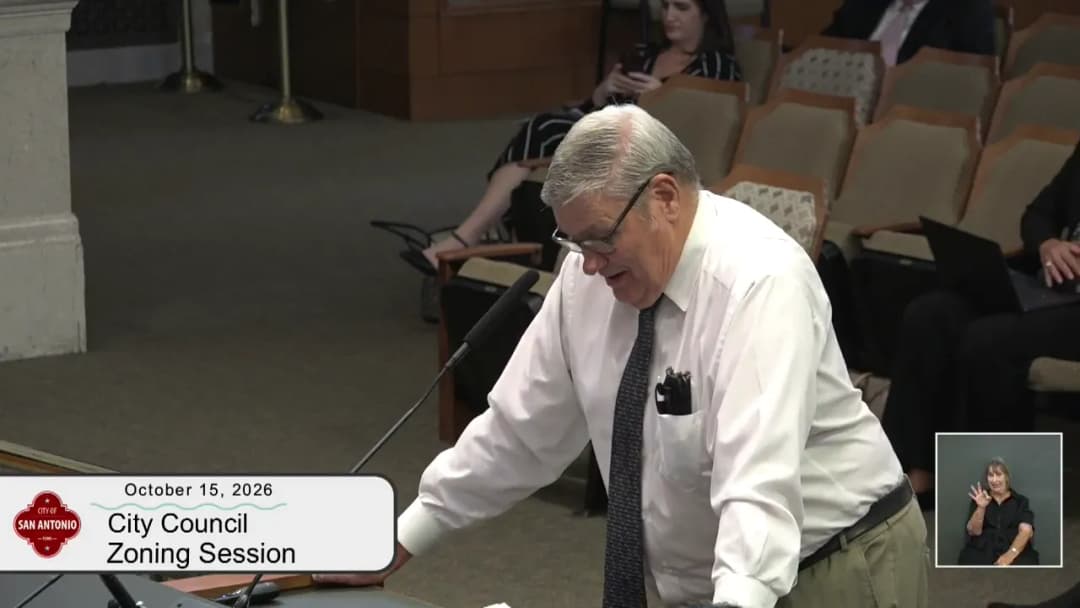
The San Antonio City Council met on October 15, 2026, with Mayor Ron Nirenberg and councilmembers present. After roll call confirming a quorum, the council moved to the consent agenda. Items 13 and 14 were set for individual consideration; the remaining items (1–12 and 15) were considered on consent. The meeting adjourned at 2:15 PM. Consent Calendar - The consent agenda included routine approvals and unanimous actions. Councilmember Corr highlighted two new Transit-Oriented Development (TOD) zones and a new Italian restaurant at the old La Facasha building, welcoming the owner. A motion to approve the balance of the consent agenda (items 1–12 and 15) was made, seconded, and carried. Public Comments & Testimony - Jack Finger spoke on consent agenda items 1, 3, and 4. He opposed item 1, an alcohol variance to allow alcohol sales within 300 feet of Bonham Elementary School, questioning the necessity. He also opposed items 3 and 4, a zoning change from C-2 to C-2 CD for conditional use as a motor vehicle sales lot (used car lot) on Blanco Road, arguing the area already had many such lots. He urged the council to deny these items. - Later, during individual items, Jack Finger again spoke on items 13 and 14, noting that planning and zoning staff and commissions all recommended denial. He stated the proposed auto paint and body repair shop would abut single-family residences without adequate buffers from hazardous emissions, making it incompatible and detrimental. He cited that 15–30% of notified residents opposed the project. Discussion Items - Items 13 and 14 (District 9): A plan amendment from community commercial to regional commercial and rezoning from C-3 to C-3S with specific use authorization for auto paint and body repair, including outside storage screened from view. The property is at 12139 Jones Maltzberger Road. Staff, the Zoning Commission, and the Planning Commission all recommended denial. Notices were mailed: within 200 feet, 7 returned in favor, 2 in opposition; beyond 200 feet, 7 in favor, 1 in opposition. Councilwoman Spears, the district representative, moved to approve, stating she had considered surrounding neighborhood input. The motion was seconded and carried. Key Outcomes - Consent agenda (items 1–12 and 15) approved unanimously. - Items 13 and 14 (plan amendment and zoning change for auto paint/body repair) approved by vote (motion carried). - Meeting adjourned at 2:15 PM.
This meeting of the San Antonio City Council focused on zoning items, including a consent calendar and two individual agenda items. Public comment was heard from a resident, Jack Finger, who opposed several proposals. The council approved the bulk of the consent agenda and later voted to approve items 13 and 14 after discussion. Consent Calendar - Items 1 through 12 and 15 were approved as a block on a motion that passed unanimously. Items 13 and 14 were removed for individual consideration. Public Comments & Testimony - Jack Finger, a resident, addressed the council on several items: - For Item 1 (District 1): He expressed strong opposition to an alcohol variance that would allow sales within 300 feet of Bottom Academy Elementary School. He questioned why the council would permit such sales near children and noted that the planning commission had recommended against the variance. - For Items 3 and 4 (District 1): He opposed a rezoning for a used car lot on Blanco Road, arguing that the district already had numerous such lots and urging the council to reject the proposal. - For Items 13 and 14 (District 9): He opposed a zoning change to allow an auto body and paint shop in a residential area. He stated that staff and the commission had recommended denial, that the use is incompatible with single‑family homes, and that only 15–30% of notified residents supported the project (with 15% to one‑third opposed). He asked why the council did not reject the items outright. Discussion Items - Items 13 and 14 (District 9): These agenda items involved a zoning change near the airport from commercial to regional commercial with specific use for auto repair and painting, located at 214 John Molzberger Road. Council member Spears, representing District 9, stated that after interviewing and considering the application, she recommended approval. She made a motion to approve items 13 and 14, which was seconded. - Consent Item 1 (District 1): Council member Corey (Kerr?) spoke briefly to welcome a new Italian restaurant owner (Cameron) who would occupy the former Focaccia building, expressing excitement about the investment in the community. Key Outcomes - The consent calendar (items 1–12 and 15) was approved as a whole. - Items 13 and 14 (zoning change for auto repair/paint shop) were approved on a motion by Council member Spears, with a second. The motion passed. - The meeting was adjourned at approximately 2:15 PM.
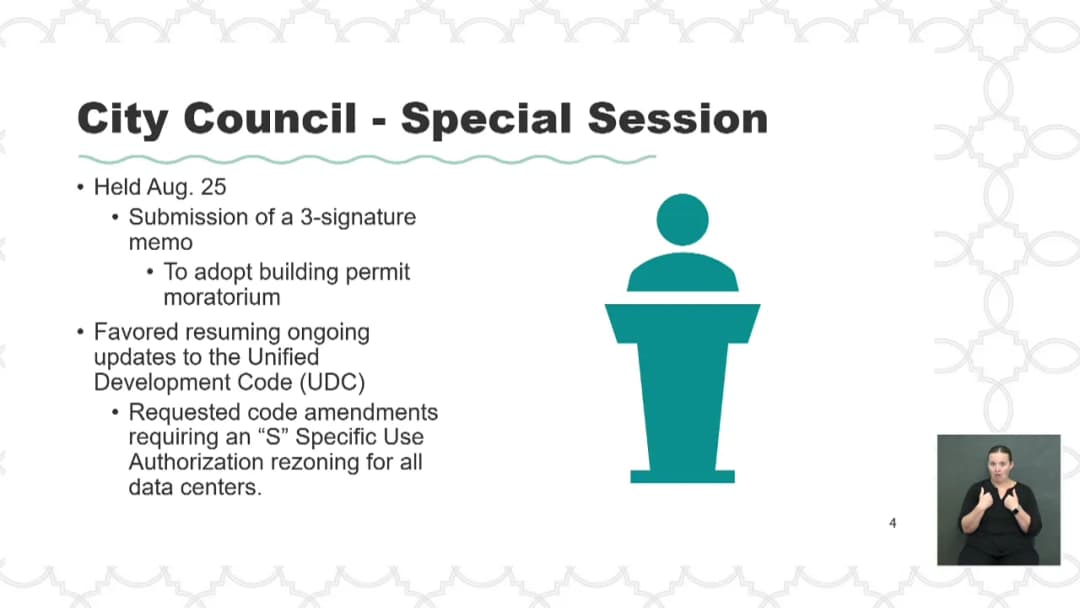
The San Antonio City Council met in a briefing session on Wednesday, October 14, 2026, from 2:08 p.m. to 5:38 p.m. The meeting covered two items: the proposed 2027-2032 bond program and unified development code (UDC) amendments for data centers. No formal votes were taken; staff received direction for follow-up reports on October 28 and October 29. Bond Program: Staff Proposal - Staff proposed a $442 million voter-approved 2027 bond plus a $175 million stormwater utility fee increase, for a combined $617 million investment. - Proposed category split: $300 million for streets, bridges, and sidewalks; $175 million for drainage and flood control (28%); $40 million for parks, including $10 million for greenway trails; $52 million for city facilities; and $50 million for affordable housing (about 12% of the $442 million bond). - About 9% of city streets are currently rated failed. Two allocation options for $100 million in failed-street funding were presented: Option 1 used a roughly proportionate formula (50% network size, 50% condition); Option 2 targeted bringing all districts below 10% failed streets. - The city has roughly 1,500 miles of sidewalk gaps within about 6,000 miles of sidewalks. A $25 million safe-passage-to-schools and bus-stop sidewalk program was suggested by Councilmember Corra. - Staff showed a drainage project list totaling about $200 million, with $175 million assumed fundable. The initial list included no drainage projects in Districts 2 and 6; staff said they would adjust it so every district receives at least one drainage project. - The state flood plan includes 17 San Antonio regional projects, but the city’s top-ranked project, Concepcion Creek, is roughly $200 million alone and was not included in the current list. - About $35 million was identified for sports and entertainment district infrastructure. Approximately $21 million is eligible for an assumed 80% TxDOT / 20% city split; the remaining $14 million covers Durango and Nueva Street projects. PFC eligibility was confirmed by staff, with financial capacity to be briefed on October 28. - A stormwater fee increase was discussed: five annual increases would add about 84 cents per month to the average residential bill by the fifth year, reaching an average bill of roughly $4.94 today plus the increase. The average nonresidential impact was estimated at about $19 per month. - Financial staff reported negative taxable assessed valuation growth of 2.7% in the current fiscal year. The $442 million bond was designed to avoid a debt-service tax rate increase if growth projections hold. A $750 million bond would require roughly a 1.5-cent debt-service tax rate increase over three years based on current projections; larger bonds would require more or longer increases. If growth falls short, even a $442 million bond could require an increase. Council Feedback on the Bond Program - Mayor Jones supported $442 million plus the $175 million stormwater fee, using PFC funds for qualifying sports district projects, prioritizing city-owned facilities that do not charge fees, and directing housing funds to households below 30% AMI. She said the city could revisit another bond in FY28 if conditions improve. - Councilmember Mickey Rodriguez presented three scenarios and supported scenario A ($442 million) first, with $750 million as a compromise. He recommended four committees, district flexibility to shift allocations, and at least one drainage project in every district. - Councilmember Viagran supported a $750 million to $1 billion bond, preferring $750 million, and criticized the $442 million proposal as the lowest since 2007 and as dividing the city. She supported community members on committees, facility replacements over renovations, and the 1.5% public art allocation. - Councilmember Mesa Gonzalez supported scenario A and moving $100 million from parks/facilities to streets. She asked to round the combined package to $650 million by adding stormwater fee capacity to ensure Districts 2 and 6 receive drainage projects. She also asked for the nonresidential fee share and reported that without the fee increase, drainage bonding capacity would be about $9.8 million. - Councilmember Castillo supported a $750 million bond with a larger housing component, housing commission recommendations, the stormwater advisory board for drainage, a merged parks/facilities committee, and failed-street option 1. She also proposed a council subcommittee and ordinance for tri-chair selection and sought funding for a diversion center in partnership with the county. - Councilmember Galvan supported $442 million or $750 million, emphasized District 6 needs including French Creek drainage, older facilities, and streets, and supported a deep-affordability housing focus. He noted that major drainage projects like French Creek were omitted because of cost. - Councilmember Corra initially supported $442 million and proposed $250 million for streets/sidewalks, $75 million for housing, and $75 million for parks/facilities, including $25 million for safe passageways. Later she proposed an alternative: eliminate the stormwater fee increase, set the total bond at $750 million, and split it as $275 million streets, $175 million drainage, $150 million housing, and $150 million parks/facilities. She stressed that all council members must support the final package. - Councilmember Alderete Gabito supported $442 million and scenario A, opposed property tax increases, supported the stormwater fee increase, and called for using vacant properties for affordable housing. - Councilwoman Spears supported $442 million, preferred moving the $50 million housing allocation into streets, parks, and facilities, and called public art a place to cut. She was unsure about the stormwater fee increase and supported the $35 million sports district infrastructure staying in the bond. - Councilmember White supported scenario A except for moving the $50 million housing allocation into streets. He opposed tax increases, supported the tri-chair subcommittee, sidewalks to schools, leverage projects, and drainage projects in every district. - Councilmember Munkia supported option B at $750 million and asked staff to present both option A and option B project lists so the council could compare trade-offs. He noted that deferred projects become more expensive over time. Data Center UDC Amendments: Staff Options - Development Services Director Amin Tomaz reported that the city received a council consideration request in October 2025, held four stakeholder meetings between May and September 2026, and held an August 25 special council session after a proposed building permit moratorium. Council declined the moratorium and asked for specific use authorization on every data center case. - Option 1 would allow data centers by right in C3 commercial and industrial districts if they meet minimum requirements: a 500-foot separation, a Type D landscape buffer (minimum 25 feet), a 50-foot setback, and no location in the Edwards Recharge Zone. Data centers not meeting those requirements would require specific use authorization. - Option 2 would allow data centers in the same zones only through a specific use authorization approved by city council on a case-by-case basis, with no data centers in the Edwards Recharge Zone. - Mayor Jones introduced a hybrid Option 3 requiring an S Code designation and council action. It would add a 45-day pre-filing notice, a 1,000-foot separation, an explicit 63 dBA daytime noise limit with a -7 evening correction, Type D landscaping, replacement of twice the green space removed within city limits, air quality monitoring/reporting consistent with TCEQ, and a request for consent to public disclosure of energy and water usage. Legal staff noted that requiring green-space dedication for nonresidential use would be unusual and would need further review. - Dr. Dyer presented survey findings: more than 1,100 responses across all 10 districts, more than 80% opposition to data centers, top concerns including water use, energy/power grid demands, and environmental impact, and about one-third of respondents categorically opposed. A handbook for elected officials is being drafted. Council Feedback on Data Center Amendments - Councilmember Galvan opposed Option 1 and supported Option 2 or Option 3. He said District 6 contains 19 of San Antonio’s roughly 28 data centers and that residents have lived with impacts for 15 years. He argued specific use authorization is necessary for public input and council accountability, citing the Vantage data center air permitting controversy. - Mayor Jones supported Option 3 because it would require consistent information from applicants, public review, and council action while preserving economic and national security benefits. - Councilmember Viagran supported Option 2 as a workable case-by-case framework, expressed concern about state preemption, and requested district-specific data and a handbook for elected officials. - Councilmember McKee Rodriguez supported any option requiring final council approval, including Options 2 and 3. - Councilmember Alderete Gabito leaned toward Option 1 for consistency, opposed a moratorium, and asked for a clearer definition of data centers based on size or megawatts so server rooms and accessory telecommunications equipment are not regulated. - Councilwoman Spears favored the least restrictive approach, saying data centers are an economic opportunity and overregulation could push them to surrounding counties. She supported case-by-case negotiation. - Councilmember White supported Option 1 with strong neighborhood safeguards and certainty for industry. He noted CPS Energy contributes about 14% of city general fund revenue and proposed narrowing the data center definition to exclude telecom central offices, cable head ends, and accessory server rooms, using language similar to Boston’s. - Councilmember Castillo supported Option 2 or 3 because both require specific use authorization. - Councilmember Munkia supported a position between Options 2 and 3 and called for more diverse stakeholder participation in future meetings. - Councilmember Corra thanked Councilmember Galvan for leadership, said she wanted more education on the issue, and suggested a possible hybrid option: Option 1 for industrial districts and Option 2 for C3 districts. - Councilmember Mesa Gonzalez supported Option 2, saying residents in District 8 raise data center concerns at every HOA meeting. - Mayor Jones also asked staff to analyze whether data centers have affected property values in surrounding communities; staff agreed to look into it. Key Outcomes and Next Steps - Staff will prepare an October 29 bond update centered on the $442 million bond and stormwater fee approach, with an adjusted drainage list so every district has at least one project. - Staff will follow up with council offices on bond committee structure and timeline before October 29. - Staff will provide PFC capacity and sports district financing information on October 28. - Tri-chair names are expected early next week. Some councilmembers requested a subcommittee or ordinance for council involvement in tri-chair selection; the mayor said she would announce the names and council could act on an ordinance. - The data center UDC amendments will be presented to the Zoning Commission on October 20 and return to council on October 29. Staff will incorporate council feedback, including definitional changes and further review of Option 3.
The San Antonio Planning Commission met on October 14, 2026, at 2:11 PM under President Peck to consider consent agenda items and individual cases, including landscaping irrigation variances, a tree preservation variance, a sector plan amendment, and updates to the UDC amendment process. Several commissioners recused themselves from specific items. Public testimony was heard, and votes were taken on multiple applications. Consent Calendar - The consent agenda was approved as amended, removing items 13, 15, 16, 17, 18, 19, and 21 for individual consideration. Commissioner Sanchez recused from items 1, 2, and 5. Public Comments & Testimony - Patrick Wolfs (address: 406 Top Brothers, San Antonio, TX 78252) spoke regarding item 2, a subdivision on Anachu Street. He stated that a drainage channel crosses his property, causing flooding and erosion during rains, and that existing development has already altered floodplain plans. He urged the commission to protect downstream property owners. Staff confirmed the subdivision complies with codes and offered to connect him with stormwater staff after the meeting. Discussion Items - Item 13 – Landscape irrigation variance for 0354 Cobold Soccer Fields. The applicant proposed using a contracted watering service instead of an irrigation system, citing no water line within a mile. Staff recommended denial due to lack of demonstrated hardship. After discussion, the commission voted to approve the variance (motion by Commissioner Cooper, second by Commissioner Miller; passed). - Item 16 – Irrigation variance for 0535 Rancho Culebra Park (1310 Watkins). Applicant requested an alternative watering method for a food truck park due to cost. Staff recommended denial. The commission voted to deny the variance (motion to accept staff recommendation; passed with Commissioners Orion and Bustamante dissenting). - Item 17 – Irrigation variance for 7504 Green Clint. Applicant proposed using a hose to water seven trees and shrubs for a new parking lot. Staff recommended denial. The commission voted to approve the variance (motion and second; passed with Commissioners Walleston and Peck dissenting). - Item 15 – Tree preservation variance for Salado Creek residence. Trees were accidentally damaged during construction; mitigation was provided. Staff supported approval but commissioners requested continuation. Motion to continue to October 28, 2026, passed. - Item 18 – Sector plan amendment (North Sector) requested by Octavio Viramontes to reclassify 1.47 acres near 281 for commercial use (C-3 and C-2 CD). Applicant presented benefits including drainage improvements and low-impact design. After discussion, the commission voted to approve the amended request (motion by Commissioner Profe, second by Commissioner Suke; passed, with Commissioner Miller leaving at 2:52 PM). - Item 19 – Originally on consent but removed; applicant requested a two-week postponement. Motion to continue to October 28, 2026, passed. - Item 21 – UDC amendment update presented by staff (Chavez). The commission agreed to hold a work session to discuss potential amendments for the next cycle (deadline March 31, 2027). Key Outcomes - Consent agenda approved (less removed items). - Item 13 irrigation variance: Approved. - Item 16 irrigation variance: Denied (6-2). - Item 17 irrigation variance: Approved (6-2). - Item 15 tree variance: Continued to October 28, 2026. - Item 18 sector plan amendment: Approved. - Item 19: Continued to October 28, 2026. - UDC amendment work session to be scheduled. - Meeting adjourned at 3:15 PM.
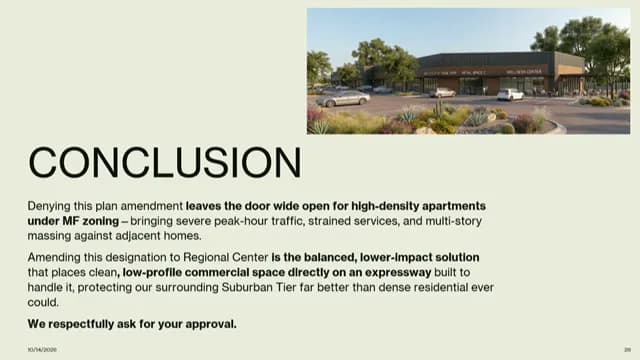
The San Antonio Planning Commission met on October 14, 2026, at 2:21 PM to consider a combined consent agenda and several individual hearing items. The meeting addressed irrigation variances for three projects, a tree preservation variance, a land use plan amendment, and an overview of the 2027 Unified Development Code (UDC) amendment process. Public testimony was heard regarding drainage concerns from a proposed subdivision. Key decisions included approval of one irrigation variance, denial of another, approval of a third, a continuance for a tree variance, and approval of an amended North Sector Plan amendment. Consent Calendar - Items on the combined hearing agenda were approved unanimously in one motion, as amended (item 7 subdivision name corrected to “.227 acres on Anacacho Street Subdivision”). The vote was 9-0. Public Comments & Testimony - Patrick Wilkes (property owner at 4046 Stapper Road, St. Hedwig, Texas) spoke in opposition to a plat (item 2). He stated that construction from the proposed development has already altered drainage from Woman Hollering Creek, causing flooding and erosion on his property. He argued that stormwater modeling was incorrect and that the new plat would further damage downstream properties. He also noted difficulty contacting the case manager (phone number invalid, email returned). Staff stated the plat meets all UDC conditions, and the case manager had resigned. The chair noted that under state law the commission must approve the plat if it meets the code. Discussion Items Item 13: Irrigation Variance – Coval Soccer Fields (7510 Tesla Road) - Staff recommended denial of a variance to waive irrigation system requirements for a new parking lot. Applicant Chad Strainhand (C2 Land Group) argued there is no SAWS water line within a mile, making installation of an irrigation system economically infeasible. The owner proposed using gator bags and a contracted watering service for the 25–30 required trees. The commission found a unique hardship and approved the variance (motion by Commissioner Cooper, second by Commissioner Miller; vote 9-0). Item 16: Irrigation Variance – Rancho Colabra Park (1310 Watkins Lane) - Staff recommended denial of a variance to waive irrigation for a small commercial food truck development with 21 parking spaces. Applicant Alberta One Stop Code Consulting stated the site preserves 77% of existing trees and that manual watering via hose bibs and gator bags would suffice. Staff found no unique hardship, as water infrastructure is available. The commission voted to deny the variance (motion by Commissioner Profit, second by Commissioner Wallerston; vote 7-2, with Commissioners Lopez and Orion voting no). Item 17: Irrigation Variance – Glen Parking Lot (7504 Green Glen) - Staff recommended denial of a variance to waive irrigation for a new parking lot (19 spaces) adjacent to a restaurant. Applicant Chad Strainhand noted a hose bib within 100 feet of all seven required trees and 44 shrubs. Commissioners expressed support, citing the small scale and adjacent owner’s ability to water manually. The variance was approved (motion by Commissioner Orion, second by Commissioner Miller; vote 6-3, with Commissioners Wallerston, Profit, and Chair Peck voting no). Item 15: Tree Preservation Variance – Residents Salado Creek - Staff recommended approval of a variance to fall below the 80% preservation requirement for significant trees within an environmentally sensitive area. Applicant Cecile Gould (2000 Northwest Loop 410) explained that one heritage tree was damaged during construction (more than 50% canopy loss) and that the applicant would pay mitigation fees. Commissioner Lopez moved to continue the item to the October 28 meeting to allow the applicant to consider planting more trees and for staff to examine penalties for the damaged trees. The motion passed unanimously. Item 18: North Sector Plan Amendment – 15838 N US Highway 281 - Staff recommended denial of a plan amendment from suburban tier to regional center on the full 1.247-acre tract. The applicant amended the request to only the front 1.247 acres and presented a proposed retail/warehouse development with C-3 zoning in front and C-2 with conditional use in the rear. Applicant representative Octavia Montes (1362 NW Military) highlighted traffic reduction, tree preservation, drainage improvements benefiting neighbors, and restrictions on future high-impact uses. The commission approved the amended request (motion by Commissioner Profit, second by Commissioner DeSuki; vote 8-0, with Commissioner Miller absent). Item 21: 2027 UDC Amendment Process Presentation - Lauren Chavez (Interim Policy Administrator, DSD) presented the timeline: amendments may be submitted from January 1 to March 31, 2027. The commission discussed holding a work session in November or December to gather commissioner ideas and then voting on proposed amendments before the deadline. Staff will support drafting language. Key Outcomes - Consent Agenda: Approved as amended (vote 9-0). - Item 19 (Continuance): Approved to October 28, 2026 (vote 9-0). - Item 13 (Irrigation Variance – Soccer Fields): Approved (vote 9-0). - Item 16 (Irrigation Variance – Rancho Colabra Park): Denied (vote 7-2). - Item 17 (Irrigation Variance – Glen Parking Lot): Approved (vote 6-3). - Item 15 (Tree Preservation Variance): Continued to October 28, 2026 (vote 9-0). - Item 18 (North Sector Plan Amendment): Approved as amended (vote 8-0). - Item 21 (UDC Amendment Process): No vote; commission agreed to hold a work session to gather ideas.
The San Antonio City Council held a session B on Wednesday, October 14, 2026, at 2:08 PM. The primary focus was an informational briefing on the 2027-2032 Bond Program, including proposed allocations for streets, housing, parks, and drainage, alongside a follow-up discussion on updates to the Unified Development Code regarding data centers. Mayor Jones and all council members were present, forming a quorum. Bond Program Size and Financial Capacity Staff, led by Mike Shanos (Director of Capital Delivery), recommended a $442 million general obligation bond program to avoid a projected property tax increase under current economic growth forecasts. An additional $175 million was proposed for stormwater drainage, funded by a rate increase averaging $4.94 per month for residents over five years. Councilmembers expressed a wide range of views on the total bond size. Councilmember Mickey Rodríguez proposed two scenarios: Option A ($442M with flexible district allocations) and Option B ($750M). Councilmembers Viagran, Galván, Castillo, and Munguía supported a larger bond ($750M to $1B), arguing it was necessary for transformative investment. Councilmembers Cor, White, Spears, and Gavito voiced support for the $442M figure, citing economic uncertainty and resident resistance to tax increases. A financial analysis revealed that the $750M option would require roughly a $1.50 to $1.75 monthly increase on a median home over three years, while the $442M option aimed for no increase but carried financial risk if property growth falls short. Key Allocations and Category Breakdown - Streets and Sidewalks: $300M was proposed for street repairs, including Type F streets and sidewalks. Councilmember Cor proposed dedicating $25M of this for safe pedestrian routes to schools and bus stops. Councilmember White advocated moving the proposed housing allocation into this category. - Housing: A $50M allocation for affordable housing was proposed. Councilmembers Castillo and Galván advocated for increasing this amount and targeting households under 35% AMI, noting that greater subsidies are required for this income level. Councilmember White favored a smaller allocation to prioritize infrastructure. - Parks and Facilities: $52M for public facilities and parks was proposed. Staff suggested combining Parks and Facilities into a single bond committee, which received broad support from the council. - Drainage: The $175M stormwater plan was debated extensively. Multiple councilmembers insisted on ensuring every council district receives a drainage project, noting Districts 2 and 6 were currently left out. Staff committed to adjusting the project list. - Public Art: The 1.5% set-aside for public art ($6.63M) was discussed. Councilmember Castillo raised concerns about ongoing maintenance costs adding to the general fund. Citizen Participation and Committee Structure A consensus formed to reduce the number of bond committees from five to three. The preferred structure is a dedicated committee for Drainage, one for Housing, and a combined committee for Parks and Installations. Regarding the Tri-Chairs, Mayor Jones indicated he would nominate three professionals to oversee the process. Several councilmembers expressed a desire for the council to be involved in the selection process, potentially through a subcommittee. Mayor Jones committed to presenting the names next week. Discussion on Data Center Regulations (Unified Development Code) Development services presented three regulatory options for data centers. Option 1 allows by-right development in C3 and industrial zones with strict standards (500 ft setbacks, landscaping) and requires a Specific Use Permit (SUP) if standards are not met. Option 2 requires all data centers to obtain an SUP, giving the council case-by-case control. Option 3 is a hybrid with stringent by-right standards but requiring an SUP for deviation. Councilmember Galván, the lead on the issue, advocated for strong local control and transparency regarding water and energy usage, supporting a requirement for council approval. Councilmembers Viagran, Cor, and Munguía supported the case-by-case approach (Options 2 or 3) to allow community input. Councilmembers Spears and White strongly cautioned against over-regulation, arguing that data centers represent a significant economic opportunity and that too much uncertainty would drive the industry to other jurisdictions. Spears favored a lighter touch to attract the industry. Councilmember Gavito leaned towards consistency and clear standards to protect neighborhoods while providing industry certainty. Councilmember White proposed a strict definition of "data center" to exclude telecom and cable facilities. The item was directed to the Zoning Commission for review with the aim of bringing back an ordinance for a vote later in October. Key Outcomes - Bond Program Direction: Staff was directed to return on October 29 with detailed proposals for both a $442M package and a potential $750M package, including specific project lists and financing impacts. The body was largely leaning towards the fiscally conservative $442M approach. - Drainage Equity: Staff was asked to adjust the stormwater project list to include a project in every council district, specifically addressing the needs of Districts 2 and 6. - Committee Structure: A consensus was reached to reduce the number of bond committees to three by combining Parks and Installations. - Data Center Zoning: The council provided direction favoring a model requiring council approval for most sites (Options 2 or 3) or a very strict by-right standard, prioritizing transparency and community notification. - Next Steps: The council will hold further community engagements on the bond, formalize Tri-Chair nominations, and aim for a final zoning vote on data centers in late October.
The San Antonio City Council convened at 9:09 a.m. on October 8, 2026, with Mayor Jones presiding and all council members present, establishing a quorum. The meeting opened with an invocation and the Pledge of Allegiance, followed by a proclamation recognizing Indigenous Peoples Day. Multiple community members spoke in support of the proclamation, emphasizing the historical and cultural significance of Indigenous peoples in San Antonio. No additional agenda items or voting items were discussed during this session. Consent Calendar - No consent calendar was presented or considered during this meeting. Public Comments & Testimony - No public comments were provided outside the Indigenous Peoples Day proclamation recognition. Discussion Items - The Mayor read a proclamation designating October 12, 2026, as Indigenous Peoples Day in San Antonio, Texas. - The proclamation acknowledged the traditions, heritage, and history of Indigenous cultures and recognized Indigenous peoples as the original inhabitants who have shaped the city of San Antonio. - Several community members accepted the proclamation and spoke about the significance of Indigenous identity and the need for continued recognition. Key Outcomes - The City Council formally recognized October 12, 2026, as Indigenous Peoples Day in San Antonio, Texas. Additional Sections - [No additional sections were discussed in this segment of the meeting.]