Browse by city
Date range
Search help

Search titles, summaries, topics and stored transcripts together. Keywords may match separately; put the whole query in double quotes for a phrase. Matching follows word analysis, so punctuation is not exact. Both dates are included. Documents are not searched.

SHOWING 1021–1030 ENTRIES
1021
APR 12, 2017 · SAN DIEGO, CALIFORNIA · LAND USE & HOUSING COMMITTEE
Smart Growth and Land Use Committee Meeting – April 12, 2017

The Smart Growth and Land Use Committee met on April 12, 2017, at 10:00 a.m. to approve minutes, hear public comments, and consider two major items: a ground lease extension for a hotel property and a 15-year flat rate ground lease for hangar tenants at Montgomery Gibbs Executive Airport. Both items were approved unanimously and forwarded to the full City Council. Public Comments & Testimony - Martha Welch (speaking as a resident) expressed strong concerns about overdevelopment, particularly near the library, trolley station, and along Kettner and Laurel. She questioned the city’s permit process, criticized lease structures based on percentage of gross revenue, and argued that the city’s maintenance rules infringe on property rights. She stated that many new hotels appear empty at night and that occupancy figures are misleading. - Ann Feige (Chair, Community Forest Advisory Board) provided an urban forestry update, noting that tree health has declined due to deferred maintenance, budget cuts, drought, disease, and storms. She highlighted that the city has only one arborist for the street tree program (compared to 25–30 in comparable cities) and requested a $1 million budget allocation to plant 2,000 trees and $500,000 to improve shade tree pruning cycles. She committed to advocating at upcoming budget hearings. - S. Clive Richard (resident of Council District 9) reflected on the committee’s evolution from Transportation and Land Use to Housing, Land Use, and now Smart Growth. He stressed the need for infrastructure investment to support smart growth and urged the committee to consider the full range of issues—housing, transportation, and infrastructure—as the city grows. Consent Calendar - The minutes of the March 24, 2017 meeting were approved by unanimous consent with no objections. Discussion Items - Item 2: Ground Lease Extension for Hotel Property (Presented by Sabelle Thompson, Director of Real Estate Assets) The committee considered an amendment to extend the ground lease for a city-owned hotel property (the leasehold is currently under 30 years remaining). The minimum rent is $1.8 million annually, but the city expects to receive approximately $3.8 million annually from percentage rent. The extension would run to 2067, with an additional option for 10 or 20 years. Councilmember Alvarez raised concerns about the long-term value of the property, noting that the minimum rent is far below actual revenue, and questioned whether the city could get a better deal by putting the lease out for bid when it expires. He requested that the Independent Budget Analyst (IBA) prepare a report on the city’s leasing practices for such properties. Councilmember Kate supported the extension, noting that the lessee has invested in improvements since 2010 and that the city has delayed action for nearly a decade. The motion to forward the item to the full City Council passed unanimously, with the request that the IBA report be provided as soon as resources allow. - Item 3: 15-Year Flat Rate Ground Lease for Montgomery Gibbs Airport Hangar Tenants (Presented by Rod Propes, Deputy Director for Airports; Debbie Schogger, Acting Supervising Property Agent; and Wayne Ryder, Program Manager, Airports Division) Staff presented a template for a 15-year flat rate ground lease (optional) for up to 99 current month-to-month tie-down tenants. Key terms: rent starts at $0.11/sq. ft. (same as current), with annual CPI increases beginning in year two, and market value adjustments at years five and ten. Tenants may store vehicles in hangars as long as the aircraft remains flyable and accessible. The lease also includes a 2% equity-sharing payment to the city upon sale of the hangar. A minor amendment was noted—removing the word “physical” from the non-discrimination clause to cover all disabilities. Councilmember Kate asked about the Montgomery Gibbs master plan, which is underway with an 18- to 24-month timeline, and requested that the committee be updated on the master plan’s implications for these leaseholds. Councilmember Alvarez inquired about revenue maximization; staff noted that rents have not increased since 2003 and that the new lease ensures annual CPI increases. The motion to approve the lease template and forward it to the full City Council passed unanimously, with a recommendation that the master plan discussion be brought back to the committee. Key Outcomes - Approval of Minutes: The minutes of March 24, 2017, were approved by unanimous consent. - Item 2 (Hotel Ground Lease Extension): Approved and forwarded to the full City Council. The IBA was requested to provide a report on leasing practices for city-owned properties. - Item 3 (Montgomery Gibbs Airport Hangar Ground Lease): Approved and forwarded to the full City Council, with a commitment to return to the committee for a discussion of the master plan’s impact on the leaseholds. - Next Meeting: The next Smart Growth and Land Use Committee meeting is scheduled for Wednesday, May 17, 2017, at 2:00 p.m.
REAL ESTATE 33% · AIRPORT MANAGEMENT 24% · PROCEDURAL 18% · PUBLIC COMMENT 7%
1022
APR 5, 2017 · SAN DIEGO, CALIFORNIA · RULES COMMITTEE
San Diego Rules Committee Meeting on TOT, Homelessness Committee, and Equal Pay - April 5, 2017

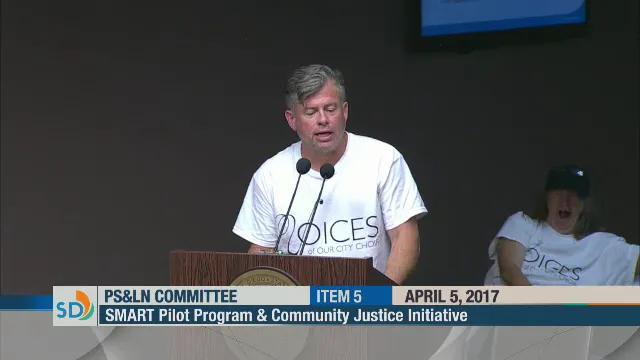
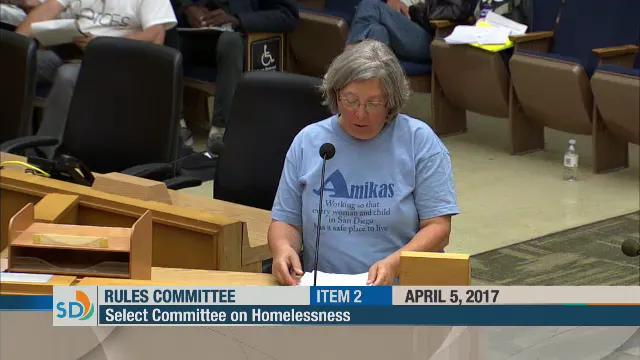
The Rules Committee, chaired by Council President Cole with members Vice Chair Kersey and Councilmember Ward present, met on the morning of April 5, 2017, to consider three major items: a proposed ballot measure to increase the Transient Occupancy Tax (TOT) to fund a convention center expansion, homelessness initiatives, and road repairs; the creation of a select committee on homelessness; and an equal pay ordinance for city contractors. All three items were advanced to the full City Council. Consent Calendar - The committee record of actions from February 8, 2017, was approved unanimously. Public Comments & Testimony - Non-Agenda Public Comments: Several speakers addressed issues not on the agenda. Martha Welch criticized the city's charter and budget process. Catherine Rhodes argued that the city had given $2 billion in cumulative pension increases over the last three years despite a supposed pay freeze, and that pension savings claimed for infrastructure were illusory. Daniel Beaman raised concerns about the difficulty of accessing public notices, recommending they be published in free community papers rather than only in paid publications. Richard Melbourne urged the committee to treat homelessness as an emergency, citing the need for immediate shelter. Patricia Cloyd, who is homeless, described the burden of predatory enforcement (e.g., a $600 encroachment ticket) and urged the city to provide secure storage for homeless individuals attending meetings. Martha Sullivan echoed the need for storage, comparing it to the service provided at Homeless Connect. - Item 1 – Proposed TOT Ballot Measure: Over 20 speakers testified. Many opposed the measure, arguing it insufficiently addressed homelessness and affordable housing. Ismahan Abdullahi (Partnership for the Advancement of New Americans) stated that $10–15 million per year for homelessness is a “band-aid” and that the measure “holds the homeless community hostage” to the convention center expansion. Stephen Russell (San Diego Housing Federation) said the funding is “a small down payment” on a $1 billion need. John Brady (Voices of Our City Choir) calculated that $10 million per year would create only 36 units annually, totaling 3,240 over 40 years. Others, including Jeannie Crescenzo, Fayaz Nawabi, and Emily Serafine Cox (MAC), called for a separate measure fully dedicated to homelessness and affordable housing. Supporters included Mike McDowell (San Diego Lodging Industry Association), Sophie Barnhorst (San Diego Regional Chamber of Commerce), Joe Turse (San Diego Tourism Authority), and Gil Cabrera (Vice Chair, San Diego Convention Center Corporation), who argued the expansion is needed to retain conventions and that the project generates a 140% return on investment. Ken Seaton (Building Trades Council) urged inclusion of local hire and prevailing wage provisions. - Item 2 – Select Committee on Homelessness: Speakers generally supported creation of the committee but urged expedited action and inclusion of homeless individuals and customer satisfaction metrics. John Brady, Susan DeBoer, and Martha Sullivan emphasized the need for input from currently homeless people. Catherine Rhodes noted unused funds (e.g., $268 million in Housing Commission reserves) that could be tapped immediately. Tom Thiessen (PATH) stressed that the committee should treat homelessness as an emergency and start work immediately, not wait until July. - Item 3 – Equal Pay Ordinance: Several speakers supported the ordinance. Rebecca Hookheld (San Diego LGBT Community Center), Emily Howe (Center on Policy Initiatives), Susan Swan (Lawyers Club of San Diego), and Marlene Lara (Planned Parenthood of the Pacific Southwest) highlighted the persistent gender pay gap, with statistics showing that women in San Diego earn 72 cents for every dollar a man earns, with even larger gaps for women of color (Black women: 50 cents; Latina women: 37 cents). Daniel Beaman urged implementation and robust enforcement. Discussion Items - Transient Occupancy Tax Increase Ballot Measure - Jessica Lawrence (Mayor's Office) presented the proposal: a 1% citywide TOT increase, plus an additional 1% in a middle zone, and another 1% in downtown (total up to 3%), to be voted on by a two-thirds majority. Revenue would fund three dedicated funds: (1) contiguous Phase 3 expansion of the San Diego Convention Center (estimated cost $630–685 million), (2) homelessness initiatives (estimated $900 million over 40 years), and (3) street repairs (estimated $900 million over 40 years). The measure would also allow bonding to generate $140–150 million for homelessness and streets in FY2019. The Mayor's Office requested a draft ordinance for council consideration in June, with a special election in November 2017. - The Independent Budget Analyst (IBA) raised several concerns: the $15 million annual TOT gain from the expansion may be overstated (the IBA's estimate is $4–9 million); the proposal lacks a spending plan for homelessness and roads; legal questions remain regarding the Fifth Avenue Landing leasehold; and the timeline is tight. The IBA recommended returning the item to committee in May for further discussion. - Committee members debated the measure. Vice Chair Kersey supported it, noting that the convention center is losing business to competitors like Anaheim and that the measure provides a return on investment. Council President Cole called for increasing the share of revenue for homelessness, especially in early years. Councilmember Ward raised several issues: legal viability (Fifth Avenue Landing litigation), the need for a “lockbox” to protect homelessness and road funds from cost overruns, and the possibility of expanding the definition of “road infrastructure” to include sidewalks and safe crossings. He also questioned the $5 million cost of a special election. Councilmember Bree asked about local hire and prevailing wage requirements. Councilmember Kersey emphasized the need to avoid supplanting existing funding and to include a “maintenance of effort” clause. - The committee voted unanimously to direct the City Attorney to work with the Mayor's Office to prepare a draft ordinance, with the goal of council consideration in June for a November 2017 special election. The motion included a request for the IBA and Mayor's Office to explore increasing the proportion of funding for homelessness. - Select Committee on Homelessness - Ralph DeMericott (Council President's staff) presented a proposal for a 12-month select committee (with potential 6-month extension) composed of four council members, with support from the Mayor's Office, City Attorney, IBA, and a .5 FTE consultant. The committee would review current programs, funding mechanisms, and the city's 1995 Comprehensive Homeless Policy. The requested action was to forward the proposal to the full council for approval. - Committee members supported the proposal but urged an expedited start. Councilmember Ward requested that the committee be formed as soon as possible, not necessarily waiting until July. Council President Cole noted that the earliest council action could be mid-May. The committee voted unanimously to forward the report to the full council with a recommendation to create the select committee and direct the City Attorney to draft a resolution. - Equal Pay Ordinance - Pam Ison (Council District 3 staff) presented the proposal, which would require businesses seeking city contracts to certify that they provide equal pay for substantially equal work regardless of gender or ethnicity. The ordinance would apply to all city contracts, regardless of dollar value, and would be enforced through complaint-driven audits. The effective date would be July 1, 2017, to align with the fiscal year. The proposal builds on state law (SB 358 and SB 1063) and does not require additional upfront reporting from contractors. - The IBA reviewed similar programs in six cities, states, and counties, noting a variety of approaches (certification, wage data reporting, random audits, etc.). They highlighted that San Francisco is still in a pilot phase and that Tempe, Arizona, offers a business designation for low wage gaps. - Committee members expressed support for the goal of equal pay but raised concerns about avoiding undue burden on small businesses, nonprofits, and community planning groups (CPPS recipients). Councilmember Kersey asked about enforcement and current compliance processes for living wage. Christina Peralta (Purchasing & Contracting) explained that contractors currently submit compliance certifications and that complaints are investigated. - The committee voted unanimously to direct Councilmember Ward to work with the City Attorney, IBA, Mayor's Office, and appropriate departments to prepare an ordinance for the full council. Key Outcomes - Item 1 – TOT Ballot Measure: Motion passed unanimously (3-0) to direct the City Attorney to draft a TOT increase ordinance for council consideration in June, with a special election in November 2017. The motion also requested exploration of increased homelessness funding. - Item 2 – Select Committee on Homelessness: Motion passed unanimously (3-0) to forward the proposal to the full council and direct the City Attorney to draft a resolution creating the committee. - Item 3 – Equal Pay Ordinance: Motion passed unanimously (3-0) to direct Councilmember Ward to work with city departments to develop an ordinance for full council consideration. The next Rules Committee meeting was scheduled for June 7, 2017.

HOMELESSNESS 28% · CONVENTION CENTER 18% · PUBLIC COMMENT 12% · PUBLIC ENGAGEMENT 12%
1023
APR 5, 2017 · SAN DIEGO, CALIFORNIA · LAND USE & HOUSING COMMITTEE
San Diego Smart Growth & Land Use Committee on Short-Term Rentals - April 5, 2017

On April 5, 2017, the Smart Growth and Land Use Committee held a public hearing to discuss proposed regulatory options for short-term vacation rentals and home sharing in San Diego. The meeting featured extensive public testimony from residents, property owners, hospitality workers, and small business operators, followed by a council debate and votes on three regulatory options. The committee ultimately voted to recommend Option 3 (owner-occupied home sharing) to the full City Council with specific additions, and to forward all three options for whole-home rentals without a recommendation. Public Comments & Testimony - Bridget Browning (President, Hotel Workers Union) expressed support for home sharing but opposed investor-owned whole-house rentals, arguing they threaten jobs and housing availability. - Dennis Richardson defended short-term rentals as a vital income source and expressed concern that new regulations would ban his long-standing vacation rental business. - Greg Ross (Crown Point property owner and manager) supported Option 3 (Chris Cate's proposal), advocating for enforceable regulations with teeth. - Molly Harstad (co-founder of Dwellwell) proposed a safety certification program as a proactive incentive for permit compliance and to attract desirable guests. - Manuel Andrade (Bankers Hill duplex owner) used rental income to care for his elderly father and pleaded for sensible regulation that does not harm small owners like him. - Beth Galdieri (District 9 property owner) argued that the city had previously interpreted the municipal code to allow short-term rentals as legal rentals, and urged against a retroactive change. - Brian Pease (attorney and City Council candidate) distinguished between owner-occupied sharing and investor-driven whole-home rentals, calling the latter a factor in the housing crisis. - Craig Klein (Ocean Beach resident and planning board member) proposed a cap of 2% of housing units (about 250 in Ocean Beach) with a $1,000 permit fee to fund dedicated code enforcement. - Amanda (single mother and student) shared that Airbnb income allowed her to stay in school and support her special-needs daughter, urging compassion for those using home sharing to make ends meet. - Matt Thompson (North Park resident) supported Option 1 (full ban on whole-home rentals) and called for stricter enforcement against noise and party houses. - John Leppard (Carmel Valley resident) argued that short-term rentals in RS zones are incompatible with residential use and recommended restricting rentals to 21 days or more. - Carolyn Marsden (Ocean Beach neighbor to a vacation rental) described noise and lack of enforcement, and criticized the regulatory options for ignoring enforcement. - Andrew Schuster (Ocean Beach resident) credited Airbnb with enabling him to buy a home; he supported reasonable rules but opposed corporate ownership. Discussion Items - Councilmember Chris Cate (District 6) questioned staff on enforcement costs, permit timelines, and the city attorney's recent memo on zoning. He proposed a motion to adopt Option 3 (owner-occupied home sharing and whole-home rentals) with additions: requirement to pay all applicable taxes (TOT, business tax), escalating fines, a revocable permit system with a three-strike rule, and direction to bring back a 24/7 enforcement proposal funded by permit fees. - Councilmember Lori Zapf (District 2) seconded the motion, emphasizing enforcement over bans and defending property rights. - Councilmember Georgette Gomez (District 9) supported owner-occupied home sharing (Option 3) but opposed whole-home Option 3, arguing that investor-owned whole-house rentals require more discussion and separate treatment. She requested splitting the motion. - After a failed vote (2-1) on the combined motion, Councilmember Cate amended: first motion only for home sharing Option 3, which passed unanimously. Then a motion to forward all three whole-home options to the City Council without recommendation also passed unanimously. - Staff indicated draft code language for all options and enforcement strategy would be ready by late summer/fall. Key Outcomes - Motion 1 (Option 3 for both home sharing and whole-home rentals, with additions) failed (2-1). - Motion 2 (Option 3 for home sharing only, with additions from Motion 1) passed unanimously. The committee recommended home sharing (owner-occupied) to the full City Council with direction to draft code amendments and include tax requirements, escalating fines, revocable permits, and a future enforcement proposal. - Motion 3 (forward all three whole-home rental options — Option 1: ban whole-home; Option 2: 21-day minimum; Option 3: owner-occupied — to City Council without a recommendation) passed unanimously. - The committee expects the full City Council to consider the matter in late summer or fall 2017.

SHORT TERM RENTALS 71% · PUBLIC SAFETY 10% · PUBLIC COMMENT 7% · PROCEDURAL 5%
1024
APR 5, 2017 · SAN DIEGO, CALIFORNIA · PUBLIC SAFETY & LIVABLE NEIGHBORHOODS COMMITTEE
Public Safety and Livable Neighborhoods Committee Meeting - April 5, 2017

The Public Safety and Livable Neighborhoods Committee met on April 5, 2017, at 10:00 AM. The committee heard public comments, received reports on lifeguard dispatch integration, psychiatric emergency response, homeless outreach, and two new justice programs (SMART and CJI), and approved the FY18 HUD entitlement funding allocations. Consent Calendar - The record of action items for March 8, 2017, was adopted by unanimous consent without discussion. Public Comments & Testimony - Non-Agenda Public Comments focused on homelessness and police practices. Martha Sullivan proposed a moratorium and amnesty on ticketing, arrest, and stay-away orders for homeless individuals, citing a 68% increase in encroachment arrests from 2013 to 2016 in the central division. Destiny Rivera urged police to think independently and redirect resources from sweeps to programs. Martha Welch criticized the police complaint process and the lack of resources for homeless placement. John Brady, who experienced homelessness, described the dichotomy of wanting help but being criminalized, and noted an encroachment ticket leading to a warrant. Richard Melvin called for emergency housing measures. Francine Maxwell thanked the city attorney for community engagement and requested more diversity in the city attorney's office and park & recreation department. E.B. Cosswin asked about the search for the next police chief. Steph Johnson emphasized the urgency of the mental health crisis. Daniel Beaman demanded more public restrooms. Susan Debore argued that police sweeps target minor offenses while ignoring gang activity. - Public Comments on Lifeguard CityGate Report included concerns about retaliation and communication. Juan Gonzalez alleged retaliation from supervisors after a press release about a drowning. Chris Banos argued the report was conducted by fire professionals and incorrectly assumes efficiency would improve by mirroring fire rescue's CAD system. Ben Lewis noted inaccuracies in the report, particularly regarding cliff rescue responses. Jeffrey Hatfield defended the existing dispatch process as faster. Eric Jones criticized the fire chief's communication with lifeguards. - Public Comments on PERT included Daniel Beaman, who supported the program; Martha Sullivan, who relayed concerns that clinicians often cannot speak directly to the person in crisis due to safety protocols; John Brady, who praised PERT but contrasted it with enforcement sweeps; and Susan Debore, who alleged PERT had been used in a retaliatory manner. - Public Comments on Homeless Outreach Team (HOT) and Serial Inebriate Program (SIP) included John Brady, who asked for enforcement to be separated from outreach; Daniel Beaman, who supported SIP; Martha Sullivan, who noted no HOT/SIP coverage on Friday nights or weekends; and Susan Debore, who echoed the need for after-hours coverage. - Public Comments on SMART/CJI included Jeannie Crescenzo, who questioned why illegal lodging and encroachment are treated as crimes rather than as housing needs; John Brady, who supported SMART and criticized the high cost of the status quo. - Public Comments on FY18 HUD Allocations included Robert McNamara (support), Raymond Bernal (support for Memorial Park playground), Andrea Sorce (support for IRC microenterprise program), Anchie May (support for Project Chop), Daniel Beaman (concerns about HUD saving limits), and John Brady (criticized conditions at St. Vincent DePaul and asked about customer satisfaction surveys for homeless services). Discussion Items - Report from Fire Rescue on Lifeguard Dispatch Study (CityGate) : Chief Fennessey and Stu Gary presented findings. The study recommended maintaining some dispatch at Mission Bay, consolidating standard operating procedures, upgrading facilities and technology, and improving cross-training and coordination. Specific findings included that not all emergencies receive the closest responder, cultural differences exist between lifeguards and firefighters, and dispatch capabilities need integration. The report included 19 findings and 20 recommendations, with some already underway (e.g., forwarding inland water rescues to fire ECDC). Cost estimates for upgrades were $26,000 one-time and $5,000 annual maintenance for CAD integration, with longer-term facility upgrades estimated at $5-7 million. The information item required no action. - Report on Psychiatric Emergency Response Team (PERT) : Dr. Mark Marvin and Assistant Chief Kay reported that PERT has 16 clinicians in San Diego police divisions, funded primarily by the county ($5.25 million total). In the last fiscal year, PERT had approximately 18,000 field contacts, with 6,800 individuals in severe psychiatric crisis. Only about half of contacts result in transport to a hospital. The program faces challenges attracting clinicians due to pay and safety concerns; seven positions were open. The committee discussed allocation of resources by call volume, the need for 24/7 coverage, and a pilot community paramedic PERT unit. - Report on Homeless Outreach Team (HOT) and Serial Inebriate Program (SIP) : Lieutenant Beeson reported that HOT contacted over 13,000 homeless individuals in 2016, with 845 accepting services. In the first two quarters of FY17, 471 individuals were placed into shelters. The team operates 5:00 AM to 11:00 PM, Monday-Thursday, with limited Friday coverage. SIP has one officer and 32 treatment beds, with plans to increase to 40 beds by the end of the fiscal year. In 2016, 1,700 individuals were arrested for drunk in public, with 361 chronic offenders. The committee discussed the low acceptance rate (7-8%), the need for weekend coverage, and the importance of building rapport. - Report on SMART Pilot Program and Community Justice Initiative (CJI) : Assistant City Attorney Hemerling and Chief Deputy Easton presented. CJI offers first-time, low-level offenders 16 hours of community service in exchange for dismissal; 2,431 participants accepted since 2014, resulting in over 29,000 hours of service. SMART targets chronic misdemeanor offenders with drug addictions in Central Division. It currently serves 10 participants with housing and treatment at a cost of $98,000 from Second Chance. Since November 2014, these participants had 442 police contacts, 102 arrests, 96 jail bookings (566 days), and 101 EMS calls ($192,000 cost). A $3 million joint grant application with the county has been submitted to expand SMART to 100 beds. The committee also discussed eligibility, recidivism tracking, and the status of Prop 47 grant funding. - FY18 HUD Entitlement Program Allocations : Staff presented the annual action plan and a substantial amendment to the consolidated plan. The total CDBG budget is approximately $29.8 million, including $10 million in entitlement funds, repayments, and reprogrammed funds. The allocation funds 33 projects, including capital improvements (Parc de la Cruz Community Center, Bay Terrace Senior Center, Memorial Park Playground ADA upgrades, Silver Wing Ballfield lights). Also included are funds for the reinvestment initiative, homeless services ($1.3 million set-aside), and other HUD programs (ESG, HOPWA, HOME). The 30-day public comment period runs March 29-April 27. The committee was asked to recommend approval to council. Key Outcomes - The consent calendar was adopted unanimously. - All information items were received without action. - The committee voted unanimously to recommend approval of the FY18 HUD allocation action items (1 through 22) to the full city council. The motion was made by Councilmember Ward and seconded by Councilmember Bree. - The next committee meeting is scheduled for April 26, 2017, at 2:00 PM.

HOMELESSNESS 33% · PUBLIC SAFETY 22% · LIFEGUARD OPERATIONS 10% · MENTAL HEALTH AWARENESS 10%
1025
MAR 24, 2017 · SAN DIEGO, CALIFORNIA · LAND USE & HOUSING COMMITTEE
San Diego Smart Growth and Land Use Committee Special Meeting on Short-Term Vacation Rental Regulations – March 24, 2017

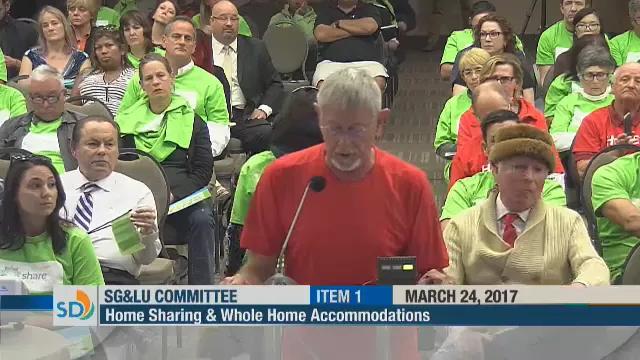
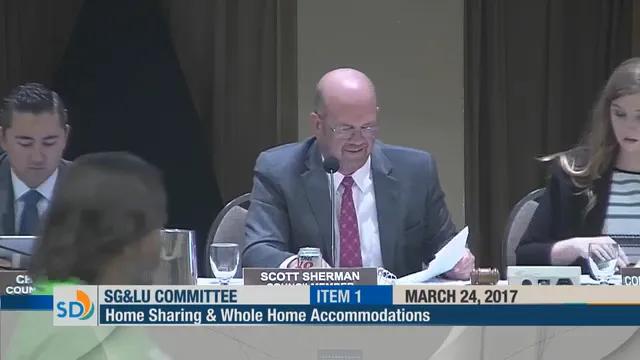
The Smart Growth and Land Use Committee of the San Diego City Council held a special meeting on March 24, 2017, to receive a Planning Department report on proposed amendments to the Land Development Code and Local Coastal Program relating to home sharing and whole-home accommodations (short-term vacation rentals, or STVRs). The committee heard a staff presentation outlining three regulatory options and then took extensive public testimony. The transcript concludes during individual public comments; no committee deliberation or vote is recorded in the provided material. Staff Presentation & Discussion - Planning Department staff (Jeff and Reynard Alos) presented the report, noting that current regulations lack a permit requirement for vacation rentals, making enforcement difficult. They proposed a new annual permit with the ability to revoke permits for chronic violators. - Three common elements across all options: an annual permit (estimated $100 processing cost), a local contact able to respond to complaints within one hour, and a standardized occupancy agreement with a "good neighbor policy." - The three options differ in how they treat whole-home rentals and home sharing: - Option 1: Allows whole-home uses with a ministerial permit for units with 5 or fewer bedrooms and no more than 10 occupants; larger units need a Process 2 Neighborhood Use Permit. Home sharing is tiered: 1–2 bedrooms are exempt, 3–5 require a ministerial permit, 6+ require a Conditional Use Permit. Parking adds half a space per bedroom over two. - Option 2: Allows whole-home use only for stays of 21 days or more with a ministerial permit; deviations require a Process 2 permit. Home sharing requires a ministerial permit. Requires one additional parking space. - Option 3: Allows whole-home use with a ministerial permit and no stay limit. Home sharing uses a ministerial permit, with no additional parking beyond the primary use. Companion unit rules vary (Option 3 allows them without additional requirements). - Staff requested policy direction from the committee to develop an implementing ordinance and enforcement program. Public Comments & Testimony - Stricter regulation / banning whole-home rentals: - James Croake, who started the Pacific Beach planning process, said "nobody is really against home sharing" but called whole-house rentals "hotels" in single-family zones and urged the committee not to allow them. - Tom Coate held a sign reading "Zoning is a promise," arguing that owner-unoccupied vacation rentals are commercial operations that destroy neighborhoods; he cited the City Attorney's memo that they are already illegal. - Crown Point residents including Denise Freeman, Tim Lowry, Chris Lichter, and Jim Marshall described rising STVR numbers (14 to 24 in two years), a shooting at a rental, and families being driven out. They supported home sharing but asked for a ban on whole-house, year-round STVRs. - A speaker called to the podium as "Johnson" presented data: 12,854 short-term rental listings in San Diego, expected to rise 30% to 16,710; 8,612 were entire-home rentals; Airbnb paid $7 million in TOT in 2016; the value of homes removed from the market was $4.779 billion. He argued this worsened the housing crisis. - Marcy Beckett, Bill Vail, Eve Anderson, Sue Hopkins, Larry Gustafson, David Austin, and others spoke against whole-home rentals while often supporting home sharing. - John Ampert, chair of the Ocean Beach Planning Board, said approximately 400 units in Ocean Beach are used as STVRs, resulting in a net loss of nearly 1,500 rental units and displacement of 720 residents. He called for restrictions, caps, and coastal-specific overlays. - Gary Wanicott, president of the Mission Beach Town Council, said Mission Beach has 50–65% STVRs, harming community character; he supported community-tailored ordinances and strong code enforcement. - Hotel industry representatives Namara Mercer and Lynn Moorefield said "sharing yes, commercialization no," advocating a level playing field, taxation, and safety requirements. - Permissive regulation (especially Option 3): - Robert Miller, a real estate professional with four rental units, supported short-term rentals and argued that bans devalue property, while hosts provide tax revenue. - Thomas Griego said Airbnb helped his family and supports the sharing economy. - Jan Reynolds, Jim Manor, Clinton Smith, Greg Ross, Ross Pettett, and others shared personal stories of renting spare rooms or casitas, saying it supports their retirement or families. - Caitlin O'Neill, public policy director for Sonder, supported Option 3, describing Sonder's managed short-term units with 24/7 rapid response. - Stephanie Benvenuto of the San Diego Regional Chamber of Commerce urged support for Option 3, citing economic benefits. - Belinda Smith, co-founder of the Short-Term Rental Alliance of San Diego, supported registration, TOT taxes, and enforcement, but opposed caps and minimum stay requirements. - Patty Sears, who manages 11 units, said TOT was over $12 million (disputing the $7 million figure) and advocated strict but fair regulation. - Middle-ground or community-specific approaches: - Several speakers, including Martin Laracy, Lucas Murdoch, and Matt Thompson, supported regulation over a ban, with Thompson endorsing Option 1 plus modifications. - Austin Hong, an attorney, noted former City Attorney Jan Goldsmith's concerns that current code language is too vague to enforce and called for sensible regulations. - Sylvia Land and Richard Hill supported owner-occupied home sharing and warned against one-size-fits-all rules. - Craig Klein suggested a cap on whole-home rentals and a $1,000 permit fee to fund enforcement. - John Leppard recommended Option 2's 21-day minimum stay to reduce conflicts. - Nancy Kramer, a vacation rental agency owner, said duplicate listings inflate STVR count and advocated reasonable permits and fines. Key Outcomes - No formal action or vote appeared in the transcript; the meeting was still in public comment when the record ended. - Staff had requested direction on which regulatory option to develop into an ordinance; the committee did not provide that direction in the captured portion. - The item was expected to be forwarded to the full City Council, but that motion/decision was not recorded.

SHORT TERM RENTALS 61% · SHORT-TERM RENTAL REGULATION 11% · COMMUNITY ENGAGEMENT 8% · PUBLIC SAFETY 7%
1026
MAR 22, 2017 · SAN DIEGO, CALIFORNIA · BUDGET & GOVERNMENT EFFICIENCY COMMITTEE
Budget and Government Efficiency Committee Meeting - March 22, 2017

The committee met at 5:00 PM on March 22, 2017, to review three action items: revisions to the municipal code for alarm permits and fees, approval of amendments and increased expenditure authority for maintenance, repair, and operations (MRO) supply contracts, and approval of a consulting agreement for fleet software upgrade. All items were approved unanimously and forwarded to the full City Council. The committee also received an informational presentation on the FY2018 budget process from the Independent Budget Analyst (IBA). Consent Calendar - The committee approved the record of actions from the March 8, 2017 meeting by unanimous consent. Discussion Items - Alarm Ordinance Revisions: The San Diego Police Department proposed amendments to the municipal code related to burglary and panic alarms, including a shift from two-year to one-year alarm permits, reduced permit fees ($10 annually), and escalating fines for false alarms. The new system uses enhanced call verification (two calls to the alarm user before police dispatch) and the CryWolf software for tracking. The department estimated a 70–90% reduction in false alarm responses, freeing up approximately 20,000 officer hours annually. Revenue is projected to decrease by $1.7 million due to fee reductions and fewer false alarms, but the department emphasized that enhanced call verification and fine increases would offset some losses. Committee members expressed strong support, citing the value of officer time for proactive policing. The motion to forward to the full council with a positive recommendation passed unanimously. - MRO Supply Contracts: The Purchasing and Contracting Department requested approval of first amendments to MRO supply contracts and an increase in expenditure authority to $56.4 million for contract years two through five. The new contracts include fixed pricing on a market basket of goods, tiered pricing for non-listed items, and provisions for emergency response. The department noted that previous cooperative agreements expired in June 2016, and the new contracts were initially executed under the purchasing agent’s $3 million authority due to time constraints. The increased authority aims to capture approximately $30 million in MRO spending that previously occurred outside contracts. Upcoming integration with the Ariba system will further improve spend visibility and control. Committee members praised the progress and the link to audit recommendations. The motion to approve and forward to council passed unanimously. - Fleet Software Consulting Agreement: Fleet Services requested approval of a $375,000 consulting agreement with CST Fleet Services to upgrade the vehicle maintenance software from version 6.3 to version 16. The project includes on-site support (40 hours per week), computer-based training for 178 technicians across 13 locations, and procedural adjustments to align with industry best practices. Funding was included in the FY2017 budget, so no additional budget action is required. Committee members noted the significant efficiency gains expected. The motion to approve passed unanimously. Information Item - FY2018 Budget Process Overview: Independent Budget Analyst Andrea Tevlin presented the budget timeline. The mayor’s proposed budget is due April 14, 2017, with the IBA review released April 28. Council hearings as the Committee of the Whole are scheduled May 2–10 (with additional days if needed), a public hearing on May 15, and final adoption by June 15. The IBA emphasized that the council has final budget authority and can override mayoral vetoes with six votes. Committee members noted upcoming budget town halls in their districts and highlighted priorities such as equity, key performance indicators, and community engagement. Key Outcomes - All three action items were approved unanimously: Item 1 (alarm ordinance) and Item 2 (MRO contracts) were forwarded to the full council with positive recommendations; Item 3 (fleet software) was approved as presented. - The meeting adjourned at approximately 5:45 PM, with the next committee meeting scheduled for April 19, 2017.

PUBLIC SAFETY 27% · PURCHASING AND CONTRACTING 21% · BUDGET 14% · PROCUREMENT 10%
1027
MAR 22, 2017 · SAN DIEGO, CALIFORNIA · ACTIVE TRANSPORTATION & INFRASTRUCTURE COMMITTEE
San Diego Infrastructure Committee Meeting - March 22, 2017

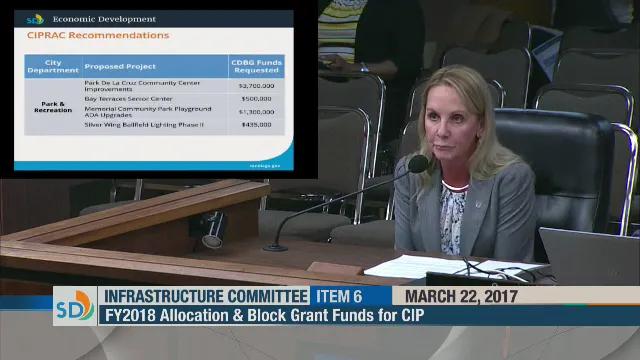
Date: March 22, 2017 Time: 10:00 AM (approximate start) Overview The Infrastructure Committee convened on March 22, 2017, with Chair Kercy presiding, joined by Vice Chair Chris Ward and Councilmember Gomez. Councilmember Zap was absent. The meeting included a non-agenda public comment, adoption of February 1, 2017 minutes, a consent agenda (items 1-4), and a single action item (item 6) regarding the allocation of FY18 Community Development Block Grant (CDBG) funds for capital improvement projects. Item 5 was postponed at staff request. The meeting was brief and concluded with unanimous approvals. Consent Calendar - Items 1-4 were approved unanimously. Vice Chair Ward expressed concern about item 4, a change order likely causing a six-month delay in a water/sewer project in Normal Heights, noting community frustration over an already lengthy project timeline. Staff addressed the concerns. Public Comments & Testimony - Non-Agenda Public Comment: Martha Welch spoke briefly (no specific topic recorded). - Public Comment on Item 6 (CDBG Funding): - Evie Kassauer (Shamrock Street, City Heights) expressed strong support for the Park de la Cruz Community Center, citing the need for senior activities and the health benefits of active aging. - Lisa Youngstitch, a person with mental health challenges, testified that Therapeutic Recreation Services (TRS) programs have kept her out of hospitalization since 2008, and urged funding for Park de la Cruz. - Ray Bernal, President of the Santa American Little League (Memorial Park), described the poor condition of park restrooms and playgrounds, and supported the proposed upgrades, noting the park's heavy use and growing neighborhood density. - Albert Pruitt spoke on behalf of TRS, sharing his personal story of moving to San Diego for its inclusive programs and praising the services provided. - Martha Welch again spoke, expressing hope that the programs would be funded and noting the long history of senior needs in the city. Discussion Items - Item 6: FY18 CDBG Annual Allocation and Reprogrammed Funds for Capital Improvement Projects - Staff (Chrissy Mayer, Community Development Coordinator, and Stephen Medouli Williams, Program Manager) presented the recommendations from the Capital Improvements Program Review and Advisory Committee (CIPRAC). - Proposed projects: - $3.7 million for Park de la Cruz Community Center (building and accessibility improvements) - $500,000 for completion of design of Bay Terraces Senior Community Center - $1.3 million for Memorial Community Park Playground ADA upgrades (new play equipment, ADA restroom, walkways, etc.) - $435,000 for Silver Wing Park Ball Field Lighting Phase 2 (sports lighting, ADA improvements, bleachers, drinking fountain) - Total estimated funding available: $5.9 million from three sources: FY18 annual entitlement, reinvestment initiative, and reprogrammed funds. - Next steps: Present to Public Safety and Livable Neighborhoods Committee in early April, then to full City Council on April 24 or 25. - Committee discussion: Councilmember Gomez praised the focus on community investment and asked about adding canopies at Silver Wing Park. Assistant Director Andy Field (Parks and Recreation) said canopies were not in the current plan but could be considered in a future phase. Vice Chair Ward asked about the source of $1.8 million in reprogrammed funds; staff explained they came from under-budget projects and unallocated FY17 funds. Chair Kercy emphasized the importance of federal CDBG funding. Key Outcomes - Motion by Councilmember Gomez to approve the staff recommendation and forward it to the full city council; seconded by Vice Chair Ward. - Vote: Unanimous (all present members voted aye). - The committee approved the allocation of $5.9 million in CDBG funds for the four capital improvement projects as recommended. - The item will be considered by the full council in April 2017.

PUBLIC COMMENT 34% · PARKS AND RECREATION 32% · WATER AND WASTEWATER MANAGEMENT 9% · PROCEDURAL 8%
1028
MAR 16, 2017 · SAN DIEGO, CALIFORNIA · ENVIRONMENT COMMITTEE
San Diego Environment Committee Meets on Choyas Creek Park and Storm Response on March 16, 2017

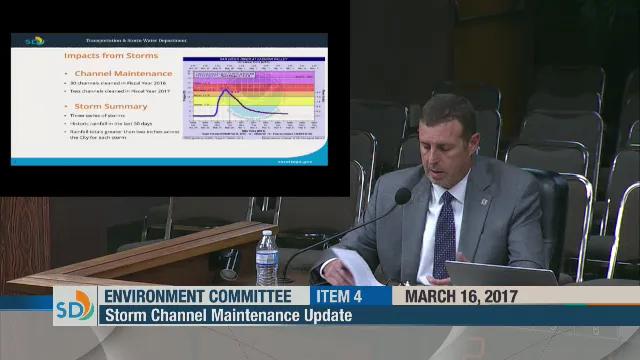
The San Diego City Council's Environment Committee convened on March 16, 2017, with Councilmembers Kate and Sherman present and Councilmember Ward absent. The committee approved two consent items and heard informational updates on the proposed Choyas Creek Regional Park and on Transportation & Stormwater's response to the 2016-17 winter storms. Consent Calendar - Items 1 and 2 were approved unanimously by voice vote, with Councilmember Ward absent. Public Comments & Testimony - Martha Welch, a member of the public, voiced concerns about what she called duplication between the city's Pure Water program and efforts by the San Diego County Water Authority. She questioned whether the city has meter readers and code enforcement, criticized the city's use of bonds and fund transfers, and alleged that money is being hidden instead of spent on infrastructure such as roads. She urged the city to examine all funds. Discussion Items Choyas Creek Regional Park Designation Update - Vicky Estrada, President of Estrada Land Planning and a Groundwork San Diego board member, presented an update alongside Leslie Reynolds, Executive Director. She explained that Groundwork San Diego grew out of the 2002 Chollas Creek Enhancement Plan and now manages the 32-square-mile watershed with 20 linear miles of creek. - Estrada described goals including restoring creek health, cleaning stormwater, protecting habitat, connecting communities, and adding recreational trails. She noted that a feasibility study was approved by the Parks and Recreation Board last year and that a watershed opportunities plan has been completed. - She stated that the next step is funding a regional park master plan, estimated to cost $1 to $1.2 million, with a possible first phase of $300,000 to $500,000 and a second phase of up to $750,000, and that the plan could be completed in about two years. - She emphasized that regional park designation would inspire stewardship, attract users from outside the watershed, and improve habitat and water quality, while acknowledging challenges from mixed public/private ownership. - Councilmember Sherman noted that Groundwork already serves as the necessary foundation and expressed support. Councilmember Kate asked about approval of the opportunities plan, funding, and how to get the project into the city's work program. Estrada and Reynolds said city funding has been the main challenge and that they have not yet been approached about incorporating Choyas Creek into the city's parks master plan. Kate said he would bring the item back as an action item later in the year and asked staff to evaluate including it in the work program. Transportation & Stormwater Update on Winter Storms 2016-17 - Drew Kleiss, Deputy Director, and Gene Matter, Assistant Deputy Director, reported on channel maintenance and storm response. They said the division had over 60 days of storm patrol—about four times the normal average—and that major storms occurred on January 20, February 17, and February 27, with the latter producing 2 to 5 inches of rain over 24 hours and some intensities equivalent to a 25-year storm. - Over the past two fiscal years, the city cleaned 30 drainage channels. Only nine of those cleaned channels experienced flooding; two channels not maintained last year also flooded. Immediate action was needed in two locations. - Examples included removing 25 tons of dead tree material at Hollister Street Bridge and removing a seven-ton collapsed cinder block wall near Cartagena Street in Choyas Creek, both with biologist oversight. - The presenters described flooding in Sorrento Valley/Roselle Street caused by a sediment plug in Los Peñasquitos Lagoon (state park), which exceeds channel capacity. The long-term solution is restoring the lagoon, with phase one planned by fiscal year 2023 and remaining work by 2030. - Clarissa Falcon, on behalf of Biomed Realty, said businesses in the Roselle Street area suffered hundreds of thousands of dollars in damages per event, including submerged cars and facility damage, and requested near-term investment and attention to the long-term fix. - Melanie Cohen, Director of Regional Policy at Biocom, stated that the life science industry employs 73,000 people and generates $17.5 billion in annual economic activity. She said Sorrento Valley floods every year, and while clean channels have helped, the city should conduct expedited cleanup after rain events and address the lagoon and channel system. - Committee members asked about the long-term plan, funding, permitting timelines, channel scoring, telemetry systems, and the status of the Tijuana River channel. They also requested information on resident damage surveys, damage estimates, and whether the state of emergency could expedite further channel work. Key Outcomes - The committee took no formal action on the informational items. - Councilmember Kate said he would bring the Choyas Creek Regional Park item back as an action item later in 2017 and asked staff to determine how to include it in the work program and to provide guidance on potential county participation via a JPA. - Staff committed to following up on requests for information about resident damage surveys, storm damage estimates, the Alvarado Creek section near Waring Road, and Roselle Street exit route signage. - The committee was reminded that the channel maintenance prioritization list will return in early fall. The next Environment Committee meeting was scheduled for April 13, 2017.

STORMWATER MANAGEMENT 31% · MISCELLANEOUS 20% · PARKS AND RECREATION 19% · PUBLIC SAFETY 10%
1029
MAR 15, 2017 · SAN DIEGO, CALIFORNIA · AUDIT COMMITTEE
Audit Committee Meeting Summary - March 15, 2017

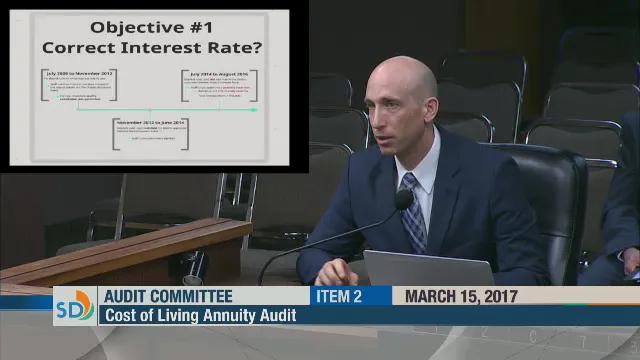
The San Diego Audit Committee met on March 15, 2017, to review internal controls, a retirement system audit, and audit office protocols. The meeting was chaired by an unidentified chair and included presentations from the City Auditor's Office, Comptroller's Office, and SDCERS. Consent Calendar - The minutes from the February 15, 2017 meeting were approved by unanimous consent. Discussion Items - Monthly Activity Report: City Auditor Mr. Luna reported audits in progress and a timetable for the lifeguard tower audit (expected completion in May or end of fiscal year). - Annual Report on Internal Controls over Financial Reporting: Mary Lewis and Rolando Charvel presented the annual report. They discussed the COSO framework, risk assessment, control activities, and monitoring. Highlights included documenting 107 process narratives in FY 2016, out of 760 identified processes (426 documented). Goals of 100 per year. Risks identified related to metro wastewater billing and privileged access to SAP system. Committee discussed prioritization and ongoing monitoring. - SDCERS Cost of Living Annuity Audit: Lee Paravano presented findings. The cost of living annuity is unique to San Diego, funded by employee contributions (17% of contributions). As of 2016, $149 million in the bucket. Average benefit $183 per month. The interest rate used (7.125%) exceeds comparable systems. Recommendations: SDCERS board consider changing the interest rate and that the city (plan sponsor) should control the contribution percentage. Committee discussed impact on unfunded liability and follow-up. - Audit Office Protocols: Mr. Luna presented a new two-page document to improve communication with departments undergoing audits. It outlines audit process, expectations, and the role of the audit committee. Key Outcomes - The committee voted unanimously to accept and forward the internal controls report to the City Council. - The committee voted unanimously to accept and forward the SDCERS audit report. - The committee voted unanimously to accept the audit protocols report. - Next meeting: April 12, 2017, at 9:00 AM.

AUDIT FOLLOW-UP 50% · PENSION FUNDING 26% · FINANCIAL MANAGEMENT 12% · PROCEDURAL 9%
1030
MAR 9, 2017 · SAN DIEGO, CALIFORNIA · ECONOMIC DEVELOPMENT & INTERGOVERNMENTAL RELATIONS COMMITTEE
Economic Development Committee Reviews BID Budgets, Arts District, and Arts Funding on March 9, 2017

The Economic Development Committee of the San Diego City Council met on Thursday, March 9, 2017, to review business improvement district (BID) budgets, receive updates on grand jury recommendations regarding the Convention Center, and hear presentations on the economic impacts of the NTC Foundation's Arts District and the Commission for Arts and Culture. The meeting was chaired by Councilmember Zap, with Councilmembers David Alvarez, Barbara Bree, and Mark Kersey present. Staff included Deputy City Attorney Daphne Scogan, Jack Straw from the Mayor's Office, Jeff Kawar (IBA), and Ryan Purdy (committee consultant). Consent Calendar - The February 13, 2017 meeting minutes were approved by unanimous consent. - No consent items were on the agenda for this meeting. Public Comments & Testimony - Robert McNamara (public speaker, former member of the FY2015 Grand Jury) spoke on the Convention Center grand jury report, noting that the Convention Center Corporation had improved transparency by including previously omitted city payments (e.g., $12.5M annual debt service and $1.2M for pumping water from the basement) in its presentations and linking to city budget pages. He noted that the audit left some governance questions open and that no decision had been made on tourism marketing changes. Discussion Items Item 1: FY2018 Business Improvement District (BID) Budgets - Staff from the Economic Development Department (Lydia Moreno, Deputy Director; Christina Vincent; Day Chi Pantaleon) presented the annual appropriation process for 18 BIDs across San Diego. - The BIDs are authorized under state law to support small businesses, create jobs, and revitalize commercial corridors. More than 14,000 small businesses participate, raising over $1.4 million annually. - Staff requested approval to move the FY18 BID budget package to full City Council for two hearings: April 11, 2017 (advisory board appointments, budget approval, and declaration of intent to levy assessments) and May 16, 2017 (public hearing and confirmation). - Councilmember Alvarez raised questions about the San Ysidro BID's budget, noting concerns about additional revenue beyond assessments. Jason Wells, Executive Director of the San Ysidro BID, explained that they had reduced staff from five to three and taken over chamber events to fill a $50,000 redevelopment fund gap, expecting additional revenue this year. - Councilmember Zap commented on the disparity between assessments and other activities, noting that Ocean Beach BID receives only $27,000 in assessments but raises $858,500 from activities, and Downtown receives $72,000 but leverages $8.7 million. He questioned the burden of monthly reports for small BIDs and recalled a prior suggestion for quarterly reports for those below a threshold; staff confirmed monthly reports are still required. - The committee voted unanimously to move the item forward to City Council. Item 2: Grand Jury Report Recommendation Status (Convention Center) - Lisa Byrne from the Office of the Independent Budget Analyst (IBA) presented IBA Report 1708, providing status updates on two recommendations from the May 2015 Grand Jury report on the San Diego Convention Center Corporation (SDCCC). - Recommendation 1518 (Transparency): The city's original response indicated future implementation; SDCCC has since included a link to city budget pages and additional info on ownership and funding. - Recommendation 1520 (Governance): The city's original response indicated future implementation; the City Auditor's Office reviewed governance models as part of a planned audit, and no further review is planned. The audit committee requested additional information on competing convention centers' governance structures when the audit goes to City Council. - This was an information-only item; no action taken. Item 3: NTC Foundation Arts District Economic Impact Presentation - Alan Ziter (Executive Director), Lori Fleet Martin (Board Chair), and Lisa Johnson (President/CEO) presented the progress of the NTC Foundation's Arts District at Liberty Station. - The district was established from 26 historic buildings at the former Naval Training Center; the foundation is responsible for renovating and operating them under a 55-year lease with the city. - Key statistics: 82 arts and culture tenants (28 nonprofits, 53 small businesses/artists), 90% occupancy, average rent of $1.52/sq ft (commercial rates exceed $3), 977 jobs restored, 600,000 visitors annually, $53 million economic impact, and $15 million from redevelopment funds, $4 million in private donations, plus tax credits and financing. - The foundation has renovated 16 of 26 buildings; 10 remain (including 4 barracks, 3 officers' homes, base exchange, and pump house). Future plans include a 300-seat performance venue and a boutique hotel in partnership with the McMillan Companies. - Councilmembers commented on the district's success and challenges, including the loss of redevelopment funds, the need for gap funding for prevailing wage requirements (increasing project costs by 25-27%), and the need to renovate remaining buildings to reduce blight. - This was an information-only item. Item 4: Commission for Arts and Culture Economic Impact Presentation - Larry Baza (Chair), Carlos Christiani (Advocacy Committee Chair), and Whitney Rue (Funding Programs Coordinator) presented the commission's programs and economic impact. - The commission was established in 1988. It manages the Organizational Support Program (OSP), which provides 70% of its budget; Creative Community San Diego (CCSD) grants (minimum award now $5,000); public art programs (2% for city construction, 1% or 0.5% options for private); arts education (allocated $100,000 annually for two years); and cultural tourism marketing. - Economic impact data (FY2015): City invested $6.7 million in TOT funding for 85 nonprofits; those organizations generated $209.3 million in expenditures, supported 6,656 jobs, and served 5.2 million people. Cultural tourists spend more ($564 vs. $325) and stay longer (3.7 vs. 1.8 days) than average tourists. - Councilmembers discussed the need to support arts education, the potential impacts of proposed NEA cuts, and the challenge of affordable housing for artists. They praised the commission's work and noted the importance of arts funding. - The commission is expected to release updated 2016 numbers in April 2017. - This was an information-only item. Key Outcomes - Unanimous approval (with a verbal 'aye' vote) to move the FY18 BID budgets to full City Council. - The Convention Center grand jury recommendations were noted as implemented or resolved; no further action needed. - No formal votes were taken on the NTC or Arts Commission presentations; they were informational. - Staff were asked to provide comparisons of arts funding with other cities and updated economic impact data when available.

ARTS AND CULTURE 41% · ECONOMIC DEVELOPMENT 18% · HISTORIC PRESERVATION 17% · BUSINESS IMPROVEMENT DISTRICTS 10%
OPENPUBLICA · PUBLIC MEETING INDEXUPDATED DAILY · openpublica.com