The Budget and Government Efficiency Committee of the San Diego City Council met on March 8, 2017, to review several action items related to information technology contracts, library security, financial policies, and asset naming. The committee also received an update on a Grand Jury report and discussed work plan priorities. All action items were approved and forwarded to the full City Council. Consent Calendar - The committee record of actions from the February 2, 2017 meeting was approved by unanimous consent. Public Comments & Testimony - Robert McNamara (District 3, former member of the 2015 Grand Jury) spoke on item 7 (Grand Jury report update). He commended the inclusion of language requiring contract administrators to ensure periodic updates, but recommended adding a sentence that "failing to appear may result in future funding being suspended" to serve as an enforcement mechanism. Discussion Items - Item 1: First Amendment to ATOS Network Services Agreement – The Department of Information Technology (CIO Jonathan Bankey and Deputy Director Sean Kilpak) presented a request for a $13.5 million increase (new not-to-exceed $79.7 million) to extend the current contract for up to 18 months during the transition to a new network services provider. The committee discussed lessons learned from the original contract, plans for a new RFP, and performance metrics. Councilmember Kate made a motion to approve, seconded by Councilmember Gomez; the motion passed unanimously. - Item 2: First Amendment to ATOS Data Center and Help Desk Services Agreement – The same presenters requested an $11.3 million increase (new not-to-exceed $58.4 million) to account for a 13-month transition period and reach five years of steady-state services. The committee discussed contract performance, key performance indicators (e.g., customer satisfaction at 90%, first call resolution target of 65%), and the possibility of a future RFP or extension. Motion by Councilmember Kate, seconded by Councilmember Gomez; passed unanimously. - Item 3: Amendment to Security Guard Services Contract (Library) – Library Director Misty Jones and Supervising Management Analyst Raul Gadinho presented an amendment to increase the citywide contract limit by $691,000 for FY17 and $421,000 for FY18 to cover additional security guard hours at library branches and the central library. Reasons included expanded hours, increased incidents, special events, and living wage ordinance costs. The committee noted that the actual annual increase is about $100,000, and that future budget requests will be made. Motion by Councilmember Sherman, seconded by Councilmember Gomez; passed unanimously. - Item 4: Reserve Policy Revision – The Independent Budget Analyst (IBA) proposed companion language to the previously approved extension of the reserve goal timeline. The language directs the Mayor and Council to evaluate accelerating reserve contributions in budget surplus years. The committee discussed the need to signal long-term financial commitment. Motion by Councilmember Gomez, seconded by Councilmember Kate; forwarded to full Council for direction. - Item 5: Biennial Update of City Debt Policy – Debt Management Director Lakshmi Komi and Debt Manager Jyoti Panthulu presented updates to the debt policy, including new state requirements (SB 1029), inclusion of enhanced infrastructure financing district bonds, and a new debt ratio metric that incorporates pension and OPEB annual costs, with a target not to exceed 25% of general fund revenues. The IBA supported the proactive transparency. Motion by Councilmember Kate, seconded by Councilmember Sherman; passed unanimously. - Item 6: Council Policy on Naming City Assets – Executive Director of Corporate Partnerships Natasha Kalora and Deputy Director of Parks and Recreation Andy Fields presented a new policy to govern naming and renaming of city assets. The policy establishes three categories: donor acknowledgement (excluded from naming), naming without financial contribution (approved by department director after advisory group input), and naming with financial contribution (requires City Council approval). The policy includes criteria for rejecting sponsorships based on values and controversy. Motion by Councilmember Sherman, seconded by Councilmember Gomez; passed unanimously. - Item 7: Update on 2015 Grand Jury Report – Balboa Park Celebration Lessons Learned – Assistant Chief Operating Officer Stacey Lametico provided an update on the remaining recommendation regarding enforcing reporting responsibilities in MOUs/contracts. The city will include language requiring contract administrators to ensure periodic updates to council committees. The speaker noted that the recommendation is now implemented. No action required. - Item 8: Committee Priorities and Work Plan Discussion – Chair Barbara Bree presented her priorities for 2017, including reviewing personnel allocations, public safety resources for AB 953, IT outsourcing contracts, community engagement in budget creation, and compliance with earned sick leave and minimum wage ordinances. Other committee members (Councilmembers Gomez and Kate Sherman) expressed support and shared overlapping priorities. No formal action. Key Outcomes - Item 1: Approved to recommend City Council adoption of the first amendment to the ATOS network services agreement (motion passed unanimously). - Item 2: Approved to recommend City Council adoption of the first amendment to the ATOS data center and help desk services agreement (motion passed unanimously). - Item 3: Approved to recommend City Council adoption of the security guard services contract amendment (motion passed unanimously). - Item 4: Approved to forward the IBA’s proposed language on reserve policy to the full City Council for direction (motion passed unanimously). - Item 5: Approved to recommend City Council adoption of the biennial update of the debt policy (motion passed unanimously). - Item 6: Approved to recommend City Council adoption of the council policy on naming city assets (motion passed unanimously). - Item 7: Received and filed; Grand Jury recommendation considered implemented. - Item 8: Committee priorities noted; no formal vote. The meeting adjourned at approximately 10:30 AM (local time). The next meeting is scheduled for March 22, 2017 at 9:00 AM.
Public Meetings - San Diego, California
Public Meetings - San Diego, CaliforniaThe Public Safety and Livable Neighborhoods Committee met on March 8, 2017, to discuss a range of public safety and neighborhood issues. The agenda included informational reports on ambulance response times, fire station coverage, the Resource Access Program, downtown public restrooms, human trafficking enforcement, and a discussion item on red light abatement. The committee approved a routine consent calendar and made two specific motions: one requesting a fiscal analysis of the fire station coverage report and another directing the city attorney to identify additional tools for red light abatement. Consent Calendar - The committee unanimously approved the record of action items from the February 8, 2017 meeting. Public Comments & Testimony - Danny Avila (speaking as a victim of racial profiling) expressed disgust with the City Council's decision on February 25/27, 2017, not to adopt recommendations from the SDPD racial profiling report. He urged the committee to take action. - Brisa Johnson (Alliance San Diego) echoed disappointment and called on the council to adopt the recommendations to address racial profiling. - Susan De Boer raised concerns about security at Horton Plaza Park, citing an incident where a suspicious suitcase was handled by private security instead of police. She also repeatedly called for safe, clean public restrooms with security. - John Long (business owner at Fault Line Park) reported that public restrooms at the park are magnets for homeless encampments, drug use, and criminal activity, harming his business. He requested an amendment to the development agreement for security or delayed opening. - Lindsay Ford (manager at Stella Public House) detailed a log of incidents including exposure, knives, human waste, threats to staff, and needles in restrooms, emphasizing safety concerns. - Jane Wu (volunteer with Alabaster Jar Project) described a nail salon where 25 workers were trafficked, and urged action against massage parlors used for sex trafficking. - Nancy Chi (business owner on Convoy Street) reported that massage parlors in her plaza engage in prostitution and trafficking, affecting the community. - Alan R. (President of San Diego City Firefighters) supported the Citigate report and highlighted the unique risks San Diego firefighters face. - Ed Harris (lifeguard representative) questioned the auto-dispatch policy and suggested it may lead to unnecessary responses, straining resources. - Steph Gross (Chair of Human Relations Commission) expressed support for the human trafficking task force and emphasized the importance of education. Discussion Items Ambulance Response Times (AMR Report) - Mike Rice (Director of Operations, AMR Rural Metro) reported that the city is currently compliant in all eight emergency zones, meeting the 90% threshold for responding within 12 minutes. Staffing improvements include 32 EMTs in paramedic school, $5,000 sign-on bonuses, and a contract compliance committee. Hospital offload delays are being addressed with a county software tool. Councilmembers Zeff, Ward, and the committee chair asked about sustainability, retention, and hospital hold times. The item was informational; no action taken. Fire Station Coverage (Citigate Report) - Stu Gary (Citigate Associates) presented an updated standards of response coverage study. Key findings: citywide first-unit travel time is 6 minutes (goal 5), and multi-unit response (weight of attack) exceeds 8 minutes. The report identified 10 major gaps (down from 19 in 2010 due to improved modeling) requiring new stations, with six already in the CIP. Additional recommendations include three battalion chiefs and use of fast response squads. IBA Chris Olson raised policy questions on funding and prioritization. Councilmember Ward expressed concerns about engine saturation in his district; Councilmember Bree asked about UCSD station negotiations and motioned for a fiscal impact analysis by the IBA. The chair requested the analysis be completed before budget review and suggested revisiting council policy. No formal vote on the informational item. Resource Access Program (RAP) - Anne Jensen (RAP Program Manager) and Deputy Chief Gina LaMantia described the community paramedic program targeting frequent 911 callers. Approximately 1,200 to 1,400 frequent users generate up to 17% of call volume; 54% are homeless. The program has achieved a 52% reduction in calls from frequent users, saving $45,000 per month. The team currently has one full-time city employee and four AMR paramedics (currently understaffed). Dr. James Dunford praised the program. Councilmembers Ward, Bree, and Zeff asked about staffing, county integration, and expansion costs. The chair requested a cost estimate for expanding the program. Informational. Downtown Public Restrooms (Grand Jury Response) - David Graham (Deputy COO) and Daniel Kay (Civic San Diego) reported on the status of three grand jury recommendations. New restrooms have been added at Fault Line Park, Horton Plaza, and future projects. A wayfinding system with 200+ signs and 20 kiosks was installed. Challenges remain due to loss of redevelopment funds and criminal activity. Councilmember Ward argued the response is inadequate, stated the city lacks a comprehensive plan and sufficient budget, and called for improved collaboration with the Port and County. No action was taken on this informational update. Human Trafficking Task Force - Danny Santiago (California DOJ) presented task force statistics: in 2016, 190 leads, 50 cases, 36 arrests, 56 victims rescued (up from 29 in 2015). The task force conducted the first electronic wiretap human trafficking case in California. Training increased significantly. A critical need is housing for juvenile victims (zero beds available). Councilmembers Bree, Zap, and Ward asked about training strategies, juvenile beds, labor trafficking, and public postings (SB 1193). The chair noted adult beds are funded by NGOs. Informational. Red Light Abatement (Discussion Item) - Deputy City Attorney Patricia Miranda explained the process under Penal Code 11225 and general nuisance laws. Past successes include settlements at Mission Valley Travel Lodge, Howard Johnson, and La Quinta. Recent cases at massage parlors achieved voluntary compliance. Public comments described trafficking in massage parlors and the need for action. Councilmember Ward asked about time frames and legislative needs. The committee chair initiated a motion, seconded by Councilmember Zap, to direct the city attorney to identify additional municipal code provisions to strengthen abatement and prevent re-opening, with a report back in four months. The motion passed unanimously. Key Outcomes - Motion by Councilmember Bree: Request the Independent Budget Analyst conduct a fiscal impact analysis of the Citigate report recommendations. The chair specified that the analysis should cover the three main recommendations and be completed in time for the budget review process. The motion was seconded and approved. - Motion by Councilmember (Zap): Direct the city attorney to identify additional municipal code provisions not covered by state law to enhance red light abatement enforcement and prevent operators from re-opening, with a report to the committee in four months. The motion was seconded and passed unanimously. - All other items were received as informational; no further action was required.
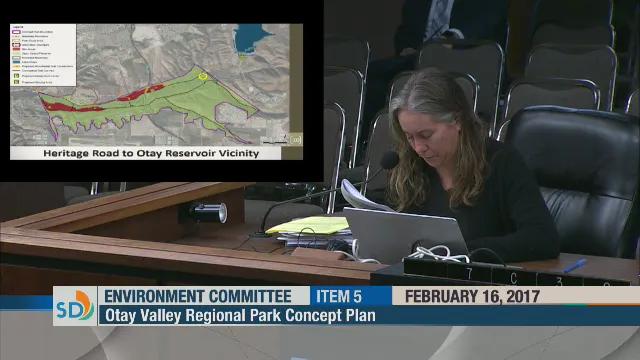
The San Diego City Council's Environment Committee met on February 16, 2017, to address various environmental and infrastructure issues. The committee heard public comments, received updates on the Oroville Dam situation, discussed water rate consultant services, approved multiple State Revolving Fund (SRF) loan applications, reviewed the Otay Valley Regional Park Concept Plan Update, and adopted its work plan for the year. All votes were unanimous. Consent Calendar - Items 1-3: Approved the action items from the December 8, 2016 meeting by unanimous consent. Public Comments & Testimony - Steve Guest (non-agenda): Business owner in Logan Heights, reported 11 flooding incidents in the last 13 years, including 8 in the last 6 years, due to lack of maintenance on Choyas Creek. He noted a 2002 Enhancement Program and recent emergency cleanup but no permanent repairs. - Don Kelly (UCAN): Expressed support for the IBA's recommendations but suggested adding clarifying language to include specific review of assumptions, estimates, and forecasts. He emphasized the importance of transparency and oversight in rate-setting. - Carolina Rodriguez (Climate Action Campaign): Voiced strong support for the work plan, emphasizing community choice aggregation (CCA) as the most cost-effective path to 100% clean energy. She urged honoring commitments to community plan updates and developing clear quantitative guidelines for fair share emissions reductions. - Tyson Siegel: Clean energy advocate, highlighted three reasons for CCA: saving money, increasing local jobs, and reducing pollution. He noted that 24% of city CO2 emissions come from electricity generation and that a CCA could reduce that to zero. - Joyce Lane (San Diego 350): Expressed support for the work plan, particularly on equitable climate action, mass transit infrastructure, CCA implementation, and climate resiliency planning. She urged adequate funding for the CAP. - Mia Weaver-Lowe (non-agenda): Raised concerns about the City charging residents for replacement of trash cans that are City property, citing a $75 fee plus $25 delivery. She highlighted the burden on fixed-income residents. Discussion Items - Oroville Dam Update: Presented by Halla Razak, Director of Public Utilities. Provided background on the February 2017 spillway incident, noting water releases were increased, the emergency spillway was used for the first time since 1968, and evacuation orders were issued for 100,000+ residents. She confirmed no immediate impact on San Diego's water supply, as 3% of regional water comes from the Bay Delta system, and local reservoirs are at 50th percentile. - IBA Report on UCAN Proposal for Water Rate Consultant: Presented by Charles Modica of the IBA. The report reviewed UCAN's proposal to hire a consultant to review PUD's rate-setting. IBA recommended against hiring a consultant for the interim reviews of funds but suggested one for the FY2021 Cost of Service Study (COS). Estimated consultant costs: $200k–$400k for a full COS review, $150k–$300k for a review of funds, or $50k–$100k for an individual consultant. - Motion and Debate: Councilmember Sherman moved to adopt IBA's four recommendations. Councilmember Kate expressed frustration over delayed timelines for reviews of funds and rate reform, requesting written schedules. The motion passed unanimously. - SRF Loan Approvals (Items 6-10): Presented by Lakshmi Committee and Brian Mandel. Approved loan applications for sewer and Pure Water projects, including a $7 million increase for Pump Station 2 (total $50 million) at 1.7% interest, and $71 million in planning/design loans for six Pure Water projects ($45.2 million water, $25.9 million wastewater). All items passed unanimously. - Otay Valley Regional Park Concept Plan Update: Presented by Casey Smith and Laura Ball. The plan updates the 2001 plan, incorporates new trails, adjusts boundaries (e.g., includes Swiss Park staging area), and removes the skydiving operation. The County and Park and Rec Board have already approved. The committee moved to forward it to City Council. - Committee Work Plan for 2017-2018: Presented by Chair Alvarez. Priorities include CAP implementation, CCA exploration, urban forestry, bike plan, recycling, regional parks (including new Choyas Creek Regional Park), and undergrounding. Public speakers urged focusing on CCA and community plan updates. Key Outcomes - Approved Action Items (Items 1-3) unanimously. - Approved IBA recommendations (Item 4) unanimously; authorized IBA to hire a consultant for future cost of service studies and rate designs, with funding from water/sewer funds; directed PUD to report on outreach, create a transparency policy, and update on tiered rates; requests for written timelines from PUD. - Approved SRF loan applications (Items 6-10) unanimously, including $7 million increase for Pump Station 2 and $71 million for Pure Water planning/design. - Approved forwarding Otay Valley Regional Park Concept Plan Update to City Council unanimously. - Adopted the 2017-2018 committee work plan. - Set next meeting date: March 16, 2017.
The San Diego City Council Audit Committee met on February 15, 2017, under Chair Gomez. The meeting covered approval of previous minutes, several informational presentations, and acceptance of audit reports. No public comments were made. The committee unanimously approved the minutes and accepted two audit reports. All other items were informational and required no action. Consent Calendar - Approval of Minutes: The committee approved the records of action from the January 25, 2017 meeting by unanimous consent. Public Comments & Testimony - No public comment speaker slips were turned in. Discussion Items - Item 1: Monthly Activity Report (City Auditor Eduardo Luna) – Informational presentation on the Office of the City Auditor's recent activities, including two issued audit products (IT audit on SAP user access and annual accomplishments report) and ongoing audits (e.g., stormwater, grants management, capital improvement program, Office of Special Events, city boards and commissions). No action taken. - Item 2: ACCELA/ACELA Systems Implementation (presented by Jim Myers, Deputy Director for Development Services) – Informational update on the implementation status. Discussion included the expedite program and the need for controls to ensure proper inclusionary fee collection. The system will have capability to add reports post-implementation. No action taken. - Item 3: Follow-up to Performance Audits for Purchasing and Contracting Department (presented by Matthew Helms, Deputy Director) – Informational update on progress implementing prior audit recommendations, including revision of the Standard Operating Procedure manual and development of online training and a compliance dashboard, expected to go live in June 2017. No action taken. - Item 4: IT Audit of SAP Privileged User Access Management (presented by Steve Gomez, Principal IT Auditor, and Laura Reyes Cortez) – Presented the audit findings and five recommendations to improve security of SAP privileged user management. Both the IT Department and Commissioner's Department agreed to all recommendations with reasonable implementation timelines. The committee voted to accept the audit report (motion by Sherman, second by Valdivia, vote unanimous). - Item 5: Calendar Year 2016 Annual Activities and Accomplishments Report (presented by Danielle Knighton, Deputy City Auditor) – Highlighted the office's achievements: 13 performance audits, one agreed-upon procedure, six hotline investigation reports, 109 recommendations (all agreed to by administration), and two recommendation follow-ups. Key reports included audits of the expedite program, street light repair, pedestrian safety, San Diego Housing Commission, library, and selected contracts. The committee voted to accept the report (motion by Sherman, second by Valdivia, vote unanimous). Key Outcomes - Approved the minutes from the January 25, 2017 meeting. - Accepted the IT Audit of SAP Privileged User Access Management report (motion by Sherman, second by Valdivia, unanimous). - Accepted the Calendar Year 2016 Annual Activities and Accomplishments Report (motion by Sherman, second by Valdivia, unanimous). - All other items were informational and required no action. The meeting adjourned. The next audit committee meeting is scheduled for March 15, 2017.
The Economic Development and Intergovernmental Relations Committee met on February 13, 2017, to review workforce development programs, the Tourism Marketing District performance report, the San Diego Regional Chamber Foundation's regional jobs strategy, and the committee's 2017 work plan. The meeting was chaired by Councilmember Zef and included Councilmembers Bree, Kersey, and Alvarez. No public comments were made and the consent calendar was approved unanimously. Consent Calendar - The record of action from the November 17, 2016 meeting was approved by unanimous consent without discussion. Public Comments & Testimony - None. Discussion Items - Workforce Partnership Presentation – Tina Yo Bartel, overseeing business programs and research, presented on the Workforce Partnership's initiatives. She highlighted that 95% of San Diego County employers have fewer than 50 employees, and the partnership has a $40 million annual budget, 90% from federal sources. Key programs included: a free HR hotline for small businesses, "Hiring at Happy Hour" networking events (funded by a Department of Labor grant), a retail grant from the Walmart Foundation ($400,000/year for two years) covering 50% of training costs for career advancement, and apprenticeship programs (life sciences, ICT, pre-apprenticeship). The partnership also launched Tech Hire San Diego, aiming to place 1,500 people in coding and programming jobs by 2021. In 2016, the Connected Careers internship program placed 1,000 interns. Councilmembers discussed outreach strategies, placement rates, and the shift under the WIOA legislation to focus on businesses as customers. - Tourism Marketing District Performance Report – Brian Hughes, Executive Director of the San Diego Tourism Marketing District Corporation, presented the FY16 annual report. Key metrics: $203 million in Transient Occupancy Tax (TOT) collections (9.1% increase year-over-year), 183,000 tourism-related jobs (4.6% increase), hotel occupancy flat, average daily rate $159.21 (4.1% increase). The TMD's return on investment was $20.80 in room revenue and $2.18 in TOT per $1 of TMD investment. Funded events included the Rock 'n' Roll Marathon, San Diego Pride, and the Holiday Bowl. Hughes noted ongoing litigation (Corey Briggs case) with a reserve that will grow to $30 million by FY18. Councilmembers discussed the closure of the Poinsettia Bowl, the need for more attractions to increase length of stay, and the challenge of filling new hotel rooms. - San Diego Regional Chamber Foundation Regional Jobs Strategy – Sean Kerffin, Executive Director of Policy and Economic Research, presented the regional jobs strategy developed with 68 partners. Key findings: San Diego has the highest percentage of millennials in the workforce among competitor metros, but the lowest percentage of women in the workforce. 54,000 youth (ages 16-24) are disconnected from school and work. 57% of renters and 42% of homeowners with mortgages spend more than 30% of income on housing. The strategy includes three goals: focus on issues that matter most for job creation (e.g., supporting innovation, military, tourism economies; reducing cost of living); replicate and leverage proven job creation programs; and improve cross-border collaboration. Councilmembers discussed the need for specific action items and the importance of addressing housing affordability and infrastructure. - Committee Work Plan Review – Ryan Purdy, committee consultant, presented the 2017 ED&IR work plan incorporating priorities submitted by councilmembers. Chair Zef emphasized growing the economy, easing burdens on small businesses, and connecting San Diegans to employment opportunities. Key Outcomes - No formal votes were taken beyond the consent calendar. The committee received all reports and discussed them. Next steps include following up on workforce partnership initiatives (e.g., expanding outreach through chambers and trade groups), monitoring the Tourism Marketing District's FY18 budget and litigation developments, and using the regional jobs strategy to identify specific actions the city can take. The committee will continue to work on housing and infrastructure as economic priorities.
The Rules Committee held its first meeting of 2017 on February 8, 2017, chaired by Council President Cole. Members present: Councilmember Breed, Councilmember Ward, Councilmember Kate, Council President Pro Tem, and Vice Chair Kersey. The meeting began with approval of the consent calendar and non-agenda public comment, followed by discussion of 2017 committee priorities and a proposal to update municipal code references from "city manager" to "mayor." Consent Calendar - The committee record of actions from November 14, 2016 was approved by unanimous consent. Public Comments & Testimony - Non-agenda public comment: Martha Welch criticized the reduction of non-agenda public comment time, asserted that city budgets have changed, and noted police stations are closed without officers. - On agenda item 1 (2017 priorities): - Eve Cowser (Women Occupy San Diego) spoke in favor, urging the committee to review the Community Review Board on police practices, specifically requesting independent investigators, subpoena power, and independent legal counsel. - Kate Yavendetti (attorney, activist) spoke in opposition to proposed limits on public comment, arguing that reducing community input is appalling and that the Brown Act is being misused to restrict repeated comments on carryover items. - Martha Sullivan spoke in favor, criticizing the two-minute limit on public comment and urging the committee to prioritize homelessness over the proposed hotel occupancy tax ballot measure. - Martha Welsh spoke in opposition to what she called an "assault on non-agenda," defending public comment as a source of ideas and expressing frustration with the city's inaction on homelessness. - Robert McNamara (District 3) spoke in favor, suggesting the charter review committee address salary setting for mayor and council, attorney and investigator for the CRB, land issues for the convention center expansion, and a survey of boards and commissions. He also called for equal division of CPPS funds among council districts. Discussion Items - Item 1: Rules Committee Priorities for 2017 Council President Cole outlined four priorities: (1) review and update the council policy manual; (2) review the city's boards and commissions, incorporating an upcoming audit; (3) hear a presentation on Mayor Faulkner's proposed ballot initiative to increase the transient occupancy tax (TOT) to fund convention center expansion, homelessness programs, and street repairs; (4) receive an update on the Get It Done customer service pilot program. Councilmember Ward expressed support for tying the TOT measure to homelessness services and noted that additional police oversight measures would be considered in 2018. Councilmember Kate emphasized continuing charter review committee work and evaluating measures K and L regarding ranked-choice voting. The motion to adopt the priorities passed unanimously. - Item 2: Amending Municipal Code - Replacing "City Manager" with "Mayor" Council President Cole noted that many municipal code sections still reference "city manager" despite the strong mayor form of government, causing confusion. City Attorney Sharon Speebak clarified that an existing code section deems those references to mean "mayor," legal compliance is current, but a full cleanup would be a larger project requiring subject-matter attorney review. Councilmember Breed moved to request a legal opinion from the city attorney on how to concisely make the necessary changes and to bring the item back within 120 days. The motion passed unanimously. Key Outcomes - Consent calendar approved. - 2017 committee priorities adopted unanimously. - Motion to request city attorney legal opinion on updating municipal code references to "city manager" passed unanimously. - Future rules committee meetings will be held at 10:00 a.m. on even months; next meeting scheduled for April 5, 2017. - A special council meeting on homelessness was announced for March 20, 2017 at 2:00 p.m.
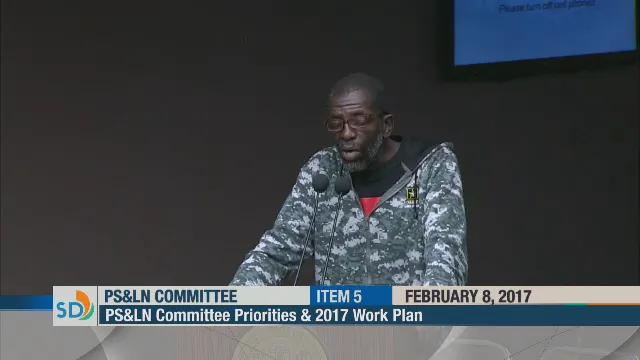
The Public Safety and Livable Neighborhoods Committee, chaired by Vice Chair Bree and Councilmember Ward, met on February 8, 2017, to address a range of public safety and livability issues. The agenda included non-agenda public comments, a consent agenda, a discussion on amending the municipal code for unmanned aircraft systems (drones), and a review of the committee's 2017 priorities and work plan. Consent Calendar - The committee unanimously approved the consent agenda, which included three items. Two speakers addressed consent agenda items: Martha Welch spoke about park maintenance concerns related to dogs and shared-use agreements with schools, and Tom Cleary, president of the Linda Vista Town Council, expressed community support for the item but noted the loss of $640,000 in redevelopment funds for a tot lot. The consent agenda was adopted by unanimous voice vote. Public Comments & Testimony - Non-Agenda Public Comments: - Laura Rayball (Eastern Area Planning Committee) urged the committee to docket an amendment to the College Area Neighborhoods Ordinance to include eastern neighborhoods, noting that the amendment had been approved at every prior step. - Barbara Gordon and Carol Green raised concerns about marijuana business signage violations, stating that permitted businesses are not following advertising rules and that enforcement is lacking. - Martha Welch expressed concerns about public safety, noting that police stations are closed, 911 is a county function, and the city defers low-income housing commitments. - Public Comments on Consent Agenda: - Martha Welch opposed the park-sharing agreement, citing dog waste, lack of bags, and maintenance issues. - Tom Cleary (Linda Vista Town Council) supported the item but highlighted the loss of redevelopment funds for a tot lot. - Public Comments on Discussion Items: - Matthew Thompson (District 3 resident) supported the drone ordinance with conditions, cautioning that the FAA's "Know Before You Fly" app may not be fully up-to-date and that the city should provide contact information for local airspace operators. - Suzanne Morse urged the committee to prioritize addressing the backlog of 2,873 rape kits, citing that only 4% of sexual assault cases are referred for prosecution, which enables human trafficking. - Martha Welch called for higher police salaries to improve retention and affordable housing for officers. - Michael McConnell (business owner, downtown resident) pushed for prioritizing homelessness, criticizing the mayor's plan as inadequate and calling for a regional solution with housing-first approaches. - Richard Melvin (veteran, homeless advocate) requested an end to the criminalization of homeless individuals and proposed making Qualcomm Park a safe place for homeless people. - Diane Collins (currently homeless) shared her personal experience of being robbed and nearly assaulted, and asked for more strategic help for homeless individuals. - Carol Green supported the committee's priorities but asked that unfinished parts of the commercialized marijuana regulations (edibles, labeling, butane hash oil safety, background checks) be revisited. - Martha Sullivan (small business owner) called for using Qualcomm Stadium as an emergency shelter for homeless people, citing a 58% increase in unsheltered homelessness and 117 deaths. - Stephanie Jennings (Women Occupy) urged the committee to fully implement Measure G (police oversight) with independent counsel, investigators, and subpoena power. - Kathleen Ferrier (Circulate San Diego) requested that Vision Zero (traffic safety) be included in the committee's priorities. Discussion Items - Item 4: Unmanned Aircraft Systems (Drones) Municipal Code Amendment - Presentation: Tiffany Vincent and John Blanc (Office of Homeland Security) presented a proposed amendment to the municipal code to encourage safe drone operation by mirroring FAA rules. The amendment would allow local law enforcement to cite careless or reckless drone operations. The working group included multiple city departments, FAA, NASA, and other agencies. The policy is based on Los Angeles' model and does not restrict safe, legal drone use. - Council Discussion: Councilmember Ward raised concerns about enforcement discretion, the definition of "careless or reckless," and the burden on local resources. Councilmember Bree asked about privacy concerns and noted that San Diego is a technology hub. Chair Kate requested an explicit amendment to include current and future FAA exemptions for commercial users. The motion to adopt the ordinance with that amendment was made by Councilmember Ward, seconded by Councilmember Bree, and passed unanimously. - Item 5: Committee Priorities and Work Plan for 2017 - Chair Kate outlined a theme-based approach for meetings (fire, homelessness, police) and emphasized the committee's goal of being a policy-oriented body of action. Councilmember Ward highlighted the need to address homelessness, police-community relations (Measure G), and Vision Zero. Councilmember Bree stressed the importance of a national search for a new police chief and enforcement of Proposition 64 (recreational marijuana). The report was accepted by unanimous motion. Key Outcomes - Item 4: The committee voted unanimously to recommend that the City Council adopt the drone ordinance, with the City Attorney's Office and Office of Homeland Security including a catch-all provision for current and future FAA exemptions for commercial users. - Item 5: The committee unanimously accepted the report on the 2017 work plan and priorities, with a commitment to hold theme-based meetings and pursue actionable policies. - Next Meeting: The next meeting is scheduled for Wednesday, March 8, 2017, at 2:00 p.m.
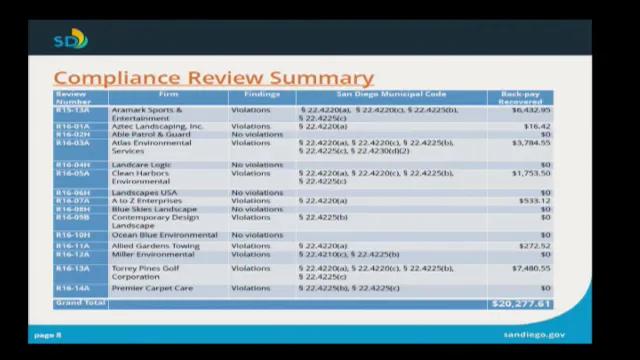
The Budget and Government Efficiency Committee, chaired by Councilmember Barbara Bree (District 1), met on February 2, 2017, to discuss and approve several items related to city finances, contracts, and policies. Key actions included approving a vending partnership, the mid-year budget report, reserve policy revisions, and the City Council budget priorities for FY2018. The committee also received informational reports on prevailing wage, living wage, business diversity, and procurement streamlining. Consent Calendar - The committee unanimously approved the record of actions from the November 16, 2016 meeting. Public Comments & Testimony - Martha Welch (public comment) expressed concerns about the city's budget, alleging that the city pays for unused SAP software and hides budget items in committee rather than full council. She also criticized the proposed vending machine fees as excessive. - Joy Sanyata (District 3 resident) thanked staff for their reports and urged council to keep individual budget memos from each district. She requested immediate funding to begin the process of finding a replacement for Police Chief Zimmerman, emphasized wise use of the Chargers termination payment, and called for a summit on the structural budget deficit. - Emily Howe (Research and Policy Analyst, Center on Policy Initiatives) urged the committee to ensure effective enforcement of living wage, minimum wage, and prevailing wage laws, noting that positions remain unfilled and that enforcement is under-resourced. Discussion Items Item 1: Marketing Partnership Agreement with COMPASS Group USA - Staff presented a five-year agreement with Canteen (a division of COMPASS Group) to provide vending services. The agreement guarantees minimum annual revenues totaling $530,000 over five years, with revenue share percentages of 33-36% on beverages and 23-26% on snacks. It includes at least 50% healthy vending options, energy-efficient machines, and in-kind support for city events. - Councilmember Kate questioned the revenue share variance and the financial responsibility for smart markets; staff clarified the partner covers installation costs. - Motion to approve passed unanimously. Item 2: FY2017 Mid-Year Budget Monitoring Report - Staff presented the report based on five months of actuals. Projections showed expenditures outpacing revenues by $4.2 million, but this is offset by the $12.575 million Chargers lease termination payment received on February 1, 2017. The report identified increases in departmental revenues (e.g., police, fire) and expenditures (e.g., fire staffing, stormwater). - The report recommended three appropriation adjustments: a correction for the Development Services Enterprise Fund, a transfer of $5.9 million from the public liability reserve, and appropriation of $5 million for tenant improvements at 101 Ash Street. - The IBA noted unanticipated fire personnel overages and planned to release its review on February 9, 2017. - Councilmember Sherman commented on the accuracy of projections. Councilmember Gomez expressed concerns about the use of Mount Hope annexation funds for general fund deficit offset. Councilmember Kate questioned franchise fee and sales tax trends. - Motion to forward to Council passed unanimously. Item 3: Revisions to the Reserve Policy - Staff recommended reducing the workers' compensation reserve goal from 25% to 12% of actuarial liability, and extending the timeline to reach the 16.7% general fund reserve goal from 2021 to 2025. This would free up funds for FY2018 budget. - Councilmember Sherman questioned the plan to replenish the pension stabilization reserve; staff stated a plan would be presented with the budget. - Councilmember Gomez asked about the distribution of freed reserves; staff noted 82% would be general fund. - Motion to approve and forward to Council passed unanimously. Item 4: FY2018 City Council Budget Priorities - The IBA presented its report, summarizing priorities from all nine council districts. Top priorities included police recruitment/retention (8 council members), police technology, fire rescue staffing, and others. The report also prioritized infrastructure, park plans, and addressing the structural deficit. - Councilmember Gomez emphasized collaboration and the need to begin the police chief search early. - Councilmember Kate noted that community input resulted in 120+ low-cost items like streetlights and crosswalks. - Councilmember Sherman praised Chair Bree for requiring councilmembers to identify funding sources for their priorities. - Motion to approve and forward to Council passed unanimously. Informational Item: Prevailing Wage Annual Report - Staff presented the annual report on the Prevailing Wage Program, which ensures compliance with state prevailing wage laws. The program covers public works contracts over $25,000 and alteration/demolition/repair work over $15,000. Over the last three fiscal years, the city received $65.9 million in state revolving fund loans, partly due to its compliance. - Staff reported on monitoring activities and compliance, noting that most contractors are familiar with requirements. In FY16, there were 15 violations totaling $234 in underpayments, all corrected. - Councilmember Sherman expressed concern about the cost of enforcement versus recovery, and asked for future reports to quantify costs. Informational Item: Living Wage Ordinance FY2016 Report - Staff presented the FY2016 annual report on the Living Wage Ordinance. The ordinance covers 444 contracts with 130 contractors, totaling $56 million. The living wage rate is $14.43 (increasing to $14.66 in FY17). Compliance reviews found violations in 7 contracts, and back wages recovered totaled $600,000 since inception. - Public comments included concerns from Martha Welch and a call for stronger enforcement from Emily Howe. Informational Item: Business Diversity Report - Staff reported on the Equal Opportunity Contracting Program, including outreach efforts, diversity statistics, and compliance. The city has over 1,300 certified SLBE/ELBE firmsasiest highest year. FY16 construction awards totaled $440 million, with significant participation from certified firms. - Councilmember Gomez questioned certification thresholds and requested a workshop in District 9. Informational Item: Purchasing and Contracting Streamlining Measures - Staff highlighted process improvements, including the P2P project (Ariba), which will be the first fully implemented municipal agency. They also discussed delegated authority, contract pre-approvals, and performance metrics. - Councilmember Kate asked about the pre-approval process; staff indicated they would refine municipal code language before proposing it again. Key Outcomes - Vending Partnership Approved: Motion passed unanimously to authorize the mayor to enter into a five-year marketing partnership with COMPASS Group USA. - Mid-Year Budget Report Approved: Motion passed unanimously to forward the report and appropriation adjustments to the full City Council for the February 14, 2017 meeting. - Reserve Policy Changes Approved: Motion passed unanimously to recommend approval of the revised reserve policy (workers' comp 25%→12%, stability reserve increase slowed to 0.25% annually) to the full Council. - FY18 Budget Priorities Approved: Motion passed unanimously to forward the IBA report and proposed budget priorities resolution to the full Council. Meeting adjourned at approximately 11:30 AM. The committee will reconvene in March 2017 (date to be determined).
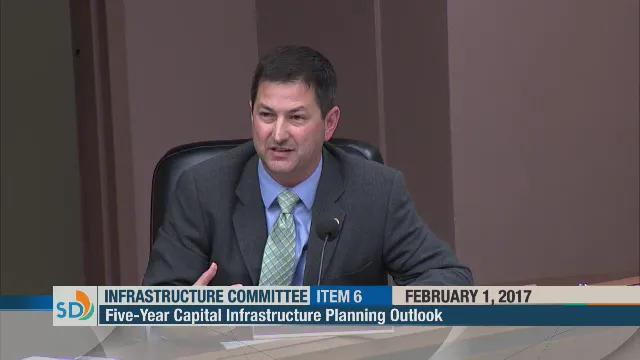
The Infrastructure Committee of the San Diego City Council met on February 1, 2017, to discuss the third iteration of the five-year capital improvement outlook, which projects $4.3 billion in capital needs against $3 billion in available funding, leaving a $1.274 billion gap. The committee also heard public comment, received updates on streamlining measures, and discussed specific infrastructure projects. Committee Member Introductions - Vice Chair Chris Ward (District 3) expressed excitement about representing neighborhoods with aging infrastructure and monitoring the committee's work. - Councilmember Georgette Gomez voiced enthusiasm for adding a community voice and finding ways to increase resources and quality of life. Consent Calendar - Items 1 through 5 were adopted unanimously via motion by Vice Chair Ward, seconded by Councilmember Zapf. Public Comments & Testimony - Martha Welch (public comment): Expressed concerns about privatization of city services, poor maintenance of public buildings, and lack of parking for the stadium. She criticized the condition of public facilities and stated that the city's list of projects "stinks." - David Modi (Chair, Community Planners Committee): Supported restarting community engagement on the capital outlook, noting that planning groups value the process for educating communities and differentiating between low- and high-impact projects. He stated that CPC would host staff presentations in March and April/May 2017. Discussion Items - Five-Year Capital Improvement Outlook (FY2018-2022) – Staff presentation by James Negelvort (Director of Public Works), Marnell Gibson (Assistant Director/City Engineer), and project manager Mastanay. - Key Assumptions: Seawalls/coastal assets due to sea level rise not included; convention center expansion not included; facility condition needs ($800M for 699 facilities) to be phased over 10-15 years; information technology excluded; maintenance activities (e.g., slurry seal) excluded; outdated Citigate data not used; grants only if in hand; development impact fees projected only one year; Prop H infrastructure funds assumed for capital. - Funding Gap: $4.3 billion in needs, $3.03 billion in available funding, gap $1.274 billion. Enterprise-funded assets (water, sewer) nearly fully funded; gap almost entirely in general fund-supported assets. Gap has shrunk from $1.7 billion (first report) and $1.4 billion (second report) due to increased revenues. - Asset-Specific Gaps: Stormwater ($328 million gap – largest), sidewalks ($101 million), bridges, street lights, bike facilities among others with significant shortfalls. Street repavement is fully funded. - Stadium Debt: $47 million outstanding on 1997 renovation bonds, not callable until 2020; lease termination payment of $12.5 million received from Chargers. - Capacity: Staff targeting $500-600 million annual expenditure; $600 million/year needed to meet outlook; capacity is dependent on consultant and contractor availability, with much of the increase driven by Pure Water program (14 projects). - Climate Action Plan: Not fully integrated; some projects (solar, bike lanes) included but many obligations yet to be priced. - Streamlining: Committee has supported multiple rounds of streamlining; staff uses multiple delivery methods (design-bid-build, design-build, MAC, job order contracting). Standard designs for fire stations and comfort stations are in progress. - Community Engagement: Staff to present to Community Planners Committee in March and April/May 2017. - IBA Comments (Charles Modick): Noted the outlook's improvement, emphasized that the $1.3 billion gap is entirely in general fund assets, highlighted stormwater as the largest gap ($328M), and cautioned that new facilities add operating costs. Recommended clear methodology for allocating deferred capital bonds. - Committee Q&A: - Chair Kercy: Highlighted positive trend of shrinking gap; discussed capacity and need for continued streamlining; proposed using $12.5M lease termination payment to pay down stadium debt. - Councilmember Zapf: Asked about standard designs for fire stations/comfort stations (still in progress); questioned why Ocean Beach lifeguard station need is listed for 2022 despite current need; staff explained that new facilities are shown under specific asset lines while repairs are in general facilities line. - Councilmember Gomez: Requested specific project list for climate action plan; questioned low funding for bike facilities ($750K/year) vs. road pavement; asked about urban forestry as capital cost; inquired about Civic San Diego projects and LAFCO funds; staff noted bike facilities are leveraged through resurfacing projects and that urban forestry is not currently considered capital. - Vice Chair Ward: Followed up on stadium debt (cannot prepay before 2020); asked about capacity ($600M/year doable given industry conditions); discussed delivery methods; asked about bridges ($149M in FY2018 for Mission Bay Bridge), fire stations ($58M in FY2022 for future stations), sidewalks (33,000 linear feet per year from assessment), and traffic signals (DIF not projected beyond FY2018 due to volatility). - Avenida de la Playa Project (La Jolla Shores): Staff reported that the storm drain system failed after construction; redesigned with new design team; repairs expected to be completed before summer 2017 moratorium; fully funded project not in outlook. Key Outcomes - The committee unanimously approved a motion (by Vice Chair Ward, seconded by Councilmember Zapf) to accept and receive the Five-Year Capital Improvement Outlook report. - The next regularly scheduled meeting is March 1, 2017. - Staff will provide additional information on climate action plan project lists, bike facility plans, and lifeguard station specifics. - Discussion on using the $12.5 million Chargers lease termination payment to reduce stadium debt will continue during budget deliberations. - Community engagement on the capital outlook will resume with CPC presentations in March and April/May 2017.
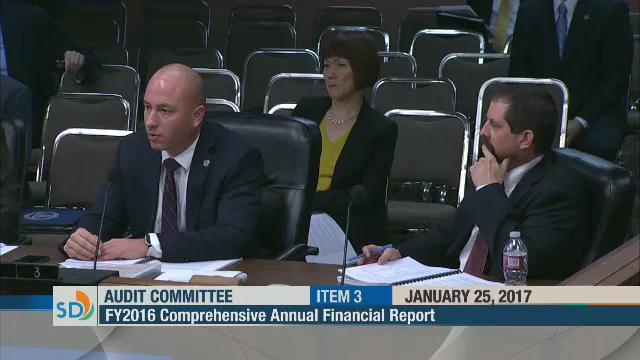
The January 25, 2017 meeting of the City Council's Audit Committee convened at 17:00 UTC with a quorum consisting of Councilmember Sherman (Chair Gomez presiding), Audit Committee Members Tom Hebrik, Ricardo Valdivia, and Alan Spencer. Also present were Deputy City Attorney Priscilla Dugart, City Auditor Eduardo Luna, Director of Council Affairs Marshall Anderson, Lisa Byrne from the Independent Budget Analysis Office, and others. The meeting covered approval of prior meeting minutes, public comment, the auditor's monthly activity report, a performance audit of the San Diego Convention Center Corporation, the city's FY16 Comprehensive Annual Financial Report (CAFR), and the quarterly fraud hotline report. All major votes were unanimous. Consent Calendar - The committee record of action from the December 7, 2016 meeting was approved by unanimous consent; Chair Gomez abstained from voting, noting it was her first meeting. Public Comments & Testimony - Catherine Rhodes (Point Loma) spoke during public comment on item 2 (Convention Center) and again on item 3 (CAFR). She expressed strong concerns that the city is not performing required annual audits of the successor agency (former redevelopment agency) and the Low/Moderate Income Housing Fund. She cited a San Diego Reader article and a 2008 city attorney letter, alleging that the CAFR and Civic San Diego's audits do not reflect the totality of successor agency expenditures, including $1.5 billion in debt. She also criticized the omission of certain housing revenues from the Affordable Housing Performance Audit and claimed missing 10,000 affordable housing units. She urged the committee to direct the auditor to investigate. - Job Nelson (Port of San Diego, Assistant Vice President of External Relations) provided comments on the convention center audit. He emphasized the port's historical investment ($165 million originally, $350 million today, plus over $250 million including expansions), noted the unique governance structure with the port owning the building and the city leasing, and stressed that any renegotiation of the management agreement must be comprehensive and consider the port's fiduciary duties to the State of California and all five member cities. - Robert Matinamar (District 3) thanked the auditor for the performance audit and recommended a white paper outlining responsibilities of all four agencies (city, port, convention center, Tourism Authority) given the complexity. He also noted the corporation's $6.5 million loss from the aborted expansion and argued the city's $3.4 million annual contribution should be more flexible and based on need. Discussion Items Item 1 – Monthly Activity Report (City Auditor Eduardo Luna) - The auditor reported issuing four products since December: the San Diego Convention Center Corporation audit, Q2 FY17 fraud hotline report, and two hotline investigations (improper discretionary leave, personal use of city vehicles). Audits in report writing include SAP user access and citywide privileged user management. Five audits are in fieldwork, including a utility billing audit expanded citywide (report now due March). Several audits are in preliminary review. The report was accepted without question. Item 2 – Performance Audit of San Diego Convention Center Corporation - Presented by Supervising Senior Performance Auditor Shine Pickney. The audit, requested by Councilmember Sherman and spurred by a 2015 grand jury report, focused on three areas: financial obligations, oversight division, and the sales/marketing contract with the San Diego Tourism Authority. Key findings: - The Center hosted 473 events from FY13-15 generating $61 million in TOT revenue and $3 billion regional impact. - The city spends $17 million annually ($13.6M debt service/dewatering/insurance, $3.4M to convention center for marketing/promotions/capital; $1.9M of that to Tourism Authority for marketing; $1.5M for capital). - Finding 1: The Tourism Authority contract lacks measurable targets, clear evaluation tools, and robust corrective action provisions. Booking guidelines used discretionarily. - Finding 2: A $53 million capital need over 10 years (FY17-26) with a $12.6 million funding gap after accounting for a $25.5M loan and city contributions. - Finding 3: Internal payment authorization procedures not followed; in FY15, $421,000 in remaining city funds were used for rental credits rather than prioritized capital (auditor recommended prioritizing capital). - Six recommendations were made; management agreed to implement all. - Discussion: Committee members (Hebrank, Sherman, Valdivia) questioned the port's responsibility for capital, the counting of room nights (short vs. long-term planning), oversight mechanisms, and the convention center's responses to recommendations. Chair Gomez asked about dewatering costs (city pays) vs. parking revenue (port receives). The port noted ongoing discussions about naming rights and comprehensive renegotiation. - Outcome: Motion by Councilmember Sherman, seconded by Committee Member Hebrank, to forward the report to City Council with: (1) convention center to clarify responses on recommendations 1, 2, 3, and 5 (to be addressed in the new Tourism Authority agreement), and (2) the auditor to supplement the report with governance structures and practices of the ten largest competing convention centers. Motion passed unanimously. Item 3 – FY16 Comprehensive Annual Financial Report (CAFR) - Presented by CFO Mary Lewis, Comptroller Rolando Charvel, Deputy Director Scott Clark, and external auditor Kevin Starkey (MGO). The CAFR reports government-wide total assets/deferred outflows of $14.6 billion, total liabilities/deferred inflows of $5.86 billion, net position $8.74 billion. FY16 revenues $3.19 billion, expenses $2.57 billion, increase in net position $621 million. Major policy reserves established/updated: Pension payment stabilization reserve ($20.5M); General fund emergency and stability reserve goals increased to 16.7% of average revenues (to be phased in by 2021). MGO issued an unmodified (clean) opinion with no material weaknesses or significant deficiencies. Key future impacts: GASB 75 (recording full OPEB liability) will require a large liability increase in FY18; SDCERS experience study increased the annual pension payment by $64 million (due to mortality assumption changes), with pension stabilization reserve to partially offset the first year. The CAFR includes successor agency and low/moderate income housing fund disclosures (pp. 66, 227, 175). Management and auditors affirmed full GAAP compliance and transparency. - Discussion: Spencer asked about internal controls; Starkey explained the five-component framework. Hebrank questioned the pension stabilization reserve, significant expense increases (litigation, land, elections, positions), new GASB standards, pension funded ratio (75.6% in 2014 shows on p. 191 as plan fiduciary net position % of total pension liability), Point Loma wastewater liability unchanged, reinstatement of Naval Training Center loan per new legislation, and the subsequent event on SDCERS. Chair Gomez asked if financial statements deviated from GAAP (no) and if more transparency needed (no). - Outcome: Motion to accept, by Spencer with friendly amendment that future auditor reports on internal controls explicitly identify any significant deficiencies and material weaknesses. Motion seconded by Hebrank, passed unanimously. Item 4 – Quarterly Fraud Hotline Report (Q2 FY17) - Presented by Fraud Investigator Andy Horita. In Q2 (October-December 2016), 44 complaints received: 14 assigned to City Auditor, 30 to departments, 15 outside purview. 28 cases closed; 45 remained open (highest inventory ever). Two substantiated cases: (1) a department director's inappropriate use of discretionary leave – two recommendations made; (2) personal use of city vehicles by six Public Utilities employees including two managers – three recommendations made (fact-finding, cost recovery, strengthened controls). Also four corrective actions (workers' comp abuse, harassment, inappropriate behavior, unequal treatment). The hotline has seen increased usage due to marketing, online reporting ease, and media coverage. - Discussion: Hebrank noted the large increase and asked about category