Browse by city
Date range
Search help

Search titles, summaries, topics and stored transcripts together. Keywords may match separately; put the whole query in double quotes for a phrase. Matching follows word analysis, so punctuation is not exact. Both dates are included. Documents are not searched.

SHOWING 1041–1050 ENTRIES
1041
DEC 8, 2016 · SAN DIEGO, CALIFORNIA · ENVIRONMENT COMMITTEE
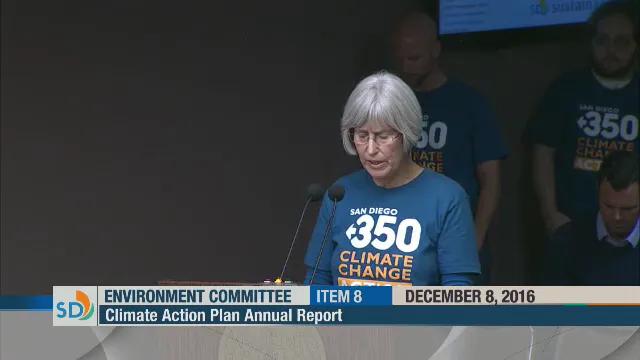
Environment Committee Meeting Summary - December 8, 2016

The Environment Committee of the San Diego City Council met on December 8, 2016, to discuss a range of environmental and sustainability topics including the utility undergrounding program, LED street lighting, recycling at city facilities, expanded polystyrene foam food container recycling, the first annual Climate Action Plan report, and the Urban Forestry Program five-year plan. The meeting included public testimony, committee discussion, and unanimous votes on several action items. Consent Calendar - Approved the record of action items from the October 12, 2016 meeting by unanimous consent. - Approved two consent agenda items: an as-needed engineering consultant services agreement with Kleinfelder and Corollo Engineers Inc. (each up to $5 million), and one other item. Both were approved unanimously after Martha Welch spoke in opposition. Staff clarified that annual average expenditure is half a million to a million dollars for these services. Public Comments & Testimony - Don Kelly (consultant to advise the council on IROC) thanked staff for work on IROC and expressed hope it would appear on the February 2, 2017 agenda. - Martha Welch spoke twice. First, in non-agenda public comment, she complained about missing street lights and criticized water management, claiming the city has spent millions without results. Second, on the consent agenda, she opposed the engineering contracts, questioning the use of funds and commercial paper/bonds, and demanded an accounting of city funds. - Climate Action Plan (Item 8) public testimony included: - Nicole Capretz (Climate Action Campaign) praised progress but stressed need for post-2020 targets, better transportation data, equity metrics, and an adaptation plan. - Carolina Rodriguez (Climate Action Campaign) announced San Diego received a gold standard in their regional report card, but emphasized implementation. - Nicholas Banning (student) urged improved public transit and bike infrastructure. - Alice Who (intern, Climate Action Campaign) shared personal challenges without a car and asked for mode share goals to be prioritized. - Nicole Burgess (Bicycle Advisory Committee) called for a mobility champion, support from SANDAG for bike projects, and continued resurfacing efforts. - Joy Williams (Environmental Health Coalition) thanked staff but requested a comprehensive set of equity metrics, dedicated staff time, and prioritization of disadvantaged communities. - Simon Mayevsky (San Diego 350) emphasized implementation, smart housing, and transportation decisions. - Elaine Maltz (San Diego 350) asked for leadership on lifestyle changes and clean public transit for aging residents. - Joyce Lane (San Diego 350) noted that most reductions came from state leadership and urged a citywide approach to align community plan updates with CAP transportation and land use goals. - Tyson Siegel (San Diego 350) urged adoption of Community Choice Energy, citing potential for lower rates and higher renewables. - Barry Donnelly supported Community Choice Energy as a way to give consumers choice and reduce climate impact. - Urban Forestry (Item 9) public testimony: - Lynette Short (CAL FIRE) thanked the city for developing the five-year plan and urged its adoption. - Carolina Rodriguez (Climate Action Campaign) requested the committee recommend adoption to city council, noting trees' role in climate mitigation. Discussion Items 1. Adobe Falls Challenge (Item 3): Presentation by Dr. Eric Frost (SDSU Homeland Security Graduate Program) on addressing graffiti and environmental degradation at Adobe Falls. Discussed multi-jurisdictional ownership (Caltrans, SDSU, city), social media attraction, and a potential solution using a tunnel from SDSU as a front door. Councilman Sherman thanked Dr. Frost and students. This was an informational item. 2. Utility Undergrounding Program (Item 4): Staff reported on the status, including completion of over 400 miles, annual revenue increase to $68 million, and 21 projects construction-ready this fiscal year. A new master plan will focus on a five-year horizon. Public outreach starts January 2017. Council approved a motion to accept the report and forward to full council (unanimous). 3. LED Street Lighting Agreement (Item 5): Staff presented a purchase and service agreement with Current powered by GE and a master lease agreement with GE government finance for retrofitting 14,000 street lights with LED and adaptive controls, at a cost of approximately $30 million over 13 years, with annual lease payments $2.5 million and annual savings of $2.4 million. Council approved the motion unanimously. 4. Recycling at City Facilities (Item 6): Staff reported on progress toward 50% diversion by 2020. Current 27% diversion rate from Republic Services data is likely understated as other recycling streams (tires, metal) are not captured. Next steps include gathering data from all vendors and developing a strategic implementation plan. This was an informational item. 5. EPS Food Container Recycling (Item 7): Staff reported that after a feasibility study, an alternative approach could add expanded polystyrene foam food containers to the curbside program at an estimated cost of $90,000 per year (transportation and tipping fee to a facility in LA). Negotiations with the contractor would be needed. Council expressed support. No action required; staff will return with a potential amendment. 6. Climate Action Plan Annual Report (Item 8): Cody Hooven presented the first annual report, showing 2015 citywide greenhouse gas emissions tracking ahead of 2020 targets. Major reductions from grid renewables (35% renewable in 2015) and energy efficiency. Challenges remain in transportation and land use. Council discussed the need for a citywide strategy to meet mode share goals, equity metrics, and community choice energy. The item was informational. 7. Urban Forestry Program Five-Year Plan (Item 9): Jeremy Barrick presented the plan, which aims to increase urban tree canopy from 13% (2015) to 15% by 2020 and 35% by 2035. The plan includes 65 actions across three goals: increase canopy, maximize efficiencies, minimize risk. Council adopted a motion to recommend council adoption (unanimous). Key Outcomes - Consent agenda items approved unanimously. - Utility Undergrounding Report: Motion to accept report and forward to full council passed unanimously. - LED Street Lighting Agreement: Item approved unanimously (motion by Councilmember Kate, second by Sherman). - EPS Food Container Recycling: Staff will negotiate contract amendment; no vote required. - Climate Action Plan Report: Informational; no vote. - Urban Forestry Five-Year Plan: Motion to recommend council adoption passed unanimously (motion by Sherman, second by Kate). - The meeting concluded with thanks to colleagues and anticipation of a productive 2017.
CLIMATE CHANGE 17% · WASTE MANAGEMENT 9% · CLIMATE ACTION PLAN 9% · URBAN FORESTRY MANAGEMENT 8%
1042
DEC 7, 2016 · SAN DIEGO, CALIFORNIA · AUDIT COMMITTEE
San Diego Audit Committee Meeting - December 7, 2016

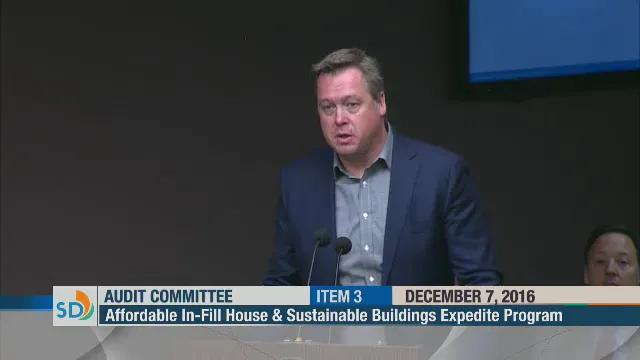
This meeting of the Audit Committee covered three major items: a performance audit of streetlight repairs, a performance audit of the Affordable Housing and Sustainable Buildings Expedite Program, and the Fiscal Year 2018 budget for the Office of the City Auditor. The committee also heard non-agenda public comment. All audits were accepted and forwarded to the City Council. Non-Agenda Public Comment - Clive Richards spoke in strong support of the City Auditor's office, referencing the "Call report" from 2006 and emphasizing the need for openness and transparency. He criticized the mayor's office for investigating the Office of Internal Auditor, stating that should have been the committee's responsibility. Monthly Activity Report from the City Auditor - Eduardo Luna reported that since the last meeting, two audit reports had been issued (streetlight repair and expedite permitting) and a budget memorandum for FY 2018. Audits in field work include the Capital Improvement Program quality assurance and three IT audits. A 30-40 day delay was noted for the Lifeguard Tower audit due to consultant issues. Performance Audit of the Street Light Repair - The audit found that the Street Division is not meeting its goal of repairing streetlights in an average of 12 days or less. Data from FY16 showed 47 repairs listed as completed in a negative number of days, and 23% of repair vehicles were not operational during a three-month period in FY17. There are no documented policies for repair prioritization or data entry, and no active inventory logs for $550,000 in parts ordered in FY16. The asset inventory was not updated for over 3,000 LED lights. Five city departments share responsibility for streetlights, but there is no comprehensive management plan. The audit included seven recommendations, all agreed to by management. The committee voted unanimously to accept the report and forward to City Council. - Councilmember Sherman (requested the audit) expressed concern about the lack of inventory and reliance on institutional knowledge. He urged faster implementation of the Infrastructure Asset Management (IAM) system. - Deputy Director Christy Reeser (Street Division) stated that a mobile work manager prototype would be presented that afternoon and that the IAM system was expected to go live within 12 months. - Committee member Hebrank questioned why developing written policies would take until December 2017; management cited dependence on the IAM system. - Committee member Spencer recommended adding training as a component to ensure policies are effective. Performance Audit of the Affordable Housing and Sustainable Buildings Expedite Program - The audit found that expedited review cycles missed their deadlines 45% of the time between 2011 and 2015, with the environmental review discipline causing a waterfall effect. The program's eligibility criteria for sustainability have not been updated since 2003 and now incentivize projects that would occur anyway (e.g., 7,000 solar permits in 2015, less than 1% through the program). Since 2006, single-family homes and small projects (under four units) were allowed into the program despite City Council policy limiting it to four units or more. These ineligible projects accounted for more than half of program entries from 2011-2015, consuming capacity and slowing processing for larger affordable housing projects. 88% of single-family homes were in the coastal zone. The audit made eight recommendations; the department agreed to all. - Director Robert Vocke (Development Services Department) noted the program is a small part of DSD's workload (about 50 projects per year out of 50,000 permits). He disagreed with the 45% late metric, stating that 85% of overall projects (based on a sample of 20) met their final timeline. - Committee member Hebrank pressed for immediate cessation of accepting single-family projects. Deputy Director Elise Lowe said they would cease immediately, not in July 2017 as initially stated in the response. - Public speaker Matthew Adams (Building Industry Association) suggested improvements such as limiting new issues on subsequent reviews and expanding self-certification. - Public speaker Jim Schmidt (Chelsea Investments) praised the program but requested more customized timing for affordable projects to meet financing deadlines. - Public speaker David Gatsky (Community Housing Works) supported the audit's critical path approach and thanked DSD staff for collaboration. - The committee voted unanimously to accept the report and forward to City Council with an updated management response clarifying immediate cessation of ineligible projects. Fiscal Year 2018 Office of the City Auditor Budget Report - City Auditor Eduardo Luna presented a budget request with no new significant additions. The office was asked to submit a 3.5% reduction (approximately $135,000) as part of a citywide directive. They proposed cuts from consultants ($40,000), low-value assets ($60,000), and books/materials ($1,500), totaling about $101,500, falling short by about $24,000. They agreed to look deeper to meet the full reduction. A planned fraud investigator position was not added. - Public speaker Clive Richards urged the committee to move toward a full staffing level of around 25 positions, arguing the office saves money and should not be cut. - Committee member Hebrank noted the difficulty because 85% of the budget is fixed (salaries and benefits). He asked for a future discussion on the benefits of the second fraud investigator position. - The committee moved to accept the report and direct the auditor to submit a budget including the requested reduction. The motion passed unanimously. Key Outcomes - Street Light Repair Audit: Accepted and forwarded to City Council. Management agreed to all seven recommendations, with implementation timelines tied to the IAM system. - Expedite Program Audit: Accepted and forwarded with an updated management response to immediately cease accepting single-family projects. Management agreed to all eight recommendations. - FY18 Audit Office Budget: Accepted with direction to submit a budget reflecting the city's 3.5% reduction request. The office will revisit whether to propose adding a fraud investigator.

AFFORDABLE HOUSING 24% · SUSTAINABLE DEVELOPMENT AREAS 15% · AUDIT FOLLOW-UP 13% · INFRASTRUCTURE MANAGEMENT 13%
1043
DEC 7, 2016 · SAN DIEGO, CALIFORNIA · ACTIVE TRANSPORTATION & INFRASTRUCTURE COMMITTEE
San Diego Infrastructure Committee Meeting - December 7, 2016

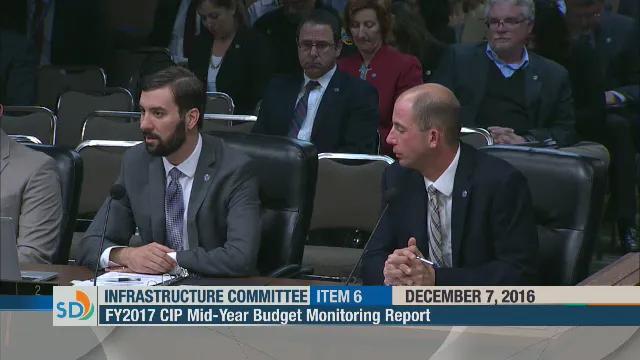
The San Diego City Council Infrastructure Committee met on December 7, 2016, for its final meeting of the year. The committee reviewed reports on the capital improvement program (CIP), asset management technology, budget monitoring, an enhanced infrastructure financing district, and a facilities condition assessment. All action items were forwarded to the full City Council. Consent Calendar - Items 1 and 3 were approved unanimously without discussion. - Item 2 (a bridge rehabilitation contract) was pulled by Councilmember Emerald for questions regarding cost increases. After clarification from Public Works that it was a new contract, the item was approved unanimously. Public Comments & Testimony - Martha Welch (member of the public) criticized the city's handling of infrastructure, water supply, street lights, and park maintenance, alleging neglect and mismanagement. She also expressed distrust of city processes. Discussion Items - Item 4: FY16 State of the CIP – Public Works presented a status update: $400 million in expenses (up $90M from FY15), 322 miles of streets resurfaced (exceeding the 300-mile goal), 52.4 miles of water pipeline replaced (goal 35), and 45 miles of sewer rehabilitated. Soft costs were 48% (benchmark 46%). Challenges included staffing capacity (60-70 vacancies) and the need for a formal commissioning process. The committee noted progress and discussed community outreach. - Item 5: IAM San Diego Project – The Infrastructure & Asset Management project demonstration showed a mobile work management system for field crews. Phase 1 (4 departments) is on track for July 30, 2017 go-live. Phase 2 planning includes 5 more departments over 4 years. The IBA raised funding concerns for phase 2. - Item 6: FY17 CIP Mid-Year Budget Monitoring – Staff requested approval of $115 million in budget adjustments: $33M from fund balance, $63M in reallocations (mostly in public utilities), and $20M deappropriations. Updates included a commercial paper program (approved for water utility; general fund program planned) and a decline in the underfunded projects (waterfall) list. The committee discussed borrowing limits and the impact of the failed TransNet expansion. - Item 7: Enhanced Infrastructure Financing District (EIFD) for Otay Mesa – The first city EIFD would capture property tax increment to fund $510 million in needed infrastructure. Projections: $300K in year 1, growing to $42M by year 45; total of $787 million via bonds and cash. The county declined to participate. A resolution of intention will go to Council in February 2017. Committee expressed support. - Item 8: FY16 Facilities Condition Assessment for Leased General Fund Facilities – Assessed 133 leased buildings (3 million sq. ft.). Average FCI (Facility Condition Index) was 35 (poor). Public facilities averaged 30; semi-public 63; offices 65; commercial/residential 10. Balboa Park leased facilities averaged 17 (good). Total backlog to reach a service level of FCI 15-20 was $426 million for leased facilities, combined with city-owned ($403M) for an $829M total, with concourse buildings representing 39%. ADA and code upgrades are not included. Next steps: develop an asset management plan. Key Outcomes - Items 4 and 5 were informational; no votes required. - Items 6, 7, and 8 were unanimously recommended to the full City Council for approval. - Staff will return with an asset management plan for facilities and a legal analysis of EIFD issues. - The committee expressed interest in a detailed discussion on Balboa Park infrastructure in early 2017.

NULL 18% · PUBLIC WORKS 17% · CAPITAL IMPROVEMENT PLANNING 13% · FACILITIES ASSESSMENT 10%
1044
NOV 30, 2016 · SAN DIEGO, CALIFORNIA · PUBLIC SAFETY & LIVABLE NEIGHBORHOODS COMMITTEE
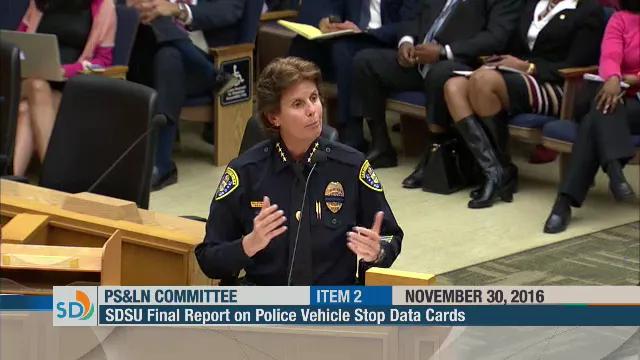
Public Safety Committee Discusses SDSU Traffic Stop Study on Nov 30, 2016

The Public Safety and Livable Neighborhoods Committee held a special session on November 30, 2016, to review the full report from San Diego State University (SDSU) on traffic stop data cards. The meeting focused on findings of racial disparities in stops and post-stop outcomes, data quality issues, and recommendations for reform. The committee heard from researchers, the police chief, and extensive public testimony before voting to refer the report to the full City Council. Public Comments & Testimony - Non‑agenda public comment: Francine Maxwell (resident of Encanto) asked for more community representation on the police advisory board and criticized reactive use of forfeiture funds. Martha Welch raised concerns about county jails, police station hours, and lack of police academies. - Comments on the SDSU report (pro‑action): - Tony Young (RISE San Diego) urged policymakers to allocate resources for the issue. - Armando King (community member) called for documenting and removing officers who racially profile; he stated the community did not need a study to confirm lived experiences. - Norma Chavez Peterson (advocate) highlighted contradictions in the report (e.g., no disparity in stops for Latinos but disparities in searches and field interviews). She presented seven requests, including referring the report to council by February 2017 and implementing AB 953 early. - Ignacio Luna (Lincoln High School student) said racial profiling is a clear problem at his school. - Marvin Shaw (retired SDPD lieutenant) supported more training, accountability for stop‑card completion, and implementation of AB 953. - Lee Hernandez (Office of Assemblymember Shirley Weber) submitted a statement supporting the report’s recommendations and urging early adoption of AB 953. - Isabel Schechter stated that admitting the problem is the first step. - Chris Wilson (community member) described different policing approaches in Southeastern vs. Northern divisions and called for one consistent approach. - Dale Kelly Bankhead (San Diego & Imperial Counties Labor Council) urged leadership to implement AB 953 and develop training on racial profiling. - Michael Dobbins (SEIU Local 221) supported racial justice and implementation of AB 953. - Bob Pearl (Oak Park resident) encouraged white bystanders to observe and record police interactions. - Paul Watson (victim of profiling) urged transparency and accountability. - Willie Blair (former committee consultant) urged the committee to take the report seriously to uphold San Diego’s “America’s Finest City” title. - Anne Marie Barron (Peace Resource Center) supported the recommendations but noted they do not go far enough; she called for a strong community review board. - Dr. Peter Brownell (Center on Policy Initiatives) explained limitations of the “veil of darkness” methodology, arguing that the report may underestimate disparities; he submitted a Syracuse study for the record. - Comments in opposition (or critical of the report): - Martha Sullivan (Women Occupy San Diego) opposed the report due to alleged changes made at the mayor’s request, lack of independent review board powers, and no review of body‑camera footage. - Richard Hilton criticized the inclusion of 2015 data, alleging deliberate adulteration. - Eddie Price (community member) stated that the police department is the perpetrator and must own the issue. - Rebecca Hookheld (San Diego LGBT Community Center) urged the committee to send the report to council with recommendations for SDPD to address disparities and comply with AB 953. - Colleen Cusack (California Western School of Law) highlighted the intersection of race and poverty, citing financial incentives for impoundment and requested supervisor‑level documentation of targeted enforcement. Discussion Items - SDSU research presentation: Josh Chanin, Megan Welsh, and Dana Nurch presented findings from analysis of 260,000 traffic stop cards (2014‑2015). Key findings: - Disparities for black drivers (stops, searches, field interviews) in 2014 but not in 2015 combined data. - Hispanic drivers were more likely to be searched and less likely to be found with contraband compared to white drivers. - Asian/Pacific Islander drivers showed fewer disparities. - Data quality issues: missing data increased over time; a 27,000‑citation discrepancy between stop cards and judicial records. - Recommendations: acknowledge disparities, enhance training, improve transparency, make traffic enforcement more data‑driven, reduce number of stops, improve data collection, and strengthen accountability. - Police Chief Shelley Zimmerman: Responded that every human has bias; SDPD has enhanced training on non‑biased policing, procedural justice, and emotional intelligence. She committed to 100% compliance with AB 953 once final regulations are known. - Committee discussion: - Chair Emerald asked about changes made to the report at the mayor’s request; researchers stated only minor corrections were made, not substantive changes. - Councilmember Cole expressed disappointment that disparities persist, noting that black drivers are more likely to be stopped and searched but less likely to have contraband. She motioned to refer the report to the full council in February 2017 with several requests. - Councilmember Gloria criticized the process (long delay, release before Thanksgiving, missing data) and stated the report did not clearly acknowledge police racial bias. He challenged the chief, who reiterated that everyone has bias. Gloria supported the motion but noted the need for budget investment. - Councilmember Kate asked about systematizing traffic enforcement priorities and noted a lack of focus groups north of Interstate 8. He supported the motion while urging the public to advocate for funding in the budget. Key Outcomes - The committee unanimously approved Councilmember Cole’s motion to refer the SDSU report to the full City Council for consideration in February 2017. The motion includes the following requests: 1. The police department commit to implementing AB 953 once final regulations are released early 2017. 2. The department identify what systems are needed to collect data required by AB 953, including cost estimates, for budget discussions. 3. The department explain how it will incorporate the report’s findings into academy and ongoing training, particularly regarding racial profiling, field interviews, and consensual searches. 4. The department provide an update and timeline for reviewing policies that create intimidating interactions (e.g., multiple police vehicles at a simple stop) and develop a policy for traffic enforcement to reduce individual officer discretion. 5. The mayor’s office and chief include in their report to council the specific actions they will take to implement all recommendations in the SDSU study. - The committee also received its annual report of accomplishments (item 1) and a brief non‑agenda comment from Martha Welch. The meeting was adjourned.

POLICE OVERSIGHT 44% · RACIAL EQUITY 23% · PUBLIC SAFETY 12% · TRAFFIC SAFETY 6%
1045
NOV 17, 2016 · SAN DIEGO, CALIFORNIA · ECONOMIC DEVELOPMENT & INTERGOVERNMENTAL RELATIONS COMMITTEE
Economic Development & Intergovernmental Relations Committee Meeting, November 17, 2016

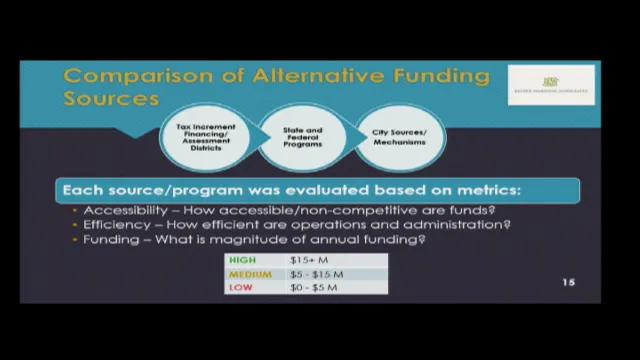
The Economic Development and Intergovernmental Relations Committee met on November 17, 2016, for its final meeting of the calendar year. Councilmembers Kate and Alvarez were present; Vice Chair Kercy was absent (attending League of Cities). The committee reviewed updates from the Port of San Diego, the San Diego Workforce Partnership's Connected Careers program, a feasibility study on Community Revitalization and Investment Authorities (CRIAs), the federal lobbying year-in-review and outlook, and the proposed 2017 state and federal legislative platform. The committee also approved a $17.5 million CDBG reinvestment initiative for fiscal year 2018. Consent Calendar - The committee approved the single consent item from the Commission for Arts and Culture. The motion was moved by Councilmember Kate and seconded by Councilmember Alvarez; the vote was unanimous. Public Comments & Testimony - Martha Welch (public comment on general items) spoke about food stamps, alleging state corruption and stating the governor is aware of issues. She expressed opposition to what she described as bribes and conspiracy. - Public Comment on CDBG Reinvestment Initiative (all speakers in favor): - Cynthia Gabler (Chair, National Federation of Filipino American Associations, San Diego Chapter) expressed strong support for funding for the Bay Terrace Senior Center project, noting it would help make the project shovel-ready. - Marcelo Petron (President, Bellam Senior Association) expressed strong support for the proposed funding for the senior center, thanking the committee. - Aurora Soriano Codal (Past President, Council of Filipino American Organizations; Chair Emeritus, NAFA) recounted past promises for a Tuma Park senior center, expressed joy at seeing $2.6 million in the budget proposal, and urged approval. - Martha Welch (additional speaker) expressed support but warned against using grass in dog parks, suggesting alternatives like gravel or bark. Discussion Items - Port of San Diego Semi-Annual Update (Item 2): Port Commissioners Marshall Merrifield, Rafael Castellanos, and Bob Nelson presented highlights. They reported the selection of One Highway One as the winning developer for the Central Embarcadero project (70-acre site, $1.2 billion total cost with $500 million equity and $700 million debt). They also discussed: redevelopment of East Harbor Island (57 acres) with two San Diego-based developers; modernization of the 10th Avenue Marine Cargo Terminal (96 acres) with a $24 million first phase (including a $10 million federal TIGER grant); plans for the North Embarcadero phase two (B Street Pier to Grape/Laurel) and a programmatic EIR covering all 6,000 acres of Port jurisdiction; a proposed permanent outdoor concert venue for the San Diego Symphony; a Blue Tech incubator program; water quality projects (copper reduction at America's Cup Harbor); and the Pond 20 mitigation bank project. The report was informational and required no approval. - Connected Careers Program Performance Overview (Item 3): Peter Costram (President/CEO, San Diego Workforce Partnership) and Stephen Cologne (Program Coordinator) presented. In 2016, Connected Careers enrolled over 3,100 young people, trained over 3,300, and placed 753 in internships (as of that morning). The program has grown from about 300 placements in 2014 to a projected 1,000 in 2016. The city's increased funding allowed the program to become year-round and add innovations like an iPad lab and the MyFirstJobSD initiative. The Brookings Institute recognized the program's software as possibly the best in the country. The presentation outlined a proposed expansion costing about $1,700 per internship and $1,500 per externship. This was an informational item. - CRIA Feasibility Study (Item 4): Eric Caldwell (Economic Development Director), Michael Lengel (Civic San Diego), and Paul Marra (Kaiser Marston Associates) presented findings on Community Revitalization and Investment Authority (CRIA) feasibility. The study analyzed five test boundaries and projected 45-year tax increment capacities. Key findings: the city share of the 1% property tax ranges from 15.6% to 20.9% across areas; without county participation, total non-housing capacity ranged from about $64 million (Barrio Logan/Southeastern/Encanto) to $118 million (City Heights/College Area); county participation would double or more those amounts. The study also compared CRIA to 12 alternative funding mechanisms, rating CRIA low on efficiency due to complex compliance requirements. No city has launched a CRIA; Indio is furthest along. Councilmember Alvarez requested the report be used to advocate for legislative changes. This was informational. - Federal Lobbying Year-in-Review and Look Ahead (Item 5): Pamela Welsh and Mallory Richardson of Squire Patton Boggs, the city's federal lobbyists, presented successes and outlook. 2016 successes included: a $5 million WaterSmart grant for Pure Water; language in drought legislation (though stalled); promise zone designation; moving to work extension; and support for regional projects. For 2017, they noted uncertainty under the incoming Trump administration, anticipated a continuing resolution through March 31, and flagged potential threats to CDBG and municipal bond tax-exempt status. Councilmembers expressed concerns about federal funding for community development. This was informational. - 2017 State and Federal Legislative Platform (Item 6): Kristen Tilquist and Alejandra Cavadden presented the proposed 2017 platform, which maintains broad policy priorities. Notable changes include removing references to redevelopment, adding support for CRIA/EIFD improvements, incorporating new priorities from councilmember memos (e.g., energy efficiency block grants, racial profiling opposition), and adding language to strengthen the promise zone and techhire designations. Councilmember Alvarez requested a strike-out comparison to the 2016 platform. The committee approved the recommendation to forward to council. - CDBG Reinvestment Initiative FY18 (Item 7): Eric Caldwell and Stephen Middle-Williams presented the proposed FY18 reinvestment plan. The city will receive $215 million in repaid CDBG obligation over 15 years; for FY18, they proposed $17.5 million. The plan includes: about $5 million for housing/homelessness, $5 million for economic development (workforce and small business), $2.5 million for sustainability, and $4.2 million for infrastructure, capacity building, and public services. The Consolidated Plan Advisory Board recommended the plan on October 12, 2016. Speakers publicly supported funding for the Bay Terrace Senior Center ($2.6 million included). Councilmember Kate moved to approve with additional reporting; Councilmember Alvarez seconded. Key Outcomes - Consent Calendar (Item 1): Approved unanimously (with Councilmembers Kate and Alvarez voting); no roll call recorded. - Item 4 (CRIA): Informational only; no formal vote. Councilmember Alvarez suggested using the report to lobby the state legislature for changes. - Item 6 (Legislative Platform): Motion by Councilmember Kate, seconded by Councilmember Alvarez, to forward the 2017 platform to full Council with the attached recommendations. The motion passed unanimously. - Item 7 (CDBG Reinvestment Initiative): Motion by Councilmember Kate to approve the proposed FY18 plan as staff recommended, with a request for additional details on funding recipients and project status; seconded by Councilmember Alvarez. The motion passed unanimously. The schedule includes City Council consideration on December 6, 2016, and annual allocation approval in March/April 2017. - Next steps for various items: Port projects will proceed with due diligence and negotiations; Connected Careers expansion will be considered; CRIA legislative advocacy will be pursued with state lobbyists; legislative platform will go to full Council in early December; CDBG plan will be presented to Council in December.

PORTS AND MARITIME 16% · COMMUNITY REVITALIZATION AND INVESTMENT AUTHORITY 11% · PUBLIC COMMENT 10% · PUBLIC POLICY 10%
1046
NOV 16, 2016 · SAN DIEGO, CALIFORNIA · BUDGET & GOVERNMENT EFFICIENCY COMMITTEE
Budget Committee Meeting November 16, 2016: Convention Center, Financial Outlook, and Policy Items

The Budget Committee, chaired pro tem in the absence of Todd Gloria, reviewed six agenda items including the San Diego Convention Center Corporation’s fiscal year 2016 year‑end and budget report, the City Treasurer’s investment policy, a water revenue commercial paper notes program, the fiscal year 2017 first quarter budget monitoring report, the five‑year financial outlook for fiscal years 2018–2022, and an update on the performance dashboard. No consent calendar items were presented, and no public speakers testified on any agenda item. San Diego Convention Center Corporation – FY16 Year‑End & Budget Report - Presented by: Rip Rippetoe (CEO), Gil Cabrera (Vice Chair & Budget Committee Chair), Mark Impach (CFO). - FY16 Performance: 158 events; $1.1 billion estimated regional economic impact; $8.9 million in hotel and sales tax revenue directly to the city’s general fund; 824,000 attendees (fifth highest ever); direct attendee spending of $658 million. - Top Events: Comic‑Con ($140 million impact), Lightfair International ($70.7 million, but lost due to space constraints), Realtors Conference ($58 million), ESRI (two shows due to MLB All‑Star game), American Neurological Association ($52.8 million). - Occupancy: 66% (16% above national average of 50%); near practical maximum of 70%. - Financial Results: Total revenues of $35.5 million (second highest); expenses of $34 million; net surplus of $1.5 million; reserves of $6.6 million. - Infrastructure Bank Loan: $25.5 million loan approved for eight projects (five in the sales pavilion, plus escalator modernization, fire/life safety systems, and cooling towers). Work to begin December 2016. - Return on Investment: City invested $17.2 million (marketing, expansion bonds, dewatering); direct tax revenue of $23.9 million; net return of $6.7 million ($1.39 per city dollar). - Discussion highlights: - Lost three shows in six months and 12 others need more space; expansion supported but naming rights stalled at Port. - New entrepreneurial initiatives: lobby design plan, co‑owned shows (e.g., Thanksgiving), credit card program saving 50–60% on fees. - City CFO indicated naming rights would be discussed in closed session in December. - Chair warned of potential 3–3.5% city budget cuts that could reduce the city’s contribution to the Convention Center. - Vote: Motion to accept the report passed unanimously. City Treasurer’s Investment Policy & Delegation of Authority - Presented by: Tristy Dean (City Treasurer’s Office). - Pool Status: $2.1 billion market value, annualized return of 0.90%. Primary objectives: safety, liquidity, yield. - Policy Changes (6 substantive): Removed language implying broker‑dealers give investment advice (to comply with SEC Municipal Advisor Rule); replaced full state code text with hyperlink; aligned ratings language with SB 974; restricted supranational investments to 10% per issuer per portfolio; clarified medium‑term note language; removed broad term “investment services” from broker qualification criteria. - Advisory Committee: Unanimous approval. - Vote: Motion to accept passed unanimously. Water Revenue Commercial Paper Notes Program - Presented by: Mary (CFO), Lakshmi Komi (Debt Management Director), Alison Frankenstein, Kevin Werner. - Purpose: Authorize up to $250 million commercial paper (CP) for water utility capital projects (Pure Water, pipelines, pump stations, storage, treatment plants, AMI, Choice building, solar). - Benefits: Short‑term interest rates (0.55%) vs. 30‑year bond rate (3.69%); estimated present value savings of $13 million over two years; flexible, just‑in‑time borrowing. - Structure: Subordinate lien; liquidity support via letters of credit from Bank of America ($175M) and Bank of the West ($75M); dealers: Citigroup, BofA Merrill Lynch, RBC Capital Markets. - Risks: Capital market, interest rate, LOC, remarketing; maximum rate capped at 11% (SIFMA never reached that). - Timeline: City Council consideration December 6, 2016; first note expected week of January 30, 2017. - IBA Support: Noted potential debt service savings and robust risk management. - Discussion: Councilmember Kate asked about the 2008 spike; advisor Jim Bemis assured system worked then and mechanisms exist to convert to fixed‑rate if needed. Councilmember Cole asked about impact on cost of service study; staff confirmed positive interim cash flow savings. - Vote: Motion to approve passed unanimously. Fiscal Year 2017 First Quarter Budget Monitoring Report - Presented by: Matt Vespie (Acting FM Director), Vanessa Montenegro. - Revenue: Major general fund revenue projected $1.4 million under budget; property tax up $3 million (assessed value growth 5.7% vs. budgeted 5.25%); sales tax down (growth rate reduced from 3.5% to 2%) due to online sales shift. - New Positions: 314.4 FTEs added; 98% created, 35% filled; all projected filled by year‑end. - Public Safety Overtime: Projected $7.7 million over budget – fire $2.7 million (emergency ops, lifeguard record incidents, strike teams) and police $5 million (shift extensions for training, community policing, grant/task force, communications training). Police overtime is $1 million more than prior year actual. - Excess Equity: Projected $20.3 million. - Reserves: Risk management reserves on target. - IBA Comments: Raised concerns about vacancy pace, online sales tax leakage, and need for zero‑based overtime review (already planned for police in FY18). - Discussion: Councilmember Kate asked about reimbursement for overtime (staff to provide details at mid‑year). Councilmember Cole highlighted community policing benefits and that overtime reflects city priorities. Chair cautioned that 35% filled positions may indicate hiring delays; staff expects progress in next quarter. - Vote: Motion to accept report passed unanimously. FY2018–2022 Five‑Year Financial Outlook - Presented by: Matt Vespie, Lisa Salaya. - Baseline Forecast: Moderate revenue growth but expenditures outpacing revenue due to pension payment increase ($36.7 million more in FY18, total $227.9 million), negotiated labor agreements, and Charter Section 77.1 infrastructure fund deposits. - Projected Shortfall: $36.9 million in FY18; balanced by FY20. - Critical Strategic Expenditures (not in baseline): Fire stations (Bayside, Black Mountain, North University, UCSD); fleet replacement (+$2.5M); new libraries (Mission Hills, San Isidro, Pacific Highlands); park facilities; Plaza de Panama (FY2020); 50 new police officers and 26 civilians; stormwater compliance unfunded. - Potential Mitigation Options: - Extend timeline to reach 16.7% reserve target. - Use $20.8 million pension stability reserve ($16M general fund share). - Reassess workers’ compensation reserve target (currently 2 years of pay‑go). - Use excess long‑term disability reserve ($16.9M, 161% funded). - Apply projected $20.3M FY17 excess equity. - Cash management initiatives. - Department budget reduction proposals of 3.5% (memo sent by COO). - IBA: Will issue a report; outlook to be heard by Council on January 10, 2017. - Discussion: Councilmember Kate questioned fire station San Pasqual overtime funding (not yet in baseline), TOT breakdown, pension return updates, infrastructure fund maintenance of effort, and use of one‑time revenues for ongoing expenses. Councilmember Cole noted Skyline fire station not included because not fully funded. Chair noted workers’ comp reserves may be excessive; staff will bring proposal in February. - Vote: Motion to forward the report to full Council passed unanimously. Performance Dashboard Update - Presented by: Karen Dennison, Maxim Pachersky. - Dashboard: In‑house built, alpha launched July 2016. Contains 32 KPIs with 49 visualizations covering 9 strategic areas. Saved 70% vs. vendor cost. - Plans: Add 20% of city KPIs annually (goal: 100% by FY2020); include Climate Action Plan metrics; automate data collection; develop performance management framework. - Discussion: Councilmember Kate asked about integration with budget (long‑term goal of fully online interactive budget), update frequency (quarterly where possible), and automation (aim to eliminate manual entry). - Vote: Motion to accept the report passed unanimously. Key Outcomes - All agenda items were accepted/approved by unanimous votes of the committee. - The Convention Center report and performance dashboard were accepted as informational. - The City Treasurer investment policy delegation was approved for one year beginning January 1, 2017. - The water revenue commercial paper program was authorized for up to $250 million, with final Council approval scheduled for December 6, 2016. - The FY17 first quarter budget monitoring report was accepted, with ongoing monitoring of sales tax and overtime. - The FY18–22 five‑year financial outlook was forwarded to the full Council with a January 10, 2017 hearing date. - The meeting adjourned with thanks to committee members and staff.

MISCELLANEOUS 25% · BUDGET 24% · CONVENTION CENTER 12% · DEBT MANAGEMENT 10%
1047
NOV 14, 2016 · SAN DIEGO, CALIFORNIA · RULES COMMITTEE
San Diego City Council Rules Committee Meeting - November 14, 2016

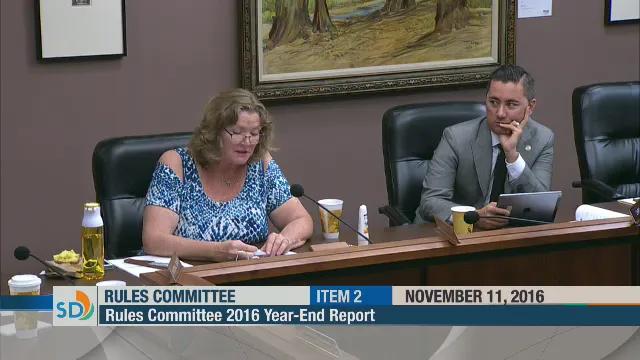
The City Council's Rules Committee met on November 14, 2016, with Council President Pro Tem Emerald, Councilmember Cole, Councilmember Kercy, and Councilmember Kate present. The committee reviewed the Funds Commission's investment performance report, accepted the 2016 Rules Committee year-end report, and accepted the Charter Review Committee's final report. Several ballot measures from the June and November 2016 elections were highlighted, and future policy directions were discussed. Consent Calendar - The committee record of actions for the October 26, 2016 Rules Committee meeting was deemed approved by unanimous consent with no discussion. Discussion Items - Funds Commission Investment Performance Report: David Walters (Chair of the Funds Commission, Bank of Southern California) and Michael Levin (Canterbury Consulting) presented an overview of six city funds totaling over $20 million in investments. The first five funds (supporting libraries and the Peñasquitos Canyon Preserve) maintain a 65% stock / 35% bond allocation, while the Mount Hope Cemetery Fund is a perpetuity fund requiring income-only spending. For the quarter ended September 30, 2016, the Los Peñasquitos Fund returned 5.3%, outperforming its benchmark (3.2%) and placing in the 2nd percentile of peer funds. Year-to-date the fund returned 6.4%, outperforming 60% of peers. Over longer periods, performance ranks in the top quartile for 5- and 10-year periods. The Cemetery Fund returned 7.8% for the trailing year, benefiting from a long-term bond bull market. Rising interest rates are expected to improve the Cemetery Fund's distributable income but may lower reported returns. Councilmember Kercy inquired about amending Council Policy 000-26 to move future reports from the Rules Committee to the Budget and Finance Committee; the City Attorney agreed to research the feasibility. Council President Pro Tem Emerald requested that future reports be made publicly available online, and the City Treasurer agreed to consider it. - Rules Committee 2016 Year-End Report: Chair Sherry presented the report summarizing committee actions in 2016, including items forwarded to full council, such as amendments to the municipal code on redistricting, meeting management, the Bicycle Advisory Board, and ballot measures F, K, L, M, and N. Council President Pro Tem Emerald moved to accept the report and forward it to the full council on the December 5-6 docket, emphasizing the need for better council-initiated legislation processes in cooperation with the mayor's office. The motion carried unanimously. - Charter Review Committee Final Report: Chair Sherry summarized the committee's work over 18 months, resulting in 11 ballot measures on the June and November 2016 ballots. Measures A through E were approved in June, and Measures E (qualifications/vacancy), F (deputy city attorneys' terms), G (Citizens Review Board on Police Practices), and H (purchasing and contracting) were approved in November. Future charter amendments were identified for further study, including reorganization of articles, revisions to Section 40 (city attorney powers/duties), Section 43 (advisory boards), and Section 32.1 (council subpoena power). Councilmember Cole expressed appreciation for Measure G, which strengthened the Citizens Review Board. Council President Pro Tem Emerald moved to accept the report and forward it to the full council on the December 5-6 docket, with the expectation that enabling legislation for Measure G would be developed in an appropriate committee. The motion carried unanimously. Key Outcomes - The Rules Committee accepted the 2016 year-end report and the Charter Review Committee final report, both to be forwarded to the City Council for review on the December 5-6, 2016 docket. Both motions passed unanimously. - The City Attorney will explore amending Council Policy 000-26 to reassign future Funds Commission reports to the Budget and Finance Committee. - The City Treasurer will consider posting Funds Commission reports online for public access. - The committee noted the need for future work on charter amendments, particularly regarding the Citizens Review Board (Measure G) and council subpoena power.

FUNDS COMMISSION 49% · CHARTER REVIEW 25% · PROCEDURAL 20% · PUBLIC RECORDS MANAGEMENT 6%
1048
OCT 27, 2016 · SAN DIEGO, CALIFORNIA · ACTIVE TRANSPORTATION & INFRASTRUCTURE COMMITTEE
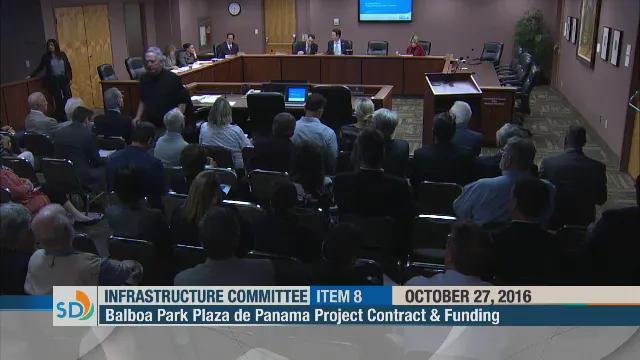
San Diego City Council Infrastructure Committee Meeting - October 27, 2016

The Infrastructure Committee met on October 27, 2016, chaired by Councilmember Kersey. The meeting covered non-agenda public comments, approval of consent items, a report on the Uptown impact fee study, and extensive discussion and public testimony on the Balboa Park Plaza de Panama project and its proposed financing. Key votes included unanimous support to forward the Uptown impact fee study, the Plaza de Panama project, and the related bond financing plan to the full City Council. Consent Calendar - Items 1–4: Approved unanimously and forwarded to full Council. - Item 5: Returned to staff at the request of staff. Public Comments & Testimony - Kevin Swanson (resident since 1958) called for a functional transportation plan linking Balboa Park to downtown, including automated electric shuttles, and criticized the current ACE parking tram system for failing to serve bus riders. - Martha Welch expressed concerns about water usage for proposed reflecting pools, noting the drought and maintenance challenges. - Matt Adams (Building Industry Association) opposed the park component of the Uptown impact fee, stating 62% of the fee ($254 million) is for speculative parks without identified projects. He argued San Diego already ranks 1 in parkland per capita and that a 40% fee increase coupled with a 2,000-unit downzone would harm housing investment. He requested the fee remain unchanged or be delayed by a year. - Matthew Adams (same as above) emphasized that the Uptown plan includes a 2,000-unit reduction and the fee increase would further discourage development. - Leo Wilson (Uptown Planners) complimented staff, noted unanimous community plan support, and stressed the need for local park space, as Balboa Park is a regional facility used mostly by non-residents. - Organized presentations in favor of Plaza de Panama: - Dr. Erwin Jacobs (Chair, Plaza de Panama Committee) described the project as a public-private partnership restoring pedestrian plazas, with the committee having already spent $14 million and committed to raising the remaining $30 million. - Jim Kidrick (President/CEO, San Diego Air & Space Museum; Chair, Balboa Park United) urged approval, calling the plan the "most superb public-private partnership." - Michael Seidel (Metro CDC) expressed strong support. - Peter Komisky (Balboa Park Cultural Partnership) cited reduced pedestrian-vehicle conflicts (from 2,500 to 700 interactions per peak day) and logical parking access. - Leo Wilson (Metro CDC/Bankers Hill) emphasized neighborhood support and danger from current car-pedestrian mix. - David Marshall (preservation architect) refuted claims that the project threatens Balboa Park's National Historic Landmark status, arguing that minor impacts (70 ft of Cabrillo Bridge railing) would not cause delisting. - Sharon Gill (resident) highlighted increased handicapped parking and removal of cars from plazas. - Organized presentations in opposition: - Bruce Coons (preservation advocate) argued the bypass bridge would compromise the iconic view from Cabrillo Bridge, cited a National Park Service letter warning of potential landmark status jeopardy, and noted the project adds only 260 net parking spaces (at $300,000 per space) while reducing ADA access and violating Climate Action Plan goals. He proposed instead the already-permitted Zoo Promenade project with 1,850 net spaces at similar cost. - David London (Balboa Park Heritage Association) claimed no pedestrian-vehicle accidents in 20 years (per SDPD records), said paid parking projections are unrealistic, and that the project diverts funds from pressing maintenance needs. - Individual speakers in opposition: - Howard Blackson urged a design competition for the bypass bridge due to its iconic importance. - David Goldbrook warned of lost landmark status and urged focus on deferred maintenance. - Bernadine King said previous court challenges denied the plan and preservationists would sue again. - Brian Curry (Pacific Beach Planning Group) argued the parking garage may become obsolete with changing transportation trends. - Deirdre Lee called for a public vote, citing underutilized parking at City College and park maintenance needs. - Individual speakers in favor: - Gordon Cofton (program manager for Plaza de Panama Committee) noted the project reclaims 6.3 acres of parkland, reduces vehicle-pedestrian conflicts from 2,400 to 750 per peak hour, and that the Oregon Pavilion lot is now full by 11 a.m. - Sharon Gale pointed out that City Hall parking at $18/day is nearly full, making $8/day a bargain, and the project enables future removal of the Air and Space Museum surface lot. Discussion Items - Uptown Impact Fee Study (Item 6): Planning staff proposed increasing the fee from $8,755 to $11,863 per residential unit. The park component (62% of fee) would fund 22 identified projects and parkland acquisition. Uptown has 15 acres of neighborhood parks versus a General Plan requirement of 156 acres; staff identified 10.85 acres for acquisition. Committee members raised concerns about maintenance costs and the need for a Citywide Parks Master Plan. Staff noted the fee can only be used for capital improvements, not operations. - Plaza de Panama Project (Item 8): Staff presented a public-private partnership to remove cars from the Central Mesa, build a three-story parking structure, a bypass road/bridge, and 6.3 acres of pedestrian plazas. Total cost $79 million, with city contributing $49 million ($45M hard costs + $4M soft costs) and the Plaza de Panama Committee raising the balance. Construction phased over 22 months. The committee voted unanimously to forward all seven requested actions to full Council. - Financing Plan (Item 7): Debt management proposed issuing $39 million in lease revenue bonds (tax-exempt) backed by parking garage revenues, with city general fund as backstop. Parking rates: $8 weekday/$12 weekend for 2 hours, $125/month for permits, $150/month for valet. Projected net revenue $3.3–4M annually. Committee discussed a one-year review of parking rates and impact on other capital projects. Key Outcomes - Uptown Impact Fee Study: Motion by Councilmember Zap, seconded by Vice Chair Cole, to forward to full Council with recommendation for approval. Carried unanimously (Councilmember Emerald absent). - Plaza de Panama Project: Motion by Councilmember Zap to approve all seven staff recommendations and forward to full Council. Seconded by Vice Chair Cole. Carried unanimously. - Financing Plan (Item 7): Motion by Councilmember Zap to approve staff recommendations and forward to full Council. Seconded by Vice Chair Cole. Carried unanimously. - Next Meeting: No meeting in November; next meeting scheduled for December 7, 2016.

PUBLIC COMMENT 25% · HISTORIC PRESERVATION 18% · PARKS AND RECREATION 8% · PUBLIC WORKS 8%
1049
OCT 26, 2016 · SAN DIEGO, CALIFORNIA · RULES COMMITTEE
San Diego City Council Rules Committee Meeting - October 26, 2016

The Rules Committee of the San Diego City Council met on October 26, 2016, to discuss and vote on several items. The committee reviewed the 311 program roadmap, revisions to municipal codes regarding the Citizens Equal Opportunity Commission and redistricting, a charter section on business interest disclosure, rules of council amendments, and several council policies. All motions were approved unanimously. Discussion Items 311 Program and Get It Done Pilot - Alex Hampton from Performance and Analytics presented an overview of the 311 roadmap and updates on the Get It Done pilot. The program, launched May 20, has received over 30,000 reports, with about 80% of reports going through the mobile app or website. Approximately 8,500 mobile app users have been recorded. About half of the reports have been completed, 25% referred to other agencies, and the rest are in progress. - The roadmap aims to expand the program, improve customer experience, and explore a centralized contact center. Implementation costs are estimated over several years, with a soft launch planned between January and July 2018. - Kathleen Higgins from the Municipal Employees Association (MEA) expressed support for consolidating call centers but raised concerns about employee transitions and emphasized the need for labor sensitivity. She requested that labor be brought into the process. Alex Hampton assured that they are working with labor and are sensitive to employee concerns. - Councilmember Kersey praised the Get It Done app for its effectiveness. Councilmember Kate asked about the CRM update and costs; the consultant report cost less than $25,000. Council President Leitner expressed concern about status updates for referred reports and noted that a report she filed was closed without action. Citizens Equal Opportunity Commission (CEOC) – Municipal Code Revision - Matt Helm, Deputy Director of Purchasing and Contracting, presented a proposed revision to San Diego Municipal Code Section 26.16(b) to add representation for women and disabled veterans. The revision changes the requirement from "possess the characteristics" to "actively advocate for or represent the interests" of the groups, addressing City Attorney concerns about unconstitutional application. - Councilmember Emerald asked about current commission representation; Felipe Monroy noted there are openings and that the Mayor's office is identifying applicants. Councilmember Kate asked about the application process. The committee voted unanimously to direct the City Attorney to draft an ordinance and forward to full Council with a recommendation for approval. Redistricting Commission – Municipal Code Amendments - Trisha Tackey from the Independent Budget Analyst's office presented research on other cities' redistricting commission application processes and budgets. None of the reviewed cities required social security numbers or transcripts, but most asked about education. The IBA recommended adding budget guidance to the municipal code. - City Clerk Liz Maland presented proposed municipal code updates resulting from the approval of Ballot Measure A (June 7, 2016). Changes include updating the nomination period, eliminating transcript requirements, and providing a process for vacancies. The IBA noted that the 2010 redistricting cost about $500,000. - Councilmember Emerald asked about Austin's voter registration number request; the IBA explained it was likely to verify voter status. Councilmember Kate requested adding language that social security numbers would not be released to the public, which was accepted. The committee voted unanimously to forward the ordinance to full Council with that amendment. Charter Section 225 – Disclosure of Business Interests - Deputy City Attorney Tom Zellani explained Charter Section 225, which requires disclosure of business interests for city transactions. The proposed ordinance would implement the section, but several details remain open. Discussion included identifying information, where to send information, when the council should see it, and enforcement authority. - Felipe Monroy (Mayor's office) and Jeff Kawar (IBA) expressed concerns about implementation costs and recommended further study. Council President Leitner suggested a working group. The committee voted unanimously to refer the matter to a working group to review implementation costs, considerations, and whether to ask voters to amend the charter. Charter Section 32.1 and 270 – Reporting and Summons Authority - Deanna Jurado Santos, Director of Legislative Affairs, presented an ordinance to implement charter amendments related to information exchange and council summoning authority. The proposal includes a 45-day timeline for providing information and changes "staff member" to "department head." - Councilmember Emerald asked about enforcement if summons are ignored; staff noted it would be a municipal code violation. The committee voted unanimously to forward the ordinance to full Council with the noted amendments. Rules of Council – Amendments - Deanna Jurado Santos presented amendments to the Rules of Council: moving closed session from 9 a.m. to 11 a.m., clarifying the failure of a motion, and updating public comment procedures. Councilmember Kate asked about public hearings; the committee voted unanimously to forward the amendments to full Council. Council Policies – Amendments and Repeals - Deanna Jurado Santos presented several amendments to council policies, including repealing policies 000-06 and 000-22, and updating others to reflect current practices. The committee voted unanimously to forward the amendments to full Council. Key Outcomes - All motions were approved unanimously. - The committee directed the City Attorney to draft ordinances for the CEOC and redistricting changes. - The committee referred the Section 225 implementation to a working group for further review. - The committee forwarded the charter section 32.1/270 ordinance and rules/council policy amendments to full Council. - The next Rules Committee meeting is scheduled for November 14, 2016, at 9 a.m.

CHARTER REVIEW 24% · REDISTRICTING 15% · TECHNOLOGY AND INNOVATION 12% · RULES OF COUNCIL 10%
1050
OCT 20, 2016 · SAN DIEGO, CALIFORNIA · ECONOMIC DEVELOPMENT & INTERGOVERNMENTAL RELATIONS COMMITTEE
Economic Development and Intergovernmental Relations Committee Meeting - October 20, 2016

The Economic Development and Intergovernmental Relations Committee met on October 20, 2016, at 10:00 AM. The meeting was chaired by Councilmember Cole, with Councilmembers Kate and Alvarez present, and Vice Chair Kersey joining later. The agenda included reports on state and federal legislative advocacy, an update from Civic San Diego, an action item to extend a federal lobbying contract, approval of a modified Tourism Marketing District (TMD) operating agreement, and a discussion on reinvesting redevelopment property tax trust fund (RPTTF) residuals into underserved communities. Public Comments & Testimony - Martha Welch (first public comment) spoke about voting procedures, criticizing the requirement for two stamps on mail-in ballots and the lack of public service announcements. She urged the Board of Supervisors to address the issue. - Ikechiko Joshua Njoku (student from E3 Civic High School) introduced himself and explained he was shadowing at the Mayor’s Office for a job shadow program. Reports and Presentations - State Legislative Update (Item 1) – Kristen Tilquist (Mayor’s Office) introduced Maura Top (Top Strategies) and Nick Garcia (Platinum Advisors), who summarized the 2016 legislative session. Key points: seven legislative races could affect a Democratic supermajority; transportation funding remained unresolved (special session open until Nov. 30); $900M cap-and-trade spending agreed; local breweries bill (SB 1426) defeated; AB 2664 (entrepreneurship at UC campuses) signed; pure water demonstration bill (AB 2022) faced Water Board reticence; stormwater fee fix (Prop 218) discussed but no resolution; housing bond (AB 2817) vetoed; Prop 63 funds for homelessness directed to counties. Councilmember Kate asked about Governor Brown’s final priorities (fiscal restraint) and water tunnels litigation risks. Vice Chair Kersey asked about pure water and housing bonds. Chair Cole advocated for Prop 47 funding for reentry services. - Civic San Diego Report (Item 2) – Michael Lindell and Gustavo Bidart presented the FY17 Economic and Community Development Work Plan. They highlighted: $83M in New Markets Tax Credit allocations (93% invested in five projects); formation of a Transit-Oriented Development (TOD) Fund (market assessment completed, fund launch late 2017); exploring an EB-5 regional center; launching a Business Improvement District (BID) Neighborhood Small Business Program in November 2016 targeting Alcalahome and Southeastern Diamond corridors; $400,000 non-interest-bearing note to Axiom San Diego for small business lending; partnership to activate commercial kitchens for social enterprise; commitment to allocate 20% of low-moderate income housing assets and 35% of New Markets Tax Credits to the newly designated Promise Zone in Southeast San Diego. Action Items - Amendment to Federal Lobbying Contract (Item 3) – Alejandra Cabaldon requested approval to extend the contract with Squire Patton Boggs for two one‑year options (Jan. 1, 2017–Dec. 31, 2018) at $14,000/month ($336,000 total). The first year (FY17 remainder) is $84,000 already budgeted. Councilmember Alvarez moved approval, seconded by Councilmember Kate. The motion passed unanimously. - Tourism Marketing District (TMD) Update and Operating Agreement (Item 4) – Meredith Dibden Brown presented the updated FY17 budget split into Part 1 (July–Oct. 2016, $41M) and Part 2 (Nov. 2016–June 2017, $24.5M) reflecting the modified district (only hotels with 70+ rooms). The new five-year operating agreement begins Nov. 1, 2016. Litigation reserve is $29M in FY17 and $30M in FY18. Councilmember Alvarez asked for a litigation update before full council; staff offered an individual briefing. Motion to approve passed unanimously. Discussion Items - Use of Redevelopment Property Tax Trust Fund (RPTTF) Residuals (Items 5 & 6) – Charles Modica (IBA) provided background: redevelopment dissolution in 2012 created the RPTTF; the city’s share of residual revenue is 17% of the countywide pool, projected to grow from $14M (FY14) to $23.7M (FY21). Councilmembers Cole and Alvarez proposed dedicating these unrestricted general fund residuals to affordable housing (25% set‑aside) and economic development in former redevelopment areas and CDBG-eligible neighborhoods. They cited successful redevelopment examples (North Park, downtown). Public speakers in favor: Michelle Muniz (Affirmed Housing Group), Matt Adams (BIA), John Seymour (National CORE), Carol Kim (Building Trades Council), Stephen Russell (San Diego Housing Federation). One speaker (Martha Walsh) opposed, arguing the funds should go to HUD-based affordable housing. Mary Lewis (CFO) warned that earmarking residuals ($18M anticipated FY18) would create a general fund hole, compounded by $25M increased pension ADC payments and Prop H infrastructure set-asides. Vice Chair Kersey suggested waiting for the five‑year financial outlook (due Nov. 9) before committing. Councilmember Kate asked about unexpended funds and geographic equity, noting CDBG areas in his district. The item was informational only; no motion was taken. Key Outcomes - Votes passed unanimously: Amendment to Squire Patton Boggs contract (Item 3); approval of modified TMD budget and new operating agreement (Item 4). - Directives: The committee requested a litigation status update on the TMD before full council consideration. Council staff will work with the Mayor’s Office, City Attorney, and IBA to develop a formal policy on RPTTF residual use, with further discussion expected after the five‑year outlook is released. - Next EDIC meeting: Scheduled for November 17, 2016. Additional Remarks The meeting included a brief student introduction and a closing announcement for Tijuana Innovadora 2016 (Nov. 3–10), but those were not part of the formal agenda.

ECONOMIC DEVELOPMENT 22% · AFFORDABLE HOUSING 12% · BUDGET 9% · INTERNATIONAL RELATIONS 9%
OPENPUBLICA · PUBLIC MEETING INDEXUPDATED DAILY · openpublica.com