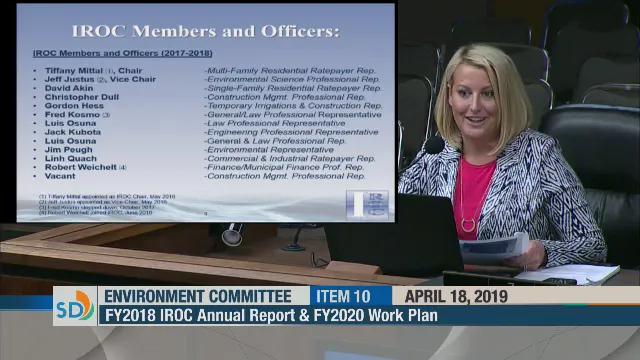
The Environment Committee of the San Diego City Council met on April 18, 2019, to discuss and vote on several items, including the Mission Trails Regional Park Master Plan Update, urban forestry initiatives, Balboa Park tree inventory, the Independent Rates Oversight Committee annual report, and action items related to water treatment chemicals, remediation cleanup services, and curbside recycling contracts. The meeting included extensive public testimony and presentations from city staff, advisory boards, and community organizations. Consent Calendar - The committee approved a routine consent item at the start of the meeting, but no details were provided in the transcript. Public Comments & Testimony - Mission Trails Regional Park Master Plan Update: Multiple speakers expressed support or opposition. - Jim Whalen (Planning Commission) supported staff recommendation, noting challenges with trails and private property issues. - Dorothy Leonard (Chair, Mission Trails CAC) urged support, highlighting long community involvement. - Meg Disz (County of San Diego Trails Program Coordinator) voiced county support. - Susie Murphy, Kevin Loomis, and Ben Stone (San Diego Mountain Biking Association) supported the plan, emphasizing compromise and collaboration. - Jeff Harkness (former project manager) supported the plan. - Gail Severins (California Department of Fish and Wildlife) opposed the Spring Canyon to Boulder trail segment, citing impacts on wildlife movement. Requested removal or alternative alignment. - Frank Landis (community member) opposed the plan as written, requesting prioritization of resource protection over trail closures. - Michael Beck (Endangered Habitats League) opposed the controversial trail segment but noted a potential compromise. - Jack Zaruk (East Elliott property owner) opposed the park extension, requesting fairness for property owners. - Urban Forestry Program: Several speakers supported tree planting and maintenance. - Janae Krueger (Trees 1000 Foundation) described private tree planting efforts in University City. - Andrew Meyer (San Diego Audubon Society) supported urban forestry, emphasizing native plants. - Frank Landis (again) advocated for native trees and multifunctional planning. - Kathy Copley (ASLA) presented concerns about inadequate soil volumes, standards, and code enforcement, recommending updates. - Muriel King (Bay Terraces Community Association) requested more trees and city investment. - Virginia Wilson (Ocean Beach) described a successful street tree education program. - Dr. Cody Peterson (Resource Conservation District) emphasized the catastrophic loss of trees in canyons and urged higher investment. - Rob Huitzel (San Diego River Park Foundation) supported tree canopy measurement and partnership. - Adrienne Heinzelman (San Diego 350) supported urban forestry for climate goals. - Troy Murphy (CFAB) requested a dedicated code compliance officer. - Rochelle Mallius (Tree San Diego) stressed water for trees and landscape regulation updates. Discussion Items - Mission Trails Regional Park Master Plan Update: Staff presented the update, including new trails, natural resource management, and community plan amendments. The plan had support from the Planning Commission (4-0) and Task Force. Key controversy centered on a 0.5-mile trail segment in East Elliott near SR-52. Councilmember Sherman moved to recommend approval, citing compromise. Councilmember Moreno expressed concern about Fish and Wildlife objections but noted the trail's location near the freeway. The item passed 4-0. - Urban Forestry Program: Brian Widner (City Forester) reported on 2018 activities: 2,500 trees planted, 40,000 trimmed, 2,000 removed. Tree canopy is 13% with a goal of 15% by 2020 and 35% by 2035. Challenges include pests (palm weevil, shot hole borer) and infrastructure conflicts. Ann Fage (Community Forest Advisory Board) presented four recommendations: engage communities, develop a long-term planting program, update codes and standards, and explore financing options. Councilmembers discussed training, code enforcement, and funding. - Balboa Park Urban Forest Program: Tomas Herrera-Mischler (Balboa Park Conservancy) presented a tree inventory of 15,302 trees, noting increased species diversity but a 4% decline in excellent health and a 4% increase in dead trees. He highlighted the need for proactive pest management and succession planting. Councilmember Moreno raised concerns about water restrictions during drought and suggested carving out exceptions for historic trees. - Independent Rates Oversight Committee (IROC) Annual Report: Tiffany Mittel and Jeff Justice presented 13 recommendations, including tracking Pure Water costs, developing a strategic plan, and conducting informal rate reviews. They requested an independent consultant for IROC. Councilmember Sherman supported the need for independent expertise. - Action Item: Ferric Chloride Contract: The committee approved a contract with Camera Water Solutions for ferric chloride (no opposition, passed 4-0). - Action Item: Remediation Cleanup Contract Amendment: The committee approved adding $5 million to the contract with Luth and Turley for cleanup services from water main breaks and sewer backups, following major breaks like Idaho Street (estimated $1.2 million). Motion passed 4-0. - Action Item: Curbside Recycling Contract Extension: The committee approved a two-month extension (through August 30, 2019) with Allen Company due to market impacts from China's National Sword policy. The new RFP is underway. Motion passed 4-0. Key Outcomes - Mission Trails Regional Park Master Plan Update: Recommended to City Council for approval (4-0). - Urban Forestry: Informational item; no vote. Councilmembers committed to exploring funding and policy improvements. - Balboa Park Urban Forest Program: Informational; no vote. Councilmember Moreno suggested a formal exemption for historic trees from drought restrictions. - IROC Annual Report: Informational; no vote. Councilmember Sherman supported funding an independent consultant. - Action Items: All three action items were approved 4-0: (1) Ferric chloride contract with Camera Water Solutions, (2) $5 million amendment for remediation cleanup with Luth and Turley, (3) Two-month curbside recycling contract extension with Allen Company.
Public Meetings - San Diego, California
Public Meetings - San Diego, CaliforniaThe Public Safety and Livable Neighborhoods (PSLN) Committee of the San Diego City Council met on April 17, 2019, chaired by Councilmember Montgomery. Other committee members present included Councilmembers Kate, Moreno, and Vice Chair Bree. The meeting approved previous committee actions, heard extensive non-agenda public comment, and then took up three major agenda items: the FY2020–FY2024 HUD Consolidated Plan and FY2020 allocations, a proposed Vehicle Habitation Ordinance, and a biannual update from the Commission on Gang Prevention and Intervention. Two routine contract items were approved without discussion. The vehicle habitation ordinance was forwarded to full council with no recommendation by a 3–1 vote, while the HUD plan passed 3–1. Due to high public interest, the meeting used an overflow room and testimony was time-limited. Consent Calendar - Approved the committee actions of March 13, 2019, unanimously. - Item 2 (contract amendment with Intergraph Corporation, now Hexagon Safety & Infrastructure) was approved unanimously without discussion. - Item 3 was approved unanimously without discussion. Public Comments & Testimony Non-Agenda Public Comment - Scott Chipman suggested scheduling city meetings to avoid conflicts with naturalization events on the third Wednesday of each month, or noting those events on agendas so attendees can plan transit. - Martha Welch complained about the condition of fire stations (lack of showers/sleeping areas), closed police stations, and missing bonds to fund infrastructure; she asserted the newest fire station is privately funded, not city-built. - Francine Maxwell (District 4 resident) argued the police department should not write its own policies/procedures for Smart Lights; she demanded community input now, not after the fact. She noted that Smart Lights helped solve a murder in Skyline but criticized ShotSpotter reporting. - John Kitchen (publisher of San Diego Homeless News) attempted to comment on vehicle habitation but was redirected to the later agenda item; he stated he was neither for nor against the proposal and wanted either a better ordinance or no ordinance. - Catherine Rhodes urged the council to place alternative revenue measures on the ballot, including reclassifying online travel agencies as hotel operators to capture full TOT and TMD taxes. She claimed the city is losing “hundreds of millions of dollars.” - Jerry Hall supported Francine Maxwell’s position on police policy, and asked for more current police and fire rescue data on the city’s open data portal; he noted police calls-for-service data were from August 2017 and fire data only by zip code. - Beryl Flom (League of Women Voters of San Diego) expressed concern about the city’s ambulance contract, which expires in July 2020, and urged that it be put out for bid. - Suzanne Morris urged the committee to request an update from SDPD on the backlog of untested rape kits, stating that April is Sexual Assault Awareness Month and mentioning “2,800” kits. - Becky Johnson (mother of six, small business owner) opposed allowing marijuana businesses to displace local small businesses in low-income neighborhoods, saying such businesses are often funded by out-of-state interests. - Terry Ann Skelly asked for a permitted cannabis testing facility in San Diego, citing contamination of marijuana products with heavy metals and pesticides, including a January investigation by an NBC affiliate. - Colleen Kuzak criticized the Citizens Review Board (CRB) as not independent, noting police canceled a speech titled “Do Cops Lie” and that body-worn camera evidence should be provided to infraction defendants without request. - William Perno (Central Region Prevention Coalition) requested reasonable regulations for city-permitted marijuana businesses, pointing to black-market competition, vehicle cannabis consumption lounges, and the upcoming Baked Festival at North Barker Dell Park. Public Testimony on Item 1 (HUD Consolidated Plan) - Francine Maxwell opposed, citing the A-250 report and claiming outreach targeted certain groups; she asked council to review sign-in sheets from community meetings. - Catherine Rhodes supported the plan, noting that CDBG program income can now be used for homeless and affordable housing, and suggested the city could recover additional money from accumulated interest. - Paul Cleary (Grid Alternatives) supported the item, citing 450 no-cost solar installations and job placement for 50+ individuals. - Ken Marlborough (outgoing chair of the Consolidated Plan Advisory Board) supported the plan and allocations, thanking staff and volunteers. - Elizabeth Schott (ACCION) supported, emphasizing microlending to low-to-moderate income small businesses. - Carla Holland (Small Business Development Center) supported, citing 162 new business starts, $38 million in access to capital, and 785 jobs created in 2018. - Sonia Diaz (Kitchens for Good) supported, citing a 90% employment rate for program graduates. - Kim Heinley (Bayside Community Center) supported, noting the center’s 90-year history and trilingual staff. - Eric Tilkemeyer (City Heights Community Development Corporation) shared a success story of a client who served 65 clients in his first tax season. - Carla Camacho (Ocean Discovery Institute) supported, noting she was a former student and now a homeowner. - Brendan Stevie (LISC) supported, saying the plan would support 125 small businesses and leverage $2 million in grant capital. - Jesse Stein (Voices for Children) supported, saying the investment would serve 125 foster youth. - Ricardo Flores (LISC San Diego) supported, advocating for the small business improvement program and a neighborhood catalyst fund. Public Testimony on Item 4 (Vehicle Habitation Ordinance) Numerous members of the public testified, with one-minute limits. Supporters mostly came from beach communities. - Scott Chipman (Save Pacific Beach) supported the ordinance, saying it should eliminate street living in cars and campers, and supported safe parking with transition services. - Brian White (Pacific Beach Town Council) supported, citing unsanitary conditions and the need for enforcement plus safe lots. - Carol Otterstad (Point Loma) supported but questioned the hours and stressed enforcement. - Steve Pruitt (Pacific Beach Planning Group) supported and recommended the city pursue safe parking facilities, possibly piloting in Pacific Beach. - Stephen Richter (Ocean Beach) supported, citing quality-of-life issues and mobility of van lifers. - Rachel Allen (Pacific Beach) supported, saying she represented hundreds of community members who want designated safe parking and enforcement. - Mia Jones (La Jolla) supported, emphasizing sanitary concerns and the “silent majority.” - Ryoko D'Onors (Pacific Beach) supported, citing accessibility, security, sanitation, and out-of-state vehicles. - Beth Roach supported, citing health, environmental, and economic concerns. - Andrea Schlageter (Ocean Beach Planning Board) supported, urging that Dreams for Change be considered for safe parking expansion. - Craig Klein (OB Planning Board) supported, saying street camping harms neighborhoods. - Denny Knox (OB Main Street Association) supported, describing negative impacts on merchants. - Marla Phelps (homeless advocate) supported, after visiting safe parking lots. Opponents argued the ordinance criminalizes homelessness and lacks sufficient alternatives. - Colleen Kuzak gave an organized presentation with videos, arguing San Diego has the fourth largest homeless population, that most became homeless locally, and that the ordinance is unconstitutional under Martin v. Boise. She cited statistics: 14% veterans, 26% female, 9% families, 12% youth. - Francine Maxwell asked the committee to send the ordinance back to staff, saying it was not what “the finest city in America” should be about. - Wendy Gollinter (Pacific Beach Democratic Club) said the club unanimously passed a resolution opposing criminalization of homelessness and needing a comprehensive approach. - Larry Stoll proposed an amendment creating a homeless vehicle habitation citation with no penalty, directing people to services. - Michael McConnell called for sending the ordinance back for more data and consultation. - Catherine Rhodes called it “blatant bigotry” against unhoused people. - Reverend Sherry Mathier (Interfaith Worker Justice) spoke about Jesus as homeless and opposed criminalizing poverty. - Emily Howe (Think Dignity) opposed, saying the language is “far worse” and would create more harm. - Ellis Rose (Regional Task Force on Homelessness) opposed, noting lived experience and the failure to include homeless people in decision-making. - Valerie Grishi (RV resident) opposed, saying RV dwellers are scapegoats and need parking permits and designated lots. - Michelle Woodson (Think Dignity attorney) opposed, arguing criminalization perpetuates poverty and wastes resources. - Teresa Smith (Dreams for Change) opposed, saying the ordinance's definition of habitation is overbroad and based on reaction, not research. - Corinne Angel (poet) opposed, reading a poem about youth homelessness. - Christina Ennis (self-described van lifer) opposed, saying many live in vehicles out of necessity and can’t pay citations. - Ryan Donchev opposed, saying the ordinance would punish all for the actions of a few. - Mary Lou Finley opposed, calling the ordinance “criminalizing poor people.” - Terry Best opposed, saying police should focus on violent crime, not homelessness. - Rafael Bautista (San Diego Tenants Union) opposed, arguing capitalism creates the crisis and rent control is needed. - Drew Hooks (Socialist Alternative) opposed, urging unity for housing. - Ally Mitchell (currently living in vehicle) opposed. - Susan DeVore opposed, saying public bathrooms are inadequate. Public Testimony on Item 5 (Gang Commission Update) - Jamie Wilson argued gang injunctions are traumatizing, unconstitutional, and aggravate gang involvement. - Aramik Glass Blake supported Pastor Sandoval and urged deeper community engagement, not just easy cases. - Amy Zamudio raised concerns about gang documentation harming young men of color, noting that La Jolla youth get more privilege. Discussion Items Item 1: FY2020–FY2024 Consolidated Plan and FY2020 HUD Allocations Staff from the Economic Development Department (Christina Bibler, Stephen Medulli Williams, and others) presented the plan. Highlights included: - A nine-month outreach process with 8 community forums and 8 stakeholder meetings, involving over 300 participants. - Top community priorities: affordable housing, economic development, and homelessness; top five specific priorities included affordable housing availability, youth services, centralized homelessness resources, small business capital access, and improved sidewalks/street lighting. - Proposed funding: CDBG ≈ $11.8 million, ESG ≈ $1 million, HOPWA ≈ $4.1 million; total entitlement for all four programs ≈ $22 million. - About $18.5 million would be allocated through a competitive process. - $12 million would support affordable housing: $10 million into the existing Housing Commission revolving loan fund and $2 million into a transit-oriented development (TOD) fund with LISC. - Recommended changes to Council Policy 700-02 included streamlining subrecipient timelines and changing the homelessness set-aside from a fixed $1.3 million to 25% of public services funding beginning FY2021. Councilmember Moreno opposed, noting that only $2.2 million of the $31.4 million in extra CDBG program income was directed to affordable housing, and that a memo sent February 1 received no response until the day before the meeting. Councilmember Kate supported, explaining the history of past CDBG mismanagement and the need for a competitive, transparent process. Vice Chair Bree supported but stressed the need to engage district offices and improve outreach. The motion to approve and forward to council passed 3–1, with Moreno dissenting. Item 4: Vehicle Habitation Ordinance Deputy Chief Operating Officer Robert Vockey presented the ordinance. It would prohibit vehicle habitation at any time within 500 feet of residences and K-12 schools, and between 6 p.m. and 6 a.m. everywhere else. Evidence of habitation would include sleeping, bathing, meal preparation, stored bedding/cookware, obscured windows, and trash or waste near the vehicle. Staff noted the previous 1983 ordinance was struck down in August 2018, and the city repealed it in March 2019. Councilmember Moreno moved to forward the ordinance to full council with no recommendation, expressing concern about overconcentration of homeless services in District 8 and asking the mayor’s office to commit to not opening additional safe parking facilities in districts that already have them; staff said they were not currently looking to open new lots. Councilmember Kate asked about enforcement; police stated they would use a progressive approach (warning, education, citation, arrest on fourth offense) and consider totality of circumstances. Vice Chair Bree questioned the lack of data on the number of people living in vehicles and safe parking capacity (120 spaces existing; new lot 80–220 vehicles) and criticized ticketing as a vicious cycle. Chair Montgomery opposed, citing multiple concerns and noting the ordinance was written from a privileged perspective. The motion passed 3–1, with Montgomery voting no. Item 5: Commission on Gang Prevention and Intervention Biannual Update Pastor Sandoval, executive director, and Dr. Rodney Hood presented the update. The commission is the official advisory body on gang prevention and intervention. They discussed an April 13 retreat, an upcoming Community Mentor Summit (Oct. 16–17), a mobile response app, and four new mentor satellite programs funded with $125,000 in state funds. Dr. Hood reported the city’s crime index fell from 3,100 in 2012 to 2,662, documented gang members dropped from 4,100 in 2004 to approximately 3,000 as of March 2018, and 332 gang injunctions were removed after DA review. The item was informational only; no action was taken. Key Outcomes - HUD Consolidated Plan: Approved by the committee in a 3–1 vote and forwarded to City Council for consideration on April 23, 2019. - Vehicle Habitation Ordinance: Forwarded to City Council with no committee recommendation by a 3–1 vote. Councilmember Moreno’s motion carried, with Montgomery dissenting. - Items 2 and 3: Approved unanimously without discussion. - Gang Commission Update: Received as an information item; no formal action taken. - Agenda server issue: The chair noted the online agenda was temporarily unavailable but later restored. -O-TH, 2019, at 5:00 PM UTC; the meeting was held in San Diego with an overflow room.
The Active Transportation and Infrastructure Committee met on April 17, 2019, at 10:00 a.m. to consider several items including a train whistle ordinance repeal, taxicab program extension, major water pipeline and sidewalk project, fire station design, street resurfacing change order, and a bridge replacement design contract. All votes were unanimous. The committee also received an informational presentation on cool pavement technology. Consent Calendar - Meeting Minutes (March 20, 2019): Approved unanimously. - Consent Agenda: Three items approved unanimously (motion by Vice Chair Ward, second by Councilmember Kate). Public Comments & Testimony - Martha Welsh (Non-Agenda): Expressed concerns about city services including water meters, road conditions, and water meters not being installed. Her remarks were somewhat unclear. - Martha Welsh (Item 7 - Fire Station): Spoke in favor of the Fairmont Avenue Fire Station, stating it is much needed and urging faster progress. Discussion Items - Item 4 – Repeal of Municode 85.28 (Train Whistle Use): Duncan Hughes (Deputy Director, Transportation & Stormwater) presented. The ordinance is void under federal law; a quiet zone has existed downtown since 2012. Councilmember Moreno requested a future committee item on expanding quiet zones to other residential areas, citing train noise in San Ysidro, Nestor, Logan Heights, and Sherman Heights. Staff agreed to schedule. Motion to approve by Vice Chair Ward, seconded by Councilmember Moreno, carried unanimously. - Item 5 – Tenth Amendment with MTS (Taxicab Program Administration): Steve Selnica presented a five-year extension of the agreement (originally from 1988). No cost to city. Motion by Vice Chair Ward, seconded by Councilmember Moreno, carried unanimously. - Item 6 – Montezuma Mid-City Pipeline Phase 2 and Sidewalk Project: Elif Chetin (Deputy Director, Public Works) presented authorization for a construction contract up to $48.8 million and a second amendment with SOMAS consultant ($390,000 increase, extension to December 2022). Project includes 4,900 feet of 66-inch water pipeline, trenchless crossing under I-8, and sidewalk on 70th Street. Construction start summer 2019, duration 29 months. Discussion noted complexities of easements and Caltrans coordination. Motion by Councilmember Moreno, seconded by Councilmember Kate, carried unanimously. - Item 7 – Fairmont Avenue Fire Station Phase 2 (First Amendment with RRM Design Group): Elif Chetin and Deputy Fire Chief James Gabriel presented. The station is a Citygate priority, located on a challenging sloped site. First amendment adds $365,000 (total $1.2 million) for technical studies, extension to Feb 2024. Project uses standard fire station design packages. Councilmember Kate noted prior committee discussions; Councilmember Moreno questioned initial budgeting. Motion by Councilmember Kate, seconded by Councilmember Moreno, carried unanimously. - Item 8 – Change Order 5 for Navajo Pump Station (Street Resurfacing): Debbie Mon Martin presented a change order for $1,033,986.52 to upgrade street resurfacing from slurry seal to AC overlay on several streets. Funding from TSW and Public Utilities. Adds 160 working days; project at 95% completion. Vice Chair Ward questioned why this was not foreseen earlier. James Nagelvoort (Director of Public Works) explained it was an opportunity to coordinate with TSW’s street condition assessment. Motion by Vice Chair Ward, seconded by Councilmember Kate, carried unanimously. - Item 9 – Agreement with RIC Engineering for El Camino Real (Half Mile to Via de la Valle): Akron Basioni presented a $2.4 million, 7-year design contract for bridge replacement and roadway widening (one to two lanes each direction, bike lanes, sidewalks). Environmental document approved in 2017. Design starts summer 2019, construction spring 2023 to summer 2026 ($27M construction cost, $20.7M grant). Councilmember Kate questioned the three-year design timeline; staff cited FHWA/Caltrans approvals. Councilmember Moreno asked about acquisition and coordination with adjacent developments (polo fields, JPA). Motion by Councilmember Kate, seconded by Councilmember Moreno, carried unanimously. Key Outcomes - All six action items were approved unanimously by the committee and will be forwarded to City Council (with Item 9 requiring two readings as an ordinance). - Staff will schedule a future committee item to explore expanding quiet zones for train whistles to other residential areas. - The committee received an informational presentation on cool pavement (GuardTop’s Cool Seal product) and discussed potential pilot projects; no action taken. - Next regular meeting scheduled for Wednesday, May 22, 2019, at 2:00 p.m.
The Economic Development and Intergovernmental Relations Committee met on April 11, 2019, at 2:00 PM. Present were Chair Ward, Vice Chair Montgomery, Councilmember Bree, and Councilmember Kercy (arriving later). Staff included Deputy City Attorney Kate Malcolm, Adrian Grand from the Mayor's Office, Jordan Moore from the Independent Budget Analyst, and committee consultant Lucas O'Connor. The meeting covered five agenda items including approval of minutes, Business Improvement District (BID) budgets, the Tourism Marketing District (TMD) budget and supplemental funding, an amendment to the Horton Plaza Owner Participation Agreement (OPA), a state legislative update, and a presentation on child care needs. Consent Calendar - The minutes from the March 7, 2019 meeting were approved unanimously. Public Comments & Testimony - Non‑Agenda Public Comment: Becky Rapp expressed concerns about the committee's goals regarding marijuana and tobacco businesses in neighborhoods, and asked whether committee members attend planning group meetings. - Item 3 – Horton Plaza OPA Amendment: Approximately 30 public speakers addressed the item. Many expressed support, including representatives from the Downtown San Diego Partnership, Gaslamp Quarter Association, BOSA Development, Unite Here Local 30, San Diego Building Trades, and others. Opponents and those with concerns included: Amy Hayes (Save Our Heritage Organization) raised historic preservation concerns; OPO Dupree (Macy's) stated that Macy's has contractual rights and has not approved plans, and criticized Stockdale's lack of communication; Jimbo Somek (owner of Jimbo's) and his attorney Cynthia Morgan Reed argued that the process has lacked sufficient detail and that their lease rights are not being respected; Gary Smith (San Diego Downtown Residents Group) urged the committee to send the proposal back until all tenant and park issues are resolved. - Item 5 – Child Care Presentation: Several speakers addressed the child care crisis, including Kelly McCormick (working mother, youth program manager), Robin Leighton (CEO of Educational Enrichment Systems), Courtney Baltiyski (YMCA Child Care Resource Service), Jordan Latchford (San Diego Regional Chamber of Commerce), Rodney Carey (Neighborhood House Association), and Catherine Johnson (San Diego Foundation). They highlighted the need for affordable, quality child care and called for city action on zoning, facilities, and coordination. Discussion Items - Item 1 – FY2020 Business Improvement District (BID) Budgets: Elizabeth Studebaker (Neighborhood Investment Manager) presented the annual appropriations process. The city has 18 active BIDs, collecting an estimated $1.6 million from approximately 15,000 businesses. Staff requested approval to forward the FY2020 budget package to the full City Council. Chair Ward praised the BIDs for their work on small business support, public safety, and community events. - Item 2 – FY2020 San Diego Tourism Marketing District (TMD) Budget and Supplemental Funding: Meredith Dibden Brown, Colleen Anderson (SD TMD Corporation), and Carrie Capuch (SD Tourism Authority) presented. The TMD covers lodging businesses with 70+ rooms assessed at 2%. Estimated FY2020 funds are about $46.5 million, with a supplemental request of $6.9 million from a litigation reserve (now fully resolved). The funding would support SD Tourism Authority and 12 events, including new events like ANOC World Beach Games and Wonderfront. The projected ROI for the Tourism Authority is 21.7:1. Colleen Anderson noted that all litigation has been concluded. Vice Chair Montgomery proposed an amendment to set aside $500,000 of the supplemental funds for community‑based tourism marketing, which was accepted. - Item 3 – Horton Plaza OPA Amendment: Mike Hanson (Planning Department) and Dan Michaels (Stockdale Capital Partners) presented. The proposal would reduce the minimum retail requirement from 600,000 to 300,000 square feet, allowing conversion to a mixed‑use technology office campus with up to 772,000 square feet of office. In exchange, Stockdale would provide enhanced park security and programming, redevelop the Bradley Building, add four stories to the Nordstrom building, extend the Lyceum lease, and achieve a minimum FAR of 4.0. Discussion focused on tenant negotiations (Macy's, Jimbo's, Lyceum), historic preservation, and the need for a comprehensive agreement. Councilmember Bree moved to approve staff recommendations with amendments: (1) park lease to come back for final council approval within six months; (2) an update on tenant negotiations, especially with the Lyceum, before full council approval; (3) all offsetting benefits applied to extended terms for the Lyceum as long as park security is covered. Chair Ward added an amendment prohibiting a hotel on the site unless approved by the City Council. The motion passed unanimously. - Item 4 – 2019 State Legislative Update: Moira Topp (City's Legislative Representative) provided an overview of key state bills and budget priorities. Topics included homelessness and housing (SB 50, SB 5, AB 11), neighborhood services, transportation, border economy, water sustainability, environment and energy, jobs and the economy, public safety, cannabis, and veterans' affairs. The committee took no action; the item was informational. - Item 5 – Child Care Needs and Economic Development: Tessa Tinkler (University of San Diego, Castor Family Center) presented data from a 2017 county study showing that 44% of working parents have no licensed child care spot (148,000 children vs. 83,000 spaces). High unmet need exists in areas like Logan Heights, Paradise Hills, and College Area. State reimbursements do not cover the full cost of care. Rick Richardson (Child Development Associates) and Eduardo Velazquez (San Diego Regional EDC) emphasized the link between child care and workforce development. The committee discussed possible city actions including zoning changes, streamlining regulations, and convening stakeholders. Chair Ward announced plans to form a working roundtable and bring actionable proposals later in the year. Key Outcomes - Item 1: Motion to forward the FY2020 BID appropriation package to the full City Council passed unanimously. - Item 2: Motion to approve the FY2020 TMD report of activities, supplemental funding request, and third amendment to the operating agreement, with the amendment to set aside $500,000 for community‑based organizations, passed unanimously. - Item 3: Motion to approve the Horton Plaza OPA amendment with amendments (park lease within six months, tenant negotiation update, Lyceum lease extension, and prohibition on hotel without council approval) passed unanimously. Staff will prepare documents for full council consideration. - Item 4: No action taken; informational only. - Item 5: No formal action; Chair Ward will lead a working group to develop city policy recommendations.
The Budget and Government Efficiency Committee, chaired by Council President Pro Tem Bree, met on April 10, 2019. The meeting included approval of previous minutes, public comment, discussion of EEO compliance, an auditor's report on pay equity and turnover, and action on three agenda items. A working group was also proposed to address performance metrics and budget priorities. Consent Calendar - Approval of meeting minutes from March 6, 2019: Motion by Vice Chair Kate, seconded by Councilmember Montgomery, passed unanimously. Public Comments & Testimony - Martha Welch (member of the public) expressed dissatisfaction with the current performance-only budgeting approach, stating it provides only half the picture. She requested a return to more detailed line-item budgets that show how much each department receives, emphasizing the need for transparency in spending on workers, parks, libraries, and other services. Discussion Items - Councilmember Montgomery raised concerns about Equal Employment Opportunity (EEO) compliance, noting that three out of five agenda items had underrepresentations in EEO statements. He stressed the importance of prioritizing EEO compliance citywide and called for progress. - City Auditor Andy Hannah presented preliminary findings from an upcoming audit on pay equity and employee turnover. He reported that the city's hard cost of turnover is approximately $39 million per year, with management citing compensation competitiveness, incentives, and discipline as key drivers. The audit will further examine these issues. - A working group was proposed to focus on performance metrics, service standards, and budget priorities. The group will be led by the Independent Budget Analyst (IBA) and include the CFO, labor unions, and the personnel department, reporting back to the committee. - Item 1: Review of a report from purchasing and contracting regarding citywide security service agreements with All State Security and Able Patrol. Discussion included armed vs. unarmed security assessments. Motion by Vice Chair Kate, seconded by Councilmember Montgomery, passed 3-1. - Item 2: Review of a report from purchasing and contracting regarding an as-needed citywide cooperative agreement with Staples and Commercial. Motion by Councilmember Moreno, seconded by Vice Chair Kate, passed 3-1. - Item 3: Review of a report from debt management regarding the biennial update of the city's debt management. Motion by Councilmember Moreno, seconded by Vice Chair Kate, passed 3-1. Key Outcomes - Approval of March 6, 2019 meeting minutes: unanimous. - Item 1 (security agreements) approved 3-1. - Item 2 (cooperative agreement with Staples and Commercial) approved 3-1. - Item 3 (biennial debt management update) approved 3-1. - Working group established, led by IBA, to address performance metrics and budget priorities. - Auditor's audit on pay equity and turnover to proceed. - Next meetings: Budget and Government Efficiency Committee reconvenes May 15, 2019; Council as Budget Review Committee meets May 1, 2019 at 9 a.m.
The San Diego Land Use and Housing Committee met on April 10, 2019, to discuss and vote on several items including middle-income housing incentives, the annual affordable housing fund plan, an update to the encroachment policy, a performance audit of community planning groups, and the creation of a citizens committee to recommend reforms to community planning group policies. The meeting included public testimony on cannabis testing facilities, housing affordability, parkland leasing, and community planning group transparency. Consent Calendar - Approval of Record of Action (March 6, 2019): Approved unanimously. - Consent Agenda Item 2: Partnership with the American Institute of Architects for redevelopment at downtown Johnny Brown’s. Councilmember Ward expressed excitement. Approved unanimously. Public Comments & Testimony - Kelly McCormick: Public health educator. Expressed support for local cannabis testing facilities, citing a severe shortage of licensed testing facilities in San Diego County. Noted that heavy metals (lead, cadmium) and pesticides become concentrated in marijuana, and testing reveals microbial impurities. - Martha Welch: Criticized the city’s housing policy for building expensive, empty buildings and neglecting family-sized units. Stated that medium and low-income housing are not being built. - Kathleen Lippitt: Public health practitioner. Expressed concern that unpermitted marijuana shops are operated by the same individuals applying for legal business licenses, and that city regulations do not disqualify scofflaws. Cited an Orange County Register article about complex ownership schemes. - Bob Kazuski: Argued that Torrey Pines Glider Port, a city park, is being leased exclusively to a business, violating park purpose. Stated that the lease expired in 2008 and the business has made over a million dollars annually. Asked the committee to consider returning the land to public park use. Discussion Items - Item 3 – Amendment to Municipal Code and Local Coastal Program for Middle Income Housing Incentives: Staff presented a proposal to incentivize construction of middle-income housing (80-120% AMI) with density bonuses, fee waivers, and parking reductions. Many public speakers expressed support, with some recommending amendments: - Maya Rosas (Circulate San Diego): Supported with amendments: deed-restriction at 80-120% AMI, allow 100% affordable projects to use the bonus, include anti-displacement rules, and allow stacking with density bonus. - Angie Kallanog (BIA): Supported but recommended maximum flexibility up to 150% AMI; disagreed with deeper affordability requirements. - Sean Carafin (Chamber of Commerce): Supported, noting that the housing crisis is making San Diego unaffordable for middle-income workers. - Dr. Murtasa Batsmusa: Conditionally supported, urging that low-income housing be included on-site and that the program be tied to the inclusionary housing ordinance. - Melanie Cohn (Biocom): Supported to help house life-science employees. - Laura Nunn (Housing Federation): Suggested covenant-protected units, rents at least 10% below market, and income averaging to serve the full 80-120% range. - Joe Lakava (Build Better SD Coalition): Opposed current form; urged focus on 80-120% AMI and stratified income levels. - Satomi Rosh Ziegler (Labor Council): Opposed as written; willing to support if amendments include on-site inclusionary and passage after inclusionary ordinance revision. - Susan Baldwin (We the People): Opposed process; wanted more public input and consideration alongside inclusionary ordinance. - Tim Hutter (developer representative): Opposed requiring stacking with density bonus, arguing it would reduce flexibility and may discourage participation. - David Modi (CPC): Supported but asked for progress on census of deed-restricted housing. Councilmembers debated: Councilmember Sherman seconded a motion by Chair Marino with amendments including stacking, definition of middle income at ≤120% AMI, deed restriction, income range from 80-120%, anti-displacement rules, and allowing mixed-income and 100% affordable projects. Councilmember Ward expressed concern that the proposal was premature without other housing policies moving concurrently. The motion passed 3-1 (Ward opposed). - Item 4 – Proposed Fiscal Year 2020 Affordable Housing Fund Annual Plan: Staff presented a plan with $72 million total, including $7 million new funding and $65 million fund balance. 86% allocated to rental housing finance, remainder to home ownership, homelessness programs, and administration. Public speakers: David Modi requested progress on census of affordable housing; Michael McConnell asked for outcome-based metrics and highlighted issues with homeless programs (e.g., closed showers at Neil Good Day Center). Councilmembers discussed administration costs, homeless funding, and the need for more traditional affordable housing. Motion to approve carried unanimously. - Item 5 – Update to Council Policy 700-06 (Encroachment on City Property): Staff presented updates to streamline and remove telecommunications references. No public speakers. Motion to approve carried unanimously. - Item 7 – Performance Audit of Community Planning Groups: The City Auditor presented findings: city provides limited oversight; many CPGs are not compliant with council policy or Brown Act; rosters, annual reports, and minutes are incomplete; some members exceed term limits; renters are under-represented; unclear project review deadlines. Recommended training, record retention, renter category, and better communication. Public speakers: David Modi (CPC) supported reforms but opposed a renters category; Maya Rosas (Circulate) supported reforms; Stephen Bossey (Atlantis Group) supported recommendations. Informational item; no vote required. - Item 6 – Creation of a Citizens Committee to Recommend Revisions to Council Policy 600-24 (Community Planning Groups): Staff proposed a 7-member committee (later amended to 11) to consolidate recommendations from the Grand Jury, City Auditor, and Circulate San Diego reports. Public speakers: Many supported the committee but with concerns about membership balance. Speakers included Randy Wilde (North Park Planning), Maya Rosas (Circulate), Melanie Cohn (Biocom), Sean Carafin (Chamber), Stephen Bossey, Ian Epley, Matthew Vasilakis (Climate Action Campaign), Sharon Gale, David Modi (opposed membership composition), Joe Lakava (opposed forming a committee; advocated immediate action), Kathleen Lippitt (opposed process), Clint Daniels (supported reforms), and DK Aniwo (Midway Planning, supported with caution). Councilmember Sherman made a motion to create the committee, seconded by Councilmember Ward with amendments to expand to 11 members including three CPC representatives, a past DSD/planning employee, two small business representatives, two housing/infill/environmental advocates, one mobility advocate, one planning commissioner, and one BIA representative. Motion passed unanimously. Key Outcomes - Item 3 – Middle Income Housing Incentives: Approved 3-1 with amendments (stacked density bonus, 120% AMI ceiling, deed restriction, anti-displacement rules). Referred to full City Council. - Item 4 – FY2020 Affordable Housing Fund Plan: Approved unanimously. - Item 5 – Encroachment Policy Update: Approved unanimously. - Item 7 – Audit of Community Planning Groups: Received as information; no vote. - Item 6 – Citizens Committee for CPG Reform: Approved unanimously with amendments to membership. Referred to full City Council for final creation.
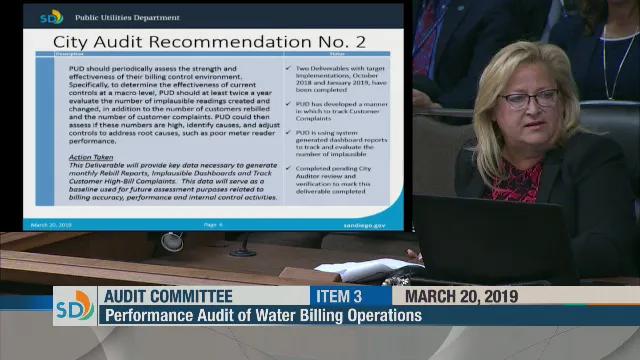
The San Diego Audit Committee met on March 20, 2019, to review progress reports on two Public Utilities Department (PUD) performance audits, receive the City Auditor's monthly activity report, and accept the annual report on internal financial controls. The committee heard public testimony and discussed recommendations, operational changes, and next steps. Consent Calendar - Approval of Minutes: The committee approved the minutes of the previous meeting (motion by Mr. Hebrik, second by Mr. Valdivia; all in favor). Public Comments & Testimony - Dwayne Harvey (former PUD employee) criticized the water meter cover replacement program as "smoke and mirrors," claiming that many changes were already in progress before the audit. He stated that the backlog was reduced from over 20,000 work orders to under 12,000 under previous leadership, but later rose to 37,000 due to diverted crews. He argued that crews lack proper equipment and that the reported numbers are not improving. He urged the committee to seek truthful information directly from field workers. - Rodney Fowler (President, Local 127) expressed support for the department's efforts but raised concerns. He noted that the backlog of meter lid/box service calls is about 22,000, with 500–600 new requests monthly. He emphasized the need for worker input in setting productivity standards and for providing proper tools and equipment (e.g., vehicles past their lifespan). He also requested that the new reference guide be distributed with employee sign-off. Discussion Items 1. City Auditor's Monthly Activity Report (Information Item) - Presenter: Kyle Elser (Interim City Auditor), with Andy Henell (Principal Performance Auditor) - Audits in report writing stage: - Park and Recreation Joint Use Agreements (management response due April 5, report due April 9) - Employee Compensation Pay Equity (management response due March 27, report due March 29) - Six audits in fieldwork: - Transportation Stormwater Tree Trimming Process - IT Disaster Recovery Preparedness - Public Utilities AMI Implementation - Public Utilities Call Center Operations - Mission Bay Fund (FY18) - Neighborhood Services Homelessness Efforts - Not yet started: One performance audit, one IT audit, one annual audit. - Committee questions: Councilmember Campbell asked about the upcoming human capital audit (planning stage, targeting summer). The auditor noted that the audit will focus on employee incentives, discipline, and pay competitiveness. 2. Performance Audit – PUD Water Billing Operations (Progress Report) - Presenters: Matt Vespie (Interim PUD Director), Ronnie Auman (Assistant Director), Jane Arnold (Program Manager), joined by Johnny Perkins (Deputy COO for Infrastructure & Public Works) - Status: 10 audit recommendations broken into 25 deliverables; 20 (80%) completed pending auditor verification. Seven recommendations fully implemented. Remaining five deliverables (related to recommendations 2, 3, and 8) on target for June 2019 completion. - Completed actions: - New SOPs for tracking high-bill complaints, meter reader performance metrics (pending meet & confer with unions), and supervisory review. - Route optimization analysis using RouteSmart software (revised to include six hours for meter reading and two hours for field investigations/admin). - Enhanced skip-code tracking and coordination between meter shop and customer support. - Organizational restructuring: Announced on February 20, 2019, effective April 20, 2019. Key changes include elevating customer support under a new executive assistant director, merging meter reading with water construction/maintenance, and aligning business support functions. - Committee discussion: Members praised the department's embrace of the audit. Councilmember Campbell asked about staffing adequacy (Matt Vespie confirmed adequate staffing but noted recruitment challenges). Questions about auditor verification process were addressed by Chine Pickney (Principal Performance Auditor), who stated verification involves reviewing documentation and ensuring consistent operational integration. 3. Performance Audit – PUD Water Meter Cover Replacement Program (Progress Report) - Presenters: Matt Vespie, Tom Howard (Deputy Director, Water Construction & Maintenance), Juan Guerrero (Interim Assistant Director, Distribution & Collection) - Status: 7 of 11 recommendations complete; on track for full implementation by April 2019. - Completed highlights: - Work standards for field crews (memorialized October 2018). - Training on identifying and reporting box/lid issues (February 2019), with annual refreshers. - New routing technique ("lassoing") to group work orders geographically, avoiding cross-city travel. - In progress: Recommendation 1 (productivity standards) – under negotiation with Local 127. Tom Howard noted that the department is analyzing average daily production (target 12 boxes/lids per crew) but recognizes variability by location and conditions (e.g., concrete vs. softscape). - Backlog: Approximately 22,000 outstanding service calls; 500–600 new requests monthly. Plans to use contractors to address backlog (scope being developed, possibly combined with smart meter installation). - Committee questions: Councilmember Campbell asked about smart meter rollout and misbilling; Steve Gomez (Principal Auditor) confirmed that smart meters were not a source of widespread errors. Discussion on Get It Done app (125 monthly reports) and potential improvements to require photos. Councilmember Hebrik asked about equipment and vehicle condition; Tom Howard acknowledged old vehicles and tools and stated improvements are underway. 4. Annual Report on Internal Financial Controls - Presenters: Scott Clark (Assistant Director, Department of Finance), Jaile Avang (Principal Accountant), Roma Nichols (Supervising Accountant) - Framework: Based on COSO – control environment, risk assessment, control activities, information/communication, monitoring. - Accomplishments: - Administrative Regulation 95.39 established management responsibilities for internal controls. - Successful implementation of GASB 75 (post-employment benefits) and new CAFR software; no audit findings or significant deficiencies for FY18. - Finance Academy launched (March 2018) for cross-departmental leaders; held twice annually. - Post-transaction monitoring of procurement card, travel, tuition reimbursements, and jury duty payments. - 592 of 827 identified financial processes documented (70%). - GFOA Certificate of Excellence: Received for past four years; FY18 had three suggestions (cosmetic improvements), down from five in FY17. - Committee discussion: Councilmember Spencer asked about coordination with City Auditor; Scott Clark confirmed participation in entrance/exit conferences but no formal MOU. Post-monitoring findings are escalated internally based on severity (up to Chief Operating Officer). IBA member Lisa Byrne asked about GFOA suggestions, which were clarified as minor formatting and labeling changes. Key Outcomes - Minutes of last meeting approved (unanimous). - City Auditor's monthly activity report received as information; no action required. - Water billing operations progress report received; committee noted 80% completion and encouraged continued collaboration with unions and on-time June 2019 deadline. - Water meter cover replacement progress report received; committee emphasized the need for fair productivity standards and proper equipment. The department committed to finalizing negotiations with Local 127 and to providing updated numbers at the April 24 meeting. - Annual report on internal financial controls accepted by committee and forwarded to City Council (motion by Mr. Valdivia, second by Councilmember Campbell, all in favor). - Next meeting: April 24, 2019, at 9:00 a.m. in the same room. Note: The meeting was originally titled by the chair as "the March twentieth, twenty nineteen meeting of the art committee," but all subsequent references and content confirm this was a meeting of the Audit Committee.
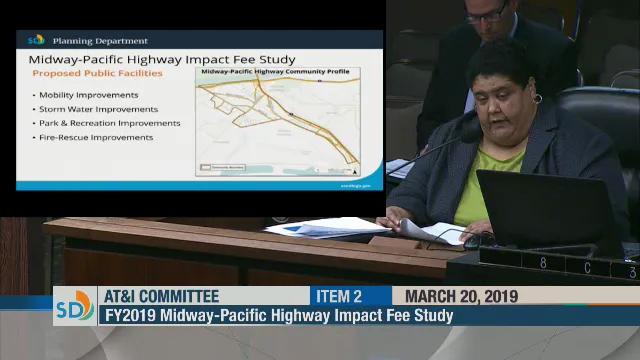
The San Diego City Council Planning Committee met on March 20, 2019, at 10:15 AM to consider two items: a 2% increase to the Regional Transportation Congestion Improvement Program (RTCIP) fee for FY2020, and the approval of the Fiscal Year 2019 Midway Pacific Highway Impact Fee Study (IFS). Both items were recommended for approval by the full City Council. The meeting was adjourned in memory of the Plaza de Panama project. Consent Calendar - Committee members unanimously approved the meeting minutes from February 20, 2019. Public Comments & Testimony - No public comments were made on non-agenda or agenda items. Discussion Items - Item 1: Regional Transportation Congestion Improvement Program (RTCIP) Fee Adjustment for FY2020 – Scott Mercer of the Planning Department presented the proposal. The RTCIP, established under the TransNet Extension Ordinance, requires annual adjustments based on the construction cost index, with a minimum of 2%. The SANDAG Board voted on February 22, 2019, to increase the exaction by 2% for FY2020. Staff recommended the City adopt the same increase to maintain compliance. The new fees would be $2,950 for single-family dwelling units (up from $2,892) and $2,360 for multifamily units (up from $2,314). Accessory dwelling units and affordable housing units are exempt. The committee voted unanimously to recommend approval. - Item 2: CFY 19 Midway Pacific Highway Impact Fee Study – Angela Abeda and Marco Camacho of the Planning Department presented the study. The IFS replaces the 2005 Midway Public Facilities Financing Plan and serves as the implementation document for the recently updated Midway Pacific Highway Community Plan. The IFS includes approximately 80 new projects, such as active transportation improvements (bike paths, cycle tracks, pedestrian projects), roadway upgrades (Rosecrans, Midway Drive, Sports Arena Boulevard), stormwater improvements, and park projects totaling nearly 28 acres, including a 17,000 square foot recreation center at Hancock and Kurtz Streets. Fair share contributions are included for a recreation center and aquatic complex at Liberty Station, as well as fire station improvements (Station 8 in Uptown, Station 15 in Ocean Beach, and a new station in Midway Pacific Highway). No new police or library facilities are proposed. The proposed residential impact fee is $7,618 per unit, a 4.5% decrease from the current fee. Non-residential fees are $533 per average daily trip (ADT) and $164 per 1,000 square feet of development. The Midway Pacific Highway Planning Group unanimously recommended approval on January 16, 2019. The committee voted unanimously to recommend approval to the full council. Key Outcomes - The committee voted unanimously to recommend City Council approval of the 2% RTCIP fee increase for FY2020. - The committee voted unanimously to recommend City Council approval of the Midway Pacific Highway Impact Fee Study and associated development impact fees. - The meeting was adjourned in memory of the Plaza de Panama project, which was originally scheduled as item three but was not discussed.
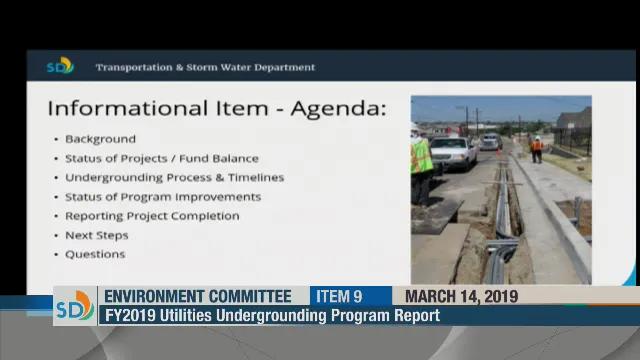
The Environmental Committee met on March 14, 2019, with committee members Moreno, Bree, Sherman, and the chair present. The meeting covered adoption of previous minutes, public comments on various environmental issues, and informational presentations on climate action, urban forestry, Clean SD program, and creek restoration. No formal votes were taken on substantive items. Consent Calendar - Approved committee actions from February 14, 2019, by a unanimous vote (motion by Sherman, second by Moreno). Public Comments & Testimony - Justin Daniel (president, California Native Plant Society San Diego chapter) and Frank Landis (conservation chair, CNPS) testified on the Fiesta Island Master Plan and its Programmatic Environmental Impact Report (PEIR). They raised concerns about inadequate protection for sensitive plants and animals, noting that rare plants require disturbance (e.g., from dog walkers) rather than fencing, and that the landscaping palette incorrectly includes Mexican fan palm as coastal sage scrub. They urged a better map of the preserve and use of the Bradley method for vegetation management. - Ann Fage and Frank Landis also commented on urban forestry, advocating for increased tree planting to meet climate goals, separate irrigation zones for street trees, and continued watering during droughts. They noted the current 35% canopy goal may be unrealistic and recommended funding professional staff and contract dollars in the 2020 budget. - Several other speakers addressed the Clean SD program, requesting more work in District 8 (Councilwoman Bree noted only 82 of 3,000 tons removed came from Chollas Creek in that district), and praised the program's effectiveness in the San Diego River area. - A resident shared a positive experience with solar installation through Grid Alternatives, highlighting reduced greenhouse gas emissions and community benefits. Discussion Items - Climate Action Plan Update: Committee discussed progress toward mobility targets (biking, walking), vehicle miles traveled reduction, and costs. Staff noted annual reporting and a 2020 update will be prepared. Councilmember Sherman asked about user fees for bicycles and breakdown of vehicle types (electric vs. internal combustion). - Urban Forestry and Tree Canopy: Informational item on tree benefits, current canopy cover, and need for funding and professional staff. Discussion included future climate adaptation, separate irrigation zones, and drought management. - Chollas Creek Restoration: Presentation on channel improvements to reduce flooding, including creation of a tributary to allow water to return to the river. Councilmembers asked about maintenance and design. Staff clarified that the project aims to prevent habitable space damage during rare flood events. - Clean SD Program: Report on trash removal (3,000 tons total, including 82 from Chollas Creek in D8). Councilmember Bree stressed need for more work in District 8. Councilmember Sherman praised public-private partnerships along the San Diego River. - Vegetation Management: Staff noted the program replaces trees at a 2:1 ratio for safety/wildfire concerns, with community input on relocation. Key Outcomes - No formal actions were taken; all items were informational or public comment. - The next scheduled meeting is Thursday, April 18, 2019, at 1:00 PM, with a focus on urban forestry and tree canopy. - The committee will hear the Fiesta Island Master Plan in April/May 2019, with earlier resolution of plant and animal issues requested.
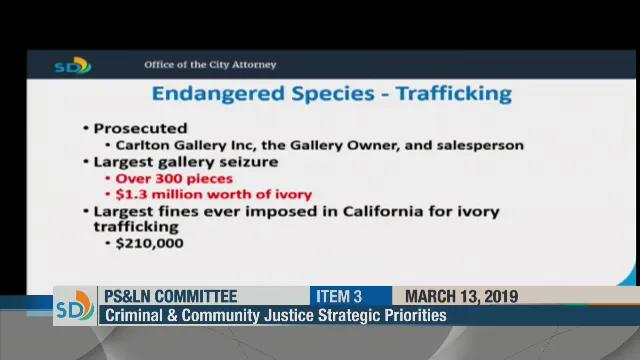
The Public Safety and Livable Neighborhoods (PSNLN) Committee of the San Diego City Council, chaired by Councilmember Monica Montgomery, met on March 13, 2019, to hear public comment, receive an overview of the City Attorney’s Criminal and Community Justice Division, and discuss two items related to recreation center funding and governance. The meeting featured extensive public testimony on police accountability, the chokehold ban, and the death of Aaliyah Jenkins, as well as deliberation on equity in recreation programming. Public Comments & Testimony - Jerry Hall (San Diego resident) urged the committee to remove two Confederate monuments from public parks (Horton Plaza Park and Mount Hope Cemetery), providing historical documentation. - Unnamed speaker (Alpha Square resident) proposed creating a 10th council district focused on homelessness and a satellite city outside San Diego for shelter and services. - Jim Varnador (City Heights resident) asked the committee to research why the Mid-City police division has strong community relations before making policy changes regarding the police department. - Becky Johnson expressed opposition to marijuana outlets and consumption lounges, citing public safety risks and urging the committee to attend planning group meetings where such businesses are debated. - Kate Yavendetti (Women Occupy San Diego, National Lawyers Guild) supported Chair Montgomery’s priority to place a charter amendment on the November 2020 ballot to convert the Community Review Board into an independent commission. - Anita Turner called for a ban on the chokehold (carotid restraint) by police, noting that six seconds can cause permanent damage or death. - Desiree Smith shared that her 15-year-old son was choked by police at school; she urged a ban on the technique. - Yamish alleged discrepancies between hospital toxicology reports and the coroner’s report in a death case, arguing police misconduct. - Alara Chilton (San Diego La Raza Lawyers Association) requested a complete ban on the carotid restraint, citing disproportionate use on people of color and the impossibility of applying it safely. - Youssef Miller (Racial Justice Coalition) supported the “I Can’t Breathe” campaign and called for a ban on the chokehold, referencing deaths of Robert Branch, Eric Smith, and Aaliyah Jenkins. - Aletha criticized two male committee members for inattentiveness, and questioned who oversees the police, naming Chris Michelle as a stealth figure. - Tasha Williamson (Racial Justice Coalition) presented demands regarding Aaliyah Jenkins’ death: release unedited body camera footage, fire Officer Lawrence Durbin, create clear policies for medical assistance, and support Assemblymember Shirley Weber’s Aaliyah Jenkins Law. She warned of escalating protests. - Darwin Fishman (Act of San Diego, Racial Justice Coalition) urged the committee to take bold action on chokehold bans and police oversight, noting that the police chief rejected previous reform proposals. - Britney M. called for accountability of officers who are disrespectful and unprofessional, citing the Aaliyah Jenkins case. - Kelly McCormick advocated for warning signs at marijuana outlets, citing health risks for pregnant women, children, and drivers, and pointing to data from states like Washington. - Kayla Jenkins (Aaliyah’s mother) disputed the medical examiner’s report, stating her daughter’s cause of death was not fentanyl overdose but lack of oxygen due to police negligence. She demanded release of the video and justice. - Vicky White (San Diego citizen) emphasized racial bias in policing and called for justice for Aaliyah Jenkins. During the City Attorney’s presentation, about 20 minutes in, the public gallery began chanting “Say her name – Aaliyah Jenkins” and demanding answers. Chair Montgomery called a recess and met with the community for about 10 minutes. After resuming, the presentation continued. Several additional speakers, including Tasha Williamson and others, reiterated demands for the video release, officer firing, and an ordinance criminalizing denial of medical assistance by police. Discussion Items City Attorney’s Criminal and Community Justice Division Overview (Information Item) - John Hemling (Assistant City Attorney) and Nicole Crosby (Chief Deputy City Attorney) presented the division’s vision, caseload statistics, and strategic priorities for 2019. - The division handles approximately 20,000 case submissions per year, prosecuting over 15,000. Key priorities include: preventing predictable gun violence (via Gun Violence Restraining Orders), the Community Justice Initiative (diversion for low-level offenders), the SMART program (transitional housing for chronic offenders with drug addiction), the PLEADS pilot program (immediate diversion to services), victim services coordination, combatting elder abuse in independent living facilities, human sex trafficking enforcement, and environmental/marine protection. - Public comment: Mr. McConnell criticized the SMART program’s small scale (20 beds) and lack of transparency, questioning the city’s overall approach to homelessness and criminal justice. - Committee members asked for data on illegal dumping prosecutions, health and safety receiverships, and expansion of the SMART program. Councilmember Moreno noted the Palm Avenue motel failure and requested locations other than the non-viable coastal property. Chair Montgomery asked about the effects of guilty pleas in the Community Justice Initiative. Approval of Fiscal Year 2020 Recreation Center Fund Budgets - Herman Parker (Director of Parks and Recreation), Shelley Stoll, and Sarah Orazzo presented the budget request. The funds ($3.9M in 2018, projected $4.3-4.4M in FY20) are generated from class registrations and permit surcharges, collected at each recreation center. - Councilmember Moreno highlighted stark inequity: Carmel Valley Recreation Center’s FY20 programming budget is $355,000, while the Robert Eger Center in District 8 has only $26,000. She requested a plan to improve equity. - Vice Chair Bree provided context on the history of recreation councils, the transition to city control after embezzlement cases, and the formation of the Parks Foundation focused on equity. - Councilmember Kate raised concerns about Prop 13 implications if funds are transferred between centers, and cautioned against pitting neighborhoods against each other. He suggested using the city budget to fund programs in underserved areas. - Motion (Councilmember Moreno): Approve staff’s recommendation and have the department return to the committee within 90 days with a plan to improve funding equity. The motion was seconded by Vice Chair Bree and passed unanimously. Amendment of Council Policy 700-42 (Recreation Advisory Groups) - Staff presented the revised policy, developed by a working group from December 2017 to January 2019, replacing recreation councils with recreation advisory groups. Key provisions: groups must comply with the Brown Act, have minimum five members, adhere to bylaws, and provide input on budgets. Companion administrative guidelines were also presented. - Councilmember Moreno proposed an amendment to add language under Article 3, Section 2: “The department will establish a plan to improve funding equity across all recreation center funds, and will prepare an annual progress report on recreation programming funding equity to be presented to the city council committee on public safety and livable neighborhoods.” - The motion was seconded. The transcript ends before a vote is recorded; the committee appeared supportive but the final outcome is not captured in the record. Key Outcomes - Motion to approve FY2020 recreation center fund budgets passed unanimously, with a directive for the Parks and Recreation Department to return to PSNLN within 90 days with a plan for improving funding equity. - Motion to amend Council Policy 700-42 with transparency and equity language was made and seconded; the official vote is not recorded in the transcript. - The committee received the City Attorney’s presentation on the Criminal and Community Justice Division’s strategic priorities; no formal action was taken. - Extensive public testimony highlighted community demands for police accountability, a ban on the carotid restraint, release of the Aaliyah Jenkins video, and an ordinance to criminalize denial of medical assistance by police.