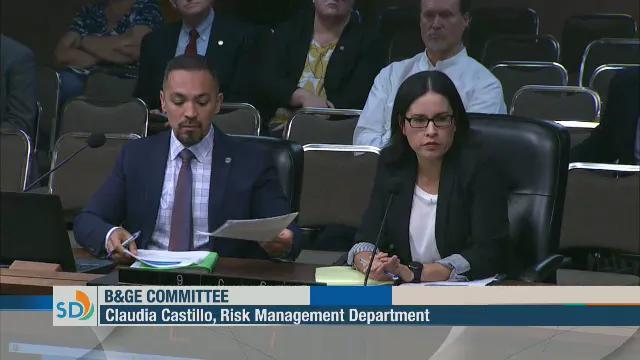
The Budget and Government Efficiency Committee met on October 17, 2018, at 9:00 AM (local time) with Chair Bry, Councilmember Kate, and Councilmember Gomez present (Vice Chair Ward absent). The committee reviewed several items including the FY2018 year-end financial report, a proposed ordinance regulating Segway rental businesses, software and copier contracts, and updates on the minimum wage program and network services transition. The meeting lasted approximately 2.5 hours. Public Comments & Testimony - Non-Agenda Public Comment: Martha Welch spoke about library book sales, plastic bag enforcement, and franchise fees. Chris Hart was deferred to item 3 (Sharp copier contract). - Item 4 (Year-End Report): Martha Welch opposed franchise fees, arguing they burden consumers and claiming the city uses them to pay for services. - Item 1 (EPAMD Ordinance): Bridget Bazone, a former Segway tour guide, expressed concerns about lack of operator outreach, uncertainty about the code of conduct, weight limit enforcement, and helmet requirements. Kenneth Lippman, a Segway tour operator for 12 years, argued that the ordinance was prompted by a single rogue operator, noted rising insurance costs, and questioned the requirement to name the city as an additional insured. - Item 3 (Sharp Copier Contract): Chris Hart from Sharp Electronics highlighted past savings and expressed excitement about the new contract. Discussion Items - Item 4: FY2018 Year-End Financial Report – The Department of Finance presented final unaudited results. Total general fund resources were $1,434.3M (up $4.5M, 0.3% variance) and expenditures $1,418.2M (down $6.8M, 0.5% variance). The net increase of $11.3M resulted in excess equity of $10.8M above required reserves. Councilmember Gomez questioned fire department staffing (net loss of 22 full-time positions, higher attrition, one academy budgeted), police department staffing (219 sworn officers short, new marketing campaign, declining attrition), and parks water consumption (increased costs due to drought recovery). Councilmember Kate asked about cannabis tax revenue ($2.7M), sales tax variance ($10M delayed due to state software glitch), fire recruitment challenges (8 of 36 conditional offers declined), and contract reclassification ($9M for 101 Ash lease moved to debt). Both requested a list of vacancies by department. - Item 1: EPAMD (Segway) Rental Business Ordinance – Risk Management proposed an ordinance requiring permits, insurance ($2M/$4M), safety rules, and a code of conduct. The permit fee of $48 is 100% cost-recoverable. Councilmember Gomez noted that only 2 of 7 identified operators were contacted after the draft was complete, and he moved to forward the item to full council without recommendation, directing staff to work with operators to address concerns about insurance requirements, the code of conduct, and lack of prior outreach. The motion passed unanimously. - Item 2: Spin Effects Software Amendment – The Department of IT requested approval to increase the contract by $221,000 to $461,795 and extend the term by up to seven years for a payroll reporting tool. The committee approved unanimously. - Item 3: Sharp Electronics Copier Contract – A cooperative procurement contract with a five-year not-to-exceed amount of $6.38M, projected to save over $1M. The new model uses a hardware lease plus low per-page cost. The IBA noted potential future savings by reducing desktop printers. The committee approved unanimously. - Item 5: Minimum Wage Program Update – The Office of the City Treasurer reported on enforcement and outreach. Since the ordinance took effect in July 2016, the program has handled complaints and tips, with 10 proactive directed investigations launched in FY2019. Outreach included presentations, business walks, and a PSA campaign. Councilmember Gomez praised the improved responsiveness and requested a breakdown of accommodation vs. food service complaints. Councilmember Kate asked about employer outreach for the upcoming wage increase to $12 in January 2019 and confirmed that investigations are typically employer-wide to protect complainant confidentiality. This was an information item only. - Network Services Transition Update – The Department of IT reported that Zensar Technologies assumed management of the city's network in July 2018. Transition milestones are nearly complete, with priority one incidents down from 5.5 to 0.4 per month and resolution times improved by 55%. About 60-70% of network infrastructure is near end of life, and an 18-month replacement plan is in development. Councilmember Kate and Gomez praised the progress. This was an information item only. Key Outcomes - Item 4: Year-End Report – Accepted as information; no vote required. - Item 1: EPAMD Ordinance – Motion to forward to full council with no recommendation and direct staff to work with operators passed 3-0 (Chair Bry, Councilmembers Kate and Gomez in favor; Vice Chair Ward absent). - Item 2: Spin Effects Software – Approved unanimously (3-0). - Item 3: Sharp Copier Contract – Approved unanimously (3-0). - Item 5: Minimum Wage Program – Information only; no vote. - Network Services Transition – Information only; no vote.

Public Meetings - San Diego, California
Public Meetings - San Diego, CaliforniaOn October 17, 2018, the Smart Growth and Land Use Committee of the San Diego City Council met to discuss the San Diego Forward 2019-2050 Regional Plan (RTP) and approve a lease with the San Diego Rowing Club. Committee members present: Councilmember Staff, Councilmember Sherman, and Councilmember Gomez (Chair). Councilmember Alvarez was absent. The meeting was called to order at 10:00 AM. Consent Calendar - The committee unanimously approved the records of action from September 19 and September 27, 2018, with Councilmember Alvarez absent. - The consent agenda was adopted without any items pulled, with a motion by Councilmember Sherman and second by Councilmember Staff. The committee noted a request to register support from Tom Rucote. Public Comments & Testimony - Non-Agenda Public Comment: - Scott Chipman, reading on behalf of Dr. Renette Lev (Chief of Emergency Department at Scripps Mercy Hospital), opposed the commercialization of marijuana in San Diego. He cited increased emergency visits for marijuana poisoning (doubled since 2010, five times since 2005) and described cases of cannabis hyperemesis syndrome, seizures worsened by THC, and a patient on life support from inhaling high-THC wax. He stated that 462 deaths in San Diego in 2016 had THC in their systems, including a one-year-old baby. - Kelly McCormick criticized the hearing officer's approval of a marijuana cultivation and manufacturing facility in a business condominium complex, arguing the system is weighted in favor of marijuana businesses. She noted that neighboring businesses (Biogeneral and Abbott Labs) objected due to risks of airborne particulates and odors that could force shutdowns. She stated there are no established compliance criteria or timely process for remedying complaints. - Martha Welch expressed concerns about affordable housing, Section 8, and county policies. She claimed that the area's AMI (Area Median Income) keeps rising, making affordable housing unclear, and criticized the county for receiving federal HUD funds without proper oversight. She also mentioned vacant buildings near the trolley. - Public Comment on Item 3 (RTP): - Sophie Wolfram (Climate Action Campaign) supported the staff recommendation to request mode share data from SANDAG. She emphasized that the city needs 2035 mode share outcomes for transit priority areas (TPAs) for each concept. She noted that SANDAG provided such data in 2015 and should do so again. She also requested SANDAG develop a scenario maximizing mode shift within revenue constraints and another to show what would be needed to meet city targets. - Gretchen Newsom (IBW Local 569) expressed disappointment with the concepts, raising concerns about meeting GHG targets, reducing air pollution in environmental justice communities, and the absence of new light rail projects like the Purple Line. She supported the staff recommendation. - Maya Rosas (Circulate San Diego) supported the recommendation, noting that data is critical for informed decisions. She stated that more transit projects need to be advanced from the 2015 plan, including planning for the Purple Line. - Ana Reynosa (Environmental Health Coalition) supported the recommendation and echoed concerns about the lack of compliance with the city's Climate Action Plan (CAP) and equity element. She urged deprioritizing freeway expansions and prioritizing mass transit, especially in environmental justice communities. - Public Comment on Item 2 (Rowing Club Lease): - Dan O'Neill (representing the San Diego Rowing Club, UCSD, and USD) spoke in favor, highlighting the club's public programs, including free learn-to-row classes, leadership courses for low-income schools, and services for disabled veterans. Discussion Items - Item 3: Report from SANDAG on the San Diego Forward 2019-2050 Regional Plan - Marcus Bush (policy advisor for Councilmember Gomez) introduced the item, noting coordination with SANDAG since the July 25 committee meeting. He emphasized the need to determine consistency with the city's CAP. - Colleen Clemenson (SANDAG Principal Planner) presented the RTP process. Key points: - The region is projected to grow by 700,000 people by 2050, with most growth in urbanized areas. - Compared to the 2015 plan, construction costs are up 15-20%, revenue assumptions are down 16% (from $205B to $180B), and the state GHG reduction target increased from 13% to 19% per capita by 2035. - Three concepts were released for public review: Concept A (Shared Mobility) focuses on transit and rapid bus; Concept B (Connected Corridors) focuses on managed lanes; Concept C (Policy Possibilities) includes programs and policies to maximize GHG reductions. - All concepts include the entire regional bike network, managed lanes on I-5, I-805, SR-78, SR-52, increased trolley and coaster/sprinter frequency, and rapid bus on managed lanes. - Concept C could achieve a theoretical 22% GHG reduction but may require tolling and other policies that could overburden low-income communities (Title VI concerns). - SANDAG is seeking public input through surveys and workshops. The board will select a preferred scenario in April 2019, with a final plan by winter 2020. - Mode share data is currently available only at the regional level, not city-specific. SANDAG is willing to provide data but noted that city-level analysis would require additional work. - Councilmember Sherman asked about the 2015 plan's performance, mode share progress, and the methodology for bike mode share goals. He noted that the bike path along I-15 appears underutilized. SANDAG responded that the 2015 plan had no mode share goals (only GHG targets), and the city's CAP sets its own targets. A regional plan monitoring report is forthcoming. - Councilmember Gomez emphasized the city's stake (40% of regional population) and the need for city-specific data to advance CAP goals. He clarified that the city is not asking for SANDAG to meet all CAP goals, but for data to understand the plan's impact. He called for a vote on the motion. - Item 2: Lease with San Diego Rowing Club and Intercollegiate Rowing Consortium - Vladimir Belotsky (Supervising Property Agent) presented the item: a 25-year public purpose lease for a 1-acre land and 0.03-acre water area in Mission Bay Park (1220 El Carmel Place). The facility is a 17,000 sq. ft. rowing center built in 1989, used by UCSD and USD (250 athletes) and the public. Current lease is month-to-month since 2013. The new lease includes: - Base rent of $25,672 plus $8,500 annual rent for deferred leasehold improvements. - Lessee to invest $850,000 in capital improvements. - Term: 25 years with two options for extension (10 and 5 years). - Rent guided by Council Policy 708 (33% of average commercial rent for Mission Bay). - The city receives improved assets at lease end. - Councilmember Sherman asked about public access. Dan O'Neill clarified that the public can use the facility through free learn-to-row programs, visitor memberships, or paid use. Monthly membership is $75. - Councilmember Gomez supported the lease, noting the club's long history (since 1888) and positive community impact. Key Outcomes - Item 3 (RTP): The committee unanimously approved a motion (Councilmember Staff, seconded by Councilmember Gomez) directing staff to work with SANDAG to provide the city with mode share data (for transit priority areas), vehicle miles traveled, and GHG reductions at the city level, and to bring draft network scenarios to the City Council in early 2019. The vote was 3-0 (Alvarez absent). - Item 2 (Rowing Club Lease): The committee unanimously approved a motion (Councilmember Sherman, seconded by Councilmember Staff) to recommend approval of the 25-year lease with the San Diego Rowing Club and intercollegiate rowing consortium. The vote was 3-0 (Alvarez absent). - The meeting adjourned at approximately 11:00 AM. The next regular committee meeting is scheduled for December 5, 2018, at 1:00 PM.
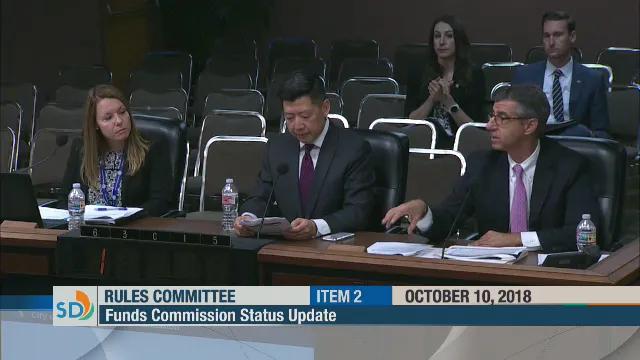
The Rules Committee of the San Diego City Council met on Wednesday, October 10, 2018, at approximately 10:00 AM. Committee members present were Council President Pro Tem Bree, Councilmember Kate, and Vice Chair Kercy. Councilmember Ward was absent. The committee approved the minutes from the September 12, 2018 meeting and then heard three agenda items: a proposed response to a grand jury report on the citizens initiative process, a status update from the Funds Commission, and an update on the Get It Done program. Consent Calendar - The committee approved the record of actions from September 12, 2018, via a roll call vote. A motion was made by Councilmember Bree, seconded by Councilmember Kate, and passed unanimously with Bree, Kate, and Vice Chair Kercy in favor; Councilmember Ward absent. Public Comments & Testimony - Joy Sanyata (District 3) spoke on non-agenda public comment, requesting clarification on her speaker slip. Later, she spoke in favor of the Get It Done update, praising city employees and expressing concern about prioritizing resources given budget constraints. She also noted the city's strategic plan goals. Discussion Items Item 1: Proposed Response to Grand Jury Report "Improving the San Diego Citizens Initiative Process" - A staff member (from the Independent Budget Analyst's Office) presented the proposed joint response from the Mayor, City Council, and City Attorney. The response addresses four findings and one recommendation from the grand jury report filed on May 23, 2018. The proposed responses: agree with Finding 1; partially disagree with Findings 2, 3, and 4 because cited state statutes do not apply to San Diego as a charter city and because the city already provides voter education. For Recommendation 18-20 (consider a standard practice of commissioning an impact report), the proposed response is "will not be implemented because it is not warranted," citing legal background, existing voter education, and resource constraints. The committee forwarded the approved response to the full city council. - Vote: Motion by Councilmember Kate, second by Councilmember Bree, passed unanimously (Bree, Kate, Kercy; Ward absent). Item 2: Status Update from the Funds Commission - Liz Correa (Deputy Director of Financial Operations), David Tam (Funds Commission Chair), and Mike Lavin (Canterbury Consulting) presented an overview of the six trust funds supervised by the Commission: Edwin A. Benjamin Memorial Fund, Fee Sergeant Memorial Fund, Los Penasquitos Canyon Preserve Fund, Gladness Edna Peters Memorial Fund, Jane Cameron Library Fund, and Mount Hope Cemetery Perpetuity Fund. Each fund has a long-term investment strategy; most are allocated 65% stocks and 35% bonds, except Mount Hope (65% bonds, 35% stocks) due to charter restrictions on income-producing securities. - Performance: The Los Penasquitos Fund has compounded at just over 7% annually net of fees over 22 years, outperforming its benchmark by 0.7% and 80% of its peer group. Over the last decade, it compounded at just under 7%, outperforming 85% of peers. The Mount Hope Fund, with a different objective, has compounded at just over 5% since 1997. - Discussion: Councilmember Kate asked about limitations and distributions. David Tam explained that the Los Penasquitos Fund distributes 5% of its market value quarterly (1.25% per quarter) for preserve maintenance. The IBA noted that in FY18, Mount Hope Cemetery operations were subsidized by the General Fund by approximately $580,000. The IBA also asked about active management; funds use institutional mutual funds except Mount Hope, which is managed by Northern Trust with individual securities. No action required, as this was an informational item. Item 3: Get It Done Update - Alex Hempton (Program Manager) and Sam Brummet (Program Coordinator) from Performance and Analytics presented. The Get It Done program launched as a pilot in May 2016 and expanded in October 2017 with a new contract. Expansion launched in summer 2018, adding services such as passport appointments, hazmat appointments, parking violations, missed trash collection, and other Environmental Services requests. Before expansion, average monthly reports were 12,700; after expansion, the average is 18,680 (a 47% increase). In September 2018, a record 22,540 reports were submitted. The city is on track to exceed 500,000 reports by the end of the fiscal year. Over 48,000 mobile app users have contributed to 332,000 total reports. Top reports include vehicles, graffiti, and illegal dumping. New internal systems replaced legacy applications. Future plans include online trash container purchases, Spanish language mobile app options, and additional code enforcement complaint types. - Discussion: Councilmember Bree asked about frequent users and how many requests come via phone/email. Councilmember Kate asked about security for online transactions (testing underway), read-only access for council offices (exploring options), and data visualization tools. Vice Chair Kercy praised the app's growth and suggested clearer messaging for street repaving requests. Council President Pro Tem Bree noted illegal dumping on freeways and inquired about Caltrans coordination; staff indicated they refer issues but lack update tracking from external partners. No action required, as this was an informational item. Key Outcomes - Approved consent calendar (minutes from September 12, 2018). - Forwarded Item 1 (grand jury response) to the full City Council with a unanimous vote. - Received informational updates on Items 2 and 3; no votes taken.
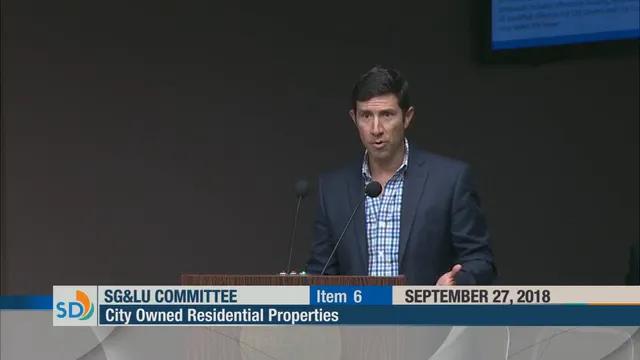
The Smart Growth and Land Use Committee met on October 3, 2018, to discuss key agenda items including a major long-term lease at Brown Field Municipal Airport, the Airport Division's FY2019 business plan, and a review of city-owned residential properties. The committee approved consent items and voted unanimously on the airport lease, directing staff to prepare additional financial analysis for full City Council consideration. Consent Calendar - The committee approved the records of action from September 19, 2018, by unanimous consent. - Three consent items were approved without pull: the Cannon Street Pocket Park (noted for preserving Portuguese heritage in Roseville), an agreement with the FAA regarding the Brown Field tower (operating agreement with no compensation, attached to the land lease), and other routine items. Public Comments & Testimony Item 4 – Brown Field Airport Lease: Six speakers expressed support. Clarissa Falcon (on behalf of South County Economic Development Council) read a letter stating full support for the redevelopment concept and ground leases, calling the project essential for Otay Mesa's long-term economic stability. Richard Sachs (developer, Metropolitan Air Park) provided detailed testimony on the project's history, infrastructure investment, and economic benefits; he yielded time from several other speakers. Robert Pippen and Jason Christopher (for MAP) yielded their time to Sachs. Alejandra Mier y Ibarra (Otay Mesa Town Council) expressed excitement and urged support. Item 6 – City-Owned Residential Properties: Two speakers addressed the committee. Joyce Sanyata (District 3) thanked staff for the report but noted that only 22 of 1,600 properties (0.013%) were identified as suitable, calling it a metaphor for the housing crisis; she asked about funding in the Capital Outlay Low-Income Unit Purchase Fund. Gilman Bishop (local real estate developer) suggested creating a “surplus with restrictions” list to allow developers to negotiate directly on sites not immediately available, citing missed opportunities for affordable housing. Discussion Items Item 4 – Long-Term Ground Lease at Brown Field Municipal Airport (MAP Project): Thurman Hodges (Real Estate Assets, Airport Division) presented a request for a resolution authorizing the mayor to execute 59 leases, right-of-entry agreements, and an agreement for rent offset with Metropolitan Air Park, LLC, covering 207 acres. The project includes four phases over 20 years, with private financing ($119M minimum infrastructure investment, $26M Phase 1 investment). No public money is used. The 50-year lease term commences per parcel. Rent is based on $6,500/acre appraised value (February 2018) at 10% return ($650/acre/year), with CPI adjustments capped at 3% annually for first five years, then market rate appraisals every 10 years (years 21, 31, 41) without caps. Total benefits to the Airport Enterprise Fund estimated at $1.4 billion (including $300M rent) and $400M to the General Fund. The developer (MAP) has already spent $32M on entitlement and will invest $200M in infrastructure. MAP will pay $250,000/year advanced rent for five years to offset loss from an existing tenant, recoupable from future rent above $250,000 baseline. Mitigation includes 36 acres off-site (acquired) and 46 acres on-airport (pending FAA and USFWS approval). Fuel flowage fees, 2% transfer fees on hangar/office sales, and possessory interest taxes are additional revenue sources. Committee members asked detailed questions about rent structure, financial projections, and transparency. Councilmember Alvarez noted the project's importance to Otay Mesa and moved to approve staff's recommendation with a request for additional financial analysis for the full council. The motion passed unanimously. Item 5 – Airport Division Business Plan for FY2019: Rod Prop (Deputy Director for Airports) presented the business plan, developed in response to a 2014 performance audit. Goals include safe and efficient operations, financial self-sufficiency, FAA compliance, customer focus, environmental stewardship, and staff training. The airport fund is financially sound: $45M total assets, $4M liabilities, $16M cash. The fund generates $2M annually in fuel flowage fees ($210K at Brown Field, $125K at Montgomery, total 2.1M gallons pumped). Recent achievements include 100% staffing, completed master plans for both airports (fast-tracked in 18-24 months), and elimination of holdover leases. No public comments were received. The item was informational only; no motion required. Item 6 – Review of City-Owned Residential Properties: Mary Carlson (Real Estate Assets) presented the results of a comprehensive review of 1,600 city-owned properties to identify those suitable for housing development. After eliminating properties in use as parks, police/fire stations, long-term leases, etc., and manually reviewing zoning, 22 properties were identified as potentially suitable for residential development (mostly vacant land, some as small as 0.16 acres). An additional 251 non-residentially zoned properties were reviewed; 8 under three acres were deemed sellable, and 15 are more challenging (odd shapes, landlocked). The city does not speculate in real estate; properties are typically acquired for public projects. Sale proceeds go to the Capital Outlay Fund unless specified otherwise (e.g., enterprise funds). Next steps: staff will process the 22 properties through the clearance process, notify affordable housing developers, and use brokers to reach buyers. If multiple offers include affordable housing, council selects the buyer. Councilmembers discussed the need to make properties available quickly, the role of community plans (e.g., Grantville), and the workload of the Real Estate Assets department. Chair Gomez suggested posting challenging properties on the website to spur unsolicited interest. No action was taken as the item was informational. Key Outcomes - Consent Agenda: Approved unanimously. - Item 4 (Brown Field Lease): Motion to approve staff recommendation, with a request to provide additional financial analysis for the full City Council meeting, passed unanimously (Alvarez motion, Sherman second). - Item 5 (Airport Business Plan): Received as information; no vote required. - Item 6 (City-Owned Properties): Received as information; staff to continue processing identified properties and consider posting all available sites online for developer inquiries. - Next Meeting: Scheduled for October 17, 2018 at 2:00 p.m.
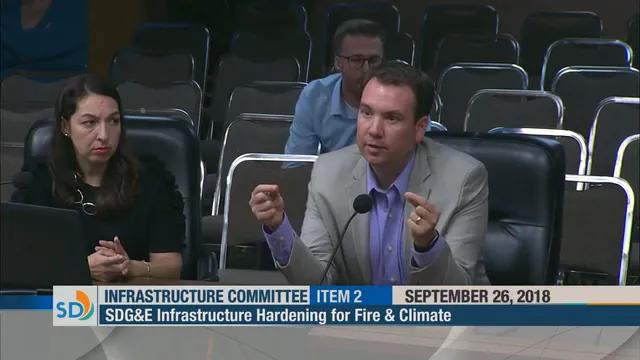
The Infrastructure Committee met on Wednesday, September 26, 2018, at 2:00 PM. Vice Chair Alvarez and Councilmember Ward were present, with condolences extended to Councilmember Zap for the loss of her father. The meeting included public comments, discussion and approval of multiple award design-build contracts for pipeline projects, and a presentation on utility vegetation management. Consent Calendar - No consent agenda items were presented. Public Comments & Testimony - Robert Buck, a retired plumber and resident of American Park, expressed concern that the city is being scammed by unnecessary sewer pipe replacement. He stated that the pipes he examined were in good condition and could function for 2,000 years, and urged the committee to reconsider the project. - Martha Welch, a resident of Park Boulevard and University, complained about a three-year construction delay, saying the work is broken and causing bus detours. She also referenced a prior approval and expressed frustration with the project's duration. - Renee Smith spoke in support of revising Council Policy 814, related to the Strategic Asset Management Plan (SAMP). She recommended bundling projects to achieve economies of scale and criticized the current piecemeal approach. Discussion Items - Approval of Five Multiple Award Design-Build (MAC) Contracts for Water, Wastewater, and Stormwater Pipeline Projects - Mark Nassar, Deputy Director of Public Works, and Jim Shamlefard, Senior Civil Engineer, presented the item. The MAC contracts are for up to $100 million; individual projects under $30 million can be awarded by mayoral action, while those over $30 million require City Council approval. Six firms were shortlisted, and five were selected; three of the five are new to the program, as three previous contractors chose not to participate. Councilmember Ward expressed concern about the threshold and requested additional information on the reasons previous firms opted out. Vice Chair Alvarez seconded a recommendation to approve the contracts with the condition that staff provide further details before the full council vote. The committee approved the motion. - Presentation on Utility Vegetation Management for Wildfire Mitigation - A representative from San Diego Gas & Electric (SDG&E) presented on the company's vegetation management plan and collaboration with the city and county to reduce wildfire risk. Councilmember Ward praised the proactive approach and preventive measures. No action was taken; the item was informational only. Key Outcomes - The committee approved the five MAC contracts for pipeline projects, contingent on staff providing additional information about the firms' reasons for not participating in the new round. - No formal action was taken on the utility vegetation management presentation. - The next regularly scheduled committee meeting was set for October 24, 2018, at 2:00 PM. The meeting was adjourned.
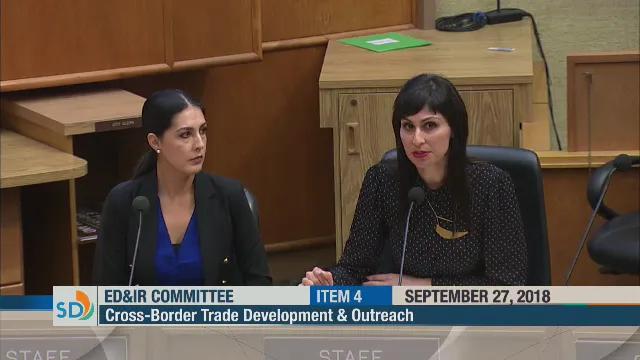
This was a special joint meeting between the San Diego Economic Development and Intergovernmental Relations Committee and the Tijuana Commission on Tourism, Commerce, and Sister Cities. The meeting focused on cross-border trade, tourism, and economic development, with presentations from Tijuana officials and the San Diego Tourism Authority. No actions were taken; all items were informational. Consent Calendar - The minutes from the July 26, 2018 meeting were approved by unanimous consent. Public Comments & Testimony - Rob Gordon, a self-employed professional from Pacific Beach, expressed frustration with the city's lack of responsiveness to the needs of self-employed workers and small business owners. He noted that the county has been more supportive, implementing policy changes he recommended. He also criticized the focus on job numbers rather than measures like startup activity or work hours per working-age adult. Discussion Items - Tijuana Commission Presentation: Chair Casillas Rivera presented on Tijuana's economic development efforts, including a fast-track business opening program, a trust fund (Fondos Tijuana) to support entrepreneurs, and border crossing improvements such as signage for Ready Lane and collaboration with CBP. Key statistics shared: over half a million California jobs depend on cross-border trade, $2.5 billion in trade in the region, and over 300% growth in the last two decades. Councilmember Brie inquired about tracking cross-border tourism numbers; Tijuana officials noted they receive monthly immigration data, including a 30% increase in Chinese tourism. - San Diego Tourism Authority Presentation: Candice Ely (Director of Communications) and Edna Gutiérrez reported on efforts to grow hotel visitation from Mexico, including the first year of consumer direct advertising in Mexico and hiring a Mexican PR firm. They discussed plans to improve the San Ysidro entry experience as "America's finest front door" and mentioned future code compliance and permitting needs. Councilmember Brie asked about ROI measurement; the authority indicated they would develop standard reporting similar to tourism marketing district metrics. Key Outcomes - No motions or votes were taken. All presentations were informational. - The committee expressed support for continued cross-border collaboration and noted the importance of trade and tourism to the regional economy. - The next meeting of the Economic Development and Intergovernmental Relations Committee is scheduled for October 25, 2018, at 2 p.m.
The Budget and Government Efficiency Committee convened on September 20, 2018, at 9:30 a.m. with Chair Bree, Vice Chair Ward, and Councilmember Kate present. The committee reviewed the proposed FY2020 budget development calendar, a response to a grand jury report on corporate partnerships, and updates to two council policies on marketing partnerships and endorsements. Three members of the public provided testimony during non-agenda public comment. Consent Calendar - The committee record of actions from the July 25, 2018, hearing was approved by unanimous consent with no requests for discussion. Public Comments & Testimony - John Contoppels (President/CEO of Elite Security, a San Diego-based company) urged the committee to issue a long-overdue RFP for security services at the SDCCU stadium site. He stated that the previous five-year contract to a Los Angeles company expired on June 30, 2018, and local vendors have been waiting six months for the opportunity to bid. - Martha Welch (District unspecified) expressed concerns about budget transparency, alleging that the city has hidden funds by repeatedly building the same projects (e.g., ClearView and a pump station) without completion. She also argued that Mission Bay Fund revenues are improperly diverted to the general fund instead of being used for parks as intended. - Joy Sunyata (District 3) proposed using the city's 1,600 properties and over 100,000 acres of real estate assets to pay off the pension debt, freeing up nearly a billion dollars over ten years to address homelessness and the housing crisis. She emphasized that the money is available and the city must act now. Discussion Items - Item 1: FY2020 Budget Development and FY2019 Budget Monitoring Key Dates Chris Olson (Office of the Independent Budget Analyst, IBA) presented IBA Report 18-27, outlining the proposed calendar for budget development and monitoring. Key dates included: October 1, 2018 – call for Capital Improvement Program (CIP) priorities; November 2018 – release of the five-year financial outlook and first quarter report; April 12, 2019 – mayor's proposed budget; May 1–14, 2019 – Budget Review Committee hearings; June 10, 2019 – council approval. Councilmember Gomez requested adding an early evening public hearing to ensure community participation early in the process, not just at the end. The committee approved the calendar with this amendment. - Item 2: Proposed Response to Grand Jury Report on Corporate Partnership Development Program Lisa Byrne (IBA) presented the proposed response to the San Diego County Grand Jury report (filed June 4, 2018) with nine findings and three recommendations. The committee agreed with most findings (e.g., that Council Policy 000-40 does not list all sponsorship types, that quarterly tracking was not done, and that conflict-of-interest disclosures were lacking) and partially disagreed with others (e.g., that all agreements were not identified, and that files were incomplete). The response recommended implementing updates to the policy. The committee voted to forward the response to the full City Council. - Item 3: Revised Council Policy 000-40 – Marketing Partnerships Natasha Kalura (Executive Director of Corporate Partnerships) presented revisions to the 1999 policy to align with current business practices and grand jury recommendations. Key changes included expanding the definition of marketing agreements, requiring annual reporting of net revenue and in-kind benefits, and adding conflict-of-interest disclosure clauses. The IBA suggested minor clarifying amendments (e.g., adding "services" to the definition, clarifying disclosure requirements, and noting that corporate partnerships does not track departmental contracts). The committee approved the policy as amended. - Item 4: Revised Council Policy 000-41 – Product Endorsements Natasha Kalura presented updates to the 2000 policy to allow vendors to list the city as a client and to permit limited, one-time endorsements (e.g., for social media, community events) valued at up to $25,000 without full council approval, enabling quicker response to opportunities. The IBA recommended clarifying that the use of identifiable city assets applies to any advertising platform. The committee approved the policy as amended. Key Outcomes - Approved the FY2020 budget development calendar with an additional early evening public hearing (motion by Councilmember Gomez, second by Vice Chair Ward, unanimous). - Approved the proposed response to the grand jury report on corporate partnerships and forwarded it to the full City Council (motion by Vice Chair Kate, second by Vice Chair Ward, unanimous). - Approved the revised Council Policy 000-40 on marketing partnerships as amended by the IBA (motion by Vice Chair Ward, second by Councilmember Gomez, unanimous). - Approved the revised Council Policy 000-41 on endorsements as amended by the IBA (motion by Councilmember Gomez, second by Vice Chair Ward, unanimous). - The committee adjourned and will reconvene on October 17, 2018, at 9:00 a.m.
The Public Safety and Livable Neighborhoods Committee met on September 19, 2018, to discuss several major items: proposed responses to two grand jury reports (on the Resource Access Program and the Community Review Board on Police Practices), an update from dockless scooter share providers, and adoption of the 2020-2024 Consolidated Plan goals. The meeting included extensive public testimony on scooter safety and other issues. Public Comments & Testimony - Scooter-Related Comments (majority of public speakers): - Multiple downtown residents (e.g., Jonathan Freeman, Vicky Mann, Dennis Weinschenker, Carol Eisman, Doreen DeAvery, and others) expressed strong opposition to the current scooter operations, citing dangers to pedestrians, blocked sidewalks, ADA access issues, lack of enforcement, and insufficient company accountability. Many called for an immediate moratorium, reduced fleet size, or a cease-and-desist order until regulations are in place. - Representatives from scooter companies (Kwa Wynne for Lyft, Yasmani Muscoso and Matt Anton for Lime) spoke in support, highlighting job creation, environmental benefits, and planned safety improvements. - Mike Lynch suggested scooter designs with seats for stability. - Alan Peterson and others reported unsafe riding on boardwalks and sidewalks at the beach. - Lieutenant Colonel Gapp (retired Air Force) emphasized pedestrian safety and provided cards with rules for riders. - Cindy Jones (ADA advocate) noted scooters block curb cuts, forcing wheelchair users into streets. - William Perno (Central Region Prevention Coalition) praised the RAP program for its past success in identifying public health threats. - RAP Program Comment: William Perno spoke in strong support of the RAP program, citing its role in detecting spice poisonings and hepatitis A, and urged its restoration. - CRB Comments: Darwin Fishman (Activist San Diego/Racial Justice Coalition) criticized the CRB for lack of diversity and inadequate oversight, noting the failure to ban chokeholds. Brittany McLean also called for stronger civilian oversight and a chokehold ban. Discussion Items - Proposed Response to Grand Jury Report: Resource Access Program (RAP): Chris Olson (Office of the IBA) presented the city's proposed response, which partially disagrees with some findings and agrees with others. The report clarifies that RAP was not a pilot but a formal program, and its paramedics were withdrawn due to AMR staffing shortages. The city will include a RAP component in the upcoming EMS RFP (expected Q4 2018). The committee voted unanimously to forward the response to full council. - Update from Dockless Scooter Share Providers: Representatives from Bird, Razor, and Lime presented their safety and technology improvements, including geofencing for speed reduction, parking enforcement, data sharing, and educational campaigns. The San Diego Police Department reported issuing over 2,200 helmet citations and numerous other citations in 2018. Committee members (Councilmember Zaf and Gomez) expressed concerns about sidewalk riding, parking, liability, and lack of city revenue. The mayor's office stated it is working on a regulatory framework. No action was taken; the item was informational only. - Proposed Response to Grand Jury Report: Community Review Board on Police Practices (CRB): Chris Olson presented the city's proposed response, agreeing with some findings and partially disagreeing with others. The response notes that the implementation ordinance for Measure G was approved in August 2018, and CRB vacancies have been filled. The committee voted unanimously to forward the response to full council. - Adoption of FY2020-2024 Consolidated Plan Goals: Stephen Medoli-Williams and Michelle Morano (Economic Development) presented the proposed goals for the five-year consolidated plan, based on extensive community outreach. The seven goals focus on affordable housing, economic development, public infrastructure, homelessness, community services, and nonprofit facility improvements. The committee also recommended authorizing the city to designate the County of San Diego as the alternative grantee for the HOPWA program. The vote was unanimous to forward to full council, with Councilmember Gomez requesting that the final agreement with the county come to council as an informational item. Key Outcomes - RAP Grand Jury Response: Unanimously passed (voice vote) to forward to city council. - CRB Grand Jury Response: Unanimously passed (voice vote) to forward to city council. - Consolidated Plan Goals and HOPWA Authorization: Unanimously passed (voice vote) to forward to city council, with the addition that the HOPWA agreement be presented to council for informational purposes. - Scooter Discussion: No action taken; committee directed mayor's office to expedite a regulatory framework.
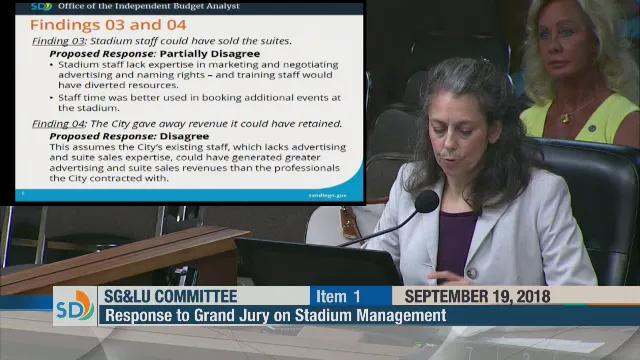
The Smart Growth and Land Use Committee, chaired by Councilmember Gomez, met on September 19, 2018, at 10:15 AM. The committee considered three action items and one informational item, including a response to a grand jury report on stadium management, amendments to planning consultant contracts, the Old Town San Diego Community Plan update, and an update on inclusionary affordable housing regulations. Public testimony was heard on several topics. Consent Calendar - Approval of Minutes (July 25, 2018): The committee records of action for July 25, 2018, were approved by unanimous consent with no discussion. Public Comments & Testimony - Martha Welch: Expressed concerns about housing planning, stating that San Diego builds too many studios and one-bedroom units and not enough two- and three-bedroom units. She alleged corruption in the county and referenced the SSE scandal, claiming the FBI is involved. She also noted that 70% of senior housing is occupied by illegal immigrants who don't pay rent. - Peggy Walker (Smart Approaches to Marijuana, local chapter): Called for more transparency in the approval process for marijuana production facilities (MPFs). She noted that 40 approved MPFs could each hold up to four state licenses, potentially becoming 160 businesses. She requested that the city notify businesses within 300 feet, enforce posting of notices, and notify businesses when applicants appear before planning groups. - Judy Strang (PTA, Health Vice President): Expressed concern about parents' ability to speak on MPF issues. She noted that in the Kearny Mesa planning group, light industrial areas planned for residences are being taken over by MPFs. She also raised concerns about 14 billboards advertising marijuana around the city, visible to children. - Kelly McCormick: Highlighted public health issues: an FDA crackdown on e-cigarettes due to a 116% increase in teen vaping in one year, a survey showing nearly 1 in 11 U.S. students have used marijuana in e-cigarettes, and a University of Michigan study showing pot use among college students at a 30-year high, with fewer perceiving harm. - Scott Chipman: Noted that today's marijuana has 15-30% THC (vs. 2-5% in the past) and edibles can be 50-99% THC. He stated that California's black market is 8-10 times larger than legal production, that less than 40% of promised tax revenues have materialized, and that 20% of industry-tested marijuana tests positive for E. coli, fungus, and other contaminants. He questioned why the industry gets carve-outs compared to other businesses. Discussion Items - Item 1: Proposed Response to Grand Jury Report – "San Diego Continues to Lose Money on Stadium Management" - Lisa Byrne (Office of the Independent Budget Analyst) presented the proposed response to the grand jury report, which was filed May 22, 2018. The report includes 11 findings (numbered 1-12, no finding 7) and four recommendations directed to the mayor and city council. The response is due to Superior Court by November 16, 2018. The proposed responses include agreeing with some findings and partially disagreeing or disagreeing with others. For recommendations, the city asserts that policies are already implemented. The committee unanimously voted to forward the approved response to the full city council. - Item 2: First Amendments to As-Needed Planning and Traffic Engineering Consultant Contracts - Brian Schoenfish (Planning Department) presented the proposed amendments to increase contract capacity: $2.5 million for each of three planning consultants and $1 million for each of two traffic engineering consultants. No budget or expiration date changes are proposed. The amendments are needed to continue work on community plan updates (Kearny Mesa, Claremont, Mission Valley, University, Mira Mesa) and to use a $2 million SANDAG Smart Growth Incentive Program grant that must be spent by January 2021. The committee unanimously voted to forward the recommendation to the full council. - Item 3: Old Town San Diego Community Plan Update - Vicky White and Elizabeth Ocambo (Planning Department) presented the update, which replaces the 1987 plan. Key features: 11 subdistricts, increased residential capacity from 570 to 1,400 units, with 80% in a Transit Priority Area. The plan includes an updated Plan District Ordinance (PDO) to preserve historic character, multimodal mobility improvements (pedestrian, bicycle, transit connections), and a roundabout concept at a key intersection. Parks and recreation needs are met via Presidio Community Park and trail improvements. The plan received unanimous support from the Technical Advisory Committee, Code Monitoring Team, Park and Recreation Board, Historic Resources Board, Design Review Board, and the Old Town Community Planning Group. The Planning Commission also voted unanimously to recommend adoption. The committee voted unanimously to recommend approval to the city council. Informational Item - Update on Inclusionary Affordable Housing Regulations - Laura Gates (Council District 9) and Jenny Vander Hyde (San Diego Housing Commission) provided an update on efforts to revise the city's inclusionary housing regulations, as part of Councilmember Gomez's 2017 Housing Action Plan. A 25-member stakeholder committee has been formed. The current ordinance has collected over $140 million in fees since inception, producing 2,977 affordable rental units from fee revenues and 1,864 units from on-site production. Assembly Bill 1505, signed in 2017, reaffirms local government authority to require affordable housing. The city is considering changes, and the Housing Commission has contracted with Kaiser Marston Associates to conduct economic analyses: a financial feasibility analysis, a fee level analysis, and a nexus analysis. The analyses will be posted for 30 days in December 2019. The committee received the update without a vote. Key Outcomes - Approved Consent Calendar: Minutes of July 25, 2018, approved unanimously. - Voted to Forward Grand Jury Response: Motion by Councilmember Sherman to send the proposed response to the full council, approved unanimously. - Voted to Forward Consultant Contract Amendments: Motion by Councilmember Sherman to approve staff recommendation and forward to council, approved unanimously. - Voted to Recommend Old Town Community Plan Update: Motion by Councilmember Sherman to approve staff recommendation and forward to council, approved unanimously. - Next Meeting: Thursday, September 27, 2018, at 9:00 AM.
The San Diego City Council met on September 13, 2018, to discuss items related to solid waste management, recycling, and stormwater maintenance. The meeting included public comments, approval of consent calendar items, and unanimous votes on several action items. Consent Calendar - Approved the record of action items from the August 2, 2018 meeting by unanimous consent. - Approved consent items 1 through 5 unanimously. Public Comments & Testimony - Martha Welch spoke during non-agenda public comment, criticizing the city's sewer system as outdated and accusing the city of lying about its management. - Jerry Rivero (Environmental Health Coalition) gave an update on the Barrio Logan Clean Air and Safe Streets Ordinance (truck route), noting a unanimous committee vote on April 12, 2018, and requesting a clear timeline and commitment from the city to prioritize the route. - Jim Ambrosa (Resource Management Group) supported the proposed franchise agreement amendments, emphasizing the impact of China's National Sword policy and urging continuation of organics programs. - Clarissa Falcon (Dart Container) expressed support for the seventh amendment to the curbside processing contract and offered a public-private partnership to help with transportation costs and connect recycled polystyrene to domestic markets. - Clarissa Falcon (on Item 6, representing Biomed Realty) praised the stormwater department for its work on Roselle Street flooding and advocated for a holistic approach to channel maintenance. Discussion Items Item 9: District Exclusive Collection Study - Mario Sierra (ESD) and Ken Prue presented the R3 consulting study comparing the current non-exclusive system to a districted exclusive system. Staff recommended against a districted system due to negative impacts on small haulers and customer rates, as seen in Los Angeles. - Instead, staff negotiated with haulers to incorporate key benefits: 100% alternative fuel packer trucks by 2025, roll-off trucks by 2028; road impact mitigation via a $1/ton franchise fee increase in 2019 and again in 2022 (each generating $800,000/year for the general fund); extension of agreement terms from 7 to 12 years (through 2030); and no increase in diversion requirements beyond 50% by 2020 due to market uncertainty. - Councilmember Gomez questioned whether the fee increase could be directed to road maintenance; city attorney stated fees go to the general fund and cannot be earmarked. - Motion to receive the report and accept staff recommendation carried unanimously. Item 10: Amendments to Non-Exclusive Solid Waste Franchise Agreements - Ken Prue presented amendments mirroring the negotiated elements from Item 9: 12-year term, alternative fuel vehicle requirements, road impact fees, and flexibility on diversion requirements. - Chair Alvarez expressed concern about the long term given market uncertainty, but Jim Madaffer (San Diego County Disposal Association) explained the longer term is needed to amortize equipment investments. - Councilmember Gomez moved to approve staff recommendation and asked the city attorney to explore directing the $1/ton fee increase to road maintenance. - Motion carried unanimously. Item 7: Seventh Amendment to Curbside Materials Processing Contract - Ken Prue detailed the impact of China's National Sword policy: recycling revenue dropped from $4 million in FY17 to $3 million in FY18, with FY19 budgeted at $0. The amendment suspends guaranteed revenue and modifies revenue sharing to ensure the city is revenue-neutral at worst; no payments are made to the contractor. - Councilmember Sherman moved to approve the amendment and requested the mayor's office work with industry on a public-private partnership for polystyrene recycling. Chair Alvarez noted the partnership discussion was not agendized but allowed the motion. - Motion carried unanimously. Item 8: Miramar Recycling Center Service Contract Amendment - Ken Prue presented the eighth amendment to extend the contract with Allen Company through December 31, 2022, and require installation of a $500,000 stormwater management system. The facility serves 125,000 customers annually and generates nearly $15,000/month in rent. - Motion to approve carried unanimously. Item 6: Stormwater System Maintenance Annual Report (Informational) - Drew Kleist, Christine Rothman, and Roger Womack presented on channel maintenance efforts in FY18 (Tijuana River Pilot, Smugglers Gulch, Salola Channel), planned work for FY19/20, wetland mitigation costs ($350,000–$575,000 per acre), and winter storm preparations (pump station checks, pre-storm sweeping, road closure gates). - Council members inquired about specific channels (Nestor Creek, South Choyas, Alvarado Creek) and mitigation bank purchases. - No action required; the item was informational. Key Outcomes - All action items (consent, items 9, 10, 7, 8) were approved unanimously. - Direction given to staff to provide a written update on the Barrio Logan truck route. - City attorney directed to investigate directing the franchise fee increase to road maintenance. - Mayor's office to work with industry on a polystyrene recycling partnership. - Informational report on stormwater maintenance received.