Browse by city
Date range
Search help

Search titles, summaries, topics and stored transcripts together. Keywords may match separately; put the whole query in double quotes for a phrase. Matching follows word analysis, so punctuation is not exact. Both dates are included. Documents are not searched.

SHOWING 911–920 ENTRIES
911
JUN 13, 2018 · SAN DIEGO, CALIFORNIA · PUBLIC SAFETY & LIVABLE NEIGHBORHOODS COMMITTEE
Public Safety and Livable Neighborhoods Committee Meeting Summary – June 13, 2018

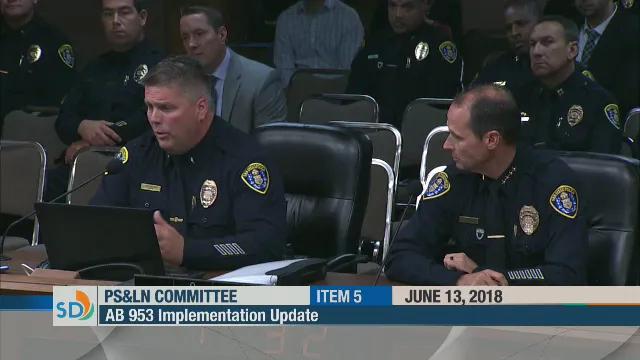
The Public Safety and Livable Neighborhoods Committee met on June 13, 2018, at 9:00 AM (the meeting began at 17:15 UTC but local time is inferred) to discuss maintenance assessment districts, a police recruitment marketing contract, implementation of AB 953 (Racial and Identity Profiling Act), summer beach operations, and red light abatement enforcement. The committee approved consent and action items and received informational updates. Consent Calendar - The committee unanimously adopted the record of action items from April 25, 2018, and approved a single consent agenda item without discussion. Public Comments & Testimony - Francine Maxwell (District 4 resident) shared concerns about police stops in Southeastern San Diego, citing a recent incident where Latino youth were stopped by the gang suppression unit. She urged honest dialogue, promotion of a town hall with Chief Nislight, and community engagement in the police marketing effort. - Christy Hill (ACLU of San Diego & Imperial Counties) called for an annual racial impact report from SDPD, questioned compliance with AB 953 data collection, and highlighted disparities shown in a 2016 SDSU study (e.g., Black and Latino drivers were nearly twice as likely to be searched despite being less likely to have contraband). She asked for commitments to local data analysis and policy updates. Discussion Items - Maintenance Assessment Districts (MADs) – Items 2 & 3: Staff presented the 2019 annual reports for 64 park and recreation and economic development MADs, explaining the assessment process and that no changes to apportionment methodology were permitted. Councilmember Gomez praised the streamlined process. The committee approved a motion to forward the items to council (motion by Councilmember Gomez, second by Vice Chair Bree; passed unanimously). - Contract with Loma Media Partners for Police Recruitment Branding – Item 4: Chief David Nislight and Captain Richard Friedman reported a 39% decline in police applications from 2014 to 2017 and 520 officers eligible for retirement in five years. The two-year, $350,000 contract (with optional extensions up to $1 million total) would create a branding and marketing campaign targeting 20-30 year olds via social media and video. Councilmembers expressed strong support, emphasizing the need to diversify the force and engage the community. Loma Media representatives discussed their digital strategy and focus group plans. The committee approved the contract unanimously, with a requirement for an annual progress report (motion by Councilmember Gomez, second by Councilmember Zaf). - AB 953 (RIPA) Implementation Update – Item 5: Lieutenant Jeff Jordan detailed the new data collection requirements effective July 1, 2018, including 17+ questions per stop and up to 60 response options. SDPD chose the San Diego Sheriff's Department web application (allowing local data analysis) over the DOJ system. Training for all officers began with in-person sessions and online modules, including a message from Chief Nislight. The department committed to releasing data via the city’s open data portal. Public testimony raised concerns about compliance and need for local analysis. No vote required; the item was informational. - Summer Beach Operations Update – Item 6: Captain Tina Williams and Lieutenant Steve Waldheim presented the 2018 summer plan. Memorial Day weekend drew 350,000 visitors; 4th of July expected over 800,000. Officers will focus on high visibility, scooter enforcement (over 200 citations on Memorial Day weekend), DUI checkpoints, and addressing noise, fire pit regulations, and oversized vehicle camping. Councilmembers discussed scooter safety, enforcement challenges, and coordination with other agencies. Informational only. - Red Light Abatement Enforcement Report – Item 7: Assistant City Attorney John Hirling and Deputy Patricia Miranda explained the abatement process under Penal Code sections 11225-11235, working with SDPD's VICE unit. In 2017, eight massage parlors were closed; four have been closed in 2018, with approximately 15 cases under investigation. Councilmember Gomez requested improved communication about complaints and outcomes. Informational only. Key Outcomes - Consent Calendar and Items 2 & 3 (MADs): Approved unanimously; referred to full council. - Item 4 (Loma Media Contract): Approved unanimously; annual reporting requirement added. Total contract value up to $1 million over five years. - Items 5, 6, 7: Received as informational; no votes taken. - Next Meeting: July 11, 2018, at 9:00 AM.

PUBLIC SAFETY 33% · POLICE OVERSIGHT 14% · POLICE RECRUITMENT 13% · PROCEDURAL 9%
912
JUN 13, 2018 · SAN DIEGO, CALIFORNIA · RULES COMMITTEE
San Diego Rules Committee Meeting Summary – June 13, 2018

The Rules Committee met on June 13, 2018, to consider multiple ballot measure proposals for the November 2018 election, primarily focusing on reforms to San Diego Unified School District board elections, city charter amendments, and other governance issues. The meeting included public testimony, presentations from proponents, and committee discussions. Key outcomes included advancing one school board election reform proposal to a second discussion in July, rejecting another, and directing the city attorney to draft a November-only elections measure for further review. Several other proposals were discussed but not moved forward. Consent Calendar - Approval of the committee record of actions from May 16, 2018, by unanimous consent. Public Comments & Testimony - Non‑agenda public comment: Two speakers addressed the committee on separate topics. The first speaker urged the committee to consider a continuance process to allow more time for public input on high‑volume items. The second speaker, Jean Brown representing the League of Women Voters, expressed concern that two stadium ballot propositions (for the November ballot) would imply those were the only development options, and urged placing a third option before voters to clarify the city's land‑use responsibilities under the general plan. - School board election proposals (sub‑items B, C, F, H, M, N, W): Numerous residents and community leaders spoke in favor of various reform proposals. Speakers such as Francine Maxwell, Lorraine Burley, John Stump, Jeff Bennett, and others advocated for district‑only elections, term limits (typically two four‑year terms), independent redistricting, and increased board membership. Some speakers criticized the school district's current process as resistant to change, citing low public confidence and declining enrollment. A few speakers opposed certain proposals, arguing that more study was needed or that the proposals did not address broader educational needs. - Item Y (charter modernization for vacancy savings): A representative from the Mayor’s office explained the proposal to streamline hiring and return vacancy savings to departments. Public testimony included support from labor unions (POA and MEA) via letters; no opposition was voiced. - Sub‑item V (November‑only elections): Andrea Guerrero (representing several organizations) spoke against ranked‑choice voting, citing potential voter confusion and suppression, but supported a November‑only system with a top‑two or similar method. Others expressed general support for increasing voter participation. - Sub‑item L (city auditor appointment): John Stump and the Independent Budget Analyst (IBA) supported removing mayoral influence from auditor appointments, arguing the audit committee should appoint and council confirm. - Sub‑item D (ethics reform): Robert Odley spoke in favor of his ethics reform proposal, noting similar successful measures in Los Angeles and support from the Grand Jury, League of Women Voters, and Chamber of Commerce. - Sub‑item I (repeal of the People’s Ordinance): Proponents argued the current ordinance is outdated, costs millions annually for temporary housing, and hinders climate goals; an opponent cited equal‑protection concerns. - Sub‑item Q (budgeting standards for zoological exhibits): John Stump and Renee Smith urged the committee to enforce existing lease requirements for budget and diversity reports from the zoo operator. - Sub‑item P (veterans recognition and preference): Bob Moltz requested a charter amendment for veterans preference; the city attorney noted that much could be achieved through municipal code changes without a ballot measure. Discussion Items - School board election reform proposals (sub‑items B, C, F, H, M, N, W): The committee grouped these under item 1 (ballot measure proposals). Presentations included: - Sub‑item B (Sally Smith): Proposed district‑only elections, term limits, and increased board size, with independent redistricting. - Sub‑item C (Lorraine Burley): Focused on term limits (two four‑year terms) and sub‑district only elections, citing survey results showing 81% support for term limits. - Sub‑item F (Brett Kazlovka / Community Voices for Education): Advocated for term limits, district‑only elections, and a nine‑member board, arguing the school district has resisted change. - Sub‑item H (Jeff Bennett): Proposed independent redistricting based on school clusters. - Sub‑item M (John Stump): Called for equal dignity with city council—nine district‑only seats and term limits. - Sub‑item N (John Stump): Proposed breaking the unified district into five neighborhood elementary districts and a high school/community college district. - Sub‑item W (Tamra Hurley): Similar to Smith’s proposal but emphasized phased implementation. - Item Y (charter modernization – vacancy savings): Presented by councilmember co‑sponsors. The goal is to speed hiring and fill vacancies by returning savings to departments. The city attorney noted several charter sections would need amendment. - Sub‑item V (November‑only elections): Councilmembers Kate and Kirser presented two options: ranked‑choice voting or a top‑two runoff in November. Public comment raised concerns about voter confusion with ranked‑choice; proponents argued it could increase participation. - Sub‑item L (audit committee and city auditor): The IBA and John Stump supported removing mayoral appointment of the auditor and having the audit committee appoint instead, to strengthen council oversight. - Sub‑item D (ethics reform): Covered salary adjustments for elected officials and other ethics rules. - Sub‑item I (repeal of People’s Ordinance): Discussed the impact on waste collection fees and city sustainability goals. - Sub‑item O (trash collection): Briefly mentioned but not voted on. - Sub‑item Q (zoological exhibits budgeting): Addressed lack of budget transparency from zoo operator. - Sub‑item P (veterans preference): Committee members expressed strong interest and committed to working with the city attorney on municipal code changes. Key Outcomes - School board reform – sub‑item T (Sharon Whitehurst‑Payne): Motion by Councilmember Bree, seconded by Councilmember Cole, to advance to the July 11th rules committee for second discussion. Passed 3‑2 (Bree, Ward, Cole in favor; Kirser, Kate opposed). - School board reform – sub‑item F (Brett Kazlovka): Motion by Councilmember Kate, seconded by Councilmember Kirser, to advance. Failed 2‑3 (Kate, Kirser in favor; others opposed). - November‑only elections (sub‑item V): A motion was made (apparently by Councilmember Kate) to direct the city attorney to draft a ballot measure for the July 11th meeting, with options including ranked‑choice voting or a top‑two system. The motion was supported and the city attorney agreed to bring back draft language for committee discussion. No formal vote recorded in the transcript, but the committee proceeded on that basis. - All other proposals (sub‑items B, C, H, M, N, W, Y, L, D, I, O, Q, P): No motions were made to advance these to the July meeting or to the ballot. Several committee members expressed interest in further study or alternative actions (e.g., sending to other committees, pursuing municipal code changes). - Next meeting: The next Rules Committee meeting will be held on Wednesday, July 11, 2018.

PUBLIC COMMENT 17% · ELECTION PROCEDURES 12% · EDUCATIONAL POLICY 9% · PUBLIC ENGAGEMENT 7%
913
MAY 23, 2018 · SAN DIEGO, CALIFORNIA · BUDGET & GOVERNMENT EFFICIENCY COMMITTEE
Budget and Government Efficiency Committee Meeting - May 23, 2018

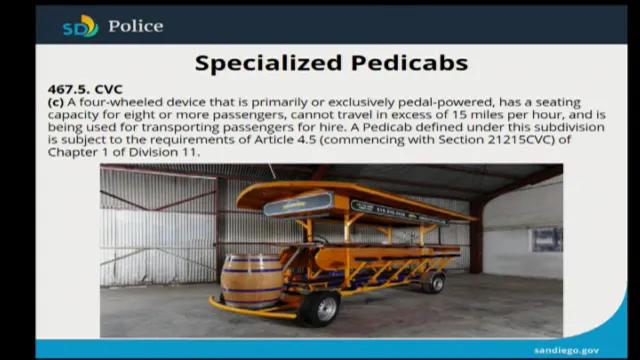
The meeting was called to order by Chair Bree with a quorum of Councilmembers Ward, Kate, and Gomez. The committee approved the minutes from the April 18 and 19, 2018 meeting by unanimous consent with no discussion. The meeting then proceeded through non-agenda public comment and four action items: revisions to pedicab regulations, a medical examination and drug testing contract, a marketing agreement for a helicopter filter donation, and an EcoPass transit benefit agreement for city employees. Consent Calendar - The committee record of actions from April 18 and 19, 2018 was approved by unanimous consent with no items pulled for discussion. Public Comments & Testimony - Non-Agenda Public Comment: Two speakers addressed the committee regarding urban forestry funding. - Virginia Wilson requested funding for the urban forestry program: two additional full-time employees for the five-year plan, $300,000 for the street tree program, and restoration of $900,000 that had been cut. She noted that the total of $1,004,000 represents less than one-tenth of one percent of the budget after the May revision. - Ann Feige, chair of the Community Forest Advisory Board, expressed disappointment that the urban forestry program may not be funded in the current budget year. She asked how the city can align its general plan, community plan updates, climate action plan, and five-year actions to achieve implementation. She noted that the mayor added $300,000 for the free tree program last year but that it may end. - Public Testimony on Agenda Item 1 (Pedicab Regulations): Multiple speakers provided comments. - Jewel Denoviev: Supported the proposed fare disclosure requirement but asked for stronger language to ensure passengers know their rights. - Juan Vergan: Supported the proposed regulations, noting that good operators do not need excessive lights or music, and urged focusing on fare disputes. - Laura Rovic (owner of Social Cycle, a specialized pedicab): Expressed concern that language regarding lighting, pedal assist, and sound systems is subjective and requested clearer definitions. - Andrew Marshall (12-year pedicab driver): Opposed a total ban on lights and music, arguing they enhance the customer experience and safety visibility. Suggested instead focusing on enforcing fare rules. - Michael Vavrzynski (Pedicab Limo, San Diego Pedicab Association): Supported fare disclosure but opposed banning lights and music. He noted that lights improve safety and that the ban would reduce driver income. He presented 70 signatures from operators opposing the light and music regulations, with over 40 not informed of the meeting. - Samuel Wooden: Opposed removing lights, stating they are part of the city's atmosphere and customer experience. - Lucas Stames: Emphasized safety—lights make pedicabs highly visible; suggested police discretion for music volume. - Pat Moran (8-year pedicab operator): Supported fare disclosure and suggested industry-led enforcement. Argued against removing lights and music, citing examples of weddings and romantic tours. - William Gioko (6-7 years pedicab): Opposed a total ban on lights and music, sharing personal stories of customer enjoyment. Noted existing laws on sound decibels and asked for stricter enforcement against overcharging. - Ali Horuz (owner of BIP Petty Cabs): Agreed with fare disclosure but questioned enforcement and consequences for repeat offenders. Proposed a 40-watt limit for music speakers and allowing non-flashing LED lights for safety. Raised concerns that the pedal-assist ban has harmed his business, causing loss of 50 drivers. - Nicole Kane (San Diego Pedicab Association): Presented the association's goals to improve industry standards, including a training program, uniform pricing, and collaboration with the police department. Discussion Items - Item 1: Pedicab Municipal Code and Fee Revisions - Acting Lieutenant Daniel Meyer and Sergeant Brian McGilvere of the San Diego Police Department Vice Unit presented proposed amendments to the municipal code governing pedicabs. The changes addressed public safety concerns: bright/strobing LED lights, loud sound amplification systems, pedal-assist devices, and fare disputes. The proposal also updated definitions to match California Vehicle Code categories (traditional pedicabs vs. specialized pedicabs) with corresponding fees. The specialized pedicab operator who was consulted agreed with the separate fee structure. - Councilmember Ward offered a motion with amendments: allow static single-color LED lights for safety, require rate structure signs on the outside of traditional bikes, allow e-assist technology (not fully motorized), allow small music devices not exceeding neighborhood decibel limits, and require display of operator permit/company name/contact information. Councilmember Gomez seconded. The motion passed unanimously. - Item 2: US HealthWorks Medical Contract - Assistant Personnel Director Garst and Deputy Personnel Director Cynthia Mitchell presented a five-year, $3.6 million agreement with US HealthWorks Medical Group to provide employment medical examinations, drug testing, and DMV medical exams. The contract estimate for FY19 is $517,666, with approximately 80% from the general fund. Only one proposer responded to the RFP. The evaluation committee included police and fire representatives. Councilmember Kate asked about past costs ($2.7 million over five years, spending $2.4 million). Vice Chair Ward inquired about the $600,000 annual general fund impact and whether it is in the FY19 budget. A staff member confirmed that annual appropriations will be based on need. The motion by Councilmember Kate, seconded by Vice Chair Ward, passed unanimously. - Item 3: Aerometals Marketing Agreement for Helicopter Filter - Battalion Chief Chuck McFarland (Air Operations) and Natasha Kaller (Executive Director of Corporate Partnerships) presented an agreement with Aerometals Inc. The company will donate an inlet barrier filter (valued at $220,000) for the city's new Sikorsky S70i helicopter. In exchange, the city will provide data evaluation and limited marketing rights (use of city name and images). Chief McFarland explained that the filter reduces engine erosion and should lower costs under the power-by-the-hour agreement with General Electric. The contract lasts up to five years. Councilmember Kate asked about warranties and was told both Sikorsky and GE have validated the filter. The motion by Councilmember Kate, seconded by Councilmember Gomez, passed unanimously. - Item 4: MTS EcoPass Agreement for City Employees - Gene Matter (Transportation and Stormwater Assistant Director), Steve Selnecker, and Travis Brady presented a five-year agreement with MTS for the EcoPass program, capped at $1 million per year. The program offers discounted transit passes to city employees (25% MTS discount plus city subsidies of 90% for MEA-represented employees and 75% for others). Participation has grown 44% over the prior five years. In FY18, there were 791 annual pass holders (661 MEA, 130 non-MEA). Councilmember Gomez asked about tying the program to the Transit Tuesday campaign; staff noted timing constraints but agreed to explore the idea. The motion by Councilmember Gomez, seconded by Vice Chair Ward, passed unanimously. Key Outcomes - Approved pedicab code amendments with modifications: static LED lights, outside rate signs, e-assist allowed, limited music devices, and operator/permit display. (Unanimous) - Approved the US HealthWorks five-year medical and drug testing contract not to exceed $3.6 million. (Unanimous) - Approved the marketing agreement with Aerometals accepting the filter donation in exchange for data and marketing rights. (Unanimous) - Approved the five-year EcoPass agreement with MTS for city employee transit benefits, capped at $1 million per year. (Unanimous) - The committee adjourned; next meeting scheduled for May 23, 2018 at 9:00 AM.

PEDICAB REGULATION 36% · PROCUREMENT 15% · NULL 12% · FIRE SAFETY 9%
914
MAY 23, 2018 · SAN DIEGO, CALIFORNIA · ACTIVE TRANSPORTATION & INFRASTRUCTURE COMMITTEE
San Diego Infrastructure Committee Meeting – May 23, 2018

The Infrastructure Committee met on May 23, 2018, to review the 101 Ash Street building lease and tenant improvement options, consider Fiscal Year 2018 Capital Improvements Program (CIP) budget revisions, approve the 2018 Regional Transportation Improvement Program (RTIP) update, award a consultant agreement for the Mission Bay Park programmatic EIR, and receive an update on the Infrastructure Asset Management Program. The committee approved most agenda items, including a split vote on 101 Ash funding. Consent Calendar - The committee approved the minutes from the April 25, 2018 meeting as distributed. No consent agenda was presented. Public Comments & Testimony - Mike Zuquet, representing the San Diego Municipal Employees Association (MEA), expressed full support for Scenario 4 for 101 Ash Street, which would renovate all 19 floors. He argued that doing the construction and improvements up front is the best long-term fiscal and operational path for the city, employees, and citizens. Discussion Items 101 Ash Street Building Lease and Tenant Improvements (Informational Item) - The city attorney clarified this was an informational-only item, precluding committee action. Substantive discussion was deferred to the CIP budget action (Item 1). - Staff (Stacey Lemetico, Assistant COO; Adam Jones, Senior Budget Coordinator; Sabelle Thompson, Real Estate Assets Director) presented a detailed history. The city entered a 20-year lease-to-own agreement in 2016, with the building's residual value estimated at $112 million. The original plan covered five floors ($5 million tenant allowance), but later space planning and delays led to four scenarios: - Scenario 1: Occupancy with no construction, requiring extensive outside lease space and yielding the highest 20-year cost. - Scenario 2: Construction on the first floor only, creating a one-stop shop for Development Services. - Scenario 3: Renovation of the original five floors (first, second, 17th, 18th, 19th). - Scenario 4: Renovation of all 19 floors, maximizing capacity and yielding the lowest 20-year cost. - Staff reported that Scenario 3 capital costs are estimated at $15 million and Scenario 4 at $27.2 million, with 20-year operating costs of $24.9 million and $5 million, respectively. Staff proposed a public bid with five floors as the base bid and an alternate for all 19 floors. - The Independent Budget Analyst (IBA) offered comments, noting that the original bids were canceled appropriately and that the new bidding structure would help the council weigh options. The IBA also noted that cost estimates may rely on high outside rent assumptions and suggested the committee consider timing for council hearings. - Councilmembers expressed frustration about the lack of communication since the 2016 approval. Councilmember Alvarez called the deal a "money pit," citing $18,000 per day in mortgage costs, and questioned whether to trust new cost estimates. Councilmember Ward preferred to proceed with bids while leaving open the choice between five and 19 floors. FY18 CIP Year-End Budget Monitoring Report and CIP Budget Revisions (Item 1) - Staff presented the sixth semi-annual CIP report, consolidating 94 individual actions, expediting nearly $120 million in funds, and saving an estimated 240 staff hours. The net CIP increase was $88.7 million. - The report included a $13.2 million appropriation for 101 Ash Street (with $5 million already appropriated, totaling $18.2 million), including $9.5 million from the Capital Outlay Fund and additional funds from IT, Arts and Culture, and Public Works Engineering funds. - The item was bifurcated: Subitem A (Hayes Avenue Storm Drain) was considered separately due to Councilmember Ward's conflict of interest. Subitem B covered all other CIP actions, including 101 Ash. - The IBA recommended that the 101 Ash funding portion be heard by the full council on June 18, alongside the 101 Ash project discussion, rather than on June 11 as originally scheduled. TransNet Local Streets and Roads Program 2018 RTIP Update (Item 2) - Staff presented the 2018 update of the Regional Transportation Improvement Program (RTIP). The fiscal year 2019 TransNet budget was proposed at $33.4 million, with 30% for street maintenance and 70% for congestion relief. The fund balance held at SANDAG was projected to decrease to $32.5 million, a 40% reduction from fiscal year 2016. Consultant Agreement for Mission Bay Park Programmatic EIR (Item 3) - Staff requested approval of a $5.8 million, phase-funded consultant agreement with DUDEC for environmental and engineering services to prepare a programmatic EIR for Mission Bay Park improvements. The three-year effort would cover projects such as wetland expansion, species preservation, and deferred maintenance. The first phase was funded at approximately $2 million. - Councilmember Zapf asked about ongoing projects like playgrounds and was assured that some exempt projects could move forward. Infrastructure Asset Management Program Update (Informational Item) - Aaron Noel, Infrastructure Asset Management Program Manager, reported that the IAM San Diego system went live to almost 2,000 end users across phase-one departments. The Strategic Asset Management Plan (SAMP) includes 25 recommended action items, including creation of an asset management leadership committee and policies for prioritization and financing. Key Outcomes - Minutes Approved: April 25, 2018 meeting minutes approved. - Subitem A (Hayes Avenue Storm Drain): Approved unanimously (3-0), with Councilmember Ward recused. - Subitem B (CIP revisions minus 101 Ash): Approved unanimously. - Subitem B (101 Ash funding): Approved 3-1, with Councilmember Alvarez dissenting. The committee requested that the council president consider hearing the 101 Ash funding item on June 18, separately from the rest of the CIP report. - RTIP Update (Item 2): Approved unanimously to forward to full council. - DUDEC Agreement (Item 3): Approved unanimously to forward to full council. - Asset Management Update (Item 4): Informational, no action taken. The next regularly scheduled Infrastructure Committee meeting was set for June 20, 2018.

REAL ESTATE 18% · CAPITAL IMPROVEMENT PLANNING 17% · PUBLIC ENGAGEMENT 13% · INFRASTRUCTURE MANAGEMENT 12%
915
MAY 21, 2018 · SAN DIEGO, CALIFORNIA · LAND USE & HOUSING COMMITTEE
Smart Growth and Land Use Committee Meeting - May 21, 2018

Date: May 21, 2018, 5:15 PM (UTC) | Location: San Diego City Hall The Smart Growth and Land Use Committee, chaired by Councilmember Georget Gomez, met to discuss a range of items including affordable housing preservation, a proposed middle-income housing incentive program, the Midway-Pacific Highway Community Plan update, and community parking district budgets. The meeting included public testimony, staff presentations, and votes on several items. Notable outcomes included forwarding the middle-income housing regulations and the Midway plan to the full City Council without recommendation, subject to further study on specific issues. Consent Calendar - The committee approved the meeting record of action from April 18, 2018 (noted as 2020 in transcript but corrected per actual date) by unanimous consent without discussion. Public Comments & Testimony - Marcella Escobar Eck (Chair, Code Monitoring Team) reported that since the code was adopted in 1997, over 38 ordinances and 11 code updates have been processed, with 18 volunteer members providing over 500 hours annually. She highlighted the team's work in keeping the code current. - John Zivarth (representing the Technical Advisory Committee) thanked the committee for providing a forum and mentioned work on streamlining measures. He suggested a historical review exemption for projects not identified in community plan surveys, such as Midway. - Kathleen LeBitt raised concerns about marijuana businesses operating with business tax certificates while pursuing conditional use permits, arguing that the city allowed them to continue without proper notification or oversight, displacing churches and others. - Maya Rosos (Circulate San Diego) presented a report titled "Democracy in Planning" with recommendations to make community planning groups more democratic, including prohibitions on restrictive voting policies, agenda reform, and changes to term limits. She requested the committee bring community planning group reform forward as an agendized item. Discussion Items Affordable Housing Preservation (Informational) The San Diego Housing Commission (Jenny Vander Hyde) presented an overview of efforts to preserve affordable housing. Key points: - Affordable housing is defined by recorded covenants. Between 2013 and 2017, affordability restrictions were extended on four developments totaling 709 units at an estimated preservation cost of nearly $200 million. - Since 2005, the Housing Commission has helped create or preserve 7,500 affordable units (35% preservation/rehab, 65% new construction). - Recommended process improvements include a comprehensive database, expanded outreach to at-risk property owners, an annual analysis of highest-risk properties by the California Housing Partnership Corporation, an interagency task force, and creation of an affordable housing preservation coordinator. Councilmember Gomez and others expressed support for creating a database and a coordinator position. Councilmember Sherman noted that the city lacks middle-income housing and needs to produce more units. Councilmember Alvarez called for key performance indicators (KPIs) to measure housing production. The item was informational; no vote was taken. Item 2: Fiscal Year 2019 Affordable Housing Fund Supplement The Housing Commission requested approval to add a preservation and anti-displacement program, setting aside $1 million from the rental housing finance allocation to extend affordability for up to 15 years for at-risk units (targeting 80% AMI or below). The total fund remains at $62 million. Councilmember Sherman made the motion, seconded by Councilmember Alvarez. The committee approved the motion unanimously. Item 4: Middle-Income Housing Regulations Proposal The Planning Department presented a new density bonus program for middle-income housing (120-150% AMI). Key features: - Projects in transit priority areas with at least 10% of units reserved for middle-income households can receive a 25% density bonus, incentives, and waivers. - Inclusionary housing fees still apply unless an additional 10% of units are provided for low/very-low income. - Parking reductions available. - The program can be combined with the affordable housing density bonus. - Advisory bodies: Code Monitoring Team (10-3 approve), Technical Advisory Committee (11-2 approve), Community Planners Committee (12-3-3 recommend denial), Planning Commission (5-0 approve). Public testimony: Jim Schmid (Chelsea Investment Corp.) gave a detailed example of how the program could produce middle-income units with no additional public subsidy, but stressed the need to allow income up to 150% AMI (not just 120-150%). Several speakers from business and labor groups supported the program, while some from community organizations expressed concerns about undermining low-income housing production, gentrification, and displacement. The San Diego Housing Federation requested replacement provisions for lost low-income units. The committee moved the item to City Council without recommendation, with direction for staff to study: (1) changing the definition to "up to 150% AMI," (2) additional parking reductions, and (3) replacement requirements for affordable units lost due to new development. The working group will reconvene to finalize language. Item 5: Midway-Pacific Highway Community Plan Update and Local Coastal Program Amendments Staff presented the plan, which envisions: - Increase residential build-out from 5,000 to 11,600 units (130% increase), mostly in transit priority areas. - Creation of mixed-use villages (Sports Arena, Dutch Flats), new parks, and enhanced pedestrian/bike infrastructure (Bay to Bay Multi-use Path). - Program Environmental Impact Report (PEIR) certified. - Planning Commission recommended approval with direction to analyze two requested changes: (a) land use designation change for 9 acres in Camino del Rio (from business park to mixed commercial/residential), and (b) change the proposed Class II bike lane on Hancock Street to a Class III bike route (requested by businesses). Public testimony: Several speakers supported the plan but raised concerns about traffic mitigation, the 30-foot height limit (Proposition D), the need for Class II bike lanes, and requests to change zoning on certain parcels to allow residential use. Councilmember Zapf expressed strong concerns about unmitigated traffic impacts on adjacent communities (Point Loma, Ocean Beach). Councilmember Alvarez supported studying a 30-foot height limit change and requested that the heavy commercial zone on Hancock Street allow residential use. Councilmember Gomez questioned whether city-owned sports arena property could support higher density. The committee voted to forward the item to City Council without recommendation, with instructions for staff to study: (1) feasibility of an Enhanced Infrastructure Financing District (EIFD) to fund traffic mitigation, (2) parking management along Hancock Street, (3) potential changes to the heavy commercial designation to permit residential, (4) further analysis of traffic impacts and public safety, and (5) maximizing density on city-owned sports arena property. The 30-foot height limit issue was noted as requiring a separate ballot measure. Item 6: Community Parking District FY2019 Annual Plans and Budgets City staff (Elizabeth Studebaker) presented the annual plans for five parking districts (Uptown, Downtown, Mid-City, Old Town, Pacific Beach). Only Uptown, Downtown, and Mid-City require committee approval as they use parking meter revenue. The plans include parking management and alternative mobility projects. Councilmember Alvarez moved approval, which was seconded. The committee approved the item unanimously. Key Outcomes - Approved the FY2019 Affordable Housing Fund supplement, including $1 million for preservation and anti-displacement. - Forwarded the Middle-Income Housing Regulations to City Council without recommendation, with staff directed to study income definition, parking, and replacement requirements. - Forwarded the Midway-Pacific Highway Community Plan Update to City Council without recommendation, with extensive direction to study traffic mitigation, EIFD feasibility, zoning changes, and density. - Approved the FY2019 Community Parking District plans and budgets for Uptown, Downtown, and Mid-City. - The committee's next regular meeting is June 27, 2018 at 2 PM, with a special meeting on June 15, 2018 at 1 PM.

AFFORDABLE HOUSING 22% · HOUSING 17% · LAND USE AND PLANNING 17% · PUBLIC COMMENT 7%
916
MAY 17, 2018 · SAN DIEGO, CALIFORNIA · BUDGET REVIEW COMMITTEE
San Diego City Council Budget Review Committee Hearing: FY18 Year-End Report and FY19 May Revision - May 17, 2018

The San Diego City Council Budget Review Committee met on May 17, 2018, to review the Fiscal Year (FY) 2018 Year-End Budget Monitoring Report and the Mayor's May Revision to the FY2019 Proposed Budget. The meeting featured presentations from Financial Management staff, comments from the Independent Budget Analyst (IBA), and extensive council member questioning and priority-setting. Key topics included fire-rescue overtime overages, budget surplus and excess equity, one-time vs. ongoing funding, and council member requests for services like tree trimming and code compliance. No public testimony was given. Consent Calendar No consent calendar was present at this meeting. Public Comments & Testimony No speakers signed up for non-agenda public comment, and no public testimony was given during the hearing. Discussion Items Fiscal Year 2018 Year-End Budget Monitoring Report Financial Management Director Tracy McCraner and staff (Jose Mendoza, Matt Vespie) presented the FY18 year-end report based on nine months of actuals and projections for the remaining three months. - Revenue and Expenditure Variances: - General fund revenues projected to exceed budget by $13.4 million (1%), driven by a $4.2 million increase in franchise fees (notably from San Diego Gas & Electric and refuse haulers), a $2.5 million increase in miscellaneous revenue from special revenue fund closures, and a $5.5 million increase in departmental revenue (primarily fire-rescue reimbursements for lifeguard services, strike team deployments, and FEMA reimbursements). - General fund expenditures projected to exceed budget by $8.5 million, largely due to a $7.6 million increase in salary and wages (mainly fire-rescue overtime) and a $3.5 million increase in fringe benefits (supplemental pension savings plans, Medicare, and OPEB). A $2.7 million increase in contracts supported fire-rescue air operations, bridge shelters, safe parking, hepatitis A response, sanitation efforts, and executive complex relocation. - Unbudgeted Expenditures: - Hepatitis A response and sanitation: $3.8 million unbudgeted (including $1.1 million for ongoing sanitation). - Bridge shelters: $3 million unbudgeted. - Safe parking program: $310,000 unbudgeted. - Executive complex relocation: $1.24 million net unbudgeted (contractual services, asbestos inspection/abatement, and leases) offset by $730,000 decrease in rent. - Fire-rescue air operations: $1.3 million for two Type 2 air tankers, $780,000 for a Cal Fire call-when-needed helicopter, $120,000 for a manned intelligence/reconnaissance aircraft, and $450,000 for a mountain aviation platform. - Fund Balance and Reserves: - FY17 ending fund balance: $218.2 million; projected FY18 ending fund balance: $214.2 million. - After reserve contributions (including pre-funding FY19 general fund reserve), projected excess equity at FY18 end: $22.7 million. - The proposed FY19 budget used $12.3 million of excess equity; the May Revision adds $8.6 million, leaving $1.8 million unprogrammed. - Risk management reserves: Long-term disability projected at $15.7 million against $5.5 million target (over target identified for negotiations and offsetting operating expenses). Public liability projected at $34.7 million against $32.6 million target (meeting policy goal early). Workers' compensation projected at $41 million against $30 million target (used to offset pay-go expenses). - Requested appropriation adjustments: $7.3 million increase in general fund revenue/expenditures (for fire costs, bridge shelters, hepatitis A, sanitation, park water, etc.), plus typical year-end budgetary control authorities. - Staff Answers and Council Questions: - Councilmember Alvarez asked about vacancies: Public Utilities had filled 7 of 10 new positions; Public Works still had 97 vacancies (including prior year positions). He also asked about micro-bid funding; staff noted micro-bids were no longer funded due to SPEP reductions, but CDBG micro-lending is ongoing. - Councilmember Sherman asked about stormwater equipment rental increase ($2.6 million), noting it had declined from mid-year ($1.9 million) due to fleet adjustments. He also questioned fire overtime patterns and requested historical data. - Councilmember Kate asked about park water cost increases ($2.7 million year-end; 1.6 mid-year) and confirmed that FY19 budget was adjusted to about $11 million. He also asked about SDG&E revenue increase being one-time; staff clarified it increases the base for FY19 projection. May Revision to FY2019 Proposed Budget Financial Management staff (Tracy McCraner, Matt Vespie, Adrian Del Rio) presented the May Revision. - Citywide Overview: - Proposes increasing expenditures by $26.3 million, including 148.8 FTEs. General fund increases by $9.7 million in revenues/expenses (including 10.88 FTEs). The May Revision maintains a structurally balanced budget with ongoing expenditures supported by ongoing revenue. - General Fund Resources: - $8.6 million of FY18 excess equity for one-time expenditures (on top of $12.3 million in proposed budget, totaling $20.9 million of $22.7 million). - Increases: property tax (+$500,000), sales tax (+$200,000), transient occupancy tax (+$500,000); decreases: franchise fees (-$200,000); net increase of $100,000 in other miscellaneous and departmental revenue. - Strategic Expenditures: - $6.8 million for fire-rescue overtime (half considered one-time due to expectations of reduced leave balances from updated MOU provisions). - $935,000 contribution to the Infrastructure Fund (based on increased major revenues; $200,000 programmed for Isabel Creek Road, $735,000 unallocated). - Five new City Attorney positions to support Family Justice Center and Civil Litigation/Criminal Division. - Restoration of $400,000 for community plan updates and internship/work-readiness program. - One police captain to oversee recruitment/onboarding. - Non-General Fund Adjustments: - Added a position to support the Climate Action Plan in the Office of Sustainability (a new branch). - Low and Moderate Income Housing Fund increased by $17.8 million (total $47 million) for expected projects including 13th & Broadway and San Ysidro Senior Village. - Adjustments to risk management and IT funds. - Council Questions: - Councilmember Alvarez asked about the 1.6/1.8 million ongoing vs. one-time funding; FM confirmed 1.6 million could be considered ongoing. He also asked about TOT baseline calculations; staff stated the allocation to arts/culture is not recalculated with updated receipts. On the Low & Moderate Income Housing Fund, staff explained it is a city fund for future council decisions. On 101 Ash Street, no changes in May Revision; CIP report would address tenant improvements. - Councilmember Sherman asked about fire overtime history and the need for new City Attorney positions given vacancies (29 vacancies). Staff promised a written response. - Council President Cole expressed strong disappointment about lack of basic services in District 4 (sidewalks, streetlights, tree trimming, weed abatement) and requested one FTE for council administration and a senior management analyst for lifeguard services. - Councilmember Gomez asked about county reimbursement for homelessness costs (no update), utility undergrounding delays (staff to provide impacted projects list), and that tree trimming restoration was not included in the May Revision (staff noted urgent situations like fire overtime overtook it). He also asked about operational efficiencies from the Office of Sustainability; staff said it aligns CAP implementation but adds capacity, not fiscal savings. He confirmed police recruitment extra funding is for the captain position, not the marketing contract. - Councilmember Ward asked how the fire overtime spike was not anticipated earlier; staff explained mid-year report had a November cutoff and December fire season (Lilac, Santa Barbara) was extreme, and the new MOU provision's impact only became apparent later. They now track monthly. Ward also confirmed the reorganization was budget-neutral, asked about the HR position for opportunity youth mentoring (staff said it coordinates with youth services), and raised concerns about code compliance, tree trimming, and homelessness reduction. - IBA Comments: - IBA will issue final report June 4. Noted fire overtime was $12.9 million over budget in FY18, with $9.3 million funded from excess equity/public liability; $6.8 million added in FY19 May Revise (half considered one-time). Expressed concern about adequacy of the 3.4 million one-time portion and need to address MOU provisions. Pointed out that $1.6 million of one-time costs are funded with ongoing revenue, allowing it to be considered ongoing; also identified $734,000 in Infrastructure Fund and $2 million in Capital Outlay Fund from land sales. Noted Mayor did not restore reductions like tree trimming, graffiti abatement, park maintenance, making budget decisions harder. Encouraged focus on one-time expenditures to avoid structural deficit. Key Outcomes - FY18 Year-End Report: Projected $4.8 million budgetary surplus; $22.7 million excess equity of which $1.8 million remains unprogrammed. Recommended appropriation adjustments totaling $7.3 million in general fund, plus non-general fund authorities. - FY19 May Revision: Approved for further discussion; includes $26.3 million expenditure increase (148.8 FTEs) citywide and $9.7 million general fund increase. Maintains structurally balanced budget. - Council Direction: Council members will submit final budget modification priority memos to the IBA by Monday. Requests included positions for lifeguards, code compliance, council administration, and one-time funding for tree pruning, graffiti abatement, library security/programming, and racial impact reports. Some requests could be funded by reducing new engineering positions in Public Works, as vacancies remain. - Next Steps: IBA final report on June 4; CIP year-end monitoring report to be released that night (May 17) and discussed in Infrastructure Committee; council to deliberate final budget in upcoming weeks.

BUDGET 69% · PUBLIC SAFETY 12% · PUBLIC WORKS 8% · PUBLIC HEALTH 4%
917
MAY 16, 2018 · SAN DIEGO, CALIFORNIA · AUDIT COMMITTEE
San Diego City Council Audit Committee Meeting - May 16, 2018

The San Diego City Council Audit Committee convened on May 16, 2018, with a quorum present (Councilmember Scott Sherman, Ricardo Valdivia, and Tom Hebrink; Alan Spencer absent). The committee heard the City Auditor's monthly activity report, the Q3 FY2018 fraud hotline update, the federal compliance single audit results, the annual internal financial controls report, and began the consultation process for appointing the next City Auditor. All votes were unanimous, and the next meeting was scheduled for June 27, 2018. Consent Calendar - The record of action from the April 28, 2018 meeting was approved by unanimous consent with no discussion. - No public non-agenda comments were received. City Auditor Monthly Activity Report (Item 4) Eduardo Luna, City Auditor, presented the April 2018 activity report: - Six audit reports are in the report-writing stage, projected to be issued in May and June: Transportation & Stormwater Division, Development Impact Fees, City's Fiscal Sustainability and Financial Condition, IT audit of data security controls for sensitive police data, Capital, and Real Estate Assets/Surplus Properties. - Three reports scheduled for completion by July are in fieldwork: Community Planning Groups, Vehicle Acquisition under Fleet Services, and IT audit of Excel implementation. - Two audits are in the planning stage: Mission Bay Fund FY2017 and an IT audit of the security of the City Hub and supporting infrastructure. - Two audits have not started: IT audit of disaster recovery preparedness and the annual Central Stores inventory audit. - The water billing audit is targeted for end of June 2018. The Community Planning Groups audit is a comprehensive review of the planning group process and decisions, with several recommendations expected to improve the process. Fraud Hotline Q3 FY2018 Report (Item 5) Andy Harida, Fraud Investigator, Office of the City Auditor, presented the third-quarter report: - 47 fraud hotline complaints were received in Q3: 8 assigned to the Office of the City Auditor, 24 assigned to departments, and 15 not in the purview of the hotline or not involving city operations. - There were 46 city-related complaints open on January 1, 2018; 32 were added, for 78 active complaints; 36 were closed during the quarter, leaving 42 open at quarter-end. - Two city auditor investigations were substantiated: (1) private youth sports businesses conducting referee activities without background checks—one recommendation issued, management agreed to implement it, and a public report was posted; (2) attempted theft of city-provided clothing—one recommendation issued, management agreed to implement it, and a public report was posted. - Four department investigations were substantiated, including theft of time and an employee using a handheld cell phone while driving a city vehicle; departments took appropriate corrective action. - One city auditor investigation and nine department investigations led to corrective actions, including email search issues, abuse of discretion, undeliverable mail sent by a department, vehicle use, supervisor misconduct, vendors parking illegally, theft of time by a supervisor, workplace safety, and improved security for utility bill payment processing. - In response to questions: department-referred cases have a 30-day target response time, while complex auditor investigations average about five months. Harida noted he receives assistance from performance auditors but stated an argument could be made for more resources. One older fraud case from March of the prior year is active and expected to close this quarter; the lack-of-safety-training complaint was specific to one employee under unusual circumstances. Federal Compliance Single Audit Results (Discussion Item 1) Kevin Starkey (Partner, MGO) and Jeff Peel presented the federal compliance portion of the annual single audit for the fiscal year ending June 30, 2017: - Entities expending more than $750,000 in federal funds are subject to a single audit. The financial statement portion (CAFR) was completed in December 2017 and reported to the committee in January 2018. - The city was classified as a low-risk auditee for the first time in several years, requiring test coverage of only 20 percent of total federal awards (high-risk entities require 40 percent). - Five major programs were audited, and 27.2 percent coverage was obtained, exceeding the 20 percent benchmark. - A clean opinion was issued with no current-year findings on internal control over compliance, the compliance requirements themselves, or the schedule of expenditures of federal awards. - Prior audit findings: the National Urban Search and Rescue Program finding (2015/16) was fully corrected; a second 2015 finding was fully corrected; the 2016-003 lead-based program finding was partially corrected, with some reports one to two days late. - Starkey stated the trend has improved every year since 2011; this was the first year the city was not considered high-risk, attributed to no significant findings in 2015 and 2016 (a two-year look-back). He confirmed there were no concerns identified that did not rise to materiality. Annual Report on Internal Financial Controls for 2017 (Discussion Item 2) Scott Clark (Comptroller Assistant Director), Sally Ruby (Internal Controls Manager), and Sarah Mayon presented: - The report satisfies a municipal code requirement (in place since 2006) for the chief financial officer to evaluate internal controls over financial reporting and submit a written report to the audit committee and city council. - The internal control program is based on the COSO (Committee of Sponsoring Organizations of the Treadway Commission) framework covering five components: control environment, risk assessment, control activities, information and communication, and monitoring activities. - A newly established Administrative Regulation 95.39 defines management responsibilities for establishing, maintaining, monitoring, and complying with internal financial controls. - Management identified five risks to financial reporting: changes in processes, organizational change, changes in accounting standards, changes in external conditions, and employee turnover. - In FY2017, management identified potential reporting misstatements regarding reimbursement agreements and working capital advances; related controls were implemented, and no findings or significant deficiencies were identified through the CAFR audit. - Approximately 895 identified processes require documentation, of which 488 have been formally documented. The increase from roughly 700 processes last year was attributed to breaking down CAFR disclosure notes (e.g., the pension note) into sub-processes. - Of 115 administrative regulations posted online, 63 have been updated and 52 are in various stages of completion. - The controller's office is monitoring new technology implementations (SAP modules, Excel) through representation on the technology committee and the Department of IT's change control board, with emphasis on segregation of duties and clear role definitions. - Committee members commended the office's progress and the tone-at-the-top emphasis, noting the mayor's and chief operating officer's support. Lisa Byrne (IBA) complimented the office for showing the relevance and importance of internal controls in the context of the city's activities. Public Comments on the City Auditor Appointment (Discussion Item 3) - John Gordon (District 7, management consultant, former CFO, and member of the 2007-2008 Charter Review Committee): Recalled the city's period of municipal fraud and mismanagement, including the SEC bond disclosure charges and the "Enron by the Sea" moniker. He expressed the strong recommendation that the next city auditor must not be anyone who currently lives in San Diego or is known at City Hall, arguing that true independence is necessary, and urged the committee and council to set exacting and demanding standards for Mr. Luna's eventual replacement. - John Stump (also submitted a letter and visual): Complimented the committee, Ms. Tevlin, and the auditor's department on progress to date, but stated there is a flaw in that the auditor is appointed by the executive branch (the mayor) whom he audits. He proposed removing that section of the charter so the appointment comes out of the audit committee, and recommended consulting with the Rules Committee and reviewing municipal code processes to improve the system, including potentially removing the mayor from the process. City Auditor Appointment Consultation (Discussion Item 3, continued) - The chair noted that City Charter Section 39.2 and San Diego Municipal Code 26.1701 require the audit committee to consult with the mayor on the appointment of the city auditor, who serves a 10-year term. Nine years have elapsed since Eduardo Luna's appointment. - Andrea Tevlin (IBA) provided historical context: The 2006 governance change from city manager to strong-mayor form resulted from the pension scandal and the Kroll Report, with an SEC-appointed oversight monitor. In 2007, Eduardo Luna was hired as an internal auditor reporting to the mayor prior to charter changes; upon the 2009 charter amendments, he was appointed independent city auditor. The 2007 recruitment process was collaborative: the mayor managed the recruitment firm; the audit committee reviewed the RFQ and recruitment materials; a screening panel (audit committee chair, mayoral staff, and IBA) narrowed candidates; and both the mayor and the full audit committee interviewed candidates separately. Tevlin noted the charter language leaves the process open to interpretation. - Felipe Monroe (Mayor's Office) corrected that Luna was hired in October 2007, not March, and stated the appointment process is expected to take roughly six months, targeting completion by the end of 2018, including identifying an outside recruitment firm to attract a large pool of qualified candidates. - Councilmember Sherman nominated Tom Hebrink to serve as the public member of the appointment subcommittee, citing Hebrink's long experience on the committee, his knowledge of its workings, and the absence of any perceived conflict given his upcoming term end. Hebrink accepted, noting his prior experience with the SEC monitor and the Kroll Report process, and expressed confidence the committee could accomplish the process during his remaining tenure. Key Outcomes - Item 2 (Internal Financial Controls for 2017): Motion by Mr. Hebrink, seconded by Mr. Valdivia, to accept the report and forward it to the full City Council—approved unanimously. - Item 3 (City Auditor Appointment): Motion by Councilmember Sherman, seconded by Mr. Valdivia, appointing Tom Hebrink as the public member to serve on the audit committee subcommittee (with the committee chair) to consult with the mayor's office and the IBA on the selection of the next city auditor—approved unanimously. - The committee received reports on items 4, 5, and 1 as information; no formal action was taken on those items. - The next Audit Committee meeting is scheduled for June 27, 2018.

AUDIT FOLLOW-UP 52% · AUDIT COMMITTEE 21% · FRAUD PREVENTION 9% · MISCELLANEOUS 5%
918
MAY 16, 2018 · SAN DIEGO, CALIFORNIA · RULES COMMITTEE
San Diego Rules Committee Meeting of May 16, 2018: Records Management, Charter Transparency, and Charter Review Proposals

The Rules Committee of the San Diego City Council met on May 16, 2018, with committee members Bree Ward and Kate present (Council President Cole absent due to illness). The meeting covered records management updates, a charter amendment to enforce a 1992 transparency law, and a discussion of five charter amendment proposals from a previous review. A proposed housing bond ballot measure was postponed to June 13, 2018. Consent Calendar - Approval of committee actions from April 11, 2018 – approved by unanimous consent. Public Comments & Testimony - Stephen Russell (Executive Director, San Diego Housing Federation) thanked the committee for rescheduling the housing bond ballot measure discussion to June 13. He presented a report from the California Housing Partnership Corporation showing the deepening housing crisis and urged action on the bond proposal. - Beryl Flum (League of Women Voters, 1577 Vista Clara, La Jolla) supported the charter amendment to merge Article 15 into the charter body, as recommended by the League's charter review committee. - Robert McNamara (District 3) supported a charter amendment to rename the Ethics Commission to the San Diego Fair Political Practices Commission, noting that most violations are inadvertent and the name change aligns with the state commission. He also supported the Charter Section 225 amendment. Discussion Items Housing Bond Ballot Measure Proposal The item, "Further Consideration of a Ballot Measure Proposal by the Housing Federation Regarding a Proposed Housing Bond," was removed from the agenda at the request of Stephen Russell. The committee agreed to hear it at the June 13, 2018, Rules Committee meeting. Records Management Amendments (Item 1) City Clerk Liz Maland presented proposed amendments to the municipal code records retention provisions and City Clerk Administrative Guidelines. The key change is transitioning from department-specific records disposition schedules to a citywide master records schedule, which is current best practice. The new structure is intended to promote consistency, reduce liability, and lay groundwork for electronic records management. The committee forwarded the amendment to the full council for approval (motion by Kate, seconded by Bree, unanimous aye). Charter Section 225 Amendment (Item 2) Council President Pro Tem Barbara Bree presented a ballot measure to amend Charter Section 225, originally approved by 86% of voters in 1992 to require disclosure of business interests in city contracts. The section has been unenforceable due to vague language. The proposed amendment clarifies disclosure requirements: names of natural persons receiving more than 10% of contract amount or owning more than 10% of the entity, and applies to transactions requiring council approval. Exemptions for public agencies and publicly traded companies. The committee voted unanimously to forward the measure to the full council for consideration for the November 6, 2018, ballot, with a second committee review scheduled before final council action. Charter Amendment Proposals from 2015-2016 Charter Review (Item 3) Senior Chief Deputy City Attorney Priscilla Dugard reported on five proposals: (1) moving sections from Article 15 (strong mayor) to Article III (legislative power); (2) moving Sections 260 and 265 to Article 4 (the Mayor); (3) consolidating independent non-mayoral departments into a new article; (4) moving Planning Commission duties to municipal code; (5) renaming Ethics Commission to Fair Political Practices Commission. Cost concerns were raised: each ballot measure costs approximately $500,000, making the total potential cost $2.5 million. The committee discussed consolidation and timing. A motion by Councilmember Kate, seconded by Councilmember Ward, directed the City Attorney to bring these proposals back to the Rules Committee in 2019 for further review, with consideration of the 2020 election cycle. The motion passed unanimously. Key Outcomes - Records Management Amendments: Forwarded to full council for approval. (Unanimous) - Charter Section 225 Amendment: Forwarded to full council for ballot placement, with a second committee review pending. (Unanimous) - Charter Proposals from 2015-2016: Deferred to 2019 for further study and potential ballot placement in 2020. (Unanimous) - Housing Bond Ballot Measure: Rescheduled to June 13, 2018, Rules Committee meeting. All votes were unanimous.

CHARTER AMENDMENTS 34% · RECORDS MANAGEMENT 14% · ELECTION PROCEDURES 14% · PROCEDURAL 13%
919
MAY 8, 2018 · SAN DIEGO, CALIFORNIA · BUDGET REVIEW COMMITTEE
Budget Review Committee Hearing on FY2019 Proposed Budget - May 8, 2018

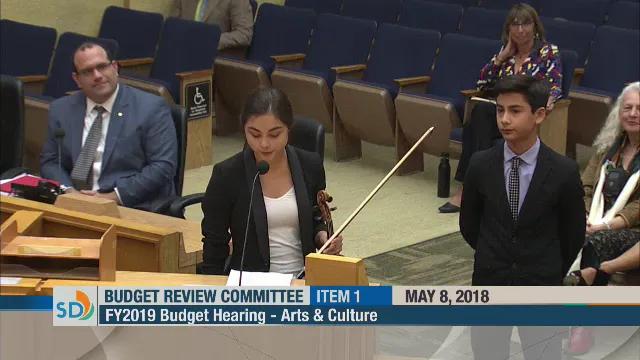
The Budget Review Committee (BRC) met on May 8, 2018, at 5:15 p.m. to review portions of the Mayor's proposed FY2019 budget. The committee heard from the City Attorney, the Assistant Chief Operating Officer, Civic San Diego, the Commission for Arts and Culture, the newly formed Government Affairs Department, and the Performance and Analytics Department. Numerous public speakers also testified, primarily in support of arts and culture funding. No formal votes were taken; recommendations will be forwarded to the full City Council. Public Comments & Testimony - Travis Rugerello shared his personal experience with mental health concerns and homelessness, stating he had been "lost in the system" and requested support. - Robbie A. Morgan claimed to have uncovered missing funds from housing, AFDC, and SSI programs and to have helped catch a wanted criminal (the "geez bandit"). - Robert McNamara (District 3) noted that homelessness impacts multiple city department budgets and suggested San Diego consider creating a separate Department of Homeless Services, citing New York City's $1.1 billion budget for its Department of Homeless Services. - Judy Forrester (Executive Director, New Children's Museum) highlighted the museum's value as a tourism driver and its impact on workforce development, thanking the council for supporting arts and culture. - Freedom Bradley Ballantine (Old Globe) read a letter from an incarcerated participant, emphasizing the transformative power of arts programs. - Anjeanette Mariah Ramey (Executive Director, Aja Project) described the organization's work using participatory photography with displaced youth and requested equitable distribution of arts funding. - Todd Schultz (San Diego Symphony and San Diego Regional Arts and Culture Coalition) underscored the importance of access to arts for youth and families. - Sheila James (music teaching artist) spoke on behalf of arts professionals and the educational value of music. - Molly Turbovich Riddenhauer (San Diego Civic Youth Ballet) expressed relief that proposed cuts did not materialize and urged sustainable funding. - Mia and Cameron Redlings (San Diego Youth Symphony) played a violin and trombone excerpt and thanked the council for arts support. - Janet Poutre (Chair, Commission for Arts and Culture) thanked the council and mayor for maintaining funding but noted the 2% reduction and encouraged additional support. - Joyce Sanyata (District 3) praised the arts as an economic engine and quality of life contributor. - Ismahan Abdullahi (Director, PANA) called for addressing inequity in arts funding distribution and emphasized impact over income. - Additional public speakers on the arts and culture item included representatives from several organizations; their slips were filed. - Joyce Sanyata also spoke during the Civic San Diego item, expressing concerns about transparency and the disposal of property including the Balboa Theatre and Chinese Historical Museum site. Discussion Items - City Attorney (Mara Elliott): Requested six additional items for the May revise: tuition reimbursement for deputy city attorneys (contractually obligated), an assistant city attorney for executive operations, one deputy city attorney and one investigator for civil litigation, one deputy city attorney for environmental/land use, and two criminal division support positions. She also noted that enforcement positions for a future short-term rental ordinance would be needed. The Family Justice Center is transferring back to the City Attorney's Office from SDPD, with plans to expand regionally. The SMART program is adding 14 beds in June. The IBA confirmed that the tuition reimbursement omission was an error and would be corrected. Councilmembers asked for prioritization of the six requests. - Assistant Chief Operating Officer (Stacey Lumetico): Presented on ADA compliance, corporate partnerships, and special events/filming. Key items: the Office of ADA is transferring to the Office of Boards and Commissions; a new corporate partnership with Sharp Healthcare is valued at $750,000 to $1.25 million over three years; the filming program saw a slight budget reduction but conservative permit estimates. The IBA noted a letter from the Accessibility Advisory Board requesting additional ADA resources. - Civic San Diego (Andrew T. Phillips & Pamela Rojas): Reported FY2018 accomplishments including 198 affordable housing units completed, 2.6 acres of park space, and $4.7 million from property sales. FY2019 proposed budget is $9.4 million (up $1.5 million) with 34 FTEs (down 4). For the first time, agency window (redevelopment) funding is less than 50% of revenue. The entity is pursuing new revenue sources such as New Market Tax Credits (three additional projects anticipated). Councilmembers discussed the need for an exit plan and avoiding duplication with city departments. - Special Promotional Programs / Commission for Arts and Culture (Christine Jones & Dave O'Nate): The proposed FY2019 budget for special promotional programs is $120.4 million (up $6.8 million). The Commission for Arts and Culture budget is $14.5 million, including a $10.5 million base plus a one-time $3.9 million general fund transfer. The Commission recommended distributing funds: $10 million for Organizational Support Program, $1.388 million for Creative Communities San Diego, $578,000 for Public Art Fund, etc. The IBA noted that arts funding as a percentage of TOT revenue is declining. Councilmembers expressed strong support for arts but raised concerns about the one-time nature of the supplementary funding and the need for long-term stability. - Government Affairs (Patrick Buteller): Presented the new department formed from existing resources, with the addition of one grants coordinator to improve coordination of grant applications. Councilmembers supported the centralization and coordination role. - Performance and Analytics (Alma Soudries & John Terwiliger): Reported on FY2018 achievements including a 1 ranking from Governing magazine for data-driven governance. The FY2019 proposed budget is $3.8 million with a reduction of one FTE and the addition of one FTE for the Get It Done expansion. The team showed a teaser video for the expanded app (summer launch). Councilmembers praised the department but emphasized the need for timely fulfillment of service requests and requested Spanish translation options. Key Outcomes - City Attorney: Councilmembers requested a prioritized list of the six funding requests; the City Attorney agreed to provide one. The IBA noted that the tuition reimbursement error would be corrected in the May revise. - Arts and Culture: Several councilmembers committed to seeking stable, ongoing funding rather than reliance on one-time transfers. The one-time $3.9 million general fund transfer will not be available in FY2020, creating a structural gap. Councilmember Ward highlighted that arts funding fell to 5.9% of TOT revenue, well below the Penny for the Arts goal. - Get It Done App: Councilmember Gomez requested that translation (at least into Spanish) be explored; the department agreed to work on it after the expansion rollout. - Civic San Diego: Councilmember Gomez asked for clarity on New Market Tax Credit allocations and noted that Civic was not receiving a new allocation this round; staff confirmed they would reapply. - The public is invited to provide further input at the evening budget hearing on Monday, May 14, at 6 p.m.

ARTS AND CULTURE 29% · BUDGET 16% · PUBLIC ENGAGEMENT 9% · PUBLIC WORKS 8%
920
MAY 8, 2018 · SAN DIEGO, CALIFORNIA · BUDGET REVIEW COMMITTEE
San Diego Budget Review Committee Meeting - May 8, 2018: FY19 CIP and Infrastructure Overview

The Budget Review Committee, chaired by Councilmember Barbara Bree, met on May 8, 2018, to review the FY19 capital improvement program (CIP) budget, the five-year capital infrastructure outlook, and presentations from the Infrastructure and Public Works (IPW) branch. The meeting included public testimony on various infrastructure needs and committee discussions on capacity, funding gaps, and project priorities. Public Comments & Testimony - Martha Welch: Commented on budget and sales tax, stating that "sell tax is not legal in this county because we voted only 2,000 points 2000 25%" and that sidewalk repairs should include new sidewalks, not just replacement and repair. - Renee Smith (Balboa Park advocate): Argued for a focused investment of at least $20 million per year in Balboa Park infrastructure, citing a facility condition assessment showing an immediate need of $80 million and a backlog of $235 million, which is increasing. He urged the committee to address deterioration before it worsens. - Coral Van Landingham (San Diego native, business owner): Requested immediate safety improvements on El Cajon Boulevard, including a traffic signal and crosswalks at Mississippi Street, due to numerous accidents. She provided a letter with bullet points, emphasizing pedestrian, bicycle, and traffic safety. - Steve Hisson (General Manager, Lafayette Hotel): Supported the request, noting he witnessed many accidents at the intersection and that new development will increase foot traffic. - Kevin Cox (business owner): Emphasized that the request is for safety, not financial gain, to protect people crossing between Texas and Florida Streets. - Janet Rogers (Chair, Grand North Condominiums): Supported funding for upgrades to the "Fatal 15" deadliest pedestrian crossings identified by Circulate San Diego, many of which are downtown, stating it is "life and death" for pedestrians. - Maya Rossus (supporter): Thanked the mayor for Vision Zero projects but requested reallocating a portion of SB1 gas tax funds to three high-priority unfunded projects: University Avenue Mobility Plan, Market Street 47 to Euclid Complete Streets, and Market Street Euclid Tapita improvements. - Robert Robinson (Broadway Heights resident): Asked that commercial paper funds be allocated to complete the Dr. King street project, noting that after years of promises, this is the only surface street named after Dr. King in San Diego and needs funding. - Ana Reynoso (Environmental Health Coalition / Community Budget Alliance): Supported funding for Hawk Lights at Altadena and El Cajon Boulevard, citing a community member hit by a car. She requested keeping the funds in the budget to prevent future injuries. - Esperanza Gonzalez (City Heights resident, promotora): Also supported the Hawk Lights funding, noting the intersection is dangerous and that the location needs improvement after a February accident. - Dr. Hill (Pastor, Christian Fellowship Congregational Church): Advocated for additional dedicated funding for Emerald Hills Community Park, which has not been upgraded since 1960 and lacks basic amenities. He noted that Hart Court repairs are appreciated but insufficient. Discussion Items - Infrastructure and Public Works (IPW) Overview: Deputy COO Paz Gomez presented the IPW branch, comprising Public Works, Transportation & Stormwater, Public Utilities, Environmental Services, and Infrastructure Asset Management (IAM). The branch has over 3,700 FTEs and a proposed FY19 budget of $1.3 billion. Key accomplishments included the successful IAM San Diego go-live (facilities in December 2017, other departments in March 2018), and awards from the American Public Works Association (APWA). Pure Water construction is set to start next fiscal year. The branch requests over 40 FTEs and a budget increase of over $31 million. - Capital Improvement Program (CIP) Presentation: Public Works Director James Nagelvoort presented the FY18 mid-year state of the CIP, the five-year (FY19-23) CIP outlook, and the proposed FY19 CIP budget. Key points: - Citywide, 1,287 capital projects were active; 35 construction contracts worth $200.8 million were awarded; 43 new construction starts and 51 project completions in the first six months. - Seven new parks opened; Mission Hills/Hillcrest Library groundbreaking occurred. - FY19 proposed CIP budget: $553 million (largest in city history), plus $376 million anticipated, for a $9 billion multi-year program. - Five-year capital needs estimate: $4.34 billion; available funding: $2.7-2.8 billion; funding gap of $1.5-1.6 billion, primarily for general fund assets. - Soft costs (non-contractor) at 51%, slightly above the statewide average of 48%; streamlining efforts ongoing. - Key performance indicators: expenditures up, encumbrances up, but time to award contracts increased to an average of 98 days (target 90). Small local business (SLBE) participation dropped from 34% to 21.2% of dollars. - Challenges: industry competition, staffing shortages, increasing construction costs. - Committee Questions and Discussion: - Councilmember Kerch (chair of infrastructure committee) asked about capacity to handle the large CIP increase; Nagelvoort noted that Pure Water is a major driver and that capacity may improve after the program tapers off in three years. He recommended using the five-year outlook for planning. - Councilmember Alvarez questioned soft costs, SLBE participation, and ADA improvements. He noted unspent sidewalk funds ($4.4 million carried over) and asked how new $5 million would be spent. Staff responded that dedicated sidewalk engineers are being added and a plan exists. - Councilmember Ward expressed concern about SB1 gas tax repeal risk; staff noted they programmed the full year but could reallocate commercial paper if needed. She requested metrics on change orders and construction management. - Council President Cole highlighted 12 CIP projects for his district, including Emerald Hills Park upgrades (tennis courts, basketball courts, playground equipment) and the MLK Promenade. He also requested a CIP for Oak Park Library expansion. - Councilmember Gomez noted that 85% of CIP funding goes to sewer and water (including Pure Water), leaving little for sidewalks, lighting, and bike infrastructure. She requested a simpler chart showing discretionary funds and expressed concern about the balance between street improvements and other modes. She also raised questions about the Castle neighborhood lighting deficit and the complete streets boulevard study. - Councilmember Sherman asked about staffing difficulties; Nagelvoort cited low unemployment and high demand for technical skills. Sherman also cautioned that commercial paper creates debt and noted that small park upgrades can trigger costly ADA and stormwater requirements. - Councilmember Kay requested a breakdown of anticipated funding sources and specific project lists for group jobs. Staff indicated page 31 of volume three provides a summary; a project-by-project breakdown can be provided. Key Outcomes - The committee heard presentations and public testimony; no formal votes were taken. - Staff will provide additional information on sidewalk spending capacity, ADA improvements, change order KPIs, funding source breakdowns, and responses to council concerns. - The public is invited to an evening budget hearing on May 14, 2018, at 6 p.m. to provide further input on budget priorities. - The committee will continue budget hearings, with afternoon sessions scheduled for operating budgets of transportation, stormwater, and other departments.

CAPITAL IMPROVEMENT PLANNING 43% · PUBLIC WORKS 21% · PUBLIC SAFETY 12% · PUBLIC UTILITIES 7%
OPENPUBLICA · PUBLIC MEETING INDEXUPDATED DAILY · openpublica.com