Browse by city
Date range
Search help

Search titles, summaries, topics and stored transcripts together. Keywords may match separately; put the whole query in double quotes for a phrase. Matching follows word analysis, so punctuation is not exact. Both dates are included. Documents are not searched.

SHOWING 1261–1270 ENTRIES
1261
MAY 5, 2021 · SAN FRANCISCO, CALIFORNIA · BUDGET AND APPROPRIATIONS COMMITTEE
San Francisco Budget and Appropriations Committee Meeting - May 5, 2021

The Budget and Appropriations Committee, chaired by Supervisor Matt Haney, met remotely on May 5, 2021, to receive mid-cycle budget updates from four city enterprise departments (Public Utilities Commission, Airport, Port, and Municipal Transportation Agency) and to hear a presentation on small business relief programs and the Office of Economic and Workforce Development (OEWD) equity plan. The meeting lasted approximately seven hours. All five hearing items were filed or continued to the call of the chair. Public Comments & Testimony - Item 1 (PUC): One caller, Marshawn Tadman from the San Francisco Marin Food Bank, urged the committee to prioritize food insecurity and reduced funding, noting that the need for food persists beyond the pandemic and that the food bank faces a potential loss of 40% of its food supply due to the federal food cliff. - Item 2 (Airport): No public comment. - Item 3 (Port): No public comment. - Item 4 (MTA): Two callers spoke. The first urged the MTA to prioritize free Muni and shared spaces over unnecessary projects. The second criticized the MTA's budget process as confusing and suggested that funds spent on parking meters should be redirected to community priorities. - Item 5 (Small Business Relief): Two callers testified. Carla Garcia, a small business owner in the Mission District, described difficulties applying for grants, including complicated applications, language barriers, and requirements for credit reports that many struggling businesses cannot meet. She also noted that some applications received no response. A second caller, who started a business in 2019, reported that grant applications were either ignored or rejected without explanation, and urged the city to revisit selection criteria. Discussion Items PUC Mid-Cycle Budget Update (Item 1) - Acting General Manager Michael Carlin presented the SFPUC's budget update, highlighting priorities of impeccable stewardship, economic recovery, and racial equity. The budget amendment includes $19.5 million in operating increases (primarily for staffing, power procurement, and racial equity initiatives) and approximately $230 million in capital increases (mainly for accelerating the Southeast Water Pollution Control Plant and other infrastructure projects). - Carlin noted that the PUC has saved more than $1.2 billion by securing low-cost state and federal loans for capital projects. The PUC also created an audit director position and initiated a third-party audit of the Social Impact Partnership Program to improve transparency. - Committee members expressed appreciation for the PUC's focus on racial equity, local hiring via project labor agreements, and accelerated infrastructure spending. Chair Haney asked about specific transparency measures; Carlin described forming a working group with the Controller's Office, scheduling a series of audits, and reporting to the commission and advisory bodies. Airport Mid-Cycle Budget Update (Item 2) - Director Ivar Sotero reported that SFO has been more severely impacted than other large hub airports due to its heavy reliance on international and business travel. Pre-pandemic enplanements were 29 million; FY21 is forecast at 8.5 million. The airport's annual service payment to the city's general fund dropped from $49 million to $13.2 million. - SFO has received $232 million in federal relief and expects another $200–$250 million from the latest stimulus. The airport deferred $2 billion of its $8 billion capital program. Sotero presented a conservative recovery forecast: 40% of pre-COVID enplanements by July 2022 and 60% by July 2023. - Committee questions focused on the recovery timeline, support for furloughed workers (75% of the private workforce, largely from disadvantaged communities), and efforts to rebuild travel confidence (e.g., air bridges, testing sites, working with airlines). Port Mid-Cycle Budget Update (Item 3) - Executive Director Elaine Forbes and CFO Katie Petruccioni described a dire financial situation: port revenues fell nearly 50%, a loss of $60 million in the last year, projected to reach $80 million over two years. The port has provided $13.7 million in tenant relief, deployed 90% of maintenance staff as disaster service workers, and cut its capital budget to minimal levels. - The port is pursuing a five-part economic recovery strategy: tenant relief, seeking state/federal assistance (including a request for $60 million from the American Rescue Plan), an internal Economic Recovery Initiative, a supplemental appropriation cutting $27 million in capital projects and $2.4 million in operating costs, and a request for a $20 million interfund loan from the city with a 20-year repayment term to avoid layoffs. - Committee members praised the port's creativity and leadership during the crisis. The motion to file the hearing passed unanimously. MTA Mid-Cycle Budget Update (Item 4) - Director Jeffrey Tumlin and colleagues presented the MTA's budget update, emphasizing that the pandemic has been the toughest period in Muni's 109-year history. COVID wiped out 40% of service hours and 70% of capacity. The MTA rebuilt the system four times, prioritizing equity: neighborhoods like Bayview, Excelsior, and Chinatown now have faster, more frequent service than pre-COVID. - The MTA has received $1.1 billion in federal relief across three packages. Despite this, the agency faces a structural deficit that will outpace recovery by FY24 unless new sustainable revenues are found. The MTA plans to restore service to 85% of pre-COVID levels by early 2022, but 15% of service will not be restored immediately. Key trade-offs include funding for subway renewal, parking meter replacement ($22 million project funded by revenue bonds), and shared spaces. - Committee members asked about the driver shortage, late-night service, school reopening, the equity of service restoration, and the impact of shifting capital funds to operations. The MTA acknowledged that long-term capital needs (e.g., train control, track replacement) will be affected if new revenue is not secured. Small Business Relief and OEWD Equity Plan (Item 5) - Supervisor Peskin introduced the hearing, noting the lack of formal oversight for OEWD and the need for equitable distribution of relief. OEWD Acting Director Ann Topier and Diana Ponce de Leon presented data on COVID relief programs: OEWD repurposed baseline funds and accepted $65 million in new funding, distributing over 3,500 grants to small businesses and 20,000 individuals. Key programs included the Resiliency Fund, mini-grants in equity-focused neighborhoods, and the SF Shines for Reopening grant. - Data showed that 72% of grant recipients were minority-owned, 52% women-owned, and 42% immigrant-owned. Grants reached top neighborhoods: Mission, Bayview, Tenderloin, Chinatown. However, only 28% of applicants received funding in the second round (lottery-based). The latest round (closing May 7) had 809 applications for 1,430 available grants. - Legacy business program director Regina Dick-Endrizzi reported that the program has 283 businesses on the registry, with 44 active rent stabilization grants. The $1 million annual grant fund is projected to be fully obligated by FY22, and additional FTEs may be needed to expand. - Committee members raised concerns about underrepresentation of District 11 (Supervisor Safai), the need for transparency in application scoring and rejection reasons, the digital divide, and the importance of the permanent shared spaces program. Supervisor Ronan requested a moratorium on nitpicky citations for shared spaces. The hearing was continued to the call of the chair to allow the new OEWD director, Kate Sofis, to present her vision. Key Outcomes - All five hearing items were filed or continued to the call of the chair unanimously by roll call votes (5-0). - Item 1 (PUC): Hearing filed. The PUC will proceed with the budget amendment and focus on audit transparency and racial equity. - Item 2 (Airport): Hearing filed. The airport will continue to manage through the pandemic with conservative recovery projections and ongoing federal relief. - Item 3 (Port): Hearing filed. The port will pursue its five-part recovery strategy, including the $20 million loan request and federal stimulus allocation. - Item 4 (MTA): Hearing filed. The MTA will restore service to 85% by early 2022, continue hiring and training, and seek sustainable revenue sources to avoid a fiscal cliff in FY24. - Item 5 (Small Business Relief): Hearing continued to the call of the chair. The committee will reconvene to hear from the incoming OEWD director and discuss further improvements to equity in relief programs, legacy business funding, and oversight.
SMALL BUSINESS SUPPORT 20% · PUBLIC TRANSPORTATION 13% · ECONOMIC DEVELOPMENT 10% · AIRPORT DEVELOPMENT 8%
1262
APR 28, 2021 · SAN FRANCISCO, CALIFORNIA · BUDGET AND APPROPRIATIONS COMMITTEE
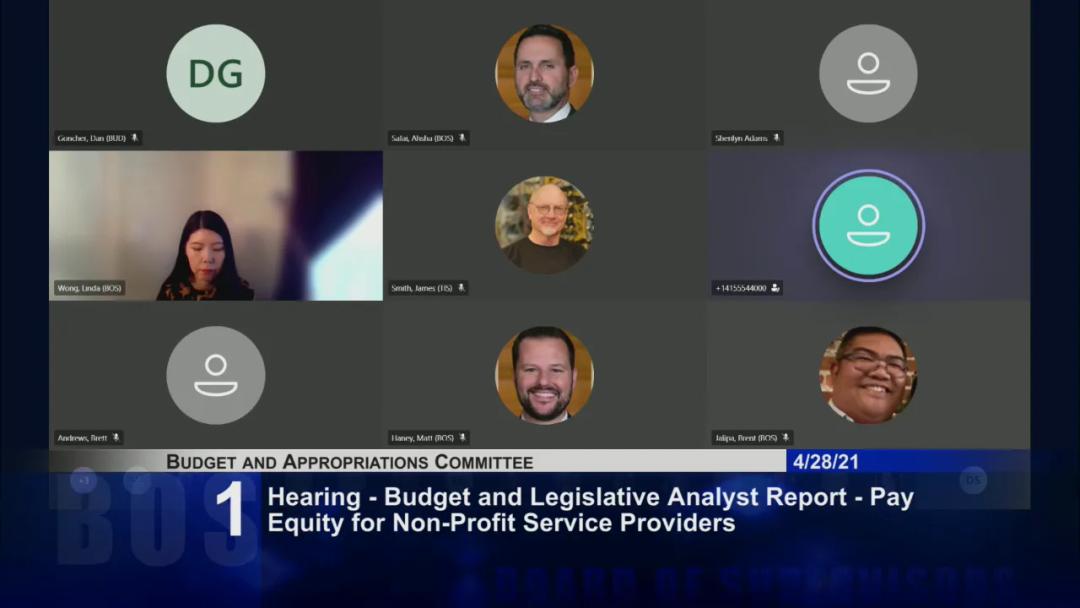
Budget Committee Hearing on Nonprofit Pay Equity and Small Business Relief – April 28, 2021

The Budget and Appropriations Committee, chaired by Supervisor Matt Haney and joined by members President Shamann Walton, Supervisors Hillary Ronen, Ahsha Safaí, and Myrna Melgar, convened remotely on April 28, 2021, to hear two major agenda items. The first and most heavily discussed hearing focused on pay equity and sustainability for nonprofit service providers contracting with the City. The committee received a detailed report from the Budget and Legislative Analyst (BLA), testimony from the Human Services Network (HSN), SEIU 1021, and NUHW, and heard from 20+ public commenters. The second item, concerning direct small business relief and an equity plan for recovery, was continued to the May 5 meeting due to time constraints. Public Comments & Testimony - Nonprofit frontline workers and community members from Larkin Street Youth Services, HealthRight 360, Baker Places, Children’s Council, Compass Family Services, Tenderloin Housing Clinic, and others overwhelmingly expressed full support for higher wages, consistent cost-of-doing-business (CODB) increases, and full funding of the Minimum Compensation Ordinance (MCO) including wage compaction and equity. Many callers highlighted that they could not afford to live in San Francisco, experienced high staff turnover, and that clients' care suffers as a result. Several speakers noted that their salaries are below the HUD very-low-income threshold ($39,000 for an individual) and that many workers commute from distant counties. A few callers also urged accountability to ensure new funds reach frontline workers, not management. - Brett Andrews (PRC/HSN co-chair) and Sherilyn Adams (Larkin Street/HSN co-chair) testified that city contracts are consistently underfunded, inflexible, and fail to cover the true cost of services. They called for at least a 3% CODB increase every two years, fully funding MCO including compaction, and a higher wage floor closer to parity with city workers. They emphasized that the workforce is disproportionately BIPOC and LGBTQ, making pay equity a racial and cultural equity issue. - Ramses Nichols, NATO Green (SEIU 1021), and John Avalos (NUHW) described a decade of organizing for wage increases. They argued that the current system amounts to outsourcing city services at the expense of workers, leading to a recruitment/retention crisis. They urged the committee to consider a prevailing wage for nonprofit workers, citing that many unionized nonprofit contractors struggle to fill positions because city and private-sector jobs pay more. Discussion Items - BLA Report Presentation (Dan Goncher): The BLA presented its second pre-budget report on nonprofit contractor sustainability. Key findings: - The MCO, originally $9/hr in 2000, rose to $17.05/hr (FY20‑21) after 2018 amendments; it is now $1.89 above what it would be under routine CPI increases. - The 2019 nonprofit working group estimated direct MCO wage costs at $1.3M/year, wage compaction costs at $12.9M/year, and wage equity costs at $12.7M/year (city staff dissented, requesting a range). - Over the past five years, the city's average CODB increase was 2.7%, just below the SF Bay Area CPI of 3.2% (though the last two years met or exceeded CPI). - The controller’s 2019 application process allocated $6.6M for MCO‑related costs, but it was a one‑time effort and data are now outdated. - The report offered two policy options: (1) ask the controller and mayor’s budget office to explore setting a regular CODB level that includes anticipated MCO needs; (2) ask the controller to lead a periodic survey (every 3‑5 years) of nonprofit contractors to assess worker status and funding sources. - Q&A with Supervisors: Supervisor Ronen pressed for automatic 3% CODB increases, asking why the city cannot simply make it a routine budget item. The mayor’s budget director (Ashley Graffenberger) explained that CODB has been subject to annual appropriation, and the city attorney was asked to explore legal mechanisms for a mandated floor. Supervisor Safaí requested more data on the share of nonprofit funding from city vs. other sources; DCYF reported that for its contractors city funds account for about 34% of total program funding. Chair Haney asked each contracting department (DPH, HSA, HSH, DCYF) to describe their CODB methodology; all stated they apply CODB to the bottom line but do not dictate how nonprofits use it, and some exclude direct pass‑through funds or restrict it to general fund dollars. - Responses to BLA recommendations: HSN and labor unions largely supported the BLA’s recommendations but urged going further – e.g., raising the wage floor above MCO, baselining a multi‑year 3% CODB, and ensuring MCO funding fully covers compaction and equity issues. The controller’s office (Risa Sandler) indicated willingness to conduct periodic surveys if directed. Key Outcomes - Motion to file the hearing (Item 1) passed 4‑0 (Vice Chair Safaí absent) with ayes from Mar, Ronen, Walton, and Haney. The filing means the hearing is concluded and the report is accepted for consideration, but no binding action was taken. - Item 2 (small business relief and equity plan) was continued to the May 5, 2021 Budget and Appropriations Committee meeting by a 4‑0 vote (Safaí absent). - The committee signaled strong intent to prioritize nonprofit pay equity and MCO funding in the upcoming FY21‑22 and FY22‑23 budget process, and to pursue structural reforms such as automatic and predictable CODB increases. The city attorney was requested to report back on the board’s legal authority to require a minimum CODB percentage.

NONPROFIT SERVICES 40% · NONPROFIT CONTRACTING 19% · BUDGET AND FINANCE 14% · FUNDING AND GRANTS 9%
1263
APR 27, 2021 · SAN FRANCISCO, CALIFORNIA · PORT COMMISSION
San Francisco Port Commission Meeting - April 27, 2021

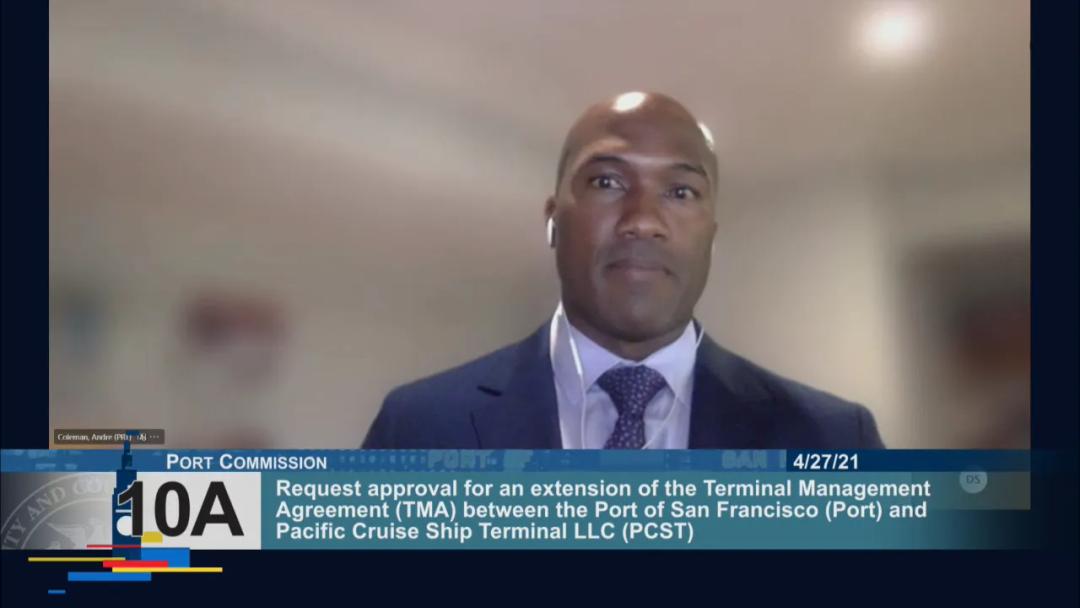
The San Francisco Port Commission met virtually on Tuesday, April 27, 2021, at 3:15 p.m. due to the COVID-19 health emergency. The meeting was called to order by President Kimberly Brandon and included roll call, approval of minutes, a pledge of allegiance, and announcements. The commission addressed a consent calendar, finance and administration items, a planning item, maritime items, and received informational presentations. No public comments were made on any agenda item. The meeting adjourned at 5:25 p.m. Executive Director's Report - Executive Director Elaine Forbes opened with remarks on the Derek Chauvin verdict, stating it provided "a powerful message to us all that working together, we can make change despite the toughest odds." She noted the port is striving to become an anti-racist organization. - COVID-19 update: 67% of San Franciscans have received their first vaccine dose, and over 85% of residents over 65. All port staff have access to the vaccine. The pandemic is not over; continued vigilance is urged. - Economic recovery: Port revenues have fallen by nearly 50% this year, with economic forecasts estimating a total loss of $100 million over the next five years. The port is pursuing a $20 million interfund loan from the city (likely from the San Francisco Airport or the city's general fund) to fill the revenue shortfall and avoid layoffs in FY2021-22. The loan would be repaid in full over time. - The Civic Impact Rent Forgiveness Program: Initially authorized for up to $200,000 total, the port received 14 eligible applications totaling $95,000. Staff allowed a 15th applicant (Young Community Builders, which exceeded the $3 million revenue threshold) to enter the program, bringing total forgiveness to approximately $111,000. - Equity: The port is making progress on its racial equity action plan, including identifying a racial equity change team and finalizing a diversity calendar to celebrate AAPI Heritage Month in May. - Crane Cove Park received a merit award from the American Society of Landscape Architects, Northern California chapter. - The Energy Observer, a French vessel running on renewable energy (hydrogen from seawater), is scheduled to berth at Pier 9 from May 2-8, 2021. Consent Calendar - Item 7A: Amendment to MOU with Department of Public Health for COVID-19 testing site at Piers 30-32 (Resolution 21-19) – Approved unanimously. The amendment clarifies rent is due from April 6, 2020; reduces the premises to approximately 172,400 sq. ft. effective April 1, 2021; and extends the term through no later than June 30, 2022, on a month-to-month basis. Discussion Items - Item 8A: FY2021-22 Operating and Capital Budget Supplemental Appropriation (Resolutions 21-20, 21-21) – Nate Cruz presented the supplemental budget. Key components: $2 million in salary savings by moving port labor to capital projects; $3 million increase for rent negotiations with Prologis at Pier 1; capital de-appropriation of $17.7 million from deferred projects and $9 million in technical adjustments; replenishment of fund balance by $38.3 million, including an $11.5 million repayment from the Resilience Program. The presentation included a forecast showing fund balance dropping to $20 million by end of FY2020-21 and recovering to above $30 million in FY2021-22 with the interfund loan. The loan of up to $20 million (interest-only for first 5 years, repaid within 20 years at 2% interest) would avoid any layoffs in FY2021-22 and reduce needed future ERI savings from $8 million to $5 million. Commissioner Woo Ho suggested considering a drawdown structure for the loan to avoid paying interest on unused funds, which staff noted was under discussion. The resolution passed unanimously. - Item 8B: Informational Presentation on LBE Contracting Activity (July 1 – December 31, 2020) – Stephanie Tang and Tiffany Tatum reported that the port awarded 5 contracts totaling $3.2 million; 55% of contract dollars went to LBEs (100% when excluding a federal contract with no LBE preference). Total contract payments to LBEs were $3.0 million (14% of total payments). Over time, the port outperformed similar city departments (SFO, PUC, Rec & Park, Public Works): 62% of contract awards vs. 38% for other departments, and 39% of dollars vs. 32%. The port launched an LBE Emergency Relief Program (17 loans approved, $700,000). Future efforts include developing an LBE toolkit, a conceptual framework for an LBE loan program, and continuing stakeholder engagement. Commissioner Woo Ho suggested exploring requiring developers to set aside funds for technical training to help LBEs gain qualifications. President Brandon noted quarterly meetings with development partners to increase LBE opportunities. - Item 9A: Amendment to Transit Shelter Advertising Agreement with SFMTA and Clear Channel (Resolution 21-22) – Dan Hodap presented. Due to COVID-19, transit ridership is down 60-70% and ad revenues down 60-88%. The amendment reduces minimum annual guarantee payments from May 1, 2020 to June 30, 2022. The port expected $1.34 million over that period; under the amendment, it will receive $702,000 (a decrease of $638,000). Payments are guaranteed regardless of advertising revenue. There is a revenue sharing clause (50% share) if Clear Channel earns more than $11.8 million annually, which has never been triggered. Commissioner Gilman supported the item. The resolution passed unanimously. - Item 10A: Extension of Terminal Management Agreement with Pacific Cruise Ship Terminal (Metro) (Resolution 21-23) – Andre Coleman presented. The pandemic caused 198 canceled cruise calls through 2021 to date, with $15 million in lost passenger tariff revenue. Metro has continued to maintain the terminal at a cost of $90,000/month and paid the monthly management fee ($18,000) throughout the pause. The proposed amendment extends the initial 10-year term by one month for each month of no cruise activity (maximum 24 months). The first cruise call will lock in the new expiration date. The port benefits by preserving Metro's operations and ensuring stability for cruise resumption. Vice President Adams expressed concern that labor (ILWU) was not included in the discussion but supported the item. Resolution passed unanimously. - Item 10B: Informational Presentation on Pier 45 Shed C Post-Fire Improvements and Long-Term Replacement Strategy – Mike Martin, Dominic Moreno, and Dan Hodap presented. The fire occurred on May 23, 2020. Cleanup and demolition were completed in November 2020. The port relocated displaced tenants (fishing industry, Red and White Fleet, SS Jeremiah O'Brien) and implemented a three-phase interim improvement plan: Phase 1 (completed April 2021) created 8,700 sq. ft. of maritime storage and 32 parking spaces; Phase 2 (by June 30, 2021) includes lighting, fencing, and electrical for the Jeremiah O'Brien; Phase 3 (by July 31, 2021) will prepare 40,000 sq. ft. for general storage. The port received a $25 million advance from insurance for site stabilization. A basis of design for rebuilding is expected by summer 2021. A resilience charrette is planned for May 2021 to address sea level rise and earthquake vulnerability. A survey of the fishing industry found desire for continued operations at Pier 45 with improved storage, cold storage, ice, bait, office space, vehicle access, and parking. Key Outcomes - Votes: - Resolution 21-19 (Consent): Approved unanimously. - Resolutions 21-20 and 21-21 (Budget Supplemental): Approved unanimously. - Resolution 21-22 (Transit Shelter Advertising): Approved unanimously. - Resolution 21-23 (Cruise Terminal Management Extension): Approved unanimously. - Directives: Staff will continue to work on securing the $20 million interfund loan, refine the LBE program, and proceed with Pier 45 interim improvements and long-term planning. No new business was introduced. The meeting adjourned at 5:25 p.m.

PUBLIC COMMENT 23% · PORT MANAGEMENT 16% · LOCAL BUSINESS ENTERPRISE 13% · PUBLIC HEALTH 10%
1264
APR 22, 2021 · SAN FRANCISCO, CALIFORNIA · PUBLIC SAFETY AND NEIGHBORHOOD SERVICES COMMITTEE
San Francisco Public Safety Committee Meeting - April 22, 2021

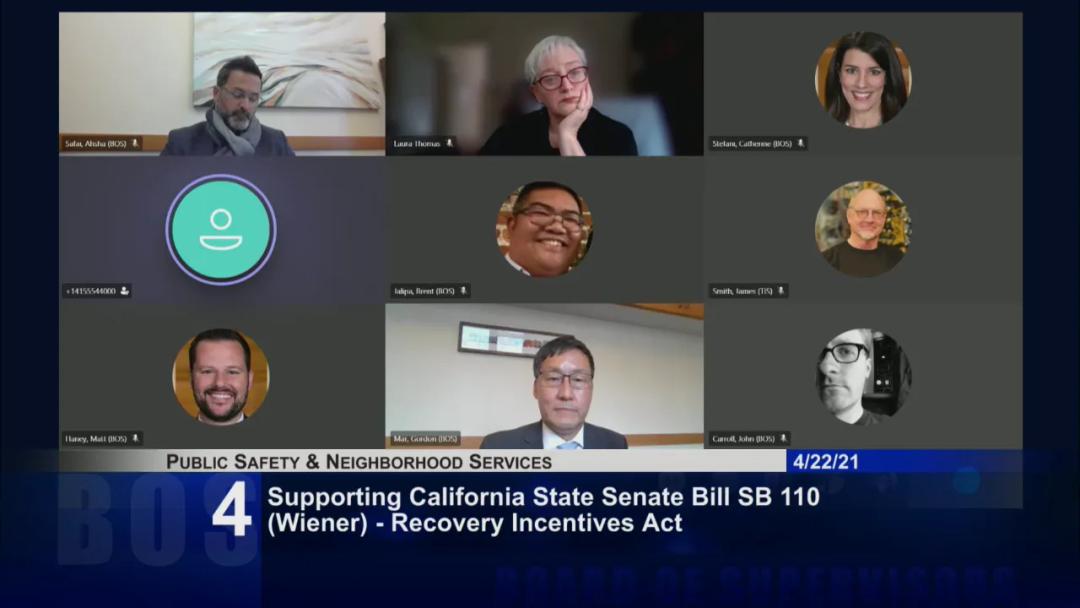
On April 22, 2021, the Public Safety and Neighborhood Services Committee of the San Francisco Board of Supervisors met remotely. Items considered included two liquor license transfers, a hearing on the city's mass vaccination strategy, and resolutions supporting state bills on contingency management (SB 110) and victim compensation for police violence (SB 299). All items were approved unanimously and forwarded to the full Board. Consent Calendar - Item 1: Liquor License Transfer – Lucinda's Deli & More (535 Scott Street). SFPD ALU recommended approval with conditions. No public comment. The committee voted 3-0 to forward a resolution finding public convenience/necessity to the full Board. - Item 2: Liquor License Issuance – The Academy (2166 Market Street). Type 57 special on-sale license for a social club serving the LGBTQ+ community. ALU recommended approval with conditions; no public comment. Voted 3-0 to forward. Public Comments & Testimony - Item 3 (Vaccination Hearing): No public comments were received. - Item 4 (SB 110 – Recovery Incentives Act): Multiple callers spoke in support, sharing personal experiences with contingency management programs and emphasizing the need for destigmatization and expanded access. One caller expressed skepticism about implementation without federal changes and concerns about oversight. - Item 5 (SB 299 – Victim Compensation): Public comment included a caller critical of past police practices and a sex worker who described being denied victim services after an assault. Another caller supported the bill, highlighting barriers faced by families of police violence victims. Discussion Items - Mass Vaccination Strategy (Item 3): The committee received an update from Dr. Navina Baba (SFDPH) and Director Mary Ellen Carroll (DEM). Key points: - 64% of San Franciscans 16+ had received at least one dose, 42% fully vaccinated; 85% of those 65+ had one dose, 70% fully vaccinated. - City has capacity for 20,000 vaccinations per day but has reached a maximum of 16,000; supply constraints remain the primary barrier. - Logistical challenges include vaccine supply reductions, reliance on Johnson & Johnson (paused), and the need to reach homebound populations, unhoused residents, and youth (12-15 approval expected in May). - Mobile vaccination teams, community sites, and a call center (25,000 calls made) are targeting equity gaps. - Supervisor Haney raised concerns about appointment access, pharmacy coordination, and planning for booster shots. - Resolution Supporting SB 110 (Item 4): Supervisor Safai introduced the resolution to support state legislation to legalize contingency management as a Medi-Cal covered treatment for substance use disorder. Laura Thomas (SF AIDS Foundation) presented data showing 63% of program participants stopped using stimulants and 19% reduced use. Discussion included the balance between harm reduction and abstinence-based approaches, the need for federal changes, and the role of incentives. The committee voted 3-0 to forward. - Resolution Supporting SB 299 (Item 5): Supervisor Safai and District Attorney Chesa Boudin presented the resolution to support state legislation removing barriers for victims of police violence to access the California Victim Compensation Board. The bill would allow compensation for funeral/burial, mental health services, and medical costs without requiring a police report or cooperation with police in cases of use of force. Anthony DiMartino (Californians for Safety and Justice) detailed the bill's provisions. Voted 3-0 to forward. Key Outcomes - Approved resolutions for Liquor Licenses (Items 1 & 2): Forwarded to full Board unanimously. - Continued Vaccination Hearing (Item 3): Continued to the call of the chair for further oversight. - Approved Resolution Supporting SB 110 (Item 4): Forwarded to full Board with positive recommendation. - Approved Resolution Supporting SB 299 (Item 5): Forwarded to full Board with positive recommendation. - All votes were 3-0 (Vice Chair Stephanie, Member Haney, Chair Maher). The next Board of Supervisors meeting to consider these items is May 4, 2021.

PUBLIC HEALTH 35% · SUBSTANCE USE DISORDER POLICY 21% · PUBLIC COMMENT 10% · VICTIM SERVICES 10%
1265
APR 21, 2021 · SAN FRANCISCO, CALIFORNIA · BUDGET AND APPROPRIATIONS COMMITTEE
San Francisco Budget Committee Reviews Miscellaneous Funds and Five-Year Financial Plan - April 21, 2021

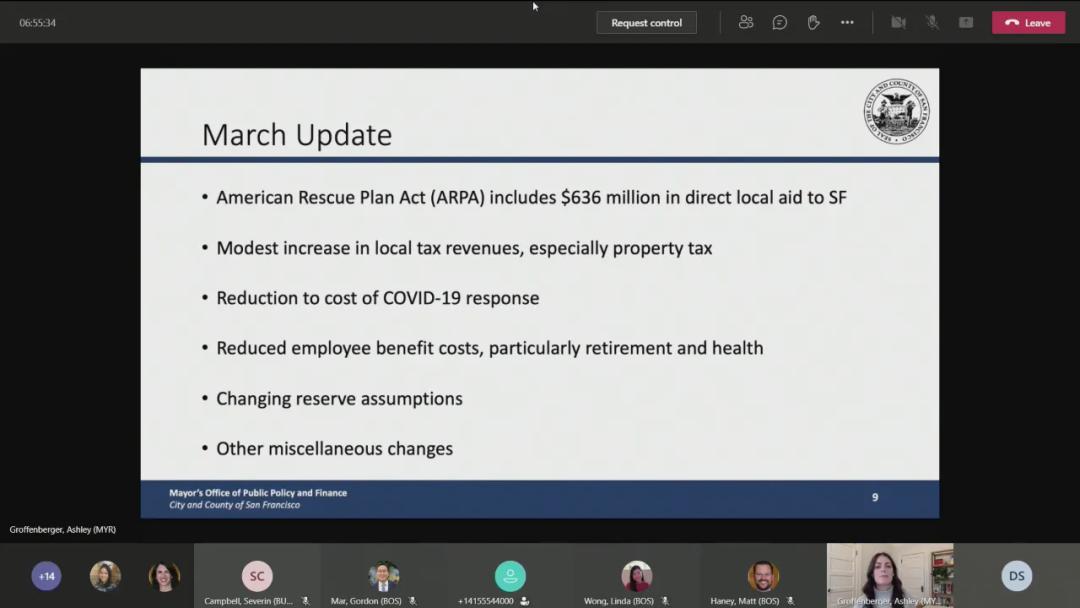
The Budget and Appropriations Committee met on April 21, 2021, chaired by Supervisor Matt Haney, with members President Walton, Supervisors Ronan, Safai, and Mar. The committee heard two major presentations: a review of miscellaneous city funds by the Budget and Legislative Analyst (BLA) and an update on the city's economic condition and five-year financial plan from the Mayor's Budget Director. The committee voted to file the first hearing and to forward the five-year financial plan resolution to the full board with a positive recommendation. Discussion Items Hearing on Miscellaneous Funds (Item 1) Severin Campbell of the BLA presented a report on the city's general fund reserves and special revenue funds. Key findings included: - The general fund balance increased by 21% from $2.2 billion in June 2018 to $2.7 billion in June 2020. - The rainy day reserve ($229 million) and budget stabilization reserve ($362 million) are restricted but partially used in FY2021 and planned for FY2022. - The unassigned fund balance stood at $510 million, with $57 million assigned to the COVID response reserve (now $505 million). - Special revenue funds increased 26% from $1.4 billion to $1.8 billion over the same period, suggesting underutilization for intended purposes. - The report recommended that the committee follow up with departments during budget hearings, particularly on public protection, street beautification, litter control, and women's recognition public art funds that lack reporting requirements. - Internal service funds: only the reproduction fund had a positive balance ($2.5 million), exceeding federal guidelines for working capital. Supervisor Ronan questioned the necessity of board-created funds and the inability to reallocate restricted funds. The committee agreed to revisit these issues during departmental budget hearings. No public comments were received. The hearing was filed unanimously. Hearing on Economic Condition and Five-Year Financial Plan (Items 2 & 3) Ashley Groffenberger, Mayor's Budget Director, presented the updated five-year financial plan (FY2022-2026). Key points: - In December 2020, the projected two-year budget shortfall was $653 million, driven by slower revenue recovery, labor costs, and COVID response expenses. - The mayor instructed departments to submit budgets with 7.5% reductions plus a 2% contingency. - By March 2021, improved FEMA guidance, better pension fund performance, and $636 million in federal stimulus (American Rescue Plan) reduced the projected shortfall to $22.9 million for FY2022-2023. - However, structural deficits reappear in FY2024 once one-time stimulus funds are exhausted; the plan uses nearly $2 billion in one-time sources by FY2023. - Revenue projections show property tax remaining stable, while economically sensitive taxes (hotel, sales, business) were most impacted and recover slowly. - The mayor's office emphasized preserving reserves to address the FY2024 shortfall and awaiting further federal guidance. Supervisor Safai inquired about positive revenue trends; the controller's office noted that property tax projections improved slightly but other local revenues are worse in the near term. Supervisor Ronan requested access to department budget submissions. No public comments were received. Key Outcomes - Item 1 (Hearing on Miscellaneous Funds): Motion to file the hearing passed 5-0 (all ayes). The report's recommendations will be revisited during departmental budget hearings. - Item 3 (Resolution adopting Five-Year Financial Plan): Motion to move to the full board with a positive recommendation passed 5-0. - Item 2 (Hearing on Economic Updates): Motion to continue the item to the call of the chair passed 5-0.

BUDGET AND FINANCE 68% · PROCEDURAL 14% · PUBLIC FINANCE 8% · PROPERTY TAX 5%
1266
APR 15, 2021 · SAN FRANCISCO, CALIFORNIA · GOVERNMENT AUDIT AND OVERSIGHT COMMITTEE
San Francisco Government Audit and Oversight Committee Meeting - April 15, 2021

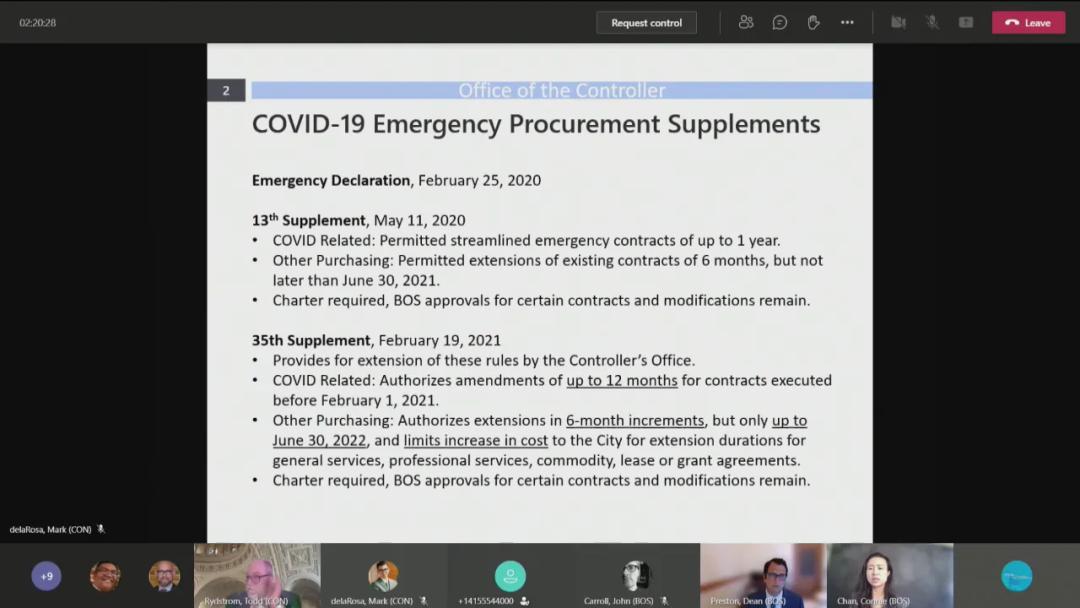
The Government Audit and Oversight Committee of the San Francisco Board of Supervisors met remotely on Thursday, April 15, 2021, to review the City's whistleblower program, consider the 35th supplemental COVID-19 emergency procurement and contract actions, and act on a series of litigation settlements. Committee members were Chair Preston, Vice Chair Chan, and Member Mandelman. All votes taken were unanimous 3-0. Public Comments & Testimony - David Pilpel spoke on the whistleblower hearing, recommending a future hearing on the Controller's rate-setting process review and asking whether whistleblower complaints inform the prioritization and risk assessment of city department audits. - John Holden, a former Recology employee and union representative, submitted comments on the whistleblower hearing and the Recology settlement, saying corruption has been 'business as usual' in San Francisco for decades and that the Recology settlement felt rushed. - David Pilpel commented on the COVID procurement item, thanking the committee for the public discussion. - During the litigation agenda, David Pilpel asked for more explanation of the rate-calculation error and requested more transparency, suggesting the Recology settlement be continued until the Controller's public integrity review is heard. Discussion Item: City Whistleblower Program Hearing (Agenda Item 1) - Chair Preston requested the hearing and praised the program, saying it is crucial for uncovering corruption and improper conduct. He asked whether the Controller's office tracks whistleblower complaints by specific category, such as corruption. - Controller's Office representatives Mark De La Rosa, Todd Reedstrom, Dave Jensen, and Steven Munoz presented the most recent whistleblower report (Q2 of FY 2020-21, issued March 15, 2021). - Key statistics provided: complaint volume has risen since July 2012; 186 complaints were received in Q3 of FY 2020-21 as of March 31; 64 cases were open as of March 31 and 68 as of the meeting; in FY 2019-20, 105 were open, 291 received, and 330 closed, leaving 66 open as of December 31. About 75% of cases are closed within 90 days, which was achieved in Q2. Typically just over 50% of reports are investigated, about 11-21% are referred to departments with charter jurisdiction, and 30-40% of investigated complaints result in corrective or preventative action. - The public integrity tip line, established after the Mohammed Nuru indictment, received 72 tips between February 2020 and the current period. - Chair Preston asked for better tracking of outcomes after cases are referred to other agencies and discussed the need to consider incentivizing whistleblowers rather than only protecting them. - Supervisor Chan asked about the consistency of outcomes and the high rate of referrals to the District Attorney and Ethics Commission, noting concerns about whether serious allegations lead to meaningful action. - Supervisor Mandelman asked whether the increase in complaints tracks with city workforce size and whether the whistleblower program could have detected the corruption cases that later led to indictments. He urged a post-mortem and consideration of incentive structures. - Controller's Office staff responded that charter-referred cases are not counted in the investigative outcome statistics, but they are exploring ways to capture and report those outcomes. They also mentioned a new case management system and weekly coordination with the City Attorney, District Attorney, and Ethics Commission. Discussion Item: 35th Supplemental COVID-19 Emergency Declaration (Agenda Item 2) - Deputy Controller Todd Reedstrom and Acting Director of the Office of Contract Administration Salija Corella presented on the 35th supplement to the Mayor's emergency proclamation. - The 35th supplement, issued February 19, 2021, allows departments to extend COVID-19-related contracts for an additional 12 months, allows extensions of non-COVID contracts in six-month increments not later than June 30, 2022, and includes provisions for expedited payments to nonprofits for cost-of-doing-business increases. - Presenters noted that in April 2020, over 10,600 city employees were working as disaster service workers; as of the meeting, about 2,800 remained in that role. The city's typical annual procurement includes over 3,300 written contracts and over 93,000 purchase orders, and the exceptions under the 13th supplement represented less than 1% of that volume. - Specific numbers reported: 15 written executed contract exceptions totaling about $46 million, 129 grant award amendments totaling about $77 million, 19 direct purchase orders at $2 million, and 25 non-COVID contract extensions totaling about $120 million, as estimated by OCA for Chapter 21 contracts. - A survey of seven departments identified 127 non-COVID contracts, totaling $578 million, for which extensions might be requested; 46% of those contracts are with nonprofits, and the largest is a $225 million UCSF agreement with DPH. - Chair Preston questioned the elimination of the 13th supplement's monthly reporting requirement and the three-quote requirement. Presenters said reporting is now provided upon request and that their policy guidance still requires at least three quotes and a standardized list of contracts by August 15, 2021. - Public comments were brief, with David Pilpel thanking the committee for the discussion. Discussion Item: Litigation Settlements (Agenda Items 3-13) - The committee considered 11 litigation matters: lawsuits with Frank Villa, Luis Angel Garcia Valencia, Jennifer Galarza, Recology San Francisco/Sunset Scavenger/Golden Gate Disposal and Recycling, Elena Ruiz-Diaz and Mercedes Arroyo, Armin Abdollahvand, Ramsey Abouremeleh, and unlitigated claims with Shipt, Inc., Katherine Ripley, Luis Hernandez, and Farmers Insurance Exchange. - The city attorney's office, including Deputy City Attorney Ann Pearson, Yvonne Murray, and Ron Flynn, presented the Recology settlement in open session before closed session. - The Recology settlement resolves claims that Recology made gifts and behested payments in violation of the Campaign and Governmental Conduct Code and omitted financial information during the 2017 rate-setting process, causing overcharges to ratepayers since 2017. The settlement includes $94,520,000 in restitution to ratepayers, $7,000,000 in civil penalties to the City, and a four-year injunction prohibiting gifts and behested payments, requiring disclosure of certain nonprofit payments and contracts with city officials, requiring lobbyist registration, and requiring public disclosure of financial errors and omissions. - Supervisor Chan said the presentation helped her think about policy solutions to prevent such relationships. Chair Preston asked about the scope of the release, and the city attorney clarified the release covers claims related to the 2017 rate application and alleged gifts, but not other matters or criminal liability. - Public commenters raised concerns about the settlement being rushed and asked for more transparency. - The committee then voted to convene in closed session for the litigation items. After returning, the chair reported that the committee had voted to recommend all agenda items 3 through 13 to the full Board of Supervisors. Key Outcomes - The whistleblower program hearing (Agenda Item 1) was filed unanimously (3-0). - The motion to recommend the 35th supplemental COVID-19 emergency declaration (Agenda Item 2) to the full board passed unanimously (3-0). - The motion to recommend all litigation settlements (Agenda Items 3-13) to the full board passed unanimously (3-0). - All recommended items are scheduled for consideration by the full Board of Supervisors on April 27, 2021. - The Controller's Office agreed to continue discussions with the committee on improving reporting of outcomes for referred complaints and to provide quarterly updates on the whistleblower program.

PENDING LITIGATION 26% · PROCEDURAL 16% · WHISTLEBLOWER PROGRAM 15% · PROCUREMENT 15%
1267
APR 14, 2021 · SAN FRANCISCO, CALIFORNIA · BUDGET AND APPROPRIATIONS COMMITTEE
Budget and Appropriations Committee Hearing on Federal Stimulus and City Finances - April 14, 2021

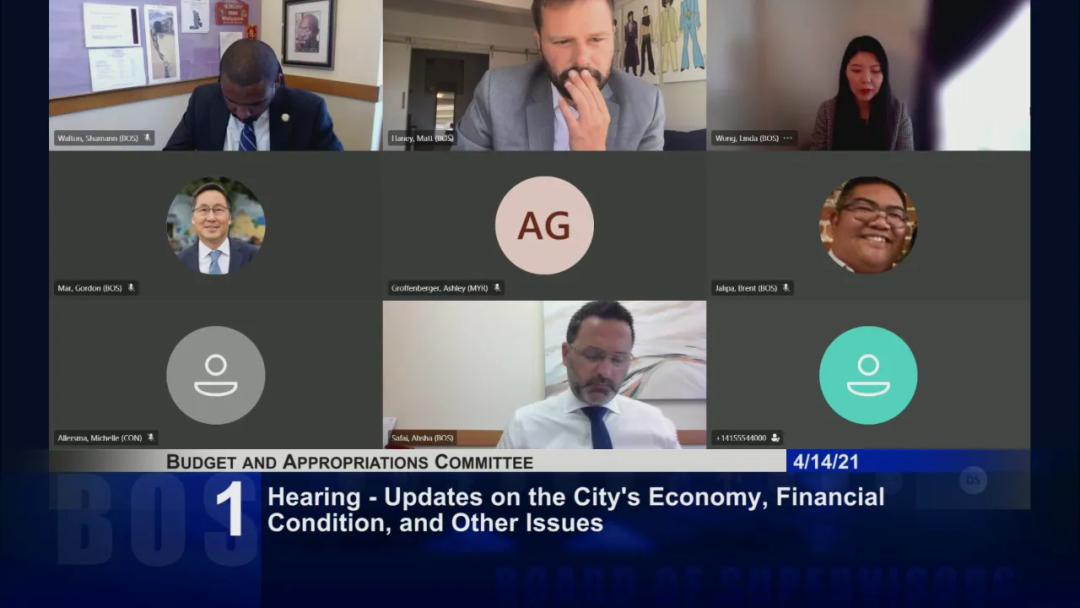
The Budget and Appropriations Committee, chaired by Supervisor Matt Haney, held a hearing on April 14, 2021, to receive updates on San Francisco's economic and financial conditions, focusing on the federal stimulus packages, primarily the American Rescue Plan Act (ARPA). The committee heard from the Controller's Office, discussed allocations and restrictions, and received public comments urging climate investment. The item was continued to the call of the chair. Discussion Items - Federal Stimulus Update (ARPA): Michelle Alarzma from the Controller's Office presented on the American Rescue Plan Act (ARPA), signed into law March 12, 2021. Key provisions include: - $350 billion in state and local fiscal aid; San Francisco's estimated allocation from the Coronavirus Local Fiscal Recovery Fund is $636 million. - Eligible uses: responding to the public health emergency and its negative economic impacts, premium pay for essential workers (excluding contractors), revenue replacement for documented revenue losses, and investments in water, sewer, or broadband infrastructure. - Restrictions: funds cannot be used to offset tax cuts or deposit into pension funds; must be spent by December 31, 2024. Distribution: 50% by May 11, 2021 (upon certification), second 50% within 12 months. - Additional estimated allocations: $300 million to SFMTA, $192 million to the airport, $112 million to SFUSD, $28.5 million to City College, and under $20 million for housing programs. Many pass-through programs (e.g., health, homelessness) are still pending federal and state guidance. - Supervisor Questions: Committee members, including Chair Haney, Supervisor Safai, and President Walton, probed uncertainties around revenue replacement measurement, state pass-through funds, and coordination with other agencies (e.g., City College). The Mayor's Budget Office representative confirmed that the five-year financial plan assumes ARPA funds can close the projected deficit, based on the revenue replacement provision, though guidance is pending. - Upcoming Item: The five-year financial plan update was postponed to the next committee meeting. Public Comments & Testimony - Six callers spoke, all urging the committee to invest a significant portion of the stimulus funds—specifically $136 million or 1% of the city's budget—into equitable climate change mitigation and resilience programs. Callers highlighted the Climate Emergency Declaration, the need to electrify housing, expand transit, and support frontline communities. Specific suggestions included waterfront contamination remediation, free public transit, and community safety alternatives to policing. Key Outcomes - Motion: Chair Haney moved to continue Item 1 (the hearing) to the call of the chair. Vice Chair Safai seconded. The motion passed unanimously (5-0). - The committee will hear the five-year financial plan update at a subsequent meeting.

BUDGET AND FINANCE 24% · PUBLIC COMMENT 22% · PUBLIC HEALTH 18% · FEDERAL GOVERNMENT PARTNERSHIPS 15%
1268
APR 13, 2021 · SAN FRANCISCO, CALIFORNIA · PORT COMMISSION
San Francisco Port Commission Meeting - April 13, 2021

The San Francisco Port Commission met on April 13, 2021, at 2:00 PM for a closed session and reconvened in open session at 3:15 PM via teleconference due to the COVID-19 pandemic. President Kimberly Brandon presided. Key topics included economic recovery, tenant relief, the state of the cruise industry, a shoreline resilience grant, and a transit shelter advertising amendment. Commissioner John Burton was absent. Consent Calendar - Approval of Minutes (March 23, 2021): Approved unanimously. - Item 10A: Mutual Termination Agreement for Lease L-8627 with Ferry Plaza Limited Partnership (Resolution 21-14): Approved unanimously. Public Comments & Testimony - Item 8 (Non-Agenda Items): Alison Madden, an attorney, requested the Port Commission be aware of a recent unpublished court decision interpreting Public Resources Code Section 6009.1(c)(13) that she believes incorrectly preempts local charters from creating independent ports. She asked the Port to consider supporting a legislative clarification. Port staff agreed to follow up. - Item 9A (Executive Director’s Report): Pete Sitnik, managing partner at Water Bar and Epic Steak, expressed gratitude for Port support but noted restaurant businesses are still operating at approximately 50% of pre-pandemic revenue. He advocated for continued small business relief, especially for Fisherman’s Wharf restaurants. - Item 13B (Transit Shelter Advertising Amendment): Three callers supported the amendment: Victor Hill (Clear Channel Outdoor operations) highlighted that Clear Channel kept all 853 Teamster employees working throughout the pandemic, providing essential cleaning and maintenance services. Romero Gonzalez (Teamster Local 853) described continued work under difficult conditions (homelessness, vandalism). Emily Abraham (San Francisco Chamber of Commerce) offered support, noting Clear Channel is a reliable community partner and that preserving the agreement is vital for transit recovery. Discussion Items - Item 9A: Executive Director’s Report – Elaine Forbes reported on: (1) Economic recovery – Mayor Breed announced return of indoor live events; over 50% of San Franciscans received first vaccine dose; Port seeking federal funding via the American Rescue Plan Act ($350 billion for state/local, with language allowing seaport sub-allocation) and the American Jobs Plan ($17 billion for ports and waterways). (2) Equity – Port completed a Racial Equity Action Plan Tracker and will participate in the Human Rights Commission’s Campaign for Solidarity. (3) RFP for Building 49 and Nice Building at Crane Cove Park to be issued April 14, due June 9. Commissioners praised the report, emphasizing the need to secure federal stimulus and infrastructure funds. - Item 11A: Portfolio Management Strategies (Resolutions 21-15 and 21-16) – Deputy Director Rebecca Benassini and Jay Edwards presented: (a) Revised Mutual Termination Policy – raising delegated authority for lease terminations from $10,000/month to $20,000/month for leases with less than 5 years remaining, with additional documentation requirements. (b) Interim Leasing Tactics – for new leases and renewals of existing tenants with leases expiring within one year (approximately 40 tenants). Options include tiered rent discounts (70%, 80%, 100% of minimum parameter rent for 3-year terms) and rent abatement (up to 5 months for 3-year leases, up to 7 months for 5-year leases) for tenants making capital improvements. Maritime leases have similar but lower abatement. (c) Delegation to share sublease revenues (currently 100% to Port) at no less than 50% on a pilot basis. Commissioners discussed the basis for the tiered discounts (based on market data from consultants Maven Properties and Kaiser Marston) and requested future reports include tenant typology. The resolutions were adopted after reading corrections to increase the monthly limit to $20,000. - Item 12A: State of the U.S. Cruise Industry – Andre Coleman, Deputy Director of Maritime, presented: Cruise operations paused since March 2020 due to CDC orders; Canada extended cruise prohibition to February 28, 2022, impacting Alaska sailings. In 2020, only 12 of 117 scheduled calls occurred, causing $15 million in lost passenger tariff revenue and an estimated $500,000 per call in local economic activity. The terminal operator (Metro Cruise and Events) has sustained $90,000/month in maintenance costs and requested relief via TMA extension (to be presented April 27). The Port is seeking $60 million in state stimulus (sub-allocation from American Rescue Plan). 27 calls remain on 2021 calendar (earliest July); 2022 forecast shows 118 calls and 295,000 passengers, including 22 calls from Carnival Miracle homeporting. Commissioners noted the industry is in a holding pattern with CDC; Port is coordinating with Metro and local health authorities for safe resumption. Commissioner Gilman suggested using the terminal plaza for public recreation while idle. - Item 13A: Heron’s Head Park Shoreline Resilience Project (Resolutions 21-17 and 21-18) – Carol Bach presented: The project addresses 50 feet of shoreline retreat since 1999 using a living shoreline (gravel beach, groins, cobble sills, oyster reef balls). Phase 1 (native plant propagation/restoration) is funded by a prior grant and underway. Phase 2 (shoreline stabilization) requires $1.667 million from the California Ocean Protection Council (Prop 68) and an application for $1.517 million from the Wildlife Conservation Board. The Port will seek Board of Supervisors approval. Commissioners commended the project and noted its community benefit. Approved unanimously. - Item 13B: Transit Shelter Advertising Agreement Amendment (Informational) – Dan Hodapp presented: The three-party agreement (Port, SFMTA, Clear Channel) provides maintenance and cleaning of transit shelters in exchange for advertising revenue. Due to pandemic ridership decline (60-70%), Clear Channel requested reduced payments from May 2020 to June 2022. Port anticipated $1.32 million over the period but would receive a guaranteed $702,000 (a reduction of $618,000). SFMTA Board approved March 2. Clear Channel kept all employees working and provided essential services. Commissioners expressed general support but asked for clearer date/revenue breakdown for the action item on April 27. No vote taken (informational). Key Outcomes - Resolutions 21-14 through 21-18 adopted unanimously (consent calendar, mutual termination policy, leasing tactics, Heron’s Head grants). - Mutual Termination Policy (Resolution 21-15): Delegated authority to Executive Director to terminate leases with monthly rent up to $20,000 (previously $10,000) and less than 5 years remaining, subject to economic benefit analysis. - Interim Leasing Tactics (Resolution 21-16): Authorized for one year: tiered rent discounts (70-100% of parameter rent) and rent abatement (up to 5-7 months) for new leases and renewals of expiring leases (3-5 year terms). Also authorized sharing of sublease revenues (Port to receive no less than 50%). - Heron’s Head Park: Accepted $1,667,000 OPC grant; authorized application for $1,517,000 WCB grant. - Cruise Update: Staff to return April 27 with Metro Cruise relief proposal; Port continues federal/state advocacy for $60 million relief. - Transit Shelter Amendment: Informational only; formal action scheduled for April 27. - Closed Session: No reportable action.

PROCEDURAL 31% · PUBLIC COMMENT 12% · CRUISE INDUSTRY 10% · REAL ESTATE AND LEASES 9%
1269
APR 8, 2021 · SAN FRANCISCO, CALIFORNIA · PUBLIC SAFETY AND NEIGHBORHOOD SERVICES COMMITTEE
San Francisco Public Safety Committee: Graffiti Relief & Hearing on Anti-Asian Violence (April 8, 2021)

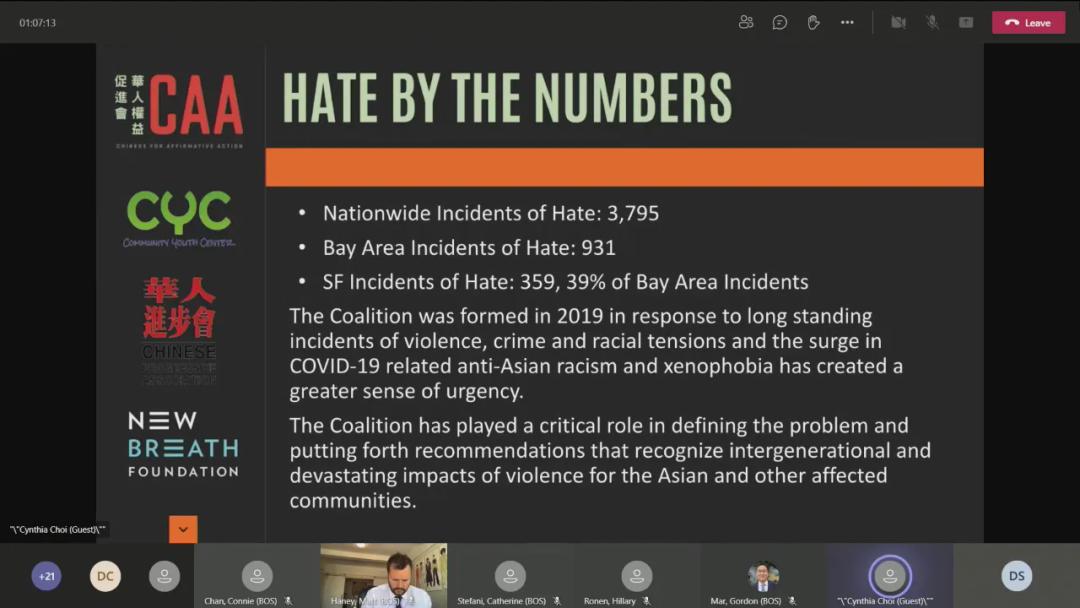
The Public Safety and Neighborhood Services Committee met on April 8, 2021, to consider two items: an ordinance to suspend graffiti abatement citations and waive fees for small businesses during COVID-19, and a hearing on crime and violence targeting Asian-American seniors and the rise of anti-Asian racism. The committee heard from community organizations, city agencies including the Human Rights Commission, Office of Civic Engagement and Immigrant Affairs (OCEIA), Street Violence Intervention Program (SVIP), San Francisco Police Department (SFPD), and the District Attorney's Office. The meeting included extensive public testimony and culminated in unanimous votes to recommend the graffiti ordinance to the full board and to continue the hearing with commitments to develop a coordinated citywide safety plan and prioritize funding for AAPI community safety. Graffiti Abatement Ordinance (Item 1) - Ordinance (File 210258): Suspends provisions of the Public Works Code that allow citations to property and business owners for graffiti on private property during the COVID-19 emergency, and waives pending fees and fines back to January 1, 2021. Sponsored by Supervisor Ronin. - Supervisor Ronin stated that small businesses are struggling and should not be re-victimized by city fines after being vandalized. Co-sponsors Supervisors Haney, Chan, Stephanie, and Melgar expressed strong support. Supervisor Haney noted that the city should take responsibility for graffiti rather than penalizing victims. - Public comment: Elizabeth Vasquez (owner of Tio Chilos) described repeated graffiti and a city “consultation visit” with threat of citation; Nas Horam (Mission Merchants Association board member) supported the ordinance but raised concerns about whether the city would use appropriate matching paint. Other commenters expressed full support. - Vote: Motion to recommend to the full board (April 20 meeting) passed 3-0 (Chair Maher, Vice Chair Stephanie, Member Haney). Hearing on Anti-Asian Violence (Item 2) - Hearing (File 210156): Addressed crime and violence targeting Asian-American seniors and other vulnerable groups, including crime prevention, investigations, victim services, and anti-racism strategies. Community Perspective - Cynthia Sin (Chinese for Affirmative Action / Coalition for Community Safety and Justice): Reported that Stop AAPI Hate tracked nearly 3,800 incidents nationwide from March 2020 to February 2021, with 359 in San Francisco (39% of Bay Area). Women and elderly are especially targeted. The Coalition proposed a three-pronged approach: dedicated victim assistance fund, expanded citywide safety infrastructure with coordinated city-community responses, and cross-racial healing and solidarity programs. Challenges include lack of formal referrals from SFPD and DA’s office, inadequate language access, and stigma around mental health services. - Sarah Wan (Community Youth Center): Noted that the Coalition launched victim support services in 2020 with Board funding, and has assisted eight victims. They conducted safety walks in Chinatown and are partnering with SVIP. Non-Law Enforcement Agencies - Human Rights Commission (Shakira Simley): Described the Office of Racial Equity’s work including the Stand Together SF initiative (launched fall 2020) and a solidarity event on April 17, 2021. Emphasized upstream (preventative education), in-the-moment (bystander training), and downstream (coordinated culturally responsive reporting) strategies. The HRC has convened community roundtables weekly since March 2020. - Office of Civic Engagement and Immigrant Affairs (Adrian Pond, Richard Whippo): Presented the Community Ambassadors Program (CAP), created in 2010 after an earlier surge in anti-Asian violence. CAP employs 25 ambassadors (budget $1.5M, reducing to $1.1M next year) providing multilingual safety escorts and engagement along commercial corridors in Bayview, Chinatown, Tenderloin, Mission, Visitation Valley, and Portola. Ambassadors work Monday–Friday, 8 a.m. to 6 p.m. Supervisor Chan questioned metrics of success and coordination with similar programs; Director Pond acknowledged need for better citywide coordination and noted the absence of a lead violence prevention coordinator (James Caldwell in Mayor’s Office was mentioned later). - SVIP (Arturo Carrillo): The Street Violence Intervention Program, under DPH, serves youth aged 10–35 with outreach, crisis response, and conflict mediation. In response to the anti-Asian violence surge, SVIP has begun partnering with CYC on safety walks (Chinatown, San Bruno Avenue) and plans to hire culturally competent staff. Funding and timeline depend on Mayor’s Office allocation. Law Enforcement - SFPD (Chief Scott, Acting Deputy Chief Vaswani, Commander Fong): Reported that violent crimes against Asian Americans decreased from 2019 to 2020 but are trending upward in 2021. Hate crimes: 7 cases identified in 2021 (4 charged, 3 open investigations); overall hate incidents increased 14% from 2019 to 2020 and 40% from 2020 to 2021. A new Community Liaison Unit (CLU, established October 2020) has assisted in 57 cases year-to-date. The department created a crime dashboard (internal) to track AAPI victimizations, updated policy to track prejudice-based incidents (effective April 7, 2021), and expanded an anonymous tip line to include multiple Asian languages. There are 286 certified bilingual officers (Cantonese, Mandarin, Spanish, Tagalog, Russian) plus 111 in other languages. Community safety walks have been conducted in several districts. - District Attorney Boudin: Reported that in 2021, his office filed 6 hate crime cases (5 with AAPI victims). Victim services: 24 victim advocates carry caseloads of 300–400 each. The office has language capacity in 12 languages (3 Cantonese, 1 Mandarin). Budget proposals include a 24/7 victim hotline ($650,000), two credible messenger advocates, clinical social workers, victim advocates for property crimes, and an emergency victim fund. He noted that victims often fall through the cracks because the office only learns of crimes when police clear cases (roughly 10% of reported crimes). Stressed need for coordination and local funding. Public Comments - Multiple speakers, including David Wu (Soma Pilipinas), Jenny Box (API Council), Nikita Sani (Public Defender’s Office), Ashley Lennick (Safe & Sound), youth from Chinese Progressive Association, Crystal Van (translating for Joyce Lee), and Con Hun Win (Southeast Asian Development Center), called for increased investment in community-based safety solutions, language access, cross-racial solidarity, and mental health services. One speaker criticized the DA’s proposal to expand victim services within the DA’s office, arguing it should instead refer to social services. Key Outcomes - Item 1 (Graffiti Ordinance): Unanimously recommended to the full Board of Supervisors for the April 20, 2021 meeting. - Item 2 (Hearing): Continued to the call of the chair. Chair Maher committed to: - Making funding for AAPI public safety a top budget priority, including community safety infrastructure, victim wraparound services, street outreach, restorative programming, and cross-racial organizing. - Developing a coordinated citywide plan to prevent violence and support victims, with a first meeting convened in April, a proposed plan by the end of May, and a follow-up hearing in June. - Supervisor Chan urged city departments to formalize partnerships with community organizations rather than relying on ad hoc relationships. Supervisors Haney and Stephanie pledged support and prioritization in budget discussions. - Motion to continue: Passed 3-0.

PUBLIC SAFETY 24% · COMMUNITY ENGAGEMENT 13% · VICTIM SERVICES 12% · COMMUNITY SAFETY 8%
1270
APR 7, 2021 · SAN FRANCISCO, CALIFORNIA · BUDGET AND APPROPRIATIONS COMMITTEE
Budget and Appropriations Committee Meeting - April 7, 2021

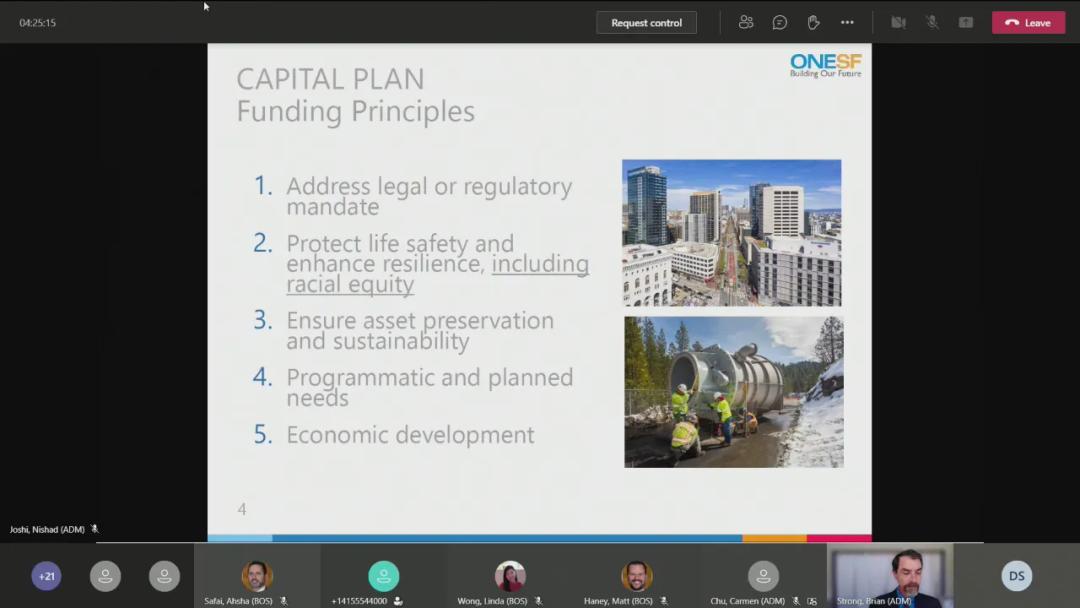
This regular meeting of the Budget and Appropriations Committee, chaired by Supervisor Matt Haney, considered two major items: the Five-Year Information and Communication Technology (ICT) Plan for FYs 2022-2026 and the Ten-Year Capital Expenditure Plan for FYs 2022-2031. Both items were recommended to the full Board of Supervisors with positive recommendations, and amendments were accepted for the capital plan. Public Comments & Testimony - Mary Kate Bacalau, Policy Director at Compass Family Services and co-chair of HESPA, spoke on the capital plan. She praised the emphasis on racial equity and urged the committee to consider shelter enhancements and reimagining congregate shelter to create safe, dignified, and COVID-safe crisis housing. She expressed a desire for continued engagement with the board and capital planning committee. Discussion Items - Item 1: Five-Year ICT Plan (FYs 2022-2026) – Presented by the City Administrator's office. Supervisor Safai asked about efforts to make technology more user-friendly, especially for residents with older devices or limited familiarity. The Director of Technology noted a focus on web-based solutions over separate apps to ensure accessibility. The committee discussed supporting these goals through the budget process. - Item 2: Ten-Year Capital Plan (FYs 2022-2031) – Presented by City Administrator Carmen Chu and Brian Strong. The $38 billion plan covers critical infrastructure investments and is projected to support 170,000 jobs. Supervisor Mar highlighted the need to match federal infrastructure ambition and confront climate change, asking about racial equity metrics. Brian Strong introduced amendments to include affordable housing as a formal category, embed racial equity criteria, and address deferred maintenance. The committee expressed support for these changes. Key Outcomes - Item 1: Motion to recommend to the full board with a positive recommendation passed unanimously (5-0). - Item 2: Amendments (including affordable housing, racial equity, and deferred maintenance) were accepted unanimously (5-0). A subsequent motion to recommend the amended capital plan to the full board with a positive recommendation also passed unanimously (5-0).

CAPITAL PLANNING 26% · TECHNOLOGY AND INFRASTRUCTURE 18% · TECHNOLOGY AND INNOVATION 16% · AFFORDABLE HOUSING 8%
OPENPUBLICA · PUBLIC MEETING INDEXUPDATED DAILY · openpublica.com