Browse by city
Date range
Search help

Search titles, summaries, topics and stored transcripts together. Keywords may match separately; put the whole query in double quotes for a phrase. Matching follows word analysis, so punctuation is not exact. Both dates are included. Documents are not searched.

SHOWING 81–90 ENTRIES
81
MAY 15, 2026 · SAN JOSE, CALIFORNIA · PLANNING COMMISSION
San José Planning Director's Hearing – May 15, 2026

Note: The meeting transcript states the hearing was held on May 13, 2026, conflicting with the provided date of May 15, 2026. This summary reflects the content of the transcript. The Planning Director's Hearing was called to order at 9:00 AM by Hearing Officer Jared Ferguson, acting on behalf of Director Christopher Burton. The meeting covered a consent calendar with three routine permits and one public hearing item. Consent Calendar - Items 3A (H25-029, V25-002, ER25-164), 3B (HA18-047-01, ER26-005), and 3C (T25-010, ER25-106) were approved in a single action. - For item 3C, project manager Jason Lee noted a citation error in the CEQA analysis (incorrectly citing Class 15 instead of Section 15061(b)(3)). The hearing officer acknowledged the correction and approved the consent calendar without any public comments or requests to remove items. Public Comments & Testimony - Mark Wu (with wife Ivy), neighbor at 2570 Brokenman Court (downhill from the project site), expressed concerns about the proposed two-story home at 2569 Colnez Court. He noted that the neighbor's land is already 12 feet above his property, and the new second-floor balconies would be 23 feet above his single-story home, creating direct sightlines into his yard and windows. He cited potential noise from cable railings in high winds, smoke from an outdoor kitchen, and unblockable outdoor lighting. He requested five reasonable conditions, including tall trees for privacy. He stated he was not trying to stop the project. Discussion Items - Item 4A – Plan Development Permit Amendment (PDA 98-067-04, ER22-202): Proposed construction of a two-story single-family house (5,400 sq ft, 5% FAR) and permitting two existing wooden decks on a 2.46-acre site at 2569 Colnez Court (Council District 8). The site is zoned with R1 standards and was originally entitled for three single-family homes. The project was found consistent with the General Plan, zoning, and outreach policy. CEQA exemption under Section 15303(a). - Staff (Alex Hughes) presented the project, noting a photometric lighting plan showed downward-facing lights with no spill onto adjoining properties, and a geohazard clearance had been obtained. - Applicant representative confirmed compliance with all setbacks and height requirements, stated the building is over 200 feet from the neighbor's home, and noted they could not lower the grade. Applicant offered to consider alternative railing materials if the city or a scientific study supported the noise concern. - Hearing Officer Jared Ferguson asked staff about lighting and noise, then encouraged the applicant to explore alternative railings to address neighbor concerns. He noted that noise and outdoor barbecue smoke are normal neighborhood expectations. No other public speakers. Key Outcomes - Consent calendar unanimously approved with the noted correction. - Item 4A was approved (PDA 98-067-04 and ER22-202) with an informal recommendation from the hearing officer that the applicant consider alternative railing options to mitigate potential noise for the neighboring property. No formal conditions were added. - The hearing concluded shortly after the action on item 4A.

LAND USE 57% · PROCEDURAL 43%
82
MAY 13, 2026 · SAN JOSE, CALIFORNIA · CITY COUNCIL
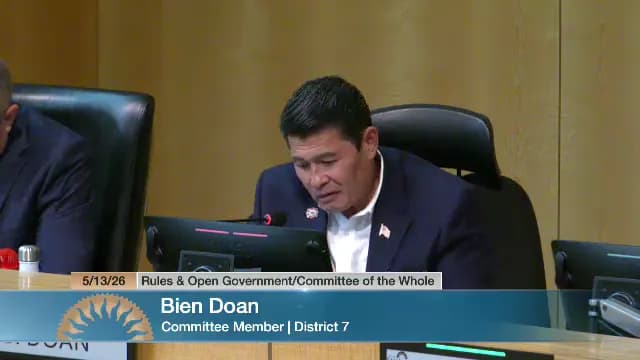
San Jose Rules Committee Meeting - May 13, 2026: Ministerial Approval Deferral and Remote Participation Reinstatement

The Rules and Open Government Committee met on May 13, 2026, at 2:00 PM to review the upcoming council agenda, discuss two major items: a proposal to expand ministerial approval for housing and a memo to reinstate remote public participation, and hear public comment. Both items passed unanimously, with the ministerial item deferred to the next budget cycle and the remote participation item approved for immediate implementation. Consent Calendar - The committee approved the agenda for the May 19, 2026 council meeting and the consent calendar (6 items) by a 5-0 vote. No public comment was offered. Discussion Items Item C1: Ministerial Approval Memo (Tordillos, Campos, Cohen, Kamei) - The committee considered a memo recommending expansion of ministerial approval processes citywide for housing projects qualifying for CEQA exemption under AB 130. Planning Director Chris Burton presented a workload analysis showing the department at 130% capacity for the next fiscal year and recommended deferral to the 2027-28 budget cycle due to competing priorities, including the four-year housing element review. - Councilmember Tordillos argued for full council deliberation, noting that Mountain View completed similar work in under four months and that San Jose already has a strong ministerial foundation. He suggested the proposal could complement or replace other work plan items like the downtown ministerial ordinance. - Vice Mayor Foley moved to defer the item to the 2027-28 budget cycle but with a cross-reference to the October CED committee meeting for earlier discussion. Councilmember Candelas seconded, expressing concern about impacts on community engagement but supporting the compromise. - Public comment: Alison Cingalani (SV@Home) spoke in favor, stating the proposal is a "practical governance strategy" that would streamline housing production. - Outcome: Motion carried 5-0. The item is deferred to the 2027-28 budget cycle, with a cross-reference to the October CED meeting for prioritization discussion. Item C2: Remote Public Participation Memo (Candelas, Ortiz, Cohen, Casey) - The committee reviewed a memo to reinstate remote public participation for city council meetings, in advance of SB 707's July 1, 2026 deadline. City Clerk Tony provided an update: the system can be operational by the June 2 council meeting, using the same Zoom-based process used during COVID, and would be ready for the June 8 budget hearing. - Councilmember Candelas emphasized accessibility for working families, people with disabilities, and those unable to attend in person. The motion aimed to implement remote participation for the rest of the fiscal year (June meetings) with permanent adoption under SB 707. - Councilmember Kamei raised concerns about potential abuse by non-local actors but acknowledged the need for compliance. The committee discussed safeguards, including pre-speaker warnings and having the city clerk handle disruptions. - Councilmember Duan clarified the SB 707 deadline is July 1, 2026 (not 2027 as originally typed). The motion was amended to extend the implementation beyond June to align with the legal requirement. - Public comment: Eleven speakers (including representatives from Catalyze SV, Working Partnerships, REACH Coalition, and disability advocates) strongly supported reinstatement, reading statements from community members who could not attend in person. They argued remote participation is essential for equity and inclusion. - Outcome: Motion carried 5-0. Remote public participation will be implemented starting with the June 2 council meeting, in time for the June 8 budget hearing, and will continue for all council meetings going forward. The city clerk will bring back policy changes (Policy 037) for formal adoption, with potential expansion to committees and commissions discussed for later meetings. Open Forum - Jordan Moldow (D3 resident, BPAC chair) urged the council to monitor state changes to the cap-and-invest program that could reduce funding, and stressed the urgency of prioritizing housing to address displacement and affordability. - Alex Shubat (community member) echoed the housing urgency, noting San Jose is far behind its housing goals and that the consequences affect the next generation's ability to live in the city. Key Outcomes - Item C1 (Ministerial Approval): Deferred to the 2027-28 budget cycle, with a directive to discuss prioritization at the October CED committee meeting. Vote: 5-0. - Item C2 (Remote Participation): Approved for immediate implementation starting June 2, 2026, for all council meetings, in compliance with SB 707. Vote: 5-0. - Open Forum: No formal action taken; comments were received for council consideration.

COMMUNITY ENGAGEMENT 44% · LAND USE 35% · TECHNOLOGY AND INNOVATION 7% · PUBLIC COMMENT 6%
83
MAY 12, 2026 · SAN JOSE, CALIFORNIA · CITY COUNCIL
San Jose City Council Meeting - May 12, 2026: Budget Hearing, Airport Master Plan, and SJ26 Events Update

The San Jose City Council met on May 12, 2026, for a regular meeting that included ceremonial proclamations, a public hearing on the 2026-2027 proposed operating and capital budgets, approval of an amendment to the airport master plan, and an update on major events under the SJ26 initiative. The council also heard public comments on immigration services, senior health and wellness programs, wildland fire staffing, and other community concerns. Ceremonial Items - Peace Officers Memorial Day: Councilmember Duan presented a proclamation recognizing May 15, 2026, as Peace Officers Memorial Day, honoring 17 fallen officers and community service officers from San Jose. - Historic Preservation Month: Councilmember Mulcahy proclaimed May as Historic Preservation Month, highlighting the 2026 theme "All People Are Created Equal." Rachel Royer, chair of the Historic Landmarks Commission, announced the launch of the "My San Jose Project" and noted that over 600 visitors are expected for the 2027 California Preservation Conference in San Jose. - Missing and Murdered Indigenous Women Awareness Day: Councilmember Ortiz proclaimed May 5 as Murdered and Missing Indigenous Awareness Day. Anasita Miller of the Indian Health Center of Santa Clara Valley cited research showing 55% of participants had a murdered relative and 50% had a missing relative. She requested the city create a local MMIP task force. - Adjournment in Memory: The meeting was adjourned in memory of Thomas "Tommy" Nunez, the first Mexican American NBA referee, who passed away on April 24, 2026. Councilmember Condelas shared personal reflections on Nunez's mentorship and founding of the National Hispanic Basketball Classic. Consent Calendar - Item 2.8 - Water Affordability Pilot: Councilmember Condelas pulled this item to thank staff for launching the pilot, which aims to assist residents struggling with water bills. He noted efforts to track its effectiveness and pledged to promote it. The consent calendar was approved unanimously. Public Comments & Testimony - Public Hearing on 2026-2027 Proposed Budget: 26 speakers addressed the council on: - Immigration Services: Multiple speakers (Karen, Joana Becerra, Jeremy Barus, Kathleen Early, Kim Gaptel) urged full $1 million funding for immigration legal services and rapid response. Mayor Mahan noted the proposed budget includes $500,000 in one-time funding and that he helped raise over $450,000 in philanthropic funds for three San Jose organizations, but acknowledged the need is greater. - Senior Health and Wellness: Susan St. Clair, Marcelo Espiritu, Georgia Basile, and others from SourceWise, SALA, Vivo, and Catholic Charities asked to restore funding for the older adult health and wellness grant, which was cut 42% last year ($300,000 remaining). They argued these services prevent higher long-term costs. Vice Mayor Foley expressed her intent to find offsets. - Wildland Fire Staffing: Speakers from The Villages (Deb Gordon, Larry McNary, Diana Halleck, Kathleen Helsing) opposed a proposed reconfiguration from a Type 6 to a Type 3 wildland engine, citing concerns about access on narrow, steep terrain. City Manager Jennifer Maguire clarified the change is not expected to adversely impact operational readiness. Councilmember Condelas noted he received reassurances from the fire chief but still has concerns about unintended consequences. - Other speakers addressed water service interruptions and general budget concerns. - Open Forum: Four speakers addressed non-agenda items: - Brian Darby warned about the dangers of normalized hate speech. - A speaker complained about PATH’s communication failures and a police interaction at a homeless encampment ("the jungle"). - Ray Carrillo asked for a fence around a closed gas station at 510 E. Santa Clara St., citing illegal activity and hazardous waste. - Elena Churchill raised a warrant issue and a complaint about an invasive vine on a city easement affecting her dogs. Discussion Items - Amendment to the Airport Master Plan (Item 5.1): Staff presented an update to the 20-year planning horizon, now projecting 17 million annual passengers by 2037 (down from 22.5 million in 2020 due to post-pandemic changes). The amendment includes planning for emerging electric vertical takeoff and landing (eVTOL) aircraft, growth in business aviation, and development of the "orange lot" (6 acres on Dela Cruz) for aviation-related uses. An addendum to the EIR found no new significant environmental impacts. Councilmember Torrijos questioned the growth forecast; Director Muki Patel noted conservative financial forecasts show flat traffic at 10 million passengers for the next two years. Councilmember Mulcahy asked about Ewart Road closure for cyclists; staff committed to working with other departments on alternate bike path flooding issues. The resolution was approved unanimously. - Republic Services Solid Waste Services Rates (Item 6.1): No public comment. The item was approved unanimously. - 2026 Major Event Status Report (Item 8.1): Staff presented results of Super Bowl and NCAA March Madness events, and previewed the upcoming FIFA World Cup. Key statistics: - Super Bowl: 12,000 attended the Kaylani concert; 48,000 unique visitors to San Pedro Square Superfest; 7,500 at the drone show. Some businesses reported 300% year-over-year sales increases. - NCAA Tournament: 46,500 attended games at SAP Center; 3,700 attended a free Shaquille O'Neal (DJ Diesel) concert with zero incidents. - FIFA World Cup: Six matches at Levi’s Stadium from June 11–July 19, 2026. San Jose will host a 34-day fanfest in San Pedro Square (largest in North America), with additional activations at Lake Cunningham (drone show), concerts, and cultural events. Paraguay will base camp at Signia and practice at San Jose State. Other upcoming events: U.S. Table Tennis Nationals (July 3–9), CrossFit Games (late July), and Slam Jose 3-on-3 basketball. Staff discussed public safety coordination, small business toolkits, and international business symposium. Councilmembers expressed excitement and urged neighborhood activations beyond downtown. Councilmember Duan requested funding for watch parties in Little Saigon and Monterey Road; Deputy City Manager Rosalind Huey said they are working with BIDs. The report was accepted unanimously (Councilmember Cohen absent). Key Outcomes - Consent Calendar approved unanimously. - Public Hearing on the proposed budget was held; no vote taken. Councilmembers noted they will work on trade-offs before the final budget adoption on June 8, 2026. - Airport Master Plan Amendment adopted unanimously (10-0, with Cohen absent). - Republic Services Solid Waste Rates approved unanimously. - 2026 Major Event Status Report accepted unanimously (10-0, with Cohen absent). - Adjournment in memory of Tommy Nunez.

ECONOMIC DEVELOPMENT 30% · PUBLIC SAFETY 17% · PROCEDURAL 11% · PUBLIC COMMENT 10%
84
MAY 11, 2026 · SAN JOSE, CALIFORNIA · PLANNING COMMISSION
Planning Director Hearing: Harker School Expansion Approved – May 11, 2026

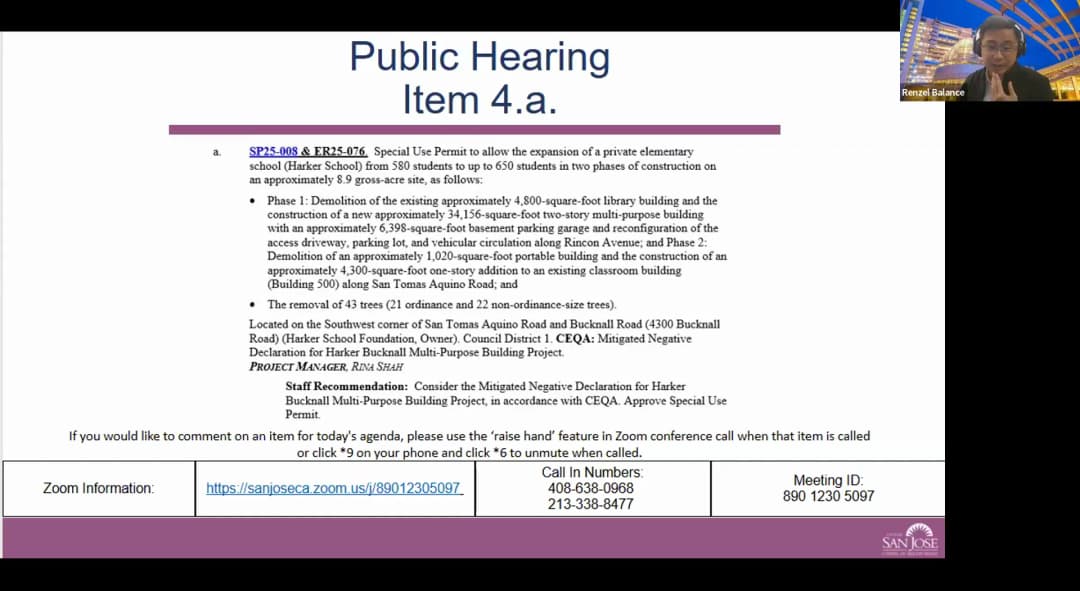
Note on Date: The transcript records the hearing as May 6, 2026, but the user-provided date is May 11, 2026. This summary uses the provided date. This hearing, conducted via Zoom and presided over by Hearing Officer Ruth Cueto (on behalf of the Director of Planning, Building and Code Enforcement), considered one public hearing item: a special use permit for the Harker School's expansion at 4300 Bucknell Road (Council District 1). The meeting began with a deferral, then moved to the public hearing. No consent calendar items were on the agenda. Deferral - Item 2A (PD 25‑019 / ER 25‑194): A planned development permit for EV truck charging stalls, storage, and a maintenance building at 4553–4653 North First Street was deferred by staff request to the May 20, 2026 director hearing for re-noticing. No public comment was offered. Public Comments & Testimony Four residents spoke in opposition to the Harker School expansion. Their concerns centered on traffic, safety, and neighborhood quality of life: - Gail Wilson (resident since 1969): Strongly objected, citing daily traffic congestion that makes exiting Bucknall and Weston Drive impossible. She noted parents park on neighborhood streets and pedestrians behave unsafely. She argued the original school was intended for 300 students and adding more than 10% will worsen unsafe conditions. - Debbie (resident since 1964/65): Opposed, highlighting parking in driveways, blocking leaf piles, and lack of traffic control on Rincon Avenue. She appreciated tree replacement but questioned the species. She expressed concern about activities permitted until 8 p.m. affecting elderly neighbors. - Nandini Acharya (resident of Della Court since 2016): Objected due to traffic. She described parents' sense of entitlement ("one child per Tesla"), failure to obey four‑way stop signs, and prioritization of Harker parents by school personnel directing traffic. She noted a crossing guard used to be at the intersection but is gone. - Raji (resident since 1989): Opposed, citing noise from 7 a.m. to 8 p.m., inability to park in front of her home without tickets, and deteriorating street conditions. She asked that the neighborhood be offered a way out if expansion proceeds. - Shamit (resident of Dorval, south of school): Opposed, describing 15+ minute delays during drop‑off/pickup, dangerous driving on Weston and Bucknell, and inequity: Harker costs $51,000/year, so the neighborhood sacrifices quality of life for families who can afford the school. Discussion Items Staff Presentation (Rena and Court Hitchens): - The project is a two‑phase expansion of Harker Elementary School (K‑5) from 580 to 650 students, with up to 190 staff. Phase 1: demolish a 4,800 sf library, build a 34,156 sf multi‑purpose building with basement parking (6,398 sf), reconfigure access and parking, and relocate basketball courts. Phase 2: demolish a 1,020 sf portable and add 4,300 sf to building 500. - 43 trees (21 ordinance, 22 non‑ordinance) will be removed; 91 new 24‑inch box trees will be planted (London plane, Chinese pistache, red maple). Perimeter redwoods along Rincon Avenue will remain. - School hours remain Monday–Friday, 7 a.m. to 6 p.m. (construction allowed until 7 p.m. within 500 ft of residences). - A Transportation Analysis (January 27, 2026) found 38 net AM trips and 17 net PM trips; vehicle‑miles‑traveled (VMT) impacts are less than significant due to carpool and private shuttle programs. - Monetary contribution of $100,000 for hardscape traffic calming (speed humps, street edge lines, intersection improvements) to be implemented post‑occupancy with input from Council District 1 and residents. - CEQA review: a Mitigated Negative Declaration was prepared (public review Feb 2026). Mitigation measures address air quality, nesting birds, cultural resources, and hazardous materials (soil sampling). Noise and vibration assessment concluded operational noise increase ≤3 dBA DNL at nearby homes. - Staff recommended approval of the special use permit and the Mitigated Negative Declaration. Applicant (Brian Yeager, Harker School): - Expressed gratitude to city staff and enthusiasm for the project. Highlighted benefits: 20 additional parking spaces (≈50% increase in queuing space), reduced road backup by moving library interior, and $100,000 for calming measures. - Addressed public comments: emphasized parent education (right‑turn‑only rule out of campus, reminders at coffee events), acknowledged occasional violations but stated the school corrects them. Noted after‑school programs end at 6 p.m., not 8 p.m. (construction window allows work until 7 p.m.). Confirmed perimeter trees mostly remain; removed trees are interior or arborist‑designated as unsafe. Staff Response (Rena, Florence, Manjut): - Tree species to be planted are similar to existing (London plane, Chinese pistache, red maple). - Transportation analysis (per City Council Policy 5‑1) shows VMT impacts less than significant with carpool and shuttle programs. Coordination with DOT for short‑term parking zones along Bucknell Avenue to prevent driveway blocking. - TDM plan includes private shuttles, education, and marketing of multimodal options (transit, bike network, carpool). Hearing Officer (Ruth Cueto): - Acknowledged the frustrations of neighbors but stressed a multi‑pronged approach: infrastructure improvements (queuing space, traffic calming, design changes), behavioral changes (parent education), and enforcement (encouraged residents to submit complaints to SJPD Traffic Enforcement Unit). Recommended approval. Key Outcomes - Approved: The special use permit (SP 25‑008) for the Harker School expansion (from 580 to 650 students) and the Mitigated Negative Declaration (ER 25‑076) were approved by Hearing Officer Ruth Cueto. - Conditions: The project must implement the Mitigation Monitoring and Reporting Program, comply with construction noise restrictions (7 a.m.–7 p.m. M–F within 500 ft of residences), provide the $100,000 traffic calming contribution post‑occupancy (with DOT and community input), and maintain TDM measures (shuttles, education). - Next Steps: The permit action is final upon signing and mailing; appealable under Title 20 (zoning) and Title 21 (CEQA) of the Municipal Code.

TRANSPORTATION SAFETY 62% · LAND USE 20% · PROCEDURAL 18%
85
MAY 11, 2026 · SAN JOSE, CALIFORNIA · CITY COUNCIL
San Jose City Council Budget Study Session on Neighborhood Services and Public Safety CSAs - May 11, 2026

This study session focused on the proposed Fiscal Year 26-27 operating budgets for the Neighborhood Services and Public Safety City Service Areas (CSAs). Council members and city staff discussed a range of service reductions, investments, and contingency plans, with particular attention to library cuts, homeless encampment management, and public safety staffing. Public Comments & Testimony - Multiple speakers urged the council to preserve public access to the California Room at the Dr. Martin Luther King Jr. Library, emphasizing its unique historical collections, its role in student projects, and the irreplaceable value of in-person research. Speakers included historians, teachers, students, and community advocates. - Jonathan Francisco Borga (speaking for himself) urged support for the recommended library budget as a compromise that preserves branch hours, but asked continued advocacy. - A representative from San Jose Firefighters Local 230 expressed concern over the proposal to defer Fire Station 32 by two years and eliminate 14 sworn vacant positions, arguing it reduces emergency response capacity. - A second firefighter representative opposed the elimination of three engineer positions at Station 24, calling for enhanced wildfire preparedness instead of cuts. - Janel Erdonias (Silicon Valley Council of Nonprofits) asked the council not to cut youth violence prevention services such as BEST, and noted disappointment over lack of continued investment in the TRUST community crisis response model. Discussion Items - California Room: The proposed budget eliminates positions that staff the California Room, resulting in closure of public access. Jill Bourne (City Librarian) stated that the library will work on alternative access methods such as appointments and retrieval services. Several council members (Vice Mayor Foley, Councilmembers Cohen, Candelas, Tordillos, Mulcahy) expressed concern and suggested exploring reduced hours, partnerships with San Jose State University or History San Jose, and community engagement to shape a new service model. - PRNS Preschool Program: The budget eliminates 4.58 positions due to low enrollment, attributed to the expansion of free transitional kindergarten in public schools. John Cesarelli (Director of PRNS) said this is a long-term strategy to transition out of a business line that cannot compete with free, full-day TK. - Senior Health & Wellness Program: Vice Mayor Foley noted the program was cut last year but partially restored; she intends to find $300,000 to continue it. Councilmember Tordillos expressed concern about year-by-year extensions of one-time funding. - POSO Meal Program: Councilmember Ortiz raised concerns about reduced funding for the Portuguese Organization for Social Services and Opportunities (POSO) frozen meal delivery for homebound seniors. Eric Sullivan (Housing Director) explained that a one-time funding spike last year is not continued; the city is working with POSO to identify other funding sources. - Park Maintenance Redistricting: John Cesarelli noted the redistricting is designed for optimization and should produce better results. Councilmember Candelas asked about impacts on Arcadia sports fields, and was told the site will transition to a citywide reservation system with prioritization for underserved areas. Councilmember Ortiz asked about expected impacts from $1M in cuts; Cesarelli said the park system should remain as is, with no major cuts, but some shifts at PAL and Arcadia. - Beautify SJ Optimization: Cesarelli described shifting 15-20 FTEs from waterway abatement teams to no-encampment zones and illegal dumping enforcement, with minimal impact on streets. - Encampment Management: Discussion included the end of large encampments such as Coyote Meadows, with resources moved to maintaining no-encampment zones. Councilmember Mulcahy asked about coordination with Caltrans; Eric Sullivan noted challenges as displaced individuals move to neighborhoods. - Arena Hotel / Interim Housing: Eric Sullivan provided updates on the Arena Hotel transition to permanent housing with a new developer, and the Taylor Street navigation hub (over 200 individuals transitioned, average stay 3-4 weeks). The budget proposes cutting funding for the latter, saving $1M. - Homelessness Prevention: The proposed budget allocates 10% of Measure E revenues ($4.5M) to prevention, with additional collaboration with the county. - Children Youth Master Plan: Councilmember Campos noted the one-time funding nature (originally $1.2M ARPA, now proposed $500K) and called for ongoing funding commitment. - Police Walking Beats: The budget eliminates walking beats (16 positions never filled). Chief Paul Joseph said downtown beats will continue; other areas can use overtime if needed. - Fire Station 32: The budget defers opening Fire Station 32 by two years, saving $4.7M. A budget addendum (MBA 5) proposes temporarily staffing it by eliminating Rescue Medic 26 and Rescue Medic 3, shifting resources. Fire Chief Robert Sapien and City Manager Jim Shannon noted this is a temporary fix. - Crossing Guards: Councilmember Ortiz expressed concern about cuts to crossing guards, noting safety issues at schools. Chief Joseph said the positions are vacant and the cuts are part of a balanced approach. - AI Report Writing Software: The police department seeks software to speed up report writing, with high upfront cost but expected savings in overtime. Councilmember Ortiz asked about guardrails; Chief Joseph said officers must review and supervisors sign off. - Contingency Plan: Several members (Councilmembers Cohen, Kameh, Campos) highlighted that if the Transit Occupancy Tax (TOT) measure fails, deeper cuts including library hours reduction would be triggered. They called for more discussion on the contingency plan. Key Outcomes - No formal votes were taken; this was a study session. - Council members directed staff to explore reduced hours or partial staffing for the California Room and to engage the community and partners (San Jose State, History San Jose) in developing alternative access. - Vice Mayor Foley and Councilmember Ortiz expressed intent to find funding for senior health & wellness and crossing guards, respectively, possibly through budget addenda. - Councilmember Candelas asked staff to provide a cost estimate for a reduced-service option at the California Room. - Councilmember Kameh urged revenue generation and increased code enforcement fines, and called for public awareness of the contingency plan. - The city manager noted that if the TOT measure fails, the contingency plan (including library hour reductions) will be brought forward as a budget addendum. - The council will continue public safety discussion after a break and proceed with further budget hearings.

PARKS AND RECREATION 27% · PUBLIC SAFETY 16% · HOMELESSNESS 14% · MUNICIPAL FINANCE 12%
86
MAY 11, 2026 · SAN JOSE, CALIFORNIA · CITY COUNCIL
San Jose City Council Study Session on FY 26-27 Proposed Budget - May 11, 2026

The City Council held a study session on May 11, 2026, to review the City Manager's proposed operating and capital budgets for fiscal year 2026-27. Presentations covered the Neighborhood Services, Public Safety, and Strategic Support City Service Areas (CSAs), as well as fees and charges and the capital improvement program. Councilmembers asked detailed questions about specific cuts, new investments, and contingency plans. No formal votes were taken. Public Comments & Testimony - Multiple speakers urged the council to maintain public access to the California Room at the Dr. Martin Luther King Jr. Library, citing its value for historical research, student projects, and community heritage. Speakers included Gail Frank, Greg Smisted, Aaron from Hillbrook School, April Halberstadt, Jean Dresden, Christa Van Land, Kay, Larry Ames, Jimmy Kogura, and Jonathan Francisco Borga. Some speakers offered creative solutions such as partnerships with History San Jose or reduced hours rather than full closure. - One speaker expressed concern about park safety and street sweeping in her neighborhood (Antonia Martinez). - A representative from the San Jose Firefighters Local 230 opposed the proposed deferral of Fire Station 32 and elimination of 14 sworn positions, arguing it reduces emergency response capacity. Discussion Items Neighborhood Services CSA - Jill Bourne (City Librarian) presented the CSA overview, highlighting key priorities: stewardship of public spaces, encampment management, library access, animal care, code enforcement assessment, and shelter optimization. - California Room: The proposed budget cuts positions associated with the California Room special collection at the King Library, leading to closure of public access. Vice Mayor Foley and Councilmember Cohen questioned the plan for alternative access (appointments, retrieval). Councilmember Candelas suggested reduced hours. The library plans to work with the community to develop access options. No layoffs are involved. - Preschool Program: Councilmember Foley noted cuts to preschool programs at Willow Glen and Cambrian due to low enrollment, exacerbated by free transitional kindergarten (TK) in public schools. John Cesarelli (PRNS) stated the city sees this as a business line to transition out of. - Senior Health and Wellness Program: Councilmember Foley expressed concern about eliminating the $300,000 program and vowed to find funding. - Park Maintenance and Beautify SJ: Discussion on redistricting park maintenance and cuts to Beautify SJ, with reassurances from staff that service levels will be maintained through optimization. Councilmember Ortiz raised concerns about East San Jose parks. - Code Enforcement: Rachel Roberts discussed completion of the operational assessment work plan, including chronic offender resolution and enhanced vacant building inspection. - Contingency Plan: Councilmember Cohen and Kamei stressed the need for more discussion on cuts that would occur if the transit occupancy tax (TOT) measure fails, particularly library hours. - Housing and Homelessness: Eric Sullivan discussed interim housing throughput, Taylor Street navigation hub (over 200 individuals transitioned, average stay 3-4 weeks), and partnership with county for two interim housing sites. Councilmember Campos questioned homelessness prevention funding. Public Safety CSA - Chief Paul Joseph presented police and fire priorities, including AI report-writing software, reduction of unstaffed positions, deferral of training center and fire station 32. - Fire Station 32: The budget defers opening by two years, but a manager's budget addendum proposes temporary funding by eliminating rescue medics 26 and 3 to staff it on overtime. Fire Chief Sapian confirmed the temporary nature. - Community Paramedicine Pilot: Funded by opioid settlement funds, aims to divert appropriate 911 calls to a paramedicine unit. Councilmember Candelas asked about metrics. - Crossing Guards: The budget cuts 5.79 vacant crossing guard positions. Councilmembers Foley, Ortiz, and Cohen discussed concerns about school consolidations and traffic patterns. Deputy City Manager Shemby committed to an information memo in October 2026 to reassess needs. - AI Report Writing: Chief Joseph explained the pilot software could significantly reduce overtime spent on report writing. Councilmember Campos raised concerns about governance and guardrails; Cohen expressed support. The department will go through RFP process. - Walking Beats: Councilmember Duong noted cuts to walking beats in Lincoln district; Chief Joseph stated they are costly and unfilled positions. Strategic Support CSA - Khaled Tawfik (CIO) and Aram Korumchian presented on IT, HR, finance, and public works. Investments include $5M for critical IT infrastructure, $500K for new grants management system, $380K for three mechanics, and $270K for 311 software licenses. - 311 Customer Satisfaction: Mayor asked about improving satisfaction from 66% to 70% target. Tawfik cited integration with back-end services through the customer experience initiative. Councilmember Kamei raised concerns about ticketing system closing reports without resolution. Fees & Charges - Discussion on parking meter rate increases ($2/hour in downtown, extended to 9pm), mural fees, ambulance transport fee (revenue estimates lowered due to payer mix), and suspension of gated event fee. Councilmember Kamei suggested reviewing citation amounts for revenue generation. Capital Budget - Jennifer Tell and Matt Lesh presented the $1.2B mid-biannual capital budget update and $3.3B five-year CIP. Major changes include exhaustion of Measure T funds by 2028-29, removal of $200M airport parking garage project, additions for HVAC at EOC, water intrusion remediation at City Hall, and paving program. - Councilmember Tordillos sought clarification on EOC HVAC replacement; Lesh explained issues with contractor and need for critical facility. - Councilmember Mulcahy discussed water intrusion at City Hall and hoped the plaza greening could be considered as part of the solution. Key Outcomes - No formal votes were taken; the study session was informational. - Staff will provide an information memo in October 2026 on crossing guard needs following school consolidations. - Staff will continue to refine the contingency plan and will bring it back for council action if the TOT measure fails. - The California Room access plan will involve community engagement and exploration of alternatives (appointments, partnerships). - The community paramedicine pilot will be implemented with opioid settlement funds. - The parking meter rate increases and other fee changes will be brought forward for separate adoption in June. - The capital budget mid-biannual update was presented for council review; no changes were directed.

MUNICIPAL FINANCE 26% · PUBLIC SAFETY 17% · PARKS AND RECREATION 11% · TECHNOLOGY AND INNOVATION 10%
87
MAY 11, 2026 · SAN JOSE, CALIFORNIA · CITY COUNCIL
City Council Budget Study Session: Public Safety, Strategic Support, and Capital Budget – May 11, 2026

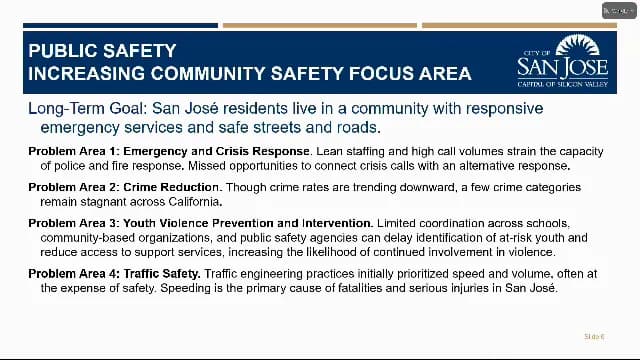
The San Jose City Council held a study session on the proposed 2026-27 budget, focusing on public safety, strategic support services, fees and charges, and the capital improvement program. Councilmembers discussed various proposals, including a community paramedicine pilot, an AI report writing tool for police, staffing for crossing guards, and capital projects such as the emergency operations center HVAC replacement. No formal votes were taken; the session was informational with direction for follow-up actions. Public Comments & Testimony - Antonia Martinez (resident, Orlando/Cunningham area for 50 years) expressed concerns about safety and the lack of scheduled street sweeping on O'Cala to Adren. She asked about initiating a schedule. (Her time expired before the mayor could respond fully; the mayor offered to speak with her after the meeting.) Discussion Items - Community Paramedicine Pilot (Fire Department) Councilman Condelas questioned Fire Chief Sapien about metrics for the proposed community paramedicine pilot, funded by opioid settlement funds. Chief Sapien outlined basic metrics: reach, number of definitive pathways to care, and reduction in repeat 911 users. Condelas also asked about call diversion between police and paramedicine; the chief noted they would develop triage protocols with law enforcement. Condelas expressed support but noted ramp-up time concerns, referencing a previous program that took six months to set up. - Fire Station 24 Type Three Engine Condelas raised concerns from residents about replacing a Type 6 engine with a larger Type 3 engine at Station 24, adjacent to the Villages. Chief Sapien stated the Type 3 offers enhanced wildfire capability, that access roads are similar, and that Type 6 units will still respond if needed. He assured there is little risk of delayed response. Condelas appreciated the reassurances. - AI Report Writing Tool (Police Department) Councilmember Campos expressed concerns about deferring the police training center (which would allow the South Substation to open) while funding an AI report writing tool at a similar cost. She sought details on the city's AI policy, governance, and projected savings. Chief Jennifer Shembury said the tool could save officers 2-3 hours per report (citing a domestic violence report that took 15 minutes vs. normally 2-3 hours) and that accuracy is ensured through safeguards. Campos also asked about measurable outcomes; the chief said overtime reduction would be seen, but exact data within 12 months is uncertain. Councilmember McCone and Vice Mayor Fuller supported the AI tool, noting its potential to reduce overtime and free officers for patrol. - Crossing Guards Councilmember McCone asked about the status of crossing guard hiring. Deputy City Manager Jennifer Shembury confirmed that previously frozen positions for priority locations are being filled, but the proposed budget reduces 5.79 vacant positions (part-time). Vice Mayor Fuller raised concerns about school closures and changing traffic patterns; she proposed revisiting the need in October with an information memo from police. Councilmember Kameh added that consolidated "super schools" may create special needs. Councilmember Tordillos supported the October review and appreciated that not all vacant positions were cut. - ALPR Reduction & Contingency Plan Councilmember Kameh asked about a proposed reduction in Automated License Plate Reader (ALPR) funding. The budget office explained that $420k appears as a six-month cost due to a grant expiring Dec 31, with an $880k annual ongoing cost. Kameh also inquired about the contingency plan if revenue measures fail; Jennifer Shembury said the administration would bring options to a council meeting before the budget adoption in June, and nothing in the contingency plan is automatic. - Behavioral Health Response & County Partnership Mayor Mahan asked about the public's perception of safety and the city's efforts with the county on behavioral health. Deputy City Manager Lee noted that the city is working with the county on involuntary treatment and has identified 60 high-acuity individuals downtown where the system is breaking down. A meeting with the county in June will focus on tools the county may have but not utilize. The mayor stressed the need for concrete steps, even if small. - Strategic Support CSA (311, IT, HR, Public Works) Chief Information Officer Carl Toffic presented the strategic support CSA budget, including $5M for IT infrastructure refresh, $276k for 311 software licenses, and $100k for cloud-based cashiering. Reductions include 20% less for emergency building repairs, deferred vehicle replacements, and elimination of two vacant finance positions. Councilmember Kameh raised ongoing issues with 311 responses being closed prematurely, especially for vehicle complaints. Lee and Toffic explained that a customer experience initiative, including a new CRM, will improve service delivery and that encampment reporting was added back to 311 last week. Councilmember Condelas questioned the $3.9M investment in customer experience through 2029 given fiscal constraints; Lee said the investment overlaps with service optimization and will generate long-term savings. - Council Appointees (City Clerk, City Attorney) Councilman Condelas thanked City Clerk Tony for work on restoring remote public comment to comply with state law. Tony reported testing is underway with some glitches; they are seeking software to enhance the system. Councilmember Mulcahy asked City Attorney Susana about a new deputy city attorney position for municipal code enforcement; Susana said it will serve as a full prosecutor for problematic properties, working with code enforcement on a proactive community justice effort. - Fees and Charges Councilmember Kameh suggested increasing parking citation fines to generate revenue, noting it had not been studied recently. Councilmember Cohon supported comparing fines with peer cities. Vice Mayor Fuller asked about ambulance transport fee revenue (budget revised downward from $1.7M to $800k). Chief Sapien explained that the payer mix is complex and estimates will improve with experience; the city does not bill patients directly but works with insurers. Fuller also noted that cost recovery for some fees is below 100% and asked why; Jim explained they phase in increases to avoid steep jumps. Condelas asked about outreach for new mural fees; Office of Cultural Affairs Director Carrie Adams Hapner said they will do outreach. Condelas also asked about the suspension of the 5% gross gate receipts fee for gated events; Adams Hapner said it was suspended about 10 years ago as it generated only $30k and was regranted; Condelas suggested it might be a revenue opportunity given large events. - Capital Improvement Program (CIP) Capital Budget Manager Jennifer Tell presented the $1.2B proposed capital budget for FY26-27 and $3.3B five-year CIP. Key changes include exhaustion of Measure T funds by FY28-29, a $7M HVAC replacement at the Emergency Operations Center (EOC) due to design/contractor issues, and $2M for water intrusion remediation at City Hall (seed money for design). Councilmember Tordillos asked about the EOC HVAC; Matt Lesh explained it's a critical facility and the city is in disputes with the contractor. Councilmember Mulcahy asked about water intrusion at City Hall; Lesh said the $2M is for early design and the larger repair is likely much more. Mulcahy suggested examining the plaza for greening opportunities; Lesh clarified the issue is groundwater, not the roof deck, but agreed to evaluate greening. Key Outcomes - Direction to staff: Provide an information memo in October 2026 analyzing school crossing guard needs and traffic patterns following school closures. Council may then consider a budget adjustment if needed. - No formal decisions taken on AI report writing tool, community paramedicine pilot, or other proposals; these will be considered during the budget adoption process. - Budget adoption schedule: The council will hold additional sessions between June 2 and the adoption deadline; the contingency plan will be discussed at a council meeting, not automatically enacted. - Follow-up on parking citations: Staff will consider a deeper analysis of citation revenue and comparison with peer cities for future discussion. - Capital projects: The EOC HVAC replacement and City Hall water intrusion remediation will proceed with design funding; staff will evaluate greening the plaza as part of the latter. The meeting adjourned at approximately 4:45 PM.

PUBLIC SAFETY 30% · MUNICIPAL FINANCE 25% · TECHNOLOGY AND INNOVATION 21% · PARKING 8%
88
MAY 7, 2026 · SAN JOSE, CALIFORNIA · CITY COUNCIL
San Jose City Council Study Session on 2026-2027 Budget: Transportation and Environmental Services - May 7, 2026

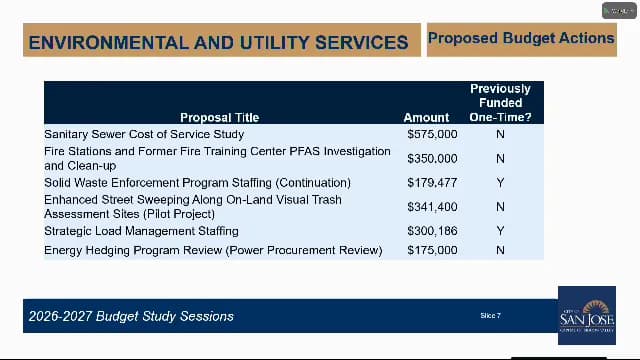
This study session, held on the morning of May 7, 2026, was part of the city's 2026–2027 budget deliberations. The council reviewed two City Service Areas (CSAs): Transportation and Aviation Services, and Environmental and Utility Services. No formal votes were taken; discussions focused on current performance, challenges, and proposed budget actions. Key topics included airport passenger decline, traffic safety initiatives (Vision Zero, automated speed enforcement), parking enforcement, infrastructure funding, water and energy utility operations, and the city's partnership with PG&E. Discussion Items Transportation and Aviation Services - John Risto (Director of Transportation) and Mookie Patel (Airport Director) presented an overview. Airport passenger satisfaction remains high, but aging facilities challenge cleanliness scores (target 80%). Asset preservation plans aim to improve. Annual passengers have dropped to a forecast 10 million, with business travel shifting and jet fuel prices doubling. The airport is focusing on real estate development (Coleman Avenue, hangars), advertising revenue ($6.7M annually), and lounge expansions to enhance customer experience. - Transportation highlights: pavement condition index held at 73-74 (Measure T expiring), bike network completion increasing incrementally, and a $570,000 general fund savings from moving speed camera staffing to citation revenues. The city received a U.S. Forest Service grant for tree planting (staffing and actual planting). A proposal to increase downtown parking meter enforcement and rates was noted. - Vice Mayor Foley expressed support for boosting airport demand, suggesting a task force with regional employers. Patel noted metrics alone don't support new non-stop routes; engagement with large employers (e.g., South Bay employer with 34,000 employees) is critical. Vice Mayor also highlighted Vision Zero: fatalities are up, and advocated for quick-build projects (e.g., Hillsdale's successful lane reduction, which reduced speeds and crashes and increased multimodal use). - Regarding automated speed enforcement, Risto reported that a federal grant was not approved, but the city is proceeding with a vendor. Deployment of all 33 cameras is on track for fall 2026 (September). Net proceeds from citations will be reinvested in safety improvements along the same corridors. - Councilmember Condellas asked about bike lane usage metrics. Risto said counts are done periodically, not annually on every street. Silver Creek Valley Road is challenging due to hills, but connections are important. On parking enforcement, citation revenue is up about 20% overall, with an estimated $13.5 million expected versus $11.6 million last year. The unregistered vehicle program has towed approximately 2,200 vehicles in one year. - Councilmember Mulcahy pushed for an airport task force and highlighted creative real estate opportunities (hotel site, west side development). He expressed displeasure that the Willow Glen street parking proposal was in the budget without consultation, requesting a return-to-source reinvestment of any new parking revenue into the business district. - Councilmember Kamei emphasized parking enforcement shortages (only 50 officers vs. 400 in San Francisco) and planted a seed for future increases. She voiced concern about rising airline ticket prices due to jet fuel costs, with Patel forecasting conservative passenger growth until 2028 and noting that the airport carries $1 billion in debt and a $20 per outbound passenger cost. - Councilmember Ortiz expressed frustration with lack of progress on White Road, Jackson Avenue, and King Road redesigns despite years of discussion. Risto cited funding gaps: King Road needs $15 million, has $8 million, and will compete for regional grants (MTC/VTA). Ortiz noted disparity in infrastructure (concrete roundabouts in District 3 vs. plastic pylons in District 5 under the In Movimiento plan) and criticized slow response to abandoned vehicles, requesting a district-by-district breakdown of towing data. - Councilmember Tordillos supported Vision Zero and bike lane expansions, backed more parking enforcement, and advocated for return-to-source for paid parking in Japan Town. He also highlighted curb management (SB 1292) and asked about enforcement near no-encampment zones. Risto explained that vehicles can park legally on public streets, limiting enforcement. Environmental and Utility Services - Jeff Provenzano (Environmental Services), Lori Mitchell (Energy Director), and John Risto (Transportation) presented. Core services include water delivery, wastewater, stormwater, solid waste, and energy. - Key dashboards: wastewater discharge below 120 MGD cap; recycled water demand lower due to unseasonably cold summer and early rain; utility asset operational status high (≥90%); sewer overflows at cap (1.9 per 1,000 miles); landfill waste diversion above 60% (state goal 50%). Budget is nearly flat; increases driven by wholesale water rate hikes. - Proposed budget actions: sewer cost-of-service study, PFAS cleanup at fire stations/training facility, addition of one solid waste enforcement officer, enhanced street sweeping pilot (with DOT), strategic load management position, and energy hedging program review. Major future costs: stormwater permit compliance, nutrient reduction mandates (ammonia discharge limits), and a PCIA increase for San Jose Clean Energy. - Councilmember Campos praised the enhanced street sweeping pilot as a one-team approach. - Councilmember Condellas asked about nonprofit cleanup coordination for Thompson Creek; Provenzano noted Valley Water owns much of that creek, and the city can partner with them. - Councilmember Kamei questioned proposed 7% increase for single-family and 4% for multifamily junk pickup fees and household hazardous waste; Provenzano said increased usage drives costs. Kamei advocated for better education about junk pickup services to reduce corner dumping. - Councilmember Duan inquired about PFAS remediation at the old fire training center (Google property). Remediation is underway and expected to take a couple more years. He also asked about the EPA Superfund site at Alma and 10th Street (38 years unresolved) and how to reduce waterway contamination – Provenzano cited green stormwater infrastructure requirements for new development. - Mayor highlighted the PG&E partnership: a June 2025 agreement tracks large projects (≥20 MW) and is being considered to include 5–20 MW projects. Interconnection times are improving for large loads but not yet small residential/commercial. Mayor also discussed energy storage: battery incentives exist (not fully tapped), and a DC fast-charging pilot will begin construction in 2026, operational in 2027, with potential low-income rates. Payback for residential batteries is estimated at 2–6 years. Key Outcomes - No formal votes were taken; this was a study session to inform budget decisions. - Staff committed to providing an information memo to the full council on vehicle concerns (lived-in vehicles, oversized vehicles, abandoned vehicles, registration enforcement) with data broken down by district. - The automated speed enforcement program is proceeding with a vendor; deployment of 33 cameras is expected in fall 2026. - The Willow Glen parking proposal remains under discussion, with councilmember requesting a return-to-source revenue model. - The city is exploring an expansion of the PG&E partnership agreement to include projects 5–20 MW and high-density residential projects. - A DC fast-charging pilot for electric vehicles is set for operation in 2027, with controlled retail pricing to offer lower rates for low-income customers and during off-peak hours.

MISCELLANEOUS 31% · ENGINEERING AND INFRASTRUCTURE 21% · PARKING 19% · CLIMATE AND ENVIRONMENT 13%
89
MAY 6, 2026 · SAN JOSE, CALIFORNIA · CITY COUNCIL
San Jose City Council Budget Study Session: May 6, 2026

This was the first budget study session for the proposed Fiscal Year 2026-2027 operating budget. The Mayor, City Manager, Budget Director, and the Director of Economic Development presented an overview of the economic context, budget balancing strategies, and key risks. The City Council discussed departmental priorities, workforce development, and the potential impacts of revenue uncertainties. No votes were taken; the session was informational. Discussion Items - Mayor’s Opening Remarks: The Mayor thanked staff and highlighted the most challenging fiscal conditions in his tenure. He noted the proposed budget assumes passage of Measure A (Transient Occupancy Tax modification) and identified three major risks: a potential $9 million shortfall if Measure A fails, $9-10 million annual ERAF (Educational Revenue Augmentation Fund) at risk with a possible $35-39 million clawback, and up to $25 million loss from card room revenue due to new state regulations. The Mayor also noted that the transition from large encampment abatements to optimized services (e.g., Beautify SJ) will save $5.4 million in FY 2026-27 and more ongoing. - City Manager Jennifer McGuire: Emphasized that the proposed budget is balanced and structurally aligns the general fund with minimal community or employee impacts. She warned that if Measure A fails, the contingency plan would result in more significant and noticeable service reductions, including cuts to library hours, parks, police, and council offices. - Budget Director Jim Shannon: Presented the $50.3 million shortfall resolved with $66 million in additional sources: $18.4 million in ongoing new revenues (including Measure A), $35 million from the Budget Stabilization Reserve for one-time uses, and other adjustments. Ongoing cost reductions of $19.4 million include deferral of Fire Station 32 and the Police Training Center, reductions in Beautify SJ ($4.2 million in FY 2026-27, $6.4 million ongoing), and interim housing portfolio savings ($1.2 million in FY 2026-27, increasing to $14.2 million ongoing). He noted that the Budget Stabilization Reserve would be drawn down to about $32.5 million by July 2026, well below the Council policy target of 10% of general fund operating expenditures. - Economic Context by Jen Baker (Director of OED): San Jose’s economy is stable but under pressure. Key data: population growth, GDP growth, unemployment at 4.1%, average wage $128,000, but 20% of residents earn less than $55,000. 49% hold a bachelor’s degree. Employment lands (14% of total land area) generate significant net value for the city. She highlighted the need to preserve employment lands and support small businesses. The technology sector continues to attract investment, but layoffs have cooled from recent highs. - Councilmember Ortiz: Called for stronger workforce development and employer accountability, urging that large employers like Google and Apple hire local youth, especially from communities of color. He stated that “the number one way to stop a bullet is with a job” and that the city must ensure returns on workforce investment. - Councilmember Foy: Asked about funding for the Momotaro (Peach Boy) statue, a gift from sister city Okayama. Staff confirmed that TOT funds will be used for reinstallation, and the funding source will be documented in the transmittal memorandum. - Councilmember Candelas: Raised concerns about the San Jose Works Youth Jobs Initiative, noting a $203,000 reduction that would cut 25-30 student placements. He asked if the 30 placements could be restored without the eliminated staff position; staff said it would require extra effort. He also inquired about the 2027 celebration strategy ($350,000 proposed) and the EIFD assessment ($100,000). - Councilmember Kamei: Expressed concern about shrinking employment lands due to state laws (e.g., SB 79) and called for a stronger strategy to protect these lands. She also emphasized the need to connect workforce programs with local community colleges. - Councilmember Campos: Raised issues of child care as an economic driver, noting a $1.3 billion loss in Santa Clara County from lack of investment. She questioned the focus on only 20% of residents earning less than $55,000, arguing that a much larger share of renters are housing cost-burdened. She also asked about the General Plan 4-year review scope and staffing levels. - Councilmember Duan: Asked about aggressive business recruitment and permitting process improvements. He also questioned the plan for Fire Station 32, which is newly built but proposed for deferral. City Manager McGuire responded that options for a modified opening are under evaluation. - Councilmember Mulkehi: Discussed business improvement districts (BIDs) and the need for continued staff support to help them become self-sustaining. He also questioned the fee structure for public art installations, arguing that philanthropic gifts like the Momotaro statue should not incur city fees. Budget Director Shannon explained that staff time is charged to projects because there is no general fund support for that work. Key Outcomes - The proposed FY 2026-2027 operating budget is balanced and includes $66 million in additional sources, $35 million from the Budget Stabilization Reserve, and $18.4 million in ongoing new revenues. Cost reductions total $19.4 million ongoing, with deferral of Fire Station 32 and the Police Training Center. - The City Council will continue budget study sessions on May 7 (Transportation, Aviation, Environmental Utilities), May 11 (full day covering remaining CSAs, fees, and capital), and subsequent dates. - The Mayor will release the June Budget Message on June 1, followed by a public hearing on June 8, and final council vote on June 9. - Several councilmembers expressed intent to explore restoration of certain cuts (e.g., youth jobs, fire station staffing) and to address affordability and workforce equity in future budget cycles. - The administration will report back on the feasibility of a modified opening for Fire Station 32 during the Public Safety study session on May 11.

ECONOMIC DEVELOPMENT 40% · MUNICIPAL FINANCE 27% · ARTS AND CULTURE 5% · LAND USE 5%
90
MAY 6, 2026 · SAN JOSE, CALIFORNIA · PLANNING COMMISSION
San Jose Planning Commission Meeting - May 6, 2026: State Law Maintenance Update

The San Jose Planning Commission met on May 6, 2026, at 6:30 PM under Vice Chair Lisa Bickford. The primary agenda item was PP 25-007, an ordinance to update Title 20 of the municipal code to comply with recent state laws and implement a housing element action item. No public comments were received. The commission unanimously recommended approval to the City Council. Consent Calendar - The minutes from the previous meeting were approved unanimously (8-0, with three commissioners absent). Public Comments & Testimony - No members of the public spoke during the public comment period. Discussion Items - State Law Maintenance Update (PP 25-007): Staff presented four state law changes required as of January 2026: - AB 1061: Expands SB9 provisions for subdivisions on historic properties. Previously, historic districts were entirely excluded; now only historic landmarks and properties requiring demolition or alteration of contributing structures in historic districts are exempt. Staff noted approximately 2,014 sites (0.01% of R1-zoned properties) are affected. - AB 752: Makes child daycare centers a permitted use when co-located with multifamily housing (5+ units), eliminating the previous special use permit requirement. Staff explained that state licensing (CDSS) will enforce standards. - AB 1154 and SB 543: Update Junior ADU regulations: owner-occupancy is not required if the JADU has separate bathroom facilities; rentals must be for a minimum of 30 days. - Housing Element Action P-41: Removes subjective language (e.g., "harmonious", "aesthetically pleasing") from findings for residential permits, replacing them with objective standards (setbacks, height). Non-residential projects retain discretionary standards. - Commissioner questions focused on: the scope of historic property protections under AB 1061 (staff clarified that only objective standards apply, no public hearing for ministerial approvals); the practical impact of removing subjective standards; the applicability of AB 752 to existing apartment complexes (staff noted that existing buildings could convert a unit to a daycare center, but new developments are more likely to incorporate them from the start). Key Outcomes - The Planning Commission voted unanimously (8-0) to recommend that the City Council adopt the determination of consistency with the Envision San Jose 2040 General Plan EIR and approve the ordinance amending Title 20. The item will also be reviewed by the Airport Land Use Commission on May 27, 2026, and by the City Council in June 2026. Reports and Updates - Staff reported that on April 28, 2026, City Council approved a site development permit for 108 units at Camden Avenue and Singletree Way. On May 5, 2026, Council approved an amendment for digital signage at Mayberry and West Mission Street. - Upcoming meetings: General Plan 4-Year Review Task Force on May 20 at 6:30 PM; study session on the 2026 General Plan Annual Report on May 27 at 5:00 PM (no regular meeting that week).

MISCELLANEOUS 39% · LAND USE 35% · PROCEDURAL 16% · HISTORIC PRESERVATION 10%
OPENPUBLICA · PUBLIC MEETING INDEXUPDATED DAILY · openpublica.com