Browse by city
Date range
Search help

Search titles, summaries, topics and stored transcripts together. Keywords may match separately; put the whole query in double quotes for a phrase. Matching follows word analysis, so punctuation is not exact. Both dates are included. Documents are not searched.

SHOWING 141–150 ENTRIES
141
JUL 7, 2022 · SHORELINE, WASHINGTON · PLANNING COMMISSION
Shoreline Planning Commission Meeting - July 7, 2022: Transportation Master Plan Update

During its July 7, 2022 regular meeting, the Shoreline Planning Commission received a detailed presentation from city staff on the ongoing update to the Transportation Master Plan (TMP) and Transportation Element (TE). The presentation covered draft modal plans, a project prioritization framework based on six community-driven goals, and initial results from a survey of 427 residents. Commissioners asked clarifying questions about specific project types (e.g., unimproved right-of-way), the top-ranking projects, and the upcoming financial analysis. No formal votes were taken, but staff outlined next steps including cost estimates and a financially constrained project list to be presented in September. The meeting also included brief updates on the annual planning commission retreat and the July 21 public hearing on outdoor seating development regulations. Discussion Items - Transportation Master Plan Update (Staff Presentation) - Staff presented the results of Outreach Series 3 (April 19–May 16, 2022), which included multilingual yard signs (English, Spanish, Mandarin), advertisements in ethnic media, and an online survey completed by 427 participants. Pop-up displays were placed at Einstein Middle School, Ronald Commons, Richmond Beach Branch Library, Spartan Recreation Center, Shoreline Library, and Shoreline High School. - The draft modal plans cover walking, biking, transit, shared-use mobility hubs, and driving. Survey respondents generally felt the plans provided the “right amount” of accommodation for each mode. - Six TMP goals were identified: safety, equity, multimodality, connectivity, climate resiliency, and community vibrancy. These were approved by the city council on May 24, 2021. - Staff developed a draft point system to prioritize projects based on these goals, weighted by public input, city policies, and council direction. The proposed weighting places safety as the top priority (matching survey results), equity as second (higher than the survey’s fourth-place ranking, citing council goals), and community vibrancy as lowest. Connectivity and multimodality are tied for third, with climate resiliency ranked last but noted as interrelated with connectivity and multimodality. - A composite map of draft equity priority areas identifies underserved communities based on age, income, race, disabilities, and language. - The draft project list includes 175 projects in categories: intersections & multimodal corridors, unimproved right-of-way, trail along the rail (a 2.5-mile trail paralleling the light rail alignment from 145th to 195th Streets), trail connections, the planned 185th non-motorized bridge, and shared-use mobility hubs. - Preliminary prioritization scored projects as high (red), medium (yellow), or low (green). Previously committed projects (e.g., 145th multimodal corridor segments) were shown in purple and not re-scored. - In response to Commissioner Carlahan, staff explained that “unimproved right-of-way” refers to informal paths connecting streets, often used as alternatives to busy streets. Some are associated with planned sidewalk projects from the 2018 sidewalk levy. - In response to a commissioner’s request for top projects, staff highlighted: - The intersection of 1st Avenue and 155th Street (required due to future failure). - The 185th multimodal corridor project (including 185th, 10th Avenue, and 180th connection) to connect to the future light rail station. - The 148th non-motorized bridge (planned, seeking funding). - The 145th off-quarter bike network, using low-speed streets to connect to the 148th light rail station and beyond to the Interurban/Burke-Gilman Trails connector. - Sidewalk projects funded by the 2018 levy, such as the 20th Avenue sidewalk connecting to Saltwater Park. - A neighborhood-scale shared-use mobility hub that scored high. - A commissioner asked about the financial analysis. Staff explained they are developing high-level cost estimates for all 175 projects to produce a financially constrained 20-year priority list. The analysis will consider projected city revenue, including grants, and will initially focus on high-scoring projects. A preliminary draft of the TE update will be presented to the planning commission in August, with a staff recommendation for a financially constrained list expected by September 1. A public hearing is planned for fall. - Annual Planning Commission Retreat - Staff announced that the annual planning commission retreat is tentatively scheduled for August 4, 2022 (regular Thursday evening). Commissioners were invited to suggest topics; last year’s retreat was held at Richmond Beach Saltwater Park. - Future Meeting Agenda - The next meeting (July 21, 2022) will include a public hearing on the outdoor seating development regulation amendments, with a potential recommendation to city council. Key Outcomes - No formal decisions or votes were made. - Staff will return to the planning commission in August 2022 with a preliminary draft of the TE update and high-level cost estimates. - A more detailed, financially constrained priority project list will be presented on September 1, 2022, followed by a public hearing. - The July 21 meeting will address outdoor seating regulations with a public hearing and possible action.
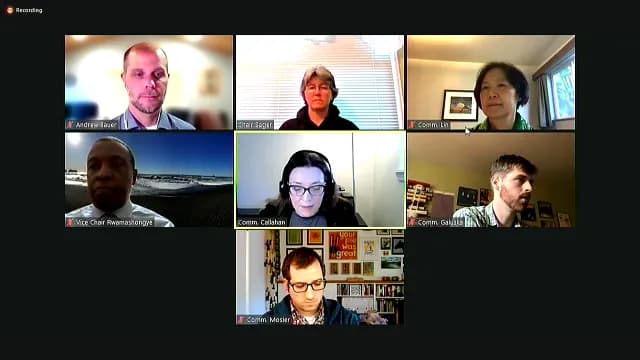
TRANSPORTATION SAFETY 69% · PUBLIC ENGAGEMENT 14% · PROCEDURAL 9% · EQUITY IN TRANSPORTATION 5%
142
JUN 16, 2022 · SHORELINE, WASHINGTON · PLANNING COMMISSION
Shoreline Planning Commission Meeting - June 16, 2022: Economic Development Update and Public Comment on Tree Protection

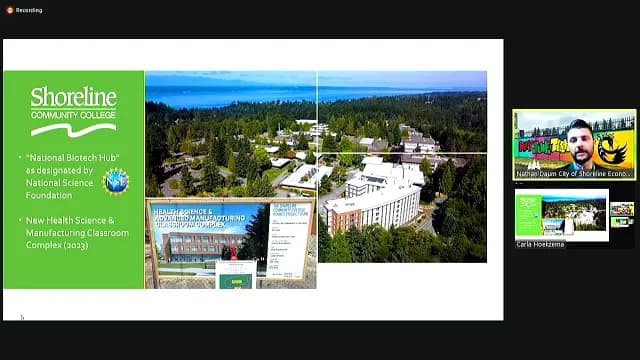
The Shoreline Planning Commission met on June 16, 2022, to receive an update on economic development activities and development pipeline from Nathan Daum, Economic Development Manager. The meeting also included public comment on tree protection and routine approvals. Consent Calendar - The commission approved the agenda as presented. - The minutes from the May 19, 2022 meeting were approved unanimously. Public Comments & Testimony - Kathleen Russell, a Shoreline resident representing Safe Shoreline Trees, spoke during general public comment. She expressed concern that approximately 20% of development property in Shoreline (zones CB, NB, MB, MUR70, and TC 1-3) is not subject to any tree code, meaning developers can clear-cut without retention or replacement requirements. On the remaining 80% of property, only 25% retention of significant trees is required. She urged the city to protect Shoreline's tree canopy for current and future residents. She referenced clear-cutting on Meridian and North 147th in Parkwood. Discussion Items - Economic Development Update (Nathan Daum): Daum presented a comprehensive overview of Shoreline's economic development activities, programs, and development pipeline. Key points include: - The city's economic development priorities originate from the Comprehensive Plan and Vision 2029. The current five-year Economic Development Strategic Plan is nearing completion; the next plan will follow after the new comp plan and light rail service in 2024. - During the pandemic, the city implemented a COVID-19 response including B&O tax deferral, outdoor dining regulations, a CARES Act grant program awarding over $750,000 to 45 small businesses, and a restaurant map. - Development activity is strong: over 10,000 housing units are in delivery, under construction, or planned, with significant activity in light rail station areas (148th St and 185th St), the Aurora Corridor, and Shoreline Place (Community Renewal Area). - Examples of challenges include soil and infrastructure issues, stormwater connections, and code amendments needed for transit-oriented development (e.g., allowing projects to connect directly to Sound Transit property). - Incentives include Transportation Impact Fee exemption (saving approximately $85,000 for a coffee shop), Multifamily Tax Exemption (MFTE) with 20% affordable units, and a 20-year MFTE pilot for station areas. - Leakage data: Shoreline has a surplus in food/beverage stores (likely Costco and Central Market) but a deficit in eating/drinking establishments; residents leave town for those. - Opportunities for job creation include Shoreline Place, the 148th St station, FurCrest, and the biotech/life sciences cluster supported by Shoreline Community College's designation as a national biotech hub. - Music and film industries are strong; the city supported filmmaking with reduced fees and has seen feature films shot in Shoreline. - Vacancy rates remain low (below 5%), indicating continued demand. - Commission Q&A: Commissioners asked about ground-floor commercial vacancies (e.g., the GO2 building) and barriers to filling them. Daum noted that patience and landlord willingness to invest may help. He also mentioned ongoing talks to acquire a property west of the park-and-ride for open space preservation. Key Outcomes - No formal votes or decisions were taken during the meeting. - The commission received the economic development update as information. - Staff provided an update on the MUR70 zone amendments: the Planning Commission's recommendation was presented to City Council on June 6; council will consider potential amendments on June 27, including deeper green building requirements and increased arts contributions. - Commissioner Callahan shared an observation from Bothell's missing middle housing efforts, suggesting that allowing duplexes on corner lots could be a gentle way to increase density in neighborhoods. - Next meeting: July 7, 2022, agenda includes the Transportation Master Plan update and Transportation Element of the Comprehensive Plan.

ECONOMIC DEVELOPMENT 57% · AFFORDABLE HOUSING 10% · LAND USE PLANNING 6% · PROCEDURAL 5%
143
MAY 19, 2022 · SHORELINE, WASHINGTON · PLANNING COMMISSION
Shoreline Planning Commission Public Hearing on MUR70 Zone Amendments and Outdoor Seating - May 19, 2022

The Shoreline Planning Commission held a public hearing on May 19, 2022, to consider the MUR70 zone development code amendments (parking reductions and building height process changes) and to study a proposed permanent outdoor seating code. The commission voted unanimously to forward the MUR70 amendments to the city council and provided direction to staff on the outdoor seating proposal. Consent Calendar - The commission approved the agenda and the minutes from the May 5, 2022 meeting without changes. Public Comments & Testimony - Kathleen Russell (president of Shoreline) testified in support of stronger tree retention requirements. She requested that 70-foot buildings be required to retain 10% of significant trees and that the 90-foot building incentive (currently an 'or' between 20% tree retention and the deep green incentive) be changed to 'and', meaning both conditions would be required. She argued that current tree replacement programs cannot replace the hundreds of trees being lost in areas like Parkwood. Discussion Items MUR70 Zone Development Code Amendments - Staff (Mr. Bauer) presented the proposed amendments, which focus on two areas: (1) allowing up to a 50% reduction in off-street parking for developments of 100+ units or 10,000+ sq ft of commercial space, contingent on a city-approved Transportation Demand Management (TDM) plan; and (2) removing the requirement for a development agreement to achieve maximum building height (140 ft) and instead substituting an administrative design review with a neighborhood meeting, while retaining affordable housing requirements and removing requirements for structured parking, TDR credits, and district energy. - Commissioners asked clarifying questions about TDR credits, the 90% structured parking requirement (which is being removed), and the interaction between parking reduction options (e.g., combining affordable housing with TDM). Staff confirmed that the 90% parking structure requirement is being dropped because market forces already deliver it, and that parking reductions under different incentives could be combined. - Commissioner Callahan moved to recommend approval of the amendments as shown in revised Attachment A. Commissioner Galuska seconded. After brief discussion, the motion passed 6-0. Outdoor Seating Development Code Amendments (Study Item) - Staff (Ms. Lee) presented results of a survey and focus group, and proposed draft code. The proposal would allow outdoor seating on private property (not in the right-of-way) for brew pubs, eating/drinking establishments, microbreweries, and micro-distilleries. It would not require additional parking for the outdoor space and would allow conversion of up to 4 spaces or 30% of required off-street parking (whichever is greater) on single-tenant sites, with a more restrictive formula on multi-tenant sites. Two alternatives were presented: Alternative 1 (greater flexibility for all sites) and Alternative 2 (more balancing). - Commissioners debated expanding the use to other retail uses. Most commissioners (Mosier, Callahan, Lynn, Vice Chair Wamishon Jay, Chair Sager) supported limiting to the four food/drink uses initially, though Vice Chair Wamishon Jay noted that limiting uses could stifle creativity (e.g., a band playing outside a tavern). - On parking conversion, Commissioner Mosier supported Alternative 1 (treating single- and multi-tenant sites equally with 'whichever is greater'). Commissioner Galuska suggested that new developments should be allowed the same reduction as existing conversions. Others (Lynn, Callahan) leaned toward the staff recommendation. - Staff asked if more study was needed; the commission indicated it was ready to proceed to a public hearing in July, with direction to bring back code language limiting uses to the four categories and incorporating Alternative 1 for parking conversion. Key Outcomes - MUR70 Zone Amendments: Voted 6-0 to forward a recommendation of approval to the city council. - Outdoor Seating: Staff was directed to return in July with a draft ordinance for a public hearing, based on commission preferences to limit uses to food/drink establishments and use Alternative 1 for off-street parking conversion. - Commissioner Callahan reported on attending Affordable Housing Week events, noting a forum on missing middle housing (May 31) and a session on renters' rights, where a model ordinance for longer notice on rent increases was discussed. She expressed hope that the city council would consider stronger renter protections. - The June 2 meeting was canceled; the next meeting is June 16 in person at City Hall, featuring an economic development forecast.

PARKING MINIMUMS ELIMINATION 25% · LAND USE PLANNING 23% · FOOD TRUCK REGULATION 19% · PUBLIC SAFETY 9%
144
MAY 5, 2022 · SHORELINE, WASHINGTON · PLANNING COMMISSION
Shoreline Planning Commission Meeting - May 5, 2022

The Shoreline Planning Commission held a virtual meeting on May 5, 2022, at 3:00 PM UTC. The main agenda items included a study session on the Sound Transit Lynnwood Link Extension Project update, a director's report on hybrid meeting requirements and Affordable Housing Week events, and administrative approvals. No public comments were received, and no formal votes were taken. Consent Calendar - The agenda was approved with the addition of a Director's Report. - The minutes from the April 21, 2022 meeting were approved without changes. Public Comments & Testimony - No members of the public signed up for general comment. Discussion Items - Sound Transit Lynnwood Link Extension Project Update: Juniper Nami, City of Shoreline Light Rail Project Manager, presented an update on construction progress. Key points included: - Two stations in Shoreline: Shoreline South (148th) elevated station and Shoreline North (185th) station with a garage and transit center. - Concrete strike resulted in over 40,000 cubic yards of concrete missed and over 4,000 delayed deliveries; schedule impacts are being assessed. - Safety record: No fatal incidents; minor issues were addressed with stand-downs and corrective plans. - Parcel surplus: Six remnant parcels in the R6 zone may be available for redevelopment, but affordability considerations are not yet finalized. - Staff coordination: City projects (e.g., 148th non-motorized bridge, Fifth Avenue sidewalks) are being aligned with Sound Transit construction windows. - Drone video of the guideway was shown (with technical difficulties); features included stormwater detention facilities, traction power substations, shared-use paths, and noise walls. - Commissioner Questions: Vice Chair Wama Shonja commented on the significance of the concrete shortage for construction. Commissioner Brinson asked about safety records and opportunities for affordable housing on surplus parcels. Discussions noted that during the 60% design phase, the city traded a parking garage site (west of I-5) for cost savings, affecting potential transit-oriented development. - Director's Report (Carla Markle): - Hybrid meetings: The governor rescinded the remote meeting proclamation; in-person meetings must resume effective June 1, 2022. The first in-person planning commission meeting is expected June 16, 2022, at City Hall. Commissioners unable to attend in person may participate via hybrid option with notice to the chair. - Affordable Housing Week (June 2022): Events hosted by NUSHA and the Housing Development Consortium. Recommended sessions include updating comprehensive plans, Black homeownership initiative, renter protections, and affordable housing 101. Deputy Mayor Robertson will present on Shoreline's multifamily tax exemption and mandatory affordable housing in station areas. - Unfinished Business: Commissioner Brinson and Commissioner Moser reported not receiving Planning Commission emails; Carla Markle will coordinate with IT to resolve. Key Outcomes - No formal votes or resolutions were taken. - Commission acknowledged the June 16 meeting will be the first in-person session (with hybrid option) and the June 2 meeting is canceled. - Staff will follow up with Sound Transit on surplus parcel policies and potential affordable housing alignment. - IT will address email distribution issues for affected commissioners.

PUBLIC TRANSPORTATION 37% · ENGINEERING AND INFRASTRUCTURE 20% · AFFORDABLE HOUSING 17% · PROCEDURAL 16%
145
APR 21, 2022 · SHORELINE, WASHINGTON · PLANNING COMMISSION
Shoreline Planning Commission Meeting - April 21, 2022: Cottage Housing Code Amendments Introduction

The Shoreline Planning Commission met to discuss cottage housing development code amendments as a study item, receive an update on recent City Council actions on development code amendments and the comprehensive plan docket, and discuss forming an affordable housing committee. The meeting began with routine approvals and no public comment. Consent Calendar - Agenda approved as presented. - Minutes of the April 7, 2022 meeting approved without changes. Public Comments & Testimony - None. Discussion Items Cottage Housing Development Code Amendments Introduction Elise Kaim, Associate Planner, presented the work plan for cottage housing regulations, funded by a Department of Commerce Housing Action Plan Implementation Grant. The presentation covered the Housing Action Plan background (adopted May 2021), the need for missing middle housing due to a regional housing shortage, and specific deliverables: existing conditions report (by end of spring 2022), public engagement (summer 2022), draft regulations (fall 2022), and final regulations (by June 2023). Cottage housing is defined as one- or two-story size-limited dwellings (700-1,200 sq ft) arranged around a common courtyard. Commissioners discussed: - Density: Current zones allow 6 units/acre; staff noted potential density bonuses based on performance metrics. Commissioner Galusca expressed pessimism, noting previous unsuccessful cottage housing codes elsewhere. - Affordability: Vice Chair Wama Shonja emphasized targeting specific income groups (e.g., those earning $30-40/hour) rather than just increasing supply. Commissioner Callahan raised concern about preventing “million-dollar cottages.” Commissioner Brinson noted size inherently lowers cost and offered expertise on affordable ownership housing. - Amenities and maintenance: Discussion on balancing required amenities (bike storage, open space) with affordability and ensuring private maintenance (e.g., HOAs) rather than city responsibility. - Existing conditions assessment: Commissioners requested analysis of parking, bike storage, ownership vs. rental (restricting short-term rentals), demographic data from existing cottage housing in Shoreline, and compatibility with tree preservation goals. - Success metrics: Commissioner Mosier suggested smaller-scale developments (e.g., two units on a lot) as an incremental approach; Commissioner Lynn emphasized blending with neighborhood character and preserving open space. Director’s Report Steve Zaver reported on City Council actions based on previous commission recommendations on development code amendments (38 amendments considered over 7 commission meetings, 4 council meetings). Key council decisions: - Changed the definition of significant tree: any healthy tree ≥6 inches DBH (previously 8 inches for conifer, 12 inches for non-conifer). - Added additional penalties for illegal tree removal: $15,000 per tree plus land disturbance costs, plus financial guarantees for replacement. - Reduced tree removal permit threshold from 30 to 24 inches DBH. - Increased minimum tree retention from 20% to 25% (commission-recommended). - Granted staff flexibility to reduce site requirements (parking, landscaping, lighting, signage) for existing commercial buildings to improve tenant attraction. - Struck requirement that parking costs be included in residential rent (split vote). - Approved the 2022 Comprehensive Plan docket, including an amendment proposed by Councilmember Roberts to allow duplexes and triplexes in low-density single-family zones, which will require substantial public outreach alongside the cottage housing work. New Business - Affordable Housing Committee: Chair Sager proposed forming a committee to research and report on affordable housing issues. Commissioners Callahan and Brinson expressed interest and were informally appointed to serve. Announcements - Staff announced plans to transition to hybrid meetings (in-person and virtual). City Council may begin hybrid meetings in late May or June; commissions will follow with at least two weeks’ notice. - A group photo of commissioners was taken for the website. Key Outcomes - Commission provided initial feedback on cottage housing to staff; no votes were taken. Staff will incorporate feedback into the existing conditions report and public engagement process. - Affordable housing committee formed with Commissioners Callahan and Brinson; they will report back periodically. - Next meeting scheduled for May 5, 2022: light rail station update from Senior Planner Juniper Nami.

HOUSING AFFORDABILITY 51% · AFFORDABLE HOUSING 15% · PROCEDURAL 8% · LAND USE PLANNING 8%
146
APR 7, 2022 · SHORELINE, WASHINGTON · PLANNING COMMISSION
Shoreline Planning Commission Meeting - April 7, 2022

The Shoreline Planning Commission convened on April 7, 2022, at 3:00 PM. The meeting included a swearing-in ceremony for new and returning commissioners, updates on the Transportation Master Plan and MUR70 zone code amendments, adoption of hybrid meeting rules, and election of officers. Consent Calendar - Swearing-in ceremony: Mayor Scully administered oaths to returning Commissioner Lynn and new Commissioners Mosier and Brunson. - Approval of agenda: Approved as presented. - Approval of minutes from March 17, 2022 meeting: Approved without changes. Public Comments & Testimony - No members of the public signed up for comment. Discussion Items 7a. Transportation Master Plan (TMP) Update – Draft Modal Plans - Nora Daly Pang, Senior Transportation Planner, presented the fifth briefing on the TMP update. The draft modal plans cover transit, shared-use mobility hubs, pedestrians, and cyclists. Key elements include: - Bicycle network planned for Level of Traffic Stress (LTS) 1–3, with facilities ranging from bike lanes to protected paths. - Transit plan: City advocating for additional service on priority corridors, working with Sound Transit, King County Metro, and Community Transit to improve connections to future light rail stations. - Shared-use mobility hubs: 18 proposed hubs (regional, central, neighborhood) to support car-light lifestyles. - Pedestrian plan: Builds on 2018 Sidewalk Prioritization Plan; identifies unimproved right-of-way opportunities. - Commissioners discussed connectivity, equity, low-cost safety improvements (e.g., from Bipartisan Infrastructure Law), and community outreach. Commissioner Brinson noted the overlay of pedestrian and bike networks. Vice Chair Womashonje raised equity concerns; staff confirmed equity priority areas are being mapped using ACS data. - Outreach Series 3 runs April 19–May 8, 2022. Draft project list due early summer 2022. 7b. MUR70 Zone Development Code Amendments - Planner Mr. Bauer presented the latest draft amendments for the Mixed-Use Residential 70 zone near the 145th and 185th light rail stations. - Key refinements since January 2022: - Base height remains at 70 feet; existing tree retention incentives (up to 90 feet) unchanged. - Maximum height stays at 140 feet, but the requirement for a development agreement is removed. Instead, buildings above 70 feet must hold a neighborhood meeting and pass administrative design review. - Parking reduction of up to 50% allowed for developments with ≥100 units or ≥10,000 sq ft commercial, conditional on a Transportation Demand Management plan. - Additional requirements for height above 70 feet: 20% affordable units at 60% AMI, plus one option: either 10,000 sq ft commercial/ground-floor community space (reduced from 40,000 sq ft), or 1% building valuation for art/placemaking, plus sub-area improvements. - Removed requirements for development agreement, deep green certification, structured parking minimum, TDR credits, and district energy. - Feedback from developer stakeholder group supported streamlining and parking reductions. - Next steps: SEPA analysis, then public hearing for Planning Commission recommendation to City Council. 9a. Planning Commission Rules of Procedure – Hybrid Meetings Update - Proposed amendments allow hybrid in-person and remote meetings for commissioners and the public, similar to City Council rules. Public comment will continue to be accepted virtually or by phone. - Motion to adopt the rules as written (Attachment A) made by Commissioner Callahan, seconded. Passed unanimously (6-0). Election of Chair and Vice Chair - Chair: Commissioner Pam Sager was nominated by Commissioner Callahan and elected by unanimous vote. - Vice Chair: Nominations for Vice Chair were Commissioner Ramashonje (nominated by Commissioner Lin) and Commissioner Callahan (nominated by another). Commissioner Ramashonje received a majority (5 votes) and was elected. Key Outcomes - Approved hybrid meeting rules (6-0). - Elected Chair Sager and Vice Chair Ramashonje. - No formal votes on TMP or MUR70 amendments; these are study items with public hearing anticipated in upcoming meetings. - Next regular meeting: April 21, 2022, for cottage housing introduction.

LAND USE PLANNING 24% · PROCEDURAL 16% · PUBLIC ENGAGEMENT 15% · TRANSPORTATION SAFETY 9%
147
MAR 17, 2022 · SHORELINE, WASHINGTON · PLANNING COMMISSION
Shoreline Planning Commission Meeting Summary - March 17, 2022

The Shoreline Planning Commission met on March 17, 2022, beginning at 15:00 UTC, with Chair Sager presiding. Commissioners Callahan, Lin, Ramashonji, and Galuska were present; Commissioner Malik had a planned absence. The main study item was the fourth briefing on the Transportation Master Plan (TMP) update, presented by city staff member Daly Peng. The commission also approved the agenda and the February 17 minutes, received no general public comment, and heard a commissioner report on a FirCrest School campus meeting. Consent Calendar / Routine Approvals - The agenda was approved as presented with no requested changes. - The minutes from the February 17, 2022, meeting were approved with no changes requested. Public Comments & Testimony - No general public comment was offered; no speakers were signed up. Discussion Items - Transportation Master Plan Update (study item): Daly Peng presented the fourth planning commission briefing on the TMP update. The TMP is Shoreline's long-range blueprint for multimodal travel and mobility; the previous TMP was updated in 2011, and the new update will guide investments in transportation infrastructure and programs over the next 20 years. The city launched the multi-year update in fall 2020 and aims for adoption by the end of 2022. - Vision and goals: The draft vision describes the transportation system Shoreline wants to provide by 2044. The six goals are prioritizing safety, providing multimodal options, protecting the environment, seeking equity, planning a connected community, and fostering a vibrant community. City Council endorsed the vision and goals, which were informed by Outreach Series One on May 24, 2021. - Project evaluation and prioritization: Staff presented a draft framework pairing evaluation criteria with the TMP goals. No scoring system has been assigned yet; staff are seeking feedback from the public, council, and planning commission before using the metrics to score potential projects as high, medium, or low priority. - Performance measures: Draft performance measures are intended to quantify how newly constructed transportation projects contribute to the TMP vision and goals. Safety measures would be reported annually through the city's traffic safety report, while other measures would be reported on a biennial cycle similar to the city's budget cycle. Attachment A in the staff report consolidated the framework. - Outreach Series Three: Planned for April 19 through May 8, 2022, this outreach will share public feedback results, gather input on draft modal plans for walking, biking, transit, shared mobility devices, and driving, and collect feedback on the draft prioritization and performance process. The project team plans to target underrepresented groups, including BIPOC communities, youth, people with disabilities, older adults, people with low income, and people with limited English skills, using ethnic media advertisements, small group meetings, pre-recorded presentations on the TMP web page, and an online survey. Outreach will include 50 English yard signs plus companion signs in Mandarin and Spanish, placed in high-visibility locations such as corners and along the Interurban Trail, with QR codes linking to the website and outreach dates. Commissioner Feedback and Questions - Commissioner Ramashonji expressed strong appreciation for the staff's work and said the TMP is forward-looking and positions Shoreline to compete for federal and state grants, including FEMA, FHWA, and WSDOT funding. - Commissioner Lin asked how yard signs had been used in prior outreach. Staff explained the sign production, placement, pairing of English signs with Mandarin or Spanish signs, and the QR code approach. - Commissioner Callahan praised the work, said she was excited to see the draft priority list, and asked whether small-dollar, quick-win, low-hanging-fruit projects would be included. Staff responded that there would also be larger multimodal projects and noted that neighborhood traffic calming measures such as speed humps are generally part of the Neighborhood Traffic Safety Program rather than the TMP project list. Staff also noted that projects addressing collision history often score well for grants under the safety-related prioritization metrics. - Commissioner Lin asked how projects would be selected using the prioritization system and how that relates to grant applications. Staff explained that the metrics were being vetted before the draft project list, that the process is designed to be data-driven rather than complaint-based, and that the consultant team built a future travel demand model to forecast population and job growth effects on traffic and intersection failures. This is layered with collision hotspot data and equity lenses based on age, income, communities of color, people with disabilities, and limited English speakers to create equity priority areas. Staff also mentioned that two light rail stations are expected to open in about two years, creating demand for multimodal connections. - Commissioner Galuska thanked the team and said she especially values the connectivity and equity elements, as well as the BRT-related work, and looks forward to the draft modal plans. Committee Reports and Announcements - Commissioner Callahan reported attending the FirCrest School Campus Master Development Plan early community input meeting, hosted by the Department of Social and Health Services, and complimented staff for their role. Key Outcomes - No formal motions or roll-call votes were taken during the meeting; the agenda and February 17 minutes were approved without objection. - The planning commission received the TMP update and provided feedback on prioritization, performance measures, equity, and outreach. - Staff plan to return on April 7, 2022, with the draft modal plans. - The next meeting on April 7 is also expected to include swearing-in of two new commissioners and Commissioner Lin's reappointment, MUR70 development code amendments, and election of the chair and vice chair. - The meeting was adjourned after the announcements and next-meeting preview.

TRANSPORTATION SAFETY 39% · PROCEDURAL 22% · PUBLIC ENGAGEMENT 19% · GRANT MANAGEMENT 12%
148
FEB 17, 2022 · SHORELINE, WASHINGTON · PLANNING COMMISSION
Shoreline Planning Commission Transportation Master Plan Update – February 17, 2022

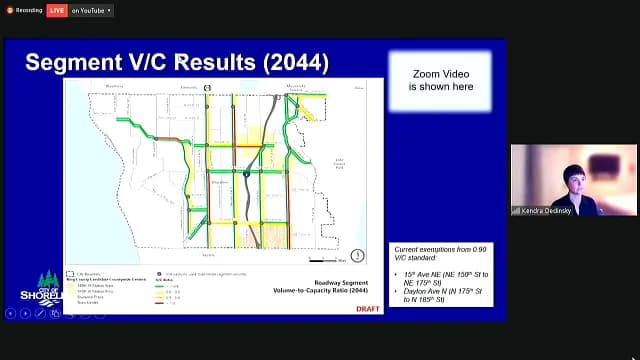
The Shoreline Planning Commission met on February 17, 2022, to receive a study item presentation on the Transportation Master Plan (TMP) update, focusing on auto level of service (LOS) options. Senior Transportation Planner Nora Daly Peng and City Traffic Engineer Kendra Nadinsky presented the third in a series of briefings, covering four LOS options for intersections and supplemental volume-to-capacity (V/C) ratio standards. The meeting began at approximately 6:15 PM (local time) and adjourned after discussion with no public comment or other business. Discussion Items - Presentation Overview: Staff explained that the TMP is a long-range multimodal blueprint last updated in 2011. The update aims for adoption by end of 2022. The project team has conducted two outreach rounds and is developing modal plans for walking, biking, transit, shared-use mobility, and auto/freight. - Auto Level of Service Options: Four options were presented: - Option 1 (Status Quo): Maintain LOS D at signalized intersections citywide (LOS B on state routes). Pros: simplicity, lowest vehicle delay. Cons: high cost for widening, harms walkability/bikability, highest transportation impact fees. - Option 2A: Allow LOS E at intersections adjacent to higher-density zoning; retain LOS D elsewhere. More context-sensitive but has edge issues and pockets with weak transportation options. - Option 2B (Staff Preferred): Allow LOS E in candidate countywide centers (148th St, 185th St, Shoreline Place), LOS D elsewhere. Better focused, fewer edge issues, aligns with growth centers. - Option 3: Use a corridor-averaging method allowing LOS E average along key corridors in denser areas. Most flexible but complex, allows highest delay, and may be perceived as arbitrary. - Modeling Results: Using 2019 baseline and 2044 projections, the number of failing intersections (by current D standard) would be 6 under Option 1, 5 under Options 2A/2B, and 3 under Option 3. Future V/C ratio analysis showed 9 corridor segments failing the current 0.9 standard, reducing to fewer than half under a 1.1 standard in centers. - Supplemental V/C Ratio Options: Three options: (1) Keep 0.9 on all principal/minor arterials; (2) Remove standard; (3) Sync with Option 2B – allow 1.1 in centers, 0.9 elsewhere. Staff preferred Option 3 for consistency and context sensitivity. - Commission Discussion: Commissioners asked about cut-through traffic, pedestrian and bicycle impacts, freight delay, and modeling assumptions. Vice Chair Rebecca expressed support for walkability. Commissioner Malik inquired about shared-use mobility hubs and the 185th St bridge. Staff noted that the 185th area would see higher delay intentionally to discourage auto-dependence. Key Outcomes - No formal votes were taken; the study item was for discussion and feedback. - Staff indicated that Option 2B (centers-based LOS E) emerged as the preferred balance, and they will return to the Planning Commission on March 17, 2022, to present project prioritization and performance measures. - Draft modal plans will be debuted in early April, with third outreach series launching mid-April. - Commission members expressed appreciation for the detailed presentation and look forward to future updates. Note: The meeting had no consent calendar, public comments, or other business. The next scheduled meeting on March 3 was canceled; the next meeting is March 17, 2022.

TRANSPORTATION SAFETY 62% · PUBLIC ENGAGEMENT 10% · PUBLIC TRANSPORTATION 7% · LAND USE PLANNING 6%
149
FEB 4, 2022 · SHORELINE, WASHINGTON · PLANNING COMMISSION
Shoreline Planning Commission Public Hearing on 2021 Development Code Amendments - February 4, 2022

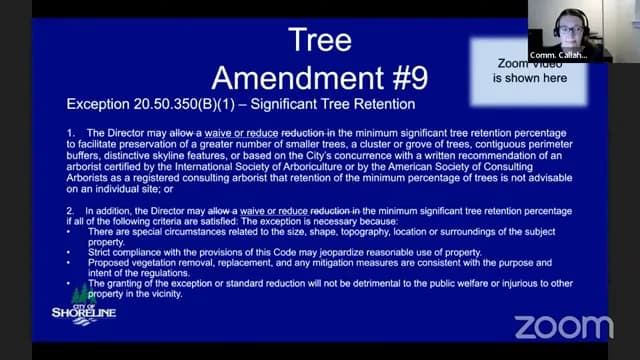
The Shoreline Planning Commission held a public hearing on February 4, 2022, to consider the 2021 Development Code Amendments Batch Two, covering miscellaneous, SEPA, and tree amendments. The commission heard public testimony, deliberated, and voted on three amendment packages. The miscellaneous and SEPA amendments were approved unanimously. The tree amendments were approved after a series of individual votes, including a sub-amendment to lower the landmark tree definition from 30 to 24 inches DBH. The commission also voted to recommend placing four items on the 2022 comprehensive plan docket. Consent Calendar - The agenda was approved without changes. - Minutes from the January 20, 2022 meeting were approved without changes. Public Comments & Testimony - Bob Craig (resident of Clinton, WA, developer in Shoreline): Expressed support for the staff recommendation to unbundle parking, citing LEED and ITE standards. - Susie Good (resident of Seattle, representing a property management company with properties in Shoreline): Supported unbundling parking for environmental reasons and practical management challenges with one-to-one ratios. - William Turner (resident of Shoreline, speaking for the Tree Preservation Code Team): Argued for lowering the significant tree definition from 8 inches to 6 inches DBH, citing multiple nearby cities using 6 inches. - Nancy Morris (resident of Shoreline): Urged the commission to recommend protective tree code amendments (2, 6, and 10) as proposed by the Tree Preservation Code Team, referencing past commission actions in 2012. - Kathleen Russell (resident of Shoreline, speaking for the Tree Preservation Code Team): Questioned why some proposed codes (e.g., 6-inch definition, landmark 24-inch, penalties) were not in staff slides, and listed 575 recently removed trees in Shoreline, asking for all proposed codes to be recommended to council. - Ann Bates (resident of Shoreline, Ridgecrest neighborhood): Expressed support for amendments 2, 6, and 10 as proposed by the Tree Preservation Code Team, emphasizing climate change urgency. - Peter Eglick (attorney for Innis Arden Club, representing over 500 lots in Shoreline): Recommended against adopting any tree amendments, advocating for a comprehensive stakeholder process and an environmental impact statement. Raised concerns about impacts on 80% of lots, solar access, and lack of scientific basis for replacement requirements. Discussion Items - Miscellaneous Amendments: Staff presented updates on parking setbacks, administrative fixes, and adaptive reuse of commercial buildings. The commission voted 5-0 to approve the staff-recommended miscellaneous amendments. - SEPA Amendments: Amendments clarifying the State Environmental Policy Act review, approval, and appeal processes. The commission voted 5-0 to approve the staff-recommended SEPA amendments. - Tree Amendments: Staff recommended approval of several amendments (numbered 1, 2, 5, 6, 8, 9, 11) but not others (e.g., 6-inch significant tree definition, 24-inch landmark tree). A motion to reject all tree amendments and refer them back for broader stakeholder input failed (Commissioner Malik and Vice Chair Wamishonje in favor, Chair Sager, Commissioners Callahan and Lynn opposed; 2-3). A subsequent motion to approve the staff-recommended tree amendments as the main motion passed. The commission then discussed each tree amendment individually: - Amendment 1 (critical root zone definition): Approved unanimously. - Amendment 2 (definitions: tree canopy, hazardous tree, landmark tree): Initially voted on as a group, but confusion arose over landmark tree definition. The commission withdrew that vote and then considered a sub-amendment by Commissioner Callahan to change landmark tree from 30 inches DBH to 24 inches DBH. The sub-amendment passed 4-1 (Commissioner Malik opposed). The amended Amendment 2 then passed 4-1 (Commissioner Malik opposed). - Amendment 3 (definitions: urban forest, urban tree canopy): Approved 5-0. - Amendment 5 (revised tree code purpose section): Approved 4-1 (Commissioner Malik opposed). - Amendment 6 (general requirements for trees): Approved 4-1 (Commissioner Malik opposed; he expressed concerns about impacts on density and transit-oriented development). - Amendment 8 (increasing significant tree retention from 20% to 25%): Approved 5-0. - Amendment 9 (allowing director to waive/reduce minimum retention under criteria): Approved 5-0. - Amendment 11 (tree protection standards: taller fencing, arborist observation, etc.): A sub-motion by Commissioner Malik to strike the arborist requirement (part E) lacked a second and failed. The amendment then passed 4-1 (Commissioner Malik opposed). After individual votes, the main motion (staff-recommended tree amendments as amended by the landmark tree change) was put to a final vote and passed 4-1 (Commissioner Malik opposed). - Annual Comprehensive Plan Docket: Staff recommended placing items 1-4 on the final docket for study: (1) transportation master plan update, (2) major comprehensive plan update (due 2024), (3) King County Park & Ride land use change at Aurora/192nd, (4) private amendment on tree preservation policy. The commission voted 5-0 to recommend these items to council. Key Outcomes - Miscellaneous Amendments: Approved 5-0 to forward to city council. - SEPA Amendments: Approved 5-0 to forward to city council. - Tree Amendments (staff-recommended, as amended): Approved 4-1 to forward to city council (Commissioner Malik opposed). Key change: landmark tree definition lowered from 30 inches DBH to 24 inches DBH. - Annual Docket: Approved 5-0 to recommend items 1-4 be placed on the final docket for staff study. - Staff noted that the recommendation letter to council will include commission comments on further study of the 6-inch vs. 8-inch significant tree definition and other concerns raised during discussion.

TREE PRESERVATION 62% · PROCEDURAL 20% · LAND USE PLANNING 6% · PARKING MINIMUMS ELIMINATION 3%
150
JAN 20, 2022 · SHORELINE, WASHINGTON · PLANNING COMMISSION
Shoreline Planning Commission Meeting on MUR70 Amendments - January 20, 2022

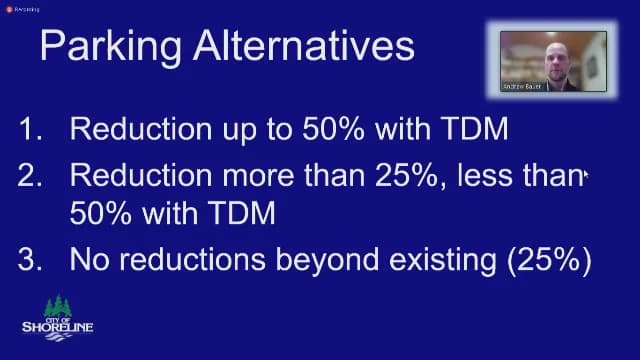
The Planning Commission met on Thursday, January 20, 2022, at 3:00 PM to discuss proposed amendments to the MUR70 development code, focusing on parking reductions and height adjustments to facilitate compact growth near light rail stations. Commissioners also heard public comment on tree code revisions and deliberated on alternatives for development agreements. Public Comments & Testimony - Rebecca Jones, a 16-year former Shoreline resident, spoke during general public comment in support of robust tree code revisions. She emphasized that the Pacific Northwest is part of a carbon sink and that mature, significant trees sequester 70% of their lifetime carbon in the last half of their natural life. She stated that to replace the benefits of one 47-year-old Douglas fir, it would require immediate planting of 13 six-year-old Douglas firs. She urged the commission to act now and not "kick the can down the road." Discussion Items - Parking Reductions in MUR70 Zone: Staff presented three alternatives: (1) allow up to 50% parking reduction for projects with ≥100 units or ≥10,000 sq ft commercial, with a Transportation Demand Management (TDM) plan approved by the director; (2) allow a reduction between 25% and 50% with similar conditions; (3) take no action. Commissioner Malik initially expressed concern about underparking but later shifted, noting the trend toward lower parking and citing examples from Capitol Hill and the Emerald Building. Commissioner Callahan suggested exploring a 65–75% reduction if car-sharing is provided. Commissioner Lynn asked about updating TDM strategies administratively. Staff clarified the TDM plan is project-specific and the strategy list would be maintained outside the code. The commission held an informal poll by showing fingers: all five commissioners (Malik, Galusca, Callahan, Lynn, Chair Sager) indicated support for Alternative 1 (unanimous consensus). - Height and Development Agreement Amendments: Staff proposed increasing the base height from 70 feet to 80 feet (but no more than 7 stories), with bonus stories for tree retention (8 stories for 10% retention, 9 stories for 20% retention), a new 100-foot height step without a development agreement (requiring 20% affordable units at 60% AMI plus either 10,000 sq ft commercial or 30% ground floor neighborhood amenities), and a 140-foot maximum with a revised development agreement. Three alternatives were presented: (1) as described; (2) increase base to 80 feet, allow 10+ stories with development agreement; (3) increase base to 80 feet, require development agreement for any height above base. Commissioner Malik argued strongly for eliminating the development agreement entirely, stating it adds time and cost (24 cents of every development dollar goes to soft costs). Commissioner Galusca questioned the likelihood of high-rise (concrete/steel) construction in Shoreline and suggested specifying "retail" instead of "commercial" and being more specific about affordability by unit size. Commissioner Lynn proposed a fourth alternative: base height to 80 feet and up to 140 feet without a development agreement, using a flexible mechanism similar to TDM to secure public benefits. Chair Sager supported exploring a no-development-agreement option. The commission agreed to gather more information: visuals of building heights, comparisons with other cities regarding development agreement requirements, and feedback from a developer stakeholder group. Key Outcomes - Parking: Unanimous consensus (5-0) to move forward with Alternative 1: allow up to 50% parking reduction for qualifying projects with a TDM plan. Staff will refine amendments based on this direction. - Height/Development Agreement: No formal vote. The commission directed staff to: - Provide visual aids comparing building heights. - Research maximum heights and development agreement requirements in comparable cities (e.g., Lynnwood, Seattle). - Engage with the developer stakeholder group to explore the attractiveness of a no-development-agreement path to higher heights. - Consider a fourth alternative: base height to 80 feet, with heights up to 140 feet achievable without a development agreement (subject to meeting specified requirements). - Next Steps: Staff will present updated proposals and engagement results at a future meeting, tentatively the February 3rd meeting, which also includes a public hearing on development code batch amendments and a presentation on the 2022 Comprehensive Plan docket.

LAND USE PLANNING 53% · PARKING MINIMUMS ELIMINATION 21% · PUBLIC ENGAGEMENT 5% · TREE PRESERVATION 4%
OPENPUBLICA · PUBLIC MEETING INDEXUPDATED DAILY · openpublica.com