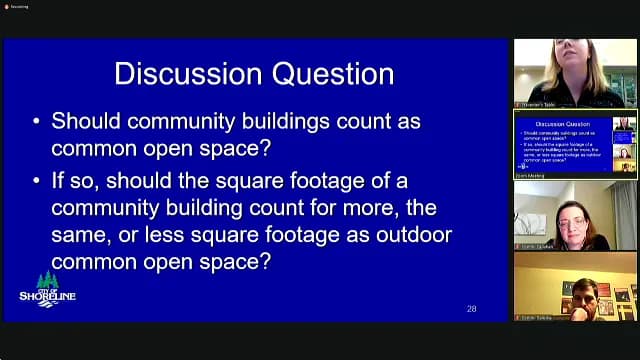
The Shoreline Planning Commission convened on Thursday, March 16, 2023, at approximately 7:00 PM for a regular meeting. The primary focus was a study item on cottage housing development code amendments, including a discussion of density bonuses, affordability, and fee-in-lieu options. The commission also heard public comment, received a director's report on state legislation and development activity, and scheduled a public hearing for April 6, 2023. Consent Calendar - Approved the agenda without changes. - Approved the minutes from February 16, 2023, with no corrections. Public Comments & Testimony - Suzanne Soming (Shoreline resident and board member of Safe Shoreline Trees) commented on the proposed cottage housing code. She noted that the Washington State Department of Commerce's middle housing bill (HB 1110) may require cities to allow at least six of nine middle housing types, including cottage housing. She asked how the city's proposed tree preservation incentives — particularly those for trees over 24 inches DBH — would interact with the bill's prohibition on standards more restrictive than those for single-family residences. Discussion Items - Cottage Housing Code Amendments (Study Item) - Staff planner Kime presented a revised draft of the cottage housing code. Key changes from the initial draft include: - A new explicit density bonus program tailored to cottages, offering bonuses for green building (25–50%), proximity to transit (25–50%), and affordability levels. Bonuses can be stacked up to double the base density of the underlying zone. - Increased building coverage and hardscape allowances by 10% in R4 and R6 zones for cottage developments. - Adoption of aggregate setbacks, allowing flexibility in meeting total linear setback requirements with a minimum of five feet. - Additional tree preservation incentives tied to reductions in common open space, height limitations, floor area, and parking requirements. - The commission discussed the fee-in-lieu option for the affordability density bonus. Opinions were divided: some commissioners supported fee-in-lieu as a practical interim measure, while others opposed it, arguing it could result in no affordable units being built. Staff clarified that the fee-in-lieu would be used for a housing trust fund to subsidize deeper affordability. The commission reached a consensus to include fee-in-lieu with a sunset provision: it would be available only until the city establishes a formal affordable homeownership program, at which point the option would expire. - Other discussion topics included: - The definition and counting of covered porches (counted as building area). - Parking lot landscape requirements and flexibility for tree placement. - The potential need to revisit the code in light of pending state legislation (HB 1110). - Staff confirmed that the draft code could be brought back for a public hearing at the April 6, 2023 meeting. - Director's Report - Planning Director provided an update on state legislative activity: - House Bill 1110 (middle housing): passed the House, moving to Senate; would allow up to 4-6 units per lot in low-density zones. - Senate Bill 5466 (transit-oriented development): in the House; would prohibit bans on multifamily uses in residential zones near transit and remove parking minimums. - House Bill 1245 (lot splitting): would allow splitting of lots 2,000 sq ft or larger. - Update on current development activity: - In 2022, the city issued over 2,200 building/development permits and processed over 3,400 applications. - Construction valuation on permit applications exceeded $700 million. - 38 pre-application meetings held since September (average 2 per week). - Major projects highlighted: Modera Shoreline (399 units), Brea multifamily (189+197 units), Shoreline Place redevelopment (first phase under construction), Connect at Shoreline (240 units, under construction), Alexon (219 units, under review), and several others at 185th and 145th station areas. Also, Alta at North City (228 units) and FurCrest master development plan (skilled nursing and behavioral health facilities). - Upcoming community events: Home improvement workshops at City Hall (three dates); urban forestry strategic plan open house (April 13); comprehensive plan online open house (early April). - New Business - Commissioner requested data on ADU trends in Shoreline, noting that Seattle is now building more ADUs than single-family homes. Staff agreed to provide the data via email. Key Outcomes - The commission directed staff to move the cottage housing code amendments forward to a public hearing on April 6, 2023, with the inclusion of fee-in-lieu language that includes a sunset provision contingent on the establishment of an affordable homeownership program. - Commissioners will receive a data report on accessory dwelling unit trends. - The next meeting (April 6) will also include election of chair and vice chair for the upcoming term.
Public Meetings - Shoreline, Washington
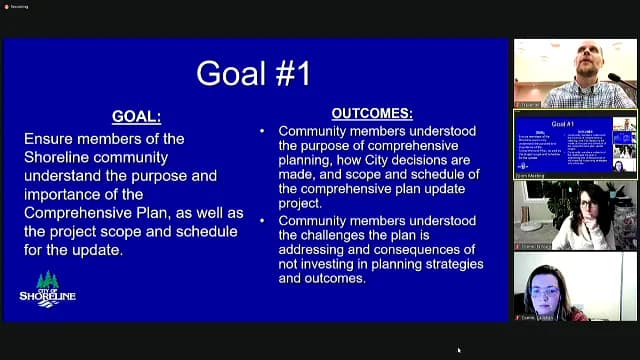
Public Meetings - Shoreline, WashingtonThe Shoreline Planning Commission met on February 16, 2023, at 3:00 PM. The meeting included approval of the agenda and minutes from February 2, 2023, public comment, study items on the 2024 Comprehensive Plan Update public participation plan and the joint meeting with City Council annual report, and a decision to cancel the March 2, 2023 meeting. Chair Sager presided, with Commissioners Galuska and Lynn absent. Consent Calendar - Approved the agenda as presented. - Approved the minutes from February 2, 2023, without changes. Public Comments & Testimony - Kathleen Russell, a resident of Shoreline representing Safe Shoreline Trees, spoke during general public comment regarding cottage housing regulations and tree protection. She referenced Ordinance 975, effective November 28, 2022, and the city council's directive to maintain and increase tree canopy while increasing housing opportunities. She noted that a separate tree code exists for seven multifamily business development zones where all trees can be cut down, and asked the planning commission to request staff provide a separate and reasonable tree code for residential zones. She also stated that, as far as she knows, no developers have taken advantage of tree retention incentives on MUR-70 sites. Discussion Items - 2024 Comprehensive Plan Update – Public Participation Plan – Staff presented a draft public participation plan for the 2024 Comprehensive Plan update. The presentation outlined the plan's five principles, three goals (ensuring understanding of the comp plan, creating meaningful participation opportunities, and using an equity lens), and a roadmap for engagement including online open houses, surveys, and community liaisons. A community liaison framework was discussed, with potential compensation for liaisons who help reach underrepresented groups. Commissioners provided input: Vice Chair Ramashanja suggested partnering with schools to engage families via student projects; Commissioner Mosher recommended reaching out to non-resident stakeholders such as Shoreline Community College students; Commissioner Callahan asked about compensation for community liaisons, and staff confirmed that intention; Commissioner Brunson asked whether liaisons could be non-residents with strong community ties, and staff affirmed flexibility. The participation plan is scheduled for council adoption on February 27, 2023. - Joint Meeting with City Council Annual Report – Staff announced that the annual joint meeting with the city council is scheduled for May 8, 2023, from 5:45 to 6:45 PM, before the regular council meeting. A draft letter summarizing the planning commission's work was included in the packet. Chair Sager requested that the letter be signed by the entire commission, which staff agreed to. The meeting will be informal with no set agenda. Key Outcomes - The planning commission provided input on the public participation plan, which will be presented to the city council on February 27, 2023, for adoption by resolution. - The joint meeting with the city council was confirmed for May 8, 2023, at 5:45 PM. - The March 2, 2023 planning commission meeting was canceled due to lack of agenda items. The next meeting will be on March 16, 2023, with items on cottage housing and the Transfer of Development Rights (TDR) program. - Commissioner Callahan's query about a pedestrian safety concern on 15th and 14th was forwarded to the city traffic engineer; staff will follow up with the commission and the commenter.
The Shoreline Planning Commission met on February 2, 2023, at 3:00 PM UTC to discuss two major study items: an overview of the middle housing work plan and a detailed review of proposed cottage housing development code amendments. The meeting included public comment, staff presentations, and commissioner discussion on density, tree preservation, parking, and site design. Public Comments & Testimony - Suzanne Soming, a Shoreline resident and property owner, spoke in support of a proposed development code amendment to incorporate cottage-specific tree preservation language. She stated that Shoreline is approximately 80% residentially zoned (based on the 2021 zoning map) and that reintroducing cottage housing will lead to more removal of established trees. She urged the commission to study the proposed cottage-specific tree code to minimize tree canopy loss. Discussion Items - Middle Housing Work Plan Overview: Staff presented a comprehensive overview of the middle housing study, funded by a Washington State Department of Commerce grant. The work plan includes a demographic and policy analysis, a racial equity analysis (required by the Growth Management Act), and community engagement through compensated participation from community-based organizations. The work is scheduled to be completed by June 2023. Commissioners discussed the need to engage landlords, the potential impact of pending state bills, and the importance of framing middle housing benefits beyond density—such as property tax implications, support for neighborhood businesses, and sidewalk improvements. The commission expressed interest in a presentation from the Department of Commerce on racial equity analysis. - Cottage Housing Development Code Amendments: Staff presented a draft code for cottage housing, which is a priority from the Housing Action Plan. Key discussion points included: - Location: The commission opposed exploring cottages in the MUR-35 zone, citing that it would disrupt the intended transition between higher and lower density zones. - Density: The draft code allows double the underlying zone density (e.g., 12 units/acre in R6) without requiring additional bonuses. Commissioners discussed potential density bonuses for affordable housing or community land trusts but leaned toward keeping the code simple and exploring such incentives separately. - Development Size: The proposed maximum of 24 units was debated; commissioners preferred not to over-restrict but suggested clustering could be encouraged for larger developments. - Tree Preservation: The commission generally opposed a separate cottage-specific tree code, favoring the existing tree code (25% retention of significant trees) with added incentives for preserving large trees (e.g., counting drip lines as open space). They supported the incentive approach. - Parking: The commission opposed requiring garages, preferring to let the market decide the form of parking (surface, garage, or carport). They noted that garages can complicate HOA issues and that storage for bikes or strollers could be a better use of space. - Open Space: The commission agreed that community buildings should not count as open space, though covered bike storage could be considered. They also discussed the need for porches to face common open space and the street to foster community interaction. - Infill Development: The commission was hesitant to allow cottages on lots with existing homes, suggesting that such infill might be better addressed through accessory dwelling unit or middle housing policies rather than the cottage code. Key Outcomes - Direction on MUR-35: Staff will not explore cottages in the MUR-35 zone. - Tree Preservation: Staff will develop incentive-based tree retention measures for cottages, not a separate tree code. - Parking: The code will allow flexible parking design (no mandatory garages). - Unit Lot Subdivisions: Staff will explore allowing unit lot subdivisions for cottages, which could facilitate community land trust ownership and easier financing, but this will be addressed under subdivision code updates. - Infill: The commission directed staff to focus on redevelopment scenarios rather than infill on existing lots for now. - Next Steps: The draft code will be revised based on commission feedback and brought back for discussion at the March 2, 2023 meeting. Staff will also prepare illustrative graphics to help visualize concepts. - Future Meetings: The commission will hold a joint dinner meeting with city council on May 8, 2023, and will continue work on the comprehensive plan update, with public engagement launching mid-March.
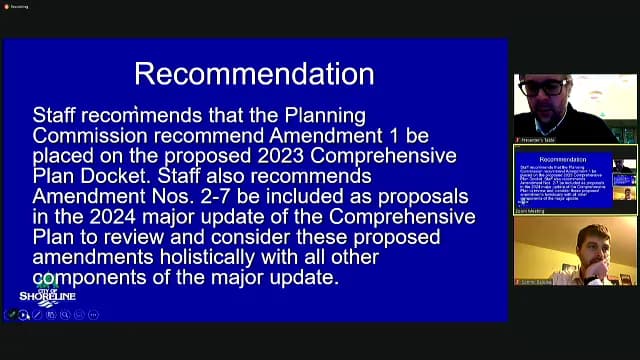
The Shoreline Planning Commission met on January 5, 2023, to discuss two main study items: a presentation on community land trusts by Homestead Community Land Trust and a review of the draft 2023 comprehensive plan docket. The commission also approved the agenda and minutes from the previous meeting, received a report on potential compensation for board members, and canceled the January 19 meeting. Consent Calendar - Approval of the agenda and minutes from December 1, 2022, was approved unanimously. Discussion Items - Presentation on Community Land Trusts (CLT): Kathleen Hosfeld, Executive Director of Homestead Community Land Trust, presented the CLT model. She explained that CLTs are private nonprofits that acquire and steward land for permanently affordable housing. Key statistics: Homestead has over 245 homes, a 30-year history, a foreclosure rate of less than 1%, and a waiting list of about 2,000 households. Homes are sold to households earning below 80% of area median income (e.g., $66,720 for a one-person household) with a 1% down payment. The model restricts equity gains to preserve affordability, but about 75% of exiting homeowners go on to purchase market-rate homes. The presentation also covered the Southern development (net-zero, mixed-income, with group homes for adults with disabilities) and suggestions for city support, including funding, zoning incentives, and streamlined permitting. - Draft 2023 Comprehensive Plan Docket: Staff Planner Steve Zeffron presented seven proposed amendments. Amendment 1 would update the Parks, Recreation, Open Space, and Arts element (required by the Growth Management Act for grant eligibility). Amendments 2-7 were submitted by the public, covering topics such as native vegetation, impervious surfaces, sea-level rise, building transitions, citizen participation, and environmental management. Staff recommended including Amendment 1 in the 2023 docket and deferring Amendments 2-7 to the 2024 major comprehensive plan update for holistic consideration. The commission discussed the resource constraints and the value of integrating these topics into the broader update process. Key Outcomes - Vote on Amendment 1: The commission unanimously voted to place Amendment 1 (PROS plan update) on the 2023 comprehensive plan docket. (Roll call: all ayes) - Vote on Amendments 2-7: The commission unanimously voted to refer Amendments 2-7 to the 2024 major comprehensive plan update, rather than the 2023 docket. (Roll call: all ayes) - Other Actions: The commission acknowledged a report on the city council's consideration of compensation for boards and commissions, including the planning commission, with funding allocated in the 2023-24 budget. The January 19, 2023 meeting was canceled due to no remaining agenda items.
The Shoreline Planning Commission met on Thursday, December 1, 2022, with Chair Sager presiding. All members were present: Vice Chair Wamishon Jay and Commissioners Brunson, Callahan, Galuska, Lynn, and Mosier. The commission approved its agenda and the October 20, 2022 minutes, received no public comment, held study sessions on the 2024 Comprehensive Plan update engagement strategy and on cottage housing code amendments, and closed by canceling the December 15, 2022 meeting. Agenda Approval and Minutes - The commission approved the meeting agenda as presented. - The October 20, 2022 meeting minutes were approved without changes. Public Comments - No general public comment was offered. Study Item 6A: 2024 Comprehensive Plan Update - Scope and Community Engagement Plan City staff and consultants from Stepherson and Associates (Franna Miller and Colleen Toomey) presented the scope of the 2024 Comprehensive Plan update. The plan will extend the city's 20-year vision through 2044, implement Growth Management Act requirements, and align with Puget Sound Regional Council Vision 2050 and King County countywide planning policies. The City Council passed a resolution in November 2022 approving the update's key themes: climate, equity and social justice, and housing. - Other scope topics include vision and framework goals, middle housing, planning for 10,000 new jobs by 2044, four candidate countywide centers (148th Street, 185th Street, Shoreline Place, and the Aurora corridor town center), utilities, livability, and development regulation consistency. - The city hired an engagement consultant before the technical consultants to emphasize equity-centered engagement. The proposed approach includes a community liaison coordination plan, translation support through Avent Page, virtual and in-person outreach, and phased work: visioning in early 2023, topic-specific engagement and concept prioritization in fall 2023, and draft plan and public hearings in spring 2024. - Middle housing engagement will be emphasized in early 2023 because federal grant funding supporting that work runs through June 2023. Commissioners offered feedback on audiences, barriers, and engagement methods: - They emphasized reaching residents whose voices are not typically heard: renters, workers, future residents, youth, east-of-I-5 residents, faith communities, people with limited time, and people not already involved in city planning. - Barriers identified included lack of time, limited broadband and technology access, language, formal meeting culture, and the tendency for vocal groups to dominate meetings. - Several commissioners supported compensating community organizations and residents for participation, and using community liaisons rather than requiring residents to come to city-led meetings. - Commissioners asked for clear outcomes, forced-priority questions, and more specific climate-related engagement questions rather than general support for climate goals. - One commissioner cautioned that decisions about the proposed centers must be examined through an equity lens, including how census tracts and resources are distributed, to avoid making communities feel excluded. Study Item 6B: Cottage Housing Development Code Amendments City planner Alice Kime presented an existing conditions report, summer 2022 public outreach results, and initial code questions for cottage housing. Cottage housing is currently not a legal use in Shoreline; the 2021 Housing Action Plan and a Department of Commerce grant are driving the code update. Key data included: - Shoreline's population is just over 60,000; the fastest-growing cohorts are adults 25-34 and 65-74. - 61% of households have one or two people, and 45% of single-person households are age 65 or older. - 67% of the housing stock is detached single-family homes, while 80% of residential developable land is zoned R4 or R6. - Home values rose 84% since 2015, while wages rose about 29% over the same period. - Public outreach included 325 online survey responses; 72% of respondents were interested in living in cottages. - Outreach themes included protecting trees, especially large conifers; interest in single-level and accessible living; sustainable design; clarified affordability expectations; front porches; privacy; and varied opinions on parking. On code topics, the commission gave initial guidance: - Location: Commissioners generally preferred allowing cottages in low- to medium-density residential zones (R4 through R12) rather than high-density zones, and considered incentives for walkable locations near amenities and transit. - Density and unit count: Commissioners agreed densities above base zone density are likely needed for financial feasibility. They were skeptical of hard minimums and maximums, suggesting lot size and density should govern, though a minimum around four units was mentioned. - Minimum lot size: Commissioners leaned toward using the underlying zone's minimum lot size rather than creating a separate cottage standard, and supported exploring unit-lot subdivisions so cottage units can be owned fee-simple. - Unit size and height: Commissioners supported maximum unit sizes and/or building footprints, with flexibility for single-story units, a required mix of single-story and accessible units, and a dedicated cottage height limit around 20-25 feet rather than matching abutting properties. - Setbacks and development standards: Commissioners generally opposed the current 15-foot setback for developments with three or more units abutting R4/R6 lots, because it can compress the common open space that defines cottage housing. They favored underlying zone standards or flexible/averaged setbacks, and asked that cottages not be treated more strictly than conventional single-family homes. - Trees: There was strong support for incentives to retain large conifers and significant tree stands, with flexibility in siting and counting preserved tree groves as common open space. One commissioner warned that the code definition of "significant tree" might allow developers to retain smaller trees while removing larger landmark trees, so incentives should target larger trees. - Parking: Commissioners generally favored parking ratios based on unit size, with lower overall parking levels rather than two stalls per unit. They supported reductions near transit and amenities and for tree preservation. Several did not support counting on-street parking as guest parking, and most opposed requiring dedicated guest parking. - Landscaping: The commission supported a light-touch approach, with a perimeter buffer and some common open space, but wanted flexibility so cottage residents can decide how shared outdoor space is programmed and maintained. - Design standards: Commissioners did not favor heavy design mandates. Practical concerns such as communal solid waste storage and front porch/stoop spaces were discussed. Internal architectural consistency was seen as more important than matching surrounding neighborhoods. - Process: Commissioners generally favored treating cottage developments like detached single-family homes in standard building, site, utility, and right-of-way permit reviews, without special neighbor-notice thresholds. Key Outcomes - The commission approved the agenda and the October 20, 2022 minutes. - The commission provided staff and consultants with input on both the Comprehensive Plan engagement plan and cottage housing code direction. - Staff expects to return with revised cottage housing regulations in early February 2023. - The commission canceled the December 15, 2022 meeting by consensus. - The next meeting is set for January 5, 2023, with a presentation by Kathleen Hosfeld of Homestead on community land trusts. Next Meeting and Adjournment - With no unfinished business or new business remaining, the meeting was adjourned.
The Shoreline Planning Commission held a regular meeting on October 20, 2022, primarily to discuss the Transfer of Development Rights (TDR) program and the Landscape Conservation and Local Infrastructure Program (LCLIP). Staff and a consultant presented an overview, followed by commissioner questions and discussion. The meeting also included reports from a recent conference and updates on local development projects. Consent Calendar - The agenda was approved without amendment. - Minutes from the October 6, 2022 meeting were approved as presented. Public Comments & Testimony - No members of the public signed up for general comment. Discussion Items - TDR and LCLIP Program Implementation – Steve Zafron (City Staff) and Nick Bratton (Senior Director of Policy at Fortera) presented an overview of the TDR program and LCLIP, a state program that allows cities to capture a portion of future property tax revenue from new construction to fund public improvements, in exchange for conserving rural land through TDR. Shoreline received a grant in 2014 and updated the feasibility study in 2020. The city would aim to place 231 TDR credits (reflecting its share of regional growth targets) and could generate an estimated $19-25 million in nominal revenue over 25 years. Possible incentives to encourage developers to purchase TDR credits include added building height, parking reductions, fee reductions, multifamily tax exemption (MFTE), tree removal incentives, and expedited permit review. - Commission Discussion: Commissioners raised several concerns: - Vice Chair Wamishon Jay asked for a clearer projection of revenue flow over time and the trade-off between incentives and net revenue, noting that bonding against future revenue carries risk. - Commissioner Callahan expressed concern about incentives potentially conflicting with other city goals (e.g., affordable housing) and requested a systematic table showing current allowances, required incentives, and proposed changes. - Commissioner Brinson asked for concrete examples of how many square feet of bonus space or parking reductions a TDR credit would buy, and whether incentives would be calibrated to current market conditions. - Commissioner Galusca questioned whether MFTE (which exempts property taxes for 12–20 years) would undermine the tax increment financing mechanism of LCLIP. Bratton responded that even with MFTE, the program is net revenue positive, but the explanation was acknowledged as complex. - Commissioner Mosier raised concerns about MFTE durations already being requested by developers and whether adding TDR incentives would further complicate the code. She also questioned whether a contiguous upzone along 145th could maximize program potential, but staff said no rezoning is part of this program. - Commissioner Brinson added that MFTE is already an incentive for affordable housing, and layering TDR on top could feel like "double dipping." He urged careful thought about combining incentives. - Commissioner Galusca noted that TDR imposes an additional cost on development, and the city should first evaluate all existing incentives (green building, affordable housing, parking) to avoid conflicts before adding new ones. - Vice Chair Wamishon Jay asked if code could be written to prevent unintended consequences (e.g., foreign ownership of conserved land, or development not meeting community needs). Staff confirmed that the TDR code can be tailored to specific zones and conditions. - Ultimately, commissioners expressed general support for moving forward with drafting code amendments, but requested a comprehensive table of current zone regulations and existing incentives before finalizing the options. - Commissioner Brinson also suggested considering ground floor commercial/restaurant-ready space as an additional incentive, and whether short plats or long plats could generate TDR credits. Key Outcomes - Direction to Staff: Prepare a detailed table showing existing zone regulations, current incentives, and potential TDR incentives to help commissioners evaluate trade-offs. - Next Steps: Staff will bring back a revised scope of code amendments for further discussion. The commission generally supported moving forward, contingent on having a clearer picture of how incentives interact. - Other Updates: - The Fircrest Master Development Permit (including behavioral health and nursing facilities) is working through intake. - A new mixed-use building application (228 units) was received for 15th Avenue NE (near 177th St), the first under new ground-floor commercial rules. - The MUR70 amendments (recommended by the commission) were adopted by Council on September 12, 2022, with minor changes. - Outdoor seating regulations were also adopted on September 12, unchanged from the commission's recommendation. - Conference Reports: Vice Chair Wamishon Jay and Commissioner Mosier shared insights from a planning conference, including lessons on middle housing and climate change communication (e.g., avoiding the term "climate change" in some communities). - Next Meeting: The November 17, 2022 meeting was cancelled due to lack of items; December 1 will feature a presentation on the comprehensive plan update scope, and December 15 will include a cottage housing code update.
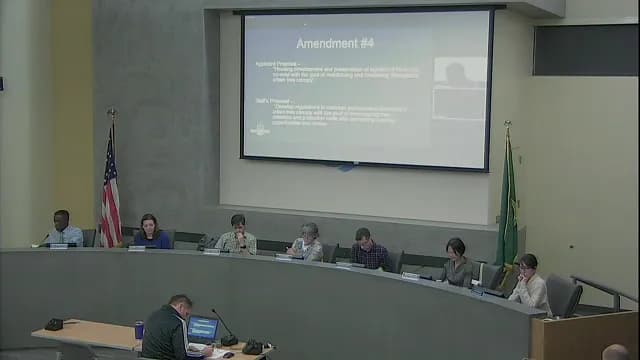
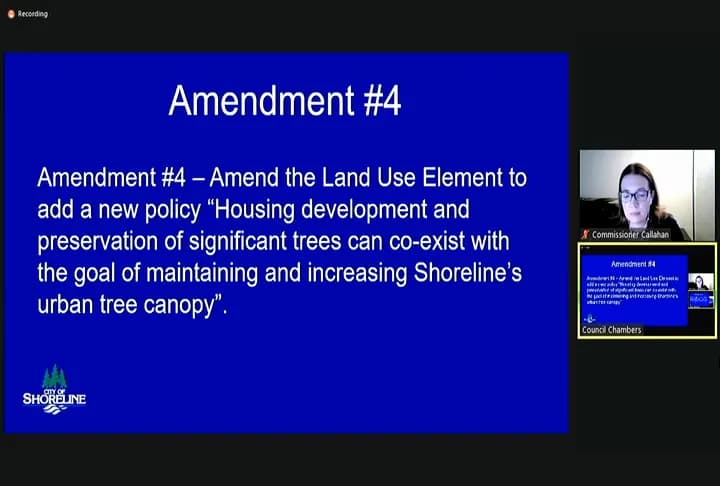
On Thursday, October 6, 2022, the Shoreline Planning Commission held a public hearing to consider the 2022 comprehensive plan amendments. The meeting included a staff presentation on six amendment items, public testimony from three residents, and a unanimous vote to recommend adoption of amendments 1, 4, and 6, and to carry over amendment 5 into the 2023 major update work. Consent Calendar - Approval of Agenda: Approved without changes. - Approval of Minutes: Minutes from August 18 and September 1, 2022, approved without changes. Public Comments & Testimony - Suzanne Soming (Shoreline resident): Spoke on Amendment 3 (Shoreline Park & Ride property). Disagreed with the assumption that the park & ride would become less utilized after light rail service begins, arguing that population growth will increase demand for parking. She expressed support for Option A: a standalone transit garage with 401 dedicated stalls. - Kathleen Russell (Shoreline resident, representing Safe Shoreline Trees): Spoke on Amendment 4. Expressed support for the staff-recommended policy to develop regulations maintaining and increasing the urban tree canopy while encouraging tree retention and housing opportunities. Asked the commission to promote awareness of established trees. - Tom McCormick (Shoreline resident): Spoke on Amendment 6, which he proposed. Stated that the city owns most tide lands north of Saltwater Park (confirmed by King County map revisions), and noted that these lands are walkable about 80–90% of the time (tides 7 feet or less). Requested approval of the map amendment to align with King County. Also commented on Amendment 5 (duplexes/triplexes in single-family zones): opposed the concept at this time, arguing that the city has already nearly met its 2044 growth target with projects currently in the pipeline, and suggested revisiting the issue in 10 years. Discussion Items - Staff Report (Mr. Zafron): Presented six comprehensive plan amendments: 1. Replacement of the Transportation Element with a new version including goals on climate resiliency and community vibrancy, pedestrian/bicycle plans, shared mobility hubs, and a fiscally constrained project list. 2. Update for the 2024 major comprehensive plan update (Growth Management Act requirement), focusing on themes of climate, equity, social justice, housing, middle housing, jobs, utilities, and livability. No recommendation required. 3. Site-specific comp plan amendment and rezone for King County Park & Ride property (hearing examiner held public hearing on September 27; decision pending). Staff noted it is separate from commission action. 4. Privately initiated policy to allow coexistence of housing development and tree preservation. Staff revised language to: "develop regulations to maintain and increase Shoreline’s urban tree canopy with the goal of encouraging tree retention and protection while also increasing housing opportunities and choice." 5. Council-added amendment to study allowing duplexes and triplexes in single-family zones. Staff recommended carrying this over into the 2023–2024 major comp plan update to allow broader community engagement and avoid rushing. 6. Map amendments updating a parcel in Richmond Beach Saltwater Park from public facility to public open space, and showing public open space for that parcel on the city map (previously omitted). Recommended for approval. - Commissioner Questions: Commissioner Lynn asked about the difference between carrying over Amendment 5 to 2023 versus tabling it for the major update. Staff explained that middle housing outreach starts in 2023 (funded by a Department of Commerce grant), and the amendment would be folded into that holistic policy discussion. Commissioner Lynn acknowledged the broader approach. Key Outcomes - Motion: Commissioner Callahan moved to recommend that City Council adopt the 2022 comprehensive plan amendments as written in the staff report dated October 6, 2022. Vice Chair Wama Shonjay seconded. - Vote: Unanimous approval on roll call (7-0). - Chair Sager: Yes - Commissioner Mosier: Yes - Commissioner Galluska: Yes - Commissioner Brinson: Yes - Commissioner Callahan: Aye - Commissioner Lynn: Aye - Vice Chair Wama Shonjay: Aye - Public Hearing Closed. - Next Meeting: Informational meeting on Transfer of Development Rights (TDRs) scheduled for October 20, 2022, presented by Forterra.
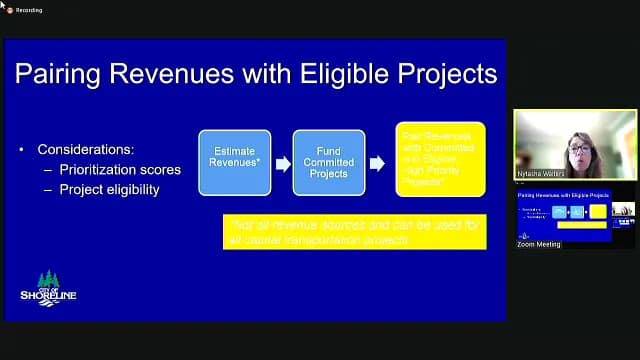
The Shoreline Planning Commission held a study session on September 1, 2022, to discuss six proposed amendments to the city's Comprehensive Plan. The meeting focused on the Transportation Element update (Amendment 1) and reviewed five other amendments, including land use changes, tree canopy policies, and housing provisions. Staff presented recommendations for action, and commissioners raised questions about implementation and timing. A public hearing is scheduled for October 6, 2022, to take formal public testimony before the Commission makes a recommendation to the City Council. Consent Calendar - No consent calendar items were presented or approved during this meeting. Public Comments & Testimony - No members of the public signed up for general public comment at this session. Public testimony will be accepted at the October 6 public hearing. Discussion Items - Amendment 1 – Transportation Element Update: Natasha and Kendra Breland (Fair and Pears) presented the constrained project list for the next 20 years. Total available transportation capital revenue is estimated at $201 million, with $160 million committed to existing projects (concurrency, Sound Transit, sidewalk program, etc.). The remaining $41 million is allocated to high‑priority projects: a segment on 175th Street (Fremont to Stone Avenue), the 185th Corridor strategy (pedestrian/bike/transit improvements near the light rail station), Third Avenue North Connectors (plaza‐style access east of the 145th station), shared‑use mobility hubs (six locations tied to light rail), and the east‑side off‑corridor bike network (alternative to constrained 145th corridor). These projects were selected based on high scores, ability to connect existing infrastructure, and support for climate resilience and equitable land use. - Amendment 2 – 2024 Major Comprehensive Plan Update: Staff described a placeholder amendment to begin the process for the next major update due December 2024. Key steps include an equitable community engagement strategy, review of existing plans and regulations, environmental review, legislative action, and submission to the state. No immediate recommendation was made. - Amendment 3 – King County Metro Park & Ride Redevelopment: This would change the land use designation from Public Facility to Mixed Use and rezone the 2.7‑acre site (currently split Mixed Business/R‑18) to Mixed Business, enabling King County Metro to seek a development partner for transit‑oriented development. The proposal will be reviewed by the Hearing Examiner before City Council action. Commissioner Callahan inquired about an adjacent vacant lot; staff noted that lot is not part of the proposed amendment, though the city previously discussed acquisition. - Amendment 4 – Tree Canopy and Housing Policy: A privately initiated amendment to add a policy on preserving significant trees while allowing housing development. Staff worked with the applicant to produce revised language directing the development of regulations to “maintain and create increased shoreline urban tree canopy with the goal of encouraging tree retention and protection while also increasing housing opportunities and choice.” Commissioner Lynn thanked staff for making the language more actionable. - Amendment 5 – Duplexes/Triplexes in Low Density Residential Zones: Added by City Council in April 2022, this would permit duplexes and triplexes in all low‑density residential zones (covering 66% of Shoreline). Staff recommended carrying this amendment over to the 2023 or 2024 docket to allow adequate community engagement and alignment with the major comprehensive plan update, and to leverage state grant funds. Vice Chair Ramashandri asked whether duplexes/triplexes are intended to fill the “missing middle” housing gap; staff responded that they are one piece of a broader middle‑housing study. - Amendment 6 – Richmond Beach Saltwater Park Map Correction: This would change the land use designation of certain parcels from Public Facility to Public Open Space to match the rest of the park, including tidally submerged areas accessible at low tide. Commissioner Lynn asked about the history of the submerged area; staff confirmed no vehicular access exists and the change is consistent with existing park use. Key Outcomes - Staff recommendations for the October 6 public hearing: Approval of Amendments 1, 3, 4, and 6; carry over Amendment 5 to a future docket; no immediate action on Amendment 2. - Next meeting: September 15, 2022 (regular meeting). - Public hearing: October 6, 2022, for the comprehensive plan docket. The Planning Commission will make a formal recommendation to the City Council based on the hearing and this discussion. - Commissioner positions: Commissioners expressed general support for the proposed amendments, with particular appreciation for the transportation element and the tree canopy language. Concerns about Amendment 5’s scope and need for further community outreach were noted, aligning with staff’s recommendation to delay.
The meeting was called to order at 15:00. All commissioners except Commissioner Brinson were present. The agenda and minutes from July 7, July 21, and August 4, 2022 were approved unanimously without amendment. No public comments were made. Consent Calendar - Approval of the agenda and the amendments from the July 7, July 21, and August 4 meetings were approved by voice vote without dissent or changes. Public Comments & Testimony - No members of the public signed up to speak or were present for general public comment. Study Item: Climate Action Plan Update Cameron Reed, Environmental Services Program Manager, presented a briefing on the Climate Action Plan (CAP) update. Key points included: Near-term climate impacts for Shoreline: hotter temperatures, extreme heat, wildfire smoke, and flooding. A Climate Impacts and Resiliency Study (2020) identified vulnerable areas including stormwater systems, ecosystems, heat-related illness, and air quality. The city’s updated science-based targets require a 60% community-wide emissions reduction by 2030 (from 2019 levels) and net zero by 2050, aligning with the Paris Agreement. Emissions are primarily from transportation (gasoline/diesel) and buildings (natural gas). Emissions have decreased 5% since 2009 despite population growth, but current trends are insufficient to meet targets. The CAP will focus on three main pathways: electrification of buildings, reducing per capita driving, and electric vehicle adoption. Strategies relevant to land use and development code include increasing density and walkability, enhancing EV-ready ordinances, tree retention and replacement, and requiring climate resilience practices in new development. Commissioner discussion included: Commissioner Lin expressed strong support for the walkability focus. Commissioner Galluska raised a concern about balancing tree retention goals with the need for urban density, noting that new development often conflicts with tree preservation. Commissioner Callahan praised the integration of climate goals and later asked about red light/speed enforcement cameras as a safety strategy, not just a funding tool. Commissioner Mosier questioned the magnitude of the required reductions, noting that the 60% target must offset projected population growth. Staff confirmed the difficulty but highlighted that existing state/federal policies and Seattle City Light’s carbon-free grid provide a viable path. Staff responded that tree retention strategies will also include education and resources for private property owners, and that the tension between density and tree canopy will be addressed through parks and open space restoration. Study Item: Preliminary Draft Transportation Element Update Natasha Walters presented the draft Transportation Element (TE) update. Key elements included: A project timeline aiming for adoption by end of 2022, with the transportation master plan finalization in early 2023. New policies emphasizing climate resiliency, community vibrancy, equity, safety (Vision Zero), and shared-use mobility hubs. A prioritization process: 175 projects were identified from modal gaps, scored using criteria including climate resiliency, multimodal connectivity, and built environment metrics. A financially constrained list is being developed: estimated revenue from REET, grants, transportation benefit district sales tax, and transportation impact fees totals about $130 million in committed projects, leaving $90 million for new high-priority projects over 20 years. Next steps include public hearing on September 15, 2022, and council adoption by end of 2022. Commissioner comments: Commissioner Callahan reiterated support for the TE’s climate focus and asked about red light/speed cameras as a safety measure. Staff noted the cameras are not a major revenue source but could be explored further for safety benefits. Commissioner Galluska observed that pedestrian and bike improvements are often tied to major arterials, but in his neighborhood, people walk on quieter parallel streets. He suggested considering improvements on lower-volume roads rather than solely on arterials. Staff explained that the prioritization focuses on connecting destinations and building a basic network with limited funds, and that lower-volume streets are already safe for walking. Staff (Kendra Breland) added that the sidewalk prioritization process (2018) used a citizen advisory committee to identify urgent needs, focusing on streets without any facilities. Key Outcomes The Planning Commission provided feedback on both the Climate Action Plan strategies and the Transportation Element draft. No formal votes were taken. Staff will consider the feedback as they refine the CAP (draft release in September) and finalize the TE’s financially constrained project list. The next meeting (September 1, 2022) will discuss the 2022 Comprehensive Plan docket amendments, which include the Transportation Element.
The Shoreline Planning Commission held a public hearing on July 21, 2022, to consider proposed development code amendments allowing expanded outdoor seating in association with eating and drinking uses. The amendments build on temporary regulations (Ordinance 985, effective July 27, 2020) that have been extended four times during the COVID-19 pandemic. Staff presented survey and focus group results, proposed code changes, and a newly added ventilation standard suggested by Seattle-King County Public Health. No public testimony was received. The Commission unanimously voted to recommend approval of the amendments to the City Council. Staff Presentation & Discussion - Kate Lee, planner in the Planning Community Development Department, presented the background: five businesses filed outdoor seating registrations on private property, with two still active. An online survey (March–April 2022) received 25 responses from business operators. Staff also met with a small focus group of three local restaurant/bar/brewery owners. - The proposed amendments allow outdoor seating only in association with eating or drinking uses, permit conversion of off‑street parking into seating areas, and establish design standards for furniture. No additional off‑street parking is required for creating these spaces. - Parking conversion limits: - Single‑tenant sites: up to 4 parking spaces or 30% of required off‑street parking, whichever is greater. - Multi‑tenant sites: up to 4 required parking spaces per tenant, or 30% of required off‑street parking, whichever is less. - A ventilation standard was added based on a comment from Seattle-King County Public Health received June 21, 2022. - Commissioners expressed appreciation for the outreach to business owners and the addition of the ventilation requirement. Vice Chair Wamishon Jay noted the amendments promote both vibrancy and public health. Chair Sager, Commissioner Lin, and others voiced support. Public Comments & Testimony - No members of the public signed up to speak or testified. Key Outcomes - Motion: Commissioner Callahan moved to recommend approval of the proposed outdoor seating development code amendments (as shown in Attachment A) to the City Council. Vice Chair Wamishon Jay seconded. - Vote: All present commissioners voted aye (Commissioners Callahan, Galusca, Lin, Mauzier, Vice Chair Wamishon Jay, Chair Sager). Commissioner Brynn was absent with notice. The motion passed unanimously. - Next Steps: The Commission's recommendation will be forwarded to the City Council, which is scheduled to discuss the item on August 15, 2022, and take tentative action on September 12, 2022. Other Business - Director’s Report: Planning Manager Andrew Bauer announced a commission retreat scheduled in two weeks. An email was sent to commissioners regarding the start time (5:30 PM vs. later). The retreat will be held at City Hall (third-floor conference room) with an outdoor rooftop terrace option for dining. The agenda includes working through business items and socialization.