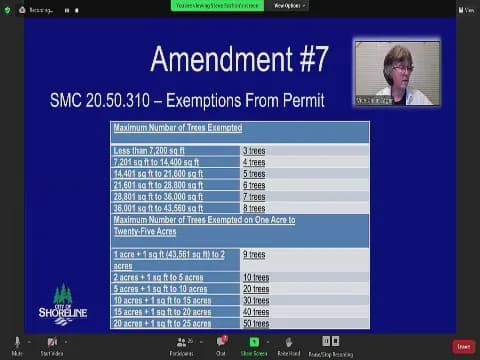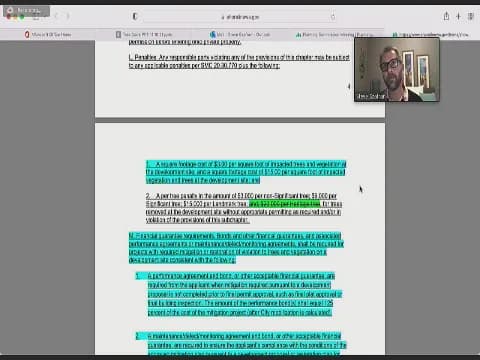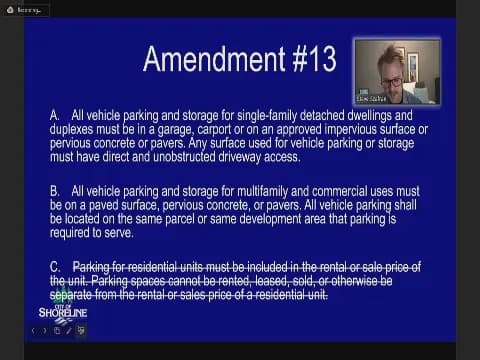
The Shoreline Planning Commission met on January 6, 2022, at 7:00 PM via webinar. The primary agenda item was a study session on the 2021 Development Code Amendments Batch 2, which includes miscellaneous, SEPA, and tree-related amendments. The commission also elected a new vice chair and received an update on the Point Wells subcommittee. No votes were taken on the code amendments, which will proceed to a public hearing on February 3, 2022. Consent Calendar - Roll call confirmed the presence of Commissioners Callahan, Galuska, Lynn, Malik, Wamashonji, and Chair Sager. - The agenda and the minutes from December 16, 2021, were approved without changes. Public Comments & Testimony Seven members of the public spoke, all focusing on the tree preservation code amendments. Key points from each speaker: - Wally Fosmore (resident, tree preservation code team): Urged the commission to direct staff to study the proposed tree code amendments (specifically amendment 6 regarding protection during clearing and grading) within 60 days and submit to council by end of February. Noted that the code does not apply to R4, R6 zones and major development zones (CBN, B, MB, TC123, MUR70), and that financial guarantee clauses (L, M) apply only to MUR35/45 zones. - Martha Diesner (resident, tree preservation code team): Opposed amendment 10 (tree replacements) as proposed by staff, arguing it reduces required replacements. Cited examples of 65, 28, and 29 trees waived on specific sites. Requested that replacement trees be required on-site or fee-in-lieu paid, and that the developer can redesign to accommodate trees. - Suzanne Soming (resident, tree preservation code team): Recommended changes to amendment 2 (definitions: 6 inches DBH for significant tree, 24 inches for landmark). Supported amendment 6 (general requirements) to extend stop work orders/penalties to residential zones R8-R48, TC4, MUR35/45. Also recommended staff produce a map of parcels over one acre for amendment 7. - Gail Janssen (North Seattle resident, tree preservation code team): Asked the commission to request staff develop incentives for developers to retain more than 25% of trees (amendment 8). Opposed the words "waive" and "reduce" in amendment 9, and requested amendment 10 require on-site replacement or fee-in-lieu. - Nancy Morris (resident, Shoreline): Encouraged the commission to recommend the tree protection code as submitted by the tree preservation code team, citing the city's own publication on tree importance. - Kathleen Russell (resident, tree preservation code team): Noted the code team submitted proposals over a year ago. Highlighted that major development zones (community/business, town center, MUR70) currently require no tree retention. Urged protection of mature trees for health and climate, referencing Comprehensive Plan goals. - Michael Oxman (Seattle resident, "tree doctor"): Urged the commission to pass the full tree protection package, warning that developers often oppose strong tree regulations. Advised requiring new construction to coexist with existing trees. Discussion Items 1. 2021 Development Code Amendments Batch 2 (Study Item) – Staff Presentation - Mr. Zafron (staff) presented the three sub-batches: miscellaneous, SEPA, and tree amendments. - Miscellaneous Amendments (reviewed July 2021): - Amendment 8/9: Allow reduction of one front yard setback on corner lots to increase flexibility for home expansions or detached ADUs. - Amendment 11: Exempt certain site improvements for adaptive reuse of vacant commercial buildings (e.g., theaters, daycares, restaurants) if criteria are met (no significant noise, no expansion, no new signs facing residential, landscape buffers). - Amendment 13: Remove requirement that parking for residential units must be included in rent/sale price, citing affordability, equity, sustainability, and proximity to transit. - SEPA Amendments (reviewed August 2021): Clarify appeal processes for environmental decisions without substantially changing evaluation. - Tree Amendments (reviewed October, November, December 2021): New definitions, protections during development, increased retention, replacement, and public notification. - Next steps: Public hearing on February 3, 2022, for commission recommendation; council discussions February 28 and March 7; potential council action March 21. 2. Commissioner Questions - Commissioner Malik asked what percentage of the city’s land area is covered by zones exempt from the tree code (e.g., MUR70). Planning Director Rachel Markle responded that about 80-82% of the city would be subject to the new regulations, while 18% (including MUR70, MB, CB, NB) would not. Malik noted that not all trees in those zones are removed, but the discussion is about potential loss. 3. Election of Vice Chair - Commissioner Malik nominated Commissioner Wamashonji. No other nominations. Vote: all six commissioners (including Wamashonji) voted in favor. Commissioner Wamashonji was elected vice chair. 4. Reports: Point Wells Subcommittee - Commissioner Malik provided a detailed history of the Point Wells development dispute, starting from May 2010 when the site's designation changed from urban industrial to urban center. He explained legal challenges by Save Richmond Beach and Town of Woodway, Growth Management Hearings Board rulings, and court decisions that were prospective and did not affect the vested application. Current status: pending a King County court ruling on the development application. Ms. Taylor (staff) reported no ruling yet; expected soon. Key Outcomes - No votes taken on the development code amendments. The commission will hold a public hearing on February 3, 2022, to make a formal recommendation to the city council. Chair and staff will coordinate how to proceed with voting on each amendment. - Vice Chair Elected: Commissioner Wamashonji was unanimously elected vice chair of the Planning Commission. - Point Wells Update: No new ruling from King County court; commission will be notified when received. - Next Meeting: January 20, 2022, study item on MUR70 zone development code amendments, following joint council discussions.
Public Meetings - Shoreline, Washington
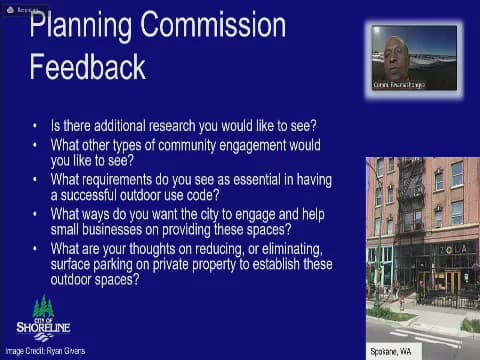
Public Meetings - Shoreline, WashingtonThe Shoreline Planning Commission held its final meeting of 2021 on December 16, 2021. The meeting included roll call, general public comments, discussion on various topics, and a farewell from a departing commissioner. Public Comments & Testimony - Two members of the public signed up for general public comment. Nancy Morris spoke first; her remarks were largely unintelligible in the transcript due to poor audio quality. A second speaker also commented, but their identity and remarks are unclear. Discussion Items - Commissioners discussed topics including business regulations, registration, and potential pilot programs. The discussion was fragmented and difficult to follow due to transcription errors. One commissioner suggested reaching out to businesses and considering a pop-up concept. - A commissioner noted the need for more information and simpler processes. Another emphasized the importance of research and community engagement. Key Outcomes - The meeting concluded with a departing commissioner expressing gratitude for serving on the commission for eight years. No formal votes or decisions were recorded in the transcript. Commissioner Farewell - A commissioner who served for eight years announced that this was their last meeting and thanked staff and fellow commissioners for the honor of serving.
The Shoreline Planning Commission met on December 2, 2021, to continue discussions on proposed tree code amendments and to provide direction on potential amendments to the annual (NUR) zoning regulations for light rail station areas. The meeting included public testimony from 11 speakers, primarily advocating for stronger tree preservation measures. Consent Calendar - The agenda and minutes from the previous meeting were approved without corrections or changes. Public Comments & Testimony - Isaac Chair, a Shoreline resident, urged the commission to prioritize tree preservation and health over monetary wealth, citing the climate crisis. - Rebecca Jones, speaking on behalf of the tree preservation code team, supported amendment C to change the landmark tree definition measurement to 24 inches diameter at standard height, and referenced the city's Comprehensive Plan policies. - Delinda (name unclear), on behalf of the tree preservation code team, requested that staff work on incentives for retaining more than 25% of significant trees, consistent with Comprehensive Plan policy NE6. - Mark Adidas (or Martin L.), on behalf of the tree preservation code team, asked the commission to recommend amendments to protect significant trees on development sites, including penalties for tree injury/destruction, and noted that amendment C6 does not apply to certain zones. - Barbara Johnson spoke on amendment C7, requesting that the allowable removal of significant trees be reduced from the current graduated scale to a stricter limit. - Kathy Russell, on behalf of the tree preservation code team, expressed concerns about amendment C9 and the term "waive" in the code, requesting clarity and equity for property owners. - Will Timothy, on behalf of the tree preservation code team, supported amendment C6 concerning the definition of significant trees, recommending a 6-inch diameter measurement. - Caesar Sony, a Shoreline resident and member of the tree preservation code team, urged timely action on the amendments, noting that the proposed codes only apply to certain zones where major construction is occurring. Discussion Items Tree Code Amendments (C6, C7, C9, C10) - Staff (Mr. Zaffrin) presented the amendments, which had been continued from November 18. The commission discussed each: - Amendment C2 (Landmark tree definition): Staff recommended maintaining the 30-inch diameter threshold; the applicant proposed 24 inches. Commissioners questioned whether certain weak-wooded species (e.g., black locust, cottonwood) should be excluded, but no consensus was reached. - Amendment C6 (Construction site violations, penalties, financial guarantees): Staff recommended moving forward without sections L (monetary penalties) and M (financial guarantees), citing conflicts with other code sections and the need for additional study. A commissioner noted that the maintenance agreement (part of M) seemed more straightforward, but staff expressed concern about staff resources for monitoring. The commission appeared to lean toward recommending the amendment without L and M. - Amendment C7 (Exempt tree removal table): A commissioner proposed changing the exempt removal threshold from 30 inches to 24 inches to preserve more trees. Staff noted a potential increase in administrative burden. - Amendment C9 (Director's authority to waive or reduce minimum tree retention): Commissioners debated the need for specific criteria (e.g., utilities, foundation issues) to guide such waivers. Some favored providing more flexibility with clear conditions, while others wanted to avoid excessive use. - Amendment C10 (Replacement tree requirements): Staff recommended not adopting this amendment, preferring to retain director flexibility to reduce on-site replacement trees and require fees for off-site replanting. Commissioners did not express strong opposition. - The commission did not take a formal vote; discussion indicated support for moving forward with most amendments but with staff recommendations on specific sections. NUR Zoning Amendments (Light Rail Station Areas) - Mr. Ballard presented a recap of the joint meeting with city council on October 25, 2021. Key topics included parking reductions, height increases, and development agreement requirements. - Commissioners provided direction to staff: - Parking: Strong interest in exploring parking reductions, with conditions to offset impacts. Eliminating parking minimums was not favored. - Height: Interest in allowing greater height (beyond 70 feet) without requiring a development agreement, potentially up to 100 feet. One commissioner opposed any height over 70 feet. - Other: Consideration of open space, linkage, and design standards. - Staff will develop draft amendments and conduct outreach before returning to the commission in early 2022. Key Outcomes - No formal votes were taken on the tree code amendments; the commission indicated general agreement to forward most amendments to the city council with staff recommendations, but requested further study on penalty and financial guarantee sections (L and M) and the exempt tree threshold. - For the NUR amendments, the commission directed staff to explore parking reduction options and potential height increases beyond 70 feet without a development agreement, with further analysis of construction types and market feasibility. - A commissioner announced their resignation before the end of the year, thanking the commission for their work. Note: This summary is based solely on the transcript; no agenda or minutes were available to verify speaker names or exact amendment numbers.
The commission met on November 18, 2021, to discuss and deliberate on several proposed amendments to the city's tree code, including definitions for significant trees, heritage trees, and replacement tree requirements. The meeting included a roll call, approval of the agenda, and a lengthy discussion of nine amendments with positions from staff and the applicant. Consent Calendar - Approval of the agenda (no changes noted). Public Comments & Testimony - No members of the public signed up for comment. Discussion Items - The commission reviewed a list of nine amendments to the tree code. Three amendments (1, 3, and 8) were agreed upon by both staff and the applicant and were not discussed in detail. - Amendment 2 (tree canopy definition): staff recommended approval with amendments; the applicant was in agreement. The definition differed between "the most pliable of the tree of the trees" (applicant) and "the full area of the tree or trees" (staff). Commissioners noted the two definitions seemed similar. - Amendment 6 (heritage tree definition): a commissioner requested staff to develop language to define heritage trees and a process for their designation, as this was considered important by the commission. Staff would bring back language at a future meeting. - Amendment 7, 9, and 10 (significant tree definition, replacement tree percentage, and other provisions): these required more discussion. The commission debated the appropriate replacement percentage (40% vs. 15% compromise) and whether to require individual tree protection rather than overall site protection. There was discussion about feasibility for single-family homeowners, including maintenance bonds and monitoring requirements. Key Outcomes - The commission directed staff to prepare revised language for amendments where there was partial agreement, including the heritage tree definition and replacement tree requirements, and to bring these back for further consideration. - For amendments where there was clear disagreement (e.g., specific wording requested by applicant that staff did not support), the commission noted the divergence but did not take a vote. - No formal votes were taken during the meeting; the focus was on discussion and direction to staff. - The meeting adjourned with no unfinished business or additional reports.
The meeting focused on updates to transportation planning, design guidelines, and community engagement efforts. Staff presented on the transportation master plan vision, parking studies, and outreach strategies. Commissioners discussed emerging technologies and the need for inclusive public input. Consent Calendar - Routine approvals and general public comments were addressed. Public Comments & Testimony - A community member commented on a bridge project and ideas for improving access, encouraging the commission to consider input. Discussion Items - Design Guidelines: Staff presented new design guidelines for the Brick Rosalia area, emphasizing physical improvements and consistency with existing codes. - Transportation Master Plan Update: A presentation reviewed the vision goals (safety, equity, value, collectivity, community biology), community survey results, and a framework for evaluating projects. Over 10 million people participated in at least one engagement activity. - Parking Studies: Staff detailed ongoing parking studies to calibrate on-street parking demand associated with new developments, balancing affordability housing requirements and parking costs. - Emerging Technologies: Commissioners discussed the need to develop policies for new transportation modes (e.g., e-bikes, scooters) and to improve outreach to diverse communities using various methods. Key Outcomes - The commission acknowledged the staff's work and encouraged continued focus on community engagement. - A motion was made to set out a point regarding the bridge and a questionnaire for further input. (Exact vote outcome unclear from transcript.) - The meeting adjourned with thanks to attendees. Note: The transcript was heavily garbled; key topics and positions have been extracted as faithfully as possible.
The Shoreline Planning Commission held a regular meeting on October 7, 2021, starting at 3:00 PM. The meeting focused on two study items: (1) the Shoreline Place Sign Design Guidelines and (2) a series of development code amendments related to tree preservation. After extensive public comment and discussion, the Commission agreed to continue both items to a future meeting in November without final action. Consent Calendar - The Commission approved the minutes for August 5, 2021 and September 2, 2021 without any concerns. Public Comments & Testimony General Public Comments – No speakers signed up. Item 6B – Tree Preservation Code Amendments - James, a 14-year resident, spoke in support of the code amendments proposed by the Tree Preservation Code Team, arguing they are usable and would benefit student schools, reduce carbon emissions, and address health and environmental concerns. He urged the Commission to support the amendments. - C and S A (speaker name unclear) stated support for the proposed code amendments, specifically for a 20% minimum tree retention requirement. They argued that the city should study incentives for developers to retain more existing trees, referencing staff's own analysis of recent projects showing retention between 25% and 30%. They recommended that the Commission ask staff to study workable incentives and opposed the staff proposal that reversed existing code on tree retention. - Lawrence Oswald, a 35-year Shoreline resident and former school board member, expressed concern about the number of trees being removed and replaced with smaller ones in residential neighborhoods. He emphasized that large trees are a defense against climate change, citing temperature differences of up to 10 degrees in neighborhoods with mature tree canopy. He supported the amendments from the Tree Preservation Code Team. - An additional speaker (name not captured) supported the code amendments, citing need for community engagement, transparency, and protection of significant trees. - (One speaker appeared to have technical difficulties but eventually spoke in support of the tree code amendments.) Discussion Items Item 6A – Shoreline Place Sign Design Guidelines - Staff presented draft design guidelines for signs within the Shoreline Place area (properties at the intersection of 155th and Aurora, including the Central Market site and properties north and west). The guidelines apply to monument signs, wall signs, and under-canopy signs, but do not address dimensional standards (sizes, heights, locations). - Key points: 15% of all sign area in the location must be devoted to identifying Shoreline Place. The guidelines are administrative and do not require code changes. The Planning Commission is the final decision-maker. - During discussion, Commissioners asked about color options, accessibility (ADA compliance for sign placement), and requested that staff explore different color combinations as suggested by community feedback. Staff confirmed they would incorporate comments. - The Commission decided to bring the sign design guidelines back for further discussion at a meeting in November rather than taking action that night. Item 6B – Development Code Amendments (Tree Preservation) - Staff presented recommendations on multiple proposed amendments related to tree preservation, including definitions of landmark and significant trees, tree retention percentages, replacement ratios, and other provisions. - Staff did not support lowering the landmark tree diameter from 30 inches to 24 inches (as proposed by the citizen group) and recommended maintaining current thresholds. Staff also did not support some procedural changes that would require interdepartmental approvals. - Staff recommended further study and analysis of the economic and regulatory impacts, and noted that a citywide tree canopy assessment was last done in 2018. - Commissioners expressed general consensus that they needed more time to consider the comprehensive package. Specific concerns included: protecting trees outside critical areas, understanding the implications of special areas, and obtaining updated data on how recent development has affected citywide tree canopy. - Commissioner requested that staff provide a current tree canopy study, a comparison of other cities' tree regulations, and an analysis of the number of properties that would be affected by the proposed amendments. - The Commission unanimously agreed to table the tree code amendments until the first meeting in November (the next regular meeting, as the October 21 meeting was cancelled due to a City Council event). Director's Report - The Planning Director provided a permitting update for September and early October. - Highlighted a new mixed-use building project in North City adjacent to the 148th Street light rail station: 252 apartment units with commercial space (potential cafe), designed to orient toward the station and connect with trails. The project is a deep green consent project and from the same developer as another nearby project. - Notified Commissioners of a new city vaccination policy requiring all volunteers (including Planning Commissioners) to provide proof of vaccination by November 16, 2021. - Mentioned that the city submitted a Housing Action Plan Implementation Grant application to the Washington Department of Commerce for assistance developing middle housing regulations. - Noted that the last tree canopy assessment was in 2018. Unfinished Business - The City was set for oral arguments on November 1, 2021 regarding a variance appeal for the Second Mill project (a separate matter not discussed in detail). Key Outcomes - The Commission decided to continue both Item 6A (Sign Design Guidelines) and Item 6B (Tree Preservation Code Amendments) to the November meeting for further discussion and potential action. - No formal votes were taken on either item; the decisions were procedural. - Staff will prepare additional analysis on the tree code amendments, including a current tree canopy study, comparative review of other cities' regulations, and data on affected properties. - For the sign guidelines, staff will explore alternative color schemes and accessibility considerations before returning in November. - The Commission acknowledged the thoughtful public input and the effort put into the proposals by the Tree Preservation Code Team and other citizens.
The Shoreline Planning Commission met to discuss amendments to the State Environmental Policy Act (SEPA) permit types and processes under batch two of the 2021 SEPA amendments. Commissioners also received an update on efforts to acquire beach access property. No public comments were submitted. The meeting included deliberative discussion on the proposed amendments and a follow-up on property acquisition, with no formal votes taken. Discussion Items - SEPA Amendments: Staff presented a series of amendments aimed at clarifying the city's SEPA review process, permit types (Type A, B, L), and appeal procedures. Key proposals included: removing SEPA from the Type B permit table because SEPA is not a separate permit; moving all SEPA appeal language to a single section; clarifying that Type L actions (legislative) have no administrative appeal; updating notice requirements for SEPA determinations; allowing applicants or qualified professionals to prepare environmental impact statements (EIS) and indicating EIS content through scoping; and striking confusing language regarding policies. Commissioners asked questions about how the amendments relate to existing policies, the feasibility of applicants preparing EIS (noting most projects are small and technical analysis is needed), and consistency of appeal routes across different decision bodies (e.g., hearing examiner vs. Shoreline Hearings Board). One commissioner noted that the amendments greatly improve clarity and thanked staff. - Beach Access Property: A commissioner followed up on a prior discussion about purchasing private property to secure public beach access. Staff reported that the Parks manager researched properties but found issues including private property constraints, erosion, and the possibility that the property could be underwater within 50 years. The commission discussed that the best path for future land purchases is through policy development in the upcoming Comprehensive Plan update and the Parks and Recreation Cultural Services Plan, which would identify capital improvement projects and be approved by the council. The commissioner expressed appreciation for the information and noted the need for policy direction. Key Outcomes - No formal decisions or votes were taken on the SEPA amendments; the discussion will continue at a future public hearing. - The commission acknowledged that policy updates (Comprehensive Plan, Parks Plan) are the appropriate mechanism to guide future property acquisitions for beach access. - The next regular commission meeting is scheduled for September 7th (with the August 19th meeting potentially canceled), and a planning retreat is set for September 16th, possibly held in person.
The Shoreline Planning Commission met remotely on July 15, 2021, to discuss several code amendments, ongoing Special Study District (SSD) projects, parking requirements, and upcoming hearings. The meeting also included updates on a landmark designation for a hospital and a joint meeting with the City Council scheduled for October 25, 2021. Discussion Items - Code Amendments: The commission reviewed proposed amendments to the zoning code, including adding definitions for "CMS3" and "RC" use types, and a requirement related to "wrongs up price to party" (likely a cost-recovery provision). The amendments are intended to clarify regulations and align with state law. - SSD 660 and SSD 661: Staff reported that recommendations for these SSD (Special Study District) projects would go to the City Council on Monday, July 19, 2021, for a first study session. SSD 661 was noted as having a hearing scheduled. - Parking Requirement: A discussion arose about a building that currently requires 20 parking spaces but only has five on site. Under the proposed amendment, the existing parking could be retained, but clarification was needed on whether a new use (e.g., selling ISP services) would trigger additional requirements. - Virtual Building and ISP Use: A commissioner asked about how the amendment would apply to a "virtual building" used to sell ISP services. Staff responded that eating and drinking style would be considered an extra value under the provision, but further clarification was needed on whether the use would require a new parking review. - Landmark Designation: The commission noted that on July 26, 2021, the City Council would hold a hearing on the landmark designation for a hospital (likely UW Medical Center or similar), including the boundary of the landmark area. - Joint Meeting with Council: The commission discussed a joint workshop with the City Council on October 25, 2021, to develop direction for zoning and development regulations around transit stations, focusing on growth near stations. Key Outcomes - The code amendments discussed will be presented to the City Council on July 19, 2021, for a study session. - The commission will continue to refine the amendments based on questions raised, particularly regarding parking and use definitions. - A landmark designation hearing is scheduled for July 26, 2021. - The joint meeting with the City Council is set for October 25, 2021, to discuss transit-oriented development strategies. - The next regular commission meeting was noted to be in a few weeks.
The Shoreline Planning Commission held a public hearing on June 17, 2021, to consider proposed development code amendments related to subdivision vacations. After a staff presentation and no public testimony, the commission unanimously approved a motion to forward the staff proposal to the City Council for approval. The meeting also included updates on the Point Wells litigation and a discussion about beach access. Consent Calendar - The agenda was approved without changes. - The meeting minutes from June 3, 2021, were approved without changes. Public Comments & Testimony - No members of the public signed up for general public comment or to testify during the public hearing on subdivision vacations. Discussion Items - Subdivision Vacation Code Amendments: Senior Planner Kate Lee presented proposed amendments to the municipal code to establish regulations for subdivision vacations, consistent with state law (RCW). The process would be a Type C land use action, requiring a hearing examiner decision, with pre-application meetings, neighborhood meetings, and public notice. The proposal had been studied at the May 20, 2021, planning commission meeting. - Point Wells Update: A commissioner reported that BSRE (an appellant) is appealing the denial of a preliminary plat application to King County Superior Court. A scheduling hearing is set for November 1, 2021, before Judge John McHale. The city of Shoreline will participate. The appeal focuses on whether the applications were appropriately denied on the merits. - Beach Access Letter: Commissioner Mallett raised a letter from Fawn McCormick regarding safety at 27th Avenue Northwest beach access, particularly near railroad tracks. He expressed support and asked for guidance on how to formally consider the issue. Staff will coordinate with the Parks Department and Dan (likely Parks Director) to explore the possibility of acquiring property for improved beach access, potentially through the Comprehensive Plan update or Parks CIP. Key Outcomes - Motion to Forward Subdivision Vacation Amendments: Commissioner Mallett moved to accept the staff proposal and forward it to the City Council for approval. The motion was seconded and passed unanimously by voice vote (commissioners present voted aye). The public hearing was then closed. - July 1st Meeting Canceled: The commission agreed to cancel the July 1, 2021, meeting due to lack of agenda items; the next meeting is scheduled for July 15, 2021. - Next Step for Beach Access: Staff will talk with the Parks Department to gather information on the feasibility of improving beach access at 27th Avenue Northwest and report back to the commission.
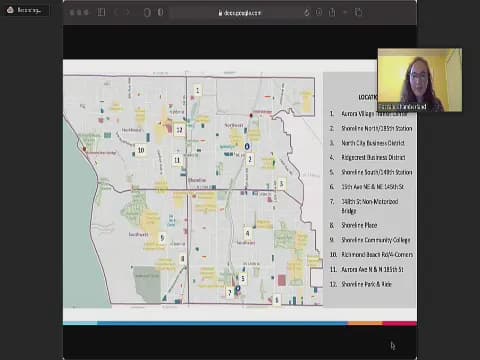
The Shoreline Planning Commission met on June 3, 2021, at 3:00 PM. The main agenda item was a study session on shared use mobility and mobility hubs, presented by the University of Washington Evans School Consulting Lab. No public comments were received, and routine items were approved without changes. Consent Calendar - Roll call was taken: Commissioners Callahan, Belissa, Tam, Wana Sonday, and Malik (absent with notice) were present. - The agenda was approved without changes. - The minutes from the previous meeting were approved without changes. Public Comments & Testimony - No members of the public signed up for general public comment. Discussion Items - Study Item: Shared Use Mobility and Mobility Hubs - Nora Daly Kang, Senior Transportation Planner, introduced the presentation, referencing her 2019 fellowship studying Helsinki's mobility ecosystem and the city's engagement with the UW Evans School Consulting Lab. - Graduate students Dale Markey Crimp, Pascal Chandeline, and Dorian Pacheco presented their report "Making Better Connections: A Study of Shared Use Mobility in Shoreline." - The presentation covered: the evolution of shared mobility devices (e.g., e-bikes, e-scooters, adaptive devices), criteria for siting mobility hubs (proximity to transit, walkability, bikeability, destinations, residential density, and equitable distribution), and a typology of hubs: regional, central, and neighborhood. - The team analyzed 12 potential hub locations, categorizing three as regional (two upcoming light rail stations and Aurora Village Transit Center), four as central, and five as neighborhood. - Key recommendations: prioritize pedestrian and bike infrastructure, partner with community organizations, develop land use code for mobility hubs, and use an adjustable matrix for future siting. - Commissioner Questions - Commissioner Gulska asked about parking at hubs; the team noted a balance is needed, citing examples from Bellevue and challenges with oversized lots. - Commissioner Kelly inquired about car sharing affordability; the team discussed membership models, subsidies, and the importance of reliable availability, citing examples from Lyon, France. - Commissioner Lynn asked about cross-jurisdiction analysis (e.g., Ballinger neighborhood bordering Mountlake Terrace and Lake Forest Park); the team acknowledged this was not explored but noted the matrix could be expanded. - Commissioner Jenny asked about curb space allocation for kiss-and-ride zones and design criteria for sidewalks and bike lanes. Senior Transportation Planner Nora Daly Kang responded that sidewalk minimums are 6 feet (single-family) or 8 feet (other), and bike facility design depends on road speed/volume. - Commissioner Moore inquired about integrating payment across modes (e.g., ORCA card); the team noted data-sharing barriers with private companies and referenced Helsinki's app-based integration. Nora Daly Kang added that a shared data policy is a key hurdle in the U.S. Key Outcomes - The commission received the presentation and report with appreciation. No formal votes or decisions were taken. - The next meeting is scheduled for June 17, 2021, featuring a public hearing on the subdivision vacation ordinance.