The Tigard City Council met on the evening of April 7, 2026, to address a range of legislative, administrative, and operational matters. The meeting included a police unit commendation, public comment on camping enforcement, adoption of an alarm system ordinance, advancement of the city manager recruitment process, and adoption of new policies for reporting improper conduct and compensating the acting city manager. All votes were unanimous. Recognition - Police Unit Commendation Award: Commander Sitton presented the department's Unit Commendation Award to the Commercial Crimes Unit (Detective Sergeant Dan Swain, Detective Jordan Welch, Detective Nelson Massey, and Detective Kyle Henderson) for their work on two complex serial burglary investigations. The investigations involved numerous hours of surveillance, search warrants, and coordination across multiple law enforcement agencies, resulting in the recovery of tens of thousands of dollars in stolen property and indictments on felony charges including burglary, kidnapping, robbery, and racketeering. Consent Calendar - Utility Billing Contract: Approved a contract for printing, mailing, and barcoding services. - Citywide Janitorial Services Contract: Approved a contract for janitorial services. Both items were approved unanimously by a voice vote. Public Comments & Testimony - Matt Rotolski (Tigard resident): Expressed concern about the lack of enforcement of camping ordinances at the water district area. He noted that police previously enforced cleanup each morning but that enforcement had stopped, leading to garbage and blocked sidewalks. He stated he was "100% for" the overnight camping rules but wanted the daytime cleanup provisions enforced. The city manager later addressed this in his report. - Written public comments: Three written comments were received regarding funding for a full-time park ranger, concerns with camping ordinance enforcement, and a request to increase the utility bill fund size. Discussion Items - City Manager Report (Acting City Manager Brian Rager): - Recognized April as Child Abuse Prevention Month, noting blue pinwheel displays at city hall. - Provided an update on houseless camping at the public works lawn: increased camper numbers and belongings blocking sidewalks. Announced three changes: (1) all officers are now instructed to address violations when observed, rather than only two dedicated officers; (2) a more liberal approach to exclusions from the campsite; (3) a proposed change to the time, place, and manner code regarding storage of personal belongings on city property during daytime, to be presented at the April 21 meeting. - Public Hearing – Ordinance to Amend Alarm System Code (Chapter 11.08): Staff (Executive Assistant Liz Upton and Commander Sitton) presented the ordinance, which updates outdated software, modernizes language, and adds an appeal process for false alarm calls. No public testimony was offered. The council voted unanimously to adopt Ordinance No. 26-08 after a roll-call vote (all ayes). - Public Hearing – City Manager Hiring Standards, Criteria, and Process: HR Director Laura Gomez and consultant Cliff Moore (Prothman) presented the scope of work, job description, and workflow timeline. Council discussed: - Councillor Schlack requested amending the candidate presentation from "top two to five" to "top three to five." - Councillor Schlack and Councillor Shaw suggested Mayor Who as the single point of contact for council input. - Council President Wolf asked about background checks; it was noted that the decision on who performs them can be made later. The council adopted the hiring standards, criteria, and process as amended (unanimous). - Review of Policy for Reporting Improper Conduct and Compensation Addendum for Acting City Manager / Elected Officials: - Reporting Policy: Created to allow employees and volunteers to report suspected improper conduct by city officers or elected officials, with protections against retaliation. The policy applies to council members and employees who report directly to council. - Compensation Addendum: Clarifies that when the Assistant City Manager serves as Acting City Manager, a three-member subcommittee may award up to 40 hours of supplemental paid time off. For other city employees serving as Acting City Manager, compensation may not exceed 5% of base salary. Discussion included concerns about extended acting periods (e.g., beyond six months) and the status of the Acting City Manager under the city charter. Council adopted both policies unanimously. - Ratification of Acting City Manager Delegation: Mayor Who reported that Public Works Director Brian Rager has agreed to serve as Acting City Manager while Deputy City Manager Trish is on personal leave. The council ratified the mayor’s action delegating the duties to Mr. Rager until further notice (unanimous). - Appointment of Subcommittee for Acting City Manager Compensation: Pursuant to the newly adopted policy, Councillors Shaw, Schlack, and Gaducey volunteered to serve on the subcommittee to consider compensation for Mr. Rager for his role as Acting City Manager. Key Outcomes - Unanimous adoption of Ordinance No. 26-08 amending the alarm system code (roll-call vote: 8 ayes). - Unanimous adoption of the city manager hiring standards, criteria, and process as amended (top three to five candidates, Mayor Who as point of contact). - Unanimous adoption of the Reporting Policy for Improper Public Officer/Public Official Conduct and the Compensation Addendum for Acting City Manager / Elected Officials. - Unanimous ratification of Mayor Who’s delegation of Acting City Manager duties to Brian Rager. - Appointment of a three-member council subcommittee (Shaw, Schlack, Gaducey) to determine compensation for the Acting City Manager. - Next steps: A proposed code change regarding daytime storage of personal belongings is expected at the April 21 council meeting; the city manager recruitment process will proceed with the adopted criteria.
Public Meetings - Tigard, Oregon
Public Meetings - Tigard, OregonThe Tigard City Council and Local Contract Review Board met on March 24, 2026, to address routine approvals, a recreational immunity ordinance, adoption of a three-year economic development strategic plan, and receive a detailed update on the River Terrace 2.0 transportation and equitable finance strategy. The meeting included public comments from developers, a city manager report, and extensive council deliberation on street designs and funding mechanisms. Consent Calendar - The council unanimously approved three consent items: a resolution granting property tax exemptions for four nonprofit low-income housing projects under Tigard Municipal Code Section 3.50; approval of city council minutes; and a contract award for mechanical HVAC preventative maintenance, service, repair, and inspection services. Public Comments & Testimony - Mark Farr (Metropolitan Land Group) spoke on agenda item 7 (River Terrace 2.0). He expressed appreciation for staff’s incorporation of developer feedback leading to right-of-way reductions but urged the council to ask staff where River Terrace 1.0 standards were expanded for River Terrace 2.0 and to further rightsize those cross-sections. He requested that the council ask Eco Northwest or staff to provide specific SDC (system development charge) numbers for different design choices so the council can understand the fee impact on home prices (e.g., $80,000, $100,000, $120,000). He also noted that a developer forum scheduled for the following week was canceled and hoped it would be rescheduled. - Pam Verdadero (Risewell Homes) commented on the transportation plan, suggesting modifications on Collector A (commercial collector) to modify parallel parking areas to allow wider sidewalks for enhanced pedestrian experience, citing a similar successful design in Beaverton. She also suggested reducing the eight-foot landscape area to create larger sidewalks. - No other public comments were received in person, by phone, or video. Legislative Public Hearing – Recreation Immunity Ordinance - City Attorney Rihala presented the staff report on Ordinance 26-07, which would allow Tigard to opt into statutory recreational immunity protections available to cities with a population under 500,000. The ordinance limits city liability for claims arising from use of trails in public easements or unimproved rights-of-way. - No written or oral testimony was received. - The council deliberated briefly; Councilor Godusi noted he could not think of a negative. The ordinance was adopted by unanimous roll-call vote (all councilors and the mayor voted aye). Economic Development Strategic Plan Adoption - Economic Development Manager Danielle Hodder presented the final three-year Economic Development Strategic Plan, developed over nine months with community engagement, workshops, and work sessions. She highlighted how feedback from the March 3, 2026 council work session was incorporated, including data analysis tools, council role clarification, one point of contact for development, storytelling, leveraging existing data sources, target industry identification, and a fast-pass checklist for desirable projects. - Council President Wolf asked about adding measures of success and goals for tracking. Councilors expressed strong appreciation for the efficient process and community collaboration. - The resolution to adopt the plan was approved unanimously. River Terrace 2.0 Update – Transportation and Equitable Finance Strategy Discussion Items - Street Designs (Part 1): Senior Planner Brittany Gata presented recommended street designs for River Terrace 2.0. The designs were the result of multiple iterations balancing policy goals for vehicle, pedestrian, and bike safety. Key designs include: - Commercial Collector (108 ft wide): Angled parking, bike lanes behind curb (rear-loaded), 8-ft tree wells, 12-ft drive lanes. This segment is 2 ft narrower than River Terrace Boulevard and limited to about 3 city blocks. - Mountainside Way (main artery): 72 ft wide (38 ft narrower than River Terrace Boulevard), with an enhanced multi-use path and alternating on-street parking. - Other collectors and neighborhood routes: Varying widths, most with multi-use paths on both sides (12-13 ft wide) or constrained cross-sections near stream crossings. - Local streets: Standard 32 ft wide with parking on both sides and shared bike/car travel. - Council discussed the 14% increase in construction costs over standard Tigard streets. Some councilors (Anderson, Shaw, Godusi, Wolf) expressed concern about costs passed to homebuyers and maintenance burdens. There was debate about narrowing bike lanes, using multi-use paths on one side vs. both sides, and the width of the commercial collector. No final decision was reached; staff will provide additional cost breakdowns and analysis for the commercial collector (Collector A) and Collector B, and return in May 2026 with more information. - Finance Strategy (Part 2): Gata presented the equitable finance strategy, which aims to identify funding sources and responsibilities for infrastructure. Key points: - Funding sources include Washington County transportation development tax, Clean Water Services fees, city SDCs (transportation and parks), supplemental SDCs, developer contributions, and potential additional sources. - A tiered SDC structure is being explored to lower fees for smaller units (e.g., middle housing) to promote affordability. The tiering may be applied citywide, not just in River Terrace 2.0. - Staff is still analyzing stormwater strategy (super-regional approach with Clean Water Services and King City may not be timely) and finalizing cost estimates. - Council provided high-level direction on balancing development feasibility, affordability, and city budget impacts. Councilors leaned toward reduced development costs (to incentivize building), but many noted the need for more detailed information on budget impacts, maintenance costs, and SDC amounts. Interest was expressed in supplemental fees (e.g., transportation use fee, park fee) and tiered SDCs. Key Outcomes - Street Designs: No final approval. Staff will return in May 2026 with additional cost estimates and analysis for Collector A and B, including impacts of narrowing bike lanes and potential reductions to the commercial collector width. The council indicated willingness to keep both-side multi-use paths and angled parking on collector A, but wanted more data on costs. - Finance Strategy: Council provided initial guidance: prioritize understanding of full budget impacts, explore tiered SDCs (potentially citywide), consider supplemental fees for ongoing maintenance, and lean toward reducing development costs to encourage timely development. Staff will present refined options and analysis in May 2026. - Next Steps: A developer forum on the finance strategy, originally scheduled for March 30, 2026, has been postponed to late April or early May. Staff will also submit preliminary transportation and park system plan amendments to meet Metro grant deadlines. The meeting adjourned at an unspecified time after the River Terrace 2.0 discussion.
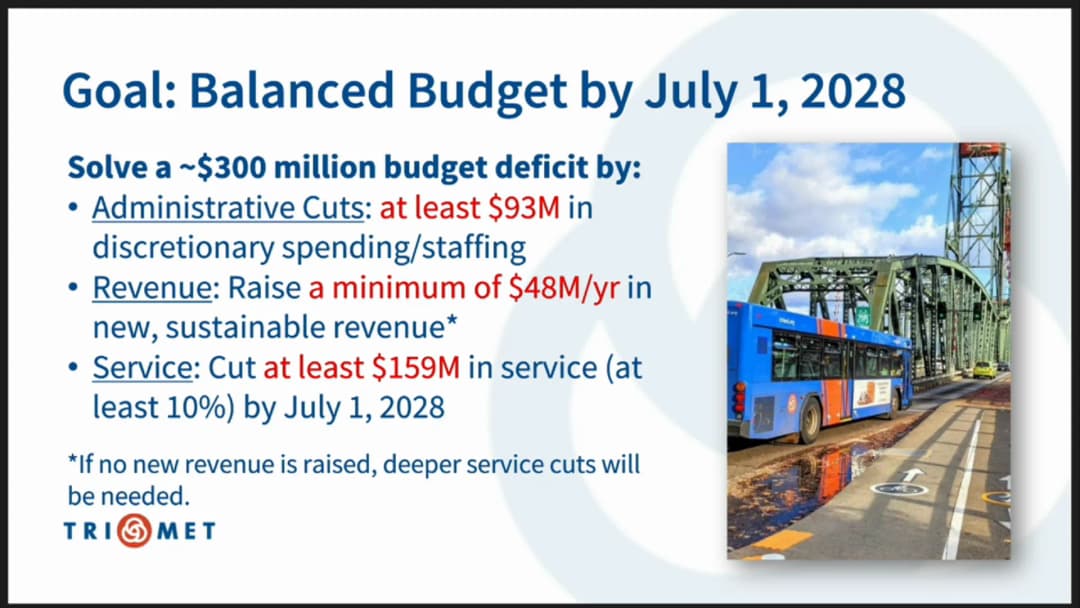
The Tigard City Council held a workshop on March 17, 2026. The meeting included updates from community partners, a police dashboard report, a presentation from TriMet on proposed service cuts, a seasonal park ranger pilot program report, and a joint discussion with the Parks and Recreation Advisory Board regarding the Lasich property. No formal votes were taken, but council members expressed support for continuing exploration of the Lasich property concept. Consent Calendar - No consent calendar items were presented. Public Comments & Testimony - No public comments were submitted in writing or offered in person or by phone. Community Updates & Presentations - Tigard High School Theater Department: Theater teacher Tori Lee Scholes and Thespian board president Vera Hardy highlighted accomplishments, including being a National Honor Society, four-time state tech champion, and three international competitors (one won superiors in solo acting and makeup design). They organized a haunted house that collected 400 pounds of food (feeding 10,513 households/48,858 individuals) in partnership with Pact with Pride. Their recent musical "9 to 5" included a feminine hygiene product drive for local shelters. They expressed a desire to partner further with the city. - Tigard High School Envoy: Becca Kasravani reported on spring events: graduation June 5 at 7 p.m., course selection underway, athletic updates (dance team state competition, tennis invitational win, lacrosse tournament, track and field meet). ASB president and vice president elections results: Sidney Jewell (president) and Gabriel Musangu (vice president). Prom is May 2 (location: Oregon Zoo). Police Department Dashboard Report - Commander Brad Sitton presented the February 2026 dashboard. Key data points: Dispatch calls and self-initiated calls both increased, indicating proactive policing. Response times decreased across all priority levels, with priority four calls (e.g., animal calls, abandoned vehicles) seeing a 22% decrease. Arrests increased 16% year over year (February 2025 vs 2026), with misdemeanor and citation arrests up. Year-to-date arrests are up 18.22% compared to the same two months last year. - In response to Councilor Gaducy’s question about enforcement of time-place-manner regulations at the public works lot (homeless services area), Commander Sitton noted challenges: constant rotation of new arrivals, sidewalk width (96 inches vs required 48 inches ADA), and increasing unaddressed canine presence. Education and exclusion (as last resort) are the primary tools. Councilor Wolf asked about the exclusion process; Commander Sitton explained it is a graduated approach before criminal trespass. Council Board & Committee Liaison Reports - Councilor Robbins: Library board reported Express Library had over 1,100 visits in first month, 269 story time attendees, 20 tech help sessions, 53 teens in winter reading challenge. Immigration committee surveyed on continuation. - Council President Wolf: Attended chamber’s governmental affairs meeting (legislative debrief, bond measure). Also attended governor’s prosperity council listening session on business climate, workforce, tools for growth. Will attend WEA policy conference. - Councilor Schlack: Housing/homelessness task force charter development; transportation advisory committee discussed the "Building a Better Tigard" bond, McDonald Street project, downtown roundabouts. - Councilor Gaducy: Parks and Rec advisory board discussed Fanno Park; water advisory board recommendations on water emergency preparedness. - Mayor Wu: Reported on joint town hall with state legislators; short session successes (TLT share, ethics clarification, recreational immunity, economic development bill with one-year pause on data center incentives). Attended regional transportation meetings on TriMet service cuts and Regional1 Act projects. TriMet Budget & Proposed Service Cuts - TriMet representatives (JC Veneta, Tom Mills, Director Robert Kellogg) presented on a $300 million deficit and proposed cuts totaling at least 10% service reduction. Context: record teleworking (Oregon 2), downtown Portland vacancy 34.7%, fare revenue down $60M/year, inflation up 56% (2019-2025), $700M capital maintenance backlog. Cuts needed by July 2028. - Proposed changes affecting Tigard: - Line 45: terminate at Washington Square (lose service on SW 121st and Walnut), operate only during rush hours serving schools. - Line 39/97: restructured to only go to Barber Transit Center (not downtown), requires transfer to Line 96 express. - Line 76: extended to Sunset Transit Center, improving one-seat ride to Cedar Hills Crossing. - Line 76 will no longer serve Oregon City due to low ridership. - The plan currently achieves about 5-6.5% savings; additional cuts likely if state transportation bill fails. Council President Wolf asked about Tiger-specific feedback; Tom Mills said they reviewed 8,100 comments and found no disproportionate burden on vulnerable communities. Mayor Wu expressed concern for transit-dependent riders (35% of ridership) and urged innovation like the SPOT pilot program. Director Kellogg warned that these may be the beginning of deeper cuts. Seasonal Park Ranger Program Pilot - Parks and Recreation Manager Rick Gurin and Park Ranger Jordan Gordon presented results of the first year. Data: 2,700-plus documented interactions, including 125 dog-off-leash encounters, 37 smoking violations, 4.23 miles of social trails mapped, graffiti management, camp cleanup cost reduction from $8,000 average to $1,100. Jordan serves as a positive presence and liaison between PD and parks. Currently seasonal (April-December). Parks Board Chair Ellen Brown advocated for converting to a full-time position with an additional seasonal. Council members praised the program but noted budget constraints; some requested more internal cost-efficiency data before committing to expansion. Parks and Recreation Advisory Board Annual Update & Lasich Property - Board Chair Ellen Brown summarized accomplishments: system plan update, tree board duties, grant support, public input vetting (e.g., pickleball, dog park battery storage proposal). Advocacy notes: Parks is a core service, currently funded below bottom quartile compared to peer cities. - Rick Gurin presented a concept for the Lasich property (zoned exclusive farm use): community-supported agriculture, demonstration gardens, native plant nursery, river access, potential community gardens. Council members expressed support for continuing exploration (Councilor Wolf, Robbins, Gaducy; Councilor Schlack wanted more information). Discussion also touched on ball field loss at Fowler Middle School and potential partnership with school district on Dirksen property. Mayor Wu asked about funding levy; board chair opposed a levy due to uncertainty and competition with other ballot measures, but some council members noted the need for voter input on park funding priorities. Key Outcomes - No formal votes were taken. - Council expressed general support for continuing discussions on Lasich property concept and directed staff to return with more details (including long-term costs). - Council acknowledged the seasonal park ranger program’s success but deferred any decision on making it full-time to the April 14 budget discussion. - Mayor Wu offered to advocate for TriMet funding at the state level. - Council is scheduled to discuss park funding in more depth on April 14.
The Tigard City Council and Town Center Development Agency (TCDA) Board met on March 10, 2026, at 6:31 PM. The meeting covered the 2026 federal legislative agenda, updates on the former Tigard Cinema site, and a review of the youth counselor program. Key decisions included direction to proceed with redevelopment first for the cinema site and sunsetting the youth counselor program in favor of strengthening the Tigard Youth Advisory Committee (TIAC). Public Comments & Testimony - Jeff Darland, a Tigard resident, expressed concerns that Tigard's water system development charges (SDCs) have not contributed to the $85 million in water bond debt service since 2013. He asked the council to formally authorize the use of development fees to pay debt service, direct staff to determine ratepayer overpayment and begin reconciliation, and include these obligations in future SDC determinations before commissioning new water capital projects. Discussion Items - 2026 Federal Legislative Agenda: Assistant to the City Manager Nicole Hendricks presented the recommended agenda focusing on project-specific funding requests (public safety facility and 72nd Avenue Corridor improvements) and policy priorities (transportation, infrastructure, transit reauthorization, affordable housing). Councillor Shaw proposed additional items including support for Community Development Block Grants, the Community Fueling Infrastructure program, the railroad crossing elimination program, tax-exempt municipal bonds, opposing changes to FEMA, and protecting Medicaid, Medicare, and SNAP. After discussion on prioritization and staff resources, the council agreed to bring the agenda back for adoption in May with edits incorporating Councillor Shaw's input and feedback from other councillors. - Town Center Development Agency – Former Tigard Cinema Site: Redevelopment Manager Sean Farrelly presented an update on the 10.89-acre site acquired in August 2025. Goals include a neighborhood park, street/trail infrastructure, Red Rock Creek restoration, and redevelopment of the non-park portion. Community engagement results showed top park preferences (walking/biking trails, playground, picnic areas, natural green space) and community needs (entertainment, food, community spaces, housing). Four scenarios were presented: redevelopment first, joint development, park first, and all public development. Staff recommended scenario 1 (redevelopment first) due to reduced risk of prevailing wage costs and time to assemble funding. The TCDA Board unanimously supported scenario 1 and directed staff to begin a request for qualifications (RFQ) process for developer selection, incorporating goals for community space and entertainment. Youth Councillor Helleck shared youth input supporting a dog park, escape park, and outdoor fitness equipment. - Youth Counselor Program Review: Acting City Manager Trish presented the staff report. Discussion centered on whether to continue the program, change eligibility, or replace it with broader civic education. Councillor Robbins proposed expanding eligibility to unincorporated Tigard students attending non-TTSD schools (e.g., Jesuit High School), but the majority opposed non-resident participation. Councillors Schlack and Shaw advocated for sunsetting the program, citing limited recruitment success and equity concerns. Councillors Goodisi, Robbins, and initially Council President Wolf supported continuation with measurable goals. After further debate, Council President Wolf changed her position to support the staff recommendation to sunset the program. The council voted to sunset the youth counselor program and redirect resources to strengthen the Tigard Youth Advisory Committee (TIAC) and civic education initiatives. Staff will produce a memo with a detailed plan. Key Outcomes - The 2026 federal legislative agenda will be returned for adoption in May 2026 with edits from Councillor Shaw and other council feedback. - The TCDA Board directed staff to proceed with scenario 1 (redevelopment first) for the former Tigard Cinema site and begin an RFQ process, incorporating community space/entertainment goals. - The youth counselor program will be sunset; staff will develop a plan to enhance TIAC and broader civic education, to be presented to council. Council President Wolf's change of vote created a majority in favor of sunsetting.
The Tigard City Council convened on March 3, 2026, at approximately 8:00 PM to address a city manager report, two quasi-judicial public hearings on comprehensive plan map amendments, an economic development strategic plan update, and a discussion on the street maintenance fee methodology. The council took unanimous votes on both land‑use ordinances and provided policy direction on the street maintenance fee. Consent Calendar - No consent calendar items were presented. Public Comments & Testimony - No public comments were offered for any agenda item. Written comments were not received for the land‑use hearings. City Manager Report - Acting City Manager Trish reported that the 2026 Police Department Community Academy launched on February 26, 2026, with about 30 community members for a 10‑week program. Councilor Schlack, a participant, noted the academy reinforced the need for a new police and public works facility, which will appear on the May ballot. Mayor Who also highlighted police engagement at a Lunar New Year celebration. Quasi-Judicial Hearing – Hall Boulevard Pedestrian Crossing Comprehensive Plan Map Amendment (CMA 2025‑0003 / SLR 2025‑0002) - Staff Presentation: Associate Planner Jenny McGuinness explained the proposal to replace a non‑compliant pedestrian signal with a rectangular rapid‑flashing beacon (RRFB) at Hall Boulevard between Omar and Burnham Streets. The project would impact 127 square feet (0.003 acre) of vegetated corridor within a significant wetland to install three stormwater outfalls. The ESEE analysis concluded the safety benefits outweighed the minimal environmental impact. The Planning Commission unanimously recommended approval on January 26, 2026. - Applicant Testimony: James Stalphil (Dell consulting, representing ODOT) and Kyle Crate (ODOT project manager) reiterated the safety purpose, noting construction is expected July–December 2026 with no road closures. Stormwater credits in lieu of on‑site mitigation will be provided. - Council Deliberation: Councilor Gadusi asked about environmental consequences; staff affirmed the degraded condition of the vegetated corridor and the net benefit from improved stormwater treatment. The council found no conflicts of interest. - Vote: Ordinance No. 26‑05 was adopted unanimously (5‑0). Quasi-Judicial Hearing – Steve Street Park Comprehensive Plan Map Amendment (CMA 2025‑0002) - Staff Presentation: Planner McGuinness described a proposed ADA‑accessible pathway (8‑ft wide) connecting Steve Street to a new 1.37‑acre park, impacting 0.03 acre of vegetated corridor. The park addresses one of 12 gap areas where residents lack a park within a 10‑minute walk. The ESEE analysis concluded that allowing the path avoids negative consequences of prohibition and improves habitat through on‑site restoration. Planning Commission unanimously recommended approval on February 2, 2026. - Applicant Testimony: Jeff Peck (Public Works) and Grace Coffee (Winterbrook Planning) noted the wetland buffer occupies the entire northern portion of the park site, making the path unavoidable. On‑site mitigation will include native plantings and restoration, improving the buffer from degraded to good condition. Wetland Scientist Sarah Hartang (ESA) was available remotely. - Council Deliberation: Councilor Gadusi inquired about mitigation; staff highlighted native plantings and stormwater treatment. Councilor Shaw asked about pathway width (confirmed 8 ft). No conflicts declared. - Vote: Ordinance No. 26‑06 was adopted unanimously (5‑0). Economic Development Strategic Plan Update - Presentation: Economic Development Manager Danelle Hother and Matt Craigie (EcoNorthwest) presented the draft three‑year strategic plan, which was developed through two workshops. The plan includes four pillars: (1) Business Attraction, Support & Growth; (2) Partnerships & Navigation; (3) Operations & Communication; (4) Development & Placemaking. Each pillar contains specific actions, sub‑actions, year‑one priorities, and performance indicators. The draft plan is available for council review, with the final version expected by the end of March 2026. - Council Feedback: - Pillar 1: Councilors supported year‑one resource scans and baseline data collection. Councilor Gadusi emphasized clear progress metrics. Councilor Shaw requested moving TCAC from “local partner” to “internal organization” (staff confirmed this correction). - Pillar 2: Councilor Shaw asked to include council’s role in governance. Councilor Schlack noted the critical importance of partnerships. - Pillar 3: Mayor Who stressed retaining existing businesses through better communication. Councilor Shaw highlighted the pilot interdepartmental economic development committee. Councilor Anderson asked about a single point of contact for developers (staff confirmed one exists). - Pillar 4: Councilor Shaw proposed leveraging data from the street maintenance fee study (Kittelson) for a commercial space inventory and suggested a “fast‑pass” for high‑revenue projects. Councilor Schlack noted the pillar’s weight in shaping the community. - Outcome: Council provided consensus direction to incorporate their feedback into the final draft. Street Maintenance Fee Discussion - Presentation: Project Manager Nicole George, Consultant Nick Popanuk (Tiberius Solutions), and Susan Wright (Kittelson & Associates) reviewed the current fee ($9.11/month per residential unit, $2.98/month per parking stall for non‑residential, generating $5M annually). The proposed switch to a trip‑generation methodology (using ITE rates) aims for greater equity. About 485,000 daily trips from the city’s 17,000 utility accounts were estimated (40% residential, 60% non‑residential). Under a pure trip‑based model, a single‑family home fee would drop to $7.83/month, reducing residential revenue and shifting costs to non‑residential accounts. Land uses with high parking turnover (e.g., medical/dental offices, shopping centers) would see increases; warehousing and industrial would see decreases. Six trip‑generation buckets are proposed for administrative simplicity. - Council Direction: Councilors expressed a shared preference to maintain the current residential rate of $9.11/month (rather than lowering it) to buffer the impact on businesses facing increases. Councilor Gadusi requested considering vehicle weight in the methodology. Councilor Shaw asked for informal briefings for deeper analysis and wanted input from the Chamber of Commerce and affected businesses. Councilor Anderson supported keeping the residential rate stable. Councilor Halek suggested a middle rate (e.g., $8.50) to soften business increases. Councilors sought an appeals process for businesses to contest their bucket assignment. Staff will return in May 2026 with refined proposals, and implementation is targeted for 2027. Key Outcomes - Ordinance No. 26‑05 (Hall Boulevard Pedestrian Crossing CMA / SLR) – Approved unanimously (5‑0). - Ordinance No. 26‑06 (Steve Street Park CMA) – Approved unanimously (5‑0). - Economic Development Strategic Plan – Council feedback will be incorporated into the final draft; adoption expected at a future meeting. - Street Maintenance Fee – Council directed staff to: - Keep the residential fee at $9.11/month (no reduction). - Refine trip‑generation buckets, consider a cap for very high‑trip uses, and explore vehicle‑weight factors. - Conduct informal briefings and outreach to businesses. - Return in May 2026 with updated methodology and draft invoices.
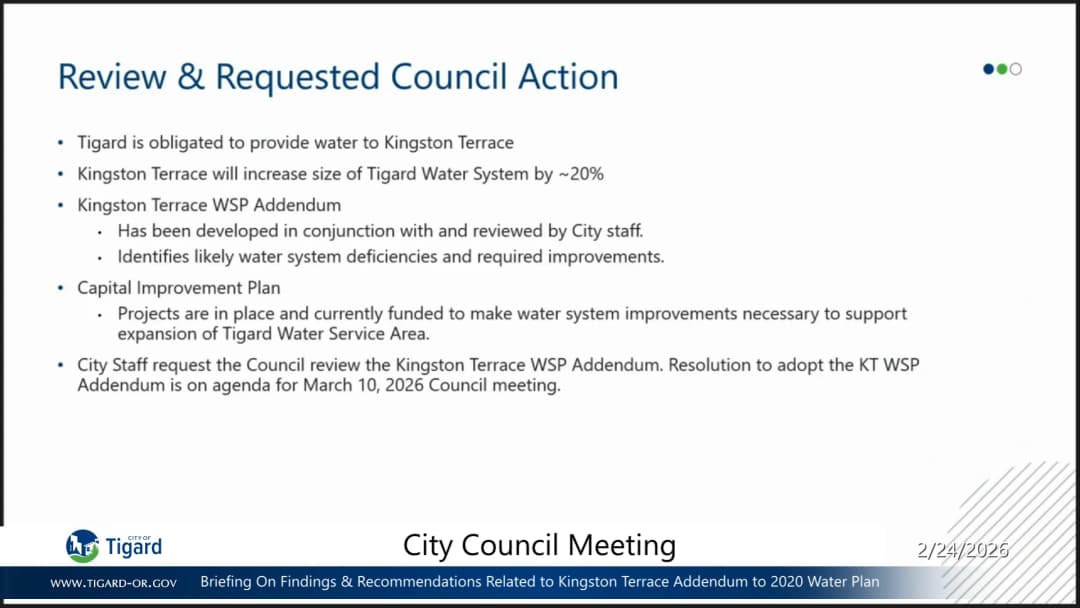
The Tigard City Council convened on February 24, 2026, at 6:30 PM. The meeting included a presentation of a Police Life Saving Award, a city manager's report, public comments, a continuation of a public hearing on the River Terrace 2.0 annexation, a briefing on the Kingston Terrace Water System Plan Addendum, and a discussion on the Downtown Tigard Reimagined project. Key votes included a unanimous decision to continue the annexation hearing to June 2, 2026. The council also provided direction for further stakeholder outreach on the downtown plan. Consent Calendar - None listed. Public Comments & Testimony - Julia Kai (Beaverton resident, Oregon Falun Dafa Association volunteer): Spoke in support of Shen Yun Performing Arts, describing the organization as a faith-based, American performing arts company showcasing traditional Chinese culture. She characterized the Chinese government as opposing the group and invited council members to attend upcoming shows in April 2026. She exceeded the two-minute time limit. - Jeff Darling (Tigard resident): Expressed concern that the pace of development commitments for River Terrace 2.0 and the King City water expansion is outpacing the financial frameworks (plan districts, funding strategies, system development charges) needed to support them. He argued that without updated SDCs, existing water customers would subsidize new connections. He urged the city to conduct a retrospective review of River Terrace 1.0 SDCs and expedite SDC updates before moving forward. Discussion Items - Police Life Saving Award: Police Chief McDonough presented Officer Jordan Yamashita with the Life Saving Medal for actions on January 17, 2026. Officer Yamashita found an unresponsive, not-breathing driver in a running vehicle, broke a window to gain entry, administered CPR and naloxone, and the patient regained a pulse and was transported to the hospital. - City Manager Report: Acting City Manager Trish reported on the City of Tigard's participation in a Think First, Stay Safe event at Twality Middle School and highlighted the Capital Improvement Projects pipeline, which includes 91 proposed projects in the five-year program. Current projects include the Cook Family Park Accessible Dock, McDonald Street Improvements, Steve Street Park, and Red Rock Creek Stabilization. - River Terrace 2.0 Annexation (Public Hearing Continuation): The council considered staff's recommendation to continue the hearing to June 2, 2026. Council President Wolf moved to continue to the regularly scheduled meeting that date, seconded by Councillor Shaw. The motion passed unanimously. Public comments may be submitted before that date. - Kingston Terrace Water System Plan Addendum Briefing: Senior Project Engineer Ross Orton presented findings from the addendum to the 2020 Water System Plan for the Kingston Terrace area, which will add approximately 4,100 dwelling units and expand the water system by about 20%. Key findings included: - Additional demand: average daily (1.1 MGD), maximum daily (2.2 MGD), peak hour (4.5 MGD). - Storage deficit requiring 7.5 million gallons of new storage by 2050; Reservoir 19 is in the CIP. - Supply deficit starting around 2050 even with the Lake Oswego–Tigard (LOT) expansion (adding 4 MGD by about 2031). - No pumping or fire flow deficits anticipated with the LOT project. - Required improvements include piping upgrades (by developers), storage, and supply; a water system plan update and SDC rate study are planned after July 2026. - Orton responded to concerns about SDC funding adequacy, noting that current SDCs partially fund needed projects and that near-term projects are expected to be affordable. A more detailed financial analysis was requested by council for the March 10 meeting. - Downtown Tigard Reimagined – Alternative Discussion: Senior Planner Susan Shanks presented refined alternatives for the downtown transportation network, bike network, zoning, and building heights, addressing council concerns from 2024. The refined proposal: - Reduces proposed new streets to balance connectivity with redevelopment feasibility. - Adds dedicated bike lanes on Ash Street and a proposed new street (pink street) to provide comfortable options for less confident cyclists, rather than retrofitting Main Street. - Proposes applying mixed-use zones (residential, commercial, employment) from the Tigard Made project to downtown. - Recommends a uniform maximum building height of six stories citywide, addressing prior concerns about excessive heights along Hall Boulevard (previously contemplated at 12 stories due to potential light rail). - Stakeholder outreach planned with the Tigard Chamber of Commerce, Downtown Alliance, Town Center Advisory Committee, Transportation Advisory Committee (TTAC), Planning Commission, developers, and businesses. Key Outcomes - Continuation of River Terrace 2.0 Annexation Hearing: Unanimous vote to continue to June 2, 2026, at 6:30 PM. - Direction on Downtown Tigard Reimagined: Council requested additional detailed analysis on the transportation network and bike lanes, and directed staff to present the refined proposal to TTAC and other stakeholders before returning for further council discussion. Staff indicated the schedule can be adjusted to accommodate this. - Financial Analysis Requested: In response to public comments and councilor questions, staff will provide a more detailed financial analysis of SDCs and system costs before the March 10, 2026 meeting on the Kingston Terrace Water System Plan Addendum adoption. - Next Meeting Schedule: The council will consider a resolution to adopt the Kingston Terrace Water System Plan Addendum on March 10, 2026.
The Tigard City Council met in a joint workshop with the Town Center Development Agency (TCDA) and the Town Center Advisory Commission (TCAC) on February 17, 2026. The meeting covered community updates, police performance, liaison reports, TCAC's annual report, a discussion on board and committee standardization, and the approval of a resolution referring a bond measure to the May 2026 ballot. Community Updates - Becca Kosravani, Tiger High School Envoy, reported on upcoming events including a kindness week (by STUD), Unity Week (theme: perseverance), a voices assembly for personal stories, a multicultural assembly, and prom on May 2 at the Oregon Zoo. Athletic updates included the swim team's district meet, dance team competition, unified basketball senior night, cheer at OSAA state, and basketball games. The blood drive on February 10 collected about 80 donors. Police Department Report - Chief Jamie McDonald presented a dashboard showing a direct correlation between dispatched calls for service and priority 1-2 response times. January 2026 calls exceeded 2,000, similar to 2022 levels, with slower response times when calls were high. Community engagement events included Coffee with a Cop, Cocoa with the Cop, and the upcoming Community Academy (filled in 6 days with over 30 participants). The deflection program (Measure 110) initially had low numbers but has increased; officers received training and referrals are now occurring regularly. Council Liaison Reports - Councilors reported on multiple board and committee meetings: - Planning Commission unanimously forwarded recommendations for the Hall Boulevard Pedestrian Crossing Project (removes 127 sq ft of wetland protection for Fanno Creek Trail crossing) and the Steve Street Park Project (removes 0.03 acres of wetland protection for a pathway). - Willamette River Water Coalition adopted a reduced budget; Tigard's FY27 dues are $21,747 (down from previous). - Lake Oswego Tigard Water Partnership elected officers (Tigard is vice chair) and received a budget/operations update; chlorine generation trial ongoing. - Washington County Public Affairs Board approved CDBG/HOME/ESG funding: Family Promise received $35,000 per year, Good Neighbor Center $230,000 for bathroom upgrades, and Tigard home ownership grants $136,000. - Library Board moved to City Hall with limited services (Fri-Sun); 276 visitors in first 3 days, 60 children at story time, 22 at a waterfowl program. - Regional Water Providers Consortium approved a budget with reduced costs for Tigard; the Willamette Water Pipe Project (30 miles, $1.8 billion? actually mentioned as 1.8 million – likely 1.8 billion contextually) is 99% complete and operational this month. - Youth Councilor Helleck reported TIAC welcomed two new middle school members and is planning AI education for residents and a movie night at Family Promise. Joint TCDA Board and Town Center Advisory Commission (TCAC) Meeting - TCAC presented its annual report and draft 2025-26 strategic plan, with three areas of emphasis: - Equitable Business and Development: Accomplishments include improvement grant program successes, parking data collection (no need for full-time enforcement), and two new Launch Pod businesses. Future goals include monitoring parking management and advocating for underrepresented business opportunities. - Connectivity and Access: Key project is 72nd Avenue development; a letter was sent to US DOT requesting BUILD 2026 funding for Phase 1. The lack of sidewalks poses safety risks (anecdote of a pedestrian with a dog trying to cross). - Housing and Shelter: Accomplishments include Just Compassion expansion (30 beds each for men and women), Family Promise renovations, The Reach's Dartmouth Crossing affordable housing grand opening, and community partners beginning construction. Future goals include attending stakeholder meetings (CHART, CEPA) and considering further development assistance. - Council members (Schlag, Shaw) requested that TCAC align its strategic plan with council's economic development policies (Goal 2, TLT strategic plan, and upcoming Economic Development Strategic Plan). They suggested a mid-year strategic planning cycle after council provides policy direction. Board and Committee Discussion - Nicole Hendrix, Assistant to the City Manager, presented a staff report seeking initial guidance on three areas: 1. Bylaw Standardization: Council generally supported standardization with flexibility. Councilor Schlack proposed 11-member committees, but many councilors preferred 5-9 members. Consensus on two consecutive terms (two-year terms), quorum as majority of sitting members, eliminating alternates but allowing case-by-case ex-officio/designated positions. Code of conduct should be included in appointment acceptance. 2. Roles and Purpose: Council affirmed that boards are advisory to council and supported strengthening feedback loops (liaison reports, formal recommendations in staff reports) so committees see how their input is used. 3. New/Rescoped Committees: Council provided initial direction: - Finance Committee: Supported, incorporating the Audit Committee as a subcommittee (one net new committee). - CCE: Rescope to focus on equity and special events. - Homelessness Task Force: Support in principle to replace CHART, but with a clearly defined scope to avoid mission creep. Councilor Schlack will circulate a proposed structure. - Climate: Have Climate Action Tigard present occasionally rather than create a new committee. - Seniors: Consider adding a senior representative to existing boards rather than a new committee. - Council will return in April for a formal recommendation. Consideration of Resolution for Bond Referral - City Attorney Rihala presented the final ballot title for the May 2026 bond measure, which had been vetted by bond counsel and council. Minor wording changes were made (e.g., added "were" before "recommended", "centralized" facility, "on site" for evidence storage). The summary emphasizes efficient response and centralized facilities. Councilor Schlag praised the language. The council approved Resolution 26-08 unanimously. Key Outcomes - Resolution 26-08 was adopted unanimously (7-0) referring a bond measure to the May 2026 ballot for public safety and public works facilities. - Council provided initial guidance for board and committee reforms: standardize bylaws with flexibility, create a Finance Committee (including audit), rescope CCE, formalize a homelessness task force, and keep climate/seniors as informal. Final recommendations due in April. - TCAC will adjust its strategic planning cycle to align with council's economic development plan.
This meeting of the Tigard City Council and Town Center Development Agency covered a range of legislative and planning items, including public hearings on code amendments, a briefing on the Tigard Home community engagement project, a proposed redesign of Nick Wilson Memorial Plaza, polling results and bond market updates for the Building a Better Tiger facility project, and council direction on the city manager recruitment process. All votes were unanimous unless otherwise noted. Consent Calendar - Resolution of support for a 2026 BUILD federal grant for the Southwest 72nd Avenue Improvement Project (99W to Dahmer Street in the Tiger Triangle). Approved unanimously. Public Comments & Testimony - No members of the public testified on any of the public hearing items. No written comments were received. Legislative Public Hearings - Ordinance 26-01 (TMC 5.20 – Liquor License Applications): Added a designee for the police chief in liquor license reviews. Changed "shall" to "will" for clarity. Adopted unanimously. - Ordinance 26-02 (TMC 14.24 – Demolition of Structures): Codified existing demolition permit process no longer covered by the state building code. Adopted unanimously. - Ordinance 26-03 (TMC 14.28 – Temporary Certificates of Occupancy): Codified existing TCO process with a two-tier fee structure (up to $500,000 valuation: $300; over $500,000: $600). Adopted as amended (corrected spelling of "certificates") unanimously. - Resolution 26-07 (Citywide Fee Schedule Updates): Revised archive fees, TCO fees, demolition fees, and added back inadvertently removed legislative fees (e.g., $20,000 for external legislative amendment applications). Adopted unanimously. - Ordinance 26-04 (TMC 7.48 – Special Event Permits): Clarified traffic control plan requirements (professional engineer required for more than de minimis impact) and removed language on city reimbursement for services due to staffing capacity. Adopted unanimously. Discussion Items - Tigard Home (Housing Opportunity, Mobility, Enterprise) Community Engagement Briefing: Associate Planner Amber Gomez presented Phase 2 progress. Key takeaways from 14 events (800+ participants): residents want green spaces, continuous sidewalks, small grocery stores, coffee shops, and community gathering spaces. Barriers include disconnected sidewalks, high car speeds, and transit gaps. Preferred building forms: traditional/craftsman, Pacific Northwest materials, mixed-use at neighborhood-compatible scale. Staff proposed proceeding with regulations for indoor sales/services and mobility hubs in residential zones. Council gave general direction to proceed, requesting a list of proposed commercial use categories and draft standards. No firm commitment made. - Nick Wilson Memorial Plaza – Proposed Scope Changes: Redevelopment Manager Sean Farley recommended pivoting from a small plaza on Main Street to improvements on the Fanno Creek Trail: replace slippery boardwalk with non-slip fiberglass decking, restore creek banks with native plants, improve the Main Street crossing (wider bulb-outs for cyclists, ADA ramp), add decorative railing on the bridge, and install a custom bench honoring Nick Wilson. Council supported the modifications unanimously. - Building a Better Tiger – Polling Results and Bond Market Update: - Polling (400 likely May 2026 voters, February 2-4, 2026, margin of error ±4.9%) showed: using "replace public safety" rather than "police" in ballot language yielded 47% starting yes; after messaging, support rose to 56%. Top messages: efficient response, accessibility, accountability, community growth, and recruitment/retention. Most trusted messengers: parents and senior citizens. - Finance Director Eric Kang reported that 30-year bond rates have increased 75 basis points, raising the estimated millage rate for a $150 million bond from $0.67/$1,000 to $0.76/$1,000 (about $9.50/month for a median home). To keep the originally estimated $0.67 rate, the bond would need to be scaled to $130 million. - Council heard from Police Chief McDonald and Acting City Manager Trish about the importance of preserving the full project scope for future growth. Council unanimously directed staff to proceed with the $150 million bond amount, noting the millage rate is not fixed until bond issuance. - City Manager Recruitment Process: HR Director Laura Gomez presented a list of five recruitment firms. Council decided not to issue a formal RFP. A subcommittee (Councilors Robins, Schlack, and Council President Wolf) was formed to vet the five firms, call references, and select a firm. The subcommittee will report back to the full council. Council will provide feedback on the scope of work via email. Key Outcomes - All ordinances and resolutions were adopted unanimously. - Council directed staff to continue Tigard Home engagement and develop code recommendations, with a preference for indoor sales/services and mobility hubs. - Council approved the modified scope for Nick Wilson Memorial Plaza (trail improvements, bench, bridge railing). - Council affirmed the $150 million bond amount for the Building a Better Tiger project, accepting the higher estimated millage rate. - A subcommittee of three council members was appointed to select a city manager recruitment firm.
The Tigard City Council met on February 3, 2026, to discuss public comments on immigration enforcement, receive updates from Washington County on budget and housing services, hear from Clean Water Services, and adopt amendments to council ground rules. Public Comments & Testimony - Caleb Johnson (Tigard resident of 27 years) expressed strong concern about the presence of ICE in Tigard, describing violent detentions, fear in the community, and children living in anxiety. He urged the council to codify sanctuary city status, hold bilingual town hall meetings, provide resources to immigrant families, and ensure Tigard police help when ICE violates constitutional rights. - Kyle (Maplewood Drive) spoke by phone, acknowledging the compassionate motivations behind opposing ICE but warning of unintended consequences: non-cooperation may force ICE into riskier field operations, endanger everyone, and lead to federal funding being withheld. He noted that less than 10% of ICE arrests involve serious crimes like murder or assault. He questioned the city's plan for funding shortfalls, whether they would encourage local law enforcement to partner with federal authorities, propose more taxes, or cut projects. City Manager Report - Acting City Manager Trish announced the temporary closure of the Tigard Public Library due to an HVAC construction project. Express library services begin February 6, 2026, every Friday–Sunday, 10 a.m. to 6 p.m. at Tigard City Hall. Phone service is available daily at 503-684-6537. The library is expected to reopen in May. Discussion Items - Washington County Commissioner Jason Snyder reported a $5 million general fund shortfall for the county, down from $20 million last year, largely due to one-time increases in assessed value from SIP agreement roll-offs and data centers. He noted that the county is considering a vehicle registration fee increase and that the recently approved library and public safety levies will maintain services for five years. Council President Wolf raised concerns about the high volume of houselessness-related calls for service (127 calls, 169 contacts, 159 individuals contacted in January alone) and a stabbing incident. Commissioner Snyder confirmed the county declared a state of emergency regarding food insecurity and immigrant/refugee issues, spending $450,000 from reserves. He also emphasized that county law enforcement chiefs have worked to help the community identify local versus federal officers. - Washington County Housing Department Presentation (Molly Rogers, Executive Director, and Jill Chen, Assistant Director): They presented the FY 2024-25 annual report, noting they served more than 20,000 persons across all programs. Highlights included: 80% of outreach contacts found shelter, housing, or reunification; 400+ shelter beds maintained; 700 individuals transitioned from shelter to permanent housing; 5,300 households served with rental assistance (including 780 in Tigard); 97% of those housed remained stably housed. They also highlighted affordable housing projects funded by Metro bonds, with 172 units at Woodspring undergoing renovation. Council questions focused on average rents (two-bedroom at 60% AMI, about $1,920 vs. market $2,000+), low vacancy rates (5% or less), and the location of the Good Neighbor Center on their map (not all shelters are SHS-funded). - Clean Water Services (CWS) Update (Joe Gall, Chief Utility Relations Officer): He provided an overview of CWS's role, budget ($800 million), and the integrated watershed permit. CWS is planning $2 billion in investments over 20 years, including $15 million for the Metzger Fannel Interceptor and $2 million for Fennel Creek Enhancement in Tigard. CWS is also conducting a feasibility study on billing systems (currently handled by cities) and updating the operating IGA with Tigard, with a target for council action in summer 2026. Councilor Schlack urged CWS to avoid rate increases given public perception of overspending; Gall responded that the utility uses reserves to smooth rates and avoids sudden spikes. Councilor Gaducey asked about the shift of the self-insurance company from Hawaii to Arizona, which Gall confirmed. - Ground Rules Discussion: City Attorney Rihala presented an amendment to clarify that council questions on policy matters should go to the department head or city manager, not line staff. The amendment was proposed after a single piece of feedback. After brief discussion, the council moved to adopt. Key Outcomes - Resolution 26-05 amending the Tigard City Council Ground Rules for 2025-2026 was adopted unanimously by the council present (7 ayes, 0 nays). - The city manager's report on library closure and express services was acknowledged with no further questions. - The council received updates from county partners and Clean Water Services; no formal action was taken. - The meeting adjourned at the conclusion of business.
The Tigard City Council held a workshop on January 29, 2026, at 6:30 PM to deliberate key policy issues for the River Terrace 2.0 community plan. Four topic areas—parking, housing density, housing options, parks, and natural resources—were addressed. The council provided direction on each, generally supporting staff's current policy proposals with modifications on housing density. Public Comments & Testimony - Gabriel Velasquez (Chair of Tigard Town Center Price Commission, speaking personally) expressed full support for denser housing, specifically the 20-unit-per-acre option, citing the need for affordable homeownership. He stated that as a lifelong Tigard resident, he wants to buy a home for his family but cannot afford an $800,000 house. - Mark Farr (Metropolitan Land Group, property owner in River Terrace 2.0) urged the council to consider positive impacts of not choosing staff's recommended options, describing the current plan as "bloated" and likening community input to an "all-you-can-eat buffet" where everyone said yes to everything. - Lady Get Mutler (River Terrace 1.0 resident and Community Advisory Committee member) encouraged the city to pursue denser housing options due to an "emergency level housing shortage" and suggested exploring social housing models used in Europe. Discussion Items - Parking Policy: Staff presented analysis showing that design standards—such as maximizing on-street parking and spacing driveways—can provide more parking than minimum requirements. The council unanimously voted to retain the current citywide policy of no minimum parking requirements for development. - Housing Density: The current proposal was an average of 20 units per net acre (≈4,600 units). Alternatives were 18 units (≈4,100 units) and 16 units (≈3,700 units). Staff noted that reducing density would minimally affect traffic on surrounding arterials (2-5% reduction) and could reduce commercial viability and transit ridership. The council debated extensively. Though initial tallies showed four councilors supporting 20 units, the mayor confirmed a majority decision to move forward with 18 units per net acre, with an emphasis on middle housing (duplexes, triplexes, row houses). The council also declined to fund an additional revenue-vs.-city-services study (cost $8,000–$10,000), with the mayor stating the majority did not want it. - Undersupplied Housing Options: The current policy uses a point system requiring 10-15% of units to be undersupplied options (e.g., smaller units, family-sized apartments, accessible units). The council voted 6-1 to retain the point system, with one councilor preferring to remove the requirement and rely on incentives. Staff committed to creating a development handbook to reduce complexity. - Parks: The council discussed level of service (5.3 acres per 1,000 residents, targeting 59 acres of usable parkland). Key findings: River Terrace 1.0 has only 22 acres of publicly accessible parks built to date. The council unanimously supported the proposed parks level of service. On sports fields, the majority opposed regulation-sized fields but supported short-sided (non-regulation) fields to serve neighborhood needs. For community parks, the council voted (5-1) to include one community park in River Terrace 2.0, with the minority preferring none, citing future development at Losich Park. Staff noted that a community park would be purchased at fair market value. - Natural Resources: The current policy uses a customized Title 13-compliant approach with tiered protection (prioritizing high-value habitat, allowing more development in lower-quality areas). The council unanimously supported this approach over the alternative Metro Model Code (80% protection) or further reduction. Staff emphasized that the customized approach already protects slightly more than the 50% minimum Metro requires (about 90 acres of the 160 acres inventoried). Key Outcomes - Parking: Retain current citywide policy (no minimum parking requirements) – unanimous. - Housing Density: Move forward with 18 units per net acre, emphasizing middle housing – majority direction (4-3 in original count, but mayor confirmed consensus for 18). No revenue study funded. - Undersupplied Housing Options: Retain current point system (6-1 vote). - Parks: Retain proposed level of service (unanimous); include short-sided fields but no regulation-sized sports fields; include one community park (5-1). - Natural Resources: Retain current customized Title 13 approach (unanimous). - Next Steps: Staff will proceed with zoning map adjustments based on 18-unit density, develop a developer handbook, and continue community engagement. Adoption process remains on schedule for November/December 2026.