The Design Review Commission (DRC) held a study session on July 1, 2026, to review and provide feedback on a comprehensive draft update to the city’s sign ordinance. The ordinance, last fully overhauled in 1992, aims to modernize regulations, increase flexibility and creativity, reduce visual clutter, and better meet business needs while preserving Walnut Creek’s community character. Staff from the Planning Division and consultants from Mentir Harnish presented the draft, which was developed through a working group (including a DRC member), community outreach (23 business responses), and staff input. The commission discussed eight targeted questions and gave direction for revisions before the ordinance goes to the Planning Commission and City Council. Discussion Items - Deep Setbacks & Additional Sign Area: Commissioners discussed whether developments with deep setbacks (currently 100 feet or more) should automatically receive a 25% increase in wall sign area. They preferred a more flexible approach: allow up to a 20% increase via a minor deviation approved by the Community Development Director, with clear criteria for visibility impairments (e.g., setback, speed of traffic, obstructions). The director could refer complex cases to the DRC. - Hotel/Motel Wall Sign Size: The draft increases the maximum from 25 to 50 square feet. Commissioners agreed 50 square feet is sufficient for standard hotel/motel signs, but any larger size should require DRC approval as a freeway‑oriented sign (since larger hotel signs are typically needed only near freeways). - Routes of Significance & Freeway‑Oriented Signs: The question was whether BART tracks or major corridors (e.g., Ignacio Valley Road, Treat Boulevard) should qualify for larger or skyline signs similar to freeways. Commissioners declined to extend these provisions, noting that BART runs through residential areas and that routes like Ignacio have mixed uses; master sign programs already allow property owners to seek tailored signage through the DRC. The consensus was to maintain status quo. - Illumination of Cabinet Signs: The draft allows internally illuminated cabinet signs but restricts full‑face lighting. Commissioners supported the proposed allowances for halo‑lit, edge‑lit, and externally lit signs. They requested adding explicit language for “dark sky” compliance and shielding to prevent light pollution, glare, and upward light spill. - Incentives for Master Sign Program Updates: The draft offers a reduced fee and administrative (director) review for property owners who update their master sign program within 10 years. Commissioners generally supported these incentives, though some noted that market forces (tenant demand) already drive updates. The commission did not request major changes. - Downtown Pedestrian Retail Area Standards: The draft includes specific, more flexible standards for the downtown pedestrian retail zone. Commissioners found these sufficient, noting that they allow alternative designs subject to DRC approval and accommodate projected light signs and portable A‑frames. No additional standards were requested. - Sign Standards by Specific Area: The commission discussed whether other areas (e.g., North Main, auto row, near BART) should have tailored sign rules. Members preferred not to create specific boundaries because these areas are in flux and could be addressed through master sign programs or case‑by‑case reviews. Flexibility was favored. - Portable A‑Frame Signs: The draft allows A‑frame signs only in three pedestrian‑oriented zones (Pedestrian Retail, Mixed‑Use Downtown, Mixed‑Use Commercial Emphasis) with standards on size, materials (plastic frames prohibited; metal/wood allowed), number (one per business), location (public right‑of‑way with an encroachment permit), and removal conditions. Commissioners supported the approach but emphasized that the standards should be clear to avoid a proliferation of unsightly signs. They agreed no separate sign permit is needed, but an encroachment permit (obtainable online) would provide liability protection and an enforcement mechanism. The city would enforce via complaint‑driven code enforcement or proactive removal if signs block pedestrian paths or become unsafe. Key Outcomes - The DRC gave clear direction on all eight discussion questions, which will guide the next draft revision. - Staff and consultants will incorporate the feedback and present a revised draft to the Planning Commission for recommendation, followed by City Council adoption. - The July 15, 2026, DRC hearing is canceled; the next sign‑related meeting is the Sign Subcommittee on August 5, 2026 (tentatively for a single sign exception).
Public Meetings - Walnut Creek, California
Public Meetings - Walnut Creek, CaliforniaApproximately 40 commissioners from the Planning, Design Review, Transportation, Parks Recreation & Open Space, and Arts commissions gathered for a joint study session to begin the General Plan 2050 update. The evening featured presentations from city staff and the consultant team from Alta Planning & Design, followed by roundtable discussions on community vision, critical issues, desired outcomes, and engagement strategies. No formal actions were taken. Presentation Overview - City staff (Crystal DeCastro, Erica VanderBruggen) and Alta’s Eric Yerkovich and Tiffany Ng outlined the general plan framework, state requirements, and the project timeline spanning 2026–2029. - Required elements include land use, transportation, open space, conservation, safety, noise, and housing (the recently adopted housing and safety elements will be carried forward). Optional elements will cover economic development, arts & culture, and healthy communities. - The five-phase process: 1) existing conditions and visioning (summer/fall 2026), 2) land use and mobility alternatives (summer/fall 2027), 3) policy review and development (winter/spring 2028), 4) draft plan and environmental review (winter/spring 2029), and 5) adoption (summer 2029). - Community engagement will include four community workshops, a speaker series, topic-specific focus groups, pop-up events at farmers markets and festivals, and an interactive website (walnutcreek2050.com) with surveys and mapping tools. - A city council meeting is scheduled for July 21, 2026, to gather council feedback. Commissioner Feedback on Vision, Issues and Outcomes Commissioners at each table shared perspectives from their respective commissions. Common themes included: - Character and identity: Walnut Creek’s vibrant downtown, small-town feel, mix of urban and open space, and strong arts scene (Bedford Gallery, Lesher Center) should be preserved. Many expressed concern that new large-scale developments and chain stores could erode the unique, walkable character. - Critical issues: Mobility and traffic congestion (especially on Ygnacio Valley Road and across Highway 680/24), housing affordability and lack of entry-level homes, parking management, climate resilience (fire risk, heat islands), and the need to retain young families and diverse populations. - Desired outcomes: Improved connectivity between neighborhoods and downtown (e.g., bridging Walnut Creek and freeway barriers), safer streets for walking and biking (enabling children to travel independently), flexible zoning to accommodate future retail and technology changes (autonomous vehicles, drone delivery), and equitable access to parks, recreation, and arts programs. - Several commissioners emphasized the need to plan for a changing demographic and to support small local businesses to maintain the city’s distinctive appeal. Discussion on Community Engagement When asked how to reach non‑traditional groups and measure success, commissioners offered: - Target populations: Renters, young families, youth (high school and middle school), seniors, non‑English speakers, immigrants, people with disabilities, and residents in unincorporated areas. - Outreach methods: Partner with school districts, PTAs, HOAs, apartment complexes, and libraries; use social media (Instagram, TikTok); set up tables at BART stations, farmers markets, and community festivals; mail paper surveys; and embed QR codes at city facilities. - Success metrics: Track participation by age, race/ethnicity, income, tenure (own vs. rent), and neighborhood location (mapping responses). Commissioners stressed the importance of making participants feel heard and showing how their input shaped the final plan. Key Outcomes - No votes or formal recommendations were made; the session was strictly informational. - Staff and the consultant team will integrate the commissioners’ input into the existing conditions reports and engagement strategy. - The next milestone is the city council meeting on July 21, 2026, where similar questions will be posed. - Commissioners were encouraged to stay involved through individual commission meetings and future joint sessions. The meeting was adjourned at approximately 8:30 PM.
The Finance Committee of Walnut Creek met on June 23, 2026, from 3:05 p.m. to 4:07 p.m. at City Hall. The committee considered approval of prior meeting minutes and discussed a proposed user fee cost recovery policy and FY27 Master Fee Schedule updates. No public comments were received. Approval of Minutes - Minutes of May 12, 2026: Approved unanimously (2–0) on a motion by Matt Francois, seconded by Craig DeVinney. Discussion Items - Proposed User Fee Cost Recovery Policy and Proposed FY27 Master Fee Schedule Updates: Administrative Services Director Kirsten LaCasse presented the policy and fee schedule. A consultant supported the project and was available for questions. The committee discussed the materials and voted unanimously to refer the proposed policy and Master Fee Schedule updates to the City Council for further discussion and potential adoption. Key Outcomes - Motion (Francois/DeVinney): Refer the proposed User Fee Cost Recovery Policy and FY27 Master Fee Schedule updates to the City Council with a recommendation for further discussion and acceptance. Carried unanimously (2–0). - Adjournment: 4:07 p.m.
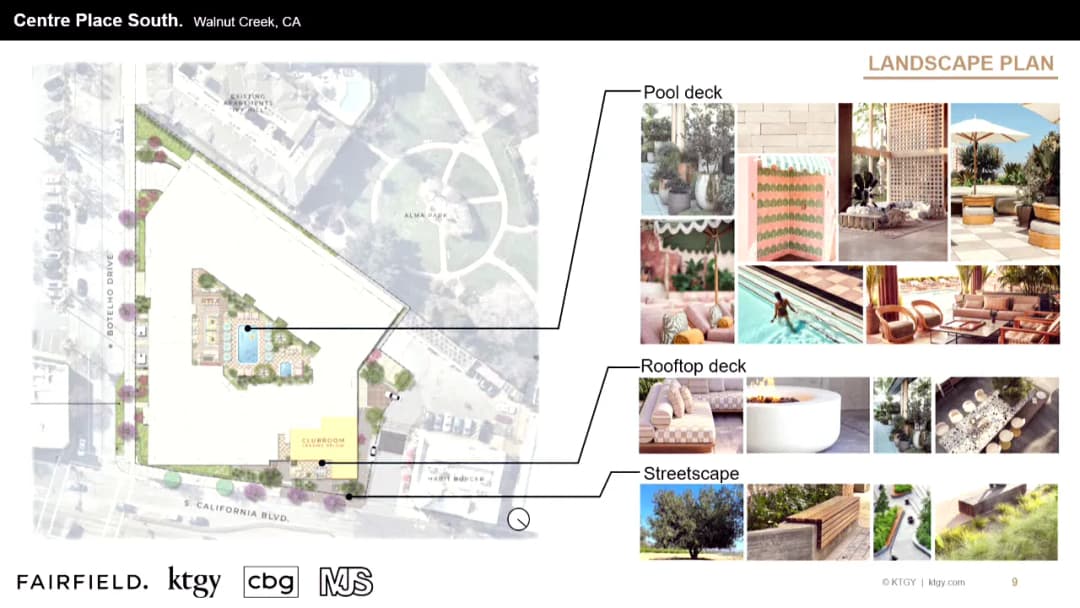
The Design Review Commission (DRC) held a public hearing on Wednesday, June 17, 2026, to review and provide feedback on the proposed Center Place South Multifamily Development at 1271 South California Boulevard. The project, processed under state housing laws including SB 330 and AB 1287, includes 172 rental units (26 affordable), a 7-story building, a density bonus allowing a 100% unit increase via two affordability tiers, and 10 requested waivers from local development standards. The DRC's feedback will be forwarded to the Planning Commission for a later decision. Consent Calendar - No items were placed on the consent calendar. Public Comments & Testimony - A former board member of an adjacent property noted the project had grown from 112 units and 5 stories (as presented in October 2025) to 172 units and 7 stories, expressing concerns about traffic, density, and a lack of community input. - Robbie Newton (resident near Alma Park) raised concerns about shadow impacts on the park, traffic congestion on Botello Drive, parking difficulties, and the overall scale of the development. - Ruben Galvan (field representative, North States Carpenters Union) requested strong labor standards, fair wages, health insurance, and apprenticeship opportunities for construction workers, noting he would follow up with the developer. - James Wolf (resident near Alma Park) supported more housing but emphasized traffic safety risks for school children crossing at California and Botello, calling for a traffic safety study. - Robin Wolf (condo owner adjacent to the site) objected to a blank wall facing Alma Park and the requested waiver to reduce the setback from 10 feet to 3 feet, and questioned the legality of the 100% density bonus. - Michael Wolf (resident near Alma Park) echoed concerns about traffic safety, disturbance to park users, and loss of views of Mount Diablo. - A speaker asked about LEED certification; the applicant responded that they do not seek certification but will include sustainable features per California codes. Discussion Items - Staff Presentation (Simmer Gill, Senior Planner): Described the site (1.32 acres, zoned Central Retail with Alma Park Specific Plan), the use of floor area ratio (FAR) instead of units per acre, the density bonus calculation (13 very low-income units + 13 moderate-income units = combined 100% bonus, resulting in 172 units), and 10 requested waivers (including FAR of 3.43, reduced setbacks, etc.). Staff stated the waivers were supported as they cause no health or safety impacts. - Applicant Presentation (Ed McCoy, Fairfield Residential; Ed Kim, KTGY Architects): Presented the design concept—active South California frontage with lobby, leasing, fitness, and retail replacement parking; parking access from both Botello and South California; architectural massing breaks, brick and tile materials; landscape plan with 59 new trees; a shadow study showing minimal additional shade on Alma Park after 12 p.m. on summer and winter solstices; and a commitment to soften the wall along Alma Park with cascading vines. - Commissioner Questions and Comments: - A commissioner (Press) critiqued the lobby location (mid-block rather than at the corner), suggested improving pedestrian engagement on Botello, asked about the possibility of reducing parking for future mobility, and proposed a pedestrian bridge to the park. - Another commissioner (Newsom) inquired about a park connection; the applicant explained grading and shoring constraints. She also suggested larger street trees and asked about shadow study details. - Commissioner Case questioned the waiver for hip/gable roofs; the applicant explained that a sloped roof would raise building height above 85 feet, requiring more expensive construction. A faux roof treatment on the parapet was suggested but not strongly supported by the commission. - Commissioner Prost emphasized the need to better engage the corner and break down the massing, particularly on the Botello and Alma Park elevations. - Commissioner Riley noted the design meets objective standards but raised concerns about the blank wall on Alma Park and the lack of clear signage for retail parking. Key Outcomes - The DRC did not take a formal vote but compiled a list of recommendations to the Planning Commission: - Improve wayfinding signage for the retail parking, both on-site and from the street. - Explore a pedestrian connection or signed access from the development to Alma Park. - Address the blank wall facing Alma Park with architectural treatments, cascading vines, or other landscaping. - Use larger street trees (e.g., sycamore or London plane) instead of crepe myrtles to better scale with the building. - Enhance the corner of California and Botello for pedestrian safety (sight lines) and civic engagement (angled glass or greater setback). - Reconcile the color palette to be warmer and more contextual with Walnut Creek. - Study the feasibility of providing a crossing guard at the intersection. - A faux gable roof treatment on the parapet was not supported by a show of hands. - The commission also acknowledged the retirement of staff secretary Chip, with Simmer Gill assuming the role of secretary to the DRC. The meeting was adjourned without a formal vote, and all feedback will be forwarded to the Planning Commission.
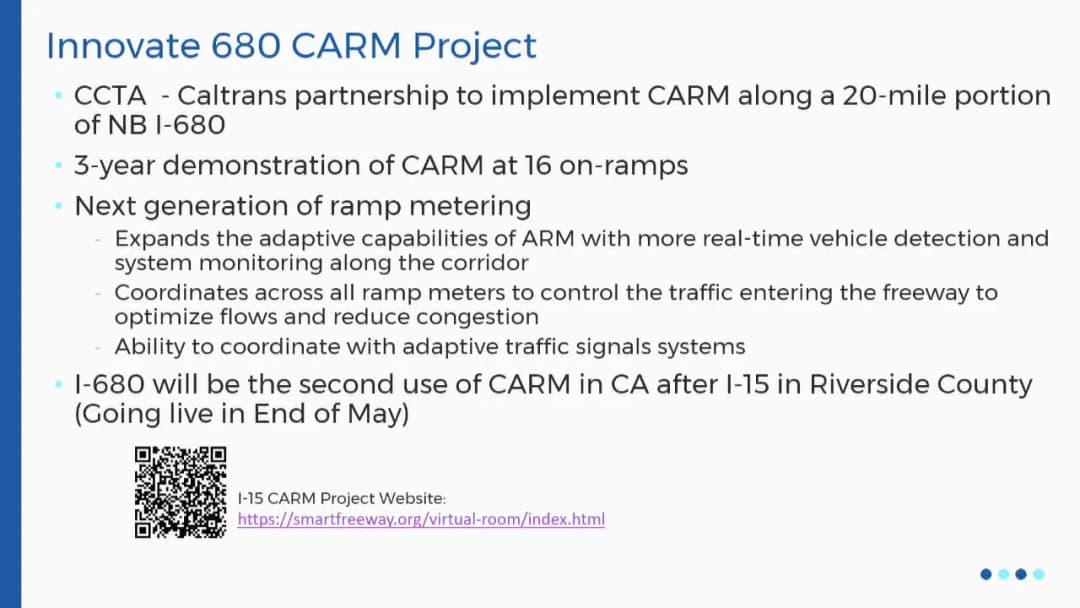
The Walnut Creek City Council met on Tuesday, June 16, 2026, in the Council Chamber at City Hall. The meeting began at 6:00 p.m. following a closed session at 4:00 p.m. and adjourned at 9:11 p.m. The council issued a Juneteenth proclamation, approved consent calendar items with separate votes on two pulled items, heard public comments, received councilmember reports (including Mayor Pro Tem Francois’ announcement that he will not seek re-election), and considered three major agenda items: an I-680 ramp metering MOU, the Tourism Business Improvement District (TBID) annual assessment, and a presentation of the draft Economic Development Action Plan for FY27-28. Consent Calendar - Approved unanimously (5-0) items a–e: minutes of June 2, 2026; warrant registers and payroll transfers; Resolution 26‑37 (Salary and Wage Plan effective June 21, 2026); Resolution 26‑38 (utility easement for the New Aquatic and Community Center at Heather Farm Park); and a Master Consultant Services Agreement amendment with Mark Thomas & Company, Inc. (increasing maximum compensation from $300,000 to $600,000). - Item 2f (Lifetime Tennis contract extension) was pulled by Councilmember DeVinney for clarification. Staff explained that the 5% profit share above $700,000 excludes shared overhead, and the city will explore internal operation during the upcoming RFQ/RFP process. Approved unanimously (5-0). - Item 2g (Chick‑fil‑A traffic calming funds) was pulled by Mayor Wilk. The $30,000 payment from Chick‑fil‑A will be used for vertical delineators, crosswalk improvements, and safety near the school. Approved unanimously (5-0) to accept the payment, appropriate a total of $60,000 in the Traffic Impact Mitigation Fees Fund, and transfer $60,000 to the Traffic Calming Improvements Project. Public Comments & Testimony - Alex Williams (Walnut Creek resident) spoke during Public Communications, asking the council to bring back “King Walnut” as a civic symbol and to revive the Walnut Festival Parade. The City Manager noted the Walnut Festival Association is an independent entity that has not recently organized the parade but could be contacted by the public. - Ed Del Beccaro spoke during the Economic Development Action Plan discussion, praising staff for improving permit processing and concierge services, and noting that Walnut Creek’s office vacancy rate (20%) should be compared to other Bay Area cities (e.g., San Francisco 30%, Oakland 35%, Concord 28%). Discussion Items - I‑680 Corridor Ramp Metering MOU (Item 5a): Traffic Engineer Matt Redmond, Caltrans, and CCTA presented a partnership to deploy ramp metering on northbound I‑680 (CARM coordinated adaptive system on a 3‑year demonstration from Alcosta to Burnett) and on southbound ramps (Caltrans ARM). The MOU establishes goals, performance metrics, and governance. Councilmembers asked about arterial impacts, queue detection, and the Lawrence Way on‑ramp. Public outreach will include videos and community events. Construction is expected to be complete by 2028, operational early 2029. Approved unanimously (5-0). - TBID Annual Assessment and Intention to Levy (Item 5b): Economic Development Manager Mike Nimon and Interim Chamber CEO Nicole Hankman presented the FY25‑26 report. The district includes 8 hotels (1,311 rooms) funded by a 3% assessment on transient occupancy tax. Highlights included an AI‑powered visitor guide, a new “Always in Season” brand, and the GFNY international cycling race scheduled for April 18, 2027 (3‑year deal). Council debated whether the district is spending down reserves (about $1.2 million) and whether the budget deficit is sustainable. Treasurer Anthony confirmed reserves were COVID-restricted and now being spent intentionally. Council adopted Resolution 26‑39 (approving the annual assessment report) and Resolution 26‑40 (declaring intention to levy assessments for FY26‑27) and set a public hearing for July 21, 2026. Approved unanimously (5-0). - Draft Economic Development Action Plan FY27‑28 (Item 5c): Mike Nimon and Cassava Washington presented a two‑year plan building on the 2024‑25 action plan. Six strategies focus on promoting Walnut Creek as an economic hub, retaining and attracting businesses (including auto and healthcare), downtown vitality, land‑use alignment with the General Plan, auto industry support, and serving as a business resource. Performance metrics include local unemployment rate (currently below 5%), business license growth, sales tax growth, and vacancy rates (office 20%, retail strong). Council provided feedback—noting the importance of healthcare and auto industry jobs, the need for exit interviews with departing businesses, and the inclusion of short‑term rental policy. No formal action was taken; staff will incorporate input. Key Outcomes - Unanimous votes (5‑0) on all action items: consent calendar (items a‑e, f, g), I‑680 ramp metering MOU (Item 5a), and TBID resolutions (Item 5b). - Public hearing set: July 21, 2026 for the TBID annual levy. - Policy direction given: Council directed staff to refine the Economic Development Action Plan based on comments, with no formal action taken. - Closed session: Council convened in closed session at the end of the meeting to discuss existing litigation (Hanely v. City of Walnut Creek, Case No. MSC23‑01901). - Mayor Pro Tem Francois’ announcement: He will not seek re-election in November 2026 but will serve the remainder of his term and support the transition.
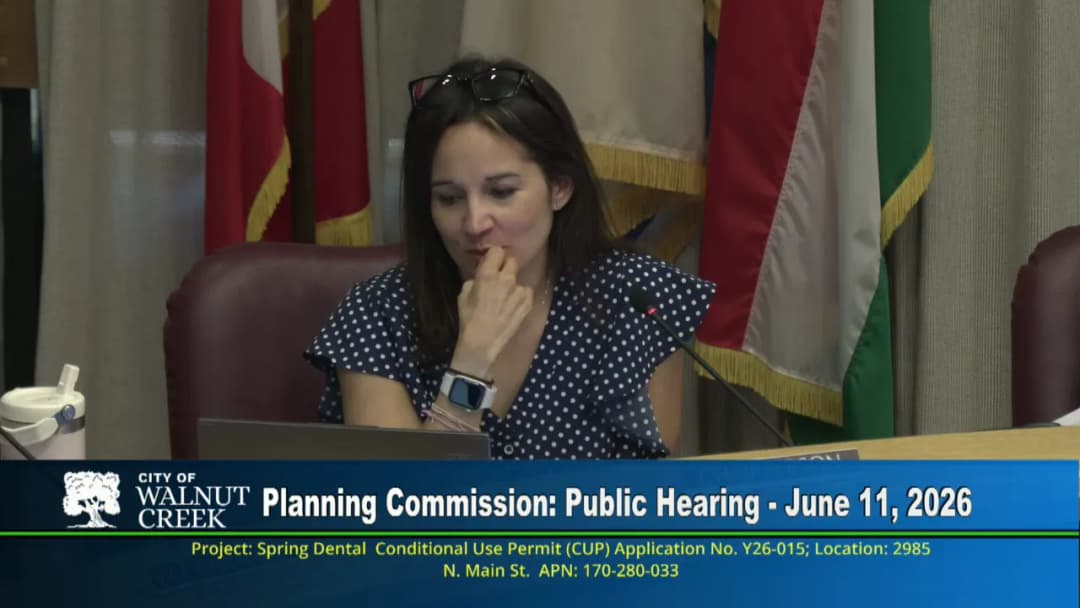
The Walnut Creek Planning Commission met on June 11, 2026, at 5:15 PM (local time) to consider several land use applications including conditional use permits for a tumbling studio, a mobile pediatric trailer, and a dental office expansion. All items were approved unanimously, with one abstention on the consent calendar. Commissioner Klopp was absent. Consent Calendar - Item Y2506 (not specified in transcript) was approved on consent. Commissioner Strongman abstained; all other commissioners voted yes. Discussion Items - Spark Athletics (CUP Y2659) – Located at 1920 Mount Diablo Boulevard. Applicant Erin Creasey proposed a tumbling and cheerleading instructional studio for ages 18 months to 18 years. Hours: 8 a.m. to 9 p.m., seven days a week. Classes held in an open format with 8–10 participants per 45–60 minute session, staffed by 2–4 instructors. The space has been vacant for about 18 months. No exterior modifications. Staff recommended approval, finding the use compatible with neighborhood-serving businesses and activating a vacant space. - UCSF Benioff Children's Hospital Temporary Pediatric Trailer (SUP Y2555) – Located at 2401 Shadelands Drive. Request for a 24-month special use permit to place a mobile pediatric primary care trailer in the parking lot, occupying three spaces. The trailer would operate two days per month (Mondays and Thursdays, 8 a.m. to 5 p.m.), serving patients who have difficulty accessing the Oakland site. The facility is a federally qualified health center targeting underinsured populations. The trailer would provide exams and vaccinations; the building houses specialty care. Staff noted a similar MRI trailer was approved in April 2025 and expires October 2026. The parking lot has 473 spaces, so the impact is less than 1%. - Spring Dental (CUP Y26015) – Located at 2985 North Main Street. Applicant Dr. Bahar Tehrani sought to expand an existing dental office into an adjacent vacant space (formerly a tattoo shop). The existing 1,100 sq ft office (approved in 2008 via a special use permit with a retail condition) would add four more treatment rooms, a sterilization room, and retail space, totaling eight treatment rooms. Hours: Monday–Saturday, 7 a.m. to 5 p.m., treating 15–18 patients daily. The commission was required to find that the location is not suitable for retail use due to its interior configuration and limited visibility, a finding from the 2008 permit. The applicant agreed to maintain 200 sq ft of retail (100 sq ft in each unit) but noted retail is a minor part of the business. After discussion, commissioners expressed support, noting the location's struggles with retail and the success of the dental practice. The new CUP would supersede the 2008 SUP without requiring retail, though the applicant may continue selling dental products. Key Outcomes - Spark Athletics: Motion to approve the conditional use permit and CEQA exemption passed 6-0 (Commissioner Klopp absent). - UCSF Pediatric Trailer: Motion to approve the special use permit and CEQA exemption passed 6-0. - Spring Dental: Motion to approve the conditional use permit and CEQA exemption passed 6-0. - Staff Updates: - The Taiwanese Cultural Center project (approved September 2025) has a new architect; staff will review the revised design at the staff level and provide a memo to the commission. - A joint commission study session on the General Plan update is scheduled for June 25, 2026. - Recognition of Chip Griffin, retiring after 15 years with the city. - The sign ordinance update is approximately 90% complete; next steps include design review committee and public comment.
The Walnut Creek Zoning Administrator held a special meeting on June 10, 2026 at 4:00 PM in the Second Floor Conference Room, City Hall. The agenda included two public hearings for Minor Use Permits regarding fence height exceptions. No minutes were available for this meeting, and the provided raw transcript is from an unrelated graduation address (Class of 2026) and does not contain any content from the Zoning Administrator meeting. The following summary is based solely on the agenda. Public Hearings - Item 3a: Bar Property twelve-foot fence (Y26-008) – Location: 41 Heather Lane, APN: 173-081-094. Applicant requested a Minor Use Permit to allow a 12-foot-tall lattice fence within the rear yard of a flag lot on a single-family residence in a multi-family zone, whereas a maximum height of 7 feet is permitted by right. CEQA: Categorically Exempt, Section 15303. Staff contact: Gerardo Victoria. - Item 3b: Seraj Property six-foot fence (Y25-002) – Location: 590 Banyan Circle, APN: 134-233-007. Applicant requested a Minor Use Permit to allow a 6-foot-tall horizontal wood fence within the street side yard setback (Peachwillow Lane) of a corner lot, where a 3-foot-tall fence is allowed. CEQA: Categorically Exempt, Section 15303. Staff contact: Gerardo Victoria. Key Outcomes - No decisions, votes, or public comments are recorded in the agenda. The meeting likely adjourned after public hearings. Appeal rights: any interested party may appeal a decision within 10 calendar days after mailing of the decision. Note: The raw transcription provided is a commencement speech to the Class of 2026 and is not related to this Zoning Administrator meeting. This summary is based solely on the agenda documents.
The Walnut Creek City Council held its 36th annual Memorial Day observance on June 3, 2026, at a park in the city. Mayor Kevin Wilk presided over the ceremony, which featured a color guard presentation, the national anthem, the Pledge of Allegiance, an invocation, speeches by council members, and a keynote address by retired Army Colonel Davis. The event honored the men and women who died in military service to the United States, with special attention to Walnut Creek residents who made the ultimate sacrifice. Opening Ceremony - Mayor Kevin Wilk welcomed attendees and introduced the color guard, the Walnut Creek Concert Band, and Mayor Pro Tem Matt François, who led the Pledge of Allegiance. - Rabbi Jenny Shabon from Congregation B’nai Tikfah delivered an invocation, praying for peace and for protection of service members, and quoting the prophet Isaiah. Remarks by Council Members - Mayor Kevin Wilk shared a personal reflection about his father, Coast Guard Seaman Robert Wilk, who had been the keynote speaker at the 2021 observance and passed away in 2022. Wilk emphasized the importance of remembering fallen service members and his father’s lesson that “it’s hard to have an enemy if you love your enemy.” - Mayor Pro Tem Matt François read General Dwight D. Eisenhower’s D‑Day order to Allied forces, highlighting the bravery of troops who landed at Normandy. - Councilmember Cindy Silver spoke as the wife and mother‑in‑law of veterans and as the descendant of a Civil War cavalryman. She recalled specific Walnut Creek casualties: Army Specialist James Kuhn (killed in Iraq in 2007) and Army Corporal Sean Langevin (killed in Afghanistan in 2007). She also described the research effort that compiled the full list of 64 Walnut Creek men lost in World War II, Korea, Vietnam, and later conflicts. - Councilmember Cindy Darling described the sacrifices of American service members as unique—fighting not for a ruler but for the idea of liberty and a freer world. Keynote Address by Colonel Davis (U.S. Army, Retired) - Colonel Davis traced the history of Memorial Day, beginning with the first official observance at Arlington National Cemetery on May 30, 1868, and noted that Congress made the holiday official in 1968 (effective 1971). - He quoted General James A. Garfield’s 1868 speech, General Norman Schwarzkopf, and General Omar Bradley. - He shared personal experiences, including a training accident at Fort Ord that killed a soldier in his platoon, and reflected on the importance of leadership, mission legitimacy, and the camaraderie that enables service members to face danger. - He thanked all veterans present and asked them to stand. Tribute to Walnut Creek’s Fallen - Mayor Wilk read the official casualty statistics for Walnut Creek residents killed in action: 32 in World War II, 11 in the Korean War, 17 in the Vietnam War, and 2 in the Iraq and Afghanistan wars. (Later in the program, Councilmember Silver cited a total of 64 fallen residents, including 34 from World War II and 11 from Korea—a discrepancy noted between the two sets of numbers.) - The names of specific individuals were recalled, including Ensign David Lawrence and the Ennis brothers (twins who died together in the Battle of the Coral Sea). - The ceremony concluded with a benediction by Rabbi Shabon and a procession led by the color guard. Note - The transcript includes a separate public service announcement (PSA) featuring “Ollie the Great Horned Owl” and city staff member Brandon discussing a city ban on gas‑powered leaf blowers effective April 1, 2026. This PSA appears to be appended to the meeting recording and was not part of the Memorial Day ceremony itself.
The Walnut Creek City Council held a special closed session at 4:00 PM followed by a regular meeting at 6:00 PM on June 2, 2026, at City Hall. The regular meeting included a proclamation, oath of office, award presentation, consent calendar, public communications, a public hearing on job vacancies, and a discussion on a comprehensive user fee study. The meeting adjourned at 8:30 PM. Consent Calendar - Approved unanimously (5-0): Approval of May 19, 2026 meeting minutes; acceptance of warrant registers and direct payroll transfers; adoption of Resolution 26-33 consolidating elections for November 3, 2026; adoption of Resolution 26-34 directing review of the City’s Conflict of Interest Code; adoption of Resolution 26-35 amending the FY27 Operating Budget and Resolution 26-36 establishing the FY27 appropriations limit; authorization for the City Clerk to execute Form 130 for disaster relief grants; acceptance of March 2026 Investment and IRS Section 115 Pension Trust Report. Public Comments & Testimony - Florence Wedington (Central San Board President) invited residents to Central San’s 80th anniversary celebration on June 13, 2026. - Ross Hillesheim (1850 Properties) expressed gratitude for collaborative staff engagement on proposed redevelopment of the Chevron station at 1700 Mt. Diablo Blvd., noting plans to reduce fuel islands and incorporate a mobility hub with EV charging. - Sakura Kuroda and Allena Lange (IES Abroad / Northgate High School) requested promotion of a Japanese student exchange program; they reported host families have been secured. - Donald Shivel raised personal grievances regarding medical treatment and alleged lack of police investigation; provided written materials. Discussion Items - Proclamation: Gun Violence Awareness Day – Mayor Wilk read a proclamation declaring June 6, 2026 as National Gun Violence Awareness Day, citing national statistics of nearly 46,000 gun deaths and 97,000 injuries annually. Kathy Maloney (Moms Demand Action) accepted and highlighted community violence prevention programs. - Oath of Office – Peat Sutherland was sworn in to the Measure O Citizens’ Oversight Committee. Sutherland is a retired teacher who has lived in Walnut Creek since 1988. - CALED Award of Merit – Dwayne Dahlman (CALED board member) presented an award to the City for its Outdoor Dining PODS Grant Program, which delivered eight parklets in 11 months with a $100,000 fund. The award recognized cross-department collaboration and enhanced downtown vitality. - Public Hearing – Job Vacancies & Retention (Government Code Section 3502.3) – Human Resources Director Trish Raver reported an overall city vacancy rate of 10.7% (41.25 vacant FTEs out of 386), with no bargaining unit exceeding the 20% threshold. Recruitment efforts included streamlined processes for police dispatchers; 3,939 applications were received in 2025 for 24 postings. The Council unanimously received and filed the report. - Comprehensive User Fee Study – Administrative Services Director Kirsten LaCasse and Matrix Consulting Vice President Khushboo Ingle presented results: Total cost of fee-based services is $33 million; current fees recover $21 million (65% cost recovery). The study analyzed nearly 500 fee line items and recommended a cost recovery framework. Council provided policy direction on six items: 1. Adopt a general cost recovery framework (three tiers: high community benefit, shared benefit, private benefit). 2. Establish non-resident fee rates; Council favored a resident discount model rather than a surcharge, with staff to explore implementation for applicable programs. 3. Define annual fee adjustment parameters, including caps on increases and phased implementation to avoid large jumps. 4. Implement annual cost-based fee updates tied to inflation or other benchmarks, with Council suggesting “cost-based” rather than strict CPI. 5. Continue market-based pricing for voluntary/rental services. 6. Evaluate housing-related fees separately from other development fees, considering affordability; Council expressed interest in recovering some costs for affordable housing monitoring and transfers. Key Outcomes - Consent Calendar approved 5-0. - Proclamation declared June 6, 2026 as Gun Violence Awareness Day. - Oath of Office administered to Peat Sutherland. - CALED Award accepted. - Public Hearing on job vacancies received and filed unanimously. - User Fee Study received; staff directed to develop a draft cost recovery policy and fee recommendations, with review by Finance Committee on June 23 and Council on July 21, aiming for adoption August 18. - Item 6a (Tourism Business Improvement District assessment) was pulled from the agenda and will return at a later date.
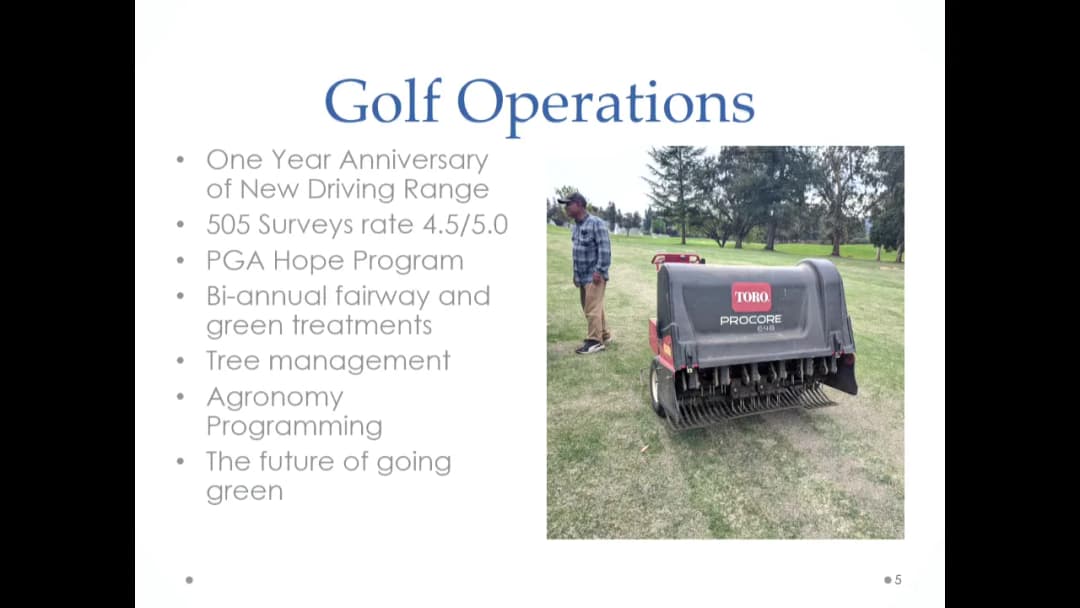
The meeting covered presentations from city partners and staff on watershed restoration, golf course operations, summer programs, and open space management. Public comments addressed PGE vegetation clearing impacts, lighting effects on wildlife at Boundary Oak, and requests for more project status updates. The Consent Calendar approving April 6, 2026 minutes passed unanimously. No formal actions were taken on other items, but the Commission directed staff to explore lighting studies and report back. Consent Calendar - Approved the minutes of April 6, 2026 (Motion by Commissioner Oller, second by Commissioner Brockhaus; passed unanimously with yeas from Commissioners Brockhaus, Garland, Oller, Vice Chair Sasser, and Chair Pinkstaff.) Public Comments & Testimony - Barbara Ginos (Walnut Creek resident) expressed concern about PGE and its contractors clearing vegetation around power lines in Lime Ridge in July 2025 and May 2026, damaging endangered Mount Diablo Manzanita and Ariasrum plants. She questioned whether the city has an agreement with PGE to notify staff before work. - Bob Weede (Walnut Creek resident) raised concerns about light spill from the new LED lights at Boundary Oak Golf Course driving range into Lime Ridge open space. He requested a photometric study similar to the Tice Valley Light project and a biological assessment of wildlife impacts. - Elizabeth Hudson (Walnut Creek resident) supported the previous speaker, emphasizing that open space was set aside for minimal human impact and that artificial light disrupts wildlife. - Barbara Ginos (Walnut Creek resident) asked about Audubon Cooperative Sanctuary certification, inventory of wildlife, whether native plants were used in the driving range landscaping, and whether driving range hours had been extended. Staff clarified hours were not extended. - Barbara Ginos (Walnut Creek resident) requested that the commission provide regular status updates on previously discussed open space projects (e.g., social trails to official trails, Bram Hall Pond restoration, Fossil Hill restoration, drone and e-bike ordinances). Discussion Items - Non-Profit/City Partner Presentation (Walnut Creek Watershed Council): Bob Simmons presented the watershed restoration plan, funded by a $300,000 federal grant, with a goal to guide restoration for 20-30 years. He highlighted restoration opportunities at Heather Farm Park, Rudgear Park, Tice Creek, and Hazard Pond. Commissioners discussed youth involvement, partnership with the city, and the importance of native plants. No formal action. - Boundary Oak Golf Course Presentation: Tim Roberts reported on fiscal performance (exceeding budget, healthy reserves of approximately $1.75 million), new driving range, food and beverage operations, PGA Hope veterans program, and wildlife stewardship (Audubon certification, bluebird boxes). Commissioners and public raised concerns about light pollution from the new LED lights at the driving range. Staff acknowledged the lights were considered a like-for-like replacement and were not evaluated under CEQA. The Commission recommended a photometric study and biological assessment; staff agreed to evaluate and report back at the next meeting. - Summer Programming Updates: Kris Farro highlighted summer camps, aquatics programs, and partnerships. Commissioners asked about soccer field access at Heather Farm; staff explained fields are locked due to supervision costs but scheduled open days are planned. No action. - Open Space Summary: Mike Vickers reviewed each open space area (Okalani's, Howe Homestead, Lime Ridge, Borges Ranch, Shell Ridge, Sugarloaf), current projects (Bram Hall Pond desilting, sign upgrades), and pending items (drone policy, e-bike code). Commissioners discussed cattle grazing, water access, trail status, and requested updates on certain projects. No formal action. Key Outcomes - The Commission unanimously approved the April 6, 2026 minutes (Consent Calendar). - Staff will evaluate conducting a photometric study and biological assessment of lighting impacts at Boundary Oak Golf Course and report back at the July PROS meeting. - The Commission recognized outgoing Student Commissioner Eli Konson for his service.