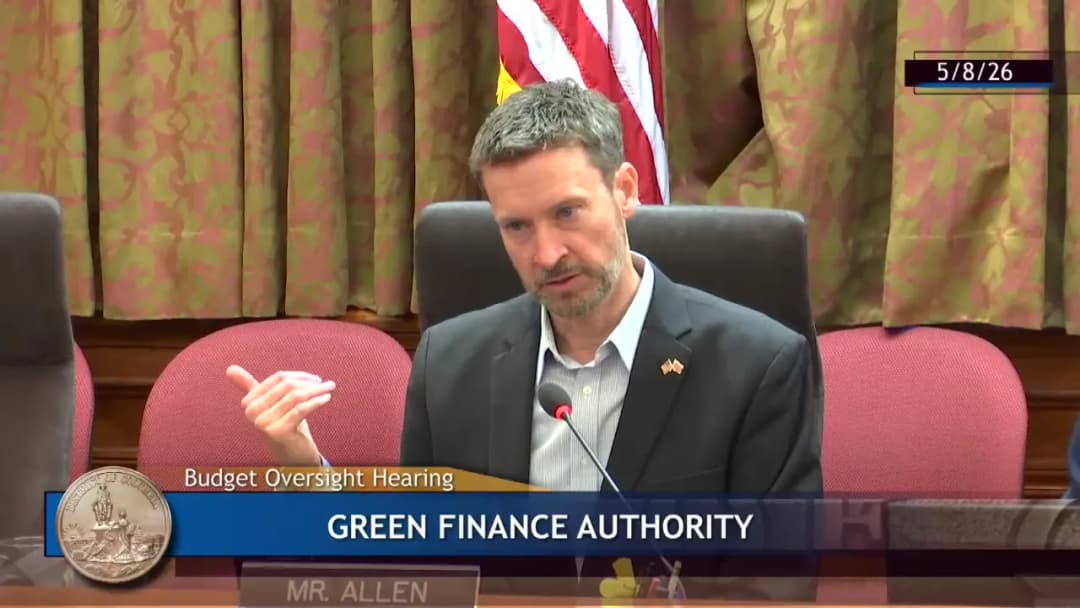
On Friday, May 8, 2026, Councilmember Charles Allen (Ward 6), Chair of the Committee on Transportation and the Environment, convened a budget oversight hearing for the Green Finance Authority (DC Green Bank) regarding the Mayor's FY27 proposed budget. The hearing included public witnesses and government representatives, focusing on the bank's achievements, operational sustainability, and future financing tools. Public Comments & Testimony - Matt Pestronk (President, Post Brothers): Expressed strong support for the DC Green Bank, calling it an "indispensable ally" in financing a large mixed-use project near the Washington Hilton via the CPACE program. He noted the bank’s role in attracting capital for sustainable development and affordable housing. - David Schatz (VP, Nuveen Green Capital): Highlighted that the Green Bank is essential for CPACE transactions, citing two closings involving over $500 million in private investment. He praised the bank's professionalism and said the district’s program is a national leader. - Gilbert Campbell (Co-founder, Volt Energy): Testified that the Green Bank provided $6 million in financing for over 1.5 megawatts of solar installations at Howard University, resulting in an estimated $1.5 million in energy cost savings over 20 years, plus scholarships and internships. He emphasized the bank's role in unlocking additional tax equity investment. - Samuel Bonar (Policy Director, DC Community Wealth Builders): Urged the council to add an FTE at the Green Bank to explore broader public finance tools like a land bank and public bank. He called for connecting the bank’s work to deeper community wealth building. Discussion Items - Green Bank Operations and Budget: Chair Allen clarified that the $3.75 million in the budget book reflects a transfer from the Sustainable Energy Trust Fund (SETF), not the full operating budget. CFO Greg Hagen confirmed the operating budget is $4.5–$5 million, funded through loan servicing fees (25 basis points ongoing) and administrative fees (1% at close), with no new SETF transfer needed for operations. - SETF Transfer Timing: Allen expressed frustration that SETF transfers are unreliable; the second half of the FY26 transfer had not yet been received. Collander noted that such delays hinder lending and that the bank now budgets assuming zero SETF funding. - CPACE Program Growth: Collander reported a record $465 million CPACE deal (largest in U.S. history) and expects annual CPACE volume of $100 million going forward. She argued the current $250 million cap is arbitrary and should be removed permanently to avoid chasing deals to other states. The bank makes administrative fees at closing and 25 basis points annually in servicing revenue. - Green Bond Exploration: The council allocated $250,000, received in December 2025, to study a green bond. Collander said the bank aims to close a $50 million bond by end of 2026 or early 2027, seeking $2.5 million from the city as a commitment. The bond would supercharge lending but is not necessary for self-sustainability; the bank achieved positive cash flow in FY25. - Affordability and Impact: Allen stressed that Green Bank investments reduce utility costs for residents and businesses (e.g., $7.5 million savings over 20 years for a Ward 5 project). Collander emphasized that the bank serves both large and small projects, from the Geneva office conversion to church solar and stormwater retention. - Risk Management: CPACE risk lies with the property and lender, not the district. Collander noted that the bank reduces risk through third-party underwriting and its mission-driven focus. Key Outcomes - No votes or decisions were taken; this was a fact-finding hearing for budget deliberation. - The committee will accept written testimony until Thursday, May 14, 2026. - The next budget oversight hearing will be on Monday, May 11, 2026, for the Public Service Commission. - Chair Allen expressed support for the CPACE cap removal and green bond proposal, and encouraged continued partnership to highlight the Green Bank’s economic and affordability benefits.
Public Meetings - Washington, District Of Columbia
Public Meetings - Washington, District Of ColumbiaThe Committee held a budget oversight hearing for the Department of Parks and Recreation (DPR) and the Department of General Services (DGS). The councilmember questioned DPR leadership on numerous fiscal year 2027 budget line items, including training costs, staffing alignments, reductions in volunteer relations, security, and external affairs, as well as capital projects such as RFK Stadium, Riggs LaSalle, Fort Stevens, pool replacements, ADA compliance, and playground equipment. The director provided explanations and committed to working with the council on prioritization. Public Comments & Testimony - Kelly Collins Choi from Casey Trees testified, encouraging DPR to prioritize expanding public-private partnerships with organizations like Casey Trees to expand access to technical assistance, philanthropic funding, and capacity support for DC's green spaces, especially in a tight budget year. Discussion Items - Training and Development: The councilmember noted an 85% increase in FY26 and over 200% increase from FY25 for training. The director explained that training was moved from HR to a new Training and Development Department to better align staff with needs, and the cost shift accounted for the increase. - Agency Financial Operations: A 60% increase (229,000) for agency budgeting was due to the AFO office not being fully staffed; additional positions were hired per an MOU. - Volunteer Relations: A 13% decrease from FY26 and 91% from FY25 was attributed to moving publications costs (e.g., in-house print) out of the budget. The director reported that volunteerism is increasing despite the cuts. - Donor Relations: A $208,000 increase was due to realigning staff within the communications division and partnership and strategic initiatives. - Security Budget: Reduced by $244,000. The director explained that DPR pays for security guards directly (not through DGS PSD officers) and that the reduction involves shifting security hours to higher-need times (e.g., evenings) rather than eliminating coverage. - External Affairs/Community Relations: An $183,000 (55%) decrease was questioned, but the director stated it would not affect timely notifications to the community. - Public Engagement and Strategic Development: A $394,000 increase was a staff realignment, not a true increase. - Administrative Services Operations: A $1.2 million (50%) decrease in support services was also a staffing alignment. - Park Monitors and Rangers: A $542,000 (30% from FY26, 60% from FY25) increase was due to pay, fringe, and aligning staff. The director confirmed 18 park rangers in FY27, all unionized. - Roving Leaders: A $3.6 million cut was actually a realignment from communications to the recreation division; the director emphasized the program is thriving, with one team winning a basketball championship. - Capital Budget: The councilmember noted an 85% reduction in capital-funded FTEs (from 7 to 1) and a $723,000 (56%) cut to project planning. The director explained that the positions were moved to operating or federal awards, and no non-personnel cuts were made. - Capital Funding: The FY27 capital budget is $82.7 million, down from $165 million in FY26 but still $20 million more than FY25. The $60 million reduction was due to the removal of the initial RFK investment, which was spread to later years. - Rock Creek Tennis Center: The $9 million added by the council for the tennis center, contingent on a transfer of jurisdiction from the National Park Service, was not pursued; the director did not know the status of those funds. - Riggs LaSalle: ADA small capital projects for the main door and HVAC upgrades are expected to start in May after a reprogramming request. The director acknowledged Riggs LaSalle is at the top of mind for modernization, but no specific timeline was given. - Fort Stevens: DCI has submitted a proposal for a gymnasium, but DPR has not reached an agreement. The director clarified that a meeting with residents was not an endorsement of the project. The new community garden funding is secure and will not be impacted. - Swimming Pools: The FY27 budget zeroes out pool replacement funding after $1.98 million in FY26, but the director stated that several pool projects are ongoing and a list can be provided. - ADA Compliance: Drops from $2.8 million to $2.15 million. The director said four batches of ADA projects are underway, and once completed, the department should be 100% compliant; the remaining $100,000 per year is for repairs. - Playground Equipment: $1.99 million, down $8 million from FY26. The director noted that a previous blitz covered many playgrounds, and LWCF funds can double the budget. A priority list will be shared. - Langdon Park: The councilmember acknowledged community concerns about the gymnastics facility, noting that many residents testified in opposition. The director explained that Langdon was chosen because it had low daytime usage and proximity to other large recreation centers. The director clarified that $2 million was not missing; it was already spent on the Chuck Brown Park. Key Outcomes - The councilmember requested that DPR work with her office to identify where funding can be practically allocated and implemented, given the council's at-large task. - The director agreed to provide a list of priority playgrounds, taking into account ADA compliance and safety issues (e.g., missing gates, taller playgrounds). - The councilmember asked for further community conversations regarding Langdon Park to reach a compromise. - The director committed to follow up on the status of the Rock Creek Tennis Center funds and the Fort Stevens project. - The hearing concluded at 2:55 p.m. Residents may submit testimony by 5:00 p.m. on Monday, May 11, 2026.
This was a public hearing of the Committee of the Whole of the Council of the District of Columbia, chaired by Phil Mendelson, held on Thursday, May 7, 2026, at 9:57 AM in Room 412 of the John A. Wilson Building. The hearing focused on the mayor's proposed FY2027 budget for the Office of the State Superintendent of Education (OSSE), as well as proposed changes to the current FY2026 budget. The chair noted that 251 individuals had signed up to testify, and the hearing was one of nine on the mayor's budget. The council is scheduled to vote on first reading on June 9, 2026, with a second reading on June 23, 2026. Public Comments & Testimony - Early Childhood Education (Pay Equity Fund and Child Care Subsidy): A large majority of witnesses testified in strong support of restoring funding for the Early Childhood Educator Pay Equity Fund (PEF) and the Child Care Subsidy Program. Many speakers, including representatives from Children's Law Center, DC Fiscal Policy Institute, DC Action, Under 3 DC, Educare DC, St. Albans Early Childhood Center, CommuniKids, and individual parents and educators, expressed deep concern about proposed cuts. They argued that the PEF has been essential for recruiting and retaining qualified educators, reducing turnover, and improving the quality of care. Witnesses noted that the mayor's budget would eliminate the salary component of the PEF, leading to pay cuts of $10,000 to $25,000 per teacher, and would freeze new enrollment in the child care subsidy program, potentially denying access to thousands of families. Specific requests included restoring the PEF salary component to $94.2 million and fully funding the subsidy program at $177.1 million. Several speakers highlighted the economic return on investment (e.g., 21% ROI per Mathematica), the importance of stability for children's development, and the disproportionate impact on Black, brown, and immigrant women. - Special Education Transportation (OSSE DOT): Danielle Robinett of Children's Law Center testified about ongoing problems with special education transportation, including unreliable service and a class-action lawsuit. She noted that the proposed budget includes an $11.5 million cut from the communications line and a $17.6 million cut from performance and strategic management, while creating a new fleet activity. She expressed concern that the agency is relying on private vendors and parent stipends rather than improving its own service, and urged the committee to seek clarity on these changes. - Community Schools: Multiple witnesses, including Scott Goldstein (Power Head), representatives from EmpowerEd, Communities in Schools, and various school coordinators, advocated for restoring $4 million in funding for community schools, including OSSE grants and DCPS-connected schools managers. They highlighted the model's effectiveness in reducing absenteeism, providing wraparound services, and improving student outcomes. - Adult Education and Workforce Development: Witnesses from adult public charter schools (e.g., Carlos Rosario, Next Step, BRIEA, Academy of Hope) and programs like CET urged the council to increase the adult learner weight in the UPSFF from 1.0 to 1.3, increase the adult learner transit subsidy from $70 to $100 per month, and restore $2.5 million in adult and family education grants. They emphasized the importance of these programs for economic mobility and family stability. - High Impact Tutoring (HIT): Several educators and advocates (e.g., from Kid Power, EmpowerEd, PAVE) supported maintaining the $3 million investment in high-impact tutoring, citing evidence of improved academic outcomes and attendance. - Advanced Technical Centers (ATCs): Supporters including the DC Hospital Association, Spark the Journey, and students testified in favor of protecting funding for ATCs, noting that they provide career pathways, dual enrollment, and industry credentials. - Other Issues: Testimony also covered the $50 study pilot (youth financial literacy), educator wellness grants, the Bridge the Gap Fund, the alternative school breakfast program, and the need for equitable funding between DCPS and charter schools. Discussion Items - The chair, Phil Mendelson, provided context on the budget challenges, noting that the council must balance the budget and that restoring funding to programs like the Pay Equity Fund would require cuts elsewhere. He listed several competing priorities (e.g., TANF, child tax credit, collective bargaining agreements) and emphasized that the council is working to address the mayor's proposals. - He questioned witnesses on the impact of flat-rate subsidies, the wait list for child care subsidies, and the proposed cuts to the quality incentive. He also engaged with testimony about the special education transportation GPS tracking app and the privatization of bus routes. - The chair expressed concern about the instability at DC International School (DCI) based on testimony from staff and students, and indicated he would follow up with the Public Charter School Board. Key Outcomes - The hearing was for public testimony; no votes were taken. The committee will use the testimony to inform budget decisions. - The council is scheduled to vote on first reading on June 9, 2026, and must act within 70 days per the Home Rule Act. - The chair noted that the committee will continue to work on budget amendments, and that the next hearing on the overall budget legislation is May 13, 2026.
On May 7, 2026, at 9:48 AM, the Committee on Facilities, chaired by Councilmember Janice Lewis George, held a budget oversight hearing for the Department of General Services (DGS) and the Department of Parks and Recreation (DPR). This hearing focused on government witnesses from DGS; public witnesses testified on April 27. The chair emphasized growing portfolios and rising costs, seeking clarity on operational impacts of the proposed FY27 budget cuts. Discussion Items - DGS Budget Overview: Director Delane O'Hunter presented the FY27 proposed budget of $174 million for leases (36% of operating dollar), $139 million for utilities (28%), $114 million for facilities operations (14%), and $5.3 million for protective services (5%). The budget reflects increases in utility costs due to a special purpose fund and transfers from DCPS, but cuts to janitorial, mowing, HVAC ITM, and security. - Facilities Management Division (FMD) Cuts: The FY27 proposed FMD budget is $114 million, down from $166 million in FY24. Reductions include $9.5 million for DCPS (17% cut from FY26, 40% from two years ago), $8.9 million for government operations (36% cut from FY26, 60% from two years ago), $6.3 million for janitorial services, $1.2 million for mowing, and $10.95 million for HVAC ITM (inspection, testing, and maintenance). DGS plans to reduce service frequency (e.g., mowing from every 8 days to every 12–14 days during shoulder seasons, janitorial from 6-day to 5-day weeks at low-use sites) and prioritize high-traffic facilities. HVAC ITM will be reduced to basic filter changes twice a year, increasing the risk of equipment failures. - Utilities and Energy Management: The electricity budget is $77.2 million in FY27, a 3% increase from FY26. DGS now pays most district electricity bills, with about 12 agencies still managing their own. DGS projects usage based on historical data and estimates for new buildings. The district has drawn only $3 million of $60 million in available federal matching grants for energy programs due to lack of local match. Two recent solar power purchase agreements are projected to save $35 million over 20 years. The waste management budget shows a 19% increase (to $1.5 million) largely due to funding realignment, not expanded service. - Protective Services Division (PSD): The PSD budget is cut by 19% ($7.9 million) in FY27, partly from transitioning contract security to 24 in-house officers (12 in training, 7 in hiring pipeline, 4 more expected). This transition is projected to save $1.85 million annually once complete. DGS will also reclassify security at lower-risk sites (e.g., from armed special police officers to unarmed security officers) to reduce costs while maintaining safety at high-threat locations. - Capital Projects and Fleet: DGS proposes $1.2 million in capital funds to purchase 30 vehicles to replace the oldest in its fleet. Small capital projects include HVAC replacement at School Without Walls (Ward 2), elevator replacement at SUSE Middle School (Ward 7), and roof replacement at North Michigan Park Recreation Center (Ward 5). The FY27 CIP includes cuts to major repairs (99.7% reduction), life safety, and athletic facilities. DGS noted that unspent balances in pooled capital projects reflect projects still in design; obligations occur when construction begins. - Portfolio Management and Leases: Lease services account for 36% of the DGS budget. DGS has generated $30 million in lease savings since 2020 by negotiating below-market rates. The city administrator has directed DGS to consolidate office space for independent agencies (e.g., OCFO, OAG) that have low in-person attendance, aiming to reduce leased square footage as leases expire. - Net Zero and Sustainability: Three net zero infrastructure enhancements from FY26 ($2.2 million for Kremel School community center, $2.6 million for Fort Davis Recreation Center, $5 million for Congress Heights Recreation Center) are being used to achieve net zero energy compliance. Congress Heights will not include a pool. DGS expects to present an exemption request for Kremel School to GBAC in June 2026. The energy savings performance contract (ESPC) at Janney Elementary is in final negotiations; funding gaps in the CIP for the archives project were noted. - Other Items Discussed: Elevator standardization (moving away from proprietary vendors), rodent abatement (funding preserved at FY25 levels), stormwater management ($400,000 cut affects green infrastructure maintenance), and organic waste composting (goal of 20 schools participating, with 13 currently interested). DGS confirmed no new FTEs but will aggressively hire against existing vacancies. Key Outcomes - DGS will develop spend plans for FY27 to mitigate service reductions, focusing on critical sites and high-demand periods, and will work with client agencies on interdistrict funding transfers to close gaps. - The committee directed DGS to provide: a breakdown of work order impact by cluster, the school readiness list and final status report by October, a crosswalk of budget acronyms, a full list of projects with net zero compliance funding, and a detailed plan for PSD presence changes. - DGS committed to follow up on specific community issues: Friendship Turtle Park (rodent and sanitation), Lafayette-Pointer erosion project (addressing upper field), Upshur pool timeline (playground repairs this May, pool after summer), and Janney Elementary community meeting for HVAC work. - The committee will work with the budget office to clarify discrepancies in the budget book regarding utility and waste management funding shifts. - No formal votes were taken; the hearing served as oversight for the FY27 budget proposal.
Chairperson Zachary Parker convened the hearing on May 7, 2026, to review the Mayor's proposed FY2027 budget for the Department of Youth Rehabilitation Services (DYRS). The hearing focused on whether to expand secure bed capacity, the need for community-based services, compliance with the Road Act, and the agency's performance on reentry, staffing, and oversight. Public witnesses overwhelmingly opposed capital investments in new beds and urged redirecting funds to community programs, while Director Sam Abed defended the expansion as necessary to address overcrowding and population management. Public Comments & Testimony - Eduardo Ferrer (Georgetown Juvenile Justice Initiative): Opposed the $29 million capital plan for 40 new beds (10 at YSC, 30 at New Beginnings), arguing overcrowding is driven by DYRS dysfunction (awaiting placement population) and not lack of beds. Called for investment in case management, economic opportunities, and violence prevention instead. - Anya Kreider (Disability Rights DC): Opposed bed expansion due to ongoing room confinement issues, lack of data on confinement, insufficient large muscle activity for youth, and inadequate staffing. Urged funds be directed to community-based mental health crisis response. - Magnalina Chungis (Council for Court Excellence): Supported independent oversight for DYRS under the Recidivism Reduction Act (unfunded) and opposed expanding beds at YSC and New Beginnings. Emphasized that shorter wait times for placement, not more beds, are the solution. - Penelope Spain (Open City Advocates): Strongly opposed expansion, citing DYRS's failing program model, 70% recidivism rate, and lack of meaningful services. Raised concerns about $1 million for Oak Hill renovations and urged focus on community mental health, education, and family engagement. - Joshua Miller (Open City Advocates): Reported youth complaints about hygiene (soap, hair products), food quality, inadequate phone access, and lack of credible messengers. Noted case management is inconsistent and corrective actions do not last. - Jordan Tony (Thrive Under 25): Advocated for community-based solutions over incarceration, using his own experience of incarceration. Supported investment in mental health, mentoring, education, and youth development. - Peggy Raymond (ACLU DC): Stressed that youth in custody still lack adequate health services, programming, and reentry support. Opposed cuts to case management and community outreach, and urged funding for prevention and reentry. - Marcel Queen (YDR and Advocate): Supported adding beds for safety because overcrowding forces two staff to manage 14 youth. Emphasized need for credible messengers, better training, and addressing staff morale. Opposed strict 15-minute room confinement limits. - Gail Avent (Total Family Care Coalition): Argued the district does not need two detention centers; overcrowding is a system problem (court delays, lack of placement). Supported independent oversight, fixing bottlenecks, and community-based intervention. - Janice Patterson (Parent Watch): Urged investment in human skills, family engagement, and addressing the poverty of spirit in youth. Criticized systemic failures and called for fixing the system rather than the children. Discussion Items - Capital Budget for Bed Expansion: Director Abed stated the $46 million (over four years) would add 10 beds at YSC and 30 at New Beginnings, primarily to relieve pressure from Title 16 youth and those awaiting placement. He noted options include using new space for mental health programming or a PRTF-like unit. Councilmembers and witnesses questioned the need and cost, pointing to the high per diem costs (nearly $200,000/day) and lack of rehabilitation at current facilities. - Overtime and Staffing: The FY27 budget includes $13.8 million for overtime, up from $8.4 million in FY25. Director Abed attributed overtime to staff shortages due to intermittent use of paid family leave (PFL) and medical leave. He stated that if overtime is reduced to $11 million, the savings could restore the $4.3 million cut to credible messengers. The agency has 6 YDR vacancies and 5 nursing vacancies at YSC. - Credible Messengers: Witnesses and councilmembers strongly opposed the $4.3 million cut to credible messenger programs. Director Abed described them as vital for reentry, family engagement, and violence interruption. The committee will attempt to restore funding. - Room Confinement: Director Abed reported that shift-change confinement has ended, and the agency is updating its tracking system (expected online by July). Data collection is currently manual. Advocates noted Title 16 youth still face confinement issues on the intake unit. - Re-Entry and Rehabilitation Plans: The agency has established a re-entry team at New Beginnings, with 61 TDM meetings since October and 82 YLS assessments completed. However, witnesses testified that individualized plans are often generic, and reentry planning starts too late (level 6, not upon entry). Director Abed defended the plans as containing individualized clinical information, but councilmembers requested sample plans for review. - Education Technology: DYRS completed a one-to-one tablet deployment for all youth at both facilities, with educational content from Maya Angelou Academy. Tablets will be used outside school hours and include family communication features. - Independent Oversight: Multiple witnesses urged funding the independent oversight provisions of the Recidivism Reduction Act, which remain unfunded. The previous Office of Independent Juvenile Justice Facilities Oversight (OIJJFO) was eliminated; its functions have not been fully replaced. Key Outcomes - No votes were taken; the hearing was for information and testimony. - The committee committed to working with DYRS to restore credible messenger funding, possibly by reallocating overtime funds. - Director Abed agreed to provide sample individualized rehabilitation plans for council review and to clarify the distinction between clinical treatment plans and success plans. - The committee will examine the cost-benefit analysis of out-of-state versus local placements and explore funding for additional JJIC and behavioral health staff to improve case management and reentry coordination. - DYRS will continue working on a two-way data exchange with the courts to enable recidivism analysis and enhance data transparency. - The committee will investigate the feasibility of using new bed capacity for a dedicated mental health treatment program (PRTF) rather than generic expansion. - The record will remain open until May 21, 2026, for additional written testimony.
This public hearing of the Committee of the Whole, chaired by Council Chair Phil Mendelson, was held on Wednesday, May 6, 2026, at 10:34 AM in Room 412 of the John A. Wilson Building. The hearing considered the Mayor's proposed FY2027 budget for four agencies: the Department of Buildings (DOB), the Commission on Arts and Humanities (CAH), the Office of Zoning (OZ), and the Office of Planning (OP). Nearly 90 witnesses were scheduled to testify. The hearing also covered the FY26 revised budget and the Budget Support Act (BSA). Public Comments & Testimony - Department of Buildings (DOB): Multiple witnesses criticized DOB enforcement. Susanna Lumier (Legal Aid DC) urged maintaining current funding for strategic enforcement, noting a reduction of $327,000 and 3 FTEs, and that only 33% of violations were abated within 30 days in 2025. Valerie Jablow (Capitol Hill resident) proposed legislation to combat illegal commercial use of residential properties. Liz de Barros (DC Building Industry Association) supported downtown conversions, zoning relief, and urged funding the permanent tax reclassification process in the Vacant to Vibrant Act. Chuck Elkins (ANC3D) highlighted 53,000 unabated housing code violations, 12,500 cases at OAH, and $62 million in uncollected fines, calling the enforcement program "a paper tiger." David Maloff (DC Federation of Citizens Associations) requested reinstating neighbor notification for construction. Michael Arias (DC Association of Realtors) reported issues with vacant property stickers on homes for sale and praised DOB's process improvement. Patrick Cutherin (Children's Law Center) and Andrea Chapman (Empower DC) called for expanding the nuisance abatement fund to $15-75 million, moving mold inspections under DOB (funded at $1 million), and fully funding the Proactive Inspection Act. Damiana Dendi (DC Jobs with Justice) noted $81.7 million in unpaid fines since 2018. Farah Fawcett (Empower DC) described how the nuisance abatement fund helped stabilize Betting Park apartments. Tom Donahue (ANC8A) requested a ward-level introductory summit for new commissioners. Jan Baker (2M Tenants Association) asked for the fund to be a revolving fund. Arthur Slade (AFGE Local 2725) reported a rodent infestation at DOB's building and requested a classification audit. County Gilliam (AFGE) urged restoring $127 million in workforce compensation funding. Residents of Museum Square described a two-month elevator outage, displacing a wheelchair-bound resident. - Commission on Arts and Humanities (CAH): Dozens of artists and organizations testified against the proposed 14.5% cut ($6.64 million) to CAH's budget. Antonio Malik and Pierce McKinney (Dunbar High School students) highlighted the value of Humanities DC programs. Rebecca Madrano (GALA Theatre) said cuts would force layoffs and cancel a free after-school program serving 100 youth. Others, including Rebecca Lichtenberg (Studio Theatre), Ryan Merkel (Shakespeare Theatre), and Charity Blackwell (DC SCORES), emphasized the economic multiplier effect of the arts (generating $2.78 per $1 invested). Many urged the council to restore the $6.8 million fund balance sweep, remove the 102% growth cap, and reinstate the original 5% sales tax allocation. - Office of Zoning (OZ): Chuck Elkins proposed adopting a mediation process similar to ABCA to reduce BZA workload. - Office of Planning (OP): A large coalition of food policy advocates testified against the Mayor's proposal to eliminate the Food Policy Council and Director (saving $413,000). Amelia Kelleher (CSPI), Delilah Backlin (LOCUS), Rachel Clark (consultant), and others noted that the office brought in over $200 million in federal and philanthropic funds, coordinated 62 agencies on food procurement, and led emergency food response during COVID. Patricia Stamper (Ward 7 resident) shared personal struggles with food insecurity. Discussion Items - DOB: Chair Mendelson questioned Director Brian Hanlin on enforcement. Hanlin reported 40 housing code inspectors budgeted, but acknowledged 54 vacancies (14.4% of total). The nuisance abatement fund has $1.7 million currently, with only $1.2 million for direct abatements in FY27. Hanlin defended the 2.6% budget increase, but witnesses pushed back on the 53,000 unabated violations. Mendelson expressed concern about the Museum Square elevator outage and the rodent infestation at DOB's office. The DOB director agreed to provide a detailed breakdown of inspectors, capital budget uses, and C of O processing times. - CAH: Mendelson vented frustration with the commission's lack of strategic vision, citing past instability and a focus on expanding grantee numbers rather than prioritizing. Executive Director Aaron Myers and Vice Chair Gretchen Wharton defended the commission's work, noting that 81.5% of the budget goes to grants. Mendelson noted that the $6.8 million fund balance sweep would require cutting elsewhere, and that the cap is not currently binding. Councilmember Parker raised concerns about non-DC entities receiving grants, specifically Imagination Stage ($90,750 in GOS). Myers said the panel process is transparent and that only 0.35% of grants went outside DC from FY21-24. - OZ: Director Sarah Bardin reported that the FY27 budget decreases by $156,902, including elimination of one-time funds for drafting orders. The BZA currently lacks a quorum (only one member via NCPC rotation). Bardin said 10 full orders have been issued this fiscal year, with 13 pending board confirmation. Mendelson stressed the need to clear the backlog. - OP: Director Anita Cozart stated that the food policy council is not core to OP's land use mission, justifying its elimination. She said the $1.23 million reduction in executive administration includes the food policy team's 3 FTEs. Councilmember Henderson questioned the lack of planning for continued work on SNAP work requirements, grocery access, and procurement. Cozart acknowledged that many responsibilities are "to be determined." On the comprehensive plan (DC 2050), Cozart said the draft will be released in September 2026, with a team of 7 FTEs handling public engagement and finalization. Key Outcomes - No votes were taken; this was a public hearing to inform budget decisions. - DOB: Director Hanlin will provide the committee with a detailed table of inspector positions, capital budget plans, C of O processing times, and a breakdown of nuisance abatement fund usage by April 25, 2026. - CAH: The council will consider restoring the $6.8 million fund balance and removing the 102% cap. Councilmember Parker will follow up on non-DC grantee eligibility. - OZ: Director Bardin will provide an updated backlog analysis by May 25, 2026. - OP: The council will consider amendments to restore the Food Policy Council and Director, possibly moving it to another agency. Councilmember Henderson expressed intent to work with colleagues on restoration. The comprehensive plan timeline remains September 2026 for public draft. - The first reading of the budget is scheduled for June 9, 2026, with a second vote two weeks later. The Budget Support Act will be heard on May 13, 2026.
On May 6, 2026, the Committee on the Judiciary and Public Safety, chaired by Councilmember Brooke Pinto, held a public hearing to review Mayor Bowser's proposed Fiscal Year 2027 budgets for three agencies: the Department of Corrections (DOC), Fire and Emergency Medical Services (FEMS), and the Office of Victim Services and Justice Grants (OVSJG). The hearing began at 9:44 AM and concluded at 9:05 PM, featuring testimony from over 150 public witnesses and government officials. Consent Calendar - No consent calendar items were considered during this hearing. Public Comments & Testimony - Department of Corrections: Advocates and impacted individuals raised concerns about the use of fees on incarcerated residents, inadequate programming, solitary confinement conditions (with reports of average stays exceeding the UN's 15-day threshold), and the urgent need for a new jail facility. The School Justice Project and others urged full funding for the Learns Act to guarantee educational services for young people in custody. Reentry program success stories highlighted the importance of sustained investment. - Fire and EMS: The union (Local 36) stressed the need for adequate staffing, consistent apparatus replacement, and funding for collective bargaining agreements. Other testimonies noted the critical role of the Police and Fire Clinic. - Office of Victim Services and Justice Grants: The majority of over 150 public witnesses spoke against the proposed 86% cut to the Access to Justice Initiative and reductions to victim services. Grantees and survivors detailed the devastating impact on legal aid, domestic violence shelters, reentry programs, and other essential services, citing a $7 return for every $1 invested in civil legal aid. Many urged the council to restore funding to FY26 levels. Discussion Items - Department of Corrections: Director Faust presented the $229 million budget (0.4% increase). Key discussion points included the timeline for a new jail annex (RFI expected May 15, 2026; phase one completion estimated for summer 2032), staffing vacancies (706 filled of 816 budgeted correctional officer positions), high overtime costs ($30 million in FY25, projected $32 million in FY26), the need for capital repairs, and the costs associated with the Learns Act. The committee questioned the feasibility of the 10-year construction timeline and the reliance on private financing. - Fire and EMS: Chief Donnelly presented the $402 million budget (8.9% increase), highlighting a zero vacancy rate for uniformed personnel, a doubled cardiac arrest survival rate, and significant capital investments. Discussion covered overtime spending ($50.4 million in FY25, $50.9 million budgeted for FY27), fleet maintenance and apparatus replacement, the replacement of Fire Boat 1 (with only $7 million allocated for a project estimated at $27 million), and the lack of funding for collective bargaining agreements in the workforce development fund. - Office of Victim Services and Justice Grants: Director Porter testified on the $77 million budget (30.2% decrease). The hearing focused on the 86% reduction in Access to Justice funding (from $31.7 million to $4.4 million), described as a return to the mayor's baseline after prior council enhancements. The committee pressed for justification of the disproportionate cut relative to other OVSJG programs. Porter noted the program's non-competitive structure and the need to prioritize stable funding for existing grantees, but acknowledged the severe impact on services. Key Outcomes - No formal votes were taken. The hearing record will remain open until May 13, 2026, for submission of written testimony. - The committee indicated it would work with agencies and the full council to restore funding for critical programs, particularly Access to Justice, victim services, and collective bargaining agreements. - DOC agreed to provide additional details on the jail annex financing, Learns Act cost estimates, and the total budget for the Ready Center. - FEMS committed to supplying the latest CARS report and details on fleet maintenance spending. - OVSJG will follow up on waitlist tracking for reentry services and address concerns about eligibility denials for returning citizens.
At-large Councilmember Christina Henderson, Chair of the Committee on Health, convened a hybrid hearing on Wednesday, May 6, 2026, at 9:31 AM in Room 123 of the John A. Wilson Building to review the proposed FY27 budget for the DC Health Benefit Exchange Authority (HBX). The hearing featured testimony from public witnesses and a government witness, HBX Executive Director Mila Kaufman, who discussed the Healthy DC Plan, Health Care for Child Care, federal policy impacts, and the agency's budget request. Public Comments & Testimony - Jacob Spidel (LegalAid DC) strongly supported the $5.7 million proposed for dental and vision benefits for Healthy DC enrollees, calling the loss of those benefits “devastating.” He urged raising the Healthy DC income limit from 200% of FPL to the former Medicaid limits (215% FPL for childless adults, 221% for parents) and called for continuous enrollment beyond the first year to avoid gaps. - Ann Gunderson (DC FPI, Under 3 DC coalition) urged preserving the mayor’s $12 million annual investment in Health Care for Child Care and the $5.7 million for dental/vision benefits. She noted that over 3,500 child care employees and families have benefited, and that the program has become a national model. - Raúl Echavaria (Communikids Preschool) described child care as essential infrastructure and warned that weakening the pay equity fund and Health Care for Child Care would lead to classroom closures, higher costs for families, and reduced workforce participation. - Patricia Quinn (DC Primary Care Association) supported dental/vision benefits and urged the Council to identify resources to cover lawfully present immigrants who will lose coverage under HR1 changes, affecting approximately 400 HBX enrollees. - Neil Christie (Ward 1 resident) praised DC Health Link’s customer service and argued that health care is a human right and government’s responsibility. - Nigel Warren (Ward 6 parent) shared his family’s experience with job loss and the importance of DC Health Link and Medicaid in providing stable, affordable coverage. - Chiniati Hubbard (DC Chamber of Commerce) supported the HBX budget as proposed, noting the chamber’s extensive outreach to small businesses (over 100,000 emails, 600 calls, 750 in-person connections, 200 referrals). She emphasized the value of DC Health Link for small employers. - Axel Martin Del Campo (Ward 4 resident, rare disease patient) insisted on protecting and expanding DC Health Link, stating that even a brief coverage gap can be “life and death.” - Veronica Hernandez (Mary Center) reported that in FY25 Mary Center assisted 3,801 residents, with 2,290 enrolled in coverage. She noted confusion from auto-enrollment into the Basic Health Plan and urged stable funding. - Gustavo Wally (Ward 4 resident, kidney transplant recipient) shared that without ACA coverage through DC Health Link he would not be alive. He stressed that continuous access to immunosuppressive medications is essential. - Marcelo Barros (Ward 2, small business owner) described DC Health Link as “incredible” and said the Healthy DC Plan has allowed him to maintain health coverage despite fluctuating income. - Elham (founder/director, WeWorld Early Childhood Enrichment Hub) testified that Health Care for Child Care allowed her center to offer health insurance, which has been critical for attracting and retaining staff. - Maria Gomez (Mary Center, BHP Advisory Council) urged full funding for HBX, noting that 15,000 individuals have transitioned from Medicaid to the Basic Health Plan, and the exchange has worked to cover lawfully present residents not eligible for federal funding. - Lee Bethel (insurance consultant/broker) asked the Council to fully fund the SHOP marketplace and continue Health Care for Child Care, which enables small employers to offer coverage. - Christopher Gardner (Chair, Standing Advisory Board) described the board’s work on special enrollment periods and urged adequate funding for HBX to maintain operations and outreach. - Donna Stevenson (Community of Hope) reported a $200,000 drop in dental revenue since the transition to Healthy DC and supported increased FTEs for the Healthy DC plan. - Che Riddle Tavasola (Restaurant Association of Metropolitan Washington) described HBX as “vital” for restaurants facing closures; RMW engaged over 600 owners/operators through events and digital outreach. - Martha Herndon (child care center director) said Health Care for Child Care cut staff turnover from as high as 75% to nearly zero, and allowed her to offer health insurance after her husband lost his job. Discussion Items - Chair Henderson opened by commending HBX for quickly establishing the Healthy DC Plan and for excellent customer service. She noted the cruelty of federal policies that strip coverage from lawfully present immigrants and expressed concern about the upcoming Medicaid work requirements. - Director Mila Kaufman presented an update: Healthy DC enrollment is 14,826; a fourth auto-enrollment round was completed; work with CareFirst to cover 44 lawfully present residents below 100% FPL; dental/vision benefits are planned for January 1, 2027, if funded; and there are 2,357 enrollees at risk due to outstanding verifications. She also flagged that a proposed CMS rule on state-required benefit mandates could cost DC at least $8 million, and that HR1 changes (disallowing auto-renewal) may require multi-million-dollar system re-architecture. - Chair Henderson and Director Kaufman discussed premium drivers (loss of federal subsidies, medical cost increases), the anonymous shopping tool, the Octo contract ($63,000 increase), the Health Care for Child Care waitlist (one facility), the IVF benefit (971 users in 2025), HIV prevention cost-sharing implementation, and the outstanding verification outreach strategy. - Director Kaufman confirmed that continuous enrollment after the first year is not permitted under current federal approval, and that HBX will seek to work with carriers on enrollee notification. Key Outcomes - No votes were taken; the hearing was for testimony and budget review. - Chair Henderson directed HBX to provide a blurb for Council members to help reach enrollees with outstanding verifications. - The committee will consider the mayor’s proposed $5.7 million for dental/vision, $12 million for Health Care for Child Care, and the overall HBX budget (proposed at $57.5 million, a 3.85% increase over FY26). - Director Kaufman committed to evidence-based decisions on extending continuous enrollment, and noted that implementation of dental/vision benefits will begin January 1, 2027, if funding is maintained. - The committee will continue to monitor federal HR1 impacts and the potential cost of state benefit defrayal.
On Wednesday, May 6, 2026, at 9:10 a.m., the Committee on the Judiciary and Public Safety, chaired by Councilmember Brooke Pinto, convened a markup meeting in Room 500, streamed online. The committee had a quorum with Councilmembers Brooke Pinto, Charles Allen, and Anita Bonds (later joined by Councilmember Donnie Crawford). The sole agenda items were two resolutions to confirm current board members Dr. Prashell Shannon and Natasha Dasher for reappointment to the Corrections Information Council (CIC) Governing Board. Key Outcomes - The committee voted unanimously to approve PR26-0635 (Dr. Prashell Shannon) and PR26-0638 (Natasha Dasher), confirming their reappointment to the CIC Governing Board for two-year terms. The motion included leave for staff to make technical, editorial, and conforming changes.
Chairman Phil Mendelson convened a public roundtable of the Committee of the Whole to consider the mayor's nominations for reappointment of four individuals to the Commission on Arts and Humanities. The hearing included testimony from a representative of an arts nonprofit and statements from three of the four nominees. The record will remain open until 5 p.m. on Wednesday, May 20, 2026. Public Comments & Testimony - Andrew Dolan, executive director of Solos NUA, expressed strong support for the Commission and emphasized the need for stable funding. He noted that DC is in a period of economic uncertainty and that nonprofit arts organizations have not fully recovered from the pandemic. He stated that when a nonprofit arts organization closes, it is unlikely to be replaced, unlike restaurants, and urged the council to give as much authority, autonomy, and funding to the Commission as possible. Discussion Items - Nominee statements: Janice Kim (Ward 4) testified as a first-generation immigrant and advocate for youth access to arts, music, and dance. She highlighted her service on the finance committee and as treasurer, and emphasized the importance of sustaining grant making despite budget cuts. Carla Sims (Ward 6) testified as a communications strategist and chair of the public arts committee. She cited increased grant applications and event attendance, and outlined three priorities: investing in DC artists, telling DC's cultural story beyond the Beltway, and championing public-facing cultural moments. Hector Torres (Ward 6) testified as a practicing artist and retired hotel executive, chair of the education committee. He highlighted his work on senior programming, Latino outreach, and a desire to reinstate a photography program for returning citizens. - Conflict of interest disclosures: Each nominee described steps to avoid conflicts. Kim stepped off all boards that could pose conflicts. Sims recuses herself from decisions involving her husband (a musician who received Commission grants) and Duke Ellington School of the Art. Torres stepped off other boards after joining the Commission. - Budget challenges: Chairman Mendelson noted that the Commission's proposed budget for the next fiscal year is lower than the current year, and the dedicated sales tax revenue stream has been subject to mayoral sweeps in the past. Nominees acknowledged the challenge and discussed the need for creative solutions, partnerships with universities and private sector, and ensuring equitable distribution of grants. - Chairman Mendelson raised the possibility of additional grant criteria, such as considering an organization's economic stability, its contribution to the broader arts ecosystem, and using conditional grants to leverage diversity (e.g., board diversification). Nominees responded that some conditions already exist and that they would bring these suggestions to the board for discussion. Key Outcomes - Hearing conducted for three of four nominees: Janice Kim, Carla Sims, and Hector Torres. The fourth nominee, Demetrius Butler, was absent and will be rescheduled. - The record will remain open until 5 p.m. on Wednesday, May 20, 2026, for public testimony and additional statements. - No vote was taken; the nominations will proceed to the full council for confirmation.