Browse by city
Date range
Search help

Search titles, summaries, topics and stored transcripts together. Keywords may match separately; put the whole query in double quotes for a phrase. Matching follows word analysis, so punctuation is not exact. Both dates are included. Documents are not searched.

SHOWING 71–80 ENTRIES
71
JUN 8, 2026 · ALAMEDA COUNTY, CALIFORNIA · BOARD OF SUPERVISORS
Alameda County Board of Supervisors Personnel Administration and Legislation Committee Meeting - June 8, 2026

The Personnel Administration and Legislation Committee met on Monday, June 8, 2026, to receive federal and state legislative updates, and to vote on positions regarding a federal regulation and a state bill. The meeting was called to order with a quorum present. Discussion Items - Federal Legislative Update: Emily DeSilva and John Assini reported on Senate passage of reconciliation 2.0 (52-47), including $70 billion for ICE and CBP through FY29. They noted the House may consider the package this week, with potential challenges due to primary elections. On Iran war powers, 38 Senate Democrats sent a letter to President Trump demanding legal justification for claims that hostilities have terminated; a war powers resolution advanced in the House (215-208). Section 702 FISA authority faces expiration on Friday, with no clear path to reauthorization after Senate Democrats blocked a vote. The House Armed Services Committee passed the FY27 NDAA (42-12) with a party-line provision to rename the Department of Defense the Department of War. Supervisor Bass asked about the Defense Production Act’s $700 million coal investment, including $75 million for a West Oakland coal export terminal; staff noted it is administrative and unclear if courts will intervene. The committee concurred to oppose federal regulation OMB 2026-0034, which would allow political appointees to terminate grants, restrict DEI and gender-related research, and limit international collaborations. A motion to recommend opposition to the full board passed unanimously. - State Legislative Update: Amy Costa from Full Moon Strategies reported on California’s primary election results, with several million ballots still uncounted. The legislature is working on the state budget (roughly $350 billion) with a June 15 deadline. Key debates include addressing a projected structural deficit, potential tax increases (e.g., extending limits on net operating losses, expanding taxes on digital software), and health care funding (Medi-Cal premiums for undocumented individuals proposed at $30–$50/month, saving $712 million annually by 2030). The Assembly included $250 million for indigent care and $250 million for public hospitals. Differences remain on homelessness funding (Governor proposed $500 million, Senate $1 billion, Assembly $800 million) and Prop 98 school funding. The committee concurred to oppose AB 1337, a bill that would revise disclosure of personal information for public assistance programs, potentially enabling public charge determinations. A motion to forward opposition to the full board passed unanimously. Public Comments & Testimony - No public comments were made on items not on the agenda. Key Outcomes - Unanimous vote to recommend opposing federal regulation OMB 2026-0034 to the full Board of Supervisors. - Unanimous vote to recommend opposing California Assembly Bill 1337 to the full Board of Supervisors. - The committee received updates and took no further action on federal and state legislative matters.

GOVERNMENT REPRESENTATION 100%
72
JUN 5, 2026 · ALAMEDA COUNTY, CALIFORNIA · BOARD OF SUPERVISORS
Alameda County Board of Supervisors Special Meeting: Measure D Polling and Brown Act Modernization - June 5, 2026

The Alameda County Board of Supervisors held a special meeting on June 5, 2026, to consider a procurement contract for polling services on potential amendments to Measure D (Save Agriculture and Open Space Lands Initiative) and to receive a presentation on SB 707 (Brown Act modernization). After closed session with no reportable action, the board discussed and voted on the polling contract, heard public testimony, and provided direction on SB 707 implementation. Public Comments & Testimony - Mark Evanhoff opposed using public funds to overturn the will of voters and urged full disclosure of all poll results, not just an executive summary. - Glenn Kirby submitted a document opposing the RFP, arguing it circumvents competitive procurement due to a self-imposed timeline and that using public funds is inappropriate. - Chuck (Chair of Castro Valley MAC, Agricultural Advisory Committee) supported the poll, stating Measure D has negatively affected agriculture and that the county should update the measure to reflect changes over 25 years. - Griffin (family farmer in unincorporated Alameda County) supported the poll, saying it does not commit the board to any policy but helps understand resident views. He noted the 2022 amendment received a higher percentage of voter approval than the original Measure D. - Shirley Lewandowski (Dublin resident) opposed the poll, criticizing the process as lacking transparency and suggested a working group instead of a poll. She questioned Supervisor Halbert's conflict of interest. - Dick Snyder (farmer) asked whether Measure D has actually enhanced agriculture and supported the poll to gather information. - Chuck (small agricultural business owner) said Measure D has been a hindrance and supported the poll. - Hilly opposed the poll, arguing that an independent Tri-Valley poll already found 76% support for preserving open space and 68% said conservation matters more than housing. He claimed the contract's legal premise is false. - Larry Gossman (farmer and conservationist) supported the poll but not as the sole source of information, noting that the agricultural ecosystem has declined. Discussion Items Item 1: Community Development Agency (CDA) Procurement Contract with Team Civics XLLC for Polling Services on Measure D - Staff requested approval of a $149,000 sole-source contract for polling to gauge voter awareness of Measure D and identify potential amendments that could gain support. The contract was initially expected under $100,000 but received only one bid above that threshold. - Supervisor Miley confirmed the procurement followed county practices and that the poll would be public. He noted the board has not voted on a November ballot measure and the poll is for information. - Supervisor Tam questioned the urgency, given that amendments were just passed in 2022 and a Tri-Valley poll conducted in March 2026 already covered similar questions (76% support for open space, 68% prioritize conservation over housing). She asked why not use stakeholder engagement instead of a poll. - Supervisor Bass expressed concern that the poll's requirements include evaluating support for transferring authority from voters to the board. She asked for broader stakeholder input on question formulation. - Supervisor Marquez asked about past polling for Measure A and how questions would be developed, stressing the need for clear goals. - Supervisor Halbert emphasized the poll is incremental, not a wholesale change, and would inform the board on countywide views, especially to support the struggling wine region and agricultural businesses. - The board heard extensive public comment for and against the poll. Item 2: Staff Presentation on SB 707 (Brown Act Modernization) - County Counsel and the County Administrator's Office presented key changes: mandated hybrid meetings with two-way audiovisual, a technology disruption policy (required by July 1, 2026), ADA accommodations for remote participation, just cause remote participation limits, and optional fully remote meetings for eligible subsidiary bodies (advisory only, no elected officials). - Staff proposed a disruption policy with a one-hour troubleshooting requirement, after which the board may continue without remote access if two findings are made. - Supervisors discussed expanding eligible subsidiary bodies to all qualifying commissions, with a phased approach. They also requested a complete list before voting. No formal action was taken; staff was directed to bring back a resolution before the end of the fiscal year. Key Outcomes - Item 1 (Polling Contract): Motion by Supervisor Halbert, seconded by Supervisor Miley, to approve the procurement contract, adopt the resolution, and allocate funds as recommended. Passed 3-1-1: Supervisors Marquez, Miley, Halbert voted yes; Supervisor Tam voted no; Supervisor Fortunato Bass abstained. All poll results and methodology will be shared publicly (as legally required). - Item 2 (SB 707): No vote taken. The board gave unanimous direction for staff to bring forward a technology disruption policy and an authorizing resolution for eligible subsidiary bodies before July 1, 2026, with further discussion on the list of bodies and phased implementation.

PROCEDURAL 34% · LAND USE PLANNING 28% · TECHNOLOGY AND INNOVATION 12% · PUBLIC ENGAGEMENT 11%
73
JUN 5, 2026 · ALAMEDA COUNTY, CALIFORNIA · BOARD OF SUPERVISORS
Alameda County Ad Hoc Committee on Reparations - June 5, 2026

The Alameda County Ad Hoc Committee on Reparations met on June 5, 2026, to review the final report and recommendations from the Reparations Commission, discuss the transition to a permanent structure, and consider next steps for implementation. Chair Miley and Supervisor Marquez were present. The meeting was initially delayed due to technical difficulties with Zoom and reconvened on Microsoft Teams. All agenda items were informational; no votes were taken. Public Comments & Testimony - Johnny Richardson (on behalf of his mother, Johnny McCormick) spoke on a non-agendized item regarding the AC Renewed program (Measure A one). He stated that his mother was approved for the program but it was canceled nearly a year later due to budget issues. He reported that the contractor assigned to the project was willing to work within the budget, but he felt stonewalled by Habitat for Humanity, the program administrator. He requested an advocate from the Board of Supervisors to address the situation. The committee noted the issue but could not take action since it was not on the agenda, and staff indicated they would follow up afterwards. Discussion Items Report on Four Priorities and Action Plan - Deborah Gore presented the Commission's final report, summarizing four key priorities to be presented to the Board of Supervisors on June 30: (1) Accept the report (160 pages, 12 phased recommendations derived from 43 original commissioner submissions); (2) Establish a more permanent structure—transition from an ad hoc committee to a standing committee and from a Reparations Commission 1.0 to a Reparations Commission 2.0; (3) Conduct equity alignment—review all county departments and agencies doing racial equity or disparate impact work to identify gaps and align efforts; (4) Operationalize an office within the Office of Equity, with the library continuing interim staffing support. - The report includes community quotes, data, and a section for each of the 12 recommendations organized in three phases (short-, medium-, and long-term). The back of the report contains all 43 original commissioner submissions. - Discussion on Community Advisory Council (CAC): The Commission proposed creating an external community advisory council for ongoing engagement. Supervisor Marquez recommended sequencing: first transition the commission to its new structure, determine staffing and funding, then consider the CAC. Chair Miley agreed, noting that a CAC could create complications under the Brown Act and would require additional resources. He suggested keeping the structure simple and focusing on the commission and committee first. However, the Commission decided to include a dotted-line reference to a future CAC in its presentation but not to commit to immediate implementation. - Digital Campaign: Deborah Gore introduced the "Show Up for 6-30" digital campaign to encourage community members to sign a letter of support and attend the June 30 Board of Supervisors meeting. Eight to nine letters had been received so far. - Bridge Funding: The Commission emphasized the need for continued funding to support the work beyond the current allocation (approximately $500,000, with about $50–60,000 remaining). They noted that without dedicated staffing, the work cannot be sustained. Chair Miley and Supervisor Marquez agreed that funding is critical but declined to specify an amount, instead framing it as a commentary for the Board. - Action Plan Report Finalization: The Commission will finalize the report by mid-June for distribution to supervisors two weeks before the June 30 presentation. Edits must be submitted by Friday. The Board letter, memo, slide deck, budget summary, and the report will be made available to the public and the Board prior to the June 30 meeting. Key Outcomes - The Committee directed staff to finalize the report and supporting documents for the June 30 Board of Supervisors meeting. - The Committee agreed to present a recommendation to transition the ad hoc committee into a standing committee and to evolve the Reparations Commission into a 2.0 version (potentially reducing from 15 to 7 members, one per supervisor plus two at-large). - The Committee endorsed a phased approach to implementation, emphasizing that the equity alignment work should first assess existing county programs before determining priorities. - The Committee acknowledged the need for interim staffing and funding but deferred specific requests until the Board considers the recommendations on June 30. - Public comment on a non-agendized item was heard but not acted upon; staff will follow up. - The meeting was adjourned after approximately one hour and forty minutes, with Chair Miley and Supervisor Marquez thanking the Commissioners for their work and committing to incremental progress despite budget challenges from federal cuts.

RACIAL EQUITY 80% · PROCEDURAL 14% · AFFORDABLE HOUSING 6%
74
JUN 3, 2026 · ALAMEDA COUNTY, CALIFORNIA · BOARD OF SUPERVISORS
Alameda County Transportation/Planning Committee Meeting - June 3, 2026

[The Alameda County Board of Supervisors Transportation/Planning Committee met on June 3, 2026, with Supervisor Miley and Supervisor Halbert present. The meeting covered six agenda items, including discussions on floor area ratio definitions, allowable uses in agricultural zones, a pilot for unincorporated communities coordination, a trail recommendation for the Alameda Tesla property, and a resolution supporting an innovative freight transportation system. Public comment was heard on multiple items, with significant debate on the Tesla trail issue.] Public Comments & Testimony - Item 1 (Floor Area Ratio): Larry Goslin (rancher) noted that Measure D uses the term floor area ratio without definition but the zoning code has a restrictive definition. He suggested outreach to the Ag Advisory Committee. Nick Schneider pointed out an omission in the East County area plan regarding Measure D's definition of structure. Another commenter questioned why staff direction was being given on an informational item. Harish supported the clarification, citing consistency with solar panel interpretations. Andrew Turnbull urged guidance from the Ag Advisory Committee and support for agribusiness. - Item 2 (Allowable Uses): Larry Goslin advocated for a legislative review of Measure D, noting the 2022 Measure D calls for broad construction to enhance agriculture. Kelly Abrase accused staff of misleading discussion and urged rewriting the zoning ordinance to comply with Measure D. Nick Schneider noted the zoning ordinance has never been updated to reflect Measure D's changes and called for board action. Andrew Turnbull supported consulting the Ag Advisory Committee and aligning with Measure D's original goals. - Item 3 (Unincorporated Communities Pilot): Dana Vinny (Castro Valley MAC member, personal capacity) opposed creating an office and suggested pilot remain in District 4. Larry Goslin supported the study and mentioned potential for a working landscape trust. Andrew Turnbull praised consultant Brianna Galat and supported the revised proposal. Ann Maris opposed, citing concerns about resident participation and influence of organizations like My Eden Voice. Keith Barrows supported the pilot, noting it could improve coordination. Another speaker opposed, favoring more representation for rural areas. Charles Pisano supported the pilot as a coordination tool. - Item 4 (Tesla Trail): David First (Livermore resident, LARPD director) disputed the Ag Advisory Committee letter's assertions about LARPD's master plan. Andrew Turnbull supported the letter, noting he helped write it and urging better communication. Laura Germany (Friends of Tesla Park) opposed, citing 25 years of studies, biological assessments, and indigenous cultural resources. Dick Schneider (RCD board) opposed, stating the Ag Advisory Committee did not review scientific material. Larry Goslin supported, noting high historical usage and state parks' recognition of fragmentation. Marilyn Harvey (RCD CEO) opposed, citing Tesla's need for reserve protection. Will Bolton (Livermore Heritage Guild) opposed due to historic resources. Haley Rose (Tri-Valley Conservancy) supported reserve classification. Beth Wurzberg (CNPS) called the letter premature and uninformed. Marilyn Russell (Tesla Road resident) opposed, citing trail damage. Multiple online speakers opposed, citing ecological and cultural impacts. Some speakers urged balance and connection to Tracy Hills. Carol Silva questioned the committee's purpose. Nancy Rodriguez opposed, noting e-bike issues. - Item 6 (Cybertran Freight): Eugene Nishinaga (Transit Control Solutions) supported, citing lower costs and global trends. - Public Comment (non-agenda): Andrew Turnbull requested better mute instructions. Larry Goslin reported stalled work on streamlining equine industry permitting, and Supervisor Halbert directed staff to bring it back in two months. A speaker supported a battery storage ordinance. Discussion Items - Item 1: Floor Area Ratio Definition - Albert Lopez (Planning Director) explained that floor area ratio (FAR) in the East County area plan is 0.01, and the building definition in zoning code determines what counts. He cited a prior case with mausoleums. Supervisor Halbert suggested open-air walkways with semi-permeable flooring might not be counted, similar to solar panels. The committee directed staff to work on clarifying the definition to exclude such structures, while ensuring consistency with Measure D. No formal motion was required. - Item 2: Allowable Uses Under Measure D - Albert Lopez listed permitted and conditionally permitted uses in the A zone, noting that Measure D restricts adding new uses without a ballot measure. Supervisor Halbert questioned whether landscaping businesses could operate with necessary equipment (trucks, mulch). Staff explained that contractor storage yards are not permitted. The committee discussed the need to better define non-contractor vs. contractor landscaping businesses. Supervisor Miley proposed referring the issue to the Ag Advisory Committee and considering professional outsourcing to update zoning to match Measure D. Both supervisors agreed that the ag committee should explore path forward. - Item 3: Unincorporated Communities Coordination Pilot - Brianna Galat presented findings from interviews and comparative analysis, identifying fragmented governance, complex issues, and communication gaps. She originally proposed a three-year Office of Unincorporated Communities with five staff, but after feedback (Fairview MAC supported with amendments, Eden MAC supported, Sunol CAC supported with amendment to focus on urban areas, Castro Valley MAC voted no), she revised to a two-year pilot with two staff in the County Administrator's Office, using $300,000 in Measure W funds. The pilot would focus on coordination, Baker Tilly recommendations, and EJ element implementation, without taking over MAC management. Supervisor Miley supported the revised plan, emphasizing budget constraints and the need for proof of concept. Supervisor Halbert agreed, suggesting a work study session before full board consideration. The committee directed to advance to a work study session. - Item 4: Tesla Park Trail Recommendation - Jack Norton (Ag Advisory Committee chair) requested the board communicate to State Parks that a multi-use east-west trail through the Tesla property should be a high priority. He argued it supports agritourism and aligns with county plans. Many public commenters opposed, citing biological and cultural resources, e-bike conflicts, and the need for reserve classification. Supervisor Miley expressed opposition, noting a lack of need for more bike trails and preferring natural reserve designation. Supervisor Halbert was hesitant, citing concerns about bikes/horses conflict and wildlife, and proposed convening a town hall to further study the issue. The committee decided not to forward the letter to the full board, but to explore the topic further. - Item 6: Cybertran Freight Partnership Resolution - Representatives from Cybertran, EarthGrid, PATH at UC Berkeley, and ManEx presented an ultra-light rail system for moving freight underground from the Port of Oakland to Tracy, using plasma boring technology. They requested a resolution to establish a public-private partnership. County Counsel noted the resolution had not been reviewed and would be subject to competitive procurement. Supervisor Miley moved to forward the resolution to the full board after county counsel review and with the typo corrected (inserting "in"). Supervisor Halbert seconded. The motion passed. Key Outcomes - Floor Area Ratio Clarification: Staff directed to develop a definition excluding open-air walkways with semi-permeable flooring, ensuring consistency with Measure D. No formal vote. - Zoning and Measure D: The committee agreed to refer the issue of defining landscaping businesses and updating zoning to the Ag Advisory Committee, with possible outsourcing. Next step: Ag committee to report back. - Unincorporated Communities Pilot: The revised two-year, two-staff pilot using Measure W funds in the County Administrator's Office will be presented at a work study session. Consultant contract extended through Supervisor Miley's office. - Tesla Trail Letter: Not forwarded to full board. Committee will hold a town hall to gather more input before taking a position. - Cybertran Resolution: Motion to forward to full board (with county counsel review and typo correction) passed unanimously (2-0). - Public Comment Follow-up: Staff directed to report back in two months on progress with equine industry permitting streamlining.

LAND USE PLANNING 22% · PROCEDURAL 19% · COMMUNITY ENGAGEMENT 12% · PARKS AND RECREATION 12%
75
JUN 3, 2026 · ALAMEDA COUNTY, CALIFORNIA · BOARD OF SUPERVISORS
Alameda County Board of Supervisors Meeting – June 3, 2026

The Alameda County Board of Supervisors met on June 3, 2026, to address a wide range of items including a $149,100 proposal to poll residents on Measure D, $37 million in bridge funding for programs affected by Proposition 1, a status update on state legislation SB 1193, and a progress report on child welfare services. The meeting featured extensive public testimony and board deliberation. Consent Calendar - Approved minutes from previous meetings. - Approved consent calendar items 51–52 and 155 as part of a mass motion. - Numerous routine contracts, resolutions, and personnel items were approved without separate discussion. Public Comments & Testimony - Item 62 – Measure D Poll: Multiple speakers urged the board to reject the contract. Mark Evanov, Glenn Kirby, Caronika, Tamara (Friends of Open Space and Vineyards), Shirley Londowski, Donna Cadvan (Sierra Club Tri-Valley), Jean King, and Dick Schneider (co-author of Measure D 2000) opposed the poll as a misuse of public funds and a prelude to a campaign to overturn voter-approved Measure D. Others, including a rancher, Griffin B. Miller (rancher/wine grower), Jerry D. Miller, and a speaker from the ag community, supported the poll as necessary to understand how Measure D affects agriculture and to gather data. - Item 18 – Prop 1 Bridge Funding: John Lindsay Poland, Alison Monroe (FASME), Chris Caro (Filipino Advocates for Justice), Margo (MARU), Aheed, Bree Thorsperwell (Hume Center), Jet Liu (Mental Health Association for Chinese Communities), Dr. Sharice McBride, and others spoke in opposition, arguing that the bridge funding list omitted 10 UELP prevention programs and that the shift to early intervention dismantled prevention. They urged full restoration and transparency. - Item 86 – Measure W Essential Services: Maria Alderetti (Community Kitchens), Alison Pratt (Alameda County Community Food Bank) spoke in support of continued funding for food security programs, citing increased demand. - Item 150 – SB 1193 Update: Chef, Kelly, Mitch Sigman (School of Imagination), Susan Muckner (Tri-Valley Nonprofit Partnership), Pastor Langford (Oakland Private Industry Council), and an additional speaker opposed the bill as an overreach. The board also heard from one speaker supporting the bill. - Item 151 – DCFS Audit Update: Speakers expressed concern about staffing and referrals but no public comment was taken on this item. Discussion Items - Item 62 – Measure D Poll (Continued to June 4): The item was pulled from the mass motion and continued to a special meeting on June 4, 2026, at 12:30 p.m. due to the absence of the contract in the agenda packet. Board members expressed concerns about the process but did not discuss merits. - Item 18 – Bridge Funding for Prop 1 Affected Programs: Director Anika Chadry presented a $37 million one-year bridge plan using $11 million from AC Health, $18 million from Measure W Essential County Services, and $7.8 million from the Home Together Fund. The plan restores most programs, including three Felton Institute programs for the deaf community and Filipino Advocates for Justice (corrected a typo). UELP providers who opted into early intervention were kept whole but required to shift from prevention to clinical models. The board approved the plan after discussion on sustainability. - Item 150 – SB 1193 Status Update: Amy Costa (Full Moan Strategies) updated the board on SB 1193, which would impose discretionary spending restrictions on Alameda County. The bill had passed the Senate 37-0 and was headed to the Assembly Local Government Committee. The board unanimously opposed the bill as a state overreach, citing Alameda County’s existing transparency (four-fifths vote, public agenda, auditor scrutiny) and the lack of evidence of local corruption. Supervisors criticized the bill as a targeted “spot bill” and an election stunt. Public testimony echoed these concerns. - Item 86 – Measure W Essential Services Fund: The board approved adjustments to the Essential County Services Fund allocation, increasing the share for essential services from the original 20% cap to address HR1 impacts. Specific funding for food recovery was increased by $500,000. A detailed expenditure plan for the $20 million in excess receipts was requested for the June 16 meeting. - Item 151 – DCFS Audit Follow-up: Michelle Love (Assistant Agency Director for DCFS) presented the ninth status update on the state audit. Progress included implementation of 7 of 15 recommendations, a 17.6% supervisor vacancy rate, 1,734 open referrals (with 375 pending closure), and a 10% decline in worker vacancies due to hiring. The board debated whether future updates should go to full board or social services committee. Supervisor Miley withdrew a motion to refer after Supervisor Tam and Supervisor Marquez emphasized the need for full board updates on child safety. - Set Matters – Proclamations: The board proclaimed June 2026 as Elder Abuse Awareness Month, May 2026 as Jewish American Heritage Month, and June 2026 as LGBTQIA+ Pride Month. Representatives from the Oakland LGBTQ Center, Jewish Community Relations Council, and PFLAG Tri-Valley spoke. - Public Hearings (Items 144-148): The board conducted public hearings and adopted resolutions for vector control rates, EMS benefit unit rates (2.48% CPI increase), fire paramedic program rates, clean water fees ($20,000 increase, $400,000 expected revenue), and assessments for FY 26-27 (no change). One public comment criticized the rate-setting process. - Item 89 – Coliseum Arena Bond Defeasance: The board approved termination of ground leases and master leases related to the arena bonds, freeing the county and city from debt on the Coliseum complex. - Item 117 – Falk Ambulance Dispatch Contract Extension: Approved a two-year $10.7 million extension for ambulance dispatch services (18% annual rate increase). - Item 118 – Lake Chabot Public Market Site Acquisition: Approved demolition RFP for the former market site to build a new fire station using Measure X funds. - Ordinances: Approved second readings of salary ordinance amendments (MOU with MCEA, fireworks prohibition in unincorporated areas, traffic regulation amendments) and first reading for a new veterans commissioner classification. Key Outcomes - Item 62 was continued to June 4, 2026, at 12:30 p.m. - Item 18 was approved (motion by Miley, second by Tam, roll call vote: Marquez aye, Tam aye, Miley aye, Fortunato Bas aye, Halbert aye). The board directed staff to correct the list to include Filipino Advocates for Justice. - Item 150 – The board received the update and reiterated unanimous opposition to SB 1193. No formal action was taken, but staff were directed to continue advocacy against the bill. - Item 86 – Approved as part of the mass motion, with a request for a detailed expenditure plan by June 16. - Item 151 – The board did not change the reporting cadence; future updates will continue to the full board. Supervisor Miley withdrew his motion to refer to committee. - Public Hearings (144-148) – All resolutions adopted. - Mass Motion – Approved with the exclusion of items 18 and 62. - Ordinances – All adopted as presented. - The board adjourned in memory of Keith Fleming, longtime labor relations partner. Note: The meeting date is June 3, 2026, per instruction, though the transcript references June 2, 2026, indicating a possible discrepancy.

CHILD WELFARE SERVICES 22% · PROCEDURAL 14% · HEALTHCARE SERVICES 10% · PENDING LITIGATION 9%
76
MAY 29, 2026 · ALAMEDA COUNTY, CALIFORNIA · BOARD OF SUPERVISORS
Alameda County Board of Supervisors Meeting - FY 2026-27 Proposed Budget Presentation - May 29, 2026

The Board of Supervisors convened at 12:30 p.m. (after a brief recess reconvened at 12:51 p.m.) to receive the County Administrator's presentation of the proposed balanced budget for fiscal year 2026-27. The meeting was chaired by President Halbert, who left at 1:00 p.m., with Supervisors Marquez, Tam, Miley, and Fortunato Bass present. The proposed budget closes a $91.4 million funding gap through a combination of ongoing and one-time strategies, without layoffs or major program reductions. Public comment featured 11 speakers (10 in-person, 1 online) representing county employees, labor unions, and community organizations. The board voted 4-0 to accept the proposed budget and schedule public hearings from June 18 through June 25, 2026. Public Comments & Testimony - John Lindsay Poland (American Friends Service Committee/Care First Ad Hoc Committee): Urged deeper cuts to funded vacant positions at Santa Rita Jail (290 vacant positions cited) and called for transparency on Behavioral Health Services Act carryover funds. Requested restoration of funding for the Supportive Housing Community Land Alliance (SHCLA). - Anya Kushwaha (Restore Oakland): Presented a petition with over 150 signatures and 37 organizations demanding at least $2 million for SHCLA, $5 million for mental health diversion, and $125 million for deep rental subsidies for justice-involved individuals with behavioral health needs. - Hannah Joy Worshing (Child Welfare Worker, SEIU 1021): Described crisis-level staffing shortages in child welfare, stating high caseloads lead to burnout and risk to children. Called for competitive wages and benefits to retain workers. - Hannah Doherty (Child Welfare Worker, SEIU 1021): Noted that Alameda County's high vacancy rate drives employees to surrounding counties; urged equitable wages and affordable health care to retain staff. - Kathy Reeves (Legal Secretary, Public Defender's Office, SEIU 1021): Cited a 26-year career and stated that frontline workers are underpaid compared to leadership; requested fair wages and respect. - Will Wells (County Employee, 28 years): Represented public health nurses, vector control, child welfare, and legal secretaries. Stated that Alameda County employees are 14% below the median for comparable counties and that management receives three times the medical coverage. - Keith Brown (Alameda Labor Council): Stood in solidarity with frontline workers, demanding a fair contract, competitive compensation, and filling critical vacancies. - Mimi (Social Services Worker, SEIU 1021): Noted that eligibility workers handle 2,000 cases on average and warned of additional burdens from HR1 implementation. - Alison Munro (Families Advocating for the Seriously Mentally Ill): Urged expansion of board-and-care housing for the seriously mentally ill, noting that SHCLA funding appeared to be cut and that the jail population is decreasing. - Wendy Alfons (Berkeley Friends Meeting): Spoke in support of Care First initiatives. - Princess (Assessor's Office): Described critical understaffing in her department (one senior technician for eight areas); stated a 5% raise does not cover Bay Area cost of living, and some full-time employees qualify for public assistance. Discussion Items - Fiscal Year 2026-27 Recommended Budget Presentation: County Administrator presented a balanced $6.7 billion all-funds budget (up 9% driven by Measure W), with a $4.3 billion general fund (up 0.3%). The budget closes a $91.4 million gap using $44 million in ongoing reductions and $48 million in one-time solutions, including elimination of 45 funded vacant positions. Key investments include $288 million in the Home Together Fund, $39 million in Essential County Services Fund, over $800 million for mental health services, $413 million for housing and homelessness, and $73 million for HealthPAC. The budget maintains a $15 million annual reserve contribution and AAA credit ratings. - Supervisor Comments: - Supervisor Miley thanked the CAO team and noted that voter-approved measures (A, A1, C, W) and prior board pension prepayments ($93 million savings) avoided layoffs. He clarified the hearing schedule: open June 18, continue to June 22–25. - Supervisor Marquez prioritized increased funding for public defender, Care First/Jails Last implementation, Reparations Commission, immigrant services, food insecurity, and senior services. Acknowledged Prop 1 bridge funding vote on June 2. - Supervisor Tam (also Chair) emphasized protecting the safety net, transparency, and requested data on vacancy savings, Santa Rita Jail vacancies and overtime, child welfare vacancies, and a presentation from the auditor on trust and reserve accounts. Key Outcomes - Motion: Supervisor Miley moved, seconded by Supervisor Fortunato Bass, to accept the FY 2026-27 proposed budget for review pending public hearings and to schedule hearings starting June 18, 2026, continued to June 22–25. - Vote: Passed 4-0 (President Halbert excused; Supervisors Marquez, Tam, Miley, Fortunato Bass voted aye). - Next Steps: Public hearings will open June 18, with full public testimony expected on June 22–23 and adoption on June 25. A joint healthcare/social services meeting on June 2 will address Proposition 1 bridge funding and state budget impacts.

FISCAL SUSTAINABILITY 43% · PROCEDURAL 16% · PERSONNEL MATTERS 12% · CHILD WELFARE SERVICES 5%
77
MAY 29, 2026 · ALAMEDA COUNTY, CALIFORNIA · BOARD OF SUPERVISORS
Alameda County Board of Supervisors Meeting on Coliseum Sale – May 29, 2026

The Board of Supervisors convened on May 29, 2026, at 10:00 a.m. to discuss and vote on a non-binding term sheet for the renegotiation of the sale of the county's half interest in the Oakland–Alameda County Coliseum Complex. The meeting included a recess into closed session, a staff presentation, public comment from 21 speakers, board deliberation, and a final vote. Consent Calendar - No consent calendar items were on the agenda. Public Comments & Testimony - Lindsay Barons (President, Oakland Roots and Soul) expressed full support, citing potential for jobs, sports, and economic opportunity. - Reneel Bukan (hotel owner) supported the project, noting the need for more events to sustain local businesses. - Keith Brown (Alameda Labor Council) urged finalization to bring good union jobs and called for retaining workers and honoring collective bargaining agreements. - JP Anthony (Local Three Painters and Drywall Finishers Union) expressed support, emphasizing community pride and job creation. - Harry Konstantopolis (Local 107, theatrical stage employees) supported the sale, highlighting the arena's global recognition. - Nizel Jones spoke about lost business opportunities, urging passage to signal revitalization. - Lynn Turner supported the deal but stressed the importance of a fair environmental liability split. - Sean Paul (National Association of Minority Contractors) strongly supported, but also called for a fair environmental responsibility split to avoid delays. - Dexter Visitant (former board liaison) expressed gratitude and support. - Jason Lindsay (Iron Workers Local 378) voiced strong support. - Fatima A (Women's Premier Basketball Association) strongly supported the sale for economic and generational impact. - David Newton (Longshoreman, JPA commissioner) supported, emphasizing union jobs and local hiring. - Gideon Price (firefighter) supported the project for revitalizing the Hegenberger Corridor. - Kiana Canada (Youth Uprising) supported, speaking on behalf of Deep East Oakland youth. - Mary Tony Jones (business owner) asked for clear assignment of environmental obligations. - John Jones III urged a yes vote, calling the project a source of hope for East Oakland. - Keote Atkins (Youth Uprising) supported, recognizing the importance of stewardship and timely action. - Ray Bobbitt (founder of AASEG/OAC) apologized for frustration at the previous meeting, thanked the board, and urged approval. - Ken Houston (Oakland City Council member) supported the project but stressed it must be in the best interest of city and county. - Henry Gardage praised Ray Bobbitt and recommended a wise decision. - Final speaker (unidentified) reiterated that delay on the carve-out would impact their project. Discussion Items - Staff Presentation: County counsel presented the non-binding term sheet, which includes: - County pays Coliseum Way Partners (CWP) $115 million to extinguish CWP's interest. - Oakland Acquisition Company (OAC) pays county $115 million in three installments with 5% compound interest starting one year after planned development approvals (or by June 2031). - County receives at least $50 million (or half of net proceeds) from sale of the arena parcel to a third-party buyer. - Arena buyer assumes arena operations and existing contracts on commercial close (anticipated June 30, 2026). - Joint Powers Authority (JPA) continues operating the remaining complex; OAC may assume operations under a management agreement. - Environmental liability: provisions shift county obligations to OAC, except OAC requested a carve-out for the arena parcel. - Board Questions: - Supervisor Miley clarified environmental liability: under current deal with CWP, county remains on hook; term sheet improves position but not perfect. OAC requested a carve-out for the arena parcel, which is not in the posted term sheet. - Supervisor Marquez asked about payment history: CWP paid $85 million purchase price plus $11.64 million in net subsidy payments (total $96.64 million). The new deal includes 5% interest, improving on the original zero-interest deal. - Supervisor Fortunato Bass raised concerns about workers: agreements should retain staff and honor collective bargaining agreements. - Supervisor Marquez asked about due diligence: county has not done environmental due diligence; CWP conducted phase one and two studies. - Discussion of Goolsby litigation: dismissal with prejudice and release are prerequisites to closing. - Supervisor Miley noted the non-binding nature allows further negotiations, particularly on environmental issues. - Deliberation: - Supervisor Marquez made a motion to adopt the term sheet as posted (without the OAC-requested arena environmental carve-out). The motion was seconded. - Supervisor Miley strongly supported the motion, stating it is fiscally prudent and keeps the county in a strong negotiating position. He highlighted the long history of the Coliseum and the need to avoid repeating past failures. - Supervisor Fortunato Bass expressed cautious support, balancing economic opportunity with the county's fiduciary duty and the need to protect safety net services amid a $91 million budget deficit. - Supervisor Tam concurred with previous speakers. Key Outcomes - Vote: 5–0 in favor of adopting the non-binding term sheet as posted (excluding OAC's requested arena environmental carve-out). - Next Steps: County negotiating team, with Supervisor Miley as observer, will continue working with OAC to finalize a binding agreement by the June 30, 2026 commercial close. Environmental liability and the arena buyer's role remain topics for future negotiation.

ECONOMIC DEVELOPMENT 82% · LAND USE PLANNING 6% · PROCEDURAL 4% · ENVIRONMENTAL PROTECTION 3%
78
MAY 28, 2026 · ALAMEDA COUNTY, CALIFORNIA · BOARD OF SUPERVISORS
Alameda County Unincorporated Services Committee Meeting – May 28, 2026

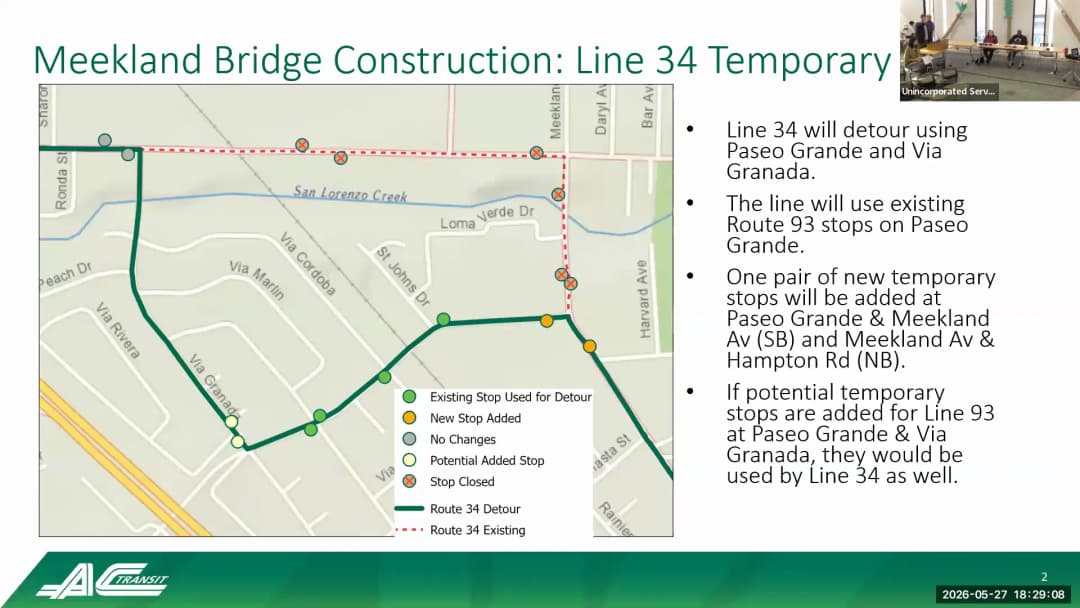
The Alameda County Board of Supervisors Unincorporated Services Committee met on May 28, 2026, to discuss three major items: the Meekland Avenue Bridge construction and road closure, enforcement against unpermitted food vending in Castro Valley and San Lorenzo, and a proposal for an unincorporated community coordination pilot. Public comments were heard on each item, and the committee received updates from county staff and partner agencies. Public Comments & Testimony - Meekland Avenue Bridge: Multiple callers expressed concerns about inadequate public notification, traffic backup on Paseo Grande near Colonial Acres school, lack of multilingual outreach (cards were in English only), and insufficient bus rerouting information. One speaker noted that the community only learned of meetings through active email sign-ups. Another urged coordination with the school district. Christine Bruner, a disabled senior, said she depends on buses 93 and 34 and feared the detours would be inadequate for non-English speakers. - Food Vending Enforcement: Keith Barrows (San Lorenzo Village) said the situation had improved but still needed “teeth” because vendors know they need permits but ignore the law. Diane Weiler thanked Supervisor Miley for his strong stance. Michael Freed suggested using waste management trucks for confiscated equipment and impounding generators for emergency use rather than destroying them. - Unincorporated Community Coordination Pilot: Approximately 36 speakers commented, with the vast majority supporting the pilot. Many urged placement in the County Administrator’s Office (CAO) for cross-departmental authority. Opponents included Dr. Ann Maris, who called the report biased and said existing services suffice, and Bill Mulgrew (Castro Valley MAC), who argued the real problem is organizational culture rather than structural gaps. Several Castro Valley residents disputed that the MAC represented them and supported the pilot. Discussion Items 1. Meekland Avenue Bridge Construction and Road Closure – Public Works Director Daniel Desabeth presented the project, which includes a full bridge closure from June 2026 to April 2027 for reconstruction. AC Transit planner Owen Christofferson detailed temporary bus detours for lines 93 and 34, including stop closures and proposed temporary stops. Supervisor Miley asked about community feedback and ridership. Public comments raised concerns about notification, traffic spillover, and lack of Spanish-language outreach. Staff responded that they would continue to post signage, coordinate with mapping services, and provide multilingual communications. 2. Unpermitted Food Vending Enforcement – Environmental Health Director Ronald Broader and Antonio Golar presented an overview of state laws (SB 946, SB 972, SB 635) and the county’s ordinance. They described a pilot enforcement plan conducted February–April 2026 in Castro Valley and San Lorenzo, which resulted in 29 inspections, all involving repeat offenders, and confiscation of food and equipment. Challenges included inability to identify vendors (no ID required), limited storage for confiscated items, and staff safety concerns. Supervisor Miley expressed strong frustration, stating that unenforced laws create health and safety risks, and directed staff to return to the Board for additional resources and to explore stronger penalties, including possible arrest authority. Supervisor Miley also called for cross-agency coordination and asked County Counsel to examine legal options for holding repeat violators accountable. 3. Unincorporated Community Coordination Pilot – Brianne Gala presented her research and updated recommendations for a two-year pilot staffed by two positions (administrator and analyst) funded by Measure W ($300,000 per year). The pilot would focus on cross-agency coordination, implementation of the Environmental Justice Element and development permit reform, and improved budget transparency. Recommended placement was in the CAO’s office. Supervisor Tam suggested the Community Development Agency (CDA) might be more practical given its existing functions. Supervisor Miley supported the pilot but emphasized the need for authority to convene departments, leaning toward the CAO’s office. The supervisors agreed to continue discussion at the Transportation and Planning Committee and then to the full Board. Key Outcomes - Meekland Bridge: No formal action; the item was informational. Staff will continue outreach and coordinate with AC Transit and schools. - Food Vending Enforcement: The committee directed Environmental Health to bring a request for additional resources (funding, equipment, storage) to the full Board of Supervisors. Supervisors also asked County Counsel to explore options for stronger enforcement, including potential arrest authority and the ability to impound vehicles. - Coordination Pilot: The committee received the report and will take the proposal to the Transportation and Planning Committee on June 1, 2026, followed by the Measure W allocation meeting. The pilot will be refined based on feedback and brought back for final Board approval. - Non-Agendized Items: AC Transit’s Diane Castleberry announced a June 10 Board meeting on possible service reductions due to a $200 million deficit, with a draft plan posted June 5. Supervisor Miley noted MTC had provided a $55 million loan. The committee also acknowledged community efforts that led to the denial of a new liquor store in Ashland.

COMMUNITY ENGAGEMENT 33% · CODE ENFORCEMENT 20% · ENGINEERING AND INFRASTRUCTURE 13% · GOVERNMENT REPRESENTATION 13%
79
MAY 26, 2026 · ALAMEDA COUNTY, CALIFORNIA · BOARD OF SUPERVISORS
Special Meeting of Alameda County Board of Supervisors – Coliseum Complex Update – May 26, 2026

The Alameda County Board of Supervisors held a special meeting on May 26, 2026, beginning with a closed session at approximately 2:15 PM. After recessing and reconvening into open session, the board received an oral report from County Counsel Andrea Weddle on the status of negotiations regarding the Oakland-Alameda County Coliseum Complex. Following public testimony and board deliberations, the board voted unanimously to direct staff to notice and post a special meeting for Thursday, May 28, 2026 at 10:00 AM to consider a non-binding term sheet among the county, Coliseum Way Partners (CWP), and Oakland Acquisition Company (OAC). Public Comments & Testimony - A total of 27 in-person speakers and no online speakers addressed the board. The public comment period lasted approximately one hour. - Oakland City Council President Kevin Jenkins and Councilmember Ken Houston spoke first, presenting a city ordinance (No. 13842, passed May 6, 2025) directing the city to convey its interest to OAC and urging the county to do the same so that the property could be under single ownership. Both committed to scheduling a special meeting of the city council to align with the county's timeline. - Multiple community members, representing organizations such as the Unity Council, Oakland Building Trades Council, Youth Uprising, Castlemont High School, local businesses, and the Oakland Roots and Soul soccer club, voiced strong support for the transaction. Speakers highlighted the Coliseum's potential for economic revitalization, youth engagement, job creation, and cultural renewal in East Oakland. - No speakers opposed the transaction or expressed concerns about the process. Discussion Items - Oral Report from County Counsel: Andrea Weddle provided a detailed history of the Coliseum transaction, including the 2019 disposition agreement with CWP for $85 million plus annual subsidy payments, the ongoing litigation (Golesby v. County) challenging compliance with the Surplus Lands Act, and the 2025 assignment to OAC with board consent. She noted that the final bond debt for the arena was paid off on February 1, 2026, and that a summary judgment hearing is scheduled for August 4, 2026. She confirmed that a non-binding term sheet has been negotiated and will be presented on May 28. - Board Deliberations: Supervisors Marquez, Miley, Fortunato Bass, and President Haubert each spoke. They acknowledged the complexity of the deal, the need for transparency, and the importance of protecting the county's fiduciary interests. Supervisor Miley emphasized his long history with the site and the need to revitalize East Oakland. Supervisor Marquez raised environmental health and safety as priorities. All expressed confidence that the term sheet would bring the deal closer to completion. Key Outcomes - The board voted unanimously (Supervisor Tam excused) to direct staff to notice and post a special meeting for Thursday, May 28, 2026 at 10:00 AM. The agenda will include a proposed non-binding term sheet for the Coliseum Complex transaction among the county, CWP, and OAC. - No reportable action was taken during the closed session. - The board committed to expediting the process, with final definitive documents expected to return for approval after the May 28 meeting.

ECONOMIC DEVELOPMENT 75% · PROCEDURAL 13% · COMMUNITY ENGAGEMENT 6% · YOUTH PROGRAMS 3%
80
MAY 26, 2026 · ALAMEDA COUNTY, CALIFORNIA · BOARD OF SUPERVISORS
Alameda County Elections Commission Meeting – May 26, 2026

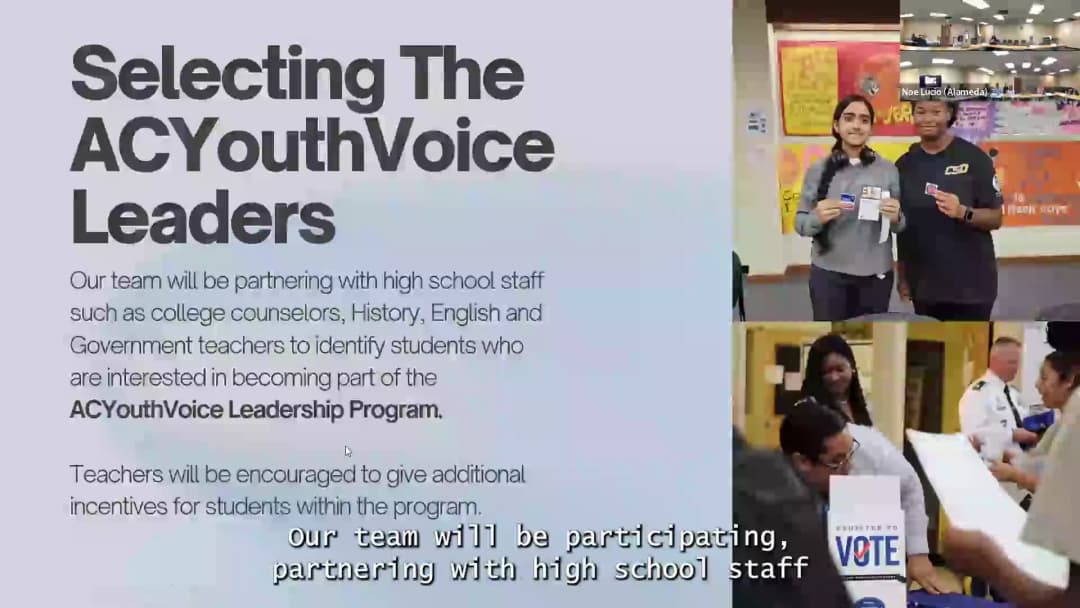
The Alameda County Elections Commission met on May 26, 2026, with seven commissioners present, achieving a quorum. The meeting covered updates on the upcoming June 2 statewide primary and June 16 special congressional primary elections, ad hoc committee reports on voting participation, youth engagement, budgeting, and procedures, as well as a presentation on a new youth leadership program. Key decisions included scheduling an additional meeting in August and approving a new committee member. Consent Calendar - Approval of Minutes: The minutes from the previous meeting were approved unanimously via roll call (7-0). Public Comments & Testimony - No public speakers were present. Discussion Items Monthly Update from Registrar of Voters - June 2 Statewide Primary: Key dates included: first mailing of voter information guides (April 23), vote-by-mail ballots (May 4), early voting (May 4–June 1), 24-hour drop boxes (May 4), close of registration (May 18), 10-day vote centers opening (May 23, 20 locations), additional 80 vote centers opening (May 30), and election day (June 2). - June 16 Special Primary (14th Congressional District): First mailing of guides (May 7), ballots (May 18), early voting (May 4), 24-hour drop boxes (May 18, 28 locations), close of registration (June 1), 10-day vote centers (June 6, 7 locations), four-day vote centers (June 13, 7 total), and election day (June 16). - Staff displayed new interactive kiosks in ballot processing areas to enhance observer experience, featuring procedures and videos. - Voter education materials emphasized that the special election is separate from the statewide primary, with distinct envelopes and guides. A dedicated website page includes maps and side-by-side comparisons to help voters understand which elections they are eligible for. Ad Hoc Committee Reports - Voting Participation Committee (Commissioner Lindsay): Analyzed voter data using PDI software. Found that in Oakland District 3, only 40% of eligible Black voters are registered, and 61% of registered Black voters turn out. The committee is considering a targeted voter registration pilot project and will examine other districts and cities before proposing. - Youth Participation Committee (Commissioner Varlick): Requested a complete list of schools visited for voter education. Commissioner Britzi Hernandez was approved to join the committee (motion passed unanimously). - Budgeting for Elections Committee (Commissioner Wagner): Met once with ROV staff to understand election cost spreadsheets. Provided feedback on billing language for city clerks. Further analysis for 2028 may follow after the special election. - Procedures Committee (President Dieter): Gathered feedback on three topics: (1) Public comment – proposed separating agenda and non-agenda comments and placing them before each item, with two minutes default but chair discretion; also suggested including written comments in agenda packets if IT allows. (2) Frequency of meetings – discussed removing the rule that designates June and December as off-months, instead adopting a yearly calendar in January. (3) Brown Act scenarios – most commissioners found the existing appendix helpful, so no change recommended. Scheduling August Meeting - The commission discussed whether to meet in August or December to fulfill the ordinance requiring at least 10 meetings per year. Consensus favored an August meeting due to the November general election and post-election assessment. The meeting was set for August 27, 2026 (motion passed unanimously). Voter Guide Discussion - Staff explained differences between the statewide voter information guide (from Secretary of State, covering state constitutional offices and propositions) and the county guide (from ROV, covering local races, measures, and sample ballot). Commissioners noted confusion among voters and suggested adding page numbers and a clear table of contents. The county guide includes large print versions available by request. General Administration - The Board of Supervisors approved two reimbursement agreements with the Secretary of State: one for voting system replacement equipment and one for cybersecurity enhancements. Signed and submitted; receipts due for reimbursement. Special Report: AC Youth Voice Leadership Program - Presented by Betty David, the program aims to train and deputize high school students (ages 16–18) as “AC Youth Voice Leaders” to conduct voter pre-registration drives and recruit student poll workers. The goal is to reach every major high school in the county. Pilot outreach in April had limited participation; full launch targeted for September 2026. The program partners with local organizations like Oakland Youth Vote Coalition and NAACP. Key Outcomes - Motion to add Commissioner Britzi Hernandez to Youth Participation Committee: Passed unanimously. - Motion to reschedule August meeting to August 27, 2026: Passed unanimously. - Committee feedback on procedures: The Procedures Committee will incorporate feedback to modify rules regarding public comment timing, meeting frequency (remove fixed off-months, adopt annual calendar), and retain Brown Act appendix. Formal proposals will be brought to the full commission at a future meeting. - Meeting adjourned at 6:38 PM.

ELECTIONS ADMINISTRATION 47% · PROCEDURAL 35% · YOUTH PROGRAMS 17% · DISABILITY RIGHTS 1%
OPENPUBLICA · PUBLIC MEETING INDEXUPDATED DAILY · openpublica.com