Browse by city
Date range
Search help

Search titles, summaries, topics and stored transcripts together. Keywords may match separately; put the whole query in double quotes for a phrase. Matching follows word analysis, so punctuation is not exact. Both dates are included. Documents are not searched.

SHOWING 4021–4030 ENTRIES
4021
SEP 29, 2026 · NASHUA, NEW HAMPSHIRE · BOARD OF ALDERMEN MEETINGS
Budget Review Committee Meeting - 2026-09-29

Note: The meeting transcript indicates the meeting was called to order on September 28, 2026, but the user instruction specifies the meeting date as 2026-09-29. This summary uses the instructed date for the title but reflects the actual proceedings from the transcript. The Nashua Budget Review Committee met on the evening of September 28, 2026 (as per the transcript) with seven members present: Aldermen O'Brien, Kelly, Gregg, Tebow, Johnson, Senate (remote), and Dow. The committee considered three resolutions: a borrowing for landfill improvements, a transfer from school computer equipment to the food service fund, and the creation of new trust funds from existing escrow accounts. All resolutions passed unanimously. Consent Calendar - A communication from Lisa Foto, Director of Public Works, was accepted and placed on file without objection. Discussion Items R-26-057: Borrowing $345,000 from Clean Water State Revolving Fund for Four Hills Landfill - Jeff LaFleur of the Landfill provided an explanation during the public hearing. No further questions. Motion to recommend final passage carried unanimously by roll call (7-0). R-26-065: Transfer of $150,000 from School Computer Equipment (Dept. 191, Account 71221) to Full Service Fund (Dept. 20210) for Food Service - Alderman Tebow expressed concern about voting without a school representative present. Crystal De Grey (Chief Operating Officer, Nashua School District) arrived later and explained the reasons for the overspent food service fund: - Decreased free and reduced lunch applications (down 240 from prior year). - Higher food costs (inflation). - More benefit-eligible food service employees. - Decreased student enrollment (approximately 210 fewer students district-wide). - She noted that the district increased lunch prices by 20 cents last year and had made a substantial increase to employee meal prices. - Alderman Johnson requested a detailed itemized list of all accounts that combined to make up the $150,000 transfer; this list is to be provided to the full board via Donna. - Alderman Kelly asked whether federal reimbursement rates have kept pace with inflation; De Grey indicated probably not. She also inquired about the possibility of further raising lunch prices to cover the gap, but noted that might not be supported at this point. - The motion to recommend final passage carried by roll call (6 yes, 1 no? The transcript shows six yes votes but a mention of a nay? However, the roll call recorded all seven aldermen voting yes. The transcript states: “You have uh six years. Motion carries.” This may indicate an error; the committee likely passed it 7-0 as no dissenting vote was named. For clarity, the resolution was approved.) R-26-074: Creation of Three New Expendable Trust Funds and Transfer of $790,387 from Prior Escrow Accounts - Tim Cummings (Director of Administrative Services) introduced the resolution as housekeeping to move funds from long-standing escrow accounts into appropriate expendable trust funds. He emphasized this is not a new appropriation; it is a transfer of existing funds to better track and manage them for infrastructure improvements, park rehabilitation, community development, general transportation, downtown improvements, waterways, and school deferred maintenance. - The resolution also creates three new trust funds, notably a General Transportation Improvements Trust Fund, intended as a holding chamber for funds until grant matches are secured. The agent to expend for this fund will be the Mayor, with the Director of Administrative Services as backup—a compromise because transportation projects involve both Public Works and Community Development. - Alderman Senate questioned whether creating new funds contradicts the statement that no new funds are being created; Cummings clarified they are creating accounts but not adding new money. - The motion to recommend final passage carried unanimously by roll call (7-0). Key Outcomes - R-26-057 approved: $345,000 borrowing for Four Hills Landfill (unanimous). - R-26-065 approved: $150,000 transfer from school computer equipment to food service fund (vote recorded as 6 yes; likely unanimous). - R-26-074 approved: Creation of three new expendable trust funds and transfer of $790,387 from escrow accounts (unanimous). - The committee adjourned at 7:49 p.m. by roll call (6 yes, 1 no? Again, the transcript shows six yes and one nay but names not provided. The motion carried.) No other business was discussed.
BUDGET EQUITY ANALYSIS 65% · PROCEDURAL 13% · CAPITAL EXPENDITURES 10% · PUBLIC WORKS 5%
4022
SEP 29, 2026 · SAN ANTONIO, TEXAS · COUNCIL COMMITTEES
San Antonio Intergovernmental Relations Committee Meeting - September 29, 2026

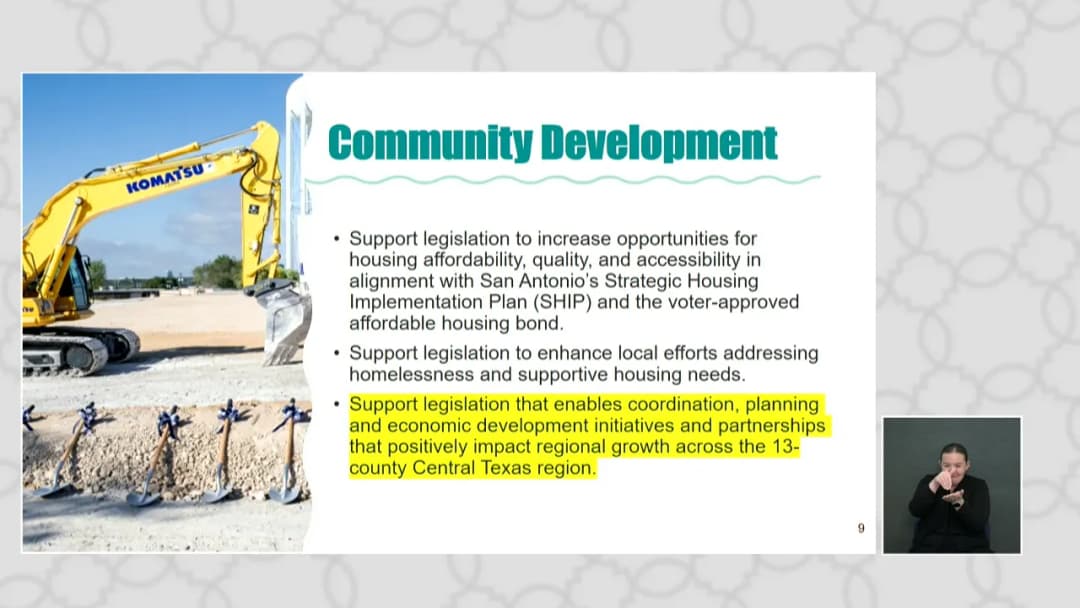
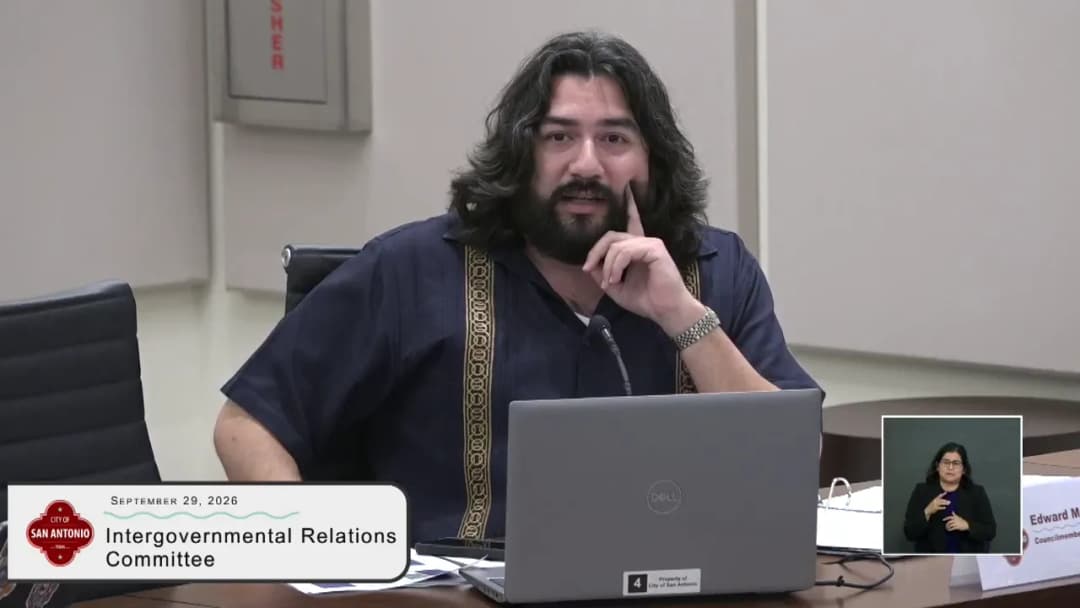
The San Antonio Intergovernmental Relations Committee convened at 2:08 PM with Chair Maquí Rodríguez presiding. Members present included Munguía, Alderete Gavito, Mesa González, and Spears, establishing a quorum. The meeting focused on a resolution regarding the potential impact of a new Level II trauma center designation, the draft 2026-2027 State Legislative Program, and guest presentations on transportation and education funding. Routine Approvals and Consent Calendar - The committee unanimously approved the minutes from the August 4, 2026 meeting. Trauma Center System Resolution - Assistant Division Director Scott Jackson and Deputy Assistant Director Jeff Coyle presented a resolution initiated by Councilwoman Spears concerning Methodist Healthcare’s intent to seek a Level II trauma center designation. - Background Context: The region currently has two Level I trauma centers (BAMC/BAMSI and University Health). Methodist Healthcare announced its intent to elevate its facility to Level II, sparking concerns that surfaced publicly in late August 2026. - Methodist’s Stated Position: Methodist indicated they are not seeking Level I status and do not wish to compete with BAMC. They argued the current model forces patient transfers out of their system or out of the region (to Austin or Houston) when BAMC or University Health is at capacity. They emphasized operating similar models in 52 other markets through HCA. - Military and Regional Concerns: The primary worry expressed by military partners and committee members was that adding Level II capacity without a corresponding increase in trauma volume would dilute the patient load. This directly threatens BAMC’s ability to maintain its Level I certification and conduct essential medical readiness training for the Department of Defense. It was noted that approximately 13,000 trauma patients are treated annually, with around 1,167 (slightly less than 10%) transferred out of the system. - Council Deliberation: - Councilwoman Spears emphasized protecting BAMC’s mission as a national security priority and expressed hope for a collaborative task force. - Councilwoman Alderete Gavito sought balance between protecting military training and allowing for business decision-making. She expressed frustration over the lack of specific data on patient volume trends and questioned whether blocking the designation was appropriate if it meant patients are sent out of town. - Councilman Mesa González (representing the medical district) called for more comprehensive data and earlier communication with the council before such urgent discussions arise. - Councilwoman Munguía warned that diluting BAMC’s volume over a ten-year horizon could risk the military moving its mission and economic investment elsewhere. - Outcome: The committee agreed to bring all stakeholders—Strack, Methodist, and BAMC—to the table for further study. Although Methodist’s application process begins October 1, the certification takes a full year, allowing time for policy coordination. The goal is to report recommendations to the full council for a Session A deadline. 2026-2027 State Legislative Program - Director of Government Affairs Sally Basurto presented the draft legislative program, incorporating feedback from previous committee meetings and individual council briefings. - Key Priorities Presented: Protecting CPS Energy’s single-ownership model, securing funds for flood mitigation and the South Texas Parkway, enhancing public safety measures (cryptocurrency fraud, organized retail theft), and investing in public education and workforce development. - Council Member Additions to the Program: - Alderete Gavito proposed adding support for expanding hospital capacity, particularly in South San Antonio, and including childcare facilities in the 300-foot alcohol buffer zone requirement currently applied to schools and churches. - Munguía requested exploring an extension of the Project Financing Zone (PFC) for the Alamodome and Convention Center from 30 to 60 years to help fund downtown infrastructure. - Mesa González emphasized preserving local decision-making authority (especially regarding CPS Energy) and supported the childcare center buffer addition. - Next Steps: The program will be presented to the full City Council for approval on October 7, 2026, and formally adopted on October 29, 2026. Guest Presentation: SAMCO Transportation Funding Update - SAMCO Executive Director Beck Foyer provided an overview of regional transportation successes and future legislative needs. - Current Status: The region has over $6 billion in transportation projects underway. A major success was the coalition formed to secure railroad grade separation funding. - Challenges: The Metropolitan Planning Organization (MPO) identifies a need of $50 billion but has only $12–14 billion identified for the 2025 plan. TxDOT faces funding volatility due to reliance on oil and gas taxes (Proposition 1) and a gas tax that has not been raised in four decades. A 60% increase in construction costs was cited. - Legislative Goals: Support continuation of the railroad separation program, back Proposition 7 (vehicle sales tax adjustments), and monitor efforts by other regions to restructure TxDOT formulas that could disadvantage San Antonio. Guest Presentation: Bexar County Education Coalition - Julia Cassar, Executive Director of the Bexar County Education Coalition, presented the community’s legislative priorities for public education. - Core Issue: Texas ranks in the bottom 10% nationally for per-student spending. Average teacher pay is approximately $6,000 below the national average. - Special Education Funding Gap: The federal government mandates a certain funding level, but the state faces a $2 billion gap relative to those requirements. The last session only offered an additional $250 million. - Affordable Housing Impact: Lower school enrollment is often linked not to population decline, but to a lack of affordable housing pushing families out of district boundaries. - Advocacy Campaign: The “Bexar Builds” campaign was recently launched, drawing 300 attendees. A 26-point legislative agenda was distributed. - Council Feedback: Councilwoman Alderete Gavito noted that the state imposes unfunded mandates such as requiring armed officers on campus; districts spend an average of $100 per student on safety while receiving approximately $20 from the state. Key Outcomes - Committee Alignment / Resolution: The committee supports bringing all trauma system stakeholders together to develop a coordinated solution that protects BAMC’s military mission while allowing Methodist to pursue its designation. A formal resolution draft will incorporate this collaborative approach. - State Legislative Program Finalized: The committee approved the additions requested by members (hospital capacity, childcare buffer zones, PFC exploration). - Action Items for Staff: - Schedule a meeting with Methodist, Strack, and BAMC to evaluate volume impact. - Investigate state-level mechanisms or incentives for hospital construction in underserved areas. - Review the feasibility of extending the PFC term. - Next Meetings: - Full City Council review of the Legislative Program: October 7, 2026. - Committee report back on trauma center collaboration study: targeted before the October 29, 2026 Session A deadline.

PUBLIC HEALTH 14% · LEGISLATIVE ADVOCACY 13% · TRANSPORTATION INFRASTRUCTURE 13% · PUBLIC EDUCATION 11%
4023
SEP 29, 2026 · SAN ANTONIO, TEXAS · COUNCIL COMMITTEES
Intergovernmental Relations Committee Meeting: BAMC Support Resolution and 90th Legislative Program (September 29, 2026)

The Intergovernmental Relations Committee of the San Antonio City Council met on September 29, 2026, at 2:08 PM. The meeting was called to order by Chair McKee Rodriguez with a quorum present (Councilmembers Mukia, Alareth, Mesa Gonzalez, Spears, and Chair). The meeting adjourned at 4:16 PM. Consent Calendar - Unanimously approved the minutes of the August 4, 2026, IGR committee meeting via motion and second. Discussion Items 1. Resolution Supporting Brooke Army Medical Center (BAMC) Amid Methodist Trauma Center Plans - Assistant City Manager Jeff Coyle and new Military Affairs Director Scott Jackson presented a proposed resolution reaffirming the city’s 2017 commitment to BAMC, the only Level 1 trauma facility within the Department of Defense (DoD). - Jackson explained that BAMC’s unique mission includes training, sustaining deployable forces, and receiving all combat casualties. Maintaining its Level 1 certification requires a minimum volume of trauma patients (currently 13,000 annually between BAMC and University Health). - Methodist Healthcare announced intentions to upgrade its Level 3 trauma center to Level 2, effective October 1, 2026, with a year‑long certification process. Methodist stated the move is about patient choice: they want to keep patients within their system rather than transferring them to Austin or Houston. They noted they have 52 other markets where they operate Level 1 facilities. Methodist agreed not to pursue Level 1, only Level 2. - Jackson reported that Methodist currently transfers about 1,167 patients per year to Level 1 facilities (out of 13,000 total trauma patients). The addition of a Level 2 center without increased demand could reduce volume at BAMC and University Health, threatening BAMC’s readiness. - The draft resolution requests: reaffirmation of support for BAMC, an objective demand study, convening of STRAC (Southwest Texas Regional Advisory Council) to coordinate a collaborative agreement ensuring BAMC’s patient volume, and establishing BAMC and University Health as the region’s primary Level 1 facilities. - Councilmember Alderetic expressed concerns about blocking Methodist’s business decision, asking for more data on trauma capacity and patient transfers. She noted the chart lacked concrete numbers and questioned the “protect the status quo” framing. - Councilmember Spears strongly supported the resolution, stating BAMC’s military readiness is a national security priority and that Methodist’s decision could invite further competition. She thanked staff for their work. - Councilmember Mungia requested mapping of Level 1 trauma centers and long‑term growth projections, noting health care gaps on the south and east sides. She cautioned against saying “status quo” as it implies rejecting needed health care expansion. - Councilmember Masekon’s office criticized the short notice, wanting earlier communication and more data on impacts to both Methodist and BAMC. - Chair McKee Rodriguez noted the October 1 deadline had already passed and suggested bringing partners back for more information. The committee consensus was to defer action, gather more data (including capacity, volume, out‑of‑town transport data), and bring the resolution back to a future IGR meeting with enhanced briefings for all council members. 2. 90th State Legislative Program Update - Sally Basur, Director of Government Affairs, presented the updated legislative program incorporating feedback from prior meetings. The four funding priorities remain: South Texas Parkway, downtown sports/entertainment district, flood infrastructure, and protecting CPS Energy’s municipal model. - Key additions include: support for public/higher education (via Bear County Education Coalition), prevention of encroachment on military bases, funding for rail grade separations, and protecting local zoning authority. - Chair McKee Rodriguez proposed extending the Project Marvel PFZ (Sports and Entertainment District) from 30 to 60 years to cover the Spurs Arena, convention center, and Alamo Dome. Jeff Coyle cautioned that doubling the state’s revenue-giveback period would be a “tall ask,” but the committee agreed to explore it. - Councilmember Mungia asked to include language supporting expansion of health care capacity (hospitals) on the south/east sides. Councilmember Alderetic supported this, and staff will research state mechanisms. - Councilmember Mesa Gonzalez requested support for protecting CPS Energy, maintaining local control, and adding “daycare/child care facilities” to the 300‑foot alcohol buffer zone exemption (Chapter 4 of Local Government Code). Staff agreed to explore. - Councilmember Spears requested specific bill tracking and flood mitigation project lists; staff will provide regular updates. - Councilmember Alderetic pushed for stronger state and federal grant pursuit, and staff confirmed a grants training session is planned. - The committee voted to approve the legislative program for full council consideration on October 7, 2026. The motion carried. 3. Presentations from Community Partners - Vic Boyer, President/CEO of SAMCO, briefed on transportation funding: $14 billion secured over 25 years; $6 billion in projects under construction; future needs estimated at $50‑55 billion by 2050. He highlighted rail grade separation grants and the need to protect highway funds from diversion. SAMCO will support gradual increase of Prop 7 and reauthorization of the Texas Mobility Fund. - Julia Grizzard, Executive Director of Bear County Education Coalition, presented the “Bear Builds” campaign focusing on four legislative priorities: school operations funding, special education funding, school safety/mental health, and early childhood education. She noted school districts are spending $100/student on safety but receiving only $20/student from the state. The committee expressed support for the coalition’s efforts and noted overlap with the city’s education goals. Key Outcomes - BAMC Resolution: Committee deferred action to gather additional data (demand trends, out‑of‑town transport numbers, long‑term projections). Staff to bring back more information and brief all council members before a future vote. The committee’s direction is to send the item to A‑session rather than B‑session for faster action. - 90th Legislative Program: Approved by committee vote to advance to full council on October 7, 2026. Several amendments were discussed and will be explored prior to full council: extending the PFZ period (Chair McKee Rodriguez), adding hospital capacity language (Councilmember Mungia), including child care facilities in alcohol buffer zones (Councilmember Mesa Gonzalez), and continued focus on grants and local control. - Next Steps: Staff will provide individual briefings to council members not on IGR, prepare the legislative program for full council on October 7, and continue bill tracking as the 90th session approaches. The next IGR meeting will include updated information on the BAMC issue.

PUBLIC HEALTH 20% · PUBLIC EDUCATION 14% · MILITARY AFFAIRS 13% · LEGISLATIVE AGENDA 13%
4024
SEP 29, 2026 · SEATTLE, WASHINGTON · CITY COUNCIL
Seattle Council Budget Committee Reviews 2027-2028 Housing, Construction, and Planning Proposals - September 29, 2026

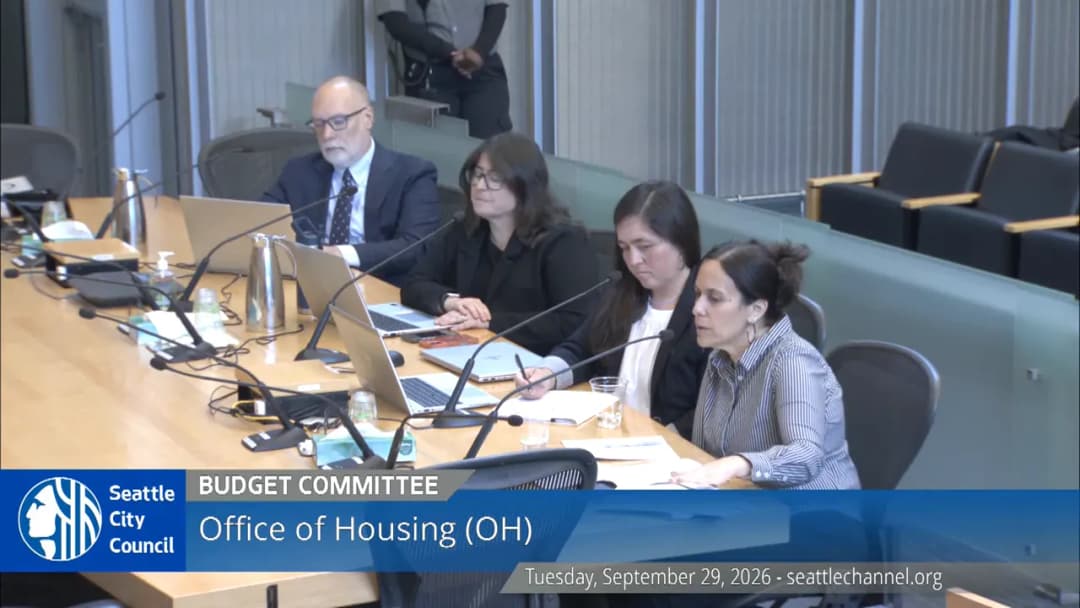
The Select Budget Committee met on Tuesday, September 29, 2026, from 9:30 AM to 2:24 PM (with a lunch recess from 12:34 PM to 1:35 PM) to review the Mayor's proposed 2027-2028 budgets for the Office of Housing (OH), Seattle Department of Construction and Inspections (SDCI), and Office of Planning and Community Development (OPCD). Chair Dan Strauss presided; 6 members were present at roll call, with 3 arriving later. The committee heard presentations from department directors and the City Budget Office, then engaged in detailed discussions on funding levels, program challenges, and potential impacts of cuts. Office of Housing (OH) - Director Kelli Larsen presented the department's proposed budget. OH will receive $140 million in JumpStart Payroll Expense Tax (PET) revenue in 2027 and $139 million in 2028, representing over 30% of annual JumpStart revenues. - The total OH budget is approximately $347 million for 2027, with no changes to staffing (69 FTE). Key allocations: $235 million for multifamily capital, $61.4 million for agency supports (operating subsidies, resident services, workforce stabilization), $13.6 million for homeownership, $8.8 million for weatherization/home repair, $19.4 million for administration, and $9.4 million for rental assistance (administered by HSD). - Larsen highlighted rising area median income (AMI) growth—8% annually over the last five years vs. 3% from 2000-2020—which pushes income-restricted rents beyond what low-income families can afford. She noted that 60% AMI studio rents now exceed market rates in some neighborhoods, making 30-50% AMI the "sweet spot" for affordability. - The department has made progress on the 2023 Housing Levy: 47% of rental home goals (1,600+ homes), 62% of operating/maintenance/service goals, and 34% of for-sale home goals achieved in the first two years. - OH used $55 million in debt restructuring to save nine buildings from foreclosure, buying down rents and improving cash flow. It also provided $40 million in urgent operating support over two years, which has prevented the collapse of major organizations. - To manage a $65 million reduction in multifamily rental funds, OH will use forward commitments of future JumpStart revenues, and no current projects or operating contracts will be affected. Housing levy commitments remain unchanged. - New NOFA criteria require 20% of new units to have two or more bedrooms and 20% to target 30% AMI or below, shifting focus toward family-sized, deeply affordable housing. - Councilmembers expressed support for maintaining steady investments, highlighted the importance of preservation and stabilization, and asked about community self-determination fund changes (no set line item, but priority maintained) and homeownership program funding (weatherization fully funded; homeownership reductions reflect removal of one-time council additions). Seattle Department of Construction and Inspections (SDCI) - Interim Director Sam Steele presented. SDCI is 91% funded by permit fees, with 9% from the general fund. Permit activity has dropped sharply: master use permit applications are projected 60% below 2019 levels, and construction permit applications 15% below. Valuation of projects has shifted to smaller, lower-value work, limiting fee revenue recovery. - The proposed budget reduces 34 fee-funded positions (27 vacant, 7 filled), resulting in 7 layoffs, to align staffing with workload. Staffing reductions are concentrated in cashiering, payment processing, design review, and internal special projects. - A 10.7% fee increase for building and land use (including 3.7% inflation) is proposed, generating about $6.3 million annually. The legislation also introduces a new $11 per-unit rental agreement regulation fee to fund enforcement of recent rental regulations. - SDCI's overall fund balance is projected to fall to roughly $30 million by end of 2026, down from $80-100 million prior to 2024. The building and land use core staffing reserves are nearly exhausted, with projections showing only $1 million in 2027, zeroing out by 2028. - A new housing ombuds position, funded by JumpStart, will help low-income and community-driven projects navigate permitting, part of Mayor Wilson's housing acceleration executive order. - Councilmembers raised concerns about the impact of staff cuts on permitting timelines, the depletion of core staffing reserves, and the negative signal of fee increases to developers. Councilmember Kettle criticized the city's "tone" toward development, citing lost projects. Councilmember Rink questioned confidence that no further cuts or fee hikes would be needed; SDCI stated cautious optimism but noted reliance on economic recovery. Councilmembers also praised the housing ombuds and urged stronger customer service. Office of Planning and Community Development (OPCD) - The committee heard the OPCD briefing after the lunch recess (from 1:35 PM onward). No detailed discussion was included in the transcript, but the item was heard and no votes were taken. Key Outcomes - All three information items (Inf 2957 OH, Inf 2965 SDCI, Inf 2966 OPCD) were heard in committee; no action was taken. - The committee recessed from 12:34 PM to 1:35 PM for lunch and adjourned at 2:24 PM. - No formal votes or decisions were made; the meeting served as a briefing and discussion. The committee will continue budget deliberations in subsequent sessions, with final budget decisions expected later in the fall.

AFFORDABLE HOUSING 47% · BUDGET EQUITY ANALYSIS 20% · PUBLIC ENGAGEMENT 6% · PROCEDURAL 5%
4025
SEP 29, 2026 · HOUSTON, TEXAS · COMMITTEES AND COMMISSIONS
Houston BFA Committee Meeting - September 29, 2026: Financial Reports and Bond Transactions

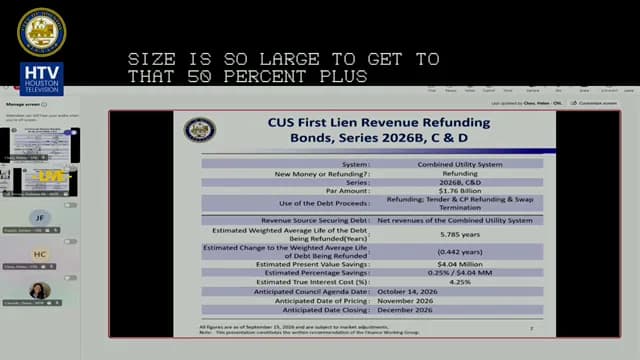
The Budget and Fiscal Affairs (BFA) Committee, chaired by Councilmember Sally Alcorn, met on September 29, 2026, to review the monthly financial report for the period ending August 31, 2026, and to discuss upcoming financial transactions, including combined utility system bonds and airport special facility revenue bonds. Key topics included the right-of-way fee, sales tax on the new garbage fee, and guardrails for utility transfers. Consent Calendar - No consent calendar items were presented. Public Comments & Testimony - Dominic Mazoc signed up to speak but was not present. No public comments were made. Discussion Items - Monthly Financial Report: Finance Director Melissa Dubowski presented the general fund projection ending fund balance of $294 million (11.2% of expenditures less debt service and pay-as-you-go) for FY27, which is $45.5 million lower than the finance department's projection due to lower revenue. The fund balance is $97.5 million above the city's 7.5% reserve target. The projection assumes $104 million in revenue from the proposed right-of-way fee; if not realized, the fund balance would drop to $190 million (7.3%), below the target. - Deputy Controller Will Jones presented the 2+10 financial report, projecting a $339.5 million ending fund balance (13% of expenditures), $143 million above the 7.5% target. Only the asset forfeiture fund projection changed (increased by $2.8 million due to higher confiscations). - Sales Tax on Garbage Fee: Vice Mayor Pro Tem Amy Peck questioned the application of sales tax to the new $5 administrative garbage fee. She noted the models showed $24 million yearly to the combined utility system, but the actual amount is $22.176 million, with $277,000 going to the general fund and $1.5 million to sales tax. She asked whether a comptroller determination was obtained. A representative from the city attorney's office (Eric) confirmed that state law requires sales tax on garbage collection as a real property service. The city received a Comptroller's opinion that when a specific fee (not a tax) is charged, sales tax applies. The drainage fee and container lease fee do not appear to be subject to sales tax. Councilmember Ramirez asked about sales tax on water sold outside the city; the legal representative agreed to report back. - Upcoming Financial Transactions: Director Dubowski presented two transactions: - Combined Utility System (CUS) Bonds (Series 2026 B, C, and D): Total expected size $1.76 billion. Series B ($785 million) will refund bonds via tender and take out commercial paper. Series C and D ($975 million) will refund variable-rate debt into fixed-rate debt and terminate swap agreements. The transaction also seeks to modernize the master bond ordinance, including adding guardrails on the right-of-way transfer (proposed 9–10% cap on gross revenues, though the FY27 budget is at 5%), establishing an interest and sinking fund for debt service, and defeasing old bonds. Estimated net present value savings of $4 million (0.25%), true interest cost around 4.25%. The transaction requires bondholder consent (at least 50% +1) for ordinance amendments. Next steps: RCA to City Council in October, pricing in November, closing in December. - United Airlines Special Facility Revenue Bonds (Terminal B): The remaining $850 million under the $2 billion MOA, after issuing $1.1 billion in 2024. These bonds are supported solely by United's lease payments, not general fund or airport revenues. Anticipated true interest cost 5.8–6.2%. Next steps: council actions in October and November, pricing and closing in November. - Discussion on Right-of-Way Guardrails: Councilmember Ramirez asked about the proposed cap on the right-of-way fee, noting the five percent start. Director Dubowski explained the 9–10% range was based on peer cities (e.g., Austin Water 8.2% cap, San Antonio CPS 14% cap) to provide flexibility for future councils. Councilmember Martinez emphasized transparency, asking how future increases would be communicated and tied to water rate studies. Director Dubowski noted that quarterly reports on the CUS financial health will come to BFA. Councilmember Alcorn recalled legislative talk about capping right-of-way fees; Director Dubowski said the city's 5% is conservative compared to peers (e.g., San Antonio utilities transfer as much as property taxes). - Airport Bonds Update: Councilmember Martinez asked about the United bonds; Director Dubowski noted that enabling project cost estimates came in under projections, so less than the $624 million in general airport revenue bonds may be needed. Key Outcomes - No votes were taken during the meeting. - The committee will receive quarterly financial updates on the Combined Utility System throughout FY27. - RCAs for the Combined Utility System bond transaction are expected at City Council in October 2026, with pricing in November and closing in December 2026. - For the United Airlines bonds, council actions are anticipated in October and November 2026, with pricing and closing in November 2026. - Legal will report back on sales tax applicability for water sales outside the city. - The meeting was adjourned; the next BFA meeting is scheduled for November 2, 2026, at 10 a.m.

BUDGET 55% · AVIATION 12% · ENGINEERING AND INFRASTRUCTURE 11% · WATER AND WASTEWATER MANAGEMENT 9%
4026
SEP 29, 2026 · HOUSTON, TEXAS · CITY COUNCIL
Houston City Council Meeting – September 29, 2026

The Houston City Council convened on September 29, 2026, for its regular meeting. The agenda included adoption of minutes, routine consent items, public comments on multiple topics, consideration of the Mayor’s Report (focusing on former Controller Chris Brown’s employment), a financial report from the Controller and Finance Department, and councilmember announcements. Key issues included opposition to the Model Cities Grant, calls to recognize Filipino American History Month, concerns about Flock camera surveillance, and a contentious debate over the value and productivity of Senior Advisor Chris Brown. Consent Calendar - Minutes Adoption: The minutes of September 22 and 23 were adopted. - Appointments: The council confirmed appointments to the Houston Commission on Disabilities, the Houston Zoo Development Corporation Board, and three municipal court associate judges (Ruth Mendez, Chad Peace, Jerry Boone). - Consent Items: Numerous items (purchasing, ordinances, utility district consents, etc.) were approved en bloc with no debate except where items were pulled for separate consideration. Public Comments & Testimony - Valero Refinery Air Permit (Reem Tariq, Air Alliance Houston): Tariq noted the Valero Houston Refinery on Manchester Street is permitted to emit over 1,000 tons of volatile organic compounds per year and has released more than 46 tons of unauthorized pollution (mostly benzene) since 2019. 7,500+ households, 10 schools, and 12 parks lie within a two‑mile radius. She urged the council and especially Councilmember Martinez to attend a TCEQ public meeting on October 1 to support strengthening the permit. - Flock Cameras and Surveillance (Katie Thibodeau, Dylan Forbes, Tara Destori Nadal): Multiple speakers criticized the Flock camera system, citing privacy violations, potential abuse for tracking abortion seekers, and ties to immigration enforcement. Tara Destori Nadal presented a map showing disproportionate camera density in Black and Brown neighborhoods (e.g., 11 cameras in one square mile of Third Ward vs. 0 in River Oaks) and called on six Black councilmembers to end the contract. - Model Cities Grant Opposition (Juan Rubio, Ronaldo Salgado, Jennifer Canales‑Pelaez, Auraseli Garcia, Norma Gonzalez, Susie Duran, and others): Numerous speakers opposed the city’s consideration of the U.S. Department of Justice Model Cities Initiative, arguing it would mandate cooperation with ICE, endanger immigrant communities, and undermine trust in local police. Ronaldo Salgado, whose father Lorenzo Salgado Arauco was killed by ICE agents, pleaded with the council not to apply. Jennifer Canales‑Pelaez cited DOJ guidelines requiring certification that the city will not protect immigrants. Susie Duran referenced a similar “Model” in Memphis that led to deaths. Several speakers noted the council had previously weakened an anti‑ICE ordinance under state pressure. - Filipino American History Month (Michelle DeBaylon, Sybil Palubna Science, Anthony Guevara, Sergeant Major Pascual Jackson): Speakers requested the council enact a formal ordinance designating October as Filipino American History Month in perpetuity. They highlighted historical contributions and invited councilmembers to upcoming community events (Oct 11 at The Post, Oct 17 in Sugar Land, Oct 26 Rockets Filipino Heritage Night). - Other Comments: Sherry Browning described a chaotic experience at a Social Security office where veterans had benefits cut; Jaime Perez complained about crime and neglect along Jensen Drive; Sandra Evans spoke about a divine revelation regarding an oil reserve; Amos Sims asked when he could retrieve his son from a juvenile detention facility, drawing a comparison to ICE releases; and additional speakers denounced the Model Cities grant and demanded accountability for Lorenzo Salgado’s killing. Discussion Items - Mayor’s Report – Chris Brown Employment: Former Controller Chris Brown appeared to defend his role as Senior Advisor for Financial Integrity. He presented a plan to combine AI and robotics with voluntary retirements to close the structural deficit. Brown stated he works on a project‑based, non‑hourly basis and estimated his weekly hours at around 15 before the recent media scrutiny, but said that varies. He accused Controller Hollins of not meeting with him and questioned the productivity of the Controller’s audit division (27 audits completed during his tenure vs. 16 under Hollins, despite a budget increase). Councilmember Gwendolyn Shabazz pressed Brown on his hours and value, citing a Houston Chronicle report that he worked 13 days and sent 12 emails. Mayor Whitmire defended Brown, saying he was hired for experience, not hourly work. Councilmember Alcorn commended Brown’s past work on pension and OPEB reform. - Financial Report: - Controller Hollins presented the August 2026 financial report, projecting a General Fund ending balance of $294 million (11.2% of expenditures), which is $45.5 million lower than the Finance Department’s projection due to lower revenue estimates. He warned that if the proposed right‑of‑way fee ($104 million) is not implemented, the balance could fall to $190 million (7.3%), below the city’s 7.5% reserve target. He criticized the administration for using stormwater funds to pay for car washes (a $2.6 million contract with Mr. Car Wash), arguing it violates the dedication of those funds. He also noted a $4 million shortfall in garbage fee revenue because the $5 monthly fee included sales tax and was implemented late. He provided an update on the Chris Brown investigation, stating the administration resisted information requests for over 100 days and then retaliated with public information requests on his office. - Finance Director Melissa Dubowski responded, presenting data showing that historical practice uses stormwater/drainage funds to maintain vehicles purchased by those funds, and that the same funding sources were used in prior years under the previous administration. She also noted that the garbage fee remains $5 inclusive of sales tax, and the sales tax impact is about $1 million (not $4 million). She demonstrated the open finance portal. - Councilmember Peck raised concerns about the sales tax on the administrative fee and potential future impacts if the fee rises. Councilmember Alcorn pressed on the $3.7 million shortfall. The report was accepted on a motion by Councilmember Peck and seconded by Castillo. Key Outcomes - Consent Items: All routine appointments, purchasing, ordinance items (except those pulled) were approved unanimously. Items 4, 12, 15, 19, 20, 23, 24, 28, 37, 38, 40, 43, and 44 were voted on separately and passed with few no votes (e.g., Councilmember Ramirez voted no on item 28). - No votes taken on Model Cities Grant or Flock cameras; these were discussed but not on the agenda for action. - Financial Report: The council voted to accept the August 2026 financial report as presented. Remarks and Announcements - Councilmembers noted upcoming events: Voter registration deadline October 5; Parking Day on October 3; National Night Out on October 6; Faith and Affordable Housing Summit on October 10; Domestic Violence Awareness Month events; and the untitled art fair. - Condolences were offered for Dr. Steven Purce (former city health physician) and former State Representative Garnet Coleman. - Councilmember Shabazz reported on the McGregor Park renovation groundbreaking. - Councilmember Castillo reminded residents to register to vote and prepare for predicted heavy rain. - Councilmember Davis noted attendance at the National Night of Remembrance. - Councilmember Panzarella announced the return of Pride banners on Westheimer. - Councilmember Ramirez introduced his new communications director, Reyes Ramirez, Houston’s poet laureate.

IMMIGRATION 16% · PUBLIC SAFETY 14% · PROCEDURAL 8% · BUDGET 8%
4027
SEP 29, 2026 · HOUSTON, TEXAS · COMMITTEES AND COMMISSIONS
Proposition A Committee Meeting on Recycling Transparency Ordinance – September 29, 2026

On September 29, 2026, the Proposition A Committee (POP A) met from 2:02 PM to 2:34 PM under Chair Mary Nan Huffman. The sole agenda item was a proposed ordinance by Councilmember Martinez requiring City Council approval for any program, policy, or contract directly affecting the collection, processing, transportation, or disposal of recyclables and other divertible materials. No formal action was taken due to lack of a quorum; the proposal was introduced under Rule 24 for future consideration. Public Comments & Testimony - Beth Martin (representing a waste-reduction coalition) expressed strong support for the ordinance, citing the Houston Recycling Collaboration MOU that bypassed council oversight and resulted in collected plastics sitting in a warehouse. She urged council to approve the measure to ensure transparency. - Malachi Key (Air Alliance Houston) spoke in support, referencing the mammoth metal recycling fire and the failed Houston Recycling Collaboration. He argued that the MOU was signed without council approval and that the chemical recycling program never delivered. In response to questions, he noted the ordinance could prevent future opaque contracts but might not have prevented the fire directly. - Stephanie Martinez (ECAP – Environmental Community Advocates for Galena Park) voiced support, emphasizing that backdoor deals should be eliminated and that all major recycling decisions must come before council for a majority vote. - Bill Kelly (former Turner administration staff) supported the ordinance and clarified its intent: to capture MOUs like the Houston Recycling Collaboration (which had no dollar amount) while exempting internal administrative decisions (e.g., changing collection days). He stressed the goal is transparency, not micromanagement. Discussion Items - Councilmember Martinez presented the proposed ordinance, explaining it would amend Chapter 39 to require council approval for any program, policy, or contract directly affecting recyclables, excluding internal staff decisions. He highlighted the 2022 MOU as a key example of an agreement that should have had council oversight. - Councilmember Ramirez asked about the scope, noting the ordinance could micromanage departments. She suggested alternative approaches like targeting MOUs or chemical recycling directly. Martinez responded that the ordinance focuses on major changes, not routine operations. - Councilmember Jackson questioned whether such contracts already come to council. Martinez confirmed not all do, and the ordinance ensures council sees them. - Councilmember Carter noted the MOU was signed by prior administration staff and is now inactive, but agreed that more scrutiny was needed. - Chair Huffman expressed interest in refining the language and encouraged collaboration. Key Outcomes - No votes were taken due to insufficient quorum; the proposal remains under Rule 24 for future action. - Councilmember Martinez stated he will work with legal staff and colleagues to refine the ordinance language. - The next committee meeting is tentatively scheduled for October 27, 2026, at 2:00 PM, contingent on receiving items for consideration.

SOLID WASTE MANAGEMENT 76% · TRANSPARENCY 9% · PROCEDURAL 4% · PROCUREMENT 3%
4028
SEP 29, 2026 · NEW YORK CITY, NEW YORK · CITY COUNCIL
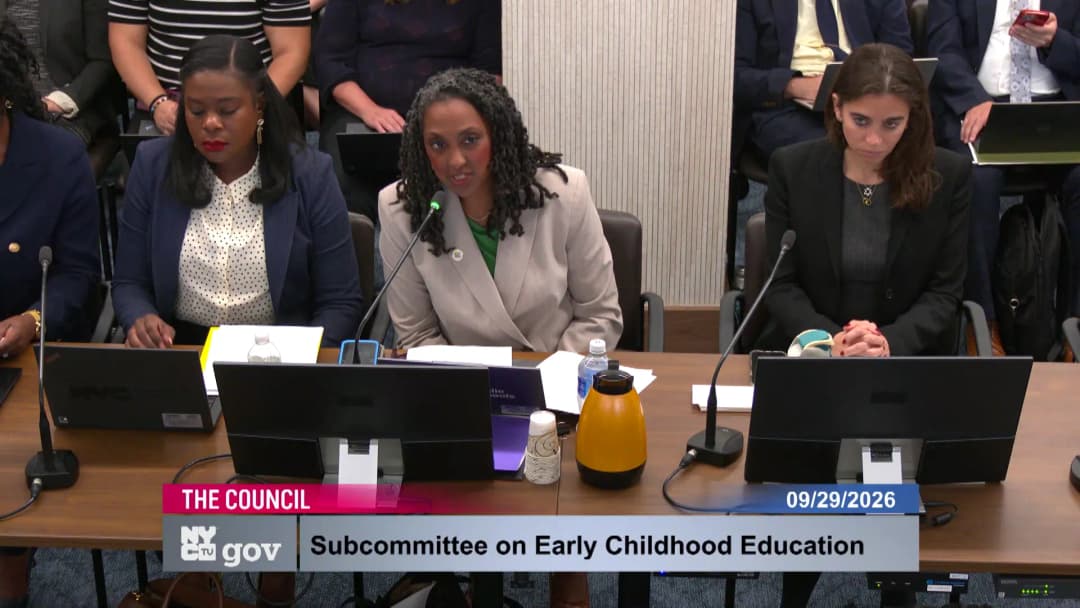
Subcommittee on Early Childhood Education Hearing on Supporting Multi-Language Learners – September 29, 2026

The Subcommittee on Early Childhood Education, chaired by Councilmember Jennifer Gutiérrez, held an oversight hearing on supporting multi-language learners (MLLs) in early childhood education programs and considered Resolution 0650-2026, which opposes a proposed federal rule requiring English-only instruction in Head Start programs. The hearing featured testimony from administration officials, the Independent Budget Office (IBO), and multiple community advocates. No votes were taken; the resolution was laid over by the subcommittee. Public Comments & Testimony - Emma Gossett (NYC IBO): Presented data showing 73% of New York City’s Head Start students (about 14,000) were dual-language learners in 2024–2025. She urged withdrawal of the proposed federal English-only rule, highlighting that it would undermine parent engagement, data reporting, and language access. - Karen Rogell (Cities First Readers): Emphasized the importance of play-based, culturally relevant early literacy programs for MLLs and invited councilmembers to visit their programs. - Albania Jimenez (Literacy in Community): Stressed that a child’s home language is foundational for learning and announced a planned workshop series, “Supporting Multilingual Homes,” to help families build on home language interactions. - Raquel Grammilla (Grandmother, former educator): Testified in favor of dual-language daycare and music programs, calling for stable funding so teachers can be paid. She spoke from experience with Nuestros Niños in Williamsburg. - Judy Blumenthal (Early Starters USA): Described trauma-informed safe spaces for newly arrived families and urged investment in community-based programs that support multilingual children and parents. - Abigail Leonard (Children’s Aid): Strongly supported Resolution 650, stating that multilingual support is integral to Head Start’s family-centered model and that English-only requirements would harm children and educators. - Betty Baez-Melo (Advocates for Children of New York): Called for more robust outreach, improved MySchools information on language supports, and addressed the gap in bilingual special education services: 65% of preschoolers with a right to bilingual instruction did not receive it in 2024–2025. - Joanne Derwin (One World Project): Described financial challenges in offering a high-quality dual-language pre-K program due to insufficient DOE funding. She urged equitable compensation for community-based providers. Discussion Items - Administration Testimony: Emmy Liss (Mayor’s Office of Childcare) and Deputy Chancellor Erica Phillips (NYCPS) outlined the city’s commitment to MLLs. They reported 30,058 MLLs in early childhood programs (pre-K: 12,725; 3K: 6,737; 2K: 581; infants: 15). They described 99 dual-language bilingual education sites across eight partner languages, with two new 3K dual-language programs (Spanish in District 15, Russian in District 31). They emphasized that all educators are expected to support MLLs through professional learning and coaching. - Q&A with Councilmembers: Councilmember Riley asked about workforce capacity; the panel noted 108 certified dual-language early childhood teachers. Councilmember Brewer raised concerns about language continuity from pre-K to middle school (e.g., Russian in District 3). The administration discussed bilingual revitalization efforts and data-driven expansion. Councilmember Gutiérrez pressed on funding: no additional per-pupil funding exists for dual-language pre-K/3K, though K–12 programs receive about $30 million annually. The administration acknowledged the need to strengthen the bilingual educator pipeline and expand access. - Resolution 0650-2026: The resolution, opposing the proposed federal English-only rule for Head Start, was discussed and laid over by the subcommittee. No vote was taken. Key Outcomes - Resolution Laid Over: Resolution 0650-2026 was heard and laid over; no vote occurred. - Data and Next Steps: The subcommittee received updated enrollment data and heard plans to expand dual-language 3K, strengthen data infrastructure, and improve language access. Councilmembers requested follow-up on specific schools and programs. - Advocacy Points Raised: Multiple speakers stressed the need for increased funding for community-based providers, bilingual special education services, and multilingual family outreach. The committee pledged continued collaboration. Note: The meeting was held on Tuesday, September 29, 2026, at 1:00 PM in Hearing Room 3, 250 Broadway, 8th Floor.

EDUCATION 71% · LANGUAGE ACCESS 19% · BUDGET 3% · DATA PRIVACY AND SECURITY 2%
4029
SEP 29, 2026 · NEW YORK CITY, NEW YORK · CITY COUNCIL
New York City Council Rules Committee Executive Session - September 29, 2026

The Committee on Rules, Privileges, Elections, Standards and Ethics convened at 10:30 AM on Tuesday, September 29, 2026, in Hearing Room 1 at 250 Broadway, New York, NY, for an oversight hearing (Item T2026-2449) pursuant to Council Rule Section 10.60. All nine committee members were present for roll call: Chair Sandra Ung, Shaun Abreu, Chris Banks, David M. Carr, Elsie Encarnación, Shekar Krishnan, Linda Lee, Kevin C. Riley, and Nantasha M. Williams. Motion to Enter Executive Session - Chair Sandra Ung stated that the committee was meeting pursuant to Section 10.60 of the Rules of the Council and that it was necessary to discuss confidential business. - She moved to enter executive session pursuant to Section 105 of the New York State Public Officers Law. - The motion passed by voice vote, and the committee proceeded into executive session. Key Outcomes - The committee entered executive session to discuss confidential business under Council Rule Section 10.60. - The oversight item (T2026-2449) was recorded in the official minutes as "Hearing Held by Committee" and "Filed, by Committee." - No public testimony, consent calendar items, or other business were conducted during the open portion of the meeting. - Note: The raw transcript identifies the chair as "Sandra Owen," while the agenda and official minutes identify her as "Sandra Ung"; this summary uses the name from the official agenda and minutes.

PROCEDURAL 100%
4030
SEP 29, 2026 · NEW YORK CITY, NEW YORK · CITY COUNCIL
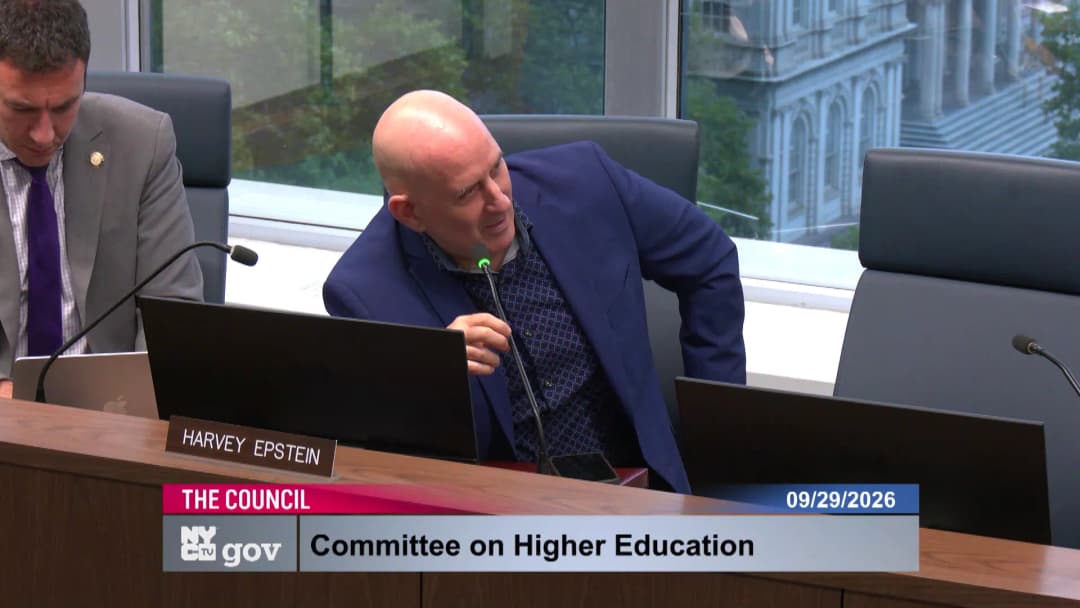
Oversight Hearing on CUNY Study Abroad Opportunities – September 29, 2026

The New York City Council Committee on Higher Education, chaired by Councilmember Rita C. Joseph, held an oversight hearing to examine study abroad programs at the City University of New York (CUNY). The hearing focused on program access, affordability, demographic participation, and strategies for expansion. Witnesses included CUNY administrators and faculty who provided detailed data on participation rates, student outcomes, and barriers. Witness Testimony - Kim Holland, University Director of Global Education and Initiatives, presented data from fall 2025 through summer 2026: 1,512 CUNY undergraduates from 15 campuses studied abroad in 49 countries. Of these, 89.1% participated in CUNY-sponsored programs, 24% in semester-long programs, and 75.9% in winter/summer intersessions. 72% were from four-year campuses, 28% from community colleges. She highlighted three program types: exchange, faculty-led, and affiliated programs. Holland noted that 16.9% of study abroad students used ePERMIT for cross-campus registration. - Stephen First, Executive Director of the Center for Global Engagement at the College of Staten Island, emphasized that study abroad is integral to CUNY's academic mission. He cited national data showing study abroad students have a 95.1% six-year graduation rate (30 points higher), are 6.2% more likely to graduate in four years (11.6% for first-generation students), earn 6.3% more ($4,000+) in their first job, and 52% pursue graduate degrees. He described barriers such as time constraints, curricular inflexibility, and finances, and noted that CUNY staff work with over 7,500 students annually (1,500 who go abroad, 1,500 who return, and 3,000 who cannot afford to go). - Professor Jessica Rothman of Hunter College described her Uganda-based wildlife conservation programs. She reported that 89 CUNY students (57 undergraduates) have participated. Students conduct field research on primates and wildlife, and many have gone on to prestigious fellowships (Fulbright, NSF graduate fellowships) and careers in science. She noted her programs serve underrepresented minorities, reflecting Hunter's 70% student of color population. Discussion and Questions Councilmembers explored several topics: - Recruitment and Awareness: Chair Joseph asked about informing students at admission. Holland noted it varies by campus; First described embedding study abroad in admissions materials at CSI. Joseph stressed the need for earlier messaging and peer ambassadors. - Career Readiness: Chair Joseph asked how returning students translate study abroad into job skills. First described new advising sheets connecting study abroad to workforce readiness and planned international internships. Rothman added that advisors help students craft resumes and identify skills. - Demographics and Equity: Holland provided demographics: 34.2% Hispanic, 11.7% Black, 4.5% multiracial, 27.4% White, 22% Asian among study abroad students; 48.7% Pell-eligible, but only 1.2% with public assistance history. Councilmember Epstein requested data on ASAP/SEEK program participants; Holland promised follow-up. - Funding: Councilmember Brewer pressed for aggressive pursuit of private and federal grants. First noted that $69.4 million in federal funding was rescinded the night before. Rothman said NSF grants are depleting. Brewer urged application to foundations. - Goals: Councilmember Dinowitz asked about specific enrollment targets. Holland said no system-wide goal exists, but CSI targets 10% of graduates to have international experience. Chair Joseph supported setting targets for underrepresented groups. - Domestic Study Away: Chair Joseph asked about programs outside New York. Holland mentioned a Queens College program but noted incomplete data. - Israel Programs: Councilmember Dinowitz asked about CUNY's relationship with Israel. Holland explained that a previous exchange program was sunset before October 7, and efforts to rebuild were paused due to safety. First confirmed CSI has agreements with Israeli universities ready to resume when safe. - Advertising and Outreach: First described multi-channel marketing (social media, email, fairs). Chair Joseph suggested convening community colleges to share best practices. - Student Stories: Rothman shared examples of students who went to Uganda and later earned PhDs and prestigious positions. First told of a student who became a Watson Fellow, Fulbright recipient, and Peace Corps acceptee. Key Outcomes - The committee filed the oversight report (per minutes). - Chair Joseph committed to working with CUNY to expand study abroad, particularly for underrepresented and community college students, and to pursue funding through public-private partnerships. - Councilmember Dinowitz requested follow-up on Israel program numbers and reaffirmed CUNY's commitment to such exchanges. - Councilmember Brewer directed CUNY to aggressively apply for grants and use platforms like Muse for scholarship promotion. - The chair indicated she would reach out to CUNY leadership to continue discussions on program expansion, funding, and creating a pipeline for anthropology students to work on local African burial ground projects.

HIGHER EDUCATION 77% · PUBLIC ENGAGEMENT 11% · STUDENT SUPPORT SERVICES 10% · PROCEDURAL 1%
OPENPUBLICA · PUBLIC MEETING INDEXUPDATED DAILY · openpublica.com