Browse by city
Date range
Search help

Search titles, summaries, topics and stored transcripts together. Keywords may match separately; put the whole query in double quotes for a phrase. Matching follows word analysis, so punctuation is not exact. Both dates are included. Documents are not searched.

SHOWING 201–210 ENTRIES
201
NOV 14, 2025 · ANCHORAGE, ALASKA · ASSEMBLY & COMMITTEE MEETINGS
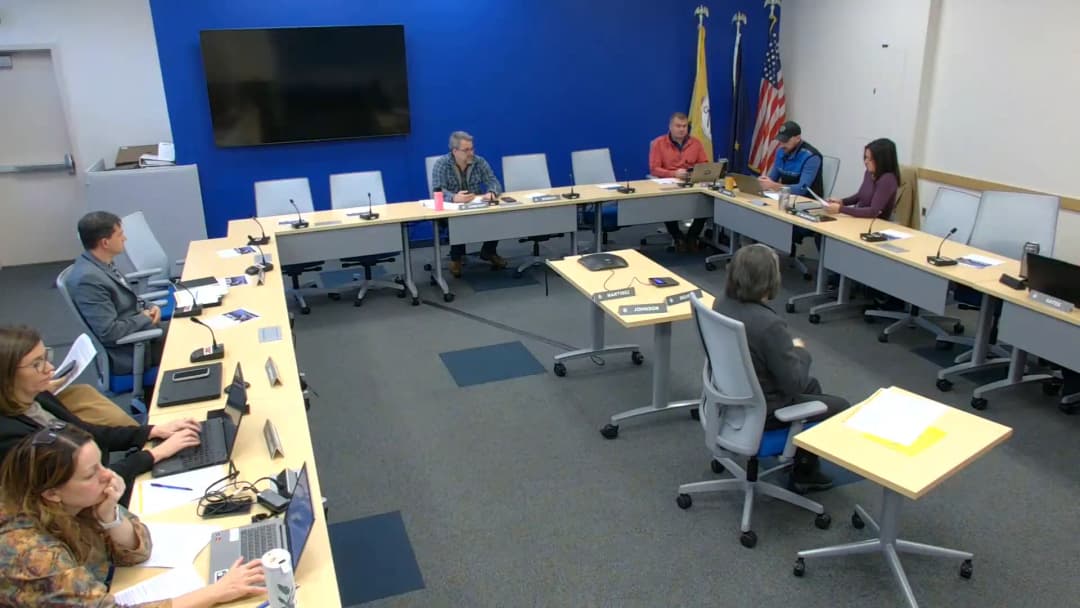
City Council Meeting Summary - November 14, 2025

The November 14, 2025, City Council meeting convened to discuss and address Ordinance Amendment AO 2025-128. This measure Amends Title 21, Chapters 2105 and 2115, to classify "shelter units" as allowable structures for specific land uses and to extend the time allowances for temporary use permits. The primary drivers for this amendment include expediting the "Recovery Residence" project at the Tudor campus and providing flexible temporary housing for evacuees from Western Alaska. The ordinance aims to streamline the permitting process by bypassing the Planning and Zoning Commission (PZC) review to ensure rapid deployment, while harmonizing zoning regulations with existing building code exemptions for these portable structures. Consent Calendar - No formal consent calendar items were presented in the transcript; the meeting proceeded directly to the discussion of the ordinance amendment. Public Comments & Testimony - Alison Lang (Municipal Attorney) and Daniel Kenna Foster (Longrange Planning) presented the ordinance details. Lang emphasized that the ordinance balances regulatory preservation with the need for nimbleness, noting that shelter units are exempt from building permits under AMC 23.110.0416 but remain subject to building code safety standards. She clarified that this is not intended to allow shelter units to be classified as "relocatable dwelling units," which are intended for permanent occupancy. - Councilor Baldwin Day requested that the presentation slides be uploaded to the city website for remote members, noting discrepancies in the Municode.org version regarding the Planning and Light Industrial (PLI) zone status. Discussion Items - Ordinance AO 2025-128 Details: The amendment permits shelter units (defined as small, portable, rigid structures) to be used for three specific use types: Habilitative Care Facilities, Transitional Living Facilities, and Homeless and Transient Shelters. It does not create a new use type in the use table but rather allows these specific uses to be physically implemented using shelter units. - Timeline Extension: Current code limits temporary uses to 90 days with one 90-day extension. The amendment is necessary because the Recovery Residence project and potential housing for evacuees require a duration significantly longer than 120 days to determine viability and stabilize residents. - Waiver of PZC Review: Council members inquired why the item was not referred to the Planning and Zoning Commission. Staff explained that bypassing the PZC was a strategic decision to accelerate the process from a potential six-month timeline to two months, addressing urgent housing needs for both the Recovery Residence project and Western Alaska evacuees. While acknowledging the loss of extended community notification and deliberation time, the council recognized the necessity of the urgency. - Use Table Clarification: Discussion clarified that while Habilitative Care (medium: 9-25 residents) recently became a permitted use (P) in the PLI zone via AO 2025-112, this ordinance allows shelter units to be built for those uses where they are permitted, rather than expanding shelter units into zones where those underlying uses are not allowed. - Future Standards: A council member suggested that while the code provides a broad extension policy, it would be wise to contemplate future standards to determine when a shelter unit has reached its useful end or begun to negatively impact the neighborhood, to be potentially added via director approval or future ordinance. Key Outcomes - The Council was briefed on AO 2025-128. The meeting concluded without a recorded vote on the final ordinance in this specific transcript segment; the item was referred for further action (implied by the statement "This item is before us Tuesday night," noting the next scheduled meeting). - Next Steps: The Planning Department committed to updating the presentation slides to reflect current Title 21 changes (specifically regarding the PLI zone) and uploading them to the website. - The ordinance seeks to allow shelter units under habilitative care, transitional living, and homeless shelter uses, exempting them from standard unit-specific zoning standards while relying on the Building Department for construction and safety compliance.

LAND USE PLANNING 60% · AFFORDABLE HOUSING 25% · PROCEDURAL 15%
202
NOV 14, 2025 · ANCHORAGE, ALASKA · ASSEMBLY & COMMITTEE MEETINGS
2025-11-14 Anchorage Council Legislative Program Work Session

This work session focused on reviewing the draft 2026 Anchorage Municipal Legislative Program, presented by Mayor's Office staff. The administration outlined prioritized state funding requests categorized under themes of Port Modernization, Public Safety (Safe), Infrastructure Resilience (Secure), and Affordability. Council members engaged in detailed discussion regarding the inclusion and exclusion of specific items,提出了 concerns about the balance of funding between surveillance and crime prevention, the prioritization of state park studies over wildfire infrastructure, and the omission of long-standing priorities like defined benefit restoration and education funding. Consent Calendar - No specific consent calendar items were presented or voted on during this work session; the focus was entirely on the discussion and potential amendments to the draft 2026 legislative program. Public Comments & Testimony - Council Member Johnson: Expressed skepticism that district priorities have historically been fulfilled, noting that the submission process felt like "going through the motions" despite submitting requests. However, the member acknowledged submitting basic needs such as pedestrian safety and infrastructure. - Council Member Silver: Stated that while the district submitted priorities, they felt the effort was performative given the low likelihood of state funding for district-specific projects in previous years, though they were open to both including and excluding them. Discussion Items Port Modernization & State Funding Context - Mr. Cloud (Administration): Identified Port of Alaska modernization as the top request, citing a need for $200 million in state investment to prevent surcharge increases that impact consumers. Noted the challenging state context with projected deficits of 1.4 to 1.5 billion dollars. - Council Member Johnson: Expressed strong support for the Port of Alaska funding request, identifying it as the significant financial request related to operations. Public Safety ("Safe") Priorities - Mr. Cloud (Administration): Presented requests including $1.5 million for the Anchorage Police Department (APD) real-time crime center, blight reduction/nuisance abatement, and inflation adjustment to the E911 surcharge. - Council Member Johnson: Strongly opposed the prioritization of the real-time crime center over blight reduction, arguing that the current split reverses priorities. The member contended that the city should mitigate the environmental conditions (vagrancy, drug use) that lead to crime rather than solely expanding surveillance tools. - Council Member Johnson: Expressed support for the blight reduction funding to address dangerous properties. Infrastructure & Security ("Secure") Priorities - Mr. Cloud (Administration): Listed a $250,000 request for a Chugach State Park Access study and increased rates for general relief in assisted living as key "Secure" items. - Council Member Baldwin Day: Expressed confusion regarding the prioritization of the Chugach State Park Access study under "resilience and infrastructure," questioning why it rose above other unfunded infrastructure needs. - Council Member Johnson: Expressed concern that the study is the only infrastructure request under "Secure" and suggested that funding for a wildfire "Firewise" program and wildland firefighting readiness should be prioritized to secure the urban wildland interface. - Mr. Cloud (Administration): Explained that the Chugach study was selected to guide future state-municipal investments in an area where bonding is not an option and to align with strategic state-municipal intersections. Affordable Housing & Education - Mr. Cloud (Administration): Outlined requests for a waste-to-energy project ($2 million), weatherization funding for mobile homes, and new financing mechanisms for attainable housing. - Council Member Johnson: Expressed deep concern regarding the removal of the "Restoration of Defined Benefits" and specific education funding requests. The member noted that these are perennial issues, with the Anchorage School District facing a reported $70 million shortfall, and argued they should remain in the program even without a specific dollar amount attached to maintain community advocacy. - Council Member Gates: Expressed agreement that defined benefits and education are critical workforce and community retention issues. - Council Member Kirker: Expressed support for the administration's decision to exclude the "Restoration of Defined Benefits" from the program, citing the high cost and the need for financial realism. District Priorities & CIP Integration - Council Member Johnson: Reported low response rates from districts regarding the request to submit priority projects, noting only one response had been received. - Council Member Silver: Argued that if the Legislative Program is to contain district projects, those projects must be included in the Capital Improvement Plan (CIP) to be fundable. The member warned that without CIP inclusion, projects fall through the cracks of the state funding system (CAPSIS). - Council Member Ross: Acknowledged the need for CIP inclusion but noted procedural flexibility exists to amend the CIP and budget to enter projects into CAPSIS if they are extraordinary, though this places a burden on limited staff. - Mr. Cloud (Administration): Discussed the potential to expand the document length to include district priorities but noted the risk of the document becoming too long ("TLDR") based on legislative feedback. Procedural & Formatting - Ms. Van Clause: Noted the legislative program must be introduced before the budget adoption to comply with code and suggested adding it to the addendum for a December vote to allow time for amendments. - Council Member Johnson: Requested that members draft amendments for the upcoming Legislative Committee meeting on November 19th. Key Outcomes - Agreement to Receive Amendments: The Assembly agreed to solicit amendments from members for discussion at the Legislative Committee meeting scheduled for November 19, 2025. - Deadline Established: Staff (Ms. Benaclos or Mr. Johnson) will communicate specific deadlines for members wishing to add items to the project. - Process Clarification: Discussion concluded that for district priorities to be fundable, they ideally must be in the CIP, though administrative staff can assist in entering extraordinary items into CAPSIS if necessary to avoid them falling through the cracks. - Draft Status Confirmation: The administration confirmed the draft 2026 Legislative Program was introduced in a timely manner, allowing for the subsequent amendment process before budget adoption.

LEGISLATIVE SERVICES 66% · PROCEDURAL 14% · PUBLIC SAFETY 6% · PUBLIC ENGAGEMENT 6%
203
NOV 14, 2025 · ANCHORAGE, ALASKA · ASSEMBLY & COMMITTEE MEETINGS
2025 Anchorage City Assembly Retreat Meeting Summary (November 14, 2025)

The Anchorage City Assembly convened on November 13, 2025, for a strategic retreat at the CH2M Hill boardroom in the Car Goldstein building. The meeting served three primary purposes: addressing recent misinformation regarding the city's election systems, conducting a collaborative work plan and goal prioritization exercise, and discussing the long-term sustainability of assembly capacity and workload. Assembly members emphasized the need to balance individual legislative passions with institutional duties while acknowledging the unique challenges of the non-professionalized, part-time legislative model. Consent Calendar - No routine consent calendar items were presented or approved during this working session; the meeting focused exclusively on discussion and strategic planning. Public Comments & Testimony - Public Misinformation Regarding Elections: Jamie Hines (Municipal Clerk) addressed a New York Times article that the Assembly received, which contained what she described as "misinformation wrapped around in bad information, wrapped around in political activism." - Speaker Position on Election Security: Jamie Hines expressed that the article was a "political play" and a "disgraceful, deeply offensive coverage" by an "activist" aimed at pushing a "vote by phone" agenda which was never the Assembly's intent. - Clarification of Systems: Hines and Council Staff clarified that the city is not piloting "vote by phone" or a "mobile voting" system. Instead, a secure document portal (Democracy Live) piloted in 2025 allows voters to download a ballot via a secure link using a personal identifier (like a Social Security number last word) after signing a paper application. This system avoids the security risks of email voting, where ballots are printed on standard paper and processed as facsimiles. - Speaker Position on Article Accuracy: Hines stated she and Council Staff carefully crafted their comments, but "pretty much none of what we said actually made it into the article." She expressed regret over the misinformation but affirmed that no move to "vote by phone" has ever been authorized or planned. - Call for Education: Council members expressed a collective interest in using this moment to educate the public and candidates. A decision was made to hold a physical work session at the election center in December to allow reporters, candidates, and the public to witness the actual processes firsthand, including the secure document portal workflow. Discussion Items - Election System Misinformation: The Assembly discussed the implications of the New York Times article. Members noted that while the system (Democracy Live) has been used for over a decade in 36 states and 2,500 jurisdictions, the article's portrayal implied a shift to phone voting that was never intended. Council members agreed that future communication must clearly distinguish between the secure document portal and a potential "vote by phone" system. - Work Plan and Goal Prioritization: Staff presented a "World Cafe" style exercise where members brainstormed priorities across four buckets: Housing Action, Energy Infrastructure & Transportation, Public Health & Safety, and Good Government. - Housing Action: Members debated the Assembly's role in the Mayor's goal of 10,000 homes, debating whether the Assembly should drive specific zoning changes or support the administration's roadmap. There was discussion on the need for a housing dashboard to track real-time progress and identify bottlenecks in the permitting process. - Public Health and Safety: Members discussed the intersection of public health and safety, specifically regarding human trafficking, illegal drug use, and the need for integrated data collection systems. There was a specific mention of requiring high-risk businesses (e.g., massage parlors, bars) to register and undergo labor verification to prevent trafficking. - Infrastructure and Transportation: The Assembly discussed the utility undergrounding project and the role of the DOT regarding pedestrian facilities. Members expressed concern about the underfunding of rural pedestrian infrastructure and the need for better accountability regarding snow clearing of sidewalks and bus stops. - Capacity and Workload: A significant portion of the meeting was dedicated to the sustainability of the Assembly's workload. Members highlighted the tension between the expectation of a "full-time" job and the part-time nature of the role, noting that many qualified candidates are excluded due to financial constraints. Members discussed the proliferation of work sessions versus committee meetings, with some advocating for fewer, longer sessions and others noting the difficulty of coordinating schedules for working parents and those with outside employment. - Institutional Culture: Members expressed a desire to maintain a culture of collaboration while respecting individual autonomy. There was a recognition that the Assembly is a "fragile" system built on voluntary service, and that exceeding charter bounds while maintaining strength is a constant challenge. Key Outcomes - Prioritized Areas: Members identified four primary strategic focus areas for the upcoming year: Housing Action, Energy Infrastructure and Transportation, Public Health and Safety, and Good Government. - Sticker Vote Results: During the prioritization exercise, members used stickers to weight their interests. High-priority items identified included: - Elections: "Continue to steward election" and "Revise AMC 240" (Community Council code). - Data: "Continue to champion integrated systems, data collection dashboards, and allocate money for it" (received two stickers). - Housing: "Communicate progress towards housing and addressing homelessness." - Infrastructure: "Waste to energy and other renewable and energy projects" (received three stickers, the highest count). - Safety: "Pre-arrest diversion to public health services" and "Business permitting, high risk registration." - Action Plan: Members agreed to review the brainstorming notes, remove completed items, and finalize a work plan document to be returned to the Assembly. Members were asked to sign their names next to specific initiatives they wish to champion or support. - Future Work Session: A work session on election procedures (including the secure document portal) is scheduled for December at the election center to be attended by reporters and candidates. - Staff Acknowledgement: The Assembly collectively expressed gratitude for the staff's role in managing the workload, organizing agendas, and providing research, acknowledging that the legislative branch functions effectively due to their support.

MISCELLANEOUS 16% · MEETING PROCEDURES 15% · STRATEGIC PLANNING 14% · PUBLIC ENGAGEMENT 10%
204
NOV 14, 2025 · ANCHORAGE, ALASKA · ASSEMBLY & COMMITTEE MEETINGS
Public Safety Advisory Commission Meeting - Nov 14, 2025

On November 14, 2025, a facilitated discussion was held to assess the collective perspective on creating a reimagined public safety commission. The meeting was explicitly framed as a consensus-building exercise to ground the group in facts, reflect on emotional responses, and interpret the meaning of the data gathered, rather than making final policy decisions. Facilitator D'Anna Daniels emphasized that while alignment would be sought, final recommendations would be presented to policymakers for approval. Consent Calendar - No formal consent calendar items were processed; the session was dedicated to facilitated dialogue and the ORID (Objective, Reflective, Interpretive, Decisional) process. Public Comments & Testimony - Speaker Position: The Alaska Civil and Human Rights Coalition expressed strong support for an independent body that is separate from the police department and municipality, emphasizing the need for statutory stability to prevent political disbanding. - Speaker Position: A police department employee (ESA) expressed concern that focusing solely on policing limits the scope; they emphasized that public safety is holistic. They argued that officers are community members and stakeholders who face their own systemic challenges, such as responding to mental health calls without adequate training. - Speaker Position: A military veteran and mother of a black son expressed that the community does not feel safe and that the current system fails to address survival needs like homelessness and food security. They argued that true safety requires separating law enforcement from outreach and addressing trauma cycles. - Speaker Position: A representative noted that while many stakeholders support the concept of a commission, there is significant skepticism regarding whether the body will have genuine authority or if it will be advisory without power to shape policy. - Speaker Position: A speaker highlighted the necessity of compensation for volunteers to ensure true community representation, noting that unpaid participation excludes working-class voices. - Speaker Position: A speaker expressed frustration with the shortened timeline, questioning the adequacy of only one remaining meeting to reach consensus given the complexity of the issues. - Speaker Position: A speaker emphasized that trust must be built through transparency and that the commission must have the authority to review incidents after the fact, not just advise on policy. Discussion Items - Nature of Authority: Participants debated whether the commission must be legally independent (enshrined in the municipal charter) versus merely advisory. A consensus emerged that a purely advisory role may lack the necessary "teeth" to effect change, while a fully separate body might lack official capacity. The enabling ordinance was identified as the critical mechanism to define duties and independence. - Scope of Public Safety: The group discussed redefining public safety beyond policing to include homelessness, road safety, mental health, and healthcare. A speaker noted that officers are currently responding to calls outside their training, indicating a mismatch in resources. - Representation and Compensation: It was noted that the current meeting attendees do not fully represent the most marginalized voices (e.g., those experiencing homelessness). Participants argued that compensation is necessary to ensure diverse participation and that specific representation quotas or constraints may need to be codified. - Trust and Humanity: Speakers collectively expressed that the core driver for this commission is the lack of trust between the community and law enforcement. There was an emotional appeal to recognize the humanity of both residents and officers, and to acknowledge that the current system often fails to treat residents as people. - Funding and Logistics: A speaker raised concerns about the fiscal notes, warning that creating a new independent body is expensive and must be weighed against a flat municipal budget. The need for a sustainable funding source was identified as a key factual constraint. Key Outcomes - Status of Decisions: The group explicitly agreed that no final decisions on the commission's structure, charter status, or authority would be made during this session. The outcome is a set of themes and clarifications to inform draft high-level recommendations. - Next Steps: The facilitation team will synthesize the discussions, sticky notes, and previous submissions to draft high-level recommendations to be presented at the final meeting or to the City Assembly. - Live Poll Result: A live poll was conducted to gauge support for a public safety advisory commission; the aggregate response showed a majority of the room strongly supporting the establishment of such a body. - Identified Themes: Key themes for the next phase include the need for an independent but integrated body, the necessity of a robust enabling ordinance, the importance of holistic public safety, and the critical role of trust, transparency, and compensation. - Discrepancy Note: A participant noted that the official proposal submitted by the Alaska Coalition for Justice was not discussed in detail, which they felt was a missed opportunity, though the facilitator acknowledged the proposal is part of the background data.

PUBLIC SAFETY 57% · COMMUNITY ENGAGEMENT 16% · MEETING PROCEDURES 11% · POLICE ACCOUNTABILITY 11%
205
NOV 14, 2025 · ANCHORAGE, ALASKA · ASSEMBLY & COMMITTEE MEETINGS
Public Naming Commission Meeting - November 12, 2025

The Public Naming Commission convened for its meeting on November 12, 2025, to review indigenous naming policies from Alberta and Edmonton, strategize for an upcoming joint meeting with the Native Village of Oclutna (Aknutna), and confirm the 2026 meeting schedule. The meeting featured a detailed presentation on best practices for indigenous engagement, followed by discussions on protocol development, recruitment of tribal representation, and administrative logistics. Consent Calendar - The agenda was approved unanimously following a motion by Member Selma and a second. - The minutes from the October 9th meeting were approved unanimously following a motion and a second. Public Comments & Testimony - No specific public comments or testimony from external community members were recorded during this session; the discussion regarding "public" input was limited to internal deliberations about engaging with Oclutna and Parks & Rec. Discussion Items - Indigenous Naming Pathway Policy Consultation: Kevin presented a comparative analysis of naming policies from Alberta and Edmonton. He highlighted that Alberta treats indigenous names as intellectual property and prioritizes proposals from nations, while Edmonton utilizes an Indigenous Naming Advisory Circle for co-designing pathways. Kevin emphasized that policies must empower indigenous nations to appoint their own representatives rather than the municipality assuming representation. - Honoraria and Tax Implications: Commissioners advised caution regarding honoraria for indigenous knowledge keepers. It was noted that payments exceeding a specific threshold could trigger 1099 tax reporting, potentially affecting elders' eligibility for essential programs like meals on wheels. The group recommended balancing fair compensation with careful accounting of annual payment totals. - Strategic Preparations for Oclutna Meeting: The commission discussed a joint meeting scheduled for December 11, 2025. Objectives identified include inviting an Oclutna representative to join the Commission's seat and learning about Oclutna's existing consultation processes. There was a consensus to split the presentation among multiple commissioners to cover the Commission's purpose, the research findings, and the recruitment pitch. - Parks & Rec Engagement: A meeting with Anchorage Parks & Recreation was proposed for the December session to foster relationships and discuss naming guidelines. - 2026 Calendar: The commission confirmed that the regular meeting schedule (second Wednesday of the month) will remain in place for 2026, with virtual attendance options available for members with changing schedules. - Commissioner Residency Update: Commissioner Jen announced that while she is currently seeking employment outside Anchorage, her primary residence remains in the municipality, ensuring her continued eligibility to serve on the commission as per municipal code. Key Outcomes - Adoption of Schedule: The commission maintained the current meeting schedule (second Wednesday of the month) for 2026. - Meeting Strategy Formulated: A specific strategy was agreed upon for the December 11th joint meeting with Oclutna: a 5-minute presentation divided among commissioners to explain the Commission's purpose, share research recommendations, and recruit a tribal representative. - Recruitment Goal: The commission prioritized the objective of securing a designated seat for the Native Village of Oclutna (Aknutna) on the Public Naming Commission. - Administrative Task: Commissioner Jenny is drafting the minutes, with a plan to include the research recommendations in the meeting packet for the December session. - Adjournment: The meeting was adjourned unanimously, with the next session scheduled for the second Wednesday of December (subject to the holiday schedule).

NATIVE RIGHTS 36% · PROCEDURAL 33% · PUBLIC ENGAGEMENT 31%
206
NOV 14, 2025 · ANCHORAGE, ALASKA · ASSEMBLY & COMMITTEE MEETINGS
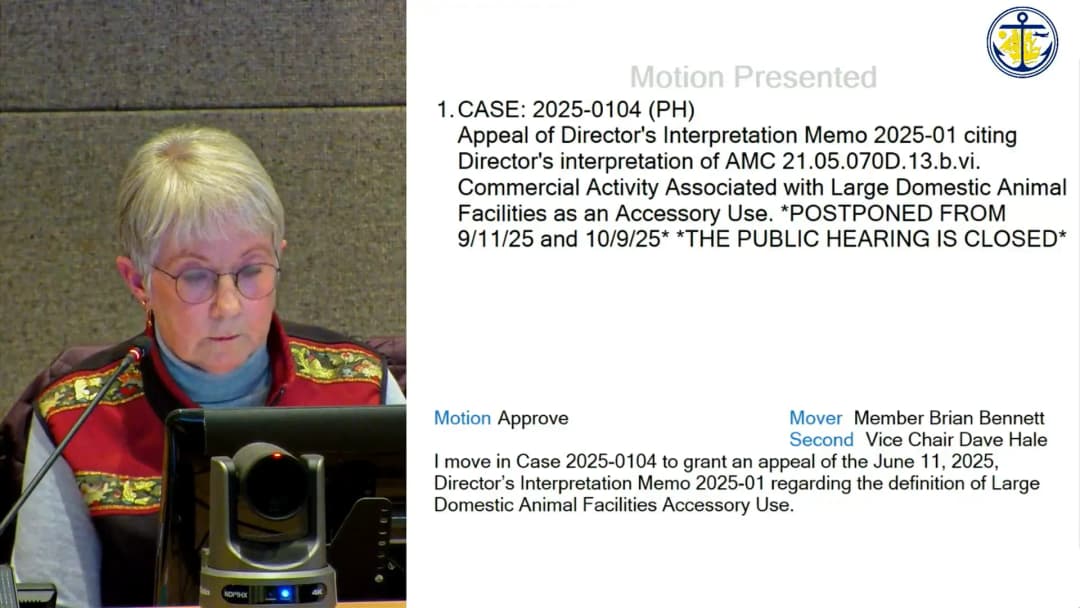
City Council Meeting on Large Domestic Animal Appeal (2025-11-14)

The City Council convened to continue mid-discussion on Case 2025-0104, an appeal regarding the sale of hay and feed as a commercial activity within a Large Domestic Animal Facility (LDAF). Board members Lang and Hale recused themselves from previous related votes but participated in this session. The primary deliberation focused on whether the Director's interpretation, which limits sales to animals physically present on the site, aligns with the municipal code allowing "commercial activity associated with" the facility. Consent Calendar - The agenda item regarding a specific resolution was moved to the next regular meeting due to insufficient voting members present during the original hearing. Public Comments & Testimony - Supporters of the Appeal: A total of 34 community members (21 in attendance and 13 via written correspondence) expressed support for the appellant, arguing that the Director's interpretation ignores the plain meaning of "associated" and restricts necessary resources in an area with thousands of horses but only three hay suppliers. - Supporters of the Director's Decision: Legal staff and Board members argued that the proposed operation functions as a standalone retail business incompatible with residential zoning, noting that the code requires commercial activities to be incidental to the animals at the facility, not general retail for the public. Discussion Items - Commercial vs. Retail Distinction: Board member Lang and others questioned the scale of operations, noting that selling multiple bales of hay to the general public constitutes retail, not an accessory use. Vice Chair Hale expressed concern that advertising tack and t-shirts commercially shifts the entity's nature beyond an LDAF accessory use. - Scale of Operations: Board member Craig Bennett highlighted that the site's size allows for 12-15 animals, while the scale of hay sales implied by public testimony suggests a volume beyond a residential area. - Code Interpretation: Board member Norris argued that the Director's interpretation is consistent with the code, asserting that once items leave the site (like hay or tack without specific animal assignment), the tie to the principal use is broken. However, Norris also noted that the community had grown dependent on the existing three locations, suggesting a reduction to two might harm the public good. - Proposed Cutoff: Board member Hale and staff discussed a potential cutoff where selling a small amount (e.g., a quarter bale) for the direct care of boarded horses is permitted, whereas selling multiple bales to trucks constitutes an unallowed retail use. - Recusal Statements: Mr. Hale and Mr. Lang formally stated they were recused from participating in the initial case 2025-0113 and abstained from prior votes, but participated in the current discussion after reviewing the previous meeting's video. Key Outcomes - Vote Result: The motion to grant the appeal failed with a 3-3 tie. - Final Decision: The appeal is denied, and the Director's interpretation (that the sale of hay and feed must be related to animals at the facility and not constitute general retail) is affirmed. - Recusal: Mr. Craig Bennett cast a vote in opposition to the appeal, noting the significant community support but finding the use incompatible with the residential zone code.

LAND USE PLANNING 77% · PROCEDURAL 23%
207
NOV 7, 2025 · ANCHORAGE, ALASKA · ASSEMBLY & COMMITTEE MEETINGS
2025-11-07 Work Session on Community Council Boundary Review

A work session was held to present the Planning Department's findings regarding the decennial review of community council district boundaries (Code 2.4.040). Senior Planner Tom Davis outlined the three-phase public process, which included questionnaire surveys, advisory committee deliberations, and review by the Planning and Zoning Commission. The session involved extensive deliberation on the criteria for boundary changes, specifically addressing the tension between "natural communities" and public desires for equitable representation and population balance. Consent Calendar - No routine consent calendar items were discussed during this work session; the meeting focused exclusively on the boundary review reports. Public Comments & Testimony - Ms. Subvers (Public Commenter): Expressed strong opposition to the proposed methodology and results. She noted that while 14 public comments from the Northeast Community Council requested a split due to the area being "too large" and "disjointed," the recommendations ignored this desire. She argued that the process failed to address "adequate representation" by transferring population from the University Community Council rather than addressing the natural boundary of the Dabar river or creating new councils. She stated, "I'm not really supportive of the methodology, I'm not really supportive of the results. I think it's flawed." - Mr. Davis (Senior Planner): Clarified that community councils are independent nonprofits and the code does not authorize the assembly to break up a council without a petition from a group of residents following a specific process. He advised that the recommendation should be to support a future petition if one is formally brought forward. - Council Member [Unnamed, likely District 72 or similar]: Expressed that the process feels like a missed opportunity to create equity, noting that the disparity in population (e.g., Northeast at 30,000 vs. Scenic Foothills being too small) creates difficulties for self-organization. They questioned if the committee considered future code parameters to allow for population parity. - Council Member Dean: Raised concerns about the lack of a scoring rubric or quantitative scale to objectively assess boundary criteria, noting that the current case-by-case approach may lead to inconsistent results. He expressed a clear intent to propose an amendment to establish a priority scale for future processes. - Council Member [Unnamed, regarding South Edition/North Star]: Commented on the "Valley Park" boundary study area, arguing that the current boundary divides the park between South Edition and North Star. From an equity standpoint, they supported the South Edition's position to retain the parcel, noting that South Edition is significantly "park-rich" while North Star has minimal park access. Discussion Items - Criteria for Boundary Changes: Discussion centered on the municipal code definition of "natural communities" (areas divided by physical/traffic barriers, common interests, or common identity) versus the implicit desire for population balance. - Staff confirmed that population was a secondary factor used to evaluate sustainability (e.g., ability to fill officer positions or reach quorum), but not a primary driver for redistricting like in electoral maps. - The committee identified 12 specific boundary study areas for recommendation to change. Staff noted that in most cases, the maps are being overhauled for accuracy (software updates) rather than moving lines, except for specific areas where public comment warranted change. - Northeast Community Council Issues: Intense discussion occurred regarding the Northeast district, which covers 30,000 people. Public comments requested splitting the area along the Dabar river, which aligns with assembly districts. The committee recommended retaining existing boundaries but suggested that if a group pets to form a new council, the assembly should support creating a new boundary along the Dabar. - Coastline Boundary Adjustment: Staff explained the proposed shift from "mean low tide" to "mean high tide" for coastal community councils (e.g., Sand Lake). This change was recommended because the low tide line is inaccurate, fluctuates significantly with tides, and is not a usable feature. Staff clarified that DNR regulations, not the community council boundary, control leases in the tideland areas, and public notice for those areas is handled via a state online system. - Boundary Advisory Committee Composition: Questions were raised about how the 12-member committee was formed. Staff explained that members were recruited based on geographic representation and experience. They noted that while some members were leaders of existing community councils, the committee took their role seriously and acted in the interest of the broader code criteria rather than just self-interest. - Park Proximity and 1,000-Foot Margins: Clarification was provided that community council boundaries do not limit participation in projects nearby. Staff and Parks & Recreation operate on a 1,000-foot margin, treating all councils within that radius as equal partners. - Timeline and Process: There was a discrepancy regarding the duration of the process. One member stated it was a "three-year process," while Staff clarified the active phase was approximately "one and a half years" since the previous reapportionment, though it is now seven years until the next mandated review. Key Outcomes - Recommendation Status: Staff presented a recommendation for the Assembly to consider 12 boundary study areas for change. The proposed maps (Exhibit A) generally retain current boundaries but with updated digital accuracy, with exceptions for specific areas like Valley Park (no change recommended but debated) and the Dabar river area (recommendation deferred unless a petition is filed). - Coastal Boundary Update: A change in the legal definition of coastal boundaries from mean low tide to mean high tide is recommended to improve map accuracy and clarity. - Future Process Improvements: Council Member Dean proposed an amendment to the ordinance to establish a "priority scale" or rubric for boundary criteria before the next phase one process begins. - Next Steps: The Assembly is not scheduled to vote immediately; a formal public hearing and deliberation are required before any motion to adopt the boundaries can be made. Staff offered to provide data on alternative scenarios (e.g., population impacts of other boundary lines) if the Assembly wishes to investigate further.

COMMUNITY ENGAGEMENT 47% · URBAN PLANNING 35% · PUBLIC ENGAGEMENT 9% · PROCEDURAL 4%
208
NOV 7, 2025 · ANCHORAGE, ALASKA · ASSEMBLY & COMMITTEE MEETINGS
Anchorage Assembly Work Session: 2025-2026 Budget & Amendments (Nov 7, 2025)

The Anchorage Assembly convened for a work session to finalize the 2026 municipal budget and review a wide array of proposed amendments across operating and capital budgets. The session addressed technical streaming issues at the start, followed by a review of the Legislative Branch budget, which was largely flat aside from specific salary adjustments for the Ombudsman's office. The majority of the meeting was dedicated to discussing over 20 amendments regarding operational efficiencies, public outreach funding, and significant capital improvement shifts, particularly concerning the CASA process and ARTS A bond allocations. Consent Calendar - No specific routine consents were formally taken; the Assembly proceeded directly to budget briefing and amendment discussions. - Technical issues regarding the YouTube stream and calendar links were noted and addressed administratively, but no formal consent items were voted on. Public Comments & Testimony - Elders/Community Members: A group of five to six elders testified at the Transportation Committee meeting (cited by Council members) to express strong support for expanding free bus ridership to seniors (65+). Discussion Items - Legislative Branch Budget: - The budget for the legislative branch (Assembly, Clerk, Ombudsman) was presented as relatively flat overall, with a 13% increase attributed to a salary raise and benefit additions for the Ombudsman. - Positions: Member Perez Verdillo and Member Baldwin Day expressed concern that the Assembly had not engaged in a comprehensive, internal budget discussion or strategic planning review comparable to executive departments, urging a more robust future process to understand budget drivers and service capacity. Chair responded that such discussions occur via strategic planning and budget/fiscal committees, but acknowledged the need for better visibility. - Operational Budget Amendments (Speaker Positions): - Member Ballard: Supported the removal of $125,000 from the marijuana tax pilot projects to fund "Best Beginnings," characterizing it as an important early literacy program. - Members Girker, Myers, and McCormick: Proposed a series of cuts categorized as operational efficiencies, targeting funds for duplicative services and unfunded vacant positions. - Member Girker explicitly positioned these cuts as necessary to avoid hitting the tax cap, to reduce the size and scope of government, and to free up funds for the upcoming AMEA contract, asserting that non-essential travel, dues, and furniture refurbishment should be eliminated. - Speaker (Girker) expressed opposition to the Office of Equity and Justice (OEJ) as a separate department, arguing its functions are duplicative of HR and should be absorbed there. - Speaker (Girker) expressed position that eliminating the locally funded staff for the Equal Rights Commission is fiscally prudent given the existence of a state-level commission, though the charter mandate for the commission itself would remain. - Speaker (Girker) stated that cuts to vacant, funded, non-recruited positions should be prioritized as they do not impact service delivery. - Wildland Fire Amendment: - Sponsors (Baldwin Day, McCormick, Perez Verdillo): Expressed strong support for operationalizing the wildland fire division within the fire department. They positioned this as a necessary necessity to protect against wildfire threats, arguing the city was "lucky" not to have seen a major event in the last 15 years and that the amendment leverages existing federal grants to avoid municipal burden. - Comprehensive Plan Update: - Member Baldwin Day: Proposed $50,000 to contract out the planning process for a comprehensive plan update, aiming to complete it in under 18 months. They expressed support for this approach to overcome the inefficiencies of the current internal process and ensure efficient land use decisions. - Free Bus Ridership: - Members Baldwin Day, Martinez, and others: Proposed $100,000 to expand free bus ridership to seniors (65+) by adding one extra day. They expressed full support for this expansion based on public feedback and potential infrastructure savings from reduced single-occupancy vehicles. - Alcohol/Marijuana Tax Education: - Member Girker: Proposed moving $30,000 for alcohol and marijuana tax education to the Health Department. They expressed support for this shift to improve public accountability and communication. - Austin Quinn Davidson (ACE Fund): Expressed support for the communication work but suggested it could potentially be covered within existing administrative line items without a specific amendment amount. - Fiscal Future Funding: - Member Girker: Proposed $30,000 to continue fiscal future discussions and public education on the budget, noting it helps bring more people (including those needing child care) into the civic conversation. - Parks & Rec Labor Amendment: - Member Girker and Brawley: Proposed converting seasonal horticulture positions to full-time roles to improve recruitment and retention. They expressed support for this net-neutral change to reduce administrative churn and address workforce abuse. - CASA (Community Area Safety Act) Amendments: - Member Ballard: Supported a zero-out of specific out-year CASA projects (road service areas) to force a review by a newly formed working group, stating this is a "process-specific" objection rather than an objection to the projects themselves. - Member Ballard (later): Proposed moving specific projects (Basher Trailhead, Lower Cabin Trail) to 2026 and delaying the Basher Road Upgrade to 2027 to prioritize existing work. They expressed support for delaying the CIP list to allow the collaborative group to define priorities. - Member Ballard: Proposed $300,000 for the Downtown Anchorage Wayfinding Project. They expressed support for continuing the project, noting it fills a gap in the current bond proposal. - Member Ballard (ARTS A): Proposed several ARTS A bond additions, including $5.1 million for Tasha Drive and $500,000 for Turnigan Street. They expressed support for these as high-priority district projects and recommended doubling pavement rehabilitation funds citywide to maintain infrastructure. - Member Ballard (Stormwater): Moved a stormwater project from 2027 to 2026, expressing support for addressing urgent flooding issues in a specific cul-de-sac. - Member Ballard (Chip Sealing): Proposed $1.2 million for purchasing chip sealing equipment. They expressed support for this as a cost-effective method to address deferred roadway maintenance, noting the municipality lacks the equipment but has the staff. Key Outcomes - No Voting Action Taken on Amendments: The session was designated for discussion and clarification. No amendments were voted on during the work session; they are to be repackaged and brought to the floor in future meetings. - Process Directives: - Chairman directed staff (Mr. Farina) to regroup amendments by topic (operating budget, tax education, CIP) while preserving amendment numbers. - Council members are encouraged to review and send additional amendments to staff for consolidation into an omnibus file. - Staff to provide a deeper historical analysis of the Legislative Branch budget and the specific positions in the "vacant, non-recruited" list upon request. - Staff to verify the charter mandate requirements for the Equal Rights Commission and provide a legal analysis before any vote occurs. - Chair to coordinate with OMB regarding caps and guidance on the ARTS A bond allocations. - Deferred Topics: The status of the I Street Stairs removal/replacement project was flagged for future administrative review but not resolved. - Budget Context: It was confirmed that the Wildland Fire amendment would be budget-neutral regarding the tax cap due to existing grant funding through 2027.

BUDGET EQUITY ANALYSIS 38% · PUBLIC ENGAGEMENT 15% · LAND USE PLANNING 10% · FISCAL SUSTAINABILITY 8%
209
NOV 5, 2025 · ANCHORAGE, ALASKA · ASSEMBLY & COMMITTEE MEETINGS
Anchorage Public Health & Safety Committee Meeting Summary, November 5, 2025

The Anchorage Public Health and Safety Committee convened at 10:45 AM on November 5, 2025, to review critical updates regarding fire station coverage, the ongoing response to the 2025 Western Alaska storms, WIC funding stability, and new police drone policies. Major discussions focused on addressing response time gaps in underserved areas, the logistical successes and future plans for storm evacuees, potential funding lapses for the WIC program, and the implementation of a new drone-as-first-responder program with strict privacy safeguards. Consent Calendar - No specific consent calendar items were explicitly listed or voted on as a separate group in this transcript segment. Public Comments & Testimony - Jamie Lovis expressed strong concern regarding the disparity in care between the evacuees and those left behind. They argued that while the city provided excellent shelter and services (including shower trailers and pet care) to evacuees, vulnerable people on the streets are facing a crisis without adequate response or resources. - Lovis also raised privacy and accuracy concerns regarding the new drone program and License Plate Readers (LPRs). They argued for transparency on data retention, questioning if data will be used for predictive analytics or profiling. Lovis expressed skepticism about the efficacy of drone collision avoidance technology, suggesting current Class C airspace requirements should be sufficient to ensure safety for small aircraft. Discussion Items Fire Department Response Time & Coverage - Doug Sharagi (Fire Dept) presented data from 2024 indicating a 39% increase in Basic Life Support (BLS) calls and a 24% increase in fire calls over the last decade. He highlighted that lower-acuity calls are taking a larger share of the volume, likely due to residents using 911 as primary care due to insurance gaps. - Position on Coverage: Sharagi expressed serious concern about underserved areas west and east of Station 12 (Potter Valley and Psycho Gate Heights), noting that these areas fall within blue zones (8-10 minute drive times) with high call densities. He argued that Station 12 is not ideally located and recommended a plan to relocate Station 12 to the east and add one new station to the west to better serve the population. - Committee Inquiry: Members asked about the distinction between driving time and response time, and whether station locations have historically shifted with population growth. It was noted that only a few stations have moved, while the majority remain at legacy locations. 2025 Western Alaska Storm Response - Amanda Loach (OEM Director) and Sean McKenzie (EOC Liaison) provided an update on the response to Typhoon Halong. They reported the successful evacuation of over 1,500 residents, with 655 flying to Anchorage. 100% of evacuees at congregate shelters (Egan Center, Alaska Airlines Center) were transitioned to non-congregate hotel rooms. - Outreach Support: The committee heard details on the pet rescue mission, where 175 dogs were rescued and 52 flew to Anchorage, with 24 placed in foster care. A dedicated website was established to reunite pets with owners. - Reimbursement: An MOU between the state and municipality was signed on November 3rd to cover municipal expenses. Members expressed gratitude for the inter-agency collaboration. WIC Funding & Federal Shutdown - Anchorage Health Department reported that due to the federal government shutdown, WIC funding is at risk. New federal Section 32 funds have provided a temporary bridge, but projections indicate staff funding will end on December 4 and food benefits on December 16. - Contingency Plan: The department presented a plan to purchase and distribute 6,084 cans of infant formula monthly at a projected cost of $183,000 (excluding tax and storage), served by a team of 12 members who are 100% currently funded by state/federal grants. - Position: Staff are working with the Mayor's Office to explore municipal funding options. Members were asked for clarity on the formula distribution plan should the cutoff occur. Police Drone First Responder Policy - Chief of Police (TK) presented a policy for "drones as first responders," featuring three drones mounted on municipal buildings (not police cars) and operated remotely from the Real-Time Crime Center. - Safety & Privacy: The Chief emphasized that safety for officers and the public is the primary goal, allowing officers to see a scene before arrival. Privacy safeguards include: 14-day retention for non-crime footage, no recording during transit without a specific event, and a prohibition on recording First Amendment activities (protests) unless a credible threat of physical harm exists. - Technology: Members inquired about collision avoidance. The Chief assured that the drones have internal technology to detect and avoid aircraft in real-time, and a separate system (Remote ID) identifies non-compliant recreational drones. - Public Transparency: The department plans to publish a public dashboard with flight dates, times, and general areas, and will engage Community Councils regarding specific installation locations which are currently being analyzed but not yet finalized. Key Outcomes - Fire Station Review: The committee requested further assessment on the need for new station locations, specifically addressing the blue-zone gaps near Station 12. No vote was taken, but the proposal to relocate Station 12 and add one station was presented for deliberation. - WIC Monitoring: The committee acknowledged the potential December 4/16 funding cutoffs and requested a follow-up email from the Health Department regarding the contingency plan status by the end of November. - Drone Policy Continuation: The committee expressed support for the safety benefits of the drone program but mandated a phased deployment approach. They requested that the Police Department provide evidence of successful cases/arrests from other jurisdictions and continue public engagement via Community Councils before finalizing site locations. - Storm Recovery: The committee accepted the OEM update and the signed MOU, noting the successful transition of evacuees from congregate to non-congregate shelter and the ongoing pet rescue mission. - Next Steps: The committee will wait for the final policy document distribution for the drone program and the Health Department's email regarding the WIC contingency plan.

PUBLIC SAFETY 37% · TECHNOLOGY AND INNOVATION 34% · DISASTER RELIEF 13% · FOOD AND AGRICULTURAL USES 5%
210
NOV 5, 2025 · ANCHORAGE, ALASKA · ASSEMBLY & COMMITTEE MEETINGS
Anchorage Assembly Meeting Summary - November 4, 2025

The Anchorage Municipal Assembly convened on November 4, 2025, to address routine business, budget public hearings, and several key ordinances. Mayor Ethan Berkowitz delivered a report highlighting the city's response to the Western Alaska evacuation crisis, upcoming tax reform proposals, and the 50th anniversary of the municipality. The Assembly approved the lease-to-own for City Hall, streamlined cottage food regulations, and voted on security services, while continuing public hearings on the 2026 budget and community council boundaries to November 18 and December 2. Consent Calendar - Approved items from the Consent Calendar (minus pulled items) by unanimous consent. - AO 2025-106 & 107: Operating and Capital Improvement Budgets were pulled for continued public hearing. - AR 2025-328: Passed unanimously to celebrate the 75th anniversary of the League of Women Voters of Anchorage. - Veterans Day Resolution: Passed unanimously to recognize November 11, 2025, as Veterans Day. - AM 804-2025: Approved (9-2 vote) to amend Securitas Security Services USA Inc. contract for transit security services, including back pay for three months of unpaid positions for four guards. - AM 824-2025: Approved unanimously to increase Van Pool subsidies from $350 to $450 per month. - AO 2025-11: Approved unanimously to rezone approximately 14.83 acres in the Kimberly and Geneva Woods subdivisions to Parks and Recreation, subject to existing conservation easements. - AO 2025-114: Approved unanimously to amend the Food Code to eliminate cottage food licensing burdens and align with state standards; a motion to substitute the version allowing raw milk sales (Item S) failed by a vote of 5-7. - AO 2025-120: Approved (11-1 vote) to authorize the City to exercise its purchase option for City Hall and engage in a sale-leaseback transaction with JP Morgan Securities to finance the $28.5 million acquisition, resulting in an estimated annual net savings of $300,000. - AO 2025-121: Approved unanimously to relinquish a 60-foot water and sanitary sewer easement at Sonoma Glenn at West Park. - AO 2025-122: Approved unanimously to issue general obligation refunding bonds. - Alcohol Licenses: Three conditional protests regarding beverage dispensary and package store renewals were approved by unanimous vote. Public Comments & Testimony - Wildfire Mitigation: Speakers John June (Hillside Area Landowners Association) and John Weddleton expressed full support for the Wildfire Division staffing positions, emphasizing the high risk of wildfires in the Urban-Wildland Interface and the critical need for dedicated staff to secure federal grants and maintain momentum. - Housing Services: Speaker Jamie Lopez criticized the current reliance on police for homeless outreach, expressing concern that current policies destabilize vulnerable populations. Lopez argued for increased funding for non-police support services to stabilize individuals rather than simply displacing them. - Cottage Food: Speaker Kirk Rose (Anchorage Community Land Trust) expressed full support for streamlining cottage food regulations to align with state statutes, noting the burden current local codes place on small businesses. Speaker Monica Jansen, a baker, expressed gratitude for the ordinance, stating it is essential for her ability to grow a gluten-free business that cannot operate in commercial kitchens. - Raw Milk: During testimony on the Food Code, speaker Monica Jansen supported the repeal of restrictive regulations. However, during deliberation, members expressed varying levels of concern regarding the public health implications of the "S" version of the ordinance which explicitly references state-allowed raw milk sales, with some questioning the clarity of municipal responsibility versus state enforcement. - City Hall Purchase: Speaker Ethan Falsey, Chief Administrative Officer, presented the financial rationale for purchasing City Hall, explaining the sale-leaseback mechanism and cost savings. Members expressed general support but noted concerns about the timing amidst fiscal uncertainty and the complexity of the financial structure for public understanding. - Community Gardeners: A speaker advocated for the establishment of an Anchorage Farm Bureau chapter and a Grange chapter to support local agriculture and community gardens. - Public Safety Incident: Speaker Savannah Schmidt requested the Assembly consider new measures to protect residents from unlawful restraint and harassment. She described an incident where she was trapped in a parking lot for over two hours, citing a gap in statutes and inadequate police response time. Discussion Items - Transit Security (AM 804-2025): Members questioned the cost efficacy ($371,000 for four unarmed guards for three months) and the rationale for not utilizing more police officers. Director Rudolph clarified the guards are for bus patrol and depot security, noting they resolved over 100 incidents last month. The Assembly noted the challenge of funding a robust police force due to the tax cap and vacancies, distinguishing between sworn officers and contract security. - Food Code (AO 2025-114): The debate centered on the "S" version of the ordinance, which explicitly codifies state regulations regarding raw milk sales. Attorney advice clarified that the municipality is not required to regulate raw milk as it is a state function, and the "S" version merely makes this explicit in local code. The motion to substitute the "S" version failed to pass. - Community Council Boundaries (AO 2025-119): A public hearing was held regarding the 10-year review of community council boundaries. Member Steve Callahan expressed support for postponing the vote to allow for further discussion regarding a potential merger with the Tudor Area Community Council and the equity of district sizes. - City Hall Acquisition (AO 2025-120): The Chief Administrative Officer explained the lease-leaseback mechanism as a method to finance the purchase without immediate capital outlay. Members discussed the long-term cost savings compared to continuing the rent-to-own option over a 30-year term. Key Outcomes - Budget Hearings Continued: Public hearings on the 2026 General Operating Budget (AO 2025-106), Capital Improvement Budget (AO 2025-107), Municipal Utilities budgets, and Community Development Authority budgets were moved to November 18, 2025, pending member amendments and further testimony. - Community Council Boundary: The public hearing on community council boundaries (AO 2025-119) was continued to December 2, 2025, to allow for additional work session discussion and community input. - Security Contract: The amendment to the Securitas contract was approved despite concerns about the cost, acknowledging the interim solution gap between police availability and public safety needs. - Food Code Update: The food code was amended to remove local cottage food licensing barriers, aligning with state law, though the specific codification of raw milk regulations was not included in the final passing version. - City Hall Ownership: The Assembly authorized the purchase of City Hall and the associated lease-leaseback financing, projecting annual operational savings. - Youth Participation: A group of high school students from Lumen Christi High School attended, providing civic education for their government class.

MISCELLANEOUS 13% · PROCEDURAL 12% · PUBLIC SAFETY 12% · FOOD AND AGRICULTURAL USES 10%
OPENPUBLICA · PUBLIC MEETING INDEXUPDATED DAILY · openpublica.com