Browse by city
Date range
Search help

Search titles, summaries, topics and stored transcripts together. Keywords may match separately; put the whole query in double quotes for a phrase. Matching follows word analysis, so punctuation is not exact. Both dates are included. Documents are not searched.

SHOWING 11–20 ENTRIES
11
OCT 21, 2026 · BOSTON, MASSACHUSETTS · CITY COUNCIL
Disability Commission Advisory Board Meeting - October 21, 2026

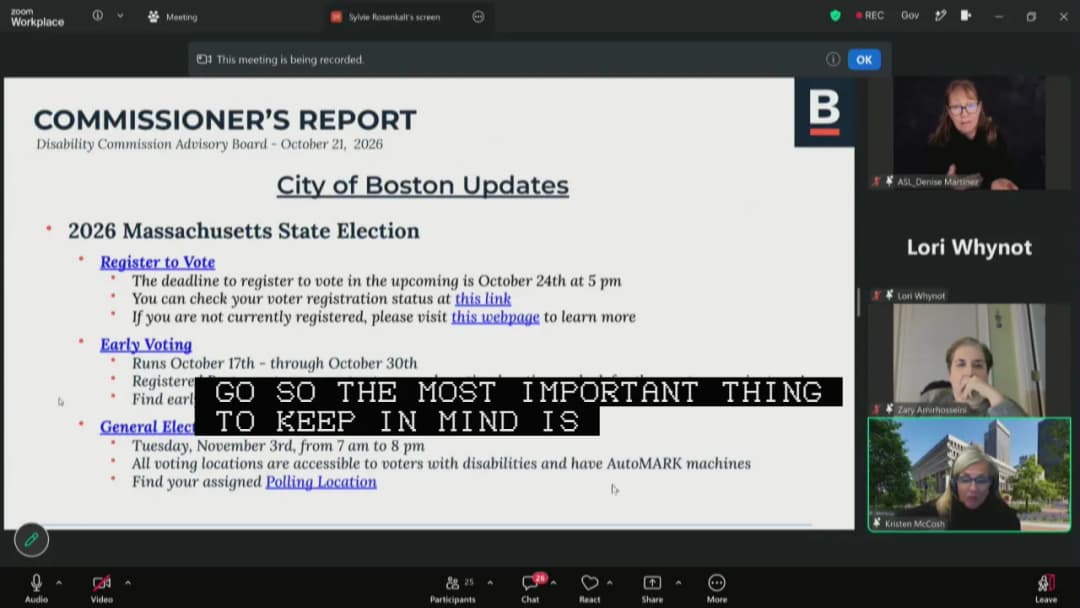
The Disability Commission Advisory Board met virtually on October 21, 2026. The transcript suggests an evening session, although the supplied meeting timestamp is 10:45 UTC. Board members introduced themselves, including their Boston neighborhoods and disability identities. They approved the September meeting minutes, heard a presentation from the Mayor's Office of Food Justice, received a report from the Disability Commissioner, and discussed an architectural access issue near South Station. The agenda did not include published minutes; this summary is based on the raw transcript. Consent Calendar - The board unanimously approved the September meeting minutes. Carl Richardson moved approval; another board member seconded; all members voted aye with no abstentions. Office of Food Justice Presentation - Melissa Honeywood, deputy director of the Mayor's Office of Food Justice, presented on food security resources in Boston. She described the office's mission to build a food system that is equitable, resilient, sustainable, and just, and noted that roughly 43% of Bostonians experienced food insecurity as measured in 2023. - She provided an update on SNAP, including the expanded federal time-limit rules for recipients referred to in the presentation as ABOD. The rules now cover older adults ages 55 through 64 and parents or caretakers with children age 14 or older. She said the Massachusetts Department of Transitional Assistance is under strain because of high caseloads and reduced federal administrative funding, with the federal share cut from 50% to 25%. - Honeywood reported that the House Ways and Means Committee released a fiscal year 2026 close-out budget with $28 million above the governor's earlier request for DTA workers. If approved, it could support hundreds of new SNAP workers. - She described the Boston Farmers Market Coupon Program, which provides $5 coupons usable at 18 or more neighborhood farmers markets from July through October. This year, the office used an outside application portal and mailed coupons to applicants. The office received over 7,200 applicants in four weeks; 51% of eligible applicants reported household income below $20,000 annually, and nearly 40% came from Dorchester, Roxbury, or East Boston. Produce and seafood were the top early spending categories. - Honeywood also mentioned the state Healthy Incentives Program and upcoming accessible raised garden beds for the spring of 2027, including double-height and wheelchair-accessible elevated beds. - Several board members raised accessibility concerns. Olivia asked about alternatives for residents with mobility, transportation, or communication barriers; Honeywood said coupons could be mailed when pickup was a barrier, but market accessibility has room for development. Richard Golovski called the 43% figure startling and asked how much impact SNAP and coupons make; Honeywood said measuring impact is difficult and food insecurity is tied to poverty, jobs, housing, and federal data limitations. Paulette Durrett described crowded, chaotic lines at markets and pantries and urged procedures so people with visual or mobility disabilities are not left at the end of the line; Honeywood said she would raise the point with market managers and partners. Wes Ireland asked about free cooking classes; Honeywood referenced programs at Boston Medical Center and the Boston Public Library's Roxbury food lab. Commissioner's Report and Board Discussion - Commissioner Krista McCosh gave city updates. The general election is November 3, 2026, with voter registration deadline October 24 at 5 p.m., early voting through October 30, and accessible vote-by-mail applications due October 27. All polling places are accessible and have AutoMark machines, but the commissioner warned of long lines because of nine statewide ballot questions, the most in state history. - She highlighted National Disability Employment Awareness Month events, including a Pathways to Employment webinar on October 29 from 1 to 2:30 p.m. and a follow-up Q&A on November 4 from 6 to 7 p.m. She also noted the ABLE lab civic engagement cohort of about 16 people and a planned spring session. - McCosh presented proposed 2027 advisory board meeting dates for review, noted that applications for two Boston School Committee seats are due November 13 at 11:59 p.m., and reminded members that input on the International Symbol of Access design is due October 27. - Board members discussed ballot question readability; McCosh said she would send a Boston Globe explainer article. They also discussed holding an in-person or hybrid December meeting and holiday gathering; McCosh said a Court Street room could be available. Architectural Access Report - Summer Street and Congress Street - Patricia Mendez, Director of Architectural Access, presented on vertical access between Summer Street and Congress Street near South Station. There is a 24-foot level difference between the parallel streets, and the only accessible route is an interior elevator at 400 Congress Street. - Original plans for the Summer Street steps between Parcel P and Parcel N included an outdoor public elevator, but the developer later received a variance to provide an interior route instead. Plans for Parcel N, also called the Congress Street Concourse, were put on hold after the COVID-19 pandemic. - Commissioner McCosh said the developer's marketing materials promoted the steps and concourse as a package; the current signage is small, unintuitive, and unsafe. She plans to follow up with the developer about larger signage and possible interim elevator access. - Board members expressed concerns. Carl Richardson asked how wayfinding would work for blind pedestrians. Wes Ireland proposed an express elevator on the right side of the stairs and supported asking the developer. Several members supported writing a letter from the board, but no formal vote was taken. Key Outcomes - The board unanimously approved the September minutes. - Food Justice staff will share SNAP guides and resources, explore farmers market accessibility improvements, and continue analyzing coupon spending data; continuation of the coupon program depends on budget and participatory budgeting decisions. - Commissioner McCosh will send ballot question materials and 2027 meeting date options, and plan a possible December in-person or hybrid meeting. - Architectural access staff will follow up with the developer on signage and possible elevator access; the board may draft a letter in support. - The next meeting was announced as December 9, 2026.
PROCEDURAL 26% · FOOD SECURITY 16% · DISABILITY RIGHTS 13% · FOOD ACCESS 11%
12
OCT 20, 2026 · BOSTON, MASSACHUSETTS · CITY COUNCIL
Education Committee Hearing on Docket #0407: BPS Bullying and Sexual Misconduct Response – October 20, 2026

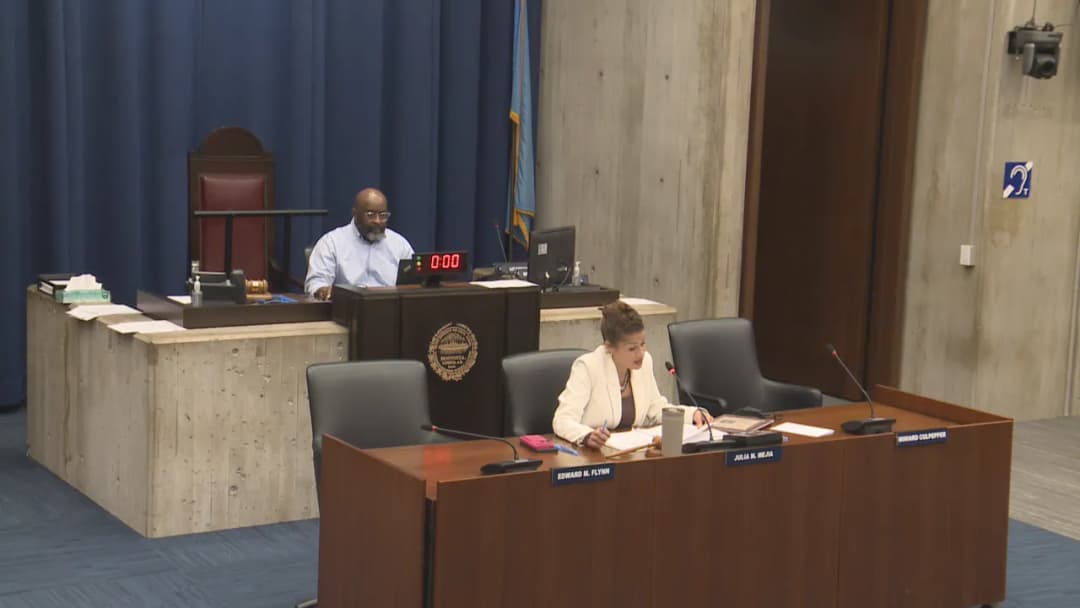
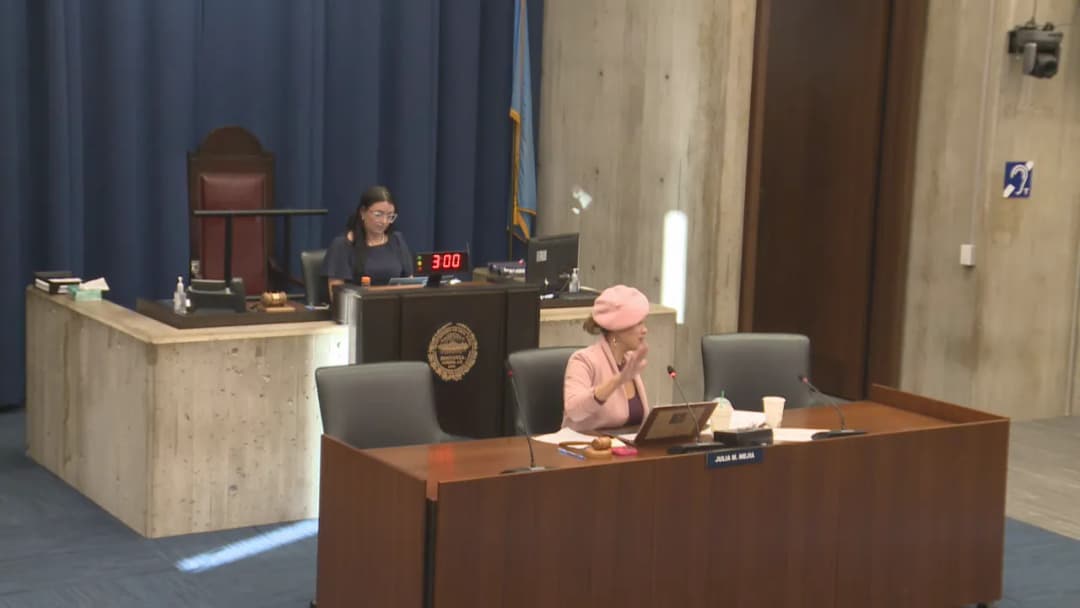
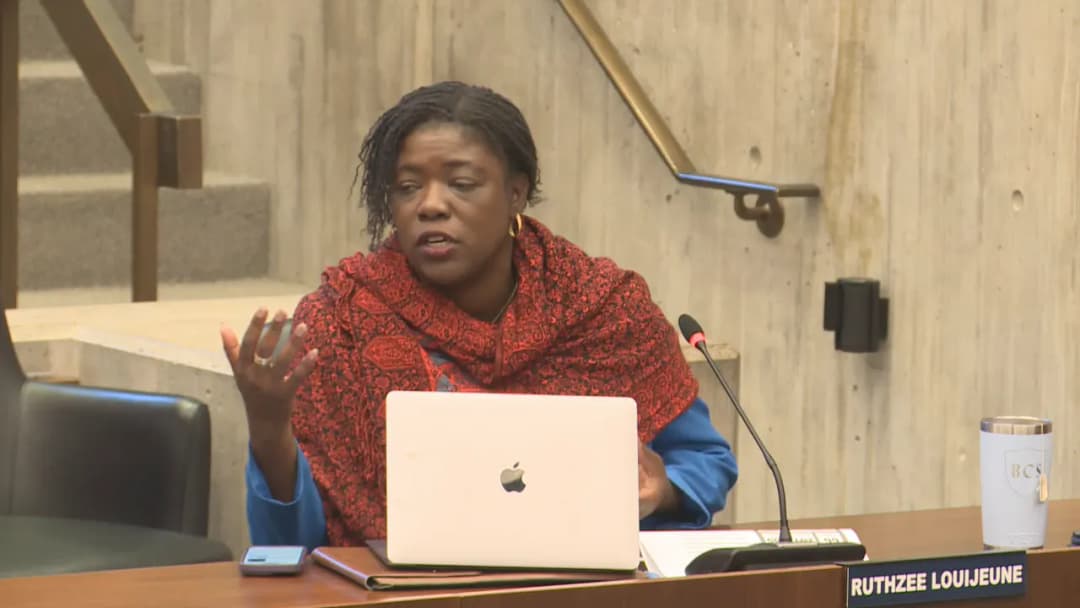
The Boston City Council Education Committee met at 3:03 p.m. on October 20, 2026, for a hearing on Docket 0407, an order to review prevention and response to bullying, sexual harassment, sexual assault, and sexual misconduct in Boston Public Schools. The matter was sponsored by Councilor Julia Mejia and referred to the committee on February 25, 2026. Councilors Murphy, Flynn, Fitzgerald, and Culpepper participated; a letter of absence from Councilor Louise Jeanne was read into the record. The hearing included a community panel, a BPS administration panel, a youth panel, and public testimony, and continued past 6:00 p.m. Public Comments & Testimony - Taisa Santiago, mother of an autistic, non-verbal BPS student, said her son was injured at school. She called for stronger licensing and training requirements for staff working with children with severe disabilities, fair pay for those workers, classroom cameras with privacy safeguards, and the option for parents to use body cameras for children when needed. - Monica Murchison testified that her daughter, Amazing Grace, was raped by a BPS staff member during school. She said BPS did not follow policies: police were not called, a 51A was not filed, and she was not contacted. She described retaliation, including 51A filings and trespass notices, an unfulfilled FERPA request, losing her catering business while homeschooling her children, and her daughter experiencing later bullying at a charter school, a concussion, repeated shoulder dislocations requiring surgery, opioid treatment, and mental-health hospitalizations. She said her daughter remains out of school and denied education and tutoring. - A parent whose eight-year-old daughter had experienced sexual misconduct on a school bus two years in a row, as well as physical assaults and bullying, called for qualified bus monitors, prevention and accountability measures, preservation of video evidence, and real investigations rather than asking the bus driver what happened. - Leon Smith, executive director of Citizens for Juvenile Justice, cited research showing bullying has long-term impacts, including depression, PTSD, and substance use. He said restorative practices are effective when faithfully implemented and are already required under state law, and he criticized DESE data showing Boston reporting zero school-based arrests or referrals to court despite years of contrary tracking. He urged an ordinance to close transparency loopholes. - Tatiana Sofia Bigalt, executive director of MASCOSH, cited 2023 Massachusetts Youth Health Survey data: 45% of middle school students and about 25% of high school students reported bullying or cyberbullying, with nearly 75% of non-binary and other-gender middle school students affected. She also cited one school psychologist per 686 students versus a recommended ratio of one per 500. She called for sustained prevention funding, a 90-day coordinated implementation plan, annual public reporting, and meaningful student and worker participation. - Kia McClay, executive director of the Boston Education Justice Alliance and a BPS alum, cited the federal civil rights investigation of Boston Latin School, 2024 Gardner Pilot Academy allegations, CDC data showing 45.9% of Black high school students experienced racism in schools, and Boston 25 Investigates data showing 131 BPS students disciplined for sexual assault from 2013 to 2022, including 69 Black, 58 Hispanic, and 3 white students. She called for measurable prevention and accountability standards, multilingual and trauma-informed reporting, protection from retaliation, transparent outcomes, and student and family participation. - In formal public testimony, Upurba Fatima of MASCOSH described an anti-bullying curriculum funded by the Department of Public Health and said youth need adults who can recognize and respond to harm with cultural competence. Bria Smith, youth program leader at MASCOSH Teens Lead at Work, said young people should be at the forefront of anti-bullying and restorative-practice policy and praised the youth panel. Students Supreme, Nina Jean-Pierre, and Chanel described the need for more mental-health support and counselors in low-income schools; Chanel said a threat she reported to a teacher was dismissed as just how that student is, leaving her feeling unheard. Discussion Items - Councillor Murphy said she filed a 17F request in December 2023 seeking answers about 1,633 substantial cases of sexual misconduct and bullying, and that 32% of incidents in one school year and 25% in the next were omitted from data. She said BPS must not hide behind student privacy while denying accountability. - Councillor Flynn said data showed over 2,000 reports of student-on-student assaults and sexual misconduct over six years. He called for BPS transparency, a task force, and public release of information without identifying survivors. He later challenged BPS claims of transparency and pressed for an unexecuted Boston Police Department memorandum of understanding that he said has been requested for three years. - Chair Mejia noted that about 18% of students said it was quite or extremely difficult to get help from an adult about bullying. She raised concerns about cases falling through the cracks, accountability for honest investigations, retaliation against parents through 51A filings, and an independent oversight committee. She also asked about the effect of BPS bullying-prevention funding dropping from a $34,000 grant in FY25 to $2,394 in FY26 and FY27. - BPS Chief of Student Support Corey McCarthy described district policy, including immediate reporting, family notification within 24 hours, investigation completion and family notification within five school days, and the criteria of power imbalance, repeated behavior, and intentional, targeted behavior. He said the district is in year three of a five-to-seven-year restorative justice practices implementation, and proposed a 60-day family assurance protocol, expanded prevention beyond classrooms, and stronger student voice. - Senior advisor to the superintendent Christine Travison described the Title IX process, supportive measures and safety plans during investigations, and concurrent code-of-conduct and Boston Police consultation processes. She acknowledged the district has not always communicated well with families. - Deputy Superintendent Dr. Samuel Lupina apologized to families and said BPS is updating its code of conduct, holds staff accountable, and consults with BPD sexual assault and crimes-against-children units. He said an MOU with BPD is signed on BPS end but not by BPD. He said he could not commit to tutoring Monica Murchison’s child but would work on a re-enrollment plan, and Councilor Culpepper said he would monitor the situation. - During the youth panel, students said bullying has serious mental-health impacts, students often do not know about counselors or do not trust them because information may be shared with parents, and reporting is deterred by fear of retaliation and snitch culture. They requested anonymous reporting, multiple trained adults, a text and website-based hotline, prevention of victim blaming and gossip during investigations, and more mental-health resources. Chair Mejia noted that a reporting hotline already exists and said BPS must publicize it better. Key Outcomes - Docket 0407 was kept in committee. - Chair Mejia said she will hold additional working sessions and a possible second hearing and will create a crisis action team or oversight body involving youth, families, community organizations, BPS, and the council. - BPS expressed willingness to work with families and community partners; Chief McCarthy said he is open to an action-oriented committee, and BPS offered restorative justice training to the council. - BPS committed to work with Monica Murchison on a plan for her child’s re-enrollment, with Councilor Culpepper indicating he would monitor follow-through. - Youth recommendations, including a text and website anonymous reporting option, more counselors, publicizing existing hotlines, and anti-retaliation protections, were left as next steps for the working sessions.

PUBLIC EDUCATION 48% · PUBLIC SAFETY 24% · YOUTH MENTAL HEALTH 16% · PUBLIC HEALTH 3%
13
OCT 20, 2026 · BOSTON, MASSACHUSETTS · CITY COUNCIL
Boston City Council CPA Hearing on Affordable Housing Allocation Increase (2026-10-20)

The Boston City Council's Community Preservation Act (CPA) Committee held a hearing on Docket 1601 to explore raising the percentage of CPA funds dedicated to affordable housing. Councillor Worrell, the main sponsor, opened the hearing along with Chair Pepper. Director Thadine Brown presented an overview of the CPA program. Councillors engaged in extended Q&A with Director Brown, followed by public testimony and a panel of developers and policy experts. Discussion Items - Councillor Worrell (Sponsor) argued that rising construction costs, the end of ARPA funding, and uncertainty in federal/state housing resources necessitate revisiting the CPA allocation formula. He noted that Cambridge dedicates 80% of its CPA funds to housing, versus Boston's 50% goal, and suggested exploring a target of 60% or 70%. He also pointed out that 40% of CPA-supported housing projects have not started construction. - CPA Director Thadine Brown provided a detailed overview: 438 projects totaling $259M have been funded since 2018. Current allocation is approximately 52% affordable housing, 20% historic preservation, 20% open space/recreation, and 10% flexible reserve. She highlighted the success of the One Plus Boston program (over 1,000 first-time homebuyers) and the Acquisition Opportunity Program. - Councillors Flynn, Durkin, Murphy, and Fitzgerald expressed caution about reducing funds for historic preservation and open space. They argued the current balanced formula has been successful and highly competitive, and that reducing one category would harm community services and green spaces. Director Brown stated the committee values a balanced approach. - Councillors Worrell and Louijen emphasized the severity of the housing crisis and the need for deeper affordability and homeownership opportunities. Director Brown noted the committee tries to prioritize deeper affordability (30-60% AMI) and homeownership. - Councillor Braden explored the discretionary 10% reserve, and Councillor Fitzgerald questioned the definition of "local resident" in project prioritization. Public Comments & Testimony - Open Space and Historic Preservation Advocates: Testified strongly against decreasing funding for their respective categories. Catherine Davis Wheeler (Boston Preservation Alliance) and Jeffrey Gagnon (Preservation Consultant) argued CPA funds are often the only funding source for historic preservation, unlike housing which has multiple streams. Jay Meekum (Boston Harbor Now), Mercy Robinson (Sao Boston in Action), and Liz Luke (Boston Food Forest Coalition) argued that decreasing open space funding would harm community health, resilience, and quality of life. - Affordable Housing Advocates and Developers: Expressly supported increasing the housing allocation. Adlar Bernadin (Norfolk Design) and Donald Alexis (Caribbean Integration) stated that construction costs have escalated 4% in the last year and subsidies are not keeping pace, making homeownership projects unsustainable. They argued strongly against moving to rental-only models without homeownership opportunities. Hilary Pizer (MAHA) detailed cuts to the One Plus Boston program and called for restoration. - Comprehensive Solutions: Several speakers and councillors, including Jeffrey Gagnon and Hillary Pizer, advocated for "making the pie bigger" through mechanisms like a ballot surcharge increase, a real estate transfer fee, or increasing the state CPA match, rather than shifting percentages between categories. Key Outcomes - No formal vote was taken on Docket 1601. - The hearing served as an informational session setting the stage for future budget discussions. Councillor Worrell committed to continuing the conversation. - Several councillors and Director Brown noted that any change to the allocation formula would require careful evaluation of data on project queues and historical spending. - Councillor Worrell requested that Director Brown provide specific analysis on the FY20 spending spike, the viability of bonding against CPA funds, and the impact of the Acquisition Opportunity Program on available housing funds.

AFFORDABLE HOUSING 56% · COMMUNITY PRESERVATION ACT 14% · HISTORIC PRESERVATION 12% · PUBLIC HOUSING 8%
14
OCT 19, 2026 · BOSTON, MASSACHUSETTS · CITY COUNCIL
Boston City Council Committee on Planning, Development, and Transportation Hearing on Docket #1718 – October 19, 2026

Chair Sharon Durkin (District 3) opened the hearing on Docket 1718, an order regarding a text amendment to the Boston Zoning Code to prohibit data centers in all zoning districts. The hearing gathered information on the impacts of data centers, considered existing regulations, and explored alternative approaches such as a threshold-based local permitting option. Opening Statements - Chair Sharon Durkin emphasized the need for a nuanced approach, distinguishing between large hyperscale data centers (unlikely in Boston due to high land and energy costs) and smaller facilities. She highlighted potential unintended consequences for academic and healthcare institutions, suggesting a threshold-based permitting framework. - Councillor Minard Culpepper (Lead Sponsor) argued Boston must proactively decide on data center land use, citing concerns over strain on electricity, water, sewer infrastructure, noise, and impacts on environmental justice communities. - Councillor Flynn noted a data center exists in his district supporting critical institutions. He referenced the Governor's executive order and stated he was present to listen to all perspectives. - Councillor Rourke (Co-sponsor) focused on establishing a baseline of current data centers, their resource consumption, and revenue collected. - Councillor Louis Jean acknowledged concerns about resource extraction but noted union leaders' perspectives on technology centers, urging careful consideration of unintended consequences. Testimony from City Administration - Jeff Thomas (Special Assistant, Planning Department) reported Boston has a handful of non-hyperscale data centers. He stated the administration does not support a citywide prohibition, arguing existing zoning (telecommunications and data distribution centers) and regulatory reviews (Article 80) provide sufficient oversight. He confirmed the administration is willing to work with the council on updated definitions and zoning for data centers. - Mayor Wu signed Boston onto the C40 Global Urban Data Centers Pact in June 2024, committing to strict scrutiny of any data center proposals for environmental and quality of life impacts. Public Testimony - Sam Cahall (Longwood Collective) requested the amendment explicitly exclude computing infrastructure for healthcare, academic, research, and clinical institutions to prevent unintended consequences for patient care and scientific research. - Dan Daly (Local 103, IBEW) opposed the ban, arguing it could discourage private investment and limit union construction and maintenance jobs, while urging for a fair review process for individual projects. - Cyril Clement (MPHA) supported the prohibition, citing concerns over rising utility bills, climate resilience, and long-term public health risks from obsolete facilities. - Kate Archard (Brockton resident) warned of speculative development and urged careful conditional zoning, cautioning against blanket exemptions for hospitals. - Chaton Green (Boston Building Trades Unions) opposed the moratorium or ban, arguing digital infrastructure is essential for hospitals, transit, and daily life, and supporting informed public dialogue over prohibitions. Expert Panel Discussion - Mary Wamboy (Honest Future for Lowell) presented a cautionary tale from Lowell, where a 50-megawatt data center received $77 million in tax incentives but created fewer than 40 permanent jobs, while causing noise, flooding, and fire department service cuts (brownouts). She argued municipal regulations are not enough without rigorous enforcement. - Hassan Faruqi (Boston Climate Action Network) advocated for a balanced approach protecting against energy cost increases, air pollution, and water depletion, while ensuring high-road union construction jobs. - Tristan Thomas (Alternatives for Community and Environment) argued data centers threaten communities through resource extraction and grid strain. He recommended setting protective thresholds for electricity, water, and noise, requiring cumulative impact analyses, and suggested 10 megawatts as a potential threshold. He noted utilities have received nearly 5,000 megawatts of data center interconnection inquiries in Massachusetts. - Professor Aisha George-Kun (Boston University & Emerald AI) proposed a technical framework centered on “power flexibility” or grid-responsive computing, where data centers reduce demand during peak grid stress. She recommended grid impact assessments, flexibility standards, and measurement and verification requirements. She distinguished between hyperscale facilities and necessary local infrastructure for low-latency healthcare, research, and finance applications. - Michelle Brooks (Sierra Club, MA Chapter) cautioned that a ban without clear definitions could shift development to less regulated communities. She recommended requiring 24/7 carbon-free energy, eliminating diesel generators, using non-potable water, and mandating community benefits and project labor agreements. - Tish McMullen (Conference of Boston Teaching Hospitals) requested explicit exemption for healthcare infrastructure, crucial for electronic health records, diagnostic imaging, and biomedical research. She noted the Governor's executive order will produce municipal guidance by the end of the year. Key Outcomes - The hearing was informational. No vote was taken, and Docket 1718 remains in committee. - The Planning Department agreed to collaborate with the City Council on updated definitions for data centers in the zoning code. The administration will work on codifying C40 Data Centers Pact requirements. - Chair Durkin adjourned the hearing with the matter left in committee for further discussion and development of a regulatory framework. - A clear divergence emerged: environmental and community groups largely supported strict limits or a ban, while labor unions, academic and medical institutions, and the administration favored tailored regulation over outright prohibition to protect existing infrastructure and future innovation capacity.

TECHNOLOGY AND INNOVATION 56% · ENVIRONMENTAL PROTECTION 17% · ENERGY AND SUSTAINABILITY 7% · PUBLIC HEALTH 5%
15
OCT 16, 2026 · BOSTON, MASSACHUSETTS · CITY COUNCIL
Boston City Council Committee Hearing on ZBA Appointments and Reappointments (October 16, 2026)

The Boston City Council Committee on Planning, Development, and Transportation, chaired by Councilor Sharon Durkin (District 8), convened on October 16, 2026, at 10:02 AM to consider the confirmation of ten appointments to the Zoning Board of Appeal (ZBA). The agenda covered Dockets 1515 through 1524, consisting of seven reappointments and three new appointments. Councillors Aaron Murphy and Ed Flynn were present for the hearing. Public Comments & Testimony No members of the public signed up to testify. Chair Durkin confirmed this and closed the hearing without a public comment period. Discussion Items Panel 1: Reappointments (Dockets 1515–1521) Reappointees introduced themselves and their qualifications. The panel included Giovanny Valencia (architect and community organizer), Katie Whewell (Deputy Director of Planning in Newton), Alan E. Langham (retired union laborer), Sherry Dong (community health professional and former BRA official), Shamaiah Turner (union sheet metal worker, absent due to a death in the family), Jeanne Pinado (longest-serving member and former CEO of Madison Park CDC), and David Collins (small-scale developer). During questions, Chair Durkin expressed her personal position that the ZBA should generally not oppose projects that have already received BPDA board approval, arguing that doing so moves the goalposts and undermines the rigorous public planning process. Alan Langham responded that if a project does not align with what a neighborhood needs, he would feel compelled to vote against it regardless of prior approvals. Giovanni Valencia noted that the ZBA hearing provides a crucial final opportunity for community input alongside the BPDA review. Councillor Murphy discussed the burden on residents navigating small-scale projects like ADUs versus large developments and the shifting role of the Office of Neighborhood Services. Councillor Flynn emphasized language and communication access; members noted the challenges and importance of ensuring non-English speakers can participate. Valencia shared his personal experience immigrating without English and urged the city to better empower tenants and non-native speakers to engage. Panel 2: New Appointments (Dockets 1522–1524) New appointees introduced themselves: Carla Monteiro (social worker and lifelong Dorchester resident), Patrick Walsh (Business Manager of Laborers Local 223, recommended by the Building Trades Employers Association), and William Masterson (founder of the urban forestry nonprofit Tree Eastie). Chair Durkin asked about their zoning philosophy in light of the city's housing affordability and climate resilience goals. Monteiro emphasized her lived experience in an underserved community with high asthma rates and poor air quality. Masterson advocated for integrating tree planting into development projects as a cost-effective measure for health and climate. Walsh noted the real-world impacts of flooding and sea-level rise in his neighborhood. Councillor Flynn asked how they would factor in health outcomes such as high asthma rates. All three emphasized a case-by-case, fact-based approach that balances rigorous listening to all stakeholders with the best interests of the city. Key Outcomes No formal votes were taken by the committee during the hearing. Chair Durkin, Councillor Murphy, and Councillor Flynn all explicitly stated their strong support for all ten candidates and their intention to vote in favor of confirming the appointments (Dockets 1515–1524) at the upcoming full City Council meeting on the following Wednesday. Chair Durkin formally adjourned the hearing.

ZONING BOARD OF APPEALS 63% · ENVIRONMENTAL PROTECTION 10% · LANGUAGE ACCESS 7% · COMMUNITY ENGAGEMENT 6%
16
OCT 15, 2026 · BOSTON, MASSACHUSETTS · CITY COUNCIL
BPDA and BRA Joint Board Meeting - October 15, 2026

The Boston Planning and Development Agency (BPDA) and Boston Redevelopment Authority (BRA) held a joint board meeting on October 15, 2026, at Boston City Hall. All board members (Ms. Jacques, Ms. Bennett, Mr. Shepherd, Mr. O’Malley, and Chair Rojas) were present. The board approved all 34 agenda items unanimously, including licenses, contracts, designations, zoning amendments, and a historic tax-relief package for four large housing projects. Presentations from BPDA staff and city officials highlighted economic pressures (38% construction cost increases, 69% interest rate increases) and the need to accelerate housing production. Public Comments & Testimony - Councillor Pepin (District 5) and Council President Breden (District 9) delivered statements in strong support of the Cleary Square Small Area Plan and the four demonstration projects for tax relief, emphasizing community collaboration and the urgent need for housing. - No oral public comments were offered, though written comments (53 in support, two in opposition) were noted for the 160 McClellan Highway project. Discussion Items Cleary Square Squares and Streets Plan (Items 16 & 17) - Maya Caller Gold presented the final plan for Hyde Park’s Cleary Square after 2.5 years of engagement, including language-specific focus groups and block walks. - The plan rezones the area into S3-6 (active main street) and SC (shopping commercial nodes) districts, allowing up to six stories near transit and four stories on River Street, with an open-space district over the former Lewis Chemical site. - Key elements: a new arts corridor, a sidewalk on Walnut Street, safer intersection design, and the potential for 30–60 affordable housing units on city-owned parcels. - Board member O’Malley praised the evolution from initial seven-story proposals and the focus on open space; Ms. Bennett urged continued evaluation of zoning impacts; Chair Rojas and Mr. Shepherd also commended the process. - Councillor Pepin read a statement of full support. The plan and zoning amendments were approved unanimously. Demonstration Projects for Tax Relief (Items 22–25) - Ruben Cantor (Senior Policy Advisor) detailed the economic context: construction costs up 38% since 2015, interest rates up 69%, and housing starts halved from 4,000/year to under 2,500/year. Vacancy rates are below 4%, pushing up rents (one-bedrooms +17%, four-bedrooms +40% over six years). - The city offered two parameters for property tax deferral: (1) taxes at current level during construction, then 2.5% increases for five years after certificate of occupancy, or (2) a 50% abatement over ten years after CO. Only 22–24 Pratt Street chose Parameter 2. - Four projects were approved: - Allston Yards Building D (341 units, 18% inclusionary, paused since 2019) - 83 Leo Birmingham Parkway (333 units, 16% inclusionary, passive house) - 22–24 Pratt Street (318 units, includes open space and public realm improvements) - 1 Mystic Avenue, Charlestown (408 units, mixed rental/condo, 20% inclusionary) - Combined benefits: 1,400 new homes, 180 income-restricted units, $900 million investment, 1,270 construction jobs, $7.5 million in annual tax revenue after relief ends. - Board members O’Malley, Bennett, Shepherd, and Chair Rojas all spoke in favor, noting the investment vs. giveaway nature and the need to restart stalled projects. Council President Breden also testified in strong support. All four passed unanimously. Other Development Approvals - 201–207 Brighton Avenue (Item 26): 145 rental units (29 IZ), all-electric, $100,000 for parks. Approved. - 50B Park Street, Dorchester (Item 27): Two self-storage buildings (144,000 sq ft), fully electric, LEED-targeted, solar-ready. Approved. - 1428 Dorchester Avenue (Item 28): 23 rental units (4 IZ), five stories, modular construction pursued. Approved. - 160 McClellan Highway, East Boston (Item 30): Central distribution center for Logan Airport (152,500 sq ft), net-zero carbon, LEED Platinum, $250,000 community mitigation, improved bus stops. Approved with board praise for community support. - 165 Park Drive, Fenway (Item 31): Notice of Project Change reducing building from seven to six stories, 112 rental units (20% IDP). Approved. - 201 Hampton Street, Roxbury (Item 32): 24 homeownership condos (3 IDP), modular construction by Reframe Systems, net-zero carbon. Approved with board enthusiasm for ownership model and modular innovation. Zoning Amendments - Dimensional Definitions Update (Item 18): Consolidated base code articles from 10 to 1, added 25 diagrams, clarified 20 definitions, deleted 23 unused terms, and updated height/lot measurements. Approved. - Article 68 and Map 4F (Item 19): Added Waterfront Manufacturing subdistrict to allow Planned Development Areas; adjusted WM boundary to West First Street. Approved as an enabling step for the Reserve Channel project. Other Approvals (Consent Items) - License agreements for storage cages at 12 Channel Street (Topologic Technologies, Boston Balloon), license agreements for Strand Theater parking and Boston Harbor Now signage, lease renewal for Echo Beauty Hair Salon, extension of tentative designations for 24 Dry Dock Avenue, 7–9 Westminster Terrace, and Parcel 10/Parcel B, final designation for Boston Food Forest Coalition, snow removal contract (Los Mellas), construction contracts for Little Mystic Harbor Walk, Shipyard Park repairs, and Long Wharf boardwalk, NDF grants for Louis D. Brown Peace Institute ($250k) and American City Coalition ($67k), and a certificate of completion for Phase Three of the Landmark Center. Key Outcomes - All 34 agenda items passed unanimously with no opposing votes. - The board authorized the director to enter into and execute licenses, leases, contracts, grant agreements, and tax-relief (121B) agreements. - The Cleary Square Small Area Plan and its zoning were adopted, with staff to initiate disposition of city-owned parcels for affordable housing. - Tax-relief negotiations for the four demonstration projects will proceed, with construction expected to start within 12–15 months. - The dimensional definitions update and Article 68/Map 4F amendments will be forwarded to the Zoning Commission. - Upcoming work: the Neighborhood Housing Zoning Initiative for Hyde Park, Roslindale, and West Roxbury will be presented to the board. Director’s Update - Chief Shen thanked staff and highlighted the significance of the tax-relief approvals as a first-time use of 121B for market-rate rental projects. - Noted that 144 approved market-rate projects (15,000 units) are not yet constructed, underscoring the need for tools like the demonstration project program. - Announced that the Cleary Square plan is likely the last small-area plan; future efforts will use a more comprehensive neighborhood approach. - The Landmark Center final phase triggered substantial community benefits: $2 million for multi-use path, $1 million for Green Line track design, $500,000 for workforce development, and $400,000 for neighborhood beautification.

ZONING BOARD OF APPEALS 18% · PROCEDURAL 15% · HOUSING 12% · AFFORDABLE HOUSING 11%
17
OCT 15, 2026 · BOSTON, MASSACHUSETTS · CITY COUNCIL
Boston City Council Hearing on Boston Resident Jobs Policy and Employment Equity – October 15, 2026

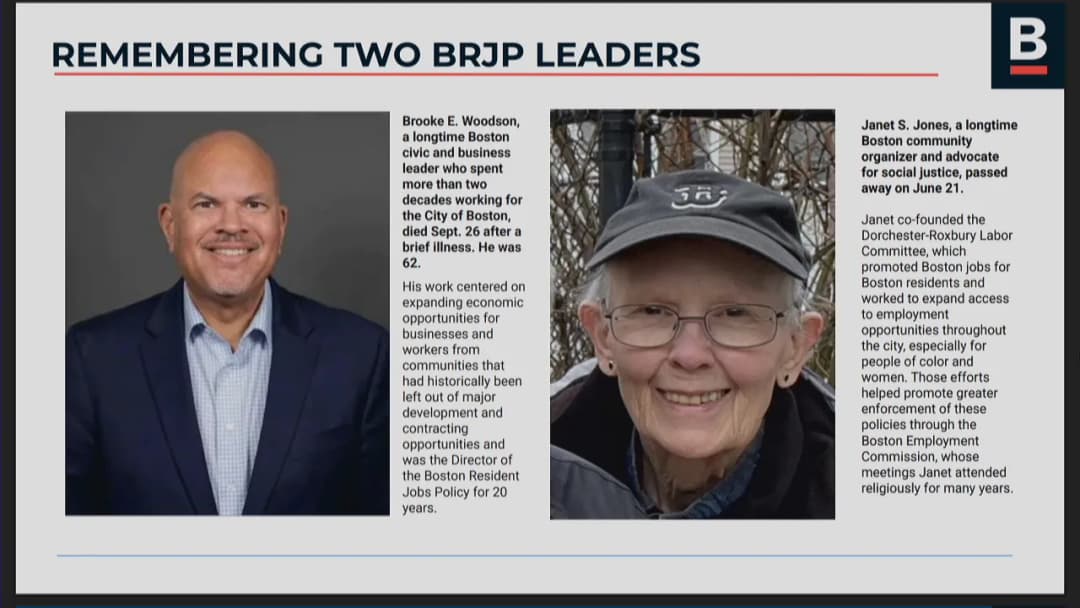
On October 15, 2026, beginning at 2:05 p.m., the Boston City Council Committee on Labor and Economic Development, chaired by District 4 Councilor Brian Warrell, held a hearing on Docket 0218 to review the effectiveness of the Boston Resident Jobs Policy and improving equity and employment standards on projects throughout Boston. Councilor Flynn joined the committee; Councilor Mejia and Council President Braden were absent. Administration officials Jody and senior manager Chris Will Brown presented an overview, compliance data, and workforce pipeline updates. The hearing was informational; no formal votes were taken, and no public testimony was offered. Opening Remarks and Tribute - Councilor Flynn expressed strong support for the Boston Resident Jobs Policy and its goal of giving Boston residents, women, and people of color equal access to construction jobs. He renewed his request for wage-dollar totals in addition to reported hours so the committee can understand financial impacts and compare outcomes across demographic groups. - The panel observed a moment of silence for Brooke Woodson and Janet Jones. Chris read tributes: Woodson, a former director of the Boston Resident Jobs Policy Office for 20 years, died September 26 at age 62; Jones, a longtime community organizer, died June 21 and regularly attended Boston Employment Commission meetings. Boston Resident Jobs Policy Overview - The policy was established in 1983 and amended in 2017. It covers city projects and private developments over 50,000 square feet. Current goals are 51% of total work hours of journey people and apprentices by Boston residents, 40% by people of color, and 12% by women. - Compliance is based on administrative requirements, such as attending pre-construction meetings, submitting documentation, and filing payroll records, rather than solely on whether contractors meet the hiring goals. - The Office of Labor Compliance and Worker Protections, under the Worker Empowerment Cabinet, enforces the Boston Resident Jobs Policy along with the Boston Jobs, Living Wage and Prevailing Wage Ordinance, the Wage Theft Executive Order, and the Heat Illness and Injury Prevention Ordinance. The office also provides free OSHA 10 and OSHA 30 training and, after the September 24 Jamaica Plain tragedy, free fall prevention training. Six-Month Compliance Data - For April 1 through September 30, 2026, the office monitored 150 construction projects: 44 private projects and 106 public projects, including 30 from the Public Facilities Department, 15 from Parks, 28 from Public Works, and 33 from the Mayor's Office of Housing. - Private projects: 3,100,000 work hours; 18% Boston residents, 41% people of color, 8% women. - Public projects: 660,000 work hours; 22% Boston residents, 58% people of color, 5% women. - The administration stated a combined total of 3,762,000 work hours; the stated subcategory figures sum to 3,760,000. - Neighborhood locations included 21 projects in Boston proper/downtown/seaport, 23 in Dorchester, 4 in Jamaica Plain, and some in various locations. - Public department breakdown: Mayor's Office of Housing had 454,000 hours with 21% Boston residents, 67% people of color, and 4% women; Public Works had 90,000 hours with 28%, 44%, and 4%; Parks had about 20,000 hours with 15%, 28%, and less than 1% women. - Overall, people of color reached 44% of hours against the 40% goal, women reached 7% against the 12% goal, and Boston residents remained below the 51% goal. Administration officials described Boston resident percentages as historically low over the last decade, even though people of color and women shares have increased. White Stadium Data - White Stadium is monitored as two projects. Percentages below are listed as Boston resident / people of color / women. - East Grandstand: about 60,000 hours; 39% / 49% / 14%. By trade: laborers 26,000 hours with 47% / 58% / 17%; carpenters 35% / 47% / 17%; iron workers 61% / 59% / 15%; operators 1% / 4% / 0%; electricians 38% / 60% / 16%. - West Grandstand: about 48,000 hours; 36% / 45% / 10%. By trade: iron workers nearly 9,000 hours with 36% / 63% / 9%; carpenters 40% / 44% / 6%; operators 1% / 5% / 0%; electricians 50% / 24% / 0%. - Jody said the comparatively strong White Stadium numbers, especially for women, were encouraging and warranted a deeper look so successful strategies could be replicated. Compliance, Payroll, and Enforcement - Seven construction monitors cover roughly 150 projects per year. Smaller projects receive scaled procedures, but compliance is required regardless of size. - Payrolls are submitted through a Salesforce database. Late submission triggers warnings, corrective action meetings, and possible recommendations for sanctions. Officials said there is not 100% timely submission, but most contractors correct the issue after warnings. One fine of $11,000 has been issued during Jody's tenure. - Wage data is currently collected only for public projects, beginning in November 2024, because it is tied to prevailing wage certified payroll records. Councilor Warrell asked whether a wage-reporting field could be added for private projects; Jody said the ordinance does not require that data and she would investigate whether the city can require it. - In response to Councilor Fischel's question, officials said the city's BRJP office is responsible for workforce outcomes, not business contracting decisions. The city sets hiring goals, but contractors choose how to meet them, and the office has no direct authority over minority- or women-owned business participation. Construction monitors advise contractors on strategies to improve outreach. - Councilor Flynn raised the 1985 executive order referencing Inspectional Services and building permits. Jody said she was not familiar with that permitting provision and noted state building code limits, but she agreed to provide a side-by-side comparison of the earlier and 2017 policy versions and to review how contractor compliance history is used in procurement and permitting. - On the Living Wage Advisory Committee, Jody said it is being merged into a new advisory committee covering all wage-and-hour laws, and the work is part of the current fiscal year work plan. Jobs Bank and Workforce Pipeline - Jobs bank usage is minimal: requests and follow-through are under 20, and contractors rarely draw from it. The database is described as mostly unskilled younger workers, while contractors often seek skilled workers, so matches are often poor. - The Boston Skilled Trades Initiative, supported by Bloomberg Philanthropies, is expanding pathways from Madison Park into registered apprenticeships. Under the project labor agreement signed by Mayor Wu with the building trades, the trades agreed to accept up to 50 young people per year, with the goal of expanding from 50 to 100 by the end of the grant period. The first cohort graduated in 2026; Vocation by Madison held its orientation the previous night; and two apprenticeship navigators are now embedded at Madison Park. - Officials said workforce development efforts are intended to expose young people to all 17 trades in the project labor agreement, including high-paying trades such as operators. Public Comments & Testimony - No public comments or testimony were offered at this hearing. Chair Warrell said advocates remain engaged, noting a three-hour community meeting the previous evening. Key Outcomes - No formal votes were taken; the hearing was informational and adjourned. - Jody agreed to provide Councilor Flynn with a side-by-side comparison of the 1985/1986 and 2017 versions of the Boston Resident Jobs Policy language and to investigate whether wage data can be added for private projects and reported from public projects since November 2024. - The administration said its next annual wage-loss report will be presented in April at a future hearing; the 2024 and 2025 reports are available on the city website. - The committee honored the memory of Brooke Woodson and Janet Jones and acknowledged the continued work of community advocates.

WORKFORCE DEVELOPMENT 40% · LABOR 21% · PUBLIC SERVICES 16% · ENGINEERING AND INFRASTRUCTURE 8%
18
OCT 15, 2026 · BOSTON, MASSACHUSETTS · CITY COUNCIL
Government Operations Committee Hearing on Private Way Pothole Ordinance (Docket #0807) – October 15, 2026

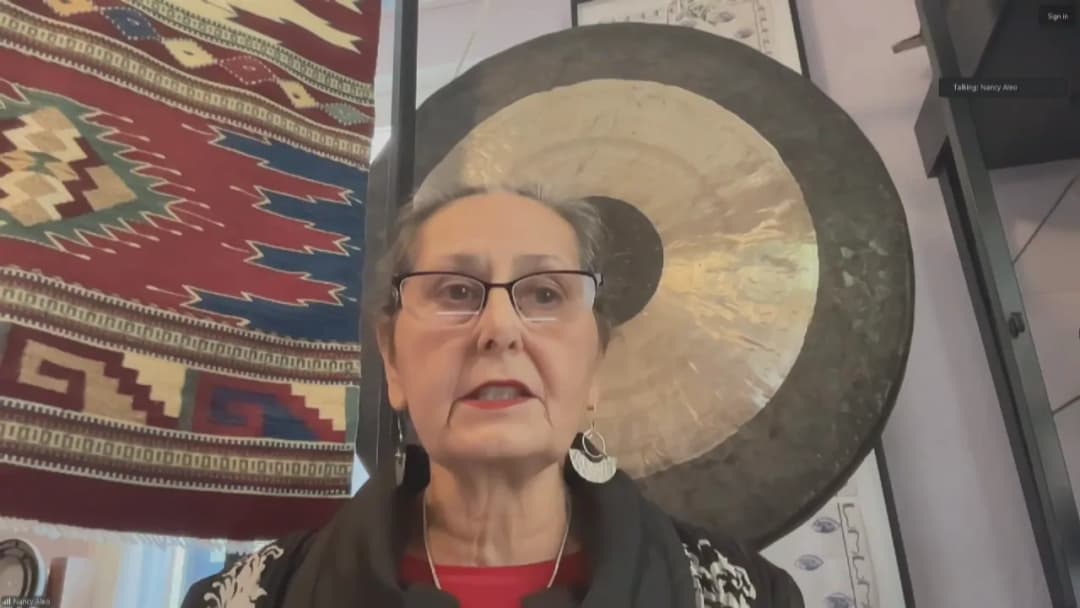
On October 15, 2026, the Boston City Council Government Operations Committee held a hearing on Docket 0807, an ordinance to address private way potholes. The matter was sponsored by Councillors Brian Warrell and Aaron Murphy and referred to the committee on April 15, 2026. Superintendent of Street Operations Daniel Knee testified for the city, and the committee heard public testimony, including two prerecorded videos. No vote was taken; the hearing was adjourned with follow-up requests and an anticipated working session. Discussion Items - Lead sponsor Councillor Warrell said the ordinance is intended to add the word asphalt to the city code’s temporary-repair authority for private ways and to make the city fill private-way potholes automatically, instead of closing 311 cases after deciding whether a public-safety repair is warranted. He noted that many residents buy on private ways without understanding that they are responsible for resurfacing, sidewalks, and underground utilities, and costs can reach six figures. - Superintendent Knee said private ways are private property and state law prohibits using public funds on private property. In practice, Public Works performs temporary repairs when emergency vehicle access, trash collection, or public safety requires it, using materials that match the existing surface: asphalt on asphalt ways, gravel or millings on gravel ways. He said potholes recur because water, runoff, and lack of catch basins are the underlying problem, and full resurfacing or reconstruction is the better long-term fix. - Knee described the city’s betterment/PIC process for converting a private way to a public way: more than 50 percent of homeowners must petition and vote, engineering surveys and a public meeting follow, and the street must be brought to city specifications, including accessible sidewalks and 53 feet of width. Only four streets had completed that process in the past 15 years; some residents voted conversion down, such as Sharon Street. - Councillors asked about the cost of city takeover of all private ways. Knee estimated hundreds of millions, or multiple hundreds of millions, of dollars plus significant staffing, and said engineering is already understaffed. Councillor Fitzgerald called it an extremely expensive undertaking. - Councillor Weber noted that paving a gravel private way can change drainage and push water into basements. Knee said asphalt is not appropriate on gravel surfaces because gravel moves with saturation and freezing; he also described Grove residents’ resistance to city work and an EPA complaint about millings that was not sustained because millings are an accepted roadway material. - Councillor Flynn asked about the 311 pothole process. Knee said cases come in as pothole even though the department internally treats them as roadway defects; cases on private ways are often closed with an abutters-are-responsible notice, but supervisors may still patch if a fire truck or ambulance needs access. The city does not bill residents for those public-safety pothole repairs. - The committee discussed ADA and legal implications: permanent resurfacing by the city would trigger ADA accessibility and full city-spec requirements, while private abutters resurfacing their own private way would not trigger those obligations but would receive no city cost share. A state-law threshold of up to 25 percent was mentioned, and the committee noted the metric was unclear. - The chair asked for follow-up data on average asphalt patch lifespan and citywide cost to fill currently unfilled private-way pothole complaints. Knee said asphalt is durable for 20 to 30 years absent underlying water or utility problems, but the pothole material is a finer tennis court top mix, not roadway asphalt. He agreed to try to produce cost information, cautioning about data accuracy. Public Comments & Testimony - Doug Woodhouse, a Roslindale private-way resident, supported the proposal. He described severe potholes, dangerous winter ice, postal service interruptions, risks to elderly residents and children using BPS door-to-door bus service, and repeated tire damage. He said his neighbors likely cannot afford to maintain the road themselves. - Feen Balomilee, a Dorchester private-way resident speaking by prerecorded video, supported the ordinance as a step in the right direction, while stating the city should ultimately resurface and completely replace private ways in disrepair. She cited safety, standing water, and vehicle damage concerns and said residents are taxpayers who use their streets alongside nonresidents. - Nancy Allio, a Stella Road resident since 1988, supported Docket 0807 but said it is only the start. She argued that private ways are heavily trafficked by the public, developers historically shifted costs onto homeowners, and current residents should not pay twice through taxes and private repairs. She proposed creative financing, such as a dedicated tax fund, and changes to outdated laws. - Rick, co-leader of the Mount Hope Canterbury Neighborhood Association, supported the ordinance as a step forward. He said the neighborhood has 10 private roads totaling 4,500 feet, only two of which are dead ends. He asked whether the city could repave such roads and build asphalt curbs to manage runoff without installing sidewalks, and whether that could avoid state-law problems. - Shirley, a Union Avenue private-way resident in Jamaica Plain for 33 years, raised broader private-way service gaps: police response, illegal dumping, towing disputes, and pedestrian safety near English High. She recommended assessing and prioritizing the worst private ways and exploring creative hard-pack surface alternatives beyond asphalt. She said potholes were not her biggest issue. - Chris Arena, a Grove homeowner for six years, supported a collaborative middle-ground solution. He described an ambulance having difficulty reaching a resident due to deep potholes on Linden Road, mail delivery problems, and a dead tree in the roadway that neighbors had to handle. He said the PIC process requiring 50 percent participation is hard in the Grove and urged solutions that activate willing neighbors. Key Outcomes - No motion or vote was taken; the hearing was adjourned. - Superintendent Knee was asked to provide a follow-up estimate for filling currently unfilled private-way pothole complaints, annual maintenance costs, and a ballpark citywide reconstruction figure based on private-way mileage. - Lead sponsor Warrell said he would pursue a working session, consider amendments and creative options, and explore whether state law allows defining temporary fix more broadly, including potential resurfacing or a separate PIC track. - The committee also agreed to take up legal questions raised in testimony, including the possibility of city repaving with runoff curbs but without sidewalks.

ENGINEERING AND INFRASTRUCTURE 43% · PUBLIC WORKS 37% · PUBLIC SAFETY 12% · PUBLIC ENGAGEMENT 3%
19
OCT 14, 2026 · BOSTON, MASSACHUSETTS · CITY COUNCIL
Boston School Committee Meeting - October 14, 2026

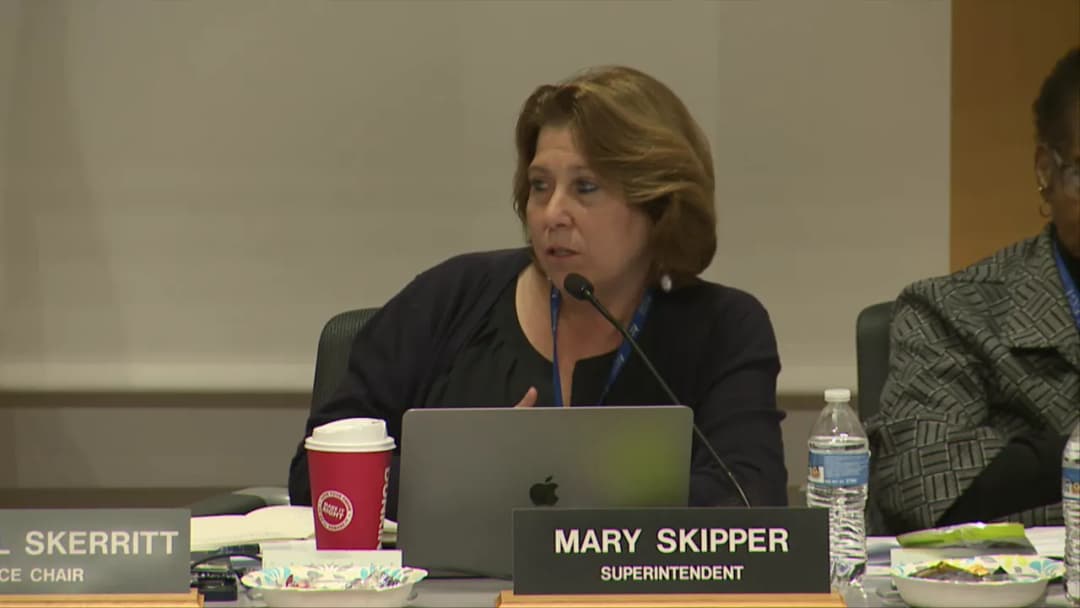
The Boston School Committee convened on October 14, 2026, for its regular meeting. The committee addressed a proposed district-wide cell phone ban, procurement failures detailed in an Inspector General report, a tentative collective bargaining agreement for custodians, over $82 million in grants, and the 2025-2026 state assessment results. Public testimony heavily focused on transportation failures for students with disabilities, academic achievement gaps, and calls for greater transparency on multilingual learner spending. Consent Calendar - Meeting minutes from September 16, 2026 were approved by unanimous consent. - A package of 13 federal and state grants totaling $82,289,934 and in-kind donations valued at $21,328.99 were approved without objection. Public Comments & Testimony - Councillor Ben Weber: Announced the first FY28 BPS budget hearing on November 19, 2026. He connected student homelessness (affecting 5,000 BPS students) to academic outcomes and pushed for a referral pipeline to the city's eviction legal services pilot. - Gada Al-Khatib (Parent): Alleged the Josiah Quincy Upper School administration engaged in a "documented pattern of negligence" regarding her son's testing accommodations and "active retaliation" by freezing his credentials after she filed a compliance grievance. She demanded immediate release of his transcripts. - John Mudd (Education Advocate): Stated that MCAS 2026 data shows current educational strategies are failing, specifically citing that only 18% of Black and Latino students and 4% of English learners in grades 3-8 met state reading standards. He later criticized the Equitable Literacy initiative for showing no measurable cohort progress. - Deirdre Manning (Parent): Detailed transportation failures affecting BPS athletics, including no-show buses for soccer and swim meets. She described a family leaving the district for Marshfield due to mismanagement, linking it to declining enrollment. - Muhammad Burhan (Financial Literacy Advocate): Urged the committee to schedule a proposal for a financial literacy graduation requirement, following a unanimous city council resolution. - Councillor Julia Mejia: Criticized outcomes for English learners, noting that only 1% of 10th-grade multilingual learners met MCAS expectations. She called for a comprehensive district-wide plan developed collaboratively. - Alexandra Oliver Davila (Exec. Dir., Sociedad Latina): Expressed full support for the proposed device ban, insisting devices must be "off and away from the body." She proposed a Technology Advisory Committee (TAC) with formal authority and requested a one-year moratorium on student-facing generative AI. - Rebecca Ostapsuk (Parent): Described repeated transportation breakdowns for her two sons on IEPs, including no-show buses, a lost driver, and a complete failure by BPS Transportation supervisors to return her calls. Discussion Items - Superintendent's Report & District Updates: Superintendent Mary Skipper presented a memo on a proposed "bell to bell" ban on personal electronic devices for the 2027-2028 school year (formal vote scheduled for January 2027). On the Office of the Inspector General (OIG) report, she acknowledged internal control failures on over $857,000 in non-compliant spending but stated reforms are ongoing, including centralizing procurement under the CFO and a 10-day audit pause during which 905 invoices were reviewed. On transportation, she reported October on-time performance at 90% in the AM and 85% in the PM, with 0.05 uncovered trips, representing an improvement from 84%/82% and 0.14 uncovered trips in the prior year. Member Polanco Garcia and others pressed for more detailed reporting on specific problematic routes. - Collective Bargaining Agreement (Custodians): Legal Advisor Mike Ryan presented a one-year wage-only tentative agreement with Local 1952 covering 475 custodial staff. The contract includes a 2% base wage increase plus an $800 stipend. The FY27 cost of $787,501 requires a supplemental appropriation from the City Council. - 2026 Assessment & Accountability Results: Deputy Superintendent Dr. Simone Wright and Chief Monica Hogan presented data showing stable grades 3-8 MCAS achievement in ELA and a 1 point increase in math. Chronic absenteeism decreased but remains high relative to peers. Advanced coursework completion increased to 74.9%. The district was classified as making moderate progress toward targets. Executive Director Andrew Rollins reported that 12 transformation schools reached the 11th percentile or above, with four (Kenny, Mason, TechBoston, Trotter) meeting criteria to exit the lowest-performing category. Principal Courtney Shepek (Blackstone Elementary) detailed the school's rise from the 3rd to the 8th percentile, crediting focused 90-day plans, high-quality instructional materials (HQIM), and distributed leadership. Dr. Christine Landry highlighted the Hernandez School's 29-point percentile gain through its dual-language mission, the Primaris Maestras educator pipeline, and robust tiered support systems. - Committee Critique on Performance: Multiple members expressed deep frustration with persistent achievement gaps despite the $1.7 billion budget. Member Peralta stated that proficiency rates of 8% and 7% for multilingual learners are "not acceptable" and demanded a concrete acceleration plan. Chair Robinson asked directly, "At what point do we say enough is enough?" for schools that have remained in the lowest 10% for over a decade. Superintendent Skipper and Dr. Wright defended the recent focus on building a district-wide foundation (HQIM, clear expectations, coaching) and committed to accelerating progress through the new strategic plan and success measures. Key Outcomes - Votes: All action items passed unanimously. Roll call votes for the custodians' contract, the related $787,501 supplemental appropriation, and the Horace Mann Charter MOUA (Dudley Street Neighborhood Charter School) were all 7-0. Grants and donations were approved by unanimous consent. - Directives: The district committed to providing granular reports on grant spending outcomes (SMART goals), deeper analysis of MWBE vendor registration, and program-level evaluations for multilingual learner programs. Member Torres requested a proactive system for identifying and supporting schools before they decline in state accountability percentiles. - Next Steps: A formal cell phone policy vote is scheduled for January 2027. A Quarter 1 transportation update is expected at the next meeting. The district will provide an update on centralizing procurement under the CFO by January 2027. The FY28 budget process will begin with a City Council hearing on November 19, 2026.

PUBLIC EDUCATION 71% · PROCEDURAL 7% · PUBLIC TRANSPORTATION 3% · PROCUREMENT 3%
20
OCT 13, 2026 · BOSTON, MASSACHUSETTS · CITY COUNCIL
Boston City Council Education Committee Hearing on English Learner Services and Spending - October 13, 2026

On October 13, 2026, the Boston City Council's Committee on Education, chaired by Councilor Julia Mejia, held a hearing on Docket 0276 concerning transparency, accountability, and service provisions for English learners in Boston Public Schools. The meeting included opening statements from councilors, testimony from BPS administration, a community panel of advocates, and public testimony from parents. Key topics included the need for a comprehensive district-wide plan for multilingual learners, expansion of bilingual education, budget allocations, and persistent achievement gaps, especially for English learners with disabilities. Discussion Items - Chair Julia Mejia opened by stressing the need for a comprehensive plan for multilingual learners and ensuring budget alignment with program priorities. - Councilor Ed Flynn noted the lack of a district-wide operational plan for native language access and highlighted the social and racial justice dimensions of ELL services. - Councilor Erin Murphy reported that 17,000 students (31% of BPS) are English learners, but only 8% of ESL 10th graders read on grade level; she called for measurable progress and accountability. - Councilor Michael Weber questioned the district's shift from BPS SEI to state-approved SEI, sought clarity on bilingual education goals, and pressed for measurable benchmarks. - Dr. Simone Wright, Deputy Superintendent of Academics, stated that BPS has expanded dual language programs from 8 to 14, serving 2,337 students. She acknowledged that BPS SEI programs were out of compliance and are being phased out (fewer than 5 schools remain) and said the district is "working to meet the needs" of multilingual learners. - Manny Ramirez, Executive Director of Bilingual Education, described efforts to address the backlog of native language special education assessments, including leveraging bilingual staff and partnerships. He reported investing in bilingual teacher pipelines with about 80 candidates in current cohorts. - Serena Laroc, Budget Director, stated the FY27 budget for the Office of Multilingual and Multicultural Education is $126.7 million and noted that the district now funds by program rather than enrollment, with partnership dollars for schools like St. Stephen's. - Councilor Kendra Culpepper pressed for specific data on MCAS proficiency and dropout rates. John Mudd later provided statistics: 4% proficiency for ELLs in grades 3–8 ELA, 8% in math; in grade 10, 1% and 4%; ELL dropout rate 6.5%. BPS could not show consistent year-over-year improvement. - Councilor Kimberly Louis Jeanne highlighted successful dual language models (e.g., Haitian Creole) and access concerns for English learners at exam schools. - Councilor Flynn referenced mothers' testimony about waiting years for IEP evaluations, calling for immediate action. BPS stated they follow federal timelines and offered to assist families. Public Comments & Testimony - Roseanne Tung (Multilingual Learner Alliance) presented research evidence that bilingual education produces better outcomes than English-only instruction. She noted BPS's own vision statement aspires to bilingualism and called for a long-term plan with yearly measurable goals, including expanded bilingual programs, educator pipelines, and improved disability assessments in home languages. - John Mudd (MLA) shared data showing extremely low academic proficiency for English learners, including 1% meeting grade 10 MCAS ELA standards. He argued the current model is failing and advocated for expanding native language instruction, urging collaborative problem-solving. - Suhe (mother and family coordinator from Roslindale) described her inability to find a bilingual school for her children and demanded a 10-year district plan for multilingual learners. - Katie (co-chair of MLA, former teacher) explained educator credentials (SEI endorsement, ESL license, bilingual endorsement) and emphasized that placing newcomers in general education without adequate support leaves teachers ill-equipped. She called for professional development, home language support, and collaborative long-term planning. - Public testimony: Jasmine A. Wesley advocated for multilingual educators and communication tools; a Spanish-speaking parent described two-year delays in IEP assessments and language barriers; another speaker stressed the need for bilingual education and early intervention. Key Outcomes - No formal votes were taken; the hearing was continued in committee. - Chair Mejia committed to hosting quarterly working meetings with BPS, the Multilingual Learner Alliance, and councilors to collaboratively develop a comprehensive plan for multilingual learners and track progress. - BPS officials (Wright, Ramirez, Baggett, Laroc) agreed to ongoing collaboration and to provide disaggregated data on student outcomes, program access, and educator pipelines. - Councilors pledged to advocate for increased resources in the upcoming budget cycle to support bilingual education, special education evaluations, and teacher training. - The hearing highlighted a discrepancy: while BPS stated adherence to IEP timelines, multiple parents reported years-long delays, prompting calls for better enforcement and parent support.

PUBLIC EDUCATION 72% · LANGUAGE ACCESS 18% · COMMUNITY ENGAGEMENT 5% · SPECIAL EDUCATION 2%
OPENPUBLICA · PUBLIC MEETING INDEXUPDATED DAILY · openpublica.com