On June 8, 2026, the Cheyenne Governing Body convened to address a wide-ranging agenda including multiple annexations, the final adoption of the FY2027 budget, a $3.5 million affordable housing donation, and several zoning and fee ordinances. The meeting featured extensive debate over the proposed annexation of 3,459.99 acres for a potential Microsoft data center campus, as well as the approval of a five percent water/sewer rate increase and a three percent solid waste fee increase. Public testimony was heard on several items, and multiple votes were taken, including amendments to the budget and the adoption of a substitute resolution for Bellvoir Ranch access. Consent Calendar - Items CA-27 (BOPU debt discharge), CA-28 (Bellvoir Ranch access resolution), and CA-42D (contract modification for 18th Street reconstruction) were removed from the consent agenda and considered separately. The remaining consent items were approved unanimously. Public Comments & Testimony - Budget (Item 10): Charles Miller (frequent commenter) called the budget a “mathematical fiction” and raised concerns about the use of reserves, the unfunded lead service line liability, and subsidization of data centers. He noted that the general fund appropriates $82.7 million while extracting $2.07 million from reserves. His comments were acknowledged but not directly addressed. - 3,459.99-acre annexation (Item 6C): Multiple residents and officials spoke: - Brian Pixley (resident) expressed total opposition to the annexation, linking it to data centers. - Jim Chirrell (Ward 1 candidate) strongly opposed the annexation, arguing it affects quality of life for the entire city and urged the council not to approve it at this time. - Heather Madrid (Harmony Meadows resident) questioned the logic of annexing such a large area without updated land use regulations, and argued the statutory criteria for health and safety were not met since no people live there yet. She noted that Microsoft could not provide the number of buildings at planning commission. - Brant Miller (Laramie County Groundwater Control Board) expressed concern about water supply and the impact on Crow Creek and groundwater in the Carpenter area. He urged consultation with the state engineer. - Mark Christensen (AVI PC, agent for applicant) stated the annexation is owner-initiated and needed for Microsoft to proceed with studies for a data center campus. He noted an open house had only three attendees but answered neighbor questions. - Rachel Irving (Microsoft Land Development and Permitting Manager) explained the scale allows comprehensive planning and phasing over 10-20 years, and emphasized Microsoft’s 14-year presence and community investments. - Lucas Downey (Microsoft Community Affairs) reiterated Microsoft’s commitment, cited $4.7 million in local donations since 2018, and outlined the “community first” commitments including paying full power costs and minimizing water use. - Brian Napier (Microsoft employee and Cheyenne resident) advocated for the annexation, describing personal benefits from Microsoft jobs and health benefits, and emphasized job creation and tax contributions. - Betsy Hale (CEO, Cheyenne Leads) provided a map of adjacent land uses (gravel pits, EOG fracking, solar farm, state lands) and argued that economies of scale make annexation in total beneficial. She supported the annexation. - Charles Miller (remote) attempted to speak but was cut off after straying off-topic. - Affordable housing donation (Item 29): Heather Madrid spoke in favor of affordable housing but expressed concern about low-income housing as a poverty trap and the broader housing affordability gap. Mayor Collins responded that the project targets 60% AMI and will stabilize families, and that building affordable housing helps market-rate prices through the vacancy effect. - Other business: Richard Johnson (former councilor) addressed various issues including wildlife control, park maintenance, speed cushions, and a request for a proclamation honoring tattoo artist Greg Skibo. Charles Miller submitted a “formal constructive notice” criticizing council’s handling of the annexation and budget, and alleged the city attorney had dismissed his notices. Discussion Items - Annexation of 3,459.99 acres (Item 6C): Staff (Connor White) presented the annexation criteria: 45.63% contiguous, all city services will be provided, utilities will be extended by the developer. Council debated extensively: - Mr. Moody asked about planning commission recommendations, which do not apply to annexations. - Dr. Aldrich inquired about public comments; staff reported none for the annexation itself. - Mr. Wolf questioned staff about meeting with Microsoft, the size of the annexation compared to Sweetgrass, and whether comprehensive plan update should precede such large annexations. Director Charles Bloom explained no size limit, anchor does not have authority to refuse petitions, and that the comprehensive plan is within its shelf life. Mr. Wolf argued the council should consider the magnitude and potential community benefit agreements; Mayor Collins expressed concern that conditioning annexation on contributions would be extortion. - Dr. Aldrich asked about case law; Mr. Hopkinson (legal) stated if statutory elements are met, the statute says the council “shall” approve. Mr. Bloom added that arbitrary denial could risk litigation. - Multiple council members emphasized that this is only a public hearing; no vote would be taken tonight, and the item would go to committee. - FY2027 Budget – Third Reading (Item 10): The budget was presented as an $83 million general fund budget. Three amendments were proposed and passed: 1. Increase facilities maintenance by $250,000 from reserves for a fleet generator. 2. Increase parks and recreation by $750,000 for pavement improvements at Lyons Park and Cahill Park. 3. Increase city attorney budget by $158,626 for an additional attorney, offset by council discretionary fund. - Dr. Aldrich noted the city now has over 300 days in reserves, allowing these projects. - Mr. Moody voted for the budget (contrary to previous year) because frontline workers received raises. - Bellvoir Ranch Access Resolution (Item 28): The original resolution authorized the mayor to execute site access agreements. Mr. Wolf offered a substitute (dated June 8, 2026) that added provisions for charging fees (where appropriate) and ensuring the city owns all data from studies. The substitute was adopted with Mr. Moody voting no. Council members expressed support for the added guardrails. - Affordable Housing Donation & Land Purchase (Items 29 & 41A): Mayor Collins described a $3.5 million donation from Related Digital to fund the purchase of 8.37 acres (for $2.645 million) to build a 184-unit affordable housing project. The land will be leased back to the developer for 50 years. The resolution and purchase agreement were approved, with Mr. Moody voting no. - Historic Horse Racing Overlay District (Item 15): Second reading of an ordinance creating a Regional Entertainment overlay district for gaming centers (historic horse racing). Dr. Rennie explained the legislative background and the need for local control. Director Bloom presented four overlay districts and noted a substitute would be offered at committee to address child care buffer concerns. The ordinance passed on second reading. - Carport Ordinance (Item 14): Second reading of an ordinance allowing carports in front yards. An amendment to remove administrative adjustment for zero setback (reverting to five-foot setback) passed. The main ordinance failed on second reading (multiple no votes, including Mr. Wolf, Dr. Rennie, Mr. Seagrave, Mr. White, Dr. Aldrich, Mr. Labourne, and Mayor Collins). - Water/Sewer Rate Increase (Item 12): Third reading of a five percent increase in water and sewer rates and three percent increase in service fees. Mr. Miller spoke against it, citing hidden reserves and unfunded lead service line liability. Dr. Aldrich supported it as fiscally responsible. Passed with Mr. Moody voting no. - Solid Waste Fee Increase (Item 8): Third reading of a one percent residential and three percent commercial increase. Passed with Mr. Moody voting no. Key Outcomes - Consent agenda approved with items 27, 28, and 42D removed. - Public hearings held on three annexations (2.69 acres, 26.29 acres, 3,459.99 acres). No votes taken; items referred to Public Services Committee. - Budget (FY2027) approved on third reading as amended, with a final total general fund of approximately $83 million and an overall appropriated budget of $232,954,329. Passed 10-1 (Mr. Moody dissenting). - Wastewater discharge limits (Item 7) approved on third reading. - Solid waste fee schedule (Item 8) approved 10-1 (Mr. Moody dissenting). - JL Ranch PUD zone change to NR2 (Item 9) approved unanimously. - Business Park zone change (Items 11, 23, 24, 25, 26) approved with Mr. Moody voting no on some. - Water/sewer rates and fees (Item 12) approved 10-1 (Mr. Moody dissenting). - Police terms (Item 13) approved on second reading. - Carport ordinance (Item 14) failed on second reading. - Historic horse racing overlay (Item 15) approved on second reading; will return for third reading after committee amendment. - Electrical code update (Item 16) approved on second reading. - Multiple first-reading ordinances (Items 17-26) introduced and referred to Public Services Committee. - BOPU debt discharge (Resolution 27) approved with $18,317.24 written off. - Bellvoir Ranch access (Resolution 28) approved with substitute, 9-1 (Mr. Moody dissenting). - Affordable housing donation (Resolution 29) approved 10-1 (Mr. Moody dissenting). - Land purchase for affordable housing (Item 41A) approved 10-1 (Mr. Moody dissenting). - Contract modification for 18th Street reconstruction (Item 42D) approved, $313,197. - Executive session was moved and approved to discuss confidential matters. Other Business - Council members announced upcoming events: Fridays on the Plaza, Downtown Summer in the Street, Ward 3 Coffee (June 20), Celtic Festival (June 13-14). Mr. Johnson (former councilor) raised concerns about wildlife control, bicycle safety, speed cushions, and requested a proclamation for Greg Skibo. Mr. Miller submitted formal written objections for the record.
Public Meetings - Cheyenne, Wyoming
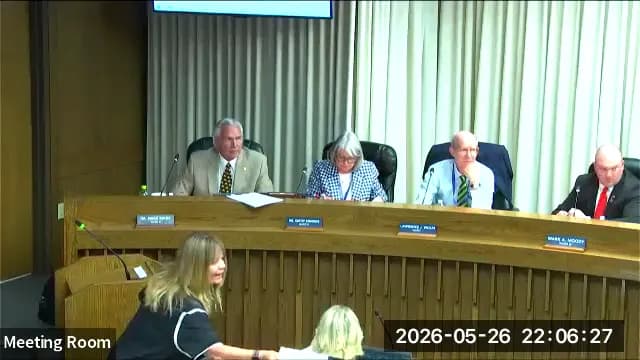
Public Meetings - Cheyenne, WyomingThe Cheyenne City Council held a six-hour meeting on May 26, 2026, addressing a wide range of items including consent agenda approvals, ordinance readings, public hearings, and a heavily debated proposal for a 12-month moratorium on data center development. The council ultimately defeated the moratorium by a vote of 1-8, with only Councilman Moody in favor. Numerous other items were approved, including the fiscal year 2027 city budget, water and sewer rate increases, and rezoning of business parks. Consent Calendar - The consent agenda was approved with items 19 (Cheyenne Regional Airport Board budget) and 28A (Yellowstone Road and Del Range Boulevard rehabilitation project) removed for separate discussion. - All other routine items listed as CA were enacted by one motion. Public Comments & Testimony - Data Center Moratorium (Item 14): Over 50 members of the public spoke, with opinions sharply divided. Supporters of the moratorium cited concerns about water usage, grid stability, noise pollution, health impacts, lack of transparency, and the pace of development. Several residents noted that existing data centers have caused no measurable harm, but argued for a pause to study cumulative effects. Opponents, including union tradespeople and business leaders, emphasized job creation, economic diversification, tax revenue, and the risk of sending a negative signal to future investors. Multiple speakers referenced Microsoft and Meta's community investments, such as the Microsoft Data Center Academy and a $3.4 million affordable housing grant from Related Digital. - Oversized Vehicle Ordinance (Item 8): Two owners of I-25 RV Storage spoke in favor of stricter enforcement and removal of size thresholds, stating that their business had suffered due to lack of enforcement. A resident also supported the ordinance, citing nuisance vehicles. - Solid Waste Fee Schedule (Item 9): One resident questioned fee increases, and the mayor explained the annual adjustment process, with residential increase averaging 33 cents per month. - Business Park Rezoning (Item 12): Several residents opposed reduced landscaping requirements, arguing that tree removal would harm aesthetics, buffer noise, and affect property values. Supporters, including Cheyenne LEADS, noted the need for flexibility to attract diverse businesses and support employee amenities like daycare. - Water and Sewer Rates (Item 13): A few residents opposed the increases, citing cumulative utility cost burdens. Staff clarified that the Board of Public Utilities is an enterprise fund with clean audits and that increases are driven by infrastructure costs. - Airport Budget (Item 19): One resident criticized the minimum revenue guarantee with United Airlines and questioned the airport's maintenance of landscaping on Airport Parkway. The new airport director committed to updating the MOU and restoring greenery. Discussion Items - Oversized Vehicle Ordinance: The council debated an amendment to remove all size measurements and apply the ban to all recreational vehicles as defined by state statute. Councilman Wolf and others argued that the public had not been properly notified of such a significant change on third reading. The amendment failed on a voice vote (appears 1-8, with only Dr. Aldridge voting yes). The main ordinance, as amended by a substitute to change enforcement from nuisance to police, passed on third reading with Councilmen Seagrave, Labourne, and Moody voting no. - Business Park Rezoning (Item 12): The planning department explained that the change from LI/HI/CB to BP allows more uses (e.g., daycare, retail) and reduces on-site tree requirements but does not change allowable uses for data centers. After extensive public comment, the ordinance passed on second reading with Councilman Moody voting no. Councilman Moody suggested future consideration of noise buffers. - Water and Sewer Rates (Item 13): Councilman Seagrave noted the need for rate increases to maintain infrastructure, citing chemical and pipe cost increases. The ordinance passed on second reading with Councilman Moody voting no. - 12-Month Data Center Moratorium (Item 14): Councilman Moody, the sponsor, urged a pause to study environmental, grid, water, and health impacts, noting that other communities like Denver and Jefferson County had enacted similar measures. Opposition from other council members argued that the city has 14 years of data, existing protections (enterprise funds, LPC tariff), and that a moratorium would chill investment. Councilman Wolf stated the ordinance was unworkable because staff could not perform the required studies. The motion to approve on second reading failed 1-8, with only Moody voting aye. - Cheyenne Regional Airport Board Budget (Item 19): Council members noted ongoing maintenance issues on Airport Parkway and requested the new airport director revise the MOU. The budget was approved with community support. Key Outcomes - Oversized Vehicle Ordinance: Approved on third reading as amended (vote: 5-3, with Seagrave, Labourne, Moody voting no). Amendment to remove all size thresholds failed. - Solid Waste Fee Schedule: Approved on second reading with a substitute correcting a math error (Moody voting no). - Business Park Rezoning: Approved on second reading (Moody voting no). - Water and Sewer Rates: Approved on second reading (Moody voting no). - Data Center Moratorium: Defeated (1-8). - City Budget (Item 11): Approved on second reading with an amendment to add a Community Service Officer using council discretionary funds. - Cheyenne Regional Airport Board Budget: Adopted. - Yellowstone Road and Del Range Project (28A): Professional services agreement with Sunrise Engineering approved in amount not to exceed $384,100. - Election of Vice President: Dr. Emmons was elected to the vice presidency of the council over objections about representation from the same ward as the president (vote 6-2, with Aldridge and Moody voting no).
The Cheyenne City Council held its regular meeting on Monday, May 11, 2026, at approximately 6:00 PM in the City Council Chambers, 2101 O'Neill Avenue. The meeting included public hearings, ordinance readings, resolutions, and contract approvals. Key topics included a planned unit development amendment for Sweetgrass, the Downtown Development Authority (DDA) budget, an engineering contract modification, and the Story Boulevard extension contract. The council also addressed a data center moratorium (referred to committee without discussion) and other routine business. Consent Calendar - The consent agenda was approved with items 31A (Story Boulevard extension bid) and 30A (AVI Engineering contract modification) removed for separate consideration. Item 23 (Cheyenne Regional Airport Board budget) was referred to the finance committee by the mayor. Dr. Rennie recused himself from item 30 due to a conflict of interest. Public Comments & Testimony - John Niles (resident) questioned the purpose of a zone change for land south of I-80, east of Southwest Drive. The applicant clarified no specific purchase option was pending; the change sought to align zoning with surrounding Light Industrial (LI) designations. - Rodney Stone (property owner on Story Boulevard) opposed the retaining wall planned in front of his house, stating he never requested it and preferred a simple slope. He asked the council to reconsider the design to avoid negative impacts on his property. - Charles Miller (public comment via Zoom) spoke on multiple items: - On the Sweetgrass PUD amendment, he argued it codified a reduction in public park space (from 66 to 45 acres) and criticized a clause allowing land-use changes without a major amendment review. He urged rejection until a transparent map of private recreation plans was provided. - On the DDA budget, he highlighted a $434,190 draw from reserves, questioned $65,100 for independent office space when city-provided space is available, and called the budget unsustainable. - On the Story Boulevard extension, he objected to the $3.49 million contract, claiming it subsidizes private development, noting the road currently carries 84 cars/day and will increase to 5,200, and criticized a retaining wall cost of $124,920 as benefiting a single property owner. Mayor Collins clarified there is no development driving the project, only pent-up demand. - On the voucher report, he cited expenditures of $40,000 for a concert, $12,292 for a climate action plan, $4,448 for firearm suppressors, and other items, arguing these divert funds from core infrastructure. - Charles Miller also commented on the AVI Engineering contract modification, suggesting it was a slush fund; Mayor Collins and staff refuted this, explaining the need for on-call engineering services due to staffing shortages. Discussion Items - Sweetgrass PUD Amendment (Ordinance Third Reading): Casey Palmer (applicant, Palm Land Planning) presented a plan to split a 66-acre park dedication into a 45-acre city-owned community park and a 28-acre parcel for private recreational development. Charles Bloom (Planning & Development Director) noted 45 acres aligns with the comprehensive plan for a community park and that the city's parks department supports the split. Councilmembers expressed concerns about the reduction in public land and the nature of the private facility. Dr. Aldridge referenced constituent complaints about unfulfilled promises (e.g., a community center). Mr. Palmer assured that the 45-acre park would remain free and public. After debate, the ordinance was approved on third reading (unanimous). - Downtown Development Authority (DDA) Budget: The initial budget of $1,005,800 was amended via substitute (May 5, 2026) to $1,022,800 (a $30,000 reduction to correct a scrivener's error). Public comment by Charles Miller criticized reliance on $434,190 in reserves and $65,100 for independent office space. Dave Tubner (DDA Board President) and Sophia Mays (Executive Director) defended the reserves draw as necessary for operational growth and strategic investments. Councilman Laborne noted the DDA's reserves ($961,700 after approval) are substantial compared to other Wyoming DDAs. The budget was approved as amended (voice vote, all in favor). - Story Boulevard Extension Contract (Bid S-19-26): The $3,493,630.85 contract with Ryman Corp was discussed at length. Laramie County Commissioner Troy Thompson explained the county's contribution of $1,161,510.60 (based on county standards) and expressed concern about cost escalation over five years. City Engineer Cobb detailed the engineering rationale for curb and gutter (due to a high-pressure gas line) and a retaining wall (to avoid fill on Mr. Stone's property). Councilman White noted the project is critical for future detours during the Dell Range project. Mr. Stone objected to the retaining wall. The contract was approved unanimously. - AVI Engineering Contract Modification (30A): The $25,000 increase brought the total to $99,500. Dr. Rennie recused himself due to his son's partnership in AVI. Some councilmembers (Dr. Aldridge, Mr. Laborne) raised concerns about sole sourcing and lack of transparency, while others (Dr. Emmons, Mr. Wolf) supported it as a practical solution to engineering staffing shortages. The modification was approved (7-2: Dr. Aldridge and Mr. Laborne opposed). - Wastewater Discharge Limits Ordinance: On third reading, the council postponed this item to May 26, 2026, to align with the EPA/DEQ public comment period (motion carried). - Future Land Use Map Amendment (Resolution): The item was referred to the public services committee and postponed to September 28, 2026, pending related zoning changes. - Data Center Moratorium: The mayor clarified that the item would be read into the record and referred to the public services committee; no discussion occurred that evening. Key Outcomes - Approved Ordinances (Third Reading): - Zone change for land south of I-80 (unanimous). - Sweetgrass PUD amendment (unanimous). - Approved Ordinances (Second Reading): - Oversized vehicle ordinance amendment (vote: Mr. Moody opposed). - Approved Resolutions and Contracts: - DDA FY 2026-2027 budget as amended (voice vote, all in favor). - BNSF Railway agreement for Reed Avenue project (vote: Mr. Moody opposed). - AVI Engineering contract modification 1 ($25,000, approved 7-2). - Story Boulevard extension bid ($3,493,630.85, unanimous). - Postponements: - Wastewater ordinance postponed to May 26, 2026. - Future land use map amendment postponed to September 28, 2026. - Referrals: - Solid waste fee schedule to finance committee. - Zone change for HR Ranch Road to public services committee. - Budget appropriation to committee of the whole (May 18, 2026). - Zone change for Cheyenne Business Park to public services committee. - Water/sewer rate changes to finance committee. - Data center moratorium to public services committee. - Executive Session: The council voted to enter executive session (unanimous) pursuant to Wyoming Statute §16-4-405 to receive confidential information. - Other Announcements: Councilmembers reminded the public of upcoming events: Boys & Girls Club breakfast (May 12), Council Coffee (May 16), Rooted in Cheyenne spring planting (May 16), LCCC graduations (May 15-16), and National Police Memorial Week.
The Cheyenne City Council convened on April 27, 2026, at 6:00 PM (local time) in Council Chambers. The meeting featured extensive public testimony and council debate on a proposed annexation of 1,200 acres west of Roundtop Road (Cox Ranch), a $5 million appropriation for the Reed Avenue Corridor, and multiple other items including zoning changes, a DDA budget increase, and a fire apparatus purchase. The council voted to postpone the annexation and related zoning items to September 14, 2026, after residents raised concerns about water, wildlife, and process transparency. Consent Calendar - The consent agenda was approved with items 15 (six-penny sales tax), 29A (Greenway land purchase), and 29D (FTA transit grant) removed for separate discussion. Public Comments & Testimony - Jim Walter (President/CEO, Visit Cheyenne) – Expressed full support for the Reed Avenue Corridor project, calling it “destination defining” and aligned with the Cheyenne Tourism Master Plan. He emphasized that the project leverages public infrastructure to attract private investment without additional taxpayer burden. - Cindy DeLancey (attorney for applicant, Cox Ranch) – Requested a postponement of the annexation ordinance to allow time for negotiations with neighboring property owners and the Cox family regarding the mausoleum. - Gay Woodhouse (attorney for Cox Ranches LLC) – Stated the need for time to preserve the family mausoleum in situ and ensure access in perpetuity; requested a postponement to August or later. - Heather Madrid (resident, Harmony Meadows) – Opposed the annexation, citing endangered plant species, bald eagle nests, surface water flow from Crow Creek, and concerns about data center water use and transparency. She criticized the involvement of the Joint Powers Board and Cheyenne LEADS. - Jordan (community member) – Opposed the annexation, arguing that residents feel their input is ignored and that the city’s promises of improved services are undermined by existing strain on fire and police resources. - Connor Nicholas (attorney for landowner trust) – Explained that the sale of the property would fund the Cox Family Foundation, supporting local FFA and agricultural causes. He stated the trust had entered a purchase agreement with Via West for data center development. - Thomas White (resident) – Opposed the annexation, concerned about the proliferation of data centers, traffic on Happy Jack Road, water depletion, and the loss of rural character. - Sue Roca (resident) – Questioned the foundation’s purposes and the impact on property values, stating that residents moved to the county to enjoy rural life. - Megan Plummer (resident) – Asked how many data centers are already in Cheyenne (12 operational, 5 under construction, 9 planned according to LEADS) and raised concerns about water, noise, and light pollution. - Richard Lyell (resident) – Supported data center technology but urged careful siting; noted national legislative efforts to pause AI data center construction. - Darrell Seifert (resident, Rolling Hills Estates) – Expressed water concerns, alleging unpermitted drilling at night and noticing decreased water pressure on his property. - Alex Bowler (Cheyenne Area Landowners Coalition) – Raised water usage concerns, noting that 13–14 data centers are already operational or under construction in Laramie County. - Jack O’Neill (purchaser, Via West) – Requested a pause to engage the community, help resolve the mausoleum issue, draft a development agreement with stringent lighting, sound, and closed-loop water systems, and complete environmental and traffic studies. - Mark Isley (King Ranch owner) – Opposed the annexation, stating it would clip his ranch headquarters; urged the council to remove his portion from the annexation boundary and emphasized the importance of ranching to the community. - Jane Lessinger (resident) – Argued that the annexation does not meet statutory criteria: the area is not contiguous (the 44-acre parcel does not make it adjacent), and the area is not developed enough to require city services. - Sandy Walk (resident, Rolling Hills) – Questioned why the county cannot rezone and expressed fear of eventual forced annexation. - Sam Galliotis (resident) – Criticized the city for not updating the Plan Cheyenne master plan since 2014 (12 years overdue) and noted that a required neighborhood meeting was not held before the planning commission. - Ann Margaret Burns (resident) – Said the North Range Business Park was developed with promises of low light, greenway, and no truck traffic on Happy Jack, but those promises have not been kept; opposed the annexation. - Minda Blevins (resident, Rolling Hills) – Stated the annexation would destroy views, wildlife, and rural character; questioned the foundation’s intent to sell agricultural land for a data center to support FFA. - Reba Epler (attorney) – Described the historic and cultural significance of the Cox Ranch, including teepee rings, endangered plants, and water resources; argued the annexation is not in the public interest. - Charles Miller (technical auditor) – Appeared multiple times, asserting that the annexation maps are factually false (surveys not completed until August), that the water use estimate of “eight homes” is misleading, and that the city is violating its own master plan. He called for a “technical reset.” Discussion Items - Reed Avenue Corridor Project (Ordinance 8) – Council members (Layborn, Aldrich, Rennie) supported the $5 million appropriation from general reserves, noting it was a voter-approved project from the 2017 sixth-penny ballot. Dr. Rennie expressed concern about the timing given other upcoming ballot measures. The ordinance passed 9–1 (Moody opposed, Rennie lost connection). - Sweetgrass PUD Amendment (Ordinance 10) – The amendment allows the city to develop a 45‑acre park and the remaining 22 acres for private use (e.g., indoor field house). Council members debated the impact on public access. Dr. Aldrich voiced concerns about the private facility but voted yes. The motion to approve on second reading passed; no vote tally given. - Cox Ranch Annexation (Ordinance 11) – Extensive discussion. The council voted to postpone until September 14, 2026, to allow time for surveys, mausoleum preservation, and community engagement. The vote was 9–1 (Dr. Rennie opposed). - Zoning for Annexation (Ordinance 12) – Also postponed to September 14, 2026, with the same vote. - Business Park Rezoning (Ordinance 13) – Postponed to September 14, 2026, with the same vote. - Six-Penny Sales Tax Ballot (Resolution 15) – Approved to place the one‑percent specific purpose sales tax proposition on the August 18, 2026, ballot. Mr. Layborn noted the importance of the measure. - DDA Budget Increase (Resolution 18) – Approved 7–3 (Moody, Labourne, Aldrich opposed). Dr. Aldrich expressed concern about duplicating a communications plan being done by the Downtown First group. The increase was for the communications plan and other projects. - Health Insurance for Part-Time Employees and Council (Resolution 22) – Failed overwhelmingly (7–2, with only Dr. Aldrich and possibly Mr. Moody voting yes? Actually the transcript says “Aye. Aye. Those opposed. No. The resolution fails with Dr. Emmons, Mr. Wolf, Mr. Seagrave, myself, Mr. Labourne, Mr. Escobel, and Mr. White all voting no.” So 7 no, 2 yes? The mayor didn’t vote? It was dead.) - Greenway Property Purchase (29A) – Approved $650,000 purchase for compliance and greenway connection. Public comment supportive. - Transit Facility Grant (29D) – Approved $4,143,600 federal grant for renovation. - Fire Apparatus Modification (30C) – Approved with savings of $44,035; funding from general reserves and future sixth-penny tax if passed. Key Outcomes - Reed Avenue Corridor: Ordinance 8 approved on third reading (9–1). - Sweetgrass PUD: Ordinance 10 approved on second reading (voice vote, no tally). - Cox Ranch Annexation and Rezonings: Ordinances 11, 12, and 13 postponed to September 14, 2026 (9–1). - Six-Penny Sales Tax: Resolution 15 adopted, placing proposition on August 18, 2026, ballot. - DDA Budget Increase: Resolution 18 adopted (7–3). - Health Insurance: Resolution 22 failed (7–2). - Greenway Property: Purchase agreement approved (unanimous). - Transit Grant: Approved (unanimous). - Fire Apparatus: Modification approved (unanimous). - Appointments: Approved (unanimous).
Note: The transcript repeatedly refers to this as the "April 13th meeting," but the official meeting date provided for this summary is April 14, 2026. This discrepancy is noted here. The Cheyenne City Council convened on April 14, 2026, for a regularly scheduled meeting. The agenda included a public hearing on a major landowner‑petitioned annexation of roughly 1,259.91 acres west of Roundtop Road and adjacent to Happy Jack Road, third‑reading votes on several zoning changes, second‑reading approval of $5 million for the Reed Avenue corridor project (contingent on a final agreement with BNSF Railway), adoption of new crosswalk criteria, and other routine business. Public comment was heard on multiple items, with residents expressing concerns about the annexation’s impact on neighborhood character, wildlife, traffic, and the lack of future public review for permitted uses. The council voted on numerous items, with most passing on bipartisan or unanimous votes. Consent Calendar - The consent agenda was approved with three items removed (items 21, 22, and 31C) at the request of council members. After removal, the remaining consent items were passed unanimously. Public Comments & Testimony - Annexation Public Hearing (Item 7): Several residents spoke both in favor of and in opposition to the proposed annexation of 1,259.91 acres west of Roundtop Road. Key speakers included: - Michael White (resident) questioned the benefit to the city, noted that the parcel for the city water treatment plant should have been brought separately, and raised questions about fire service response times. - Sam Galeotis (8827 Shellback Road) criticized the erroneous name on early documents and questioned the compatibility of a business park with the residential and ranch character north of Happy Jack Road. He asked why the statutory criteria of “logical and feasible addition” and “natural, geographical, economical and social part of the city” were satisfied when the area has no current residents. - Barry Meyer (7713 Barrington Road) expressed concern about taxes, traffic, and the potential for future annexation of his own property. - Carmen Cook (3221 McKinney Drive) asked about the types of businesses allowed in a business park (e.g., data centers, solar farms) and worried about noise and light pollution, citing a previous Bitcoin mining operation. - Paul Cremples (2606 McKinney Drive) argued the business park would create a pocket of county land surrounded by city land and that it is a “bad fit” for the area. - Rick Kessler (3605 Burke Drive) asked how the development constitutes a natural geographical, economical, and social part of the city when most surrounding land is ranchland. - Minda Blevins (7814 Cox Road) spoke about the peace, quiet, and wildlife of the area, and worries about traffic and future development if the annexation goes through. - Gay Woodhouse (on behalf of Cox Ranches LLC) noted that a family mausoleum sits on property that would be annexed and expressed fear that a data center could disturb it or block access. - Charles Miller (remote) argued the annexation fails state law because there are no existing residents to protect, and claimed approving it would permanently silence public oversight of future development. - Mandy Shaddock (7505 Barrington Road) raised concerns about well water impacts, the pocket effect, and accused the city of prioritizing appearance over people. - Other Business – Public Comment: - Noel Letter (Southwest Regional Council of Carpenters) spoke about construction tax fraud, alleging cash pay and undocumented workers on local projects. - Charles Miller (remote) delivered a “systemic audit” of the agenda, criticizing $5.6 million in discretionary spending for Reed Avenue and building renovations while the city has 28,000 service lines of unknown material and lead action‑level exceedances. He also referenced the use of ARPA funds for Flock cameras and the relaxation of lead limits in wastewater. Discussion Items - Annexation Public Hearing (Item 7): - Staff Report: Connor White (Planning) explained the annexation is landowner‑petitioned (petition filed Feb. 17, 2026), the land is 5.26% contiguous to city limits, no residents currently live there, and the proposed zoning change to Business Park (BP) would run concurrently with annexation. A future land use map amendment will be introduced in two weeks. - Council Questions: - Dr. Aldridge asked about residents (none). Council Member Moody asked about residents within half a mile (a couple) and whether there are plans to annex other areas (no). Council Member Wolf asked about the benefit to the city and the public’s future opportunity to comment on development (staff said once zoned BP, site plan review is administrative with no public hearing). - Council Member White (Michael) and others raised concerns about fire service, traffic, and the mausoleum. - Mayor’s Clarification: The public hearing was for input only; the next steps will occur at Public Services Committee (next Monday) and then through three readings of the annexation and zoning ordinances. - Reed Avenue Corridor Funding (Item 15 – Ordinance Second Reading): - The ordinance appropriates $5 million from the general fund reserves for the Reed Avenue corridor project, contingent on a final written agreement with BNSF Railway. - Proponents (Council Members White, Wolf, Escobel, Labourne, Dr. Aldrich, Dr. Emmons) argued the project was approved by voters in 2017, that private investment has been made in the area, and that the funding is a commitment to move a long‑stalled project forward. - Opponents (Council Members Moody and Dr. Rainey) cited fiscal prudence concerns, timing, and the need to reserve funds for emergencies. Dr. Rainey noted she has supported the project for nearly a decade but opposed the timing of the ordinance. - Public Comment: Charles Miller opposed the funding, arguing the $5 million should be used for lead pipe replacement instead. - Vote: Approved on second reading with a majority vote (two “no” votes: Moody and Dr. Rainey). - Crosswalk Criteria Resolution (Item 22): - The resolution adopts updated crosswalk guidelines and confirms the city engineer’s authority to implement crosswalk treatments. - Public Comment: Carol Davenroy and Bonnie Joe Cruz thanked the council for their persistence, referencing the long‑standing need for a crosswalk on Gardenia, which is now expected to be installed by late summer. - Council Discussion: Council Member Labourne praised the effort to move beyond strict MUTCD standards. Council Member White credited residents for driving the change. Council Member Moody requested that thermoplastic be used for durability; City Engineer Cobb responded that they use it where feasible but noted some projects (e.g., Yellowstone) will wait for a major maintenance project. - Vote: Unanimously adopted. - Zoning Changes (Items 8-12 – Third Readings): - Item 8: 6.5‑acre zone change from PUD to NR3 (neighborhood residential high density) for apartments – Approved unanimously. - Item 9: 25.17‑acre zone change from PUD to NR3 – Approved unanimously. - Item 10: 14.47‑acre zone change from AG to NR3 – Approved unanimously. - Item 11: 0.5‑acre zone change from MR to NR2 (neighborhood residential medium density) – Approved unanimously. - Item 12: Vacation of Frank Court and a segment of alley – Approved unanimously. - Wastewater Ordinance (Item 13 – Second Reading): - Updates local discharge limits to comply with NPDES/WPDES permits. Staff from BOPU explained it as limiting contributions to protect the treatment plants, workers, and downstream users. Approved unanimously. - DDA District Expansion (Item 14 – Second Reading): - Expands the downtown development district to include 2100 Snyder Avenue (Snyder Food). The property owner voluntarily agrees to pay the additional 20‑mill tax. Approved unanimously. - Other Items – First Readings (Items 16-20): - Items 16 (zone change south of I‑80) and 17 (Sweet Grass PUD modification) referred to Public Services Committee. - Items 18 (annexation ordinance first reading), 19 (assigned zoning AG/Public for annexed land), and 20 (zone change to BP) all referred to Public Services Committee. - Final Plat (Item 21): - Final plat for 2900 Central Avenue Townhomes adopted unanimously. - Professional Services Agreement (Item 31C): - Contract with MHP Assurance Services for audited financial statements (not to exceed $148,600 over three years) approved. Council Member Labourne emphasized that the audit ensures full accountability of city funds. - Contract Modification (Item 32A): - Modification to street overlay project (Knife River) for Cheshire Drive ($217,150.20) approved. Dr. Aldridge expressed concern about repeated change orders; staff explained improved coordination to prevent future gaps. - Other Business – Governing Body: - Council Member Dr. Aldridge reminded of the Ward 3 Council and Coffee on Saturday. - Council Member Escobel praised the water treatment plant as state‑of‑the‑art. - Council Member Moody noted he would be absent from the coffee event. - Council Member Seagrave moved to enter executive session (Wyoming statute 16‑4‑405(a)(vii)), which was seconded and carried by voice vote. The meeting then adjourned. Key Outcomes - Annexation Public Hearing: Completed; no vote taken. The item will proceed to Public Services Committee on April 21, 2026, with a first reading vote expected on April 28, and final reading on May 12 (along with associated zoning and future land use map amendments). - Reed Avenue Corridor Funding (Item 15): Approved on second reading (vote: ayes majority, with Council Members Moody and Dr. Rainey voting no). The $5 million appropriation is contingent on a final written agreement with BNSF Railway. - Crosswalk Criteria (Item 22): Adopted unanimously, enabling more flexible crosswalk placement. - Zoning Changes (Items 8-12): All approved on third reading unanimously. - Wastewater Ordinance (Item 13): Approved on second reading. - DDA District Expansion (Item 14): Approved on second reading. - Professional Services Agreement (Item 31C): Approved unanimously. - Contract Modification (Item 32A): Approved unanimously. - Executive Session: Approved by voice vote to discuss confidential information; meeting then adjourned.
This special meeting of the Cheyenne governing body was convened to continue negotiations on a collective labor agreement with the Cheyenne Professional Firefighters International Association of Firefighters, Local 279. The meeting resulted in a tentative agreement on wages, vacation scheduling, and other contract provisions, subject to final language review and formal approval in two weeks. Discussion Items - City's Wage Analysis and Revised Offer: Mayor Collins presented a detailed comparison of Cheyenne firefighter compensation to other Wyoming departments (Casper, Gillette, Sheridan, Laramie, Loveland, Rock Springs) using the Community Council for Economic Research cost-of-living index. The city stated that its math did not support the union's claim of being 30% behind market. After adjusting for pay components and years in rank, Cheyenne was found to be higher than most communities at every rank except for Sheridan and Laramie where firefighters were 3.3% behind, engineers 7.9% behind, and lieutenants 7% behind, but with $300,000 more in retirement and 44% fewer calls. The city then offered a new proposal: a 3% raise for all members on all supplemental pays, a probationary firefighter increase to 10.4% (to reduce the gap with step 4 firefighters), an additional 3.5% for captains, and an additional 4.75% for battalion chiefs to address compression. The rest of the offer remained as previously presented. - Union's Response and Counterproposals: The union thanked the city and presented two contingencies for accepting the wage proposal: (1) extending the sunset clause on cost-of-living adjustments to cover the full duration of the upcoming collective labor agreement (the current sunset expires June 30, 2026); and (2) acceptance of the MERP (Medical Expense Reimbursement Plan) language as proposed. The union emphasized that MERP is a long-term health and well-being benefit and that the agreement offered an opportunity for the city to be part of that legacy. - Vacation Scheduling Negotiations: A key point of discussion was the number of vacation slots available per day. The city proposed four vacation slots per day with the ability to use EOD (exigent or other duty) as long as two slots remained above the minimum to cover overtime. The union initially wanted four slots but agreed to the city's language after clarification that four slots could be used for either vacation or EOD, and that the city would maintain two slots above the minimum. The city also agreed to allow emergency exceptions for vacation or EOD use by the battalion chief, deputy chief, or fire chief, as long as it does not cause overtime. - Other Contract Items Agreed Upon: The parties reached agreement on several other items: sick leave for day personnel (Section 27 of the contract), a requirement that employees work a full month to accrue leave (to simplify payout calculations for those who quit mid-month), and conversion of benefit hours for daytime personnel. However, the city rejected the union's request to apply a conversion factor to vacation time for daytime personnel, arguing that daytime employees already have greater flexibility and 11–12 paid holidays. The union did not press the issue. - MERP Agreement: The city agreed to the MERP language with one exception: the city will not pay into the plan for firefighters who are on unpaid leave (e.g., not working without pay). The city will only contribute when the firefighter is paying into the plan. The union accepted this condition. Key Outcomes - Wage Agreement: The city's offer of a 3% across-the-board raise, plus specific increases for probationary firefighters (to 10.4%), captains (additional 3.5%), and battalion chiefs (additional 4.75%), was accepted by the union, contingent on the two conditions (extended sunset clause and MERP language). - MERP and Sunset Clause: The union agreed to the city's condition on MERP (no city contribution for unpaid firefighters). The extended sunset clause was accepted. - Vacation Language: The parties agreed to four vacation/EOD slots per day with two slots above the minimum, and emergency exceptions without causing overtime. - Next Steps: The city and union will finalize the contract language within the next week (meeting with the deputy chief since the fire chief is on spring break). The finalized agreement will be presented to the governing body in two weeks for formal approval. - Adjournment: The meeting was adjourned with thanks from all parties.
The Cheyenne City Council met on March 24, 2026, to address a range of items including the third reading of an ordinance to repeal the stormwater fee, multiple zone changes to facilitate housing development, a contract modification for the municipal building renovation design project, and other routine business. The meeting featured significant public comment and council debate, particularly on the stormwater fee repeal and the contract modification. Consent Calendar - The consent agenda was approved unanimously. Public Comments & Testimony - Stormwater Fee Repeal: Richard Johnson (612 McGovern Avenue) spoke opposing the repeal, expressing distrust in the legislature and arguing that the fee was necessary to prevent loss of life from flooding. He stated, "I don't trust the legislature" and criticized the repeal as a "stab in the back for false promises from the legislature." He emphasized that the fee was created to save residents and property. - Contract Modification for Municipal Building Renovation: Richard Johnson urged the council to wait, warning that using general fund reserves for design work may not be realized if the sixth penny ballot fails, saying, "I think this is going to come back and bite you because I don't see this passing on six penny when you actually come to construction." - Other Business: Richard Johnson promoted a Habitat for Humanity fundraiser at Wagon Hound Winery (20% of proceeds from party flights) and encouraged council members to participate in the upcoming blitz build. Discussion Items - Bar and Grill Liquor License (Item 10A): Robin Kozad, new owner of Mongolian Bar and Grill (1637 Stillwater Avenue, Suite C), presented plans to add a bar to the establishment. A public hearing was held; no opposition was voiced. The item was assigned to the finance committee. - Stormwater Fee Repeal (Ordinance 3rd Reading – Item 11): The council debated an ordinance to repeal the monthly stormwater runoff management system user fee, enacted in 2024. The repeal was proposed in collaboration with the legislature, which agreed to study the issue during the interim. Council members expressed varied positions: - Dr. Rennie supported repeal as a compromise, noting the legislature's select committee on water would address stormwater statewide. - Mr. Wolf opposed, stating he would pursue other funding sources and voted "emphatically no." - Mr. Seagrave reluctantly supported, warning of potential legislative backlash but suggesting other solutions like requiring large property owners to eliminate water leaving their property. - Dr. Aldrich reluctantly supported to keep the city's word to the legislature, but expressed lack of confidence in legislative follow-through. - Mr. Labourne voted no, citing no plan B and lack of tangible progress on drainage improvements. - Dr. Emmons supported as a hopeful compromise, noting the infrastructure and fee structure remain in place as a fallback. - Mr. Moody supported due to constituent opposition and the burden on businesses like Union Pacific Railroad ($18,000/month), Microsoft, and Magpul. - Mr. Escabel opposed on principle, stating the risk of flooding deaths was unacceptable. - Mr. White reluctantly supported, criticizing the legislature for allowing the fee then reversing after local work was done. - Zone Changes (Items 12-16): Multiple ordinances on second reading to rezone land for housing development: - Item 12: Zone change to NR3 for five 24-unit apartment buildings north of West College Drive. - Item 13: Zone change to NR3 for 196 cottage-style homes on smaller lots (priced around $300,000) south of West Allison Road. - Item 14: Zone change from AG to NR3 north of Allison Road for future housing development. - Item 15: Zone change from MR to NR2 for existing townhomes to allow individual lot sales. - Item 16: Vacation of Frank Court and a small alley segment. All five items were approved unanimously on second reading. - Contract Modification for Municipal Building Renovation Design (Item 24A): Director Vicky Nemichek (Public Works) presented a $867,050 contract modification to Plan One Architects to add design of the former senior center (new council chamber) and the second floor of the municipal court to the existing municipal building renovation project. The modification would be funded from general fund reserves, as the original sixpenny ballot funds are restricted to the municipal building. Debate centered on urgency, fairness, and whether to put the additional work out for competitive bid. Council members: - Mr. White supported, citing inflation savings and the need to move quickly to complete the sixth penny project. - Dr. Rennie supported, arguing coordination by a single firm was essential and that the project was time-sensitive. - Dr. Aldrich opposed, citing fiscal responsibility and concerns about prior unused plans; also questioned fairness to local firms like Winters Griffith (which had submitted an email arguing for competitive bidding). - Mr. Wolf opposed, stating local firms should have an opportunity to bid and that the urgency was self-created; he urged putting the work out for RFP. - Mr. Moody opposed, calling it "putting the cart before the horse." - Mr. Seagrave supported, arguing that private industry would not switch architects mid-project and that the former senior center was a cost-saving alternative to a building addition. - Dr. Emmons expressed concern about optics but did not explicitly state a vote; the motion passed with opposition from Wolf, Moody, Labourne, and Aldrich. - Other Ordinance First Readings (Items 17-19): Three ordinances were introduced and referred to committees: amending wastewater discharge limits, expanding the downtown development district, and appropriating funds for the Reed Avenue Corridor Project. - Appointment (Item 26A): Andy Michelson was appointed to the Public Transit Advisory Board; approved unanimously. - Other Business: Council members made announcements. Dr. Aldrich highlighted a Cheyenne Animal Shelter vaccination clinic that vaccinated 293 pets. Mr. Moody welcomed Shin Young back to the community and wished Happy Passover and Easter. Mr. Seagrave thanked city staff for their response to recent wind events, including tree removal, safety barriers, and increased calls handled by police and fire departments. Key Outcomes - The consent agenda was approved. - The stormwater fee repeal ordinance passed on third reading, 6-3 (Yes: Emmons, Moody, Rennie, Seagrave, White, Aldrich; No: Escabel, Labourne, Wolf). - Five zone change ordinances (Items 12-16) were approved on second reading. - The contract modification for the municipal building renovation design project was approved, 5-4 (Yes: White, Rennie, Emmons, Seagrave, and possibly Aldrich? The transcript shows Aldrich voted no, so tally: Yes: White, Rennie, Emmons, Seagrave, and one more? Mayor did not vote. Need to recount: The transcript shows "Those opposed: Mr. Wolf, Mr. Moody, Mr. Labourne, and Dr. Aldridge" – that's 4 nos. The motion passed, so 5 yes. Likely: Emmons, Rennie, Seagrave, White, and Dr. Aldrich? But Aldrich said no. Re-read: After the vote, the transcript says "Yes, the contract modification is approved" after listing the noses. Possibly Dr. Emmons and others voted yes. No clear roll call. So 5-4 passage is correct.) - Andy Michelson was appointed to the Public Transit Advisory Board. - A public hearing was announced for April 13, 2026, at 6 p.m. to determine compliance of annexation conditions for approximately 1,259.91 acres west of Round Top Road adjacent to Happy Jack Road.
This was a special meeting of the Cheyenne City Council convened at 6:00 p.m. on March 17, 2026, for the purpose of collective labor bargaining with the Cheyenne Professional Fire Fighters, International Association of Fire Fighters, Local No. 279. Present were Mayor Patrick Collins and Council Members Aldrich, Emmons, Esquibel, Laybourn, Moody, Segrave, and White. Council Members Rinne and Wolfe were absent. The meeting adjourned at 6:49 p.m. without reaching a contract agreement. Discussion Items - Union Proposal to Table Wages: Chris Thoms, President of Local 279, stated that the parties remain at an impasse regarding wages and proposed setting aside wage discussions to negotiate other sections of the contract and make progress. He emphasized the union’s desire to keep negotiations constructive. - Mayor’s Rebuttal and Data Presentation: Mayor Collins declined to set wages aside, calling wages the primary sticking point. He reviewed the city’s investments in firefighter staffing (increased from 89 to 103 firefighters since 2021), new apparatus and stations, and safety equipment. He provided detailed compensation comparisons, asserting that Cheyenne firefighters are the highest paid in Wyoming after a 3% raise when adjusted for cost of living. He compared Cheyenne to Loveland, Colorado, noting that Loveland firefighters handle 44% more calls per officer, have a higher cost of living index (121 vs. 104), and are non-union with a 401(a) retirement plan. He also compared total compensation (including specialty pays) to fire departments in Jackson, Gillette, Casper, Sheridan, Laramie, and Rock Springs, showing Cheyenne firefighters earning significantly more after cost-of-living adjustment in most ranks. - Union Response to Data: Thoms noted that the city’s data sets differ from the union’s and requested time to review the mayor’s new data, which was handwritten. He reiterated the union’s desire to move negotiations forward in good faith by addressing other contract sections first. Mayor Collins insisted on resolving wages before proceeding. - Impasse and Next Meeting: After a recess from 6:20 p.m. to 6:45 p.m. for union members to caucus, the parties remained at an impasse. They agreed to meet again on Monday, March 23, 2026, after the regular City Council meeting (estimated 7:00–7:30 p.m.) to continue negotiations. The union requested the city’s compensation data be provided for review beforehand. Key Outcomes - No agreement was reached on wages or any other contract sections. - The parties remain at an impasse on wages. - A follow-up negotiating session was scheduled for March 23, 2026, after the regular City Council meeting. - The union requested the city’s compensation data be provided for review before the next meeting.
This special meeting of the Cheyenne City Council was convened at 6:00 p.m. on March 16, 2026, for collective labor bargaining with the Cheyenne Professional Fire Fighters, IAFF Local 279. (Note: source materials list March 16, but the assigned date for this summary is March 17, 2026.) The meeting included opening remarks, presentation of a counter proposal by the Union, extensive discussion on wage comparisons, peer groups, cost of living, attrition, and specialty pays, an executive session, and adjournment with a scheduled follow-up meeting. Discussion Items - Union Counterproposal: Union President Chris Thoms presented a counter proposal reducing the wage increase request from 6% to 5%, along with updates to Section 19 (Inclement Weather) and Section 21 (Classification of Employment and Basic Wages). - Peer Comparisons: The Union argued for including Front Range departments (Loveland, Greeley, Fort Collins) as appropriate comparisons due to similar staffing models, call volumes, and shared regional labor market. They claimed Cheyenne firefighters are behind some of these departments by 22.6 to 42.3 percent even after accounting for cost-of-living differences. Mayor Collins and the City maintained that Wyoming municipalities (Casper, Laramie, etc.) are the proper peer group because they operate under the same funding mechanisms and have comparable cost structures. - Cost of Living Data: The Union cited data from bestplaces.net showing Cheyenne is 14.7% cheaper than Fort Collins, 11.5% cheaper than Loveland, and 4.5% cheaper than Greeley, but argued the wage gap remains significant. Mayor Collins recalculated using the same website and contended that after factoring in specialty pays, a Cheyenne company officer would need $106,031 in Loveland to match compensation, which is higher than Loveland's current wage. - Attrition and Recruitment: Union Vice President Jason Lindsay presented a list of 17 firefighters who left over 17 years, with 12 departing for wages. Mayor Collins countered with a 10-year analysis showing 23 departures, only 4 related to salary (others: family relocation, career advancement, termination, etc.). He noted Cheyenne currently has 108 applicants on the list for the upcoming test, spanning 11 states, indicating no recruitment crisis. - Specialty Pays: The Union emphasized that specialty pays compensate for advanced certifications (paramedic, hazmat, technical rescue) and are not bonuses. They argued 40% of Cheyenne firefighters are paramedics, contributing to higher average wages. The City noted it pays for training and provides ongoing specialty pay ($7,700 annually for paramedics), and the higher wages reflect this investment. - City's Offer and Fiscal Position: Mayor Collins reiterated the City's standing offer of a 3% raise already implemented plus another 3% in the contract (6% total for the year). He stressed that recurring expenses must be funded by recurring revenues; one-time building permits and reserves should not be used for ongoing salary increases. The Union argued the City has accumulated reserves and an upcoming Meta data center will bring significant new revenue (the City disputed the Union's revenue projections). - Executive Session: At 6:41 p.m., the Council moved into executive session (W.S. §16-4-405(a)(x)) with specified staff, reconvening at 7:06 p.m. for continued discussion. Key Outcomes - No Agreement Reached: The parties remained at an impasse primarily over the definition of appropriate peer groups. - City Standing Offer: The City reaffirmed its proposed 6% overall increase (3% already implemented plus 3% in the new contract). - Union Request to Review Data: The Union asked for time to review rank average compensation data provided by the City. - Next Scheduled Meeting: The Council and Union agreed to reconvene the next evening (March 17, 2026 at 6:00 p.m.) to continue negotiations. - Adjournment: The special meeting was adjourned at 7:35 p.m.
The Cheyenne City Council convened a special meeting on March 12, 2026, at 6:00 p.m. in Council Chambers for collective labor bargaining with the Cheyenne Professional Fire Fighters, International Association of Fire Fighters, Local No. 279. The meeting included an executive session (6:04 p.m. – 6:33 p.m.), followed by open discussion of the city’s wage and benefits proposal, and concluded with an agreement to adjourn and reconvene on Monday, March 16, 2026, at 6:00 p.m. for further negotiations. Mayor Patrick Collins presided; Councilmember Dr. Rinne was absent. Public Comments & Testimony - Chris Thoms, President of Local 279, thanked the governing body for its continued support of Cheyenne Fire Rescue, including funding for new stations and apparatus and the department’s accreditation process. He noted that in 2020 the union voluntarily accepted a wage reduction during the COVID pandemic. He reviewed regional pension differences: Wyoming’s pension pays 2.8% of salary per year of service (resulting in 70% of salary after 25 years for a firefighter earning $90,000), compared to Montana (2.5% per year, 62.5% at 25 years) and Colorado (2% for first 10 years then 2.5%, 57.5% at 25 years). He calculated that over a 30-year retirement a Wyoming firefighter would receive $202,500 more than a Montana firefighter and $337,500 more than a Colorado firefighter. He also cited higher cost of living in other states: income taxes (Montana 4.7–5.65%, Colorado 4.4%) and higher property taxes, meaning a firefighter earning $90,000 living in a $400,000 home would pay $6,300 more in Montana and $4,185 more in Colorado compared to Wyoming. Thoms stated that after studying other Wyoming departments (Casper, Gillette, Rock Springs, Sheridan, Laramie, and Campbell County), Cheyenne firefighters are among the highest paid when including specialty and longevity pay. He requested a recess to caucus with union members (6:43 p.m. – 7:11 p.m.). Discussion Items - Mayor Collins’ Proposal: The mayor presented the city’s offer, which included: (1) memorializing the 3% cost-of-living adjustment already granted to all city employees on January 1, 2026; (2) an additional 3% raise effective July 1, 2026 (the start of the new budget year), resulting in a total 6% increase for 2026; (3) revised vacation language to limit the number of firefighters on leave to two slots above minimum personnel (currently 25), intended to control overtime and ensure full staffing; (4) provisions for vacation carryover for military deployment or extended illness/injury; (5) clarification that vacation accrual in the final month of employment will follow citywide rules (no partial-month accrual) as requested by the city treasurer; and (6) updated definitions for rotational positions in Section 2 and new dates in Section 4 of the collective bargaining agreement. Mayor Collins argued that Cheyenne’s overall compensation package – including retirement, wages, specialty and longevity pay – is competitive compared to other Wyoming communities and noted that working in other states involves higher costs of living due to income and property taxes. - Union Response: Chris Thoms thanked the mayor for the detailed written proposal and requested a recess to review it. After caucusing, the union agreed to adjourn the meeting so they could study the proposal line by line and continue negotiations at the next scheduled session. Key Outcomes - No formal vote was taken on the proposed labor contract amendments. - The governing body and union representatives unanimously agreed to adjourn the special session at 7:12 p.m. and reconvene on Monday, March 16, 2026, at 6:00 p.m. to continue negotiations. - The motion to adjourn was made by Councilmember Segrave, seconded by Councilmember Aldrich, and passed by voice vote with all present members in favor.