The Committee of Finance, Diversity, Equity, and Inclusion meeting convened to review three emergency ordinances related to the North Coast Connector Project, the sale of city-owned property for a hotel development, and a collective bargaining agreement. Key discussions focused on clarifying funding amounts, legal descriptions, and project phases, as well as addressing community concerns regarding neighborhood impacts and development plans. Consent Calendar - No Routine Approvals: All agenda items required substantive discussion and amendment. Public Comments & Testimony - Councilman Casey: Expressed concern that the summary of the North Coast Connector Project listed a $447 million cost while initial funding requests were $5 million, necessitating a procedural amendment to clarify the removal of the $5 million request from the current legislation. - Councilman Palensky: Expressed confusion regarding the total project cost ($447M vs. $284M vs. $470M), inquired about current funding availability ($160M), and asked for the full master plan design for the entire lakefront area. He voiced strong concern regarding the allocation of "half a billion dollars" to the lakefront while neighborhoods have unmet needs. - Councilwoman Jasmine Center: Asked for clarification on the appraisal value of the parcels being sold to confirm the sale price matched market value. Discussion Items Ordinance 1072-2025 (North Coast Connector Project) - Project Description: The ordinance amends Ordinance 549-2025 regarding a contract with Osborne Engineering Company for the Lakefront Pedestrian Bridge Connector (West 3rd to East 9th Street). It involves preliminary design ($11M construction cost component) for a project with a total estimated cost of $470M. - Funding Clarification: Councilman Casey and Assistant Director Ms. Chambers debated the specific dollar amounts cited in previous ordinances. An amendment was adopted to strike the reference to $4.5 million from the current legislation, clarifying that the $5 million originally requested in Ordinance 549 is being removed from this specific amendment to correct the clerical record. - Future Phases: Staff clarified that funding currently exists only for the phase from West 3rd to East 9th Street. The extension from East 9th to East 18th Street (Phase 2/3) is still conceptual with no current funding, though a TIFF and additional grants are being explored. - Design Status: Staff noted that while the bridge and shoreway realignment have a design, the area north to Brown Stadium remains conceptual/pre-engineering. - Community Request: Council members requested the full master plan for the entire lakefront to assess the impact on surrounding neighborhoods. Ordinance 1223-2025 (Ortho School Properties Hotel Sale) - Project Description: Authorizes the sale of five parcels (including one added via amendment, Parcel 119-09-041 at 1819 East 90th Street) to Ortho School Properties LLC for a Marriott-affiliated Spring Hill Suites hotel. - Pricing Amendment: Councilman Griffin requested an amendment increasing the sale price from $52,000 to $65,000 (based on $13,000 per parcel appraisal) after initially lacking the price data. - Procedural Clarification: Councilman Palensky noted the site is north of Chester Avenue in Councilwoman House Jones' ward (shifting if redistricting occurs). Councilwoman Jones recused herself as her mother's house is adjacent. Staff confirmed no land is currently being transferred; this ordinance provides necessary control/letters for financing before the Planning Commission and BZA review. - Neighborhood Concerns: Councilman Palensky questioned how a hotel fits among single-family homes. Councilman Harrison clarified the developer controls two of three parcels on-site and is in negotiations for the third, with a pledge to work through the Planning Commission process to address design compatibility. Ordinance 1323-2025 (Collective Bargaining Agreement) - Project Description: Ratifies a successor collective bargaining agreement with Utility Workers of America, AFL-CIO Local 270, for the period April 1, 2025, through March 31, 2028. The agreement affects approximately 60 employees, including water plant operators and stationary engineers. - Action: The agreement was approved by the committee and referred to the full body for ratification. Key Outcomes - Ordinance 1072-2025: Approved as amended, effectively striking the $4.5 million request to correct the clerical record of funding removal from the previous ordinance. - Ordinance 1223-2025: Approved as amended, increasing the total sale price for five parcels to $65,000 and adding the legal description for Parcel 119-09-041. - Ordinance 1323-2025: Approved by the committee and referred to the full body for final consideration. - Directives: Committee members directed staff to provide the full lakefront master plan design to the council.
Public Meetings - Cleveland, Ohio
Public Meetings - Cleveland, OhioThe Committee of Finance, Diversity, Equity, and Inclusion convened for a special hearing to establish the procedural framework for future deliberations regarding the proposed settlement between the City of Cleveland and Haslam Sports Group (HSG) concerning the move of the Cleveland Browns to Brook Park. Mayor Justin Bibb and senior administration officials testified that the agreement secures $100 million in assets for the city, including immediate cash, stadium demolition, and community benefits, while acknowledging that the settlement is contingent upon Council approval of specific real estate and financial components. Consent Calendar - N/A (This was a special hearing without routine legislation.) Public Comments & Testimony - Building Trades (Mr. Wondolowski): Acknowledged as present to support the involvement of union labor in the stadium demolition and subsequent lakefront development. - Council Member Councilwoman Rebecca Moore: Expressed strong opposition to the move, characterizing the deal as "socialism for NFL owners" and expressing concern that the $600 million state funding for the new stadium comes from unclaimed funds belonging to average Ohians. She requested that union leverage be used to ensure not only construction jobs but also long-term stadium employment remain unionized, noting that HSG has previously utilized non-union labor. - Council Member Councilwoman Deborah Gray: Expressed emotional distress over the potential loss of the team, noting the confusion regarding why the Model Law did not prevent the team's departure after Haslam's purchase in 2012. Discussion Items - Mayor Justin Bibb: Stated that the administration acted on three mandates from Council: protect taxpayers, do not leave the city empty-handed, and fight hard in court. He argued that the baseline for negotiations was zero, as the lease expiration posed a risk of the city receiving nothing and being left with stadium maintenance liabilities. He emphasized that the state legislature gutting the Model Law and providing $600 million to HSG for Brook Park fundamentally altered the city's leverage. - Law Director Mark Griffin: Explained the legal strategy, noting that while the city holds three active lawsuits, none could legally force HSG to remain in Cleveland or guarantee a specific dollar amount beyond a six-month negotiation window. He clarified that the administration sought a pragmatic settlement to avoid the risk of a $0 outcome in court. - Chief of Staff Jessica Travisano: Outlined the deal structure: $25 million in upfront cash, $25 million in installments, $30 million for demolition (covered by HSG), and $20 million in community benefits to be defined by Council. She noted that the $100 million figure was never on the table until the final negotiations. - Council Member Michael Palencik: Expressed skepticism regarding the financial math, arguing that net costs (remaining $32.9 million debt, capital repairs, and legal fees) outweigh the settlement value, potentially leaving the city with a net negative outcome. He criticized the lack of prior briefings to the full Council and questioned the justification for a deal he deemed insufficient compared to the city's historical investment. - Council Member Brian Casey: Expressed frustration with the "dance with the devil" narrative, questioning why the administration entered terms that allow HSG to retain influence over the lakefront redevelopment despite their stated intent to leave. He questioned if passing the legislation effectively grants HSG permission to leave Cleveland. - Council Member Richard Starr: Asked for detailed cost breakdowns for the stadium's remaining debt, debt service, and capital repairs. He sought clarification on community benefits and requested a Community Benefits Agreement (CBA) be finalized before Council approval to ensure local hire and diversity requirements are met. - Council Member Joe Jones: Inquired about the timeline of negotiations, noting he received only high-level updates during the process. He requested confirmation that the City Council must approve the entire settlement agreement, not just the term sheet, and sought details on the $30 million demolition estimate. - Councilman Danny Kelly: Emphasized the need for construction and future stadium jobs to be available to Cleveland residents and emphasized the value of union labor. - Councilman Anthony Harrison: Expressed optimism for future negotiations to secure additional benefits and discussed the necessity of maintaining a unified Council front despite differing opinions on the process. - Councilman Charles Sleif: Criticized the deal as a "top hat welfare" scheme and expressed doubt that the Brook Park location would generate promised economic benefits, calling it a bad precedent for the region. - Councilman Harsh: Expressed deep concern about taxpayers indirectly funding the move to Brook Park through infrastructure projects (airport, RTA) and questioned the validity of the $600 million state appropriation. - Councilman Casey (Follow-up): Questioned if the administration could recover $100 million or more if the demolition costs overage the $30 million estimate and whether the agreement permits the Browns to leave. Key Outcomes - Process Framework Established: Council agreed to conduct multiple hearings to deliberate the deal, with referrals to the Department of Public Safety (DPS) and Municipal Services committees. - Full Agreement Requested: Council explicitly noted on the record that it requires viewing the entire finalized settlement agreement, not just the term sheet, before voting, to ensure a full understanding of legal obligations and substantive terms. - Council Authority Confirmed: It was clarified that while the Law Director has the authority to settle certain legal claims, the City Council retains mandatory authority to approve real estate transactions, lease extensions, and the acceptance of donations over $1 million. - Deadline Identified: A target date of November 24, 2025, was established to finalize legislation to secure the initial $25 million payment scheduled for December 1, 2025. - Community Benefits Directive: Council directed the administration to finalize a Community Benefits Agreement (CBA) defining the $20 million community benefits fund, ensuring local hire, diversity, and union standards before the settlement is voted on. - Financial Data Request: Council ordered the administration to provide a comprehensive spreadsheet detailing all outstanding stadium debt, debt service, capital repair estimates, legal fees, and revenue offsets (CPP, utilities, security) to allow for a complete cost-benefit analysis. - Demolition Liability: The administration confirmed that Haslam Sports Group bears 100% of the cost for demolition and site preparation, including any overages beyond the $30 million estimate, protecting the city from additional liabilities. - Lease Extension Options: It was clarified that the term sheet includes two one-year lease extension options for HSG to remain at the current stadium, though HSG does not anticipate utilizing them. - Timeline for Future Action: Discussions will continue on the long-term economic mitigation for downtown businesses and hospitality workers affected by the team's departure.
This meeting addressed appointments to city boards, specifically the Greater Cleveland Regional Transit Authority (RTA) and the Cleveland City Planning Commission. The primary focus was reviewing the qualifications of appointees, clarifying conflicts of interest regarding elected officials holding multiple public offices, and discussing pressing housing policy issues, including modular housing and front-load garage regulations. Council members and applicants emphasized the need for flexible, creative approaches to accelerate housing development in neighborhoods with high vacancy rates. Consent Calendar - The appointment of Chanel Smith Wiggum to the Greater Cleveland Regional Transit Authority (RTA) board was approved without objection. The legal department confirmed that while City Charter Section 26 prohibits council members from holding public office, Ms. Wiggum is not a council member, thus the appointment is valid. Public Comments & Testimony - Director Mersman: Recommended Mr. Anthony R. Whitfield for the City Planning Commission, citing his 20 years of experience, including 15 years as Director of Economic Development at Fairfax Renaissance Development Corporation and his extensive background in design review, engineering, and community development. - Mr. Anthony R. Whitfield: Expressed gratitude for the nomination and noted his long tenure serving on voluntary design review committees, including chairing the Southeast Region Design Review and serving on the Euclidean corridor of Buckeye design review. He confirmed his availability to attend the lengthy Friday morning commission meetings. - Councilman (Northwood resident): Advocated strongly for modular and manufactured housing, stating he is "100% on board" for their use to jump-start new construction. He expressed deep frustration with the current reluctance to allow front-load garages, citing the Northwood development as a successful, highly desirable example of mixed garage placements (front-load and backyard) permitted in the 1960s. He argued that the current rigidity prevents two minority developers in the Glenville neighborhood from building homes on vacant lots. He called for flexibility and creative solutions to resolve design objections. - Councilman (Unidentified by name in text, but speaking to Ms. Woodfield): Asked Mr. Whitfield how the Commission would resolve a situation where a Council member opposes a project the Commission supports. He highlighted the need to avoid legal fights, noting the high cost and time involved, and asked for a resolution that prioritizes development over technicalities. Discussion Items - RTA Appointment Conflict Check: Councilmembers discussed the City Charter, specifically Section 26, which prohibits a council member from holding another public office. It was clarified that an RTA board position constitutes a public office, ensuring the legal compliance of the appointment for Ms. Wiggum as she is not a sitting council member. - Planning Commission Vacancy: Director Mersman confirmed that with Mr. Whitfield's appointment, all seven commission seats will be filled. He also noted legislation passed on October 6th to allow for two paid alternate members, with recommendations for these positions expected soon. - Housing Construction Strategies: The Council debated the city's approach to new housing, specifically regarding modular homes and front-load garages. The Councilman noted the existence of 18,000 vacant lots and the difficulty of filling them under current strict design review standards. He cited the Northwood development (built in the 1960s) as proof that mixed garage placements can result in desirable neighborhoods. - Design Review Philosophy: Mr. Whitfield acknowledged the debate on front-load garages. He stated that while he supports modular housing as a fast solution, he has reservations about alternating front and rear garages in a single neighborhood, fearing it creates a "patchwork quilt" appearance lacking symmetry. He suggested potential solutions where some neighborhoods might mandate rear-only garages while others allow front ones, but noted the need for further discussion on uniformity. He emphasized a preference for collaborative conversation over legal disputes when conflicts arise with Council members. - Commission Agenda Process: Director Mersman explained that the Planning Commission agenda is driven by outreach from applicants, either through building permit filings or direct contact, and proposals may be scheduled for a Design Review Advisory Committee before reaching the full commission. Key Outcomes - Approved: The appointment of Chanel Smith Wiggum to the RTA board. - Recommended for Approval: Mr. Anthony R. Whitfield has been recommended by Director Mersman and accepted for the Cleveland City Planning Commission to fill a vacancy left by the departure of Isabella McKnight. A vote is implied as the discussion concludes the item, pending formal approval in the minutes. (Note: The transcript ends before the explicit final vote record, but the recommendation was presented for approval). - Policy Considerations: The Council and Commission acknowledged the need to balance design uniformity (symmetry) with the urgent need to utilize vacant lots and allow for front-load garages and modular housing to accelerate development. - Future Agenda Items: Two paid alternates for the Planning Commission will be proposed in the near future following the passage of the October 6th legislation.
The City Council Committee met on October 14, 2025, to consider four major agenda items: the sale of city-owned land for a hotel development, two landmark designations (the Tamir Rice Butterfly Memorial and the former Fire Station 26), and a transportation improvement package including pedestrian and bicycle infrastructure and fleet electrification. Amendments were made to two ordinances, and all items were approved with varying degrees of discussion. Discussion Items Ordinance 1223-2025: Sale of City-Owned Property for Hotel Development - Commissioner Green presented a request from the Department of Community Development to sell four city-owned parcels on East 90th Street to Ortho School Properties LLC for a SpringHill Suites hotel in Ward 7. The project will include 127 rooms, an estimated $21 million development, 300 construction jobs, and 25 permanent full-time jobs with workforce development opportunities. The developer is in early talks with the Office of Equal Opportunity for a Community Benefits Agreement. - During discussion, a fifth parcel (11909041), previously thought to be a land bank parcel, was identified as also city-owned. Commissioner Green requested an amendment to include it. The committee agreed, and the ordinance was amended to add that parcel. - Councilwoman House Jones recused herself from the vote, stating her mother lives on East 93rd Street and that she could not be impartial. She also criticized the city’s lack of equitable opportunities for long-term residents to benefit from development. - The parcels will be sold at fair market value (appraised by McDaniels and Associates), with the developer paying approximately $7,000 per parcel (total near $500,000 including land bank parcels). - The ordinance was approved as amended. Ordinance 1084-2025: Designation of Tamir Rice Butterfly Memorial as a Cleveland Landmark - Dan Musson, Secretary of the Cleveland Landmarks Commission, presented the request. Samira Rice, mother of Tamir Rice, and Nikki Hudson provided testimony. The memorial, located in Cudell Commons Park, was renovated and expanded in 2022 into a butterfly-shaped design. It commemorates Tamir Rice, a 12-year-old shot by Cleveland police in 2014, and his sister Tajay Rice. The site is already part of the Clifton-West Boulevard Historic District but was deemed to rise above its significance. - Councilmembers praised the memorial as a sacred space and thanked Ms. Rice for her continued advocacy. Councilwoman Jenny Spencer noted that the city and CMSD are investing in complementary green space improvements around the memorial. - The ordinance was approved unanimously. Ordinance 1083-2025: Designation of Former Fire Engine Company 26 Station House as a Cleveland Landmark - Dan Musson presented the history of the station, built in 1898 and renovated in 1939. The building, now leased to the Vanguards of Cleveland as a community resource center and public safety museum, meets multiple criteria for landmark designation. The city owns the property, and consent was obtained from the fire chief. - The ordinance was approved without opposition. Ordinance 1218-2025: High-Comfort Pedestrian and Bicycle Improvements and Fleet Electrification - Director Mersman and Chief O'Keefe presented a package funded by a CMAC grant (80% federal, 20% local) for constructing 15 miles of separated bikeways and sidewalk improvements in school zones, as well as electrifying waste management trucks. The total award is $5.45 million federal with a $1.36 million local match (down from an initial $11 million application). Construction funding becomes available in state fiscal year 2030 (summer 2029), but early access is possible. - Councilmember Harsh offered three amendments: (1) notify the clerk on any 108B expenditures, (2) add a not-to-exceed amount of $6,815,532, and (3) attach the executive summary as a file attachment. The amendments were seconded and passed. - Discussion included concerns about community engagement. The Chair requested that the administration reach out to ward councilmembers before the next committee meeting to ensure awareness of segments in their wards. - The ordinance was approved as amended. Key Outcomes - Ordinance 1223-2025 (Hotel land sale): Approved as amended (added parcel 11909041). Councilwoman House Jones recused. - Ordinance 1084-2025 (Tamir Rice Butterfly Memorial landmark): Approved. - Ordinance 1083-2023 (Fire Station 26 landmark): Approved. - Ordinance 1218-2025 (Transportation improvements): Approved as amended (with notification requirements, dollar cap, and attachment of executive summary).
The meeting on October 13, 2025, began with ceremonial proceedings and public comments from residents addressing housing disparities, environmental remediation, property taxes, and police accountability. Council then celebrated the 50th anniversary of Cleveland EMS with speeches from former and current officials. After passing several emergency ordinances, council members engaged in a lengthy debate on the proposed relocation of the Cleveland Browns to Brook Park, raising significant financial and procedural concerns. Public Comments & Testimony - Austria Everson (Buckeye Woodhill, Love Project movement): Expressed devastation over the Garden Valley explosion families leaving the previous meeting in tears, criticized council for not acknowledging their suffering, and argued that residents feel unheard and hopeless across several wards. - D'Artanian Ward (Shaker Heights, Slavic Village CDC President): Requested city funding to supplement a grant for remediating the Harvard Landfill and installing a solar farm, stating that current conditions cause environmental harm to nearby residents and that the neighborhood deserves investment. - John Francis (Ward 11): Asked council to officially table legislation 791-2024 concerning a former CVS parcel at West Boulevard and Madison Avenue, stating that residents in Wards 11 and 15 oppose its reintroduction. - Bridget Smith Jackson (East Cleveland): Criticized council for failing to support 150+ displaced residents from the Garden Valley explosion nearly four months ago, accusing the body of deflection and insufficient coordination between city departments. - Terry Wang (Tremont): Discussed the burden of rising property taxes on seniors, cited Langston Hughes, and urged council to explore local property tax relief programs similar to those in Lorain County. - Chairman Fahim (Buckeye Woodhill, New Era Cleveland): Announced an evidentiary hearing on October 24 regarding police officer Lance Henderson, pushing for termination, and accused the mayor of being fraudulent on police reform promises. - Lou (Ward 8): Criticized lack of transparency in Cleveland Public Services, cited delayed construction on Payne Avenue, and called for a utilities committee hearing on the Harvard Landfill project after Cleveland Public Power reportedly backed out. Presentation: 50th Anniversary of Cleveland EMS - Former Councilman Matt Zone recounted how his father's death from a heart attack in 1974, due to a slow emergency response, led his mother, Mary Zone, to champion the creation of a professional EMS system. The first academy graduated exactly 50 years ago on this date. - Commissioner Wheeler thanked council and the mayor for their support, highlighted new programs like whole blood administration, and introduced Lee Nathan, who wrote the original grant and served as the first EMS director. - Dr. Jeremiah Escajeda, the newly appointed medical director, noted that EMS is changing medicine in the streets and pointed to the June 2025 implementation of whole blood for traumatic injuries. - Council members praised the legacy of Mary Zone and the ongoing commitment of EMS staff. Discussion Items: Cleveland Browns Relocation Proposal - Councilman Christopher Harsh questioned the financial details of the announced deal with Haslam Sports Group: $100 million total, with $25 million upfront (likely spent by 2029), $30 million set aside for demolition (likely insufficient), and $45 million restricted. He argued moving the Browns to Brook Park would harm the downtown economy and infrastructure. - Councilman Brian Casey sharply criticized the mayor, saying he “sold out” by not fighting harder to keep the team downtown, and also raised concerns that his personal information was exposed in the GovQA system since 2022 without redaction, calling for immediate action. - Councilman Michael Polensick, the only remaining member from the original Browns deal, calculated that after inflation and demolition costs, the city would end up with “zero” from the $100 million. He requested a detailed briefing with spreadsheets, arguing the state’s $600 million could have been used to redevelop the lakefront stadium. - Councilman Kevin Conwell echoed the need for a written financial breakdown rather than oral explanations, and called for transparency. - Council President noted that discussions with the law director and mayor would follow to provide briefings and understand legal obligations. Key Outcomes - Emergency ordinances were passed with 14 yea votes (one nay on Ordinance 1215-2025): - 1295-2025: Authorizing amendment to MOU with Greater Cleveland RTA for additional services. - 1304-2025: Authorizing contract with West Creek Conservancy for wetland mitigation. - 1307-2025: Renaming Herman Park to Judge Raymond L. Pianca Park. - 1310-2025: Requiring voluntary payments for Herman Park renovations. - 1309-2025: Authorizing agreement with Slavic Village Development for the Rooms to Let Project. - 1082-2025: Contract with Heritage Health Systems for medical billing for inmates. - 1215-2025: Enacting new code sections on underspeed vehicles (13 yea, 1 nay). - 1216-2025: Establishing the local government test fund. - 1217-2025: Authorizing agreement with Granicus for legislative management software. - 1224-2025: Transfer and amendment of $350,000 within the general fund. - Approved plat for a small land dedication at East 15th and Carnegie (Ward 6). - Approved several liquor license applications and transfers. - Council recessed to the call of the chair; next meeting scheduled for October 20, 2025. - Absences of Councilmembers Gray, Slife, and Spencer were excused.
The Committee of Finance, Diversity, Equity, and Inclusion met on Monday, October 13, 2025, to consider several ordinances and discuss departmental transfers. Key topics included the regulation of golf carts for business use, a medical billing contract for inmates, a local government test fund for a transfer station, a budget transfer from police to fire, salary classification amendments, and a software subscription for the council. Discussion Items Golf Cart Business Ordinance (1215-2025) - Ordinance Summary: An emergency ordinance to define underspeed vehicles and allow businesses to operate golf carts on city streets with speeds under 35 mph, subject to annual inspections and approval by the Bureau of Traffic. Businesses must submit service area maps, and the Director of Public Safety can restrict areas if needed. - Representatives: Bob Polk (Leisure Tours Cleveland) and Chris Taylor (Golf Cart Girl CLE) presented their business models. Polk has given bike tours since 2011 and sees golf carts as a way to serve older customers. Taylor previously operated carts unaware they were illegal and supports connecting entertainment districts. - Council Debates: Councilmember Polinsic asked about limiting zones and operators, suggesting a cap of 10 businesses initially. The planning director argued against caps, citing fairness and desire to learn demand. Councilmember Bishop expressed opposition, arguing that if golf carts are unsafe in neighborhoods, they should not be allowed downtown either; he voted no. Councilmember Casey noted a loophole: anyone can obtain a business certificate and use a golf cart for personal transportation under the guise of business. Commissioner Holmes confirmed only 20 traffic officers are available for enforcement. - Positions: Councilmember Polinsic expressed concerns about proliferation and wanted caps. Councilmember Bishop opposed the ordinance outright. Councilmember Casey highlighted enforcement challenges. The administration emphasized starting with businesses only and revisiting later. - Outcome: Ordinance 1215-2025 as amended was approved (Councilmember Bishop recorded as no). A six-month review was suggested. Inmate Medical Billing Contract (1082-2025) - Ordinance Summary: An emergency ordinance authorizing a contract with Heritage Health Solutions Inc. for medical billing services for inmates, replacing the incumbent Medical Mutual. The contract is for one year with two one-year renewal options. The division of corrections budgets approximately $750,000 annually for medical claims and administrative fees. - Council Debates: Councilmember Polinsic confirmed no city employees would lose jobs. The new vendor was selected via RFP and is cheaper, offering an online portal. - Outcome: Ordinance 1082-2025 approved. Local Government Test Fund (1216-2025) - Ordinance Summary: An emergency ordinance establishing a special revenue fund required by state law for closing costs and EPA remediation at the Ridge Road transfer station. The amount is approximately $200,000, based on annual independent audit estimates. - Council Debates: Councilmember Polinsic asked how the amount is set and whether similar funds exist for city fueling stations. The finance director confirmed the fund is non-bond, earns interest, and cannot be used for other purposes. The council requested a follow-up report on fueling station reserves. - Outcome: Ordinance 1216-2025 approved. Police-to-Fire Budget Transfer (1224-2025) - Ordinance Summary: An emergency ordinance transferring $350,000 from police vacancy savings to fire to hire 12 additional firefighters for the remainder of the year. The city is currently eight firefighters over budget; the money funds them through December. The positions are expected to be returned to police via attrition next year. - Council Debates: Councilmember Polinsic expressed frustration that the item did not come through the Public Safety Committee and stressed the need for police officers, noting a recent spike in car break-ins (60 in one day in one neighborhood). Commissioner Drummond mentioned police arrested 10 individuals over the weekend, recovering four stolen vehicles and two weapons. Councilmember Casey raised concerns about the impact on the Community Police Commission (CPC), which is funded as a percentage of the police budget. The finance director acknowledged they had not considered that and would report back. Councilmember Polinsic demanded all future fund movements go through Public Safety. - Outcome: Ordinance 1224-2025 approved, with a commitment to review CPC funding impact. Salary Classification Amendments (1298-2025) - Ordinance Summary: An emergency ordinance amending the pay plan for three classifications: replacing Buyer with Procurement Specialist (salary range $50,000–$105,000), updating the Veterinarian position (salary range $70,000–$200,000 to aid recruitment), and increasing Head Usher/Organ Tuner hourly maximum to $16.26 (to align with living wage). The buyer position already required a bachelor's degree; the new role adds substitution options for experience and certifications. - Council Debates: Councilmember Polinsic asked about school guard vacancies and requested a deep dive into compensation. The human resources director noted that health benefits are a draw and that 45% of the city's 33 bargaining units have settled contracts (10-11 fully executed, three pending council ratification, others in progress). The negotiations are handled by Wilkins Law Firm for public safety and Stefanik Iosue for others. - Outcome: Ordinance 1298-2025 was heard for consideration by full council (committee approved). Granicus Software Subscription (1217-2025) - Ordinance Summary: An emergency ordinance authorizing a contract with Granicus LLC for cloud-based legislative management software for Cleveland City Council. An amendment was offered and approved to correct the funding source to general fund (object code 6320-00, fund 01001). - Outcome: Ordinance 1217-2025 as amended approved. Key Outcomes - Ordinance 1215-2025 (Golf carts): Approved as amended with one recorded no vote; six-month review planned. - Ordinance 1082-2025 (Inmate medical billing): Approved. - Ordinance 1216-2025 (Transfer station test fund): Approved; follow-up on fueling stations requested. - Ordinance 1224-2025 (Police-to-fire transfer): Approved; concerns about police staffing and CPC funding to be addressed. - Ordinance 1298-2025 (Salary amendments): Heard for full council consideration. - Ordinance 1217-2025 (Granicus software): Approved as amended. - Other: Committee adjourned after completing the agenda.
The Cleveland City Council Safety Committee met on October 8, 2025, to consider two ordinances, receive updates on drone programs, discuss pursuit policies, and address concerns about council notification of violent incidents. The meeting included testimony from business operators and extensive deliberation. Ordinance 1082-2025: Heritage Health Solutions Contract for Inmate Medical Billing Discussion: The ordinance authorizes the Director of Finance and Director of Public Safety to contract with Heritage Health Solutions for professional services to process medical claims for pre-booking prisoners (individuals arrested but not yet accepted by the county jail). The contract is for one year with two one-year renewal options. An RFP received six proposals; Heritage was selected. Currently, Medical Mutual provided this service but discontinued it; Medical Mutual has been extending the service until a replacement is found. Key Points: - Heritage will act as a third-party administrator, repricing bills at Medicaid rate and verifying services (Director Drummond, April Bucci). - The city is legally obligated to pay medical costs for individuals in its custody (Councilman Slife). - No city employees will lose their jobs (Director Drummond). - The contract cost is a $50 fee per claim; the city is responsible for the underlying medical costs regardless of the billing service (Director Drummond). - Council members requested more detailed legislative summaries (Councilman Starr, Chair Palencick). - Council requested data on historical costs and number of claims (Councilman Starr). Key Outcome: Ordinance 1082-2025 was approved as read (voice vote, no objection). Ordinance 1215-2025 (Substitute): Under Speed Vehicles (Golf Carts) for Business Use Discussion: The ordinance enacts new sections to allow golf carts (under speed vehicles) on city streets with speed limits ≤35 mph, for legitimate business purposes only. It requires annual inspections ($150 fee), state licensing, compliance with Ohio traffic laws, and gives the Director of Public Safety authority to restrict service areas. Public Comments & Testimony: - Chris Taylor (Golf Cart Girl CLE): Supports the ordinance, envisioning point-to-point transportation and tours. He cited a need for mobility options for disabled veterans and to connect entertainment districts. He charges $10 flat fee downtown. - Bob Polk (Leisure Tours Cleveland): Supports the ordinance as an extension of his bicycle tours, focusing on history tours in Tremont, Ohio City, and downtown. He has an 8-person cart. Discussion Highlights: - Councilman Casey raised concerns about potential influx of golf carts on event days and asked about restrictions. Director Drummond and Commissioner Holmes noted the authority to restrict areas. - Councilman Casey questioned why the ordinance limits to businesses, not personal use. The administration explained it is a controlled introduction. - Councilman Slife asked about fuel type (not specified), definition of golf cart (Ohio Revised Code defines), and potential impact on parking revenue. Director Mersman responded that it adds mobility options and job creation. - Councilwoman Gray asked about neighborhood tours and traffic lane usage. Operators clarified they use city streets and stay within downtown and near west side due to battery range. - Councilman Starr requested data from other cities (Columbus, Cincinnati) – no published reports but informal outreach showed no major concerns. - Councilman Star introduced an amendment requiring all vehicles to display business name, contact phone number, and email address. The amendment was approved by voice vote. Key Outcomes: - Amendment requiring business identification on golf carts (name, phone, email) was adopted. - Ordinance 1215-2025 was approved as amended (voice vote). Third reading was not waived at the request of Councilman Casey. Drone Program Updates Police Drones (Commander Mussel): The division operates nine SkyDO X-10 drones with nine trained pilots. They are centrally located at a 24-hour facility. Recent uses include the Machine Gun Kelly concert, Guardians playoff games, a missing juvenile, and a fleeing suspect (this morning in the 4th district). The drones are up-to-date and maintained under contract. Fire/EMS Drones (Director Drummond): In early planning stages. Identifying pilots and locations (downtown area initially for highways and lake rescues). Goal to have operational by end of 2025. Discussion: Council members asked about flight duration, distance, and potential uses for quality-of-life issues (e.g., Luke Easter Park, dangerous dogs). Chair Palencick also noted the three-year delay due to federal monitor and CPC approval. Pursuit Policy Discussion Council members expressed grave concern about high-speed pursuits entering Cleveland from suburbs, resulting in fatalities. Chair Palencick cited two recent incidents (one from Euclid, one from two years ago) where innocent bystanders were killed. He advocated for a countywide pursuit policy. Assistant Law Director Shachner clarified: - Each municipality has its own pursuit policy; there is no legal requirement to follow another city's policy. - State law governs authority to pursue across jurisdictions. - The only way to harmonize is through voluntary agreements. Councilman Starr called for a meeting of Cuyahoga County municipalities to align policies. Key Outcome: Council will pursue discussions with county and suburban partners to develop recommendations, though no binding resolution was passed. Notification of Council Members About Violent Crimes Several council members (Palencick, Slife, Gray, Starr) expressed frustration that they are not notified of major incidents (homicides, rapes, shootings) in their wards. Director Drummond acknowledged the need for improvement and committed to better follow-through, citing Marcy's Law limitations but promising to improve communication. Police Headquarters Update Mark Doolak (Capital Projects) reported: - Three components: Art Craft building, Cat 4 addition (real-time crime center, fusion center), parking garage (substantially complete). - Permanent power connection expected by October 15, 2025. - Substantial completion: Art Craft building mid-July 2026, Cat 4 building June 19, 2026. - Move-in planned before end of October 2026. Key Outcome: Council noted progress and looks forward to moving out of the Justice Center. Additional Items - Councilwoman Gray raised concerns about smoke shops (deferred to future meeting). - Committee adjourned.
The Cleveland City Council held a regular meeting on October 6, 2025, featuring extensive public comment, the resignation of Councilman Kerry McCormick and appointment of Lauren R. Welch to Ward 3, passage of multiple emergency ordinances, and a controversial announcement regarding the takeover of WCSB radio by Ideastream. Public Comments & Testimony - Tian Lun Jun (representing Ohio Falun Dafa Association) spoke about alleged Chinese Communist Party repression of Falun Gong in the U.S., citing the case of organ harvesting and expressing concern about CCP propaganda spending. - Michelle Hicks (from Garfield Heights, no representation) discussed diversity, equity, and inclusion, stating that Cleveland remains the worst city in America for black women despite a 2020 resolution declaring racism a public health crisis. She cited Project Noir data: 71% of black women passed over for promotions and 79% paid less than peers. - Crystal Sierra (Planning Director, Slavic Village Development) expressed frustration over the Harvard Refuse landfill solar project being jeopardized after Cleveland Public Power Commissioner Amon Danielson pulled out, citing engineering costs, land concerns, and grant issues. She noted the project received $129 million in federal grant money in 2024. - Astria Everson (New Era Cleveland / Love Project Movement) highlighted crime in the Buckeye area, human trafficking of minors, and lack of police response. She criticized the city for creating barriers instead of addressing community needs. - Chairman Fahim (New Era Cleveland) spoke about “Drapetomania” and the recent acquittal of his organization on 15 charges. He alleged police targeting of community activists and claimed missing surveillance footage in their case. - Dale Snyder (Road Gold Inc., from Sacred Heights) addressed recidivism and the need for preventative measures, emphasizing economic opportunity as a key to public safety. - David Hill (Ward 4, no representation) criticized Mayor Bibb for wrongfully blaming Play Barn Grill for a shooting in the Flats, stating the bar was boarded up despite no evidence linking it to the incident. He noted another shooting at the same location two weeks later with no mayoral response. - Juan Tilado Diaz (Inquisitor Media, Ward 11) spoke on Hispanic Heritage Month, decrying federal targeting of Latinos and calling on the council to pass an ordinance making Cleveland a sanctuary city. - Angela Davis (Ward 3, no representation) criticized Mayor Bibb for scheduling a State of the Schools address during work hours at the City Club, making it inaccessible to parents and students. - Bridget Smith Jackson (East Cleveland, no representation) demanded accountability for the June 23 explosion at Rainbow Terrace Apartments that killed Cordell Sheffield, injured two children, and displaced 44 families (150 residents). She highlighted prior warnings and called for a full public report and citywide emergency plan. Legislation & Appointments - Resignation and Appointment: Council accepted the resignation of Councilman Kerry McCormick (Ward 3), effective October 3, 2025. Lauren R. Welch was nominated by Councilmember Santana, seconded by Conwell, and elected with 13 votes. She was sworn in by her grandmother and gave brief remarks. - Mayor's Nominations: Appointments to the Greater Cleveland RTA (Chanel Smith Wigham) and Landmarks Commission (Michelle Anderson, Robert Strickland, Raymond Terasuk Jr., Julie Trott) were referred to committee. - Multiple Emergency Ordinances (first and second reading): Passed unanimously (13-0) after suspension of rules. Included ordinances on towing regulations (1252-2025), airport consulting (1253-2025), concrete work at Port Control (1254-2025), and casino revenue fund agreements for community programs (1255-2025, 1256-2025, etc.). Also passed street name change of East 159th Street to Euclid Beach Boulevard (1174-2025) and resolutions on liquor permit objections (1257-2025, 1258-2025, 1262-2025). Miscellaneous Announcements & Remarks - Councilman Harsh delivered a lengthy statement on the takeover of WCSB (Cleveland State University radio) by Ideastream on October 3. He described the station’s history (50 years, 98 volunteer DJs, diverse cultural programming) and criticized the manner of the takeover, including student lockouts and police escort. He said CSU spent $40,000/year on the station while students raised $40,000–$50,000 annually. He called for Ideastream to return programming and noted a silent protest planned for October 7. - Councilman Polensek supported Harsh and requested Council President Griffin schedule a meeting with Ideastream at City Hall. - Councilwoman House Jones reported a community record: the “Wall of Love” collected over 17,000 pairs of socks in one hour on October 4, breaking the previous Guinness record of about 2,500. - Introductions: Councilmembers recognized AFSCME Local 100 members, local business owners, and Italian-American Heritage Day events. Key Outcomes - Lauren R. Welch was appointed as the new Councilmember for Ward 3, effective October 6, 2025 (13 votes in favor). - All emergency ordinances and resolutions introduced were passed unanimously (13-0). - Resolutions of condolence were approved for Mamie Carroll Gaines, Robert Schwin, Angela Edwards, and Nasheim Lynch. - Resolutions of congratulations were approved for retiring Police Chief Clayton Harris, Coach Boom Solomon, USPS 250th anniversary, and Italian-American Heritage honorees. - Council adjourned to the call of the chair; next meeting scheduled for October 13, 2025.
The City Council Finance, Diversity, Equity, and Inclusion Committee met on October 6, 2025, to discuss several ordinances and departmental updates. Key topics included questions about supplemental insurance RFPs, a street renaming, an air quality grant renewal, and a corporate sponsorship initiative. The meeting also featured a heated discussion regarding a YMCA land transaction. Discussion Items - AFLAC Supplemental Insurance Inquiry: Councilmember expressed concern that AFLAC representatives were unable to obtain RFPs for supplemental insurance. Director confirmed that RFPs are issued for supplemental insurance and will check on the next opportunity. No vote was taken. - Ordinance 1174-2025 - Street Renaming: Proposed to rename a portion of East 159th Street to Euclid Beach Boulevard. Councilman Polensek supported, citing the road was never officially dedicated and to honor historic nature. Approved unanimously. - Ordinance 1167-2025 - Air Quality Grant: Authorized acceptance of $2.7 million annually from Ohio EPA for air quality division operations. Councilman Conwell noted robust discussion in committee. Approved. - Ordinance 820-2025 - Corporate Sponsorship Consultant: Authorized hiring of Superlative Group for up to $305,000 over two phases to assess and sell naming rights/corporate sponsorships for city facilities. Council debated return on investment, amendment to require semi-annual reports to council, and assurances no existing facility names would be replaced. Approved as amended. Key Outcomes - Ordinance 1174-2025 approved unanimously. - Ordinance 1167-2025 approved. - Ordinance 820-2025 approved with amendment requiring semi-annual updates on sponsorship revenue and usage. Additional Discussion - YMCA Land Controversy: Councilman Conwell expressed frustration that the administration denied a YMCA request to purchase land in Glenville without consulting council. Chief McNair explained deed restrictions prevent sale, but offered to meet. Council President Griffin urged a follow-up meeting. No formal action was taken.
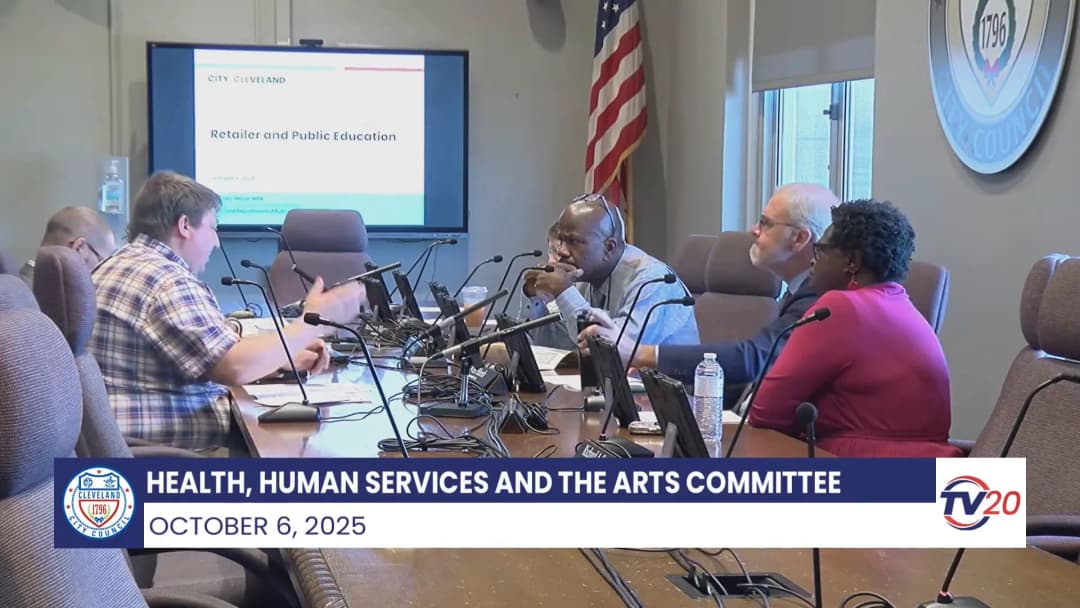
The committee met to discuss two major items: an emergency ordinance authorizing an Ohio EPA grant for air quality monitoring and enforcement, and the implementation of the new tobacco retail licensing program. Council members and department staff discussed the scope of the programs, enforcement capacity, and community outreach. Discussion Items - Ordinance 1167-2025 (Ohio EPA Air Quality Grant): Presented by Director of Public Health and Brian Sokolowski, Chief of Air Quality Monitoring. The ordinance authorizes acceptance of a $2,725,620 per year grant from the Ohio Environmental Protection Agency for two years (October 1, 2025 – September 30, 2027) to fund three programs in the Division of Air Quality: enforcement, engineering (permitting), and air monitoring. The grant supports roughly 30 personnel. Discussion included the air monitoring network (26 of 30 hyperlocal sensors deployed in Cleveland neighborhoods, data available on a public dashboard), the team's training requirements, and risk of non-attainment for the new fine particulate standard (reduced from 12 to 9 micrograms per cubic meter). Council members asked about wind patterns, community engagement, and the importance of tree planting. The ordinance was presented for discussion; no vote was taken at this meeting. - Tobacco Retail Licensing (TRL) Implementation: Patrice Minor, Director of Community Health Initiatives, presented the progress on implementing the comprehensive tobacco legislation passed in April 2025. The TRL program goes into effect October 13, 2025, with a deadline for retailers to obtain a license by December 31, 2025. Key points: an estimated 800 tobacco retailers in Cleveland (about 53 per ward); the city has conducted direct outreach via palm cards, billboards, social media, and a pre-registration website; enforcement will include two annual inspections per retailer and underage decoy buys (ages 18-20) to check compliance with Tobacco 21. The license fee is $500 per year, funding enforcement and education. Discussion included: the difference between the TRL and state cigarette licenses, enforcement against smoke shops selling illegal hemp-derived products, and the role of other city departments (Building & Housing, City Planning) in regulating smoke shops via occupancy permits and zoning. Council members raised concerns about retailer advertising, the impact of state preemption, and the capacity of the Department of Public Health to enforce the new program given existing workloads (6,000 nuisance complaints annually handled by six local code enforcement inspectors). Councilwoman Gray expressed frustration with a specific unresolved dumpster complaint, questioning the city's ability to enforce code violations effectively. The director acknowledged the capacity issue and noted that TRL funding would be used to hire additional staff as needed. The committee agreed to revisit the matter during operational oversight meetings. Key Outcomes - No formal votes were taken on the ordinance or the TRL program; both were presented for discussion and information. - The committee directed the Law Department to explore cooperative agreements (similar to liquor license conditions) as a tool to address problematic tobacco retailers. - The director committed to follow up on the specific dumpster complaint raised by Councilwoman Gray. - The committee will hold operational oversight meetings in the coming weeks to further examine staffing and enforcement capacity, particularly for the tobacco retail license program.