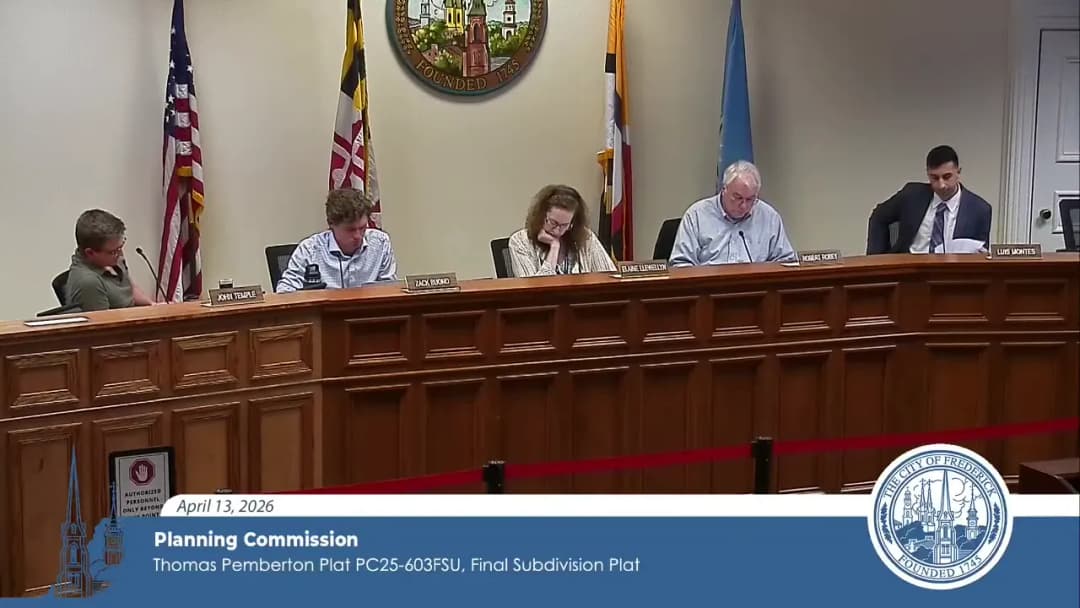
The Frederick City Planning Commission held a regular meeting on April 13, 2026, at 6:00 PM. The commission considered several agenda items including a site plan extension, architectural elevations, a lot consolidation, a major mixed-use development revision, a Walmart expansion, and two zoning text amendments. All votes were unanimous except for the Pemberton plat, which passed 4–1. No public testimony was offered on any item. Consent Calendar - Minutes: Approved minutes of the March 9, 2026 Planning Commission meeting and the April 10, 2026 pre-planning meeting, both by 5–0 votes. - Election of Officers: Commissioner Roby was elected Vice Chair and Commissioner Temple was elected Secretary, each by 5–0 votes. Chair Llewellyn continues in that role. Discussion Items NICLOC Building Expansion (PC 22‑653 FSI) – Extension of Final Site Plan - Proposal: The applicant requested a three-year extension (to May 2029) of an approved 45,616 sq ft industrial addition at 8400 Progress Court, citing construction delays, tariffs, and difficulty procuring German manufacturing equipment. - Staff Position: Recommended a one-year extension, noting that the code intends timely construction and that other applicants have met benchmarks within the original timeframe. - Commission Action: After discussion, Commissioner Temple proposed an 18‑month extension to align with existing APFO certificates. The motion carried 5–0. Kellerton Architecturals (PC 13‑195‑14 PND) – Elevations and Window Modification - Proposal: Approval of elevations (Kipling, Prescott, Bradbury, Livingston, Preston, and a new Normandy elevation for the Devonshire model) and a modification to allow square windows (1:1 ratio) instead of the required 1.5:1 ratio. - Staff Position: Found the elevations meet code criteria and that square windows add diversity; recommended approval. - Commission Action: Approved the modification (Action 1) and the elevations (Action 2), each 5–0. Commissioners noted the recurring nature of the window modification and suggested future code review. Pemberton Plat (PC 25‑603 FSU) – Lot Consolidation at 301 Grove Boulevard - Proposal: Combine two existing residential lots (totaling 19,577 sq ft) into one to permit a new single‑family home. Staff recommended approval, citing consistency with other double‑lots in the neighborhood. - Commission Debate: Commissioner Temple moved for denial, arguing the lot would be an outlier in size (2.8 times the minimum R‑6 lot of 7,000 sq ft) and inconsistent with the Comprehensive Plan’s compact‑neighborhood policies. The motion failed 1–4 (only Temple in favor). A subsequent motion to approve passed 4–1 (Commissioner Temple opposed). The approved plat allows the owner to build a single‑family residence. REN Quarter Phase 3 – Revisions and Fence Modifications (PC 25‑608 PSU FSI & PC 25‑609 PSU FSI) - Proposal: Approve revisions to preliminary plat and final site plans for two sections of the rental townhome development (176 units total), and a modification to allow fences beyond the front facade on certain lots fronting high‑traffic roads and stormwater areas. - Staff Position: Supported the fence modification with compensating features (open‑rail design, 30‑inch setback, landscaping) and recommended approval of both site plans with one condition (remove leftover fence notations on sheet 3 of section 1). - Commission Action: Approved four actions unanimously (5–0): - Fence modification for lots 1–23 (Section 1). - Fence modification for lots 16–29 and 84–92 (Section 2). - Approval of combined preliminary plat/final site plan for Section 1, conditioned on removing notations. - Unconditional approval for Section 2. Commissioners praised the inclusion of amenities (dog park, pickleball, putting green) and noted the importance of tree canopy. Walmart Expansion (PC 25‑490 FSI) – Final Site Plan and Parking Reduction - Proposal: Expand the existing Walmart at 2421 Monocacy Boulevard by 4,368 sq ft for online grocery operations, and reduce the minimum required parking from 794 to 758 spaces. - Staff Position: Found the parking analysis adequate and that transit improvements (bus shelter, canopy removal, restriping) served as genuine compensatory features. Recommended approval with a condition to update APFO note on the cover page. - Commission Action: Approved the parking modification (Action 1) and the final site plan (Action 2), both 5–0. Commissioners commended the applicant for providing a bus shelter as a meaningful compensatory feature. Text Amendment – Gas Stations in Mixed‑Use Districts (PC 25‑248 ZTA) - Proposal: Recommend to City Council amendments to allow convenience stores with gas sales and automobile filling stations as conditional uses in MU‑1 and MU‑2 districts, update pump‑density tables, and add a 100‑foot setback from residential and resource conservation zones. - Staff Position: Supported the amendment, noting it clarifies conflicting code provisions, allows redevelopment of non‑conforming sites, and enhances safety with a larger setback than comparable jurisdictions (e.g., Brunswick’s 20–40 ft, Middletown’s 50 ft). - Commission Action: Recommended approval to City Council (5–0), with a minor modification to replace “district” with “development” in the PND pump table. Text Amendment – Home Occupations (PC 25‑615 ZTA) - Proposal: Recommend to City Council a comprehensive rewrite of home‑occupation regulations, creating three tiers: “no impact” (no permit, no employees, no customers), “low impact” (zoning permit, up to 5 customer visits/week), and “conditional use” (ZBA approval, up to 20 visits/week). The amendment eliminates the previous dual‑permit system and aligns with modern work‑from‑home realities. - Staff Position: Supported the amendment, stating it better reflects the Comprehensive Plan’s goals of flexibility, reduced vehicle miles, and support for small businesses. - Commission Action: Recommended approval to City Council (5–0). Some commissioners expressed concerns about enforcement but acknowledged the need to reduce unnecessary violations for low‑impact home businesses. Key Outcomes - Votes: All items were approved by 5–0 votes except the Pemberton plat, which passed 4–1 (Commissioner Temple dissenting). The NICLOC extension was granted for 18 months, not the requested 3 years. - Conditions: The REN Quarter Section 1 approval was conditioned on removing fence/arrow notations from sheet 3. The Walmart site plan was conditioned on updating APFO note 18 on the cover page. - Referrals to City Council: Two text amendments (gas stations and home occupations) received unanimous positive recommendations and will now go to the City Council for final action. - Upcoming Meetings: A Planning Commission workshop and a citywide community outreach meeting are scheduled for April 20, 2026.
Public Meetings - Frederick, Maryland
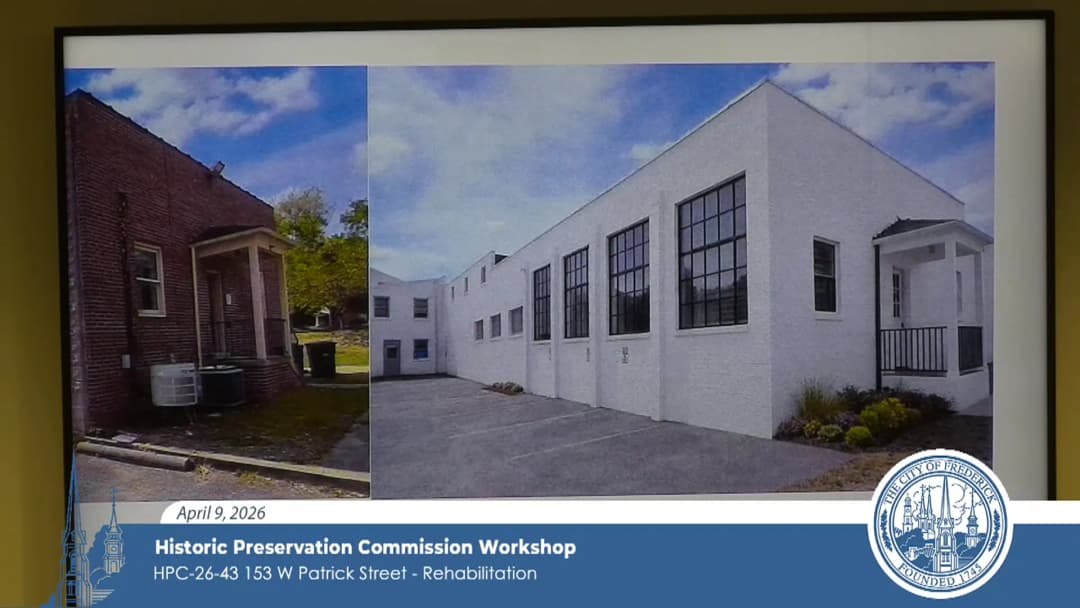
Public Meetings - Frederick, MarylandThe Frederick Historic Preservation Commission met on April 9, 2026, for a hearing and workshop. The commission approved minutes from March 26, 2026 (5-0), and received an administrative report noting that 24 applications were processed. Key discussions included a demolition review for an ice house at the city-owned golf course and multiple certificate of appropriateness applications. The commission voted on several cases and deferred workshop items for additional documentation. Consent Calendar - Approval of March 26, 2026 hearing and workshop minutes (5-0). - Administrative approval report: 24 applications reviewed and processed. Discussion Items Demolition Review: HPC 26-107 DR – 8415 Gas House Pike (Clustered Spires Golf Course Ice House) Staff presented a request to demolish a circa 1850 stone ice house, the last remaining structure of the McMurray Farm Complex. The property is on city-owned land and had been reviewed for designation in 2014-2015 but not advanced. Staff recommended against pursuing designation due to lack of significance and integrity. Commissioners supported the ice house's historical value, calling it rare and significant for interpreting Frederick's agricultural heritage, while acknowledging its deteriorated condition and public safety hazard. The commission voted 5-0 to initiate a zoning map amendment to apply a historic preservation overlay for the ice house structure. Case HPC 25-382 – 331 North Market Street Applicant Sal proposed roofing, gutter, HVAC, composite trim, gooseneck lighting, masonry repairs, painting, and window film on a 1959 non-contributing commercial building. Staff recommended approval with conditions. The commission approved the application 5-0 with conditions: gooseneck lighting installed into mortar joints, double-leaf entry doors of wood or aluminum-clad per product literature, blackout window film with non-mirror finish, masonry repairs limited to stone caps, and any additional work requiring staff review. Case HPC 26-20 – 337 West Patrick Street Staff recommended the commercial building be found a contributing resource to the Fredericktown Historic District, consistent with the 2021 National Register nomination. The agent concurred. The commission voted 5-0 to find the resource contributing. Case HPC 26-50 – 53 East All Saints Street (Commissioner Kinsey recused) Applicant Jane Bodrin proposed installing a gas meter on the front elevation of a circa 1947 concrete block building. Staff noted site limitations and supported a deviation from guidelines, recommending the meter be painted to match the wall. The commission approved the application 4-0 with the condition that the gas meter be painted to match adjacent wall color. Workshop Case HPC 26-34 – 179 West All Saints Street Applicant Brandon Jim presented plans for masonry repairs (rebuilding sections of the front wall and side walls), roof reconstruction with a standing seam metal roof, chimney work, and window reinstatement. The structural engineer's report was not submitted. Staff and commissioners requested a clear scope of work, marked photographs with notes, product literature for the roof, and documentation of all work areas. No vote was taken; resubmission deadline set for the following Monday. Workshop Case HPC 26-43 – 153 West Patrick Street Co-owners David Mussolino, Brennan Gaminer, and Kathy Troxel proposed painting previously unpainted masonry on the rear section (circa 1930, possibly altered later), replacing window panes in metal frames with insulated glass, widening a side entrance for new mahogany double-leaf doors, and adding an ADA-accessible sidewalk. Extensive discussion centered on the rear wall's historic status and evidence of prior paint. The applicant demonstrated insulated glass samples fitting existing frames. The commission requested additional photographs, historical research on the rear wall, and a clarified scope of work. No vote was taken; resubmission deadline set for Monday. Key Outcomes - Approved minutes from March 26, 2026 (5-0). - Advanced historic preservation overlay for the ice house at 8415 Gas House Pike (5-0). - Approved HPC 25-382 with conditions (5-0). - Determined 337 West Patrick Street as a contributing resource (5-0). - Approved HPC 26-50 with condition (4-0). - Deferred workshop cases HPC 26-34 and HPC 26-43 for additional documentation; resubmission due April 13, 2026.
The Government Operations Committee of the Frederick City Council convened on April 6, 2026, to discuss voting methods, a housing production target resolution, charter amendments, priority-based budgeting, and the land management code update. The meeting featured a presentation by Walter Olson on approval voting, ranked choice voting, and open primaries, followed by committee discussions and public comment. Public Comments & Testimony - Kevin Salner commented on the housing resolution, emphasizing that the goal should be building affordable housing regardless of the exact numerical target. He also expressed disappointment that affordable housing was not included in the mayor’s proposed budget despite strong inaugural commitments and urged the council to consider aggressive funding for housing. Regarding the land management code update, Salner asked whether Councilmember Taylor’s proposal to hire consultants would reduce citizen input. Discussion Items - Voting Methods Briefing (Walter Olson): Walter Olson, a voting systems expert, presented on approval voting and open primaries. He argued that approval voting, used in Fargo and St. Louis, suffers from strategic voting (nearly a third of Fargo voters bullet-voted) and may reward "the triumph of the tepid" rather than producing more moderate candidates. He contrasted it with ranked choice voting, which he considers more effective for crowded fields. On open primaries, Olson outlined variations (fully open, semi-open, auto-re-registration) and noted that while open primaries can increase participation, they do not guarantee centrist outcomes. He cited Frederick City data: 60,000 registered voters, with only 15% turnout in the general election and primary winners often decided by 2,500-3,300 votes (5% of voters). Olson cautioned against the Maryland shuffle (insincere party registration) and noted potential for sabotage in cross-party voting. Councilmembers expressed interest in ranked choice voting and open primaries, with Councilmember Brahm noting that unaffiliated voters in Frederick (second largest bloc) feel excluded from primaries. - Housing Production Target Resolution (Council President): Council President presented a resolution that officially recognizes the housing study's finding that Frederick needs approximately 13,774 new housing units by 2035 (about 1,400/year), with affordability targets (at least 15% affordable). The resolution is a non-binding statement to guide policy and includes annual reporting. Councilmember Atkins raised concerns that the 13,774 target (43% of county's projected need) is too high based on historical patterns (city has historically accounted for 30-33% of county housing). He provided data from Frederick County Planning showing the city already has a pipeline of 7,000 units (50% of county pipeline). The committee discussed verifying the numbers with county consultants before finalizing. Councilmember Brahm suggested softening Section 1 to say the city "will establish" a target based on deliberation rather than stating a fixed number now. The resolution will be revised after further analysis. - Charter Amendments Discussion: The committee reviewed a list of proposed charter amendments, including redistricting (to be addressed after June), a non-interference clause (preventing council from directing executive branch employees), and a provision requiring district candidates to live in the district for one year prior (raising concerns about renters and family moves). Councilmember noted the need for external experts on redistricting. The list will remain a living document. - Priority-Based Budgeting Discussion: Councilmember Brahm introduced priority-based budgeting as a framework to move away from incremental budget increases, focusing on aligning resources with priorities and accountability. The timeline targets FY28 for changes, with FY27 being a learning year. The committee noted the need for collaboration with the executive branch and existing work by Budget Director Barkdow. No decisions made. - Land Management Code (LMC) Update: The committee discussed a draft job description for an LMC commission (to be formed after budget season). Councilmember Taylor presented a proposal to hire a limited-term legislative project manager to lead the LMC update, along with a land use commission of volunteers. The project manager would first identify low-hanging fruit amendments, then recommend a zoning type (current form-based vs. incentive zoning), and oversee an RFP for consulting. A short moratorium on new annexations and master plans would occur only during council review (max 270 days). Councilmember Atkins raised concerns about maintaining strong resident input with consultants. Public comment echoed this concern. The proposal will be refined. Key Outcomes - The housing production target resolution will be revised to verify the data with county consultants, and the affordability targets will remain. The committee will recommend sending a revised version to full council after budget season. - The charter amendment list will continue to be updated, with redistricting briefings scheduled after June. - Priority-based budgeting discussions will continue, with no immediate changes to FY27 budget. - The LMC update will proceed with a job description and further discussion of Councilmember Taylor’s proposal, ensuring resident input remains central.
The Community Culture Committee of Frederick City held a meeting on April 2, 2026, at 8:00 PM. The meeting included a presentation on the partnership between the city and Celebrate Frederick, discussion of future work plan priorities, and public comment. Key topics included expanding community events citywide, enhancing accessibility, and fostering interfaith and diverse community engagement. Presentation: Celebrate Frederick and Office of Special Events - Director of Recreation Bob Smith and Development and Fundraising Program Manager Jen Martin presented on the partnership between the City of Frederick, the Office of Special Events, and the nonprofit Celebrate Frederick (a 501(c)(3) with a 15-member board and nearly 200 volunteers donating over 400 hours per year). - Events run from mid-May (Beyond the Garden Gates garden tour) to mid-September (In the Streets), with the first two weekends in December. Most events have been held for over four decades, beginning in 1978. - The city provides in-kind staff support (2.25 full-time equivalent employees) and logistical support from other departments (public safety, street closures, sanitation, facilities). - Celebrate Frederick handles volunteer recruitment and training, board and committee leadership, assists with fundraising, and operates under bylaws and policies covering volunteers, fundraising (sponsorship levels, first refusal policy, local preference), entertainment (artist applications, booking, insurance, cancellation), and individual event policies. - Long-term vision includes evolving and expanding events, increasing inclusivity, diversifying funding streams, and planning for additional staffing and resources. Discussion: Expansion of Community Events - Councilmembers discussed expanding events beyond downtown, particularly to Westside Regional Park. Director Smith noted the park has an action plan with open areas suitable for events, though funding would be needed. - The lake at Whittier was raised as a potential venue for park concerts, but infrastructure upgrades (power) and limited parking were noted as challenges. Director Smith mentioned conversations with HOAs and NACs and potential for fishing derbies or other events at the lake. - Director Smith reviewed the Carroll Creek rental policy: applications are accepted December 1–31 for the following calendar year. A tier system prioritizes City of Frederick (first), MOU holders and Downtown Frederick Partnership (second), nonprofits (third), then for-profits. Three reservation windows limit the number of for-profit markets per period, and one weekend blackout window per period is allowed to keep the creek quieter. For 2026, all requested weekends were granted. The number of rentals in 2025 was not immediately available. Committee Work Plan Overview - The chair provided a review of discussion items from previous meetings, covering: - Equity and accessibility: downtown facility accountability enhancements, grants for small business retrofits, accessible wayfinding, aging-in-place housing retrofits, inventory of city building accessibility, sidewalk and frontage improvements for wheelchairs/walkers, parking accessibility, outdoor public Wi-Fi in parks, inclusive playground equipment, outreach to diverse communities including a deaf community ombudsman, interfaith community commission, technology for non-English speakers, partnerships with the IEC for immigrant services. - Creative use of public property: inventory of city properties, identifying sectors to support (affordable housing, studio space, child care), long-term programming goals. - Upcoming presentation in May from the Manager of Public Arts and Culture (currently on maternity leave). - Policies to encourage community events in all neighborhoods; potential pilot program to close downtown streets for walkability and bicycle use. - Workforce training strategic plan, city apprentice program updates, youth center, re-entry training, workforce training for people with disabilities, internships. - Councilmember Hempler Ronnie expressed support for the outdoor public Wi-Fi idea, citing a Pittsburgh example with an outdoor cafe. The deaf ombudsperson position was noted as potentially not yet budgeted; the speaker suggested inviting deaf community leaders to present on needs. - Both council members supported the interfaith commission concept, noting faith groups provide food, donations, showers (e.g., Living Water Shower Ministry), laundry services, and shelter; collaboration could help identify unmet needs. - The chair also noted upcoming review of the noise ordinance, based on emails received. Public Comment - A resident from East Patrick Street asked about city Wi-Fi access, reporting difficulty connecting. Staff indicated the Wi-Fi should be "COF public" or "Frederick" (capital F) and not require a password, though the resident saw only password-protected networks. The resident identified as a journalist for the Frederick News-Post needing to access notes. Key Outcomes - The chair will formalize the work plan list, share it with all committee members, and prioritize items for action. The public will be informed of the committee's direction. - No votes were taken. - A future meeting will include a presentation on public arts and culture, and discussion of the noise ordinance.
The Frederick City Council convened on April 2, 2026, to address a range of items including the approval of the community-wide climate and energy action plan, a lease amendment with the National Museum of Civil War Medicine, and the ordinance concerning City of Frederick Values and immigration enforcement activities. The meeting featured extensive public comment, particularly on the immigration enforcement ordinance, which ultimately passed unanimously. Consent Calendar - Approved the minutes of the March 19, 2026 regular public meeting (motion by Councilmember Bram, second by Councilmember Taylor, vote 6-0). - Approved Special Ordinance 263 amending the FY2026 budget to include revenue and expenditures for a law enforcement training scholarship grant (motion by Councilmember Schackerfort, second by Councilmember Atkins, vote 6-0). Public Comments & Testimony - O'Reilly: Spoke in support of both the climate plan and the City Values Act, urging the council to also pass a broader resolution insisting the federal government obey domestic and international law. Cited statistics on deportations under Obama (2.5 million), Biden (1 million), and Trump (1.5 million). - Janile Rivas: Shared a personal story of her brother-in-law's 85-day detention in an ICE camp, urged the council to vote yes on the City Values Act, stating a 'no' vote would be choosing popularity over humanity. - Laurel Beavan: Expressed support for the City Values Act, stating it truly reflects community values and the need to protect neighbors. - Nicole Rios: Political director for Congressman David Trone, expressed full support for the City Values Act, emphasizing it protects resident rights and safety regardless of status. - Tiffany Grant: African American woman and downtown resident, expressed support for the City Values Act, drawing parallels between historical profiling of Black communities and current fears among immigrant families. She noted a Frederick News Post article from March 23 reporting immigration enforcement was scouting for office space. - Christian Benford: Latino resident, spoke in support of the City Values Act, sharing experiences of being made to feel like an outsider. He cited statistics: 46 deaths in immigration enforcement custody since 2025 and 9 people shot and killed by ICE/border patrol, including U.S. citizens. - Tatiana Santos: Representing Indivisible Frederick, urged passage of the City Values Act, stating it provides clear guidelines for city employee interactions with federal law enforcement. - David Walinsky: A county resident, expressed support for the City Values Act, urging the council to strengthen protections and questioning their readiness for future challenges. Discussion Items National Museum of Civil War Medicine Lease Amendment & MOU - Tracy Coleman presented two items: a first amendment to the lease for 48 East Patrick Street, updating the transfer of ownership process and adding a reversionary clause, and a memorandum of understanding designating the museum as project manager for CIP improvements. The museum intends to exercise its purchase option after completing improvements. Both items were approved 7-0. Community-wide Climate and Energy Action Plan - Jenny Willoughby, sustainability manager, presented the plan, which incorporates adaptation, mitigation, and resilience measures aligned with the 2020 climate emergency resolution. A public commenter urged that all city policy executive summaries include references to the plan's efficiency standards. The plan was approved 7-0. City of Frederick Values and Immigration Enforcement Activities Ordinance (City Values Act) - Council President Atkins introduced the ordinance, which had been refined since a previous workshop. Changes include replacing 'ICE enforcement' with 'immigration enforcement', strengthening reporting requirements (quarterly and annual reports), and adding a section on recovering costs from federal immigration enforcement activities. Councilmember Taylor asked about police review and definitions; Atkins clarified the ordinance does not affect police operations and that 'Federal Immigration Authorities' is defined. Atkins stated the ordinance is about ensuring residents feel safe accessing city services. An amendment to add a cost recovery section passed 7-0. Key Outcomes - National Museum of Civil War Medicine Lease Amendment: Approved 7-0. - National Museum of Civil War Medicine MOU: Approved 7-0. - Community-wide Climate and Energy Action Plan (Resolution 266): Approved 7-0. - City Values Act (Ordinance G 261): Approved 7-0. Councilmember Atkins was praised by colleagues for his leadership. - Announced (for future hearing): Amendments to the land management code regarding mixed-use development, convenience stores with gas sales, and single room occupancy units.
The Frederick Historic Preservation Commission met on March 26, 2026, for a combined hearing and workshop. The commission approved two hearing cases concerning new construction and a tower restoration, received public comments on a workshop item, and reviewed several workshop proposals with direction for further refinements. Consent Calendar - Approval of Minutes: The minutes from the March 12, 2026 hearing and workshop were approved with corrections (spelling of “Ann Hart” and window size on HPC 26‑7). Motion carried 7‑0. Public Comments & Testimony - David Hunter (109 East 7th Street): Opposed the proposed addition at 11 East 7th Street (HPC 25‑369), citing concerns that the stoop would preclude a driveway, access from Herm Alley lacked a right‑of‑way, the single‑room‑occupancy design does not meet human needs, the project resembles a group home or Airbnb, and the green space calculation and landscaping plan are inadequate. He also noted that condemned properties and expired time limits affect the neighborhood. - Ryan Weinstein (113 East 7th Street): Also opposed the same project, arguing that the addition remains too large in size and scale compared to the neighborhood fabric, that the stated green‑space percentage is incorrect and does not account for necessary walkways, and that the landscaping plan (only holly bushes) is insufficient. Discussion Items HPC 26‑7: 248 South Carroll Street (Hearing) - Proposal: New two‑and‑a‑half story dwelling with detached garage, sited similarly to neighboring properties. - Staff Report: Updated drawings reflect larger south‑elevation windows and relocation of a garage window. Staff found the massing, height, and scale compatible with the district. Materials requiring clarification: fiberglass doors (rear/garage), composite railing with concealed fasteners, and full‑divided‑light windows as defined by Andersen 100 series. Staff recommended approval conditioned on submission of product literature and updated elevation drawings. - Discussion: Commissioners debated whether exposed fasteners on composite railing are appropriate; consensus favored concealed hardware. The window “full divided light” designation was clarified to match Andersen’s product definition. The applicant expressed openness to alternative railing systems (e.g., RDI Transform). No public comment on this case. - Key Outcomes: Motion to approve with conditions – (1) product literature for fiberglass rear and garage doors, (2) updated drawings clarifying materials on each elevation, (3) railing with concealed fasteners, (4) windows as full divided light per Andersen 100 series, all subject to staff review. Vote: 7‑0. HPC 26‑16: 113 East 7th Street (Hearing) - Proposal: Remove existing fiberglass windows from the square tower of a Queen Anne dwelling and reinstate siding, wood windows, and architectural features to restore the historic appearance. - Staff Report: Recommended approval with conditions that half‑timbers be non‑pressure‑treated wood (mahogany or cedar) and that the final tower design replicate the 2021 National Register photograph, including double‑hung windows at the second floor on the south and east elevations. - Discussion: The applicant (Ryan Weinstein) preferred keeping the existing fixed windows (original lower sashes) but agreed to install double‑hung windows as shown in the historic photograph. Commissioners supported the restoration approach. - Key Outcomes: Motion to approve with conditions – (1) half‑timbers of mahogany or cedar (non‑pressure‑treated), (2) final tower design replicates the 2021 National Register photograph, with double‑hung windows on the second floor east and south elevations. Vote: 7‑0. HPC 25‑369: 11 East 7th Street (Workshop – Fourth Review) - Proposal: Addition to an existing two‑family dwelling. The applicant presented revisions: length reduced 9 ft, width reduced 3 ft, roof pitch lowered from 7:12 to 6:12, entry moved to west elevation, building shifted directly behind the existing structure. - Staff & Commission Discussion: Many commissioners acknowledged the improvements but expressed mixed opinions on final scale. Some felt the addition is still too large relative to neighboring buildings; others noted it complies with guideline limits (not wider, taller, or longer than the existing building). Discussion also covered parking (seven spaces plus one in front), green space (claimed 50%, but neighbor disputed), need for landscaping enhancement, lighting (preference for path lighting rather than building‑mounted lights), and exterior color (applicant agreed to a dark gray). The applicant stressed adherence to guidelines and noted community support from the county and pending city support. - Key Outcomes: No vote (workshop). The applicant was directed to provide a complete resubmission (deadline March 30 for April 9 hearing or April 13 for April 23 hearing) addressing: product literature for all materials, clarification of trim material, fencing, lighting details (path lights recommended), a landscape plan showing existing trees and new plantings, and a color rendering (dark gray or similar). Further refinement of scale was left open. HPC 25‑382: 331 North Market Street (Workshop) - Proposal: Rehabilitate a 1959 non‑contributing commercial building (former Carmack Day supermarket) with new TPO and asphalt shingle roofing, gutters, rooftop HVAC units, composite wood trim, gooseneck lighting, masonry repairs and painting, and window repairs with blackout film. - Staff Report: Noted missing product literature and conflicting scope‑of‑work details. Windows: blackout film proposed for energy efficiency and privacy; staff noted reflective or tinted film is not permitted, and product literature is needed. New doorway on east elevation requires clarification. Masonry painting with Sherwin‑Williams “Shiitake” color is acceptable for non‑historic masonry. - Discussion: Commissioners questioned the reflectivity of the film; applicant agreed to consider patterned opaque film or curtains. The new doorway (single or double) will be detailed in resubmission. Applicant confirmed composite trim, gooseneck lights for future signage lighting, and that window repairs (trim repaint, sill replacement) are minor. No concerns with roof or hatch. - Key Outcomes: No vote (workshop). Applicant to resubmit (deadline March 30 for April 9 hearing) with: product literature for all materials (windows, doors, lighting, vents), clarified scope of work, and removal of signage from drawings if not proposed. Landscaping and parking details were not discussed in depth. HPC 26‑30: 151 North Market Street (Workshop) - Proposal: Remove the wood‑shingle pent roof and restore the fire‑damaged, non‑historic first‑story exterior to a design consistent with historic photographs of the building. - Staff Report: Application lacked product literature, current photographs, and a detailed scope of work. Drawings indicate recessed entries on Market Street, but the north elevation (Second Street) bay window is not projected as in historic photos. Bulkhead material, cornice, door styles, and lighting/ventilation details are undefined. - Discussion: Commissioners strongly encouraged restoring the historic cornice across the Market Street facade. Bulkhead material advice varied: wood panels (traditional), real stone or brick veneer, or high‑density plywood (e.g., HDO); most discouraged cement‑board siding. Storefront doors should be full‑light wood with wide stiles and rails, consistent with historic photos. Transom windows should be clear glass. Exhaust vents on the rear are acceptable but should be color‑matched and located inconspicuously. - Key Outcomes: No vote (workshop). Applicant to resubmit for the April 23 hearing (deadline April 13) with: complete product literature, full photographic documentation, cornice design, defined bulkhead material, door and window details, lighting plan (if any), and clarification of infill and new rear openings. Key Outcomes - Approvals: HPC 26‑7 (248 South Carroll St) and HPC 26‑16 (113 East 7th St) approved with conditions, both 7‑0. - Workshop Items: Applicants for HPC 25‑369, HPC 25‑382, and HPC 26‑30 were directed to refine their proposals and resubmit with complete documentation for future hearings. - Upcoming Deadlines: April 1, 2026 – deadline for historic preservation tax credit applications. April 9, 2026 – hearing date for resubmissions filed by March 30. April 23, 2026 – hearing date for resubmissions filed by April 13. - Other Business: The city’s April 13 “Digging Local” event was announced (archaeology month). The commission discussed potential updates to the staff‑level review authority and reminded the public of time limits for citizen comments.
Note: The transcript states the meeting as March 9, 2026, but the supplied metadata indicates the meeting date is March 24, 2026. The summary uses the supplied date. The Frederick Planning Commission held a hearing on March 24, 2026, at 6:00 PM. The meeting covered approval of minutes, a continuance, the 2026–2027 calendar, the Capital Improvements Program (CIP) recommendation, and numerous site plan and zoning text amendment items. All votes were 4-0 unless otherwise noted. Consent Calendar - Approval of Minutes: The Commission approved the minutes of the February 9, 2026, Planning Commission meeting, the February 17, 2026, workshop, and the March 6, 2026, pre-Planning Commission meeting. All passed unanimously. - Continuance (PC 25-248 ZTA): A zoning text amendment concerning convenience stores with gas sales and gas stations was continued to the April 13, 2026, hearing to allow staff more analysis time. Approved unanimously. - 2026–2027 PC Schedule: The Commission approved the final schedule for the upcoming year, which includes earlier publication of agendas and staff reports. Unanimous approval. Public Comments & Testimony - CIP Discussion: Heather Goddard of East Frederick Rising urged the Commission to prioritize painted walking zones on East Street, citing safety and lower cost compared to full redesign. She noted that the Active Mobility Advisory Committee (AMAC) recommended such improvements. - ADU Zoning Text Amendment: Several residents spoke against removing the owner-occupancy requirement. Meta Nash (city resident) argued it would invite investor-buyers and change neighborhood character. Linda Dove (city resident) detailed high construction costs ($300,000 for an 800 sq. ft. ADU), questioning affordability. Steve Jacobsick (Market Street) echoed concerns about investment opportunities undermining affordable housing goals. Ann Ryan (Frederick Housing Solutions Task Force) supported ADUs as part of a broader housing strategy but noted zero permits in five years. Kate McDermott (Klein Boulevard) opposed removing owner-occupancy and suggested lot-size-based ADU limits rather than a flat 800 sq. ft. threshold. Discussion Items - Capital Improvements Program (CIP) Recommendation: The Commission discussed prioritizing projects for the FY2027–2032 CIP. Commissioner Temple highlighted the AMAC letter and suggested de-emphasizing downtown streetscape in favor of functional improvements. Commissioner Buono supported easy wins like bike markings. Commissioner Robey wanted more specificity on budgets and schedules. After public comment, the Commission voted to recommend a letter prioritizing completion of East Street rails-with-trails, evaluating striped sidewalks on East Street (if safe), maintaining other priorities from the 2026 letter, and de-emphasizing downtown streetscape. Unanimous. - Frederick Commerce Center Lot 1 (PC 22-1016 FSI): The applicant requested a two-year extension of the final site plan for a 1 million sq. ft. warehouse. Staff recommended one year. The applicant cited market conditions and pending data center legislation. Public commenter opposed extension, calling it a speculative approach. The Commission approved a one-year extension, finding it sufficient time to proceed. Unanimous. - Sycamore Springs Multifamily Architecturals (PC 22-51406 PND): Approval of a modification to allow square windows (1:1 ratio) and approval of architectural elevations for six 16-unit condo buildings (affordable housing in the low $300,000s). Both actions approved unanimously. The Commission suggested evaluating a code change to accommodate such window modifications. - Sycamore Springs Multifamily Final Site Plan (PC 25-580 FSI): Approval of four modifications (access points, lighting spillover, level 2 buffer reduction, level 1 buffer waiver) and the final site plan for 96 multifamily units. All actions approved unanimously with conditions including adding APFO exemption date and correcting code references. - 40 West Booster Pump Station Replacement (PC 25-487 FSI): Final site plan for a city utility building. Approved with condition to provide libra and folio of recorded access easement. Unanimous. - Floor and Decor Addition (PC 25-401 FSI): Final site plan for a 7,580 sq. ft. addition to a former Joann's fabric store. Approved with condition to show fire department connection on utility drawings. Unanimous. - Costco Addition (PC 25-579 FSI): Approval of a modification to reduce parking from 644 to 575 spaces (using off-site employee parking) and final site plan for a 5,931 sq. ft. addition. Both actions approved unanimously with conditions. - West Ridge Square (PC 25-403 PSU/FSI & PC 25-404 PFCP): A complex mixed-use redevelopment of a shopping center including 119 multifamily units. Approval of five modifications (street detail, bicycle parking, parking setback, two landscape buffers), combined preliminary plat and final site plan, and preliminary forest conservation plan. All actions approved unanimously. Condition added to consider renaming Riverstone to Hillcrest Drive. - ADU Zoning Text Amendment (PC 25-614 ZTA): The Commission considered proposed amendments to Section 802 of the Land Management Code regarding accessory dwelling units. The three main changes addressed parking, owner-occupancy, and maximum size. After extensive discussion and public comment, the Commission voted to recommend approval with modifications: (1) in DB, DBO, and DR zones, no additional parking shall be required if parking is removed for an ADU; (2) retain the owner-occupancy requirement; (3) recommend the council evaluate a time-based deed restriction to prevent investor exploitation. Unanimous. Key Outcomes - All minutes, calendar, and continuance approved unanimously. - CIP recommendation letter approved with specific prioritizations. - Frederick Commerce Center extension: 1-year approval (4-0). - Sycamore Springs architecturals and site plan: all modifications and approvals (4-0). - 40 West Booster Pump Station: final site plan approved (4-0). - Floor and Decor addition: final site plan approved (4-0). - Costco addition: parking modification and site plan approved (4-0). - West Ridge Square: all seven actions approved (4-0). - ADU ZTA: recommended to City Council with modifications (4-0).
The Frederick Public Works Committee met on March 24, 2026, beginning at 9:00 AM, to discuss sidewalk maintenance and repair policies, and to receive presentations from the Affordable Housing Council and the Frederick Housing Solutions Task Force regarding affordable housing strategies. The meeting included detailed discussions on current sidewalk repair programs, funding sources, and policy recommendations for increasing the supply of deeply affordable housing. Public comments were also heard. Public Comments & Testimony - Kevin (last name not provided) urged the committee to consider a policy change to not waive school construction responsibility when annexing property, advocated for allocating 2.5% of the general fund for affordable housing gap financing, and recommended waiving fees for affordable housing developments, citing examples from Salisbury, Maryland. He also suggested exploring form-based code changes to allow additional stories for affordable housing. - Alan Feinberg (East Church Street) echoed support for the 2.5% general fund allocation and referenced a video by Jake Day, mayor of Salisbury, as an inspiring example of what can be achieved with leadership. Discussion Items Sidewalk Maintenance and Repair Program - Tracy Coleman, Director of Public Works, and Nicole (last name not provided) presented an overview of the city's sidewalk code (Chapter 22, Article 2), which holds property owners responsible for adjacent sidewalk repair and maintenance. They explained that the city's enforcement is complaint-driven, with inspections triggered by resident reports. The city uses a 0.5-inch variance threshold for ADA compliance. - The city has a sidewalk repair program where property owners can either use the city's contractor (simplified process) or hire their own contractor (must meet city specifications and obtain permits). If sidewalk damage is caused by a city street tree, the city covers 50% of the repair cost only if the property owner uses the city contractor. - The city's operational budget allocates $1.5 million annually for sidewalk repair, with expected revenue of $1 million from property owner reimbursements. A separate CIP (Equity Emphasis Area Sidewalk Repair Program) was created in July 2024 with $1 million for precision cutting and full-depth replacement. Approximately 2.2 miles of sidewalk were repaired last year using $2–2.5 million, equating to roughly $1 million per mile. - A citywide sidewalk condition survey and inventory is nearing completion; it will include recommendations for repair methods, prioritization, and cost estimates. The committee plans to schedule a follow-up presentation for late May 2026. - Councilmember Brem and Councilmember Shackleford asked about the role of the city arborist, the historic preservation overlay's concrete color requirements, and coordination with the Downtown Frederick Partnership's streetscape initiative. The Downtown Partnership has received design funding but not construction funding; staff are collaborating to avoid duplicate street work. - Councilmember Hemplerani raised the need to revisit the 2001 sidewalk repair policy, particularly regarding snow removal and the 50% tree-related cost share, noting the policy is 25 years old. Affordable Housing Council Presentation - Mary Ellen Mitchell, Chair of the Affordable Housing Council (AHC), and Michael Hatfield, Vice Chair, presented the council's mission to advocate for the preservation and expansion of affordable housing in Frederick County. The AHC includes representation from the city (Councilmember Shackleford) and the county (Councilmember Cavante Ducket). - Key policy priorities include speeding up the permitting and approval process, sustaining housing assistance programs, and supporting senior housing. The AHC hosted seminars on permitting delays and is seeking funding to bring in an expert to fast-track projects. They also publish a monthly blog to educate the public about affordable housing. - The AHC is actively involved in the city's Housing Task Force, which is meeting weekly for two months to develop a strategic plan based on the recently released county housing needs assessment. The AHC is also working to engage surrounding municipalities in addressing affordable housing regionally. - Councilmember Brem noted the tension between residents' perception of rapid housing construction and developers' complaints about slow permitting, and raised concerns about infrastructure capacity (schools, roads, transit). Mitchell responded that nearly half of the county's land is preserved as agricultural, limiting buildable land, and that preservation of existing housing stock is as important as new production. Frederick Housing Solutions Task Force Presentation - A representative (name not given, referred to as 'Anne' in later comments) presented the task force's mission, formed in partnership with the Coalition for Healthier Frederick, to increase the supply of deeply affordable housing for those earning under 30% of Area Median Income (AMI). The task force identified a need for 1,600 units (160 per year for 10 years) for this income group. - The task force is organized into four priority teams: (1) New Units – exploring partnerships with faith communities, city/county land, and a dedicated fund; (2) Shared Housing – promoting single-room occupancy (SROs) and home-sharing for seniors and others; (3) Landlord Engagement – creating a registry of affordable units; (4) Policy – reducing zoning barriers, passing an SRO ordinance, and pre-approved permits. - Specific recommendations include: setting aside 2.5% of the city's general fund for an innovative housing demonstration project fund to cover pre-development costs (engineering, architecture, legal fees); requiring developers to build MPDU units rather than paying in lieu of; and building on city-owned land such as the Highland site (530 Highland), which was awarded five years ago but stalled due to a DPW dump site relocation issue. Bruce Davis (Davis Architecture and Design) Presentation - Bruce Davis, with 40 years of experience in affordable housing, presented a set of actionable items. He emphasized that existing MPDU payment-in-lieu policies have resulted in zero built MPDU units since 2011, and recommended forcing developers to build units on-site. He supported the 2.5% general fund proposal as a stable revenue stream for gap financing. - Davis advocated for the city to conduct an inventory of excess property, noting that the Trinity school site and the Highland site are prime candidates. He argued that the city should prioritize affordable housing in RFPs, requiring a percentage of units for 30% AMI, and that developers should be required to provide wraparound services. - He suggested that the city consider waiving fees for affordable housing, as done in Salisbury, Maryland by Mayor Jake Day, which led to thousands of developer submissions. Davis also called for increasing density through zoning changes, higher height limits (currently 70 feet), and using form-based code to allow additional stories for affordable housing. - Councilmember Hemplerani noted that the city is already moving on some of these items, including the city-owned property inventory, text amendments for zoning, and the SRO ordinance. Councilmember Brem questioned the long-term strategy given finite land and water resources, and Davis responded that increasing density and building more units is essential to drive down prices. Key Outcomes - The committee agreed to schedule a follow-up presentation on the sidewalk condition survey results for late May 2026, with a focus on policy recommendations and comprehensive repair planning. - The committee will receive a separate presentation on snow removal policies related to sidewalks, as raised by Councilmember Hemplerani. - No formal votes were taken during the meeting. The discussions are expected to inform upcoming budget decisions (FY27) and the city's housing strategic plan.
The committee met on March 23, 2026, to discuss two main agenda items: a lease amendment and memorandum of understanding (MOU) with the National Museum of Civil War Medicine, and a compilation of city studies and plans for follow-up. No public comments were made. The meeting also included planning for upcoming sessions. Discussion Items Civil War Museum Lease Amendment and MOU Tracy Coleman, Director of Public Works, introduced two items concerning the National Museum of Civil War Medicine: a first amendment to the lease for the property at 48 East Patrick Street, and a draft MOU designating the museum as project manager for capital improvement projects. The museum has leased the building since 1996, with the lease expiring in August 2025 and currently on a month-to-month basis. The draft amendment provides an updated path toward transferring the property to the museum and modifies lease terms. The MOU allows the museum to oversee planning, bidding, and execution of city-funded CIP projects and to contribute additional funds to expand scope and accelerate timelines. The city purchased the property for $1.887 million, and maintenance costs have been under $500,000 over the past 14 years. David Price, Executive Director of the museum, and Lily Leonard, consultant with Black Dog Philanthropic, presented details. The museum is the number one tourist attraction in downtown Frederick, with 30,000 visitors per year, and serves as an economic engine. The capital campaign combines internal exhibit upgrades ($1.82 million) and external deferred maintenance (brick repointing, roof, windows, HVAC, ADA compliance, restrooms) for a total of approximately $3.2 million. The museum has contributed $1 million from its endowment, raised over $600,000, and received a $350,000 CIP budget item for FY26, plus a $150,000 grant from the Maryland Department of Housing and Community Development. The museum's collection includes about 5,000 items, with 99% displayed in Frederick. Councilmember Kelly asked about the lease amendment, noting it renews until 2030 with an option to purchase the premises for $100. Kelly requested adding language stating the museum's intent to exercise that option. David Price agreed, noting the museum intends to take ownership within a few years. The item is scheduled for the April 2, 2026 meeting for full council consideration. Compilation of City Studies and Plans Councilmember Nash presented a compilation of city studies, organized by department, prepared by staff member Clara. The list includes studies dating back to the early 2000s, with most from 2010 onward. Councilmembers discussed the need to extract recommendations, assess current status, and prioritize follow-up. Councilmember Taylor praised the compilation and suggested adding a brief background for each study (origin, mandate, etc.). Councilmember O'Connor noted some studies are ongoing (e.g., affordable housing task force, complete streets). Councilmember Nash proposed creating a template with recommendations and status, then assigning studies to councilmembers for review. Councilmembers volunteered for specific studies: - Councilmember Taylor: Water and sewer rate study, tree canopy, downtown circulator, mobility and parking recommendations. - Councilmember Nash: Police department strategic plan, NAC committee, emergency operations plan, parks and rec master plan, sites of enslavement. - Councilmember Kelly: City of Frederick housing gap and future demand projections (recently presented). - Councilmember Peter: Police department strategic plan (already assigned), plus others. Councilmembers agreed to return in approximately one month with findings and notes. The compilation will also be shared for budget purposes. Future Meeting Planning Councilmember Nash outlined upcoming meetings: no meeting the following week (fifth Monday), then on April 6 presentations on elections, charter amendments, redistricting, performance-based budgeting, and open primaries. Councilmember Taylor requested a recap of the 2025 election (lessons learned), possibly from the elections commission. Councilmember Nash will seek a speaker on open primaries and coordinate with city elections staff. Key Outcomes - The Civil War Museum lease amendment and MOU will be revised to include language affirming the museum's intent to purchase the property for $100, and will be presented for full council approval on April 2, 2026. - Councilmembers will use a template to review assigned studies and report back in approximately one month. - Future committee meetings will include presentations on elections, charter amendments, redistricting, performance-based budgeting, and open primaries.
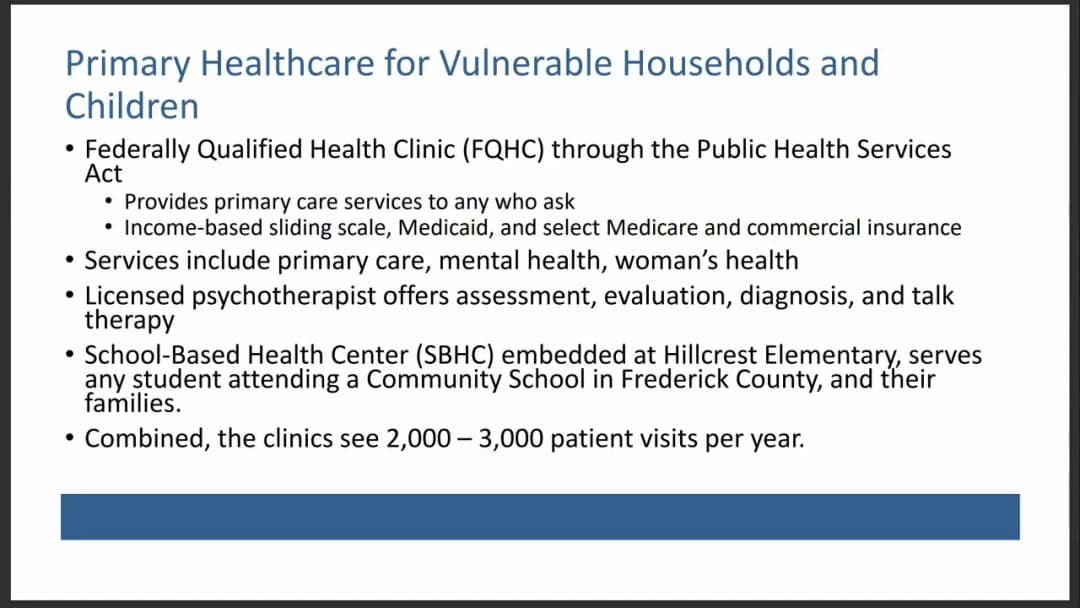
The Committee and Culture Committee of Frederick City met on Thursday, March 19, 2026, to receive a presentation from the Department of Housing and Human Services (HHS). Director Stuart Campbell provided an overview of the department's history, services, and current initiatives. The meeting included discussions on homelessness, food security, health clinics, federal funding risks, and future needs. No votes or decisions were taken beyond the consent calendar. Consent Calendar - The committee approved the minutes of the March 5, 2026 meeting by a 3-0 vote (motion by Councilmember Taylor, second by Councilmember Hempel O'Rani). Discussion Items - HHS Overview: Director Campbell described HHS’s history dating back to 1968, its designation as a community action agency, and its expansion to a second location at 6040 New Design Road in 2025. The department has about 75 full- and part-time employees and 350 volunteers annually. In FY2025, it served over 16,000 individuals in 8,600 households, with 41% of clients being county residents outside the city. - Homeless Services: The outreach and case management team engages individuals in encampments, building trust. Permanent supportive housing includes 15 units with 24-hour staff, but Director Campbell noted the need far exceeds capacity. Federal threats to reduce permanent supportive housing funding from 90% to 30% of Continuum of Care awards pose a risk. Rapid rehousing was discussed as an effective alternative for most experiencing homelessness. - Food and Nutrition: Two food pantries serve about 950 households per month. A new client-choice model was introduced. The community table provides a daily hot meal, with an estimated 30,000 meals served in FY2025. Programs also include child and adult care food programs and summer meal distribution at parks. - Health Services: The community health clinic is a federally qualified health center with sliding fees. Two-thirds of funding comes from the city. Medical director Dr. Jacqueline Duchet is working to increase reimbursements. The school-based health center at Hillcrest Elementary and a mobile clinic are part of the services. Mental health services are limited, with partnerships to address severe cases. - Housing Policy: The Sold on Frederick downpayment assistance program provides up to $25,000 for first-time homebuyers, but rising home costs have reduced its effectiveness. The housing policy division focuses on increasing affordable housing stock. - Federal Funding Concerns: Councilmember Taylor highlighted that over half of HHS funding comes from federal sources. Director Campbell noted that while court challenges have prevented immediate cuts, the city may face increased responsibility if federal reductions occur. Nonprofits are particularly vulnerable. - Future Needs: Director Campbell's wishlist included expanded permanent supportive housing, a health clinic on the Golden Mile, enhanced mental health services, secure lockers for belongings, and tiny home communities integrated with amenities and transit. - Prevention and Communication: Discussion included eviction prevention programs and the need for better outreach to inform residents about available services. Councilmember Hempel O'Rani noted challenges in marketing services. Key Outcomes - No formal decisions or votes were taken beyond the consent calendar. The presentation served as an informational session to inform future policy and budget discussions. The committee plans to develop work plans based on these overviews. - The meeting was adjourned without further business.