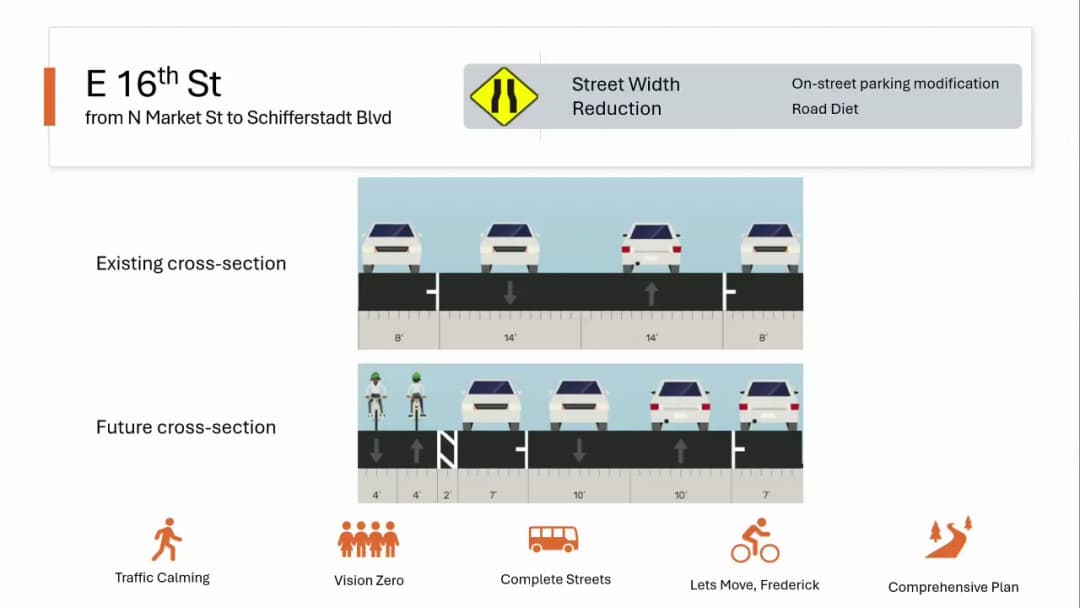
The Frederick City Council met on March 19, 2026, to address appointments, public comments, a resolution, and a detailed presentation on traffic calming and safe streets. The meeting covered routine approvals, contentious debate on an ethics commission reappointment, and extensive community input on transportation safety and immigration enforcement. Consent Calendar - Approved the minutes of the March 5 regular public meeting, February 19 closed session, and March 5 regular meeting (unanimous). - Approved the release of a surety bond ($48,127.50) posted by World Rent Development Company for on-site improvements at Monocase Center. Public Comments & Testimony - Ian Thompson (resident) expressed full support for the City Values Act (G-261), emphasizing the need for judicial warrants and application to both ICE and Customs and Border Protection. He thanked Council President Diaz for introducing the ordinance. - Tom Rotondo (East 16th Street) opposed the planned bike lanes on East 16th Street, arguing they create hazards due to narrow travel lanes (10 ft), inadequate parking for large vehicles (e.g., dually pickups), and unsafe driveway sightlines. He noted that only nine bicycles were observed on the street over eight months. - Ed Remus (East 16th Street) suggested alternative designs (parking adjacent to curb, then buffer, then bike lanes) and argued that the street has 50 houses with driveways, unlike other projects (e.g., Tuscany, Hayward). - Robert Sharp (North Market Street) criticized the existing bike lane on Market Street, noting that cyclists often don't use it, and speeds remain high. He called for restoration of two travel lanes from 7th to 9th Street. - Jim Smurse (resident) praised city staff for making the Capital Improvement Program (CIP) visible on Spire's GIS, calling it a valuable planning tool. - Walter Ruby (Dill and Bent Street) complained about persistent late-night speeding on Bent Street, stating that police responses have been ineffective and that the issue harms residents and downtown tourism. - Gail Peterson (Villa Estates) argued that striping alone hasn't reduced speeding; effective traffic calming requires dynamic crosswalks and chicanes. She urged the city to prioritize retrofitting existing neighborhoods (e.g., Military Road) for pedestrian safety. - Robert Duggan (Military Road) expressed frustration that Military Road has been on the traffic-calming list for over 20 years. He proposed low-cost measures such as painting speed limits on pavement, 3D crosswalk illusions, and signs to deter speeding. - William Mahom (NAACP Frederick Chapter) applauded the City Values Act, but also called for revisiting redistricting, citing findings of racial bloc voting and the need for expanded electoral participation. - Christian Benford (Carroll Parkway) supported the City Values Act and recommended clear reporting guidelines (e.g., SALUTE format) and transparency for employee discipline. He urged the council to consider banning surveillance equipment using proprietary data. Discussion Items - Appointments: - Planning Commission: Council interviewed and unanimously approved (7-0) the appointment of Mr. Mogtez, who emphasized alignment with the comprehensive plan and responsible development. - Neighborhood Advisory Councils: Reappointments of David Furman, Gail Peterson, and Denise Sparks for two-year terms (March 20, 2026 – March 19, 2028) were approved 7-0. - Zoning Board of Appeals: Reappointment of Stephen Collar for a three-year term (March 20, 2026 – March 19, 2029) was approved 7-0. - Ethics Commission: The reappointment of Kevin Lawler for a three-year term was debated. Councilmember Nash raised concerns about a conflict of interest: Mr. Lawler is director of the Housing Authority, and she had been corresponding with him and his wife (also at the Housing Authority) about Lucas Village issues. An ethics complaint against Nash had been filed, and Mr. Lawler's term had expired on December 1, 2025, but he continued serving under a holdover provision. Nash questioned the timing and transparency. Councilmember Hempolani moved to table the appointment to the next meeting; the motion passed (5 in favor, 1 abstention, 1 against). - Council Liaison Appointments: Approved 7-0: Councilmember Peter Brem to Ferdinand Committee Action Board, Councilmember Sarah Hempolani to Public Arts Commission and Containment Lab Community Advisory Committee, Councilmember Joe Atkins to Planning Commission, Councilmember Derrick Chalkover to Wanderer Board of Directors. - Councilmember Comments: - Councilmember Nash detailed her concerns about the Ethics Commission reappointment, citing a pattern of questionable timing, expired terms, and potential conflicts of interest. She urged transparency and recusal. - Councilmember Brown recognized Women's History Month and noted the contributions of women on the council. - Councilmember Shackleford recognized Captain Daniel Hayter, a firefighter injured in a fire, and asked for thoughts for his recovery. - Traffic Calming & Safe Streets Presentation: - Traffic engineer Shrada Praraj presented on the city's approach to traffic calming (horizontal/vertical deflection, street width reduction, routing restrictions) and its evolution toward Vision Zero and Safe Streets. Key statistics: pedestrian survival probability drops from 90% at 23 mph to 50% at 42 mph and 10% at 58 mph. Roundabouts reduce all crashes by 70–80% (when converting signalized intersections) and 30–40% (when converting two-way stops). Completed projects include Rosemont Avenue, Hayward Road, Tuscany Drive, Walter Martz Road, Jefferson Street, Villa Estates, and Baumans Lane. Ongoing projects include East 16th Street (protected bike lanes with parking as buffer), Willowdale Drive (bike lanes and mini-roundabouts), and 7th Street (protected bike lanes). Councilmembers discussed the need for post-installation data, maintenance of crosswalks, and the importance of addressing both speed and perception of safety. - Resolution 265: The council passed a resolution (7-0) supporting Maryland House Bill 1142, which would create a task force to study modernizing municipal revenue sources. The city joined the Maryland Municipal League in urging the state to address the fact that Maryland is one of six states that does not share sales tax revenue with local governments. Key Outcomes - Planning Commission appointment approved 7-0. - Neighborhood Advisory Council reappointments approved 7-0. - Zoning Board of Appeals reappointment approved 7-0. - Ethics Commission reappointment (Kevin Lawler) tabled to the next council meeting (motion passed 5-1-1, with one abstention and one vote against). - Council liaison appointments approved 7-0. - Resolution 265 (support for state task force on municipal revenue) passed 7-0. - Traffic calming presentation: No vote taken; staff will continue design and implementation of projects, including East 16th Street (weather-dependent) and Willowdale Drive. The Safe Streets for All action plan is due by August 2026. - City Values Act (G-261): Noted as introduced; public comment was received, but no vote occurred at this meeting.
Public Meetings - Frederick, Maryland
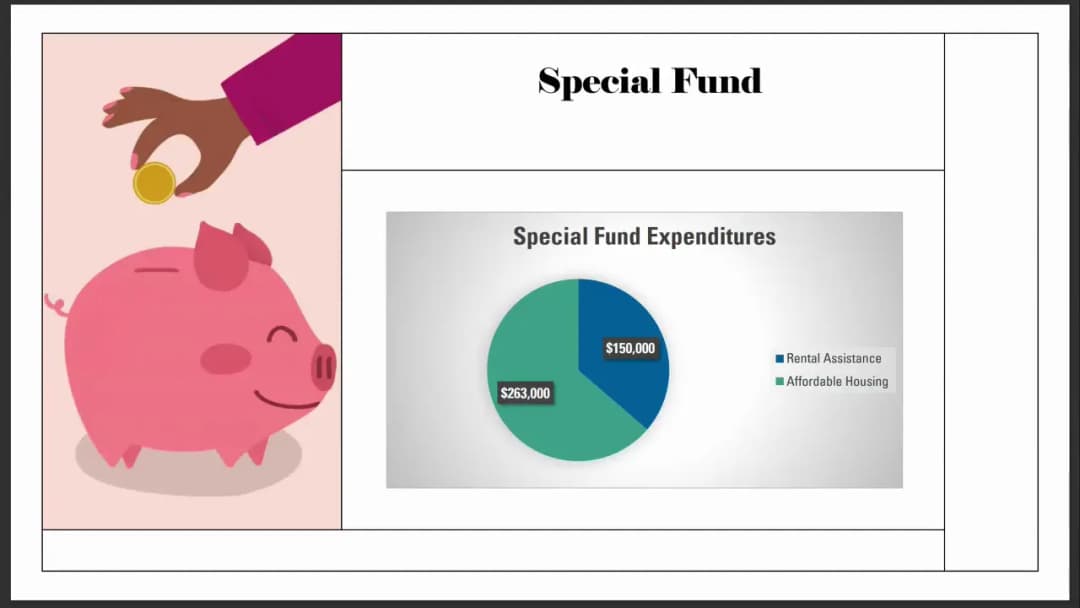
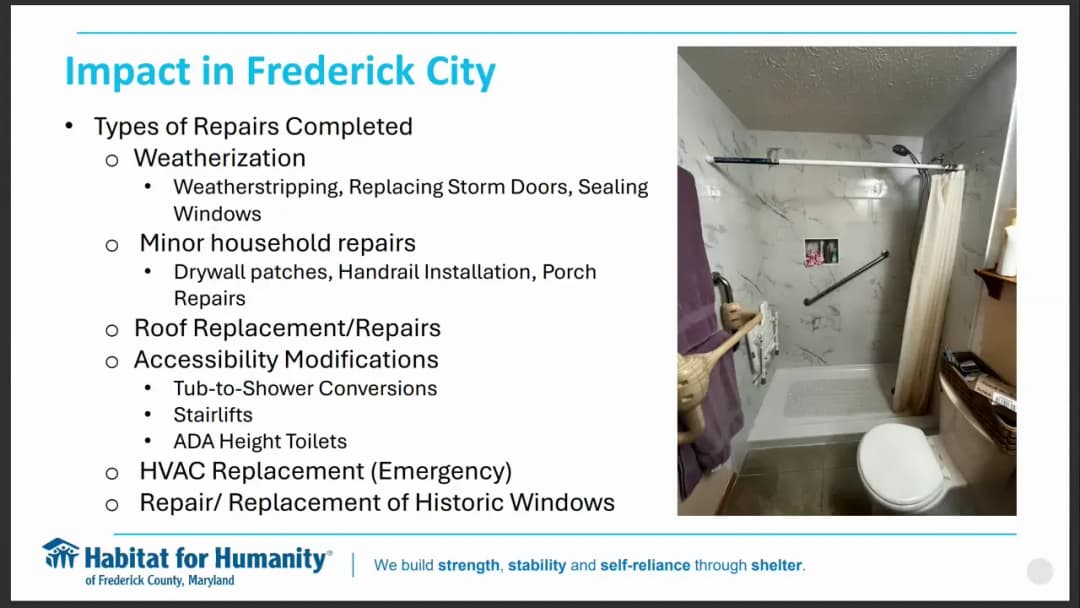
Public Meetings - Frederick, MarylandThe Public Works Committee of Frederick, Maryland, met on March 10, 2026, at 4:00 PM to review the housing work plan and receive updates on three key housing programs: Moderately Priced Dwelling Units (MPDU), Rental Licensing, and Payment in Lieu of Taxes (PILOT). The committee also heard presentations from Habitat for Humanity of Frederick County and Beyond Shelter on their use of rental licensing funds for housing preservation and rental assistance. No formal votes were taken, but the committee provided direction for future policy discussions and process improvements. Discussion Items - Housing Work Plan: Councilmember Brown introduced a draft housing work plan, calling it a "work in progress" divided into phases. Councilmember Hempel Rani emphasized the need to consider long-term feasibility and the growing gap between wages and housing costs. Councilmember Shackleford noted the importance of partnerships with nonprofit organizations and strategic use of government resources. The plan includes policy discussions, rental licensing, and identifying barriers to building housing at different AMI levels. - MPDU Program Overview: Jody Ostage, Housing Policy Advisor, presented on the MPDU ordinance, which requires 12.5% of units in developments over 25 units to be moderately priced (70-90% AMI). Developers may pay a fee in lieu of $2 per square foot (increased from $1.65 in 2023). The city housing fund has accumulated $9.7 million over the program's lifespan (since 2014), with $4.9 million spent. The fund currently holds $4.5 million, including roughly $3 million collected since 2023. Eligible activities include grants for accessibility modifications, health/safety repairs, and gap financing for affordable developments. Staff noted overlapping federal/state programs and offered to recommend streamlining. Councilmember Shackleford questioned the logic of the fee level and the 12.5% requirement; staff explained it was set through stakeholder consensus and to encourage building rather than paying out. Director Campbell noted the small sample size since the 2023 change and the need for future evaluation. - Rental Licensing Program: The rental licensing fee, adopted in 2022 and effective 2023, has generated $1.3 million. After covering Public Works operating costs, 50% goes to a rental assistance fund and 50% to an affordable housing conservation fund. The city allocated $263,000 to Beyond Shelter for rental assistance and $150,000 to Habitat for Humanity for housing preservation. Staff acknowledged delays in disbursement due to lack of formal application process and are working to establish a standardized request-for-proposals (RFP) process. Jody Ostage extended the expenditure deadline to December 31, 2026, to allow partners sufficient time. - PILOT Program: The Payment in Lieu of Taxes program provides tax abatement for affordable developments, with a maximum waiver of $468.59 per unit. The program was amended in 2024 to decouple from county rates. There is no formal application process; developers typically negotiate with the county first, then the city. Staff noted the program is critical for project viability, especially for lower AMI targets. Councilmembers discussed potential adjustments to incentivize deeper affordability (e.g., 30% AMI) through higher abatements or additional tools. - Habitat for Humanity Presentation: Executive Director Eric Anderson and Family Services Coordinator Coralin Wells reported on their use of the $150,000 affordable housing conservation grant. They completed 10 projects (spent $61,000) serving 16 city residents, with average project cost of $6,163. Seven households had a person with a disability, six included seniors, and three were veteran households. Average household income served was $36,314 (well below 80% AMI of $85,450 for a two-person household). Projects included weatherization, roof leak repairs, accessibility modifications, and an emergency HVAC replacement. Habitat recommended maintaining/expanding rental licensing allocation for housing preservation, multi-year funding structures, and streamlined reporting. - Beyond Shelter Presentation: Nick Brown reported on the $263,000 rental assistance grant. They have spent approximately $60,000 serving 34 households, averaging $1,669 per household. Funds are distributed directly to landlords. They observed that most clients arrive three months in arrears, and they are exploring longer coverage periods. Brown also highlighted a critical need for senior homelessness solutions, noting that the Linton shelter effectively serves as a nursing home for homeless seniors. He suggested that MPDU funds could be used for special populations (e.g., severely impoverished or disabled). He supported standardized processes and inclusion of administrative costs in grants. - Process Improvement Discussion: Councilmembers and staff agreed on the need for formal application processes, clear funding amounts, earlier notice of allocations, and consistent reporting for both MPDU and rental licensing funds. Councilmember Shackleford emphasized getting funds out quickly to meet community needs. Director Campbell suggested tying annual expenditures to revenue projections to maintain balance. Key Outcomes - The committee directed staff to bring recommendations on streamlining MPDU eligible activities and addressing overlapping federal/state programs. - Future deep-dive sessions were scheduled: mid-April on rental licensing and fees, followed by later sessions on PILOT and MPDU. - Staff will develop a formal RFP process for rental licensing funds to ensure fair, efficient allocation. - The committee encouraged continued partnership with Habitat for Humanity and Beyond Shelter, with potential for multi-year funding structures. - No binding votes were taken; all decisions were advisory and directed toward future policy revisions.
The Frederick Planning Commission met on March 9, 2026, at 6:00 p.m. to consider a lengthy agenda including consent items, capital improvements program recommendations, several final site plans, and a zoning text amendment regarding accessory dwelling units (ADUs). All votes were unanimous (4-0) unless noted. Consent Calendar - Approved minutes from February 9, 2026, February 17, 2026 (workshop), and March 6, 2026 (pre-meeting). - Approved the 2026-2027 Planning Commission schedule. - Granted a continuance for ZTA PC 25-248 (convenience stores with gas sales, gas stations) to April 13, 2026, at staff's request. Public Comments & Testimony - Heather Goddard (East Frederick Rising) urged the commission to consider low-cost painted walking zones on E Street (akin to Maxwell Alley) for safety and accessibility, prioritizing function over beautification. - Steve Jakupsk (Citizens for Responsible Growth) opposed the two-year extension for Frederick Commerce Center Lot 1, arguing the city should not enable land speculation and that the applicant had three years to secure a user. - Mita Nash (Frederick resident) opposed eliminating the owner-occupancy requirement in the ADU ZTA, warning that it would enable investor speculation and change neighborhood character without adequate protections for older neighborhoods. - Linda Dove (Frederick resident) argued that ADUs are not affordable due to high construction costs (e.g., $300,000 for an 800 sq ft unit) and that eliminating owner-occupancy would not achieve affordability. - Steve Jakupsk (again) reiterated concerns that ADUs would become investment vehicles rather than affordable housing, and urged caution on non-owner-occupied units. - Ann Ryan (Frederick Housing Solutions Task Force) supported ADUs as one tool to expand housing options but noted that no permits have been issued in five years, indicating a need for incentives and careful policy design. - Kate McDermott (Westbrook neighborhood) opposed the size increase to 1,200 sq ft and the removal of owner-occupancy, arguing that community character is more than parking metrics and that further study is needed. Discussion Items - CIP Recommendations (FY 2027-2032): The commission discussed priorities from the Active Mobility Advisory Committee (AMAC) and staff. Commissioner Temple emphasized function over beautification and supported completing rails-with-trails. Commissioner Temple proposed a motion to prioritize completion of E Street rails-with-trails, evaluate striped sidewalks on E Street if safe, maintain other 2026 priorities, and de-emphasize downtown streetscape plan. Motion voted 4-0. - Frederick Commerce Center Lot 1 – Extension: Staff recommended a one-year extension (applicant sought two years). The applicant cited market dynamics and a pending ZTA for data centers. Commissioner concerns included enabling speculation and ensuring APFO compliance. Motion to approve one-year extension passed 4-0. - Sycamore Springs Multifamily Architecturals: Approved two actions: (1) modification to allow square windows (1:1 ratio) – 4-0; (2) approval of architectural elevations with condition to correct window ratio note – 4-0. - Sycamore Springs Multifamily Final Site Plan: Approved five actions including modifications for access points, parking lot lighting, buffer reductions, and final site plan (all 4-0). Conditions included updating notes and adding APFO exemption date. - 40 West Booster Pump Station Replacement: Approved final site plan with condition to provide recorded access easement – 4-0. - Floor and Decor Addition: Approved final site plan with condition to show fire department connection on utility drawing – 4-0. - Costco Addition: Approved two actions: (1) modification to reduce parking from 644 to 575 spaces – 4-0; (2) final site plan with conditions (sketch plan date, APFO updates, distance notation) – 4-0. - West Ridge Square (Mixed-Use Redevelopment): Approved seven actions including five modifications (street detail, bicycle parking, parking setbacks, two landscape buffers), combined preliminary plat/final site plan, and preliminary forest conservation plan (all 4-0). A condition was added to consider renaming Riverstone Drive to Hillcrest Drive. - Accessory Dwelling Units ZTA (PC 25-614): The commission discussed three substantive changes: parking reduction (transit proximity and reduced stall dimensions), elimination of owner-occupancy, and increased maximum size (800 to 1,200 sq ft). Public testimony was divided. After deliberation, the commission voted 4-0 to recommend approval with two modifications: (1) add a provision that no additional parking is required for ADUs in DB, DBO, and DR zones if parking is removed for the ADU; (2) retain the owner-occupancy requirement. The commission also noted concerns about community character and requested council consider monitoring. Key Outcomes - Approved all consent items unanimously. - Approved CIP recommendation letter prioritizing E Street rails-with-trails and evaluating striped sidewalks – 4-0. - Approved one-year extension for Frederick Commerce Center Lot 1 – 4-0. - Approved architectural and site plan approvals for Sycamore Springs, 40 West Booster, Floor and Decor, Costco, and West Ridge Square – all 4-0 with conditions as noted. - Recommended approval of ADU ZTA with two modifications (parking exemption for DB/DBO/DR zones, retain owner-occupancy) – 4-0.
The Government Operations Committee met on March 9, 2026, to receive two presentations: an overview of the Family Connects home visiting program for new parents in Frederick County, and an annual update on the city’s residential rental licensing program. Councilwoman Nash was absent; Councilmember Peter Brem chaired the meeting. County Council Member Renee Knapp attended as a guest. Public Comments & Testimony - Family Connects presentation: The committee heard from Heather Kirby (Vice President, Frederick Health), Lori Sprecker (Clinical Manager), and two program participants. Alyssa Frederick testified that a Family Connects nurse discovered her dangerously high blood pressure (168/98) after discharge, leading to a diagnosis of postnatal preeclampsia. She stated, “Family Connects saved my life.” Catherine Dorsey described how a nurse monitored her postpartum blood pressure, which reached 154/101, and directed her to seek care. She emphasized that the program “bridges the gap” between hospital discharge and the six-week OB visit. Dr. Ywande Oladende, co-founder of Black Mamas Building Bridges and a member of the Leadership Advisory Council, spoke about the council’s role in ensuring the program remains inclusive and responsive. Discussion Items - Family Connects Program: The program launched January 1, 2023, using ARPA funds. It is a universal, evidence-based home visiting service for all families with newborns, regardless of risk or income. As of December 2025, 3,997 families had been served; 65% of those were Frederick City residents. The program achieved the fastest certification by Family Connects International (eight months). An independent evaluation by American Institutes for Research found a trend of reduced healthcare spending, with a return on investment of $4.10 for every dollar spent. The program’s current funding expires November 30, 2026. A gap of $960,000 is needed for December 2026 through June 2027, and the full annual budget is $1.7 million. State legislation has created a work group for statewide implementation, but no funding is yet available. Councilmembers asked about funding sources, undocumented families, and economic impact. Councilmember Brem requested a spreadsheet detailing all funding requests and anticipated sources. - Residential Rental Licensing Update: Dustin Newsbaum (Chief Building Code Official) and Brittany Parks (Manager of Code Enforcement) reported that in 2025, 519 new rental licenses were issued, bringing the total to 8,063. Random inspections reached 1,182 (exceeding the required 15%), with 85% passing on the first inspection (up from 65% the prior year). The special fund balance is $921,106, allocated to rental assistance and affordable housing. Councilmembers expressed concern that the money is not being distributed quickly enough. Discussion included potential improvements to the ordinance, such as capturing all rental units (including those under eight years old, short-term rentals, and ADUs) in a database, possibly with tiered fees. Councilmember Taylor suggested that the goal should be a comprehensive database, not just fee collection. Staff noted that any expansion would require additional staff and policy changes. Key Outcomes - No formal votes were taken. The committee directed staff to provide a spreadsheet detailing Family Connects’ funding needs and expected sources. - Staff will explore speeding up the grant-making process for rental assistance and affordable housing funds from the rental licensing special fund. - The committee signaled that a future public works session will revisit the rental licensing database, exemptions, and fee structure to improve coverage and data on all rental units.
On March 5, 2026, the Community and Culture Committee held a meeting featuring two presentations: an overview of the city's economic development efforts and a review of underutilized city-owned properties with development potential. The committee discussed key statistics, programs, and future opportunities for reinvestment and collaboration. Economic Development Overview - Richard Griffin (Director of Economic Development) and Mary Ford (Economic Development Manager) presented the city's economic development strategy, which focuses on business attraction, retention/expansion, neighborhood development, and workforce development. They noted that the City of Frederick, occupying only 3.5% of the county's landmass, contributes 30% of the population, 25% of the tax base, 42% of businesses, and 48% of all jobs in the county. - The city has a jobs-to-residents ratio of 1.6–1.7 jobs per resident, and about 97% of its 4,100 businesses are small businesses (fewer than 50 employees). Key industry sectors include healthcare, advanced manufacturing (including biotech), professional/technical services, technology, and hospitality (2.1 million visitors annually). - Staff highlighted the "Empower Program" (free mentorship and accelerator) for underrepresented businesses, a food business entrepreneurship program (which won an IEDC Gold Award), and GRO grants ($5,000–$10,000) for physical improvements. They also noted that for every dollar invested in economic development, the community receives $9.17 in return (Maryland Economic Development Association). - Workforce development efforts include the Biotech Boot Camp (8 cohorts), a returnship program (first in the country), and partnerships with Frederick County Public Schools on career coaching. - Committee members asked about walkability in mixed-use developments, the percentage of residents working in the city (under 30% commute outside the region), and the need for access to capital for small businesses. Staff expressed interest in attracting another biopharmaceutical manufacturing plant and a potential city-funded access-to-capital program. Underutilized City-Owned Properties - Richard Griffin and Zach Kirshner (COO) presented a list of underutilized city-owned properties totaling over 200 acres. These include parcels such as the former Trinity School, Husky Park, and the multimodal transit center parking lot, among others. - The city's property disposition policy (since 2002) requires a declaration of surplus, appraisal, public bidding (RFP or invitation to bid), and council approval for sale or lease. Examples of successful past dispositions include Creekside Plaza (Frederick Social), La Paz site, and Maxwell Place. - Staff noted that these properties could be used for mixed-use development, affordable housing, or other community needs. The Westside Regional Park has a portion encumbered by Program Open Space funding, but a portion may be developable for senior or affordable housing. - Committee members discussed using city-owned land for child care facilities, leveraging properties for price-appropriate housing, and the need for a comprehensive reinvestment commission to coordinate planning, housing, economic development, and transportation. The committee chair suggested forming a reinvestment commission to avoid siloed decision-making. Key Outcomes - No votes were taken during the meeting, but several next steps and directives emerged: - Staff will provide the committee with specific data on the percentage of residents who work in Frederick (under 30% commute outside the region). - The committee chair expressed interest in creating a reinvestment commission to coordinate development across departments. - The city's Chief Financial Officer, Katie Bartle, noted that a child care facility tax credit would be presented for approval at the public hearing later that evening (March 5, 2026). - The committee will continue discussions on leveraging city-owned properties for affordable housing, child care, and mixed-use development, with a focus on collaboration between departments.
The Frederick City Council met on March 5, 2026, to consider a consent agenda, several purchase contracts, and three tax credit ordinances. The meeting also included public comments on government reform and a skate park project, as well as councilmember remarks on community safety. Consent Calendar - Request to serve alcohol on city property: Approved 7-0. - Special ordinance S26-2: Approved 7-0. Public Comments & Testimony - Kathy Anderson (Fairview Avenue resident) urged the council to reform the appointment process for boards and commissions, arguing the current system concentrates power in the mayor's office. She proposed moving to an open council interview model and requiring independent legal counsel for ethics and planning boards to avoid conflicts of interest. She requested a legislative work session on these reforms. - Kelly Russell spoke in support of the Hill Street Skate Park project, detailing the decade-long advocacy and planning process from 2004 to the present. She emphasized the project's deliberate, step-by-step progression. - Winston (11-year-old) expressed excitement for the new skate park, saying it would help his training and welcome new skaters. - Isaiah Rosser (Embark Skate Shop) thanked the council on behalf of the skating community, highlighting the need for a safe, modern, and unique skate park. - Donica Zemchak asked questions during the tax credit discussions regarding eligibility for the surviving spouse credit and the selection of emergency workers over other professions. Discussion Items Skate Park at Hill Street Park - Presentation: Jonathan Whitting (DPW) requested approval of a $1,688,766 contract with Grindline Skate Parks for design, demolition, and construction of a new skate park, plus $160,208 contingency, totaling $1,848,974. The project is partially funded by a $1 million Outdoor Recreation Legacy Program grant from the Maryland Department of Natural Resources, with city matching funds. The timeline is 247 days after approval, with completion expected early next year. Three community meetings will be held during the design phase. - Council Questions: Councilmembers inquired about the lifespan (20 years for concrete), the current park's age (built 2004), and community engagement opportunities. - Outcome: Motion to approve passed 7-0. McCurdy Field Athletic Lighting Replacement - Presentation: Scott Gesey (Park Superintendent) requested a purchase order of $113,346 to Musco Sports Lighting for LED replacement of the 1973 lighting system at McCurdy Field, a 102-year-old facility. The project is part of ongoing renovations, including recent sod replacement and irrigation. Future improvements include bleacher replacement and ADA upgrades. - Council Questions: Discussion on timeline (lights not available for spring season; expected late June/early July), single-source procurement through a cooperative agreement, and next steps. - Outcome: Motion to approve passed 7-0. Lotes Field Athletic Lighting Retrofit - Presentation: Scott Gesey requested a purchase order of $131,065 to Musco Sports Lighting to retrofit Lotes Field with repurposed metal halide fixtures from Harry Grove Stadium, saving the city money. The original lights date to 1990. The repurposed lights have less than 5,000 hours of use and are expected to last 15 more years. - Council Questions: Clarification that the reused lights are not LED; the new stadium lights are LED and color-changing, required for Major League affiliation with the Keys. - Outcome: Motion to approve passed 7-0. Verizon Tower Lease Amendment at McCurdy Field - Presentation: Mark Lawrence (Facility Manager) presented a second amendment to the lease agreement with Cell Co Partnership (Verizon) for a tower at McCurdy Field. The original 2009 lease was at risk of termination due to high costs, but a sublease with AT&T stabilized the arrangement. The amendment extends the Verizon lease to run concurrent with the AT&T sublease, providing the city approximately $60,000 per year in income. - Council Discussion: Several councilmembers expressed frustration with poor cell service in their districts (e.g., Warman's Mill, Whittier, Tasker's Chance) and the lack of company representatives at the meeting. They questioned whether the city is getting the best deal and suggested hiring a tower management company like Milestone to negotiate future leases. Councilmember Atkins requested follow-up to address service deficiencies. - Outcome: The motion to approve passed with a vote of 4-2-1 (4 in favor, 2 opposed, 1 abstain), though the council president noted confusion in the vote tally. The transcript indicates the vote was unclear. Tax Ordinances Disabled Veterans Property Tax Credit Update - Presentation: Rachel Gray (City Attorney) presented ordinance G-5-D-257 to update the definition of "disabled veteran" to include those with a non-permanent service-connected disability of 100%, aligning with state law. Currently, nine veterans use the program. The change is permitted but not required; Frederick County has already adopted it. - Outcome: Approved 7-0. Property Tax Credit for Surviving Spouse of a Fallen Emergency Worker - Presentation: Katie Bartle (CFO) presented ordinance G-25-24 to establish a 100% city property tax credit for the surviving spouse of a fallen emergency worker (law enforcement, fire, EMS) who died in the line of duty. The credit lasts five years and applies to the primary residence. Frederick County offers a similar credit and will administer it jointly. The fiscal impact is expected to be minimal. - Public Questions: Donica Zemchak asked about eligibility (coverage of all emergency workers, not just city employees; line-of-duty requirement) and why other professions were not included. Council clarified the state-law authorization. - Outcome: Approved 6-1, with one abstention. Property Tax Credit for Daycare Center Improvements - Presentation: Katie Bartle presented ordinance G-25-25 to establish a tax credit for real property improvements used exclusively for licensed daycare, effective July 1, 2025. The credit is the lesser of $10,000 or the city property tax attributable to the improvement, claimed for five consecutive years. The credit was expanded to include child care centers on business property. The county has adopted similar changes. Estimated fiscal impact: $40,000–$60,000 annually if 4–6 providers participate. - Council Discussion: Councilmember Taylor emphasized the need for outreach to ensure providers are aware of the credit, suggesting coordination with the Childcare Consortium and Asian American Center. - Outcome: Approved 7-0. Key Outcomes - All consent agenda items approved unanimously. - Skate park, McCurdy lighting, and Lotes lighting contracts approved unanimously. - Verizon lease amendment approved with a vote of 4-2-1 (unclear tally). - Disabled veterans tax credit update approved 7-0. - Surviving spouse tax credit approved 6-1. - Daycare tax credit approved 7-0. - Council directed staff to follow up on cell service issues with providers and explore tower management options. Councilmember Remarks - Councilmember Shackelford recognized Women's History Month, wished Noah Grove well in the Paralympics, and emphasized the importance of ensuring no one in the community lives in fear. - Councilmember Atkins reported an immigration enforcement action at Hill Street Park that impacted children walking to school. He thanked colleagues for support and stressed the need to address community concerns.
The Budget and Finance Committee met to review the city's taxing authority, discuss a proposed budget monitoring work plan, and receive an update on the implementation of OpenGov budget software. The committee heard a detailed presentation from Chief Financial Officer Katie Barkdow on the city's property tax, tax setoff, income tax, admission and amusement tax, and tax credits. Members then discussed a framework for ongoing budget oversight, including performance metrics and priority tracking, and agreed to forward the work plan to the full council. No formal votes were taken. Discussion Items - Taxing Authority Overview: CFO Katie Barkdow explained that the city's power to levy taxes and grant tax credits must be authorized by state law. She outlined the property tax rate-setting process, noting that while state law requires a rate set by June 20 and city code says July 1, in practice the rate must be set by the end of May to coordinate with Frederick County's billing cycle. The city uses a single tax rate for all property except habitually vacant properties. - Tax Setoff (Tax Differential): Barkdow described the tax setoff agreement between the city and county, which reduces the county tax rate for city residents in exchange for duplicate services (police, planning, parks, roads). Prior to 2013, the city received a direct rebate of $5-6 million annually. In 2013, the city switched to a tax differential, lowering the county rate by 12 cents and raising the city rate by 8 cents, leaving 4 cents with taxpayers. The current county tax rate is just over $1.00 for city residents and $1.11 for residents outside the city. The county has sole authority to change the calculation. Councilmember Atkins noted a desire to reevaluate the formula and approach the county. Committee members expressed frustration that the city is compared to smaller municipalities and asked Barkdow to provide historical records from 1981. - Business Personal Property Tax: Barkdow noted that the city has phased out assessments for business personal property except for utilities and railroads, effectively taxing those at zero. She stated that reinstating a broader tax would require state law changes or a full reinstitution. The county is pursuing a legislative change this year. - Income Tax: The city receives a passive share of resident income tax – the greater of 17% of the county income tax liability or 0.37% of Maryland taxable income. Corporate income tax is not shared with local governments. - Admission and Amusement Tax: The city levies a 10% tax on gross receipts from admissions and amusements, 5% from horse-drawn carriage operations and concerts, and 0.5% on merchandise sold with entertainment. Annual revenue is between $600,000 and $700,000. Exemptions include recreational sports, health classes, and arts/entertainment district activities. Committee members questioned whether the tax should be streamlined, but Barkdow noted it is state-administered. - Hotel Tax and Short-Term Rentals: Barkdow explained that the city cannot levy a hotel tax because the county already does so for tourism funding. Committee members expressed interest in exploring a tax on short-term rentals (Airbnb-type properties) due to housing impacts, though the legality is uncertain. - Tax Credits: Barkdow presented a chart of available tax credits under state law. The city currently offers credits that mirror the county's. Two new credits were introduced in October and will be voted on Thursday (March 5): - Child care center improvement credit (max $10,000 per state law). - Surviving spouse of fallen law enforcement/fire/EMS workers credit (100% of city tax for five years). The county administers these credits for the city. Barkdow also discussed the city's use of Payment in Lieu of Taxes (PILOT) agreements for affordable housing. Councilmember Kelly asked about the process for adding new credits; Barkdow said it depends on the credit's state authorization and revenue impact. - Budget Monitoring Work Plan: Council Vice President Nash presented a draft schedule for ongoing budget oversight beyond the March-April budget review. The plan includes tracking council priorities, measuring program outputs using performance metrics, and creating a reporting cadence. Members suggested adding sections on budget transfers (within and between departments) and year-over-year comparisons by line item. They also requested including bond capacity analysis and studies like the parks master plan and sidewalk study. The committee agreed to have Nash send a letter to the mayor and CFO to alert departments of the discussion, then bring the refined work plan to the full council. - OpenGov Implementation: CFO Barkdow announced that the city is implementing OpenGov budget software, which will automate CIP project spending reports and other templates. The software is about 50% ready for the upcoming budget presentation and will be fully launched by July 1. She invited council members to participate in building the reporting templates. The committee expressed support and agreed to coordinate meetings starting in April. Key Outcomes - The committee requested CFO Barkdow to provide the 1981 tax setoff agreement and historical tax equity files. - The committee intends to schedule a conversation with the county to discuss potential changes to the tax setoff formula. - The committee expressed interest in exploring a short-term rental tax, pending further legal research. - The budget monitoring work plan will be revised to include line-item transfers, year-over-year comparisons, bond capacity, and department input, then presented to the full council. - Councilmembers will work with CFO Barkdow and her team on OpenGov template design beginning in April. - Two tax credit ordinances (child care and surviving spouse) will go to a formal vote on March 5, 2026.
The Frederick Historic Preservation Commission (HPC) held a public hearing and workshop on February 26, 2026, at the City of Frederick auditorium. The meeting included consideration of four applications: post-fire replacement work at 137 North Market Street, a rear yard patio and gazebo at 140 West Church Street, awnings for a condominium at 208 East 2nd Street, and a demolition and replacement plan for a barn at 220 East Patrick Street. The commission also heard public comments and conducted a workshop on the barn case. Votes were taken on several items, with one case continued to a future meeting. Consent Calendar - Approval of Minutes: The commission approved the hearing and workshop minutes from a previous meeting (motion carried 5-0), with corrections noted: Joshua Masser was not present at the hearing, and a wording correction in the workshop minutes regarding overshadowing by the proposed building. Public Comments & Testimony - Bob Robey, East Second Street resident: Raised concerns about exterior lights on the north face of the new building at 208 East 2nd Street. He stated that the lower-level lights shine directly into his residence and are very bright. The developer agreed to replace those fixtures with downward-facing lights. Robey also urged the commission to consider the color temperature and illumination levels of LED lights in future projects. Discussion Items - HPC 25-124 – 137 North Market Street (Post-Fire Replacement): The applicant (Jay Satch Dave, owner since 2010) sought post-work approval for vinyl siding, soffits, eight vinyl windows, and 12 LED light fixtures installed after a fire. Staff recommended denial of vinyl materials (citing guidelines requiring wood or matching historic materials) and approval of the LED lights. The applicant stated he replaced in-kind because the previous materials were vinyl and he was unaware of the need for prior approval. The commission noted the lack of photographic evidence of the pre-fire windows. After discussion, the commission voted to deny the vinyl siding, windows, and soffits (4-0, Commissioner Kinsey abstaining due to ineligibility) and separately approved the 12 LED light fixtures (4-0). Staff will coordinate next steps with the applicant. - HPC 26-9 – 140 West Church Street (Rear Yard Improvements): The applicant (Jason West) proposed a 16x16 patio, 10x16 gazebo, lighting (uplighting and floodlights), gas fire pit, and L-shaped sitting wall. Staff recommended approval with the condition that floodlighting and uplighting be excluded, as such artistic lighting is not supported for residential architecture. The applicant agreed to remove those lights. The commission voted to approve the application as amended (5-0). - HPC 26-10 – 208 East 2nd Street (Awnings for Unit 501): The applicant (Lance Jacquard, developer/architect) proposed four awnings on the south elevation for a condominium building. Staff found the awnings appropriate given the building is non-contributing and similar awnings were previously approved. The commission voted to approve the application as submitted (4-0, Commissioner Kinsey recused himself). - HPC 26-11 – 220 East Patrick Street (Barn Determination of Contributing Resource): The commission considered whether a one-story frame outbuilding (constructed before 1887, used as a garage and hen house) is a contributing resource. Staff recommended it is contributing. After debate, the commission voted 4-1 to find the barn a contributing resource, with Commissioner McMahon opposed. The case then moved to a workshop for discussion of demolition criteria. - Workshop on HPC 26-11 and HPC 26-12 (Demolition and Replacement Plan): The commission reviewed the structural engineer’s report, which found the barn structurally obsolete and recommended condemnation. The applicant (Kevin Roycroft) explained that initial plans to underpin and stabilize the barn proved unfeasible due to the lack of a foundation and severe deterioration. The replacement plan (HPC 26-12) includes regrading, paving for vehicle circulation, underpinning of a historic stone retaining wall, a new concrete retaining wall (with a stippled finish to match historic stone), and a mechanical pad. Staff noted that the regrading would trigger an archaeological review and require a revision to the approved site plan. Commissioners expressed differing views: some argued the barn is a symbol of Frederick’s industrial history and should be preserved, while others cited its poor condition, substandard construction, and the need for the hotel project. No vote was taken; the demolition and replacement plans are scheduled for the March 12, 2026 hearing at the annex building. Key Outcomes - HPC 25-124: Denial of vinyl siding, windows, and soffits (4-0). Approval of 12 LED light fixtures (4-0). - HPC 26-9: Approval of rear yard improvements with condition excluding uplighting and floodlights (5-0). - HPC 26-10: Approval of awnings as submitted (4-0). - HPC 26-11: Determination that the barn is a contributing resource (4-1). - Workshop: No decision; continued to March 12, 2026 hearing. Staff will require an archaeological application and revised site plan before a vote. - Announcement: Historic preservation tax credit applications are due April 1, 2026.
The Frederick City Council held a workshop on February 24, 2026, focusing on the city's sustainability efforts and the environmental impacts of data centers. Sustainability Manager Jenny Willoughby presented the city's annual sustainability report, followed by a presentation from Karen Cannon, Executive Director of Mobilize Frederick, on data center resource impacts. The meeting included council member questions, public comments, and a discussion of state-level policies. Consent Calendar - The council approved the minutes from the previous meeting by a voice vote (all in favor). Discussion Items - Sustainability Annual Report (18-month period): Jenny Willoughby presented the report highlighting volunteer impact, energy sector shifts (street lights decreased from 25% to 15% of energy use since 2013 due to LED conversions), composting growth (approximately 1,900 households, steady 44 pounds per household per month, 1.5% month-over-month growth), and upcoming projects including a climate dashboard (planned launch end of June), a tree canopy assessment (starting July 1, FY27), and a B City certification application. She noted that the city has 30 electric vehicle charging stations, with 12 in garages (Blink) and the rest (Potomac Edison) at various locations. The city purchases 100% wind RECs from Texas, with a planned shift to community solar (40% to Maryland RECs). Willoughby reported that the plastic bag ban is complaint-driven and rarely enforced, and that expanding a bottle bill at the city level would be difficult without state action. - Data Center Environmental Impacts: Karen Cannon, co-chair of the county data center work group, described potential impacts of data centers on water, noise, emissions, vibrations, and electricity. She noted that Rowan data centers are approved for about 440,000 gallons per day each, using up the 1.2 million gallons per day allocation on the Quantum Frederick site. Noise recommendations suggest keeping levels below 55 decibels at 300 feet (equivalent to a babbling brook). To date, no data center in the county has specified Tier 4 backup generators; instead, Tier 2 generators with catalytic converters are being used. Cannon stated that electricity rates are already high due to data centers, and that the state's climate goals are at risk without stricter regulations. She and Willoughby emphasized that the city cannot regulate electricity, but can require power purchase agreements or “bring your own new clean energy” (BYONCE). - Water Study & Resource Constraints: Willoughby noted the city is in a severe drought (90% of Potomac watershed) and that a water resources study is underway (managed by DPW, completion date uncertain). The previous water report was done before her tenure, and she will obtain it. Councilmembers asked about water quality and the broader impact of all new development on water resources. Public Comments & Testimony - Kevin Sellner (Fifth Street resident, works with Karen Cannon and Jenny Willoughby) highlighted the massive scale of diesel generators (locomotive engines, housed in 53-foot containers), concerns about diesel fuel and biocides in cooling water, and respiratory distress complaints from Adamstown residents. He urged the city to obtain data from county air quality monitors near Adamstown. Key Outcomes - Councilmembers requested a copy of the previous water resources study, data from county air quality monitors near Adamstown, and a timeline for the current water study. - The council will meet with state delegation on Thursday to discuss state legislation, including potential bottle bills and data center regulations. - Councilmember Hempel asked about expanding tree canopy through HOA open spaces; Willoughby suggested targeting large mowed areas without utility conflicts. - The meeting adjourned without any formal votes beyond the consent agenda.
This meeting, held on February 23, 2026, at 9:00 AM, focused on a presentation by the Center for Election Science (CES) regarding approval voting as an alternative voting method. Council members heard from Mary Kramer Wagner and Alison Sardinas, who detailed the mechanics, benefits, and real-world applications of approval voting. No public comments were offered, and the meeting concluded with a brief update on committee work plans. Presentation on Approval Voting - Presenters: Mary Kramer Wagner (Pinnacle Strategies, representing CES) and Alison Sardinas (Director of Public Affairs, CES). - Background: Wagner shared her 21 years of experience in elections and a task force bill (bipartisan, introduced in state House and Senate) to study approval voting and ranked choice voting (RCV). A hearing is scheduled for Wednesday, February 26, 2026, at 1:00 PM. - Definition: Approval voting allows voters to select all candidates they approve of (like a Doodle poll). It aggregates consensus rather than seeking a 50% threshold. - Case study – St. Louis, MO: Proposition D passed with 68% support, implementing approval voting. In the first election, two women (a black woman and a white woman) rose to the top with over 50% approval each, the first such outcome in city history. The previous plurality system had allowed a candidate to win with 32% due to vote splitting. Implementation cost only $1,000 for voter education. - Case study – Fargo, ND: Used approval voting the longest among modern U.S. municipalities. Council races saw reduced vote splitting and more candidates winning with higher approval percentages. - Cost & Complexity: No additional ballot paper costs; no software changes required (overvote function turned off). Compliant with risk-limiting audits and hand counts. - Voter Behavior: Initially about 30% of voters choose multiple candidates; this increases as voters become more familiar. No increased burden on election administrators. - Turnout: Voting method not a primary driver of turnout; strong parties and GOTV efforts matter more. Approval voting moderately increases turnout (1-2%). - Discrimination Concerns: Sardinas stated a forthcoming peer-reviewed study found approval voting is the easiest method for minority populations and not discriminatory. - Funding: CES is funded primarily by individual donors from mathematics and engineering fields; all donor information is transparently disclosed. Q&A Highlights - Councilmember Atkins: Asked whether approval voting eliminates primaries. Sardinas clarified it is compatible with any primary structure; CES prefers a single open primary (as in St. Louis) to save costs. - Councilmember Taylor: Inquired about winning thresholds and why approval voting is not more widespread. Sardinas noted it is a newer method in public use, with only two municipalities currently using it, but it has long academic history. - Councilmember (unidentified): Raised concerns about name recognition bias. Sardinas cited studies showing approval voting helps overcome incumbency bias and allows first-time candidates to win. - Councilmember (senator volunteer): Asked about low-turnout elections and bullet voting. Sardinas explained outcomes still change under approval voting (e.g., winners reach 50% approval even in low turnout). About 33% bullet vote initially, but that declines over time. - Councilmember (unidentified): Asked about open primaries. Sardinas confirmed St. Louis used an open, nonpartisan primary with approval voting and a top-two plurality runoff. - Councilmember (unidentified): Asked if approval voting has been called discriminatory. Sardinas acknowledged it has been, but their research found the opposite; results will be published soon. - Councilmember (unidentified): Asked about funding sources. Sardinas listed individual donors from technical fields; CES is small and transparent. - Councilmember (unidentified): Asked about mail-in ballots and elderly voters. Sardinas noted that older voters tend to be more politically informed and may vote for more candidates; no ballot errors occur because any vote is counted. Key Outcomes - No votes or formal decisions were taken. - The presentation was received by the committee as part of its ongoing elections reform study. - A rescheduled presentation on related topics by Walter Olson will be arranged. - CES will share additional studies and data with council members. - The work plan status was briefly updated; next week’s meeting will focus on budget monitoring.