Houston, Texas — Public Meeting Index
Search help
Summaries & topics includes titles; words may match separately. Transcripts match a literal word or phrase, with case and whitespace normalized. Punctuation and contractions must match. Documents are not searched. Results have separate pages by source; a meeting may appear in both. Both dates are included.
Summaries & topics
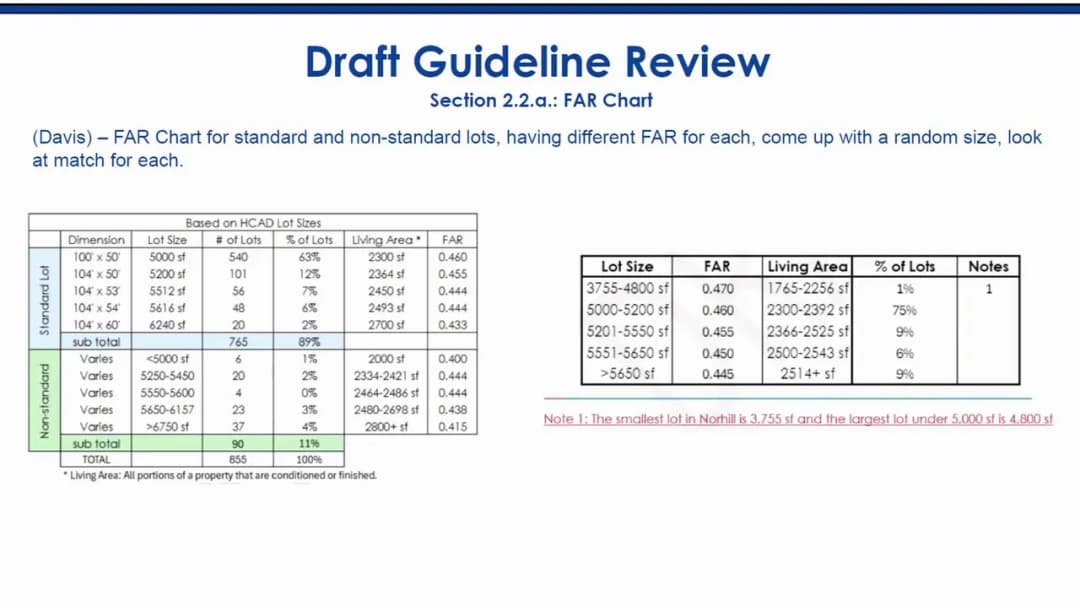
The Houston Archaeological and Historical Commission (HAHC) met on Thursday, June 18, 2026, at approximately 1:00 PM local time. Chair David Buchek called the meeting to order with a quorum present. The meeting included a public hearing on HAHC policy and procedures, approval of meeting minutes, two protected landmark designations, a detailed discussion of the Norhill Design Guidelines, and consideration of several certificates of appropriateness (COAs). Key decisions were made on policy direction and specific COAs, with several items deferred or approved with conditions. Consent Calendar - Approved consent calendar for 12 certificate of appropriateness items as recommended by staff: E4 (1215 Ashland), E5 (121 East 18th Street), E6 (405 Highland), E8 (pulled from list), E9 (2132 Trune Street alteration/addition landmark), E10 (2132 Trune Street new construction garage/carport landmark), E11 (1993 West Gray sign alteration landmark), E12 (811 West Millwood demolition garage/carport Norhill), E13 (811 West Millwood new construction garage/carport Norhill), E14 (1923 Washington sign alteration Old Sixth Ward). All passed unanimously. Public Comments & Testimony - Item A (Policy & Procedures): No public speakers. - Item B & C (Landmark Designations): No public speakers; community support was noted in staff presentations via a letter from Preserve Southampton. - Item D (Norhill Design Guidelines): Multiple residents and stakeholders spoke in strong support of the guidelines, urging the commission to move forward. Speakers included Emily Ardwan (Preservation Houston) who raised concerns about conditioned space definitions and consistency of language; Adam Till, Virginia Kelsey, Ty Keikoa (on behalf of Councilmember Mario Castillo), Dwayne Bradley, Mary Schultz, Kimberly Sturrock, John Santorelli, Rebecca Hackworth, Lawrence Phibo, and Karen Stokes. All supported the guidelines, though some noted minor suggestions (e.g., plate heights, porch language). - Item E1 (1118 2 Lane): No public speakers. - Item E2 (4601 Oak Ridge): Applicant Jordan Prentice spoke in favor of his proposal, asking for a front porch. No other public testimony. - Item E3 (509 Euclid): Applicant spoke in favor; neighbors Charlotte Scales and Jane Buchanan opposed the addition due to impact on a large historic live oak tree (shared with the adjacent Avery House landmark) and excessive scale. Applicant rebutted that he sought to preserve the tree and that other nearby homes were similar size. - Item E7 (7718 Morley Street): Homeowner (speaking through translator) explained he painted brick unknowingly and requested to keep the paint due to financial hardship. He had letters of neighbor support. Discussion Items - Item A: Policy and Procedures (No Vote Taken) - Discussion on four topics: abstention votes, recording of abstentions, draft staff reports, and speaker time. Commissioner Broadbeck cited an Attorney General opinion allowing abstentions; legal counsel Matthew Smith argued city ordinance (Sec. 33-240A/B) mandates a binary approve/disapprove vote. No conclusion reached; vote deferred to next month. - Staff confirmed that after March 2026, no applicant materials are added to staff reports after Friday posting, and that public comments will be posted 24 hours in advance (per planning commission policy). Speaker time rules to be codified: applicant 3 minutes, opponent 2 minutes, rebuttal 2 minutes, with possibility for additional time by motion. - Approval of Minutes – April 23 & May 21, 2026 - Motion to approve with corrections (changing Commissioner Broadbeck's abstention vote and removing a sentence about abstention policy) failed for lack of second. A second motion to approve as written passed. - Item B (2322 Dunstan Road) & Item C (2107 Tangley Street) - Staff presented each property as meeting criteria for protected landmark designation. Both passed unanimously. - Item D: Norhill Design Guidelines - Staff Terrence Jackson reviewed changes made in response to March comments. Key items: definitions (compatibility, massing, conditioned space); FAR chart adjusted; roof pitch, plate heights, dormer placement, and materials clarified. Public testimony was overwhelmingly supportive. Commissioners discussed: conditioned space counting toward FAR (Commissioner Cosgrove opposed, wanting to exclude attic/garage conditioning); FAR lot range increments (Commissioner Cosgrove suggested larger ranges for consistency); plate height and porch massing concerns. A motion to approve the guidelines with conditions (strike conditioned space from FAR, recalibrate FAR chart for logical progression, correct typographical errors) passed. Staff to post revised language within one week. - Item E1 (1118 2 Lane) – Applicant proposed removing stone veneer due to structural issues and replacing with siding. Commissioner Davis presented evidence (Sanborn maps and city directories) showing the house originally had stone, not siding. Motion to approve COA with condition to retain, repair, and reinstall original stone veneer passed. - Item E2 (4601 Oak Ridge) – Applicant requested a front porch. Staff recommended denying it. Commissioner Blakely moved to approve staff recommendation but allow the porch as shown if constructed removably and with simplified columns. Motion passed 8-2. - Item E3 (509 Euclid) – Large addition staff recommended denial on criteria 1,4,5,8,9. Commission deferred the item to next month to allow applicant to address massing, historical fabric (asbestos siding), and tree impact. - Item E7 (7718 Morley Street) – After hearing homeowner's hardship, staff recommendation to deny COA and require paint removal was upheld on a vote (6-2?). Commission noted difficulty of enforcement but approved denial to protect district character. Key Outcomes - Policy & Procedures: No vote; discussion to continue next month. - Minutes: Approved as originally recorded. - Landmark Designations: Unanimously passed for the Irene and George Robinson House (2322 Dunstan Road) and the Merle and Vernon Williams House (2107 Tangley Street). - Norhill Design Guidelines: Approved with conditions (strike conditioned space from FAR, recalibrate FAR chart, typographical corrections). Staff to post revised text by June 25, 2026. - COA E1 (1118 2 Lane): Approved with condition to retain and repair original stone veneer. - COA E2 (4601 Oak Ridge): Approved with conditions for porch (removable, simplified columns). - COA E3 (509 Euclid): Deferred to July 2026 meeting. - COA E7 (7718 Morley Street): Denied; paint removal required (no immediate enforcement unless future permit needed).
On Wednesday, June 17, 2026, at 2:03 PM, the Economic Development Committee of the Houston City Council, chaired by Mayor Pro Tem Martha Castax Tatum, convened to discuss a proposal to amend the Houston Sign Code to allow digital billboards. The meeting included a presentation by Clear Channel Outdoor and Outfront Media, followed by public testimony and committee member questions. No formal vote was taken; the session served as a pulse check on council sentiment. Public Comments & Testimony - Andrea French (Executive Director, Scenic Houston) – Opposed the proposal, arguing that Houston’s sign code has successfully reduced billboards from 10,000 to approximately 1,400 over 40 years, and that digital billboards would reset the clock on amortization. She emphasized the need for thorough public engagement and cited safety concerns from driver distraction. - Ashley Grigsby (Scenic Houston board member) – Noted that the city does not share in advertising revenue and collects only modest permit fees. She urged a slow, transparent process. - Alex Lopez Negrete (marketer, Lopez Negrete Communications) – Supported digital billboards, stating Houston is one of the last major U.S. cities without them, and that they provide critical real-time emergency messaging and economic competitiveness, especially during events like the FIFA World Cup. - Mel Turnquist (CEO, Texas Center for the Missing) – Supported digital billboards, citing 20 Texas children recovered through digital billboard campaigns, including three from Houston. She noted that dynamic message signs on highways cannot display images essential for missing child alerts. - Bob Williams (CEO, Bob’s House of Hope) – Supported digital billboards, detailing a campaign that rescued 10 sex-trafficked boys. He argued that digital billboards are vital for public awareness. - Nicole Kristoff (COO, Crime Stoppers of Houston) – Supported digital billboards, describing a campaign where a case was solved within 24 hours. She emphasized the value of large-scale recognition for victims. - Maisha Coulter (CEO, Aid to Victims of Domestic Abuse) – Supported digital billboards, highlighting their flexibility for updating messages and reaching survivors in multiple languages. - David Mills (founder, Kaylee Mills Foundation) – Supported digital billboards, sharing a personal story of losing his daughter in a crash and using billboards to promote seatbelt safety. - David Malsby (Camp Hope, veterans’ services) – Supported digital billboards, noting that they help raise awareness for veteran suicide prevention. - Anne Lintz (quality of life coalition) – Raised questions about interactions with freeway expansions, unzoned city concerns, amortization program, safety study reliability, and whether public benefits are as advertised. She called for detailed answers before proceeding. Discussion Items - Presentation by Clear Channel Outdoor and Outfront Media: Lee Vella (VP Public Affairs, Clear Channel) and Lanny Farrow (VP Public Affairs, Outfront Media) presented a proposal to allow digital billboards in commercial/industrial areas and along controlled-access interstates. They proposed a 3-to-1 trade-in ratio (three static billboards removed for each new digital one), a phase-in of up to 10 per company per year, and strict lighting controls (0.3 foot candles over ambient). They cited safety studies from FHWA (2013) and Texas A&M (2025) finding digital billboards safety-neutral, and highlighted public safety benefits such as Amber Alerts, missing children recoveries, and emergency messaging. - Councilmember Alcorn – Expressed strong opposition, arguing that digital billboards are more dangerous, that studies conflict, and that Houston has worked decades to improve its visual landscape. She questioned the 3-to-1 ratio and the permit fee revenue model. - Councilmember Ramirez – Inquired about e-waste from LED bulbs, the number of billboards in Houston (approx. 2,000 combined), spacing requirements (current TxDOT minimum 1,500 feet), and public safety protocols. She asked about higher fees charged in other cities. - Councilmember Davis – Expressed support for digital billboards for crime-solving and emergency messaging, citing his experience with crime stats and evacuation needs during hurricanes. - Councilmember Flickinger – Clarified the trade-in ratio (three static removed for one digital) and noted the timing advantage due to I-45 expansion. She asked about the percentage of public service announcements. - Councilmember Carter – Raised concerns about billboards not being on property tax rolls (only personal property tax), and suggested that the billboard companies and Scenic Houston should negotiate a compromise. - Councilmember Alcorn follow-up – Questioned the 3-to-1 ratio, noting other cities like St. Petersburg achieved 13.8-to-1. She also voiced skepticism about the public safety narrative, stating that the companies are primarily advertising businesses seeking profit. - Committee questions on lighting, safety studies, and PSAs – Multiple members discussed the brightness (0.3 foot candles), driver distraction studies, and the percentage of PSA inventory (estimated 10-20% on static boards; more digital would allow more PSA space). - Mayor Pro Tem Tatum – Noted that no formal proposal has been submitted, and that the administration is not pushing this. She encouraged billboard companies and Scenic Houston to collaborate on a draft ordinance. Key Outcomes - No vote was taken. The meeting was informational to gauge council appetite for digital billboards. - Several council members (Alcorn, Ramirez, Carter) expressed opposition or deep skepticism, while others (Davis, Flickinger) were more open, provided strong public safety and economic benefits are demonstrated. - Committee members agreed that a thorough public process is needed, including detailed studies on safety, amortization, locations, and fiscal impacts. - The chair directed that any future proposal should ideally come from a joint effort between the billboard industry and Scenic Houston. - The next Economic Development Committee meeting is scheduled for July 15, 2026.
On June 17, 2026, from 2:03 PM to 4:00 PM, the Houston City Council's Economic Development Committee, chaired by Mayor Pro Tem Martha Castex Tatum, heard a presentation from Clear Channel Outdoor and Outfront Media on a proposed change to the Houston Sign Code to allow digital billboards. The meeting included extensive council questions and public testimony. No formal vote was taken; it served as a pulse check on council and community sentiment. Public Comments & Testimony - Andrea French (Executive Director, Scenic Houston): Opposed the proposal, stating that Houston has spent 40 years reducing billboard clutter from 10,000 to approximately 1,400. She argued that digital billboards would reset the amortization clock, that the three-to-one trade is insufficient compared to other cities (e.g., St. Petersburg at 13.8-to-1), and that the public deserves a thorough, transparent process. She noted that 93% of Texas cities do not permit digital billboards. - Ashley Grigsby (Scenic Houston board member): Focused on economics (city does not share advertising revenue), public benefit (emergency messaging already exists via TxDOT boards and wireless alerts), and the need for deliberate process. - Alex Lopez Negrete (founder, Lopez Negrete Communications): Urged adoption, saying Houston is the last major U.S. city without digital billboards, which puts it at a disadvantage for events like the FIFA World Cup. He emphasized the medium's flexibility for real-time emergency messaging and community outreach. - Anne Lintz (citizen, Quality of Life Coalition): Raised numerous questions: interaction with I-45 expansion, lack of zoning as an unzoned city, interaction with existing amortization program, safety study context, and whether public benefits are real. She suggested using digital billboards to improve airport corridors. - Mel Turnquist (CEO, Texas Center for the Missing): Described successful partnerships with Clear Channel that have recovered 20 Texas children. Stated that digital billboard images are essential for missing child alerts, unlike TxDOT dynamic message signs which cannot show photos. - Bob Williams (CEO, Bob's House of Hope): Reported that digital billboard campaigns by Clear Channel have led to the rescue of 10 trafficked boys and generated over 900,000 impressions. He stressed the urgency of public awareness for child sex trafficking, especially with FIFA events. - Nicole Christoph (COO, Crime Stoppers of Houston): Noted that their first digital campaign with Clear Channel solved a case in under 24 hours. Digital billboards give victims a voice and put a face to perpetrators. - Maisha Coulter (CEO, Aid to Victims of Domestic Abuse): Explained that digital billboards allow her organization to quickly update messages in multiple languages, helping survivors know free help is available. She supported the technology as a public health tool. - David Mills (founder, Cayley Mills Foundation): Shared his personal story of losing his daughter in a car crash. Digital billboards are central to his seatbelt awareness campaign, and he believes they save lives. - David Malsby (Camp Hope): Advocated for reaching veterans with PTSD resources; digital billboards help direct veterans to services that save lives. Discussion Items - Presentation by Clear Channel and Outfront: Lee Vella and Lanny Farrow proposed a responsible update to the sign code: digital billboards limited to commercial/industrial areas and controlled-access interstates/roadways, with a three-to-one trade-in ratio (remove three static billboards for each new digital), a phased rollout (maximum 10 per company per year), and an eight-second static message change. They cited safety neutral studies from FHWA (2013) and Texas A&M (2025), and highlighted public safety benefits: 20 missing children recovered, 53 fugitives apprehended, and emergency messaging during disasters. They noted that over 111 Texas cities and about 1,000 U.S. cities allow digital billboards. - Councilmember Alcorn (opposed): Expressed strong opposition, citing safety studies showing a 25-29% greater crash rate near digital billboards, and fears that allowing digital would open the door to unlimited expansion. She questioned the three-to-one ratio and the percentage of billboards used for PSAs. - Councilmember Ramirez (neutral/inquisitive): Asked about workforce impact (presenters said jobs increase due to maintenance), e-waste recycling (presenters said modules are recycled through specialized companies), and permit fees (presenters said cities may negotiate higher fees). He requested copies of safety studies. - Councilmember Davis (supportive): Emphasized the potential for public safety, citing the need for rapid communication during storms and for crime tips. He noted that digital billboards can be updated within 15-30 minutes. - Councilmember Flickinger (neutral): Questioned the trade ratio mechanics, timing with I-45 relocation, and whether the city could charge a fee per ad rotation. She encouraged stakeholders to negotiate. - Councilmember Carter (mixed): Raised concerns about billboards not being on tax rolls as real property (only personal property tax) and wondered about a revenue-sharing model. He preferred that billboard companies and Scenic Houston work together. - Mayor Pro Tem Tatum (neutral): Stated the administration is not pushing the proposal; the meeting was to gauge council appetite. She encouraged the billboard industry and Scenic Houston to sit down and craft a joint proposal. Key Outcomes - No vote or decision; the meeting was informational. - Directive: Mayor Pro Tem Tatum urged Clear Channel, Outfront, and Scenic Houston to continue negotiations in hopes of producing a consensus draft ordinance. - Next steps: The next Economic Development Committee meeting is scheduled for July 15, 2026, at 2:00 PM. Council members and the public were invited to submit questions to District K office. - No formal timeline set for a potential ordinance change; further public engagement and review of safety studies were noted as necessary.
The Houston City Council convened on June 16, 2026, under Mayor Pro Tem. The meeting featured multiple proclamations, a weather update from the Office of Emergency Management, public testimony on the proposed closure of Memorial City Ice Rink and a drainage dispute, and approval of several ordinances including an expansion of the water aid fund. The council also recognized interns and announced upcoming Juneteenth events. Proclamations - Miss Juneteenth Pageant: Councilmember Evans Shabazz presented a proclamation recognizing the 19th annual Mildred Johnson Mr. and Miss Juneteenth Pageant, held on June 6, 2026, at the Third Ward Multi-Service Center. Winners included Seven Watson (Teen Miss Juneteenth), Jillian Ridley (Miss Juneteenth), and Hanisha Stewart (first runner-up). Mayor Whitmire proclaimed June 16, 2026, as the winners’ day. - Ross Shaw Sterling Senior High School Bicentennial Class of 1976: Councilmember Davis and Councilmember Evans Shabazz honored the class on its 50th anniversary. The school, founded in 1965, now hosts the HISD Aviation Science Magnet Program. Mayor Whitmire proclaimed June 16, 2026, as Ross Shaw Sterling Senior High School Bicentennial Class of 1976 Day. - Houston’s Dementia Friendly Church: Councilmember Huffman recognized the ministry at The Landing at Augusta Woods, established in 2023. Over 500,000 Texans live with dementia. Mayor Whitmire proclaimed June 24, 2026, as Houston Dementia-Friendly Church Day. - Baha’i Prayer: Nadia Jolly, vice chair of IM Houston, delivered a prayer for America on behalf of the Baha’i faith, which has about 1,000 adherents in Houston. Weather Update - Brian from the Office of Emergency Management reported that the city had been tracking a potential rain event for 4–5 days. Lake Houston was lowered by one foot, barricades deployed, and dump trucks converted into high-water rescue vehicles. A potential tropical cyclone (likely Tropical Storm Arthur) was forecast to pass east of Galveston, placing Houston on the “clean side” with minimal impacts. FanFest for the World Cup was expected to open at 6:30 p.m. for the Argentina match. Residents were urged to monitor trusted sources and avoid driving into standing water. Public Comments & Testimony - Memorial City Ice Rink: Multiple speakers (Amy Good, Aliska Good, McKenzie Knoll, Charlotte Knoll) urged the council to prevent the demolition of the rink, owned by Metro National, which is set to close in 44 days. They noted the rink serves 1,500 regular skaters and 1,000 occasional skaters weekly, and that Houston has only five regulation-sized ice rinks compared to Dallas’s 23. They requested the city deny any permits that would destroy the asset and partner with the newly formed Houston Ice Sports Coalition to develop a new centrally located rink. Councilmember Huffman and Councilmember Salinas expressed interest in following up. - Darnell Fennell (Reverend): Complained about lack of communication from Councilmember Evans Shabazz’s office regarding a street closure issue. Councilmember Shabazz responded that her office had engaged and that the issue was resolved. The exchange highlighted tensions over public versus private communication. - Jessica LeBayer (District H resident): Described a drainage hazard at 839 East 27th Street, where a property owner filled a public drainage ditch with gravel to create an unpermitted parking pad in a high-risk AE 100-year floodplain. Despite three red-tag violations over nearly a year, the city had not remediated. She requested an emergency right-of-way abatement. Councilmember Castillo acknowledged the frustration and said her team would continue working with Public Works. - Other speakers: Topics included the Day of the African Child (book donations to libraries), a request to rename the Hispanic History Research Center to include “Chicano,” a complaint about a council member’s staff hire, and personal appeals for vehicle recovery and civil rights. Discussion Items - UT Health Houston Academic Health Department Partnership: Mayor Whitmire introduced a collaboration between the Houston Health Department and all seven institutions under UT Health Houston—the first such academic health department in the nation. Dr. Teresa Tran (Health Department director), Dr. Melina Kibbe (UT Health Houston president), and Dr. Eric Borwinkel (Dean of School of Public Health) spoke. The partnership aims to improve workforce development, research, and evidence-based programs for Houston’s 2.3 million residents. Councilmembers expressed strong support. - Consent Calendar and Ordinances: The council approved numerous items, including: - Item 10: Ordinance amending the water aid to elderly residents fund to include administrative fees for solid waste relief. Councilmember Salinas thanked the administration for expediting this. Passed unanimously. - Item 22: Interlocal agreement with Harris County for neighborhood traffic management (speed cushions) in District H. Councilmember Castillo noted some projects had been in queue for four years. Passed. - Item 23: Public improvement development agreement for a hike-and-bike bridge over Buffalo Bayou connecting Memorial Park to Uptown. Councilmember Panzarella highlighted connectivity benefits. Passed. - Item 15: Appropriation for material handler equipment replacement for urban forestry. Councilmember Flickinger thanked colleagues for support. Passed. - Several items were tagged for additional information (Items 1, 20, 29). - Speed Cushion Costs: Councilmember Mayor Pro Tem Tatum raised concerns about the tripling of speed cushion costs, noting that the $1 million in CDSF funds cannot cover 40 cushions in one neighborhood. Councilmember Panzarella suggested street redesign alternatives. Mayor Whitmire indicated the backlog would be cleared by year-end. Key Outcomes - Proclamations issued for Juneteenth pageant winners, Sterling High School class of 1976, and Dementia Friendly Church (future date). - Weather preparedness actions confirmed: lowered lake, staged rescue vehicles, and barricades. - Public comments on the ice rink and drainage were referred to council members for follow-up. - Consent calendar approved with items 2, 5, 6–8, and most ordinances passed; items 1, 20, and 29 tagged. - Item 10 (water aid fund) passed unanimously, expanding relief for low-income residents facing the new solid waste fee. - Item 22 (speed cushions partnership) passed, with council members noting cost challenges. - Item 23 (hike-and-bike bridge) passed. - Public hearing dates set: July 8, 2026, for amendments to Chapter 42 (parks) and for nominations to the Houston Municipal Employees Pension System Board of Trustees (positions 10 and 11). - Council announcements: Juneteenth events on June 19, summer safety initiatives, intern recognitions, and a call for artists for Buffalo Speedway gateways (applications due June 30).
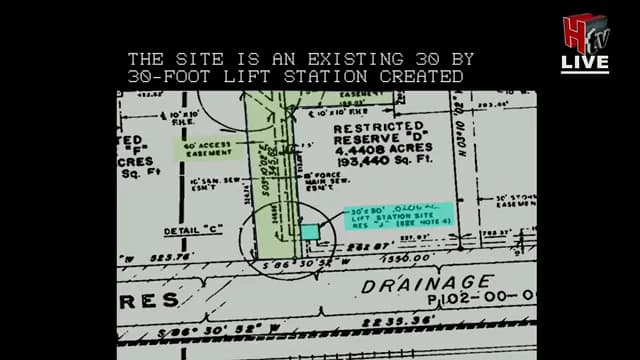
The Houston Planning Commission met on Thursday, June 11, 2026, at 2:32 PM in the City Hall Annex, 900 Bagby. Vice Chair Sunny Garza chaired the meeting due to Chair Lisa Clark's absence. The commission considered 64 consent and replat items, several public hearing plats, variance requests, special exceptions, and a development plat. Multiple items were deferred or withdrawn, and no public comments were submitted. Consent Calendar - Items 1-64 (Sections A & B): The commission approved all staff recommendations for consent and replat items not requiring notification, with the exception of items 7, 20, 28, 29, 30, and 60, which were pulled for separate consideration and approved individually. No speakers were present. Director's Report - Director Von Tran reported on the 2026 Major Thoroughfare and Freeway Plan Amendment virtual open house held the previous evening, which had several dozen attendees. The next step is a public hearing before the Planning Commission on July 23, 2026, at 1 PM. Discussion Items - Item 65 - Charlotte Mont Place: Approved to create three single-family residential lots. No variances requested; staff recommendation approved. - Item 66 - Culver Residences: Deferred to allow the applicant to provide a letter of support from an adjoining lot. The public hearing was continued. - Item 67 - Davenport Manor: Approved to create two single-family residential lots. No variances requested. - Item 68 - FMU Kwood Collection: Deferred for two weeks per applicant request to coordinate with legal on deed restrictions. Public hearing continued. - Item 71 - Madero Village: Deferred because the item packet was missing from the full agenda packet; deferred for two weeks. - Item 72 - Royal Plaza: Approved to create one unrestricted reserve. - Item 73 - Woodland Acres Part 2, Replat 5: Approved to create two single-family residential lots after the applicant revised the plat to meet a 25-foot front building line restriction. - Items 75 & 76 - Grand Mason General Plan and Detention Reserve A: Deferred for two weeks (item 75) and a 30-day extension was granted (item 76) per applicant request to coordinate with Harris County Engineering on right-of-way status. - Item 77 - Houston Office Build-Out: Approved with a variance to allow an unrestricted reserve to take access via an access easement instead of public street frontage. - Item 78 - Market Street Lift Station 2: Approved with a variance to allow access via an existing access easement for a lift station expansion. - Item 79 - Mountain View Terrace: Approved with variances to allow a 40-foot right-of-way (instead of 50 feet) and reduced intersection spacing. The property is in the Acres Home Mobility Study area; a compromise was made to secure a street connection. - Item 80 - North Houston Commerce Park GP: Approved with variances to exceed maximum local intersection spacing along multiple boundaries. The site is proposed for industrial use and adjacent to an elementary school and other constraints. - Item 81 - Poundbury Section 2: Deferred to give the applicant time to provide revised materials and new drawings. - Item 82 - Salinas Estates at Sharon Street: Approved with variances for reduced building lines (12 feet along major thoroughfare, zero feet on local street) and no visibility triangle. The site was reconfigured due to historical platting and street widening. - Item 83 - Wildcat Industrial: Deferred at the request of Mayor Pro Tem Martha Castex Tatum's office to address constituent concerns regarding a sunset property adjacent to the site. - Item 84 - Dunham Point GP: Approved with a special exception to exceed intersection spacing by not providing an east-west public street, justified by a 2024 amendment removing a major thoroughfare segment across Cypress Creek. Commissioner Pierce recused. - Item 86 - Solara: Approved with a variance to exceed intersection spacing by not extending a stub street or terminating it in a cul-de-sac. - Item 87 - Windward Falls GP: Approved with a variance to allow minimum intersection spacing of 301 feet instead of the required 600 feet, due to an adjacent recently recorded subdivision and a school turning zone. - Sections G, H, I, J (Items 88-102): Approved all staff recommendations as a group, including extensions of approval and certifications of compliance. Commissioner Matis recused on item 89. - Item 104 - 4210 Fulton Street: Deferred per applicant request. A member of the public spoke asking about the deferral; staff clarified the item will return in two weeks. - Item 105 - 726 Lawrence Street: Approved with a variance to allow a 5-foot building line for the second floor along Lawrence Street instead of the required 10 feet. The lot is at the end of the street adjacent to a park. A commissioner noted potential utility clearance issues but no deferral was needed. Key Outcomes - Approved: Items 1-64 (with pulled items individually approved), 65, 67, 72, 73, 77, 78, 79, 80, 82, 84, 86, 87, 88-102, and 105. - Deferred: Items 66, 68, 71, 75, 81, 83, and 104. Item 76 received a 30-day extension. - Withdrawn: Items 69, 70, 85, and 103. - Public Hearings: Set for July 9, 2026, for multiple plats (Alkenbury Residents, Bayou Woods Section 2 Rep. 3, Brays Park Estate, Hamlet Residence, High Line Enclave Rep. 1, Kirk and Doll Village Section 1 Rep. 1, Rhine Retreat, Torres Venture Rep. 1, and Vale View Homes). - Next Steps: The commission will meet next on June 25, 2026 (two weeks from this meeting) for deferred items. The public hearing on the Major Thoroughfare and Freeway Plan amendments is scheduled for July 23, 2026. Public Comments & Testimony - No speakers signed up for public comment; no members of the public addressed the commission at the end of the meeting. - One speaker addressed the commission regarding item 104 (4210 Fulton Street) after it was deferred, asking about implications; staff provided clarification.
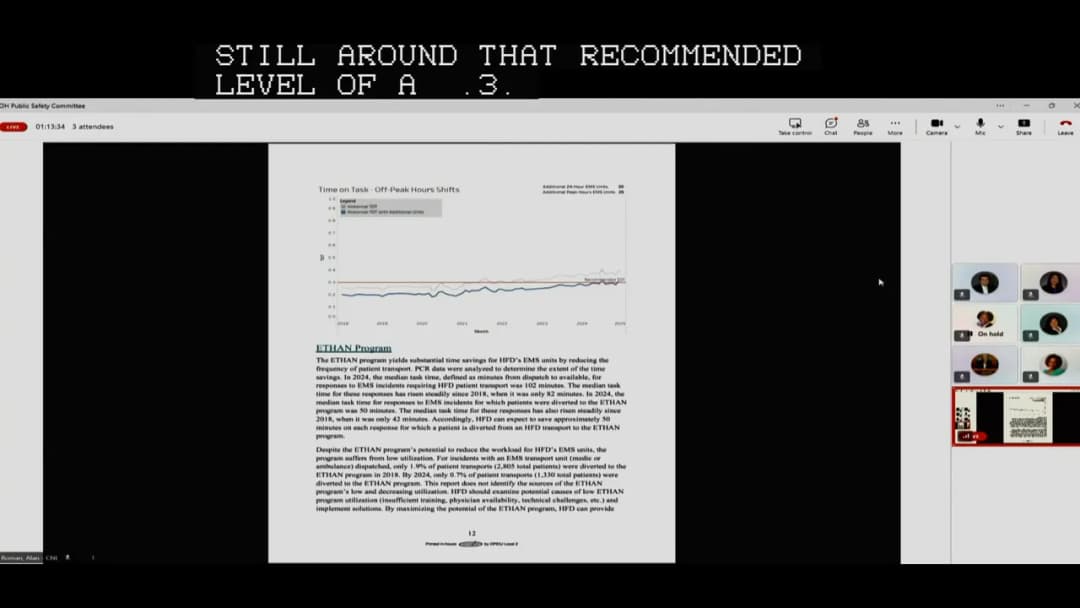
The Houston City Council Public Safety Committee, chaired by Council Member Amy Peck, met on June 9, 2026, to receive a presentation from the Houston Professional Firefighters Association (HPFFA) on a comprehensive work demand analysis of the Houston Fire Department (HFD). The study, conducted by International Association of Firefighters data analysts over a year at no cost to the city, examined seven years of CAD data (2018–2024) to assess resource needs and service delivery. Key findings included a 34% increase in fire incidents per day and a 21% increase in EMS incidents per day over the study period, with call volume growth outpacing resource additions. The analysis recommended adding 65 EMS units (30 24-hour and 35 peak-hour ambulances) and constructing 10 new fire stations to improve response times and reduce system strain. Public Comments & Testimony - Doug Smith: Expressed support for increasing ambulance availability and noted the importance of the Ethan program (low-acuity transport alternative), expressing concern about its low utilization (0.7% of transports). Asked for clarification on definitions of EMS unit types (medics vs. squads) and sought data on airport-reimbursed overtime for fire department personnel. Also noted a discrepancy in incident counts between pages 10 and 13 of the report. Discussion Items - Presentation by Marty Langton (HPFFA President), Jeremy Berman (IAFF data analyst), and Marshall Cloud (EMS data specialist): - Overview: The study was a collaborative, data-driven analysis of HFD operations from 2018–2024, including all CAD, PCR, and out-of-service data, with interactive tools for each council district. It aimed to identify systemic issues and efficiency opportunities. - Call Volume Trends: Fire incidents per day increased 34%; EMS incidents per day increased 21%. Population growth (estimated 300,000 new residents since 2010) is a primary driver, but aging infrastructure and development patterns also contribute. - Time on Task (Utilization): The industry-recommended utilization target is 0.3 (30% of unit hours spent on direct patient care). In 2018, 31% of EMS units exceeded this during off-peak hours; by 2024, 86% exceeded it. During peak hours, 86% exceeded the target in 2018 and 96% in 2024. Over the last 200 days of the study, 56% of medic units and 65% of ambulances were busy or out of service during the median incident, leading to 211 incidents where all medics were unavailable and 63 where all ambulances were unavailable. - Recommended Additions: To return to 2018 workload levels, the report recommends 65 additional ambulances (30 24-hour, 35 peak-hour). This would bring peak-hour time on task from 0.6 to below 0.4. Ten new fire stations were recommended based on a value-added analysis (at least three additional incidents per day expected to receive a four-minute response). - Dispatch Options: Changing ALS dispatch to send only one medic and a fire apparatus could reduce overall workload but would increase medic unit workload, already a constrained resource. - Travel Time: Current engines meet the four-minute travel time standard for only 29% of incidents within their own response area; the new stations target high-impact areas. - Ethan Program: In 2024, only 0.7% of patient transports used Ethan (low-acuity alternative transport). HPFFA supports the program and believes education and consistency will improve utilization, potentially saving an average of 50 minutes per transport. - Staffing: HFD has added paramedic classes (previously under 25, now up to 150 in training) thanks to council funding. The department achieved a net gain of 100 firefighters in eight months, overcoming prior attrition trends. Full paramedic staffing will take time due to the nine-month training requirement. - Cost Estimates: Initial ambulance cost $325,000, with annual operating cost $1 million per unit (net $700,000–$800,000 after cost recovery). - Council Member Questions and Comments: - Council Member Alcorn: Asked about the 34% fire incident increase, attributing it to growth; clarified time on task calculation and value-added station metric. Noted the contrast with the 2016 Facets study recommendation (70 ambulances) vs. only 5 added. - Council Member Martinez: Inquired about breakdown of fire vs. EMS calls, noting 87% EMS incidents. Discussed prioritizing ambulance addition over apparatus, and learned that adding ambulances reduces fire truck usage for medical calls, lowering overall system strain. Also asked about paramedic count (400+ currently) and Ethan program low utilization. - Council Member Huffman: Raised traffic impediments at specific intersections (e.g., Woodway/Chimney Rock) and suggested PSAs to improve public awareness of yielding to emergency vehicles. HPFFA agreed to model specific locations and supported re-education efforts. - Council Member Ramirez: Questioned population growth assumptions, citing data from Bill King showing domestic outmigration and slower future growth. Discussed staffing models—HPFFA stated cross-training paramedics as firefighters is required by Texas law and integral to system efficiency. Also inquired about stationing ambulances without full fire stations; HPFFA explained that 24-hour units require infrastructure for crew rest, and co-location is most cost-effective. - Council Member Davis: Asked about transport times to hospitals and the impact of hospital bed availability on unit out-of-service time. HPFFA noted no standard governs transport times but data can be modeled. Also discussed workload distribution by unit and district. - Council Member Flickinger: Noted population growth from 2018–2024 was only 2.7% (65,000), implying other factors drive call volume increases. Asked about ambulance-only stations; HPFFA stated such stations are being considered but co-location remains most efficient. Also asked about mutual aid (e.g., Kingwood) and confirmed incidents data includes mutual aid calls. Expressed support for PSAs and increasing ambulance fleet, sharing a personal anecdote about a fire truck response without transport capability. - Staff from Council Member Panzarella's Office: Clarified reasons for fire trucks responding to medical calls (shortages of ambulances and need for multiple personnel). Asked about paramedic training pipeline (from 25 to 150 trainees) and steps to improve Ethan utilization; HPFFA emphasized collaboration with city leadership and dispatch protocol adjustments. - Staff from Mayor Pro Tem Castatum's Office: Asked about hospital selection criteria (closest appropriate facility based on trauma level) and crew assignment consistency (affected by previous staffing shortages, now improving). HPFFA noted hodgepodge assignments are being addressed. Key Outcomes - No formal votes were taken; the meeting was informational. - The committee will request an update from HFD on the Ethan program within the next few months. - HPFFA will provide follow-up data on specific questions raised (e.g., average travel times, airport overtime reimbursement, breakdown of mutual aid, discrepancy in incident counts, and details on squad vs. medic units). - Council members expressed support for increasing ambulance capacity and exploring public education campaigns on yielding to emergency vehicles. - The next Public Safety Committee meeting is scheduled for July 14, 2026.
The Houston City Council met on June 9, 2026, to adopt the Fiscal Year 2027 budget, consider multiple proclamations, hear public testimony, and vote on a series of budget amendments. The meeting began with proclamations honoring Memorial Assistance Ministries, The Women's Hospital of Texas (50 years), the Greater Houston LGBTQ+ Chamber of Commerce (10 years), and two first responders (Captain Andy Roseborough and Dr. Joyeth Lagesity). After public comments and discussion, the council approved the budget (15-1) and numerous related items. Consent Calendar - Adopted minutes of May 27, June 2, and June 3, 2026. - Approved routine items including appointments, contracts, and spending authorities on the consent agenda, with several items pulled for separate consideration. Public Comments & Testimony - Multiple speakers urged increased funding for BARC (animal shelter), noting that Houston allocates only $6.75 per person compared to $14 in Dallas and San Antonio. Speakers from Barrio Dogs, East End Kitties, and other groups called for free spay/neuter services, public education, and an end to "pet rent." - Residents from Northeast Houston (e.g., Mirtala Tristan, Vernon Bruce Hart, David Espinoza) supported budget amendments 4.01 (illegal dumping) and 4.02 (public works hiring), describing chronic flooding, clogged ditches, and dangerous tree limbs. - Lucy Moreno complained about solid waste service, including a broken recycling bin and a staff member damaging her property; council members promised follow-up. - Cheryl Chandler requested an honorary street marker for Reverend Bird Lacey Jr. in Fifth Ward; council expressed support. - Several speakers advocated for the "People's Budget," opposing a regressive trash fee and calling for more transparency on tax abatements (amendment 1.05). - Four pastors (Elmo Johnson, F.N. Williams, Reverend Castanõ, T. Leon Preston) spoke in favor of the $5 administrative fee, describing it as a small sacrifice for improved services. - Additional testimony addressed women's health, youth programs, Juneteenth, and other community concerns. Discussion Items - Public Hearing – Chimney Rock Park Utility Corridor: Houston Public Works and Parks & Recreation presented a proposal to use a portion of Chimney Rock Park for a new 42-inch sanitary sewer line (trenchless construction). The existing 1958 line has reached its end of life. Alternatives were analyzed, and the preferred route avoids major disruptions. The hearing was closed with no opposition. - Budget Amendments and Voting: Over two dozen amendments were considered. Key outcomes: - 1.01 (Ramirez): $216,000 for Crisis Call Diversion Center (passed). - 1.02 (Ramirez): $115,000 for a licensed therapist on a CERT team (passed). - 1.03 (Ramirez): Quarterly overtime reporting – referred to committee. - 1.04 (Ramirez): TIRF affordable housing expenditure report – referred to housing committee. - 1.05 (Ramirez): Tax abatement accountability report – referred to economic development committee. - 4.01 (Salinas): $3 million for illegal dumping prevention and cleanup (passed). - 4.02 (Salinas): $500,000 for public works hiring – withdrawn after commitment to fill 95 inspector vacancies. - 6.01 (Peck): Analysis required before any increase in the solid waste administrative fee (passed). - 6.03 (Peck): Sunset of container lease fee at end of FY27 unless council votes to continue (passed 10-6). - 13.01 (Castillo): $75,000 for LGBTQ+ economic empowerment coordinator (passed). - 13.02 (Castillo): $500,000 for BARC kennel cleaning and operations (passed). - 16.02 (Castex-Tatum): $250,000 for recycling education and outreach (passed). - Other amendments were withdrawn, referred, or voted down. - Floor Amendment (Salinas): Incorporation of the administrative fee into the city's Water Fund (donation-based) for low-income relief – committed to be brought back for formal vote within two weeks. - Item 61 – FY2027 Budget Adoption: After extensive debate, the budget was approved 15-1 (Councilmember Pollard voted no). The budget includes a $5 monthly solid waste administrative fee, reorganization of solid waste under Public Works, and funding for water infrastructure, public safety, and illegal dumping. Key Outcomes - FY2027 Budget Passed (15-1) with a $5 administrative fee for solid waste, remaining at $5 for FY27 and FY28 with a cap of $25. The budget uses $200 million from the Combined Utility System (CUS) reserves for right-of-way and solid waste integration, with assurances that water and wastewater projects will not be delayed. - Container lease fee sunset (6.03) unless council votes to continue after FY27. - $3 million dedicated to illegal dumping (4.01) with quarterly reporting. - $500,000 added to BARC (13.02) for kennel cleaning and operations. - $75,000 for LGBTQ+ business coordinator (13.01). - Commitments to fill 95 public works inspector vacancies and to provide ongoing committee reports on overtime, TIRF spending, tax abatements, and container lease fund performance. - Planned amendments to allow low-income relief for the administrative fee via the Water Fund within two weeks. - Proclamations declared June 9, 2026 as "Memorial Assistance Ministries Day," "The Woman's Hospital of Texas Day," "Greater Houston LGBTQ+ Chamber of Commerce Day," and "Captain Andy Roseborough and Dr. Joyeth Lagesity Day." - Honorary street marker for Reverend Bird Lacey Jr. to be voted on at a future meeting.
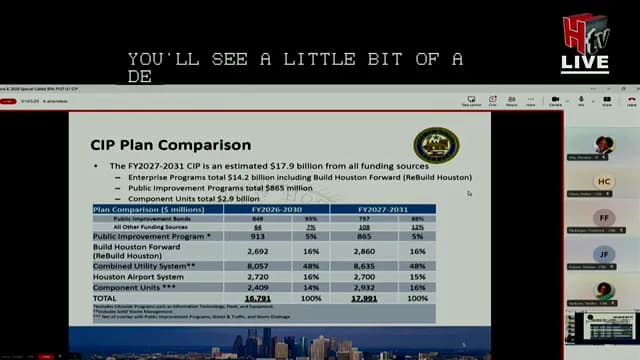
The Budget and Fiscal Affairs Committee, chaired by Sally Alcorn, met on June 8, 2026, to review the proposed Capital Improvement Plan (CIP) for fiscal years 2027 through 2031. The meeting included presentations from Finance Director Melissa Dubowski and Deputy Director Alma Tamborello, covering the $17.9 billion five-year plan across four major areas: Public Improvement Program, Build Houston Forward, Enterprise Funds, and Component Units. Councilmembers discussed bond capacity, sidewalk funding, drainage programs, fleet spending, and solid waste reporting. Discussion Items - Overview of the CIP: Finance staff presented the $17.9 billion proposed plan, a decrease in the Public Improvement section due to solid waste moving to Combined Utility System, and increases in Build Houston Forward and Combined Utility System. The plan is a rolling, five-year document subject to change. - Funding Sources: Public Improvement is supported by general fund debt; Build Houston Forward by DDSRF (drainage utility charge and developer impact fees) plus grants; Enterprise Funds by rates, charges, and grants; Component Units by tax increment, zoo revenue, and Houston First revenues. - Public Improvement Program Highlights: $185 million for municipal courts, fire station renovations, fleet commitment of $292 million (up from $246 million), and technology upgrades including CAD system replacement ($10 million) and SAP S4 HANA ($12.8 million). - Build Houston Forward: Street and traffic control: $1.58 billion, with $790 million for citywide rehabilitation and $513 million for thoroughfares/collectors. Council district service fund: $27.5 million. Safe sidewalk program increased to $28 million (from $16.5 million). Storm drainage: $1.3 billion, with neighborhood drainage $775 million, SWOT program $128 million, local drainage $97 million, and ditch reestablishment $125 million. An additional $25 million for ditch reestablishment is in the FY27 operating budget (stormwater fund). - Debt Payoff: Since 2012, $2 billion in street and drainage debt paid off; $367 million still owed. As debt is paid, more funds become available for pay-as-you-go projects. - Combined Utility System: Wastewater treatment facilities $3.8 billion, including neighborhood sewer renewal ($731 million). Water system $4.3 billion, driven by East Water Purification Plant. Need to expand commercial paper capacity for implementation. - Houston Airport System: Five-year CIP totals $2.7 billion, with $2 billion at IAH focusing on taxiway and runway improvements. - Bond Election Discussion: Vice Mayor Pro Tem Peck asked about timing for a future bond election. Staff indicated elections are held every 4-6 years; the last was in 2022, so another is likely in the next year or so. Councilmember Panzarella clarified that bond authorization is like a credit limit and does not necessarily mean tax increases; the city plans to stay within revenue caps. - Fleet Spending: Councilmember Panzarella asked about fleet details. Staff explained that fleet spending is broken out by department, with specific unit counts only for the first year due to cost volatility in later years. - Solid Waste Reporting: Councilmember Panzarella requested better separation of solid waste capital costs from the combined utility system. Staff noted that solid waste facilities are in a separate chapter but funding source is now Combined Utility System. A council district summary of projects will be provided. - Amendment Process: Councilmember amendments are due by the end of the week (June 12). Finance will compile them into a matrix for organized discussion. Key Outcomes - The CIP will be brought to City Council on June 17, 2026, with a potential vote on June 24, 2026. - Council members were directed to submit CIP questions through the SharePoint system under the appropriate department. - A council district summary of projects will be made available. - No formal votes were taken at this committee meeting.
The Super Neighborhood Alliance held its monthly meeting on June 8, 2026, via video conference. The meeting featured presentations on disaster recovery housing funds from the City of Houston Housing and Community Development Department and an update from the Texas Department of Transportation (TxDOT) on World Cup preparations. Other business included a budget and finance committee report, approval of minutes, and a decision to take July and August off. Public Comments & Testimony - Several super neighborhood representatives asked questions of Latasha Smith (HCD) about the disaster recovery program, including eligibility, taxable status of grants, floodplain requirements, and requests for presentations in their neighborhoods. Tamaro Bell expressed appreciation for TxDOT engagement. Vicky from Super Neighborhood 49/50 reported a lighting issue on 610 and a missing sign, and Glenn Albert committed to follow up. Lindsay Williams requested a meeting about the I-45 realignment project. Dexter asked about better communication on construction closures. Doug reported a victory against a proposed gas station on Southmore. Discussion Items - Disaster Recovery Funds (HCD Presentation): Latasha Smith presented on the Disaster Recovery Program for the 2024 storms (DeRico May 16–17 and Hurricane Beryl July 5–9). The program provides up to $100,000 for home rehabilitation and up to $300,000 for full reconstruction. Eligibility: owner-occupied primary residence in Houston city limits, outside floodway, income at or below 80% area median income, sustained damage from the named storms. Homeowners must be current on mortgage/property taxes. Temporary housing is provided during reconstruction. Applications are expected to open at the end of summer; advance preparation of documents is encouraged. Smith noted that application workshops will be held at community centers to assist. - TxDOT World Cup & Cleanliness Update: Glenn Albert, Houston District Engineer for TxDOT, reported on efforts to beautify corridors in preparation for the FIFA World Cup. Over 5,500 trees planted, 17 million sq ft of concrete power washed, 13 million sq ft power washed and repainted, 2,800 large green signs replaced, and 1,200 high-mast lights upgraded to LED. Maintenance has increased: interstate sweeping from twice monthly to weekly, mowing from 4 to 8 times per year, and doubled litter pickup. During World Cup, contractors will continue work behind existing barriers but no new lane closures or temporary closures on game days; only the downtown NHIP drainage project will be paused. - Budget and Finance Committee Report: Jack provided an overview of the city's budget situation. The city faces a $200 million shortfall in a $7.5 billion budget. Proposed solutions include transferring $200 million from the water fund and adding a $5 monthly household fee for trash service. Jack expressed concerns about sustainability and noted that the health department may be shortchanged. Controller Hollins approved the mayor's budget proposal, but overtime spending remains a concern. The budget must be approved by July 1. Key Outcomes - Approval of Off Months: A motion to cancel meetings in July and August was approved unanimously. - Minutes Approval: The April and May meeting minutes were approved. The February minutes remain unresolved; Letitia directed Greg to meet with Cheryl within 14 days to resolve concerns, after which a virtual vote will be conducted. This directive was challenged by Greg but the meeting ended without further action. - Next Steps: HCD will schedule presentations at individual super neighborhood meetings. TxDOT committed to better communication and will provide a map of state-maintained roads. A meeting on I-45 realignment will be arranged.
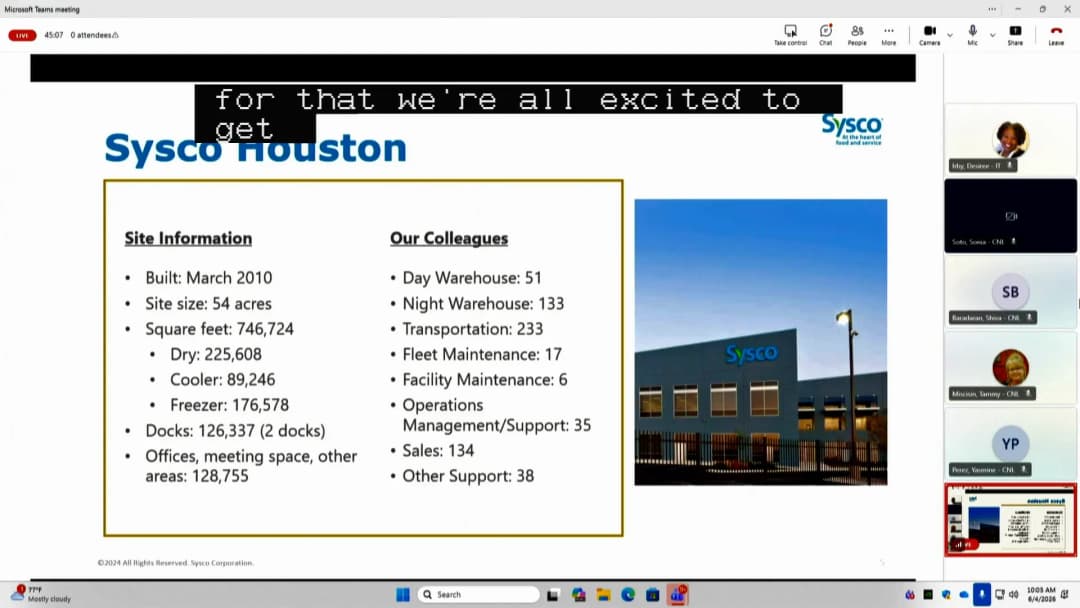
On June 4, 2026, the City of Houston's Resilience Committee, chaired by Councilmember Twilight Carter, convened at 10:01 AM. The committee heard a presentation from Cisco (Sysco) on its business continuity and disaster support operations. Representatives Vendetta Blau (VP of Enterprise Risk Management) and Ryan Forth (South Texas Region President) detailed Cisco's Houston presence, resilience strategies, and recommendations for city-private sector coordination. Councilmembers present included Carter, Panzarella, Thomas, Martinez, Tatum, and Ramirez, along with staff from multiple council offices. Presentation Overview - Cisco operates 337 distribution points across 13 countries, with over 75,000 employees supporting 730,000 customers in restaurants, hospitals, schools, and government. - Its Houston headquarters (built 2008, LEED Gold) houses about 1,200 employees, and a broadline distribution center on the north side employs roughly 600. Two cash-and-carry locations (Cisco To Go) recently opened. - The company's resilience program includes annual readiness training, generator backups, fleet inspections, and simulation scenarios. It prioritizes deliveries to hospitals, nursing homes, and first responders during disasters. - Through the Greater Houston Partnership, Cisco secured passage letters for drivers to access disaster areas. It also donated 23,000 bottles of water, 8,000 bags of chips, 10,000 pieces of fruit, and 6,000 servings of juice to West Gray and Southwest multi-service centers after Hurricane Barrel. Discussion & Q&A - Councilmember Panzarella asked how multi-service center locations (West Gray and Southwest) were selected for past distributions; Cisco responded that locations were based on need and accessibility, and it is open to prioritizing centers designated by the city. - A question from Councilmember Peck's office inquired whether district offices could request disaster relief directly from Cisco. Cisco confirmed it is possible, subject to bandwidth after ensuring employee safety and facility power, and offered to follow up with a formal plan for such requests. - Councilmember Carter noted Cisco's large fleet (third-largest in the U.S.) and emphasized the value of its resources. No other questions were raised. Key Outcomes - No formal votes or decisions were taken. The committee received information and recommendations for strengthening Houston's resilience. - Cisco offered to provide a follow-up plan outlining how council districts can request disaster relief support. - The next Resilience Committee meeting is scheduled for August 10, 2026, at 10:00 AM.
Transcripts
No published pilot transcripts are available for this city. The current pilot covers Sacramento City Council only.
Transcript coverage details
The pilot includes June 9 and two June 23, 2026 sessions. Recording completeness is unknown. Missing, cancelled, incomplete, or changed transcripts can leave gaps. No match does not establish that something was never discussed.