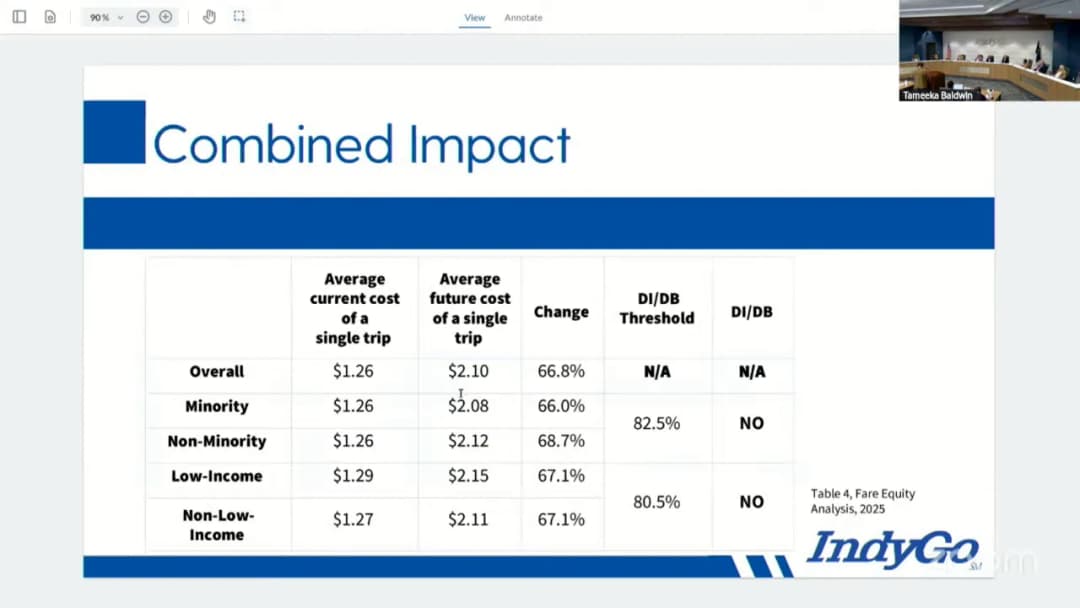
The IndiGo Board of Directors held a meeting on August 21, 2025, to consider and approve several action items, including the fiscal year 2026 budget, an updated fare policy, and the purchase of a replacement bus. The meeting also featured presentations on financial performance, the IndiGo Foundation's program analysis, and a fiscal sustainability study. Consent Calendar - Action Item A-1: The board unanimously approved the minutes from the meetings of July 17 and July 31, 2025. Action Items - Action Item A-2 (FY 2026 Budget): The board adopted the operating, capital, and debt service budgets for fiscal year 2026, totaling $432,246,559. This includes a special tax levy resolution. The budget breakdown is: $153.9 million (operating), $257.6 million (capital), and $20.8 million (debt service). Director of Budget Justin Rukus presented the item, noting that the budget was introduced on July 17, a public hearing was held on July 31, and it will proceed to the City-County Council on October 6, 2025, after a hearing on September 17, 2025. The vote was approved by roll call with Director Gardner and Director Wilson voting aye. - Action Item A-3 (Fare Policy Update): The board passed an amended resolution to update fare policies, including an increase in the base fare from $1.75 to $2.75 effective January 1, 2026, and an increase in IndiGo Access (ADA paratransit) fares (from $3.50 to $5.50) delayed to July 1, 2026. The motion, made by Director Gardner and seconded, also authorized the CEO to make minor non-substantive changes to the final policy documents. The vote was unanimous by roll call. - Action Item A-4 (Bus Purchase): The board approved the purchase of one 60-foot diesel articulated bus from New Flyer of America for $1,615,686.72, including a 15% contingency for tariffs. Chief Operating Officer Aaron Vogel explained that the bus replaces one lost in an incident in April 2024 and will be paid for by insurance proceeds. The purchase will be combined with the existing order for 18 Blue Line buses. The motion carried unanimously. Discussion Items - Fare Policy Presentation: Staff presented detailed reasons for the fare increase, citing inflation eroding fare revenue (purchasing power of the $1.75 fare is 67% of its 2009 value) and increased operating expenses from collective bargaining, local bus route improvements, and BRT service. The presentation also covered federal Title VI fair equity analysis, which found a "disproportionate burden" for low-income riders using the reduced-fare 31-day pass, mitigated through public outreach and continued acceptance of passes beyond the effective date. Public feedback included concerns about the increase being too high, especially for IndiGo Access riders; issues with MyKey validator reliability; and concerns over eliminating the 31-day pass. The board discussed the importance of equitable access and requested staff to develop a fare collection enforcement plan. - Foundation Update: Emily Moe, Executive Director of the IndiGo Foundation, presented the results of a program analysis funded by an Eli Lilly grant. The analysis produced a theory of change, logic models for each program, and a data sharing framework to improve coordination between IndiGo and the Foundation. Recommendations included using a shared CRM and better utilizing customer surveys. - Fiscal Sustainability Study: Brooke Thomas, Chief Development Officer, presented a study aimed at addressing potential budget deficits by exploring revenue growth (fares, advertising, partnerships) and cost reduction (operating practices, service realignment). Key obstacles include limited funding expansion options, aging capital assets, and staffing challenges. The study will include peer agency benchmarking and produce an action plan. Key Outcomes - Approved Minutes (July 17 and 31, 2025). - Adopted FY 2026 Budget ($432,246,559 total). - Approved Fare Policy Update (base fare to $2.75 on Jan 1, 2026; paratransit increase delayed to July 1, 2026). - Approved Purchase of One Replacement Bus ($1,615,686.72). - Staff directed to develop a fare collection enforcement plan (requested by Director Slash). - The fiscal sustainability study will continue with a focus on creating an action plan.
Public Meetings - Indianapolis, Indiana
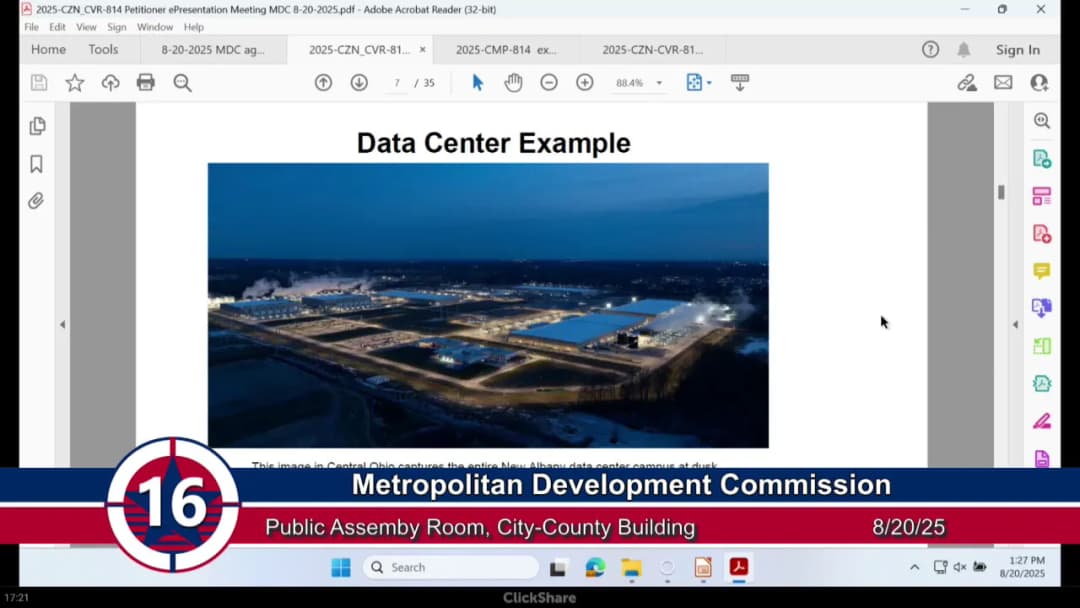
Public Meetings - Indianapolis, IndianaThe Metropolitan Development Commission (MDC) met on August 20, 2025, at 1:00 PM in the Public Assembly Room, City-County Building, Indianapolis. The meeting covered adoption of minutes, several policy resolutions, tax abatement public hearings, zoning petitions, and a major rezoning for a data center campus. Key decisions included approval of Roche Diagnostics tax abatements, approval of the Deep Meadow Ventures (Google) data center rezoning and variance, approval of a rezoning for the Universal Church of Truth's Life Village project, and denial of the corresponding variance for that project. Consent Calendar - Adoption of Minutes (August 6, 2025): Approved 7-0. Commissioners Morerity and Robinson recused themselves as they were not present. - Policy Resolutions: Five resolutions were approved 9-0: 2025-R-031 (conveyance of property at 2240 Enterprise Park Place to Fields Mortuary Transport & Removal Services LLC for redevelopment), 2025-A-031 (preliminary ERA for Romet (US) Inc. – 5-year personal property tax abatement), 2025-A-032 (preliminary ERA for Deep Meadow Ventures LLC – 10-year real property tax abatement for data center), 2025-E-024 (authorizing payment of $157,471.50 to GP-CM BOT LLC for services), and 2025-P-010 (amending contract with Town Planning & Urban Design Collaborative, LLC to extend term and revise scope). - Petitions of No Appeal: Seven petitions (2025-APP-007, 2025-MOD-008, 2025-ZON-065, 2025-ZON-070, 2025-ZON-072, 2025-ZON-073, 2025-ZON-076) were approved 9-0. (Item 11, 2025-ZON-019, was withdrawn.) Public Comments & Testimony - Roche Diagnostics Tax Abatement (2025-A-029): One public speaker, Spencer Andrews, opposed the 10-year real property tax abatement, arguing that large corporations like Roche should pay their fair share of property taxes and that abatements are a discredit to residential homeowners. He urged the commission to reconsider. - Deep Meadow Ventures (Google) Data Center Rezoning (2025-CZN-814 / 2025-CVR-814): Extensive public testimony was heard. Remonstrator Julie Goldsbury (representing a group of 797 signatories in the 46239 zip code, 1,069 in surrounding zip codes, and 5,127 Indiana residents) opposed the project, citing concerns about building height (variance up to 75 feet), noise (65 dB limit), water usage (2-3 million gallons), potential contamination, lack of transparency (NDAs), and inconsistency with the Comprehensive Plan. She noted that the project would create only 50 jobs while consuming vast resources. Several remonstrators also spoke. Councilor Hart (District 20) opposed the project, stating that the process was flawed, that the city should pursue higher-value developments, and that the abatements and tax benefits were insufficient. He highlighted that the 50 jobs and limited tax revenue do not justify the impact on infrastructure and schools. The Franklin Township Civic League submitted a letter of support, but remonstrators argued it was reluctant. - Universal Church of Truth Life Village (2025-CZN-828 / 2025-CVR-828): Remonstrators Gladys Whitfield, Margaret McCarthy, and Jacqueline Richards opposed the project, stating they were not properly consulted, that the proposed density and reduced parking (38 spaces vs. 77 required) and reduced unit sizes (500 sq. ft. vs. 660) were inappropriate, and that the three-story apartment building would be out of character with the one-story single-family neighborhood. They also cited safety concerns from increased traffic and parking. Discussion Items - Roche Diagnostics Tax Abatements (2025-A-029 and 2025-A-030): Staff presented that Roche will invest $145 million in real property (A029) and $405 million in personal property (A030) at its 9115 Hague Road campus. The project is expected to create 650 new jobs (average wage $35/hr) and retain 2,634 existing jobs (average wage $42+/hr). 5% of tax savings will go to the Indy Achieves Completion Grant. The City-County Council approved the statement of benefits on August 11, 2025. Staff recommended approval. The commission approved both resolutions 9-0. - Deep Meadow Ventures (Google) Data Center Rezoning and Variance: The petitioner, represented by Joe Calderon, requested rezoning of 467.66 acres from D-A, C-4, and SU-43 to C-S (Special Commercial) for a data center campus, plus a variance for building height of 75 feet (max normally 38 feet) and no maximum front yard setback. The project would include up to four buildings with a total investment of approximately $1.5 billion, creating 50 high-wage jobs (avg. $100,000+/yr). The petitioner highlighted 34 commitments (later 35) including a 150-foot landscape buffer, noise limit of 65 dB, 200-foot building setbacks, and coordination with AES and Citizens Energy for utilities. Staff recommended approval, noting that the Comprehensive Plan supports light industrial and office/industrial mixed use on the majority of the site. The Hearing Examiner had recommended approval, but an appeal was filed. The commission discussed traffic, noise, water, fire safety, and visual impact. After a 5-minute rebuttal, the commission voted 8-1 to approve the rezoning and 8-1 to approve the variance. - Universal Church of Truth Life Village (Rezoning and Variance): The petitioner proposed rezoning 1.02 acres from D-5 and SU-1 to D-8 for a 42-unit permanent supportive housing community for low-income homeless seniors. The project included a three-story apartment building, duplexes, triplexes, and a community center. Variances sought were for use (apartment in SU-1), reduced parking (38 vs. 77), reduced unit size (500 vs. 660 sq. ft.), and reduced open space. Staff recommended denial, citing incompatibility with the surrounding one-story single-family homes, overdevelopment, and lack of connection between scattered sites. The remonstrators argued they were not consulted, and the project would harm neighborhood character. The commission approved the rezoning 6-3 but denied the variance 4-5, creating a procedural impasse. Key Outcomes - 2025-A-029 (Roche Real Property Tax Abatement): Approved 9-0. - 2025-A-030 (Roche Personal Property Tax Abatement): Approved 9-0. - 2025-CZN-814 (Deep Meadow Ventures Rezoning): Approved 8-1. - 2025-CVR-814 (Deep Meadow Ventures Variance): Approved 8-1. - 2025-CZN-828 (Universal Church of Truth Rezoning): Approved 6-3. - 2025-CVR-828 (Universal Church of Truth Variance): Denied 4-5. - Continuances: 2025-ZON-046 (Pulte Group) continued to September 3, 2025; 2025-A-028 (Thunderbird CC Land Partners) continued to September 3, 2025. - Next Steps: The commission encouraged the Universal Church of Truth petitioners to work with remonstrators to resolve the variance issues. The staff will determine the implications of the mixed vote.
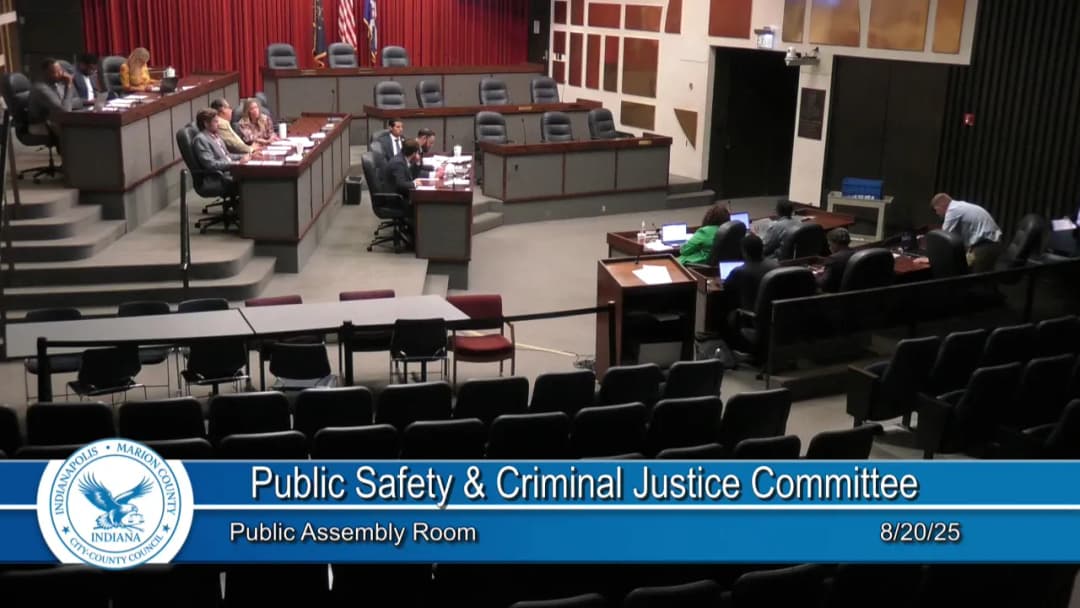
The Public Safety and Criminal Justice Committee of the Indianapolis-Marion County City-County Council met on Wednesday, August 20, 2025, at 5:30 p.m. in the Public Assembly Room of the City-County Building. The committee heard budget presentations for three agencies: the Marion County Prosecutor's Office (including the Child Support Division), the Marion County Public Defender Agency, and Marion Community Corrections. No votes were taken; the hearing was for discussion and information gathering only. Marion County Prosecutor's Office and Child Support Division Prosecutor Ryan Mears presented the 2026 proposed budget of $35,012,418 for the Criminal Division and $7,072,132 for the Child Support Division. He highlighted that so far in 2025, the office has charged 31 murder trials to verdict with a 90% conviction rate (28 for 31). Of 52 homicide cases filed this year, 26 individuals (50%) had no prior adult arrests. The office has seen a shift toward self-defense cases; all three trials lost this year involved self-defense claims. Sex crimes cases remain strong: 11 for 11 in child molest trials. Notable convictions include Raymond Childs (360 years for killing six family members), Bruce Minnenhall (serial killer), and Kevin Bennett (108 years for serial rape). The office lost two state-funded grants – the Adult Protective Services grant ($500,000) and the DOC diversion grant ($189,000) – leading to elimination of 10 positions, though some staff were reassigned. Starting attorney salaries were raised to $72,000, improving recruitment. The office has partnerships with Vera Institute and Stanford University to evaluate racial disparities in charging. Mike McGuire presented the Child Support Division's budget. The division currently has 37,032 open cases. The proposed $7,072,132 budget does not reflect total expected expenses of $8,146,811. By shifting more expenses to County General, the county could capture an additional $709,288 in federal reimbursements. The division runs programs like the Parents that Work program (197 participants in 2024, goal of 230 in 2026) and Second Chance Workshops (1,400+ served in 2024, goal of 1,600 in 2026). A new mediation program is planned for 2026 using incentive funds. In Q&A, Councilors asked about grant losses, racial disparities in charging, bond processes, and the revolving door of criminal justice. Prosecutor Mears clarified that the office does not set bonds (bail is based on a matrix) and that information flow from arrest to charging is a process challenge. On residency requirements, he noted his office is not legally bound by them and expressed concerns about losing employees to cheaper housing outside Marion County. Marion County Public Defender Agency Chief Public Defender Ray Casanova presented the 2026 proposed budget of $34,821,120, a reduction of $81,317 from 2025. County General funding dropped by $470,851, leading to a loss of 10 funded FTEs. The agency has 314.5 total FTEs, with 260 filled and 54.5 vacant. Critical vacancies exist in the Major Felony Division (5 attorney IV positions). The agency relies on a 40% reimbursement from the Indiana Commission on Court Appointed Attorneys for non-capital cases (50% for capital). In 2024, reimbursement totaled $10.3 million; 2025 is projected at $11 million. The Title IV-E grant will help cover contractual expenses for experts, contractors, and the pending capital case. Casanova stressed that the residency requirement (from which the prosecutor's office is exempt) hinders recruitment and retention. A recent denial of a waiver forced an attorney to leave, leaving 114 open cases. The agency prefers full-time attorneys over contract attorneys due to better supervision and training. Budget details: Character 1 decreased by $258,785 (County General) due to 2.6% COLA and health insurance increases, forcing the 10-FTE reduction. Character 3 decreased by $212,621 (County General), shifting contractual expenses to federal grants (increase of $534,000 in Federal Grants fund). Federal grants include ARPA/IDS project (expires Sept 2026), Quality of Life program (extended to Sept 2026), and Title IV-E. State DOC grant for problem-solving courts likely not renewed for 2026. Public comments were heard from three employees: - Lucy Frick (Major Felony attorney, 10 years): Described understaffing in Major Felony; her caseload exceeds 30, and colleagues are higher. Asked for more funding and a union contract, noting negotiations have stalled since February 2024. She warned she would leave if no contract is signed. - Raul Delarosa: Noted that the union contract is unsettled, making it difficult to set a budget. Said a 2.6% COLA does not keep up with inflation. Mentioned federal loan forgiveness is on hold. - Evan Dominguez (Major Felony team lead): Echoed colleagues, criticized budget cuts while IMPD received a $20 million increase. Raised concerns about mental health issues in the community and retention problems due to harassment, pay, and respect. Marion Community Corrections Director Scott Hohl and CFO Justin Garcia presented the 2026 proposed budget of $22,492,408, a decrease of $462,423 from 2025. The agency supervises over 3,400 active clients; in 2024 it served 7,077 clients. It has 204 positions, 179 filled (21 vacant, 4 frozen). The budget includes a 4% reserve required by OFM, leading to freezing 4 positions (saving $303,225) and removing $220,000 based on 11% attrition rate. Character 1 increased by $79,974 due to COLA and health insurance; Character 3 decreased by $478,352, limiting programming, training, and XBE contract expansion. Duvall Residential Center continues to face costly repairs: $70,000 in unexpected repairs in 2024 and $110,000 so far in 2025. Known issues include a roof replacement ($1.3 million), walk-in freezer ($50-60k), and generator ($50-60k). A facility assessment is underway. Revenue projections: $1 million from user fees (electronic monitoring and work release), with fees based on financial analysis and poverty rates. Grants: $5,992,607 from Indiana DOC and $83,873 from JAG. The DOC grant was cut by $7 million statewide, impacting Marion County by $1.2 million, with programs like prosecutor diversion and probation treatment zeroed out. Performance metrics: 76% program completion rate in 2024, 53,000 electronic monitoring alerts handled by the 24-hour Client Services Center, 47 home visits resulting in 34 arrests, 59 guns seized, and over 45,000 grams of drugs seized. Only 8 critical incident reports and 6 use-of-force incidents at Duvall. Awards: Isaac Olorunnisomo won Residential Employee of the Year; Kyle Mishler accepted into APPA Leadership Institute; Captain Jeffrey Sutt graduated from DOC Leadership Academy. In Q&A, Councilor Hart asked about statutory mandate; Director Hohl explained community corrections is optional for counties. Councilor Boots inquired about the Duvall facility assessment timeline and digital kiosks (used for probation payments, not related to community corrections). Councilor Graves questioned the budget's impact on XBE participation; Garcia clarified that the agency cannot expand contracts due to Character 3 cuts, affecting all providers, including XBE. Key Outcomes - No votes were taken. The committee received presentations and asked questions. The 2026 budgets for the three agencies will be considered by the full City-County Council as part of the overall county budget process. - The committee will continue budget hearings on other agencies in future meetings.
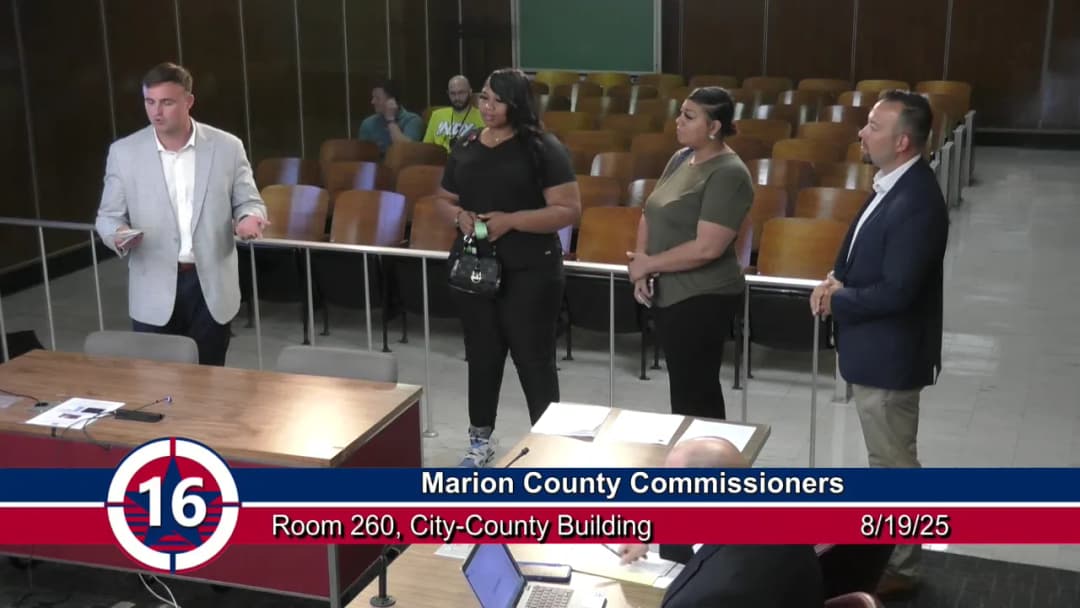
The Marion County Board of Commissioners met on August 19, 2025, at 2:05 p.m. in Room 260 of the City-County Building. President Joseph O'Connor called the meeting to order with Commissioners Milo Eldridge (Auditor/Secretary) and Barbara Marins (Treasurer) present. The board approved minutes from July 15, 2025, received a scholarship presentation, and held a public hearing on the transfer of 43 surplus properties to the Department of Metropolitan Development. Consent Calendar - Meeting Minutes Approval: The board unanimously approved the minutes from the July 15, 2025 meeting. Public Comments & Testimony - Scholarship Presentation: Cam DeMoreau (Deputy Legislative Director, Association of Indiana Counties) and Zach Hughes (SRI) awarded a scholarship to T.R. Gibson, a senior at Franklin High School. Gibson described community service activities including making blankets, volunteering at churches, singing in choirs, cleaning beaches in Gary and parks, and participating in parades. Gibson will attend Indiana State University to study nursing. Commissioners congratulated her. Discussion Items - Transfer of Surplus Properties (Resolution): Ryan (from the Department of Metropolitan Development, DMD) presented a request to transfer 43 county-owned properties (mostly single-family lots, some double lots) to DMD for redevelopment through the renewed "Vacant to Vibrant" land bank program. Ryan explained the program includes standard sale, affordable application (discounted for nonprofits), homestead application (20% discount for owner-occupants with a two-year occupancy requirement), and side lot applications for adjacent owners. The program timeline aims for 3–6 months from application to final disposition, with review by registered neighborhood groups, a DMD review committee, and the Metropolitan Development Commission. A design review for new construction is also required. Commissioner Eldridge asked about due diligence (title search, encroachment checks). Commissioner Marins inquired about Parcel 36 (7046490) listed as "Fisher Creek condominiums"; Ryan clarified it is a vacant lot with no condos built, and condominium owners have inquired but were ineligible for the side lot program. No public comments were offered. Key Outcomes - Unanimous Approval: The board approved the resolution to transfer the 43 properties to DMD. A motion by Commissioner Marins was seconded and passed unanimously (voice vote). - Next Meeting Scheduled: September 16, 2025, at 2:00 p.m. in Room 260 of the City-County Building. - Adjournment: The meeting was adjourned by unanimous consent.
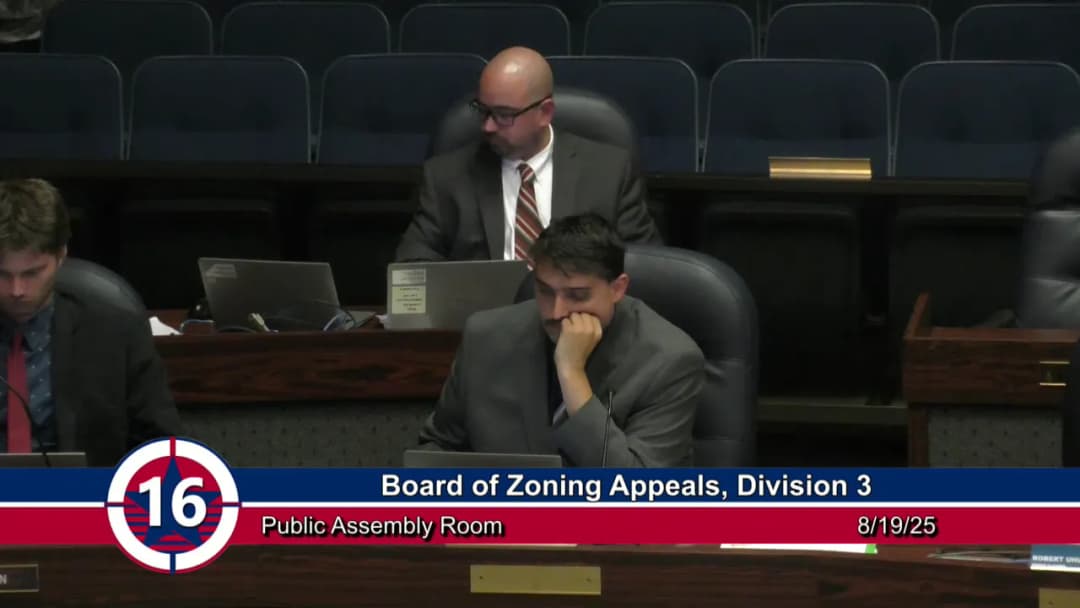
The Metropolitan Board of Zoning Appeals Division 3 met on August 19, 2025, at 6:15 PM ET under Acting Chairperson Brian Hannon. Board members Rihanna Bender, Rod Bohannon, Percy Bland Jr., and David Duncan were present. The hearing considered continuances, expedited petitions, and 10 regular cases involving variance requests across Indianapolis. Key issues included extensions for temporary structures, pedestrian connectivity waivers, setback reductions, use variances for transitional housing, event centers, recreational vehicle parking, signage, and adaptive reuse of a former big-box store. Consent Calendar - Approval of July 15, 2025 minutes – Unanimously approved. - Waiver of rules for expedited petitions – Unanimously approved, allowing votes without additional testimony. Public Comments & Testimony - 2025-UV3-006 (2308 Shelby Street): Neighbor Beth Brandon (Hervey St.) opposed the outdoor recreation/entertainment variance, citing overdevelopment, safety concerns due to the clear sight triangle, and historic district context. Ed Barry (E. Bradbury Ave.) argued the use is out of character with the historic Garfield Park Historic District. Richard Whitney (E. Bradbury Ave., neighborhood association president) stated the board voted 5-2 against the variance due to lack of trust in the property owner. Ed Mahern (Tabor St.) noted nearby infants and asked the board to deny the petition. - 2025-UV3-020 amended (3615 S. Rural Street): Neighbor Timothy Brock (3515 S. Rural) opposed the event center, citing prior dumping, rodent issues, noise, drainage problems, and safety for children and elderly residents on the dead-end street. He expressed concerns about gravel parking, snow removal, and increased traffic. - 2025-UV3-024 (10859 E. Washington Street): The Warren Township Development Association expressed support (letter in packet). The Metropolitan Planning Organization opposed use aspects, but staff disagreed. Councillor Michael Paul Hart also supported the project. Discussion Items - 2025-DV3-001 (5510 Millersville Road): Petitioner Ted Nolteen (Atty.) and Tom Dock (NOAH's Animal Hospital) requested a two-year extension for a temporary modular building. They cited 15,000+ patients in 12 months (70% urgent/emergent), a broken leg injury to Dr. Thomas, and ongoing engineering issues. Staff opposed, noting this would be the third extension (total 6 years) and that the site had other code violations (unenclosed dumpster, illegal signage). After discussion, the board amended the request to a one-year extension with a commitment to file a rezoning petition within six months. Approved 4-1 (Bland dissented). - 2025-DV3-024 (2747 N. Emerson Avenue): Petitioner Joe Calderon (Atty.) requested a waiver of pedestrian connectivity requirements for an industrial site (concrete contractor). He argued there is no existing sidewalk on Emerson Avenue, and requiring a walkway is impractical due to drainage ditches and grade changes. Staff opposed, citing a planned sidewalk project (ST26501) and the ordinance's intent to provide safe pedestrian access. The petitioner noted the building expansion is private and no public incentives are involved. Approved 4-1 (Hannon dissented). - 2025-DV3-026 (95 S. Mitthoeffer Road): Petitioner Misha Rabinowich (Atty.) and architect Drew White (Studio Axis) sought a variance to reduce the south transitional yard setback from 20 feet to 0.5–11 feet for a credit union expansion. The site is near the Pennsy Trail. The petitioner stated 430 transactions daily (up to 730 peak), and the expansion is needed to serve the community. They offered additional landscaping and removed some parking spaces. Staff recommended denial, arguing alternative site plans could avoid the encroachment. Approved 4-1 (Bender dissented). - 2025-UV3-006 (2308 Shelby Street): Petitioner Walter Racinos (owner) requested a use variance for outdoor recreation/entertainment on a deck, plus setback and clear sight triangle variances. He built the deck to support a future restaurant with live music. He expressed frustration with neighbors and the HOA, noting prior issues (prostitution raid at a massage parlor tenant). Staff and neighbors opposed. The board voted unanimously to deny (0-5). - 2025-UV3-012 amended (2319, 2327, 2331 N. Gale Street): Petitioner David Gilman (Atty.) and ICNA Relief USA Programs sought a variance for transitional living quarters for homeless women and children. The site is a duplex split by D5 and C5 zoning. The organization runs 27 such homes nationally; this would be Indiana's first. They have support from the Muslim community, the school, and Councillor Bob Osley. Staff recommended denial, arguing the same services could be provided without the variance. The board approved 5-0 with a commitment to operate per the submitted plan. - 2025-UV3-016 (1659 E. Sumner Avenue): Petitioner Aaron Donovan (owner) requested variances for a second primary building (1,414 sq. ft.) and a reduced east side setback (4 feet vs. 7 feet required). The owner built without permits and has since paid fines. They argued the city's own zoning charts were confusing, and the site has unique hardships (storm sewer bisects the parcel). Staff recommended denial, calling it overdevelopment. Approved 4-1 (Duncan dissented). - 2025-UV3-020 amended (3615 S. Rural Street): Petitioner Maurice Scott (Atty.) and Ricardo Lopez Jr. (owner) sought a use variance for an event center (weddings, corporate events) on a 4.81-acre farm property. They planned to reduce parking to 100 spaces and add landscaping. Staff opposed, citing incompatibility with residential surroundings, drainage, noise, and traffic safety. A neighbor testified against it. Denied 2-3 (Bohannon and Duncan voted yes; Bland, Hannon, Bender voted no). - 2025-DV3-027 (3303 S. State Street): Petitioner David Deering (Atty.) and Melissa Yoberto (GoPro Investments) sought variances for recreational vehicle parking, gravel area width, and fence height. After withdrawing several requests (RV count reduced to 2, parking width reduced to 30 ft.), the remaining variance was for a 6-foot front yard fence (max 3.5 ft. allowed). The owners cited proximity to I-65 and a concrete plant, needing the fence to block noise, dust, and contain a Bernese Mountain Dog. Staff opposed, recommending landscaping instead. Approved 5-0. - 2025-UV3-022 (6520 E. 82nd Street): Petitioner Pat Rooney (Atty.) and Taha (smoke shop owner) sought to add a tenant panel to an existing pole sign (lit, 30 ft. tall) along the congested 82nd Street corridor. The sign would be the seventh freestanding sign within 1,000 feet. Staff cited the Castleton Strategic Revitalization Plan calling for reduced sign clutter. The petitioner argued the business is hidden and losing customers. Approved 3-2 (Bland and Duncan dissented). - 2025-UV3-024 (10859 E. Washington Street): Petitioner Andy Metzel (Atty.) and Jeff Carlson (President, University Loft Company) requested a use variance for furniture warehousing/assembly and a fence variance for a 5-6 ft. metal fence around the front parking lot. The property is a former Sam's Club (135,000 sq. ft.). The use variance had staff support (adaptive reuse, no incentives); the fence variance was contested. The board split the vote: use variance approved 5-0; fence variance approved 4-1 (Bender's vote not explicit in transcript but implied). Commitments included use-specific limitations, landscaping, and removal of spear tops on fencing. Key Outcomes - Approved variances: - 2025-MO2-001 (one-year extension, rezoning commitment) – 4-1 - 2025-DV3-024 (pedestrian connectivity waiver) – 4-1 - 2025-DV3-026 (setback reduction, credit union) – 4-1 - 2025-UV3-012 (transitional living quarters) – 5-0 - 2025-UV3-016 (second primary building) – 4-1 - 2025-DV3-027 (fence height) – 5-0 - 2025-UV3-022 (sign panel) – 3-2 - 2025-UV3-024 part A (use variance) – 5-0 - 2025-UV3-024 part B (fence variance) – 4-1 (exact tally not fully recorded but granted) - Denied variances: - 2025-UV3-006 (outdoor recreation, deck, setbacks) – 0-5 - 2025-UV3-020 amended (event center) – 2-3 - Continued cases (to September 16, 2025): 2025-DV3-025, 2025-DV3-023, 2025-DV3-020, 2025-UV3-023, 2025-UV3-021 (acknowledged). - Expedited case: 2025-SE3-001 (manufactured home) – Unanimously granted. - Resolution: 2025-BZ3-001 – Unanimously adopted, authorizing staff participation in court proceedings.
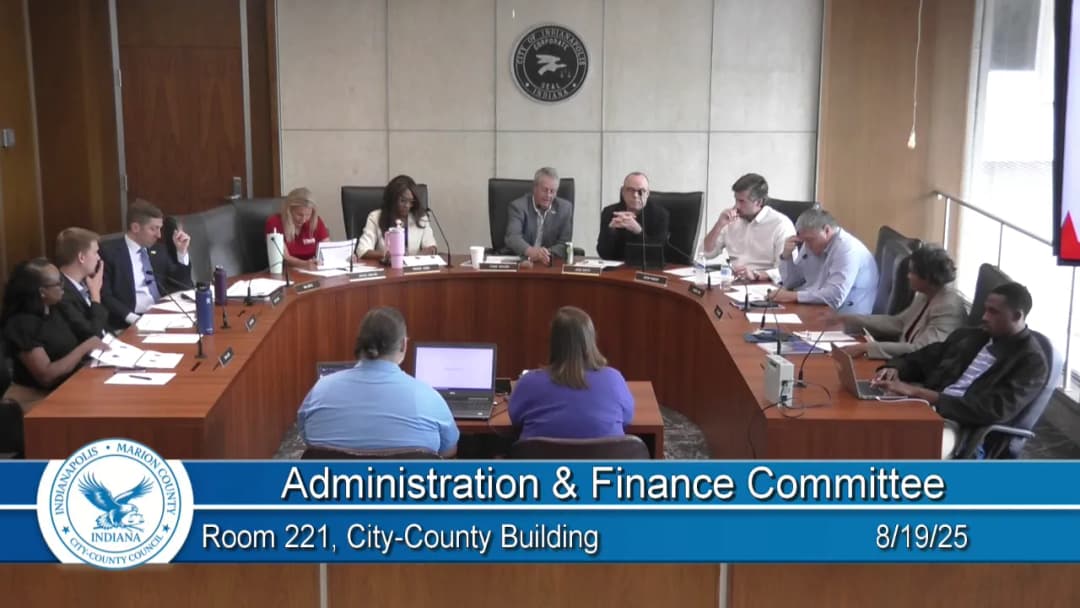
The Administration and Finance Committee of the Indianapolis-Marion County City-County Council met on Tuesday, August 19, 2025, beginning at 5:30 p.m. in Room 221 of the City-County Building to hold budget hearings for four agencies: the Marion County Election Board, Voter Registration, the Marion County Building Authority, and the Marion County Cooperative Extension Service. The committee heard presentations from agency officials and asked questions, but took no formal votes. Marion County Election Board - Presented by Kate Sweeney Bell, Marion County Clerk and Secretary of the Election Board, who described the board's bipartisan oversight of all primary, general, and special elections. - The 2026 budget request is $7,115,806, a $1,651,358 increase from the 2025 adopted budget of $5,464,448. The increase is largely due to election-year costs, including poll worker pay raises (from $11 to $15 per hour for poll workers, $100 to $180 per day for clerks, and $240 per day for inspectors) authorized by Ordinance 16 in 2024. - Character 1 (Personal Services) increased by $1,278,490 to $2,451,147, reflecting higher salaries and seasonal worker needs. Character 2 (Supplies) increased by $11,930 to $42,440. Character 3 (Services) increased by $1,310,938 to $4,233,219, driven by a new election service center, security upgrades, and vendor logistics. Character 4 (Capital) remained at $0 from the general fund, with special funds from the Cumulative Capital Improvement Fund decreasing by $950,000 to $389,000. - Bell noted that the new election service center will replace the current warehouse after 15 years, with enhanced security features including a separate ventilation system for mail handling. - Councilors asked about mail-in voting security, early vote site expansion, poll worker recruitment, and residency requirements. Bell stated that the cost of early voting sites is not the barrier; logistics and bipartisan agreement on the vote center plan are key. The board has one full-time opening and expects another due to a relocation. Residency requirements for poll workers are statutory and cannot be changed locally. Voter Registration - Presented by Alex Nirenda, Democratic Board Member, and Cindy Mowery, Republican Board Member, of the Marion County Board of Registration. The agency manages voter rolls, processes registrations, and certifies petitions. - The 2026 budget request is $1,351,591, a $63,392 increase from the 2025 adopted budget of $1,288,199. The increase is mainly in Character 1 (Personal Services) and Character 3 (Services). Character 2 (Supplies) decreased by $9,500 to $15,500 due to leaner operations. - As of August 13, 2025, there were 625,938 registered voters in Marion County, the largest in the state. In 2024, the agency processed over 137,000 registrations. - The agency is fully staffed with 12 positions, equally divided between Republicans and Democrats per statute. The office provides outreach through voter registration drives, using bipartisan teams, and offers Spanish-language forms. Online registration via IndianaVoters.gov is encouraged to reduce errors. - Councilor Boots asked about affirmative outreach to high schools. Nirenda noted security challenges but said they are developing relationships with teachers and staff. Councilor Allen asked about age data of registered voters; the agency does not have that report readily available. Marion County Building Authority - Presented by Mark Peterson, General Manager, and President Verdix. The authority manages 23 properties with a total proposed budget of $36,172,591 for fiscal year 2026-2027. - Notable changes: The Office of Finance and Management (OFM) has taken back garage/parking lot operations. Three new properties are included: Belmont Solid Waste Garage (opening January 2026), Animal Care Facility (opening Q1 2026), and the Housing Hub. The Family Youth Intervention Center (formerly JJC Annex) is now operating 24/7, increasing its budget. - No major capital repair budget is included; OFM will provide $500,000 for capital projects in 2026. The authority reported spending $5,112,449 with XBE vendors (21.0% MBE, 9.5% WBE, 1.1% VBE), exceeding the city's goals. The voluntary turnover rate is 2.5%, with 7 open positions. Annual turnover decreased to 18.4% from 33.8% in 2023. - Councilor Mowery raised concerns about the temperature in meeting rooms, noting that the air conditioning often shuts down early. Peterson acknowledged the issue may be related to a climate control project and agreed to address it. Marion County Cooperative Extension Service - Presented by Laura Dodds, County Extension Director, and Rita Blythe, Director of Operations. The agency delivers research-based educational programs through Purdue University in four core areas: Agriculture & Natural Resources, Health & Human Sciences, Community Development, and 4-H Youth Development. - The 2026 budget request is $969,694, a $47,527 increase from the 2025 adopted budget of $922,167. Character 1 (Personal Services) decreased by $13,598 due to staff retirement and changes in health insurance elections. Character 2 (Supplies) decreased by $730. Character 3 (Services & Charges) increased by $61,854, primarily due to a $48,313 increase in ISA chargebacks and a 3% increase in the Purdue Extension Educators contract. - The agency serves over 40,000 residents annually, with 78% of programs offered free. Grant revenue of $172,500 is expected for 2026, supporting 4-H, nutrition, mental health, and free tax preparation (VITA program). The VITA program is transitioning from the United Way of Central Indiana to the Extension Service. - Councilor Nelson, a VITA volunteer, praised the program and noted its importance for low-income residents. Key Outcomes - No formal votes or decisions were taken during the hearing. The committee received the presentations and will consider the budgets as part of the overall 2026 budget process. The next steps involve further committee deliberations and potential amendments before full council consideration.
The Board of Directors of the Indianapolis Local Public Improvement Bond Bank (ILPIBB) met on Monday, August 18, 2025, at noon in Room 260 of the City-County Building. The meeting was called to order at 12:00 p.m. with a quorum present. The Board approved the minutes of the June 16, 2025 meeting and two resolutions authorizing refunding bonds totaling up to $495 million. The meeting lasted 12 minutes, adjourning at 12:12 p.m. Consent Calendar - Approval of Minutes (June 16, 2025): A motion was made by Short, seconded by Carter, and unanimously approved by all present. Discussion Items - Resolution 2 – Authorization of 2025C Bonds (Refunding 2010A-2 BABS): The Board approved the issuance of bonds with an original aggregate principal amount not to exceed $150 million and a maximum interest rate of 6.5% to refund the outstanding Series 2010A-2 Build America Bonds (BABS). - Resolution 3 – Authorization of 2025D Bonds (Refunding 2010B-2 BABS): The Board approved the issuance of bonds with an original aggregate principal amount not to exceed $345 million and a maximum interest rate of 6.5% to refund the outstanding Series 2010B-2 Build America Bonds. - Executive Director Joe Glass provided an overview: He explained that both resolutions authorize a tax-exempt refunding of the 2010A-2 and 2010B-2 bonds originally issued for the construction of Eskanazi Hospital. Due to federal budget sequestration, the federal subsidy on these bonds has decreased, costing Health and Hospital Corporation about $500,000 more in annual debt service than originally anticipated. The refunding will provide more certainty for the Corporation and allow for the release of a cash-funded debt service reserve, giving access to over $30 million. - Board discussion: Chairman Gurwitz initially moved to vote on both resolutions together, but upon counsel advised separate votes, each resolution was voted on individually. - Updates on Current Projects: Joe Glass reported that the City-County Council recently approved the issuance of general obligation bonds (up to $21 million) to finance new storm sirens/emergency communication equipment, a new IFD fire station, and new snow plows/line-striping equipment. ILPIBB approval is anticipated in October. Bonds for the reconstruction of Old City Hall (part of the TWG development) are expected to be brought to the Board in September or October. Key Outcomes - Minutes approved: Unanimous. - Resolution 2 approved: Motion by Short, seconded by Carter. All present voted aye. (Members absent: Marlene Dotson) - Resolution 3 approved: Motion by Short, seconded by Park. All present voted aye. - Meeting adjourned at 12:12 p.m. Motion by Carter, seconded by Short; all in favor. - Next meeting: Scheduled for September 15, 2025, pending Board approval (subject to change).
The Marion County Alliance of Neighborhood Associations (McCanna) held its regular monthly meeting on August 18, 2025, from approximately 9:00 to 11:00 AM at North United Methodist Church. President Kathy Burton led a discussion-focused session without a scheduled speaker, covering the value of in-person meetings, strategies to increase engagement and reach younger residents, proposed initiatives to support neighborhood-specific issues, and the city budget from a neighborhood perspective. No formal votes were taken, but several actionable next steps were identified. Discussion Items Value and Future of Monthly In-Person Meetings Kathy Burton opened by asking attendees whether the current monthly meeting format remains valuable, given declining attendance and the rise of digital communication. All members present expressed strong support for continuing the in-person meetings. Jim Spoholski (Near East Side Community Organization) noted that monthly meetings provide a regular touchpoint for sporadic participation. Alma Treywick (Keystone Millsville) emphasized that in-person interaction allows neighbors to learn from each other and network across the city. Pat Andrews (Decatur Township Civic Council) argued that face-to-face meetings cannot be replaced by online or televised formats, and that the meetings serve as a hub for cross-neighborhood communication. The group agreed that the frequency and format should be maintained, while also improving outreach. Outreach and Technology Improvements Several members suggested better communication methods to increase attendance. Adriana Riggs (Crown Hill Neighborhood Association) recommended sending meeting reminders a week in advance, along with an agenda. Chris Williams, a first-time attendee, offered to assist with automation tools for email blasts and social media. The group discussed the limitations of Kathy Burton's current email system (AOL), which splits large lists and may cause messages to be flagged as spam. Chris Williams volunteered to help set up automated reminders using free tools. The idea of recruiting an intern from a local college to handle technology and outreach was raised and welcomed. The group also discussed attending community events (e.g., IMPD Community Days, Feast of Lanterns) with a McCanna banner, though manpower is currently limited. Engaging Younger Residents and Future Leaders President Burton raised the challenge of involving younger generations in neighborhood organizations. Attendees shared ideas: meeting youth where they are (e.g., using digital platforms), providing structured volunteer opportunities, and offering educational components like edutainment (education through entertainment). Chris Williams emphasized that many youth lack awareness of existing resources and that intentional, action-oriented events (not just entertainment) are needed. Adriana Riggs shared data from a Crown Hill neighborhood survey (29 responses) indicating residents' top concerns: vacant housing, safety, street conditions, drug use, and lack of youth activities. She also noted that her younger sister (in her early 20s) expressed interest in serving on a committee and wanted to see more felony-friendly job assistance, addiction resources, and mental health support. The group agreed that direct outreach to neighborhood leaders and personalized invitations are more effective than mass emails. Proposed "Neighborhood Support" Initiative Kathy Burton proposed a new monthly focus: pick one or two days per township to concentrate attention on a specific neighborhood issue. For example, on designated dates, McCanna would coordinate email and social media blasts to city-county councilors and relevant officials about a particular problem (e.g., a dangerous alley, chronic code violations). The goal is to apply pressure and show cross-neighborhood solidarity. Attendees supported the idea, noting that concentrated complaints can sometimes escalate responses. Alma Treywick cautioned that the MAC center may treat multiple complaints as spam, so tactics may need to vary. The initiative would launch in October 2025, with Burton collecting specific issues from neighborhoods via email (CB7801@AOL.com) or Facebook (Marion County Alliance of Neighborhood Associations). Details on the dates and townships will be communicated via email and Facebook. City Budget Priorities The group discussed how the city should prioritize spending in its upcoming budget. Each attendee shared their top concerns: - Road maintenance (multiple speakers): Many said roads are in poor condition, with 38th Street cited as particularly hazardous. - Parks and green spaces: Several members urged greater investment in park maintenance and park rangers, noting that parks are essential for community health and crime reduction. - Code enforcement: Participants criticized slow response times (up to a year), inadequate penalties for chronic violators, and lack of follow-through. Suggestions included daily fines for ongoing violations and more personnel for the Business and Neighborhood Services (BNS) department. - Affordable housing and homelessness: Speakers highlighted the need to help seniors age in place, address gentrification, and provide support for the unhoused population without relying solely on law enforcement. - Mental health and addiction services: Chris Williams and Adriana Riggs stressed the importance of accessible mental health education and trauma-informed resources, especially for youth. - Sidewalks and streetlights: Poor maintenance of sidewalks (including tree root damage) and numerous out streetlights (especially on major corridors like Meridian and 38th Streets) were raised as safety and quality-of-life issues. - Transparency in economic incentives: Several members questioned the city's focus on attracting tourists and large corporations, asking for a clear accounting of the return on investment from tax incentives and whether some of those funds could be redirected to neighborhood needs. Pat Andrews added a note about AES electric rate increases and suggested inviting the Citizens Action Coalition as a speaker to inform neighborhoods how to respond. She also recommended the Indiana Forest Alliance for those concerned about open space preservation. Specific Neighborhood Issues Attendees shared immediate problems needing support: - Stop sign at 39th and Tacoma: Overgrown bushes block sight lines, leading to frequent crashes into a neighbor's yard. Previous trimming by the health department grew back. This is a code enforcement site distance issue. - Narrow roads with overgrown vegetation: On the near east side, vegetation narrows roads until they become single-lane, forcing cars to scrape against bushes. - Illegal dumping: Jim Spoholski identified this as a widespread problem throughout the near east side. - Homeless encampments in vacant buildings: In Crown Hill, unhoused individuals use abandoned homes, and there are challenges with trespass enforcement and health concerns. Key Outcomes - Continue monthly meetings: The group affirmed that Saturday morning meetings at North United Methodist Church (9–11 a.m., third Saturday) should continue, with enhanced outreach. - Improve communication: Chris Williams volunteered to help set up automated email reminders using free tools. Attendees were encouraged to send their contact lists to Burton for more effective distribution. - Launch "Neighborhood Support" initiative in October 2025: McCanna will coordinate monthly concentrated advocacy for specific neighborhood issues. Neighborhoods should submit their problem details (location, duration, contact person) to Burton. - Draft a priority letter on the city budget: Burton will compile the discussed priorities (roads, parks, code enforcement, affordable housing, mental health) and send a letter to the City-County Council and the Mayor's office. - Recruit interns and volunteers: The group will explore partnerships with local colleges for unpaid interns to assist with technology and outreach, and seek grants through the Indianapolis Neighborhood Resource Center (INRC) to cover small technology costs. - Next meeting: Scheduled for September 20, 2025; speaker to be announced. Suggestions for speakers are welcome, especially those who can help make personal connections.
The Metropolitan and Economic Development Committee of the Indianapolis City-County Council met on August 18, 2025, at 5:30 p.m. in the Public Assembly Room. The committee considered two appointments, tabled a code amendment proposal, approved a Payment in Lieu of Taxes (PILOT) for an affordable housing project, and conducted budget hearings for the Department of Metropolitan Development (DMD), the Department of Business and Neighborhood Services (BNS), and the Marion County Surveyor’s Office. Consent Calendar - Proposal No. 237, 2025 – Appointed Brad Klopfenstein to the Citizens Advisory Committee for the Lawrence Township Comprehensive Plan. Approved unanimously. - Proposal No. 238, 2025 – Appointed Lori Miser to the City Market Corporation Board of Directors. Approved unanimously. Public Comments & Testimony - Carolyn Watts (resident, co-chair of near Northwest communities) expressed full support for Proposal 184 (Canal Village III PILOT), stating that the developer, BWI, has made efforts to upgrade Canal Village I homes and that affordable housing is critical for the community. - Candia Scott Moore (co-chair of AMWA TIF for 15 years) supported the project, noting that the remonstrators were not involved in earlier community efforts and that BWI’s only fault was lack of communication during COVID. - Lori Perdue (stakeholder in Northwest Landing, co-director of Community Canopy Alliance) opposed the project, presenting documents showing tree canopy loss from Canal Village I and arguing that the committee must secure neighborhood character. - Ray Schnapp (co-director of Community Canopy Alliance) presented data identifying 13 heritage trees on the proposed parcels, calculating annual benefits of $120 per tree in stormwater, CO2 capture, and particulate reduction, totaling up to $33,000 over each tree’s lifetime. - Hadia Emitting Latroy Carter (representing Northwest Landing neighborhood) voiced concerns from Canal Village I residents about delayed repairs (e.g., roof leaks, landscaping), and asked that repairs continue before approving Canal Village III. - Alita Kemp (Northwest Landing resident) questioned why the project was being reconsidered, stating that repairs only occur when BWI is under scrutiny and that residents do not trust the developer to maintain quality. - A speaker (unidentified) emphasized the need for affordable housing, noting the presence of 40–50 homeless individuals around the building. Discussion Items - Proposal No. 239, 2025 – Amends various code sections for fee, penalty, and policy changes in the Department of Business and Neighborhood Services. The committee tabled this item; it will be discussed at a later date. - Proposal No. 184, 2025 – Approves a PILOT for Canal Village III, LP, a 33-unit affordable housing project (all units for residents at or below 60% Area Median Income) financed with low-income housing tax credits. The developer, BWI, provided updates on Canal Village I repairs: all repairs completed last summer, tree preservation commitment, and MOU upgrades (fences, sponsorships) ahead of schedule. Council President Vop Osili (District 12) voiced support for the project, citing commitments and need for affordable housing. DMD clarified enforcement mechanisms: city can inspect during construction and 15-year affordability period, can take back city-owned lots if developer fails, and can revoke the PILOT or assess penalties for non-compliance. - Budget Hearing – Marion County Surveyor’s Office – Deborah Jenkins presented a $1,164,611 budget (increase of $65,508 from 2025, absorbed by the Perpetuation Fund). Key points: 10 full-time employees (1 vacancy), 15th consecutive year exceeding state mandated 5% corner perpetuation (goal 9% in 2025), H.E.L.P program for staff education, community outreach efforts, and need for a $80,000 GPS station. Obstacles include a vehicle fire and safety incidents. - Budget Hearing – Department of Metropolitan Development (DMD) and City Market – Director Megan Vukusich and CFO Lucas Anderson presented a $90,310,240 budget (6.3% decrease from 2025, driven by phase-out of one-time ARPA funds). Highlights: 92 FTE (21 vacancies), 683 affordable rental units and 186 homeownership units in pipeline, 97% of permanent housing program participants stay housed long-term, 1,900 new jobs and 4,200 retained jobs incentivized, new Engagement Division and Economic Incentives Compliance team. DMD is requesting $325,000 in opioid funds to expand master leasing from 30 to 50 units. City Market: RFQ issued for Whistler Plaza improvements; former operating subsidy of $507,000 removed. - Budget Hearing – Department of Business and Neighborhood Services (BNS) – Director Abby Brands and CFO Jacob Miller presented a $21,919,629 budget (2.5% decrease). Key points: 210 staff (18 vacancies), average 13-day turnaround for development permits, 24 tons of litter collected in neighborhood cleanups, 79 demolitions completed in 2024 (38 year-to-date), new continuous vacancy program targeting 150–200 structures vacant for 6+ years with three consecutive repair orders. A proposed fee/penalty update (first major change since 1988/2010) includes raising zoning violations from $50 to $325 (e.g., petition violation), creating accelerated inspection fees for commercial properties, and instituting a reinspection fee. Public comment noted limited docket space for violations in court. Key Outcomes - Proposal No. 237 – Approved unanimously. - Proposal No. 238 – Approved unanimously. - Proposal No. 239 – Tabled (moved and seconded). - Proposal No. 184 – Approved unanimously. The PILOT agreement authorizes annual payments equal to 20% of property taxes that would otherwise be due, deposited into the Housing Trust Fund. BWI must complete CV1 MOU upgrades (fences, repairs) before property transfer. - Budget Hearings – Heard and taken under advisement; no votes were taken. - Next Steps – Proposal No. 239 will be revisited at a future committee meeting. The BNS board will vote on fees under its jurisdiction on August 26, 2025, with council codification to follow.
2025年8月15日下午1:00,印第安纳波利斯机场管理局(IAA)董事会召开会议,处理例行事务和多项资本项目。会议批准了7月18日的会议记录和2026年预算条例(一般条例2-2025),并一致通过了11项官方行动,涉及土地购买、租约修订、合同续签、设备采购、基础设施建设和专业服务等,总价值超过2400万美元。 Consent Calendar - 批准2025年7月18日会议记录:动议通过,投票一致。 - 批准2026年预算条例(一般条例2-2025):涉及机场管理局预算和拨款金额,动议通过,投票一致。 Discussion Items - BP 2025-8-2:土地购买协议:批准以762,500美元(每英亩42,361.11美元)从Jacob和Jody Berna处购买约18英亩土地(位于Hancock县4712 West 300 North),用于未来跑道保护区和交叉风跑道重新对齐。资金来自土地项目,未来可申请FAA补偿。动议一致通过。 - BP 2025-8-3:Bentley Capital Partners租约修正:延长企业机库租约5年,至2030年,含两个5年续租选项。年租金从135,912美元增至268,000美元(净额256,693.80美元),因租户改良提供信用。动议一致通过。 - BP 2025-8-4:Siemens行李处理系统合同续期:批准第二次一年期续约(从2025年9月30日起),金额2,049,309美元,较首次续约增长4%。动议一致通过。 - BP 2025-8-5:购买农用拖拉机及机场附件:从Bain Welker Equipment购买,金额343,560.78美元,通过SourceWell合作采购,用于替换22年旧设备,符合野生动物危害管理计划。动议一致通过。 - BP 2025-8-6:Taxiway Papa重建合同授予:授予Milestone Contractors,金额不超过13,692,240美元(含8%储备),用于重建30年旧的滑行道,为FAA资助项目第一阶段。动议通过(投票后提到一票弃权,但记录显示全票赞成)。 - BP 2025-8-7:Kreider and Crater变更单(雨水管理设施):金额705,480美元,用于移动约6,000车土壤以支持Indy Regional机场跑道重新对齐。动议一致通过。 - BP 2025-8-8:Wreath Riley Construction变更单(经济停车场路面):金额210,469.19美元,为最终平衡变更单,用于经济停车场第二包修复。动议一致通过。 - BP 2025-8-9:Butler Fairman and C专业服务合同(Taxiway Romeo重新对齐):金额4,260,376.33美元,FAA资助,重新对齐滑行道以提供更多过夜停机位和未来航站楼扩建空间。动议一致通过。 - BP 2025-8-10:授权执行董事批准道路和停车场施工合同:授权提前实施2025年道路修复项目(北服务路),避让酒店施工交通,预计金额50-100万美元。动议一致通过。 - BP 2025-8-11:CSO Inc.合同修正(酒店项目):金额1,990,000美元,用于Weston Indianapolis Airport Hotel项目的继续设计、施工管理服务。比2月预算增加约590,000美元,但整体项目预算未增,通过其他节省抵消。设计服务费占施工费的5.65%,属行业标准。动议一致通过。 - BP 2025-8-12:Reliance Engineering专业服务合同(委托服务):金额不超过180,000美元(或180,160美元),用于酒店项目的测试、调试和符合LEED认证。动议一致通过。(注:转录结尾不完整,但根据内容记录。) Key Outcomes - 批准2025年7月18日会议记录和2026年预算。 - 批准11项官方行动(BP 2025-8-2至8-12),所有项目均获通过,投票结果均为一致赞成(BP 2025-8-6可能有一票弃权,但记录不清)。 - 所有行动均符合预算,部分项目利用FAA资助或合作采购节省资金。 - 项目涵盖机场扩建、基础设施升级和酒店开发,旨在支持长期运营和经济影响。