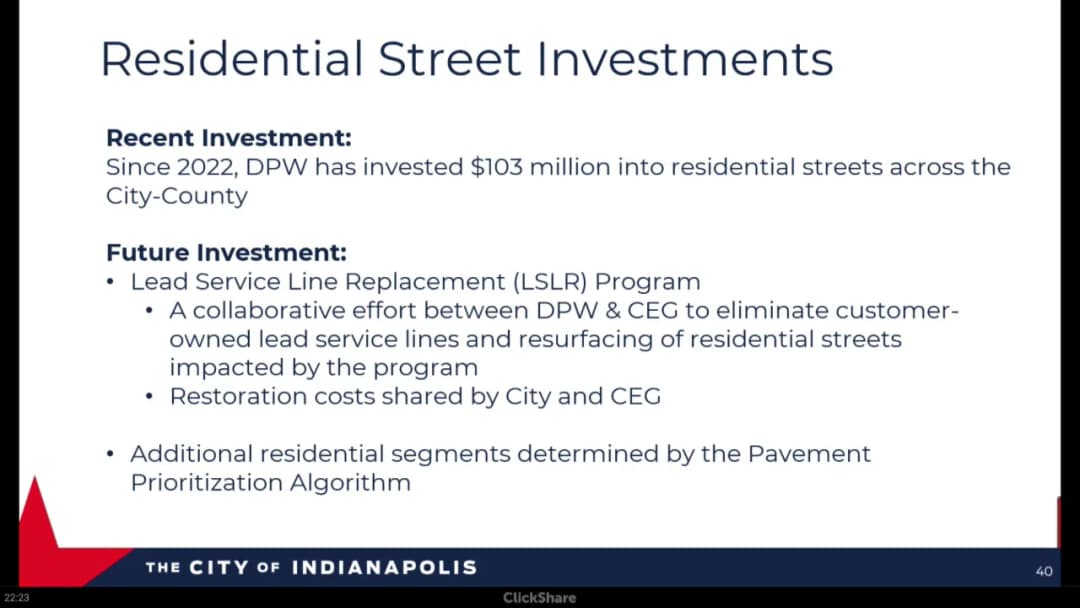
The Public Works Committee of the Indianapolis-Marion County City-County Council met on August 14, 2025, at 5:30 p.m. in the Public Assembly Room. The meeting covered ten traffic-related proposals (246–255) and the 2026 budget presentation for the Department of Public Works (DPW). All proposals were advanced to the full council with unanimous do-pass recommendations. The budget hearing featured detailed presentations from DPW Director Todd Wilson and CFO Sam Barris, followed by extensive council discussion on road funding, staffing, and future capital plans. Consent Calendar - Proposals 246, 247, 248 (Intersection Controls): Authorized intersection controls at 56th Street and Haverford Avenue (District 7), Lynhurst Drive and Mooresville Road (District 21), and Acton Road and Southeastern Avenue (District 25). Moved by Councilor Bain, seconded, and passed unanimously (all ayes). - Proposals 249–255 (Speed Limit Reductions): Authorized 25 mph speed limits in Canterbury Neighborhood, Forest Hills Neighborhood, Buck Creek Village and Cedar Park subdivisions, Diamond Place subdivision, Boulevard Manor subdivision, and Kessler Park Neighborhood; also a 30 mph reduction on Michigan and New York Streets from State Street to Emerson Avenue (District 13). Moved by Councilor Roberts, seconded, and passed unanimously. Public Comments & Testimony - No members of the public spoke during the meeting. Discussion Items - 2026 DPW Budget Overview: Director Wilson and CFO Barris presented a comprehensive budget, highlighting a $257.4 million total operating budget (a $10.8 million increase from 2025). Key revenue sources include gas tax (forecast $86.4 million in 2026), solid waste user fee ($32/unit), and stormwater user fee. The budget includes a 2.6% COLA for bi-weekly employees and a 3% increase for union employees per the CBA. Staffing has improved to 88% filled (out of 810 budgeted positions), up from 84% in 2025, with no new FTEs but reallocations to trails maintenance (14 FTEs) and pavement markings teams. - Capital Plan: The transportation capital plan totals $1.087 billion over five years, including $279 million in 2026. New state legislation (HB 1461) provides $50 million annually in state matching funds, requiring $50 million in new city revenue starting in 2027. The plan also includes a $10 million supplemental appropriation for emergency strip patching in 2026. DPW is adopting data-driven project selection using a pavement prioritization algorithm (PCI, traffic volumes, MAC complaints, crash data). - Residential Streets and Road Funding: Councilors Bain, Evans, and others raised concerns about the adequacy of residential street funding. The current annual investment in residential streets is approximately $16 million (including $8 million from the state and $8 million city match). Councilor Evans noted that the 2020 asset management study estimated annual needs of $752 million for all streets (pre-COVID/inflation). Councilor Boots asked about sidewalk funding, and Director Wilson confirmed no dedicated sidewalk budget exists beyond projects attached to road reconstruction. Councilor Evans urged that a portion of the $50 million city match be directed to residential streets. - Tox Drop Program: An additional $300,000 in ongoing funding was included for 12 extra Tox Drop events per year, plus $100,000–$200,000 one-time costs for a new east-side drop-off site. - Fleet and Equipment: A $1.2 million increase in operations equipment budget for snow trucks, pavement marking trucks, and street maintenance equipment. Additionally, $2 million from spring fiscal was used to order 14 one-ton snow trucks, doubling the fleet of such vehicles. - Vision Zero: The Vision Zero Action Plan is under development, with public comment period closed July 31. DPW is focusing on policy changes and pavement marking improvements. Councilor Nielsen requested updates on implementation. - Staffing Challenges: Councilor Bain asked about the impact of the residency requirement. Director Wilson stated that eliminating residency restrictions would be beneficial for hiring, especially for highly specialized engineering positions. Councilor Gibson noted over 1 million residents in Marion County and suggested qualified employees exist locally. - Community Powered Infrastructure: The program (50-50 cost-share) has 11 projects installed in 2025, with applications closing August 31. Councilor Lee expressed frustration with delays in projects from 2022-2023 appropriations, citing a sidewalk project in the Town of Clermont that has not yet begun construction. Key Outcomes - Proposals 246–255 were all advanced to the full council with do-pass recommendations (unanimous votes). - Budget Hearing: No vote was taken. The committee received the 2026 DPW budget presentation and will continue review. Councilors requested additional analysis on projected lane miles for strip patching and resurfacing, to be provided as part of the review and analysis process. - Next Steps: The full council will consider the traffic proposals. The budget will proceed through the council budget process, with further committee discussions expected. DPW will bring its snow response plan to the Board of Public Works in the fall and to this committee later in the year.
Public Meetings - Indianapolis, Indiana
Public Meetings - Indianapolis, IndianaThe Board of Public Works met on August 13, 2025, at 1:00 PM in the Public Assembly Room, City-County Building, Indianapolis. The board adopted a revised agenda (removing Resolution No. 10 and adding a walk-on item), approved the July 23, 2025 meeting minutes, and unanimously approved all resolutions, change orders, professional services agreements, amendments, and final acceptances. Key discussion centered on a $3.07 million change order for the Washington Street bridge replacement and a walk-on amendment for inspection services. Consent Calendar - Adoption of the August 13, 2025 revised agenda (motion by Bob Perrin, second by Leslie Schulte). - Approval of the July 23, 2025 meeting minutes (motion by Idris Redman, second by Susie Corti). Discussion Items - Change Order No. 2 (BM-24-113): Washington St. over Little Eagle Creek – $3,066,142.76 increase to Pontem Contractors, Inc., adding 157 days. The project originally budgeted at $2 million now totals $6.18 million. Board member Bob Perrin questioned the competitiveness of the additional work. Jason Watt (Administrator of Construction) explained that staff reviewed unit prices against historical bid data and negotiated with the contractor, noting Pontem has been transparent and cooperative. The bridge replacement is using an off-site assembled arch structure, with traffic expected to open in October 2025. - Walk-on Amendment No. 1 (ENG-23-017): On-Call Transportation Inspection Services with VS Engineering, Inc. – $2,000 increase for a new total of $700,000, to fund additional inspection work through the JOC program. Approved unanimously. Key Outcomes All actions were approved unanimously by the board (Chair Todd Wilson, Robert Perrin, Susie Corti, Idris Redman, Leslie Schulte). Resolutions (encroachments/modifications into regulated drain right-of-way): - No. 9: Schilling Regulated Drain – Lenar Homes of Indiana LLC (Crescent Ridge subdivision). - No. 11: Fowler-Haueisen Regulated Drain – AeroGas, Inc. (detention basin expansion). - No. 12: Miller Ditch Regulated Drain – Steve Jones (tractor sales facility). - No. 13: Smith-Young Regulated Drain – Indianapolis Public Transportation Corporation (IndyGo Blue Line terminus). - No. 14: Rabourn Regulated Drain – Lenar Homes of Indiana LLC (Crescent Ridge subdivision). Change Orders (approvals): - C/O No. 1 (ST-22-092): Thoroughfare Structural Rehabilitation – Area 1 – $0.00, 200 days added (Milestone Contractors, L.P.). - C/O No. 1 (ST-24-114): Concrete Rehabilitation 2024 CCMG – $19,746.36 increase (Rieth-Riley Construction Co., Inc.). - C/O No. 2 (SD-19-073): Dr. AJ Brown/30th/Keystone Drainage Improvements – $467,899.65 increase, 55 days added (Eagle Valley, Inc.). - C/O No. 2 (BM-24-113): Washington St. over Little Eagle Creek – $3,066,142.76 increase, 157 days added (Pontem Contractors, Inc.). Final Change Orders (final acceptance/credit): - C/O No. 3 (Final) (PA-25-003): Pogues Run Trail Phases 2 and 3 (C) – credit of $49,264.01, 303 days added (Morphey Construction, Inc.). - C/O No. 1 (Final) (CL-16-069): Small Structure Replacement at 5030 N Moller Road – credit of $50,851.87 (Edge Construction, LLC). - C/O No. 3 (Final) (ED-25-213(B)): 16th & Monon Development Phase II – credit of $158,187.10 (Rieth-Riley Construction Co., Inc.). Professional Services Agreements: - ENG-25-004: On-Call Residential Reconstruction Sectors 1-4 – $2,500,000 (Crossroad Engineers, PC) – includes 40% DBE participation. - BM-25-179A: Pedestrian Bridge Inventory FY2025-2028 – $288,200 (EGIS BLN USA, Inc.). - BR-25-178H: Marion County Bridge Inspections FY2026-2029 – $2,452,244.15 (USI Consultants, Inc.) – 7.15% DBE participation. Professional Services Amendments: - Amendment No. 2 (BM-24-113): West Washington St. over Little Eagle Creek – $236,236.05 increase (Woolpert, Inc.). - Amendment No. 2 (ST-31-059): White River Innovation District Infrastructure Project – $909,851.74 increase (Butler, Fairman & Seufert, Inc.) – total agreement $3,328,106.51. Final Acceptance: - WQ-22-010: Broad Ripple Outfall Rehabilitation – $92,989.00 (Scenic Construction Services, Inc.). No other business was discussed. The meeting adjourned.
On August 13, 2025, the Indianapolis Public Library Board convened a public hearing to discuss the proposed 2026 budget. Presentations focused on the impact of recent state legislation (Senate Bill 1) on property tax revenue, assessed valuation, local option income tax, and the library's long-term financial outlook. The library is in a strong cash position but faces future structural deficits due to legislative changes. Public Comments & Testimony - No members of the public offered comments or testimony. The public hearing was opened and closed with no public participation. Discussion Items - Legislative Overview and Financial Modeling (Mike Water, Advisor): - Summarized the most active legislative session in years, detailing Senate Bill 1 provisions including a new homestead credit (up to 10% or $300), a deduction for rental properties (starting at 6% in 2026, growing to 33% by 2031), and a business personal property exemption threshold increase to $2 million in 2027. These changes will reduce assessed valuation and shift tax burden. - The local option income tax (LOIT) structure will change significantly in 2028, eliminating the current levy freeze ($3.8 million) that reduces property tax liability. However, counties can adopt up to 0.05% LOIT for libraries, potentially generating $18.7 million annually for the library (though adoption is uncertain). - The assessed valuation for 2026 has not yet been certified (delayed beyond the August 1 deadline), so projections assume a 1% decline. Tax rates are expected to increase even if levy amounts remain flat, due to shrinking assessed valuation. - The library's general fund levy is capped at 4% growth for 2026, consistent with recent years. The debt fund rate will remain at 0.0318% for 2026, but the board may need to shift to a levy-based conversation in future years. - The library’s cash balance is strong: $45 million at end of 2024, projected to drop to $34 million by end of 2026 due to the new property tax credit loss (estimated $1.5 million in 2026) and a 27-payroll year. This cash cushion provides time to react without immediate cuts. - A structural deficit is projected in later years, but the potential $18.7 million from a 0.05% LOIT could offset losses, though political hurdles remain. - 2026 Budget Presentation (Lilita): - Proposed 2026 operating budget: $67.2 million (8.25% increase over 2025). Total 2026 budget (all funds): $89,394,474 (4.64% increase). Debt service fund decreases 7.22% due to payoff of 2017 bond. - Revenue challenges include Senate Bill 1 impacts: projected loss of $2.035 million in 2026, $1.1 million in 2027, and an uncertain gain of $2.2 million in 2028 (subject to reassessment). Circuit breaker credit estimated at 20% of levy. - Expenditure drivers: pay raises, Sunday premium hours for possible expanded Sunday service, 27 payroll dates in 2026, increased workers' compensation (14% rise), security and housekeeping cost increases, and new liability under Senate Enrolled Act 409 for employee absence to attend children’s meetings. - Revenue from fees and services (including room rentals) is 4% of total revenue. Interest income expected to decline by 0.5-0.75% in 2026. - The library's strong cash position allows for $12 million in deficit coverage without immediate cuts, and the ability to transfer some capital expenses to bonds provides operational flexibility. The board emphasized no plans for layoffs. Key Outcomes - The public hearing was closed by unanimous roll call vote (Eugene White, Kyle Martada, Louis Palacio – all present; board members Angie Gilbert absent, new member Matissa Woodard joined but did not vote). - No formal action on the budget was taken, as the hearing was informational only. The budget adoption is scheduled for a later meeting, pending receipt of the certified assessed valuation. - The board acknowledged the need to monitor 2028 LOIT changes and to advocate for levy replacement rather than rate increases.
The Public Safety and Criminal Justice Committee of the City-County Council met on August 13, 2025, at 5:30 p.m. in the Public Assembly Room of the City-County Building. Chair Leroy Robinson presided. The committee considered Proposal No. 243 (Commissary Fund Report) and held budget hearings for the Marion Superior Court, Marion Circuit Court, Marion County Coroner’s Office, and Indianapolis-Marion County Forensic Services Agency. No public testimony was offered from the audience. Proposal No. 243 – Commissary Fund Report - Deputy Chief Kelvis Williams (Marion County Sheriff’s Office) presented the quarterly commissary fund report as required by HEA 1208 (effective July 1, 2025) and Indiana Code 36-8-10-21, covering January 1, 2025 to July 1, 2025. Councilor Hart asked about a recurring $1,500 monthly charge to "Gasoline Alley Rental LLC" – Williams explained this is for garage space used to store ATVs, bicycles, and motorcycles owned by the Sheriff’s Office. Councilor Hart also inquired about the timing of report delivery; staff noted it was submitted in July after the previous committee meeting. The committee accepted the report without a vote. Marion Superior Court Budget Hearing - Presentation: Judge Marc Rothenberg and Finance Director Holly Fellows presented the 2026 budget. Total proposed budget: $74,499,520 (increase of $698,051 from 2025 adopted, primarily due to grant fund increases; county general fund request flat). Highlights: the Legal Resource Center since June 2022 has logged over 34,000 visits, averaging 1,500 per month in 2025 (up from 900 in 2024). Community service work program provided 32,994 hours in 2024 (cost benefit $239,208); 2025 six-month total was 11,041 hours ($80,047 benefit). Kiosk probation check-in program handled 9,551 check-ins in 2024; over 1,600 clients per month use kiosks, equating to 12 probation officer positions not needed. The Family and Youth Intervention Center (FYI) at 2401 E. 25th Street (funded via opioid settlement and grants) began renovations and licensing. - Discussion: Councilor Mascary asked about grant cuts – Judge Rothenberg confirmed a 13% cut to state grants for problem-solving courts. Councilor Boots inquired about eviction cases; Judge Rothenberg explained they are centralized in Court 33 (Judge McMath) for consistency. Kiosk locations: Chief Curl noted $14,000 per kiosk per year needed to expand to all townships; currently funded by Superior Court, townships provide electricity/internet. Councilor Bain asked about the "revolving door" of criminal justice – Judge Rothenberg defended judicial discretion and the constitutional presumption of innocence. Councilor Bain also raised juvenile records access; Judge Rothenberg confirmed ongoing meetings with IMPD Chief Bailey and stated the legislature has created a state repository. Councilor Mascary questioned due process for Hispanic individuals being arrested without hearings; Judge Rothenberg affirmed the rule of law requires due process. Councilor Hart noted limited court time for city prosecutor civil violation cases (currently 4 hours on Wednesday mornings) and suggested more resources may be needed. Judge Rothenberg said any increase in judicial officers must be based on the weighted caseload system. - Outcome: No vote on budget; hearing only. Committee requested a detailed breakdown of grant-funded programs. Marion Circuit Court Budget Hearing - Presentation: Judge Amber Collins-Gebrehiwet presented. Total proposed budget: $1,307,135 (decrease of $20,135). The court handles Title IV-D (child support) and civil divisions (8.5% of county civil cases), including all name/gender change cases (projected over 1,000 in 2025, up from 483 in 2023). Title IV-D reimbursements returned $108,815 to the county general fund in 2024. Community outreach: youth mock trial program with local schools and IFD summer camp. - Discussion: Councilor Bain asked about fees/fines – Judge Collins-Gebrehiwet stated the court does not impose fines (civil only, filing fees may be waived for indigent litigants on a case-by-case basis). On a high-profile child welfare case, she declined comment due to ethical rules. Councilor Mascary asked about due process for Hispanics – the judge affirmed everyone is entitled to a hearing. Councilor Boots asked about case allocation between circuit and superior courts; judge explained the weighted caseload system and biennial division plans. Councilor McCormick suggested partnering with local universities for internships to help with navigator workload. Councilor Graves commended the youth program for improving community perception. Councilor Hart noted the employee benefits line jumped 75% from 2024 to 2025 (from $164k to $289k) and another 40% in 2026; the judge explained this reflects standard county benefit cost increases. - Outcome: Budget hearing only; no vote. Marion County Coroner's Office Budget Hearing - Presentation: Coroner Alfie McGinty and Mallory Malczewski presented. Total proposed budget: $7,595,316 (reduction of $228,401 or 3%). County general fund decrease of $428,239 (15%) in uncontrolled operational budget. Character 1 increased 5% for COLA/health insurance. Character 2 cut $75,738 (35%) – reduced funding for small office equipment, photography supplies, uniforms, safety supplies. Character 3 cut $294,638 (9%) – funding for forensic pathologists and lab/equipment repairs reduced. Character 4 cut $17,889 (57%) – autopsy equipment and fleet replacement. Revenue initiatives: charging outside counties for autopsies and diligent fee collection for records requests. Grants: Overdose 2 Action federally funded at 60% for 2026 (unknown amount); COSSUP unknown; Health First Indiana partnership with MCPHD; Opioid Settlement funding deputy coroners, social workers (TBD), family advocate, and mental health vendors. Agency successes: data modernization, reduction in overdose deaths for two consecutive years, social workers/family advocate program. Community outreach: gun lock distribution to prevent child accidental shootings (3 in 2023, 4 in 2024, 3 YTD 2025 under age 5). - Discussion: Councilor Mascary commended the annual report and new facility. Councilor Boots praised the unclaimed decedent ceremony; coroner noted she has been invited to other states to share the program. On budget impact of reduced homicides: McGinty said fewer homicides reduce need for pathologist autopsies and court testimony. On duplication of opioid settlement services: McGinty stated the coroner's cases are unique and they follow up with referrals. Councilor Perkins thanked staff for professionalism at death scenes and asked about pathologist staffing – McGinty reported 5 regular contracted pathologists plus locums (costing about $600,000 annually) due to national pathologist shortage. Turnaround time: autopsy within 48 hours; complex cases up to 8-12 weeks. Councilor Graves noted a 35% increase in suicides in 2024 – McGinty attributed it to untreated mental health issues and lack of resources. Councilor Hart asked about residency requirements: McGinty supported removal to widen applicant pool (currently must submit letter for case-by-case exemption). Councilor McCormick asked about virtual testimony for out-of-state pathologists; McGinty said parties must agree and she coordinates schedules with prosecutor's office to have locums testify during their on-site weeks. - Outcome: Budget hearing only; no vote. Committee acknowledged operational challenges and potential need for additional funding in 2026 if case volume spikes. Indianapolis-Marion County Forensic Services Agency Budget Hearing - Presentation: Director Richard Amberger and COO Kyle Swalls presented. Total proposed budget: $12,768,769 (decrease of $12,519 from 2025 adopted). 20% ($2.58M) from federal grants. County general fund: $9,930,907 (slight decrease due to lower-tier health insurance selections). Agency is allocated 75 FTEs (71 filled; 4 vacancies). Demographics: 72% female, 80% White, 20% BIPOC. Successes: completed 11,989 analysis requests and analyzed 62,289 evidence items in 2024; full reaccreditation with zero findings; received Project Foresight Maximus Award (top 14 of 220 labs). Grants: the agency is awaiting decisions on multiple federal grants applications pending for months; if funding is reduced, may eliminate grant-funded staff positions (sexual assault and firearms cases) and have insufficient supplies. Goals: reduce backlogs by 20% by year-end, continue DNA outsourcing, complete firearms section training (with IMPD assistance). - Discussion: Councilor Mascary noted a multi-layer communication gap between law enforcement/prosecutors and the lab regarding adjudicated cases – Amberger agreed and said there is no systematic alert. Councilor Boots asked about rape kit backlog – Amberger said each law enforcement agency manages its own kit inventory; the lab tests what is submitted; IMPD sends some kits to a private lab (Bodie); others may remain stored. Time does not invalidate kits. Councilor Hart asked about residency requirements – Amberger supported removal; he has successfully used the new process for firearms examiners but had difficulty for a DNA technical leader. Councilor Perkins asked about firearm technology advances – Amberger said novel approaches (serial number on firing pin, electronic locks) are not yet reliable; firearms are simple tools. Councilor Boots commented on the residency exemption process: Amberger noted the budget book includes a specialized skill set provision, but he has only gotten exceptions for a few firearms examiners. - Outcome: Budget hearing only; no vote. Key Outcomes - Proposal No. 243 (Commissary Fund Report) was accepted by the committee. - All four budget hearings were informational; no votes were taken. The committee will consider the proposed budgets in future meetings. - Several council members expressed support for removing residency requirements for specialized positions (forensic scientists, deputy coroners) to improve recruitment. - The Coroner's Office and Forensic Services Agency flagged potential operational disruptions if federal grant funding is delayed or reduced. The Superior Court noted a 13% cut to state grants for problem-solving courts. - The committee requested the Superior Court provide a detailed breakdown of grant-funded programs and the Coroner's Office to continue coordinating with the prosecutor's office to minimize travel costs for out-of-state pathologists. - Councilor Hart indicated he will introduce a proposal to address residency requirements legislatively.
The Metropolitan Board of Zoning Appeals Division II met on August 12, 2025, at 1:00 PM in the Public Assembly Room, City-County Building, Indianapolis. Chair Craig Von Deylen presided, with members Beth Brandon and Tom Barnes present. Legal counsel Chris Steinmetz and planning staff assisted. The board handled special requests for continuances and notice waivers, approved three expedited petitions, and ruled on four contested variance petitions. The meeting adjourned after adopting findings of fact. Public Comments & Testimony - Rebecca Garcia (daughter of petitioners, address 6511 W 15th St, Indianapolis) spoke in support of a fence variance at 3870 Broadway Street, citing safety for children after a nearby shooting and presenting letters of support from neighbors. - Harriet Greenland (petitioner, 1144 Navajo Trail South Drive) testified in support of an 8-foot rear fence, arguing it provided privacy and security after a neighbor cut down her previous fence. - Robert Rice (neighbor, 1145 Timberlane Street) remonstrated against the Navajo Trail fence, stating he had fixed the fence previously and that the new lattice element was unattractive and violated the ordinance. - Sharmin Frye and Brandon Spitz (petitioners, 1337 Olive Street) spoke in support of a taller carriage house, noting similar structures in the neighborhood and arguing the height variance was needed for a family dwelling. - David Deering and John Puffer (petitioners, 5227 Knollton Road) testified in support of a front-yard pole barn, emphasizing that placement in the rear would require clearing forested land and harm heritage trees. - Dorothy Feibelman (neighbor, 5117 Knollton Road) remonstrated against the pole barn, raising concerns about flooding, environmental impact, lack of an environmental impact statement, and potential harm to wildlife. Discussion Items - Special Requests & Continuances: The board handled multiple procedural requests: - 2025-DV2-028 (415 South Oxford St): Continued to October 14, 2025 without notice at petitioner's request. - 2025-DV2-016 (1507, 1501, 1533 West New York St): Stringtown Neighborhood Association requested a second continuance due to lack of communication; petitioner opposed. Board granted continuance to September 9, 2025 without notice. - 2025-UV2-011 (5380 North College Ave): Two-day waiver of posted/mailed notice granted as staff had no objection. - 2025-DV2-027 (5227 Knollton Rd): One-day waiver of yard sign posting granted; neighbor had no objection. - 2025-UV2-010 (802 Roache St): Moved to expedited docket as staff recommended approval. - 2025-DV2-029 (5907 Birchwood Ave): Automatic continuance filed by a registered neighborhood was acknowledged. - Expedited Petitions (approved without additional testimony): - 2025-DV2-026 (5547 N Delaware St): Variance for a detached garage with reduced setbacks. Granted unanimously. - 2025-UV2-010 (802 Roache St): Amended petition for a freestanding monument sign at a church. Granted unanimously. - 2025-UV2-011 (5380 N College Ave): Variance for a bar within 10 feet of a protected district. Granted unanimously. - 2025-DV2-019 (3870 Broadway St, fence variance): Staff recommended denial due to fence height (6.5 ft vs 3.5 ft max) and encroachment into clear sight triangles and right-of-way. After discussion, the board negotiated a compromise: the petitioners agreed to remove the top two boards along both frontages and cut fence posts to no more than one foot above the fence height. The board imposed these as commitments. Granted unanimously subject to commitments. - 2025-DV2-021 (1144 Navajo Trail S Dr, 8-ft rear fence): Staff recommended denial, stating a 6-ft fence provides sufficient privacy and alternative landscaping could be used. The board voted to deny the variance (unanimous). - 2025-DV2-022 (1337 Olive St, carriage house height and setback): Staff recommended denial, citing the taller structure would be out of character and the lot width sufficient for compliance. The petitioner expressed willingness to adjust; the board continued the case to September 9, 2025 without notice to allow the petitioner to measure the primary dwelling's height and consider alternative designs. - 2025-DV2-027 (5227 Knollton Rd, pole barn in front yard): Staff recommended approval, noting that placing the pole barn in the front yard (285 ft from the road but still in front of the house) would avoid clearing forested rear yard and preserve heritage trees. The remonstrator's environmental concerns were addressed as requiring separate permits from BNS. Granted unanimously. Key Outcomes - Votes on expedited petitions: All three granted without opposition. - 2025-DV2-019: Granted with commitments (remove top two boards, cut posts). - 2025-DV2-021: Denied. - 2025-DV2-022: Continued to September 9, 2025. - 2025-DV2-027: Granted. - The board adopted findings of fact for all decided cases before adjourning.
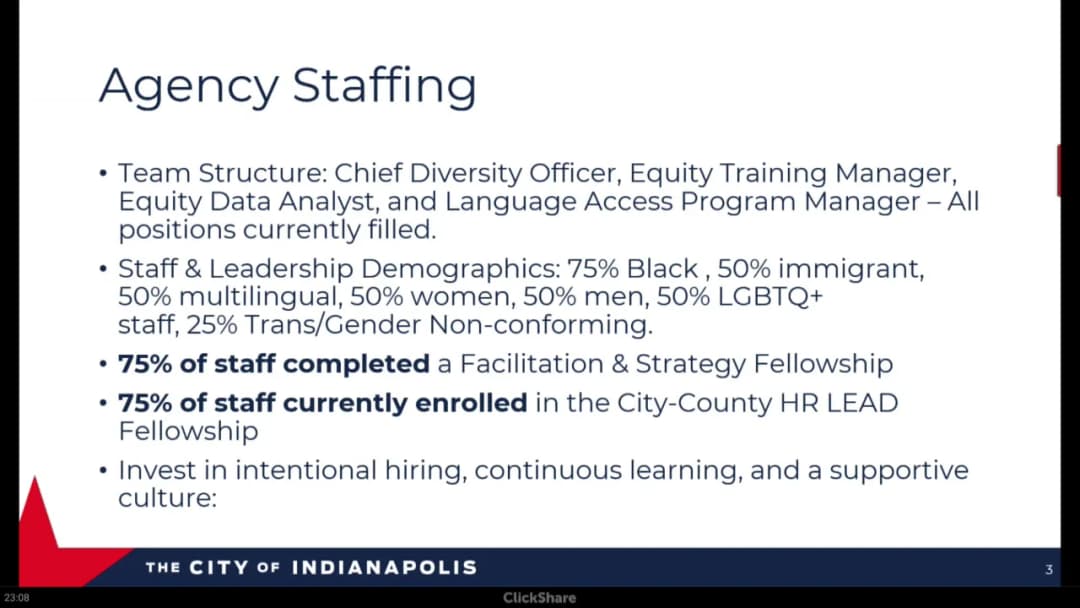
The Administration and Finance Committee of the Indianapolis-Marion County City-County Council met on August 12, 2025 at 5:30 p.m. in Room 260 of the City-County Building, chaired by Councilor Frank Mascari. The committee considered three proposals and held budget hearings for the Office of the Mayor, the Office of Finance and Management (OFM), and the Office of Equity, Belonging, and Inclusion (OEBI). All three proposals were passed unanimously, and the budget hearings were informational. Proposal 234, 2025 – Appointment to Information Technology Board - Action: The committee voted unanimously to approve the appointment of Laura Larimer to the Information Technology Board for a term ending September 8, 2027. Councilor Boots added himself as a co-sponsor. No public testimony was offered. Proposal 235, 2025 – Amendment to Definition of Confidential Employees - Presented by: Dustin Roach (President, Teamsters Local 135) and David Vlink (General Counsel). - Purpose: To amend Section 291-602 of the Revised Code by changing “office of the mayor” to “office of the mayor’s administration,” thereby clarifying that employees of the Mayor’s Action Center (MAC) are not categorically confidential employees and are eligible for collective bargaining. - Support: The Mayor’s Office, through Chief Deputy Mayor Dan Parker, expressed support. The Teamsters stated that MAC customer service representatives had already chosen union representation, and the amendment would allow the city to recognize that election. - Committee Vote: Passed unanimously (voice vote). No public testimony. Proposal 274, 2025 – Levy Freeze Tax Rate Reduction Authorization - Presented by: Controller Abby (last name not stated in transcript, but identified as Abby). - Purpose: To authorize the Controller to request approval from the Indiana Department of Local Government Finance (DLGF) to lower the levy freeze tax rate from 0.1593% to 0.1412%. This is the first step in a two-step process to realign income tax rates without changing the overall 2.02% income tax rate paid by residents. - Key Details: The shift would move revenue from the levy freeze and property tax relief rates to the certified shares and public safety rates, freeing $16 million for essential services and public safety. The property tax relief rate (0.0355%) would be eliminated, offset by a new state-provided credit of approximately $17 million. The levy freeze stabilization fund (current balance $8.3 million) would be drawn down to zero by 2028 as required by Senate Bill 1. - Discussion: Councilor Mowery asked about impacts on MSD Warren Township, which Controller estimated at $300,000 (0.5% of their levy). Councilor Lewis questioned effects on schools and towns, with Controller noting that towns would likely see a net positive due to increased income tax distributions. The committee expressed support contingent on further discussions with affected units. - Committee Vote: Passed unanimously (voice vote). No public testimony. Budget Hearings The committee heard presentations and held Q&A on the proposed 2026 budgets for three offices. No votes were taken. Office of the Mayor - Presented by: Chief Deputy Mayor Dan Parker. - Budget Overview: The total proposed 2026 budget is $6,934,512, a decrease of $227,913 (3.2%) from 2025. The reduction includes elimination of one vacant position (Deputy Mayor of Economic Development) to save $130,000, as economic development functions were transferred to the new Indy Economic Development Inc. Other changes include right-sizing of the India Chiefs program and inclusion of $400,000 for Circle City Readers. - Key Priorities: Continued focus on public safety (NICJR gun violence reduction strategy – 50% homicide reduction since 2021), infrastructure (HB 1461 matching funds), housing (Streets to Home Indy, tenant advocacy), quality of life (parks, trails), and economic development (supporting IU Indianapolis and Purdue University Indianapolis growth). - Discussion: Councilors Lewis and Boots commended the collaborative budget process. Councilor Barth asked about how community feedback was incorporated; Parker cited council input, neighborhood advocates, and agency-level engagement. Councilor Gay discussed potential for AI in the Mayor’s Action Center to improve efficiency and language access. Office of Finance and Management - Presented by: Controller Abby and Budget Director Jake McVeigh. - Budget Overview: The total proposed 2026 budget is $12,493,934, a decrease of $858,755 (6.4%) from 2025. Reductions come from lower ISA and building authority rent charges and agency reserves. Personnel costs include a 2.6% COLA and 5.6% health insurance increase, offset by keeping three positions vacant. The Drug Free Community fund is maintained at $200,000 by supplementing with opioid settlement dollars. - Key Highlights: Implementation of a centralized fleet accident tracking system (Vision Zero recommendation), expansion of the online bidding portal for vendors, development of a customer service center in the City-County Building, and continued community outreach through Indiology internship program. Fund balance policy targets were adopted to maintain strong credit ratings. - Discussion: Councilor Nielsen asked about outstanding debt collection and the Kroger payment option. Councilor Lewis asked about the impact of reduced Drug Free Community revenue on grantees; Controller committed to follow up. Office of Equity, Belonging, and Inclusion - Presented by: Chief Diversity and Equity Officer Ben Tapper. - Budget Overview: The total proposed 2026 budget is $1,041,566, a decrease of $35,629 from 2025. The reduction is entirely in professional services and training (Character 3). Personnel costs increased due to COLA and health insurance. - Key Priorities: Expanding equity training (270 employees trained in 2025, goal of 300 in 2026), rollout of the city’s first Language Access Plan, expanding employee demographic data collection (including country of origin), and supporting enterprise-wide cultural assessment (launched August 2025). - Discussion: Councilor Lewis requested that OEBI include enterprise-wide demographic data in future presentations. Councilor Boots asked about involvement in Devington/Brendon Park neighborhood advocacy; Tapper explained OEBI’s role as facilitator. Councilor Allen asked about partnership with Eskenazi on health equity and language access for Haitian and other communities in her district. Councilor Cahill asked about metrics for the Language Access Plan; Tapper agreed to provide data on requests received. Key Outcomes - Proposal 234: Passed unanimously – appointment of Laura Larimer to the IT Board. - Proposal 235: Passed unanimously – amendment to confidential employee definition. - Proposal 274: Passed unanimously – authorization to request DLGF approval for levy freeze rate reduction. - Budget Hearings: Informational; no votes taken. The committee will consider the full 2026 budget at a later date.
The Indianapolis City-County Council convened on Monday, August 11, 2025, at 7:00 p.m. for a regular meeting. The primary focus was the presentation of the proposed 2026 city-county budget by Mayor Joseph H. Hogsett and City Controller Abby Hansen, along with the final adoption of several ordinances and appointments. A significant portion of the meeting was devoted to debate and passage of a curfew ordinance (Proposal 232) establishing temporary public safety hours for minors. Consent Calendar - Proposals 187 and 216 (appointments to the Citizen Complaint Board): Approved 23-0. - Proposal 208 (appointment of Amanda DeHorty as Director of Animal Care and Control): Approved 23-0. - Proposal 209 (reappointment of Daniel Moriarty to the Metropolitan Development Commission): Approved 23-0. - Proposal 214 (appointment of Brittany Krohn as Director of Parks and Recreation): Approved 23-0. - Proposal 215 (appointment of Trina Routabush to the Greenways Development Committee): Approved 23-0. - Proposals 260–272 (rezonings certified by the Metropolitan Development Commission): Passed into law without objection. - Proposal 185 (PILOT for Crystalmore Court Rehab LP, 40 units): Approved 23-0. - Proposal 186 (PILOT for BPCP Apartments LP, 74 units at Broadway Park and Citizens Park): Approved 23-0. - Proposal 210 (tax abatement for Thunderbird CC Land Partners LLC): Approved 23-0. - Proposal 211 (tax abatement for Roche Diagnostics Operations Inc.): Approved 23-0. - Proposal 212 (PILOT for Monon 35 Phase I, 200 affordable units): Approved 23-0. - Proposal 213 (refunding bond up to $150M for Health & Hospital Corporation): Approved 23-0. Public Comments & Testimony No public comments or testimony were recorded during this meeting. Discussion Items - 2026 Budget Presentation: Mayor Hogsett presented the proposed $1.7 billion operating budget, the ninth consecutive balanced budget without a tax increase. Highlights included a 50% reduction in criminal homicides since 2021, over 900 police officers hired (100 in the past 18 months), $8.5 million for a new fire station (Ladder 33), $8 million for tornado siren replacements, $217 million in transportation funding, $10 million in new road funding to prepare for the state match under House Bill 1461, $10 million for homelessness initiatives (including Streets to Home Indy), continued funding for affordable housing, the Tenant Advocacy Project, and Circle City Readers literacy program (over 60% of third graders passed iRead). Controller Abby Hansen detailed fiscal challenges: union contract costs, a 13% PERS rate increase for public safety, denial of a SAFER grant, and a projected $43.3 million deficit closed by income tax realignment and BNS fee increases. Senate Bill 1 (property tax reform) is expected to reduce city revenue by $10.5 million in 2026 and a cumulative $88 million by 2029. The budget package also includes $20 million in additional appropriations ($10M for road design, $10M for homelessness) and debt authorizations totaling $21 million. - Curfew Ordinance (Proposal 232): The council considered an ordinance to establish temporary public safety curfew hours for minors for 120 days, in response to a recent mass shooting downtown. An amendment by Councilor Delaney (passed 23-0) added preambles declaring the public safety emergency and triggering the temporary hours. A second amendment by Councilor Evans (passed 17-6) removed 17-year-olds from the public safety curfew hours, keeping them under the state's 11 p.m. curfew instead. Debate centered on whether 17-year-olds should be subject to an earlier curfew, with supporters arguing it provides a targeted tool for officers, while opponents noted 17-year-olds are nearly adults and the danger is from gun proliferation rather than age. The final amended ordinance passed 23-0. Key Outcomes - The 2026 budget package (Proposal 259) and related appropriation (Proposal 273) were introduced and referred to multiple committees for further deliberation. - All consent agenda items and final adoption proposals passed unanimously (23-0) except for the curfew amendment on age (17-6). - The council adopted the amended curfew ordinance (Proposal 232) with a 23-0 vote, establishing temporary public safety hours for children under 17 (ages 15–16) for 120 days. - The meeting adjourned after recognition of several deceased individuals as part of the permanent record.
The Municipal Corporations Committee of the Indianapolis City-County Council met on August 7, 2025, at 5:30 p.m. in Room 221 of the City-County Building to consider Proposal No. 213, authorizing the Health and Hospital Corporation of Marion County to issue up to $150,000,000 in general obligation refunding bonds. The refunding targets the Series 2010 A2 and B2 Build America Bonds (BABs) used to finance the construction of Eskenazi Hospital, aiming to reduce financial uncertainty from federal subsidy sequestration and free up cash reserves. Discussion Items - Proposal 213 Presentation: Joe Glass, Executive Director and General Counsel of the Indianapolis Bond Bank, and James Simpson, interim CFO of the Health and Hospital Corporation, presented the refunding plan. They explained that the 2010 BABs received a 35% federal interest subsidy under the 2009 American Recovery and Reinvestment Act, but since 2013, sequestration has reduced that subsidy by a fixed 5.7% (since 2021), costing HHC approximately $500,000 annually in additional debt service. The refunding would eliminate this uncertainty, reduce annual rental payments by $2.45 million, and free up $33.8 million currently held as a cash debt service reserve (which would be replaced with a surety). The bonds' final maturity remains January 2040, and the maximum interest rate is capped at 6.5%. The refunding has been approved by HHC's board and the Marion County Building Authority and does not require council action for the related lease rental bonds. - Committee Questions: Several councilors asked clarifying questions: - Councilor Allen (District 16) likened the refunding to a mortgage refinance to lower long-term costs, confirmed that interest savings might occur but the main drivers are subsidy uncertainty and reserve release, and asked about potential recapture of past sequestered subsidies (answer: not available; the reduced payment is legally mandated). - Councilor Bain (District 21) asked how savings are achieved without a lower interest rate; Glass explained the primary savings come from freeing the cash debt service reserve via a surety. Bain confirmed the bond term is not extended. - Councilor Hart (District 20) asked about restructuring costs; Glass replied they are paid through issuance costs rolled into the refunding. - Chairman Evans requested HHC provide additional context on the federal subsidy issue; Simpson elaborated on the sequestration history and the annual $500,000 burden. - No public comments were offered. Key Outcomes - Vote: Councilor Gibson (District 8) moved to send Proposal 213 to the full council for final adoption with a "do pass" recommendation. Councilor Allen seconded. The motion passed unanimously by voice vote (all ayes). - Next Steps: The proposal will be considered by the full City-County Council at its August 2025 meeting, with additional approval needed from the bond bank. Pricing is expected in September 2025. - Effective Date: If approved, the refunding would take effect upon bond issuance, with the same maturity date (January 2040).
The Metropolitan Development Commission (MDC) met on August 6, 2025, at 1:00 PM in the Public Assembly Room of the City-County Building. The commission approved routine items, heard two public hearings on the Oxford Row economic development area, and approved sixteen zoning petitions on the no-appeal docket. Consent Calendar - Minutes: Approved (5-0, with two recusals from Commissioners Hergut and Lyle, who were not present at the prior meeting). - Continuance: Item 2025-MOD-008 (7436 Rockville Road) was continued to the August 20, 2025 meeting due to lack of commitments (unanimous 7-0). - Policy Resolutions (5 items): The commission approved a block of five resolutions not subject to public hearing: - 2025-R-028: Authorized DMD to amend the joint services agreement with Downtown Indy Inc. for placemaking services, adding $10,000 for a total not to exceed $1,360,000. - 2025-R-029: Authorized DMD to convey the property at 900 East 64th Street to the Department of Parks and Recreation at no cost for redevelopment. - 2025-R-030: Authorized DMD to convey the property at 1128 North Ewing Street to Key 2 Destiny LLC for $31,000, subject to a project agreement. - 2025-E-023: Authorized a second amendment to extend the interlocal agreement with the Capital Improvement Board for downtown event parking. (Note: President Dillon later stated a recusal on this item; the initial roll call showed 7-0, but the record indicates a 6-0 vote with one recusal.) - 2025-C-002: Authorized DMD to add or amend agreements with the approved contractor pool for the Indianapolis Homeowner Repair Program, increasing funding by up to $2,000,000. Discussion Items - Homeowner Repair Program: Deputy Director Jenny Foltz presented the program, emphasizing its importance for low-income homeowners and plans to expand capacity with the additional funding. President Dillon expressed strong support for the program. - 2025-E-020 (Oxford Row Confirmatory Resolution): Emily Stump, Administrator of Economic Incentives, described a mixed-use development at 25th and Delaware streets, featuring 46 rental units (10% at or below 50% AMI) and 5,000 square feet of retail space. Staff recommended approval. The commission voted 7-0 to approve. - 2025-E-021 (Oxford Row TIF Bond Pledge): Megan Bukasit, DMD Director, explained that this resolution pledges tax increment from the Oxford Row Allocation Area to secure economic development revenue bonds (not to exceed $2,012,000) to finance the project. Staff recommended approval. The commission voted 7-0 to approve. - 2025-CZN-829 (Archdiocese of Indianapolis, Evanston Avenue): Brian Tuohy, representing the Roman Catholic Archdiocese of Indianapolis, presented a rezoning to SU-2 district for school uses at Chatard High School. The school plans to build six tennis courts on four acquired residential lots. Neighbors expressed support but requested no lighting and no pickleball court striping, which the applicant agreed to in written commitments. Commissioner Murphy recused, and the item passed 6-0. - 2025-ZON-055 (Kentucky Avenue fueling station): Commissioner West confirmed he was satisfied with answers regarding this petition. Key Outcomes - Policy Resolutions Approved: The five consent resolutions were approved. The vote was 7-0 on the block, with President Dillon noted as recused on E023, making that item 6-0. - Oxford Row District and Bonds Approved: Both resolutions (E020 and E021) passed 7-0, establishing the Oxford Row Economic Development Area and allocating up to $2,012,000 in bonds pledging 80% of tax increment revenues. - No-Appeal Docket (16 petitions): All sixteen zoning petitions recommended by the hearing examiner were approved. Voting was 7-0 in favor, except for petition 2025-CZN-829 which passed 6-0 with Commissioner Murphy recusing. - Meeting Adjourned: The commission adjourned following the votes.
The Board of Public Health and Safety met on August 6, 2025, to adopt minutes, approve a contract for IMPD leadership training, and approve six sub-recipient contracts under the Community Violence Intervention and Prevention Initiative (CVIPI) grant. All items were approved unanimously. Consent Calendar - The minutes from the previous meeting were adopted without discussion. Discussion Items Item 080625A – Armstrong Consulting (IMPD Leadership Training) Debbie Hall, CFO for IMPD, presented a contract with Armstrong Consulting to provide leadership training for IMPD command staff and first-line supervisors/mid-level management. The training will consist of one 4-hour session for command staff and two 4-hour sessions for frontline supervisors, scheduled for September 22–23, 2025. Topics include strategic decision-making, community engagement, people-first decision-making, and reform implementation. Deputy Chief Terry noted that the training draws from Chief Armstrong’s experience in Ferguson, Missouri, post-Michael Brown. Board members asked about the training’s focus on police-community tensions, particularly with Black and brown communities, and received assurances that the curriculum addresses those issues. The contract cost was described as reasonable compared to sending staff to out-of-state trainings. Items 080625B–080625F – CVIPI Grant Sub-Recipients (Non-Fatal Shooting Program) Alexis Webster, Assistant CFO for IMPD, presented five contracts that continue services from the previous ARPA-funded non-fatal shooting program under the new CVIPI grant. The contracts are: - 080625B: IU Health Methodist Hospital – $146,250 over three years for mental health services for victims of non-fatal shootings and their families. - 080625C: Inner Beauty Program – services for young women (ages 15–35, located in Lawrence/NE side). - 080625D: Emmanuel Missionary Baptist Church (Pastor Webster’s boot camp) – services for men. - 080625E: Eskenazi Health – food access services. - 080625F: Voices Inc – youth services (ages 13–24, both genders). Discussion centered on whether post-incident treatment qualifies as crime prevention. Some board members expressed concern that funding treatment reduces the pool for true prevention. Webster and Hall argued that addressing mental health and underlying factors (e.g., retaliation, trauma) is integral to preventing future violence. Board members noted age gaps (younger men and older women not served) and called for expansion to organizations like Ladies Under Construction. They also urged better coordination and data sharing among IMPD, OPHS, and the Indianapolis Public Safety Foundation. Webster committed to sharing quarterly data on outcomes. Key Outcomes - Item 080625A (Armstrong Consulting) was approved unanimously. - Items 080625B–F were each approved unanimously: - 080625B: IU Health Methodist Hospital - 080625C: Inner Beauty Program - 080625D: Emmanuel Missionary Baptist Church - 080625E: Eskenazi Health - 080625F: Voices Inc - The board requested quarterly data sharing on the CVIPI grant’s progress and outcomes. - No further action; meeting adjourned.