The Jacksonville City Council Rules Committee convened on Monday, June 15, 2026, at 2:00 PM in the Council Chamber, City Hall, to consider a revised marked agenda. The meeting was chaired by Chris Miller, with Vice Chair Terrance Freeman excused. Six members were present: Ken Amaro, Ron Salem, Randy White, Mike Gay, and Michael Boylan. The meeting adjourned at 2:33 PM, lasting 33 minutes. Public Comments & Testimony - Marshall Adkison spoke regarding Item 10 (2026-0358), the towing and storage ordinance. His specific position was not recorded in the minutes or transcript. Discussion Items - Item 10 (2026-0358): Towing and Storage of Vehicles and Vessels - The committee considered amendments to the towing ordinance, including insurance requirements aligned with the Florida Highway Patrol model ($300,000 garage keeper's liability, $50,000 off hook, $100,000 on hook), expanded non-business hours (6 PM – 8 AM from 8 PM – 7 AM), and updated definitions. The Neighborhoods, Community Services, Public Health and Safety (NCSPHS) Committee had previously recommended the amendment. Trista Carraher from the Auditor’s Office explained the amendment. The bill was approved 6-0 in the Rules Committee. - Item 14 (2026-0446): Polling Place and Precinct Boundary Changes - Jerry Holland, Duval County Supervisor of Elections, explained changes for the August 18, 2026 primary: 8 permanent and 2 temporary polling location changes, boundary adjustments for 5 precincts, and reduction of total precincts from 160 to 159. Affected voters will receive new voter information cards and signs at old locations. The committee amended the bill to correct addresses and add Precinct 1110, then approved 6-0. - Item 15 (2026-0447): Risk Management Information System - Appropriated $500,000 from the Self Insurance Fund retained earnings (per auditor recommendation) for a new system. The funding source was changed from liability case reserves due to volatility. Approved 6-0. - Item 17 (2026-0454): Special Revenue and Refunding Bonds - Authorized issuance of up to $400,000,000 in bonds to fund capital projects and refinance existing debt, with a waiver allowing negotiated sale. Attached revised project list. Approved 6-0. - Item 19 (2026-0457): Loan to Jacksonville Housing Authority - Authorized a $1,000,000 loan (2% interest, 3-year term) from General Fund Operating Reserves for demolition and environmental remediation of Downtown East Apartments (formerly Franklin Arms). The NCSPHS Committee amendment changed funding source from commercial paper. JHA plans to redevelop into 130 senior housing units. Approved 6-0. - Item 20 (2026-0458): Affordable Housing Surplus Property Inventory - Adopted an inventory of 15 city-owned parcels (11 in District 10, 4 in District 7) for affordable housing disposition. Waived requirement for 4 educational workshops to 2. Properties first offered to non-profits for 30 days, then any entity for 60 days. Approved 6-0. - Item 21 (2026-0459): Litigation Settlement – David Washington - Approved $180,000 settlement from General Fund Operating Reserves for pending litigation. Funding source clarified. Approved 6-0. - Item 22 (2026-0460): JFRD Regional Preparedness Grant - Accepted $4,360,470 in federal grant funds (no city match) for equipment and training across Duval, Clay, Nassau, St. Johns, and Baker counties. Authorized an additional Emergency Preparedness Planner position. Approved 6-0. - Item 23 (2026-0463): Baseball Grounds Improvements - Appropriated $703,183.22 for MLB-required improvements (from Baseball Park and Sports Complex accounts). The city is not obligated for cost overruns per the cost disbursement agreement. Amended to correct account information. Vote: 5-1 in favor (Councilmember Gay opposed). In the subsequent Finance Committee, the vote was 4-3. - Appointments and Resolutions (Items 24-26, 36-39): Approved reappointment of Steven W. McMikle to the Council on Elder Affairs (87% attendance), appointment of David Monk to the Building Code Adjustment Board, confirmation of Dr. Truitte L. Moreland to the Jacksonville Journey Forward Board, and resolutions honoring Officer Willie Perry, two baseball state champions, and America’s 250th anniversary. All passed 6-0. Deferrals - Eleven items were deferred at the request of council members or the administration, including legislation on mayor's transfer authority, code enforcement fines, lobbying restrictions, JEA appointments, abortion funding, code enforcement fees, naming of Warren A. Jones Baseball Complex, police and fire pension governance, home occupations, and funding for Springfield Preservation and Revitalization. Key Outcomes - Approved 6-0: Towing ordinance (Item 10), polling place changes (Item 14), risk management system (Item 15), bond issuance (Item 17), JHA loan (Item 19), affordable housing inventory (Item 20), litigation settlement (Item 21), JFRD grant (Item 22), and all appointments and resolutions. - Approved 5-1: Baseball Grounds improvements (Item 23), with Councilmember Gay voting nay. - Withdrawn 6-0: Zoning code amendment on nonconforming use administrative deviations (Item 11). - Second Readings: Nine items (27-35) were read a second time and rereferred to other committees; no final vote taken. - Next Meeting: The next regular Rules Committee meeting is scheduled for Monday, July 20, 2026.
Public Meetings - Jacksonville, Florida
Public Meetings - Jacksonville, FloridaThe Jacksonville Waterways Commission convened on June 10, 2026, at 9:31 a.m. and adjourned at 11:29 a.m. during the final meeting of the council year. The commission received a water quality and manatee update, heard public comments, considered a small-scale land use amendment, and discussed Hogpen Creek watershed analysis, a Fort George River no-wake zone proposal, and updates on Shad Creek and the George Crady Bridge. Consent Calendar - Approval of Minutes (May 13, 2026): A motion to approve was made, seconded, and approved without objection. Public Comments & Testimony - Carnell Oliver spoke on economic development through the Jacksonville Port Authority, advocating for a community trust fund for black Americans and a "freedman zone" within original city limits. - John Nooney discussed FIND (Florida Inland Navigation District) and JWC, referencing recent trust funds and a planned movie project. - Leatrice Bell commented on the George Crady Bridge Fishing Pier, invited commissioners to tour the site with the Mayor on June 22 at 9:30 a.m., and expressed concerns about unannounced development and restricted public access. Discussion Items St. Johns River Status Report on Water Quality & Manatees (Dr. Gerard Pinto) - Dr. Pinto reported that rainfall had increased, reducing salinity though levels remained high; water temperature was approximately 82°F. A year-to-date rainfall deficit of 5 inches persisted, but May brought 5–6 inches of rain. Mixed algae were present with no detectable toxins. - Manatee mortality: Five additional deaths since the May meeting – three watercraft mortalities near Mayport, Huguenot Park, and Sisters Creek (suspected mating group struck by a large vessel), and one at the Queens Harbor lock, the third lock-related death this year. Aerial surveys counted 71 manatees. - Lock safety: The management company is coordinating with state and federal agencies. Dr. Pinto noted a hydrophone system might be needed. Adam Hoyles suggested inexpensive steerable sonar; Dr. Pinto agreed. Chair Amaro asked about cost; Dr. Pinto stated the management company would bear it. New Business: Small-Scale FLUM Amendment (2026-0475) – 0 Granite Place (WD-WR to LI) - Ed Lukacovic (Planning Department) presented the proposed change from Water Dependent-Water Related (WD-WR) to Light Industrial (LI) for a 1.91-acre site, of which approximately 1.42 acres are Category 1 salt marsh wetlands. The site lies in a flood zone and the coastal high hazard area. Flows from the site reach Nichols Creek via a 400-foot cross drain. - Applicant Brian Small stated a buyer wants to park up to five box trucks for a moving company and will not disturb wetlands; the change is needed because the trucks are not port-related. - Commission concerns: Marc Hardesty noted nearly 80% of the site is wetlands and expressed reluctance, citing flooding risks and prior wetland destruction. Andrew Fraden worried about future changes after approval. Michael Barker questioned whether LI would allow more use; Lukacovic said no difference. Shannon MacGillis cautioned against discussing the companion rezoning bill (quasi-judicial). - Representative Dean Black argued the current designation already allows parking with magnets, so approving causes no harm. - Motion to recommend approval failed 4–5, effectively denying the amendment. Other New Business: Hogpen Creek Watershed Analysis – FIND Letter of Support - Michael Barker requested adding the study to FIND’s project list. Brian Burket (Parks) clarified the study itself is not FIND-eligible; only recommendations can be funded at 25% reimbursement (no public access facility), with 50% of match from benefiting properties. A public facility could raise reimbursement to 50%, but opportunities are minimal. - Matt Carlucci asked about study cost; Burket estimated unknown without hiring a consultant. Jim Suber noted dredging is not a permanent solution. - Shannon MacGillis recommended no commission action because Councilmember Rory Diamond committed to securing funding for the analysis. The commission took no vote. - Marc Hardesty tied the issue to persistent shoaling problems (e.g., Clapboard Creek) and stressed the need for agency acceptance of future studies. Other New Business: Fort George River Sandbar Boating Hazard – No-Wake Zone Proposal - Matt Jones proposed designating the Fort George Inlet a No Wake Zone, citing up to 200–300 boaters on weekends, shifting sandbars, and safety risks. He noted minimal cost for signage. Support expressed by Councilmember Gay (who discussed increased patrols) and Jim Suber (who had received requests from FWC and JSO). - Shannon MacGillis explained that municipal regulation under F.S. 327.46 requires an ordinance, competent substantial evidence for FWCC review, and coordination with FDEP, Coast Guard, and Army Corps due to the site’s protected status (Timucuan Preserve, Outstanding Waterway). She recommended creating a task force to gather evidence. - Chair Amaro called for a task force with a 90-day deadline. A motion to authorize its creation was made, seconded, and approved without objection. Amaro proposed three commission members (Jones, Gay, Hardesty) and two public members; MacGillis will draft a charge memo by June 12. Old Business: Shad Creek Resolution Update - MacGillis stated the waterway lacks adequate features for municipal speed regulation under statute, so the matter rests with FWC. Burket suggested applying to FWC for zone expansion, noting a navigation study was not done when the bridge was replaced. No further action. Old Business: George Crady Bridge Update - Acting Chair Gay reported meeting with FDEP, which is open to developing a plan for reopening the fishing pier. Work in progress. Key Outcomes - Land Use Amendment 2026-0475: Denied by a vote of 4–5. - Fort George River Task Force: Authorized unanimously; three commission members and two public members to be appointed; charge memo due June 12; report due within 90 days. - Hogpen Creek: Commission acknowledged the FIND letter but took no action; Councilmember Diamond’s funding commitment noted. - Shad Creek: Municipal regulation not feasible; FWC to lead. - George Crady Bridge: FDEP engaged; plan development ongoing. - Meeting adjourned at 11:29 a.m.
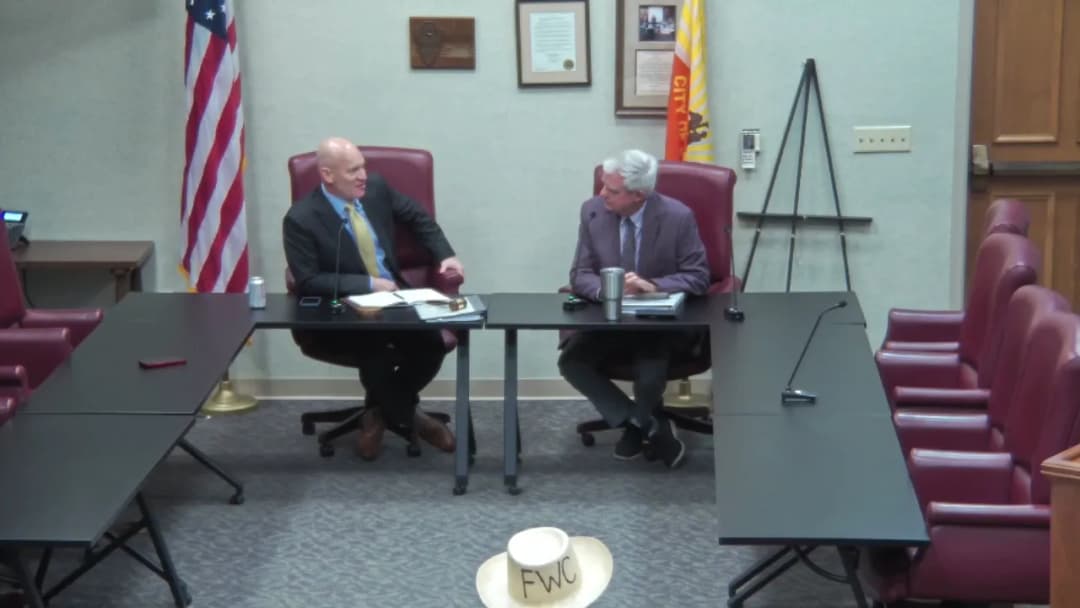
This was a meeting between Councilman Boylan (terming out after eight years) and the incoming Council President to discuss Boylan's priorities for his final year on the council. Topics included committee assignments, a sidewalk project in Mandarin, a proposed preservation entity, enforcement of attendance rules, and budget challenges due to the upcoming November referendum. A single public comment was heard. Public Comments & Testimony - John Nooney (8356 Baskum Road, Jacksonville) spoke in support of open meetings and praised the incoming leadership. He urged the council to consider generating revenue from surplus city properties, referenced a recent Duval County commission meeting where all surplus property would be contributed to private developers, and noted the Northeast Florida Regional Council's potential land acquisition list. He also mentioned a film project, trust funds for parks and veterans, and expressed hope Councilman Boylan would grant a pardon related to JU. Nooney stressed that Duval County should not lose revenue to adjoining counties. Discussion Items - Committee Assignments: Councilman Boylan expressed interest in serving on the Neighborhoods committee, which he chaired previously, and offered to serve wherever the incoming President assigns him. - Mandarin Sidewalks: Boylan clarified that the Mandarin sidewalk extension is a JTA project, not a city one, based on work from a decade ago. He noted a small but vocal segment of the community is concerned, and he believes a community preservation organization like the ones in Springfield or San Marco could have helped manage that communication. - Mandarin Area Preservation Project: Boylan secured $156,000 in strategic funding for a consultant to explore creating a self-sustaining entity to facilitate community voices on preservation and beautification. - Bill 137 – Attendance Bill: Boylan urged the incoming President to task committee chairs with enforcing higher accountability and responsibility among council members, as outlined in the new ordinance. He noted existing council rules prohibit leaving meetings without permission, but he is working with Michelle on a bill to define “present” as being physically in the room within arm’s reach of the voting machine, to prevent members from ducking votes in the green room. The incoming President agreed that walking out disrespects colleagues and can change outcomes. - Budget Uncertainty and Referendum: Both discussed the impact of the November referendum, which could reduce residential tax collections by an estimated $200 million in the next cycle. Boylan expressed concern about the high non-homeownership rate (42–43%), the effect on renters, and the need to avoid a hatchet approach. The incoming President stated they are already working with the Mayor’s office on a flat budget, putting non-core items below the line until November. Boylan suggested considering a millage increase or other fees, though solid waste fee increases were a non-starter. The budget for October 2026–September 2027 will not feel the full impact; the hit is expected in October 2027. Key Outcomes - Direction to Committee Chairs: The incoming President agreed to instruct committee chairs to enforce attendance rules per Bill 137, and to clarify the definition of “present” if needed. - Potential New Attendance Bill: Boylan is preparing a legislative definition of “present” for council meetings, to be introduced if enforcement does not improve. - Budget Strategy: The administration and council will adopt a flat budget from the Mayor, move non-core wish-list items below the line, and wait until after the November referendum to make final decisions. Both agreed to be responsible and not leave the next council with a $200 million shortfall. - Next Step: Councilman Boylan will continue working on the Mandarin Area Preservation Project and the attendance definition bill. The incoming President will set committee assignments and budget priorities.
Attendees included outgoing Council President Salem and the incoming Council President-elect. The meeting focused on Salem’s remaining priorities, budget challenges ahead of a November referendum, and strategies for downtown development funding. Discussion Items - Clubhouse at Blue Cypress Golf Course: Councilman Salem highlighted a joint venture with Jacksonville University (JU) to build a clubhouse. The course recently expanded from 9 to 12 holes, and the clubhouse would serve as a venue for the JU golf team and the public. It is already a Capital Improvement Project (CIP) item approved under a previous $50 million bond. He hopes construction begins this year. - JP Small Hall of Fame: Salem described a $10 million investment in JP Small Field, including recent upgrades (lighting, field). The final major component is a Hall of Fame outside the left field wall, intended as a museum featuring Negro League memorabilia in partnership with former owner Peter Braken. He believes it could become a tourist attraction off I-95 in the heart of Durkeyville. - Doge Completion: Salem committed to finishing the Doge initiative in June. A meeting the following Tuesday would complete a health care analysis with rate recommendations. He noted that last year the city had to supplement health care costs with $21 million plus $5 million to reserves, urging administration to consider recommendations. - Special Committee on JEA: The committee’s last major interview is in two weeks, and a survey is ready to go out. Salem stated it is not the committee’s job to act on the information but to forward it to the board. The product may roll into July. - Capacity Issue: Salem and the President-elect agreed the capacity issue needs to be resolved and then presented to the board for a decision on collection dates. - Budget Process and November Referendum: Salem expressed interest in the budget process, calling the upcoming budget “very challenging.” The President-elect noted the November referendum on homestead exemption expansion will clarify financial constraints. He proposed pulling $50 million (minimum) out of the current budget to prepare for potential revenue loss, with a possible special meeting in December to release funds if the referendum fails. They discussed a previous model of a $25 million special release. The President-elect warned that future councils could face $200–$300 million shortfalls if the exemption expands. - Downtown Development and Funding Alternatives: The President-elect mentioned the public’s right project as a catalyst for downtown, costing $28 million, but questioned affordability. Salem suggested creative funding options: treating loans like low-interest mortgages (e.g., $10 million over 20 years with $500k annual repayment plus interest), equity stakes, or other mechanisms. They noted completion grants have reduced red in the five-year plan but revenue constraints limit cash for non-core projects. Reserves are for core services and emergencies, not new projects. Key Outcomes - Agreement on Budget Cuts: Both agreed to pull at least $50 million from the budget. The President-elect emphasized that the city cannot depend on November’s outcome; cuts are necessary now. They considered raising the cut from the current 2% ($3.8 million) to 5% or more, noting only the Inspector General’s department has proposed savings so far. - JEA Committee: Survey results and final interviews will be forwarded to the board by July. - Healthcare Analysis: Recommendations from the Doge committee to be delivered Tuesday; administration urged to adopt them. - Capacity Issue: To be resolved and presented to the board for decision. - Funding for Downtown Projects: Further debate needed; alternative sources (loans, equity) to be explored. - Councilman Salem’s Role: He committed to assisting the President-elect with any needs, serving on committees, and contributing to the budget process in his final year.
The meeting was a brief discussion between a departing council member (in their eighth and final year) and the council president-elect regarding the departing member's top priorities for the upcoming year. The council member outlined two key initiatives and requested support from the incoming leadership. Discussion Items - Normandy Boulevard Four-Laning: The departing council member identified this as the top priority on Duval County's list of unfunded projects. It is a state-level project, and the member noted strong support from Tallahassee representatives, including Sam Garrison. The council member requested to remain on the Transportation Planning Organization (TPO) to help advance the project. - Mounted Patrol Relocation to Equestrian Center: The council member had previously secured $3.5 million three years ago to move the mounted patrol from the wet soil at Peak Farm to the city-owned equestrian center. The cost has since increased to an estimated $8-9 million. The project is expected to be a Capital Improvement Plan (CIP) budget item. The council member mentioned that Mr. Weinstein supports the project and believes it will be an easier lift. Key Outcomes - The council president-elect agreed to support both priorities and confirmed the mounted patrol relocation will be treated as a CIP item. - The council president-elect indicated the departing council member could remain on the TPO to assist with the Normandy Boulevard project. - The meeting concluded with thanks and adjournment.
Councilman Nick Holland, incoming Council President, convened a special open-agenda meeting with Councilman Matt Carlucci at 10:30 AM on June 10, 2026. The purpose was to discuss Carlucci’s legislative priorities for his final year on council and to align with Holland’s upcoming agenda. Topics ranged from naming honors and preservation projects to budget planning amid a November referendum on revenue. Discussion Items - Warren A. Jones Wall of Council Presidents – Carlucci proposed designating the wall displaying portraits of past council presidents as the “Warren A. Jones Hall of Council Presidents” (or “Wall of Council Presidents”) to honor the longest‑serving council member in consolidated Jacksonville’s history. Warren Jones, who served two terms as council president and chaired the school board, has not requested any recognition. Carlucci sought Holland’s support and co‑introduction of legislation, and also wants to include Councilman Rockman Johnson. Holland called it a “terrific idea” and agreed to co‑introduce unless city cost is an issue; Carlucci offered to personally cover any expense. The legislation will be drafted after meeting with Johnson. - Renaming Museum Circle to Haskell Way – Carlucci is preparing legislation to rename Museum Circle (on the Southbank, near the former Prudential building now owned by Haskell Company) to “Haskell Way” as a surprise for Preston Haskell. Because Haskell is still living, a five‑year waiver from the historic commission is required. Carlucci is in the process of filing the legislation and noted that there are only three addresses on that street, one owned by the city. - Mark Middlebrook Preserve – Carlucci plans to rename one of the two Cedar Point Preserves in the Timucuan Preserve as “Middlebrook Preserve” in memory of Mark Middlebrook, a former Times‑Union reporter who helped lead the preservation project under Mayor John Delaney. The change would also resolve confusion between the two similarly named preserves. Carlucci has spoken with Delaney, Mark Woods, and the Middlebrook family; constituents in the Black Hammock Island area have expressed support. A final community meeting will confirm approval before legislation is introduced. - Laura Street Trio – Carlucci updated that the note on the historic Laura Street Trio is expected to go into foreclosure in July, after which the current noteholder will likely buy the properties. Future redevelopment will depend on the outcome of the November referendum. Carlucci recounted the 1990s compromise that saved the Trio from demolition and secured funding for the Main Library. - Consolidation Lunch and Learn – Carlucci proposed a lunch‑and‑learn session for council members (and possibly candidates) to review the foundations of Jacksonville’s consolidated government. He suggested Rick Mullaney and Earl Johnson as speakers. Holland preferred scheduling it in May 2027 after the council elections to attract new members. They agreed to plan for a May date. - Northwest Infrastructure Investment – Carlucci noted that the mayor’s upcoming budget is expected to include significant infrastructure spending for the northwest quadrant. He stated he will support that investment during budget discussions. - Peace Memorial Park – Carlucci reported on a project by Wayne Weaver (age 91) to dedicate park improvements at Peace Memorial Park (across from Willow Branch Library) in honor of his mother and father. The park is a veterans’ memorial; a flag and enhanced landscaping are planned. A ribbon‑cutting is likely in early November. - Riverfront Parks – Carlucci emphasized the importance of continued funding for riverfront parks and the Emerald Trail, cautioning against over‑spending given the pending referendum. He shared that he drove through downtown in 90‑degree heat and observed heavy park usage. - Springfield Lofts – Carlucci proposed a $6 million redevelopment of the former Jacksonville Jewish Center site north of Klutho Park into approximately 85 affordable housing units. The financing model would be $6 million from city reserves: $3 million forgivable grant and $3 million loan repaid by the developer, Josh Pardue. Carlucci acknowledged the project’s uncertainty due to budget constraints. - Budget and November Referendum – Councilman Holland stated his immediate focus is a thorough review of the budget. To avoid leaving the next council president with a potential $200 million austerity risk, he is discussing with the mayor and CAO the possibility of making contingent cuts (“below the line”) that could be restored if the November referendum passes. He also highlighted job creation and economic development at Cecil Field, noting new legislation requiring the Jacksonville Aviation Authority to present a development plan for Cecil. - Mutual Goals – Both councilmen expressed a desire to support each other’s priorities. Carlucci offered to help Holland achieve a “magical” year; Holland committed to creative public‑private partnerships if traditional funding is constrained. Key Outcomes - Holland agreed to co‑introduce legislation for the Warren A. Jones Wall of Council Presidents and to approach Councilman Rockman Johnson. - Carlucci will proceed with legislation to rename Museum Circle to Haskell Way, pending the required waiver. - Carlucci will introduce legislation to rename one Cedar Point Preserve to Middlebrook Preserve after final community affirmation. - Both councilmen agreed to organize a consolidation lunch‑and‑learn in May 2027. - No formal votes were taken; the meeting served as a planning and alignment session. - The meeting adjourned at approximately 11:00 AM.
The Jacksonville City Council met on Tuesday, June 9, 2026, at 5:00 PM in the Council Chamber. The meeting lasted until 8:20 PM and covered a wide range of items including quasi-judicial matters, consent agenda, public hearings on land use, third-reading ordinances, and unfinished business. 16 members were present initially, with some excused. Key actions included approval of a school millage referendum for the November ballot, approval of an Emerald Trail eminent domain ordinance, and passage of a contentious bill changing appointment authority for the Kids Hope Alliance and Library Boards. Consent Calendar - Approved unanimously (16-0): A block of 14 items including: - 2026-0379: Closing of a portion of Ionic Ave R/W - 2026-0380: Amendment to lease for Duval County Tax Collector's Office - 2026-0388: Sale of JEA's former headquarters site for $1,000,000 - 2026-0389: Amendments to dockless mobility program ordinance - 2026-0391: Delegation of FDEP domestic wastewater program authority - 2026-0394: Appropriation of $350,000 from FDOT for traffic signal rebuild - 2026-0398: Appropriation of $3,371.63 for city's Amazon subscription - 2026-0399: Confirmation of reappointment of Dr. Carmen Martinez to Election Advisory Panel - 2026-0400: Confirmation of appointment of Robyn Cenizal to Eastside Grants Committee - 2026-0401: Appointment of Scott K. Thomas to Jacksonville Waterways Commission - 2026-0402: Confirmation of appointment of Geoffrey A. Youngblood to TRUE Commission - 2026-0415: Reappointment of Heather Rios to Opioid & Substance Use Disorder Grants Committee - 2026-0470: Honoring Officer Adam "Sonny" Fluker Jr. - 2026-0471: Honoring Officer & Bishop Antonio C. Richardson Public Comments & Testimony - Teacher millage referendum: Numerous speakers (teachers, school psychologists, community members) urged the council to place the one-mill ad valorem tax continuation on the November ballot. Many wore red and expressed gratitude after the council voted to discharge the bill and approve it. - Free to Garden Act: Multiple speakers (Nathan Valentine, Jennifer Leggett, etc.) supported the proposal to make community and market gardens permissible by right, citing benefits for food access and community building. - JEA union negotiations: Representatives from Local 630 (Ronnie Burris, Daniel Kersey) and supporters spoke about the impasse with JEA, requesting fair wages and recognition of pay disparities. - Connor Collie case: Several speakers (Dragon Beloit, Ryan Delaney, Sarah Haddad, etc.) criticized the arrest and sentencing of Connor Collie, who was convicted for actions during a previous council meeting. They called for removal of Officer Aliaga as Sergeant-at-Arms and decried what they saw as suppression of free speech. - Other: Speakers addressed zoning concerns, opposition to the KHA/library board bill, support for the homeless initiatives commission amendments, and mental health crisis response. Discussion Items - 2026-0345 (Appeal of Joann Purdie): Council voted 16-0 to deny the appeal and uphold the Planning Commission's approval of a zoning exception and administrative deviation for a restaurant at 1604 Margaret St. - 2026-0290 (Yellow Water Residential PUD): After an amendment carried on voice vote, the bill was approved 13-1 (Councilmember Clark-Murray dissenting). She expressed the Southwest CPAC's opposition due to lack of environmental impact study, traffic concerns, and density. - 2026-0387 (School millage referendum): Councilmember Arias moved to discharge the ordinance from Finance committee. After a second and discussion, the discharge passed by voice vote. The council then voted 15-0 to approve placing the one-mill ad valorem tax continuation referendum on the November 3, 2026 ballot. - 2025-0872 (KHA & Library Board appointments): After extended debate and a failed floor amendment (Clark-Murray's proposal to limit president's appointment power), the bill as amended (by committee) passed 9-6. The bill changes appointment authority for Kids Hope Alliance and Library Board of Trustees, giving the Council President appointment power for 3 of 7 KHA seats and 5 of 12 Library seats, subject to council confirmation. - 2026-0327 (Emerald Trail eminent domain): A finance substitute requiring council approval before filing condemnation petitions was adopted. The bill then passed 13-1 (President Carrico dissenting). - 2026-0363 (Private providers for subdivision regulations): Postponed to June 23, 2026 by a 14-0 vote after concerns raised about scope. - 2026-0518 (Reunification Month resolution): Declared an emergency and passed 14-0 after floor amendment adding emergency language. Key Outcomes - Approved (16-0): All quasi-judicial resolutions and ordinances (items 1-10, 76, 78, 80-82, 84, 86-89). - Approved (14-0 or 15-0): Numerous public hearing items including the UNF Campus Master Plan development agreement (2026-395), LISC Small Business Employment Re-Grant Program (2026-451), Goodwill Summer Youth Works Program (2026-452), Vision for Excellence Summer Program (2026-466), and several land use amendments and rezonings. - Approved (13-1): Yellow Water Residential PUD (2026-290), DIA regulatory fee authority (2026-383), and Economic Development Agreement for 108 affordable housing units (2026-386). - Approved (9-6): Ordinance 2025-872 amending appointment powers for Kids Hope Alliance and Library Board. - Passed as emergency (14-0): School millage referendum placement on November ballot (2026-387); Reunification Month resolution (2026-518). - Postponed to June 23, 2026: Ordinance 2026-363 (private providers for subdivision regulations) and several land use items: 2026-122, 2026-123, 2026-126, 2026-127, 2026-293, 2026-294, 2026-295, 2026-311, 2026-365 through 2026-371 (public hearings continued). - Defeated: Floor amendment (Clark-Murray) to limit Council President's KHA appointment authority (failed by voice vote).
Note: The transcript provided references the meeting date as June 4, 2026. The user-directed date is June 9, 2026. This discrepancy is noted here; the summary uses the user-provided date as instructed. The Taxation Revenue and Utilization of Expenditures (TRUE) Commission met in committee and then as a full commission on June 9, 2026, from 4:00 p.m. to approximately 5:25 p.m. The meeting covered four audit reports, an attendance enforcement action, a bylaw amendment on public comment, and a new resolution on affordable housing. Six of eleven commissioners were present, achieving quorum. Public Comments & Testimony - John J. Nooney (Jacksonville resident) attempted to speak about City Council Resolution 2023‑0819 and three intended donations to city trust funds (Parks Trust Fund, Veterans Trust Fund, Artificial Reef Trust Fund). He was ruled out of order for not confining remarks to agenda items and was given 40 seconds to address the resolution. He briefly stated that the resolution would increase the supply of affordable housing but argued it lacked a quality‑of‑life component, referencing the Resilient Jacksonville report on poor waterway access. Discussion Items - Audit Report 832 – Stormwater Fee Follow‑up (Second Follow‑up) Presented by the Council Auditor’s office. The original audit (April 2019) had 23 issues; after the second follow‑up, 7 issues remain. Key outstanding items: (1) policies for calculating compacted dirt as impervious area not finalized, (2) use of third‑party aerial photos to review non‑residential parcels not fully implemented, (3) incomplete applications for charitable/faith‑based stormwater fee exemptions continue to be approved. Commissioners questioned the lack of a policy timeline and the dollar amount of improper credits. The auditor agreed to research whether a policy was proposed between 2023 and 2026 but never adopted, and to determine the total dollar value of credits granted on incomplete applications. Both items are to be reported back in August 2026. - Audit Report 906 – Employee Reimbursement Audit Released May 15, 2026. The audit covered FY2024‑25 (2,598 reimbursement items totaling $403,865) and cash advances from February 2020 to September 2025 (36 advances totaling $22,011). Findings: Missing/incomplete policies, cash advances not timely closed (no expense reports created for $5,108; 16 of 36 advances not reported within five days of return), incorrect system configuration for meal reimbursement, former employee accounts not deactivated, and system improvements needed. Commissioners expressed concern that $5,108 in cash advances lacked any documentation and asked about repercussions. - Attendance & Vacancy Declaration The chair noted that Commissioners Alexandra Hoffman and Kim Pryor had missed two of three successive meetings without cause or prior excuse, triggering Article 3, Section D of the bylaws and City Ordinance §50.104. A motion to declare the seats vacant passed unanimously (6‑0). The Urban Core CPAC and Greater Arlington Beaches CPAC will be notified to fill the vacancies. - Bylaw Amendment – Public Comment (Article 9) Commissioner Barr proposed adding a new section allowing the public to speak for two minutes on any matter, not just agenda items. An amendment by Commissioner Lewis to keep three minutes (or less depending on number of commenters) passed by a show of hands. The amendment was then adopted, and the bylaw revision now reads: Section B – “All members of the public may speak before the TRUE Commission on any matter.” Section C – “Members of the public shall be limited to three minutes or less depending on the number of commenters.” - Audit Report 905 – Quarterly Summary (Six Months Ending March 31, 2026) Presented highlights for independent agencies: JEA projects a year‑end surplus of $6.3 million; JAA projects $11.2 million surplus; JTA projects an overall $2.2 million deficit (driven by the Connection/CTC division), with the bus division breaking even via cost cuts approved by JTA’s board in February 2026. The bus division had a $15 million unfavorable variance in actuals through six months but expects to offset with $13.2 million in favorable expenditure variances. The Skyway, Ferry, and engineering divisions are all projected to break even. Commissioners asked detailed questions about JTA’s divisions and the ferry’s continued operation; it was clarified that the ferry remains part of A1A and is still used. - Audit Report 871A – Follow‑up Procurement Audit (Informal Purchase of Supplies) First follow‑up on the original procurement audit. Fifteen original issues; six cleared, nine remain. Outstanding items: undocumented internal procurement processes, requisitions that can bypass procurement, excessive user access (18 of 22 procurement employees could single‑handedly complete a purchase; 56 users could use any funding source; 179 could submit requisitions for non‑departmental cost centers), and system configuration that allows approval by the requester’s department instead of the funding source’s department. Commissioner Carter asked whether auditors tested if excessive access was actually exploited; the auditor said it had not been part of the follow‑up testing but agreed to discuss with the audit manager. - New Business – Resolution on Affordable Housing Using Surplus City Property The chair presented a resolution proposing that all city‑declared surplus properties be contributed to private developers to create buildable lots for single‑family and multifamily units. After construction, the Duval County Housing Finance Authority would issue bonds to finance mortgages for homeowners and multifamily operators. The chair argued this would reduce housing cost by eliminating land cost (25‑40%) and lower financing costs via municipal bond rates, increasing affordable housing without direct taxpayer dollars. Commissioners raised concerns: existing mechanisms for property grants, impact on surrounding property values, risk of temporary fixes, and the need for more research. The motion was tabled to the August 6, 2026 meeting, with the chair to provide parcel numbers and property appraiser data for commissioner review. Key Outcomes - Seat Vacancies Declared: Commissioners Hoffman and Pryor were removed for non‑attendance (vote 6‑0). - Bylaw Amendment Adopted: Public comment limited to three minutes or less on any matter. - Resolution Tabled: The affordable housing resolution was postponed to August 2026 for further study. - Audit Follow‑ups: The auditor will report back in August on the stormwater fee policy timeline and the dollar amount of improper credits, and will discuss with the audit manager whether to test if excessive procurement access was exploited. - Next Meeting: August 6, 2026 (no July meeting).
The Jacksonville City Council held a noticed workshop on June 9, 2026, from 3:06 PM to 3:29 PM, to discuss proposed Target Growth Areas (TGA) under Bill 2026-311 and updates to the comprehensive plan. The meeting, chaired by Councilman Johnson (District 14), featured a presentation by planning staff and the chair of the Livable Density and Resilience (LDR) Update Committee, outlining a multi-year process to encourage residential growth in low-flood-risk, transit-served areas while protecting neighborhoods and increasing affordable housing. Public Comments & Testimony - Ruth Nelson Peoples (resident): Expressed confusion about the incentive process and asked who decides the incentives (which she referred to as variances). She requested a copy of the incentive page. Staff clarified that the specific incentives will be determined in later public hearings as part of the zoning code changes. Discussion Items - Staff Presentation (Helena Parola): Described the TGA boundaries (pink and yellow on map) based on low flood risk (compound flood model), high-ridership transit corridors (with JTA), and within half a mile of the Emerald Trail. Excluded areas: zoning overlays, low-density residential (LDR) land use, and accident potential zones. The incentives for density include resilient design standards (e.g., permeable surfaces, stormwater management, on-site renewable energy) or affordable housing (rental at 100% AMI, home ownership at 120% AMI). The current legislation (Ordinance 2026-311) only establishes the TGA map in the comp plan and allows density increases; specific zoning code changes will follow state review. - Emily Pierce (LDR Update Committee Chair): Added historical context—the effort began 10 years ago with an Adaptation Action Area Group that led to the city's compound flood model, now used by the Army Corps. She highlighted statistics: a renter needs at least $25/hour to afford a basic two-bedroom apartment; over half of low-income renters (defined as 80% of Area Median Income, which she estimated near $200,000) spend over 50% of their income on housing. She noted that firefighters, police, and teachers are considered low income. Resounding support was reported from the Chamber of Commerce, NEFPA, and CPACs (including a standing ovation at one CPAC meeting). The committee ran financial models with builders and developers to confirm the incentives would make a meaningful difference. - Councilman Johnson: Questioned affordability thresholds, expressing concern that builders might price units beyond reach despite incentives. He clarified that the current proposal sets 100% AMI for rentals and 120% AMI for home ownership (to be finalized in zoning code). He advocated for moving the needle toward home ownership over rental. Staff explained that developers can choose either resilient design standards or affordable housing (or both) to qualify for density increases. Key Outcomes - No formal votes were taken; the workshop was informational. The next step is the comp plan amendment (Ordinance 2026-311) will be sent to the state for comment, after which the council will consider a second ordinance with the same comp plan changes but a different number, along with the detailed zoning code changes that will specify incentives and affordable housing requirements. Staff committed to providing council members with TGA map breakdowns by council district. Note: The meeting was adjourned at 3:29 PM. No agenda or minutes were available for this meeting.
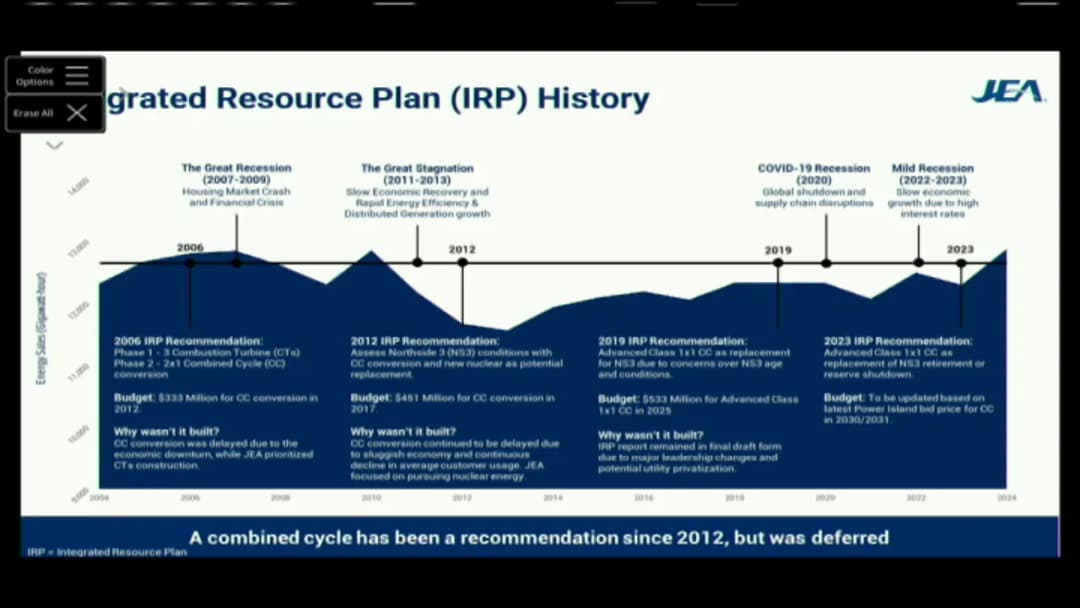
The Special Committee on JEA met on June 8, 2026, to receive a presentation on JEA's proposed combined cycle generating facility. The presentation, originally given to the JEA board on August 26, 2025, covered the need for new capacity, the evaluation of self-build versus purchasing power from FPL, and the status of regulatory approvals. Committee members questioned JEA officials about risks, costs, public outreach, and transparency. Discussion Items - Combined Cycle Project Overview: JEA Chief Administrative Officer Denise Brooks presented the project history, noting that JEA has not built new generation in 14 years. The proposed 600 MW combined cycle unit at the former SGRPP site is needed to replace retiring Northside Unit 3 and meet growing demand. A self-build option was compared to a 30-year power purchase agreement (PPA) with FPL, with less than 1% variance in net present value ($6.24B vs $6.18B over 30 years). The JEA board selected self-build in August 2025, approving a not-to-exceed cost of $1.57 billion. - Regulatory Approvals and Risk: Brooks confirmed that JEA filed a need determination application with the Florida Public Service Commission (PSC) and a site certification with DEP on June 4, 2026. PSC is expected to issue a determination by November 1, 2026. Chair Salem expressed concern that the risks of PSC and DEP approval were not discussed publicly at board meetings, only in one-on-one meetings with board members. Brooks stated that in the history of PSC need determinations, no utility has opposed another's application, though NGOs like the Sierra Club could intervene. - Upfront Financial Commitment: JEA entered a reservation agreement for the turbine with a non-refundable deposit to secure its place in line. The deposit amount is confidential under a non-disclosure agreement. Councilman Teal questioned why JEA committed hundreds of millions of dollars before receiving regulatory approvals. Brooks explained that waiting would delay the project beyond the 2031 need date, and that the deposit is assignable. - Transparency and Streaming of Meetings: Chair Salem and Councilman Carlucci noted that JEA committee meetings and workshops are not streamed or recorded, unlike past practice under former CEO Jay Stowe. Brooks committed to ensuring future meetings are streamed. - Community Outreach: Greg Corcoran, Director of Community Affairs, reported that a town hall on February 19, 2026, drew 16 attendees, with only three phone calls from residents. Councilwoman Pittman expressed concern that residents are not well-informed about the project and suggested alternative outreach methods. - Cost Overrun Risk: Brooks acknowledged that cost overruns would be borne by ratepayers. She noted that a one-year delay could cost JEA $91 million. Councilman Pittman asked about lessons learned from past projects like Plant Vogtle; Brooks emphasized that this project uses proven technology and JEA controls the contracts. Key Outcomes - The committee received the presentation and asked detailed questions. No formal action was taken by the committee. - JEA officials committed to improving transparency by streaming committee meetings and workshops in the future. - The project will proceed through regulatory reviews, with a PSC hearing anticipated in September 2026 and a final determination by November 1, 2026.