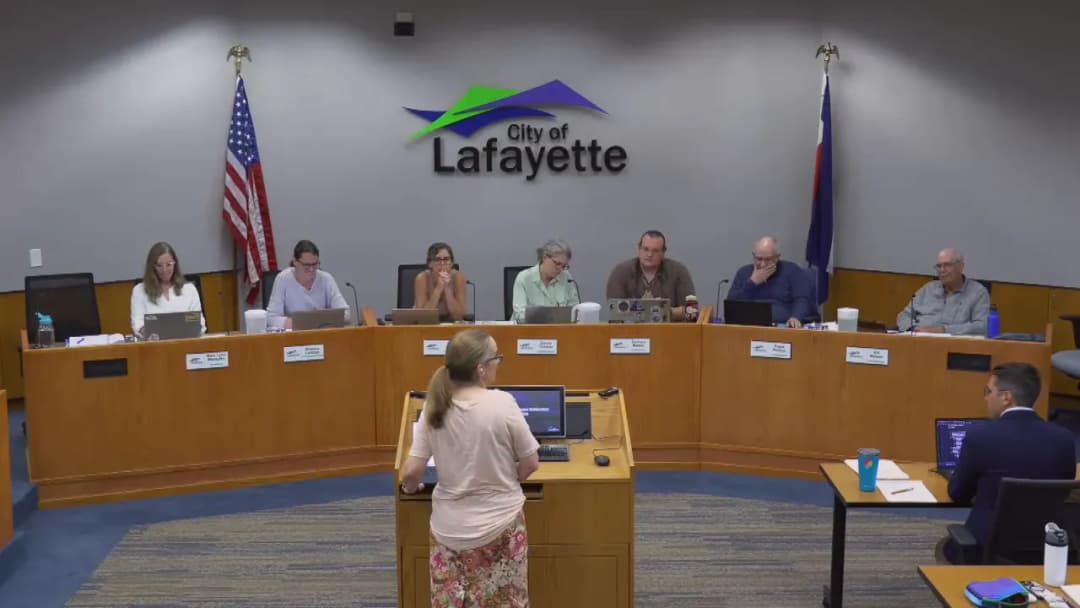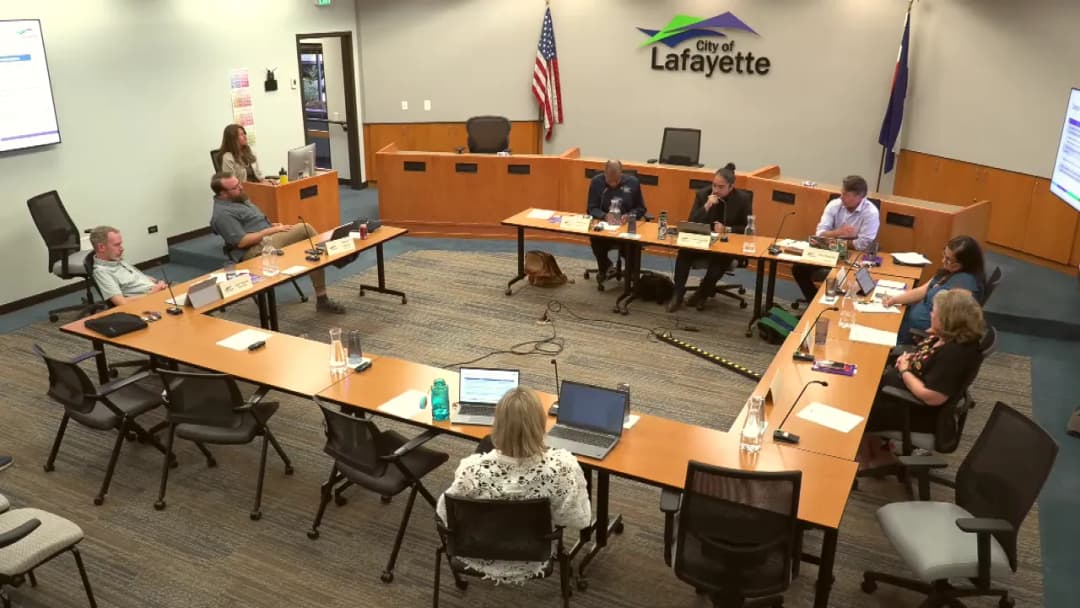
The August 18, 2026 City Council meeting included a public hearing on the first reading of Ordinance No. 15, Series 2026, which would repeal and replace Chapter 26 (Land Use Code) and the zoning map. Council heard public testimony on the land use code, the capital bond project for the Bob Burger Rec Center, ADU restrictions, and Flock security cameras. The consent agenda was approved unanimously, and 14 members were appointed to the Lafayette Youth Advisory Board. Council voted to approve the land use code on first reading and directed staff to prepare specific amendments for second reading. Consent Calendar - Approved August 4, 2026, City Council Meeting Minutes. - Approved July 28, 2026, City Council Workshop Summary. - Approved Second Reading of Ordinance No. 14, Series 2026 (amending the Human Rights Board name, scope, duties). - Approved Resolution No. 2026-21 (authorizing assignment of private activity bond allocation to Boulder County Housing Authority). - Approved Contract with A to Z Recreation, LLC for Yarrow Park Playground Equipment Replacement (pictures corrected per Councilor Jensen). Public Comments & Testimony - Frank Archelleta expressed full support for naming a new pocket park at South Public and King Street after Rosabella Luaris and placing a historical plaque, citing dark history of the KKK and discrimination in Lafayette. He urged council to champion the park name. - Tony Munoz also supported naming the park after Rosabella Luaris, emphasizing the need to educate the community and honor good behavior over past discrimination. - Rosario Russian (7-1 Pascal Drive) expressed concerns about the Bob Burger Rec Center capital bond project, stating that community priorities (fitness space, weight room, multipurpose room) are not reflected in the architectural plans from Davis, and that the survey was biased and only reached 598 predominantly high-income white older adults. She requested a pause, a bilingual survey, and genuine incorporation of feedback. - Catherine Sarr (300 West Canyon Street) echoed concerns about the Rec Center bond, stating that the initial promises have shifted, the survey was biased, and patrons feel dismissed. She highlighted the economic impact of losing rec members to other towns and asked for transparency and incorporation of feedback. - William Hutcheson (Old Town) spoke about ADU regulations, arguing that homeowners should be allowed to build their own ADUs without a contractor's license, just as they can for an addition. He asked council to direct staff to clarify the definition. - Tamar Grunold (437 Elk Trail) raised privacy concerns about the Flock security cameras, questioning independent security testing, oversight of officer searches, the placement of one-third of cameras around the hospital (HIPAA implications), and the ability to search by bumper stickers implicating First Amendment rights. She noted that Fort Collins and Denver have ended or reconsidered Flock contracts. Discussion Items - Public Hearing / First Reading / Ordinance No. 15, Series 2026 (Land Use Code) - Staff (Phil Pleisler, Elizabeth Garvin) presented the draft Land Use Code, which replaces the 1986 zoning code with a modern, standards-based code implementing the Legacy Lafayette Comprehensive Plan. Key features include tailored zoning districts, housing mix point system, form-based districts for Old Town and adaptable mixed-use, updated use standards, and streamlined review procedures. - Council raised questions on the housing mix point system (how it incentivizes attached housing, affordability, density), Old Town zoning (OTX3 debate, building height limits, parking minimums), public land dedication, and the regulatory plan process. - Public testimony on the land use code included: Caroline Leland (Southwest Energy Efficiency Project) supporting middle housing and ADUs for energy and water efficiency; Tony Munoz urging sustainability (ICFs, geothermal, solar) and opposing drive-throughs and large buildings in Old Town; Karen Norbeck (800 East Geneseo) opposing OTX3, citing a petition with over 1,000 signatures to keep Public Road quirky and limit building heights to two stories; Jack Bestall (Boulder Ranch representative) asking for less formulaic housing mix, cautioning about forcing rental attached housing, and questioning the review process; Cindy Lurie strongly objecting to OTX3, stating it violates the comp plan; Rob McClure supporting planning commission recommendations, urging caution on private facility credits and data center moratorium; Claire Scott (Immaculate Conception Church Social Justice Ministry) supporting middle housing and asking about mobile home park zoning; Bonnie Freeman presenting data that OTX3 would allow buildings 979% larger than existing, contradicting comp plan; Mike Cooper (Boulder Creek Neighborhood) suggesting lowering housing mix points to avoid forcing attached housing and questioning mandated commercial; Kristen Dean asking about floor area ratio vs. building footprint in OTX, and why child care is not permitted in AMX2; Brad Edwards (Table Presbyterian Church) requesting redesignation of two church parcels to neighborhood mixed use center (NC) instead of AMX2, for consistency with other churches. - Council deliberation after public hearing: Councilor Fridland expressed that the code is not ready for first reading, citing unresolved planning commission conditions and lack of working group review. Councilor Gianola, Jensen, Gallegos, and Mayor Pro Tem Barnes supported moving forward with first reading, noting that the process allows for amendments before second reading and the joint workshop with planning commission on September 9. Council voted unanimously to approve on first reading with the understanding that staff will bring amendments. - Council directed staff to: eliminate the private facility credit for public land dedication; schedule a land use code working group meeting before the joint workshop; develop flow charts for the development review process; revisit child care as a permitted use where appropriate; add sustainability menu items (geothermal, roof pitch for solar) to the joint workshop agenda; and amend the manufactured housing community district intent language to note affordable housing. The OTX3 zoning issue will be discussed at the September 9 joint workshop with planning commission. Key Outcomes - Consent Agenda approved unanimously (Councilors: Aye – all present). - Lafayette Youth Advisory Board appointments approved unanimously (14 members for 2026-2027 term). - Ordinance No. 15, Series 2026 approved on first reading (unanimous). Second reading scheduled for September 15, with a July 28 workshop and a September 9 joint session with planning commission. - Direction to Staff (recorded): 1) Eliminate private facility credit for public land dedication in the code. 2) Schedule a meeting with the Land Use Code Working Group before second reading. 3) Develop flow charts for the development review process. 4) Revisit child care as a permitted use in all appropriate zones. 5) Include sustainability menu (geothermal, roof pitch, possible increase in required options) in the September 9 workshop. 6) Amend intent language in manufactured housing community district to reference affordable housing. 7) Address church properties on South Boulder Road to ensure consistency (likely NC zoning). - Flock camera concerns noted; no immediate action taken. - ADU owner-builder restrictions noted; staff to consider as part of future ADU streamlining work.
Public Meetings - Lafayette, Colorado
Public Meetings - Lafayette, ColoradoThe Lafayette Planning Commission met on August 12, 2026, at 1:00 PM. The meeting was called to order by Chair Thomas with roll call present: Vice Chair Wilson, Commissioners Lehman, Mettler, Phillips, Schoenbeck, and Watson. The primary agenda item was consideration of a site plan and architectural review (SPAR) for a commercial office and accessory storage building at 107 East Simpson Road. The commission also approved prior meeting minutes and received updates on other projects and code-related matters. Consent Calendar - Approval of Minutes – The minutes from the June 8, 2026 meeting were approved unanimously without discussion. Motion by Commissioner, seconded, all in favor. Public Comments & Testimony - No members of the public spoke on non-agenda items. Discussion Items - Site Plan and Architectural Review for 107 East Simpson Road – The applicant presented plans for a two-building development: a front office building with a traditional residential character and a rear accessory storage building (carriage house style). The site is in the B1 zone, use-by-right. Staff (planner Amelia Brackett) confirmed all zoning standards are met and recommended approval with no conditions. The commission asked questions about solar readiness (solar-ready but not installed due to cost), EV parking requirements (one EV-ready and one EV-capable based on code), and the accessory building’s use (storage only for a construction company). Commissioners complimented the design for fitting the neighborhood. No public testimony was heard. The commission then moved to deliberation. Resolution PC-2026-16 was moved, seconded, and passed unanimously (all aye). - Commission Comments & Department Updates – Staff provided updates on several projects: the Ionics building permit was nearing release; larger projects (The Range, Silo, Kensington) were under active review, with Silo and The Range likely next to come to planning commission; 40 North was awaiting final plan and would go to city council; the joint meeting with city council was tentatively set for September 9th; and the land use code workshop was being scheduled. Discussion also covered a recent council decision to move planning commission recruitment to January (offset from the standard fall cycle) and potential impact on attracting applicants. The commission also inquired about the future renovation of the Lafayette Rec Center – it was noted that the project may require planning commission review depending on its scope under the new code, and staff would follow up. Key Outcomes - Resolution PC-2026-16 – Approved unanimously (all aye) for the 107 East Simpson Road SPAR with no conditions. This approves the site plan and architectural review for the commercial office and accessory storage building. - Next Meeting – The next regular meeting was canceled; a joint meeting with city council is scheduled for September 9, 2026 (date tentative). - Ongoing Projects – Staff to continue review of large projects (Silo, The Range, Kensington, Sundar apartments at Dillon Road and 287). The 40 North project to go before city council. - Land Use Code – Commissioners were encouraged to review the code spreadsheet and submit minor comments ahead of the joint workshop. - Planning Commission Recruitment – Vacancies will be filled in January 2027, with recruitment in December. This change was noted as potentially affecting applicant interest.
The Lafayette City Council met on August 4, 2026, beginning with an executive session at 4:30 PM before reconvening in open session at 5:36 PM. The meeting included public comment, a consent agenda, a proclamation, a presentation on the Coca-Cola mural sign, board and commission updates, referral of a LaMont Does Park property tax extension to the November ballot, acceptance of the 2025 Annual Comprehensive Financial Report, and authorization to negotiate the sale of 200 North Public Road. All votes were unanimous. Consent Calendar - Item B: July 7, 2026, City Council meeting minutes approved. - Item C: July 21, 2026, City Council meeting minutes approved. - Item D: Resolution No. 2026-20 – Second amendment to the real estate purchase agreement for Lot 18, Vista Business Park, extending the closing date and updating the legal description, approved. - Item E: Motion authorizing the City Manager to execute change orders up to $170,000 for the D2C Architects Fire Station 1 design contract, approved. Councilor Beaulieu noted the low threshold and hoped for a future increase to the ceiling. Proclamations - National Night Out: August 4, 2026 was proclaimed National Night Out to promote police–community partnerships and crime prevention. Public Comments & Testimony - Frank Archelletta urged council to name the new pocket park on South Public Road after Roosevelt Lawarez, a 13-year-old early civil rights activist who testified after her mother was killed following a lawsuit against the city for denying Latino families access to the public pool. He also highlighted discriminatory practices in Lafayette’s history. - Roy Johnson opposed placing additional tax measures on the ballot, arguing that the proposed $37/year average increase for LaMont Does Park, when combined with previous increases, would represent a 40.3% cumulative city property tax hike over two years. He criticized the city’s use of taxpayer funds to campaign for tax increases. - Anna Smith (220 Summit Circle) spoke on behalf of users of the Bob Burger Rec Center, criticizing the remodel plan presented by Davis Partnership as not reflecting community needs. She noted the chosen firm was the most expensive and had least experience in recreation design, and urged cutting ties and seeking better options. - Brad Edwards (644 South Vermont Drive, lead pastor of Table Presbyterian Church) requested two changes to the draft land use code: rezone two lots (currently AMX-2) to Neighborhood Mixed-Use Center, and make religious and secular assembly permitted by right rather than special use review. He noted four congregations serve 400 people on that corner, including two congregations of color. - Tim Twin (334 Tourist Drive) supported the Table Church, highlighting the economic opportunity of the Sundance Film Festival coming to Colorado and the church’s role as a venue for community film events. - Bailey Jumea, a family law attorney and member of the Table Church, testified that churches fill gaps government programs cannot, such as providing legal assistance and community support. She urged council to make zoning regulations not prohibitively difficult for the church to stay. - Elizabeth Gillespie (202 Northfoot Avenue) supported the Table Church, describing how it built community connections and urged council to ensure zoning doesn’t hinder the church’s long-term presence. - Doug Conaro argued in favor of Option 1 for the Coca-Cola sign: restore it and transfer ownership to Rick Ross, who has volunteered to be its caretaker. He criticized the city’s neglect and stated that the Historical Society emphasized the sign’s cultural significance to the Latino community. - Dave Devorak (2340 Riverock Circle) thanked council for the cemetery plan, praised the land use code’s provisions for ADUs, mobile home zoning, and middle housing, and urged adjustments to the inclusionary housing proposal, specifically lowering the AMI target to 40-50% and adjusting in-lieu fees based on home size. - Michael Watson (708 South Carolina Avenue) criticized the cemetery issue process, stating the city hid behind procedure and failed to have a “flat” dialogue as promised. He noted less than 3% of council discussion engaged specific resident cases. He also warned against balancing the budget by cutting health care benefits for the lowest-paid city workers. - Vicky Ewan (303 West Simpson) strongly supported Option 1 for the Coca-Cola sign (restore and transfer to Rick Ross) and opposed Option 2. She highlighted the sign’s history as part of Saloon Row and the Lincoln Highway, and noted the public raised $126,000 to restore it. She supported a conservation easement and landmarking. - Kurt and Mary Pat Munding (302 East Geneseo Street) expressed full support for the Red Queen Bookstore moving into the Chase building, calling them the best tenant they ever had. - Allie Johnson (1303 Lambert Circle, online caller) supported maintaining the Great Outdoors Water Park, emphasizing its value for young families. Discussion Items - Coca-Cola Mural Sign Update: Director Bridget Keating presented two options after extensive due diligence: Option 1 – restore the sign and transfer ownership to property owner Rick Ross (cost $40,000–$100,000+), with a conservation easement; Option 2 – preserve only the Pat & Gar Highway Bar banner and replace the lower portion with a rotating mural program (cost $35,000–$50,000 for initial work, future murals sponsored). Laura pledged $50,000. Boards and commissions supported preserving the Pat & Gar element and favored a rotating mural concept. Council discussed the importance of honoring the community’s history and investment. Most members leaned toward Option 2, with direction to ensure the first mural pays tribute to the sign’s history (including the Coca-Cola imagery). Council also expressed interest in amending the landmarking ordinance to allow objects. - Board and Commission Updates: - Human Rights Board Renamed: Ordinance No. 14, Series 2026 was introduced (first reading) to rename the Human Rights Board to the Inclusion, Diversity, Equity, and Access (IDEA) Board and update its scope to advise council on policies, initiatives, and community outreach. Approved 7-0. - Planning Commission Term Adjustment: A motion extended all Planning Commission term end dates to January 31st to align with a revised recruitment timeline. Approved 7-0. - LaMont Does Park Ballot Question: Council considered Resolution No. 2026-19 to refer a question to the November 3, 2026 election asking voters to extend an existing property tax (currently expiring December 31, 2026) for 20 additional years (through 2046) for capital improvements and continued operation of the park and Great Outdoors Water Park. The tax is $36.67/year for an average home. The resolution recitals reference a financial assistance program for low-income residents, but council decided not to add specific language to the ballot question. Council approved forwarding the question to voters 7-0. - Acceptance of 2025 Annual Comprehensive Financial Report: Auditors from Eide Bailly presented a clean (unmodified) opinion on all opinion units, noting one material weakness concerning a correction of an error: management discovered that Baseline Reservoir no longer qualifies as a discretely presented component unit and corrected the prior classification. No other deficiencies. The report was accepted unanimously. - Authorization to Negotiate for 200 N. Public Road: Director Keating reported that after a two-phase RFP process with three respondents (Grant Hoppenspringer/Teal Cali, Urban West Group/Arts Hub, and Red Queen Bookstore and Cafe), the evaluation committee ranked Red Queen highest based on alignment with city goals, community feedback (82% positive comments), and feasibility. The community engagement received 1,800 responses. Council authorized the City Manager to negotiate a purchase and sale agreement with Red Queen Bookstore and Cafe. Key Outcomes - Consent Agenda – Approved unanimously. - Proclamation – National Night Out adopted unanimously. - Coca-Cola Mural – Council directed staff to pursue Option 2 (preserve Pat & Gar banner, install rotating murals), with the first mural to honor the sign’s history. Staff will also explore amending the landmarking code to include objects. - Ordinance No. 14 – First reading approved 7-0; second reading and adoption are pending. - Planning Commission Term Adjustment – Approved 7-0. - LaMont Does Park Tax Extension – Referred to November 3, 2026 ballot via Resolution 2026-19, approved 7-0. - 2025 Annual Comprehensive Financial Report – Accepted 7-0. - 200 N. Public Road Negotiation – City Manager authorized to negotiate exclusively with Red Queen Bookstore and Cafe, with a purchase and sale agreement to return to council for final approval. Staff Reports & Council Reports - City Attorney – No report. - City Manager – Announced ribbon-cutting for a new bike corral on Public Road, two upcoming recreation center design engagement sessions (August 22), the August 12th deadline for mental health grants, sponsorship of Community Solutions summit (August 25), the employee appreciation event (August 5), and upcoming August 18 land use code first reading. - Councilor Jensen – Requested a future discussion on maximizing Lafayette’s participation in the Sundance Film Festival. - Mayor Pro Tem Barnes – Raised the issue of aridification versus drought in the West, emphasizing water resilience and the importance of tree shade. He will propose inviting an expert to a future workshop.
The Lafayette City Council held a workshop on July 28, 2026, to receive updates on transportation, the land use code, and board and commission changes. Staff from public works and planning presented detailed reports, and council discussed scheduling, public outreach, and specific policy items. No new ideas were submitted. Transportation Update - Presenters: Jeff Arthur (Public Works Director), Leslie Uwe (Engineering Capital Projects Manager), Casey Carlson (Senior Civil Engineer), and Michelle Melanakis (Principal Transportation Engineer) provided an overview of the city's progress on the Multimodal Transportation Plan (MMTP) adopted in late 2023. - Key Statistics: Approximately 120,000 vehicles pass through Lafayette daily; the city maintains 250 miles of streets; less than 1% of roads are in very poor condition (PCI below 40). The 2026 pavement condition analysis (completed June 2026) rated the average roadway network as satisfactory. - MMTP Implementation: The MMTP identified $10 million in additional investment needed for the near-term (2024-2028). Over 30 of 38 near-term projects are completed or in progress. Community top three priorities: off-street multi-use paths, fixing sidewalks, and on-street bike lanes. - Vision Zero Action Plan (VZAP): Prioritizes safety improvements based on crash history, risk, community input, and equity. Top priority corridors: Colorado 7 (Arapaho Road and Baseline Road segments) followed by Public Road. - Annual Programs: Street and sidewalk rehabilitation, traffic signal maintenance, and sign/striping replacements follow a one-build approach, coordinating with MMTP and VZAP improvements. Examples: Baseline Road improvements (lane width reduction, bike lanes, ADA upgrades); Casper Drive roundabout reconstruction with pedestrian refuges. - Specific Projects: Wanaka Lake Trail – staff presented a preliminary $410,000 design to address speeding/parking near pickleball courts (VZAP rank 84). Project would be advanced when the road is resurfaced or could be done sooner by delaying higher-priority projects. - Regional Collaboration: Staff highlighted coordination with CDOT (287 safety barrier project, CO 42 design, Baseline Road fixes), RTD (successful advocacy to retain Route 228 service; upcoming COA and Connect projects), and participation in Northwest Mayors and Commissioners Coalition. - Council Discussion: Councillors praised staff work. Questions covered PCI ratings, public communication of road conditions, speed cameras (not currently used, mobile radar discussed), concerns about cut-through traffic during Highway 7 construction, and RTD service equity. Councillor Jensen requested a briefing for her role on the Highway 7 coalition. Mayor Pro Tem advocated for proactive identification of transit-dependent destinations. Land Use Code Update - Presenters: Steven Williams (Planning and Building Director) and Phil Kleisler provided an update on the land use code adoption process. - Background: The code update was restarted with Clarion in fall 2024. Two public hearings before Planning Commission (June 24 and July 8, 2026) totaling 12-13 hours resulted in a unanimous recommendation to adopt with 17 conditions. Staff identified 11 conditions that can be implemented immediately. - Proposed Schedule: First reading scheduled for August 18, 2026; joint workshop with Planning Commission in early September (if council agrees); second reading on September 15; deferred effective date of December 15, 2026, to allow for additional outreach and code refinements, including a potential second ordinance for more significant changes (e.g., OTX zoning). - Planning Commission Recommendations (selected): 1. Public Land Dedication – Expand allowable uses to include open space; reduce credit for private recreational facilities; clarify unacceptable land (detention ponds, medians); make LOSAB review mandatory for annexations. 2. Parks and Open Space Zoning – Create separate districts for parks and open space. 3. Data Centers – Add definition and allow only in M-3 (heavy industrial) via special use review; council to consider temporary moratorium. 4. Advanced Air Mobility – Add as a use in M-3 with special use review; consider moratorium for further research. 5. Old Town Lot Consolidations – Limit to 21,000 sq ft or average block lot size (whichever smaller), down from 30,000 sq ft as recommended by Planning Commission. 6. Definitions – Add “collectiflex” from Comprehensive Plan. 7. Neighborhood Meetings – Allow director to require them; require applicant record submission. 8. Building Height – Measure from existing grade for infill, from final grade for large projects; further analysis needed on lot sizes, setbacks. 9. Cottage Court/Courtyard Developments – Explore expansion to manufactured housing communities, old town, and FN zone. 10. Manufactured Homes – Retain 15-ft separation for fire safety; consider case-specific exemptions for replacements. 11. Moratoriums – On data centers and advanced air mobility to allow further study. - Council Discussion: Majority supported a joint workshop with Planning Commission, preferably after first reading. Concerns raised about: businesses and churches being rezoned out (Councillor Bollier and Jensen), need for a cooling-off period for council members moving to Planning Commission (Bollier), mobile home replacement allowing permanently affordable units (Jensen), and timing of public notice (Jensen). Council generally endorsed the 11 immediate changes but wanted to refine some details at first reading. Staff agreed to bring proposals on small business transition periods and affordable housing options. Board and Commission Update - Presenter: Alex Elson (City Manager?) presented two items. - Human Rights Board (HRB): Proposed renaming to Inclusion, Diversity, Equity and Access (IDEA) Board and revising scope to advise on: (1) city policies promoting IDEA, (2) city initiatives improving IDEA in municipal services, (3) community outreach practices to remove participation barriers. The change follows extensive feedback and a motion by HRB. Council unanimously supported the change; staff will bring an ordinance forward. Recruitment for the new board will begin in about a month. - Planning Commission Recruitment: A proposal to shift the recruitment cycle to after the city council election (starting December instead of August) was discussed. Rationale: allow candidates who ran for council to apply, and let incoming council appoint commissioners. Staff noted this year is not an election year, so urgency is low. Council debate: Councillor Gianola and Bollier supported the shift; Councillor Gallegos and Jensen preferred keeping all boards on the same timeline. Mayor Pro Tem suggested exploring a unified schedule. City Manager advised either piloting for PC now or holding for holistic review. Council did not reach consensus; no immediate change was adopted. The HRB scope change will proceed. New Ideas - No new ideas were submitted for this meeting. - Councillor Jensen raised the topic of orphaned oil and gas wells in Lafayette, noting regional working group interest. She requested a future workshop to discuss the issue. Mayor acknowledged the full agenda but left the possibility open for scheduling. Key Outcomes - Transportation: Council directed staff to provide a briefing to the Highway 7 coalition representative (Councillor Jensen) on city priorities. No formal votes; staff will continue current projects under the MMTP and VZAP. - Land Use Code Update: Council expressed general support for the 11 immediate Planning Commission recommendations. A joint workshop with Planning Commission will be scheduled between first and second readings (August 18 to September 15). Staff will prepare specific proposals on small business transition periods and affordable housing options for mobile home replacement for the first reading. The deferred effective date of December 15, 2026, was endorsed. - Board and Commission: Council directed staff to proceed with an ordinance changing the Human Rights Board name and scope to the Inclusion, Diversity, Equity and Access Board. No change was made to the Planning Commission recruitment cadence; further study on a unified schedule may be considered. - No votes were taken during this workshop; all decisions will be formalized at upcoming regular meetings.
The Lafayette City Council held a special meeting on July 21, 2026, dedicated solely to addressing the future of the Lafayette Cemetery. The subcommittee presented recommendations after extensive community engagement, followed by public testimony and council deliberation. Council unanimously approved an amended resolution that provides plot holders with increased buyback options, fee waivers, and an individual plot planning process for casket burials, while extending decision deadlines and removing a requirement for plot holders to pay for burial observers. Subcommittee Recommendations - Increase Buyback Amount: From $1,500 to $3,500; previous sellbacks will be made whole. - Waive Cremains Burial Fee: One fee waived per plot. - Improve Coal Creek Memorial Cemetery: Allow upright headstones, create new burial areas; exchange plots at $1,500 with $2,000 refund. - Individual Plot Planning Process: For casket burials where conditions permit, based on GPR, historical records, and ground conditions; secondary option required. - Options Not Advanced: Expanding north into ball fields (community asset), disinterring unmarked remains (state law prohibits), reconfiguring cemetery (roads needed), constructing a mausoleum (foundation issues), and stacking burials (shallow graves). Public Comments & Testimony - Frank Archuletta: Opposed the 90-day deadline, citing fairness for out-of-state plot owners; criticized past management and asked about a memorial plaque for Potter's Field. - James Ortega: Expressed disappointment over lack of proof for plot conditions; opposed 90-day limit and paying for observer; requested verifiable GPR data. - Kathy Erickson: Asked about marking unmarked graves; opposed 90 days; shared emotional distress over potential separation from husband. - Mike Watson: Proposed eight amendments including city-paid observer, consolidated field operation, and release of raw GPR data. - Sharon Stetson: Supported amendment requiring the city to publish the draft agreement and guidelines before families sign. - Christy Erickson: Supported amendment for city to pay for observer; requested verification of plot conditions through digging. - Jill Ortega: Questioned GPR accuracy; suggested a community dig day; supported amendments on headstone moving costs and extended timeline (180 days instead of 90). - Tony Munoz: Emphasized the difficulty for shut-ins and elderly; opposed 90 days; noted lack of published list of plots needing contact. - Other speakers: Doug Conaro, Carol Sadler, Janet Sherba, and others raised similar concerns about timeline, GPR reliability, and need for transparent, compassionate process. Discussion Items - 90-Day Deadline: Council debated two timeframes: a shorter period to contact unresponsive plot owners and a longer period for decision-making. Final compromise: contact deadline extended to October 31, 2026; decision deadline to January 31, 2027. - Burial Observer: Council agreed to strike the requirement for plot holders to pay for a professional observer, leaving the city to arrange and fund as needed. - Prioritization of Repurchased Plots: Council directed staff to return before January 31, 2027, with criteria for repurposing sold-back plots, especially for families with existing loved ones in the cemetery. - Draft Agreement: Council encouraged posting a generic form agreement on the city website but did not include it in the resolution. Key Outcomes - Council unanimously approved Resolution 2026-18 as amended (7-0). - Key amendments: - Plot holders who contact the city by October 31, 2026, have until January 31, 2027, to choose among options (buyback, cremains, exchange, or individual plot agreement). - The requirement for plot holders to hire and pay for a burial observer was removed. - Staff will return to council before January 31, 2027, to propose a prioritization process for repurposing sold-back plots. - The resolution authorizes the city manager to execute individual plot agreements, updates cemetery rules, and repeals the previous moratorium (Resolution 2025-77). - Next steps include continued outreach, newspaper publication of unresponsive plot owners, and improvements to Coal Creek Memorial Cemetery.
The Lafayette Urban Renewal Authority (LURA) met on July 14, 2026, to consider transfers of easements, funding for the historic Coca-Cola mural, and an extension for a development project. The board approved two resolutions and a cooperative agreement, and received updates on downtown projects. Consent Calendar - Approval of March 10, 2016, meeting minutes: The board unanimously approved the minutes from the March 10, 2016, meeting. Public Comments & Testimony - Doug (first speaker): Expressed strong support for the $50,000 commitment to restore the Coca-Cola sign, noting that restoration bids have decreased from $100,000–$110,000 to $35,000–$85,000. He advocated for a conservation easement and landmarking, and emphasized that property owner Rick Ross would take ownership and maintain the sign only after restoration. - Vicky (Simpson Street): Echoed support for the easement transfer and cooperative agreement. She detailed LURA's historical failure to maintain the sign, citing emails and a conservator's maintenance plan that was not followed. She argued that $50,000 amortized over 10 years ($5,000/year) is reasonable given LURA's prior maintenance obligations. Discussion Items - Resolution 2026-01 – First Amendment to Economic Development Agreement with 210 North Public LLC: The board considered extending the project completion date from September 1, 2026, to April 1, 2028, and the restaurant lease commencement date to April 1, 2028. Developer Graham explained delays due to losing a restaurant operator and a redesign from a single counter-service and ice cream concept to a three-stall mini food hall with bar, arcade, and outdoor space. The exterior remains unchanged. He noted permits are under review and construction is expected to start in fall 2026, with completion in 14 months. The board expressed cautious optimism and approved the motion unanimously. - Resolution 2026-02 – Assignment of Easement Agreement for Historic Coca-Cola Mural: Staff presented extensive history of the mural, its discovery in 2015, restoration in 2016, and subsequent deterioration. Options for long-term preservation were discussed. The resolution authorized transferring the easement from LURA to the City of Lafayette, which owns the sign. The motion passed unanimously. - Cooperative Agreement for $50,000 Funding: The board approved a one-time transfer of $50,000 to the city for activities related to the mural's preservation, including restoration, relocation, replication, or site restoration. The funds are to be used at the city council's discretion. During discussion, multiple commissioners expressed no strong preference for how the funds should be used, though some favored long-term solutions (e.g., indoor display) and honoring the association with Pat Wright, Lafayette's first female city councilor. Staff will note these considerations in their report to council. Key Outcomes - Resolution 2026-01: Approved unanimously (4-0, with one commissioner arriving late). Extends EDA deadlines to April 1, 2028. - Resolution 2026-02: Approved unanimously. Assigns the easement for the Coca-Cola mural to the City of Lafayette. - Cooperative Agreement: Approved unanimously. Provides $50,000 to the city for mural preservation, with no specific direction from LURA on use. - Updates: Staff reported that pocket park construction has started, with completion expected in fall 2026. The 700-800 block streetscape project is within budget and moving toward right-of-way acquisition. A final LURA meeting is anticipated in September 2026 to wrap up remaining easements and property transfers.
This meeting of the Lafayette Planning Commission, held on July 8, 2026, focused primarily on the continued public hearing for the adoption of the new Lafayette Land Use Code (Resolution PC 2026-15), including the new zoning map and property rezoning. The commission also heard public input on an annexation application and approved the minutes from the previous meeting. Consent Calendar - The minutes from the June 24, 2026, meeting were approved with a minor correction. Public Comments & Testimony - Holly Wilder (Nyland Co-housing resident) opposed the annexation and rezoning of 8600 Baseline Road by developer Jack Bestall, citing traffic, evacuation route concerns, fire safety, infrastructure costs, limited sales tax revenue, incompatibility with rural zoning, wildlife impact, and quality of life. She noted a petition with over 2,000 signatures against the development and referenced a 2018 staff report that similarly opposed a previous proposal. She also mentioned that the IDD (intellectual and developmental disabilities) community had been interested in a smaller-scale project but were disappointed by the larger plan. - Grant Swift (Chair, Lafayette Open Space Advisory Board) supported the open space provisions in the land use code and commended staff for incorporating wildlife plan elements. He urged approval of the code's open space sections. - Karen Norvack expressed concerns about the Old Town mixed-use zones (OTX), particularly the potential for large-scale development on South Public Road that could alter the character of the area. She requested clarity on neighborhood meeting requirements and public land dedication language. - Jack Bestall (developer for Boulder Ranch) spoke in favor of neighborhood meetings and offered suggestions for refining the point system, lot standards, and commercial/mixed-use requirements to facilitate affordable and attainable housing. - Eric Ellis (architect) praised the new code but suggested loosening PUD minimum acreage requirements and ADU restrictions to address the housing crisis, and recommended embracing transit-oriented development rather than fighting state legislation. - Kristen Dean (representing Tebow Properties) objected to the AMX2 zoning for the Aspen Ridge area, arguing it would eliminate or restrict existing industrial uses that have operated for decades. She requested that the code allow M1 uses in AMX2 to protect existing businesses. - Multiple public commenters raised concerns about the pace of the code adoption process, lack of redlines, and the need for more thorough public engagement before finalizing the code. Discussion Items - Land Use Code Presentation and Deliberation: Staff (Steven Williams, Elizabeth Garvin, Jake Mitchell) presented an overview of the code update process, goals, and timeline. They emphasized that the code is intended to implement the Legacy Lafayette comprehensive plan, create more predictable development outcomes, and right-size the development review process. The commission discussed numerous proposed amendments and conditions, including: - Revisions to the PLD credit structure. - Separating parks and open space zones. - Adding use-specific standards for data centers and advanced air mobility. - Adjustments to Old Town zoning (OTX1, OTX2, OTX3) – significant debate on whether OTX3 should be retained or merged with OTX1, with a majority favoring striking OTX3 and conducting further analysis. - Allowing neighborhood meetings at the director's discretion. - Requiring building height and dimensional standards analysis. - Removing the term "lawn" and clarifying non-living ground cover. - Consideration of allowed uses in various districts (e.g., schools, greenhouses, short-term rentals in MHC). - The commission also discussed the effective date of October 31, 2026, and the need for a joint workshop with city council to finalize amendments. Key Outcomes - The commission voted to approve Resolution PC 2026-15 recommending approval of the new Lafayette Land Use Code, zoning map, and rezoning, subject to the amendments and conditions discussed during the meeting. The vote was 7-0 (with one abstention noted? Transcript shows opposition but unclear – actually says "I oppose" but then motion passes. Re-read: "I oppose. I know this isn't the longest meeting you've ever had like this, right? Oh no. No. All right. I moved to uh Jeremy's meeting. Yeah, geez." It appears the motion passed with one commissioner opposed? But the chair says "All those in favor?" and then "I oppose" by one commissioner, but then soon after it says "I moved to uh Jeremy's meeting" which seems to indicate the motion passed. We'll note the approval with conditions. - Key conditions include: - Revise public land dedication language to include open space and reduce credit for private facilities. - Create separate parks and open space zones. - Add special use review for data centers and advanced air mobility (with recommended moratorium). - Strike OTX3 and conduct further analysis of South Public Road zoning. - Clarify neighborhood meeting requirements and allow director to require them. - Explore allowing greenhouses in OTX districts via use-specific standards. - Staff to provide redline versions of code changes. - Hold a joint planning commission/city council workshop before October 31, 2026, to discuss outstanding issues. - The commission directed staff to perform additional analysis on OTX districts, alley connectivity, and neighborhood center commercial requirements, and to consider whether development processes are overly burdensome.
This meeting included updates from the cemetery subcommittee, public comments on cemetery issues and taxes, adoption of updated building codes, and a presentation on extending the tax for Lamont Does Park. Council also made appointments and formed a subcommittee on council norms. Consent Calendar - Approved June 2 and June 16, 2026 council minutes; June 23 workshop summary; second reading of ordinance 13 series 2026 (sidewalk/street fees); and updates to the city investment policy. All passed unanimously. Public Comments & Testimony - Frank Archuletta urged council not to pass Resolution 2613 and to abolish the moratorium, emphasizing unity and justice for 270 plot owners. He suggested using land near the recreation center for burials. - Alan Garcia presented a formal letter regarding municipal liability, asserting he holds deeds purchased from the city on August 1, 2000, contradicting the city’s claim that plot sales ended in 1999. He requested written acknowledgment of his vested property rights. - Pete Salas asked for employee demographic data and a racial equity plan for the city, and expressed concerns about e-bike safety on trails. - Mike Watson criticized the process around the cemetery and theater projects, and urged council not to cut health benefits for lower-paid city workers. - Roy Johnson opposed placing a tax question for the water park on the ballot, arguing funds should come from efficient budgeting rather than a new perpetual tax. - Ron Spaulding opposed an in-perpetuity tax extension for Lamont Does Park, supported a shorter term (e.g., 10 years), and questioned the need for synthetic turf. - Josh Johnson (phone) supported the tax extension, noting the $36/year cost is reasonable for a valued amenity. Proclamations - Council proclaimed July 17, 2026 as Park and Recreation Professionals Day in Lafayette, recognizing the contributions of park staff. Passed unanimously. Regular Business – Adoption of Updated Building Codes - Ordinance 12, Series 2026 repealed and reenacted Chapter 30 and repealed Article 3 of Chapter 45 to adopt the 2024 I-code package (building, fire, residential, energy, electrical, etc.) with local amendments. Chief Building Official Kevin Shulman presented the updates, including a 5.5% cost reduction and 7.25% energy use reduction over the 2021 code, and plans for future waste diversion requirements. The ordinance takes effect August 1, 2026 for permits submitted on or after that date. Council discussed compatibility with existing developments and future energy code improvements. The ordinance passed unanimously. Presentation – Lamont Does Park Tax Extension Ballot Language - CFO and Community Services Director presented a draft ballot question to extend the existing property tax (approximately $36/year per average household, generating $713,000 annually) in perpetuity for capital, operations, and maintenance of Lamont Does Park and related facilities. Council discussed concerns about in-perpetuity taxation, potential voter fatigue after a large 2025 bond, and the need for financial assistance programs to ensure equitable access. Councilor Friedland questioned the wisdom of subsidizing a water park and the ad hoc approach of funding a single park. Councilor Jensen, Gianola, and Bolier expressed support for a limited term (10–20 years) rather than perpetuity. Direction was given to staff to return with a resolution that includes a defined timeline, consideration of a debt component if bonding is planned, and language about concurrent financial aid expansion. No vote was taken. Council Appointments - Downtown Development Authority Board: Reappointed Tom Hardy and Ian Munding to terms expiring June 30, 2030. Councilor Gianola disclosed renting space from Hardy but saw no conflict. Motion passed unanimously. - Council Norms Subcommittee: Formed a subcommittee consisting of Mayor Pro Tem Barnes and Councilor Gianola to develop recommendations for improving council meeting efficiency and working norms. Motion passed unanimously. Staff Reports - City Attorney: No report. - City Manager: Announced surveys for Bob Berger Rec Center and CO 42 intersection design, and the annual Public Safety Day on July 15, 2026 at Lamont Does Park. Cemetery subcommittee continues one-on-one meetings; agenda updates will be provided to council. Council Reports - Councilors provided updates on library book sale, regional meeting on capped wells, public safety concerns with e-bikes, need for clarification on Erie’s mineral rights sale, and upcoming planning commission discussions on land use code – including a potential moratorium on data centers. Key Outcomes - Consent agenda approved unanimously. - Proclamation passed unanimously. - Ordinance 12 (building codes) adopted unanimously. - Direction given to staff to prepare a tax extension ballot question for Lamont Does Park with modifications: a defined term (not perpetuity), potential debt language, and mention of financial aid program. Resolution to be brought back before September certification. - DDA Board appointments and council norms subcommittee approved unanimously.
The Lafayette Planning Commission held a meeting on June 24, 2026, to review and provide a recommendation on the city’s draft Land Use Code (LUC) update. The meeting began with a presentation from staff and consultant Elizabeth Garvin, followed by clarifying questions from commissioners, public testimony, and extended deliberation. After discussion, the commission voted to continue the public hearing to July 8, 2026, to allow additional time to refine the code. Public Comments & Testimony - Karen Norbeck (resident, former advisory committee member) expressed strong concerns about the treatment of open space in the draft LUC, asking for separate zoning districts for parks and open space, removal of permissive uses (e.g., food truck courts, private recreation clubs) on open space, and elimination of credits for private recreational facilities in public land dedication. She also opposed giving the planning director more unilateral decision-making authority. - Vicky Eulas (303 West Simpson Street) raised concerns about OTX districts, noting that the building type table on page 71 allows fully residential triplexes and townhouses in all OTX districts, which could change character and reduce sales tax revenue. She questioned the 30,000-square-foot lot merger limit and asked for clarity on the amendment process and neighborhood meetings for annexations. - Jack Bestal (owner’s rep for Boulder Ranch, 8600 Baseline) urged the commission to take more time to refine the code, noting it is not easy to follow and contains lot standards that don’t sync with current market realities. He cautioned against requiring neighborhood commercial on parcels under 40 acres and asked for adjustments to the housing mix point system. - Grant Swift (Chair, Lafayette Open Space Advisory Board) stated the code “attacks” the city’s open space system by combining parks and open space into one zone, allowing incompatible uses (e.g., private clubs, food trucks, solar energy) on open space. He requested a separate “capital O” open space district and called for public land dedication to occur earlier in the development process (before sketch plans). - Mike Cooper (Boulder Creek Neighborhoods, working group member) expressed disappointment that the working group did not have enough time to vet the final draft. He identified five main issues: neighborhood commercial requirement (should be optional for 40 acres), housing mix point system (needs calibration to avoid forcing rental housing), lot standards (incompatible with current building practices), building height measurement (advocated measuring from finished grade for new construction), and review timelines (called for codified review periods). - Kristen Dean (Touchstone Planning and Development, representing a property owner in the Aspen Ridge area) warned that rezoning industrial/manufacturing areas to AMX-2 could make existing businesses non-conforming and unable to expand. She recommended more outreach to property owners before adoption. Discussion Items - Staff presentation (Bill and Elizabeth Garvin) outlined the draft LUC’s structure, new tailored zoning districts (including three form-based districts), a housing mix point system, streamlined procedures, and a delayed effective date (late October 2026). Key deferred policy items included neighborhood serving commercial, building height incentives, and old town building height measurement. - Commissioner questions covered many topics: the new point system for housing diversity; the definition of building height and why old town height measurement was deferred; the rationale for the old town zone boundaries (Emma Street line); the role of the Planning Commission under the new code; the big box conversion plan; public land dedication; parks vs. open space zoning; mobile home replacement standards; data center regulations; and the amendment process. - Debate on adoption timeline: Commissioners discussed whether to recommend adoption now with a list of corrections or to take more time. Staff noted the code is a living document and an early effective date would allow an opt-in period, but the commission generally agreed that more time was needed to address substantive items (e.g., open space districts, lot standards, OTX subdistrict rules, mobile home replacement, data center definitions). The city attorney advised that a continuance is procedurally clean and that a workshop between meetings could be arranged after adoption. - The commission acknowledged receiving public comments about open space, neighborhood meetings, and the need for clearer definitions. Staff clarified that many comments, especially on open space, were already noted for future edits. Key Outcomes - Motion passed unanimously to continue the public hearing to July 8, 2026, with proper notice. The commission directed staff to compile a list of all suggested changes discussed during the meeting and to prepare a revised version for further deliberation at that time. - The commission also noted a separate recommendation to city council: consider a moratorium on data center applications and a policy review of big box development and advanced air mobility hubs. These items are not part of the LUC text but will be transmitted as policy suggestions. - Staff confirmed they will work on specific language for: separating parks and open space zoning; adjusting building height measurement; refining point system calibration; updating lot standards to match market; clarifying mobile home replacement rules; and adding ground-floor commercial requirements in all OTX subdistricts. - The planning director will also review the feasibility of requiring neighborhood meetings for annexations.
The meeting focused on a financial outlook presentation, an update on capital bond project implementation, potential policy updates to the investment policy and purchasing procedures, and a discussion on council meeting norms to improve efficiency. No formal votes were taken; decisions were reached by consensus. Economic & Revenue Update - CFO Heather Balzer presented national and state economic indicators: U.S. unemployment slightly higher than Colorado; employment growth slowing; household savings declining to about 3.6%; credit card and other delinquencies rising; inflation in the Denver area between 4–5% in June 2026; nominal retail sales in Colorado lagging the U.S. due to employment contraction and suppressed tourist activity. - Colorado economic growth has slowed; personal income is projected to increase, but consumer confidence is down; debt and delinquencies rising; property tax growth stabilizing; retail sales post-COVID are flat or slightly negative. - Revenue projections for 2026 are conservative due to uncertainty; recession risk is moderate. Council expressed concern about the structural imbalance where expenses (especially personnel and benefits) have grown faster than revenue for five consecutive years, with personnel costs rising from 57% of general fund expenses in 2022 to 65% in the 2026 budget. - Council questioned the sustainability of using fund balance (the gap between revenue and expenses) and asked for a clearer breakdown of structural vs. one-time deficits. - Staff noted that property tax revenue is expected to decline in 2026 and 2027 due to state law changes, and the city must seek revenue diversification (e.g., lodging tax, head tax, user fees). Capital Bond Project Implementation - Megan (project manager) provided an update on the $74 million bond projects approved by voters in November 2025. The implementation is split into two phases: Phase 1 covers the Bob Burger Recreation Center (BBRC) and the Service Center; Phase 2 covers the Civic Center. - The project management team includes Artaik (program management), Davis Partnership Architects for BBRC design, and D2C Architects / BBD for the Service Center design-build. - Community engagement for BBRC will start with a survey launched this week, with public forums on July 22, 2026. - The Service Center design-build team is beginning programming and facility tours; neighbor engagement will follow. - Maddie (bond advisor) outlined the bond issuance timeline: a parameters ordinance for first reading in September 2026, a competitive sale anticipated in October 2026, closing before year-end. The first series of about $40 million will fund the BBRC and Service Center; the remaining $34 million expected about a year later. - Current market rates are estimated at 4.17% (tax-exempt), well under the 5% maximum assumed in the ballot question. The city’s existing AA+ rating is expected to hold. - The mill levy for the bonds will be certified in December 2026 for taxes paid in 2027. Investment Policy & Purchasing Procedures Updates - Staff proposed updating the 2018 investment policy to clarify language, remove antiquated references, and allow greater flexibility, including language on sustainability goals (ESG considerations). Council generally supported but asked for more specific guidance from the Sustainability and Resilience Advisory Board (SRAB) on exclusions (e.g., oil and gas, firearms). - Mary Donovan (investment advisor) explained that ESG scoring can be used to assess corporate bond issuers, and the policy could include issuer restrictions. Council agreed to split the update: approve the cleanup language soon, and return with SRAB input on sustainability specifics later. - For purchasing procedures, staff proposed removing the $100,000 limit that requires council approval for contracts already within the adopted budget, citing the need for timely bond project execution. Council expressed interest in a middle ground—perhaps a higher threshold (e.g., $500,000 or $1 million) or a reporting requirement—rather than complete elimination. Staff will research what other cities do and bring back options. Council Meeting Norms Discussion - Councilors led a discussion on why meetings have run late and proposed potential norms. Consensus was reached on several initial steps: - Hold questions until designated question slides during staff presentations (unless for clarification). - Set internal time estimates for agenda items and an overall end-time goal (targeting 10:30 PM; no regular business after 10:30 PM without a vote to extend). - Limit executive sessions to an agreed time (e.g., 45–60 minutes) and avoid starting late—prefer scheduling earlier when possible. - For presentations, limit council questions to two rounds (two bites at the apple) per item, with flexibility. - Keep proclamations on the regular agenda (not consent) but keep remarks brief. - Public comment length and residency considerations were discussed but not changed; it was agreed to see how other norms impact meeting length before revisiting. - A subcommittee (Councilor Gianola and Mayor Pro Tem Barnes) was formed to develop a draft set of council working norms. Key Outcomes - Council agreed to implement the following immediate meeting norms: 1. Hold questions until the designated question slide in presentations. 2. Aim to conclude regular business by 10:30 PM; no new business after 10:30 PM without a council vote. 3. Limit council questions to two rounds per agenda item (with flexibility). 4. Keep executive sessions to a planned time limit and avoid starting after the meeting has run late. - Staff will update the investment policy (cleanup language) for council action in July 2026; sustainability/ESG specifics will be developed after SRAB input. - Staff will research purchasing threshold alternatives and bring back a proposal for council approval of contracts—revising the current $100,000 limit to a higher amount or implementing a reporting mechanism. - A subcommittee of two councilors will draft working norms to be presented at a future meeting. - Council expressed appreciation for staff's work, notably on the cemetery issue, and acknowledged the need to balance public input with meeting efficiency.