Browse by city
Date range
Search help

Search titles, summaries, topics and stored transcripts together. Keywords may match separately; put the whole query in double quotes for a phrase. Matching follows word analysis, so punctuation is not exact. Both dates are included. Documents are not searched.

SHOWING 41–50 ENTRIES
41
SEP 17, 2025 · MILWAUKIE, OREGON · CITY COUNCIL
Milwaukee City Council Regular Meeting – September 17, 2025

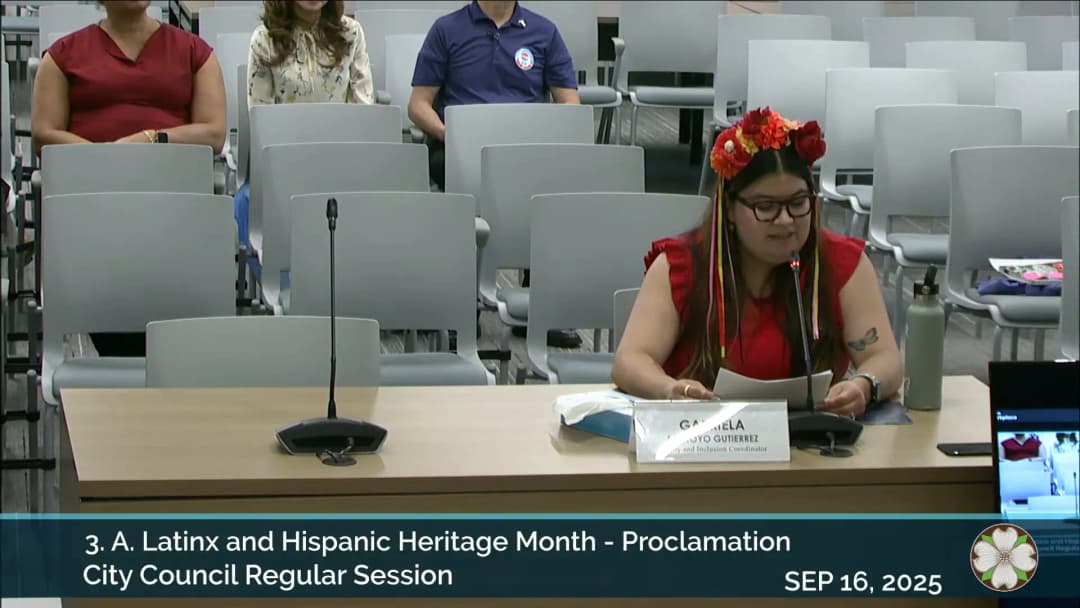
The 2,433rd regular meeting of the Milwaukee City Council was called to order at City Hall and via video conference on September 17, 2025. All five council members were present. The meeting included two proclamations, a presentation on voter registration, approval of the consent agenda, and a detailed discussion on the Transportation System Plan (TSP) update. The council also heard council reports covering topics such as the state transportation bill and the Community Action Board. Proclamations - Latinx and Hispanic Heritage Month (Sept 15 – Oct 15): Presented by equity coordinator Gabriela Santoyo Gutierrez, who highlighted contributions and ongoing challenges faced by Hispanic/Latinx communities. Council members expressed solidarity and reaffirmed the city's commitment to protecting all residents. - Vietnamese American Mid-Autumn Festival Day (October 4, 2025): Presented by Tao Te, president of the Vietnamese Community of Oregon. The festival will be held at Clackamas High School from 1–5 p.m. The council adopted the proclamation unanimously. Consent Calendar - Approval of minutes from the August 19, 2025 work session and regular session. - Resolution appointing George Stier to the Planning Commission. - Resolution (as local contract review board) awarding a contract for the King Road Improvements Project. All consent items were approved unanimously. Public Comments & Testimony - National Voter Registration Day: Clackamas County Clerk Catherine McMullen presented and encouraged residents to check registration, sign up for ballot tracking, and make a plan to vote. No other public comments were received. Discussion Items - Transportation System Plan (TSP) Update: Planning manager Laura Weigel, city engineer Jennifer Garblik, and consultant Matt Huebert presented the project prioritization process. The data-driven process produced a tier‑one financially constrained project list totaling approximately $29 million, exceeding the projected funding capacity of $27.5 million (125% of available funds). Three advisory groups (TSPAC, technical committee, planning commission) refined the list, shifting some projects and adding small gap‑filling projects. Specific projects discussed: - Harrison Street sidewalks (P16/P17): partly moved to unconstrained due to existing buffered sections. - 37th & Railroad left turn (R25): moved down as capacity needs were not compelling. - Pedestrian/bike connections on 42nd Street (B26) and 34th Street (B64) were deprioritized. - Council raised concerns about safety at the River Road/99E trolley trail intersection (R6) and crossing at 37th & Minthorn. Staff noted updated project descriptions and future RAFA grant opportunities. - Funding Gap and State Transportation Package: Council President Anderson noted a pending state package could increase annual state highway fund allocations by about 25% (approx. $11.7M over 20 years), potentially bridging the $2M gap. Council agreed to discuss this further on October 21, but cautioned against assuming future funds. - Classification and “20 is Plenty” Proposal: A project to replace speed limit signs on certain roads (cost $400,000) was introduced as a potential policy direction. Council requested more data on effectiveness from cities like Portland before moving forward. Staff will bring a public engagement survey and data analysis to the November 18 council meeting. Key Outcomes - Consent agenda approved unanimously. - TSP adoption timeline: Next council discussion on October 21, 2025; planning commission hearings in November/December; council adoption targeted by end of January 2026 to meet ODOT contract deadline. - Staff directed to prepare a recommendation for cutting $2M from the constrained list (by moving projects to unconstrained) and to bring funding scenarios based on the pending state transportation package. - Council agreed to explore reclassifications of several streets (e.g., 40th, 42nd, Stanley) and to add missing bike/pedestrian connectivity projects. - The “20 is plenty” speed reduction proposal will be studied further with public input and data analysis, with an update expected in November. Council Reports - Councilor Casaburri reported on the Community Action Board meeting, noting a 74% cut to OHCS rental assistance for FY2025-26 and planning for the 2026 community needs assessment. - Council President Anderson reported on meeting with the district director for Rep. Bynum regarding the Harrison grant, safe routes to school applications, and a town hall on September 29 in Ardenwald. - Councilor Casaburri also expressed concerns about the state transportation bill’s impact on EV drivers (higher fees) and ODOT accountability. Council President Anderson noted that the bill includes some accountability measures but acknowledged the difficult trade-offs. - City staff announced the launch of a new meeting records website and urged the public and council to register for email notifications at milwaukie.gov. Adjournment The meeting adjourned without further business.
TRANSPORTATION SAFETY 31% · ENGINEERING AND INFRASTRUCTURE 16% · PROCEDURAL 10% · PUBLIC ENGAGEMENT 8%
42
SEP 16, 2025 · MILWAUKIE, OREGON · CITY COUNCIL
Milwaukee City Council Work Session on Transportation SDCs, Utility Code Update, and Leadership Academy – September 16, 2025

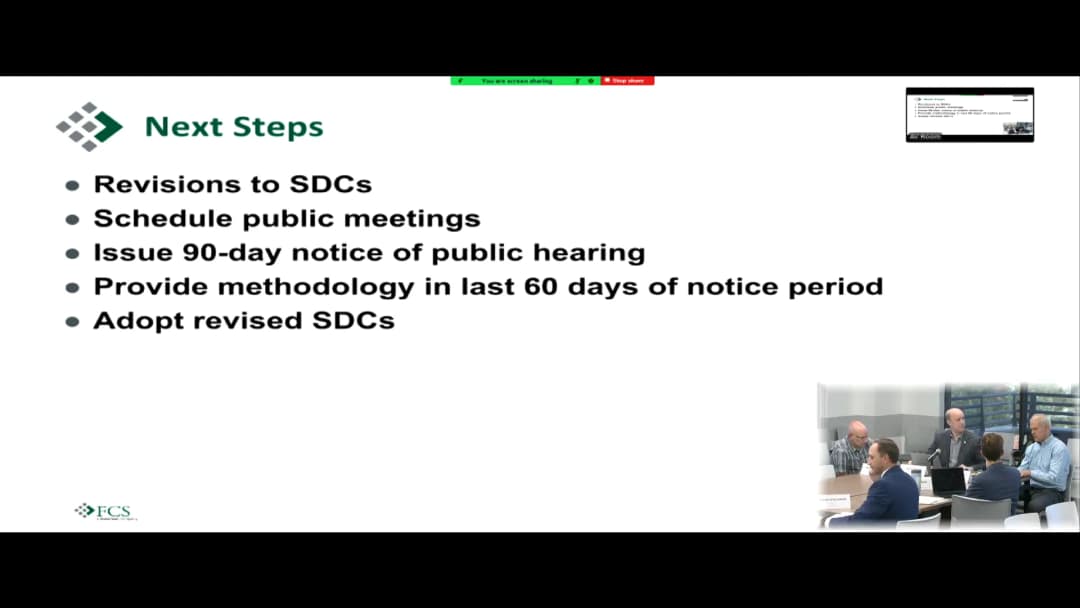
The council held a work session covering three major topics: an update on transportation system development charges (SDCs), proposed amendments to the utility code, and a report on the Milwaukee Leadership Academy. No formal votes were taken; the session was informational and directive. Discussion Items Transportation System Development Charges (SDCs) - Peter and John from FCSG presented an overview of SDC methodology, focusing on transportation. They explained the two components: reimbursement fee (buy-in to existing capacity) and improvement fee (future growth projects). The calculation uses a denominator of growth in peak hour person trips, derived from the city's 2018 Transportation System Plan (TSP) and national trip generation factors. - Key statistics: Current SDC for a single-family residence is $2,470; the legally defensible maximum calculated is $3,982 (based on a combined CIP/TSP list). The improvement cost basis is $5.5 million, reimbursement cost basis $611,000, and total cost basis $6.18 million. Growth is projected at 2,300 PM peak hour person trip ends (converted from vehicle trips using a factor of 1.58). - Council members asked about measuring unused capacity, inclusion of bike/pedestrian projects, and the effect of the city's climate action plan. Staff noted that the TSP update (expected December 2025) will revise project lists and assumptions. - A comparison of regional SDCs showed Milwaukee at the bottom, even with the maximum charge. Staff discussed scaling options (by dwelling unit size, proximity to transit) and recommended that any discounts for affordable housing be backfilled to avoid undermining the SDC fund. Utility Code Update - Finance Director Mike Horn and Peter proposed four clarifications: (1) ownership of service lines – city responsibility from main to meter, property owner from meter to house; (2) temporary water use limited to construction, not general uses like pool filling; (3) leak responsibility based on meter side; (4) flexibility in shutoff dates (currently third Thursday of month) to allow a seven-day window and discretion for the finance director and city manager to avoid holidays or extreme weather. - Council discussed the need for code updates to reflect current operations (e.g., no separate sinking fund, utility bill includes multiple fees). Staff noted that 24 accounts (mostly in Island Station) do not receive city water but still pay public safety and other fees via a separate utility bill. The city is considering future enforcement mechanisms for non-water utility fees. - Council directed staff to proceed with drafting code amendments based on the discussed concepts for a future reading. Milwaukee Leadership Academy - Events and Volunteer Coordinator Dan Paris reported on the 2024-2025 cohort. The academy, facilitated by community member Seth Lashbrook, educates residents on city government. 33 people registered (over capacity), 16 completed more than half of the sessions. There was a drop-off after the November 2024 election. Classes are held third Wednesdays, October through June, with three field trips. The program has produced graduates who serve on boards and commissions. - Council commended the program and noted the increase in board applications this spring, possibly linked to national election engagement. Key Outcomes - No formal votes were taken. Council directed staff to: - Bring back a draft utility code update reflecting the proposed changes and additional cleanup (e.g., removing references to outdated boards, consolidating fees to the fee schedule). - Continue work on transportation SDC analysis, incorporating the upcoming TSP adoption, and consider options for scaling SDCs by unit size, transit proximity, and backfilling any discounts. - The leadership academy will proceed with the 2025-2026 cohort starting in October 2025.

TRANSPORTATION SAFETY 38% · WATER AND WASTEWATER MANAGEMENT 19% · COMMUNITY ENGAGEMENT 16% · ENGINEERING AND INFRASTRUCTURE 10%
43
SEP 11, 2025 · MILWAUKIE, OREGON · CITY COUNCIL
Milwaukee City Council Study Session: Utility Billing Assistance and Capital Improvement Program Prioritization - September 11, 2025

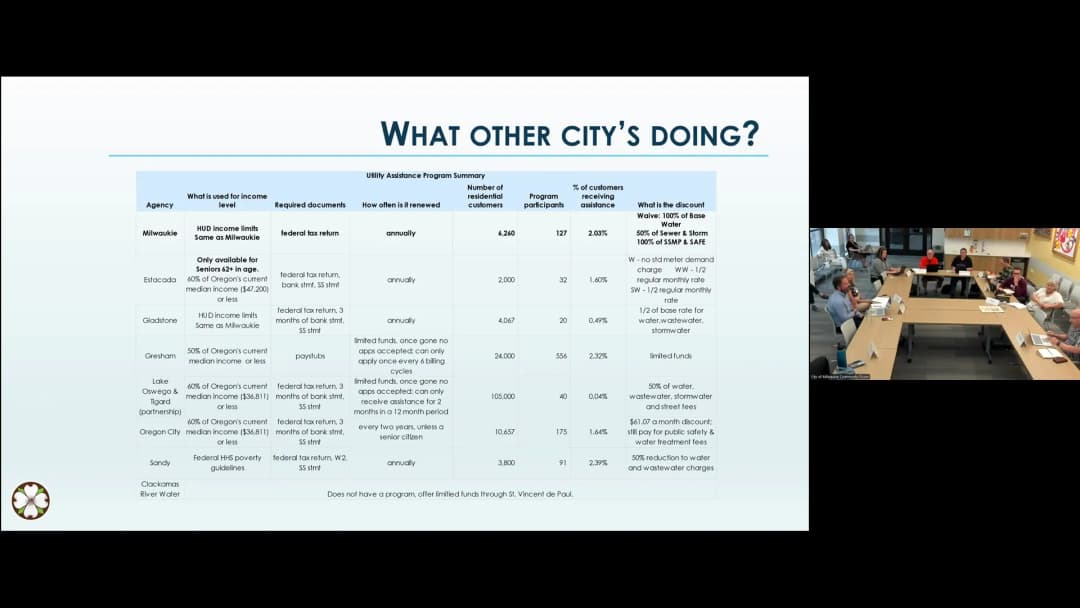
The Milwaukee City Council held a study session on September 11, 2025, to discuss two major agenda items: a presentation on utility billing and assistance programs, and a comprehensive update on the Capital Improvement Program (CIP), including project prioritization criteria and a proposed sewer line relocation project. The meeting included detailed presentations from staff, council member questions, and direction for future actions. Utility Billing and Assistance Presentation - Staff (Michael and Amy Randis) presented an overview of the utility billing department, including duties, monthly cycle, meter reading (currently manual, contracted), and the monthly shutoff process. They noted that the city uses Tyler Technologies software, which is functional but not highly flexible. - The city currently has about 7,000 accounts, with 260 customers receiving past due notices monthly, 75 receiving door hanger notices, and an average of 12 shutoffs per month. The staff emphasized that the low shutoff number is due to proactive outreach by Amy, who handles hard conversations with empathy. - The Utility Assistance Program (UAP) currently serves 127 customers (2% of accounts), with income thresholds based on HUD very low-income (50% of median). The program waives certain fees and provides a discount. Staff also discussed external resources: St. Vincent DePaul ($7,000 city budget), Clackamas County Utility Support, and 211/United Way. An internal hardship fund of $5,000 is also available. - Council discussed three potential changes: (1) increasing enrollment under current thresholds, (2) expanding eligibility to 80% HUD low-income, and (3) deepening discounts. Council members expressed a preference for a sequential approach, starting with outreach to increase enrollment. They directed staff to focus on that first step and report back in December 2025 with results and data on potential rate impacts. - Council also discussed the feasibility of setting a target population and using qualitative data from customer interactions. Staff will explore outreach strategies such as workshops at the library and social media campaigns. Capital Improvement Program Updates and Prioritization Framework - Staff (Jen, Peter, and others) provided updates on several projects: completion of the dog park, Washington area improvements (finishing in October), eight miles of street paving, and a planned one-year pause on slurry seal to develop a five-year plan. The pause will allow for better coordination with other utility work. - Projects in progress: Harvey Street (construction starting mid-October), Waverly Heights (delayed due to easements), Waverly South and 26th Avenue (60% design), and the Monroe Greenway (design phase with public engagement in October). - Staff presented a new prioritization framework for CIP projects, using weighted criteria: policy alignment (weight 3), regulatory compliance (weight 3), asset condition (weight 2), equity (weight 2), environmental sustainability (weight 2), community engagement (weight 2), external funding (weight 2), economic development (weight 2), and sound fiscal stewardship (weight 1). Sample scores ranged from 15 to 41 for various projects. - Council requested more detailed sub-criteria before finalizing the framework. Staff will provide the methodology notes to council for review. The full draft CIP is expected in February 2026. - A major discussion centered on the Kellogg Creek pump station/sewer line relocation project, estimated at $4.5 million. The project is part of a larger dam removal and habitat restoration effort. Financing options include using reserves and a 2.5% rate increase over several years to maintain fund balances. Staff noted that the project would require significant staff capacity, potentially delaying other projects. - Council members expressed varied views: some supported including the project in further CIP planning, while others were concerned about staff capacity and project delays. Ultimately, council directed staff to include the project in future CIP analysis, with further exploration of external funding and partnership opportunities. Council also emphasized that the project team should bear the primary delivery burden, not the city's staff. Key Outcomes - Council directed staff to prioritize increasing enrollment in the existing Utility Assistance Program (UAP) before expanding eligibility or deepening discounts. Staff will report back in December 2025 with outreach results, data on target population, and rate impact analysis. - Council directed staff to include the Kellogg Creek project in future CIP planning for further analysis of rate impacts, staff capacity, and potential external funding. Staff will return in November 2025 with more details on trade-offs and financing options. - Council will receive the detailed sub-criteria for the CIP prioritization framework for review before the November meeting. - The Mayor shared historical information about the naming of Harvey Street, linked to a 1910 murder trial. The renaming policy will be discussed at the October 21, 2025 council meeting.

WATER AND WASTEWATER MANAGEMENT 39% · ENGINEERING AND INFRASTRUCTURE 30% · PUBLIC ENGAGEMENT 4% · AFFORDABLE HOUSING 4%
44
SEP 3, 2025 · MILWAUKIE, OREGON · CITY COUNCIL
Milwaukee City Council Regular Session and Redevelopment Commission Meeting - September 3, 2025

The regular session of the Milwaukee City Council was called to order at 7:00 p.m. on September 3, 2025, in City Hall and via Zoom. The meeting included announcements, a proclamation, approval of the consent agenda, a discussion on the future of the Milwaukee Station food cart pod, a public hearing and final vote on affordable housing code incentives, a supplemental budget hearing, council reports, and a subsequent meeting of the Milwaukee Redevelopment Commission (MRC). Announcements & Proclamation - Mayor Lisa Beatty read a proclamation declaring September 17–23, 2025, as Constitution Week, noting the 238th anniversary of the U.S. Constitution. Council members added comments about the importance of reading foundational documents and the Constitution app. - Upcoming community events were highlighted: the Milwaukee Environmental Stewards Group’s fourth annual sustainability fair (Sept. 6), a Metro parks and nature workshop (Sept. 7 and Sept. 13), and Saint Stephen’s Serbian Orthodox Church festival (Sept. 13–14). Consent Calendar - The consent agenda, which included minutes from the July 28, 2025 Middle Housing Town Hall, August 5, 2025 work session, and August 5, 2025 regular session, was approved unanimously. Public Comments & Testimony - No public comments were made on items not on the agenda or on the budget adjustments. Discussion Items - Milwaukee Station Food Cart Pod (presented by Assistant City Manager Joseph Rulio): Staff provided a history of the property, acquired from TriMet in 2016, and the Johnson Group’s management of the food cart pod since 2017. The pod currently has 12 carts (near capacity). The Johnson Group wants to sell the business; their lease expires November 30, 2026. Staff outlined two pathways: (1) explore continuation of the current use by working with the Johnson Group to assign the lease to a new entity, possibly with city compensation for the sale (estimated $5,000–$20,000), or via a new RFP; (2) explore alternative uses, including redevelopment per the South Downtown plan. Council members expressed strong support for continuity, citing the value of existing small business owners (BIPOC, women, veterans). Council consensus was to pursue option 1, with staff directed to first discuss compensation with the Johnson Group and quantify city investments in the property. No formal vote was taken. - Affordable Housing Code Incentives (continued public hearing): This was the second reading and final vote on Ordinance ZA 202503, amending the zoning code to provide incentives for affordable housing. The first reading on August 19, 2025, passed 3–2, requiring a second vote. The ordinance passed again by a 3–2 vote (Council President Anderson, Councilor Staven, Councilor Councilbadi in favor; Councilor Massey and Mayor Beatty opposed). The ordinance was adopted as Ordinance 2256. - Quarterly Budget Adjustments (Supplemental Budget for Building Division): Assistant Finance Director Matt Deans presented a supplemental budget to move $430,000 from contingency to the building department line item, funding two new positions (an inspector/plans examiner and a development coordinator) due to high development workload. The adjustment required a public hearing per state law because it exceeded 15% of the building fund budget. No public comments were received. The resolution authorizing the supplemental budget passed unanimously. - Council Reports – Dispute over Communication: Councilor Massey (Mayor) criticized a newsletter sent by Council President Anderson regarding the affordable housing vote. Massey stated the email misleadingly implied that the two dissenting councilors did not acknowledge the affordability crisis, arguing that a delay would have allowed improvements. Massey also disputed the claim that middle housing sells for $300,000 less than single-family homes, citing Redfin data showing a $161,000 difference. Council President Anderson responded, defending his newsletter as a way to engage the public and noting that the council had a productive and respectful disagreement. Other council members urged private conversations and better communication. The exchange concluded with both expressing willingness to work together. Key Outcomes - Consent Agenda: Approved unanimously. - Milwaukee Station Food Cart Pod: Council directed staff to explore continuation of the current use, beginning with negotiations with the Johnson Group on lease assignment and compensation. Staff will also quantify city investments in the property. - Affordable Housing Code Incentives: Ordinance 2256 passed 3–2 (Anderson, Staven, Councilbadi in favor; Massey, Beatty opposed). - Budget Adjustments: Supplemental budget resolution approved unanimously, authorizing $430,000 for two new building division positions. - MRC Meeting: The Milwaukee Redevelopment Commission approved the minutes of June 3, 2025. Executive Director Joseph Rulio reported that $1 million has been reallocated from construction to the URA grant program, which will reopen for applications. The program will be combined with a citywide program using CET funds. No formal votes were taken on the reallocation. Additional Statistics from Council Reports - Councilor Massey (Mayor) shared data from a C4 retreat presentation by Mary Rumbaugh: In Clackamas County, unsheltered homelessness increased from 2023 to 2025, but chronic homelessness declined. 20.5% of the houseless population is over age 65. On average, 74% of a monthly Social Security check goes to rent. 38% of the homeless count is outside the Metro urban growth boundary, though only 24% of the county population lives there. - Councilor Massey also noted that NCPRD senior services budget cuts (eliminating Fridays at the Milwaukee Community Center, the transportation program, and the Recmobile) will proceed in January 2026. - Councilor Coats (Council President) acknowledged the summer events organized by neighborhood groups, noting that NCPRD permit fees increased and the city provided an additional $400 stipend to defray costs.

PROCEDURAL 56% · ECONOMIC DEVELOPMENT 27% · AFFORDABLE HOUSING 8% · HOMELESSNESS 5%
45
SEP 2, 2025 · MILWAUKIE, OREGON · CITY COUNCIL
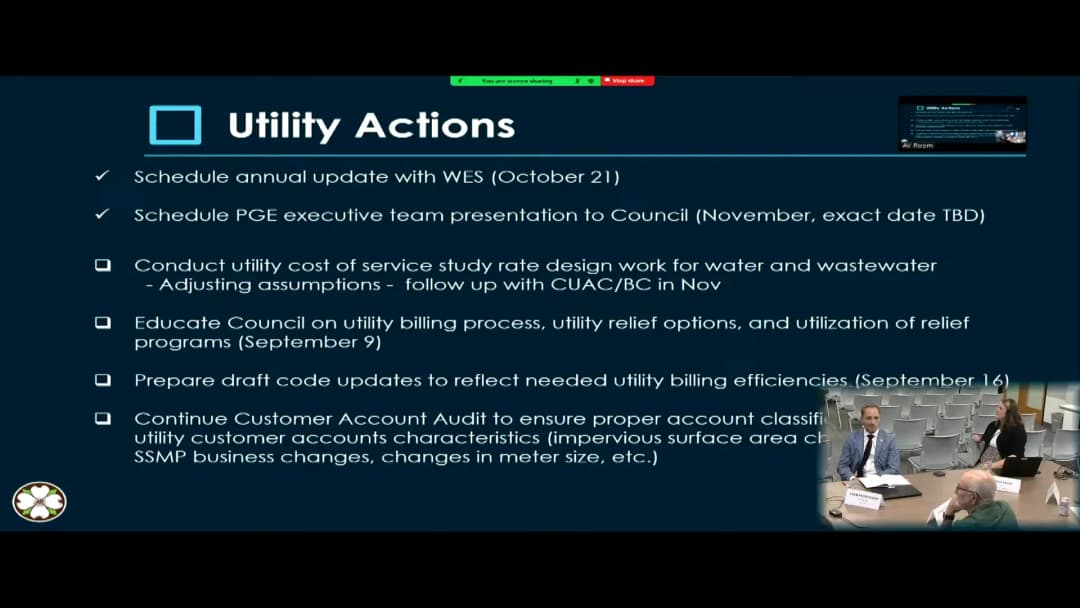
City Council Work Session on Utility and Housing Affordability – September 2, 2025

The City Council held a work session on September 2, 2025, to review progress on the affordability goal, including utility rate studies, housing development strategies, and proposed tenant screening reforms. Staff provided updates on Q2 and Q3 accomplishments, and council discussed upcoming actions and connected affordability priorities to budget development. Discussion Items - Staff Recap (Q2/Q3): Public Works Director Peter Pasarelli, Assistant City Manager Joseph Relio, and Finance Director Michael Osborne presented accomplishments. On the utility side: solid waste rate updates in June, fee schedule revisions as part of financial stability strategy, and initiation of a water/wastewater cost‑of‑service rate design study with a consultant. Peter noted that a low‑interest state revolving loan (up to $6 million, with about $3 million forgivable) is available for water treatment work, pending a feasibility study. On housing: the draft affordable housing code was completed and voted on by council two weeks prior. The Sparrow project RFP launched August 15, with a mandatory site visit on September 9; one neighbor attended the initial neighborhood meeting. Interest from developers is higher than expected. - Council Goal Lead Report: Councillor Costarabati reviewed council accomplishments: completion of the goal action plan aligned with CAV strategic plan; selection of new budget/QuAC committee members; fee schedule adoption; advocacy with Metro and WES on rate transparency and low‑income discounts. He highlighted a meeting with Congresswoman Dexter’s office to discuss federal affordability policies. - Affordability Priorities from Budget Committee: Councillor Costarabati summarized consensus from the June budget committee: expand existing utility assistance programs before creating new discounts; consider setting maximum reserves for water funds; adopt realistic capital budgeting; expand incentives/disincentives (e.g., conservation discount, tree rebate). Staff noted that only a small fraction of eligible households currently enroll in the low‑income utility assistance program, and barriers (language access, outreach) need to be addressed. - Tenant Screening Fee Proposal: Councillor (likely Councillor Massey) introduced a proposal to cap screening fees and require landlords to accept portable tenant screening reports. Options presented: require landlords to accept one‑to‑three city‑approved portable reports, or if they opt out, cap fees at $10. Discussion covered enforcement challenges (complaint‑driven model, parallels to unenforced home energy score requirement), potential inclusion in a broader rental registration program, and the need for stakeholder engagement with Multifamily Northwest and tenant advocacy groups. Council agreed to continue the conversation as part of the upcoming housing production strategy work session in October. - Other Reports: Councillor Massey updated on the state transportation package (passed Oregon House, payroll tax sunset in 2028; TriMet still faces service cuts); the TSP project list is coming to council on September 16. Councillor Staven George reported on the PARP meeting (bylaws adopted, officer elections in September). Councillor Anderson alerted council to the Metro community choice workshop on September 7. The council also discussed the need to sharpen policies regarding meals for elected officials in light of the OGEC ethics opinion; consensus was to adopt a model ordinance from a sister city. Key Outcomes - Direction to staff: Explore a rental registration program as part of the business registration code update; coordinate with the public works department on utility billing code cleanup (work session September 16). - Tenant screening: Further discussion will be folded into the October work session on increasing high‑density housing capacity and the November land‑banking strategy session. - Affordability outreach: Staff will develop collateral for utility assistance programs and partner with the Milwaukee Community Center, Wichita Center, and school district to boost enrollment. - Food policy: Council directed staff to bring a draft policy (modeled on other cities) to a future meeting to explicitly address meals as compensation under OGEC rules. - Sparrow project: Developer selection anticipated by end of 2025; council will receive a recommendation for negotiation approval. - Rate study: Draft rate recommendations will be presented at the November QuAC and Budget Committee meetings, followed by final CIP adoption in early 2026.

PUBLIC ENGAGEMENT 27% · AFFORDABLE HOUSING 20% · HOUSING 19% · WATER AND WASTEWATER MANAGEMENT 13%
46
AUG 20, 2025 · MILWAUKIE, OREGON · CITY COUNCIL
Milwaukee City Council Meeting: Stabilization Center Update, Affordable Housing Incentives, and Public Safety Fee Adoption - August 20, 2025

The two thousand four hundred and thirty-first meeting of the Milwaukee City Council was held in person at City Hall and via video conference. The meeting included an update on the Clackamas County Stabilization Center, community comments, approval of the consent agenda, a public hearing on affordable housing code incentives, and a public hearing on a new public safety fee. Key decisions included unanimous approval of the public safety fee and a split vote on the affordable housing incentives ordinance, which will proceed to a second reading. Consent Calendar - Approved minutes of the July 15, 2025 regular session and July 16, 2025 site visit unanimously. Public Comments & Testimony - General Community Comments: Dylan Cruz (Milwaukee resident) spoke about a middle housing town hall, tree code enforcement, and advocated for a waterfront amphitheater and entertainment district. No other general comments were received. - Affordable Housing Incentives Public Hearing: Testimony was provided by Dylan Cruz, Allison Cruise, and Heather Buchanan (all Milwaukee residents). They expressed concerns about potential exploitation of variances, lack of enforcement mechanisms, reduced setbacks, increased height, and the need for explicit language prohibiting height increases on middle housing. They urged caution and clearer protections. - Public Safety Fee Public Hearing: No oral testimony was provided, but written correspondence was noted, including one comment that was more about street maintenance than the fee. Discussion Items - Clackamas County Stabilization Center Update: Mary Rumba, Director of Health, Housing and Human Services, presented an update. The stabilization center has two components: a 23-hour crisis stabilization center (run by Claire Vita) and a housing/case management program (run by Father's Heart). The 23-hour center is for law enforcement and mobile crisis referrals (no walk-ups), with an average stay of 10–11 hours. Construction is on track for completion in October 2025, with a December 2025 opening and a ribbon cutting in early November. A “good partner framework” agreement is being finalized. Discussion included transportation for discharged individuals, integration with Milwaukee’s behavioral health unit, and information sharing under HIPAA. A separate Recovery Campus was also discussed: a two-building campus (withdrawal management/residential treatment and outpatient/transitional housing) on 6.6 acres near the former Clackamas Heights school. Cost estimated at $40 million, half funded; groundbreaking expected summer 2026. The county is working on a universal release of information to coordinate between programs. - Affordable Housing Code Incentives Ordinance: Planning Manager Laura Wingle and Senior Planner Vera Coleus presented the proposed code amendments (new section 19.511). The incentives are for qualifying affordable housing developments (middle housing, mixed-use, multi-unit) with tiered affordability: e.g., 50% of units at 60–80% AMI, or 20% at <30% AMI. Up to 10 variances are packaged, including reduced setbacks (side yard 40%, front/rear 25%), reduced open space (25%), increased lot coverage, building height increase (one story or 20 ft, only in mixed-use and high-density residential zones, not middle housing), reduced bike parking, reduced facade articulation requirements, and reduced window glazing (minimum 12%). Continued affordability: 99 years for rental, 60 years for ownership (staff recommendation; planning commission recommended uniform 60 years). Townhouses: planning commission recommended a 200-foot linear length limit instead of a unit count. The review process is expedited (100 days). Council discussion focused on concerns about detached units, enforcement, tree canopy, and the pace of changes. A motion to adopt the ordinance passed 3-2 (not unanimous), so it will have a second reading on September 2, 2025. Council upheld the 99-year rental requirement and the 200-foot townhouse limit. - Public Safety Fee Adoption: City Manager Emma Sagor presented the rationale for a new public safety fee to address growing demand for services. Since 2020, police calls increased 21% to over 21,000 per year, while staffing has not increased. Behavioral health crises, substance abuse (Milwaukee had the most overdose 911 calls in Clackamas County in 2024), library incidents (327 logged, 35% requiring police), and court dockets at pre-COVID levels all strain resources. The proposed fee: $7/residential, $5/multifamily unit, commercial tiered $5–$50 based on trip data, with a low-income exemption through the utility assistance program. Revenue estimate $900,000–$1 million annually to fund additional FTE (behavioral health specialist, training officer, two patrol officers, two library staff, one court staff). Council discussed transparency, performance metrics, and baselines. The motion to adopt the resolution passed unanimously. Implementation will begin on November or December 2025 utility bills, with ongoing reporting. Key Outcomes - Affordable Housing Incentives Ordinance (ZA-2025-003): Motion to adopt passed 3-2, but not unanimous, requiring a second reading on September 2, 2025. The ordinance was read once in full. Council adopted planning commission recommendations for 60-year affordability (both rental and ownership) and 200-foot townhouse limit. - Public Safety Fee: Resolution adopting the fee passed unanimously. Staff committed to transparent reporting on expenditures and outcomes, and to establishing baselines. - Stabilization Center Update: Noted progress and upcoming ribbon cutting. Council directed staff to continue coordination with the county. - Transportation Bill Letter: Council agreed to send a letter to state legislators regarding the transportation bill, with minor edits.

AFFORDABLE HOUSING 35% · MENTAL HEALTH AWARENESS 16% · PUBLIC SAFETY 16% · ENGINEERING AND INFRASTRUCTURE 12%
47
AUG 19, 2025 · MILWAUKIE, OREGON · CITY COUNCIL
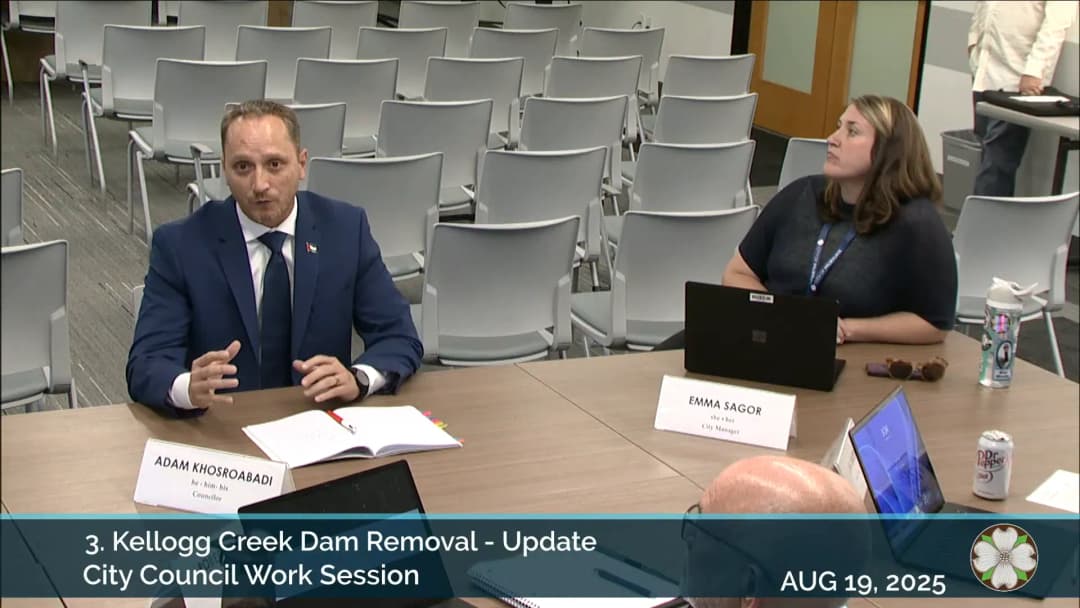
Milwaukee City Council Work Session - Stormwater Plan, Capital Projects, and Kellogg Dam Removal - August 19, 2025

The Milwaukee City Council held a work session on August 19, 2025, to receive updates and discuss several key city projects. Presentations covered the Stormwater System Plan update, completion of the Public Safety Building seismic retrofit and Johnson Creek Campus solar array, and a detailed discussion of challenges facing the Kellogg Dam removal project, including a critical sewer line relocation, conservation easements, and coordination with the Coho development. Councilors provided staff with direction on priorities and requested further analysis. Stormwater System Plan Update - Peter Pasarelli (Public Works) and Scott Bern (consultant) presented the update on the Stormwater System Plan. The project is behind schedule due to data incompatibility issues with the hydraulic model, which required rebuilding and field verification of elevations. The last plan was from 2014. The update will address new regulatory requirements (MS4 permit, TMDLs, UIC dry well rules), climate vulnerability (using climate models to 2080), growth impacts (minimal increase in impervious area), and operations/maintenance standards. Area of concern include the industrial park, Dave Green wetlands, Apple Plum Hemlock (a known flooding area), and the Island Station neighborhood near the railroad. The city is also reviewing development standards, considering adopting Clackamas County's stormwater manual or creating a custom one to reduce administrative burden. The plan is expected to be finalized in spring 2026. Public Safety Building Seismic and Johnson Creek Solar Projects - Mandy (project manager) reported completion of two projects: the Public Safety Building seismic retrofit (completed November 2024, on time and under budget, funded by a $1.2M Business Oregon grant) and the Johnson Creek Solar Campus (completed February 2024, with a 164.8 kW system providing 85-90% of building load, also under budget). The solar project was funded by a $375,000 Department of Administrative Services grant. Councilors praised the work and inquired about potential battery storage for resilience, which staff indicated is being explored for a future phase. Kellogg Dam Removal Project – Sewer Line Relocation, Conservation Easements, and Coho Coordination - Joseph Relio (Assistant City Manager) and Jim Barley (Public Works Director) led a discussion on three critical issues for the Kellogg Dam removal project. - Sewer Line Relocation: A gravity sewer line on the project site (serving Lake Village Apartments and other areas) must be relocated to allow full floodplain restoration. Three options exist, with the preferred being a pump station to pump sewage up to Lake Road. Estimated cost is $3.5–5 million for construction, plus ongoing operations and maintenance (estimated at 0.5 FTE and 160 hours/year for two maintenance staff). The sewer line is not currently in the CIP. Councilors Massey and others expressed concern about the impact on wastewater rates and the city's affordability goals, especially given other significant projects (e.g., PFAS treatment). Councilor Massey noted the worst-case risk that if the dam removal project loses funding, the sewer work would be a stranded cost. Staff will work with rate consultants to provide a detailed rate impact analysis and explore funding options (e.g., Clean Water Revolving Loan Fund with potential $2M forgiveness, state and federal appropriations). Council did not give a definitive yes/no but directed staff to proceed with gathering information and to prioritize ratepayer impact. - Conservation Easements: The project will lower water levels after dam removal, potentially affecting 20 private properties along the creek. The city may need conservation easements from all property owners to satisfy federal and ODOT funding requirements. If voluntary agreements cannot be reached, the city might need to consider eminent domain, which grants do not cover. Staff are working with Metro to begin negotiations. Councilors noted that many property owners may simply choose to fence their property lines, but the legal necessity of easements is still being clarified. No formal decision made; staff will continue engaging property owners and return with more details. - Coordination with Coho Development: The Coho housing development project is on a similar timeline and may conflict with Kellogg dam removal design (e.g., a retaining wall at Coho impacts the restoration plan). Staff have been representing both projects as equally important but seek policy direction. Councilor suggested waiting until October 7, 2025, for more information on Coho's status before making trade-off decisions. Council concurred to maintain a parallel approach for now. Key Outcomes - Stormwater Plan: No decisions; staff will continue model runs and return with a draft plan in spring 2026. - PSB Seismic and Solar: Projects completed successfully; council expressed appreciation. - Kellogg Dam Removal – Sewer Line: Council directed staff to provide a detailed analysis of rate impacts, funding options (including revolving loans and appropriations), and operations & maintenance costs before committing to the sewer relocation. Staff to report back at upcoming CIP milestones (September 9 and November budget committee). - Kellogg Dam Removal – Conservation Easements: Staff to begin property owner outreach with Metro; no eminent domain decision made. - Kellogg/Coho Coordination: Council advised to continue gathering information and wait for the October 7 update on Coho before adjusting priorities. - No formal votes were taken; council provided verbal guidance.

WATER AND WASTEWATER MANAGEMENT 52% · ENGINEERING AND INFRASTRUCTURE 17% · ENVIRONMENTAL PROTECTION 6% · PUBLIC CONTRACTING 4%
48
AUG 6, 2025 · MILWAUKIE, OREGON · CITY COUNCIL
Milwaukie City Council Meeting Summary - August 6, 2025

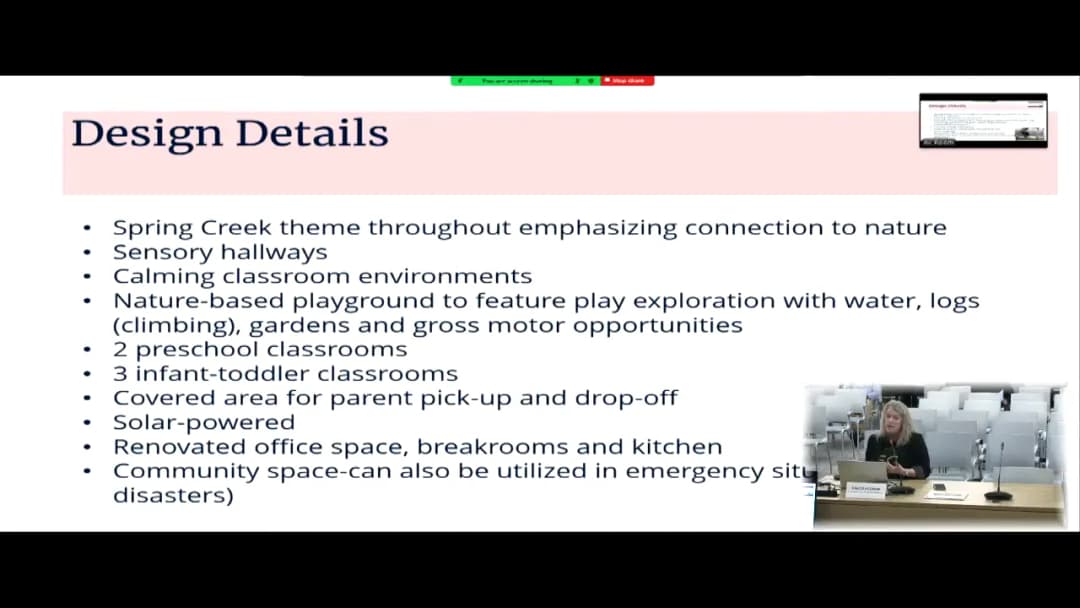
The Milwaukie City Council met in regular session on August 6, 2025, at City Hall and via Zoom. Key agenda items included a proclamation for National Farmers Market Week, a presentation on the Spring Creek Childcare Center, a follow-up discussion on the downtown open container zone, and a major proposal for a new public safety utility fee. The council also heard community testimony and approved routine consent items. Consent Calendar - Approved minutes of the July 8, 2025 special session. - Approved an intergovernmental agreement with Clackamas River Water for the King Road Improvements Project. - Authorized a contract with Topani Inc. for the Harvey Street Improvement Project. - Reinstated an engineering services agreement with OTEC Inc. for property line adjustment services. All consent items were approved unanimously (4-0, including Councilor Stavendort via Zoom). Public Comments & Testimony - Mr. Crawford (Jackson Street resident, Hector Campbell neighborhood) testified against the proposed public safety fee, expressing concern for seniors on fixed incomes and questioning the transparency of adding the fee to utility bills. He stated his property taxes have risen from $1,200 to $5,000 and argued that the city should find other funding sources. He supported additional police and library services but requested a break for seniors. His testimony lasted the allotted three minutes. Discussion Items - National Farmers Market Week Proclamation: Mayor Beattie and Council proclaimed August 3–9, 2025, as National Farmers Market Week in Milwaukie. Shauna Walker of Celebrate Milwaukee and the Milwaukie Farmers Market accepted the proclamation, highlighting the market's 27-year history and acceptance of SNAP benefits. - Spring Creek Childcare Center Update: Darcy Kilsdunk, Executive Director of the Clackamas County Children's Commission (dba CLAKCO Kids), presented plans for the new center at 2992 SE Monroe Street. The center will open in October 2025, featuring two preschool classrooms (capacity 20 each, typically kept at 17) and three infant/toddler classrooms (capacity 8 each), totaling up to 64 children. It will have solar panels with battery storage (pending a PGE grant), a nature-based playground with a water pump and dry creek bed, a sensory hallway, and a classroom that can serve as a community emergency space. This is the agency's fourth Milwaukie location; the agency currently serves 306 preschool and 296 infant/toddler children countywide. In Milwaukie, the need is greatest—children in the area have the highest risk factors in the program. Council expressed strong support and anticipation for the center. - Downtown Open Container Zone Follow-up: Police Chief Ryan Burdick and Captain Tony Cherignino presented the third discussion on this topic. Staff recommended against a permanent open container zone, citing: minimum police staffing of three officers citywide (already stressed), insurance costs ($400–$900 for a beer garden, prohibitive for a broad zone), TriMet restrictions on alcohol on transit property, OLCC volunteer monitor requirements, and potential negative impacts on individuals with substance abuse or behavioral health issues. Conversations with downtown businesses revealed their primary goal is foot traffic, not necessarily an open container zone, and they found the existing event permitting process workable. Council concurred with staff's recommendation to continue the current permit-based approach. - Public Safety Fee Proposal: City Manager Emma, Finance Director Michael Osborne, Library Director Brent Hesher, and Chief Burdick presented a proposed public safety utility fee to address a structural general fund deficit. Since 2020, police calls have increased 21%, while staffing has decreased (fewer officers than in 2002). Overtime averages $410,000 annually. The library sees 600–800 visitors daily (approaching 250,000 annually) and recorded 323 severe incidents or social service referrals in two years, including 67 calls to 911, 97 disruptive behavior incidents, and 26 assaults or threats. A behavioral health specialist (Glenn) works Monday–Thursday only; an additional specialist is needed. The proposed fee would fund: an additional behavioral health specialist, a dedicated police training officer, 2–3 patrol officers, 2 library staff, and 1 court clerk, with an annual cost target of $900,000–$1,000,000. Four rate scenarios were presented; council discussed the need for transparency and low-income exemptions. Currently, the low-income utility assistance program has a 3% utilization rate (about 333 households), but council requested further data on eligibility and enrollment. Councilors expressed support for the fee as a better alternative to a property tax increase. Key Outcomes 1. Public Safety Fee Direction: Council directed staff to move forward with a public safety fee at $7/month for single-family residential, $5/month for multifamily, and a tiered commercial rate ($5–$50/month based on trip generation). Low-income accounts enrolled in the city's utility assistance program will be exempt. The fee will be presented for a vote at the next regular meeting on August 19, 2025, with adoption targeted for fall 2025. Staff will provide additional data on low-income utilization and specific position costs before the vote. 2. Open Container Zone: Council agreed with staff's recommendation to maintain the existing event permitting process and not pursue a permanent open container zone. 3. Consent Agenda: Approved unanimously. 4. Next Steps: Council received updates on the upcoming state legislative special session (August 29, 2025) addressing transportation funding, including a proposed 6-cent gas tax increase and other fee hikes. Council also discussed the potential loss of senior services at the Milwaukie Community Center due to NCPRD budget cuts. 5. Youth Engagement: Council recognized Adeline, a youth ambassador for the Arts Committee, for her active participation in community events.

PUBLIC SAFETY 26% · YOUTH PROGRAMS 14% · PUBLIC ENGAGEMENT 14% · PROCEDURAL 11%
49
AUG 5, 2025 · MILWAUKIE, OREGON · CITY COUNCIL
Milwaukee City Council Work Session: Parks and Green Space Goal Update - August 5, 2025

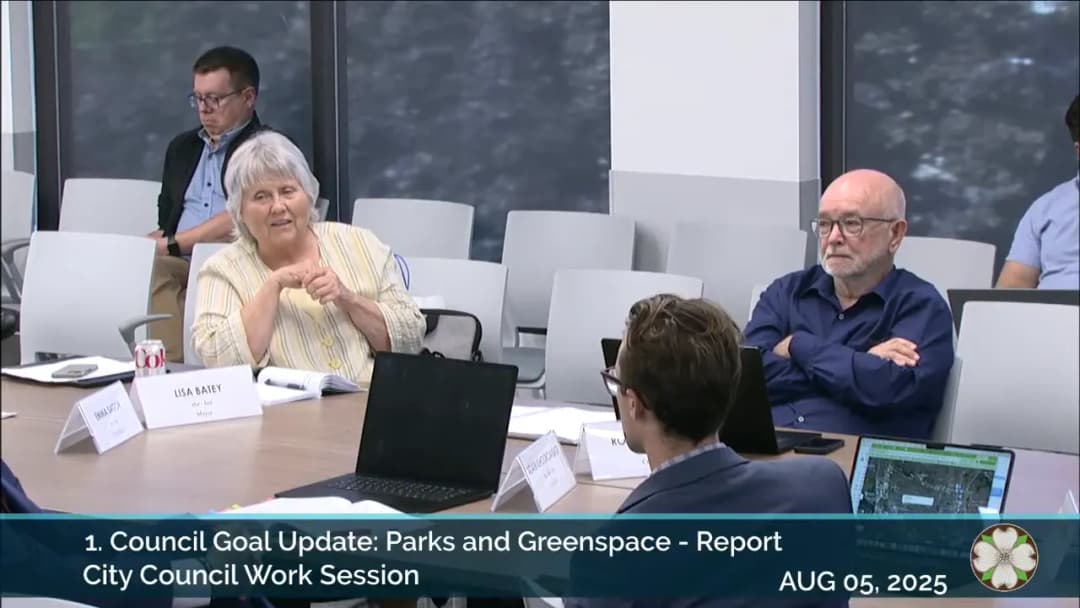
This work session, held on August 5, 2025, focused entirely on updates to the city's parks and green space goal. Staff presented accomplishments from the past quarter, upcoming projects, and sought council direction on several key issues, including the Good Neighbor program, green space accessibility mapping, and ongoing negotiations with North Clackamas Parks and Recreation District (NCPRD) for Milwaukee Bay Park. Good Neighbor Program Update - The first application cycle closed June 30, 2025, with 7 applications received. One application (Johnson Creek Watershed Council) was withdrawn due to inability to secure a property owner agreement. - Staff reviewed applications in July and recommended $188,738 in funding for four projects: North Clackamas Watershed Council (community stormwater engagement), The Wetlands Conservancy (boardwalk in Thorn/Love Springs area), Milwaukee Parks Foundation (Elk Rock Island Restoration), and Bird Alliance of Oregon (backyard habitat and nature walks). Minor modifications to scope are needed for some. - Two lower-scoring applications (a small cleanup event and an ADA bench project) were not recommended. The program's geographic eligibility area was expanded under the new Good Neighbor agreement with West. Three Parks Grant Closeout & Bell Park Safety Issue - Staff announced the successful closeout of all grants for the three new parks: $2.25 million in federal ARPA (COVID) funds, a $300,000 Oregon State Parks grant (second highest rated in state) for Scott Park, and additional Metro and Nature in Neighborhoods grants. - At Bell Park, a playground safety inspection identified a disagreement among experts regarding rocks near the embankment slide. To mitigate liability, staff will add bollards and chains and modify bench rocks to clarify they are not playground equipment. The solution is reversible and funding is available from non-grant sources. Nature in Neighborhoods Community Choice Program - Metro's community choice program received 152 ideas across Clackamas County; over half were in Milwaukee city limits. After filtering ineligible and duplicate submissions, 78 ideas remain and will proceed to public voting. - Voting workshops begin in the fall, with the first scheduled for first Sunday in September at City Hall. Projects are capped at $250,000 with a 30% city match. Projects that qualify for this program may also automatically qualify for larger capital grants (up to $1 million) in future cycles. Staff noted potential synergies with the Good Neighbor program. Green Space Accessibility Mapping - Staff presented draft maps showing city-owned accessible and inaccessible green spaces, 10-minute walk sheds, trails, and the impact of schools. The Trust for Public Land estimates Milwaukee's population coverage at 88%. - Council discussed including schoolyards and church properties as quasi-green spaces. Direction was to build an inventory and categorize spaces by availability (always open vs. limited hours). Trails like the Springwater Corridor were distinguished from road-parallel paths like Linwood and 17th Avenue. - Staff will continue refining the maps and data, with population estimates noted as approximate. NCPRD Negotiations for Milwaukee Bay Park - Councillor Massey and the Mayor reported on four meetings with NCPRD since January. The city's priorities are: substantial delivery by 2027, maintaining the scope of the latest plans, and an equitable funding strategy. - Progress has been made on a cooperative IGA, with staff-level negotiations advancing. The NCPRD board has not yet agreed to move the project from mid-term (5-10 years) to near-term (1-5 years), but the county administrator said they would take it on. - The Mayor expressed concern about timelines, noting that if talks fall through by September, a bond measure for November would be challenging. Council agreed to continue good-faith negotiations but acknowledged that the 2027 deadline may be difficult to meet even under ideal conditions. - Staff will continue working on both the cooperative and construction IGAs in parallel, with a goal of completion in September. Private Events and Commercial Installations in Parks - Staff asked council for direction on two questions: (1) permitting temporary one-day or multi-day events for private profit, and (2) exploring longer-term permanent commercial installations. - Council expressed general support for temporary events (e.g., paddleboard rentals, food carts) but was cautious about permanent installations. Staff will incorporate this into the larger green space management strategy rather than making an immediate policy decision. Council agreed that a dedicated discussion could be added to a future agenda if needed. Preliminary Green Space Acquisition - The Mayor and Public Works Director conducted a tour of potential acquisition parcels. No funding is identified, but staff will continue to develop an inventory of possible properties to fill gaps identified in the accessibility mapping. Partnership opportunities with Metro were noted. Key Outcomes - Good Neighbor program: Staff to proceed with the four recommended applications after minor modifications and will begin second round planning. - Bell Park safety fixes: Staff to implement bollards/chains and signage; funding from non-grant sources. - Nature in Neighborhoods: City to host a voting workshop on the first Sunday in September; staff to continue feasibility analysis. - Milwaukee Bay Park: Staff to continue parallel IGA negotiations with NCPRD, aiming for September completion. Council to evaluate progress and potentially explore alternative strategies if talks fail. - Green space accessibility: Staff to expand inventory to include schools, churches, and other quasi-public spaces, and to refine mapping. - Private events: Staff will include commercial use policies in the upcoming green space management strategy; no immediate regulatory changes. - Green space acquisition: Staff to continue scoping and will report back in a future work session. - LIDAR data: Expected in fall 2026; no update on tree canopy metric in 2025. - The meeting then adjourned to executive session under ORS 192.660(2)(d).

PARKS AND RECREATION 68% · PUBLIC ENGAGEMENT 20% · COMMUNITY ENGAGEMENT 6% · ENGINEERING AND INFRASTRUCTURE 4%
50
JUL 29, 2025 · MILWAUKIE, OREGON · CITY COUNCIL
Milwaukie City Council Middle Housing Town Hall - July 29, 2025

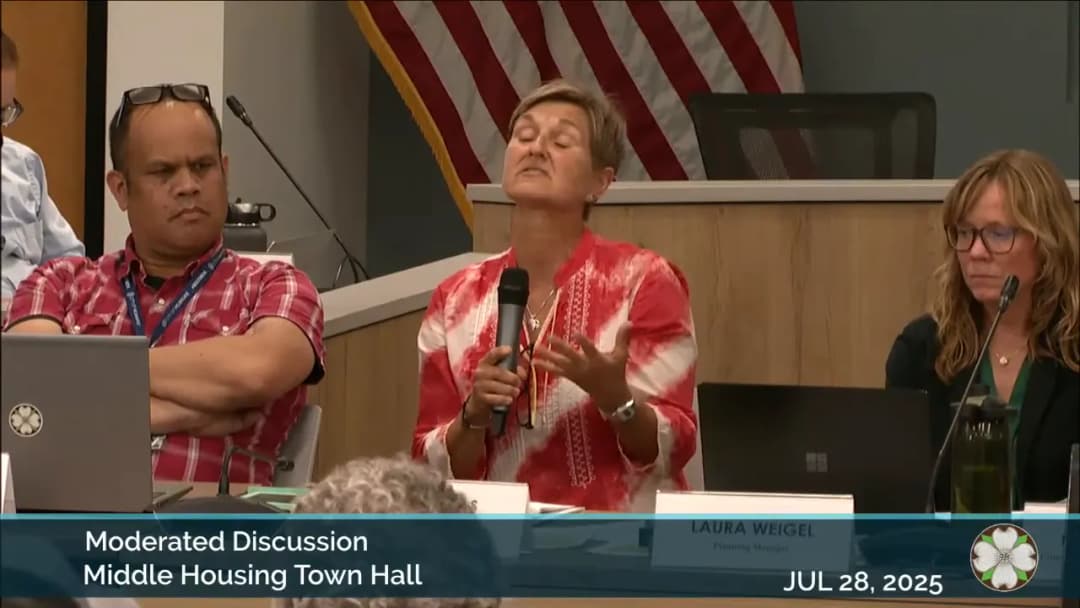
The Milwaukie City Council hosted a middle housing town hall on July 29, 2025, to inform residents about state and local middle housing policies, address questions, and gather community feedback. Presentations from city staff and a state representative covered the history of middle housing, state mandates (HB 2001 and HB 2138), parking regulations under the Climate-Friendly and Equitable Communities (CFEC) rules, the tree code, and the development review process. Public comments raised concerns about parking, tree removal, lot sizes, code enforcement, affordability, and neighborhood impacts. Council members acknowledged limitations imposed by state law but outlined potential local actions. Public Comments & Testimony - Alison Cruz (Milwaukie resident): Expressed frustration that developers clear-cut trees before the tree code took effect and criticized the tree fee-in-lieu option as insufficient. Asked the city to consider minimum lot sizes like Lake Oswego's 7,000 sq ft for detached quadplexes. - Rob Reynolds (Hector Campbell): Questioned what benefit middle housing provides to existing residents, citing increased density, parking issues, and infrastructure strain. He opposed attracting outsiders over caring for current residents. - Sean (Ardenwald, CPA): Argued that cottage clusters are a simulacrum of homeownership, with high debt and little equity growth compared to renting. He described the Proud Ground model as predatory. - Dylan Cruz (Harrison Street resident): Criticized the detached quadplex at Harrison Street as a "race to the bottom" with no trees, tight spacing, and dead replanted trees. Supported minimum lot size review and increased enforcement. - Sally Newson (Ardenwald): Lamented the loss of big trees and the ease with which developers pay fines to remove them. - Joanne Macy (Waverly): Shared a past experience in Portland where neighbors negotiated parking with a developer; asked if similar negotiation is possible now (staff responded no, but residents can engage developers directly). - Dave Ashenbrenner (Hector Campbell): Called for more code enforcement due to overwhelmed staff and unclear parking rules on Home Avenue after reconstruction. - Cheryl (Hector Campbell): Worried about lack of HOA requirements leading to slum conditions; supported infrastructure investment and rezoning for neighborhood commercial. - Kelly Smith Haley (Lidwood): Disappointed that a flag-lot development will build large unaffordable homes without street improvements. - Rita (Ardenwald, on Olsen): Opposed new sidewalks because homeowners must pay for public right-of-way repairs; stressed that seniors and families need cars and parking. - Maya Blanco Chapin (Hector Campbell): Asked about using fee-in-lieu and fee-lock as pushback tools, and whether council members running for re-election would adopt protections; called development a land grab. - Brian Haley (Lidwood): Recounted saving historic trees from a development; asked city to define its identity (e.g., dogwood) and step up enforcement of tree code. - Heather (Hector Campbell): Supported higher fines for tree removal and increased enforcement; noted developers often violate erosion and runoff rules. Also called for more accessible housing (single-story units) and creative parking solutions. - Laura McNani (Hector Campbell): Echoed concerns about parking, trees, and enforcement; said the housing crisis is a federal issue and city should use its influence. - Chuck Letterton (Ardenwall): Raised safety concerns about narrow streets (32nd Avenue) and bike lane enforcement. Discussion Items - Presentations by City Staff and State Representative Sean (DLCD): - Laura (City Staff): Explained middle housing (duplexes, triplexes, quadplexes, townhouses, cottage clusters) and its history in Milwaukie. Noted that 65% of housing is single-family. Cited that 60 units are completed or under construction, with about 100 in pipeline. Average cottage cluster unit price $475,000 vs new single-family $700,000. Emphasized that cities cannot treat middle housing differently from single-family under state law. - Sean (DLCD): Described state mandates (HB 2001 2019, HB 2138 2025) requiring cities to allow middle housing in single-family zones. HB 2138 expands flexibility and removed ability to set minimum lot sizes for middle housing. He personally bought a middle housing unit for $290,000. - Laura: Parking cannot be required in 80% of city due to CFEC rules; city council previously extended that citywide. Tree code requires preservation of 30% canopy, replanting to 40%, with fee-in-lieu (up to $16,000) and bonds for replanting. - Vera (Planning): Explained development review process is the same for single-family and middle housing; both go through by-right building permits. - Jeff (Engineering): Described frontage improvements (sidewalk, curb, gutter, street repaving) required for new development, with option for fee-in-lieu (VLOC). - Emma (City Manager): Summarized constraints: cities cannot impose stricter regulations on middle housing than single-family; cannot require off-street parking in most areas; must adopt state-compliant code; HB 2138 now includes detached plexes. Proposed potential local actions: design standards (if applied equally), parking permit programs, car-share, increased code enforcement, infrastructure investment, and revisiting public works standards. - Council Closing Remarks: - Councilor Stabenberg (Rebecca): Thanked attendees, acknowledged frustration, noted she could not afford her own home today. Emphasized need to balance community character with housing needs. - Council President Anderson (Will): Focused on areas the city can influence: minimum lot size, tree enforcement, higher fees, fee locks, VLOC, and code enforcement. Expressed personal frustration with state eliminating parking requirements after local work. - Councilor Massey (Robert): Called state housing bills an overreach that benefit developers. Committed to pushing back and using city levers like tree code, parking permits, enforcement, walkability, and infrastructure plans. - Councilor (Adam?) (unclear, likely Casravati): Distributed a one-paper with five strategies: green space incentives, parking management, code enforcement, walkable neighborhoods (corner stores), and infrastructure fixes. - Councilor Beatty (Mayor): Cast sole dissenting vote on 2022 middle housing code due to parking; opposed HB 2138 to legislature. Expressed concerns about HOA maintenance and developer profits; prefers townhomes over cottage clusters. Key Outcomes - No formal votes or decisions were taken at the town hall. - Council members collectively identified several areas for potential local action: reviewing minimum lot sizes (though HB 2138 may limit that), increasing tree code fines and enforcement, exploring parking permit districts, enhancing code enforcement staff, incentivizing green space and walkability, and advocating to the state legislature. - City staff will compile all public comments and questions into an event summary to be posted online. - The meeting concluded with an invitation for continued engagement via email, phone, and regular council sessions.

HOUSING 28% · AFFORDABLE HOUSING 28% · PROCEDURAL 13% · TREE PRESERVATION 11%
← PREVIOUS
01…0405
OPENPUBLICA · PUBLIC MEETING INDEXUPDATED DAILY · openpublica.com