Browse by city
Date range
Search help

Search titles, summaries, topics and stored transcripts together. Keywords may match separately; put the whole query in double quotes for a phrase. Matching follows word analysis, so punctuation is not exact. Both dates are included. Documents are not searched.

SHOWING 51–60 ENTRIES
51
MAR 12, 2026 · NORMAN, OKLAHOMA · PUBLIC MEETINGS & LIVE-STREAMS
Committee Discussion on TIF District Process - March 12, 2026

The committee continued discussion on creating a formal policy/ordinance for establishing Tax Increment Finance (TIF) districts. City Attorney Catherine Walker presented a draft policy based on Fort Worth and Olathe, Kansas policies, with modifications for Norman. Discussion focused on application process, stakeholder committee composition, economic analysis, and criteria for residential development. Discussion Items - Draft Policy Overview: The draft policy outlines the purpose of TIF districts as tools for strategic investment in eligible areas (historic preservation, reinvestment, or enterprise zones). It includes a "but-for" test requiring that development would not occur without dedicated TIF funds, even for projects in per se eligible areas. - Multi-Property Requirement: A proposed requirement that TIF districts support development across multiple properties of separate ownership. Councilmember NoFire raised concerns about rural areas (e.g., Ward 5) where a single-property TIF might be needed for a small business like a bait shop/coffee shop. The committee agreed to differentiate urban vs. rural areas, allowing single-property TIFs in rural contexts. - Economic and Risk Analysis Timing: Councilmember Gainesbury preferred conducting the economic analysis after an applicant has shown vested interest (e.g., after application fee is paid) to avoid wasting resources on unlikely projects. The city attorney confirmed the analysis would occur after application submission and fee, not before council involvement. - Stakeholder Committee Composition: The draft proposes a 7-member ad hoc stakeholder committee representing businesses, residents, and nonprofits within the proposed project area or a 350-foot radius. Councilmember NoFire noted that rural areas may lack enough residents within that radius. The city attorney will adjust language to allow a larger radius, similar to zoning notice provisions. - Application Process: Applications will be submitted to the city manager. They must include an economic feasibility study, four years of assessed value data, a project and financing plan with proformas, tax increment projections, and an outreach plan (or a pre-development meeting). The committee favored a pre-development meeting over an outreach plan because it provides a formal venue and minutes. - Application Fee: Set at 1% of proposed project cost, not to exceed $10,000. The fee is refundable if the project plan is adopted and the city can reimburse its costs from TIF revenues. If not adopted, the city retains the fee. - Assistance and Development Financing: The policy includes criteria for developers seeking TIF proceeds after district creation, such as demonstrating a financial gap, providing market feasibility studies, and job creation details. Councilmember Gainesbury asked about small business facade grants, which would not require a full market study. The city attorney will add language to allow flexibility for smaller projects like facade grants. - Residential Development Preferences: The draft expresses preferences for affordable housing, walkability, and aging in place. Councilmembers discussed using HUD's definition of affordable housing, referencing the city's visitability ordinance (recently made permanent) for aging in place, and using engineering design code for walkability definitions. The committee agreed to flesh out these definitions and align with existing city initiatives. - Cannibalization: If a TIF application involves relocating a business from another area of the city, sufficient justification must be included. Existing businesses that relocate into a TIF district will not be counted for sales tax increment purposes. - Future Steps: The city attorney will bring the policy back in ordinance form at the April committee meeting. A study session is planned for June, with first reading and adoption by second reading. The committee will also review a map of eligible areas to discuss rural opportunities. Key Outcomes - Direction to City Attorney: Revise the draft policy to: - Adjust multi-property language to allow single-property TIFs in rural areas. - Modify stakeholder committee radius to accommodate low-density areas. - Add language for small business facade grants and other flexible assistance. - Clarify definitions for affordable housing (using HUD), walkability (using engineering design code), and aging in place (using visitability ordinance). - Reorder the economic analysis questions to prioritize financial success of the TIF district. - Next Meeting: April committee meeting to review the revised ordinance form and discuss the eligible area map.

TAX INCREMENT FINANCING 59% · ECONOMIC DEVELOPMENT 16% · AFFORDABLE HOUSING 13% · ENGINEERING AND INFRASTRUCTURE 8%
52
MAR 10, 2026 · NORMAN, OKLAHOMA · PUBLIC MEETINGS & LIVE-STREAMS
Norman City Council Meeting - March 10, 2026: Proclamations, SPUD Approval, and Weather Recess

The Norman City Council, Norman Utilities Authority, Norman Municipal Authority, and Norman Tax Increment Finance Authority held a joint meeting on March 10, 2026. The meeting featured four proclamations, council announcements, a consent docket, and a major discussion on a proposed Simple Planned Unit Development (SPUD) at 1107-1111 Chautauqua Avenue, 601-615 Hoover Street, and 1010-1030 College Avenue. After extensive public comment and amendment, the council voted unanimously to approve the SPUD on final reading. The meeting was recessed due to a tornado watch, resuming on March 17, 2026. Proclamations - Item 1 – Earth Day & Green Norman EcoBration (March 22 – May 18, 2026): The council acknowledged a proclamation designating April 22, 2026 as Earth Day (55th anniversary) and March 22 – May 18, 2026 as "Green Norman EcoBration." Michelle (city staff) and Katrina Boatler accepted, noting community events including the 26th annual Earth Day Festival at Reeves Park on April 26, 2026 (noon–5 p.m.). - Item 2 – Women's History Month (March 2026): Proclamation accepted with a theme of "Leading the Change: Women Shaping a Sustainable Future." A speaker highlighted historical figures (Susan B. Anthony, Ida B. Wells Barnett, Zitkala-Sa, Fannie Lou Hamer) and current challenges to women's rights. - Item 3 – Public Transit Professional Appreciation Day (March 18, 2026): Proclamation presented by Will Taylor Johnson. Transit staff (Annie Jamerson, Jerry Madden, Todd Marino, Sean Lachance) were recognized. Public transit services travel over 622,293 miles and facilitate over 549,832 passenger trips annually in Norman. - Item 4 – International Compost Awareness Week (May 3–9, 2026): Proclamation accepted; theme: "Compost, Feed the Soil that Feeds Us." Lisa from OK Composts noted events including a compost festival at Scissortail Park on May 9th. Council Announcements - Ward 1: Fundraiser for Center for Children and Families. - Ward 3: Reminder of five propositions on the April 7th ballot; Oklahoma Ethics Commission interim campaign finance reporting system now operational. - Ward 5: Encouraged voting in the April 7th election and a Ward 5 candidate runoff. - Ward 6: Thanked Center for Children and Families; promoted Norman PTA Council's Suite Symphony chocolate festival on March 28th (student musicians can apply to perform). - Ward 7: OU Spring Pow Wow (March 24); medieval fair at Reeves Park (April 10); Earth Day Festival (April 26). - Mayor: Reminder of April 7th voting, voter registration deadline Friday at 5 p.m., and a Ward 5 candidate forum on March 11 (6–8 p.m.). Consent Calendar - Items 5–19 were placed on the consent docket and approved unanimously without discussion. Discussion Item: Item 20 – SPUD Rezoning (1107-1111 Chautauqua Ave, 601-615 Hoover St, 1010-1030 College Ave) Presentation by Councilmember Peacock (Architect of Record) - Councilmember Peacock recused from the vote due to an actual conflict of interest (he worked professionally on the project), but was permitted to present. - Background: The original project (24 units, 21 parking spaces, single access on Chautauqua, 85% impervious coverage) was withdrawn after neighborhood concerns. The revised project includes additional parcels (Hoover and College) and proposes 108 condominiums (larger one-bedroom or 330 sq ft micro-units), 109 parking spaces (88 on-site, 21 on-street, plus 28 spaces for the Lambda Chi Alpha fraternity via a property swap related to Lindsay Street expansion), 40 new trees, 79% impervious coverage, commercial trash service, and two access points (Hoover and College, no Chautauqua access). - The development is consistent with the AIM Norman 2045 Urban Medium land use (allows 3-4 stories, multi-unit housing). The Planning Commission voted 7-0 to approve. - Neighbor requests: A proposed 6-8 ft solid masonry wall was rejected due to safety concerns (CPTED principles); a shorter wall compromise was offered but still under discussion. Additional SPUD language addresses noise, outdoor speakers, events, yard parking, resident-generated litter, and lighting – sent to neighbors on January 28, 2026, with limited feedback received. - Traffic study (TEC): The project generates only 25% of traffic requiring a full impact analysis; no traffic issues anticipated. Amendment by Councilmember Grant - Motion to amend subpart 3M of the SPUD narrative to prohibit outdoor amplified sound similar to a professional sound system. - Several speakers (Barbara O'Brien, Steve Ellis, Mike, Marguerite Larson, Sarah Wallace) spoke in favor, citing existing noise issues from the Kappa Sigma house (professional sound systems, DJs, laser light shows). - The amendment passed unanimously. Public Comments on the Amendment - Speakers asked for stronger language (no DJs or light shows) and expressed concern that short-term rentals could undermine the intended young professional demographic. Public Comments on the SPUD (as amended) - Stephen Ellis (Ward 4): Questioned the value of the SPUD to the city; predicted the units would become "football flats" and short-term rentals, not housing for young professionals. Suggested an amendment banning short-term rentals. - Marguerite Larson (Ward 6): Supported the short-term rental concern, citing negative impacts on neighborhoods. - Luigi Povani: Opposed demolition of existing "cute houses" that define Norman's character; supported density in other forms. - Fred Schmidt (University Lutheran Church): The church was caught off-guard by the first reading on February 24 (12 days after Planning Commission, vs. the expected three weeks). Requested more time to negotiate with the developer. - Joe Grabowski: Noted that with 108 units and only 88 off-street spaces, the parking ratio is 0.88:1, inadequate for multiple-vehicle households and guests; parking will overflow into the neighborhood and church lot. - Sandra Longcrier: Proposed a floor amendment to limit the project to 3 stories and 99 units, citing Census data that suggests 109 cars would be generated for 108 units, but only 88 spaces are provided. - Doug Bowden: Raised stormwater concerns: 79% impervious coverage will increase runoff; proposed infiltration trenches may not work in clay soil; requested soil testing before approval. - Sarah Wallace: Stated that despite developer claims, neighbors have not had sufficient opportunity to add covenants to the SPUD; asked for safeguards (noise, parking enforcement). - Barbara O'Brien (1124 Chautauqua, across from site): Described decades of noise from fraternities; asked for no outdoor speakers, sound systems, DJs, or light shows; urged council to change city ordinances to prevent nuisance behavior. - John Kaufman (725 Hoover St, 26-year resident): Stressed existing traffic/parking congestion on Hoover; worried that adding 108 residents will worsen conditions; urged a wall on Chautauqua to prevent shortcuts. - Kathy Bowden (University Lutheran Church, 33-year member): Noted church parking lot is directly adjacent; feared overflow parking and short-term rentals, which would increase noise and security issues; requested removal of STR allowance from the SPUD. - Cindy Rogers: Opposed the project overall. - Chelsea Gravel (Ward 4): Initially opposed the first design, but found the revised design impressive; believes parking shortages and STRs are a developer risk; supports the project. - Carlinda Gravel (Ward 4, First Courthouse neighborhood): Acknowledged that development inevitably reduces quality of life for some; urged council to listen to affected residents. - Miami Windler (Ward 2): Suggested requiring homestead exemptions for condo buyers to prevent STRs. - Terry Bell (Norman resident, University Lutheran member): Noted that the Elmwood area has transitioned to student rentals; church parking is already used by students; fears this project will exacerbate parking and noise issues. Council Discussion - Councilmember Grant: Asked about the financial timeline; developer stated that closing on the Hoover and College properties must happen by Thursday, postponement would kill the project. The developer (a Norman resident) is open to future amendments and plans to pre-sell units. Parking strategy includes potential overflow at Lloyd Noble Center (with shuttle) and talks with OU; a parking study is underway via a pro-housing grant. - Councilmember Hinkle: Asked about the condo owners association; developer plans to either form a POA or hire a property management company. - Councilmember Gansbury: Requested city manager Darrell to work with Police Chief Foster on enforcing noise/nuisance ordinances against the Kappa Sigma house, citing video evidence provided by residents. - Councilmember Bruce: Questioned parking allocation; developer stated micro-units may not come with a parking space, fostering a car-free lifestyle. - Councilmember Grant: Asked about short-term rentals; developer acknowledged they are allowed under existing zoning but is open to setting guardrails. - Councilmember (Ward 7): Noted the site was previously a 24-unit apartment complex (torn down) that had lower impervious coverage (60-65%); believes the SPUD is preferable to what could be built by right (e.g., a six-bedroom, 20-unit project at 1010 College). Supports the project with expectations of continued conversation. Outcome of Item 20 - The ordinance (0-2526-40) was adopted on final reading as amended (including the amplified sound prohibition), with all council members voting in favor. Councilmember Peacock recused from the vote. Key Outcomes - Item 20 (SPUD): Approved 8-0 (with Peacock recused). The rezoning to SPUD will allow construction of 108 condos with specific restrictions on amplified outdoor sound. - Councilmember Grant and the developer committed to ongoing dialogue with neighbors to address additional concerns (short-term rentals, parking, noise). - Request to Police Department: Council directed city staff to work with Chief Foster to enforce noise ordinances at problem properties (specifically the Kappa Sigma house). Recess Due to Weather - A motion to recess to March 17, 2026 at 6:00 p.m. (council chambers) passed by a vote of 8-1 (Councilmember Gansberry voting no). - Items 21 and 22 (plus miscellaneous comments) will be taken up at the reconvened meeting. - The council acknowledged a tornado watch; the meeting ended with an alert for attendees to travel safely.

ZONING AND LAND USE 33% · PROCEDURAL 13% · PUBLIC TRANSPORTATION 11% · COMMUNITY ENGAGEMENT 11%
53
MAR 3, 2026 · NORMAN, OKLAHOMA · PUBLIC MEETINGS & LIVE-STREAMS
Norman City Council Special Meeting – March 3, 2026: FY 2027 CIP Budget and Bond Program Updates

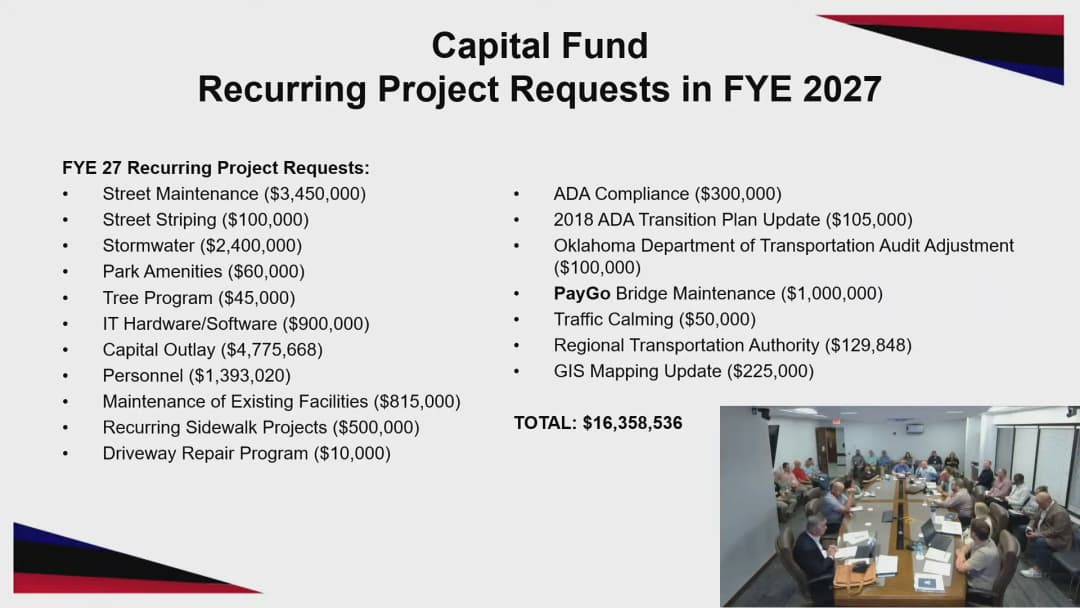
The Norman City Council held a special meeting on Tuesday, March 3, 2026, to discuss the Fiscal Year Ending (FYE) 2027 Capital Improvements Program (CIP) Budget and the FYE 2027–2031 CIP Plan, along with a separate item to consider adjourning into executive session for pending litigation. City staff presented revenue projections, recurring project allocations, and status updates on voter-approved bond programs. No formal votes were taken; the discussion served to guide the development of the preliminary budget, which will be presented to council on May 5, 2026, for adoption in June. Discussion Items - Budget Process Timeline: Budget analyst Jake Huckabee outlined the CIP schedule: March 3 (midpoint review), May 5 (review of the city manager’s preliminary budget), and June (adoption). The preliminary budget will be delivered to council before the April 17 meeting. - Capital Sales Tax Revenue: The city’s capital sales tax (0.7%) generates approximately $17 million annually. Staff proposed allocating $16,358,536 to recurring projects, leaving minimal funds for new projects. The pie chart breakdown: 20% street maintenance ($3.45M), 27% capital outlay ($4.78M), 7% maintenance of existing facilities, and 36% for other projects and debt service (including $10M annual debt service). Council member requested future charts to show debt service as a separate slice. - Recurring Project Requests: Key recurring allocations include: - Street maintenance ($3.45M): alley repair, asphalt/concrete maintenance, crack seal. - Stormwater ($2.4M): Finley Avenue pipe replacement ($1.5M), Forest drainage ($100K), drainage rehab ($400K), Lake Thunderbird TMDL project ($400K). - Sidewalk projects ($500K total): school/arterial sidewalks on Alameda Street, ADA ramps on Brookhollow Road, 50-50 cost-share program ($125K), downtown sidewalk on Garver Street, trails along 12th Avenue NE, and horizontal saw-cut on Northbury Street. - Park amenities ($60K), tree program ($45K), IT hardware/software (major Microsoft upgrade), capital outlay ($4.78M for fleet and computer replacements), personnel costs ($1.39M for capital-funded staff), ADA compliance ($300K + $105K for plan update), ODOT audit adjustment ($100K), bridge maintenance ($1M pay-go), traffic calming ($50K), RTA contribution ($129,848), and GIS mapping update ($225K). - Fleet and IT Replacement Discussion: City staff noted that fleet vehicle costs have nearly doubled over six years (police vehicles from $50K to $80K; fire trucks from $500K to $1M; ladder trucks from $1M to $2M). Staff assured council that Norman’s fleet age and condition are competitive with peer cities (Broken Arrow, Edmond). A council member requested comparison metrics (e.g., average mileage); staff committed to providing data from Fleet Superintendent Mike White. - Street Maintenance Bond Program (2021–26): The $27M, five-year program is nearly complete, with all projects finished on schedule. The final item (urban concrete pavement) is under construction and will be completed before year-end. Voters will consider a renewal on April 7, 2026: a no-new-tax, $35M, five-year bond program covering 180 lane miles (up from 150 in the previous program). - Transportation Bond Programs: - The 2012 transportation bond project (Porter Avenue) received a $25M Safe Streets for All grant; total construction estimate is $32.06M. Phase 2 discussions with OTA continue. - The 2019 transportation bond ($177.2M authorized, $46M issued) has two completed projects (Porter Avenue streetscape and intersection), three underway (Grey Street two-way conversion, traffic management center, Jenkins Avenue – $15.5M with $10.2M in federal funds). Staff is pursuing grants for remaining projects. - Bridge Maintenance Bond Program (2023, $50M over 10 years): $16M issued. Completed four projects, three in design. The Absentee Shawnee Tribe contributed $13.8M for Porter Avenue rehabilitation. FY 2027 requests include design for 72nd Avenue NE bridge replacement and 48th Avenue/Franklin Road bridge rehab ($500K total). - Permanent Homeless Shelter Proposition: Voters will decide on April 7, 2026, an $8M general obligation bond (20-year term) to construct a shelter on Reed Avenue (capacity: 120 people). Operations would be contracted and funded from the general fund, not capital funds. - Public Safety Sales Tax (PSST) Fund: The final critical capital need is the reconstruction and relocation of Fire Station Five (estimated $6.5M). Staff will bring a funding request for design on the next council agenda (March 10). Once the existing PSST bonds are paid off in 2027, the fund will fold into the general fund; council discussed continuing to track it separately for transparency. Also noted: the PSST fund currently overspends its revenue, with the general fund backfilling police and fire personnel costs. - Norman Forward Sales Tax Fund: Major projects (Saxon Park, Canadian River Park) are complete; remaining funds ($11M projected surplus by FY 2031) will be allocated to neighborhood park renovations, trails, and traffic improvements. FY 2027 requests include $650K for neighborhood park improvements, $21K for public art (likely tied to Saxon Park), and a grant match for a Kids Base playground replacement (potential $600K Tset grant). Council is not required to finalize these allocations until future budget amendments. - Midpoint Projections: Staff presented a negative $8,065,697 available for new projects in FY 2027, assuming full spending of previously appropriated funds (which typically does not occur). Staff emphasized the art and science of revenue forecasting, noting past successes and the unpredictable nature of events like COVID. Executive Session - Council voted to adjourn into executive session (per Oklahoma statutes) to discuss pending litigation in Bad Day Towing and Recovery Company, Inc. v. City of Norman, Oklahoma Supreme Court Case No. SD 12329. Key Outcomes - No formal votes were taken on budget allocations. Council provided general direction and requested additional data (e.g., fleet age comparisons, debt service breakdown). - The preliminary budget will be distributed before the April 17 council meeting and formally reviewed on May 5, 2026, with adoption expected in June. - Voters will decide on two ballot propositions on April 7, 2026: the street maintenance bond renewal (no new tax, $35M over five years) and the homeless shelter bond ($8M). - Staff will return on March 10, 2026, with a funding request for design of the new Fire Station Five and implementation of the fire department matrix assessment.

CAPITAL IMPROVEMENTS 26% · BUDGET EQUITY ANALYSIS 17% · PUBLIC SAFETY 16% · ENGINEERING AND INFRASTRUCTURE 10%
54
FEB 26, 2026 · NORMAN, OKLAHOMA · PUBLIC MEETINGS & LIVE-STREAMS
Community Planning and Transportation Committee Meeting - February 26, 2026

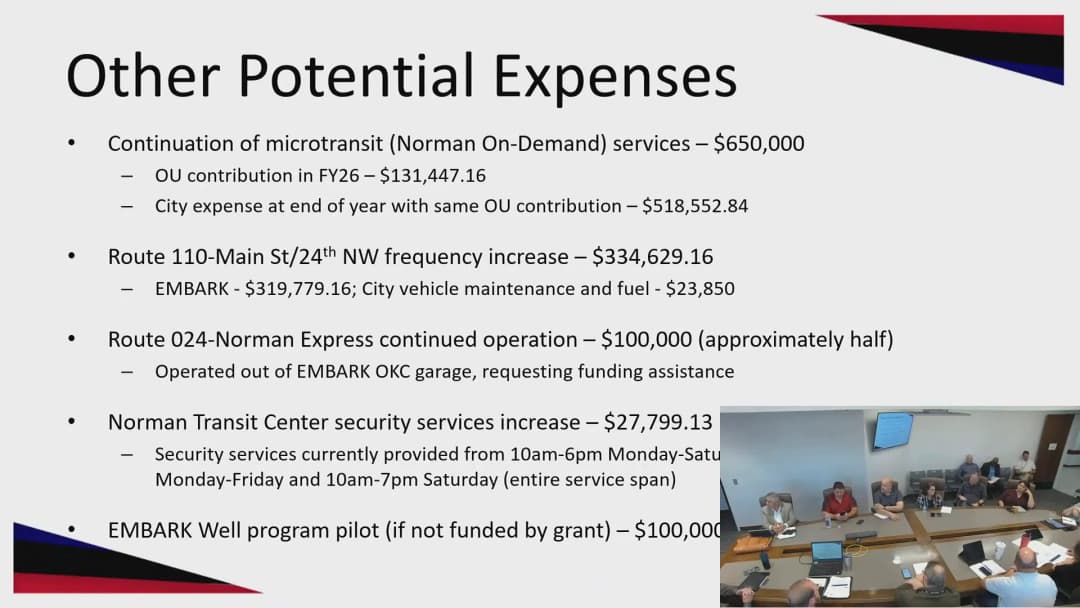
The Community Planning and Transportation Committee met on February 26, 2026, to discuss the January public transit report, the FY2027 transit budget, downtown parking policy, and updates on the Access Oklahoma East-West Corridor project. Staff presented ridership data, budget projections, and parking management changes, with council providing direction on several items. Discussion Items January Public Transit Report - Taylor (City Staff) presented the January 2026 transit ridership report. Total fixed-route ridership was just shy of 35,000 rides, down from nearly 40,000 in January 2025, attributed to one fewer weekday and four weather days. Saturday ridership increased 29.7% across all routes, with West Timpary up 92%. Bikes and mobility devices on buses increased from 608 to 926. Norman On-Demand ridership fell to 1,813 riders from 3,272 in January 2025, following a fare increase implemented in September 2025. The operator is scaling back hours to achieve savings. - Vehicle maintenance updates: Only one bus remains to be replaced; three large buses on order may face cost increases due to tariffs, potentially impacting next fiscal year's budget. FY2027 Transit Budget Discussion - Taylor reviewed the history of transit since the city took over from OU in 2019, including the passage of the public transit sales tax in November 2019. The FY2027 Fund 27 (Transit and Parking) projections show revenues of approximately $6.9 million (including $2.8 million in FTA grants and sales tax) and expenses of about $6.9 million, leaving a surplus of roughly $590,000. Staff proposed several unbudgeted items: - Norman On-Demand continuation: $650,000 (with OU contribution of $131,000, net cost $518,000) - Route 110 frequency increase (to 30 minutes): $335,000 - Potential funding for Route 24 (Norman-OKC) if Embark OKC reduces service - Transit Center security expansion: $28,000 (to cover full service hours) - Council discussed the high cost of microtransit ($21-22 per ride) and the need to balance services. Councilmember Grant suggested scaling back microtransit hours or zone coverage to save money. Councilmember Dixon supported funding security and possibly Norman Express, but not the full microtransit cost. Councilmember Bruce questioned the viability of reducing microtransit to core ADA and late-night functions. - Staff noted the $590,000 surplus would be almost entirely consumed if microtransit and security were funded, leaving no reserve. The city's goal has been self-sustaining transit without general fund subsidy. Council directed staff to work with the operator and OU to identify possible savings in microtransit, while planning to include $28,000 for security expansion. The Route 110 frequency increase was deferred for now. Council also expressed interest in the Embark Well program (pending grant) and increasing microtransit fares if needed. Downtown Parking Discussion - Staff presented an overview of downtown parking, including the new management plan adopted December 9, 2025, which increased Gray Street lot rates from $0.25 to $0.50 per hour and decreased ASP lot rates from $1.00 to $0.50 to encourage use. The map showed various time limits: purple (no time limit), yellow (1 hour), orange (1.5 hours), red (2 hours), and green (paid lots). - Council supported making most timed parking on Main Street, Gray Street, and around the courthouse consistent at 2 hours (red), while retaining the no-time-limit areas (purple) such as near the Well and Jones Avenue. Councilmember Peacock advocated for longer times to encourage lingering. Councilmember Nofire noted consistency reduces confusion and tickets. Commissioner Hughes from Cleveland County requested timed parking (2 hours) instead of paid parking around the courthouse to improve access for taxpayers and jurors. Staff noted that removing the courthouse paid meters would lose about $23,000 in annual revenue, but the Gray Street lot rate increase would generate an equivalent amount, resulting in no net change. - Council directed staff to prepare changes to convert yellow (1-hour) and orange (1.5-hour) zones to red (2 hours) on Main Street and Gray Street, and to replace paid parking around the courthouse with 2-hour timed parking. The no-time-limit areas will remain. Staff will notify downtown businesses and property owners before implementation. Access Oklahoma East-West Corridor Project Updates - Staff provided an update on the OTA project. The bridge over the Canadian River will mobilize in early March. OTA will construct what was formerly Phase II (Franklin Road to Indian Hills), saving the city an estimated $3.5-4 million. The city will contribute $2.2 million plus in-kind services. An interlocal agreement will be brought to council on March 10, 2026. - Upcoming bid lettings: Interchange at 60th Ave NW in August 2026; 48th to 36th Ave section in September; bridge at 48th Ave in October; 36th Ave in November; and section from 36th Ave to I-35 in January 2027. OTA expects east-west traffic from I-44 to I-35 operational by end of 2027. - ODOT's Highway 9 project (from 2024) is substantially complete with barrel removal and striping underway. A longer-term study on Highway 9 from I-35 to East 24th is ongoing, potentially a freeway with overpasses. - Next CPTC meeting will feature ODOT presenting findings from the Highway 9 safety audit. ODOT is also taking public comment on the Robinson to 4th Street corridor study. Key Outcomes - Transit Budget Direction: Council directed staff to budget for $28,000 to expand Transit Center security and to continue Norman On-Demand with efforts to reduce costs (e.g., scaling back hours or zone). Staff will negotiate with OU and the operator. The Route 110 frequency increase was not funded for FY2027. Council will revisit funding for Route 24 next year. - Downtown Parking Changes: Council instructed staff to change downtown timed parking on Main Street, Gray Street, and around the courthouse to 2-hour limits (red), while keeping existing no-time-limit zones (purple). The paid parking around the courthouse will be replaced with timed parking. Staff will notify businesses and implement changes. - OTA Agreement: The interlocal agreement with OTA for the East-West Corridor will be presented to council on March 10, 2026. - Future Discussions: ODOT will present Highway 9 safety audit findings at the next CPTC meeting. The city will continue to monitor transit budget scenarios. Note: No formal votes were taken; decisions were consensus-based directives to staff.

PUBLIC TRANSPORTATION 54% · PARKING MANAGEMENT 20% · ENGINEERING AND INFRASTRUCTURE 7% · BUDGET EQUITY ANALYSIS 5%
55
FEB 25, 2026 · NORMAN, OKLAHOMA · PUBLIC MEETINGS & LIVE-STREAMS
Norman City Council Meeting – February 24, 2026

The Norman City Council, along with the Norman Utilities Authority, Norman Municipal Authority, and Norman Tax Increment Finance Authority, met on February 24, 2026, to conduct a regular meeting. The agenda included the swearing-in of a new council member, recognition of award recipients, approval of a consent docket, and action on several ordinances and plats. Key items included a rezoning for a mixed-use development at 24th and Alameda, a property detachment, and adoption of state-mandated traffic safety ordinances regarding marijuana consumption and handheld device use in school and construction zones. The meeting also featured extensive public comment on the Rock Creek Entertainment District TIFF and other matters. Consent Calendar - Oath of Office: Council Member Elect Robert Bruce (Ward 3) was sworn in by Judge Nichols. - Recognition of Jennifer Baker: The council adopted a resolution honoring Jennifer Baker for her contributions to arts education and receipt of the Arts and Education Award at the 46th Governor's Arts Awards. - 25-Year Service Awards: The council recognized city employees who completed 25 years of continuous service, including a posthumous acknowledgment for Carl Leganis. - Consent Docket (Items 4–26): Approved unanimously. Council Member Peacock abstained from Item 5 due to a professional conflict. The docket included funding for upgrades to Eagle Cliff Park (Ward 7) and a voter-approved park for Sutton Place (Ward 6). Public Comments & Testimony - Rezoning at 24th and Alameda (Items 27–28): Several residents spoke. Cindy Rogers (Ward 4) expressed support for infill but called for updated analysis of stormwater volume and fiscal impacts. Cherilyn Denzel (Wards 4 and 6) supported the project, noting a need for more duplexes. No other public speakers opposed the item. - Detachment of 2800/2801 Hensley Road (Item 29): Cindy Rogers spoke in favor, stating that property owners who do not receive city services should be allowed to detach. Billy Jewell (Ward 5) asked whether approval would set a precedent and raised concerns about environmental regulation and future land use. The applicant's representative clarified that the property is at the end of an unmaintained road and that owners have been refused services. - Marijuana Consumption in Vehicles Ordinance (Item 30): Multiple residents spoke. Paul Wilson (Ward 1) and Steve Ellis (Ward 4) expressed concerns about ride-share drivers and passengers with THC balms/tinctures. Ben Plummer (Ward 4) and Trey Kirby (Ward 5) opposed the ordinance, arguing it targets medical marijuana users and could lead to enforcement issues. Cherilyn Denzel urged adoption for housekeeping consistency with state law. Cullen Beaver (Ward 3) questioned the lack of a measurable impairment standard for marijuana. - Handheld Device Use in School/Construction Zones (Item 31): Paul Wilson supported a broader ban on phone use while driving. Steve Ellis questioned the need for redundancy with state law. Ben Plummer argued against additional legislation. Sherilyn Denzel and Billy Jewell supported the ordinance for safety. A citizen questioned whether manual transmission driving could be considered a distraction. - Miscellaneous Comments: Several residents addressed the Rock Creek Entertainment District TIFF. Paul Wilson, Steve Ellis, Ben Plummer, Trey Kirby, Rob Norman, and others urged the council to repeal the TIFF ordinance and put it to a public vote, citing potential financial risks and the right of voters to decide. John Scammy Horn advocated for homeless relocation programs. Chelsea Gravel warned of state intervention if the budget is in deficit. Ella Crenshaw (Ward 6) requested a four-way stop at James Garner and Acres. Council Member Gandisbury reported on conversations with homeless individuals about shelter needs. Discussion Items - Rezoning and Preliminary Plat at 24th and Alameda (Items 27–28): The applicant presented a proposal to change existing C2 (General Commercial) zoning to a mix of C2 on 1.4 acres and RM6 (Medium Density Apartment) on the remainder, for a 60-unit duplex development with a small commercial building. The site is currently undeveloped but zoned for intense commercial use. Staff found the project largely aligned with the AIM Norman land use plan. The Planning Commission recommended approval unanimously. Council discussion focused on density, park proximity, stormwater detention, and traffic. Council Member Hinkle (Ward 6) voted no, citing numerous protests from constituents. The motion passed 7-1. - Detachment of Property at 2800/2801 Hensley Road (Item 29): Assistant City Attorney Beth Muckala explained that the 20.1-acre property is unplatted and located on the city's southern boundary. All owners signed the petition under state law. The property is accessed by a road not maintained by the city, and owners have been refused services. The Planning Commission recommended approval. Council discussed the lack of city benefits and the unique situation. The ordinance passed unanimously. - Marijuana Consumption in Vehicles Ordinance (Item 30): Assistant City Attorney Jeannie Snyder and Major Barber presented the ordinance to mirror state law effective November 1, 2025. It prohibits driving while consuming marijuana (including medical), inhaling secondhand smoke, and possessing an open container of marijuana in the passenger area. The ordinance allows city citations, reducing officer time compared to state charges. Council discussed enforcement, discretion, and the distinction between impairment and possession. The ordinance passed unanimously. - Handheld Device Use in School/Construction Zones (Item 31): The ordinance prohibits holding a handheld electronic device while operating a motor vehicle in designated school zones and active construction zones, with exceptions for voice-activated use and emergencies. The measure aims to reduce distracted driving and align with state law. Council clarified that the ban applies to any handheld use, not just texting. The ordinance passed unanimously. Key Outcomes - Item 27 (Rezoning) and Item 28 (Preliminary Plat): Approved 7-1, with Council Member Hinkle dissenting. - Item 29 (Detachment): Approved unanimously. - Item 30 (Marijuana in Vehicles): Approved unanimously. - Item 31 (Handheld Devices): Approved unanimously. - Consent Docket (Items 4–26): Approved unanimously, with Council Member Peacock abstaining from Item 5. - Recognition of Jennifer Baker and 25-year employees: Adopted unanimously.

ZONING AND LAND USE 19% · PUBLIC SAFETY 15% · PROCEDURAL 12% · CANNABIS REGULATION 11%
56
FEB 24, 2026 · NORMAN, OKLAHOMA · PUBLIC MEETINGS & LIVE-STREAMS
Norman Forward Financial Update and Potential Project List - City Council Meeting - February 24, 2026

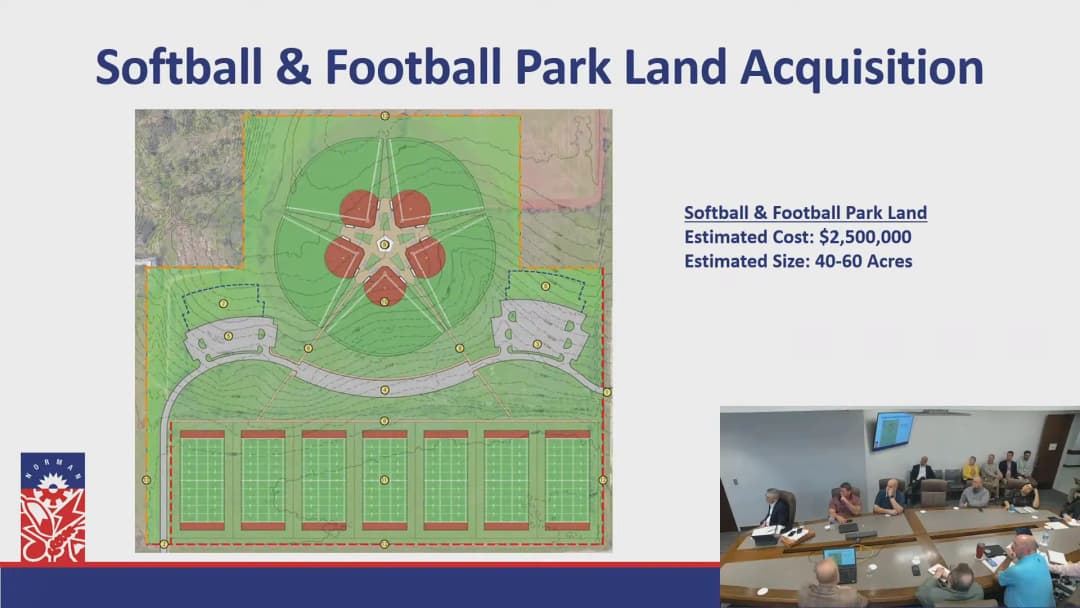
This meeting was a city council discussion regarding the financial status of the Norman Forward program. Jason, Director of Parks and Recreation, presented projections showing a potential remaining fund balance of approximately $11 million after all currently planned projects are completed. He outlined a list of possible projects that could be funded with the surplus, and council members provided initial feedback on priorities. No formal votes were taken; the council directed staff to collect member priorities and return to a future study session or committee meeting. Discussion Items - Jason presented an overview of the Norman Forward program, noting that most large projects are completed or near completion. Remaining projects include Canadian River Park (land acquisition ongoing), Saxon Park (design done, construction likely late spring/early summer), new neighborhood parks (Bluestem and future South Lakes), neighborhood park renovations, and trail development. - Projections (assuming moderate growth) show an ending fund balance of about $10.2 million after all obligations, with Norman Forward revenues ending in December 2030 and debt service extending to 2032. - Jason presented a list of potential projects for council consideration, emphasizing that these were ideas and would go through public input (Parks Board, Citizens' Financial Oversight Board) before final council decisions. The list included: - Purchase of Sutton Wilderness land from the state ($3 million). - Land acquisition for a future softball/football park (40–60 acres, $2.5 million; two sites under consideration: old North Water Treatment Plant and state-owned land). - Adding a multipurpose gym to the Adult Wellness and Education Center ($2.5 million). - Updates to Reeves Park: replacing KidSpace playground ($1 million) and adding a Miracle Field ADA-accessible baseball field ($1.5 million). Note: a $600,000 T-Set grant application is pending. - Griffin Park updates: highly accessible playground ($750,000) and public restroom near dog park ($500,000). - Andrews Park updates: pond construction (with stormwater benefits) and restroom ($2.75 million total). - Young Family Athletic Center (YFAC): weight room addition ($4 million total, with $2 million from the city and $2 million from the Young family), plus paying off remaining YFAC bond ($2.4–2.5 million) to free up guest tax revenue. - Westwood Park: new feature (slide, surf machine, etc.) estimated at $1.5 million. - Sign packages for community and neighborhood parks ($550,000). - Ruby Grant trail upgrades for cross-country (cost not specified; OU interested in co-investment for SEC championships in 2029). - Council discussion: - Councilman confirmed that excess Norman Forward funds can only be spent on projects described in the original ordinance. - Council Grant expressed strong support for prioritizing Andrews Park, noting the lack of restrooms and the stormwater relief benefits. He stated he would rank it number one and suggested holding some funds for maintenance. - Mayor noted the stormwater benefits of the Andrews Park pond, providing relief to downstream neighborhoods. - Council discussed the possibility of using funds for the Central Library building issues, but Jason explained that the building is evidence in ongoing litigation, cannot be altered, and no contractor would accept liability. Key Outcomes - No formal decisions or votes were made. The council directed staff to compile individual council members' priorities from the list and return to a future study session or appropriate committee meeting (e.g., Bocca, Community Planning and Transportation, or Finance) for further discussion. - The Citizens' Financial Oversight Board has suggested setting aside some surplus for maintenance or replacements of worn-out facilities, which will be considered. - Staff will continue to gather input from the Parks Board and the public before making final recommendations.

PARKS AND RECREATION 66% · FISCAL SUSTAINABILITY 24% · STORMWATER MANAGEMENT 5% · PENDING LITIGATION 3%
57
JAN 20, 2026 · NORMAN, OKLAHOMA · PUBLIC MEETINGS & LIVE-STREAMS
City Council Study Session Summary - January 20, 2026

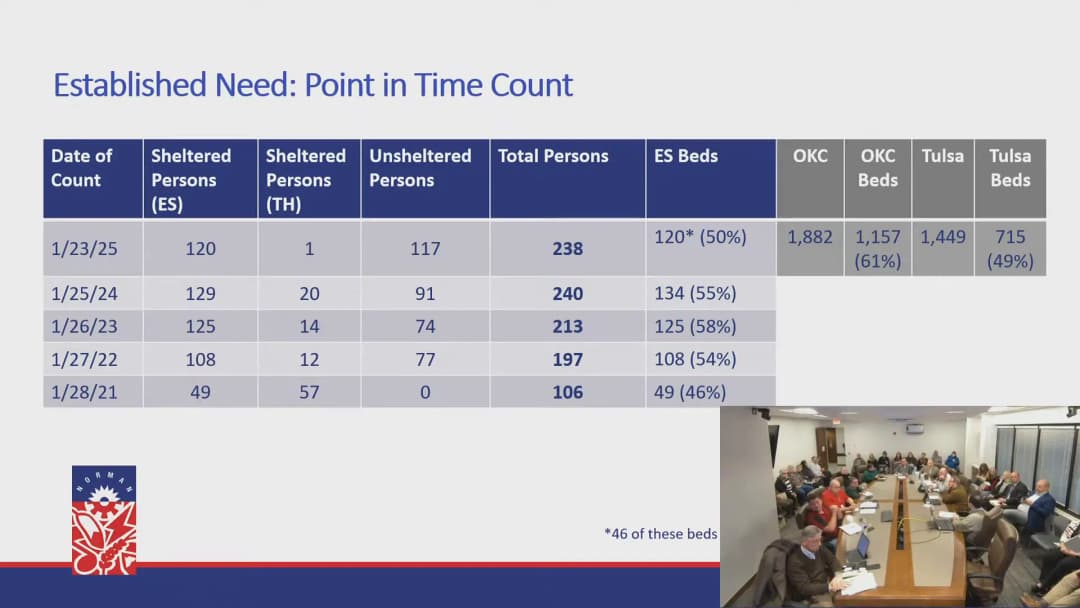
The City Council of Norman convened on January 20, 2026, to discuss five critical agenda items aimed at funding and managing essential city services. The session featured detailed presentations from bond counsel, public works officials, legal staff, and representatives from City Care regarding the city's financial instruments for street maintenance, housing bond propositions, and homelessness strategies. Key discussions centered on the technical requirements for general obligation bonds, the specifics of a five-year street maintenance plan, a comprehensive overview of homelessness due diligence and the proposed shelter model, a transient guest tax increase, and proposed charter amendments. Consent Calendar - No routine consents were addressed during this study session as all items were subject to discussion and debate. Public Comments & Testimony - Council Member Pegar: Expressed support for the necessity of sidewalk maintenance, characterizing it as "low-hanging fruit" given the high community demand, though noted the city's unique ownership cost structure makes it expensive compared to other municipalities. - Council Member Grant: Expressed strong appreciation for the transparency in the street bond presentation, specifically the clarification that road repairs are not contingent on the proposed Turnpike alignment. Council Member Grant also voiced full support for the City Care partnership, noting their rapid integration and positive outcomes as evidence of due diligence. Council Member Grant advocated for holding the ballot in April to ensure maximum voter participation and opposed postponing the Auditor qualification amendment. - Council Member Nofire: Expressed love and support for City Care's passionate work, noting the service is "needed" and praising their data-driven approach to reducing homelessness duration. - Council Member Bruce: Expressed concern regarding the rigidity of the listed 100% street projects in the bond proposition, seeking assurance that the capital budget provides sufficient flexibility for emergent tactical repairs. Council Member Bruce also inquired about the maturity models for shelters, accepting the response that success is measured by competitive grant acquisition. - Rachel Freeman (City Care): Expressed a clear position that the new shelter will not double the city's budget, estimating only a 15% increase, and asserted that the city will not need to underwrite operational costs in perpetuity. She affirmed her organization's commitment to being a "good neighbor" and fully supports community fundraising efforts across Cleveland County. Discussion Items - Bond Counsel Legal Technicalities (Nate Ellis): - Explained that Article 10, Section 27 of the Oklahoma Constitution allows cities to issue bonds for transportation and public utilities via a 50% majority vote, distinct from the 60% requirement for school bonds. - Clarified that for public utilities (like a homeless shelter), the city must "exclusively own" the facility, though it may hire an operator; however, it cannot lease the asset to a private entity for their exclusive control. - Noted that streets are categorized under the "right of way" owned by property owners, hence the exception for the exclusive ownership rule, whereas sidewalks exclusively require a 60% vote due to ownership issues. - Confirmed that the 70% spending rule for identification must be met, but Norman historically identifies 100% of funded projects to ensure compliance. - Street Maintenance Bond Program (Scott Sturz, Public Works): - Presented a five-year ($35 million) bond program (2026–2031) renewing the existing tax. The program aims to increase pavement condition scores from the mid-60s to the upper-70s. - Discussed the classification of road repairs into five categories: urban concrete, urban asphalt, urban reconstruction, preventative maintenance, and rural asphalt. - Reaffirmed that the Turnpike alignment is not a factor in street selection, noting the closest parallel roadway is a mile away. - Clarified that I-35 frontage roads are the city's responsibility, not ODOT's, and are currently in poor condition. ODOT's eight-year plan does not include converting frontage roads to one-way traffic in that stretch. - Explained that preventative maintenance (crack sealing) extends asphalt life significantly and that the city's internal crew is weather-constrained, necessitating contracts for larger projects. - Homelessness Shelter Strategy (Anthony, Shannon Stevenson, Rachel Freeman): - Provided a historical overview from 2019 to present, detailing the transition from temporary sites (Comanche, Gray Street) to a planned permanent facility. - Outlined the due diligence process, noting that multiple locations were vetted (Hunter Drive, 718 North Porter, Griffin Hospital) and rejected due to infeasibility, cost, or accessibility issues. - Confirmed that 718 North Porter was rejected because the building could not accommodate the shelter's elevator access needs and was not ADA compliant. - The new facility will be located at the property currently owned by the city (next to the Health Department), chosen for its proximity to resources. - Operational Model: Defined the shelter as a "night shelter" (flow system) that partners with Food and Shelter for daytime services, not a 24-hour facility. City Care will operate the shelter with a focus on housing navigation. - Financials: Rachel Freeman stated that including housing navigation increases costs by approximately 15%, not 100%. The city expects to reduce operational subsidies over time through grants (e.g., medical respite beds paid for by hospitals) and community fundraising. - Risk Management: Addressed liability concerns; City Care will carry insurance as required, and the contract will delineate the city's responsibility for building maintenance versus the operator's responsibility for daily operations and staff conduct. - Transient Guest Tax Increase (Kathleen Walker, Mason Olson): - Proposed increasing the tax rate from 8% to 10% and adding an RV provision. - Presented two distribution splits: - Proposal 1: Parks receives the entire 2% increase. - Proposal 2 (Preferred): Visit Norman receives 50%, Parks receives 30% (including 1.75% increase), and Norman Arts Council maintains 20%. - Identified a dedicated portion (approx. 0.25% to 0.5% of the rate) to fund a permanent Public Arts program, estimated at over $118,000 annually. - Noted that Norman is currently at the top of the comparable SEC/Texas cities' range (8.5% to 9.25%) and proposed 10% would be competitive. - Clarified that the Arts Council portion is independent of the general arts funding they receive from TIFs and other sources. - Charter Amendments (City Clerk): - Discussed two proposed amendments: extending the Council term start date to 60 days post-election (instead of five months) and adding qualifications for the City Auditor. - Consensus Decision: Council decided to split the amendments; the Auditor amendment will proceed to the April ballot, while the Council term extension will be postponed to a future election (potentially June) to reduce ballot fatigue. Key Outcomes - Bond Proposals: Approved for inclusion on the April General Election ballot, contingent on second reading confirmation. - Street Maintenance Bond: $35 million over five years (renewal of existing tax). - Homeless Shelter Bond: Authorization for general obligation bonds to fund construction of a new homeless shelter facility. - Transient Guest Tax: Proposed increase to 10% with the 50/30/20 split (Visit Norman/Parks/Arts). - Charter Amendments Amendment: Council voted to strike the Council term extension item from the April ballot, isolating the City Auditor qualification amendment for the April election while postponing the term change. - Operational Agreement: Council directed staff to finalize contracts with City Care for the new shelter, maintaining the "city-owned, contractor-operated" model with specific KPIs and risk mitigation clauses. - Ballot Scheduling: Finalized April 22nd as the likely election date, with a note to the City Clerk office by Thursday noon regarding any further objections to the ballot contents. - Public Education: Staff directed to ensure website updates include interactive maps for the street bond and comprehensive data on homelessness efforts prior to the vote.

HOMELESSNESS 40% · TRANSPORTATION SAFETY 14% · LEGAL ISSUES 8% · PROCEDURAL 6%
58
JAN 15, 2026 · NORMAN, OKLAHOMA · PUBLIC MEETINGS & LIVE-STREAMS
Finance Committee Mid-Year Budget Review - Jan 15, 2026

The Finance Committee convened on January 15, 2026, to conduct a mid-year budget review, examine the monthly revenue and expenditure reports, and discuss reserve fund adjustments. Budget Manager Kim Kaufman presented the findings, highlighting fiscal variances from the FY25 audit, the impact of stalled capital projects, escalating health insurance costs, and the stagnation of sales tax revenue compared to pre-2020 growth rates. Council members expressed strong positions regarding contract fairness for School Resource Officers (SROs), the sustainability of current healthcare cost trajectories, and the need for careful capital management. Consent Calendar - Review and discussion of the monthly revenue and expenditure reports for December (covering October–December FY25-26). No formal motions were taken, as the committee reviewed the data to inform ongoing budget discussions. Public Comments & Testimony - No formal public testimony or comments from the general public were recorded during this meeting transcript. Discussion Items - General Fund Fiscal Status and Capital Restrictions: - Budget Manager Kaufman explained that FY25 ended with a fund balance of $11.6 million, approximately $400,000 less than the $12 million budgeted, largely due to unliquidated purchase orders (encumbrances) totaling $3.5 million. - Councilmember (implied) expressed concern regarding the rigidity of the voter-approved seven-tenths of a percent sales tax earmark for capital projects ($18 million annually), noting it creates a "hard string" that limits operational flexibility when new opportunities arise. - The committee agreed that while sales tax revenue has plateaued, the 25% revenue growth seen between FY2019–FY2023 is unsustainable, and future growth is attributed to population increases rather than per-capita retail shifts. - Public Safety Sales Tax (PSST) Fund & SRO Contract: - PSST expenses were lower than budgeted ($2.6M budgeted vs. $212k actual subsidy) due to unused purchase orders, resulting in a fiscal year-end balance of $54,145. - Councilmember expressed strong opposition to the current SRO reimbursement contract with Norman Public Schools, citing a potential $2.2 million discrepancy between the fully funded cost of the program (including overtime) and the actual reimbursement received. - Councilmember positioned the current contract as unfair compared to the Cleveland County agreement, which prohibits overtime and utilizes less experienced officers yet costs significantly less. Councilmember argued that fully trained officers are being overcompensated in the current arrangement while the school district pays less. - Staff indicated that overtime management has improved via active management, but the major and chief acknowledged the pressure of concurrent high school football games driving overtime costs. - Health Insurance and Risk Management: - The Risk Management Fund is in a deficit of $804,445 for the first half of FY26 due to higher-than-anticipated health claims. Kaufman noted that while prescription drug costs are rising, hospitalization and doctor visit costs are decreasing in metro comparisons. - Councilmember expressed skepticism about the sustainability of the current healthcare system, acknowledging that some employees incur half a million dollars in annual prescription costs, which is critical for life or death outcomes but fiscally difficult to sustain. - Staff confirmed that the city is self-insured with a stop-loss cap of $250,000 per person (with a total cap of $5 million), and that the cost of stop-loss premiums is increasing. - Park and Rec / Room Tax Fund: - Parks Department has a negative reserve in FY27, meaning no new capital appropriations are projected for the upcoming fiscal year under current room tax rates. - Public Transportation / Micro-Transit: - The Public Transportation fund (Fund 27) currently requires a $39,000 subsidy. If a $665,000 micro-transit program (added in FY26) is not renewed, the fund projects a surplus of $16,000 in FY27. Council must decide whether to fund micro-transit in FY27 entirely from the General Fund. - Councilmember expressed reluctance to support a request from a commissioner to change downtown courthouse parking to timed parking (hourly) rather than single-day, noting that parking is available in other areas, though acknowledged the revenue potential. - Capital Fund Management: - The Capital Fund holds a healthy balance of $70 million, largely tied to specific bond projects and reserves for existing obligations, leaving $0 available for new projects. - Staff explained that the $4.7 million annual general fund capital outlay is typically fully consumed within the fiscal year by vehicle and computer replacements, with most other requests denied due to rising costs (e.g., fire trucks doubling in price over five years). - Norman Forward Fund: - The fund is projected to have a $7.7 million balance in FY26, growing to $22 million by FY2031 if no new projects are identified. - Council discussed utilizing this surplus for approved but unfunded projects, such as the River Park project, gymnasium expansion at the senior center, turf fields at Griffin, and potential upgrades to Reeves Park. Key Outcomes - Mid-Year Budget Review Adopted in Principle: The committee accepted the staff recommendation to freeze fiscal year 2027 expenditures at current levels (rollover budget) unless significant variances occur. This strategy aims to restore the General Fund balance to a healthier level without entering deficit. - Reserve Fund Decision (Rainy Day): The committee deferred a decision on depositing the $463,021 surplus into the Rainy Day Fund. Staff recommended leaving the funds in the General Fund, as the current balance ($5.32 million) already exceeds the $636,058 minimum requirement, preserving flexibility for future emergencies. - PSST Fund Sustainability: The PSST fund is projected to require a $336,000 subsidy from the General Fund in FY27 to remain in the black, with future years projected to require less as tax revenue grows and expenses stabilize. - Rate Increase Considerations: Wastewater rates are identified as a necessary area for a potential rate increase, likely to be brought to council for voter consideration in November 2026, to maintain the 125% debt coverage ratio for bondholders. - Administrative Directives: Staff was directed to reapproach Norman Regional regarding a potential pharmacy partnership for employee prescriptions and to prepare a report analyzing on-demand parking revenue and enforcement costs for the Finance Committee. - Meeting Adjourned: The meeting concluded with the committee adjourned after reviewing the monthly reports and acknowledging the staff's performance in staying within budget.

FISCAL SUSTAINABILITY 37% · BUDGET EQUITY ANALYSIS 21% · PUBLIC SAFETY 19% · HEALTH INSURANCE 6%
59
JAN 14, 2026 · NORMAN, OKLAHOMA · PUBLIC MEETINGS & LIVE-STREAMS
City of Norman Council Meeting Summary - January 14, 2026

The City of Norman City Council convened on January 14, 2026, to approve meeting minutes, conduct public announcements, and address routine consent items. The meeting featured significant deliberation on a zoning change for a proposed residential development at 765 Jenkins Avenue and the first reading of an ordinance to submit an $8 million bond issue for a permanent homeless shelter to the April ballot. Public testimony reflected a wide range of opinions, including strong support for affordable housing and shelter expansion, alongside deep concerns regarding city finances, the shelter's operating costs, placement in residential neighborhoods, and transparency in development processes. Consent Calendar - Approval of Minutes: Unanimous approval of the minutes for the October 16, 2025, November 18, 2025, and December 2, 2025, City Council meetings; various other board and committee minutes from late 2025; and the City Council Conference Minutes. - Consent Docket: Items 2 through 36 were placed on and approved by the consent docket by unanimous vote. - Postponement of Item 37: The motion to postpone Item 37 (a zoning amendment for a property near US Highway 77) to January 27, 2026, for combined consideration with the preliminary plat passed unanimously. Public Comments & Testimony - Councilmembers' Announcements: Ward representatives reported on community events including a Resource Fair, a Town Hall on voter registration (deadline January 16), a Francis Energy charger ribbon cutting, a household hazardous waste facility sculpture unveiling, and an interfaith breakfast. Councilmember Dixon emphasized the critical nature of the upcoming February 10th local elections, noting many have been decided by single-digit vote margins. - Support for Shelter & Affordable Housing: Cheryl Antenzo supported the shelter bond. Shy Fenwick (Teacher, Ward 5) expressed full support for the shelter, citing the impact of student homelessness on education and the high eviction rates in Cleveland County. Ella Crenshaw (Ward 6) expressed complete favor for the shelter's placement on the East Side, valuing access to community resources. - Concerns Regarding Shelter Costs, Operations, and Placement: - Diana Hudzel, Billy Jewel, Bill Hudzel, and Floyd Carroll expressed strong opposition to the $8 million shelter bond. Hudzel argued the city is ignoring a projected $7.6 million deficit, the opacity of operating costs (estimated $3.6M/year vs. current $1.8M/person), and the plan to rely on vague future funding from "City Care." Jewel noted only property owners fund the bond despite high renter populations. Hudzel suggested utilizing the Salvation Army, citing their lower per-capita cost ($275 vs. City Care's $1,800) and established track record. - Gary King and Floyd Carroll opposed a recent substation approval near a residence, citing misleading information regarding noise, lighting, and chemical use, and requested a reconsideration. - Steve Ellis argued that SPUDs should not be required to be "partners" in developer profitability, suggesting the city should rely on form-based codes instead of project-specific negotiations. - Evan Taylor (Ward 4, resident near the site) did not oppose the shelter but demanded clarity on operational assumptions regarding neighborhood impact before the second reading to maintain public trust. - Dr. John Scammy Horn opposed the shelter's location in residential areas, comparing it to Portland or SF, and argued for prioritizing the 130,000 housed residents over the unhoused. - Sheryl Landinzo warned against TIFs bankrupting the city and urged fiscal responsibility. - Carlinda Gravel (Ward 3) highlighted code violations near the Salvation Army (liquor/dispensary proximity) and expressed concern for an 80-year-old resident at 201 Reed, requesting contractual protections to prevent property value loss. - Ben Plumber suggested banning private equity property ownership and implementing an eviction tax. - Richard Stewickey warned of a potential mass lawsuit from Dalton Lane residents regarding a sewer line failure caused by a city-approved interceptor connection. - Mayumi Windler complimented the new digital agenda format and requested clarification on whether road bonds increase taxes or simply continue current rates. Discussion Items - Item 0-2526-21 (Jenkins Avenue SPUD Amendment): - Applicant Position: Gunnar Joyce (representing Incremental Development) proposed removing the mandatory ground-floor commercial requirement to allow 100% residential use (6 units: 3 units on floors 1-2, communal living on floor 3) due to market feasibility. He highlighted a new paved bike access lane and tandem parking layout, arguing the site is well-suited for student housing and walkability. - Councilmember Grant Position: Expressed support for the changes, specifically the removal of the commercial requirement and the exclusion of short-term rentals from allowable uses. He raised concerns about ADA accessibility and trash disposal logistics. - Councilmember Peacock Position: Requested and was granted an abstention from voting on this item. - Councilmember Bruce Position: Inquired about the sole reason for removing commerciality; the applicant explained that mixed-use financing is difficult and that current zoning language allows commercial as an option rather than a requirement to avoid killing projects. Bruce cast a "No" vote. - Public Comment on Zoning: Cheryl Antenzo opposed the lack of a dumpster on site, fearing sanitation issues with multi-family units. Carlinda Gravel warned the council to be responsive to citizens, referencing past issues with AIM Norman projects. - Staff Response: Utilities Director Chris Mattingley stated that while dumpsters are preferred, the site lacks space for brick enclosures; poly carts are a viable alternative if accessed via the rear alley. The applicant confirmed poly carts would be used and that sanitation details will be finalized during building permits. - Final Vote: The ordinance was approved on Second and Final Readings by a vote of 7-2, with Councilmember Peacock abstaining and Councilmember Bruce voting No. - Item 13 (Homeless Shelter Bond Ordinance First Reading): - The Council considered the ordinance to submit an $8 million bond (first reading) to the April ballot. Mayor Holman noted the bond would cost taxpayers close to $12 million with debt service and that staff would present a conceptual design and cost analysis at the second reading and public hearing two weeks hence. - Council Position: Council members affirmed they will not pursue a pay raise for council at this time due to the city's fiscal deficit but expressed a desire to increase it eventually, noting Norman's rates are significantly lower than neighboring cities. Key Outcomes - Approved Consent Calendar: All routine items (minutes, Items 2-36, and the postponement of Item 37) were approved. - Zoning Amendment Adopted: Ordinance 0-2526-21 amending Section 36-201 Code (removing commercial requirement at 765 Jenkins Ave) was adopted. - Shelter Bond Referral Scheduled: The Council voted to proceed with the first reading of the $8 million shelter bond ordinance. The second reading and a full public hearing are scheduled for the meeting two weeks from January 14, 2026 (January 28, 2026), with a potential final vote to send the issue to the April ballot. - Substation Reconsideration: Council member Gary King filed an order of reconsideration regarding a previously approved substation; the Council acknowledged receipt and invited him to discuss further. - Pay Raise Clarification: Council confirmed they are not advancing a proposal to raise council member pay at this time due to the city's budget deficit.

HOMELESSNESS 16% · COMMUNITY ENGAGEMENT 14% · ZONING AND LAND USE 13% · PROCEDURAL 12%
60
JAN 8, 2026 · NORMAN, OKLAHOMA · PUBLIC MEETINGS & LIVE-STREAMS
Norman Planning Commission Meeting Summary 2026-01-08

The Norman Planning Commission met on January 8, 2026, to consider a rezoning and preliminary plat application for a medium-density apartment development in Ward 6, a petition to de-annex two parcels to the south, and several other zoning amendments. The Commission also addressed public testimony regarding environmental impacts and neighborhood character, and postponed two additional items and a general discussion on traffic signal warranting. Consent Calendar - Approvals of the December 11, 2025, Planning Commission minutes: Passed 7 to 0. Public Comments & Testimony - Patricia Kerr: Expressed concern regarding the interconnected ecosystem of Summit Lake and the stream, noting a decline in bird populations (including whooping cranes and pelicans) due to upstream dam work. She requested an environmental assessment and urged the preservation of bike lanes on Alameda and proper lighting/height considerations to protect wildlife. - JC Crosby: Opposed the project, stating that dense tree removal and creek disturbance would cause erosion and harm to wildlife. They expressed concern that the RM6 zoning allows for three-story apartments in the future, despite current plans being for duplexes. - Matt McDonough: Opposed the project, arguing that high-density housing devalues existing single-family home values. He compared the proposed units unfavorably to the high-value Summit Lake Villas and raised concerns about fire safety, traffic congestion, and strain on local schools (Irving and Washington). - Mary Jean Green: Opposed the project due to concerns over property values and the discrepancy in the protest map count. She questioned the accuracy of traffic studies and raised concerns about the safety of children walking to schools in a high-traffic area. - Rick Green: Opposed the project, citing traffic hazards for elderly residents and questioning the utility of bike lanes due to low usage. He expressed concern about the visual impact of potential three-story buildings and future traffic congestion. - Roger Gallagher: Opposed the project, referencing the history of the Summit Lake dam repair issues and the perceived lack of sufficient spacing between new units. He argued the project has too many faults to be approved. - Ann Gallagher: Opposed the project, requesting clarification on police safety assessments and school overcrowding impacts. She suggested fencing around 24th Avenue for child safety and noted that comparing the project to Summit Lake Villas was inaccurate due to the lack of gated community restrictions. - Susan Parker & Sandra Whalen: Opposed the project, expressing concern that new residents would gain access to the private Royal Oaks lake and walkway, diminishing safety and privacy for current residents who pay for maintenance. - Bonita Kubert: Opposed the project, citing concerns regarding pet density and the proposed egress point through a single-entry residential area causing traffic delays, particularly in icy conditions. - Commissioner McDaniel: Expressed that while traffic was a concern, the project was an improvement over current conditions, noting the removal of a former homeless encampment and expressing support for the preservation of the WQPZ and two-story height limit. - Commissioner Byrd: Expressed support for the project as a better design than previous proposals, noting the need for the city to make recommendations to the Council, though the final decision lies with Council. - Commissioner Griffith: Expressed strong support for the project, noting it reduces the potential intensity compared to the existing C2 zoning, mimics the density of the immediate neighborhood, and creates a necessary buffer between commercial and residential uses. - Commissioner Kindle: Expressed support for the project, acknowledging the loss of habitat but emphasizing the Commission's duty to follow the AIM Norman plan. She encouraged additional landscaping beyond code requirements. - Commissioner McCowan: Expressed support, highlighting that the project downzones the site from C2 and creates a buffer, aligning with city goals to prevent high-intensity commercial development adjacent to residential areas. Discussion Items - Rezoning and Preliminary Plat (Item 2 & 3): The Commission discussed the application by Norman Premium Real Estate LLC to rezone a 10-acre tract from C2 (General Commercial) and R1 to RM6 (Medium Density Apartment) and R1 (retained C2 corner). The proposal includes 62 duplexes and 1.41 acres of commercial space. Staff noted two inconsistencies with the AIM Norman plan: lower density (13.8 units per acre vs. 18 recommended) and lack of building variety. The applicant argued the lower density was due to topography and better suited for the neighborhood, and that the horizontal mixed-use concept aligns with AIM. Public Works clarified that detention ponds could be placed in the Water Quality Protection Zone (WQPZ) but natural vegetation must remain untouched. The Parks Board unanimously voted for a fee in lieu of land dedication to Royal Oaks Park. Commissioners debated traffic, school capacity, and the potential for future three-story buildings (allowed by right under RM6 but currently planned as two-story). - De-annexation (Item 4): The Commission discussed a petition by three property owners to de-annex 20.1 acres from the City of Norman to the unincorporated county. Staff and the applicant stated the owners bear all contracting burdens without receiving municipal benefits, citing the area was annexed decades ago for watershed concerns unrelated to the specific 20-acre parcel. No infrastructure had been installed by the city on the site. - Postponements: Items 5 (Replat at 542/534 S. University Blvd) and 6 (SPUD at 420 E. Lindsey St) were postponed by consent vote to the February 12, 2026 meeting. Item 7 (C1 to C2 at 809-817 26th Ave NW) was withdrawn by the applicant. - Traffic Signal Warranting: General discussion regarding the warranting of traffic signals was postponed to the February 12, 2026 meeting. Key Outcomes - Approval of Rezoning and Plat: The Commission voted 7 to 0 to approve the rezoning to RM6 and the preliminary plat for the Ward 6 site, with the motion noting the developer's commitment to two-story duplexes and the retention of the WQPZ. - Approval of De-annexation: The Commission voted 7 to 0 to approve the petition to de-annex the Hensley Road properties, recommending the ordinance to the City Council for adoption. - Postponements: The agenda items for the replat on South University Boulevard and the SPUD on East Lindsey Street were postponed. The general discussion on traffic signal warranting was also postponed. - Adjournment: The meeting was adjourned after a recommendation to attend a development workshop on February 2.

ZONING AND LAND USE 48% · PROCEDURAL 9% · COMMUNITY ENGAGEMENT 8% · ENGINEERING AND INFRASTRUCTURE 7%
OPENPUBLICA · PUBLIC MEETING INDEXUPDATED DAILY · openpublica.com