Browse by city
Date range
Search help

Search titles, summaries, topics and stored transcripts together. Keywords may match separately; put the whole query in double quotes for a phrase. Matching follows word analysis, so punctuation is not exact. Both dates are included. Documents are not searched.

SHOWING 71–80 ENTRIES
71
NOV 26, 2025 · NORMAN, OKLAHOMA · PUBLIC MEETINGS & LIVE-STREAMS
Norman City Council Meeting - Nov 26, 2025

The Norman City Council convened to finalize the approval of city minutes, acknowledge a Small Business Saturday proclamation, and discuss the acquisition of a new land parcel for a permanent homeless shelter, alongside several public comments regarding neighborhood impacts and future development concerns. Consent Calendar - Approval of Minutes: The council unanimously approved the minutes from various City Council meetings, study sessions, committee meetings, and special meetings held between March 2024 and October 2025. - Consent Docket Approval: Items 3 through 26 were placed on and approved via unanimous consent on the consent docket. Public Comments & Testimony Regarding the Reed Avenue Shelter Land Purchase: Residents expressing opposition/concern (Ward 4 & 7): Multiple residents from the Original Townsite and surrounding neighborhoods (Evan Taylor, Judy Moss, Dan Munson, Misty Lamb, Jeanette Coker, Karen Chapman) expressed strong concerns about the rapid timeline and potential negative impacts on their neighborhoods. Positions included demands for a delay until a formal planning framework, a citizens oversight committee, and a neighborhood impact assessment are established. Residents cited safety issues (theft, drug use, property damage), strain on Bishop Creek watershed, and the impact on existing property values. Misty Lamb and others emphasized that while they acknowledge the need for shelter, the current process moves too quickly and the neighborhood is already in a state of fear, requesting that the city not add a permanent structure without safeguards. Residents expressing conditional support (Ward 4): Steve Ellis expressed support for purchasing the land immediately due to its proximity to services and the need to house the unhoused for winter, but argued that neighbors must have a voice in the design without a veto power. He suggested amenities and potential neighborhood buyouts as mitigation. Cindy Rogers echoed the need to buy the land but strongly advocated for a designated police presence and community policing as a trade-off for the neighborhood impact. John McGraw supported the purchase but emphasized the need for residents to have a seat at the table during the planning phase. Residents expressing support for immediate action: Marguerite Larson (Ward 6) and Luigi Pulvani (Ward 4) argued for immediate purchase to ensure safety for the unhoused, noting that previous neighborhood votes supported shelter development and that delaying tactics act as a "soft no." Mayumi Wilson (Ward 2) suggested utilizing the land for a community garden due to its triangular shape and lack of buildable space. Regarding the Chautauqua Street Rezoning (Item 4): Residents opposing rezoning: Michael Carter, Barbara O'Brien, Maggie Kaufman, and Joe Grobowski opposed the proposed 24-unit apartment building. Their positions focused on the degradation of neighborhood character, excessive traffic congestion on Chautauqua Street, lack of parking, inadequate stormwater management, and the potential for eyesores like rats and noise. Joe Grobowski specifically cited privacy concerns regarding overlooking his backyard. Miscellaneous Public Comments: Immigration and Safety: Joel Rayburn urged the council to condemn the detention of Dr. Vahid Abedini by federal authorities and requested the Norman Police Department not collaborate with ICE. City Council Compensation and Economic Development: Dan Munson proposed increasing council stipends or providing healthcare benefits and opposed bond measures in favor of increasing the PSST (Public Safety Sales Tax). He also called for greater accountability in economic development partnerships. Mental Health and Shelter Models: Michael Gladson suggested mental health professionals rather than police presence as the primary solution to neighborhood issues. Jeanette Coker advocated for high-barrier shelter models. Discussion Items Reed Avenue Land Purchase for Homeless Shelter (Item 27): Staff Presentation: City Attorney Anthony Purinton presented an interlocal agreement to purchase a 3.23-acre parcel for $74,290. The site is proposed as a location for a permanent shelter, with construction tentatively scheduled for summer 2026 after necessary zoning, platting, and design work. The city intends to work with CityCare and Food & Shelter for operations. Council Deliberation: Councilmember Grant: Expressed support for the purchase but acknowledged the need to connect with neighborhoods. She highlighted that the timeline for construction is realistic rather than immediate, allowing time for community input. She noted that CityCare has a history of good neighbor agreements and that the new leadership at Food & Shelter may shift the operational culture. Councilmember Gansbury: Stressed the urgency of the issue, noting that vulnerable populations (pregnant women, seniors, veterans) are currently sleeping outdoors and that the project's delayed timeline (6 months) does not solve the immediate winter crisis. He emphasized the rarity of the opportunity to acquire state land at such a favorable price and the potential for future redevelopment of the broader Griffin property. Councilmember Bruce: Supported the purchase and the continued dialogue with the Oklahoma Department of Mental Health regarding future opportunities, noting the state's accelerated timeline for filling the SSM behavioral health beds. Mayor Holman: Acknowledged the long, difficult road to this point and the valid concerns of residents. He clarified that while the purchase moves forward, the actual construction is a multi-year process. He committed to a collaborative approach where the city proactively engages neighbors on design and operational details, ensuring residents have a seat at the table for the future development. Outcome: The contract for the purchase was approved unanimously. Miscellaneous Agenda Items: Councilmember Grant's Recusal: Mayor Holman and Councilmember Grant noted a conflict of interest for Grant regarding a separate item (Item 4) and her recusal from that specific discussion. Key Outcomes - Contract Approval: The contract (K-2526-102) to purchase the 3.23-acre property on Reed Avenue for $74,290 passed with a unanimous vote. - Timeline Clarification: Staff and council confirmed that while ownership is being transferred, the earliest physical construction (prefab building) on the site is estimated for summer 2026, contingent on platting and design approvals. - Community Engagement Commitment: Council, led by Mayor Holman and Councilmember Grant, committed to proactively engaging with neighborhoods in Ward 4 and Ward 7 to incorporate their feedback into the shelter design, including potential SPUD (Special Purpose Use District) controls for lighting, landscaping, and buffering. - Next Steps: The city proceeds with the closing of the property in December 2025. Councilmember Grant indicated she will seek to facilitate neighborhood meetings regarding the Chautauqua Street rezoning and may consider postponing that vote pending further discussion. - Alley Vacancy: Council confirmed the intent to vacate the alley behind the property to eliminate unauthorized camping opportunities, a process estimated to take 90 to 120 days.
HOMELESSNESS 24% · COMMUNITY ENGAGEMENT 23% · ECONOMIC DEVELOPMENT 10% · PROCEDURAL 9%
72
NOV 25, 2025 · NORMAN, OKLAHOMA · PUBLIC MEETINGS & LIVE-STREAMS
November 25, 2025 City Council Conference: Economic Development Discussion

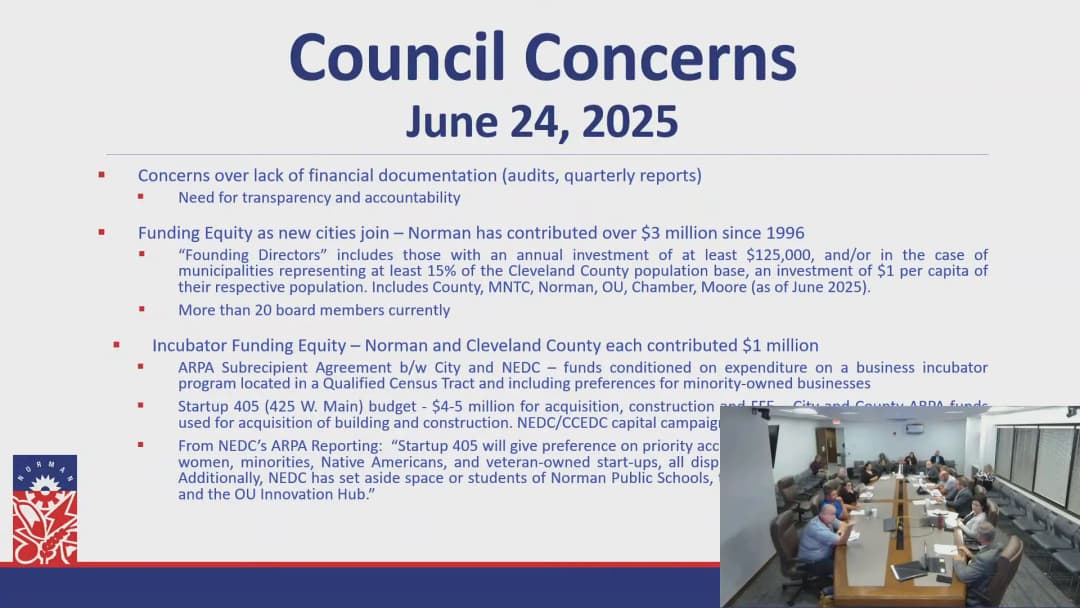
On November 25, 2025, the Norman City Council held a conference to deliberate on two primary economic development strategies: entering a new contract with the Cleveland County Economic Development Coalition (CCEC, succeeding the Norman Economic Development Coalition) or utilizing the dormant Norman Economic Development Authority (NEDA). The meeting featured a presentation by City Manager Ms. Walker detailing the history of the existing coalition, the proposed changes for 2025-2026, and the Council's significant concerns regarding transparency, accountability, and contribution equity. Council members engaged in a roundtable discussion regarding the organization's refusal to provide audits, the political activity clauses, and the comparative economic performance of Norman versus neighboring cities. Consent Calendar - None. The agenda consisted entirely of discussion items with no routine approvals or unanimous actions scheduled for immediate action. Public Comments & Testimony - No public comments were recorded during this segment of the transcript. Discussion Items - Cleveland County Economic Development Coalition (CCEC) Contract Proposal: - Context & History: Ms. Walker presented that the City has contributed over $3 million to the organization since 1996. The organization is rebranding/collapsing into the Cleveland County Economic Development Coalition, expanding its scope from Norman to the entire county but maintaining similar functions. - Prohibition on Political Activity: The proposed contract removed the explicit prohibition against using funds to support or oppose state/local questions, retaining only the statutory ban on supporting/opposing candidates or political parties. Ms. Walker emphasized the legal risks and the need for caution regarding public funds. - Lack of Transparency: The new contract does not require the submission of annual audits or detailed financial reports to the City. - Councilmember Nofire's Position: Expressed deep concern and disheartenment regarding the refusal to provide audits, noting that even with previous contractual obligations, the organization refused. She argued that public dollars demand public oversight and requested a true Return on Investment (ROI) layout for the $3.1 million contributed, skeptical of claims that all economic growth was directly driven by the coalition despite their claims of a billion-dollar impact. She questioned why the organization refuses to release data when their own auditors have found nothing out of bounds. - Councilmember Dixon's Position: Expressed that the request for audits, open meeting act compliance, and open records act compliance is standard for other contractors and that the refusal is unusual. He questioned the equity of the per-capita rate ($1 per resident) compared to the County's contribution and noted the organization's claim that historical contributions do not influence current board representation. - Councilmember Hinkle's Position: Expressed that economic development is a critical part of solving homelessness and that spending only $1 per person ($130,446 total) is insufficient compared to Broken Arrow ($400,000 minimum) or Edmond ($800,000). She argued that if the Council does not want to support economic growth, they should explicitly state that, but emphasized that the investment is necessary to raise median income levels which have been falling. - Councilmember Grant's Position: Stated he did not receive the October 17th email regarding audit availability and remains skeptical of the $1 billion economic impact claim without verified breakdown. He recommended reviewing the history of all previous contracts and is willing to meet again to dig into the data. - Councilmember Gansbury's Position: Expressed a "hiccup" with the leadership's operational style and concerns over a "pay-to-play" model where larger corporations might receive preferential treatment. He felt the organization's refusal to compromise on audits and transparency broke the mediation process and recommended organizing a meeting with leadership before the December 31st founding partner deadline to seek a compromise. - Councilmember Moore's Position: Expressed that not participating leaves Norman without a seat at the table, reducing his voice and ability to compete for opportunities. He highlighted the potential of the Oklahoma Aviation Academy ($53 million project) as an example of the strategic value of the coalition, noting that the coalition successfully navigated state funding requirements by broadening the scope beyond just Norman. - Councilmember Jackson's Position: Stated that if the audits exist and are clean (as claimed), there is no reason for them not to be shared, and refusing to do so suggests something is being hidden. He reiterated that Norman is falling behind in median income and needs to act, but insisted on accountability before approval. - Staff & Director Response: The Director (Lawrence McKinney) acknowledged the issues but stated in writing that he was not open to contract changes regarding audits, political language, or Open Meeting/Records Act compliance for the public funds portion. He claimed the audits have been clean and current through FY2024. - Norman Economic Development Authority (NEDA): - Status: A public trust authority created in 2012 to facilitate long-term contracts, debt issuance, and property acquisition, but currently inactive with no dedicated funding source or active projects. - Potential Use: Discussed as an alternative to the CCEC. It could be funded via the proposed $130,000 per capita allocation to provide targeted incentives, tenant improvements, or acquire/hold property for redevelopment (e.g., Gray Street, RTA stations). - Capabilities: The NEDA can hold property, issue debt, and make long-term investments that the general fund cannot. Council serves as the trustees. - Comparison: Unlike the CCEC, the NEDA would allow for a more direct, city-focused approach to economic development, potentially allowing for incentives for mixed-use development and affordable housing. Key Outcomes - No Vote Taken: The Council took no formal vote on the CCEC contract or NEDA funding tonight. The item was designated as a discussion to allow Council members time to digest the written responses from the CCEC Director. - Action Items: Staff will not bring forward an action item immediately. The Council will review the provided information and may convene a study session or meeting with the CCEC Director prior to the December 31, 2025 deadline for "founding partners." - Directives: Mayor and Council members expressed a need for further transparency, specifically requesting to see the ARPA and general audits to verify the claimed $1 billion economic impact. Concerns regarding the lack of board representation equity for new joiners versus historical contributors were highlighted as unresolved. - Next Steps: A follow-up discussion is anticipated on the Council meeting scheduled for either December 9th or December 16th, pending preparation and potential meeting with the CCEC leadership.

ECONOMIC DEVELOPMENT 77% · PUBLIC ENGAGEMENT 5% · CONTRACT MANAGEMENT 5% · PROCEDURAL 3%
73
NOV 13, 2025 · NORMAN, OKLAHOMA · PUBLIC MEETINGS & LIVE-STREAMS
Norman City Council Meeting Summary - November 13, 2025

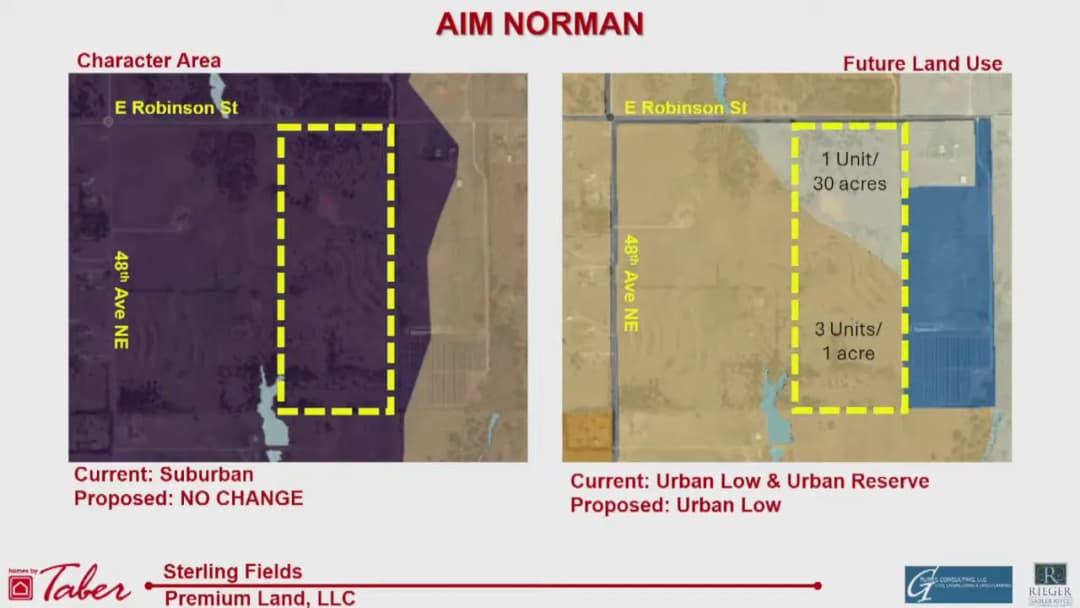
The City of Norman Planning Commission convened to review various zoning amendments, rezoning applications, and code updates, primarily focusing on implementing the newly adopted AIM Norman 2045 comprehensive plan while addressing housing density, enforcement mechanisms, and neighborhood character concerns. Consent Calendar - Minutes: Approval of the Planning Commission meeting minutes from October 9th, 2025 (Item 1) was approved after an inactive commissioner was removed from the vote count. - Variance (COS-2526-4): Approval granted with a typo correction in the title, changing a measurement from "229.92 feet" to "329.92 feet". The variance adjusts the minimum width requirement from 330 feet to 329.92 feet and the 10-acre requirement to 9.980 acres for a site in Ward 5. Public Comments & Testimony - Michelle Kaufman: Expressed strong opposition to the micro-unit apartment project at 1107/1111 Chautauqua Ave. She argued the development would quadruple traffic and noise, destroy the "quaint" character of the Hoover/Chautauqua neighborhood, and create parking shortages for residents. - David Harper: Stated he has lived in the area for 40 years and expressed concern that the proposed density conflicts with the "three unrelated persons" rule, which was historically implemented to prevent rental conversions, and noted the area has become a speed zone. - Robert Bruce: Expressed concern regarding property rights and the change in neighborhood character for homeowners who bought in R1 zones, arguing that rezoning negatively impacts their "quiet enjoyment." - Mary Elizabeth LeBlanc: Identified as a licensed massage therapist and AMTA Oklahoma chapter GR chair. She expressed that law enforcement has approached the issue "the wrong way" without consulting legitimate therapists, citing specific anatomical concerns in the proposed ordinance language. - Kaylee Winchester: A licensed massage therapist with 15 years of experience in Oklahoma. She expressed concern that the proposed zoning and licensing language was confusing for legitimate businesses working under medical supervision and that the term "parlor" is outdated and unprofessional. - Bill Swain: Raised engineering concerns regarding drainage, erosion, and the negative impacts of "leapfrog development" that releases water runoff onto protected pasture land rather than urban drainage systems. - Mike Brule: Lived near the proposed Sterling Fields development. He expressed concern over erosion on terraced land used for cattle, the shallow gas line crossing the property, and the impact of 59 new septic systems on the watershed. - Steve Lemke: Strongly supported the AIM 2045 plan and argued that the Sterling Fields subdivision is premature, constitutes leapfrog development, and undermines the city's long-term growth framework. - Brandon Nofire: Opposed the Sterling Fields project, highlighting the lack of city utilities (requiring 59 wells/septic systems) and noting the proposal is incongruous with the surrounding rural area. - Carlinda Gravel: Expressed opposition to the proposed removal of the "three unrelated persons" limit. She argued it would lead to overcrowding, increase housing turnover to rental investors, and potentially create safety hazards, stating she fears a "roller coaster" effect in neighborhoods. - Cheryland Dawson Densao: Opposed the ordinance change, warning it could facilitate human trafficking and create unmanageable overcrowding, stating "nothing good comes from stuffing more people in a dwelling." - Elaine Boyd: Expressed concern over a neighbor converting a property into a multi-occupant rental with an accessory dwelling unit (ADU), citing drainage issues from increased concrete and the impact on the historic district's character. - Trent Baggett: Retired prosecutor who argued that the city should not remove the ordinance simply because enforcement is difficult; he suggested the city should work harder to enforce existing laws rather than repeal them. - Rick Pollen: Opposed the removal of the restriction, arguing that R1 zones are meant for single-family residences and that the current rule provides a necessary barrier against large-scale rentals to unrelated individuals. - Steve Ladner (Read by Commissioner): Submitted written comments regarding the conversion of single-family homes into rental properties for sorority girls in the 500 block of South Lahoma, warning that lifting restrictions accelerates the loss of long-term residents. - Post-Meeting Comments: Carlinda Gravel and Cheryland Dawson Densao offered general kudos and warnings to the commission about maintaining community standards and avoiding "slippery slopes" in neighborhood preservation. Discussion Items - Item 2 (Micro-Unit Rezoning): Staff presented a proposal to rezone R1 to SPUD for a 3-story micro-unit building (24 units, 21 parking spots). The applicant, Matt Peacock, argued the project aligns with the AIM 2045 "Urban Medium" designation and targets young professionals rather than students. Staff noted it is inconsistent with typical surrounding setbacks. Commissioners questioned the density definition (medium vs. high) and parking viability. Commissioner Brewer expressed support for the micro-units and affordable housing goals, viewing them as quiet and suitable for the area. Commissioner McClure expressed concern that the 24 units represent a high-density max for an "Urban Medium" area, arguing for a transition rather than an abrupt jump to maximum density. Commissioner Kindle noted the project is conformance with the land-use plan but personally favored a lower unit count to allow for flexibility and neighborly compatibility. The applicant clarified that while 24 units were chosen to avoid the high cost of single kitchens per unit (student style), reducing units might force a return to larger units. - Item 4 (Massage Therapy Ordinance): Staff proposed removing outdated definitions of "massage parlor" and "sexual encounter center" from the zoning code and adding licensing requirements to combat human trafficking and prostitution. The applicant, City Legal, explained the ordinance responds to police data showing hundreds of ads for illegal operations. Licensed massage therapists in the audience expressed concern that the language was gendered, medically ambiguous regarding anatomy (e.g., piriformis), and lacked input from legitimate therapists. Staff clarified that enforcement mechanisms are necessary as state law only regulates therapists, not establishments, and that the "three unrelated" language removal is not the focus of the zoning vote, which is to delete the problematic definitions. - Items 5 & 6 (Liberty Point PUD Amendment): The applicant proposed amending an existing PUD to add approximately 334 multifamily residential units and reconfigure commercial space. Staff and the applicant confirmed the project aligns with AIM 2045. A commissioner noted that the site has only one egress, which meets code but is less than the standard for larger developments. No public comments were recorded. Commissioner Parker noted the engineering meets code. - Items 7, 8, & 9 (Sterling Fields / Urban Reserve): Staff and the applicant proposed amending the AIM 2045 land use plan from Urban Reserve/Low to Urban Low and rezoning to PUD for 59 lots of 3/4 acre each on the edge of the rural/urban boundary. The applicant argued for flexibility to create a "missing middle" of large-lot housing not currently available under AIM. Opposing public commenters and commissioners argued this constitutes premature leapfrog development, threatens the watershed with private septic systems, and ignores the intentional topography-based boundaries of the Urban Reserve designation. Commissioners expressed significant hesitation, stating the project is not yet ready and undermines the AIM plan's intent to protect the watershed and allow sequential growth. - Item 10 (SPUD Amendment): The applicant requested to remove commercial ground floor allowances from a previously approved SPUD near the university, converting the entire building to residential. Staff confirmed the density remains unchanged. The applicant clarified the project is not in the Center City Form Based Code area. No opposition was recorded. - Item 11 (Unrelated Persons Ordinance): Staff proposed removing the "three unrelated persons" limit from the definition of a family in the zoning code, citing unenforceability and the difficulty of proving familial relations. The applicant (Staff) explained that 19 complaints were closed due to insufficient evidence in 2023, and that the rule prevents affordable housing options for young professionals and non-family roommates. Commissioners opposed to the change argued it removes a necessary complaint mechanism and creates a slippery slope for overcrowding. Commissioners in support argued the rule is unenforceable, creates neighborhood conflict, and hinders affordable housing for graduates and working professionals. The discussion highlighted that while the rule is unenforceable, it currently provides a legal basis for complaints that could be lost without replacement strategies. Key Outcomes - Item 1 (Minutes): Approved unanimously. - Item 2 (Micro-Unit SPUD): Approved by a vote of 6 to 1. Commissioner McClure voted against, citing concerns about the density level being too high for an Urban Medium zone. - Item 4 (Massage Ordinance): Approved by a vote of 7 to 0. The commission moved forward with the ordinance amendments to remove problematic definitions, pending further input from massage therapists before final council action. - Items 5 & 6 (Liberty Point): Approved by a vote of 7 to 0. - Items 7, 8, & 9 (Sterling Fields): Motion to Reject approved by a vote of 7 to 0. The commission denied the rezoning and land use amendment, citing premature development and watershed protection concerns. - Item 10 (SPUD Amendment): Approved by a vote of 7 to 0. - Item 11 (Unrelated Persons): Approved by a vote of 6 to 1. The commission voted to remove the "three unrelated persons" language from the code definition of family. Commissioner Kindle voted against, citing concerns over enforcement mechanisms and potential overcrowding. - Items 12 & 13 (Class & Boulevard): Postponed to the December 11, 2025 Planning Commission meeting by unanimous voice vote. - Item 14 (Sorority House): Postponed to the December 11, 2025 Planning Commission meeting by unanimous voice vote. Next Steps: - Staff will organize a meeting with massage therapy professionals to review ordinance language for Items 4 before it goes to City Council. - The City Council will hold a subsequent meeting on December 2nd to discuss the massage therapy ordinance. - Items 12, 13, and 14 are rescheduled for the December 11, 2025, Planning Commission meeting.

ZONING AND LAND USE 63% · PROCEDURAL 10% · LAND USE PLANNING 8% · COMMUNITY ENGAGEMENT 4%
74
NOV 13, 2025 · NORMAN, OKLAHOMA · PUBLIC MEETINGS & LIVE-STREAMS
Norman City Council Meeting Summary: 2025-11-13

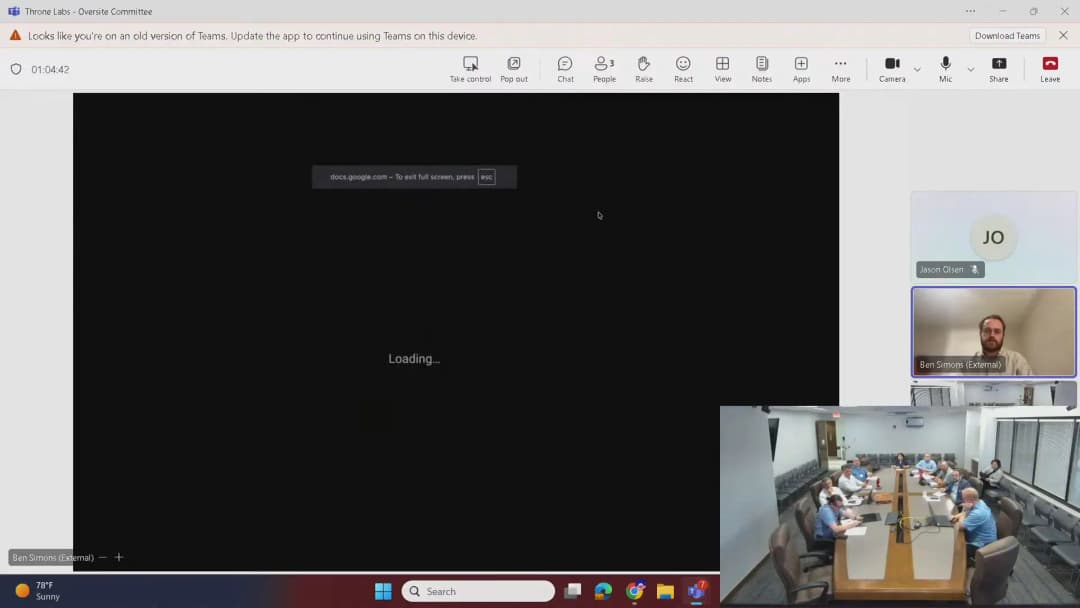
The Norman City Council convened on November 13, 2025, to review presentations and discuss public safety operations regarding EMS services, as well as the potential implementation of high-tech portable restroom solutions in city parks. The meeting featured detailed overviews from MSTAT (Norman's EMS provider) regarding response metrics, fleet capabilities, and the exploration of subscription service models, followed by a proposal from Throne Labs regarding touchless, automated public restrooms to improve hygiene and reduce loitering. Consent Calendar - No routine approvals or unanimous actions were formally listed; the council proceeded directly to substantive discussion items. Public Comments & Testimony - Kyle Hurley (MSTAT): Expressed support for the current hospital-based EMS model, highlighting strong survey scores and partnerships with Norman Fire and Police. He stated that the current system pushes money back into the health system and expressed willingness to explore a subscription service model if the council provided consensus, provided it could be implemented in Norman and Moore simultaneously. - Ben Simons (Throne Labs): Expressed a personal mission to expand access to clean restrooms, stating a strong belief that clean and delightful restrooms are a human right. He articulated support for a high-tech, touchless solution that utilizes data and accountability features to ensure cleanliness and deter misuse. - Councilmember Hinkle: Expressed strong support for the Throne Labs concept, noting the high level of service (cleanliness, air conditioning, automated features) compared to current city facilities. He suggested the potential for the company to customize wraps for special events (like OU football) and advocated for expanding the service to include the OU campus and neighboring municipalities. - Councilmember Bruce: Expressed interest in the scalability of the restroom model, noting that while a single high-end facility might not fit the current budget, a long-term partnership could be cost-effective compared to building permanent facilities which cost upwards of $300,000 to $400,000. - Councilmember Gainsary: Asked about the potential for shared regional deployment to lower costs, receiving confirmation that a regional consortium (e.g., Norman with Oklahoma City or Moore) could reduce the per-unit investment. Discussion Items - MSTAT Agency Overview and Metrics: - Agency Structure: Kyle Hurley clarified that MSTAT is a department of Norman Regional Health System, not a municipality, and has been the sole EMS provider in Norman since 1995. They operate 21 ambulances and respond to Norman, Moore, Goldsby, and unincorporated areas of Cleveland County. - Licensure and Special Teams: The presenter detailed the hierarchy of licensures (EMT, EMT-A, Paramedic, Critical Care Paramedic) and introduced specialized units including the Disaster Medical Response Team, Hazardous Materials medics, and the SWAT Medic team working closely with police. - Special Events: Discussion focused on the "Bike Medic" program at OU football games and the Gilmer Jones Medical Facility. Hurley noted that bike medics are the quickest method for response in stadiums, handling 60-100 contacts per game (heat-related in early season, dropping later) and providing care up to the level of an ER physician. - Quality and Response Times: The agency reported a Net Promoter Score (NPS) between 72 and 87, indicating strong patient satisfaction. Average 911 response time was cited as 8 minutes and 3 seconds, increasing to 13 minutes for the 73026 zip code, though fire departments provide ALS care in transit. The presenter advocated for decreasing the use of lights and sirens to reduce risk while maintaining response efficiency. - Transport Volume and Costs: Hurley explained that a drop in call volume (approx. 2,800 calls) was due to the closure of the Porter Campus, shifting patients to Norman Regional Hospital (Helplex). He emphasized that MSTAT does not charge for inter-facility transfers between Norman Regional locations. - Subscription Service Proposal: The council discussed implementing a subscription service (similar to IMSS in Oklahoma City or Wadleys in Purcell) to cover the gap in patient insurance payments. Hurley stated the health system has not currently adopted this model due to regulatory considerations and the need to offset lost patient revenue, but expressed openness to a study to explore feasibility, potential capital benefits, and implementation mechanics for both Norman and Moore. - Portable Restroom Implementation: - Throne Labs Proposal: Ben Simons presented a solution involving smart, touchless portable restrooms that require no permanent water or sewer hookups. Key features include a 10-minute time limit to prevent loitering, automatic cleanliness monitoring via QR code scans, and a 95% uptime rate. The service includes all cleaning, maintenance, and repairs. - Cost and Deployment: Simons indicated a minimum market entry requirement of 15 to 20 units, with potential to scale to 25-30. The model operates on an annual service fee with no upfront installation costs. Council discussion revealed that while the current city budget cannot absorb the cost of 15-20 units alone, a regional approach involving Norman, Oklahoma City, Moore, or other agencies could make the project feasible. - Strategic Next Steps: Mayor and Council directed staff to identify potential partner agencies within a 40-mile radius (including Moore, Goldsby, and potentially OU) to consolidate demand. Councilmembers Hinkle and Gainsary emphasized the need to explore how this could be integrated into the fiscal year 2026-27 budget and requested staff to contact counterparts in neighboring cities and Ann Arbor, Michigan, to gauge interest and share best practices. Key Outcomes - EMS Discussion: The Council expressed consensus to explore the feasibility of a subscription service for EMS transport, with staff instructed to consult with finance and legal departments and potentially bring back a formal recommendation. This includes working with MSTAT to determine if the health system is open to the venture and how to finance potential capital needs through this new revenue stream. - Restroom Initiative: The Council directed staff to actively reach out to neighboring municipalities (Oklahoma City, Moore, etc.) and potential partners (OU, local agencies) to gauge interest in a joint deployment of Throne Labs' high-tech restrooms. The goal is to aggregate enough demand to meet the minimum deployment threshold (15-20 units) and assess budgetary implications for the upcoming fiscal year. - Data Collection: Staff were tasked with gathering specific data on the potential cost savings of the Throne Labs model versus building permanent facilities, which currently cost between $300,000 and $400,000 each without the ongoing maintenance benefits provided by Throne Labs.

PUBLIC SAFETY 32% · HOMELESSNESS 13% · EMERGENCY MANAGEMENT 12% · PARKS AND RECREATION 11%
75
NOV 6, 2025 · NORMAN, OKLAHOMA · PUBLIC MEETINGS & LIVE-STREAMS
Business & Community Affairs Committee Meeting - November 6, 2025

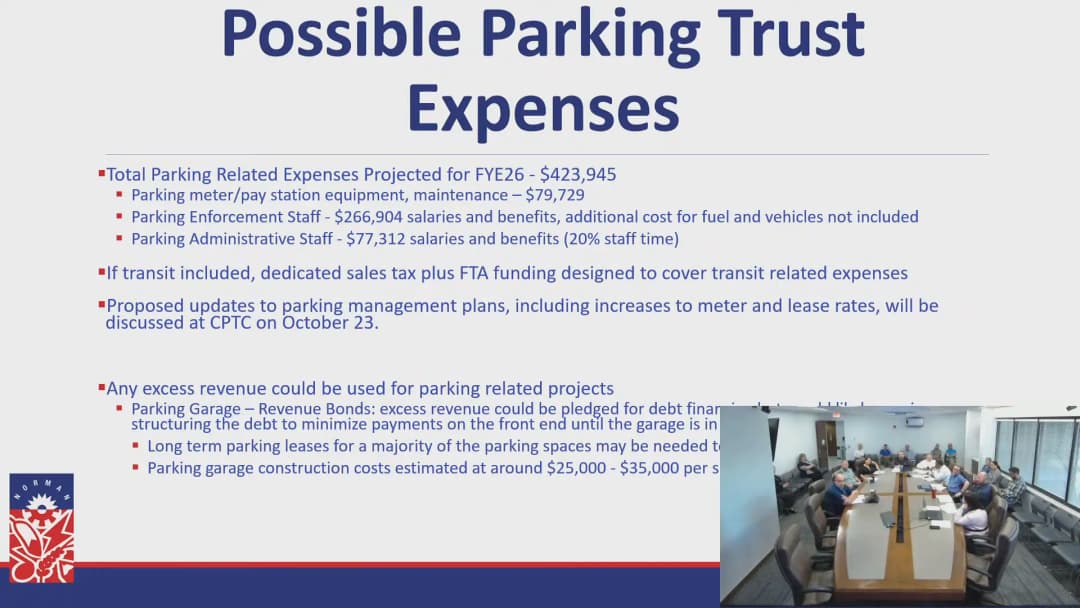
The Business and Community Affairs Committee convened on November 6, 2025, to review visitor attendance reports for 2025, analyze the economic impact of the OU football season on hotel occupancy and guest tax revenue, discuss the installation of safety and weather monitoring infrastructure in city parks, and deliberate on integrating the Campus Corner area into the Center City Tax Increment Finance (TIF) district and Form-Based Code. Consent Calendar - No specific routine approvals or unanimous actions were recorded in the transcript for a formal consent calendar. Public Comments & Testimony - No direct public comments were recorded in the provided transcript. Discussion Items - Event Attendance & Economic Impact Report: Mr. Olsen and Mr. Shim presented data from 2025. Mr. Olsen highlighted that while total visitor spend remained flat, arts and entertainment spending rose by 5%. He noted that football games drive significant traffic, with the Medieval Fair drawing 48,000 visitors and the Norman Music Festival drawing 53,000. Mr. Shim presented data from Zardico software showing that hotel occupancy for the fiscal year was up 6%, with short-term rental occupancy down slightly but average daily rates up nearly 20%. Guest tax collections were up 25% for the first three months of FY26 compared to the prior year. - Football Season Economic Analysis: Mr. Shim detailed the economic impact of specific games. The Michigan game resulted in 95% hotel occupancy and a 57% increase in Average Daily Rate (ADR). The Tennessee game (previous year's benchmark) saw similar spikes. Councilmember Holman noted positive feedback from out-of-state visitors regarding the welcoming nature of Norman. Councilmember Grant asked about hotel overflow in Oklahoma City, to which staff responded that occupancy in OKC increased significantly on game weekends. - Safety & Weather Infrastructure: Staff presented on blue safety lights and weather stations. The existing blue light at Saxon Park (installed 2020) costs approximately $11,000, while new models with monitoring and cameras cost around $15,000. Councilmember Gansberg inquired about usage frequency and repair capabilities; staff confirmed self-repair is possible, and the city will retrieve usage logs for the budget review. Newer weather stations at Ruby Grant, Saxon, and Sutton Wilderness provide mass voice notifications for lightning and heat warnings to park staff and users. - Campus Corner & Center City TIF Integration: Ms. Walker explained that while Campus Corner is within the Center City TIF boundary, it is excluded from the project plan's specific infrastructure improvements and the 2017 Form-Based Code. The current project plan cap is $47.4 million, tied strictly to public infrastructure (sewer, water, storm). A condition in the Form-Based Code requires an "adequately sized parking structure" or funding mechanism to include the area. Councilmember Hinkle, Councilmember Grant, Mayor Holman, and Councilmember Durant discussed creating a parking garage (projected 5-6 stories) to satisfy the condition and allow Campus Corner to be included in the Form-Based Code. - Positions Discussed: Councilmember Durant expressed full support (100%) for a consolidated parking garage to enable high-density housing development. Mayor Holman expressed opposition to adding height limits to Campus Corner as a condition for the parking structure, preferring market-driven development. Councilmember Grant emphasized the need to update surface streets (Boyd, University) to match existing improvements and avoid suburban zoning forms. Councilmember Dixon questioned the potential for private mixed-use (housing/commercial) above the public garage. Key Outcomes - Data Review: The committee reviewed and accepted the 2025 visitor and football economic data, noting positive trends in hotel occupancy and guest tax revenue. - Safety Infrastructure: Staff committed to retrieving the usage log for the Saxon Park blue light to include in the upcoming proposed budget for potential additional installations. - TIF/PPP Strategy: The committee moved forward with the concept of a Parking Trust and Authority and potential TIF backstop financing to fund a multi-story parking garage in Campus Corner. This is intended to trigger the inclusion of Campus Corner into the Center City TIF project plan and the Form-Based Code. - Next Steps: 1. Staff to provide a Parking Trust document for the November Council meeting. 2. Engineering and cost estimates to be developed for a potential 5-6 story garage, including land acquisition for adjacent parcels. 3. Consideration of a major amendment to the TIF project plan or the potential creation of a new TIF to encompass Campus Corner, subject to an Ad Hoc Committee review. 4. Further cost analysis and infrastructure studies regarding the impact of potential higher-density redevelopment in Campus Corner.

PUBLIC ENGAGEMENT 20% · ECONOMIC DEVELOPMENT 20% · PARKING MANAGEMENT 18% · PUBLIC SAFETY 11%
76
NOV 4, 2025 · NORMAN, OKLAHOMA · PUBLIC MEETINGS & LIVE-STREAMS
City Council Special Meeting - November 4, 2025

On November 4, 2025, the Norman City Council convened a special meeting to address three primary agenda items: a proposed amendment to the definition of 'family' regarding unrelated persons, a discussion on a potential bond election for a permanent homeless shelter (potentially bundled with public safety infrastructure), and an executive session for real property negotiations. The council received detailed reports from Planning Director Jane Hudson and City Manager Pam Pyle, engaging in significant deliberation regarding housing affordability, enforcement mechanisms, and public sentiment on past and proposed ballot measures. Several council members expressed strong support for removing the 1954-based occupancy limit to aid low-income housing and students, while others emphasized the need for better enforcement of nuisance ordinances to address neighborhood concerns. Consent Calendar - No items from the consent calendar were listed or acted upon during this special meeting transcript. Public Comments & Testimony - No direct public comments or testimony were recorded in the provided transcript; all input came from council members and staff. Discussion Items - Three Unrelated Persons & Residential Zoning: - Staff Position: Planning Director Jane Hudson reported that the current 'three unrelated persons' definition (in place since 1954) is outdated and creates enforcement difficulties with low success rates in citations (19 complaints in 2023, 8 in 2024, 1 in 2025, mostly dismissed). She advocated for amending the definition to allow greater flexibility and affordability, noting that noise, parking, and traffic issues can be addressed through existing nuisance ordinances rather than occupancy caps. - Councilor Murray: Expressed concern for neighborhoods facing pressure from luxury student housing and investors, noting that residents in historic districts feel the current rule is their only recourse. However, he acknowledged that existing ordinances (nuisance, parking, noise) should be the primary enforcement tools. - Councilor Graham: Stated he felt the rule was arbitrary and discriminatory, citing that a single problematic neighbor is worse than a group of respectful students. He supported the change to allow affordability for business owners and low-income residents, provided existing nuisance codes are vigorously enforced. - Councilor Bruce: Expressed uncertainty about the logic of the cutoff numbers ('three is okay, four is too many') and questioned why a million-dollar house could house ten unrelated people while smaller units could not. He noted that boarding rooms in R1 zones are currently prohibited. - Councilor Gansford: Expressed full support for the measure, arguing that utilizing existing large homes for multiple unrelated adults (like business teams) is an economic benefit and does not increase the city's footprint. - Proposed Bond Election (Homeless Shelter): - Staff Position: City Manager Pam Pyle proposed returning to the ballot to ask voters for $5 million for a permanent shelter, contrasting it with the vague 2019 proposal that received 48% support. The new proposal includes identified locations, operators (CityCare), and a plan for 12-month services including day services. She noted the option to bundle this with a new Fire Station 1 and Police Department into a 'Public Safety Bond.' - Councilor Grant: Expressed support but requested data confirming community desire for the specific location and budget. He noted that CityCare has a high track record for fundraising operations costs. He was open to bundling shelter with fire/police to increase passage chances. - Councilor Peacock: Strongly supported revisiting the measure, arguing that the 2019 vote was a rejection of a poorly structured package, not the concept itself, as many other popular projects (senior center, YFAC) were also voted down simultaneously. He emphasized the need to present a detailed proposal. - Councilor Gansbury: Expressed strong support, citing constituent feedback during his campaign as a major community need. He advocated for bundling the shelter with a new Fire Station to improve response times. - Councilor Pico: Supported the concept but insisted on polling to gauge sentiment. He was open to a standalone shelter question or a bundled public safety bond, provided timelines for the fire and police components do not delay the shelter. - Councilor Blodge: Expressed full support ('100% supportive') based on feedback from business owners downtown who view the current temporary shelter on Gray Street as a major concern. He suggested the business community would likely back this initiative. - Staff Clarifications: The City Manager clarified the mission has evolved from winter-only emergency housing to 12-month care involving housing assistance and document recovery. She confirmed CityCare operates in Oklahoma City with a similar model and expects to raise future operational funds. - Operational Models: Discussed leasing city-owned facilities to nonprofits for $1 rent, with the nonprofit managing operations and fundraising. - Executive Session: - The council moved to adjourn into an executive session under Oklahoma Title 25, Section 307(B)(3) to discuss the possible purchase of real property owned by the Department of Mental Health and Substance Abuse on land between Alameda and Main Streets. Key Outcomes - Zoning Amendment Direction: The council unanimously supported the proposal to amend the definition of 'family' to remove the 'three unrelated persons' limit. The item is scheduled to go before the Planning Commission next week (December) with a probable final council vote in January. - Bond Election Strategy: The council reached a consensus to pursue a ballot measure for a permanent homeless shelter, likely in April 2026. Staff is directed to poll the community to determine the best approach: a standalone shelter question or a bundled 'Public Safety' bond question including a new Police Department and Fire Station 1. - Executive Session: A motion was passed to enter executive session immediately following the public meeting to discuss real estate acquisition.

PUBLIC SAFETY 34% · ZONING AND LAND USE 30% · HOMELESSNESS 22% · AFFORDABLE HOUSING 6%
77
OCT 23, 2025 · NORMAN, OKLAHOMA · PUBLIC MEETINGS & LIVE-STREAMS
October 23, 2025 Community Planning & Transportation Committee Meeting Summary

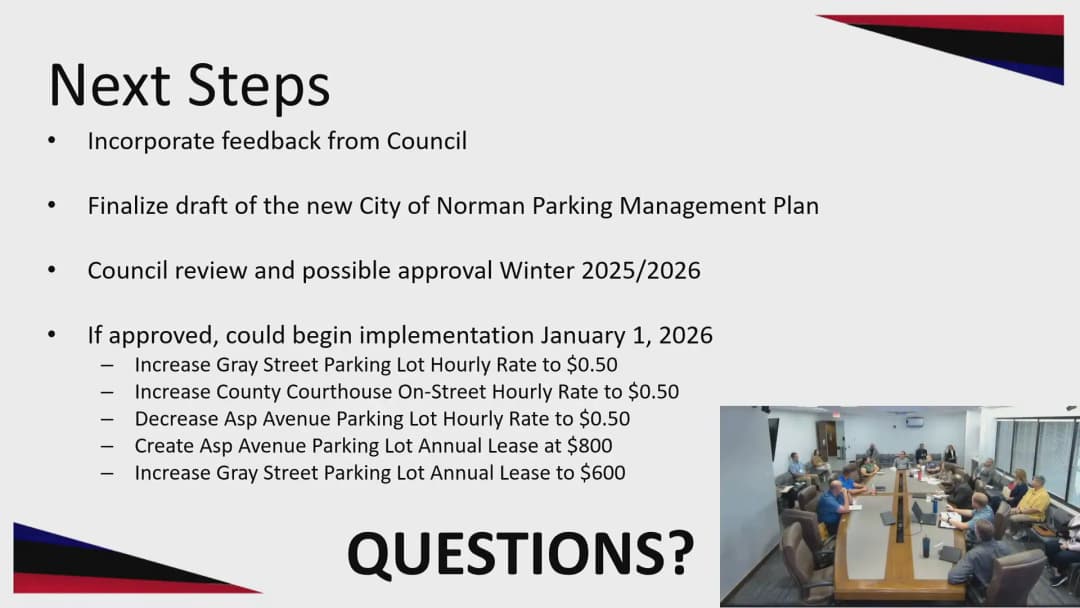
The Community Planning and Transportation Committee convened on October 23, 2025, to review the September public transit ridership report, discuss proposed updates to the city's parking management plan including potential food truck leases and rate adjustments, and consider the vacation of an unimproved alleyway causing safety and sanitation issues for residents. Staff presented data indicating steady fixed-route growth alongside a decline in demand-based on-demand services, proposed significant changes to parking fees to address operational deficits, and outlined a legal strategy to vacate a problematic alley to benefit abutting property owners. Consent Calendar - No consent calendar items were discussed or approved as unanimous actions during this meeting. Public Comments & Testimony - Resident Concerns: A resident noted the alleyway acts as an "attractive nuisance" and mentioned broken fences, expressing relief that the city might assist with re-establishing fence lines. - Legal Safeguards: Council Member Counselor Grant requested legal input to ensure the city is protected from liability should food trucks tie into city electricity in the future. Discussion Items Monthly Public Transit Ridership Report - Ridership Data: Staff reported 47,643 rides in September for fixed-route services (Embank and Plus), representing a slight increase from the prior year's 44,679, though growth has slowed compared to previous 20-25% increases. Routes 112 and 121 saw over 30% growth, while Route 110 remained heavily utilized but saw slight declines. Saturday service on Main Street increased by 35%. - Fleet Replacement: Taylor Johnson confirmed the recent purchase of three large buses, which will be the final replacements needed to modernize the inherited fleet; only two older buses remain in service. - Long-Range Plan: The Central Oklahoma Long Range Transit Plan is anticipated for adoption by ACOG in November, with work on implementation starting in the next calendar year. - Grant Pursuit: Staff is pursuing a 100% funded T-SEC grant for an "Embank Well" senior-focused pilot program targeting health and wellness for residents over 60, with a grant resolution to be presented for approval on October 23. - Norman on Demand: Ridership dropped by 38% year-over-year (from 4,760 to under 3,000). Staff attributed this to a fare increase ($2 to $3), the removal of six free sign-up rides, and service tapering. However, total accounts grew to 13,800, with approximately 4,400 active users. - Service Frequency: All fixed routes operate on 30-minute frequencies except for Route 110, which currently runs on an hour. Staff noted that improving Route 110 to 30 minutes is the third priority in the long-range plan, requiring additional staffing and potential new buses, and offered to provide a cost breakdown if requested. Parking Management Plan Updates - Proposed Fee Changes: Staff proposed increasing hourly rates in the East Gray Street lot and around the County Courthouse from 25 cents to 50 cents per hour to address operational deficits. Council considered a uniform $1/hour rate but leaned toward the 50-cent increase. A three-hour minimum may be required at the 50-cent rate to cover transaction fees ($0.35). - Asset Usage Incentive: Staff proposed lowering the Aspen Avenue (Asp) parking lot rate from $1/hour to $50 cents/hour to incentivize usage of the underutilized lot. - Lease Rate Adjustments: Annual lease rates for the East Gray Street lot are proposed to increase from $450 to $600. Staff also proposed creating a lease system for 21 spots in the Aspen Avenue lot, potentially at $800 annual for a 50-cent hourly rate, utilizing a lottery system. - Food Truck Policy: Staff proposed allowing food truck permitting in city lots, noting the complexity of space requirements (often 3 spaces per truck), access to pedestrians, and electricity. Staff recommended allowing trucks in corners to minimize space loss, with a strict prohibition on city-provided electricity initially to mitigate liability. - Long-Term Leasing: Discussion arose regarding long-term leases for residential developments in the center city, necessitating potential changes to the annual lottery model and longer commitment terms. Alleyway Vacation (Reed Avenue and Cook) - Issue Description: An unimproved T-shaped alleyway between Reed Avenue and Cook is a source of significant neighborhood disruption, hosting encampments of 30-40 people and safety hazards including used needles and trash. - Proposed Action: Staff proposed vacating the alley, which would legally transfer the 20-foot wide property to the abutting homeowners (10 feet to each side). This would allow neighbors to fence off the space and potentially secure CDBG funds to establish a fence line. - Process: The process involves a resolution of intent, planning commission review, court filing, and notification to utility companies (noting ONG meter relocation efforts) and abutting owners. Key Outcomes - Transit: Staff is directed to pursue the T-SEC grant resolution for October 23 approval and is tasked with providing a cost estimate for expanding Route 110 service to 30 minutes if requested by council. - Parking Rates: Council indicated consensus to proceed with the proposal to raise hourly rates in Gray Street and Courthouse areas to 50 cents per hour (with a potential three-hour minimum) effective January 1, pending legal review of transaction fees and rate authority. - Parking Leases: The committee agreed to move forward with increasing the Gray Street lot lease to $600 immediately for the upcoming cycle, with the Aspen Avenue lot lease potentially starting July 1 to allow for further discussion on residential long-term needs. - Food Trucks: Council granted staff the flexibility to develop and incorporate food truck policies into the new Parking Management Plan, emphasizing the need for legal protections regarding utility connections and spatial requirements. - Alley Vacation: Council reached a consensus to proceed with the vacation of the alleyway between Reed Avenue and Cook, directing staff to issue the resolution of intent for consideration on November 25 and to begin notifying abutting property owners.

PARKING MANAGEMENT 48% · PUBLIC TRANSPORTATION 18% · FOOD SERVICES 8% · HOMELESSNESS 8%
78
OCT 16, 2025 · NORMAN, OKLAHOMA · PUBLIC MEETINGS & LIVE-STREAMS
City Council Finance Committee Meeting - October 16, 2025

The City Council Finance Committee of Norman convened on October 16, 2025, to discuss the establishment of a parking authority trust, potential amendments to the guest room tax for recreational vehicles, and a review of current sales tax revenue trends. The session featured detailed presentations on public trust structures, financing strategies for vertical parking, and the financial implications of current economic conditions. Consent Calendar - No items listed for unanimous approval; all agenda items were discussed as discussion items. Public Comments & Testimony - No public testimony was recorded or provided in the transcript. Discussion Items - Public Trusts & Parking Authority Trust: Staff introduced the concept of a Parking Authority Trust as a separate legal entity to issue debt, manage parking facilities, and potentially include transit operations. - Staff Position: Recommended creating a broad trust to allow flexibility for future projects and debt issuance backed by dedicated revenues, noting that Oklahoma City's COTPA successfully uses a similar model. - Councilmember Granger's Position: Expressed strong support for fast-tracking the concept to enable housing projects that are currently stalled due to a lack of parking, stating that there is approximately $100 million in construction "on the precipice" solely because of insufficient parking. - Councilmember Creek's Position: Expressed support for the inclusion of long-term leases to back debt financing and inquired about the necessity of using general fund resources for interest-only payments on initial bonds. - Mayor Holman's Position: Leaned toward including transit alongside parking to leverage broader funding avenues and access federal grants, though noted that vertical construction is significantly more expensive per story as height increases. - Councilmember Peacock's Position: Supported the rapid advancement of parking garages to unlock housing and commercial development, suggesting mixed-use structures with retail and housing to maximize city growth. - Councilmember Government's Position: Emphasized the urgency of aligning parking solutions with the upcoming Regional Transportation Authority (RTA) to avoid missing opportunities for park-and-ride integration. - Councilmember Dixon's Position: Suggested exploring feasibility of integrating RV hookups and EV chargers into proposed parking garages, particularly for festival vendors and potential van-dwelling residents. - Guest Room Tax Amendment (RV Parks): Staff proposed amending the guest room tax ordinance (currently 8%) to include overnight spaces in recreational vehicle (RV) parks. - Staff Position: Noted that RV spaces are not currently covered by the definition of "hotel" or "recreational vehicle" in the code. Highlighted that an amendment requires voter approval. - Councilmember Green's Position: Expressed support for the amendment, noting backing from the Norman Arts Council, and favored clarifying the definition of "recreational vehicle" to capture camper vans while ensuring Norman residents remain exempt. - Councilmember Peacock's Position: Supported placing the amendment on the next general election ballot alongside other potential charter changes. - Sales Tax Revenue Report (Mr. Francisco): Presented October sales tax figures, which were flat compared to the previous year. - Staff Position: Reported a 0.01% decrease (negative 0.01%) for October, which is within budget expectations. Noted that while revenue is flat, it remains in a historical plateau significantly higher than pre-2019 levels. - Mayor Holman's Position: Expressed that describing Norman as being in "revenue decline" is a misnomer, arguing the city is stable and flat relative to record-high numbers, whereas neighboring smaller cities show volatility based on single business openings. - Councilmember Beacon's Position: Highlighted the disadvantage Norman faces compared to neighboring cities that can raise utility rates to offset stagnant sales tax revenue. Key Outcomes - Parking Trust: Council directed staff to coordinate with parking structure experts to finalize the trust indenture document and develop a financing study to present at a subsequent study session. Staff agreed to verify developer interest in long-term leases at identified sites (Aspen, Peters, and Gray). - RV Tax Amendment: Council agreed to explore the feasibility of amending the tax code definition of "recreational vehicle" and will prepare to present the amendment on the ballot, likely in the upcoming April election. - Sales Tax Monitoring: The committee acknowledged the flat revenue trend as consistent with the broader metro area but noted the fiscal health of the city remains stable with a controlled payroll budget (30.8% spent vs. 38% of budget time). No action required other than continued monitoring. (Omitted section: Public Comments as none were present in the transcript.)

PARKING MANAGEMENT 34% · FISCAL SUSTAINABILITY 14% · SHORT TERM RENTAL REGULATION 10% · ECONOMIC DEVELOPMENT 8%
79
OCT 14, 2025 · NORMAN, OKLAHOMA · PUBLIC MEETINGS & LIVE-STREAMS
Norman City Council, Utilities Authority, Municipal Authority, and TIF Authority Joint Meeting - October 14, 2025

The joint meeting of the Norman City Council, Norman Utilities Authority, Norman Municipal Authority, and Norman Tax Increment Finance Authority convened on October 14, 2025, at approximately 8:26 PM CT. The meeting began with a pledge of allegiance, decorum reminders, approval of minutes, a proclamation, council announcements, and a consent docket before moving to an extended public comment period dominated by reaction to recent statements by council members regarding the death of conservative activist Charlie Kirk. Consent Calendar - Items 3 through 34 were placed on the consent docket by unanimous vote and then approved by unanimous vote. No council member requested removal of any item. Public Comments & Testimony - Dan Munson (Ward 7) suggested a future Norman Forward art project complementing the 2028 Olympics, possibly featuring women's softball, and proposed an annual girls' softball camp starting in 2026 through the Olympics. He also expressed concern about maintenance in University North Park, citing three large potholes (64, 40, and 75 inches wide) and unkempt landscaping, noting the city invested over $50 million in the area through TIF and Norman Forward. He called for a form-based code to maintain consistent aesthetics. - Gary Marksdale (Ward 8) and multiple subsequent speakers criticized statements made by Councilmembers Helen Grant (Ward 7) and Kimberly Blodgett (Ward 4) about Charlie Kirk, who was assassinated. Marksdale called the rhetoric "gross, unacceptable, and violent" and demanded a public apology. Several speakers (Nathan Trapenidger, John Ryan, Trenton Rippe, Emily Griffith, Justice Chandler, OU Turning Point USA president, John Cepola, Lane Paul, Philip Holzhauser, and others) expressed that they felt personally attacked by being described as part of a "death machine" and defended Kirk's legacy, often invoking Christian faith and prayer. Some speakers reserved time for silent prayer. - Stephen Ellis countered that the "death machine" comment, made in a Facebook dialogue, referred to gun violence as a system, not to individuals, and criticized the public prayer as performative, citing Matthew 6:5-6. - Diane Hudzel (Ward 5) spoke in favor of the proposed agreement with the Cleveland County Economic Development Coalition (CCEDC), citing sales tax revenue shortfalls: last year fell $1.8M short leading to a $5.8M deficit, this year expected shortfall of $7.2M, and last month revenues were down over 1% below expectations. She argued the $130,000 contract (about $1 per resident) gives access to professional economic development expertise. She listed examples of past successes including $20M ARPA funding for Oklahoma Aviation Academy, $7M quality jobs tax credit, and $1M investment in Lake Thunderbird trails. - John Dr. Scammyhorn (Ward 1) expressed concern about city finances, homelessness policies, and opposed placing permanent supportive housing near senior housing in Ward 1, saying seniors are terrorized by the proposal. - Caleb McGee urged understanding and noted that a Fox News host suggested euthanizing the homeless, followed by two mass shootings at homeless encampments in Minneapolis causing 13 deaths. He argued that housing people is the solution to violence. - Lindsay Brule criticized the use of religion to attack others, stating the Lord's name was taken in vain, and called for empathy. - Mark Campbell (Ward 2) defended council members' free speech rights and mocked what he called "teeny peen USA." - Jordan Cantrell called for consequences for the council members' statements, reading from a Facebook post and arguing it described Kirk as a necessary part of a death machine worse than gun violence. - Michael Blunk (Ward 6) defended the character of Norman and its vulnerable residents, sharing his own work with food banks and child welfare, and rejected slander of the community. - Marguerite Larson supported the council, calling criticism of them a "worship of idols." - Cheryl Ann Dinzo (Wards 4 and 6) accused the council of charter-breaking by allowing mayoral and council pontification after public comments, criticized TIFs, and demanded more transparency. - Chelsea Gravel (Ward 4) blamed the council for funding homeless services at the expense of police and fire departments, and accused some council members of activism from office. - Cynthia Rogers (Ward 4) questioned the CCEDC contract, noting the city has not received required audits from the entity since 2021, and expressed concern about the arena TIF financing crushing the city budget. - Russell Rice (Ward 2) called for a TIF on blighted potholes, highlighted danger at the James Garner Extension intersection, and noted only about 0.23% of Norman's population is homeless. - Evan Dunn (Ward 7) book recommendations and nominated Tori Rose for her work with the jail. - Lane Brown (non-resident) was cut off after directing comments to a council member by name; he claimed separation of church and state does not exist and offered a Bible to Councilmember Grant. - Joe Love (Ward 1) asked for clarification or apology from council members, stating the divisive rhetoric makes people feel written off based on political affiliation. - Vicky Garcia (Ward 4) thanked the council and suggested the state should address mental health funding at Griffin Memorial Hospital, where patients cycle in and out due to short stays. - Kaylee Holzhauser spoke of her past involvement with Antifa and conversion to Christianity, and condemned the celebration of Kirk's death. - Alex Kinesny (Ward 4) and Aishelle (Ward 3) thanked the council for their service and called for unity. Aishelle, a Muslim woman, noted that many council members' social media pages mock Muslims and urged working together. Key Outcomes - Approved minutes of previous meetings by unanimous vote. - Acknowledged proclamation designating October 2025 as Domestic Violence Awareness Month; passed unanimously. - Approved consent docket (Items 3–34) unanimously, covering routine approvals. - No substantive votes or referrals resulted from the public comments; the meeting adjourned after the public comment period without further council deliberation. The mayor reminded attendees that future zoning and development items are typical agenda topics.

PUBLIC ENGAGEMENT 37% · COMMUNITY ENGAGEMENT 19% · PUBLIC SAFETY 15% · MENTAL HEALTH AWARENESS 7%
80
OCT 9, 2025 · NORMAN, OKLAHOMA · PUBLIC MEETINGS & LIVE-STREAMS
Norman Planning Commission Meeting - October 9, 2025

The Norman Planning Commission met on Thursday, October 9, 2025 at 5:30 PM with all nine commissioners present and a quorum established. The commission considered a consent calendar of administrative items, a major rezoning and preliminary plat for a 456-unit student housing development, a postponement request, and a controversial micro-unit apartment project that drew public opposition. Votes were taken on several items, with one approval and one postponement. Consent Calendar - Item 1: Approval of the September 11, 2025 planning commission meeting minutes. - Item 2: Short form plat (SFP 2526-61) for 2020 West Lindsay Street (Block B Hilltop Edition) by KNL Properties LLC. - Item 3: Certificate of Survey (COS 2526-62) for Gregory Estates by Boognites Properties LLC. - Item 4: Certificate of Survey (COS 2526-63) with variances in minimum width (330 to 275.98 feet) and 10-acre requirement (10 to 9.61 acres). All consent items were approved unanimously. Public Comments & Testimony - Alan Tollius (on behalf of Helen Todd, 1600 East Imhoff Road): Expressed concern about road widening on Imhoff Road, noting that when Hitachi moved in, all widening was taken from her side; requested that the developer give up land on the opposite side. - David Gainsbury (2124 Oak Vista Circle, Ward 1 City Councilman): Voiced residents’ desires to preserve as many trees as possible in the eastern buffer, protect the natural creek line and stormwater flow, and noted that the developer reduced entry points from three to two. He also raised concerns about street lighting at the Oakhurst and Imhoff intersection. - Michael Carter (1124 South Chautauqua Avenue, attorney and neighbor): Opposed the micro-unit project (Item 10), stating no pre-development meeting was held with neighbors, the developer (Hunter Miller of Cradle Investments) has not engaged the community, and the 24-unit building would exacerbate parking congestion and impervious surface coverage (85%). He requested postponement or denial until discussions occur. Discussion Items Items 5 & 6 – Withdrawn Items 5 and 6 (rezoning and preliminary plat for Ironwood Hills at East Lindsey Street between 36th and 48th Avenues SE) were withdrawn by the applicant prior to discussion. Items 7 & 8 – Rezoning and Preliminary Plat for Coal Rain Multifamily (Ironwood Hills) - Proposal: Rezone 32.5 acres from A2 Rural Agricultural and I1 Light Industrial to PUD Planned Unit Development, and approve a preliminary plat for 456 student housing units (77.97 acres) at 1751 East Imhoff Road, approximately 1,500 feet east of Classen Boulevard. - Staff Presentation (Laura Hoggett): The site is currently vacant; surrounding uses include multifamily to the west and single-family to the east. AIM Norman designates the area as Urban High and Urban Medium. The project includes 57% pervious coverage, 426 new trees, a pedestrian walkway connecting to an existing park, and a fee-in-lieu of parkland (unanimously approved by the Parks Board). Protests received totaling 4.3% within the notification area. - Applicant Presentation (Gunnar Joyce): The project is a purpose-built student housing development with a substantial commitment to green space (57% pervious vs. 42% impervious). Buildings are pulled to the south and west to buffer single-family neighbors to the east. The plan includes a large wooded buffer along the eastern border, a pedestrian walkway to Twisted Oak Drive and the nearby park, and amenities such as study rooms, fitness centers, and outdoor recreation. - Commission Discussion: Commissioners praised the green space, tree preservation, and walkability. A recommendation was made to allow the contractor to find a natural path for the pedestrian walkway rather than a straight dozer-cut path; city staff indicated this could be handled via easement on the final plat. No concerns about parking or density were raised. - Key Outcome: Motion to approve carried 7-0. The project will proceed to City Council with a recommendation for approval. Item 9 – Special Use for Sorority House - Proposal: Ordinance to grant special use for a sorority house at 1401 College Avenue in the R3 district. - Action: The applicant requested postponement to the November 13, 2025 Planning Commission meeting. Motion to postpone carried unanimously. Item 10 – Rezoning to SPUD for Micro-Unit Apartments (Chautauqua Avenue) - Proposal: Rezone 0.4 acres at 1107 and 1111 South Chautauqua Avenue from R1 Single-Family to SPUD Simple Planned Unit Development to allow a three-story, 24-unit micro-unit apartment building (330 sq. ft. units) with 21 parking spaces and 5 bike racks. The developer (Cradle Investments, Hunter Miller) seeks to provide a new housing product for young professionals. - Staff Presentation (Justin Fisher): The site is currently two single-family homes. AIM Norman designates the area Urban Medium. A protest map received shows 3.4% protest (only one valid property). The applicant requests a 20-foot access drive (instead of 24-foot required) and reduced setbacks. The rezoning triggers no pre-development meeting requirement. - Applicant Presentation (Matt Peacock): The project is designed for walkability and bikeability; parking is intentionally limited to encourage alternative transportation. The developer is negotiating off-site parking leases and may charge a premium for on-site spaces. The building will use polycarts for trash (no dumpsters) to avoid truck turnaround issues, and no recycling is provided due to city restrictions on multifamily polycarts. - Public Testimony: Michael Carter (neighbor) strongly opposed, citing no community outreach, parking shortage (24 units with 21 spaces), 85% impervious surface, and concerns that the units will attract fraternity members rather than young professionals. He requested postponement or denial. - Commission Discussion: Commissioners expressed mixed feelings. Some liked the concept but were concerned about the impervious surface (85%) and lack of pre-development meeting. The applicant committed to meeting with neighbors before the November 13 meeting. The initial motion to approve failed for lack of a second. A motion to postpone to November 13, 2025 was made and seconded. - Key Outcome: Motion to postpone to the November 13, 2025 Planning Commission meeting carried. The applicant will use the time to engage with the community and seek off-site parking agreements. Key Outcomes - Consent Calendar: Approved unanimously (items 1-4). - Items 7 & 8 (Ironwood Hills/Coal Rain Multifamily): Approved 7-0; recommendation to City Council. - Item 9 (Sorority House): Postponed to November 13, 2025, at applicant's request. - Item 10 (Micro-Units at Chautauqua): Postponed to November 13, 2025, to allow applicant to meet with neighbors and address parking and impervious surface concerns. Additionally, commissioners urged the city to explore recycling options for multifamily polycarts and to develop a strategy for pocket parks in densifying areas to ensure access to green space.

ZONING AND LAND USE 45% · PUBLIC ENGAGEMENT 17% · PROCEDURAL 11% · PARKS AND RECREATION 6%
OPENPUBLICA · PUBLIC MEETING INDEXUPDATED DAILY · openpublica.com