Browse by city
Date range
Search help

Search titles, summaries, topics and stored transcripts together. Keywords may match separately; put the whole query in double quotes for a phrase. Matching follows word analysis, so punctuation is not exact. Both dates are included. Documents are not searched.

SHOWING 11–20 ENTRIES
11
OCT 14, 2026 · RICHMOND, VIRGINIA · CITY COUNCIL
Richmond City Council Informal Meeting: OCWB Annual Impact Report and Docket Review, October 14, 2026

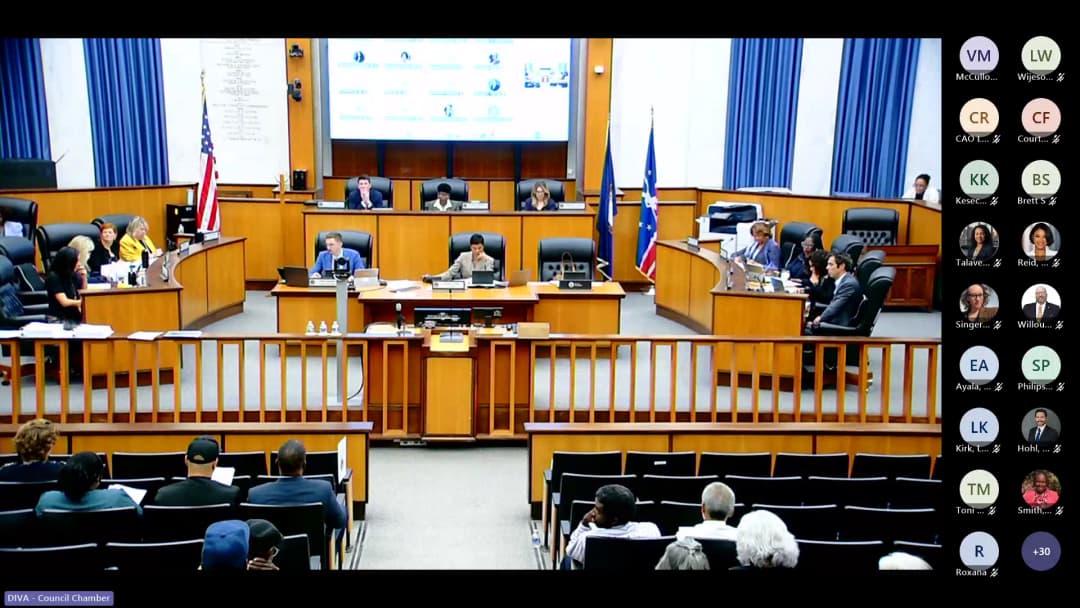
The Richmond City Council held an informal meeting on October 14, 2026, beginning at 17:00 UTC. The Mayor delivered the annual Office of Community Wealth Building (OCWB) impact report, followed by council questions and a docket review of upcoming agenda items. No formal votes were taken on substantive items; several matters were continued by consensus. Discussion Items - Mayor's annual OCWB impact report: The Mayor said the city's anti-poverty work is broader than OCWB alone and is organized under the mayoral action plan, with goals set by a resident-led commission in 2012: reduce the number of people in poverty by 40% by 2030, reduce child poverty by 50% by 2030, and lower the city's poverty rate below 15%. - Progress data: The Mayor reported that from 2015 data — a 25.5% city poverty rate and child poverty of nearly 40% — the number of residents in poverty fell from about 51,000 to below 40,000 (39,900), a 22.9% decrease, while child poverty fell by 27.3%. He said Richmond is outpacing the country, the state, surrounding jurisdictions, and comparable Southern cities, including Montgomery, Alabama, and Baton Rouge, Louisiana. - Demographic and income context: The Mayor noted population growth, increased employment, higher educational attainment (one in five city residents lacked a high-school diploma in 2012; now one in ten), and a 15,000-person increase since 2020. He also cited a decrease of about 10,000 African American residents in raw numbers over the decade, an 80% increase in the Latino population (about 11,000 people, now one in ten residents), and continuing racial disparities: overall poverty at 18%, below 10% for white residents, 25% for Black residents, and 24.1% for Latino residents. He acknowledged that some low-income residents can no longer afford to stay in the city and are moving to surrounding localities. - Income and cost trends: Median regional wages rose by $6.16, and the minimum wage rose by about two-thirds, but the wage needed to afford a two-bedroom apartment rose by more than $10 per hour, and grocery costs rose by $326 per month, equal to about $2 per hour for a full-time worker. The Mayor highlighted that the 50th-percentile income for middle-income Black residents was $41,757, slightly lower than the 20th-percentile income for white residents, and that highest-income Black residents (about $81,000) remained significantly below the white median. - Policy and program highlights: The Mayor described OCWB's community-driven policy research process that generated 101 ideas, including reinvesting delinquent tax sale revenue into generational real estate wealth, creating user-curated resource lists, expanding GRTC transit, increasing contractor pay toward $20 per hour (after a step to $18 for janitorial contractors), and subsidizing deeply affordable housing at or below 30% AMI. He cited over $120 million in affordable housing investment with 5,800 units completed or in the pipeline over five years, 589 youth paid $859,000 through summer work-based learning, 2,500 senior contacts, nearly 500 immigrants and refugees served, and more than 20,000 nights of shelter provided by NCS. - Public housing redevelopment: The Mayor cited Raj Chetty's national data showing adults moving from concentrated public housing to mixed-income housing saw little gain, while children had higher college attendance, reduced incarceration, higher earnings, and lifetime gains sometimes reaching $500,000, with stronger effects for younger children. He said this underlies the city's priority on public housing redevelopment and the Gilpin transformation. - Partnerships and next steps: The Mayor said a Gilpin transformation MOU with RRHA would come before council, with the city responsible for the people plan and neighborhood planning and RRHA responsible for housing redevelopment. He also mentioned a joint economic mobility squad, raising contractor pay, using city-owned land, a revised affordable housing strategy, a zoning code refresh, and a November ballot measure for a 1% sales tax to support school infrastructure. - Family story: The Mayor closed with the Richardson family, including Cheryl Owens Richardson, who became a doula through OCWB, her daughter Barbara, now also a doula, and her son Benton, a participant in Youth Works RVA. Council Questions and Positions - Councilwoman Robertson thanked the Mayor and staff, noted she was part of the original committee and chairs the Citizen Advisory Board, and asked for a more detailed meeting with the administration. She questioned whether the reported reductions reflected people leaving poverty or changes in the city's total population, said the racial disparities were devastating, and stated that people in poverty in Richmond are poorer today than when the initiative began. She said the advisory board wants clearer metrics for sustainable change. - Councilwoman Gibson said she was not convinced the gains were not largely driven by displacement. She noted Richmond Public Schools enrollment fell from about 24,000 students in 2015 to closer to 21,000, with financial implications, and asked the administration to publish studies showing where displacement has occurred, to examine RRHA vacancy rates, and to analyze potential teardowns resulting from the code refresh. - Councilwoman Lynch agreed with Councilwomen Robertson and Gibson, recalling that OCWB was originally intended to be both a policy-coordinating body and a direct-service program. She asked for program-level data, such as prior reports showing specific numbers like 101 people served through the workforce program, rather than aggregate American Community Survey data, so council can evaluate OCWB's actual impact. - A council member suggested the advisory board should start by reviewing whether the existing poverty goals are appropriately framed and provide direction. - Councilwoman Jones said certain slides were vague, including references to 'record investments in RPS' and 'support people in crisis,' and asked for program-level clarity so the city can explain where poverty reductions actually occurred. She requested information in partnership with the advisory board and other city departments. - Mayor's response: The Mayor said there are two different things — citywide poverty trends and OCWB as a program deliverer — and acknowledged council needs both. He left early to catch a plane, and OCWB Director Capricia Spellman remained to answer questions. She said the comprehensive report accompanying the presentation would be forthcoming and would include more details. Docket Review - Consent agenda: Ordinance 2026-155 was retained on the consent agenda after being continued from September 28, 2026. Ordinances 2026-181, 2026-197, and 2026-286 were continued to the November 9, 2026 council meeting by consensus; Ordinance 2026-197 was awaiting an amendment. Ordinances 2026-198, 199, 200, 201, 207, 254, 255, 257–267, and 269–274 received Planning Commission recommended approval. Ordinances 2026-275 and 2026-282 through 2026-290 received Education and Human Services recommended approval. Ordinance 2026-296 and Resolution 2026-R040 had Finance Committee referral waived and were retained on the consent agenda. - Regular agenda: Ordinance 2026-081 (two papers) was retained after being continued from September 28, 2026. Ordinance 2026-196 was continued to November 9, 2026 per the patron's request. Resolution 2026-R019 was retained. Resolution 2026-R029 was continued to November 9, 2026 per the patron's request. Ordinance 2026-256 received Planning Commission recommended approval with an amendment and was to be amended later that evening, then continued to November 9, 2026. Resolutions 2026-R038 and 2026-R039 were to be amended and considered later that evening. - Chief of Staff Warren noted that the amendment for Ordinance 2026-197 might be ready for introduction and consideration after the meeting, with more information to come. Key Outcomes - No substantive votes were taken; the meeting was informal. - Council consensus continued several items to the November 9, 2026 council meeting, including ordinances 2026-181, 2026-197, 2026-286, 2026-196, and 2026-256, and Resolution 2026-R029. - Council asked the administration for responses to questions about displacement, program-level data, poverty metrics, and OCWB outcomes. - OCWB Director Spellman committed to providing a fuller comprehensive report. - The Citizen Advisory Board and administration planned to hold a more detailed follow-up meeting. - The informal meeting adjourned after the docket review.
ECONOMIC DEVELOPMENT 27% · COMMUNITY ENGAGEMENT 20% · PROCEDURAL 17% · AFFORDABLE HOUSING 12%
12
OCT 14, 2026 · RICHMOND, VIRGINIA · CITY COUNCIL
Richmond City Council Formal Meeting - October 14, 2026

[Introductory paragraph: The Richmond City Council held a formal meeting on October 14, 2026, beginning at approximately 7 PM (after preamble). The meeting included awards, public comments, consent agenda, and regular items including a payment register for financial transparency, a special use permit for 21 townhomes on South Meadow Street, legislative agenda adoption, and council announcements. Multiple votes were taken and significant procedural discussions were held around transparency, surveillance, and housing density, and community engagement....] Awards & Presentations - Honoring Vicky Hester: A recognition presented by President Cynthia Newbill, Councilor Stephanie Lynch, and Mayor Dania Vula to recognize Vicky Hester, owner of Babes of Careytown, for LGBTQ+ advocacy. Her wife Ashley Ruger Hester accepted the award. Public Comments & Testimony - Travis Sneed (District 6): Expressed concerns for unhoused individuals along Midlothian Street, requested partnership with city to resources to restore dignity. - Ben Porter (District 6) opposed Code Refresh citing vacancy rate over 9%, population growth projections of 300,000 by 2037 unrealistic; argued existing zoning sufficient for extra housing unit 1.2 per new resident. - Aurora Britt (District 6) supported Code Refresh pushing intended densification local businesses leaving Henrico , praised council's lack urgency on Flock cameras (mass surveillance).- Twitch Justice (District 6) challenged accessibility infrastructure in Richmond, asked allocated budget for disabled residents. - Phil Bonney? (supports FY27 delinquent real estate tax auction) claiming could result increase result.. - Stella Walker (District 7): Opposed proposed households definition for Code Refresh argued not correlated overcrowding density. - Susan Dolman Webb (District 4) urged ALPR removal contract removal mayor annouce non-renew by 2027; provided actions improve transparency ALPR ban and FLock cameras installations. - Jessica Wilhelm (District 6) surveillance including FLOCK cameras pointed out widespread public opposition. Ada Townsend (6) extended gratitude guard privacy contract renew and removal advocate further. - Others: Andrew Kreider (opposed as consent item 11, zoning 5902 Grove Ave) yields to council. Discussion Items .'

LAND USE AND ZONING 21% · PUBLIC SAFETY 14% · AFFORDABLE HOUSING 13% · COMMUNITY ENGAGEMENT 11%
13
OCT 9, 2026 · RICHMOND, VIRGINIA · CITY COUNCIL
Richmond Education and Human Services Committee Meeting - October 9, 2026

The Education and Human Services Standing Committee of the Richmond City Council met on October 9, 2026, to hear a public comment on homelessness, receive a detailed presentation on the updated strategic plan to end homelessness, and vote on several ordinances related to opioid settlement funds, shelter operations, and other initiatives. The meeting ran approximately one hour and fifteen minutes. Public Comments & Testimony - Rhonda Sneed (Blessing Warriors RBA) spoke about persistent challenges for unsheltered families, criticizing the existing protocol that limits shelter referral eligibility to children under three, children under 18 with chronic health conditions, or individuals three months pregnant. She stated that a four-year-old child should not be discriminated against and questioned who made this protocol. She also highlighted the lack of a 24-hour hotline for families and seniors in crisis, noting that first responders often have no option but to call 911, which is inappropriate. She expressed appreciation for the cooling center but said it was activated too late (after 12 hours of rain). She called for faster action, stating "it's not moving fast enough." Discussion Items - Strategic Plan Update to End Homelessness – Alison Sailors, Manager of the Office of Homeless Services, presented the "Greater Richmond Partnership to Address Homelessness and Housing Instability," an update to the 2020 plan. Key points included: - The update was required by city ordinance and responds to changing trends: the July 2025 point-in-time (PIT) count showed more unsheltered than sheltered people for the first time; the July 2026 PIT count showed unsheltered numbers dropping to 286, with 326 sheltered. - Regionally, rents have risen 24% since 2020, and there is a deficit of 27,000 rental units affordable to households at 30% area median income or below. - Federal funding shifts (HUD) have eliminated rapid rehousing as an intervention and reduced funding for permanent supportive housing (PSH). - The plan is organized around five strategy groups: Governance, Shelter & Outreach, Permanent Supportive Housing, Housing Instability, and Older Adults. - Governance: Formalize regional partnership with written agreements. - Shelter & Outreach: Goal 2.2 – expand equitable access to shelter, noting only 28 of 147 year-round beds are for women, and there is a shortage of beds accessible to people with disabilities and older adults. Goal 2.1 – scale the regional outreach team. - PSH: Three main funding sources (HUD, DBHDS, Virginia Housing target population leasing preference) are not coordinated; utilization of the Virginia Housing units is below 15%. The plan aims to better coordinate and expand capacity. - Housing Instability: Focus on families and older adults. Families often fall through gaps due to differing definitions of homelessness (McKinney-Vento vs. HUD). Older adults are a recurring priority. - Winter shelter: The inclement weather shelter at 1900 Chamberlain Avenue must move next year to allow Salvation Army renovations. The city is responsible for finding alternative space for the 50-bed men’s shelter, 106-bed inclement weather shelter, and city resource and training center. The winter shelter plan for this season (Nov 15 – Apr 15) includes CARITAS surge and warming centers. - Councilmember Jones asked about total housing needed for unsheltered individuals, requesting specific numbers. She noted that a 350-unit PSH shortage was cited in the Richmond 300 plan and asked how regional origins of homeless individuals are tracked. She also asked about coordination with the Department of Corrections for re-entry. - Councilmember Lynch requested an inventory of PSH units and vacant public housing units from RRHA, and asked about multiple access points to shelter. He noted that the single homeless connection line is a barrier. - The committee requested that Daily Planet bring forward their contingency management plan (related to item 6) and that Home Again explore reserving 10–15 beds for after-hours family referrals. - Ordinance Approvals – The committee voted on several ordinances in blocks: - Items 1 & 8 (Opioid Settlement): Ordinance 2026-275 (accept $614,426 from National Opioid Settlement Fund) and Ordinance 2026-288 (nation's foundation grant for harm reduction) were approved unanimously. - Items 3, 4, 5, 6, 7, 9: Included: 2026-283 (SARA grant for warm line), 2026-284 (amendment to lease for 50-bed emergency shelter at 7 N. Second St.), 2026-285 (amendment to sub-lease for family shelter), 2026-286 (Daily Planet contingency management), 2026-287 (La Casa de la Salud opioid prevention), and 2026-289 (extension of grant for Home Again family shelter). Approved with the condition that Daily Planet present its plan at the next meeting. - Item 2: Ordinance 2026-282 (transfer $700,000 from outside agencies to ACTS for Family Crisis Fund) approved. - Item 10: Ordinance 2026-290 (fiscal agency agreement with Next Up RVA for youth program) approved. - Board Vacancies: The committee approved reappointments to the Richmond Behavioral Health Authority (Taylor Davis, Arya Kirkland Harris, Dana Sally Allen) and continued the vacancy for the Advisory Board of Recreation and Parks. Key Outcomes - Approved nine ordinances (2026-275, 2026-288, 2026-282, 2026-284, 2026-285, 2026-286, 2026-287, 2026-289, 2026-290) forwarding to full council with recommendation to approve. - Requested the Daily Planet to present its contingency management program plan at the next committee meeting. - Requested Home Again to explore reserving 10–15 shelter beds for after-hours family referrals. - Requested an inventory of housing units by AMI levels and occupancy/vacancy data from RRHA. - Approved RBHA board appointments; held vacancy for Parks and Recreation board. - The committee’s next meeting is scheduled for November 8, 2026, with an anticipated update from Richmond Behavioral Health Authority.

HOMELESSNESS 62% · PUBLIC HEALTH 9% · PROCEDURAL 8% · AFFORDABLE HOUSING 6%
14
OCT 8, 2026 · RICHMOND, VIRGINIA · CITY COUNCIL
Education and Human Services Standing Committee Meeting – October 8, 2026

The Education and Human Services Standing Committee met on Thursday, October 8, 2026, at 2:00 PM in the Council Chamber. The meeting included a presentation on the updated Homeless Services Strategic Plan, public comment, discussion of multiple ordinances, and board vacancy appointments. The committee acted on a series of funding and contract measures related to opioid settlement funds, shelter operations, and youth programming. Public Comments & Testimony - Rhonda Sneed (Blessing Warriors RVA) expressed frustration with the lack of a 24-hour protocol for families with children experiencing homelessness, particularly after hours. She described an existing eligibility criteria that required a child to be three years or under, or a child under 18 with a chronic health condition, or an individual three months pregnant. She argued that this discriminated against older children and placed liability on volunteers. She also noted that a 90-year-old unsheltered individual was told to call 911, which was not appropriate. She urged faster action on homelessness solutions. Presentation: Homeless Services Strategic Plan Update - Alyson Saylors, Manager of the Office of Homeless Services, presented the Greater Richmond Partnership to Address Homelessness and Housing Instability – an update to the 2020 strategic plan required by city ordinance every two years. - Key context: The July 2026 point-in-time count showed 287 unsheltered individuals (down from 2025, but still high) and 326 sheltered individuals. Rents in the region have risen 24% since 2020, with a deficit of 27,000 affordable rental units for households at 30% area median income or below. Federal funding changes (HUD) have eliminated rapid rehousing as an intervention and reduced permanent supportive housing (PSH) funding. - The plan was developed regionally with partners: City of Richmond, Chesterfield, Hanover, Henrico, and the Greater Richmond Continuum of Care (GRCOC). Engagement included a community meeting (119 participants), a bilingual survey, 44 lived-experience interviews, five strategy groups, and 19 key informant conversations. - Five priority areas: governance, outreach and access, permanent supportive housing, housing instability, and older adults. - Governance goal: formalize regional partnership with written agreements and a public dashboard within two years. - Outreach goal: scale the regional outreach team to move unsheltered individuals into housing more efficiently. Current outreach capacity has declined. - PSH goal: better coordinate three main funding sources (HUD, DBHDS, and Virginia Housing target population leasing preference). Current utilization of the Virginia Housing set-aside (10% of new LIHTC units) is below 15%. - Housing instability goal: expand resources for families and older adults, noting that families often fall outside HUD’s narrow definition of homelessness. McKinney-Vento definitions include doubling up or living in a hotel, which are not covered by HUD programs. - Older adults: identified as a growing population at risk of first-time homelessness due to fixed incomes and rising costs. The Elder Justice Shelter Initiative (VCU, Homeward, Caritas, etc.) concluded in August 2026. - Winter shelter update: The Salvation Army shelter at 1900 Chamberlayne Avenue will need to relocate for two years starting next year for renovations as part of the Center of Hope project. The city must find a new location for the 50-bed men’s shelter, 106-bed inclement weather shelter, and resource center. The 2026-2027 winter plan: Inclement Weather Shelter open Nov 15–Apr 15 nightly; CARITAS surge Dec 1–Mar 31 when temp ≤40°F and Salvation Army 85%+ capacity; warming centers for ≤20°F (contracted with CARITAS up to 20 nights). Discussion Items - Committee members questioned the plan on several points: - Councilmember Jones asked for the exact housing unit gap needed for unsheltered individuals, noting the Richmond 300 plan cited a shortage of 350 units. She emphasized the need for a specific number to plan land use and funding. - Also asked how the region tracks where unsheltered individuals are from (e.g., Henrico, Chesterfield) to coordinate housing investments across localities. - Asked about collaboration with the Department of Corrections for re-entry individuals who may not be from Richmond but are released there. - Chair Lynch requested an inventory of all PSH units at 30% AMI and below, and vacancy data from Richmond Redevelopment and Housing Authority (RRHA). - Councilmember Jones requested that Daily Planet bring forward its contingency management plan for the opioid program to the next meeting. - Councilmember Breton noted the need for multiple access points to shelter, not just the single Homeless Connection Line, and asked that this be considered by the regional body. - DCAO Popovich responded that the plan aims to better understand current system capacity, and that regional partners are committed as shown by their participation. Key Outcomes - Approved Ordinances (all moved to full Council with recommendation to approve): - Block 1: Opioid settlement related 1. ORD 2026-275: Accept $614,406 from the National Opioid Settlement Fund for opioid abatement strategies. 2. ORD 2026-288: Grant contract with Nationz Foundation for comprehensive harm reduction services. - Block 2: Opioid-related (3,6,7) 3. ORD 2026-283: SAARA grant contract for Alive RVA Warm Line. 4. ORD 2026-286: Daily Planet grant contract for contingency management in Medication for Opioid Use Disorder clinic. 5. ORD 2026-287: La Casa de la Salud grant for culturally responsive opioid prevention/education for Latine community. - Block 3: Shelter operations (4,5,9) 6. ORD 2026-284: First Amendment to lease with Potomac Area Hostels for 50-bed year-round emergency shelter at 7 N. 2nd St. 7. ORD 2026-285: Second Amendment to sublease with HomeAgain Richmond for 50-bed year-round emergency shelter for families. 8. ORD 2026-289: Second Amendment to grant contract with HomeAgain extending shelter operation through Nov 30, 2027, with three one-year renewal options. - Block 4: 9. ORD 2026-282: Transfer $700,000 from Presbyterian Homes and Family Services line item to Area Congregations Together in Service for the Family Crisis Fund. - Block 5: 10. ORD 2026-290: Fiscal agency agreement with NextUp RVA for CarMax Basketball Youth Development and Summer Camp program. - Board Vacancies: The committee forwarded reappointments to City Council for David Lambert (Parks and Rec Advisory Board, 3rd District), Taylor Davis (RBHA, resident/work in city), Arya Kirkland-Harris (RBHA, reappointment), and Dana Sally-Allen (RBHA, reappointment, family member of service recipient). Vacancies without applicants were noted. - Minutes: The September 10, 2026 meeting minutes were approved as presented. - Staff Report: Ms. Brown summarized action items: Chair Lynch and Councilmember Jones requested housing inventory across AMI levels and RRHA vacancy data; Daily Planet to present contingency management plan at next meeting; HomeAgain update requested. Next meeting scheduled for November 8, 2026, with anticipated update from Richmond Behavioral Health Authority.

HOMELESSNESS 52% · AFFORDABLE HOUSING 18% · PUBLIC HEALTH 12% · PROCEDURAL 8%
15
OCT 7, 2026 · RICHMOND, VIRGINIA · CITY COUNCIL
Richmond Planning Commission Meeting - October 7, 2026: Grove Ave Townhomes and Office Use SUP

The Richmond Planning Commission met in person and virtually on October 7, 2026, at 3:15 PM UTC (evening local time) to consider a consent agenda of 26 items, two regular agenda items, and a council action update. The meeting featured extensive discussion on a proposed 33-unit townhome development at 4101 Grove Avenue, where the commission ultimately approved the project with an amended site plan overruling the Department of Public Works’ objection to a mid-block curb cut. A separate special use permit for interior design and tutoring offices at 5900/5902 Grove Avenue was also approved. Consent Calendar - The consent agenda (items 2 through 26) was approved unanimously with one recusal (Commissioner White recused himself on item 19, 5908 Three Chopt Road). Items included acquisitions for drainage improvements, green space preservation, multimodal transportation easements, a $1 million Safe Streets and Roads for All grant, and numerous special use permits for residential infill, mixed-use buildings, accessory dwelling units, and amendments to existing permits. Also included was a final location and character extent review for a future RACC adoption facility at 2310 West Cary Street. Public Comments & Testimony Item 27 – 4101 Grove Avenue (33 townhomes): - Bo Farland (King Crest neighborhood) spoke in favor, thanking the developer for extensive community engagement and noting the need for two access points due to density. He expressed sadness over the loss of the historic 7th Street Christian Church but supported the project with the Grove Avenue entrance. - Bill Atkinson (King Crest resident) supported the project, stating the Grove entrance was safer than a Malvern entrance, which would introduce conflicts with bike lanes and pedestrians. - Scott Oostdyk (adjacent resident) spoke in favor, praising the developer’s responsiveness and the reduction from 35 to 33 units. - Zachary Taylor (resident) expressed concern about potential U-turns at the Grove Avenue entrance but acknowledged DPW could address safety. - No speakers opposed the project. Item 28 – 5900/5902 Grove Avenue (office for interior design and education): - Meg Coogan (4302 Grove Avenue) spoke in favor, noting similar uses already exist on the block and that low-impact uses fit the neighborhood. - Susie Keller (616 Maple Avenue) supported, stating traffic impact would be minimal and the educational services benefit local families. - Jane Gill (Willway Avenue) spoke in favor, emphasizing the applicants’ local ties and stewardship of the open space. - Ray Paul (5805 Grove Avenue) supported, saying traffic from the proposal would be insignificant compared to existing school carpool peaks. - Eugenie Calderon (5905 York Avenue) opposed, presenting a petition from 30 households. She argued that approving commercial use on R2-zoned property would blur the boundary between the commercial node and residential neighborhood, setting a harmful precedent. - Zachary Taylor (York Road) opposed, citing the same precedent concern and noting Maple Avenue as a clear demarcation line. - John Mancini (unclear address) opposed, also citing the line of demarcation and urging preservation of the single-family character. Discussion Items Item 27 – 4101 Grove Avenue SUP for 33 townhomes: - Staff presented the proposal for a special use permit to allow up to 35 single-family attached dwellings (later amended to 33) on a 1.8-acre site currently occupied by a church and parking lot at Grove Avenue between Malvern and Antrim. The property is zoned R5; attached dwellings are not permitted without a SUP. - The applicant’s revised site plan introduced a mid-block curb cut on Grove Avenue for a second access point. The Department of Public Works (DPW) objected, citing safety concerns: increased conflict points, potential for rear-end collisions, and higher traffic volumes compared to the former church use. DPW recommended an entrance on Malvern Avenue instead, but the applicant and neighborhood favored the Grove entrance. - Commissioners debated safety tradeoffs. Several commissioners (White, Rowe, Greenfield) questioned DPW’s position, noting that the existing curb cut had been used for decades, that right-in/right-out on Grove (with a median) might be safer than a full-access entrance on Malvern (which has bike lanes and higher perceived speeds). Commissioner White noted that DPW’s standard approach may not apply to this specific location. - The applicant argued that the Grove entrance was safer than Malvern, which would require grading, tree removal, and create conflicts with queuing from a signalized intersection. - The neighborhood representatives (Farland, Atkinson) supported the Grove entrance, stating it was critical for their support and that Malvern would create more hazards. - The commission voted to recommend approval with an amendment reducing units to 33 and adopting the applicant’s updated site plan showing the Grove Avenue entrance (6-1, with Commissioner Rowe dissenting). Item 28 – 5900/5902 Grove Avenue SUP for interior design and education: - Staff presented the request to convert an existing single-family house and adjacent lot (currently a learning garden) into an office for interior design and Montessori-style tutoring (pre-K to grade 5), with nine off-street parking spaces. No new construction; only interior renovations and parking lot improvements. - The property is zoned R2; the uses are not permitted by right. The site is on the corner of Grove and Maple, within the West Hampton neighborhood node designated for mixed-use services. Staff found the uses compatible with the node and consistent with the master plan. - The applicant noted that traffic generation would be less than 1% of current intersection volume, based on a traffic study. - Opponents argued that approving commercial use on a residential lot would set a precedent for creeping commercial activity across Maple Avenue, which they consider a clear boundary. Supporters countered that the SUP is specific to these two parcels and does not rezone the area; the underlying R2 zoning remains. - The commission voted unanimously to recommend approval, with several members noting the corner location, limited nature of the uses, and the fact that special use permits are evaluated case-by-case (7-0). Key Outcomes - Item 27 – 4101 Grove Avenue: Recommended approval (6-1) of the special use permit for 33 townhomes, with an amended site plan reducing units from 35 and retaining the mid-block entrance on Grove Avenue. The matter will be forwarded to City Council. - Item 28 – 5900/5902 Grove Avenue: Recommended approval (7-0) of the special use permit for interior design and educational services, with conditions on hours, parking, and student capacity. - Consent Agenda: Approved unanimously with Commissioner White recused on item 19. - Council Action Update: The September 28 City Council meeting was adjourned early; a special meeting on October 5 introduced three new SUPs referred to the October 20 Planning Commission meeting. Five SUPs were adopted on September 28. The next Planning Commission agenda (October 20) will include three new SUPs, three returning SUPs, and a final resolution on the Jackson Ward community plan.

LAND USE AND ZONING 75% · TRANSPORTATION SAFETY 9% · PROCEDURAL 8% · COMMUNITY ENGAGEMENT 4%
16
OCT 6, 2026 · RICHMOND, VIRGINIA · CITY COUNCIL
Richmond City Council Organizational Development Standing Committee Meeting - October 6, 2026

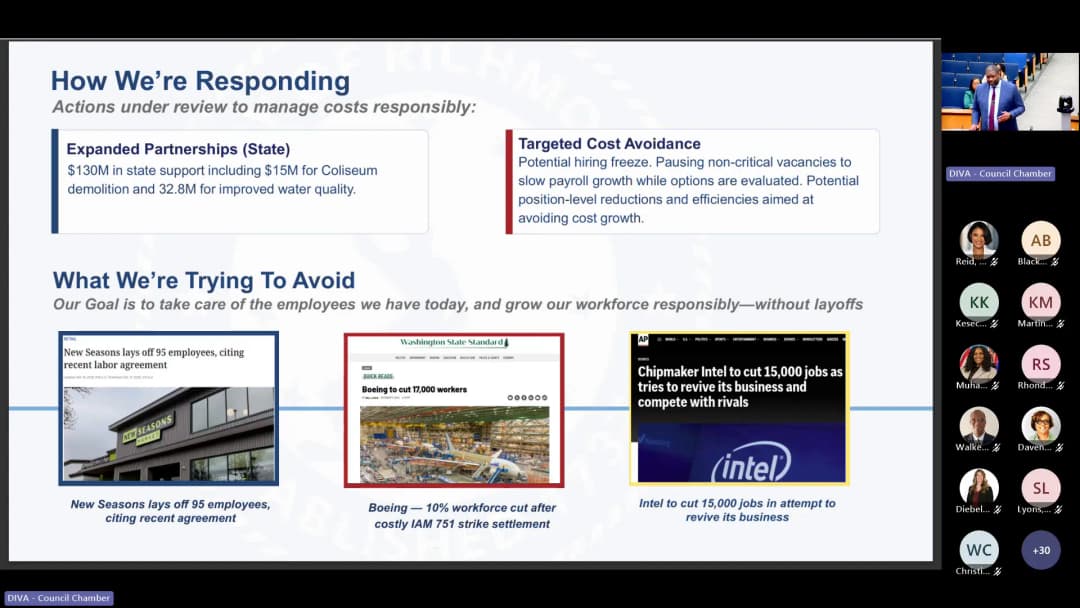
The Organizational Development Standing Committee of the Richmond City Council met on October 6, 2026 at 2:15 PM. The meeting consisted of a preliminary budget work session for FY 2028, featuring presentations from the City Assessor, CAO, and PFM consulting, followed by council discussion of budget priorities. A motion was approved to allow Councilmember Stephanie Lynch to participate electronically due to a family caregiving arrangement. Consent Calendar - Approval of the minutes from the September 8, 2026 Organizational Development Standing Committee meeting. Discussion Items - City Assessor Richard McKeathan presented real estate market trends, forecasting a 4.5% increase in taxable real property for the next reassessment (June 2027). He attributed the moderation to national economic struggles: interest rates at approximately 7.5%, inflation, and gas prices averaging over $4/gallon. Discussion with Councilmembers Gibson, Burton, and Trammell focused on the implications of an 18-month gap since the last reassessment, the conservatism of the forecast, and the need for written interim data. McKeathan agreed to revisit the forecast in spring 2027. - CAO Lincoln Donald provided a fiscal overview, stating the city’s fiscal health is good but faces structural challenges. He highlighted commitments including a 2.5% real estate tax allocation to the Affordable Housing Trust Fund, upcoming collective bargaining negotiations, a $120 million pension obligation bond resulting in $10 million annual debt service for 20-22 years, and capital reinvestment needs. He mentioned potential cost avoidance measures such as a hiring freeze and pausing non-critical vacancies. - PFM Group (Danielle Scott Parker, Ashley Anyo, Christy Choi) presented a financial condition assessment and multi-year baseline forecast. Key findings: revenue growth (3-4% annually) is being outpaced by expenditure obligations (7-9% annually), primarily driven by personnel costs (41% of general fund), Richmond Public Schools contributions (23%), debt service, and the Affordable Housing Trust Fund. The baseline forecast, assuming 4.5% assessed value growth in FY28 and 6% thereafter, shows structural deficits in the first three years and fund balance falling below policy by FY2030. The model does not assume next-round collective bargaining increases or tax changes. The impact of a one-cent and four-cent real estate tax reduction was illustrated. - Mayor Danny Avula acknowledged lower revenue projections than expected, citing the new assessment calendar and national economic uncertainty. He reaffirmed commitments to workforce investment, economic development, safety, and service delivery. He explained that a proposed one-cent real estate tax cut and one-cent meals tax reduction were contingent on the sales tax referendum for school renovation, but fiscal realities may require adjustment. - Councilmember Gibson requested detailed data on new construction revenue, delinquent tax collections, the actual 4.5% value, and timing for tax rate decisions. Councilmember Abubaker questioned debt service increases (9.3% annual from FY21-24) and compared earlier deficit projections ($27M, $319M) to current PFM projections indicating a potential shortfall around $40M; CAO Donald clarified that the $319M figure is not current and that decisions on hiring and cost avoidance will affect the actual deficit. - Councilmember Trammell expressed concerns over high real estate taxes for homeowners, especially seniors, and opposition to the code refresh initiative. Mayor Avula responded that new development generates revenue to cover rising government costs and that supply helps control housing costs. - Councilmember Jones asked for clarity on how PFM’s role differs from Davenport (the city’s long-term financial advisor) and urged integrated financial storytelling. Mayor Avula explained that PFM supports budget development and economic forecasting, while Davenport advises on credit rating and bond issuances. - Councilmember Gibson raised concerns about Diamond District financing, noting $129 million in general fund line items and questioning whether the project is self-funding given development delays. CAO Donald stated that the $120 million figure relates to debt service and that he would respond to written questions within 30 days, cautioning against conflating different financial items. Council Budget Priorities - Mr. Warren read each council district’s citywide and district-specific budget priorities for FY 2028. These will be grouped into themes by council staff, and a resolution with an appendix of priorities will be drafted for introduction in November. Key Outcomes - Procedural votes: approval of electronic participation for Councilmember Lynch (unanimous) and approval of September 8 minutes. - Council staff to collect questions and provide responses within 30 days. - Budget priorities to be synthesized into a resolution for November introduction. - Meeting adjourned after addressing all agenda items.

PUBLIC FINANCE 42% · BUDGET EQUITY ANALYSIS 30% · FISCAL SUSTAINABILITY 9% · ECONOMIC DEVELOPMENT 6%
17
OCT 6, 2026 · RICHMOND, VIRGINIA · CITY COUNCIL
Special Meeting of Richmond City Council - October 6, 2026

A brief special meeting of the Richmond City Council was held on October 6, 2026, to introduce new legislation. The meeting was called to order, an emergency evacuation announcement was given, and attendance was noted. All council members were present except Councilors Breton, Robertson, and Lynch, but a quorum was established. Legislation Introduction - Council introduced new legislation items numbered 1 through 18 as presented. A list of the items was made available for public inspection at the rear of the council chamber and online via the city's website. Key Outcomes - The 18 new legislation items were formally introduced without discussion or opposition. The meeting adjourned immediately after the introduction.

PROCEDURAL 100%
18
OCT 5, 2026 · RICHMOND, VIRGINIA · CITY COUNCIL
Organizational Development Standing Committee Meeting - October 5, 2026

This meeting of the Richmond City Council's Organizational Development Standing Committee on October 5, 2026, served as a preliminary budget work session for FY2028. The committee received a real estate assessment forecast, a comprehensive fiscal outlook from the administration and external consultants, and heard individual councilmembers' budget priorities for the upcoming fiscal year. No binding votes were taken on substantive matters. Consent Calendar - Approval of Minutes: The minutes from the September 8, 2026, meeting were approved without amendment. (Motion to approve electronic participation for Councilmember Lynch passed unanimously: 8-0-0; ayes from Breton, Gibson, Jones, Trammell, Abubacher, Jordan, Newbill, and the chair.) Discussion Items - Real Estate Assessor's Office Update: City Assessor Richie McKeithen forecasted a 4.5% increase in taxable real property for the next reassessment (due June 2027), down from the 6.5% increase in the prior cycle. He cited rising interest rates (approximately 7.5%), inflation, and gas prices over $4/gallon as moderating factors. Councilmembers Gibson and Burton questioned the basis and timeline, noting the 18-month gap since the last full reassessment. McKeithen acknowledged he is not an economist and will revisit the forecast in spring 2027. He agreed to provide additional data on interim valuations and modeled assumptions. - City Fiscal Outlook: Chief Administrative Officer Odie Donald II reported the city's fiscal health is sound but faces headwinds from a slowing economy, higher costs, and commitments. He highlighted the 4.5% growth projection, existing collective bargaining agreements, the Affordable Housing Trust Fund (2.5% of prior year real estate tax collections), pension obligation bonds ($10 million annual debt service for 22 years), and capital reinvestment needs. PFM consultants (Danielle Scott Parker, Ashley Anywhere) presented a five-year baseline forecast showing structural deficits in FY2028–2030, potentially forcing the city below its fund balance policy by FY2030 under status-quo assumptions. They noted revenue growth (3–4% annually) has been outpaced by expenditure growth (7–9% annually), driven by personnel (41% of general fund), RPS contributions (23%), and debt service. PFM stressed that upcoming collective bargaining negotiations will be a critical determinant of fiscal trajectory. Mayor Avula echoed the need for collaborative, long-term planning and reiterated commitments to workforce investment, economic development, safety, and service delivery. Councilmembers Gibson, Abubacher, Trammell, and Jones raised questions about tax cuts, the Diamond District financing, code refresh, and coordination with previous consultant Davenport. The CAO committed to providing a written response to councilmember questions within 30 days. - FY2028 City Council Budget Priorities: Council Chief of Staff Mr. Warren read out individual councilmember priorities by district. Key themes included: transportation and after-school programs (District 1), spot blight funding and fare-free GRTC (District 2), staffing for code enforcement and urban forestry (District 3), sidewalk and park infrastructure (District 4), family shelter and violence prevention (District 5), landlord-tenant services and farmers markets (District 6, via Lynch), Health Equity and Child Care Trust Funds (District 7), retiree COLA increases and road maintenance (District 8), arts, senior resources, and food programs (District 9). These will be compiled into a resolution with an appendix. Key Outcomes - No formal votes were taken on budget or policy items. - Councilmembers directed the administration to provide additional data on assessment modeling, new construction revenue, delinquent tax collections, and Diamond District debt service within 30 days. - The committee will continue budget discussions in subsequent meetings. Council staff will draft a resolution reflecting the identified budget priority themes. - The meeting adjourned without further action.

PUBLIC FINANCE 41% · BUDGET EQUITY ANALYSIS 27% · FISCAL SUSTAINABILITY 13% · ECONOMIC DEVELOPMENT 5%
20
SEP 29, 2026 · RICHMOND, VIRGINIA · CITY COUNCIL
Richmond City Council Informal Meeting (September 29, 2026): Legislative Agenda and Solar PPA

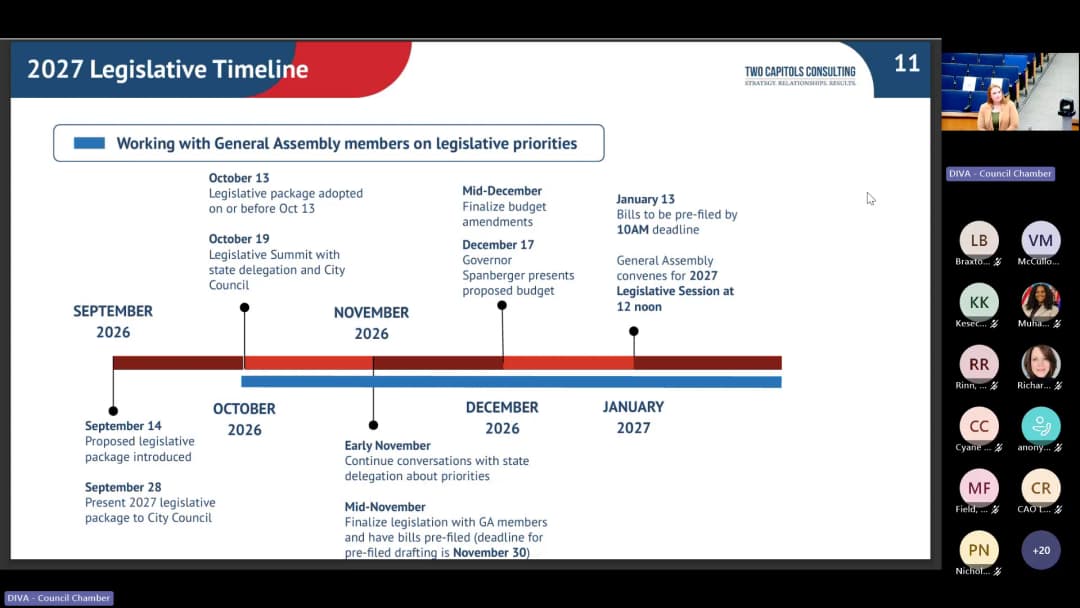
The Richmond City Council held an informal meeting on September 29, 2026, at 2:00 PM. The meeting included a docket review with several continuances, a presentation on the 2027 General Assembly legislative package, and a presentation on a Municipal Solar Power Purchase Agreement. Council members discussed these items but took no formal votes. Consent Calendar - Ordinance 2026-155 (item 1) was continued to the October 13 council meeting per the applicant's request. - Ordinance 2026-175 (item 2) was amended at the September 14 meeting and retained on the consent agenda. - Ordinances 2026-187, 2026-189, and 2026-190 (items 6, 8, 9) were continued to the November 9 council meeting based on planning commission or committee recommendations. - Ordinance 2026-195 (item 13) was flagged by Councilwoman McGibson for discussion, but no motion was made to move it to the regular agenda. - Several ordinances and resolutions (items 15-37) received standing committee approvals and were retained; Councilwoman Robertson was added as co-patron to resolutions R032 and R033 (items 33 and 34). - Resolution R037 (item 37) was continued to the October 13 meeting. - Ordinance 2026-081 (item 40) was retained on the regular agenda; item 41 (ordinance 2026-109) was continued to November 9; item 43 (ordinance 2026-196) was continued to October 13; items 44-82 were retained; and resolution R019 (item 83) was retained. Discussion Items 2027 General Assembly Legislative Package - Devin Cabot (CAPS Consulting) presented the draft legislative agenda. - The top priority is the Long-Term Owner Occupancy Program (LOOP), which requires a constitutional amendment; the city will request the first reference this year. - Housing policies include tenant protections and housing justice measures, expansion of local authority for vacant properties (including the urban public-private partnership redevelopment fund and enterprise zone real property investment grant), and short-term rental regulations. - Policy positions cover housing, human services, transportation, public safety, education, economic development, and administration, including support for eviction prevention, public housing redevelopment, K-12 funding formula modernization, and avoidance of unfunded mandates. - Budget requests include continued investment in drinking water infrastructure and funding for combined sewer outflow improvements. - Timeline: legislative summit on October 19, governor's amendments on December 17, and session start on January 13, 2027. - Council members expressed support; Councilwoman Gibson praised the package's representation of council interests. Vice President Jordan raised the possibility of revisiting charter changes, and Councilmember Lynch advocated for building on prior work rather than starting from scratch. Municipal Solar Power Purchase Agreement - Laura Thomas (Director of Sustainability) and Donald Lexi (Energy Program Manager) presented the proposal. - The project covers 39 public properties across all nine council districts, generating 5 megawatts of solar energy, and is projected to save $20 million in avoided electric costs over 25 years. - The power purchase agreement (PPA) has fixed rates with no escalators, while Dominion rates are set to increase 23.5% on July 1st and another 20% on July 1st, 2027. - The contract is based on a Prince William County Public Schools RFP, also used by the City of Roanoke and Richmond Public Schools, with Secure Solar Futures as the partner. - The city administration signed the contract in August; the council is being asked to approve site leases. The leases carry no cost or risk to the city, and each property will undergo structural and permitting reviews. - The project includes workforce development opportunities, such as training and apprenticeships. Key Outcomes - No formal votes were taken during the informal meeting. - The legislative package will be continued to the October 13 council meeting for amendments and adoption. - The solar PPA site leases will be presented for formal consideration at a future council meeting. - Several agenda items were continued to specific future dates as outlined in the consent calendar.

PROCEDURAL 29% · LEGISLATIVE AGENDA 29% · ENERGY EFFICIENCY 28% · HOUSING 7%
OPENPUBLICA · PUBLIC MEETING INDEXUPDATED DAILY · openpublica.com