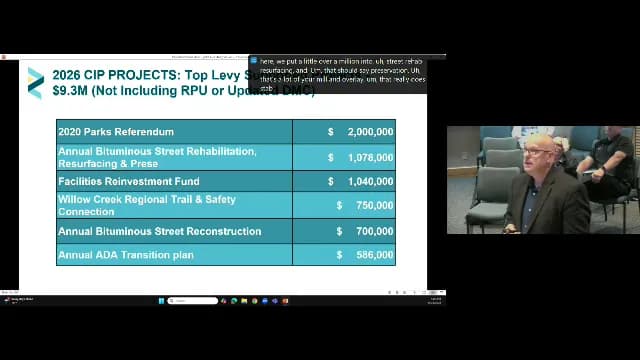
The Rochester City Council held a study session on June 23, 2025, at 3:30 p.m. to receive the 2024 year-end audit presentation, a preview of the recommended 2026-2027 budget, including the Capital Improvement Plan (CIP) and outside agency funding, and to review the upcoming study session schedule. No formal votes were taken; the session was informational and deliberative. Discussion Items 2024 Year-End Audit Presentation - Jason Boynton of Smith Schaefer presented the audit results. The city received an unmodified (clean) opinion on its financial statements for the 53rd consecutive year, and the city expects to receive the GFOA Certificate of Achievement again. - General Fund: Revenues were $120 million (up $11 million from 2023), expenditures were $117 million, producing a $3.1 million surplus that added to unassigned fund balance. Property taxes accounted for $69 million, up $6 million due to a 9% levy increase. - Council Member Palmer questioned the surplus and noted that if the levy had been lower, the surplus would have been smaller. He also asked about the appropriateness of payment-in-lieu-of-tax (PILOT) amounts from enterprise funds. Administrator Zelms replied that PILOT rates are being reviewed for alignment. - Fund Balance Policy: The unassigned fund balance stood at 48% of 2024 expenditures and 43% of budgeted 2025 expenditures, both above the city's minimum of 42% (five months of expenditures). Council Member Miller noted that this metric helps optimize the levy. - Other funds highlighted: Library fund ended with $3.6 million fund balance (37% of expenditures); Municipal Recreation had $3 million fund balance (21%); Airport had a $1.6 million surplus, partly due to $1 million in CARES Act funds; Transit had a $568,000 surplus with no property tax levy for nine years; Parking had a small deficit of $58,000. - Enterprise Funds: Electric utility generated a $35.6 million surplus; RPU is building reserves for upcoming capital needs (estimated $1.2 billion). Water utility surplus was $3.6 million. Sewer utility had surplus of $15 million (revenues $35 million, expenses $20 million). Stormwater surplus was $2.4 million. - Bonds and Liabilities: Outstanding bonds totaled approximately $96 million (excluding utilities). Net pension liability (PERA) was $55 million, with a funding level of about 90%. - Council Member Wall praised the city's financial position; Boynton confirmed that Rochester's planning and reserve-building are strong compared to peers. Recommended 2026-2027 Budget Preview - Administrator Zelms presented an overview of the budget process. The recommended budget is still being finalized; a full budget book will be presented at the August study session. - Total levy increase requests from departments were $4.2 million before prioritization and baseline adjustments. - Budget Optimization Options (potential savings totaling about $334,000): These included reducing Sunday library hours, scaling back the Fourth of July festival (saving $20,000 by only doing fireworks), discontinuing short-term rental licensing/inspections, and reducing adaptive recreation leased space. Council members debated these options, with Council Member Fredericks noting that comparison libraries have fewer weekend hours. Council Member Miller asked about using Cascade Lake for fireworks to save costs, but staff noted parking and logistics challenges. Council Member Doring suggested deferring detailed discussion until the full budget is presented. - Tax levy impacts were illustrated: The median home value in 2025 was $288,000, and a 6% levy increase would result in about $80 more per year for that home. Capital Improvement Plan (2026-2031) - Deputy Administrator Parrish presented the six-year CIP. The total plan includes 210 projects across 25 categories, totaling $560.4 million. For 2026 alone: 127 projects, $144.9 million. - Major 2026 projects include: Airport runway upgrades ($56.4 million), wastewater treatment liquids/solids upgrade ($14 million), Bus Rapid Transit ($7 million), Center Street reconstruction with roundabout ($5.7 million), and 18th Avenue improvements ($14.4 million, pending federal funding). - Funding Sources: $40.5 million federal, $15 million state DMC funds, $9.3 million tax levy (plus $2 million from parks referendum). Council Member Palmer asked about street reconstruction funding from the local sales tax; staff will provide details. - Council Member Schubert asked how projects land on the CIP; staff replied that projects requiring state/federal cost-sharing are often programmed only when those funds are awarded. The Sixth Street Bridge and East Zumbro sewer improvements were cited as examples not yet in the CIP due to pending funding. - Council Member Palmer inquired about specific CIP line items: stormwater flood control on 12th Street and 3rd Avenue (separate from Broadway/14th Street project), a $60,000 bicycle parking allocation, and sediment removal from Silver Lake/Cascade reservoirs. Staff clarified that the sediment fund is a contingency placeholder. Outside Agency Funding - Administrator Zelms presented recommended funding for six outside agencies for 2026-2027. The recommended 2026 total is approximately $572,800, a roughly 5% overall increase from 2025. - Details by agency: - 125 Live: $116,902 in both 2026 and 2027 (contractual). - Community Building Fund: $20,000 per year (no increase recommended). Council Member Palmer suggested the name is confusing; staff explained it funds small grants ($500–$5,000) for community-building projects. - History Center: $60,000 in 2026, $68,000 in 2027 (to support busing for school field trips). - Art Center: $56,000 in 2026, $60,000 in 2027 (operational support for summer programming). - Civic Theater: $65,000 in 2026, $71,000 in 2027 (to help maintain 300+ nights of use and support for 25 nonprofits). - Our Neighbors: $115,000 in 2026, $120,000 in 2027 (restoring to approximate 2020 funding level after pandemic cutbacks). - Rochester Area Economic Development, Inc. (RDA): $57,500 in 2026, $60,000 in 2027 (staff expressed concern about a requested $125,000 increase for marketing/staffing; no recommendation to fully fund). - Southern Minnesota Initiative Foundation (SMIF): $15,000 in 2026, $20,000 in 2027 (Council Member Wall supported elimination, but Council Member Palmer noted SMIF's reading programs benefit Rochester; the recommendation keeps funding). - Council Member Miller asked for a report on Community Building Fund impact. Council Member Doring clarified that the Civic Theater and Art Center increases are to sustain current service levels, not new programs. Council Member Palmer supported the Civic Theater increase. Council Member Wall emphasized the quality-of-life value of the Art Center and RDA's Thursday Downtown events. Study Session Schedule - Administrator Zelms reviewed the upcoming meeting schedule. The July study session will be on July 14 (regular topics), and August will have a longer study session on August 11 with four significant topics (potentially until 7 p.m.). The August 25 meeting will consider the Recommended 2026-2027 Budget. Key Outcomes - No formal votes were taken. The council received the audit and budget preview as informational. - Staff will provide additional details on budget optimization options, CIP project funding, and outside agency performance reports as requested. - The full recommended 2026-2027 budget (operating and capital) will be presented at the August 11 study session. - Council expressed interest in future discussions on scaling community investments (e.g., Community Building Fund, Our Neighbors) as Rochester grows.
Public Meetings - Rochester, Minnesota
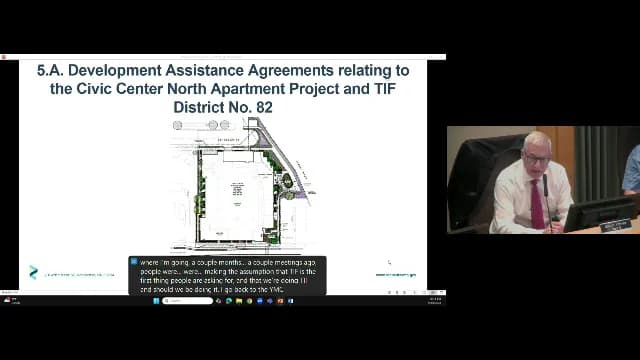
Public Meetings - Rochester, MinnesotaThe Rochester Economic Development Authority (EDA) met on June 16, 2025, at 7:00 p.m. to consider and approve development assistance agreements and tax increment financing (TIF) for the Civic Center North Apartments project. The meeting was called to order after the City Council recessed. The EDA approved the consent agenda and voted 6-1 to adopt the resolutions supporting the project, with one council member dissenting. Consent Calendar - Approved the minutes of the May 19, 2025, meeting of the Rochester Economic Development Authority. Discussion Items - Development Assistance Agreements for Civic Center North Apartments (TIF District No. 82-1): Josh Johnson and Brett Sven V presented the proposal. The project involves a 341-unit development on a less than two-acre city-owned riverfront site, with 76 units of affordable housing at 50% and 30% Area Median Income (AMI). The project integrates market-rate and affordable housing seamlessly, includes a wrapped parking garage, and delivers riverfront improvements. The developer, Sherman Associates, is investing $140 million, representing a roughly 10-to-1 public-private ratio. The city is providing up to $13.1 million in performance-based TIF over a 25-year district, with affordable housing committed for 30 years. The affordable portion generates only $565,000 in increment over the district's life, with $8.5 million in tax increment from market-rate units cross-subsidizing the affordable units. Without this pairing, the city would need to seek alternative subsidies (e.g., GSIA). Council members discussed the length of the TIF (25 years, consistent with updated policy), the AMI mix (14 units at 30% AMI, 36 units below 50%, and the rest at 60% AMI on average), and the overall public benefit. Councilmember Palmer expressed concern that the 25-year term and subsidy level ($13.1 million for 76 affordable units) was not a good payback for the city, noting past projects had 15-year TIFs. Councilmember Keene acknowledged the high subsidy but supported the project due to its long-term downtown investment and the quality of construction. Key Outcomes - Adopted Resolution approving the Purchase and Development Assistance Agreement between the Rochester EDA and Rochester Civic Lot Limited Partnership and a Purchase and Development Assistance Agreement between the Rochester EDA and Rochester Tower LLC regarding the Civic Center North Apartments project, associated with Tax Increment Financing District No. 82-1. Vote: 6-1 (one nay). The meeting then adjourned back to the City Council.
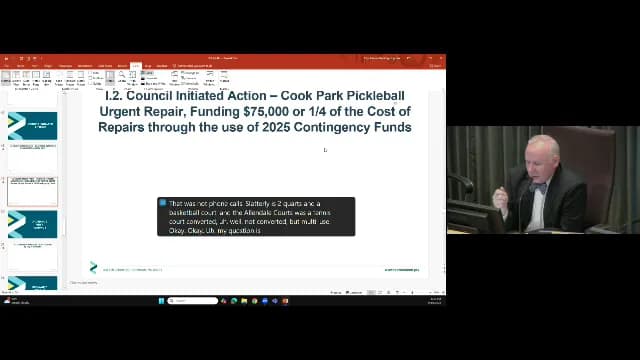
The Rochester City Council met on June 16, 2025, at 6:00 p.m. at the Government Center Council Chamber. The meeting began with a moment of silence for the victims of a weekend tragedy involving former Speaker Melissa Hortman and her husband, and Senator John Hoffman and his wife, followed by the Pledge of Allegiance. The council addressed a lengthy agenda including consent items, public hearings, and several discussed items, with notable votes on affordable housing bonds, a FEMA firefighter grant, pickleball court repairs, and a historic preservation veto override. Consent Calendar - Approved unanimously: Minutes of June 2, 2025, accounts payable of $20,772,480.35, updated 2025 council calendar, annual gambling permit for Rochester Elks Lodge, updated strategic priorities and foundational principles, bid advertisement for regional stormwater pond, contract awards for sanitary sewer improvements, city-owner contracts for First & Banks Apartments and Prairie Ridge Subdivision, reconstruction of Sunrise Ave SE, contracts for Midwest Mechanical Solutions, Kats Excavating, CD Tile and Stone, change order for airport road project, Olmsted County Fairgrounds park-and-ride agreement, 2025 pedestrian ramps contract, utility connection agreements, agency agreement with MnDOT for sidewalk improvements, RPT safety plan update, amendment to Valley High Solar PPA, revocable permit with Shaw Acquisition Corporation, grant acceptance and professional services agreements for airport land acquisition and apron reconstruction, grant acceptance and contracts for runway reconstruction and professional planning services, environmental assessment for Olmsted Aggregate, letters of support for low-income housing tax credit applications, state transit funding agreements, settlement agreement related to transportation improvement district fee disputes (with a name correction on the settlement), and the professional services agreement with Mayo Clinic for enhanced safety program (adding 2 police officer positions). - Items pulled: F.13 (Heart of the City Peace Plaza Paver Modifications) and F.32 (DMC Strategic Development Funding for Civic Center North Apartments) were pulled for separate discussion. Public Comments & Testimony - Unnamed speaker: Addressed a lengthy email to council, thanked Councilmember Dorin for returning, and requested accountability for how council members' time is spent. Also noted Safe City Nights events reduced from six to four per year and urged more community engagement. - Denise Depree (President, Rochester Area Pickleball Association): Described the hazardous condition of Cook Park pickleball courts, noting they became unplayable in 2025 after resurfacing in 2021. RAPA is ready to commit 50% of repair costs and is fundraising, but membership is declining. She urged council support for urgent repairs. - Audra Gomez (Rochester Public Transit Dispatch): Reported that Transdev has not paid drivers for missing wages despite promises. Only two of five named drivers had been paid, with more added to the list. She stated, "Transdev doesn't care. ATU cares, Adam and I care. Do you care?" - Adam Busby (ATU Local 1005 representative): Accused Transdev of mismanagement, creating a hostile work environment, and failing to pay overtime, sick time, and vacation time. He said Transdev has terminated him, brought in out-of-state workers, and called the police on him. He stated, "The city's response is 'we want the temperature brought down.' If you want the temperature brought down, pay employees what they are owed." He called the city's inaction union busting. - Ryan Timlin (ATU Local 1005, bus operator for 20 years): Stood with Adam Busby, arguing that Busby was exercising his First Amendment rights and was trespassed from public property. He criticized Transdev for prioritizing profits over workers and called for making transit public. - Pat Ryan (representing Ryan Rentals): Protested a contractor's service yard being built on a lot zoned commercial mixed-use, which he said is illegal. He stated the construction is 10 feet from his property, with no neighborhood notification, and will disrupt a nurse's sleep. - David Montequin (member of IAM Local 319): Expressed solidarity with ATU, condemned Transdev's union busting and unpaid wages, and criticized both Republicans and Democrats on the council for representing big business. He called for taxing the rich to fund public transit and oppose cuts to city workers. - Emma Smith: Criticized the council for attacking working class and poor residents, citing union busting and the crisis at Mayo Clinic. She demanded the council tax the rich to fully fund public transit and all services. - Dave Butts (Vice President, ATU Local 1005): Said the union steward was removed by Transdev in coordination with the city attorney's office, calling it union suppression. He warned of potential Section 1983 civil rights claims if retaliation continues. Discussion Items - G.1 Major Land Subdivision – Stonebrooke 6th & 7th Addition: Staff presented a preliminary plat for 63 acres into 83 single-family lots, 100 townhome lots, and four outlots. Applicant Mark Welch (G-Cubed) explained a lift station will be built and owned by the homeowners association. Public commenters raised concerns about green space and wetland preservation. Councilmember Keene questioned the temporary vs. permanent nature of the lift station and communication to future homeowners. The subdivision was approved unanimously. - G.2 Multifamily Housing Revenue Bonds – Rochester Civic Lot Affordable Project: Staff detailed the issuance of $16,053,950 in tax-exempt conduit bonds for 76 affordable senior housing units (50% AMI or less). Developer Dan Collison (Sherman Associates) and Carol Medi presented the project, which is part of a larger 341-unit development. The city is providing land valued at approximately $4.2 million. Councilmember Palmer expressed concerns about the cost of public subsidies, but the bonds were approved 6-1 (Palmer nay). - G.3 Multifamily Housing Revenue Bonds – Onward Civic Center Phase I: Staff explained the developer is not ready to close on bonds, so the public hearing was held but no action taken. The developer will forfeit the current bond allocation and reapply. The hearing was closed without a vote. - H.1 FEMA SAFER Grant Application: Fire Chief Mason Pooler presented a request to apply for a FEMA SAFER grant to hire eight additional firefighters, increasing ladder company staffing from three to four per unit. He highlighted the city's growth, high-rise fire risks, and that the current staffing is 25 firefighters per day versus the 42 recommended for a high-rise fire. The grant would cover 75% of costs in years 1-2 and 35% in year 3, with the city share about $1.25 million over three years. Councilmember Keene expressed concerns about the compressed timeline and the change from the previously adopted 8-step plan. The council voted to authorize the application, with a vote of 6-1 (only Councilmember Palmer opposed? Actually the transcript shows aye all, but the roll call is not given; the motion passed). - I.2 Cook Park Pickleball Court Urgent Repair Funding: Councilmember Palmer proposed allocating $75,000 from contingency funds for urgent repairs to Cook Park pickleball courts, matching park board and RAPA contributions. The total project cost is $387,000. Parks Director Paul Widman explained the courts are at the end of their life and concrete replacement would extend life to 15-20 years. Mayor Norton and Councilmember Doring questioned the process, preferring the park board to reprioritize. The motion passed 5-2 (Mayor Norton and Councilmember Doring opposed). - H.2 Downtown Historic District Property Preservation Program Funding (Veto Override): Mayor Norton vetoed the June 2, 2025, approval of $245,185 in GSIA for 324 South Broadway. She argued the adaptive reuse grant program is not aligned with the original intent of DMC funds and that the funds should be loans, not grants. Councilmember Wall and Palmer defended the program, noting the 50% match and that the project adds housing and tax base. The veto override passed 6-1 (Councilmember Doring voting to sustain the veto). - F.13 Heart of the City Peace Plaza Paver Modifications (Pulled from Consent): Councilmember Palmer pulled the item, requesting more detail on design and survey costs. Staff explained the survey was to check for settlement, not to find errors. The project involves turning over pavers to create a flatter surface, with a 28-working-day schedule. The motion to approve passed 6-1 (Palmer nay). - H.4 DMC Strategic Development Funding for Civic Center North Apartments: The council authorized up to $500,000 in GSIA and up to $13.5 million in TIF for the project. Councilmember Palmer stated he would vote no for reasons previously stated. The motion passed 6-1 (Palmer nay). - I.1 Stonebridge Subdivision Connectivity Feasibility Study (CIA): Councilmember Palmer requested a feasibility study for trail connectivity from Stonebridge subdivision to the city trail system. Some council members argued this should be prioritized through existing processes (active transportation plan) rather than a special CIA. The motion to deny the CIA passed 4-3 (Keene, Miller, Fredericks, and Council President Schubert voting aye; Wall, Palmer, Doring voting nay). - Ordinance First Reading (J.1): Annexation of 158.2 acres north of 48th Street SE. Received and filed. - Ordinance Second Reading (K.1): Zoning map amendment for 55.48 acres from LI to SI. Approved unanimously. - Other Business: The council recessed to the EDA meeting and then adopted the EDA findings. A brief discussion followed about using parkland dedication for trail connectivity, with staff noting it would be a heavy lift to change the Unified Development Code. Key Outcomes - Consent Calendar: Approved (all but F13 and F32 passed as a block). - Stonebrooke Subdivision (G.1): Approved unanimously. - Civic Center North Affordable Housing Bonds (G.2): Approved 6-1 (Palmer opposed). - Onward Civic Center Phase I Bonds (G.3): Public hearing closed; no action taken. - FEMA SAFER Grant Application (H.1): Authorized to apply (vote not explicitly tallied, but passed). - Cook Park Pickleball Court Funding (I.2): Approved 5-2. - Downtown Historic District Veto Override (H.2): Overridden 6-1. - Peace Plaza Paver Modifications (F.13): Approved 6-1. - DMC Strategic Development Funding (H.4): Approved 6-1. - Stonebridge Connectivity Feasibility Study (I.1): Denied 4-3. - Annexation First Reading (J.1): Received and filed. - Zoning Map Amendment Second Reading (K.1): Approved. - EDA Findings: Adopted.
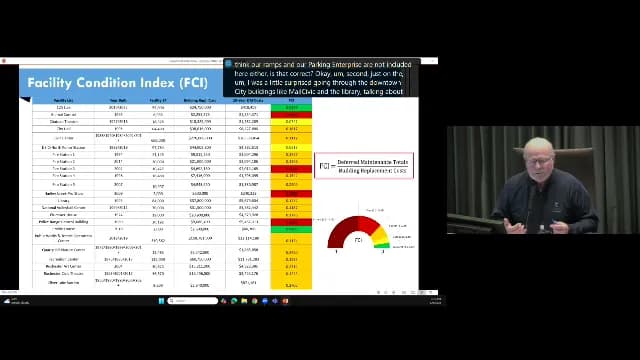
The Rochester City Council met for a study session on June 9, 2025, at 3:30 p.m. in the Government Center Council Chamber. The agenda included a facilities condition assessment presentation, downtown residential parking minimums, a developer parking agreement policy, and future study session scheduling. No formal votes were taken on the substantive policy items; council members provided direction for staff to return in July. Facilities Condition Assessment - Zach Wood, Manager of Facilities and Property, presented a citywide facilities condition assessment covering 23 facilities and roughly 1.7 million square feet. It identified approximately $126.9 million in deferred maintenance needs over 10 years, described as the "cost of inaction." - Four facilities were rated in poor condition: the police range control building, animal shelter, Hadley Creek Pro Shop, and Fire Station 3. - Representative facility details: Animal shelter (1995, 6,900 sq ft, $2.2M replacement value, $1.3M deferred), police range (1980, 20,000 sq ft, $9M replacement, $5.5M deferred), Fire Station 3 (2002, 10,500 sq ft, $4.7M replacement, $2M deferred), Hadley Creek Pro Shop (2009, 2,000 sq ft, $600K replacement, $240K deferred), Chateau Theater (1927, 18,000 sq ft, $18M replacement, $1.9M deferred), 125 Live (2016, 55,000 sq ft, $24.7M replacement, $400K deferred), D6/North Precinct (97,000 sq ft, $44M replacement, $4.4M deferred), National Volleyball Center (70,000 sq ft, $31M replacement, $4.5M deferred), Rochester Art Center (30,000 sq ft, $15.3M replacement, $4.3M deferred), and Civic Theater (36,000 sq ft, $16.5M replacement, $2.5M deferred). - Deputy Administrator Parrish said the city currently invests about 0.25% of replacement value annually versus an industry recommendation of 4–7%. The recommended 2026 CIP includes about $1 million for facility investment, while the identified need is $126.9 million; addressing general fund facilities alone would require increasing to about $8.5 million per year. - Staff highlighted strategies: incremental CIP growth, energy rebates, energy savings reinvestment, building automation, redirecting expiring debt, and one-time funding. Mayo Civic Center has about $40 million in 10-year needs, potentially funded by lodging tax after existing debt ends around 2033. - Council discussion included Councilmember Wall asking how much of the total is truly deferred versus ordinary maintenance; staff said they could provide critical-item details. Councilmember Palmer questioned separating building versus department equipment costs and suggested using surplus property sales. Mayor Norton asked about bundling tuck pointing/window repairs and noted newer buildings already need repairs; staff attributed some issues to prior decentralized project delivery. Councilmember Keene noted parks facilities were missing and utility/enterprise facilities were intentionally excluded, and expressed concern that geothermal investments were expected to cover more HVAC costs than they did; staff explained the Downtown Building Energy Transition addresses central plants, not all building-level equipment. Residential Parking Minimums within Downtown - Community Development staff presented a history of downtown parking requirements: no minimums in the CBD from 1992 to 2017; the 2017 DMC DPOZ reintroduced requirements; current UDC requires 0.5 spaces per dwelling unit citywide, with reductions and a transportation demand management (TDM) option that can yield a 100% reduction. - Staff cited examples of cities removing parking minimums: Buffalo saw a 39% increase in mixed-use development; Hartford reduced car dependency; Hamilton saw 15–20% lower construction costs. Staff cautioned that local context matters. - Staff reviewed 13 downtown projects since 2011: four were underparked relative to the ordinance, but projects averaged 26% more parking than required. Developer feedback indicated lenders and investors generally expect parking, tenants still rely on vehicles, and underparking can hurt lease-up; proximity to public parking and transit can reduce dependence. - Four options were presented: (1) remove residential parking minimums downtown with the upcoming UDC update; (2) remove them when Link BRT goes online; (3) reduce the requirement to 0.25 per unit; (4) maintain current requirements and continue evaluation. - Councilmember Palmer said he favored option 1 and cited parking costs as about 25% of apartment construction costs. Councilmember Fredericks also favored option 1, saying downtown residents increasingly do not expect parking and developers should assume risk. Councilmember Miller favored option 1 and suggested studying other uses and being ready for state zoning reform. Council President Schubert noted downtown parking minimums are effectively zero already via a TDM plan, and that maintaining some requirement could force developers to justify zero parking. - Mayor Norton preferred option 3 (0.25 per unit), warning that zero parking is not pragmatic because many residents and visitors will still have cars, and expressed concern about spillover into neighborhoods. Councilmember Keene asked about spillover, financing, and the adequacy of TDM; Councilmember Wall asked how developers in case-study cities obtain financing without parking and whether neighborhood complaints occurred. - No formal vote was taken; staff will incorporate feedback before the July UDC update. Developer Parking Agreement Policy - Nolan Shield, Parking Systems Manager, presented a draft policy for developer parking agreements. Currently there is no formal policy, and 13 special parking agreements exist; five are development-related, representing approximately 400 spaces. Non-development agreements total 632 spaces and individual monthly contract parkers total 539 spaces. - Staff said existing agreements are inconsistent in duration, terms, and number of spaces; some have no end date (including one in perpetuity), and some reserve spaces that are not paid for or fully used. New parking equipment will improve tracking. - Draft policy criteria include: agreements no longer than five years with possible five-year renewals; space counts based on system capacity; city reserves the right to adjust based on actual use; all reserved spaces would be paid for; and preference for developments providing at least 50% of required parking on-site. - Council discussions: Councilmember Palmer preferred guidelines over policy and supported five-year reviews; Councilmember Keene opposed giving away parking and said reserved spaces should be paid at market rates; Councilmember Fredericks sought clarity on how many agreements are "pay to play" (staff said fewer than 100 spaces) and noted unused reservations can harm public access; Councilmember Miller suggested market-rate pricing and using TDM tools; Mayor Norton stressed the need to plan for future parking demand and noted surface lots will be lost to development. - No formal vote was taken; staff will use council feedback to refine the policy. Study Session Schedule - The City Administrator proposed canceling the August 4 council meeting due to quorum concerns, moving the meeting to August 11, and adding a study session on August 18 from 3:30–5:00 p.m. Council members agreed by consensus; a formal decision will be placed on the June 16 consent agenda. - Upcoming sessions highlighted include the audit, capital improvement plan, and outside agency recommendations on June 23; no council meeting on June 30; and on July 14, city real estate disposition, electric vehicle charging rates, surface water management, and equity in the built environment update. Key Outcomes - No formal votes were taken on facilities assessment, parking minimums, or developer parking agreements; council feedback will inform staff work and future presentations. - Council reached consensus on the August meeting schedule change, to be formalized June 16. - Staff will return in July with UDC updates and refined developer parking agreement policy details.
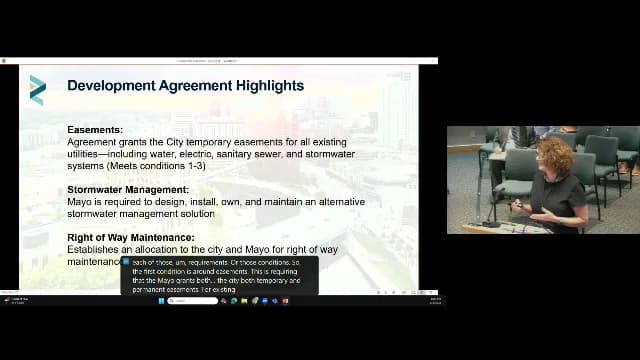
The Rochester City Council held its regular session on June 2, 2025 at 6:00 PM. The meeting covered consent agenda items, five public hearings, several reports and recommendations, and ordinance readings. Key actions included approval of a major land subdivision (Flowing Brook Valley), a street vacation for affordable housing, annexations for a future sports complex, 2026 state bonding priorities (airport parking, East Zumbro sewer, and planning for Civic Center Drive/South Broadway), the Biolabs shared lab space project (up to $8 million GSIA), and a development agreement with Mayo Clinic. A consent item for 4th St/19th Ave intersection improvements was pulled due to a bid protest and later resolved via rebid. A motion to include a park-and-ride in the DMC district failed 3-3. Consent Calendar - Approved minutes of May 19, 2025 meeting. - Approved accounts payable totaling $20,647,912.47, including investment purchases of $7,061,428.00 and accounts payable of $13,586,484.47. - Approved numerous items en bloc (F1-F9, F11-F14, F17-F18), including: Med City Art Festival as community festival; golf cart permit route (Councilmember Keene voted no, citing slippery slope); Heritage Preservation Commission rules; LMCIT liability waiver; boundary clarification with MAAB LLC; Fire Station 3 roof replacement contract ($84,495 with Priority Construction); John Adams Middle School Safe Routes to School contract (Rochester Sand & Gravel); School Resource Officer agreement with ISD 535 ($45,993/month); utility connection agreement (Steven T. Sawyer Revocable Trust); annexation CD2025-001ANX; support for Greater Minnesota Housing Infrastructure Grant program; Downtown Historic District Property Preservation Program funding (four properties: $161,535, $6,750, $127,039, $245,185); Loom Apartments DMC project (up to $4,000,000 GSIA); and Aeon West Transit Village Phase 1 (up to $3.9 million GSIA and $4.9 million TIF). - Items F10 and F15 were pulled; F16 was pulled by Councilmember Palmer. F15 and F16 were later approved under separate votes (H5 and H6). Public Comments & Testimony - Rebecca Goneway: Described difficulty with a catastrophic repair bill and inability to find good contractors. Requested assistance for herself and neighbors. - Mark Iverson: Highlighted loss of tree canopy in Sunset Terrace, lack of boulevard trees at Valley High Post Office and Gage School. Urged attention to older neighborhoods. - John Holper (attorney, Bassford Remley, representing ICON LLC): Objected to consent item F10, stating ICON was the low responsive bidder ($42,729.14 less than next bid) and that staff incorrectly deemed the bid unbalanced. Asked for rebid or deferral. - Kenny Iverson: Raised concerns about the Lemon Hill Solar Project (windmills) in Haverhill and Viola, acknowledging it is outside city jurisdiction but seeking feedback. - Susan Chase (Senior Vice President, Biolabs): Expressed support for the shared lab project at Discovery Square, describing Biolabs as an international operator of 17 lab spaces. Cited potential for Rochester to become a hub for life science innovation. Discussion Items G1 – Major Land Subdivision: Flowing Brook Valley (Build Wealth Inc.) - Proposal to subdivide 98.67 acres into 37 residential lots (34 duplex/triplex, one 12-unit apartment, one community center lot, one common lot). Discussion focused on the decor edge (geological feature) and environmental risks. - Applicant described extensive soil borings (100+ probes) and a decor edge analysis certified by Olmsted County. Public Works confirmed modern standards (under drains, rock features) mitigate risks. - Councilmember Keene noted past development failures in the area and inherent environmental risk. - Approved with five conditions. Passed 6-0. G2 – Vacation Petition (Onward Investors) - Proposed vacating portions of 4th St NW, 5th St NW, and alleyways to assemble land for a 270-unit affordable housing project. The project is pursuing state tax credits. - Approved with two conditions. Passed 6-0. G3, G4, G5 – Growth Management, Comprehensive Plan, and Annexation for Sports Complex - Three related applications for a future regional sports complex in SE Rochester. - G3: Reclassify 145.5 acres from “Urban Expansion Beyond 2050” to “Near Term Urban Expansion” (supermajority required). - G4: Comprehensive Plan Amendment – change 136.27 acres to Medium Density Residential, 9.23 acres to Commercial and Business Development, and 12.7 acres from Industrial to Commercial and Business Development (supermajority required). - G5: Annexation of 158.2 acres with MXG (21.94 acres) and R-3 (136.27 acres) zoning. Approximately 95-100 acres for the sports complex; 7-12 acres potentially sold for residential. - All three items passed 6-0. H1 – 2026 State Bonding Priorities Resolution - Staff presented three ranked priorities: (1) Airport Parking Infrastructure & Energy Components, (2) East Zumbro Sewer for Housing Opportunities, (3) Planning for Civic Center Drive/South Broadway Ave. - Council discussed consistency, the need to meet a June 13 submission deadline, and the possibility of a 2025 special session. Councilmember Keene moved to adopt the resolution as presented, emphasizing the importance of maintaining prior commitments. The motion passed unanimously. H2 – BioLabs Shared Lab Space Project - Approved as a DMC Public Infrastructure Project with up to $8,000,000 in GSIA. Also authorized the Mayor to sign an MOU for the creation, launch, and long-term operation of BioLabs Rochester. - Project expected to house 20-25 companies employing 70-80 people at full occupancy, host at least 50 companies over 3-5 years, and increase clinical trials. A clawback provision will protect the city investment. - Passed unanimously. H3 – Development Agreement with Mayo Clinic - Satisfies conditions from the November 2024 vacation of 3rd and 4th Avenues SW. Includes: easements for utilities, underground stormwater vault, 8-foot public passageway (6:30 AM – 10 PM daily), restoration of north-south bike connectivity (maximum cost $480,000 based on Broadway cycle track), and intersection improvements at Civic Center Dr NW/6th Ave NW. - Council confirmed the passageway is a through-connection for the public, not just between Mayo buildings. - Passed unanimously. H4 – 4th St SE and 19th Ave SE Intersection Improvements (Rebid) - Following bid protest from ICON LLC, staff recommended rejecting all bids and authorizing a rebid (bid opening July 8, 2025). Staff stated they did not agree with ICON's claims. - Motion to reject all bids and rebid passed unanimously. H5 – Downtown Historic District Property Preservation Program Funding - Approved four grants: 216 1st Ave SW ($161,535), 326/328 South Broadway ($6,750), 22 3rd St SW ($127,039), 324 South Broadway ($245,185). - Program has stimulated nearly $3 million in private investment. A review of criteria is planned for September DMCC meeting. - Passed unanimously. H6 – DMC Development District Boundary Modification - The main motion to modify the boundary passed unanimously. - Councilmember Palmer offered an amendment to instruct staff to start the process for including the North Broadway park-and-ride in the DMC district. After discussion, the amendment was withdrawn but later resubmitted as a separate motion. - The separate motion to start the inclusion process failed 3-3 (Keene, Miller, Schuberg opposed; Wall, Fredericks, Palmer in favor). J1 – Ordinance First Reading: Annexation by North Rock Real Estate (33.56 acres) - Received and filed. Passed. K1 – Ordinance Second Reading: Gas Franchise - Adopted unanimously. K2 – Ordinance Second Reading: Annexation by Danielson Farms and Stark Enterprises (67.77 acres) - Adopted unanimously. Key Outcomes - Consent agenda approved with one dissenting vote on F4. F10 pulled and later resolved via rebid. F15 and F16 approved under separate items. - G1 (Flowing Brook Valley subdivision) approved (6-0). - G2 (street vacation) approved (6-0). - G3 (Growth Management Map Amendment) approved by supermajority (6-0). - G4 (Comprehensive Plan Amendment) approved by supermajority (6-0). - G5 (Annexation for sports complex) approved (6-0). - H1 (2026 Bonding Priorities) adopted as presented (unanimous). - H2 (BioLabs) approved with up to $8M GSIA and MOU authorization (6-0). - H3 (Mayo development agreement) approved (6-0). - H4 (Rebid for 4th St/19th Ave) approved (6-0). - H5 (Historic district grants) approved (6-0). - H6 (DMC boundary modification) main motion approved; separate motion to include park-and-ride failed (3-3). - J1 received and filed; K1 and K2 adopted.
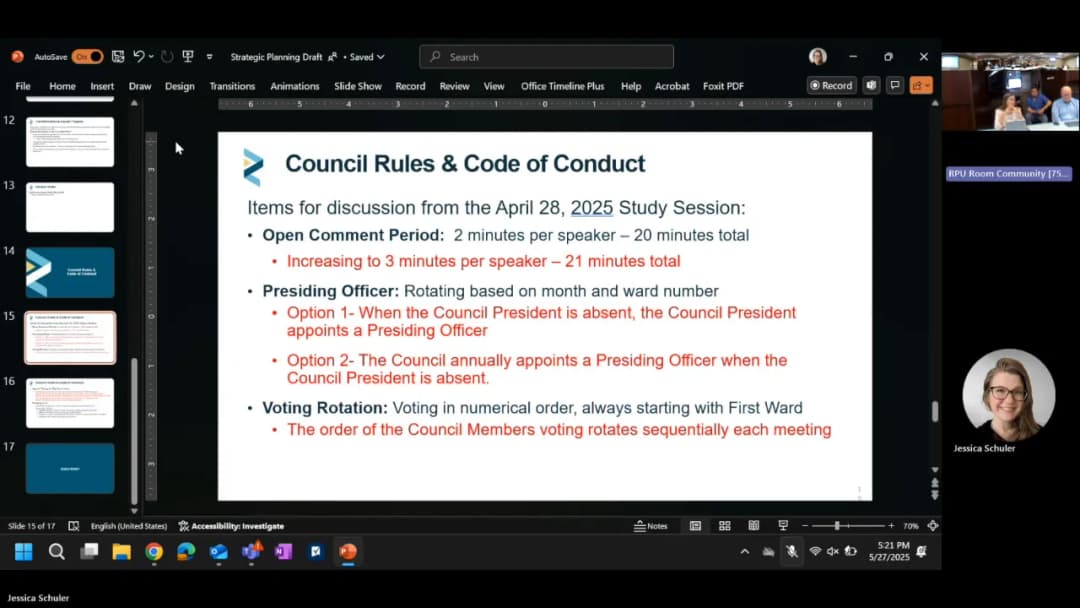
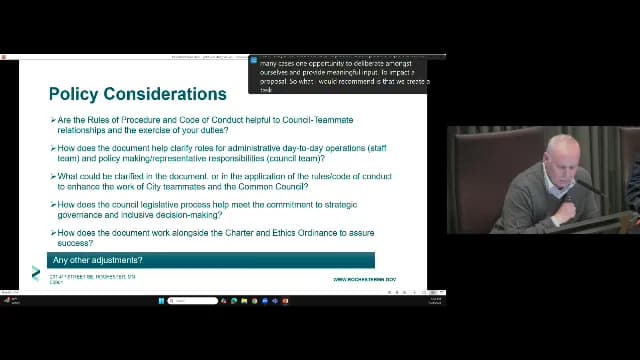
At a study session on May 28, 2025, the Rochester City Council reviewed and refined its strategic priorities, foundational principles, and council rules of procedure and code of conduct. The session was held at the RPU Community Room due to county use of chambers on Tuesdays. Council members provided extensive feedback on five strategic priorities, deliberated on changes to meeting protocols, and outlined expectations for future action plans and agenda glide paths. Discussion Items Strategic Priorities and Foundational Principles - The council reviewed a five-item strategic priority list (economic resilience, housing access, inclusive growth management, responsible environmental stewardship, transformational capital projects) tied to foundational principles (social equity, fiscal responsibility, sustainability, quality services, inclusive decision-making). - Responsible Environmental Stewardship: Most members favored the alternate language that extends the city's role to promoting environmental action throughout the community, rather than limiting to city operations. Councilmember Keene cautioned that broadening the language does not imply increased investment. - Housing Access: Councilmember Palmer expressed concern that the priority was watered down from a focus on owner-occupied housing, citing the Maxwell study indicating Rochester lags in homeownership. Other members supported the broader language to encompass renters, new residents, and a variety of housing types. It was noted that action plans could prioritize owner-occupied affordable housing. - Economic Resilience: Discussion centered on diversifying the local economy, supporting small businesses, streamlining permitting, and coordinating with entities like REDI, DMC, and Experience Rochester. Councilmember Palmer stressed the need for a balanced regulatory environment and business retention. Mayor Norton added child care as an economic resilience component. - Inclusive Growth Management: Topics included infill vs. edge development, transportation planning, municipal consent, land use/transportation coordination, and ensuring equitable service distribution. Councilmember Miller emphasized the need for strong public transit, noting frequent route cancellations. Councilmember Palmer questioned the inclusion of some items as strategic priorities. - Transformational Capital Projects: Councilmember Keene urged focus on executing major projects (e.g., Link, Sixth Street Bridge) on time and budget, warning that delays constitute government failure. Mayor Norton cautioned against overloading staff, emphasizing judicious use of resources. The council agreed that a shared understanding of which projects are transformational is needed. - Environment/Data Tracking: Councilmember Miller suggested key performance measures for each priority, and Councilmember Palmer proposed a dashboard for environmental metrics (emissions, waste). Support for organized garbage collection study was mixed; Mayor Norton and Councilmember Palmer cited past public preference for choice. Council Rules of Procedure and Code of Conduct - Open Comment Period: Proposal to extend from 2 to 3 minutes per speaker. Some members favored 3 minutes (Miller, Keene) for more grace; others (Fredricks, Palmer) preferred concise 2 minutes. Mayor Norton noted the change was made a year ago and saw no problems. If extended, agreement to increase total time from 20 to 30 minutes. - Presiding Officer & Acting Mayor: Discussion on whether to replace the monthly ward rotation with a system where the council president appoints a presiding officer when absent. Mayor Norton requested ability to work with the council president to appoint acting mayor. Majority support for option 1 (council president appoints), but charter language requires council involvement. No final decision. - Voting Rotation: Little interest in changing the current ward-order rotation. Councilmember Palmer raised it but found no support. - Agenda Glide Path: Council expressed desire for significant items (e.g., major contracts or projects) to be previewed in a study session or report and recommendation at least two weeks before a decision vote. Staff acknowledged challenges due to timing and negotiations. Council agreed to pursue this as guidance rather than a rule change. - Board/Commission Appointments: Councilmember Wall proposed returning to a seniority-based rotation system for appointments to council committees and outside boards. Current process: council president nominates, council approves. Only limited support for change; most felt the current system worked. - Remote Participation: New state law allows more remote participation. Council expressed caution, preferring to limit remote attendance to 3 times per year per council member for important items. Mayor Norton noted non-voting participation is less problematic. Staff will bring proposed rules adjustments after the governor signs the bill. Key Outcomes - The council provided clear direction on strategic priorities: endorse the broader environmental language, retain housing access with emphasis on homeownership, focus economic resilience on business retention and regulatory streamlining, and prioritize execution of transformational capital projects. - Staff will bring the refined strategic priorities to the second regular council meeting in June for formal endorsement, followed by a detailed action plan. - No formal votes were taken on rules changes. Staff will incorporate guidance on open comment timing, presiding officer procedures, and remote participation limits into a future rules revision. - The next study sessions are scheduled for June 9 and June 23, covering facilities assessment, parking policies, legislative update, audit, and budget updates.
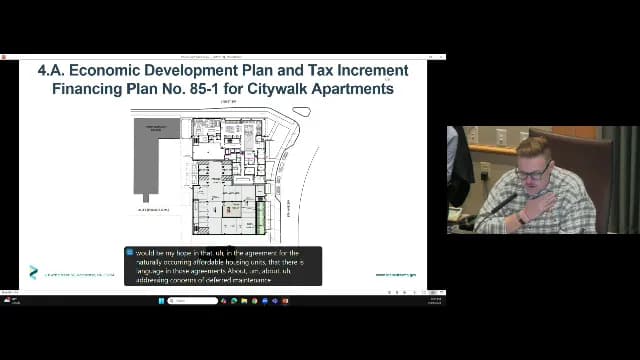
The Rochester Economic Development Authority (EDA) met on May 19, 2025, following the regular City Council meeting. The primary agenda item was a public hearing and vote on an Economic Development Plan and Tax Increment Financing (TIF) Plan for the Citywalk Apartments project, a 13-story, 340-unit high-density market-rate housing development at the corner of 2nd Street SW and 6th Avenue SW. The meeting also included approval of the consent agenda and a brief update on a separate development agreement with Sherman Associates. Consent Calendar - Approval of Minutes: The EDA unanimously approved the minutes of the February 19, 2025, meeting. Motion by Councilmember Wall, seconded by Councilmember Fredericks. Public Comments & Testimony - No members of the public spoke during the public hearing. The hearing was opened and closed with no testimony. Discussion Items Citywalk Apartments TIF Plan (Public Hearing) - Presentation: Economic Development Director Josh Johnson presented the request for an Economic Development District No. 85 and Redevelopment TIF District No. 85-1 for the Citywalk Apartments. The project involves five parcels at the intersection of 2nd Street SW and 6th Avenue SW. The site currently contains underutilized and vacant buildings deemed structurally substandard by a blight study. The proposed 13-story building will include 340 units: 250 market-rate apartments and 90 short-term rental units, with 264 structured underground parking stalls. Estimated project value is $86 million, generating approximately $1.3 million in annual property taxes after the TIF period. The developer, Justin Fincher of Reuter Walton, plans to break ground by late 2025 or early 2026 with a 24-month construction timeline. - Affordable Housing Component: As part of the project, the developer's partner (the current landowner) will place 76 units from two adjacent apartment buildings (west and south of the site) into the county’s 4D affordable housing program for 20 years (two 10-year renewal cycles). These units are not within the TIF district but are part of a separate development agreement tied to the project. - Council Questions & Concerns: - Councilmember Palmer questioned the parking ratio (264 spaces). Fincher stated that lenders require that level of parking for market-rate projects, and that the project originally had fewer spaces. - Councilmember Keene expressed skepticism about the “but-for” test (that the project would not happen without TIF) and requested a robust independent financial analysis from Baker Tilly at the next stage. He also noted confusion about combining naturally occurring affordable housing with a government program. - Councilmember Wall supported the project but voiced broader concern about the frequency of TIF use. Johnson noted that seven TIF projects (valued at $103 million) are expected to decertify within three years, and that Rochester’s TIF-to-tax-capacity ratio (4.5%) matches peer city averages. - Councilmember Doring inquired about prior subsidies: the project had already received a $500,000 DMC Main Street grant for intersection and public realm improvements. She also stressed that the two affordable housing buildings need deferred maintenance addressed, and Johnson confirmed that discussions are ongoing. - Councilmember Miller asked about the building’s useful life (estimated well over 50 years) and the long-term economic benefit of foregone taxes. Administrator Steinhauser clarified that TIF is “last money in” after extensive legal and financial vetting, and that the city’s revised TIF policy provides clear guidelines for 15-, 20-, and 25-year terms. The 25-year term is justified by the inclusion of the affordable housing component. - Other Stats: Johnson provided context: no new market-rate rental housing has opened in the DMC area since 2020; Maxfield study shows a shortage of 3,336 market-rate units over the next decade; the seven soon-to-decertify TIF projects will free up $103 million in tax base. Key Outcomes - Adoption of Resolution: The EDA unanimously approved the resolution adopting the Economic Development Plan for District No. 85 and the TIF Plan for District No. 85-1 for the Citywalk Apartments. Motion by Councilmember Keene, seconded by Councilmember Palmer. The vote was 7-0 (all present in favor). - Next Steps: The project will return for a separate Development Assistance Agreement, which will include further financial analysis. The affordable housing component will be secured through a separate agreement with the owner of the adjacent buildings. - Other Business: Councilmember Palmer asked about the Sherman Associates development agreement, which expires June 30, 2025. Staff confirmed that if no deal is reached by then, the agreement terminates. No further action was taken. - Adjournment: The meeting adjourned by motion of Councilmember Miller, seconded by Councilmember Palmer.
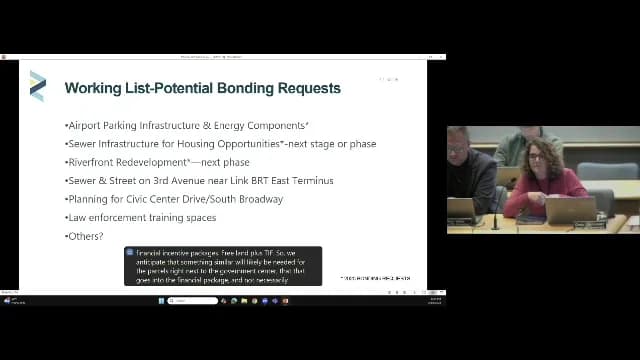
The Rochester City Council convened on Monday, May 19, 2025, at 6:00 p.m. for a regular session. The meeting included a consent calendar, three public hearings, a discussion on potential 2026 state bonding priorities, several pulled consent items, and concluded with an executive session on threatened litigation. Key actions included approval of a major land subdivision and annexation (Badger Heights), a contentious vote to approve municipal consent for the Broadway Avenue South/Trunk Highway 14 intersection improvement project (4-3), and approval of travel budget overages for two council members. Consent Calendar - Approved the minutes of the May 5, 2025, meeting. - Approved accounts payable for May 19, 2025, totaling $19,747,264.52, including $10,147,309.18 in investment purchases and $9,599,955.34 in accounts payable. - Approved annual gambling permits for Rochester Elks Lodge at Lucky's M & J LLC and Rochester Elks Lodge 1091. - Approved the forWARD Neighborhood Park Concert Series as a community festival. - Approved Mayoral appointments of Valerie Wassmer to the Heritage Preservation Commission and Lisa Ross to the Planning and Zoning Commission. - Approved out-of-state travel and training for Mayor Norton to attend the Harvard-Kennedy School Executive Education Series. - Approved the award of a $7,500 USPCA / AKC K9 Cop Grant. - Approved the Fire Service Contract with Cascade, Haverhill, Marion, and Rochester Townships. - Approved a state grant of $18,528 for airport snow removal equipment. - Approved several city-owner contracts and professional technical services agreements for Hadley Creek Estates, Hadley Creek Bridge, Marion Bus 10/11 Feeder Extension, Link BRT rebar procurement (ABC Coating, Inc., $113,650), reconstruction of 17 1/2 St NW (S L Contracting, Inc.), 2025 Stormwater Catch Basin Rehabilitation (Alcon Excavating, Inc., $389,966.38), Mayo Civic Center volleyball court replacement (Gerflor USA, $155,628), and the 2026 Joint Powers Agreement with Minnesota Housing Finance Agency. - Authorized a revocable permit with Mayo Clinic for electrical duct bank and pedestrian tunnel within city right-of-way. - Authorized resubmission of the 2024 DMC Certification of Contributions. Public Comments & Testimony - Tom Schmidt opposed agenda item F8 (Councilmember travel budget overage), urging council to stay within budget as a leadership example. - Larissa Mortonson (member of 319 union) spoke in support of part-time library workers, stating projected budget overruns in part-time hours threaten jobs and disproportionately affect people with disabilities, LGBTQ+ individuals, and people of color. - Linda Smith expressed frustration with parking meter changes (from 30 minutes to 3 hours), construction downtown, and parking challenges for customers and businesses. - Michael Woj (Med City Meander organizer) thanked city staff (Kelly Peterson and Ben Bolt) for assistance with event routing amid construction, noting 800 participants expected. - Audrey Gomez (ATU) read a statement from a bus driver who quit, describing a crash incident and calling for the return of the union representative to improve driver safety and morale. Public Hearing: Major Land Subdivision (G1) & Annexation (G2) – Badger Heights Staff presented a request by North Rock Real Estate to subdivide 33.56 acres into 84 residential lots and two outlots (Badger Heights), with access from 50th Avenue and Valley High Drive. The property is proposed for annexation and zoning R2/R3 consistent with the land use plan. The Planning Commission recommended approval with 10 conditions. Applicant Jeff Brown (North Rock Real Estate) agreed with the conditions. No public testimony was offered. - Councilmember Keene clarified the procedural distinction between the major land subdivision (conceptual step) and the final plat (requires annexation). - Councilmember Wall commended the developer for community trust, noting only one resident attended the neighborhood information meeting. Key Outcome: - G1 (Major Land Subdivision) approved unanimously with 10 conditions. - G2 (Annexation) approved unanimously. Public Hearing: Municipal Consent for Broadway/Highway 14 Intersection Improvement (G3) City staff and MnDOT presented the $19.5 million project to reconstruct the intersection of Broadway Avenue South and US Highway 14 (12th St SE/SW). The project includes smart channels, raised crosswalks, a 10-foot shared-use path, and addition of dual left-turn lanes on Highway 14 (increasing crossing distance by 4 feet). The city's share is approximately $5.7 million plus engineering and potential contaminated material costs. The municipal consent hearing was required due to a change in access at First Avenue SE (converting to one-way northbound). Public Testimony (six speakers, all opposed to the design with dual left-turn lanes): - Laurel Podulke Smith (Olmsted County Commissioner, District 1) urged denial, stating the dual left-turn lane adds 10 feet to crossing distance and prioritizes vehicle speed over pedestrian safety. - Adam Busby (ATU 105) expressed concern about traffic being dumped into future dedicated transit lanes. - Lee Schneider said the extra turn lanes make the intersection less safe for people walking or rolling. - Aaron Meadow argued the design creates a less safe, more obstructive intersection inconsistent with transit-oriented development and MnDOT's safe systems approach. - Luke Doske noted the intersection is already poor for pedestrians and the added lanes increase crossing time. - Michael Wojcik (Bicycle Alliance of Minnesota) requested denial, stating the design is inconsistent with city policies, induces demand, and prioritizes speed over safety. He noted the city's design speed would be 30 mph, but MnDOT's design does not achieve safe speeds for pedestrians. - Greg Wright (Olmsted County Commissioner) warned the project would divide the city north-south and hinder pedestrian access to Graham Park. - Marty Cormac opposed the extra turn lane and urged rejection, advocating for eventual rerouting of Highway 14 out of South Rochester. Discussion: - Tom Austin (MnDOT) defended the dual left-turn lanes as necessary for intersection efficiency, allowing more green time for pedestrians and eliminating conflicts with left-turning vehicles. He stated the design is for 30 mph but state statute requires a post-project speed study to change the speed limit. He emphasized the extra 4 feet of crossing is offset by reduced crossing distance on Broadway and phasing that gives pedestrians longer crossing time. - City Engineer Dylan Dombrowski confirmed the city supports the design, believing it will be safer for pedestrians, bicyclists, and vehicles. He noted the signal will prohibit left turns when pedestrians are crossing. - Councilmember Keene questioned the basis for traffic projections, noting the traffic model did not account for potential mode shift or the city's VMT reduction goals. - Councilmember Miller expressed concern that the project prioritizes efficiency (peak-hour volume) over safety and long-term compatibility with transit-oriented development. He noted that if delayed two years, a different, safer design might emerge under updated statewide policies. - Councilmember Palmer argued the project is a significant improvement over the current dangerous intersection and trusted staff's recommendation. - Councilmember Wall stated the project improves safety for all users based on city engineer testimony. Vote: The resolution to approve the geometric layout was adopted 4-3. Ayes: Keene, Wall, Fredericks, Palmer. Nays: Miller, Doring, Schuberg. Discussion Item: Potential 2026 State Bonding Priorities (H1) Deputy Administrator Aaron Parrish presented a list of potential bonding priorities for the 2026 state capital investment bill. Projects included: - Airport infrastructure and solar/covered parking (top priority, reliant on bonding) - Sewer infrastructure for housing opportunities (received receptivity) - Riverfront redevelopment (design phase) - Third Avenue SE street and sewer upgrades - South Broadway/Civic Center Drive gateway design - Law enforcement training facilities Councilmembers provided feedback: - Support for sewer infrastructure for housing (multiple members) - Interest in riverfront planning but noted challenges with DMC perception and competition - Councilmember Palmer proposed a mental health facility; staff noted state has funded similar projects - Councilmember Wall suggested bonding for downtown revitalization; staff cited existing models (historic district) - Councilmember Schuberg raised the Chateau Theater (100th anniversary) as a potential project - Councilmember Fredericks emphasized needs for housing and law enforcement training - Councilmember Keene highlighted the need for readiness and 50% local match; favored airport parking and sewer infrastructure - Councilmember Miller suggested regional trail connections and coordination with the county - Councilmember Doring proposed library facilities as a bonding opportunity No formal action was taken; feedback will be incorporated for a resolution at the June 2, 2025 meeting. Pulled Consent Items: Travel and Training (F7, F8) F7 (Mayor Norton out-of-state travel): Approved unanimously after discussion. F8 (Councilmember travel budget overages for Doering and Miller): Councilmember Palmer opposed, arguing council should stay within budget as a leadership example. Councilmember Fredericks offered to contribute unused training funds to support newer members. Councilmember Keene noted the overall $15,000 budget (adopted in 2024) is not exceeded by these overages. The motion passed 5-1-1 (Palmer nay, Doring abstain). Ordinance First and Second Readings - J1: First reading of a zoning map amendment (LI to SI) for 55.48 acres near Broadway Ave N and East River Rd NE. Received and filed. - K1: Second reading of an annexation ordinance for 28.84 acres (Bigelow Homes, LLC) – adopted. Other Business - Recessed to Rochester EDA meeting; subsequently adopted the EDA findings. Executive Session - The council moved into closed session (13D.05 Subd. 3(b)) to discuss threatened litigation related to transportation infrastructure fees. The session was limited to legal consultation; no action was taken. Key Outcomes - Approved Badger Heights major land subdivision and annexation (both unanimous). - Approved municipal consent for Broadway/Highway 14 intersection improvement (4-3). - Approved out-of-state travel for Mayor Norton (unanimous) and travel budget overages for two council members (5-1-1). - Received and filed zoning map amendment first reading; adopted annexation ordinance second reading. - Adjourned to closed session for threatened litigation discussion.
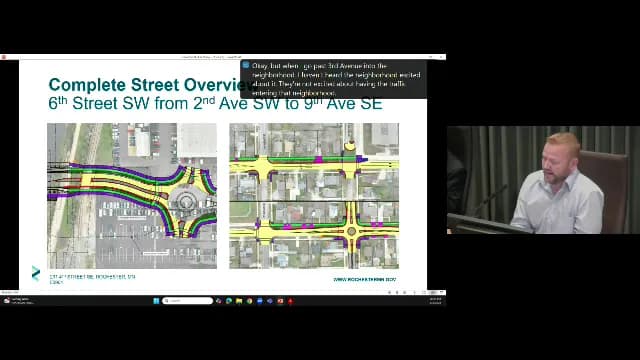
The Rochester City Council met on May 5, 2025, to consider a full agenda including consent items, public hearings on zoning and historic preservation, a major subdivision, an appeal of a Heritage Preservation Commission decision, and an update on the 6th Street Bridge and Riverfront Project. The meeting featured extensive public comment on budget cuts, transit service, and the proposed demolition of historic buildings on South Broadway. The council voted 5-2 to deny the removal of landmark designation for five properties and similarly denied an appeal of the HPC's denial of a Certificate of Appropriateness. Consent Calendar - Approved minutes of April 21, 2025; accounts payable of $15,518,831.54. - Off-site gambling permit for VFW Post 1215 at Graham Park. - Appointments: Bob Hopkins to Library Board. - Budget amendment of $92,256 for Link BRT police officer program. - Bid advertisement for Link BRT Maintenance Bay Addition. - Contract with Fitzgerald Excavating for 50th Ave NW reconstruction ($1,756,871.57). - Septic system connection agreement with Nelson family. - City-owner contracts for Ponderosa Pine Subdivision Phase 2 and Rochester Sand & Gravel. - Contract with Elcor Construction for Link BRT civil utilities ($21,284,394.16). Public Comments & Testimony - Budget & Library Cuts: Toby H., Heather Dillon, David Montequin (AFSME Local 319) opposed proposed budget cuts to library and city services, calling for taxing the rich instead. They criticized city and state budget proposals. - Transit Issues: Adam Busby (ATU 1005) reported missed routes, toxic management at Rochester Public Transit, and urged city to hold Transdev accountable. Ryan Stack and Becca Anklin shared personal experiences of missed rides and unreliable service. - Historic District Preservation: Over 30 speakers, including business owners, artists, students, and residents, urged the council to deny the removal of landmark designation for 309–317 S. Broadway. Speakers highlighted the cultural and community value of businesses like Cafe Steam, Art Heads Emporium, Threshold Arts, and Tree Dome. Many argued the buildings are historically significant and that demolition would set a dangerous precedent. - Safety & Development: Molly Dennis raised concerns about pedestrian safety near construction at Broadway and Elton Hills. Doris Amundson opposed the 8-foot multi-use trail and mini-roundabout on 6th Street SE, citing safety and tree impacts. Discussion Items G1 – Zoning Map Amendment (City of Rochester) Approved unanimously to change 55.48 acres from LI to Special Industrial to support future development. No public comment. G2 – Major Land Subdivision: London Brook Ponds Approved with two conditions. Applicant Mark Welch (GQD Engineering) described 50 for-sale townhomes, a multi-family parcel, and a daycare. Resident Joanne Sandstrom raised concerns about traffic, law enforcement coverage, and HOA fees. G3 – Utility Easement Vacation (Chick-fil-A) Approved unanimously to vacate existing easements on a site at 317th Ave NW for a quick-service restaurant. G4 – Request for Landmark Removal (309–317 S. Broadway) Extensive debate. Applicant Hal Henderson (311 Broadway Development LLC) proposed a mixed-use student housing tower with a gymnasium, retaining building facades. He argued economic hardship and that the buildings are marginally significant. Staff and HPC recommended denial, finding no change in historic significance or integrity. Public speakers overwhelmingly opposed demolition, citing the district's cultural importance. Councilmembers Palmer and Fredericks moved to remove the landmark designation due to economic hardship, but the motion failed 2-5 (yes: Fredericks, Palmer; no: Keene, Miller, Wall, Doring, Schubring). A subsequent motion to deny the removal passed 5-2. G5 – Appeal of HPC Denial of Certificate of Appropriateness Related to the same project. The council considered whether the proposed design met Secretary of Interior Standards and local design guidelines. Staff and HPC found the scale incompatible. Applicant argued compromise had been reached after 13 meetings. Public comment reiterated concerns. A motion to uphold the HPC denial passed 5-2 (yes: Miller, Keene, Wall, Doring, Schubring; no: Fredericks, Palmer). H1 – 6th Street Bridge and Riverfront Projects Update Staff presented 30% design for a new bridge with separated pedestrian/bike paths, traffic calming on 6th Street SE, and riverfront enhancements. Discussion included lane widths, speed reduction to 25 mph, coordination with Link BRT, and floodplain permitting. Concerns were raised about the multi-use path in residential areas and traffic diversion. Council directed staff to continue engagement with the neighborhood and explore innovative safety features. K – Ordinance Readings (Second) - K1: Ordinance amending police department personnel (removing Community Service Officers). Approved. - K2: Rezoning 1.07 acres in Willow Ridge area from R-2 to R-3. Approved. - K3: Rezoning 3.89 acres at Marion Rd from R-2 to MX-C. Approved 6-0 (Councilmember Palmer absent). Key Outcomes - Consent Calendar: Approved as a block. - G1 (Zoning): Approved, directing city attorney to prepare ordinance. - G2 (Subdivision): Approved with two conditions. - G3 (Utility Easement): Approved. - G4 (Landmark Removal): Motion to remove failed (2-5); motion to deny removal passed (5-2). - G5 (HPC Appeal): Denied (5-2), upholding HPC decision. - H1 (Bridge Update): No vote; staff to proceed with design and further engagement. - K1-K3: Approved as noted.
The Rochester City Council held its April 28, 2025 study session at the Government Center Council Chamber, beginning at 3:30 p.m. The meeting covered two primary agenda items: a comprehensive review of factors influencing the two-year city budget, followed by a review of the City Council Rules of Procedure and Code of Conduct. The meeting concluded with a closed executive session on labor negotiations pursuant to Minn. Stat. Section 13D.03. City Administrator Alison Selms and Deputy Administrator Aaron Parrish led the budget presentation, while City Attorney Michael Spindler-Davies covered the rules review. Factors Influencing the Budget - Strategic Priorities Update - Administrator Selms presented an update on the strategic plan refresh, noting that feedback from prior study sessions informed proposed changes to foundational principles and strategic priorities. - Council members expressed general support for moving "quality services" and "inclusive decision making" to foundational principles, and for breaking strategic priorities into more focused categories: inclusive growth management, housing access, economic resilience, transformational capital projects, and responsible environmental stewardship. - Councilmember Miller suggested using "integrate" instead of "encourage" for environmental stewardship language, and Mayor Norton expressed a desire for the stewardship priority to extend beyond city operations to the broader community. - Councilmember Keene emphasized the importance of focusing on executing existing transformational capital projects (e.g., Bus Rapid Transit, Sixth Street Bridge) rather than being distracted by new initiatives. - Administrator Selms noted the group is "heading in the right direction" and will schedule a follow-up discussion to flesh out the meaning of each strategic priority. Budget Overview and Economic Indicators - The total 2025 city budget, including Rochester Public Utilities, is just shy of $720 million, serving nearly 57 square miles. - Property tax levy accounts for less than 16% of the total budget; the majority comes from charges for services (utilities, parks and recreation), intergovernmental revenue, and other sources. - The general fund (public safety, public works, fire, police) is more reliant on the property tax levy — roughly $11 million for 2025. - For a median-value home of $288,000, city property taxes are about $1,325 per year. - Rochester's unemployment rate is just over 2%, considered full employment by some economists. - Building permit valuations reached a record $700 million in 2024. - Lodging tax collections have recovered from a pandemic-era low of approximately $6 million to just under $11 million. - Sales tax collections came in at just under $16 million versus a projected $13 million. - Property tax valuation grew by 1.77% (new construction) and existing properties grew 4.81% in value. - A projected 2026 property tax levy increase of 10.68% was presented, down from the forecast of previous years due to staff optimization efforts. Councilmember Wall praised staff for reducing the projected increase by about 2%. - Mayor Norton emphasized that the levy increase percentage does not translate directly to each property's tax bill, as it depends on valuations and shifts among property classes. - Staff noted that $2.3 million of one-time federal ARPA funding had been used to buy down the levy in 2023, stepping down to $1.4 million later; Rochester received $18 million in ARPA funds compared to Duluth's $65 million and Minneapolis/St. Paul's $100 million, according to Mayor Norton. Key Budget Challenges and Cost Drivers - Labor costs are a major driver: the baseline budget carries a 4% cost-of-living adjustment for 2026 and 3% for 2027 across the city's 20 bargaining units. - Health insurance costs are projected to rise 8% and dental 1.5%; the state's paid family medical leave program adds an employer contribution of 0.44%. - The state's duty-related disability health insurance reimbursement is projected to drop from 100% to its historical 45% level in 2027. - Local government aid of $5 million is at risk depending on state budget outcomes. - The city has 55 active federal grants; major funded projects include the airport runway project (over $90 million) and Bus Rapid Transit ($85 million). - The facility condition index identifies approximately $120 million in deferred maintenance across city buildings, including nearly $40 million for the Civic Center alone; the current facility renewal budget is about $1 million per year versus an estimated $110 million need over the next decade. - The equipment revolving fund is under pressure due to rising replacement costs, and property insurance premiums are increasing substantially this year. Budget Policy Considerations and Cost-Saving Options - Administrator Selms outlined approximately $1.7 million in positive revenue adjustments (e.g., building permit fees) and $1.3 million in expenditure adjustments. - A list of potential service-level changes was presented for future discussion, including reducing library Sunday hours, ending the day-long Fourth of July festivities (but keeping fireworks), adjusting tall grass/weed enforcement, and changes to disease tree complaint processes. - Councilmember Doring expressed strong opposition to any reduction in library services, saying his constituents want more robust library services. Councilmember Fredericks supported retaining the fireworks. - Outside agency funding for 2025 totals $838,000; requests exceed that by $180,000, and Administrator Selms recommended holding increases to approximately 5%. - The issue of a gas utility franchise fee (newly authorized) was raised by Councilmember Miller as a potential revenue source for energy efficiency programs, though staff noted it likely would not be ready for adoption in this budget cycle. - Councilmember Miller also requested analysis of the cost of services relative to property values per acre and integration of transportation planning goals with the comprehensive plan. Council Rules of Procedure & Code of Conduct Review - Administrator Selms and City Attorney Spindler-Davies reviewed the purpose of the rules, including meeting procedures, ethics requirements, and the prohibition on gifts of more than nominal value ($5 per state statute). - Council President Schubring proposed creating a task force of two to three council members and staff to explore ways to lengthen the "glide path" for high-impact decisions, improve public engagement, and reconsider study session objectives. He also raised the idea of council committees as a first stop for key proposals. - Councilmember Keene expressed caution about creating subcommittees, noting the open meeting law implications (confirmed by the City Attorney, who stated subcommittees are treated as separate public bodies), and suggested that the study session format may already serve this function. - Councilmember Wall asked to revisit the process for selecting council board and commission liaisons, noting the November 2023 change had received little engagement. - Councilmember Miller suggested adding study sessions on the occasional fifth Monday of the month and discussed moving public comment from two minutes to three minutes, which Councilmember Keene also supported. - Mayor Norton raised two additional items: revisiting the rotating chair/vice-chair appointment process (the current system assigns by month/ward, which has created awkward situations when both the chair and the mayor are absent), and clarifying the mayor's role relative to the council, citing charter ambiguity. - No formal votes were taken on these items; staff will synthesize the feedback and report back with viable options. Study Session Schedule - The next study session is scheduled for May 12, 2025, including the annual bus tour. A June 9, 2025 study session is also scheduled, though Councilmember Miller noted a potential duplicate topic (UDC downtown parking) and staff agreed to verify. Key Outcomes - No formal votes were taken on budget or rules items during this portion of the meeting; all decisions were deferred to future sessions. - Staff will return with synthesized feedback on strategic priorities and schedule a follow-up discussion. - Administrator Selms requested council feedback on budget policy questions before the end of May. - The full council voted unanimously (7-0) to move into closed session pursuant to Minn. Stat. Section 13D.03, subd. 1(b) to discuss strategies for labor negotiations. The motion was made by Councilmember Wall, seconded by Councilmember Miller, and passed with all members voting aye.