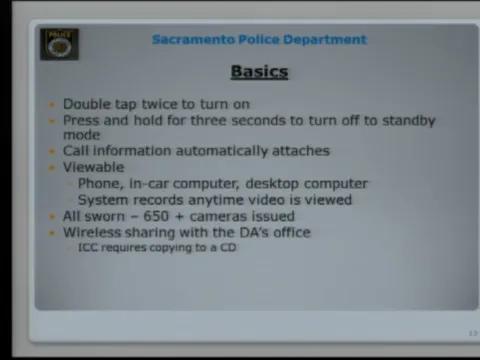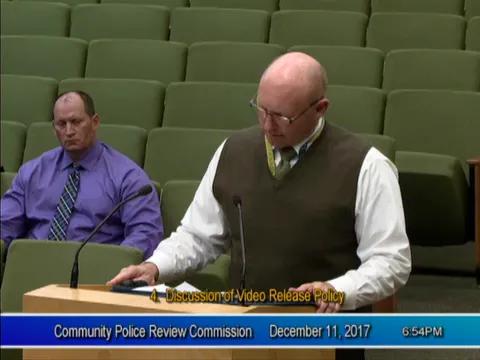
The Sacramento Community Police Review Commission met on Monday, December 11, 2017, at 6:00 p.m. in the City Hall Council Chamber (915 I Street). The Commission approved the prior meeting minutes, heard three presentations from Sacramento Police Department staff on excited delirium, less-than-lethal force options, and video release policy, received public comment, and discussed future commission business. The meeting adjourned at 7:41 p.m. Consent Calendar - Approval of Commission Meeting Minutes for November 13, 2017. Moved by Member Hoyt, seconded by Member Guerrero. Passed with 8 yes votes and 1 abstention (Member Zamora). Note: The agenda recommendation incorrectly referenced "Special Meeting Minutes dated October 9, 2017," while the item title and approved motion referred to the November 13, 2017 minutes. Discussion Items Excited Delirium Presentation - Lieutenant Bob McCloskey of the Sacramento Police Department Major Crimes Division presented. He described excited delirium as a potentially fatal medical distress condition, often linked to intoxication or altered neurochemicals, with indicators such as high body temperature (105+ degrees), irrational behavior, undressing, profuse sweating, and superhuman strength. He stated it is not caused by conducted energy devices (CEDs or Tasers). - Officers are trained to recognize the condition, call for fire/EMS, and transport subjects quickly; the focus is on rapid medical care rather than pain compliance. Training is POST-mandated and included in an 8-hour block covering officer-involved shootings and in-custody deaths. No written medical research is provided, only signs/symptoms and general orders. In-custody deaths are reported to the state Department of Justice within 10 days. - Commissioner questions addressed training materials, possible confusion with mental illness or overdose, tracking of outcomes, and whether outside medical professionals are involved (they are not). Less than Lethal Force Options - Deputy Chief Dave Polletta presented. Pre-2017 tools included expandable baton, OC spray, CED/Taser, and K9. After two fatal 2016 officer-involved shootings (Center Parkway and Del Paso Heights), the city approved $800,000 in February 2017 for equipment and training. - New tools include converted Remington 870 shotguns with beanbag rounds, rifled pepperball guns, 40mm launchers with sponge rounds, ballistic shields, and first aid kits. These are assigned to patrol teams for faster deployment. - Training: 5-hour block, limited to 12 students, focused on communication and de-escalation. 225 patrol officers trained so far; about 300 remain, with a target completion date of March 2018. - Commissioner questions covered effectiveness, use in excited delirium situations (Deputy Chief unsure), training content, and prioritization. Video Release Policy - Captain David Risley presented. The policy originates from the City Council's use of force policy (passed November 29). Section L requires release of video associated with officer-involved shootings, in-custody deaths, or complaints reported to OPSA within 30 days, unless release would hamper an investigation or endanger parties. Families get a preview; faces are blurred; graphic content warnings are given. - Process includes identifying video from in-car, body-worn, surveillance, and third-party sources. Redaction takes an average of 36 hours per case (12 video recordings, 10 minutes each). The chief can request a waiver from the council; this has happened once. - Current redaction is done by one media services staff member, with others being trained. A more comprehensive video release policy is in development, with a target of the first quarter of 2018. Public Comments – Matters Not on the Agenda - Muriel Strand read a 1994 quote from John Ehrlichman regarding the Nixon administration's drug policy targeting anti-war groups and black communities. She commented that police forces have been put in unfair situations for political reasons and submitted written materials. Commission Comments & Ideas - Member Savage-Sangwan thanked SPD for invitations to the promotion ceremony and town hall, and asked about the status of the use of force policy review. It was agreed an update would be agendized once drafted. - Member Hoyt requested notification when police-department-related items go to the City Council. OPSA agreed to send agenda notices. - Discussion about race data on complaints: OPSA will include race when available in the new system, with reports from July 2017 onward; recommendations from Commissioner Carter are being considered for quarterly reports, subject to POBR (Police Officers Bill of Rights) review by the city attorney. Key Outcomes - Approved consent calendar minutes (8 yes, 0 no, 1 abstention). - Received and filed all three discussion items (excited delirium, less than lethal force options, video release policy). - OPSA to send notifications for police-department-related City Council agenda items. - Use of force policy update to be presented to the Commission once available. - Next meeting scheduled for January 8, 2018, with calendar adoption and chair/vice-chair elections.
Public Meetings - Sacramento, California
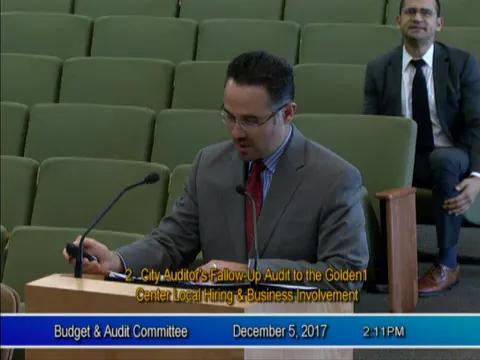
Public Meetings - Sacramento, CaliforniaThe Sacramento Budget and Audit Committee met on Tuesday, December 5, 2017, starting at 2:00 p.m. in the City Hall Council Chamber. Vice Chair Jay Schenirer presided; Councilmembers Angelique Ashby and Rick Jennings were present, and Mayor Darrell Steinberg was absent. The committee approved routine minutes and accepted the City Auditor’s Follow-Up Audit of the Golden1 Center Local Hiring and Business Involvement, forwarding it to the full City Council. Consent Calendar - Passed a motion approving the Budget and Audit Committee meeting minutes from June 6, August 3, September 19, October 3, and November 7, 2017 (File ID: 2017-01638). Motion by Member Jennings, second by Member Ashby; approved unanimously by the members present. City Auditor’s Follow-Up Audit of the Golden1 Center Local Hiring and Business Involvement The City Auditor’s office presented the follow-up audit. Key findings included: - More than 1,600 workers who worked on the Golden1 Center lived in Sacramento County and received nearly $36 million in pay from July 2014 to July 2017. Sacramento County workers made up 43% of the project workforce, the most of any county. - The project met its apprentice-hour goal, with 20% of building and construction trade hours performed by apprentices. - The Golden1 Center achieved 130% of its priority apprentice program goal: 91 qualifying priority apprentices worked on the project, exceeding the goal of 70, including 21 who met the newer priority worker criteria. These apprentices contributed more than 67,000 hours and received more than $1.6 million in gross pay, averaging more than 700 hours per apprentice, $24.46 per hour, and more than $18,000 in gross pay. - An additional 52 individuals meeting the priority apprentice criteria were hired for nearby construction projects but did not work on the Golden1 Center. - Local small business involvement was estimated at 73% against a 60% goal; small business involvement met the 20% goal, with 92% of small businesses being local small businesses, exceeding the 75% goal. - The audit relied on information from Turner Construction Company and the Sacramento Metropolitan Chamber of Commerce. - A high-level economic indicator review, rather than a full economic impact analysis, found improvements in the downtown area. Since the Golden1 Center opened, development such as the Kimpton Sawyer Hotel and Downtown Commons has moved forward, though the audit did not conclusively tie all projects to the arena. - Parking revenue grew from nearly $31 million in fiscal year 2013 to more than $37 million in fiscal year 2017, while the city also modernized its parking program. - Property values in the central city area increased 58% relative to June 2006 values, although values also rose elsewhere in Sacramento and comparable cities. - Transient occupancy tax increased from $23.8 million in fiscal year 2015 to $28.5 million in fiscal year 2017. - The audit noted that a key contract provision protected the city from sharing in more than $80 million in cost overruns; the city’s contribution ended at approximately 45.6% of project costs instead of the original estimate of about 57.6%. - Surveyed participants said the local hiring and business involvement goals were appropriate and challenging, and they would likely participate in similar goals for future city projects. Suggested improvements included clearer tracking procedures, defined roles and responsibilities, and a local/small business capacity study. The city’s economic development department plans to conduct a more detailed economic impact report for the Golden1 Center in the coming year. Committee Comments and Direction - Member Jennings praised the audit as showing a positive impact and exceeding hiring goals, called the project a model for others, and moved to forward the audit to the full City Council. Member Schenirer seconded. - Members asked about the planned economic impact analysis, including who would conduct it and its scope. They requested that the report to Council include sales tax data for the downtown core, particularly if favorable, and construction value changes since the Golden1 Center opened. - The committee suggested running the scope of the economic impact study by GSAC and SACOG to ensure the data and reporting are robust and defensible. Key Outcomes - Approved the Consent Calendar item approving prior meeting minutes. - Passed a motion accepting the City Auditor’s Follow-Up Audit of the Golden1 Center Local Hiring and Business Involvement and forwarding it to City Council for approval. Motion by Member Jennings, second by Member Schenirer; carried 3–0 with Mayor Steinberg absent. - Directed staff to incorporate additional requested information into the Council presentation and consider external input on the future economic impact analysis. The committee adjourned at 2:20 p.m.
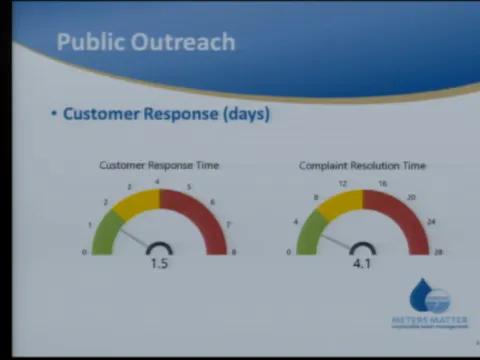
The Water Committee held a special meeting on November 21, 2017, at 3:04 PM in the City Hall Council Chamber (called to order at 3:04 PM). The committee approved the 2018 meeting schedule, selected a vice chair, reviewed and forwarded an outdoor water conservation ordinance amendment, received presentations on the Sacramento–San Joaquin Delta and the water meter retrofit program, and discussed related outreach and coordination efforts. Consent Calendar - 2018 Regular Meeting Schedule for the Water Committee – Approved unanimously. The committee will meet quarterly on the third Tuesday of each quarter at 3:00 PM. Discussion Items - Selection of 2018 Vice Chair – Councilmember Eric Guerra was unanimously selected as Vice Chair for 2018, effective at the next regular meeting. - Ordinance Amending Chapter 13.04 (Outdoor Water Conservation) – Staff presented revisions requested by City Council on August 15, 2017. Changes include: reducing the second violation fine from $50 to $25; a moratorium on second, third, and fourth violations until March 1, 2018, to focus on education; a new 30-day landscape establishment period; and director’s authority to grant exemptions for unique circumstances (e.g., homeowner associations). The ordinance also clarifies intent to encourage efficient water use and healthy trees. The committee voted unanimously (3–0) to forward the ordinance to the full City Council for approval. Members discussed the importance of smart controllers, rebates, and coordination with low-impact development policies. - Sacramento – San Joaquin Delta Presentation – Staff provided an update on delta processes including the California Water Fix (two 40-foot diameter tunnels, 35 miles under the Delta), the Bay-Delta Water Quality Control Plan Phase 2, and a voluntary settlement agreement facilitated by former Interior Secretary Bruce Babbitt. The city’s “modified flow management standard” for the lower American River aims to protect water supply reliability and improve habitat. The committee received and filed the presentation. - Water Meter Retrofit Update – The accelerated water meter program: City is 71% metered, with approximately 40,000 meters remaining to be placed by the end of 2020. Construction costs total $212 million; program total $245 million. To date, $20 million has been spent. Outreach efforts include a website, app, and ads. Average customer response time is 1.5 business days (goal 2 days). Local hire participation averages 24% (goal 5%). Committee members praised the improved program and requested better coordination with Public Works on road resurfacing and messaging about water main relocations. The presentation was received and filed. Key Outcomes - Approved the 2018 regular meeting schedule (quarterly on third Tuesdays). - Selected Councilmember Eric Guerra as 2018 Vice Chair. - Forwarded the outdoor water conservation ordinance amendment to City Council. - Received and filed the Delta presentation and Water Meter Retrofit Update.
The Sacramento Preservation Commission convened on November 15, 2017, at 5:30 PM at New City Hall, 915 I Street Council Chambers. The meeting covered updates on infill development guidelines, the Old City Cemetery Technical Advisory Committee, the relaunch of the Mills Act program, the Director’s Report, and public comments. The commission voted unanimously to forward recommended modifications to the Central City design guidelines and approved the October 18, 2017, minutes. Consent Calendar - Approval of Minutes – The commission approved the minutes of the October 18, 2017, meeting by a unanimous motion (Commissioner Volonia moved, Commissioner Bounds seconded). No corrections were requested. Public Comments & Testimony - William Burg – Representing Preservation Sacramento and Sacramento Heritage, Mr. Burg expressed concern that city staff ignored the unanimous recommendations of both the Preservation Commission and the Planning and Design Commission regarding two proposed ordinance changes (Sections 17.808.140 and 17.808.120). He questioned whether the changes would allow staff-level approval of projects without public notice and urged the commission to request that the City Council postpone action until design guidelines are in place. - Margaret Buss – Speaking for herself and the Boulevard Park Neighborhood Association Board, Ms. Buss supported the commission’s stance on infill guidelines and the ordinance issues. She emphasized that eliminating public notification and delegating decisions to staff level undermines good governance and urged postponing the ordinance changes until comprehensive guidelines are ready. - Additional public comments were made on the Old City Cemetery TAC (via Ms. Buss reading a statement from Anita Clevinger) and on the Mills Act program (Mr. Burg reading an email from Johanna Welty, highlighting the lack of an active Mills Act program in Sacramento and the need to allow contributing properties in historic districts to apply without first becoming individual landmarks). Discussion Items Ad Hoc Committee Status Report on Infill Development (Item 3) - Commissioner Whitelam reported attendance at the October 26 Planning and Design Commission meeting, where the commission supported deleting Sections 17.808.140 and 17.808.120 from the proposed ordinance. He also attended a November 13 town hall (District 4) for the now-named Central City Specific Plan, which raised concerns about height transitions near historic districts and trust in maintaining height limits. At the November 14 Law and Legislation Committee meeting, the committee deferred consideration of the two sections to November 28 due to time constraints. Chair Marshak attended the town hall and emphasized that the commission’s rationale for its positions needs to be clearly communicated to subsequent decision-making bodies. Ad Hoc Committee Report on Design Guidelines (Item 2) - Commissioner Whitelam presented the committee’s detailed recommendations to modify the proposed second editions of the Central City Urban Design Guidelines and Central City Neighborhood Design Guidelines. Key recommendations include: clarifying applicability to historic districts, retaining the preservation commission’s role, adding references to the interim infill development principles, preserving detailed guidance on scale, height, materials, and context, adding guidance for mid-century modern styles, and retaining the index. The commission voted unanimously (motion by Commissioner Volonia, second by Commissioner Bounds) to forward these recommendations to the Planning and Design Commission and City Council, along with the committee’s rationale. Staff noted that a revised draft incorporating comments will be brought back to the commission in January 2018 before final adoption. Old City Cemetery Technical Advisory Committee (Item 4) - Staff provided an update on the October 25 kick-off meeting of the Technical Advisory Committee (TAC). Commissioner Bounds, the commission’s designee, noted the TAC’s focus on using a GIS database for a holistic master plan, the extension of an RFP for an operations assessment, and the need for transparent minutes. Public comment (via Ms. Buss) relayed Anita Clevinger’s concern that draft TAC minutes had not yet been shared with members. Staff clarified that the TAC is not a Brown Act body and will report back on meeting records dissemination. Proposed Mills Act Program Relaunch (Item 5) - Preservation Director Carson Anderson presented an administrative framework for restarting the Mills Act program, which has been on hiatus. Proposed elements include: an enrollment cap (e.g., 10 contracts initially), two categories (one focused on lower-income homeowners and deteriorated properties, another for better-preserved buildings), a scoring system, low application fees to encourage participation, and multiple workshops. Commissioners discussed the need to allow contributing properties to apply without first becoming individual landmarks, to set fees that do not outweigh tax benefits, and to involve other city departments. Staff will refine the proposal and return to the commission for review before final approval. Director’s Report (Item 6) - Director Anderson announced the hiring of Tom Pace as the new Planning Director (starting December 11), a qualified candidate for the associate planner position, and several other staff changes. He noted the release of the draft EIR for the Sacramento Convention Center renovation and 15th & K Street Hotel project (comment period through January 2). Upcoming events: the Preservation Forum on November 18 (featuring the Sacramento Valley Station Master Plan) and National Preservation Institute seminars. Commissioners requested that training opportunities be emailed to them. Key Outcomes - Approved consent calendar (unanimous). - Approved motion (5-0) to forward the Ad Hoc Committee’s recommendations on the Central City Design Guidelines to the Planning and Design Commission and City Council, with rationale. - Received and discussed the status report on infill ordinance changes; the commission will continue to monitor the November 28 Law and Legislation Committee meeting. - Received and commented on the Old City Cemetery TAC update; staff will follow up on minutes dissemination. - Provided direction on the Mills Act program relaunch; staff will refine the framework and bring it back to the commission for review. - Received and filed the Director’s Report. - No formal action taken on public comments or commissioner comments beyond discussion.
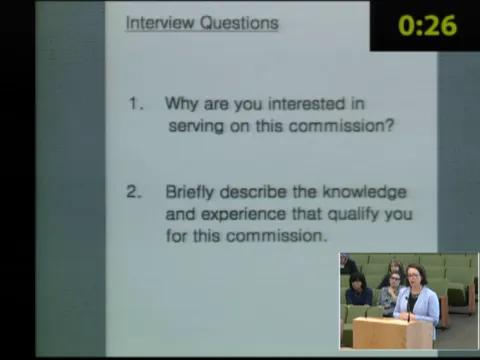
The Personnel and Public Employees Committee of the Sacramento City Council met on November 14, 2017, at 1:35 p.m. in the City Hall Council Chamber. Chair Larry Carr presided, with Vice-Chair Steve Hansen and Member Angelique Ashby present; Member Allen Warren was absent. The committee conducted interviews for multiple boards and commissions, made several nominations, and forwarded recommendations to the Mayor. The meeting adjourned at 2:26 p.m. Consent Calendar - Minutes Approval: The committee unanimously approved the meeting minutes for September 12, 2017, and October 30, 2017. Motion by Angelique Ashby, seconded by Steve Hansen. All present members voted yes. Discussion Items - Interviews for the Civil Service Board: The committee interviewed Ed Perez, a 20-year Sacramento resident and labor relations specialist with the State of California Department of Water Resources. Another applicant, Shirley Ogata, was unable to attend but remained interested. The committee voted to nominate Ed Perez to Seat E (a citizen with no connection to city government). - Interviews for the Natomas Basin Conservancy Board of Directors: The committee interviewed David Christophel, the sole applicant for Seat E. Christophel is a wildlife biologist and environmental consultant with deep local ties. Members praised his 22 meetings with zero absences. He was unanimously nominated for another term. - Interviews for the Sacramento Housing and Redevelopment Commission: The committee interviewed multiple applicants for three seats on the commission. Among them, incumbent chair Kathy Creswell expressed her interest in continuing to serve, highlighting her career in housing and community development. Other applicants included Andrew Whittle, Charles Malmsten, Jane Mantey, Gillian Davey, Richard Saunders, Samuel Starks, Tyffanie Wedding, Tyler Hickey, and Wanda Leyes. Some applicants were absent. No nominations were made at this meeting; the committee planned to continue nominations at the next meeting. - Interviews for the Sacramento Yolo Mosquito and Vector Control District: Raymond LaTorre, the sole applicant for Seat A, was unanimously nominated for another term by acclamation, with no interview conducted. - Interviews for the Utilities Rate Advisory Committee: The committee interviewed four applicants for Seat F: Eliseo Garcia, Jason Orta, Mike Sharif, and Rachel Ann Vanderworf (who was not present). No nominations were made; decisions were deferred to a later meeting. - Nominations to the Ann Land and Bertha Henschel Memorial Funds Commission: The committee reviewed applications and unanimously nominated Caitlin Maple to Seat B (representing the general public). - Nominations to the Sacramento Ethics Commission: The committee discussed 39 applicants. After deliberation, the committee agreed on five nominees: Mary-Beth Moylan (Seat A), Deanna Adams (Seat B), Emelyn Rodriguez (Seat C), Linda Ng (Seat D), and Susan Underwood (Seat E). The motion passed unanimously. - Nomination to the Sacramento Metropolitan Arts Commission: The committee unanimously nominated Veronica Delgado to Seat F, based on the Arts Commission's recommendation. Key Outcomes - Appointed Ed Perez to the Civil Service Board, David Christophel to the Natomas Basin Conservancy, Raymond LaTorre to the Sacramento Yolo Mosquito and Vector Control District, and Veronica Delgado to the Sacramento Metropolitan Arts Commission. - Nominated Caitlin Maple to the Ann Land and Bertha Henschel Memorial Funds Commission. - Nominated five individuals to the Sacramento Ethics Commission. - Deferred nominations for the Sacramento Housing and Redevelopment Commission and Utilities Rate Advisory Committee to the next meeting.
The Sacramento Community Police Review Commission met on Monday, November 13, 2017, at 6:00 p.m. in the City Hall Council Chamber. The meeting included presentations on police and OPSA statistics, police equipment (body-worn and in-car cameras), and critical incidents protocol. The commission received and filed reports on these topics and scheduled future presentations on excited delirium and less-lethal weaponry. Consent Calendar - Approval of Minutes (October 9, 2017): Passed with 8 yes votes (Kinsey, Sabeniano, Elkarra, Savage-Sangwan, Guerrero, Escobar, Carter, Coleman) and 1 abstention (Hoyt). Discussion: SPD and OPSA Statistics - Presenter: Francine Tournour, Director of OPSA, reported on complaints and investigations for the period January 1, 2016, through June 30, 2017. - In that period, there were 56 cases with 317 allegations (each allegation counted as a complaint). - SPD directly received 235 allegations, resulting in 56 investigations; OPSA sent 82 allegations to SPD. - Of 39 formal investigations completed, 34 were sustained; 17 cases were still open at reporting time. - 15 officers were disciplined as a result of sustained allegations. - Tournour clarified that some sustained cases may result in training rather than discipline, which is not considered formal discipline. - She noted that the 87% discipline rate is based on allegations, not cases. - Officers are allowed to view body-worn camera video before writing reports, and after critical incidents, video is locked down after initial viewing. - OPSA will provide quarterly statistical reports starting in January, with more detailed breakdowns of allegations and dispositions. Discussion: Police Equipment - Presenter: Lieutenant Justin Risley (SPD) discussed both in-car and body-worn cameras (BWC). - In-car cameras: Panasonic Arbitrator, in use since 2001, upgraded to Gen 2 in 2012. Features include rear cameras, wireless download, and 30-second pre-record. - Body-worn cameras: Two-year project, selected Taser/Axon (now Axon). Cameras have 12-hour battery life, 43-degree field of view, and 23 hours of record time. - All sworn officers have been issued BWCs. - Automatic triggers (e.g., emergency lights, rear door activation) activate both in-car and body cameras. - Axon system is cloud-based with three layers of encryption; no known hacking incidents. - Video retention: currently 18 months unless evidence-related; may extend to 2 years minimum, up to 10+ years for homicides. - Officers are authorized to review their own video; supervisors may review all video. - One incident of an officer intentionally not wearing a camera was reported; that case is being addressed. - Body-worn cameras are not used in county jail per sheriff's request; jail has its own cameras, but that footage is not subject to same release policy. - A 127- or 142-video release for a recent officer-involved shooting is being managed. - No formal post-implementation survey is planned, but officer feedback has been positive. Discussion: Critical Incidents Protocol - Presenter: Lieutenant Bob McCloskey (SPD) and Captain Norm Leong (SPD). - Overview of response to officer-involved shootings, homicides, and in-custody deaths. - Statistics: Approximately 14,000 arrests and 117 use-of-force incidents per year; 350,000+ calls for service annually; average 3-5 officer-involved shootings per year, about 1 in-custody death per year. - For officer-involved shootings, parallel criminal and administrative investigations occur; DA's office performs independent review. - Public safety statements are limited to who, what, where, when (not why). - Round counts are conducted for all officers on scene to verify who fired. - Body-worn video is reviewed by officers before statements, then locked down. - Witnesses may be detained if they have information; filming police is not illegal, and officers have been briefed on this. - Lead detective now serves as family liaison, providing direct contact. - Deceased subjects are not touched until coroner's permission; body screens are used for privacy. - Officers get a minimum of three days off after a shooting and receive peer support, which is confidential. - 30-day critical incident review is led by management. - Reports to Attorney General's office are required within 10 days for deaths in custody or officer-involved shootings. Key Outcomes - Consent calendar minutes approved (8 yes, 1 abstain). - Reports on statistics, police equipment, and critical incidents protocol were received and filed. - OPSA will provide a breakdown of allegations associated with discipline, expected by next week (as of November 13, 2017). - Future presentations planned on excited delirium and less-lethal weaponry. - Commission’s next meeting is scheduled for December 11, 2017. Public Comments & Testimony - No public comments were made for items not on the agenda. Commission Comments - Commissioner Carter requested more detail on sustained allegations and associated offenses; OPSA will provide. - Commissioner Guerrero asked about redaction processes; clarified redaction involves blurring/beeping, not removal. - Commissioner Savage-Sangwan asked about complaint demographic data; OPSA will capture more via a new system. - Concerns were raised about the clarity of statistics (e.g., whether numbers refer to cases or allegations); OPSA acknowledged the report could be misleading and will clarify.
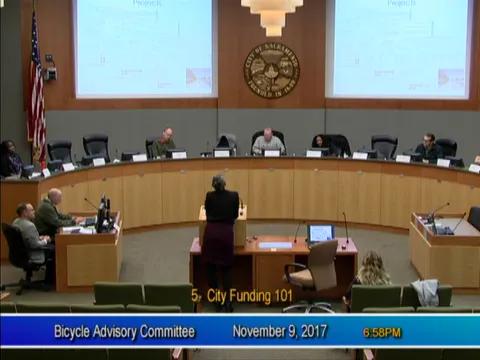
The City County Bicycle Advisory Committee (SacBAC) met on Thursday, November 9, 2017, at 6:00 p.m. in city chambers. The committee reviewed two major infrastructure projects, received a funding overview, and discussed the transition to separate city and county bicycle advisory bodies. The meeting included a consent calendar, three information items, and committee updates. Consent Calendar - Approval of Meeting Minutes of October 19, 2017 – Approved with a minor amendment (removing the word "acting" from the Chair's description). One abstention recorded. - Bicycle Advisory Committee Log – Received and filed without changes. Public Comments & Testimony - No members of the public spoke during the public comment period for matters not on the agenda. Discussion Items Franklin Boulevard Project (Item 3) - Presenter: Megan Johnson, City Associate Civil Engineer, presented the Franklin Boulevard Complete Streets project for the northern segment (38th Avenue to Sutterville Road, 1.5 miles). - Key data: Existing average daily traffic: 19,000 vehicles; 85th percentile speed: 47.5 mph; only one city street tree along the corridor. The project emerged from a grassroots community effort. - Two alternatives: - Alternative 1 (Buffered Bike Lanes, Class II): Road diet from four lanes to two lanes with a center median, 3-foot buffer, widened sidewalks, and on-street parking with tree wells. Estimated construction cost: $13 million. - Alternative 2 (Raised Class IV Bikeway): Raised bikeway adjacent to the sidewalk, with grade separation and landscaping. Estimated construction cost: $17 million. - Community outreach: Walking tours, public workshops, a pop-up demonstration, and a steering committee. The community preference is leaning toward the raised alternative. - Concerns raised by committee members: - Conflicts between pedestrians and cyclists with the raised design, especially near driveways. - Potential hazards from uneven surfaces and street furniture. - Support for either option, but preference for the buffered lane from a “cyclists as traffic” perspective. - Next steps: Preliminary engineering and environmental documentation (CEQA/NEPA) ongoing; targeting construction in 2020 pending grant funding. Auburn Boulevard Bike & Pedestrian Improvements (Item 4) - Presenter: Anthony Voo, County Associate Civil Engineer, presented a $1.4 million HSIP-funded project on Auburn Boulevard (0.6 miles from Annadale Lane to just west of Winding Way). - Safety data: Between 2009–2014, 12 bicycle-related and 8 pedestrian-related crashes, including two fatalities. - Existing conditions: Four-lane arterial with 40 mph posted speed (85th percentile 44 mph), ADT 20,000, narrow shoulders (2–3 ft eastbound, 4–7 ft westbound). - Proposed improvements: - Restripe to provide a 10-foot two-way left-turn lane, 11-foot travel lanes, and 5–6 foot bike lanes. - Install a pedestrian-activated HAWK signal near the Powerhouse Science Center Discovery Campus. - Upgrade traffic signal at Norse Avenue to video detection for bicycles. - Improve bus stop accessibility and add infill street lighting. - Concerns: Committee noted high-speed traffic near the I-80 interchange and expressed interest in future improvements east of Winding Way. - Next steps: CEQA exemption and NEPA categorical exclusion received; final design and right-of-way acquisition; construction anticipated in 2019. City Funding 101 (Item 5) - Presenter: Jennifer Donlon Wyant, Active Transportation Program Specialist, explained how bike projects are funded. - Key points: - Transportation is not funded from the general fund (except a one-time $2.25 million mid-year allocation for bikeways). - Sources: gas tax, Measure A (new construction), TDA, and grants. Local match is typically 11.47%. - The Active Transportation Program (replacing the Bikeway Program) has about $1.4 million per year for local match. - Over the past five years, 21% of the city’s total transportation budget was spent on biking. This percentage is higher than in comparable cities, but the overall transportation budget is smaller. - SB1 (new state gas tax) is expected to provide $8 million in the first year (rising to $14 million ongoing), primarily for pavement maintenance, with opportunities to add bike lanes during repaving. - Questions: Committee discussed the 21% figure and how SB1 funds will be allocated; staff will bring a list of corridors with bike improvements to the next meeting. Update on New City Bicycle Advisory Commission (Item 6) - Presenter: Jennifer Donlon Wyant reported that the proposal to form a city-only Bicycle Advisory Commission will go to the Law and Legislation Committee on November 14, 2017, then to City Council in January. - Structure: 13 members (12 council district appointees plus two at-large, with a mayoral appointee). The current joint committee will be dissolved in December 2017. - Timeline: Recruitment and appointments likely in early 2018; first meeting anticipated in late spring. - Committee comments: Members expressed hope for continuity and asked about authority; the commission will have no additional authority unless granted by council. Committee Comments & Updates - Vision Zero: Drew Hart announced that a public draft plan will be released in December 2017; public comment period will remain open. - Special Meeting: The committee will hold a special meeting on Tuesday, November 14, 2017, at 6:00 p.m. in Room 1119 to review the Bike Plan Implementation Plan (Section 3). - County Advisory Committee: Dave reported that the county will propose a separate county-only bicycle advisory committee to the Board of Supervisors on December 12, 2017, with effective date January 1, 2018. Appointments will follow a similar process. No applications are being accepted yet. Key Outcomes - Consent Calendar approved with one abstention. - No formal votes on the information items; the committee offered comments and feedback for staff to consider. - Next regular meeting: December 14, 2017, at 6:00 p.m. in the same chambers. - Special meeting: November 14, 2017, at 6:00 p.m. for the Bike Plan Implementation Plan. - Staff will provide a list of SB1-related corridors with bike improvements at the next meeting, and continue outreach on the Franklin and Auburn projects.
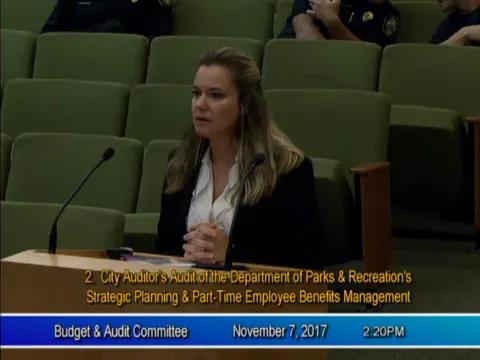
The Budget and Audit Committee met on Tuesday, November 7, 2017, starting at 2:01 p.m. and adjourning at 2:25 p.m. at City Hall Council Chamber. Vice Chair Jay Schenirer presided, with Councilmembers Angelique Ashby and Rick Jennings present; Mayor Darrell Steinberg was absent. The committee unanimously approved the consent calendar and two discussion items, forwarding them to the full City Council for final action. Consent Calendar - City Auditor’s Activity Report for the 1st Quarter of Fiscal Year 2017/18: Accepted and forwarded to City Council. The report summarizes the Auditor’s office work for that period. - City Auditor’s Whistleblower Hotline Activity Report for April to September 2017: Accepted and forwarded to City Council. The report details hotline activity over that six-month period. Both items were approved unanimously (3-0) on a motion by Member Ashby, seconded by Member Jennings. Public Comments & Testimony - No public comments were made on matters not on the agenda. Discussion Items 3. Audit of the Department of Parks and Recreation’s Strategic Planning and Part-Time Employee Benefits Management Assistant City Auditor Lynn Bashaw presented the audit findings. Key findings included: - Finding 1: Strategic planning documents (master plan and strategic plan) are outdated; the master plan was last updated in 2009 (technical update) and originally from 2004. Registration data showed declining program attendance over four years. Over 40% of 311 calls related to Parks and Recreation were categorized as “other” or “general info,” indicating data quality issues. Many programs lacked performance measures. - Finding 2: The department lacks a formal cost recovery philosophy; fees have been set on an ad hoc basis. A benchmarking survey found that charging non-resident fees is common in other cities, but Parks and Recreation (except for Camp Sacramento) does not charge them. A voluntary donation program on utility bills could generate $80,000 to $100,000 annually. - Finding 3: 20 out of 41 supervisors responsible for part-time employees had not received labor relations training. While benefits were being offered correctly, training and policy gaps existed. The department (Shannon Brown, operations manager) concurred with the audit and has already started implementing corrective actions, including updating the strategic plan (target completion: April 2018). The committee unanimously (3-0) passed a motion (Jennings/Schenirer) to accept the audit and forward it to the City Council. 4. Proposed Emergency Medical Services (EMS) Fee Adjustments and Amended Policy for EMS Revenue Recovery and Fee Waiver Deputy Chief Chad Augustin presented the proposal. The last fee increase was in June 2012. The proposed adjustments aim to close the gap between service costs and revenues, support future ambulance needs, and include an annual Consumer Price Index adjustment. A new first responder fee is proposed to offset paramedic level service costs, with a waiver program for those unable to pay. Implementation is targeted for January 1, 2018. The committee reviewed the proposed fees and policy, and unanimously (3-0) passed a motion (Jennings/Ashby) to forward the item to the City Council for a public hearing. Key Outcomes - Consent Calendar: Approved unanimously (3-0). - Parks and Recreation Audit: Accepted and forwarded to City Council unanimously (3-0). - EMS Fee Adjustments: Reviewed and forwarded to City Council for a public hearing unanimously (3-0). - No committee comments, ideas, or meeting reports were made.
A special meeting of the Personnel and Public Employees Committee was held on Monday, October 30, 2017, beginning at 10:02 a.m. in the City Hall Council Chamber. The meeting was called to order by Chair Larry Carr after a one-hour delay due to quorum issues. The sole agenda item was to conduct interviews of applicants for five seats on the newly created Sacramento Ethics Commission. No appointments were made; nominations were continued to the next meeting. The committee heard from 31 applicants (with three withdrawals) and one public speaker. Discussion Items - Interviews for the Sacramento Ethics Commission (File ID 2017-01287) – The committee conducted interviews for Seats A, B, C, D, and E of the inaugural Ethics Commission. Applicants were called in alphabetical order (by first name) and given two minutes each to answer questions. Among the 31 candidates who appeared, three had withdrawn prior to the meeting (Byron Miller, Craig Siegel, and Michael Fluke). The committee also heard from a wide range of qualified individuals, including attorneys, former FPPC staff, journalists, educators, and community volunteers. Several candidates disclosed potential conflicts of interest (e.g., a son who interned at City Hall, a father working for a political law firm, employment at the FPPC that would end soon). Councilmember Ashby noted that the commission's creation was a long process and thanked the applicants. Chair Carr emphasized that selections would be based on qualifications and representation of the city's diversity. Public Comments & Testimony - Paula Lee, representing the League of Women Voters, publicly thanked all candidates for applying and commended the council for establishing the commission. Key Outcomes - No appointments were made – The committee accepted the interviews and will continue discussion and nominations at the next scheduled meeting (date not specified). - Chair Carr and Councilmember Ashby encouraged all applicants, especially those not selected, to apply for future openings on the commission or other city boards. - The meeting adjourned at 11:26 a.m. Candidates Interviewed (in order of appearance) Alexander McCabe, Alvin Block, Amanda Kelly, Andrea Jaramillo, Blayne (BJ) Flora, Cameron Demetre, Caroline Hostetler, Deanna Adams, Deirdre Lopez, Derek Cressman, Diane Elizabeth Sheffield, Emelyn Rodriguez, Eric Rivera-Jurado, Gloria Magana, Jennifer Harmon, Lexi Purich Howard, Linda McAtee, Linda Ng, Mariah Cook, Marina Perez, Mary-Beth Moylan, Monica Baumann, Nancy Coleman Chavez, Pat Cruz, Rhonda Rios Kravitz, Sarah Ream, Scott Arrants, Sharon Victor, Susan Underwood, Tim Matalka, and Virginia Fair-Amitani.
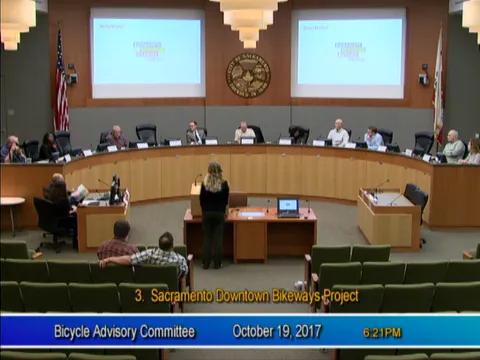
The Sacramento City County Bicycle Advisory Committee (SacBAC) met on October 19, 2017, at 6:00 p.m. in City Hall Council Chamber. The meeting initially lacked a quorum, so the consent calendar was deferred until later. After a quorum was achieved, the committee approved the consent calendar with amendments, heard public testimony, and received updates on the Downtown Bikeways Project, Measure A expenditures, bike parking, and Vision Zero. Consent Calendar - Item 1: Approval of Meeting Minutes of September 14, 2017 – Approved with corrections. Committee Member Melvin noted his name was misspelled on motions; Walt pointed out that Item 4 was incorrectly listed as an information item (should be action item) and that the motion language was inaccurate (the committee approved the language of a letter, not just identified key points; also the recommendation to send a letter to the air quality district was misstated). Staff noted they would review the tape. Motion to approve as amended carried by voice vote, with Vice Chair Farland and Member Casey abstaining. - Item 2: Bicycle Advisory Committee Log – Received and filed as part of the consent calendar. Public Comments & Testimony - Josh Croft (Sacramento resident) expressed strong support for protected bike lanes, stating he feels unsafe biking in Sacramento and currently uses a scooter on sidewalks. He praised the concept and hoped for more such facilities. Discussion Items - Item 3: Sacramento Downtown Bikeways Project (Information Item, 30 min) – Megan Johnson, Associate Civil Engineer, presented a project to install parking-protected bikeways (left-side bike lanes) on H, I, P, Q, and 10th Streets to fill gaps in the bikeway network and improve safety on the High Injury Network. The project is funded by mayor's budget and tied to Vision Zero. Key features: removing one travel lane, shifting parking, adding a 7-foot bike lane with 3-foot buffer, and flexible bollards. A pop-up demonstration (Oct 4-6) and community open house (Oct 9) generated 40 comment cards; majority support. Some concerns about intersection design, street sweeping, and right-turn maneuvers. Next steps: final design, then construction after the rainy season. Committee members commended the rapid turnaround and asked about intersection treatments, bollard choice, street sweeping, and left-side bike lane turning maneuvers. Johnson noted that bike boxes and two-stage turn boxes are being considered. - Item 4: Accounting of Measure A Expenditures (Information Item, 15 min) – Chair Whelan presented the annual fiscal year 2016-17 collection and distribution data. Total revenue of $11.8 million, with distributions to city and county. Committee members Walt and Jordan requested more information on the “complete streets” provision in Measure A and whether SB1 money will also be tracked. They suggested inviting STA or city/county finance/transportation staff to explain monitoring. Chair Whelan agreed to explore invitations. - Item 5: Bike Parking Update (Information Item, 15 min) – Drew Hart presented the city's bike rack program: free racks to businesses in the public right-of-way, with priority given to businesses lacking private space. 22 racks are being installed in Oak Park, 8 in midtown, 2 in downtown. Committee questioned the policy of deferring to business owners who don't want racks (Floleane argued for public good), and asked about funding source (public works operations budget, likely Measure A). Hart noted the program is steady but not increasing. He also mentioned the upcoming secured bike parking at Sacramento Valley Station (bike spa, key card access, opening December/January). - Item 6: Vision Zero Update (Information Item, 15 min) – Drew Hart presented multiple projects: Top Five High Injury Network Corridor Study (30% designs, 18 months), School Safety Study (analyzing opportunities for school zones to lower speed limits), Systemic Safety Analysis Report Project (SSARP, 12 months, identifying contributing factors for crashes and applying for HSIP funding), and a Safety Outreach Campaign (six messages, neighborhood-level events). Funding sources include grants (OTS, HSIP). Committee members asked about behavioral causes (speeding, distracted driving, DUI) and suggested addressing all three in outreach. Hart noted that police reports will be a starting point for analysis. Key Outcomes - Consent Calendar approved with amendments (motion by Lewis, second by Jordan; 2 abstentions). - Downtown Bikeways Project – Committee reviewed and commented; design will continue with consideration of intersection enhancements. Construction expected after rainy season. - Measure A – Committee requested staff to invite STA or city/county representatives to discuss complete streets compliance and SB1 integration. - Bike Parking – Committee noted concern about business owner veto power; staff will continue program. Secured bike parking at Sacramento Valley Station will open in December/January. - Vision Zero – Draft action plan expected in December 2017. Committee provided input on outreach campaign content. - Next Meeting – November 9, 2017, at 6:00 p.m. December 14 meeting is still on calendar; committee may continue into January before dissolution. - Committee Comments – Request for staff report on barriers to improving bikeway gateways under freeways where Caltrans owns right-of-way. The committee noted that Caltrans has a new sustainability manager (Jeannie Ward Waller) who is familiar with Sacramento.