The Sacramento Public Library Authority Board met on Monday, December 8, 2024, beginning at approximately 3:16 p.m. and adjourning at 3:30 p.m. (about 14 minutes). The board approved the consent calendar and an amendment to the Library Director’s employment contract, received a report from the Friends of the Sacramento Public Library, and heard executive updates including capital project status across multiple branches. Consent Calendar - The board approved a four-item consent calendar. - Vote: 8-0 (Dickinson, Talamantes, Maple, Brewer, Spees, Kaplan, Larratt, Gatewood voting yes/aye). Discussion Items - Action Item: Contract amendment — Library Director employment contract - Presenter: Jennifer Gore (Legal Counsel), who stated the item followed the prior meeting’s annual performance review and recommended a 2% increase to the Library Director’s annual salary. - Motion: Director Karina Talamantes; Second: Vice Chair Katie Maple. - Vote: 8-0. Presentations - Friends of the Sacramento Public Library report (speaker: Devon, Friends representative; with Anita Scurry noted as leading the communications committee) - Reported on Friends board activities from November, including discussion of library rebranding rollout (with Lisa Martinez) and work on 2024 tax returns, governance/bylaws, and filling board vacancies/leadership for the next year. - Booked In / Book Den activities: - Announced a Jane Austen 250th birthday tea scheduled for December 14, 12–3 p.m. at Booked In, including a guest speaker. - Reported Booked In’s TikTok activity “going viral,” including a video receiving 83,000 views, and stated this helped support donations and revenue. - Highlighted book donations and community impact (including support for classroom libraries), and credited volunteer leadership (Pam Whitley). Executive Team Report - Presenter: Deputy Director Keller - Introduced Salwa Shehme, Sacramento Public Library’s new Deputy Director and Chief Operations Officer, attending their first Authority Board meeting. - Carmichael Library staff were nominated for three “Best of Carmichael” awards and received Best Book Club from the Chamber of Commerce. - Reported a November 12 event featuring District Attorney and author Thien Ho about his book The People vs. the Golden State Killer, including Q&A; stated over 200 books were provided courtesy of the DA and the Socopolis family, and that a recording is available on the library website. - Capital projects / facilities updates: - Colonial Heights Library: Soft reopening had been scheduled for “tomorrow” (relative to the meeting) but was delayed due to a utilities issue; Keller reported the City of Sacramento resolved the utilities issue the morning of the meeting and was conducting final HVAC testing, with an announcement for a soft reopening hoped for “this week.” Community room work was expected to complete this month or early next, with a full grand reopening planned for January. - Del Paso Heights Library parking lot project: Reported a minor delay; work had resumed that day, with hope the library would open early in the year. - North Sacramento–Hagenwood: Reported a November 20 groundbreaking (crediting Councilmember Dickinson) and stated the new permanent library is anticipated to open in 2027, if not sooner. - Noted 2025–2026 as a major period for capital projects and that 2026 would also be “the year of closures” for some libraries; stated the library would notify the public and use mobile services to augment access during closures. Key Outcomes - Approved the four-item consent calendar (8-0). - Approved a contract amendment providing a 2% salary increase for the Library Director (8-0). - Received updates on Friends programming (including the Dec. 14, 12–3 p.m. event) and multiple branch capital projects, including anticipated reopenings and the North Sacramento–Hagenwood timeline. Reports, Ideas, and Questions from Board Members - No reports or questions were raised. Meeting adjourned at approximately 3:30 p.m.
Public Meetings - Sacramento County, California
Public Meetings - Sacramento County, CaliforniaThe Board convened in open session, approved a large consent calendar, held a Proposition 218 hearing for an assessment change in Orangevale, approved the Gerber South Subdivision project in Vineyard, introduced a new stormwater utility fee ordinance (SWU2), debated (but took no action on) a potential 2026 road-maintenance tax measure, and unanimously directed staff to pursue a new countywide homelessness governance model centered on reconstituting the Continuum of Care (COC) with elected leadership. In the afternoon, the Board received required annual reports (Truth Act and Inmate Welfare Fund), held workshops on major federal/state funding impacts to indigent health care and CalFresh administration, and made appointments to the COC Board. Public Comments & Testimony - Deanna Rutkowski (off-agenda): Asked follow-up questions regarding county procedures for citizen complaints, including an example alleging perjury and failures to protect vulnerable populations; stated it had been “five months and 19 days” that an employee remained on administrative leave pending investigation. - Ronald F. Owens, Jr. (off-agenda): Claimed harms and deaths from COVID-19 vaccines, cited multiple statistics and anecdotes from across counties/states, and asserted the County has a responsibility to inform residents. - Barb Ram (off-agenda & later items): Disputed factual assertions in an opinion piece about jail releases and services; requested clarifications on release processing time, access to medication, and resource guides. Later objected to outside contracting for homelessness services and asked about affordable/missing-middle housing in the Gerber South project. Consent Calendar - Item 44 dropped (MOU with Sutter County for crime lab services, Dec. 9, 2025–June 30, 2026) by unanimous vote (5–0). - Items 5–49 approved (with clerk notes on items 7 and 18 introducing ordinances to be continued for adoption) by unanimous vote (5–0). - Item 22 (Development Impact Fee report): Supervisor Pat Hume commented that a report presented to jurisdictions showed Sacramento County single-family development fees at $109,000 per unit, and urged scrutiny of cost drivers. - Item 13 (Warren E. Thornton Youth Center remodel for Behavioral Health Children’s Crisis Stabilization Unit): - Carpenters Local 46 representatives (Richie Cruz, Matthew Beeston, Matthew Kelly): Expressed opposition to awarding to Bobo Construction, requested removal from the agenda pending further investigation, and cited concerns including project delays, stop payment notices/bond claims, litigation, prevailing wage penalties, and prequalification disclosures. - Austin Bobo (Vice President, Bobo Construction): Defended the firm, disputed statements regarding prequalification issues (described Los Banos as a timing issue and Walnut Creek as clarified via revised submission), and argued the company is a responsible contractor. - Item 43 ($4 million Brilliant Corners agreement): A public speaker opposed the award, arguing the vendor had no Sacramento presence and questioned feasibility of assisting 250 households to retain/find housing; urged the Board to reconsider. Discussion Items County Service Area 1, Zone 1 (Orange Meadow Estate Subdivision, Orangevale) — Proposition 218 Hearing (Item 50, 10:00 AM) - Project/assessment facts: A 6-lot single-family subdivision; benefit category change from “safety light only” ($2.56/year) to enhanced street & safety light residential ($393.72/year per residence stated for the six residential properties). - Public hearing: No speakers. - Ballots/tabulation: One ballot from legal owner Aspen Holdings LLC marked “yes.” Staff stated 0% opposition and 100% in favor (by service-charge weighting). - Outcome: Resolution adopted unanimously (5–0). Gerber South Subdivision (Vineyard) — Community Plan Amendment/Rezone/Subdivision (Item 51) - Staff presentation (Emma Carico, Associate Planner): - Site: 77.6 acres across five parcels south of Gerber Rd./east of Florencia Ln. - Proposed entitlements: Community Plan Amendment, rezone, large- and small-lot tentative maps, special development permit, design review, and easement abandonment. - Land use changes: From Residential 3–5 to 55.4 acres Residential 5–7, 16.4 acres Residential 7–12, and 5.8 acres Open Space. - Rezone: 55.4 acres RD-7, 16.4 acres RD-10, 5.8 acres Recreation. - Small-lot map: 370 single-family lots; 10.2-acre elementary school site; 5.4-acre park; plus greenways, drainage/LID, and landscape lots. - Design/traffic features: 161 RD-10 alley-loaded lots (reduced lot size/setbacks via special development permit); a signalized intersection planned at A Drive/Gerber Rd. with pedestrian crossings. - CEQA: Addendum to the 2010 Florin Vineyard Community Plan EIR; staff found no need for subsequent EIR. - Board questions: Supervisor Hume discussed setback flexibility, utility/ADA constraints, and raised concerns about creating an irregular “non-participant” remainder parcel. - Applicant (Catherine Bardis-Mary, Bardis Land Company): Supported the alley-home “missing middle” product; described efforts to coordinate around the non-participant Guthmiller parcel; acknowledged compliance with dust/noise ordinances. - Public comment (Barb Ram): Expressed support for the project but asked what “affordable housing” and “missing middle” mean for this development. - Outcome: Approved unanimously (5–0). Presentations / Recognitions (Items 2–4) - Sacramento County Law Enforcement Chaplaincy Program: Resolution recognizing volunteer chaplaincy work; speakers highlighted rehabilitation and spiritual support in jail settings; members referenced chaplain service of 40 years (as corrected during remarks). - Dr. Harry Wang, M.D.: Resolution honoring 33 years of service on the Maternal, Child, and Adolescent Health (MCAH) Advisory Board (including co-chair service 1992–2025). - 175th Anniversary Time Capsule (to be opened in 2050 at 200th anniversary): Public Information Director Kim Nava described items (over 30 total) including an iPhone 13 (battery removed), photo of the 2025 Board, an engraved gavel signed by Chair Serna, assembly resolution, COVID-19 test kit and N95, water production/usage summary, and 175th anniversary challenge coins; placement planned in a glass case on the third floor break room at 700 H Street. Stormwater Utility Fee Ordinance (SWU2) (Item 52) - Staff (Amitosh “Sandy,” DWR Drainage Division Chief): Introduced a new stormwater utility fee to fund long-term maintenance of stormwater infrastructure and low-impact development (LID) improvements for new development areas choosing county maintenance. - Structure: Two tiers (Tier 1 stormwater facilities; Tier 2 includes Tier 1 + LID within public right-of-way). Initial coverage: 13 projects. - Example fee (sample): RD-5 single-family would pay $15.76/month (Tier 1) and $26.08/month (Tier 2). - Prop. 218 hearing: One speaker (Chris Norum, North State BIA) expressed support, describing it as a “real easy win” vs. HOAs/CFDs; no protests received. - Outcome: Ordinance introduced and steps authorized (including mailing ballots and setting Jan. 27, 2026 for ballot tabulation); approved unanimously (5–0). Road Maintenance Funding: Temporary Special Tax Measure Evaluation (Item 53) - Staff (Amanda Thomas, Chief Fiscal Officer): Reported on a request to evaluate a temporary special sales tax for unincorporated road maintenance. Noted a $1.4 billion road-maintenance backlog and current Pavement Condition Index (PCI) of 41 (as stated by Vice Chair Rodriguez). - Ballot/approval thresholds: Special tax requires two-thirds approval in the unincorporated area; general tax requires majority. - Polling reference: STA transportation sales tax polling showed 56% likely support among unincorporated voters, short of the 67% needed. - Board discussion: - Some supervisors expressed reluctance to pursue a tax measure immediately, emphasizing prioritization, leveraging regional/state funds, and timing/polling considerations. - A public speaker (Kevin Bolt) criticized the county’s procurement/bidding approach and asserted broader policy concerns. - Outcome: No action; staff to return with broader tax-measure options on Jan. 27, 2026. Homeless & Housing System Partnership Model Update (Item 54) - Context: Report back from the countywide homelessness summit/joint meeting held Oct. 28, 2025. - Consultant findings (Mosaic Solutions & Advocacy: Matt Cate and Darby Kernan): Reported consistent stakeholder concern that current governance is overly complex, lacks transparency/accountability, and does not sufficiently integrate elected officials. - Key recommendations: 1. Reconstitute the COC Board with voting membership led by elected officials (Board of Supervisors, City of Sacramento, and each suburban city), while retaining sector participation (healthcare, business, schools, CBOs, lived experience, etc.). 2. If COC will not reconstitute, create a new elected-official governance body and shift certain county/city funding away from SSF to support it. 3. Update the county–city agreement. 4. Develop MOUs between the County and each city. - County staff recommendation (Emily Halkin, Director, Dept. of Homeless Services and Housing): Preferred option: use the existing COC structure but reconstitute its membership to add elected-majority and decision-makers from key sectors; alternative: form a new elected-only Sacramento Homeless & Housing Board (SHHB) if COC does not agree. - Sacramento Steps Forward / COC testimony: - SSF/COC leaders emphasized collaboration and presented a proposed “Option C” concept (described as between staff’s recommended and alternative models), generally supporting creation of a leadership board while keeping the COC focused on federally mandated duties, and citing HUD technical assistance caution against fully restructuring the COC. - Board members challenged the timing/urgency and questioned how the proposed alternative would improve accountability given COC’s federal authority over funding. - Public comment: SAC-backed Housing and Homeless Policy Committee members urged a more workshop-style process and flagged risks from federal NOFO changes. - Outcome (Board action): By unanimous vote (5–0), the Board directed staff to: - Pursue the recommended option (reconstituted COC governance) if cities and the COC are amenable; and - If not, work with cities to establish the Sacramento Homeless & Housing Board. - The Chair emphasized the need for explicit direction due to the COC’s authority under federal rules. Afternoon Session (Reconvened at 2:30 PM) Truth Act 2024 Forum (Item 55) - Presenter: Matt Owens, Chief Deputy for Corrections, Sacramento Sheriff’s Department. - Reported 2024 data: - 0 ICE detainees held in county jails. - 0 ICE interviews conducted at the main jail or RCCC. - Noted the Board voted June 5, 2018 not to renew the ICE contract. - Discussion: Sheriff’s Department stated it does not coordinate immigration enforcement; noted some non-ICE federal requests were denied and that the department did not have prior knowledge of certain ICE field operations (e.g., Home Depot event). - Outcome: Information item; no action. Inmate Welfare Fund (IWF) Annual Report (FY 2024–25) (Item 56) - Revenue: $10,678,000 (approx.), including $2.8M commissary commissions, $6.1M commissary transfers, $844K inmate communications commissions, $646K interest. - Expenditures: $11.8M, including $2.9M salaries/benefits/training (IWF-funded positions), $6.1M commissary sales, $2.0M facility service projects/upkeep, and programmatic items (chaplaincy $85K, law library $156K, inmate training/counseling $117K, recreation $73K, indigent supplies $62K). - Net: Operating loss about $1.1M; fund balance declined from $14.8M (July 1, 2024) to $13.6M (June 30, 2025). - Outcome: Information item; no action. Workshop: Indigent Care Program & Healthy Partners — Federal/State Impacts (Item 57) - Presenter: Tim Lutz, Director of Health Services; supported by DHA leadership. - Legal framework: Welfare & Institutions Code §17000 and related case law require counties to support indigent residents for medically necessary care (with broad statutory language). - Program status: - CMISP: Historically 50,000 participants and $50M budget pre-ACA; currently 0 enrollees, no current operating budget, and reduced clinic/specialty infrastructure. - Healthy Partners: Historically 3,000 participants/year and $2.5M budget; currently 0 participants (after 2024 state expansion of Medi-Cal to undocumented adults), with $550K budgeted. - Policy concern noted: A state enrollment freeze for undocumented adults beginning Jan. 1, 2026 may increase demand for Healthy Partners and county indigent services. - Cost scenarios (illustrative options): - Option sets based on CMISP income eligibility thresholds: 138% FPL, 200% FPL, or 400% FPL, each modeled with/without continuing Healthy Partners. - Estimated annual totals (services + admin + startup + reserve) ranged roughly from $29M (138% FPL without Healthy Partners) up to $77M (400% FPL with Healthy Partners), with reserves ranging $5M–$15M depending on scenario. - Outcome: Workshop only; staff to return for direction Jan. 13, 2026 and potential resolutions Jan. 27, 2026. Workshop: Federal Impacts to CalFresh Administration (Item 58) - Presenter: Ethan Dye, Director, Department of Human Assistance. - Key HR1 impacts described: Expanded work requirements (age range and exemptions), waiver restrictions, utility allowance calculation changes, reduced non-citizen eligibility for SNAP/CalFresh, and reduced federal administrative reimbursement from 50% to 25% effective Oct. 1, 2026. - Administrative funding impacts: - Current admin cost cited at about $102M (FY 2024–25). - Two “bookend” scenarios presented for FY 2026–27: a projected county shortfall of about $6M (if state increases support) up to $23.4M (if state does not increase from current levels). - Department mitigation actions already taken: Hiring freeze, deleting vacant positions, increased use of temporary staff, reduced discretionary spending, and planned closure of the 28th Street welfare office (doors anticipated to close end of May, building vacant by end of June). - Additional risk cited: Potential county penalty exposure tied to payment error rates; a state payment error rate of 10.21% was cited as an example of potential statewide exposure. - Outcome: Workshop only; no action. Appointments, Nominations & Administrative Items - Continuum of Care Board appointments from own ranks (Item 59): Supervisors Desmond and Kennedy appointed as at-large members through Feb. 27, 2027; approved unanimously (5–0). - Boards/Commissions nominations (Item 60): Multiple items continued to future dates; approved select nominations: - Behavioral Health Commission: nominated Matthew Grabeau (process waived); other seat continued. - Sacramento Housing Redevelopment Commission: nominated Julian Burgos. - Vineyard Area CPAC: reappointed Paul Sylvester (process waived); remaining seats continued. County Executive & Supervisor Comments - County Executive highlighted a Behavioral Health “Ripple Effect” fentanyl documentary campaign, citing a 27% reduction in fentanyl-related deaths and 19,000 clicks to treatment resources and 41,000 visits to educational content. - Supervisors recognized local student and community achievements and requested staff return with an agenda item on a vacant property registration ordinance concept for unincorporated areas. Key Outcomes - Dropped Consent Item 44 and approved remaining consent items (with ordinances continued for adoption on Dec. 16, 2025): 5–0. - Orange Meadow Estates Prop. 218 assessment change approved: 5–0. - Gerber South Subdivision entitlements approved: 5–0. - Stormwater Utility Fee (SWU2) ordinance introduced/advanced, with next tabulation scheduled Jan. 27, 2026: 5–0. - Homeless governance direction adopted (pursue reconstituted COC model; if not feasible, form SHHB): 5–0. - Truth Act and Inmate Welfare Fund reports received (no action). - Indigent care and CalFresh federal/state impact workshops received; further direction anticipated in January 2026. - Supervisors Desmond and Kennedy appointed to Continuum of Care Board: 5–0.
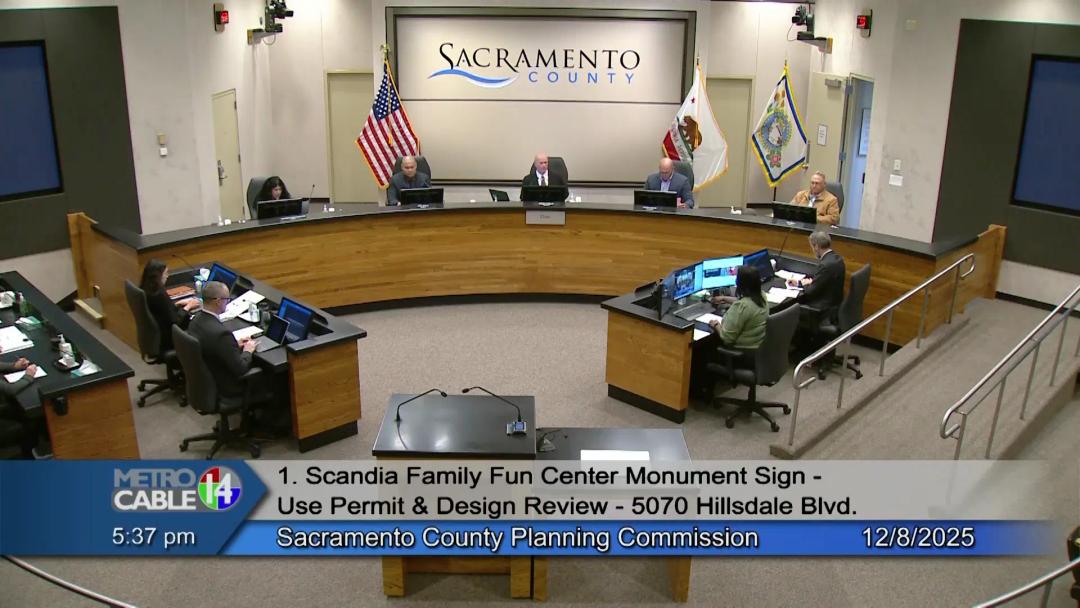
The Sacramento County Planning Commission met on Monday, December 8, 2025, and approved three non-contested land use items (sign permit/design review, a Delta parcel map, and a South Sacramento rezone/subdivision/design review) with unanimous votes. The Planning Director also provided updates on an upcoming North Watt Avenue Specific Plan effort and a Housing Element amendment. The meeting adjourned at 5:44 PM. Discussion Items - PLMP 2025-00054 — Scandia Family Fun Center Monument Sign (Use Permit & Design Review) | 5070 Hillsdale Blvd (Foothills) | Environmental: Exempt - Applicant remarks: William Ty Larson (Scandia) stated the site needs a new on-premise monument sign, described it as primarily informational (not advertising-focused), and expressed appreciation for past commission support. - Commission questions/discussion: - A commissioner asked about removal of a magnolia tree; the applicant indicated removal was necessary for the sign location and stated it would be replaced as suggested, noting the site has extensive landscaping. - Light pollution concerns previously raised at CPAC were mentioned; the applicant expressed the position that parking lot lighting is important for safety and that reducing lighting could worsen security issues. - Caltrans Outdoor Advertising Permit (ODA) question: George Selzler (Electrovision Advertising) stated the proposal is an on-premise sign, and therefore Caltrans does not have jurisdiction, even if within 660 feet of the right-of-way (ODA rules applying to billboards/off-premise signs). - PLMP 2025-00003 — Leary Road Parcel Map (Parcel Map, Special Development Permit & Design Review) | 13510 Leary Rd near Hwy 160 (Delta) | Environmental: Exempt - Applicant representative remarks: John Schmidt (Shoup Land Surveying), representing property owner Robin Brown Burroughs (absent due to medical issues), described the request as a land division with no further development proposed. He stated farming would continue on an 88-acre parcel and a 12-acre parcel would be separated for the existing house and structures (existing since 1992). - PLMP 2024-00186 — Rezone, Tentative Subdivision Map & Design Review | East of Gardner Ave and 0.2 miles south of Florin Rd (South Sacramento) | Environmental: Addendum - Applicant remarks: Mike Robertson (Baker-Williams Engineering Group, civil engineer) stated he reviewed the conditions of approval, had no questions, and was available for questions. Public Comments & Testimony - No public comments were received or provided on the three project items. - No public comments were provided for items not on the agenda. Planning Director’s Report - North Watt Avenue Specific Plan (North Highlands): Planning Director Todd Smith reported the Board of Supervisors initiated an effort (updating the North Watt Corridor Plan/Special Planning Area Ordinance) with an “aggressive” timeline due to grant constraints. Staff anticipates bringing it to the Planning Commission mid-next year (June/July 2026), aiming for Board consideration by this time next year. - Housing Element Amendment: Smith reported that, following an extensive countywide rezone program, the State Department of Housing and Community Development is requiring an amendment to incorporate rezoned properties into the Housing Element. Anticipated timeline: Planning Commission in January 2026, Board in February 2026. Key Outcomes - PLMP 2025-00054 (Scandia monument sign): Approved, unanimous (all members voting yes). - PLMP 2025-00003 (Leary Road parcel map): Approved, unanimous (all members present voting yes). - PLMP 2024-00186 (South Sacramento rezone/subdivision/design review): Approved, unanimous (all members present voting yes). - Adjournment: Meeting adjourned at 5:44 PM.
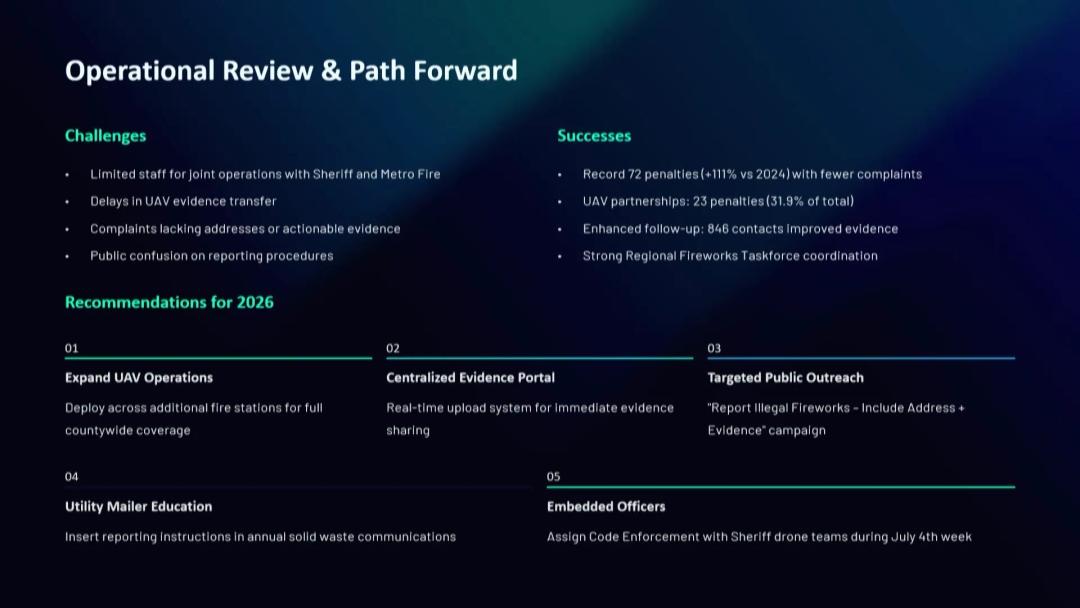
The Sacramento County Board of Supervisors met Tuesday, November 18, 2025 (morning session with timed items at 10:00 a.m.; afternoon session resumed at 2:00 p.m.). Major actions included unanimous approval of a Proposition 218 benefit-category/assessment change for the Maverik gas station project, denial of a Public Convenience or Necessity (PCN) request for an off-sale Type 21 alcohol license at “Smile Market,” presentations on the 2024 Crop & Livestock Report and 2025 fireworks after-action results, and a lengthy public hearing on the Coyote Creek Agri-Voltaic Ranch (PLMP 2021-00191), which the Board approved unanimously after extensive public testimony (Clerk reported 150 speakers at one point; Chair later referenced a cutoff with remaining names deleted). The meeting concluded with an adjournment in memory of Amy Joleen Finley (d. Nov. 3, 2025). Consent Calendar - Approved Consent Calendar items 4–44 unanimously. - Clerk notes for Item 26 (stormwater utility fees): ordinance introduced (amending County Code Ch. 15.10) with waived full reading and continued to Dec. 9, 2025 for adoption; resolutions included setting a protest hearing, approving procedures, and a resolution of intention to establish Zone 14 for stormwater O&M. - Supervisor Kennedy commented on Item 39 (removal from Carmichael Recreation and Park District Board per Resolution 2017-0010 §1.02), requesting staff review for more consistent countywide processes for removal-for-cause across boards/commissions. Public Comments & Testimony (Non-agenda) - Richie Cruz (NorCal Carpenters Union representative): raised concerns alleging “questionable business practices” by Bobo Construction, including delays/overruns, litigation, safety/labor violations, and prevailing wage issues; urged the County to reassess Bobo’s “responsible bidder” status. - AJ Albano (Decarcerate Sacramento): asserted reports from people recently released from Rio Cosumnes Correctional Center that buprenorphine/Suboxone doses were cut in half for many in custody; requested the Board place jail medication-assisted treatment protocols on the next agenda and investigate immediately. Chair requested staff follow-up; Supervisor Kennedy asked for a report. - Lisa Bates (Sacramento Steps Forward): briefed the Board on HUD’s 2025 CoC NOFO released late Thursday, with application due Jan. 14, 2026; stated funding renewal uncertainty changed from roughly 90% (past expectation) to 70% “in the hands of HUD,” and HUD priorities shifting (example: local historic emphasis 87% permanent housing now “capped” at 30%”). Chair asked for Board briefing ahead of anticipated Dec. 9 discussion about the County’s relationship with the CoC/Sacramento Steps Forward. - Public commenter (“Ms. Ram”): alleged jail intake violence; said the Exodus Project (launched July) was not providing promised housing/mental health services (claimed it now provides phones/bikes/basic resources rather than up to 3 months housing) and alleged people were not being asked about the program. Boards, Commissions, Nominations & Appointments - Multiple items were continued to future dates (Dec. 9, Dec. 16, Jan. 13) for various councils/commissions. - Notable nominations/reappointments included: - Disability Advisory Commission: reappointments recommended for Patty Gaynor and Randy Hicks; remainder continued to Jan. 13. - Local Child Care Planning & Development Council: nomination of Veronica Jones; remainder continued. - Public Health Advisory Board: nomination of Naomi Thompson; remainder continued. - Sacramento County Employees’ Retirement Board: Board nomination of Cyril Shaw. - Southeast Area CPAC: Supervisor Hume nominated Christopher Carson; remainder continued. - Vineyard Area CPAC: Supervisor Kennedy nominated J.D. Bhatia and reappointed Peter Frusche. Discussion Items County Service Area No. 1, Zone 1 — Maverik Gas Station Benefit Category Change & Increased Service Charge (Item 45, 10:00 a.m. public hearing) - Presenter: Dawn Pimentel (County Engineering). - Project: Maverik gas station at South Watt Ave & Jackson Rd; approved previously on Sept. 10, 2024 (boundary line adjustment, street abandonment, DPR, CUP, special development permit). Includes 7 vehicle fuel dispensers + canopy, 8 truck fuel dispensers + canopy, recreation dump station, convenience store. - Prop 218 process: Notice and protest ballot sent Oct. 3, 2025. - Assessment change: from “safety light only” $2.56/year to “enhanced street and safety light non-residential” about $907.68/year. - Protest ballot result: Clerk reported one ballot (Tyckert Land Company) with a “yes” vote; tabulation recorded as 0 written protests, 100% in favor, 0% opposed. - Action: Board adopted resolution confirming levy of increased service charges unanimously. Smile Market — PCN for Alcohol Sales (Type 21 ABC License) at 2950 Bradshaw Rd (Item 46) - Presenter: Irving Huerta (Associate Planner, Planning & Environmental Review). - Request: PCN for a Type 21 license (beer/wine/spirits) for an existing convenience/Korean specialty store. - Trigger: census tract “over-concentration” of liquor licenses; staff noted within 1-mile radius there were five Type 20 and five Type 21 active off-sale licenses, with some in City of Rancho Cordova. - CPAC vote: Cordova CPAC on Feb. 20, 2025 recommended denial (reported as 3 yes, 0 no, 2 absent). - Sheriff: staff reported a conditional objection from Sheriff’s Office with recommended conditions for ABC license. - Public testimony: - Chuck Shaw (Shawshank Development Company, adjacent property owner) opposed and requested denial; stated they attempted to contact applicant after CPAC meeting; expressed hope applicant would pursue Type 20 in future. - Board discussion: - Supervisor Hume questioned whether applicant could switch to Type 20 (staff: would need a new application). - Supervisor Rodriguez stated support for the business (noted “24 years” in business; said area not a high crime area; valued cultural celebration and referenced “10,000 Koreans” in the county and limited availability of soju). Asked County Counsel about precedent; counsel said decisions are case-by-case, though future applicants may cite prior approvals. - Action: Motion to uphold staff recommendation (deny) passed; Supervisor Rodriguez voted no. 2024 Sacramento County Crop & Livestock Report (Item 2) - Presenter: Chris Flores (Agricultural Commissioner). - Key statistics: - 2024 gross production value: $536,154,000 (farm gate value; excludes costs). - Top commodities included wine grapes ($167M), market milk ( $51M), pears ( $49M), poultry ( $32M), aquaculture ( $29M); almonds entered top 10 at $14M. - Walnuts: despite lower yields, quality/demand increased prices; value increased 55% vs. prior year. - Almond value: rose 42% (increased acreage, yields, price/unit). - Direct marketing: 109 certified producer certificates, 734 commodities across 927 acres. - Pesticide program (2024): 38 investigations; 79 private applicator exams; 212 restricted material permits; 381 pesticide-use inspections; 726 pest control businesses registered. - Japanese beetle: 180 beetles detected in Carmichael; county deployed 8,200 traps and serviced them 57,000 times. - Organic: 23 certified organic farms; 2,726 acres; $6.5M value. - Weights & measures: 22,000 devices tested; 2,000 price verification inspections; 126 marketplace complaints. - Pest exclusion: 5,000 shipments inspected; 183 rejected; 33 pests intercepted; 3,754 phytosanitary certificates to 67 countries. - Board Q&A: included pesticide drift complaint response protocols and glassy-winged sharpshooter monitoring (not established in Sacramento County; increased trapping near El Dorado County border). Resolution Honoring Canine Handler Michelle King and “Colonel” (Agricultural Detection Dog) on Retirement (Item 3) - Presenter: Chris Flores. - Recognition: Colonel’s 6 years of agricultural detection work; outreach role. Chair noted the program would not continue after Colonel’s retirement due to the state redirecting funds to another county. 2025 Fireworks After-Action Presentation (Item 47) - Presenters: - Amy Nygren (Fire Marshal, Sacramento Metropolitan Fire District) - Lt. Chuck Fowle (Sacramento Sheriff’s Office, North Division) - Tom McHugh (Bomb Squad/EOD Commander) - Taylor Parker (Senior Code Enforcement Officer) and Mike Sanchez (Chief of Code Enforcement) - Kim Nava (County Public Information Director) - Metro Fire (July 1–5 window; all calls, not just fireworks): - Total call volume reported with a 10% decrease vs. prior year. - Total fires reported with a 14.66% decrease. - Fireworks-related fires showed a slight increase; “Safe and Sane” category relatively consistent; “undetermined” increased. - UAV operation: 14 violations identified from one deployment location; stopped when UAV needed to support a fire incident. - Safety concern: illegal aerial fireworks used against first responders in Antelope/Orangevale; Metro Fire described situations where responders could not enter streets. - Recommendations included stronger state/federal action to deter sales/imports, ordinance amendments to allow per-incident fines, and cost-sharing of fine revenue. - Sheriff’s Office: - Noted Antelope/Orangevale activity (roughly 9:00 p.m.–11:30 p.m.) exceeded resources. - Communications center reported 3,800 total calls (up 4.6%), with fewer abandoned calls. - Major enforcement success (over multiple operations across three days): seizure of 15,000 pounds of fireworks, 145 explosive devices, and $145,000 in cash and narcotics. - Lessons learned included need for unified command and mobile field force, expanded drone use, more proactive deterrence, and potential undercover intelligence. - Concern: only 62% of 911 calls answered within 15 seconds. - Code Enforcement (County): - 774 total complaints (26% decrease from 1,052 prior year). - Penalties: 72 citations at $1,000 each ($72,000 total), up from 34 prior year. - Citations sourced from UAV evidence: 32%; 14 from fire UAV; 11 from sheriff. - 846 follow-up contacts. - Compared with other jurisdictions: City of Sacramento issued $3.0M in penalties (including three $500,000 citations related to selling from a car trunk; city estimated $400,000 collections). - Code stated County must post citations in person (not mail) under current ordinance. - PIO campaign: coordinated “Keep it safe, keep it legal” messaging starting mid-June; coverage via website, text/email to 38,000 subscribers; materials in English and Spanish (with plan to expand to county threshold languages). - Public testimony (selected themes): - Several nonprofit booth operators (churches, Knights of Columbus, youth band, mentoring/recovery programs) expressed support for continued Safe and Sane fireworks permitting and described fundraising reliance. - Residents Against Illegal Fireworks urged expanded enforcement tools and asked the County to urge a California–Nevada joint illegal fireworks task force/interstate compact. - Multiple speakers supported increased penalties, greater UAV coverage, year-round collaborative task force/working group. - Board direction/discussion: supervisors discussed increasing penalties (including stacking), staffing/overtime, public messaging, grant opportunities, improving 311 reporting/app functionality, and requested clarification on legal process for cutting off public comment sign-ups. Public Hearing: Coyote Creek Agri-Voltaic Ranch (PLMP 2021-00191) — Use Permit, Special Development Permit, Design Review; EIR (Item 48) - Timing/Process: Afternoon hearing began after 2:00 p.m. roll call. Clerk swore in speakers; Chair reported 74 speakers and growing at start; later references included 150 speakers. Two-minute time limit enforced (with occasional overruns). A coalition block was permitted up to 15 minutes. - Staff framing: Planning Director Todd Smith linked the project to the County’s adopted Climate Action Plan (about one year prior) and earlier climate emergency resolution targeting carbon neutrality by 2030. - Project (staff description): - Location: Barton Ranch area in the Cosumnes community; approx. 2,700 acres. - Proposal: 200 MW solar photovoltaic facility with 100 MW battery energy storage system; solar development area 1,357 acres. - Evolution: reduced footprint by 55 acres from the DEIR project; preserved 1,150 acres via on-site/adjacent preserve; reduced grading cut by 1 million cubic yards (44% reduction). - EIR impacts: three significant and unavoidable impacts remained—aesthetics, cumulative oak woodland loss (temporal loss), and tribal cultural resources. - Trees: staff cited removal of up to 3,493 native trees and 41.36 acres oak canopy loss; mitigation included 1:1 preservation/replanting (with additional planting commitments discussed). - Advisory votes: Cosumnes CPAC recommended approval (5–2); Planning Commission recommended approval (4–0, 1 absent). - Applicant highlights (Desri Renewables / consultants): - Desri stated it has projects in 22 states and multiple SMUD-contracted projects in Sacramento region. - Claimed property tax projections: Coyote Creek projected $67M over 20 years (of $90M across Desri’s SMUD portfolio). - Claimed project contributes about 15% of SMUD’s identified utility-scale solar need. - Conservation/mitigation: stated preservation of 13,000 oaks via conservation easements (described as a 4:1 preservation ratio vs trees impacted) and additional tree planting (acorns/seedlings) with Sacramento Tree Foundation involvement. - Prairie City SVRA: described $2.5M+ commitment for park improvements including go-kart track work, plus coordination on events and temporary trail closures during construction. - Key public positions (attribution emphasis): - Opposition themes: speakers (including tribal representatives, environmental advocates, biologists/foresters, OHV user organizations, and residents) expressed opposition based on irreversible impacts to oak woodlands and vernal pools, tribal cultural landscape impacts, aesthetics/scenic corridor impacts, alleged CEQA deficiencies (including calls for recirculation), and concerns about Prairie City SVRA operations/safety. - Support themes: speakers (including labor representatives, some nearby residents, ranching/ag advocates, business groups, and members of the Barton family/adjacent partners) expressed support emphasizing renewable energy needs, climate action alignment, economic impacts/jobs, keeping land under Williamson Act with grazing, conservation easements, and avoiding future housing development. - Board deliberation & vote: - Motion by Supervisor Rodriguez to approve staff recommendation; second by Supervisor Hume. - Supervisors Kennedy, Hume, Desmond, and Chair Serna stated their intent to support approval (each acknowledging the difficulty and tradeoffs). - Final action: Approved certification of the FEIR and adopted CEQA findings/overriding considerations and MMRP; approved entitlements unanimously (5–0). Key Outcomes - Consent Calendar (Items 4–44): Approved unanimously. - Maverik gas station CSA Zone 1 assessment change (Item 45): Approved increased annual service charge (from $2.56 to about $907.68) after one protest ballot (100% in favor); unanimous. - Smile Market PCN Type 21 (Item 46): Denied (upheld staff recommendation); passed with Supervisor Rodriguez dissenting. - 2024 Crop & Livestock Report: Received presentation; no vote. - Canine Colonel retirement resolution: Presented/recognized; no vote detail stated. - 2025 Fireworks after-action: Received multi-agency presentation; Board discussed potential ordinance changes (stacking penalties), expanded UAV use, coordinated command, grant exploration, and improved reporting tools. - Coyote Creek Agri-Voltaic Ranch (Item 48): FEIR certified; CEQA overriding considerations adopted; use permit/special development permit/design review approved 5–0. - Process directive: Chair requested a joint memo (Clerk/Counsel/CEO) clarifying the legal/procedural rules and precedent for cutting off speaker sign-ups. - Adjournment: Meeting adjourned in memory of Amy Joleen Finley (passed Nov. 3, 2025).
The Sacramento Area Sewer District (SASD) Board convened with a quorum, approved the Consent Calendar unanimously, and received a detailed quarterly update on the Harvest Water Program covering July 1–September 30, 2025 (Q3). Staff reported major construction progress (all major pipelines installed) and reviewed program financials, grant funding status, and upcoming actions. Board discussion focused heavily on risks to project success tied to grower participation, community goodwill, and implications for groundwater sustainability planning. Consent Calendar - Approved Consent Items 1–7 by unanimous vote (no items pulled; no public comment). Public Comments & Testimony - No public comments were received (including on consent items and other non-agenda matters). Discussion Items Miscellaneous District Engineer Matters - Christophe Dobson, District Engineer, noted this was the last board meeting of the year; the next meeting is January 14 and will include election of a new Chair and Vice Chair. - Dobson flagged that Item 12 would not be heard (receive-and-file only), but disclosed it involved an increase in employee benefits via a lifestyle spending account as part of a wellness program; staff already had authority to approve. Harvest Water Quarterly Report (Q3 2025: July 1–September 30, 2025) Capital program construction update (Mike Crooks, Harvest Water Capital Program Manager) - Reported eight total construction contracts to build Harvest Water infrastructure. - Pipelines: Four main pipeline packages (Elk Grove Transmission Pipeline; Franklin/Eschinger; West; Central South) totaling just over 43 miles of pipe. All pipeline is in the ground; remaining final tie-ins expected within 2–3 weeks. - Road restoration/paving: Roads affected by pipeline work were paved except certain corridors with only temporary trench paving (not final full-width). - Final full-width paving expected in spring 2026 due to weather constraints. - In the City of Elk Grove, final surface and striping on Franklin Boulevard and Willard Parkway also expected in spring 2026 (city согласла/“good with that,” per staff). - Pump station construction: Schedule challenges due primarily to fabrication/quality-control issues with out-of-state manufactured pump cans (delivered late and still creating installation difficulties). - Staff expected backfill and improved construction momentum in January–February. - A key tie-in between the pump station discharge header and the Elk Grove transmission pipeline was expected before the end of December. - Control building: Slab pour was scheduled to begin Monday the following week, with completion by the end of that week, enabling building fabrication to proceed. - On-farm connections (Phase 1): Construction began September 2025; building 56 connections on parcels south of Elk Grove. - Staff indicated Phase 1 work likely has about another year to complete. - Staff anticipated coming to the Board in January to request authorization to advertise the Phase 2 on-farm connections contract. Capital program financial snapshot (as of end of Q3 unless otherwise stated) - Construction budget: $326 million. - Spent: $205 million (stated as 63%) as of end of September 2025. - Change orders: - Allowance authority referenced at $20 million (stated as 7.3% of total construction contract values). - Approved change orders: $10 million (stated as 3.7%) as of end of November. - Projected change order rate at completion: 6.2%. - Board Q&A: - Director Kaplan asked about a higher change-order rate on one package (referenced as “WEP” in discussion). Staff attributed increases to unforeseen utilities and conditions, including a PG&E gas line deeper than design near a railroad tunneling area (leading to deeper tunneling, groundwater intrusion, and dewatering), discovery of an unexpected concrete layer under Franklin Boulevard, wet soils, and more extensive road reconstruction than anticipated. - Staff noted Sacramento County DOT contributed $5.5 million toward road improvements. - Kaplan expressed congratulations/support for the milestone that pipelines were completed. Administrative/Program Management & Outreach updates (Jofiel Borja, Environmental/Legislative/Regulatory Affairs Manager) - Outreach and agreements: - Staff emphasized expanded stakeholder engagement and one-on-one meetings. - Phase 2 deadline: December 15 for Phase 2 signing of “off-cuts” (referenced as OFCAs in the transcript). - Staff reported Phase 1 includes 56 off-cuts, representing 68% of the summer irrigation demand goal. - Phase 2 status: nine OFCAs secured through November 21; staff working to secure remaining agreements by mid-December 2025. - Staff invited growers/farmers and family members to a plant tour/meeting on December 15 to address questions about water quality and water delivery. - EcoPlan / crane pilots and public benefits: - Reported crane forage and crane roost pilots completed in Q3 with positive early indicators (birds observed using pilot sites; staff noted they were not yet the target sandhill cranes due to season timing). - Staff stated that under public benefit agreements, each sandhill crane can be “upwards to $90,000” in grant reimbursement value, and the program committed to the state to add 700 individuals over the life of the program. - Multiple landowners expressed interest in riparian and wetland management options. - Groundwater monitoring (public benefits requirements): - Continued monitoring at 8 existing wells to establish baseline before water delivery. - Installed four new wells at two individual sites and one nested site on the west side of the service area. - Planned 8–10 additional wells near the center/east of the service area, targeted for completion in first half of 2026 (weather permitting). - Funding status and grants: - Amendment 1 with the California Water Commission increased the total award to just shy of $306.5 million. - Staff reported submitting $50 million in invoices in October/November and receiving close to $100 million from the state under WSIP. - Staff stated Valley Water withdrew the Pacheco Reservoir project from WSIP in September, potentially freeing close to $560 million for reallocation; Harvest Water is now one of five remaining Proposition 1 WSIP projects and (per staff) the one making the most construction progress. - Staff also referenced an unfunded $15 million recycled water program grant still in drafting, and hope to secure another close to $15 million in additional Proposition-related funding. - Overall program funding gap (as presented): - Potential funding to date: $416 million. - Total program funding need: $597.2 million. - Staff objective: close the gap via construction savings and additional external funding. - Staff noted an APMO budget of $120 million with $17.6 million spent through Q3. - Upcoming board actions (anticipated in Q1): - Customer reimbursement framework for on-farm improvements. - Potential CPMO consultant amendment services during construction. - EcoPlan procurement activities to implement benefits. Board Deliberation: Grower participation risk, community impacts, and governance - Director Hume questioned whether Phase 2 participation is necessary to meet promised deliveries and received confirmation that Phase 1 covers 68% and remaining needs depend on Phase 2 participation. He pressed for a numeric goal; staff indicated the program needs more than a dozen / about two dozen additional sign-ups to meet the water demand target (with nine secured to date). - Hume issued a strong warning that the project is at an “inflection point,” stating constituents/farmers are experiencing construction-related impacts (e.g., damaged driveways, tires, windshields, and business disruption) and that goodwill is being exhausted. He emphasized that growers do not need the recycled water because they have wells, and they may be unwilling to provide habitat benefits without trust and partnership. He also connected participation progress to competitiveness for remaining state funding. - Director Dickinson asked about the project’s role in the region’s Groundwater Sustainability Plan (GSP). Staff stated Harvest Water is a key part of assumptions for achieving sustainability and agreed it is crucial to meeting GSP outcomes, though they did not provide specific percentage contributions during the meeting and committed to follow up. - Dickinson emphasized that landowners should understand participation is tied to broader GSP compliance and potential consequences if sustainability targets are not met. - Director Suen proposed forming a board subcommittee to focus on farmer concerns so that Hume is not the sole board member hearing constituent feedback. Staff/Chair indicated the subcommittee would need to be agendized for a future meeting. - Director Desmond volunteered to participate in the subcommittee and offered to join constituent meetings, emphasizing that loss of goodwill among intended users/landowners could jeopardize the project. - The Chair summarized that concerns raised—especially those affecting South County—would be addressed and that the subcommittee item would return in January. Key Outcomes - Consent Items 1–7 approved unanimously. - Harvest Water Q3 report received (presentation and board discussion; no public testimony). - Direction/next steps (no formal vote recorded): - Staff to bring back an agendized item in January regarding creation of a board subcommittee to address farmer/community concerns related to Harvest Water construction and participation. - Staff to follow up on Harvest Water’s specific contribution assumptions within the relevant Groundwater Sustainability Plan (percent/quantification not provided during the meeting). - Upcoming meeting milestone: January 14 board meeting to include Chair/Vice Chair elections.
The SacRT Board met in December 2025 (recorded for Metro Cable Channel 14 and online streaming) with a quorum reported as requiring 8 votes. The Board first held a closed session regarding real estate negotiations, then approved a multi-item Consent Calendar, received customer service updates addressing rider feedback (including accessibility and safety barriers), reviewed the FY2025 audited financial results (clean audit; surplus added to reserves), and took action on intent motions for 2026 Chair and Vice Chair leadership. Public commenters—many identifying with Strong SacTown—repeatedly emphasized needs for improved frequency, evening/Sunday service, reliability, and real-time information, while accessibility advocates raised concerns about ADA usability beyond baseline compliance. Closed Session - Reordered agenda to hear Item 11.1 first: Conference with real estate negotiator (Gov. Code §54956.8; multiple properties/APNs referenced). - Outcome: Board returned with no report out. Consent Calendar - Approved Consent Calendar Items 2.1–2.15 (motion/second; passed unanimously by voice vote). - Item 2.15 discussion: staff described a procurement/contract issue involving an automatic renewal (“evergreen”) provision and a retroactive ratification need because the provision exceeded delegated signing authority. Staff stated the vendor had no objection to removing the evergreen provision; future approval would come to the Board. Public Comments & Testimony - Board meeting schedule / access (Item 2.2): Glenn Mandelkern supported proposed scheduling changes and requested the Board announce the next meeting date at adjournment due to the lack of a predictable pattern; he also asked the Board to consider reinstating a virtual option for public participation. - Employee benefits equity (Item 2.4): Helen O’Connell raised concerns about inequality in healthcare/welfare benefits across divisions (big bus, train, and RT GO), stating that “worker bees” should receive comparable benefits. - Operator restroom access (Item 2.7): Helen O’Connell supported expanding restroom-access agreements so operators are not forced to wait extended periods. - Paratransit contract bridge (Item 2.9): Helen O’Connell supported a contract extension intended to bridge service until a new contract is implemented, and urged consistent guidelines and accountability for performance. - Train control/safety (Item 2.10): Helen O’Connell supported automatic train protection / communications-based control improvements and suggested contingency planning such as bus bridges during rail disruptions. - Streetcar project concerns (Item 2.13): - Farah Mars Nabavi acknowledged staff’s prompt response to an FTA notice warning of possible discontinuation of federal drawdowns, and urged the Board to pull the item from consent and debate whether to proceed given risk, operating costs, and staff time/opportunity costs. - Bassam Ibrahim (Strong SacTown) expressed opposition/concern that the streetcar is “small but expensive” and argued resources should prioritize frequency and night service. - (Staff/Director comment) Director Kennedy requested staff engage public commenters to explain that certain federal funds are not easily reprogrammable between projects. - Technology/system reliability (Item 2.15): Glenn Mandelkern described observed issues with bus-tracking and stop information (including a reported “828 timeout” on Nov. 29 and a stop reportedly shown as nonexistent), and expressed concern about potential database corruption, water damage, or cyber issues. Discussion Items Customer Service Response to Feedback (Item 3.1) - Presenter: Lisa Hines, VP of Security, Safety, and Customer Satisfaction. - Language access: Customer service communicates in English but connects callers to AvantPage interpretation (24/7; 150+ languages; connection typically <30 seconds). Title VI Language Assistance Plan stated as current and compliant. - Train door/ramp timing: Dwell time described as roughly 20 seconds. When ramp deployment is prioritized, a delay in door function may occur for safety. SacRT added decals and is testing a software update on two trains, with an expected fleet-wide rollout by end of December. - Bus operator barriers: Staff stated barriers were purchased under an earlier Board-declared emergency due to increased assaults. Barriers installed on 77 buses; SacRT plans to install barriers on the full fixed-route fleet. Staff stated the barrier meets ADA regulatory requirements; a reported conflict involved a mobility device larger than what buses are required to accommodate under ADA standards. - Power Inn Station adjacent parcel / TOD: SacRT described constraints tied to zero-emission bus (ZEB) facility requirements and a facilities transition plan for 250+ big buses and 200 shuttles. A 13-acre Power Inn site was identified for potential future bus facility use; SacRT suggested it may be possible to scale operations footprint and accommodate 5–6 acres for transit-oriented development (TOD) in the future. Public testimony on Item 3.1 (accessibility and process): - Helen O’Connell argued ADA compliance is not the same as ADA usability and emphasized consulting the Mobility Advisory Council (MAC) earlier in procurement/design. - Dan Allison (Sacramento Transit Advocates and Riders, STAR) supported accessibility concerns about driver barriers and criticized what he described as a pattern of insufficient pre-purchase evaluation; he cited ongoing accessibility issues with low-floor railcars. Public Address to the Board (Non-Agenda Items) - Multiple commenters (many identifying with Strong SacTown) described barriers to using SacRT, most frequently citing: - Long headways (30–60 minutes), especially evenings and weekends. - Sunday frequency (claims of 45 minutes to an hour waits; comments that some routes are 60 minutes Sundays vs. 30 minutes weekdays). - Reliability/on-time performance and missed connections (examples included missing a bus by minutes leading to an hour wait; light rail delays described as up to 45 minutes). - Requests for real-time information for light rail (GTFS-RT), and mention that CalITP offers free/procurement assistance that commenters said is available only through the end of the year. - Requests for expanded coverage (including to Elk Grove on Sundays and to major corridors between population centers). - Paratransit and accessibility: - Jeffrey Tardeguia and Helen O’Connell raised concerns about paratransit pickup/drop-off timing for dialysis and medical appointments, characterizing long waits as potential health risks. - Riders described accessibility challenges with low-floor train ramps and boarding/alighting. - Some commenters expressed appreciation for staff communication on router/cancellation issues and for the existence of the transit network, while still urging major service improvements. Annual Comprehensive Financial Report (Item 5.1) - Presenter: Jason Johnson, VP of Finance/CFO; audit performed by Crow LLP. - Audit opinion: Unqualified (“clean”). - Track record: 6th consecutive year with no audit findings. - FY ended June 30, 2025 results: Revenues exceeded expenditures by $950,000. - Reserves: Surplus to be added to operating reserve, bringing reserve balance to $40 million, stated to cover approximately 60 days of operating expenditures and to fulfill the operating reserve requirement. - Staff noted ongoing future operating funding challenges and stated an updated long-term fiscal forecast would be provided early next year. Board Leadership Intentions for 2026 (Item 5.2) - Action type: Intent motion(s) in advance of January seating, with discussion that bylaws allow (but do not require) two consecutive terms, while statute requires selecting a chair each year. - Substitute motion (to continue item): Motion to continue the item to the next meeting (to allow discussion with Chair Jennings, who was absent). - Vote (roll call): Brewer No; Budge No; Dickinson Aye; Hume No; Kennedy Aye; Schaefer No; Serna No; Chair Singh Allen Abstain; (Maple and Jennings absent). - Outcome: Failed. - Original motion (Chair intention): Intent to select Chair Singh Allen as Chair for 2026. - Vote (roll call): Brewer Yes; Budge Yes; Hume Aye; Kennedy Aye; Rorba Yes; Schaefer Aye; (Dickinson vote not clearly captured in transcript); Serna not clearly captured; Chair Singh Allen Abstain; (Maple and Jennings absent). - Outcome: Motion passed per the meeting discussion, though the transcript contains unclear/incomplete roll-call capture for a few directors. - Vice Chair intention: Motion to select Director Hume as Vice Chair (noted as typically a county representative). - Vote: Approved by voice vote (no tally stated). - Directors offered remarks thanking Chair Rick Jennings for leadership during the prior year and noting the value of regional representation. General Manager’s Report - Presenter: Henry Li, General Manager/CEO. - Emergency exercise drill: Two scenarios described: 1) Bus displaying “call 911” on headsign; response using onboard cameras and GPS. 2) Trespassers in a light rail facility; response using thermal imaging and AI drone technology; CEO stated SacRT had FAA permission and described it as a first for a non-law-enforcement agency. - Mystery Rider program: Through September 2025, 159 evaluations (about 25 per month) with an average score of 91.57%, stated as consistent with the agency scorecard. - Conference participation: CEO thanked Directors Hume and Schaefer for representing SacRT at APTA (Boston; 10,000 attendees). - Grants: - Reported a new federal award of $39.7 million to replace 49 aging buses; described as 3rd largest in California and largest in the nation for that category, and that <2% of agencies receive such grants. - Affordable Housing & Sustainable Communities (AHSC) / related program: CEO stated the region sought awards totaling $126 million out of $800 million statewide, and that SacRT-related partnerships received $25.8 million across 4 applications with 3 awarded. Key Outcomes - Closed session held first by approval; no report out. - Consent Calendar Items 2.1–2.15 approved (unanimous voice vote). - FY2025 audit accepted as an information item: clean audit, $950,000 surplus, operating reserve increased to $40 million (60 days). - Board intent actions for 2026 leadership: - Substitute motion to continue leadership item failed (roll call). - Intent to select Chair Singh Allen as 2026 Chair passed (roll call; transcript includes some unclear roll-call entries). - Intent to select Director Hume as 2026 Vice Chair approved by voice vote. - Major themes elevated for future work (from public testimony and CEO remarks): service frequency/coverage (especially evenings and Sundays), reliability, accessibility usability, and real-time information for light rail.
The Sacramento Metropolitan Cable Television Commission convened a regular meeting (date and start/end times not stated in the transcript), opened with roll call and the Pledge of Allegiance, heard one off-agenda public comment regarding delivery of a commission-initiated TV series, approved the 2026 meeting calendar, recognized an employee’s 10-year service milestone by resolution, approved an eighth amendment to a closed captioning agreement, and adjourned after a closed session with no reportable action. Public Comments & Testimony - Shira Lane (Atrium 916, creative innovation center for sustainability) stated that Atrium 916 delivered all six episodes of a TV series, "Citizens of Planet Earth," which she said was a project initiated by the Cable Commission to help local creatives. She expressed excitement to share the series, said they were proud of the project, and stated it reflects local creatives positively and reflects the County’s waste diversion efforts. She said she was available for questions and looked forward to working with PEG channels on promotion. Discussion Items - Item 2: Adopt 2026 Commission meeting calendar - Approved by roll call vote: all members present voted yes. - Tenure/Recognition Resolution: Mary Tau Anacleto (10-year milestone) - The Commission recognized Mary Tau Anacleto for 10 years of service (described as the Commission’s second longest-serving employee). - Highlights read into the record included: began as a temporary Senior Office Assistant (April 2014); became full-time Senior Office Assistant (November 2015); responsibilities cited included reconciling PEG grant reimbursements to channels and member agencies, fiscal/budget administration (reports/logs/compliance), and ensuring payroll/benefits processing accuracy; and mentoring/training staff. - Mary Tau Anacleto gave remarks expressing gratitude to God, the Commission, colleagues, and leadership, and reflected on lessons learned over 10 years (patience, collaboration, adaptability) and appreciation for support from past and present leadership. - The recognition resolution was adopted by roll call vote: members present voted yes (note: the transcript indicates Member McCarty stepped out during this portion). - Item 3: Resolution approving the eighth amendment to closed captioning agreement with Aberdeen - Approved by roll call vote: all members present voted yes. - Item 5: Closed session - The Commission recessed to closed session and later reconvened. Key Outcomes - Approved the 2026 Sacramento Metropolitan Cable Television Commission meeting calendar (unanimous among members present). - Adopted a tenure/recognition resolution honoring Mary Tau Anacleto for 10 years of service. - Adopted a resolution approving the eighth amendment to the closed captioning agreement with Aberdeen. - Closed session report: No reportable action. - The meeting was adjourned by roll call vote (members present voted yes).
The First Five Sacramento Commission met on Monday, December 1, 2025 (afternoon session; exact adjournment time not stated). The Commission approved prior meeting records, received committee updates, held two public hearings (FY 2024–25 audit and annual report), updated its contractor advance payment policy, and appointed a 2026 Vice Chair. Major informational items included Equity in Action funding activity (400+ letters of interest and a December 13 decision meeting), a countywide CalFresh disruption affecting tens of thousands of children, and commissioner discussion about impacts of federal immigration enforcement on local agencies. Consent Calendar - Approved the October 6, 2025 Draft Action Summary (roll call vote 7-0: Serna, Wesley, Fernandez-y-Garcia, Gordon, Casirier, Boston, Moak). Public Comments & Testimony - Crystal Harding (Sacramento PLTI; identified as District 3/Supervisor Desmond’s district) promoted Sacramento PLTI recruitment for English and Spanish-language cohorts beginning January 10, 2026, and encouraged the public to follow @SacramentoPLTI (Instagram/Facebook) and apply via sacramentoplti.com. She also referenced a “Soul Family Ball” on October 26 and described increased social media engagement efforts. Discussion Items - Executive Director’s Report (Julie [Executive Director]) - Racial equity / Equity in Action updates: - Reported 400+ responses to letters of interest. - Committee review led to 61 entities invited to apply for funding (speaker also referenced “70 or so” earlier in the same update). - Total requests were stated as $62 million, with $4.2 million available to distribute. - The Equity in Action Committee planned to meet December 13, 2025 for final decisions to bring to the Commission in January for approval. - Topic areas referenced: individual family needs/concrete supports; group presentations/activities/community building; systems improvement; parent leadership/engagement. - CalFresh benefits disruption: - Reported scope in Sacramento County: 270,000 individuals and 90,000 children impacted/served by CalFresh. - Noted partner response (Family Resource Centers, Child Action, and others). - Reported Health Net donated $30,000 to six local food banks. - Stated the county is “apparently safe until September 2026,” then uncertainty resumes. - Commissioner recognition: - Noted Commissioner Fernandez-y-Garcia received the Council on Community Pediatrics Local Hero Award (American Academy of Pediatrics) and was described as the first UC Davis Health pediatrician to receive it. - Described a system change at the Sacramento County Health Center: families with young children receive referrals on after-visit forms to their neighborhood Family Resource Center (FRC) and to Sac Family Connect. - PLTI alumni chapter: Partner Sac Children’s Home created a PLTI alumni chapter; 75 parent leaders have graduated in recent years. - Data system replacement planning: Staff plans to request authority in the new year to bid a new data management system; current system (Persimmony) has been used for 15 years and is described as outgrown, with security/functionality concerns. - Potter the Otter exhibit (Sacramento Children’s Museum): Two additional free days noted (December 2, 2025 and January 15, 2026). Reported 1,000 children attended across the three free days held so far. - Staffing update: Introduced new Human Services Program Specialist Sharon Watts (in role for 2 weeks), described as a former Coro Northern California policy fellow and certified doula. - Committee Updates - Advisory Committee (reported as Oct. 10, 2025 update): Committee did not meet in October; next scheduled meeting February 13 (year not stated, presumably 2026). - Evaluation Committee (November 17, 2025): Discussed annual report to First 5 California and database needs; staff to issue letter of interest in early 2026, followed by an RFQ in late winter; next meeting January 26, 2026. - Financial Planning Committee (November 13, 2025): - Staffing: previously vacant Administrative Services Officer I and Human Services Program Specialist positions filled; recruiting for Senior Office Assistant. - Reported current vacancy rate: 7.1%. - FY 2024–25 audit issued October 30, 2025; committee voted to approve; no findings. - Described enhanced fiscal oversight for Equity in Action contracts (e.g., flexible insurance pathways, contract funds for independent audits/financial admin, indirect rate up to 15%, fiscal risk assessments, possible fiscal agent). - Committee reviewed and approved revised advance payment policy (presented later as Item 10). - Systems Optimization & Sustainability Committee (October 22, 2025): Discussed state bills affecting early care and education workforce (including immigration-related bills), Equity in Action Ready grant, and SNAP impacts; received presentations from SCOE representatives about Help Me Grow and mental health supports in schools and child care; next meeting December 17 (year not stated). Public Hearing: FY 2024–25 Financial Audit (Item 8) - Staff reported audit completed by Macias, Gini & O’Connell LLP (MGO); tested 24 compliance procedures and found the Commission in compliance. - Russell Robertson (Assurance Director, MGO) reported: - Issued an unqualified opinion (highest level of assurance). - Noted a slight decrease in net assets/revenue attributed to expected Prop 10 revenue changes while maintaining strategic plan commitments. - Noted adoption of GASB 101 on compensated absences requiring sick leave liabilities; included a $190,000 restatement (described as non-material). - Reported no disagreements with management and no material adjustments. - Public hearing opened/closed with no public speakers. - Adopted the FY 2024–25 financial audit (roll call vote 7-0). Public Hearing: FY 2024–25 Annual Report (Item 9) - Carmen Garcia Gomez (Evaluation Manager) presented the annual report submitted to First 5 California in early November 2025 (required by November 1; submission delayed due to audit timing, as the audit and annual report are submitted together). - Report structure described as AR1 (fiscal), AR2 (demographics), AR3 (evaluation/highlights). - Key figures reported: - FY 2024–25 expenditures: $19.2 million, a reduction of about 10%, attributed to Equity in Action contracts not launching during that fiscal year. - FY end fund balance: $17.1 million. - People served: 14,171 parents, children, and providers; a 34% reduction (again attributed to delayed contract launches and a strategic shift toward systems-improvement strategies). - AR3 highlights included findings from FY 2023–24 and a profile of launching the Equity in Action Initiative. - Public hearing opened/closed with no public speakers. - Adopted the FY 2024–25 annual report (roll call vote 7-0). Approval: Revised Advance Payment Policy to Contractors (Item 10) - Staff requested approval to update the advance payment policy first created in 2001. - Changes approved: - Increase standard contract advance threshold from 20% to 25% of annual allocation (to align with county-level standards). - Allow Equity in Action contracts to request advances up to 50% of annual allocation to support smaller/new community-based organizations. - Staff emphasized enhanced monitoring and repayment through monthly invoicing/withholding to reconcile by year-end. - Commissioner Hassett emphasized advances require justification and that reimbursement-based grants can burden smaller organizations. - Adopted revised policy (roll call vote 7-0). Appointment: 2026 Vice Chair (Item 11) - Nominated: Commissioner Guerra (nomination by Commissioner Hassett). - Commissioners Moak and Chair Serna offered remarks recognizing Commissioner Hassett’s long tenure and leadership as Vice Chair. - Appointed Commissioner Guerra as 2026 Vice Chair (roll call vote 7-0). Commissioner Guerra thanked Commissioner Hassett and referenced his child attending the Potter the Otter exhibit. Commission Member Comments - Commissioner Gordon (SCOE Superintendent) stated federal immigration enforcement actions are impacting his agency, reporting that on Friday, November 28, 2025, a SCOE staff member was detained by ICE while leaving home; he stated the agency had not been able to confirm her location/status since, despite work authorization documentation and attorney action. - Chair Serna responded with concern, referencing a prior visit with Council Member Guerra and Congresswoman Doris Matsui to the Moss Federal Building intake space and emphasized due process concerns. - Vice Chair–Elect Guerra referenced the SAC Fuel Network (sacfuelnetwork.org) as a legal assistance resource and thanked Chair Serna for helping establish the Joe Serna Jr. Immigration Defense Fund. - Commissioner Wesley noted First 5 California’s “Children First” campaign, describing $10 million available related to immigration, with 30% intended for local efforts, and suggested exploring an application. Key Outcomes - Approved October 6, 2025 draft action summary (7-0). - Adopted FY 2024–25 financial audit (MGO; unqualified opinion; 24 compliance procedures tested; $190,000 GASB 101 restatement; no findings) (7-0). - Adopted FY 2024–25 annual report (expenditures $19.2M; fund balance $17.1M; 14,171 served; noted 10% spending and 34% service reductions tied to delayed contract launches and systems-improvement pivot) (7-0). - Approved revised contractor advance payment policy: 25% standard / 50% Equity in Action (7-0). - Appointed Commissioner Guerra as 2026 Vice Chair (7-0). - Noted upcoming dates: Equity in Action Committee December 13, 2025; Systems Optimization & Sustainability Committee December 17; Evaluation Committee January 26, 2026; Advisory Committee February 13.
SAFCA convened its November 2025 board meeting with an 11-member quorum. The meeting was live-streamed on Metro 14 (Metro14live.satcounty.gov), scheduled for re-air on Saturday, November 22 at 3:00 p.m., and was to be posted to SAFCA’s website within 48 hours. The Board heard no public comment on non-agenda items, approved the consent calendar, received an Executive Director’s federal funding and operations update (including the Natomas Basin project), and adjourned with the next meeting set for January 15, 2026. Consent Calendar - Approved Items 1–14 in a single motion, with no items pulled and no public comment. - Director Kaplan stated for the record that Item 4 (regarding Natomas Levee Improvement Projects) involved a land swap that had been worked out with the Natomas Basin Habitat Conservancy, and he expressed that there was “no concern” about the issue as handled. Public Comments & Testimony - No public comments were received or offered on items not on the agenda. Discussion Items - Executive Director’s Report (Jason Campbell, Executive Director) - Reported that a federal continuing resolution was in place, allowing federal operations to continue and enabling progress toward budget activity. - Stated that the House Appropriations Energy and Water Development bill included provisions beneficial to SAFCA projects (including Natomas), while the Senate had not yet adopted its version. - Noted that the bill identified the U.S. Army Corps of Engineers work plan as included, and SAFCA was hoping to secure additional funding for the Natomas project in Fiscal Year 2026 or Fiscal Year 2027. - Characterized the Natomas Basin as the only currently operating project expected to need additional funding in the foreseeable future; absent funding, SAFCA would need to ensure progress in FY 2027. - Announced planned meetings in Washington, D.C., December 1–4, with committees, members, and Corps headquarters to advocate for continued movement to “finish” Natomas. - Described a “hot demolition” (controlled burn) near the Sankey Road area: a SAFCA-purchased house slated for demolition was used for a controlled burn training with fire academy students. - Reported that Pleasant Grove Fire Academy collaborated with other fire departments. - Stated UC Davis indicated this was the first time in 20 years their cadets participated in an active structure fire training scenario. - Referenced that the Board had adopted cancellation of the December meeting and closed with holiday greetings. Key Outcomes - Consent Calendar (Items 1–14) approved by voice vote (motion, second; Ayes heard; no opposition/abstentions stated). - December meeting cancellation referenced as adopted (details/vote not stated in the transcript segment). - Next meeting scheduled: January 15, 2026. - Meeting adjourned following the Executive Director’s report and confirmation of no public comment.
The Sacramento Area Sewer District (SacSewer) Board met on November 12, 2025 (morning meeting; exact start/end times not stated) with a quorum present. The board approved routine consent items, received updates on end-of-year scheduling, approved revised employee benefits documents for multiple employee groups, and received presentations on a pollinator habitat pilot project at a pump station site and on SacSewer’s Operations Challenge competition team performance and training value. Consent Calendar - Approved Items 1–6 (no public comment). Motion and second; approved unanimously with members present. - Clerk noted Director Dickinson arrived and was marked present prior to the vote. Public Comments & Testimony - No public comments were received on consent items. - No public comments were received on non-agenda items (no speaker request slips submitted). Discussion Items - Miscellaneous District Engineer Matters (Christoph Dobson, District Engineer) - Announced there would be no second meeting in November. - Noted one meeting remaining for calendar year 2025, scheduled for December 10, 2025. - Revised Employee Benefits Documents for Employee Groups 4, 6, and 9 (Christoph Dobson presenting; referenced Matt Doyle, Director of Internal Services) - Staff described this as the final step to “lock in” salary/benefit structures for unrepresented employees, using the same compensation study approach previously applied to represented employees. - Compensation target stated as the median of the market, with attention to appropriate classification “spreads” to avoid compaction. - Noted use of a third-party review for human resources classifications and the executive team due to internal involvement in the compensation process. - Motion and second to approve the staff recommendation (vote tally not verbally stated in the transcript). Hovnanian Drive Pump Station Pollinator Project (Pilot) - Presenter: Carolyn Belaz, Environmental Sustainability Coordinator, SacSewer. - Project drivers and purpose (project description): - Aligns with environmental stewardship and SacSewer’s environmental sustainability program. - Converts high-water-use landscaping to drought-tolerant, low-maintenance California native plants. - Enhances pollinator habitat and aims to conserve water by reducing demand and minimizing site runoff. - Site selection (project description): - Hovnanian Drive Pump Station, Natomas, adjacent to Blackbird Park and a community garden. - Selected in part because the site already had water available for the landscaping area (many sites do not). - Staff coordinated with the Four Seasons at West Shore HOA, including adding a contact number on the sign for reporting issues. - Design concept (project description): Four planting “swaths” - Habitat hedgerow (shrubs/trees; shelter and some nectar) - Nectar bank (perennial nectar sources intended to support pollinators year-round) - Oil and resin resource (plants providing oils/resins used by some native ground-nesting bees) - Grassland buffer (grasses for cover/shelter; included deer grass) - Installation/observations (project description): - Landscaping replacement addressed prior conditions described as vines/weeds and overgrowth. - Photos referenced at 40 days and 120 days after installation showing maturation; presenter highlighted California fuchsia as highly attractive to bees. - Presenter stated installation occurred at the end of June 2025, and that early monitoring already showed significant pollinator activity. - Signage and public education (project description): - A 24" x 32" metal sign scheduled to be installed on the 20th (month not explicitly stated, context suggests November 2025). - Sign includes pollinator facts, descriptions of the swaths, a QR code linking to a SacSewer webpage, and a contact number for site issues. - Success metrics (project description): - Site health/appearance, pollinator abundance and diversity, plant-pollinator associations observed, and general foot traffic. - Public interest tracked via QR code scans and webpage visits. - Board discussion / positions (speaker positions): - Director Kaplan expressed appreciation for piloting the project in her district, emphasized the value of coordination with the HOA, and expressed enthusiasm about benefits including water conservation and potential pollination support for the adjacent community garden. - A board member asked where bees go after visiting; presenter explained the project seeks to attract both honeybees and native bees, which may forage in nearby gardens and may nest locally. - Director Sander raised concerns about long-term maintenance (noting examples where native landscaping is installed and later neglected) and asked about maintenance/replacement standards. - Presenter responded that the site is on the landscapers’ maintenance list and will be monitored; during the first year it is under the installing landscaper’s maintenance, and after that it transitions to SacSewer’s ongoing facility landscaping maintenance. - Presenter stated the first-year maintenance period would run through June 2026, and that long-term replacement standards are still being determined because this is a pilot. Operations Challenge Team Presentation - Presenters: Christoph Dobson (District Engineer) and David Lehmer (Maintenance & Operations Assistant Superintendent; team coach). - Program overview (project description): - The Water Environment Federation (WEF) Operations Challenge began in 1988 and is framed as professional development “wrapped up in a competition,” emphasizing teamwork, task sequencing, efficiency, and safety. - Events described: collections, laboratory, maintenance, process control, and safety. - Divisions described: - Division III for new teams (typically 3 years to move up unless top-3 overall) - Division II (advance to Division I by placing top-3 overall) - Division I described as the highest level. - SacSewer team history and 2025 results (statistics): - SacSewer previously competed from 1988–2008, spending most years in Division I. - Team restarted in Division III in 2024. - 2025 preparation events (not separated by division at those events): - May: placed 7th of 8 teams overall; earned 3rd in the maintenance event. - July: placed 5th of 6 teams overall; earned 2nd in the pump event against a field including a returning national champion. - Nationals in Chicago: placed 4th overall out of 28 teams in their division; 1st in the maintenance event. - Presenter stated their performance would have equated to 2nd in Division II and 3rd in Division I. - Team members identified: Nate Fuwa (Senior Wastewater Treatment Plant Operator; national event captain), Gabe Avalos (Maintenance & Operations Technician, collections), Efren Gutierrez (Treatment Plant Operator II), Chris Ticker (Maintenance & Operations Technician, collections), Wendell Duncan (Underground Construction & Maintenance Supervisor; prior captain who was injured mid-year), and David Lehmer (coach). - Board discussion / positions (speaker positions): - A director asked about lack of lab staff on the lab event; presenter confirmed no laboratory personnel are on the team, emphasizing cross-training. - Presenter described challenges with process control questions reflecting different regional practices. - Discussion included how team membership was initially volunteer-based; presenter said future tryouts/rotation may occur as interest grows. - Director Suen commended the team for pride in their craft and representing SacSewer and the region. Key Outcomes - Consent Calendar (Items 1–6): Approved unanimously (members present). - Revised employee benefits documents (Groups 4, 6, and 9): Motion and second to approve staff recommendation (vote count not stated in transcript). - Pollinator pilot project: Received presentation; next step stated as installing site signage on the 20th and continuing monitoring using defined metrics; pilot intended to inform possible expansion to other facilities. - Operations Challenge team: Board received performance report; leadership invited directors to observe practices to better understand the training/effort involved. - Adjournment: Meeting concluded after miscellaneous director matters with a motion/consensus to receive and file and adjourn (formal vote tally not stated).