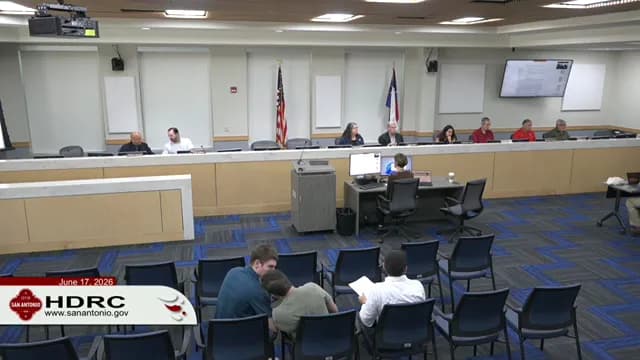
The Historic and Design Review Commission (HDRC) convened on Wednesday, June 17, 2026, at 3:00 PM to consider several items including a street name change, a new mixed-use development, a temporary ramp, and new residential construction. The commission heard staff presentations, discussed design concerns, and voted on recommendations. The meeting was adjourned after all agenda items were addressed. Consent Calendar - Minutes from the June 3, 2026, meeting were approved unanimously. - Consent agenda items 4, 5, 6, and 7 were approved unanimously with staff stipulations. These items included addresses at 2484 Gillingham Drive, 741 West Ashby Place, 112 Armor, and 231 Bryan Boulevard. Discussion Items - Item 1 – Street Name Change from Cesar Chavez Boulevard to Durango Boulevard - Clayton Wallace (Development Services) presented the proposal, which would rename a 295-address stretch from Southwest 36th Street to South Hackberry Street, affecting 412 property owners and eight neighborhood associations. Estimated cost: $305,200. Community listening sessions were held in April, the Governance Committee recommended proceeding on May 20, and Planning Commission review is scheduled for June 24 with City Council tentatively in August. - Commissioner Velasquez spoke against the motion, noting his prior role in naming the street for Cesar Chavez and arguing the change missed an opportunity to honor a Mexican American leader such as Hector P. Garcia or Gus Garcia. He stated the name change should be for a person, not a place name like Durango. He also noted that no one is renaming streets named after Thomas Jefferson or Andrew Jackson. - The motion to approve with staff stipulations carried 8–1 (Commissioner Velasquez opposed). - Item 2 – New Development with Circulation Connector Cladding - Staff recommended approval with stipulations, including consideration of alternative materials for the circulation connector cladding to reduce perceived massing. The applicant (Francisco and Aubrey, from Mariside) indicated they were evaluating metal panels or other options and would return to staff. - Commissioner Savino raised concerns about massing and requested a protection plan for the adjacent historic Hertzburg clock. The applicant agreed to provide a protection plan and add signage at a new ramp indicating it does not reach the River Walk. The motion was amended to require the material selection for the cladding to return to the commission for final approval. The motion carried unanimously. - Item 3 – 405 Club Ramp - The applicant (Seth Wilcoxon) was not present. Staff noted a temporary ramp had been administratively approved but a permanent ramp requires a public hearing. Commissioner Mazuka moved to postpone the item to the next meeting, which was seconded and carried unanimously. The existing temporary ramp remains in place pending the hearing. - Item 8 – New Residential Construction at 731 North Paul Meadow - The applicant (Octavio Villamontes) proposed two single-family houses on a vacant lot: one facing Burnett Street and one facing North Paul Meadow. Staff recommended approval of the North Paul Meadow structure with stipulations (porch railing, window specifications, tapering profile, mechanical screening) but did not recommend approval of the Burnett Street structure due to massing inconsistency with the historic district. The applicant had reduced frontage to 50 feet and modified the layout to an L-shape. - Commissioners discussed window styles, porch railings, massing, and the roof height. Commissioner Grew made a motion for conceptual approval on both structures with all staff stipulations. The motion carried unanimously. Commissioners suggested further work via a Design Review Committee (DRC) to refine details. Key Outcomes - Item 1: Approved 8–1 (recommendation to Planning Commission and City Council). - Item 2: Approved unanimously with amended stipulation requiring commission review of cladding materials. - Item 3: Postponed to next meeting (unanimous). - Item 8: Approved unanimously (conceptual with stipulations) for both structures. - Consent agenda items 4–7 approved unanimously. - Certificates of appropriateness and commission action letters will be emailed within 10 days for approved items.
Public Meetings - San Antonio, Texas
Public Meetings - San Antonio, TexasThis regular city council meeting addressed three community council requests (CCRs): rezoning of the Stone Ridge area, street designation in honor of Erika Andrews, and creation of a task force for safe housing and public safety. The meeting included public comment and discussions on process and budget implications. Consent Calendar - The consent calendar was approved unanimously. Public Comments & Testimony - Jack Fingers spoke in opposition to the street naming honoring Erika Andrews, arguing that Andrews' background (referenced as a drag queen and transgender person) made the honor inappropriate. He urged the council to abandon the proposal. Discussion Items CCR 1: Rezoning of Stone Ridge Area (Site 10) - Tomás Amín, Director of Development Services, presented a request to correct zoning inconsistencies in an area currently zoned for duplexes and single-family residences. The recommendation was to initiate rezoning proceedings, with future amendment plans to bring non-conforming parcels into compliance. The council voted to approve the motion. CCR 2: Designation of North Main Avenue for Erika Andrews - A CCR requested by Councilor Sucard (likely misspelled) to designate a portion of North Main Avenue between East Cypress Street and Ashby in honor of Erika Andrews for her positive impact on the LGBTQ community. Several support letters were received. Councilor Villagran raised the need for a formal process for naming streets and memorials, stressing the importance of establishing clear criteria. After discussion, a motion to proceed was made and seconded; the motion passed. CCR 3: Task Force for Safe Housing and Public Safety - Councilor Mickey Rodríguez presented a CCR to create a task force addressing public safety concerns in neighborhoods with extended-stay motels and lodging, which have been linked to nuisance calls (911/311) and illicit activities. The proposal aimed to explore operations, engage property owners, and connect with research institutions. Several councilors expressed support for the concept but voiced concerns about funding, noting the city's tight budget and the need to identify costs for any pilot program. Councilor Villagran emphasized that small businesses worry about paying for new regulations. Councilor Spears highlighted issues in her district, including homeless individuals living in low-cost motels and lack of employment opportunities. The council agreed to send the CCR to the Public Safety Committee for further evaluation, including cost analysis and consideration of existing programs like DART (which identifies properties with high crime activity). Key Outcomes - CCR 1 (Stone Ridge Rezoning): Motion passed unanimously. - CCR 2 (Erika Andrews Street Designation): Motion passed; council agreed to develop a formal process for future naming requests. - CCR 3 (Safe Housing Task Force): Motion passed to refer the proposal to the Public Safety Committee for review and budget consideration. The committee will meet in August to begin dialogue. - The meeting adjourned at approximately 10:34 AM.
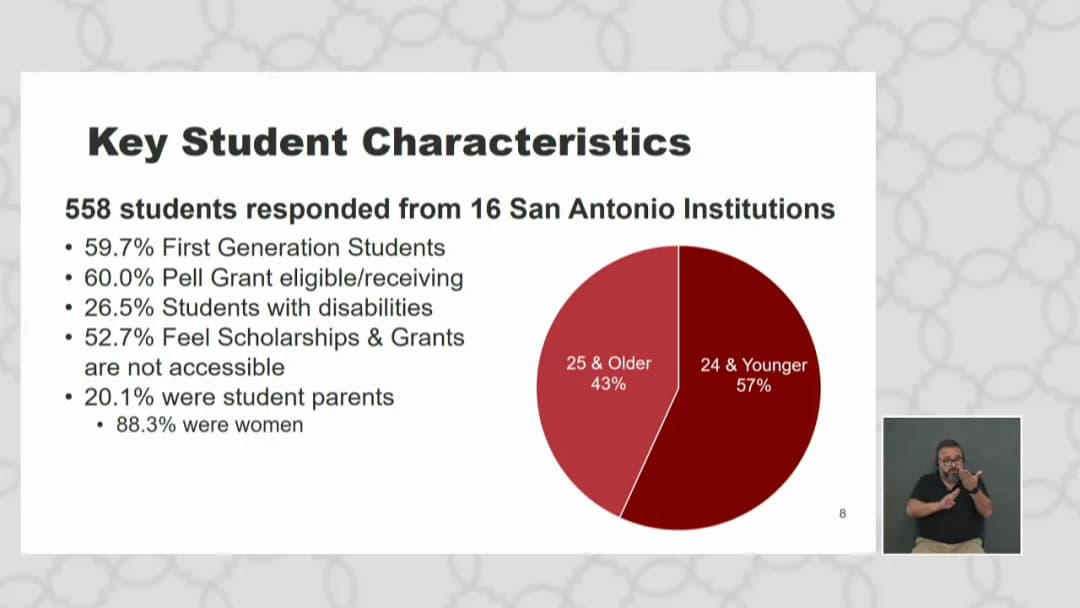
The Educational Opportunities Committee of the San Antonio City Council convened at 10:04 AM on June 16, 2026, with a quorum present. The meeting focused on presentations and discussions regarding the community schools model, youth budget priorities, and higher education student barriers and recommendations. No public comments were heard. Consent Calendar - The minutes from the previous meeting were approved unanimously with no edits or opposition. Discussion Items Community Schools Model Presentation - Alejandro Lopez, President of the San Antonio Alliance of Teachers and Support Personnel, presented on the community schools model, outlining six pillars: strong curriculum, high-quality teaching, inclusive leadership, culture of belonging/safety/care, family/community partnerships, and community support services. He cited research from New York City and California’s $4.1 billion investment, noting gains in academic achievement, attendance, and reduced disciplinary incidents. - Councilmember Corr expressed full support for the model and emphasized that wraparound services funded through city delegate agencies align with community schools principles. She warned that potential budget cuts to that funding would be “disastrous” and stressed the importance of after-school and summer programming to prevent summer slide. She also advocated for restorative justice practices. - Councilmember Castillo highlighted the value of focusing on school climate and discipline, noting the lack of support for 13-14-year-olds. He asked how the city could better partner with delegate agencies like Big Mama Safe House to align with younger youth needs. - Chair Godland (Galvan) asked about coordination between the city and school districts in allocating delegate agency funding. Melody Woosley (Human Services Director) confirmed that city staff works with SAISD and invites district representatives to panel reviews. - Mr. Lopez emphasized that a comprehensive needs assessment led by a dedicated community schools coordinator is critical for effective implementation, but noted that funding for such a coordinator is a challenge. He suggested a pilot program across multiple districts. San Antonio Youth Commission Presentation - Divya Beerham, Chair of the San Antonio Youth Commission, presented results from the FY2026 Youth Budget Survey (185 responses) and the 2025 Youth Budget Town Hall. Top youth priorities included affordable housing/homelessness services, libraries, parks and recreation, metro health, and domestic violence protection. She identified three themes: stability at home, educational support beyond school, and health and safety. - Councilmember Castillo requested that slide 7 (comparing community vs. youth survey priorities) be included in the full budget briefing, noting alignment with the committee’s work. - Councilmember Corr noted that libraries and parks are heavily affected by proposed cuts, directly conflicting with youth priorities. She urged youth to email council members and requested the full survey dataset. - Chair Godland asked about engagement timing and how to better reach youth. Divya suggested pre-school-year events and more frequent interactions with government officials. - Councilmember Corr also pointed out that the high ranking of domestic violence prevention among youth underscores the importance of the Public Safety Committee’s work on a healthy relationships curriculum for after-school programs. Higher Education Student Advisory Board Presentation - Jonah Martinez (mayoral appointee) and Victoria Shipley (Chair) presented the 2025 San Antonio Higher Education Student Survey (558 respondents, statistically significant). Key findings: 59.7% first-generation, 60% Pell-eligible, 52.7% felt scholarships inaccessible, 26.5% with disabilities, 20% parents (88.3% women), 43% age 25+. Top reasons for considering dropping out: financial hardship (54%), mental health (44%), family responsibilities (39%). 71.7% of student parents said childcare resources would improve persistence. - Recommendations included a higher education resource hub, financial literacy programming (e.g., via the Financial Empowerment Center), enhanced social media outreach, expanded affordable childcare eligibility (e.g., modifying the R City Cares program), and continued survey/data collection. - Councilmember Corr asked about proportional representation across institutions; staff noted 16 institutions were represented but could not confirm proportionality. She also suggested exploring cross-population with Ready-to-Work childcare funding. - Councilmember Castillo asked for more detailed breakdowns of financial and family challenges, and supported financial literacy initiatives that meet students where they are. He also linked the need for affordable childcare to the Pre-K 4 SA initiative. - Chair Godland recommended stronger collaboration between the HESAB and Cafe College, and requested a dedicated page on the DHS website for the board (agreed upon). He noted the importance of social media for reaching students. - Victoria Shipley noted that federal changes in higher education regulation (e.g., elimination of HSI designation, reduced financial aid for professional programs) have worsened financial challenges since the survey was conducted. Key Outcomes - No formal votes were taken beyond the consent calendar approval. - Committee members expressed strong support for maintaining and potentially increasing funding for delegate agencies, wraparound services, libraries, parks, and youth programs in light of upcoming budget discussions. - The committee committed to continued collaboration with the Youth Commission and Higher Education Student Advisory Board, including sharing survey data and exploring pilot programs for community schools and enhanced financial literacy/childcare support. - City staff will work to establish a dedicated DHS webpage for the HESAB and improve social media outreach to higher education students. - Next steps include the FY2027 Youth Budget Town Hall (August 22) and Youth Summit (September), and further analysis of the higher education survey to inform policy recommendations.
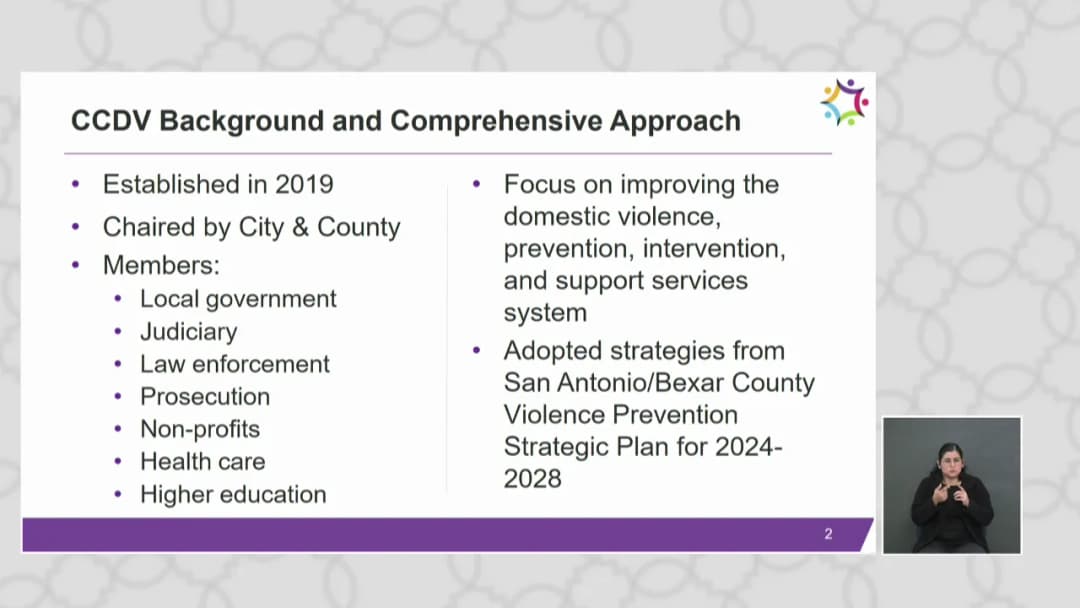
The San Antonio Public Safety Committee met on June 16, 2026, at 2:40 PM to discuss several items including approval of minutes, fire department performance metrics, a briefing on obscene materials, and an update from the Collaborative Commission on Domestic Violence (CCDV). The meeting adjourned at 4:04 PM. Consent Calendar - Approval of Minutes from May 28, 2026: The committee voted unanimously (motion and second) to approve the minutes. No discussion or opposition. Discussion Items - Fire Department Performance Metrics: Fire Chief presented data for FY24, FY25, and FY26 year-to-date. Key statistics: approximately 247,000 incidents in FY24, 253,000 in FY25 (2.5% increase), with EMS representing 78–80% of all incidents. Average citywide response time improved from 8 minutes 38 seconds in FY25 to 8 minutes 32 seconds in FY26 year-to-date; 90th percentile improved from 12:39 to 12:27. Council members requested deeper dives into mobile integrated health (MIH) trends, unauthorized burn heat maps, and the impact of clinical dispatcher and squad programs on medical vs. non-medical response times. The Chief noted that more fire apparatus are available than ambulances, contributing to faster non-medical response times. - Briefing on Obscene Materials: Assistant Chief Jesse Salami presented on the 15% increase in pornography/obscene material incidents (166 in Q1 2025 to 191 in Q1 2026). Three primary offenses drove the increase: unlawful disclosure of intimate visual material (101 cases), sexual coercion/sextortion (40 cases), and possession/promotion of child pornography (largest increase). The presentation covered legal definitions, investigative units (SVU and Human Exploitation), and victim support. Council members discussed the need for broader awareness campaigns, school-based education, and tracking of victim satisfaction. The Chief emphasized that prevention begins at home and that technology (e.g., deepfakes) poses new challenges. - Annual Progress Report: Collaborative Commission on Domestic Violence (CCDV): Maria Villagomez (co-chair) and Judge Monique Diaz presented highlights of the 2025 report. The CCDV focuses on three strategies: improving data acquisition, a comprehensive communications campaign (including a hybrid symposium with over 500 participants, a billboard campaign generating 58 million impressions), and incorporating healthy relationship education early in life. Martha P. from the Peace Initiative noted two concerning trends: a 12% increase in men as victims and more infants (1–2 weeks old) arriving at shelters. Council members asked about measuring outcomes, offender rehabilitation programs, and alignment with delegate agencies. The committee expressed support for continued prevention efforts. Key Outcomes - The committee approved the May 28, 2026 minutes unanimously. - Requests for further data: Fire Chief to provide MIH trend breakdown, a heat map of unauthorized burns, and data on lift assists resulting in transport; Police to provide a list of delegate agencies supporting victims of obscene material crimes, and to explore a post-investigation satisfaction survey. - The CCDV will continue its work, with a planned community-wide assessment and lived-experience advisory board. The city and county obtained a waiver to increase domestic violence prevention program sessions at the jail to twice per week. - The committee agreed to revisit the CCDV subcommittees in the fall and to follow up on implementing a healthy relationships pilot program in after-school programs.
The San Antonio Zoning Commission convened on June 16, 2026 at 1:00 PM under Chair John Bustamante. The commission considered a consent calendar of nine items, two postponements, and five individual zoning cases, with significant public testimony on multiple proposals. Consent Calendar - Items 7, 10, 11, 13, 14, 15, 17, 18, 19 were approved unanimously as a consent calendar. These included zoning changes for properties at 19273 Baco Road (C2 to C3 with specific use), 454 Avondel Avenue (I1 to R1), Castro Road (C2 to RM4), South Highway 181 (PUD MF-18 to LM), 1850 East Houston Street (RM4 to C2), 320 Isom Place (R6 to RM6), 7137 West Military Drive (O2 and C2 to ICID Z1 with limited intensity), 7400 Woodback Road (C2 to C2S for hotel/corporate apartment extension), and 9300 block South East Loop 410 (C2 to L). No public opposition was recorded. Public Comments & Testimony - Item 8 (Car wash): Three residents (Gerry Stennen, Alberto Sierra, Lorena Ibarra) spoke in opposition, citing traffic congestion, noise, and proximity to residences. The applicant, Carlos Wanson of Carleton Texas, expressed willingness to work with neighbors and proposed noise mitigation and water recycling (80% recapture). - Item 6 (Truck repair shop expansion): Silvia Alanís, president of the neighborhood association, spoke in opposition, citing existing congestion and 18-wheeler traffic. The owner, Reyes Alvarado, stated the expansion was only to provide covered workspace for employees, not to increase business volume. One resident spoke in support. - Item 3 (Pickleball court): Ross Ryan, an adjacent property owner, spoke in opposition, citing light pollution, noise, and disruption to the neighborhood's character. The applicant noted community feedback and proposed design changes including a consolidated building and acoustic insulation. - Item 4 (Paint booth): No public comments were offered. The applicant's representative stated that three of six originally opposed neighbors had changed their position after visiting the site. - Item 5 (Bar): Over a dozen residents spoke in opposition, including Armando Santiago, Denise Valentine, Daniel Mancinga, Jacob Stetler, Jeff Hunt, and others. They cited existing crime (109 calls in 365 days within 500 feet), inadequate parking (16 spaces for required 36), saturation of bars (15 within the area), and concerns about alcohol consumption near a World Heritage corridor. A few speakers (Lorenzo Contreras, Shannon Locke, Mark Garcia himself) supported the proposal, emphasizing the applicant's commitment to security and a different clientele. - Item 9 (Duplexes): No public testimony recorded. The applicant's representative noted two community meetings with limited feedback. - Item 2 (Multi-family): Ruby Ramos spoke in opposition, stating that MF-18 zoning did not fit the single-family neighborhood. The applicant's representative noted they had reduced the proposal from 12 to 6 units after community input. Discussion Items - Item 8 (Car wash at 17176 Blanco Road): Commissioners discussed water quality, noise (decibel limits), and the concentration of car washes. Staff noted special conditions: 80% water recapture, biodegradable detergents, sediment traps, and 65% impervious cover limit. The motion to approve passed 6-5. - Item 6 (Truck repair shop at 9330 NE Loop 410): The proposal was to amend a conditional use permit to allow 15,000 sq ft of building (from 5,000 sq ft). Commissioners clarified the owner's intent was to cover existing work, not increase business volume. A friendly amendment was accepted. The motion to approve passed unanimously (11-0 based on roll call). - Item 3 (Pickleball court at 55 Heath Road): Staff recommended denial due to inconsistency with the low-density residential plan. The applicant revised the plan to a single building with 60-foot setbacks. Despite concerns about compatibility, the commission voted to approve (10-1 or similar). - Item 4 (Paint booth at 12139 Jones Maltsberger): Staff recommended denial due to insufficient buffer (34 feet) for hazardous emissions. The applicant argued that modern paint booths (with filters and inspections) were safe. Three of six opposing neighbors withdrew objections. The commission voted to deny (unanimous). - Item 5 (Bar at 1301 Roosevelt Avenue): Staff recommended approval, but the commission heard extensive opposition. The applicant proposed a small bar (wine and beer only) until midnight with security cameras. Commissioners cited the area's high crime, existing bar saturation, and inadequate parking as reasons to deny. Denial passed 9-2. - Item 9 (Duplexes at 314 J Street): Commissioners discussed the lack of neighborhood response despite two meetings. A motion to postpone to July 17, 2026 passed (6-4). - Item 2 (Multi-family at 101 Stumberg): The applicant sought RM-5 zoning for six duplexes, but staff recommended denial. Commissioners noted the density (MF-18) was out of character. The motion to deny passed 6-5. Key Outcomes - Consent calendar (9 items): Approved unanimously. - Item 16 (unrelated agenda item): Postponed to July 21, 2026. - Item 8 (car wash): Approved (6-5) with special conditions. Applicant has six months to take to City Council. - Item 6 (truck repair shop expansion): Approved with amendment (unanimous). The owner may proceed with the site plan to provide covered workspace. - Item 3 (pickleball court): Approved (majority). - Item 4 (paint booth): Denied (unanimous). - Item 5 (bar): Denied (9-2). - Item 9 (duplexes): Postponed to July 17, 2026. - Item 2 (multi-family): Denied (6-5). - Minutes: Approved as amended (correction to Commissioner Wisel's name). The meeting adjourned at 5:08 PM.
The San Antonio Zoning Commission met on June 16, 2026, at 1:00 PM to consider a consent agenda, continuances, and nine individual rezoning cases. The commission heard public testimony, deliberated, and voted on each item. The meeting adjourned at 5:08 PM. Consent Calendar - Items 7, 10, 11, 13, 14, 15, 17, 18, 19 were approved unanimously. These included zoning changes for a machine shop (item 7), residential zoning at 108 Dickey Avenue (item 10), RM4 at 202 Casterville Road (item 11), a change to L zoning in the 11000 block of Highway 181 (item 13), C2 at 1850 East Houston Street (item 14), RM6 at 320 East Courtland Place (item 15), IDZ1 with a foster group home at 7137 West Military Drive (item 17), C2S for extended‑stay hotel in the 7400 block of Warsbach Road (item 18), and L zoning in the 9300 block of Southeast Loop 410 (item 19). Continuance - Item 16 – 454 Avondale Avenue (and 19273 Babcock Road, also postponed): A five‑week continuance to the July 21, 2026 meeting was granted after one public speaker (Patrick Ramey, 2917 North Main Avenue) expressed opposition to subdividing the property, citing historic character and property values. The motion passed unanimously. Public Comments & Testimony - Item 8 (17680 Blanco Road – car wash): Gary Stinnett (Wash Tub Car Washes) opposed, citing five existing car washes within a two‑mile radius. Alberto Sierra (18417 Rustling Ridge) and Lorena Ibarra (101 Country Club Lane) also opposed, raising concerns about traffic, noise, and insufficient evaluation of operational impacts. The applicant, Carlos Swanson (Cross Development), argued the design minimizes noise (vacuum motors inside, blowers facing Blanco Road) and that the car wash would pull from existing traffic. - Item 6 (9330 Northeast Loop 410 – truck repair expansion): Sylvia Alanis (830 Studs Drive), president of Eastgate Neighborhood Association, opposed, stating that 18‑wheelers cut through the neighborhood and that the expansion would increase industrial impact. Property owner Reyes Alvarado (Texas Truck Shop) explained the expansion is needed to bring trailers (now 57 ft) inside for employee safety and that trucks only enter/exit from the access road. - Item 3 (5995 Heath Road – indoor pickleball facility): Rose Ryan (7950 Clyde Dent Drive) opposed, citing noise, light intrusion, traffic, and endangered species (horned toads). The applicant, Emily Weissler (Killin Griffin & Fairman), noted that Misty Oaks Neighborhood Association (through registered liaison Nancy Cardinius) stated they had no concerns after reviewing updated site plans. - Item 4 (12139 Jones Maltzburger Road – auto paint/body repair): No public speakers were present, but three of the six initially opposed property owners within 200 ft retracted their opposition after a tour and meeting with inspectors. - Item 5 (1301 Roosevelt Avenue – bar/tavern): Ten neighbors testified in opposition, including Armando Santiago (523 West Highland Boulevard), Denise Valentine (127 Loretta Place), Daniel Meinzinger (235 Yellowstone), Robert Bender (132 Castillo Avenue), Jacob Studham (same address, vice president Roosevelt Park Neighborhood Association), Oswald John Nita (206 Isabel Street), Vanessa Revellas (512 Honstock), Gabriela Gast (310 Hansford Street), Jeff Hunt (121 Loretta Place), Karen Brandenburg (201 Isabel), and Ron Wallace (562 East Mitchell Street). They cited 109 crimes within 500 ft in the past year, inadequate parking (16 marked spaces vs. 36 required), saturation of 15 existing bars, and concerns about noise, loitering, and safety. Supporters Lorenzo Contreras (542 Cravens Avenue), Shannon Locke (2131 Winding View), Roland Percado, and Herman Booker (10451 Clearwater Way) argued that applicant Mark Garcia would run a professional, low‑impact establishment with security and upscale clientele. - Item 2 (223 East Petaluma Boulevard – MF18 rezoning): Ruby Rombles (215 East Petaluma) opposed, stating multifamily would harm the single‑family character. Applicant representative Elizabeth Russell explained that the owner (Nason LLC) proposes six condominium units (three duplexes) to be sold at $300 K each, that MF18 was the only viable zoning to achieve six units, and that door‑to‑door outreach had been difficult (one aggressive encounter). She noted that the neighborhood association (Harland Del McCullum) supports R4CD for four units, but that four units would be financially unviable. Discussion Items - Item 8 – Car wash at 17680 Blanco Road: Staff recommended approval. SAWS representative confirmed 80% water recapture, biodegradable detergents, grit traps, and 65% impervious cover limit. After questions about noise (city noise ordinance limits business‑zone decibels to 70 dB from adjacent properties) and HOA outreach (Blanco Bluffs non‑responsive; Canyon Creek Bluffs president indicated no objection), Commissioner Duval moved approval. Vote: 7–4 (Commissioners Losef, Huey, Sipes, and Pana voted no; Chair Bustamante also no). The motion carried. - Item 6 – Truck repair expansion at 9330 NE Loop 410: Commissioner Losef expressed concern about conflicting messages (initial intent to expand work vs. now providing shade for workers) and motioned for continuance, which failed for lack of a second. Commissioner Pete Rodriguez then moved approval with the amended site plan (building pushed back an additional 5 ft for 55 ft rear setback). Vote: 10–1 (only Commissioner Losef opposed). The motion carried. - Item 3 – Indoor pickleball facility at 5995 Heath Road: Staff recommended denial due to C1 building size restrictions and inconsistency with the low‑density residential plan, though planning commission had recommended approval of a plan amendment to community commercial. After public testimony, Commissioner Huey moved approval. Vote: 9–2 (Commissioners Losef and Kellum voted no). The motion carried. - Item 4 – Auto paint/body repair at 12139 Jones Maltzburger Road: Staff recommended denial, citing proximity to residences and potential hazardous emissions. Commissioner Duval moved denial, noting that three of nine property owners within 200 ft remained opposed and that use would be more intensive than existing. Vote: 11–0 (all aye). The motion carried. - Item 5 – Bar/tavern at 1301 Roosevelt Avenue: Staff recommended approval, but the Roosevelt Park Neighborhood Association and 10 residents opposed. Commissioner Hinojosa moved denial. Vote: 9–2 (Commissioners Pete Rodriguez and Pana voted no). The motion carried. - Item 9 – RM5 rezoning at 314 J Street: Staff recommended approval, but the Denver Heights Neighborhood Association had not responded. Commissioner Losef moved a three‑week continuance to July 7 to allow applicant to attend a neighborhood meeting. Vote: 7–4 (Commissioners Huey, Witsett, Pana, and Chair Bustamante voted no). The motion carried. - Item 2 – MF18 rezoning at 223 East Petaluma Boulevard: Staff recommended denial with an alternate recommendation of R4CD for four dwelling units. Commissioner Hinojosa moved denial. Vote: 6–5 (Commissioners Kellum, Pete Rodriguez, Huey, Sipes, and Kelly voted no). The motion carried. Key Outcomes - Consent calendar (items 7, 10, 11, 13, 14, 15, 17, 18, 19) approved unanimously. - Item 16 continued to July 21, 2026. - Car wash (item 8) approved (7–4). - Truck repair expansion (item 6) approved (10–1). - Pickleball facility (item 3) approved (9–2). - Auto paint/body repair (item 4) denied (11–0). - Bar/tavern (item 5) denied (9–2). - RM5 rezoning (item 9) continued to July 7 (7–4). - MF18 rezoning (item 2) denied (6–5). - Minutes approved with one amendment (correcting spelling of Emily Weissler’s name).
The meeting, chaired by Councilmember Galvan, convened at approximately 10:00 AM and concluded at 11:18 AM. The committee received three presentations: a community schools model overview, a student-led mental health and budget priority survey, and a higher education retention study. Councilmembers Cort, McKee Rodriguez, Munguía, and Castillo were present. No public comments were offered. Discussion Items 1. Community Schools Model Presentation - Alejandra López, a teacher and assistant, presented the community schools model, emphasizing a strong, systematic curriculum and certificated teachers. She described the model as involving families, restorative practices, and collaborative decision-making. López cited a 2021 California investment of $4.0 billion (state) and $670 million (federal) in community school initiatives, and noted the model’s potential for San Antonio’s 17 districts. - Councilmember Cort highlighted the importance of community involvement from the start and suggested identifying a community liaison to align schools with city services. - Councilmember Munguía stressed the need for early intervention, especially for children aged 13–14 in the colonias. - Councilmember Castillo supported the model as a framework for city-funded support, proposing innovative funding strategies rather than traditional consulting. 2. Youth Mental Health Survey and Budget Priorities - Debian Burium, a senior at Episcopal School and student council representative for 2025-2026, presented on behalf of the Student Commission (SIC). She reported 185 survey responses from all districts, identifying top priorities: affordable housing, homeless services, police camp cleanups, emergency services, libraries, recreation, and mental health. Students emphasized stability and safety as foundational for academic success. - Councilmember Galvan noted alignment with city budget priorities, particularly around libraries and youth programs, and encouraged early registration for youth events. - Councilmember McKee Rodriguez asked about outreach to students before they leave school and suggested involving adult mentors to sustain engagement. 3. Higher Education Retention Survey - Victoria Shepley (President of the Higher Education Advisory Council) and Jonah Calman Espinoza (University of Texas representative) presented a survey of 550 respondents. Key findings: - 59.7% were first-generation students, 60% received Pell Grants, 52.7% other grants, 26.5% had disabilities, and 20% were parents or guardians. - 38% considered leaving or left college; 54% cited financial situations, 30% mental health, and 30% family responsibilities. - Recommendations: (1) collaborate with partners like Café College and local universities, (2) improve financial aid knowledge through city initiatives and private sector sharing, (3) engage DHS communications to support awareness, (4) advocate for accessible childcare and parental support programs, and (5) continue data collection to address gaps. - Councilmember Castillo requested more detail on the specific financial challenges (e.g., housing costs, caregiving responsibilities) and suggested using social media platforms to reach students. - Councilmember McKee Rodriguez emphasized the need for stable funding for programs like Ready to Work, and noted reductions in federal aid for certain programs. - Councilmember Galvan encouraged connecting the commission with Café College and aligning with childcare credit initiatives (CCR), and supported unifying the city’s educational resource webpage under a single .gov domain. Key Outcomes - No formal votes were taken; the committee received the presentations and expressed appreciation. - Councilmembers directed the presenters to continue collaborating with Café College, Ready to Work, and other city departments. - A recommendation was made to develop a consolidated city webpage for education resources (e.g., higher education, community schools) to improve accessibility. - The committee acknowledged the importance of ongoing data collection and committed to follow up on the higher education retention recommendations in future budget discussions.
The San Antonio Board of Adjustment met on June 15, 2026, to hear and decide on several variance requests, an appeal of a short-term rental permit revocation, and a continuance. The meeting began at approximately 1:10 PM and adjourned at 4:15 PM. A quorum of 9 of 11 commissioners was present, with two joining digitally later. All votes required a 75% supermajority (9 out of 11 votes). The board approved minutes from the previous meeting unanimously. Consent Calendar - None explicitly designated; however, several routine variance requests were approved unanimously and are detailed under Discussion Items. Public Comments & Testimony - Item 1 (Cactus Street): Elisa García, a resident from across the street (address not given, but she stated she lives near 117 Cactus Street), spoke in opposition to the short-term rental permit appeal. She alleged ongoing drug trafficking, prostitution, and underage girls entering and leaving the property at night, as well as trash and blocked driveways. She provided photos and stated she had not been able to contact the owner. She also mentioned issues with a neighboring property at 114 Cactus Street involving an armed confrontation. The board allowed her three minutes to speak. No other public comments were registered for this item; however, a voice mail was received before the meeting but not counted as official (received Friday at 4 PM). The board also heard a brief rebuttal from the applicant's attorney. Discussion Items Item 9 – 18 Chelsea Way (Variance) - Request: Variance to reduce the required rear setback from 20 feet to 12 feet for a rear addition to accommodate an accessory dwelling for the applicant's disabled mother-in-law. - Staff Recommendation: Approve, citing irregular lot shape, sufficient separation for maintenance and water runoff, and one letter of support with none in opposition. The Lincoln Heights Neighborhood Association provided support. - Testimony: Applicant Michael Lamquist explained the need for the suite and the lot constraints. No public opposition. - Outcome: Motion to grant the variance passed unanimously (11-0). Item 1 – 117 Cactus Street (Appeal of Short-Term Rental Permit Revocation) - Request: Appeal of the administrative decision to revoke a Type 2 short-term rental permit. Staff alleged the applicant submitted an altered photograph of the driveway (using AI or photo editing) to obtain the permit. The revocation was based on Section 16-111 of the city code (false information). The property had been initially approved in February 2026, renewed in April 2026, and revoked on April 21, 2026. - Staff Recommendation: Deny the appeal. - Testimony: Attorney for the applicant argued that the driveway existed (though unpaved, with caliche) and that the photo was an honest mistake or an attempt to show the driveway in better condition, not deceit. He noted that neighbors support the short-term rental. He requested time for an adjournment if needed, but the board proceeded to vote. Commissioner Ibáñez questioned whether the driveway material (gravel) meets code; staff noted gravel is acceptable if contained. - Public Comment: Neighbor Elisa García spoke in opposition (see above). She stated she had not been contacted by the owner and alleged criminal activity at the property. - Outcome: Motion to grant the appeal failed. Vote: 2 in favor (Commissioners Ibáñez and Brackman with findings) and 9 opposed. The appeal was denied. The applicant may reapply after 12 months. Item 2 – 9102 Boxe Drive (Variance – Continuance) - Request: Variance for a reduced setback for an accessory structure (gutter encroachment). The property owner requested a continuance because CPS Energy needed to evaluate the structure and the owner would be out of town until August 2026. - Staff Recommendation: Staff had no objection to a reasonable continuance. - Outcome: Motion to continue the case to August 17, 2026, passed unanimously. Item 3 – 219 Palo Grande (Multiple Variances) - Request: (1) Variance to exceed maximum accessory structure area by 1,215 sq ft (total 3,715 sq ft allowed by special exception), (2) variance to allow barbed wire on rear boundary, (3) special exception for a solid 6-foot front fence (3 ft maximum normally). Property is zoned RE. The applicant is a veteran ceramic artist who wants to build an ADU for grandchildren and has had existing structures and fencing for 13 years. - Staff Recommendation: Deny barbed wire variance (prohibited material) and the front fence special exception (would undermine district character). Approve accessory structure area variance. - Testimony: Applicant explained the need for the structures and fence. He noted no neighbor objections except one unreturned contact. He argued the fence with barbed wire is necessary for security and that the front solid fence is common in his neighborhood. - Outcome: - Accessory structure area variance: Motion to grant passed unanimously (11-0). - Front fence special exception: Motion to grant passed 10-1 (Commissioner Brackman dissented, citing lack of security testimony and harm to neighborhood character). An amendment was made to limit the fence to the presented design. - Barbed wire variance: The board approved as part of the structure variance (implied, as the motion covered all three items). The final vote was 10-1. Item 4 – 155 Kent Street (Variance for Corrugated Metal Fence and Clear Vision Area) - Request: Variance to allow a corrugated metal fence (prohibited material) and a reduced clear vision area (1.5 ft instead of 15 ft) at a corner lot. The applicant’s son owns the property and is in the military; they installed the fence for security due to theft and vandalism in the neighborhood. - Staff Recommendation: Deny, citing that the fence is prohibited and the reduced vision area would create a safety hazard. - Testimony: Applicant Jack Hernandez explained the need for durable fencing, noted they installed a cap on the fence to prevent injuries, and offered to make the fence open at the corner to improve visibility. - Outcome: Motion to grant the variance with conditions (metal fence with cap, clear vision area to be predominantly open) passed unanimously (11-0). Item 5 – 631 Cincinnati Avenue (Variance for Carport Setback) - Request: Variance to reduce the required side setback from 5 ft to 4 inches from the property line for a proposed carport. The lot is narrow and the driveway is limited. - Staff Recommendation: Deny, citing insufficient space for fire safety and water runoff mitigation. - Testimony: Applicant Henry M. González Jr. stated the carport would be open metal with gutters directing water to the front, and that neighbors are in favor. He brought photos showing similar carports in the area. - Outcome: Motion to grant the variance passed unanimously (11-0). Item 6 – 124 Ceballos Street (Multiple Variances) - Request: Variances for impermeable cover (to allow river rock and no plastic liner), fence height (6 ft instead of 3 ft, open design), and clear vision area (reduced from 8 ft to 2″). Property is a triplex in a commercial/residential area. - Staff Recommendation: Deny impermeable cover variance (excessive coverage) and clear vision variance (safety); approve fence height (open design promotes community). - Testimony: Applicant’s contractor explained that the impermeable cover is necessary due to limited lot width and that the river rock is permeable. The fence is for security; the driveway was moved to the center to improve sight lines. - Outcome: Motion to grant all variances passed unanimously (11-0). Item 7 – 551 Greeks Avenue (Variance for Carport Setbacks) - Request: Variance to reduce front setback from 10 ft to 4 ft 4 in and side setback from 5 ft to 4 ft 4 in for an already-built carport (no permit initially). The property is near a fire station; the owner has disabled relatives and needs covered parking. - Staff Recommendation: Deny, stating insufficient space for maintenance and that the reduced front setback violates the open space spirit. - Testimony: Representative for owner apologized for building without a permit. The carport is open with gutters. The owner is willing to add gutters to control runoff. - Outcome: Motion to grant the variance passed unanimously (11-0). Item 8 – 1471 West Gramma C Place (Variance for Carport Setback) - Request: Variance to reduce side setback from 5 ft to 1 ft 6 in for an open metal carport for classic cars. The lot is narrow; the carport is necessary for access and security. - Staff Recommendation: Deny, citing fire and water concerns. - Testimony: Applicant Lenny Sinclair is the HOA president and has support from the neighborhood. The carport will be open metal, slope toward the alley, and include gutters. - Outcome: Motion to grant the variance passed unanimously (11-0). Item 10 – 5017 Nevada Street (Variances for Lot Size and Side Setback) - Request: Variance to reduce minimum lot area from 4,000 sq ft to 3,550 sq ft and side setback from 5 ft to 4 ft 11 in (including a 24-inch overhang) for a home reconstruction. The house predates zoning (built 1928) and is in a historic area. The applicant wants to renovate without triggering full zoning compliance. - Staff Recommendation: Approve, citing the lot’s age and that the encroachment is minor and adjacent to a neighbor’s driveway. - Testimony: Applicant Donald Donalds (?) explained the property was bought five years ago; foundations were laid but delayed. The renovation will keep existing footprint. He agreed to add gutters on the west side to address water runoff. - Outcome: Motion to grant the variances passed unanimously (11-0). Item 11 – 3614 Charlotte Brook Drive (Variance for Rear Setback) - Request: Variance to reduce the required rear setback from 20 ft to 14 ft for a 10 ft x 12 ft kitchen addition (enclosing an existing porch). The addition is 26 sq ft. - Staff Recommendation: Deny, citing lack of air circulation and fire mitigation, though noting no opposition from neighbors and some support. - Testimony: Applicant explained the small size of the addition and that neighbors support it (4 letters of support). - Outcome: Motion to grant the variance passed unanimously (11-0). Item 12 – 285 Post Avenue (Variance for Rear Setback and NSD Design Standards) - Request: Variances for a triplex project in the Westfort Conservation District (RCD zoning). Requested: reduce rear setback from 20 ft to 10 ft, allow 25 ft wide driveway (NSD requires narrower), and allow carports in the side yard (NSD prohibits). The project was negotiated with the neighborhood association in 2023 and has support from the Westfort Alliance and Joint Base San Antonio (no objection). - Staff Recommendation: Approve the rear setback variance; deny the NSD variances (strict compliance would encourage creative design). - Testimony: Applicant Patrick Christensen explained the history: rezoning in 2023 for three units with neighborhood support. The fire department agreed to a 15 ft access width, but NSD requires 10 ft. The driveway width proposal is 25 ft (15 ft measured). Carports are to hide vehicles. He argued the strict NSD standards would cause unnecessary hardship. - Outcome: Motion to grant all three variances passed 10-1 (Commissioner Dean abstained). The board found that the NSD variances would not harm the neighborhood character and were necessary due to unique site conditions. Key Outcomes - Item 9 (Chelsea Way): Variance granted (11-0). - Item 1 (Cactus Street): Appeal denied (2-9). The short-term rental permit revocation stands. - Item 2 (Boxe Drive): Continued to August 17, 2026 (unanimous). - Item 3 (Palo Grande): Accessory structure variance granted (11-0). Front fence special exception granted (10-1). Barbed wire variance implicitly granted as part of the package. - Item 4 (Kent Street): Variance granted with conditions (unanimous). - Item 5 (Cincinnati Avenue): Variance granted (unanimous). - Item 6 (Ceballos Street): All variances granted (unanimous). - Item 7 (Greeks Avenue): Variance granted (unanimous). - Item 8 (West Gramma C Place): Variance granted (unanimous). - Item 10 (Nevada Street): Variances granted (unanimous). - Item 11 (Charlotte Brook Drive): Variance granted (unanimous). - Item 12 (Post Avenue): Variances granted (10-1, one abstention). The meeting adjourned at 4:15 PM. Commissioners were reminded to speak with staff regarding any questions. No director's report was given.
The Board of Adjustments of San Antonio convened on June 15, 2026, to hear 11 variance and appeal cases. The board considered requests ranging from setbacks for carports and additions to a controversial short-term rental permit revocation appeal and variances in a neighborhood conservation district. The meeting lasted from approximately 1:13 PM to 4:15 PM, with a full board of 11 members present for most items. Consent Calendar - The board approved the minutes from the previous meeting without opposition. - Item 9 (18 Chelsea Way): A request for an eight-foot variance from the minimum 20-foot rear setback to allow an addition 12 feet from the rear property line was approved unanimously. Staff recommended approval. The applicant, Michael Amquis, proposed a mother-in-law suite above an existing garage. The vote was 11-0. Public Comments & Testimony - Public Comment on Item 1 (117 Cactus Street): Elisa Garcia, a neighbor who owns 112 Cactus Street, spoke in opposition to the short-term rental permit appeal. She alleged criminal activity (drug trafficking, prostitution) at the property and stated the applicant did not have a compliant driveway in 2023. She also disputed the claim that neighbors were in favor. - No other public comments were made on other items. Discussion Items Item 1 – Appeal of Short-Term Rental Permit Revocation (117 Cactus Street) - Staff recommended denial, stating the applicant provided an altered photo of a driveway to obtain a renewal. Code enforcement later confirmed the driveway did not match the photo. Staff cited a pattern of deception, noting eight total violations from the same entity. - The applicant’s attorney, Eddie Bravinek, argued the mistake was unintentional and did not benefit the client, as the actual driveway (then caliche) was code-compliant. He also noted the neighbor’s support but could not address other alleged violations because staff had not disclosed them beforehand. - Board discussion: Some commissioners felt the photo issue was minor given a driveway existed; others saw it as falsifying documents. The motion to grant the appeal failed 4-7. The board then clarified the applicant may reapply after 12 months. Item 2 – Variance Continuance (9102 Broxton Drive) - The applicant, active military, requested a continuance to August 17, 2026, to allow CPS Energy to assess the property. The board granted the continuance unanimously. Item 3 – Variances at 219 Palo Grande - Applicant Dudley Harris (age 83, Vietnam veteran) sought variances for: (1) 1,215 sq ft additional accessory structure square footage (approved 11-0); (2) a fence height special exception for a 6-ft solid front yard fence on a large lot (approved 10-1, with Commissioner Bragman dissenting). The razor wire variance was withdrawn as the applicant had removed the razor wire. - Key Outcome: Accessory structure variance approved unanimously. Fence height special exception approved 10-1, with an amendment limiting the fence to the existing location as presented. Item 4 – Variances at 155 Canton Street (Corrugated Metal Fence) - Applicant’s father, Jack Hernandez, explained the fence was needed for security in a high-crime area. Staff recommended denial on the fence material (corrugated metal) and clear vision variances. - The board approved all three variances unanimously after amendments: (1) corrugated metal fencing allowed with caps, limited to north and east sides; (2) clear vision variance for corner (3 ft vs 25 ft required); (3) clear vision variance for driveways (6 ft vs 15 ft). The motion included a requirement for predominantly open fencing on the front to mitigate clear vision concerns. Item 5 – Carport Setback Variance (6316 Cincinnati Avenue) - Applicant Henry Gonzalez proposed a 12x40 ft metal carport 4 inches from the side property line. Staff recommended denial, but the board unanimously approved the variance, praising the applicant for seeking approval before construction. The carport will slope to the front with gutters. Item 6 – Multiple Variances at 124 East Savio Street (IDZ District) - Staff recommended denial for impervious cover and clear vision variances, but approval for a fence height special exception. - The board granted all three requests unanimously: (1) impervious cover variance (as submitted, river rock without plastic liner); (2) clear vision variance (6 ft 10 in vs 15 ft); (3) fence height special exception for a 6-ft front yard open fence and a 7.5-ft overhead rail for a sliding gate. Item 7 – Carport Setback Variances (551 Griggs Avenue) - Applicant Valerie Tobias, representing her mother, sought variances for an existing carport built without permits. Staff recommended denial, but the board approved both variances unanimously (front setback reduced to 4 ft 4 in; side setback reduced to 8 in). The applicant agreed to install gutters along the front. Item 8 – Carport Setback Variance (1431 West Gramercy Place) - Applicant Cecil St. Clair proposed an open metal carport 18 inches from the side property line, sloped to the alley with gutters. Staff recommended denial, but the board unanimously approved the variance, noting the open design mitigates fire risk. Item 10 – Lot Size and Side Setback Variances (517 Nevada Street) - Applicant Dan Gonzalez sought variances for a home renovation where the existing structure encroaches. Staff recommended approval. The board unanimously granted the variances: (1) 450 sq ft exceeding the minimum lot size; (2) side setback reduction to 1 inch (existing condition). The motion included a note about gutters, later withdrawn, but the variance was granted as applied. Item 11 – Rear Setback Variance (3614 Shallow Brook Drive) - Applicant Adam Ortiz requested a 6-ft variance to allow a 12x14 ft addition 14 ft from the rear property line. Staff recommended denial, but the board unanimously approved, noting support from adjacent neighbors. Item 12 – Multiple Variances at 285 Post Avenue (NCD9) - Applicant Patrick Christensen explained the project (three dwelling units) had neighborhood support during rezoning but required variances for rear setback (10 ft vs 20 ft), driveway width (15 ft front, 25.5 ft side vs NCD standards), and carports in side yard. West 4 Alliance did not object. - Staff recommended approval for rear setback but denial for NCD design variances. The board overruled staff and granted all three variances 10-1 (Commissioner Dean abstained), finding the project did not conflict with neighborhood character. Key Outcomes - Item 1 (Appeal): Motion to grant appeal failed 4-7. The short-term rental permit revocation stands. Applicant may reapply after 12 months. - Item 2: Continued to August 17, 2026. - Item 3: Accessory structure variance approved unanimously. Fence height special exception approved 10-1. - Item 4: All three variances approved unanimously with amendments. - Item 5: Carport variance approved unanimously. - Item 6: All three variances approved unanimously. - Item 7: Both carport setbacks approved unanimously. - Item 8: Carport variance approved unanimously. - Item 9: Rear setback variance approved unanimously (handled earlier as consent-like item). - Item 10: Lot size and side setback variances approved unanimously. - Item 11: Rear setback variance approved unanimously. - Item 12: All three variances approved 10-1 (one abstention).
The San Antonio City Council convened at 9:07 a.m. on June 11, 2026, with all council members present. The meeting opened with an invocation by Murphy Patamala, a leader in the Indian community, followed by the Pledge of Allegiance. The council approved the minutes from the May 22, 2026 meeting. Ceremonial recognitions included the U.S. Army's 251st birthday, Philippine Independence Day proclamation, and the Jossie Awards for performing arts. Council members also highlighted personal privileges, including the 10th anniversary of Pierce Salt Park, a traffic safety advocacy by a 12-year-old student, and a tribute to a deceased Army veteran. Consent Calendar - Item 3: Approval of minutes from the May 22, 2026 meeting – approved unanimously. - Items 5–11, 14–33: Consent Agenda – approved as a block with highlights: - Item 6: $100,000 contribution from the San Antonio Medical Foundation for Lisa Star Park's playground improvements. - Item 9: Bond funding for Brackenridge Park nature playscape (ADA accessible). - Item 17: Acceptance of $3.2 million in grants from Texas Department of State Health Services for Metro Health's Communicable Disease Division, funding 32 positions. - Item 22: $250,000 in federal funds for McFarland Tennis Center ADA improvements. - Item 23: Appointment of Antoinette Flores to the Disability Access Advisory Committee. - Items 12, 13, and 25 were pulled for individual consideration. Public Comments & Testimony - No members of the public signed up to speak on any agenda item. Discussion Items - Items 12 & 13 – Eminent Domain for CPS Energy Projects: - Item 12 authorized acquisition of 192 acres (fee simple) for the Howard 765 kV switching station project in Council District 4. The ordinance declared the project a public use/necessity. Motion by Councilmember Mungia, seconded, and approved without discussion. - Item 13 authorized acquisition of 120 permanent electric transmission easements, 35 temporary construction easements, and 17 access easements for the Howard to San Miguel transmission line in Bexar and Atascosa counties. Approved similarly. - Item 25 – Resolution on Bond Committee Appointments: - Staff presented a resolution requiring City Council approval of the mayor's appointees for tri-chairs and co-chairs of the 2027–2032 community bond committees. Councilmembers debated timing, process, and whether to also require approval of council-district appointees. An amendment by Councilmember White to require council confirmation of all bond committee appointees (including district members) was adopted. The main motion as amended failed on a split vote, with several councilmembers opposing due to timing concerns and preferring to revisit after the current bond cycle. Key Outcomes - Approved: Minutes of May 22, 2026; Consent Agenda (items 5–11, 14–33); Item 12 (eminent domain for Howard switching station); Item 13 (eminent domain for Howard–San Miguel transmission line). - Failed: Item 25 (resolution requiring council approval of bond committee chairs) as amended. - Next Steps: The bond committee appointment process will proceed under existing rules; a future work session on potential changes was suggested.