This meeting of the San Antonio Construction Standards Board was held on Thursday, July 2, 2026, from approximately 9:00 AM to after 10:12 AM. The board considered emergency demolitions, a staff report on recent emergency demolitions, and five individual property cases. All votes were unanimous. Consent Calendar - The minutes of the previous board meeting were approved unanimously by voice vote (motion by Commissioner Fernández, seconded). Staff Report on Emergency Demolitions - Kathy Rodríguez, Development Services Administrator, reported three emergency demolitions in District 5: 2 Thomson Place (demolished June 9, 2026), 1122 Pérez Street (demolished June 17, 2026), and 10162 Wood Trail (demolished June 20, 2026). All were due to fires. No questions or further discussion. Discussion Items 4426 Eisenhower Road (District 2) - Staff Presentation: Code Officer Cynthia Santana presented the case for demolition. The property is a single-story 3,100 sq. ft. residence built in 1957, severely damaged by a fire in March 2026. It lacks water and electricity service. Code violations included unsafe conditions, debris accumulation, and proximity to St. Thomas School (within 1,000 feet). The owner had been given multiple notices; no financial proof or repair plan was provided. Police Officer Carlos Gutiérrez testified that from January to June 2026, there were 65 calls to the address, with 43 after the fire, including reports of trespassing, suspicious persons, and possible minors entering. The structure is dangerous for police entry. - Owner Testimony: Salvador Caballero Ramos, owner, stated he had intended to repair the house but was hospitalized from June 18 to approximately June 25 and could not respond to notices. He asked for an extension, claiming he had a civil engineer and contractor ready. He admitted renters and homeless had been staying there. He provided no financial documentation or work scope. - Discussion: Commissioners questioned the owner about financial capacity and contact with city staff. The owner had not met with development staff aside from the code officer. Commissioner Fred Andes noted repeated debris cleanups costing $3,546.00 total. The board noted continued occupancy despite vacate orders. - Board Action: Initial motion by Dewey Nelson for demolition within 30 days, seconded by Fred Andes. An amendment by Fred Andes to require the owner to reimburse all past and future abatement costs (weed and debris removal) was accepted. The motion passed 6-0. 3446 Roosevelt Avenue (District 3) - Staff Presentation: Code Officer Sergio Quintanilla presented the case. The commercial structure, built in 1970, is dilapidated with missing exterior, rotting roof, broken windows, and debris. No water or electricity. Located within 1,000 feet of a daycare. The owner had been contacted but no financial proof or repair plan. - Owner Testimony: Michael Álvarez (Roberts?) appeared. He expressed full agreement with demolition, acknowledging the property is dangerous. He stated he has maintained other lots and will maintain this one after demolition. He thanked the officer for his work. - Public Comment: A letter from Jane Henry on behalf of the Mission San José Neighborhood Association was read, supporting demolition and noting the property has no historical significance. - Board Action: Motion by Paul Hernández for demolition within 30 days, cleanup of debris, and securing the property. Seconded and passed unanimously. The owner was reminded of ongoing maintenance responsibilities. 224 South Home (District 5) - Staff Presentation: Code Officer Crystal Tant presented. The property has a main structure and a detached accessory structure, both dilapidated. There is a leak, debris, blocked exits, and no water or electricity. The owner, Minerva Zapata, was not present; the property had been discussed in a previous attorney conference. No financial proof or repair plan. Two abatements: one in February 2025 costing $6,025.00. - Discussion: The board noted the owner's absence and the property's continued deterioration. - Board Action: Motion by Dewey Nelson for demolition within 30 days, requiring the property to be vacated, secured, and all past and future abatement costs paid by the owner. An amendment by Paul Hernández to also disconnect water and electric services was accepted. Passed unanimously. 1202 Marseille Street (District 2) - Staff Presentation: Code Officer Cynthia Santana presented. The property is a structure built in 1965, facing Cadmon Elementary School. It is abandoned, with severe exterior and interior damage, infestation (bees), and evidence of squatters. The owner, Universal Distributors LLC, did not appear and could not be contacted. No permits or financial proof. The property has a history of code violations since 2022; abatements in June 2024 ($806), November 2025 ($583), and January 2026 ($480). Tax delinquency of nearly $30,000 is noted. - Discussion: Commissioners questioned the ongoing deterioration and inability to reach the owner. The recommendation was for repair, but due to lack of contact and persistent violations, the board considered demolition. - Board Action: Motion by Dewey Nelson for demolition within 30 days, requiring all prior abatement costs paid by the owner, disconnection of utilities, and securing and cleaning the property. Seconded by Paul Hernández. Passed unanimously. 214 Hermitage Court (District 3) - Staff Presentation: Code Officer Crystal Tant presented. The property has a main structure and three accessory structures, all in hazardous condition. Missing foundations, rotten wood, exposed interior, graffiti, and squatters. The owner, Luis Treviño, was not present and could not be contacted. Abatements: $712 in 2025, $602 in September 2025, $346 in June 2026. No water or electric service. - Discussion: The board noted no contact with the owner and ongoing issues. - Board Action: Motion by Ryan Baldwin for demolition within 30 days, clearing debris, and requiring the owner to pay all abatements. Passed unanimously. Key Outcomes - All five properties were ordered demolished within 30 days from the date of the orders. - Owners held responsible for abatement costs: For 4426 Eisenhower Road, 224 South Home, 1202 Marseille Street, and 214 Hermitage Court, owners must reimburse the city for all prior and future abatement costs (debris removal, securing, etc.). For 224 South Home, water and electric must be disconnected. - No appeals were filed; owners were informed of the 30-day appeal window to the appeals board. - The board’s decisions were unanimous (6-0) on all motions.
Public Meetings - San Antonio, Texas
Public Meetings - San Antonio, TexasThe San Antonio Building Standards Board convened on July 2, 2026, at 9:00 AM under Chair Dwayne Nelson to hear five cases concerning dangerous structures. The board reviewed staff recommendations, heard testimony from property owners, police officers, and a public comment, and voted on demolition orders for four properties and a repair order that was converted to demolition due to owner non-response. Consent Calendar - The board approved the minutes of the prior meeting as drafted, with a motion by Fred Andes and a second by Paul Hernandez. The motion passed unanimously. Staff Report: Emergency Demolitions - Kathy Rodriguez, Development Services Administrator, briefed the board on three emergency demolitions in City Council District 5, all ordered due to fire (described as a "sudden act"): - 652 Thompson Place – structure removed on June 9, 2026. - 1120/1122 Bettis Street – structure removed on June 17, 2026. - 10162 Wood Trail – structure removed on June 20, 2026. Public Comments & Testimony - A public comment from Jane Henry, President of the Mission San Jose Neighborhood Association, was read into the record for case 3446 Roosevelt Avenue. The letter expressed full support for demolition, noting the structure’s lack of historical significance and the nuisance caused by overgrowth and vagrants. Discussion Items and Key Outcomes Case 1: 4426 Eisenhower Road - Staff Presentation: Cynthia Santana (Dangerous Premises Officer) presented a case for demolition. The structure, built in 1957 and suffering a fire on March 12, 2026, was deemed dangerous under multiple code subsections. Key issues: no water/electricity, repeated vagrant occupancy, fire damage compromising structural integrity, proximity to St. Thomas More School. The city had abated rubbish twice (costs: $1,788 on March 30 and $360 on May 12) and secured the structure twice (costs: $195 on June 1, plus an earlier $360). A notice to vacate was posted on April 22 but repeatedly violated. - Testimony – Officer Carlos Gutierrez (SAPD): Reported 65 calls to the address from January 1 to June 21, 2026, with 43 calls after the fire. Calls included squatters, burglaries, narcotics, and fires. The structure posed a danger to officers and neighbors, including children near the school. - Owner Statement: Salvador Caballero requested time to repair, citing a hospital stay, a civil engineer contact, and plans to sell. He admitted allowing homeless individuals to stay but stated he was no longer living there. He provided no financial proof or scope of work. - Board Discussion: The board noted the owner’s failure to appear at the conference meeting or provide required documents. A friendly amendment was added to hold the owner liable for past and future abatement costs. - Motion and Vote: The board voted 6-0 to order demolition within 30 days, require the property to be vacated and secured, and hold the owner liable for all past and future abatements. Case 2: 3446 Roosevelt Avenue - Staff Presentation: Sergio Quintanilla presented a case for demolition of a commercial structure built in 1970. The building had deteriorated foundation, roof, and interior, with vagrants repeatedly breaking in. Located within 1,000 feet of a child care center. Violations included multiple code subsections. - Owner Statement: Michael A. Alvarez (owner) traveled from Dickinson, Texas, and concurred with demolition, citing high costs and safety risks for his family. He noted he had attempted to sign a hold harmless form but was unable due to a policy change. He committed to maintaining the vacant lot after demolition. - Board Action: The board approved demolition with a motion by Paul Hernandez, seconded by Ryan Baldwin. The motion included demolition within 30 days, clearing of trash and debris, and securing the property. - Vote: Passed unanimously. Case 3: 224 South Home - Staff Presentation: Crystal Town presented a case for demolition of a main structure and an accessory structure. The owner on record (Pata Minerva) was not present; the board proceeded. The property had extensive interior debris, missing sheetrock, blocked egress, and structural issues. The city had abated the property once (February 17, 2025, cost $6,025). The owner's daughter had previously indicated intent to sell. - Board Action: Motion by Ryan Baldwin, seconded by Paul Hernandez, with friendly amendments to vacate the property and disconnect utilities. - Motion and Vote: The board ordered demolition of both structures within 30 days, vacate the property, secure it, disconnect utilities, and hold the owner liable for past and future abatements. Vote: unanimous. Case 4: 1202 Marcellus Street - Staff Presentation: Cynthia Santana presented a case for repair (staff recommendation), but the owner (Universal Distributors LLC) was not present and had never been contacted. The property is across from Cameron Elementary School. The structure had missing siding, damaged roof, repeated vagrant break-ins, and abatements totaling $1,919 ($856 in June 2024, $583 in November 2025, $480 in January 2026). No permits, no contact, and property taxes were $30,000 in arrears. Electricity was still on. - Board Discussion: Board members expressed concern that no contact had been made despite certified mail being claimed. The owner's listed office was empty. The board determined repair was not feasible and moved to demolition. - Motion and Vote: Motion by Fred Andes, seconded by Paul Hernandez, to demolish within 30 days, hold owner liable for all abatements past and future, cut utilities, and secure the property. Vote: unanimous. Case 5: 214 Hermitage Court - Staff Presentation: Crystal Town presented a case for demolition of a main structure and three accessory structures. No owner present (owner Lois Trevino). The property had foundation rot, missing siding, broken windows, and had been broken into multiple times. The city conducted abatements totaling $1,660 ($712 in May 2025, $602 in September 2025, $346 in June 2026). No utilities were on. The property had a history of animal issues and vagrant activity. - Board Discussion: Neighbors reported potential shootings but no police records confirmed. - Motion and Vote: Motion by Ryan Baldwin, seconded by Fazal Hussein, to demolish all structures within 30 days, clear debris, and hold owner liable for abatements. Vote: unanimous. Key Outcomes - Demolition Orders Issued: Five properties ordered demolished within 30 days: 4426 Eisenhower Road, 3446 Roosevelt Avenue, 224 South Home, 1202 Marcellus Street, and 214 Hermitage Court (including three accessory structures). - Owner Liability: For all properties, owners were ordered to pay past and future abatement costs and ensure properties are vacated, secured, and cleared of debris. For 224 South Home and 1202 Marcellus Street, utilities were ordered disconnected. - No Repairs Approved: Despite one staff recommendation for repair (1202 Marcellus), the board found the property not feasible to repair and ordered demolition. - Appeal Rights: All owners were reminded of the right to appeal to civil district court within 30 days of the order being mailed. The meeting adjourned at approximately 10:12 AM after executive session for attorney-client consultation (no action taken). The board wished attendees a happy Independence Day.
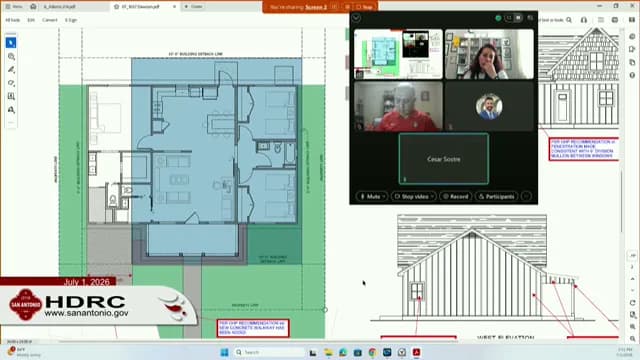
The Historic and Design Review Commission (HDRC) met on July 1, 2026, with a quorum present. Acting Chair Jeffrey Fetzer presided over the meeting, which included approval of consent agenda items, public testimony, and discussion of four individual cases. The Commission granted conceptual approvals for two projects, approved one project as presented, and approved a residential accessibility ramp after deliberation. City offices will be closed on July 3, 2026, for the July 4 holiday. Public Comments & Testimony - A staff member (Casey) requested that applicants provide photographs of all sides of a building for administrative approvals, noting inconsistencies that raise concerns. - Bianca Maldonado, representing Montechillo Park Neighborhood Association (MPNA), spoke in support of the project at 1901 Fredericksburg Road (item 4) with an additional stipulation that the fenestration pattern on the Donaldson Avenue elevation be reevaluated to relate to the historic structure. Consent Calendar - Meeting minutes from June 17, 2026, were approved unanimously. - Five consent agenda items were presented: 402 Carleton Court (ADA ramp), 218 Adams, 1901 Fredericksburg, and 1103 Cincinnati. - Commissioner Savino pulled item 2 (402 Carleton Court) for discussion. - Motion to approve items 1, 3, 4, and 5 with staff stipulations carried unanimously. - Item 2 (402 Carleton Court): The applicant requested a ramp for a 70-year-old mother who uses a walker. The ramp would be temporary/removable and placed at the front due to an unpaved gravel rear area. Discussion centered on alternative rear placement and front door blocking. The Commission approved the ramp after a vote (7 ayes). Discussion Items Item 6: 14 Adams Street (HDRC 2026-162) – Conceptual Approval - Applicant: Christian Vasquez, architect; Kyle (co-architect). Requested a certificate of appropriateness for a two-story rear addition and a two-story rear accessory structure. - Staff recommended conceptual approval with 11 stipulations, including reuse of historic windows, height reduction, wood columns, standing seam metal roof, and garage door design. - The applicant agreed to all stipulations but noted height of the addition (ridge at 25'9") and accessory structure required further exploration. - Commissioners raised concerns about overall height, tree preservation, landscaping, and water runoff (flat roof section). A design review committee (DRC) was recommended. - Motion for conceptual approval with staff stipulations and a DRC carried unanimously. Item 7: 1037 Dawson (HDRC 2026-158) – Conceptual Approval - Applicant: Nicole Sostra (in person) and Caesar Sostray (virtual). Requested a certificate of appropriateness for new single-family construction on a vacant lot in the Dignity Hill Historic District. - Staff did not recommend approval and listed nine stipulations, including setbacks, width reduction, massing/roof form, foundation height, and landscaping. - The applicant provided an updated plan addressing many stipulations but maintained the proposed width due to lot size. Staff suggested potentially reducing the front setback to allow a narrower structure. - Discussion focused on window proportions, porch massing, and driveway width. Commissioner Velasquez expressed concern about the front door orientation but deferred to DRC. - Motion for conceptual approval with staff stipulations and a DRC carried unanimously. Item 8: 7303 Old Corpus Christi Road (HDRC 2026-163) – Conceptual Approval - Applicant: Tyler Schlinke and Clay Schlinke (developers). Requested a certificate of appropriateness for 21 two-story multi-family structures in the River Improvement Overlay (RIO) District. - Staff recommended approval with 10 stipulations, including sidewalk, curb cut width (max 25 feet), landscaping, mechanical screening, primary orientation of easternmost structures toward Old Corpus Christi Road, and design variations. - The applicant stated many stipulations were already met or in progress but noted the curb cut was already built at 34 feet as approved by the city. Staff clarified they would work with development services on classification. - Commissioners discussed design variations (roof forms, siding, colors), front door orientation (side vs. front), and consistency with urban pattern. Commissioner Velasquez opposed side-entry doors for all units, arguing they undermine street safety and pattern. The applicant offered a mix of front and side entries. - Motion for conceptual approval with staff stipulations and a DRC carried unanimously (Commissioner Velasquez did not vote in opposition; roll call showed all ayes). Item 9: 145 Terrain Boulevard (HDRC 2026-159) – Approval as Presented - Applicant: Heather Keenan (consultant) for clients Stephanie and Jacob Abrami. Requested a certificate of appropriateness to enlarge a rear window opening (two existing windows into one picture window) and replace a non-historic window on the west facade with a casement window. - Staff did not recommend approval, citing historic window profile guidelines. However, staff noted the windows were on a non-original rear addition and the products met material standards. - The applicant argued the new windows would be more historically appropriate than existing vinyl windows and are not visible from the street. - Discussion centered on whether opening modifications were acceptable. Some commissioners supported the upgrade given the non-historic nature of the addition. - Motion to approve as presented passed (6 ayes, 2 nays: Commissioners Savino and Fetzer voted nay). Key Outcomes - Consent Agenda (items 1, 3, 4, 5): Approved with staff stipulations. Item 2 (402 Carleton Court ramp) approved after separate vote. - Item 6 (14 Adams Street): Conceptual approval with staff stipulations and a DRC scheduled for the following Tuesday. - Item 7 (1037 Dawson): Conceptual approval with staff stipulations and a DRC scheduled for the following Tuesday. - Item 8 (7303 Old Corpus Christi Road): Conceptual approval with staff stipulations and a DRC scheduled for the following Tuesday. - Item 9 (145 Terrain Boulevard): Approved as presented (6-2). - All decisions are advisory to the city manager; certificates of appropriateness will be issued within 10 days.
The Historic and Design Review Commission (HDRC) met on July 1, 2026, at 3:02 PM to consider five agenda items, including one consent calendar, one accessibility ramp request, two residential additions/new construction, and one window replacement. The meeting included public comment and referred several items to the Design Review Committee (DRC) for further refinement. Consent Calendar - Items 1, 3, 4, and 5 (addresses: 402 Carlton, 404, 218 Adams, 11. 1901 Fredericksburg Road, and 11.03 Cincinnati) were approved unanimously with all staff stipulations. - Bianca Maldonado of the Monticello Park Association spoke in favor of item 4 (1901 Fredericksburg Road) and requested an additional sixth stipulation requiring that the new window opening on the east elevation match the height and craftsmanship of the historic structure. Public Comments & Testimony - Bianca Maldonado (Monticello Park Association) requested consistency in administrative approvals, specifically that staff require the same level of documentation (including photographs of site and context) for items presented to the HDRC as for those handled administratively through CITAP. Discussion Items - Item 2 – Accessibility Ramp: The applicant, speaking on behalf of his 70-year-old mother with mobility needs, requested a permanent ramp from the front porch due to gravel and uneven surfaces in the rear. Commissioner Sabino expressed concern about placement and lack of rear photographs, but the applicant confirmed the rear was not viable. The commission approved the ramp unanimously with staff stipulations. - Item 6 – 214 Adam Street: Architect Cristian Vázquez presented a proposal for a two-story rear addition and an accessory dwelling unit. Staff stipulations addressed height (currently 25’9” peak), historic window reuse, metal roofing, railings, and setbacks. Commissioner Mazuca requested a tree replacement plan. The concept was approved unanimously with conditions and referral to the Design Review Committee (DRC) for final details. - Item 7 – 1037 2nd Street (Jignawe Hill Historic District): The applicant proposed a new single-family structure on a subdivided lot. Staff did not recommend approval and listed eight conditions including reduced front setback, integrated porch, and consistent window proportions. Commissioners discussed the narrow lot and alignment with historic patterns. Commission approved the concept with conditions and referral to DRC, including a stipulation that all windows maintain consistent proportions. - Item 8 – 7303 Corpus Christi Road: Developer Taler Schrecky presented a plan for 22 duplex units in the River Overlay District. Staff recommended conditions such as 25-foot driveway width, varied design, and alternating paint colors. Commissioner Velázquez objected to all side-facing front doors, citing security and neighborhood pattern. The applicant agreed to mix front and side entry orientations. The concept was approved with conditions and referral to DRC. - Item 9 – 145 Terrain Boulevard: The applicant sought to replace two windows: one fixed 73-inch window and a non-historic window on the west façade. The house had no original windows. Consultant Heather Kemen explained the changes improve functionality and are not visible from the street. Commissioners noted the modifications are to non-original openings. Approved as presented (6–2, with Commissioners Sabino and Fetzer dissenting). Key Outcomes - Consent items approved unanimously (8–0, with Davis abstaining on minutes but voting yes on items). - Item 2 approved unanimously. - Items 6, 7, and 8 approved conceptually with staff stipulations and referrals to the Design Review Committee. - Item 9 approved (6–2). - The Commission reminded applicants that certificates of appropriateness will be mailed within 10 days, and no work may commence without proper permits. - The next regular meeting will be after the July 3 holiday closure.
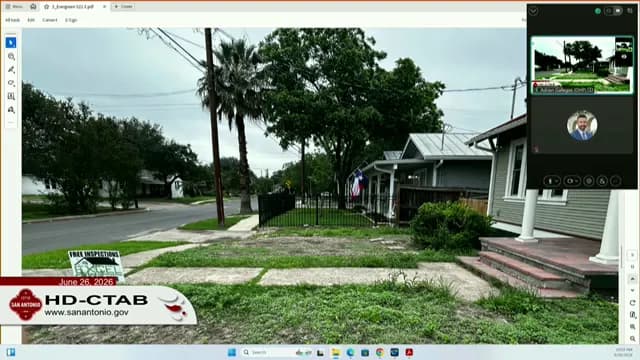
The Compliance and Technical Advisory Board (CTAB) met on Friday, June 26, 2026, at 9:05 AM. Chairwoman Juanita Sepulveda presided with Vice Chair Jason Vasquez and commissioners Davis, Garcia, Regard, Spiller, Fullerton, and Pollock present. A quorum was established. The board approved minutes from May 22, 2026, and a consent agenda item before reviewing two Certificate of Appropriateness cases. Consent Calendar - Meeting Minutes (May 22, 2026): Approved unanimously via roll call vote (Davis aye, Garcia aye, Regard aye, Spiller aye, Pollock aye, Sepulveda aye). - Consent Agenda Item: Approved unanimously via roll call (same tally). Discussion Items Case 1: CTAB Case 2026 – 322 Lay Street (Fence and Driveway) - Applicant: Matthew Chessler and Alia requested a Certificate of Appropriateness to install a 4-foot tall steel post and wire front yard fence with a pedestrian gate and two driveway gates, plus a concrete ribbon driveway on the northeast side. - Staff Recommendation: Approve the fence with stipulations (solid 4x4 wood posts, maximum height 4 feet, only one driveway gate installed behind the front facade plane); deny the ribbon driveway (finding E) and recommend using the existing western driveway. - Discussion: Applicants argued for functionality (two-generation household, child, dog, security, and prior water line leaks from gravel driveway). They noted similar fences exist in the neighborhood. Commissioners debated historic guidelines (2012 and 2022) vs. functionality and safety. A motion was made to approve staff's recommendations. - Vote: Motion carried (Davis nay, Garcia aye, Regard aye, Spiller aye, Fullerton aye, Pollock nay, Sepulveda aye). Applicants were advised to work with staff to finalize compliance. Case 2: CTAB Case 2026-132 – 522 East Evergreen (Driveway Width) - Applicant: Arian, with Carlos and his mother, requested an 18-foot wide concrete driveway at the northeast corner of the lot. - Staff Recommendation: Approve a 10-foot wide driveway with a 12-foot approach (curb cut flare). - Discussion: Applicant cited lack of on-street parking due to nearby hospital, angled house orientation, three vehicles, and an inaccessible rear alley. A letter from the neighborhood association was submitted. Commissioners considered site constraints and historic guidelines. A compromise of 16 feet was proposed, with an option to add 2 feet using permeable surfaces (e.g., grass crete). - Motion: Approve a solid concrete driveway up to 16 feet wide, with an approach no wider than 18 feet, and allow an additional 2 feet (to reach 18 feet total) using a permeable surface, subject to staff coordination. - Vote: Motion carried (Davis aye, Garcia aye, Regard aye, Spiller aye, Fullerton aye, Pollock aye, Sepulveda nay). Key Outcomes - Case 1 (322 Lay Street): Fence approved with staff stipulations; ribbon driveway denied. Applicant to submit updated site plan and work with staff. - Case 2 (522 East Evergreen): Driveway approved at 16 feet wide (solid) with option for additional 2 feet in permeable material. Applicant to coordinate with staff for final design. - Meeting adjourned at 10:35 AM.
The Technical Compliance and Advisory Board (CITAP), an advisory board appointed by the city council, met on June 26, 2026, from 9:05 AM to 10:35 AM. Members present: Davis, García, Regard, Spiller, Fullerton, Pollack, Vázquez, and Sepúlveda (President). The board advises on certificate of appropriateness requests for properties in historic districts. Consent Calendar - [The board approved the minutes from the May 22, 2026 meeting and one consent agenda item (unknown specifics) without discussion. Votes were unanimous among present members.] Public Comments & Testimony - [No public comments were registered for either agenda item.] Discussion Items - CITAP Case 2026-144 – 32 Lake Street The applicant, representing the property owner, requested a certificate of appropriateness for two items: (1) a 4-foot-high pedestrian fence along the front property line, and (2) a concrete band (strip) in front of the structure. Staff recommended approval of the fence with wood posts (not metal), placed behind the building's façade plane, with only one vehicle entrance. Staff recommended denial of the concrete band, suggesting instead use of the existing configuration on the eastern side. The applicant cited safety for a two-year-old child and dog, privacy, and functional needs for two residences on the lot (a main house and a secondary unit). The applicant was open to wood posts but preferred iron for durability. Discussion centered on the second driveway (existing) and the proposed concrete band. Commissioners expressed support for the fence but concern over the second driveway and concrete band. A motion was made to approve item 1 (fence) with staff's stipulations: wood posts, height not to exceed 4 feet, only one vehicle entrance, and a revised site plan showing the entrance location. The motion passed 6–1 (Davis, García, Regard, Spiller, Fullerton, Sepúlveda yes; Pollack no). The concrete band was not approved; the applicant was directed to work with staff on a compliant alternative. - CITAP Case 2026-??? – 522 East Evergreen The applicant sought approval to install a driveway in an unpaved area on the property. Parking on the street is not permitted, and the property has three residents. The proposed driveway would provide parking. Staff recommended a 10-foot-wide driveway with a 2-foot shoulder (total 12 feet). The applicant requested an 18-foot width to accommodate two vehicles side by side, citing similar driveways in the neighborhood. Discussion included the historic character of the area, the narrow lot, and the presence of a rear alley (used by a neighbor). Commissioners debated the appropriate width, with concerns about the visual impact on the streetscape. A motion was made to approve a driveway width of 16 feet, not to exceed 18 feet, with the option for the additional two feet to be permeable surface (e.g., grass pavers) to allow vegetation. The motion passed 6–1 (Davis, García, Regard, Spiller, Fullerton, Pollack yes; Sepúlveda no). The applicant was instructed to coordinate with staff on final design and materials. Key Outcomes - Case 2026-144 (32 Lake Street): Approved the pedestrian fence with conditions (wood posts, 4 feet height, single vehicle entrance, revised plan). Denied the concrete band. Vote: 6–1. - Case 522 East Evergreen: Approved a driveway of up to 16 feet width (with potential 2-foot permeable strip), subject to staff coordination. Vote: 6–1. - The board concluded the meeting at 10:35 AM.
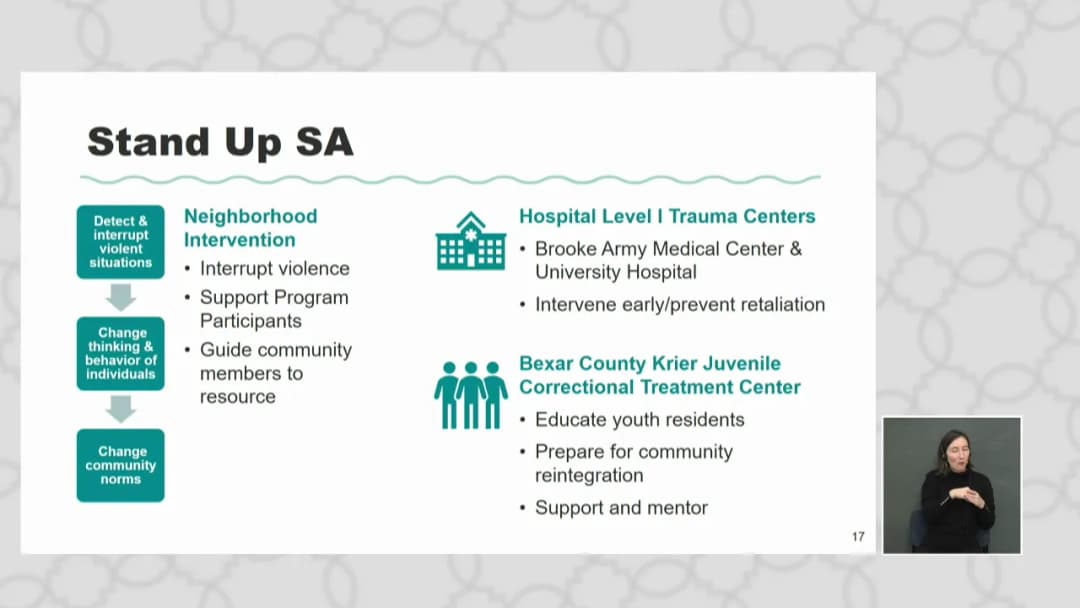
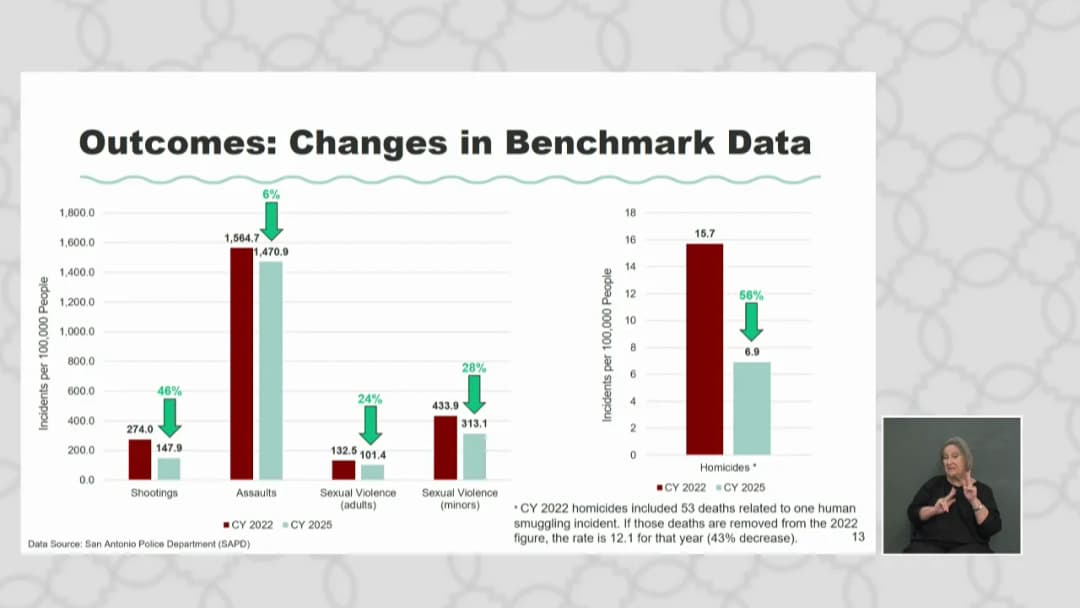
The Community Health Committee convened at 10:00 a.m. on June 25, 2026, to receive a briefing from Metro Health on the Regional Violence Prevention Strategic Plan and the Stand Up SA gun violence intervention program. The presentation covered community-wide violence data, program metrics, and a discussion on funding priorities and evaluation challenges. Public Comments & Testimony - Roger Garza, Texas State Director for Giffords, spoke in support of expanding violence prevention efforts. He advocated for the creation of a centralized Office of Violence Prevention and sustained investment in evidence-based community-driven strategies such as hospital-based intervention, street outreach, and case management. Discussion Items - Presentation by Metro Health (Dr. Jacob, Erica Haller Stevenson): - Provided an overview of violence as a public health issue. Key statistics for 2024: homicide was among the top four causes of death for ages 1–34 in Texas; SAPD reported 126 homicides; Bexar County had seven family violence calls per 911 each hour; 16% of homeless individuals were survivors of domestic violence; CPS confirmed over 3,000 child abuse cases. - The city’s violence prevention budget is $11.5 million (current year), with 67% allocated to domestic violence, 17% to Stand Up SA (gun violence intervention), 5% to Triple P (child abuse prevention), and the remainder to support staff and data collection. - The Regional Violence Prevention Strategic Plan (2024–2028) was launched in January 2024. Midterm assessment shows the city is implementing three-quarters of the plan’s strategies across four priority areas: youth violence, gun violence, sexual violence, and domestic violence. - Crime data (2022 vs. 2025) shows declines in rates: shootings down 46%, homicides down 56% (43% if excluding the 2022 migrant death incident), sexual violence (adults and minors) down, and assaults down 6%. - Stand Up SA, a Cure Violence model program, began in 2015 on the east side (District 2) and expanded to the west side (Districts 1 and 5) in 2022. In FY25, staff interrupted nearly 500 violent conflicts, and the program includes hospital-based response and juvenile justice engagement. - Council Q&A and Discussion: - Councilmember White questioned the attribution of crime reductions to specific programs versus hotspot policing and requested a cost-effectiveness analysis per dollar spent. He noted the difficulty of linking public health interventions directly to outcomes. - Councilmember Castillo asked about coordination with the Neighborhood and Housing Services Department (NHSD) and delegate agencies. Metro Health and DHS provided details on domestic violence relocation assistance and funding levels ($1.2 million for domestic violence agencies serving 2,300 individuals, $1.5 million for child abuse programs serving 3,700 children/families). - Councilmember Alderete Gavito raised concerns about serving immigrant and veteran populations and asked about automatic referrals to Ready to Work employment pipeline. Metro Health confirmed they train staff on Ready to Work but lack a formal referral system; the Chair suggested exploring a “button” for automatic referrals. - Councilmember Mesa Gonzalez requested a gun safe distribution partnership and inquired about healthy relationship education in schools. Metro Health noted legal barriers from the governor’s office but highlighted workarounds through after-school programs and partnerships with SAISD. - Councilmember White (District 2) emphasized the value of Stand Up SA in his district (which contains two of the five target zones), urged consideration of 13–15 year olds for prevention, and supported the centralized hub model discussed at a re-entry roundtable. - Chair Galan raised questions about grant funding landscape (CDC’s Office of Injury and Violence Prevention dismantled, limited DOJ funds) and the need for dedicated staff to monitor the strategic plan’s implementation and data integration. He requested area-specific crime data and comparison with peer cities. Key Outcomes - Metro Health will follow up with council on: - A cost-effectiveness analysis for violence prevention programs. - A partner slide listing delegate agencies for each priority area. - Exploring an automatic referral system between Metro Health and Ready to Work. - Councilmember White will connect with Metro Health on a potential visit to the juvenile justice facility. - The Chair suggested bringing a more detailed update (including area-level data) back to the committee later in 2026 or early 2027. - No formal votes were taken; the meeting adjourned at 11:12 a.m.
The San Antonio Health Committee met on June 25, 2026, to receive a presentation from Metro Health on the strategic plan for violence prevention. The meeting was called to order at 9:59 AM, with a roll call and approval of the minutes. No public comment was offered. Presentation and Discussion - Presentation by Jake Jacob of Metro Health: Jacob outlined the strategic plan to address violence as a public health issue. He reported that in 2024, homicide was a leading cause of death for ages 1–34 in Texas, with 126 homicides in San Antonio and over 9,000 domestic violence calls. The Metro Health violence prevention budget totals $11.5 million, with approximately three-quarters from the general fund and 10% from Medicaid extension. - Crime trend data: Comparing 2022 and 2025, assaults decreased by 6%, shootings by 4%, domestic violence among adults and minors decreased, and homicides fell by 56%. The violence interruption program, launched in 2015 on the south and west sides, interrupted 125 acts of violence in 2025. - Council member questions and comments: - Council Member González asked how to compare program effectiveness per dollar, calling for more rigorous cost-benefit analysis. Metro Health replied that they do not yet have a direct per-dollar comparison but will adjust priorities during budget discussions. - Council Member Castillo praised the work and asked about coordination with NHSD on relocation assistance. Metro Health noted a $1.2 million investment in delegated agencies for relocation. - Council Member Aldrete Gabito inquired about sexual abuse education in schools, noting legal barriers to curriculum adoption. Metro Health mentioned ongoing discussions with school districts, including a pilot program with SAISD. - Council Member White emphasized the importance of prevention and connecting with vulnerable populations, including veterans and active-duty service members. - Council Member Tenoscoro asked about comparing San Antonio to other cities. Metro Health explained that different crime coding across cities makes direct comparison difficult, so they focus on internal trends. - Council Member White further asked what portion of crime reductions can be attributed to these specific programs. Metro Health acknowledged the difficulty of isolating attribution but highlighted collaborative efforts with police and other agencies. - Budget and funding sources: Metro Health noted that most of their funding comes from the Department of Justice, with limited non-criminal justice funds. They emphasized continued pursuit of federal grants and the need for data-driven resource allocation. Key Outcomes - The committee received the presentation and discussed the strategic plan, with council members expressing support for the program and its preventative approach. - No formal votes were taken, but members directed Metro Health to provide more detailed data on program impact per dollar and by city area. - The committee acknowledged the difficulty of directly attributing crime reductions to specific programs but recognized the overall positive trends. - Next steps include continued collaboration with SAISD on a social-emotional learning curriculum and further budget discussions as part of the forthcoming city budget process. The meeting adjourned at 11:12 AM.
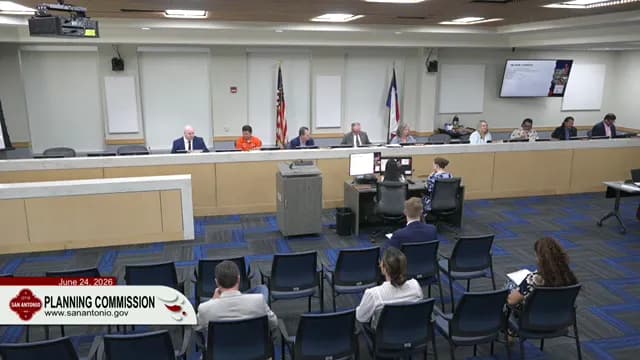
The San Antonio Planning Commission convened on June 24, 2026, at 2:00 PM. The meeting addressed a consent calendar, a postponement request, and a major street name change proposal. Commissioners present included Suki, López, Cooper, Wallersted, Bustamante, Sigal, Profit, Peck, and later Sánchez. Consent Calendar - The consent calendar was approved unanimously by roll call vote, with the exception of items 10, 13, and 16, which were removed for individual consideration. Public Comments & Testimony - Item 16 (Postponement): Cintia Walker registered to speak in opposition but did not address the item; the postponement was granted without further discussion. - Item 10 (Street Name Change): - María Cárdenas (resident on the affected street) expressed opposition to changing the street name back to Durango. She cited the $305,000 cost and argued the money could be better used in District 5. She also opposed the original change to César Chávez. - Elba Flores (caregiver for a disabled resident on the street) spoke in opposition, emphasizing the burden on elderly and low-income residents who would have to update identification, bank accounts, utility bills, and other documents in person, noting many lack internet access or transportation. - Gabriela Hernández Garmitines (resident on César Chávez) spoke in favor of a new name—Perpetuo Socorro—for protection and unity, and stated she was collecting signatures from neighbors. - Rosa García (resident on César Chávez Boulevard) spoke in favor of returning the name to Durango Street, sharing family history and noting that the surrounding neighborhood has streets named San Jacinto, Las Moras, Sanders, and Buena Vista. Discussion Items - Item 16 (Postponement): The applicant requested a two-month postponement to August 26, 2026. Commissioner Bustamante noted that item was moved to the next meeting. The postponement was approved unanimously. - Item 10 (Street Name Change from César Chávez Boulevard to Durango Street): The proposal, initiated by the city (District 5), would rename a segment between 36th Street and Hackberry Street. Staff reported 299 addresses would require new street signs and highway signs, at a total cost of $305,000. Eight neighborhood associations were notified, and no significant support was received during the comment period. The item was previously reviewed by a Community Coordination Review (CCR) on April 13, which recommended approval. - Commissioners expressed concerns about the cost ($305,000) and the financial burden on residents to update documents. Commissioner Profit suggested future use of memorial designations instead of renaming. Commissioner Sánchez asked about funding sources; staff indicated the council office had allocated funds for the César Chávez event and anticipated covering the difference, but no confirmed funding source was identified at that time. Key Outcomes - Item 16: Approved unanimously to postpone to August 26, 2026. - Item 10: Motion to approve the name change back to Durango Street was passed by a vote of 8 in favor (Commissioners Suki, López, Cooper, Wallersted, Bustamante, Sigal, Profit, Peck) and 1 opposed (Commissioner Sánchez). The item will proceed to City Council on August 18, 2026, for a final decision.
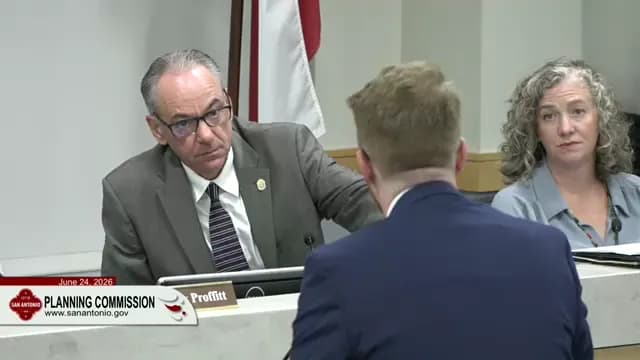
The San Antonio Planning Commission met on Wednesday, June 24, 2026, at 1:00 PM (approximate). The meeting included approval of the consent agenda, a continuance for item 16, and a public hearing on item 10, a proposal to rename Cesar Chavez Boulevard to Durango Boulevard. After hearing public testimony and commission discussion, the street name change was approved on a 9-1 roll call vote. Consent Calendar - All consent agenda items (except items 10, 13 (removed), and 16) were approved unanimously. Commissioner Bustamante recused himself from the consent agenda. Motion by Commissioner Prophet, second by Commissioner Cooper. Roll call vote: 8 yeas, 0 nays (Commissioner Lopez appeared absent during this vote but later participated). Public Comments & Testimony - Maria Cardenas (address not provided) opposed the street name change. She questioned the allegations against Cesar Chavez and argued he deserves to be honored for his work with farm workers and unions. She stated the $300,000 cost could be better spent elsewhere in District 5. - Elva Flores (address not provided) opposed the change, detailing the significant burden on her disabled family member and other low-income senior residents along the street. She noted they would need to change IDs, bank accounts, utility bills (CPS, water), and insurance in person, which is especially difficult for those without cars or computer access. - Gabriela Hernandez Martinez (address: 40 75 26 Cesar Chavez, speaking in Spanish with interpreter) presented signatures from neighbors requesting the street be renamed to "Virgin of the Perpetuo Socorro" for protection and unity. She asked the commission to consider that name. - Unnamed speaker (address: 1717 West Cesar E. Chavez Boulevard) supported the change to Durango Boulevard. She noted her father's contributions to the neighborhood and that Durango is a beautiful state in Mexico, fitting with other street names in the area. Discussion Items - Item 16 (continuance): The applicant requested a two-month continuance to the August 26, 2026 meeting. Cynthia Walker was signed up to speak but declined to speak at that time. The commission granted the continuance unanimously (roll call: 9 yeas, 0 nays). - Item 10 (street name change): - Staff presentation by Clayton Walsh, Interim Principal Planner: The proposal changes Cesar Chavez Boulevard (from SW 36th Street in District 6 to S Hackbury Street in District 2) to Durango Boulevard. Approximately 295 addresses will need to be changed; 412 notices were sent to property owners, and 8 neighborhood associations were notified. The estimated cost is $305,200, split between application fees, notification costs, and sign replacement (city and highway signs). Community listening sessions were held April 8 and 11; technical review found only support. HDRC recommended approval. City Council decision is expected in August 2026. - Commissioner questions: Commissioner Bustamante asked if city resources would help residents with address changes; Walsh said no funds are allocated for that currently and directed residents to their council offices. Commissioner Prophet noted the high cost and suggested memorial designations as an alternative for future recognitions. Commissioner Sanchez asked about the funding source; Walsh replied that part may come from funds previously set aside for a Cesar Chavez event, but the remainder is not yet confirmed. - No further questions after public testimony. Key Outcomes - Consent agenda approved. - Item 16: Continuance granted to August 26, 2026. - Item 10: Motion to approve the street name change to Durango Boulevard (Commissioner Prophet, second by Commissioner Siegel). Roll call vote: 9 yeas, 1 nay (Commissioner Sanchez voted no). Motion passed, recommending approval to City Council. - Meeting adjourned at 2:22 PM.