Browse by city
Date range
Search help

Search titles, summaries, topics and stored transcripts together. Keywords may match separately; put the whole query in double quotes for a phrase. Matching follows word analysis, so punctuation is not exact. Both dates are included. Documents are not searched.

SHOWING 351–360 ENTRIES
351
APR 9, 2026 · SAN ANTONIO, TEXAS · CITY COUNCIL
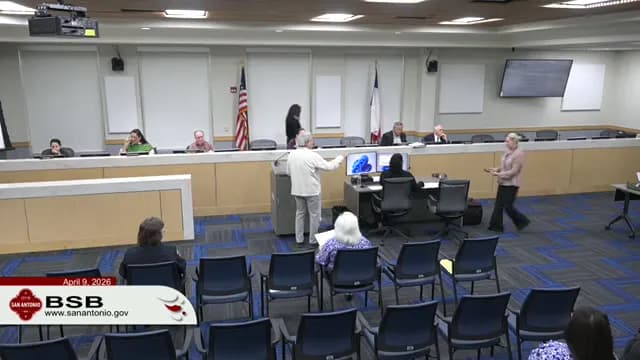
San Antonio City Council Meeting: Fiesta Proclamations, Detention Center Report, and Market Square Fee Debate (April 9, 2026)

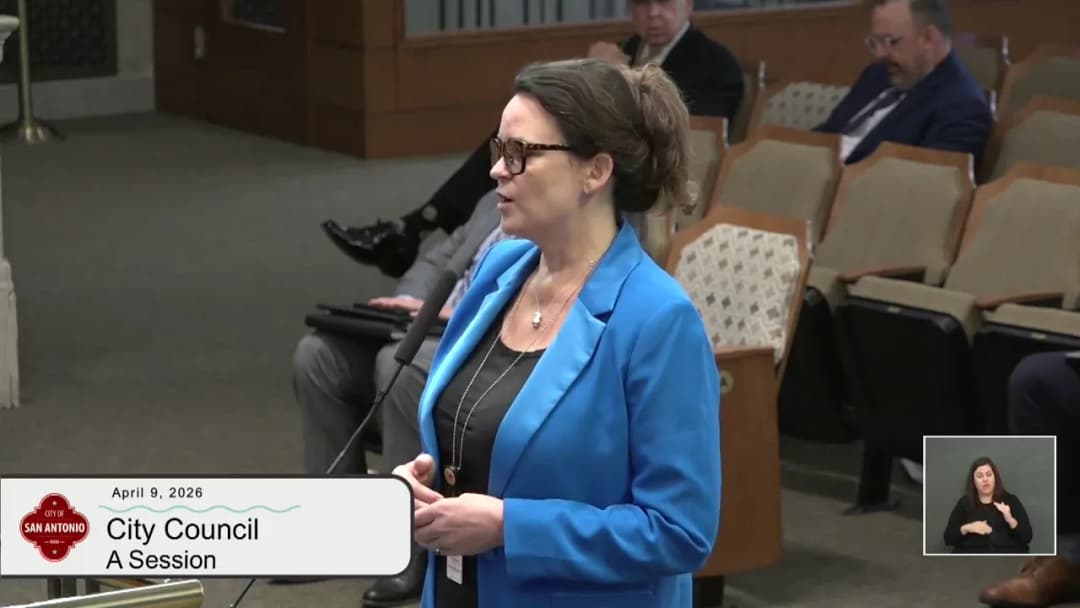
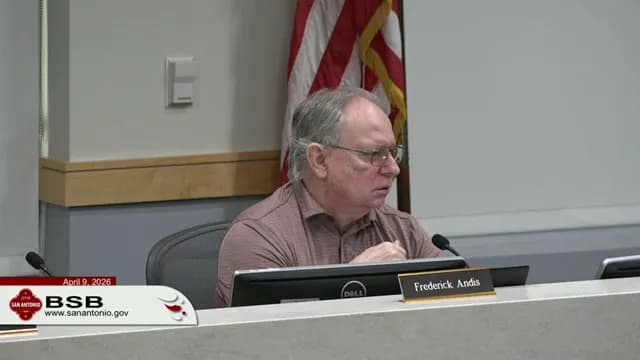
The San Antonio City Council convened on April 9, 2026, at 9:07 a.m. with Mayor Gina Ortiz Jones presiding. The meeting began with an invocation and pledge of allegiance, followed by multiple proclamations recognizing Fiesta San Antonio 2026, King Antonio, Rey Feo, the Nayosa Society (77th presentation), the Battle of Flowers Parade, and the Fiesta Flambeau Parade. Council members expressed gratitude for the economic and charitable impact of Fiesta. City Manager’s Report City Manager Maria provided an update on the resolution approved February 12 regarding the protection of all San Antonio residents, specifically concerning private detention centers. Completed actions: A request for information on AIS activity in San Antonio was posted on the city's website (regional data only). Ongoing actions: Amendments to the unified development code to regulate private detention centers are scheduled for the April 16 session. The city is evaluating options for tracking alleged rights violations, with a report expected by April 15. The city is also assessing whether detention facilities comply with federal environmental law and considering including legislation in the 120th Congress agenda. Mayor noted she sent a letter to the new DHS secretary expressing lack of interest in detention centers, with no response yet. A national APA timeline was mentioned: a firm has been engaged to prepare court documents for compliance. Consent Calendar - Point 7: Lease contract with San Antonio Tennis Association. - Point 8: Temporary street closures for Fiesta celebrations. - Point 9: Ordinance for Airport Infrastructure Program – acceptance of $12.5 million for terminal development (expected opening Q2 2028). - Point 14 & 15: Reappointments to the Robert Bank (Housing Board) – board with authority to issue demolition orders, prioritizing public health and safety. - Point 20: Designation of a memorial along Highway 1604 honoring Officer David Evans, who died from injuries sustained in the line of duty. Family members spoke in gratitude. - Additional appointments noted (Robert Mijara to Bridges and Streets board). The consent calendar was approved unanimously, with Point 17 pulled for individual consideration. Public Comments & Testimony (on Item 17) Multiple speakers addressed the proposed $5 entry fee for Fiesta de los Reyes at Market Square: - Telma González (business owner for 35+ years) opposed the fee, stating it changes the spirit of Market Square, reduces traffic, and limits access for families who have enjoyed free entry for decades. - Ivette Ramírez (President of Market Square Plaza de San Antonio Association) expressed concerns about lack of transparency, noting the fee was not properly voted on and that the city already spends $400,000–$600,000 on security for the event. She argued the fee would restrict public access to a historic public space. - Verónica Sandoval added that the organization has not provided a transparent record or map regarding alcohol sales expansion, and that the city has not received its share of alcohol revenue as per previous agreements. - Sofía Vázquez (retired pastor, District 4 resident) opposed the fee, recalling that her family could only afford Fiesta by attending free events at Market Square. She noted the economic burden on low-income families. - Román Peña (retired Market Square participant) recalled that in the past, a $1 fee was rejected by the mayor to keep the event free. He warned of potential protests (huelga) if the fee is imposed. - Henry Rodríguez (executive director, Lula Concilio Zapatista) argued the fee targets low-income residents from housing projects who attend Market Square as their only affordable Fiesta activity. He called it an insult and urged council to be heroes for the people. - Elaine de los Santos (interim director, Rey Feo Council) supported the fee, explaining security costs increased due to incidents. She detailed the compromise: weekdays free until 6 p.m. or 5 p.m., weekends free until 1 p.m. (with different hours for various days), and children under 12 free. The fee would fund security and scholarships. - Frank Garza (sub-chief, Fiesta de los Reyes since 2011) supported the fee as a reasonable measure, noting that the event costs $1 million to produce, and 50% of net revenue goes to the city. He emphasized that the fee only applies to certain hours and helps fund scholarships. Discussion Items Item 17: Amendment to Contract with Rey Feo Educational Foundation for Fiesta de los Reyes Magos Sheldon Miller presented the proposed amendment: a $5 entry fee for persons 13 and older during specific hours (weekdays after 5 or 6 p.m., weekends after 1 p.m.), with free entry otherwise. The fee is intended to cover increased security costs (private security for perimeter and screening). The city would receive 25% of revenue above $250,000, estimated at $37,500. The council discussed extensively: - Councilman Galván (who pulled the item) noted that security costs are a shared burden and asked whether the city could subsidize the fee using existing resources. He emphasized that Market Square has historically been free and expressed concern for tenants. - Councilwoman Korr supported the pilot, noting that safety concerns after past incidents require action. She suggested that free weekend hours and children under 12 free mitigate impact. She also mentioned the difficulty of funding security from city budget. - Councilwoman Gavito supported the fee, citing the need for scholarship funding and safety. - Councilwoman Maki Rodriguez strongly opposed the fee, calling it racist and classist. She argued that $5 per person (or $20 for a family) creates a barrier for low-income families who have few other affordable Fiesta options. She questioned why the city cannot cover the security costs given the economic benefits. - Councilman Munguía supported the fee but stressed the need for better implementation and future efforts to keep it free. - Councilwoman Villagran opposed the fee, noting there are many free events and that the Southside is often ignored. She offered to help coordinate free transportation for District 3 residents. - Councilman Castillo expressed concerns about equity and infrastructure neglect at Market Square but ultimately acknowledged the need for safety. Mayor Jones emphasized that the city contributes $3 million overall to Fiesta and loses money on these events. She noted that security is essential and suggested exploring technologies like Clear for future efficiency. The motion to approve Item 17 passed (exact vote tally not provided but appears to be approved). Key Outcomes - Consent Calendar approved unanimously (excluding Item 17). - Item 17 (Market Square entry fee) approved. The $5 fee will be implemented for Fiesta de los Reyes 2026 with the specified free hours and children under 12 free. The council will review the pilot and consider other funding mechanisms in future budget cycles. - City Manager’s report on detention center actions noted; ongoing work continues with a public website for compliance updates. - Memorial designation for Officer David Evans on Highway 1604 approved.
ARTS AND CULTURE 32% · COMMUNITY ENGAGEMENT 20% · PUBLIC SAFETY 13% · PARKS AND RECREATION 8%
352
APR 9, 2026 · SAN ANTONIO, TEXAS · BOARDS & COMMISSIONS
San Antonio Construction Standards Board Panel B Meeting – April 9, 2026

The Construction Standards Board Panel B convened on April 9, 2026, at 9:04 AM and adjourned at 11:58 AM, with a brief executive session from 11:18 AM to 11:29 AM. The board addressed six properties, voting on demolition or repair orders. All meetings were conducted in Spanish with translation services available. Consent Calendar - Approval of Minutes: The board approved the minutes of the previous meeting by voice vote (motion seconded, all in favor). - Staff Report on Emergency Demolitions: Two structures demolished due to fires required no board action: - 563 West Hermosa Drive – demolished April 1, 2026 (fire March 17, 2026). - 111 East Villiers Boulevard, District 3 – demolished April 2, 2026 (fire March 21, 2026). Discussion Items - 725 Roper Street (District 2) – First hearing. The property is a 2,504 sq. ft. commercial structure built in 1935 (with a 1955 addition). Staff documented severe deterioration: foundation settlement, rotted wood, missing siding, interior exposed to weather, unsafe electrical, and unauthorized demolition of a front room. Owner José Alberto Guajardo testified that he has been trying to repair the building, citing health issues and confusion over permits. He presented a foundation contract and photos of partial work. A friend, Cheryl Teak, stated that the foundation contractor delayed work and misled the owner. The board questioned whether the foundation work met code. Motion: The main building is a public nuisance that can be repaired; order repair within 90 days. Accessory structures (wood shed and carport) are irreparable nuisances; order demolition within 30 days. Vote: 5–2 (Kayla Miranda, Joel Solís, George Grimes Jr., Yvonne Addison, Fred Andes in favor; Linda López Rodríguez opposed). Note: The vote was recorded as 5 to 2. - 1918 McCullough Avenue (District 1) – First hearing. This one‑story commercial building (tire shop) has cracked brick veneer, missing roof sections, exposed electrical hazards, and interior water damage. Owner Herbert Lawrence Polinard stated he only recently received notices due to an incorrect address on file and requested a continuance to hire a new contractor. He presented an engineering report arguing that cracks are cosmetic. Staff noted no permits or financial documents were submitted. Motion: The property is a repairable nuisance; reschedule to the next available meeting (allowing the owner to submit required documents). Vote: Unanimous (6–0). - 2402 Higgs Avenue, Building 2 (District 2) – First hearing. A vacant commercial accessory structure with extensive wood rot, graffiti, a collapsed roof, and interior debris. Owner Carla Jean Gonzaba agreed to demolition. Motion: The property is an irreparable public nuisance; order demolition within 30 days, with site cleared of debris. Vote: Unanimous (6–0). - 1728 El Monte Boulevard (Accessory Structure) (District 1) – First hearing. A vacant, unsecured wood accessory building with a failing roof, missing siding, and interior trash. Owner Berta Hernández was not present; her son Juan Rodríguez requested time to obtain a permit and demolish himself. Staff recommended demolition with deconstruction, but the board waived that requirement due to the structure’s condition. Motion: The accessory structure is an irreparable public nuisance; order demolition within 30 days, with deconstruction requirement waived, and property cleared. Vote: Unanimous (6–0). - 312 Fight Alley (District 5) – First hearing. A vacant residential structure with fire damage, a large roof hole, interior debris blocking egress, and unpermitted electrical work. No owner or representative appeared. Motion: The property is an irreparable public nuisance; order demolition within 30 days, with site secured and cleared. Vote: Unanimous (6–0). - 206 Menefee Boulevard (District 5) – First hearing. A vacant commercial structure with broken windows, graffiti, active squatting, and interior water damage. Staff found a person sleeping inside during inspection. The owner’s sister, Aileen López, submitted a written request for continuance to sell the property. The board proceeded. Motion: The property is an irreparable public nuisance; order demolition within 30 days, with the property evacuated, secured, and cleared. Vote: Unanimous (6–0). Public Comments & Testimony - 725 Roper Street: Owner José Guajardo and friend Cheryl Teak testified. - 1918 McCullough Avenue: Owner Herbert Polinard testified, requesting a continuance. - 1728 El Monte Boulevard: Son Juan Rodríguez testified, requesting time to self-demolish. - 2402 Higgs Avenue: Owner Carla Gonzaba agreed with demolition. - 206 Menefee Boulevard: Written request from Aileen López was read into the record. Key Outcomes - 725 Roper Street: Main building must be repaired in 90 days; accessory structures demolished in 30 days. - 1918 McCullough Avenue: Case rescheduled; owner must submit work plan, financial responsibility letter, and engineering report by next hearing. - 2402 Higgs Avenue, Building 2: Demolition ordered within 30 days. - 1728 El Monte Boulevard (accessory): Demolition ordered within 30 days; deconstruction waived. - 312 Fight Alley: Demolition ordered within 30 days. - 206 Menefee Boulevard: Demolition ordered within 30 days; property to be evacuated. - Administrative: The board requested a full committee meeting with the deconstruction team for a future presentation. Two new members (Hassan Hussein and David Balletera) were selected for Panel B; a mayoral appointment (Jaime J. Miller) is pending City Council approval.

CODE ENFORCEMENT 87% · PROCEDURAL 5% · HOUSING 3% · ZONING AND LAND USE 3%
353
APR 9, 2026 · SAN ANTONIO, TEXAS · BOARDS & COMMISSIONS
Building Standards Board Meeting – April 9, 2026

The Building Standards Board (B Panel) convened on April 9, 2026 at 9:04 AM under Chair Kayla Miranda. Six board members were present: Kayla Miranda, Joel Solis, George Grimes Jr., Dr. Linda Lopez Rodriguez, Yvonne Addison, and Fred Andes. The meeting considered six properties for dangerous building violations, heard staff reports and owner testimony, and received one public comment. Votes were taken on each property. Consent Calendar - Emergency Demolitions (No Board Action Required): The structures at 563 West Hermosa Drive (District 2, demolished April 1 2026 after a March 17 fire) and 111 East Villeray Boulevard (District 3, demolished April 2 2026 after a March 21 fire) were reported as demolished per City Code Chapter 6‑175. Before‑and‑after photos were provided. Public Comments & Testimony - 725 Roper Street: Cheryl Tice (500 Corona Avenue) spoke in support of owner Jose Guajardo, describing confusion over permits and delays by the repair contractor. She noted Mr. Guajardo had paid for permits, engineering fees, and a dumpster, and that blueprints were in progress. Her three‑minute time expired; she was asked to submit her full comments in writing. - 206 Manifee Boulevard: A letter from Eileen Lopez (sister of the owner, who is disabled) was read into the record, requesting a reset because she could not attend from out of town and the property was for sale. The board proceeded with the hearing. Discussion Items 725 Roper Street (District 2) – Staff (Officer Cynthia Santana) recommended demolition due to extensive code violations (subsections 1,2,5,7,8,12,15,17,18). The structure was severely deteriorated: foundation failure, water damage, missing roof decking, and interior exposure. Owner Jose Guajardo requested repair, stating he had paid for foundation work, received engineering plans, and had a contractor ready. He provided partial documentation but no complete scope of work or financial proof. After questions on permits and progress, the board debated feasibility. A motion was made to order repair of the main structure within 90 days and demolition of the two accessory structures within 30 days. 1918 McCullough Avenue (District 1) – Staff (Officer Hassan Arazawi) recommended repairs for a commercial structure with cracked brick siding, interior water damage, and electrical hazards (subsections 1,2,5,7,8,11,12,15). The owner, Herbert Polinard, stated he had not been properly notified (address issue), his contractor recently passed away, and he needed time to obtain a new contractor and bids. He provided an engineer’s report. The board granted a reset to the next available date to allow him to prepare required documents. 2402 Hicks Avenue 2 (District 2) – Staff (Officer Ryan Garza) recommended demolition of an accessory structure with severe roof collapse, water damage, and vagrant activity (subsections 1,2,5,7,8,11,12,15,17,18). Owner Carla Jean Gonzaba appeared and agreed to demolition. The board ordered demolition within 30 days, with the property secured and free of debris. 1728 El Monte Boulevard (District 1) – Staff (Officer Hassan Arazawi) recommended demolition of an accessory structure that was collapsing, unsecured, and full of debris (subsections 1,2,5,7,8,11,12,15,17,18). Deconstruction was required because the structure may predate 1945. The owner’s son, Juan Rodriguez, stated he was willing to demolish but needed 60 days due to previous confusion over permits. After an executive session to discuss legal matters, the board ordered demolition within 30 days and voted to waive the deconstruction requirement. 312 Fight Alley (District 5) – Staff (Officer John Garza) recommended demolition of a vacant residential structure with fire damage, roof holes, and interior deterioration (subsections 1,2,5,7,8,11,12,15,17,18). No owner or representative appeared. The board ordered demolition within 30 days, with the property secured and free of trash and debris. 206 Manifee Boulevard (District 5) – Staff (Officer Jaime Hassel) recommended demolition of a commercial structure that was occupied by vagrants, had water damage, deteriorating siding, and no utilities (subsections 1,2,5,7,8,11,12,15,17,18). The owner was not present; a sister requested a reset but the board proceeded. The board ordered demolition within 30 days, with the property vacated, secured, and free of trash and debris. Key Outcomes - 725 Roper Street: The main structure was declared a public nuisance feasible to repair; ordered repaired within 90 days of order issuance. Accessory structures 1 and 2 were declared not feasible to repair; ordered demolished within 30 days. Note: The board chair initially announced a vote of 5‑2, then corrected to 4‑2. The roll call showed 5 yes (Miranda, Solis, Grimes, Addison, Andes) and 1 no (Lopez Rodriguez), indicating a discrepancy. The final recorded order reflects 4‑2. Owner to receive instructions from the code officer. - 1918 McCullough Avenue: Case reset to the next available BSB hearing date. Owner must provide contractor estimates, financial proof, and a complete scope of work. Vote: 6‑0. - 2402 Hicks Avenue 2: Accessory structure ordered demolished within 30 days; property to be secured and free of trash and debris. Vote: 6‑0. - 1728 El Monte Boulevard: Accessory structure ordered demolished within 30 days; deconstruction requirement waived; property to be free of trash and debris. Vote: 6‑0. - 312 Fight Alley: Structure ordered demolished within 30 days; property to be secured and free of trash and debris. Vote: 6‑0. - 206 Manifee Boulevard: Structure ordered demolished within 30 days; property to be vacated, secured, and free of trash and debris. Vote: 6‑0. The meeting adjourned at 11:58 AM.

CODE ENFORCEMENT 89% · PROCEDURAL 4% · ZONING AND LAND USE 2% · HISTORIC PRESERVATION 2%
354
APR 8, 2026 · SAN ANTONIO, TEXAS · CITY COUNCIL
San Antonio City Council B Session – COSA Connect Update and Contract Recommendation – April 8, 2026

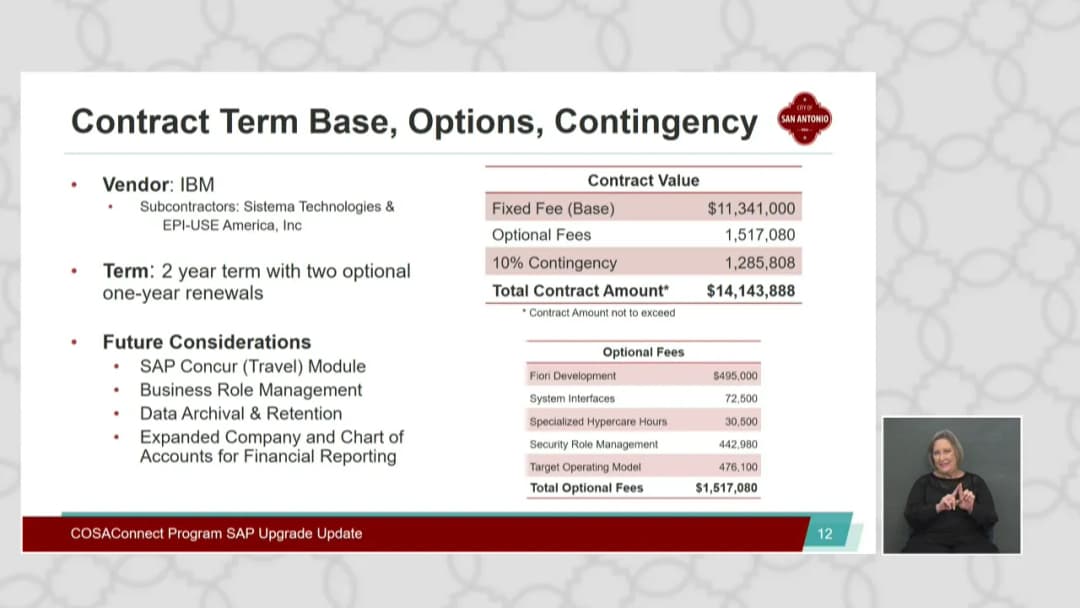
The San Antonio City Council convened in B session on Wednesday, April 8, 2026, at 2:02 PM. The meeting focused on an update to the COSA Connect program, the city's multi-phase effort to modernize its financial and procurement systems (SAP S/4HANA and SAP Ariba). City staff presented the program's progress, a finalized solicitation for a system integrator, and a recommendation to award a contract to IBM. No votes were taken; council members provided feedback and asked questions. The meeting adjourned at 4:19 PM after an executive session. Public Comments & Testimony - Three individuals signed up for public comment, but no transcript of their remarks was provided. The council noted their presence but no content was recorded. Discussion Items - COSA Connect Program Overview: Craig (deputy city manager) and Troy (project lead) presented the program's history, noting the city has used SAP since 2004, with support ending in 2027. The program includes three main phases: HR (SuccessFactors, live 2025), budget (SHERPA, partially live), and the final phase—finance and procurement (S/4HANA and Ariba). Total program cost is $71.9 million over approximately five years. - Solicitation and Scoring: A request for proposals (RFP) was released August 29, 2025, with four respondents: IBM, Ernst & Young (EY), Accenture, and Firecat Studios. An evaluation panel scored proposals on experience/qualifications (60 points), price (15), SBE subcontracting (10), local preference (10), and veteran-owned small business (5). IBM scored highest (66.96 points) after interviews, due to detailed proposed plans and deep team experience (25+ years). - Contract Recommendation: Staff recommended awarding IBM a contract worth $14.1 million (base fee $11.3 million, plus $1.7 million in optional fees and 10% contingency). Options include Fiori development, additional interfaces, extended hypercare, security role management, and a target operating model study. IBM will subcontract with local firm Systema Technologies (training/testing) and EPI-USE America (payroll). - Implementation Timeline: The project follows the SAP Activate methodology with phases: Discover, Prepare, Explore, Realize/Test, Deploy, and Hypercare. Go-live target is October 1, 2027. Expected lifespan of the new systems is 10–15 years. - AI Capabilities: Craig noted that built-in AI assistants (e.g., for sourcing, data queries) are included in the software. Additional AI (SAP Joule) is not being implemented initially due to uncertain pricing (usage-based credits); the city will experiment with one internal team first. - Council Questions and Concerns: Council members raised topics including: cybersecurity; local workforce development and opportunities for small businesses; employee experience during transition; integration with other city systems (e.g., XLA, Accela); data governance and audit capabilities (e.g., deactivating former employees); KPIs and performance measurement; and the need for resident-facing dashboards. Councilwoman Castillo requested evaluation of labor practices in RFP scoring. Councilman Mungia suggested exploring a data aggregation platform (Tolemi). Mayor noted parallel efforts on a unified digital experience and digital twin. Key Outcomes - No formal vote was taken. The council indicated support for moving forward with the IBM contract; staff will bring the contract for consideration at the April 30, 2026, council meeting. - Staff committed to engaging with the Economic Workforce Development Committee (EWDC) to incorporate vendor feedback into system design and to explore local talent development. - An update on the city's AI policy and the digital twin project was requested for future sessions. - The meeting recessed into executive session at 3:17 PM to discuss economic development, real property, litigation, and collective bargaining, then reconvened at 4:19 PM with no action taken.

TECHNOLOGY AND INNOVATION 53% · PROCUREMENT AND CONTRACTING 39% · WORKFORCE DEVELOPMENT 4% · ARTIFICIAL INTELLIGENCE 3%
355
APR 8, 2026 · SAN ANTONIO, TEXAS · BOARDS & COMMISSIONS
San Antonio Planning Commission Meeting – April 8, 2026

The San Antonio Planning Commission met on April 8, 2026, at 2:00 PM. The meeting included a combined consent agenda, three individual agenda items, and recognition of outgoing commissioners. Items addressed zoning amendments, a continuance, and a community plan amendment for auto sales. Consent Calendar - The combined consent agenda (items not individually read) was approved unanimously on a voice vote. All items had staff recommendations for approval and no public speakers registered. Discussion Items - Item 12 – Zoning Change from Industrial/Agriculture to Light Industrial This item was continued from the March 8 meeting. The applicant sought a change to light industrial to allow construction adjacent to other factories. Staff recommended denial due to opposition from nearby property owners. The applicant reported contacting the homeowners' association and neighbors but received no further concerns. During discussion, Commissioner Bustamante noted that opposition had increased from 2 to 6 letters since the previous meeting. The applicant argued that light industrial is the best classification and that the use would not set a precedent for neighboring properties. Motion to deny (by Commissioner Sigo, seconded by Sánchez) failed 3–4 (yes: Sigo, Sánchez, García; no: Succi, López, Bustamante, Peck). A motion to approve (by Commissioner López, seconded by Bustamante) passed 5–1–1 (yes: Sánchez, López, Bustamante, García, Peck; no: Sigo; Succi vote unclear). Item 12 was approved. - Item 13 – Request for Continuance The applicant requested a two-week continuance to the April 22 meeting. The commission approved the continuance unanimously. - Item 14 – Community Plan Amendment (North Central Neighborhood) The request was to change the land use designation from neighborhood commercial to regional commercial for auto sales. Staff recommended denial but the applicant amended the request to a C-2CD (commercial district with auto sales use), which aligned with city code. The neighborhood association consented; the institutional association did not respond. Discussion included questions about pavement in the rear lot and stormwater runoff. The applicant stated the alley would be kept clear and the rear area used for parking. Staff supported the amended request. Motion to approve as amended passed unanimously. Key Outcomes - Item 12 approved: Light industrial zoning granted (vote 5–1–1). - Item 13 continued: To April 22, 2026 (unanimous). - Item 14 approved as amended: C-2CD commercial district for auto sales (unanimous). - Recognition: The commission thanked Commissioner Maylan Aulet and Commissioner García for their 13 years of service.

ZONING AND LAND USE 92% · PROCEDURAL 8%
356
APR 8, 2026 · SAN ANTONIO, TEXAS · BOARDS & COMMISSIONS
San Antonio Planning Commission Meeting - April 8, 2026

The San Antonio Planning Commission met on April 8, 2026, at 2:00 PM, with all members present. The meeting covered a combined consent agenda and three individual hearing items, including a plan amendment for light industrial use, a continuance request, and a community plan amendment for auto sales. Key decisions included the approval of the light industrial request despite staff opposition and the approval of an amended commercial designation for a car sales lot. Consent Calendar - The consent agenda (items not requiring individual discussion) was approved unanimously by a 7-0 vote. Commissioner Bustamante recused himself from items 2, 3, 4, and 8 before the vote and re-entered after. Discussion Items - Item 12 – MPA Plan Amendment (Light Industrial): Staff recommended denial of a request to change from agricultural to light industrial for a property next to a residential neighborhood. The applicant, Ashley Ferramon (Killen Griffin and Fairmond), reported contacting the HOA, which had no questions. Six neighbors opposed, up from two at the prior meeting. During questions, Commissioner Bustamante noted the increased opposition and asked whether approving the change could set a precedent for neighboring lots to request similar uses; staff said any property owner can ask regardless. The commission first voted on a motion to deny (3 yes, 4 no: Commissioners Siegel, Sanchez, Garcia in favor; DeSucci, Lopez, Bustamante, Peck opposed), which failed. A subsequent motion to approve passed 6-1 (Commissioner Siegel opposed). - Item 13 – Continuance Request: A two-week continuance to April 22, 2026 was requested and approved unanimously (7-0). - Item 14 – North Central Community Plan Amendment: The applicant requested rezoning from neighborhood commercial to regional commercial to permit auto sales at 1315 Basi Road. Staff recommended denial of regional commercial but supported amending to community commercial (C2 CD with conditional use for auto sales). The applicant agreed to the amendment. Commissioner Siegel raised concerns about whether paving in the backyard (increasing impervious cover) was permitted; staff agreed to follow up but did not require a delay. The motion to approve the amended request (community commercial) passed unanimously (7-0). Key Outcomes - Item 12: Approved (6-1) for light industrial use, despite staff's recommendation for denial. - Item 13: Continued to April 22, 2026 (unanimous). - Item 14: Approved (7-0) as amended to community commercial, allowing auto sales under conditional use. - Staff recognized outgoing commissioners, including Commissioner Garcia, for their service.

ZONING AND LAND USE 82% · PROCEDURAL 18%
357
APR 8, 2026 · SAN ANTONIO, TEXAS · CITY COUNCIL
San Antonio City Council Session B – SAP Financial System Phase 3 Update (April 8, 2026)

On April 8, 2026, at 2:00 PM, the San Antonio City Council held Session B, receiving an update on Phase 3 of the Connect program to modernize the city’s financial systems. The presentation was led by Chief Financial Officer Troy Kirgan and IT Director Eric, with contributions from council members. The meeting included a transition into executive session at 3:17 PM for legal and collective bargaining matters, reconvening at 4:19 PM with no action taken, and adjourning shortly after. Consent Calendar - There was no consent calendar on this agenda. Public Comments & Testimony - Three members of the public signed up to speak, but their names were not stated in the transcript, and their comments were not included in the recording. Discussion Items - Phase 3 SAP System Upgrade Proposal – City staff presented plans for the final phase of the SAP system modernization, with a target to go live by October 2027. The upgrade aims to improve financial operations, enable better integration with other city systems, reduce reliance on spreadsheets, and include new tools like a co-pilot AI assistant. The contract value is approximately $47.1 million, with about $1.7 million allocated for design and exploration. The selected integrator is IBM, with subcontractors including Ernst & Young (20% local staffing) and FireCat Studio. The project will involve significant organizational change, including changes to workflows and user training. - Employee Impact and Transition – Council members raised concerns about potential job displacement for city staff, the need for robust training programs during the transition, and the importance of recognizing employees who help implement the new system. The presenters acknowledged that some roles may change and that training is critical, adding that the project includes a change management and training budget. - Cybersecurity and Data Governance – Discussion highlighted that moving to cloud-based systems reduces the city’s internal cybersecurity exposure and that SAP’s built-in security tools will help manage user access and prevent issues of former employees retaining system access. - Local and Small Business Participation – Council members emphasized the need to include local, small, and minority-owned businesses in the project, asking for written commitments and reporting on how these firms can be involved. The presenters noted that three local firms have been contracted so far and that they are committed to expanding local participation. - AI Strategy and Costs – The council discussed the city’s policy on artificial intelligence and how the new system’s AI capabilities would be deployed. The cost for citywide access to AI tools was estimated at approximately $300 per employee per year, but council emphasized the need for a clear strategy and training to ensure effective use. - Digital Twin and Resident Services – Council members inquired about digital twin technology and how the new system would improve resident-facing interfaces, such as reporting outages or accessing permits. Staff explained that the project focuses on back-end modernization but will ultimately enable better online services for residents. Key Outcomes - The council received the Phase 3 SAP upgrade update and will consider formal approval of the contract on April 30, 2026. - The council will request a written plan for increasing local and small business participation in the project. - The council will have a future discussion on the city’s AI policy and associated costs. - The meeting moved into executive session at 3:17 PM for legal and collective bargaining discussions, reconvened at 4:19 PM, and adjourned with no action taken.

TECHNOLOGY AND INNOVATION 74% · PROCUREMENT AND CONTRACTING 11% · PERSONNEL MATTERS 7% · PROCEDURAL 3%
358
APR 7, 2026 · SAN ANTONIO, TEXAS · BOARDS & COMMISSIONS
San Antonio Zoning Commission Meeting – April 7, 2026

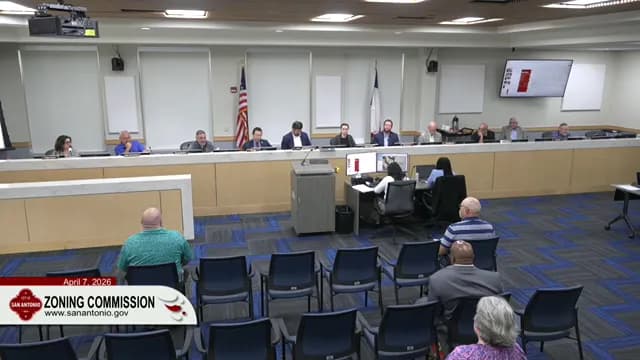
The San Antonio Zoning Commission convened on April 7, 2026, at 1:01 PM. The meeting, chaired by Commissioner John Bustamante, included a consent calendar approval, public hearings on 13 individual zoning cases, and a debate on a Unified Development Code (UDC) amendment regarding detention centers. The commission recommended denial of the UDC amendment. Consent Calendar - Approved consent items (agenda numbers 6, 8, 9, 11 as amended, 12, 14, 16, 17, 18, 25, 26, 28) with amendments. For item 11, the applicant amended to remove a boutique wine use. For item 12, public comment was heard from Rudolpho Garcia, who expressed concern about the type of business (C1 zoning). The commission recommended approval. Public Comments & Testimony - Item 3 (2520 McCullough, C2 to IDZ1): Public comments from several residents including Andrea Garza (opposed, citing parking and pedestrian safety), Janice Clayton (opposed, wanting to keep C2 to maintain balance), Tony Garcia (opposed on behalf of Montevista historical association, citing parking concerns), Liz Cardenas (opposed, raising safety issues). The applicant, John Alfernaro, stated the IDZ permit was needed to upgrade an electrical box for kitchen expansion. - Item 13 (1210 Caten, R4 to R4 CD for a third unit): Public comments from Alfredo Pizzano (opposed, property values), Denise Martin (opposed, concerns about rentals), Rachel Oren (opposed, emergency vehicle access and density), Aaron Reed (president of Highland Park neighborhood association, opposed, requested postponement for negotiation). The applicant, Diego Rodriguez, argued for the need for more housing and accused the association of not responding. - Item 15 (271 Spectrum, I1/C3 to C3R): Public comments from Jamie Perez and Susan Stinniken, both supportive after the applicant removed alcohol sales (amended to C3R). - Item 22 (3913 St. Mary's, C1 CDS for tobacco shop): No public comment. - Item 23 (1729 Babcock, C2S for tobacco shop): No public comment. - Item 24 (6400 Callahan, C3 to C2S for tobacco shop): No public comment. - Other items had no public comments. Discussion Items - Item 3 (2520 McCullough, IDZ1): Staff recommended approval with an amendment removing the wine bar. Commissioners debated parking relief (IDZ allows reduced parking). The applicant said parking agreements exist but may not be permanent. Commissioner Kellum motioned to approve as amended. Approved 11-0. - Item 13 (1210 Caten, R4 to R4 CD): Staff recommended denial. Applicant sought to add a third unit to an existing duplex. Neighbors opposed citing density, parking, emergency access. Commission postponed to May 5, 2026 (11-0) to allow negotiation. - Item 15 (271 Spectrum, C3R): Applicant amended to C3R (no alcohol). Staff recommended denial of original C3, but after amendment, commission approved 11-0. - Item 19 (1115 Euclid, R6 to IDZ1): Staff recommended denial, but commission approved 11-0, viewing IDZ1 as appropriate in a transition area. - Item 20 (760 S. Mistletoe, R6 to IDZ1): Similar to item 19, approved 11-0. - Item 21 (1315 Basse, C2 to C3): Staff recommended denial. Applicant sought to expand auto sales lot. Commission postponed to May 5, 2026 (11-0) for applicant to prepare a site plan for a conditional use. - Item 22 (3913 St. Mary's, C1 CDS for tobacco shop): Staff recommended denial due to proximity to a school. Commission denied recommendation (9-2). - Item 23 (1729 Babcock, C2S for tobacco shop): Staff recommended denial. Commission denied recommendation (11-0). - Item 24 (6400 Callahan, C3 to C2S for tobacco shop): Staff recommended denial. Commission approved 10-1 (Commissioner Kelly dissenting), noting the nearby institution was a college, not a K-12 school. - Item 29 (UDC Amendment on Detention Centers): Staff proposed amendments to restrict detention centers within 1,000 feet of schools, residences, and religious institutions, with exemptions for state or federal facilities. After extensive debate, a motion to postpone for 45 days failed (5-6). A motion to reconsider passed (10-1), then a motion to recommend denial passed (10-1). The commission recommended denying the UDC amendment, with several commissioners stating the issue was political and better addressed by the City Council. Key Outcomes - Consent calendar approved with amendments for items 11 and 12. - Item 3 approved (11-0) as amended. - Item 13 postponed to May 5, 2026 (11-0). - Item 15 approved (11-0) as amended. - Items 19 and 20 approved (11-0 each). - Item 21 postponed to May 5, 2026 (11-0). - Item 22 denied (recommendation) 9-2. - Item 23 denied (recommendation) 11-0. - Item 24 approved (recommendation) 10-1. - Item 29 recommended denial (10-1). The City Council will have final action on all recommendations within six months. - Minutes from March 17, 2026, accepted.

ZONING AND LAND USE 83% · PROCEDURAL 9% · PARKING 2% · COMMUNITY ENGAGEMENT 2%
359
APR 7, 2026 · SAN ANTONIO, TEXAS · COUNCIL COMMITTEES
San Antonio Health Committee Meeting - April 7, 2026

The San Antonio Health Committee met on April 7, 2026, at 10:02 AM (CT) to discuss the community health improvement plan (CHIP), trauma-informed care certification, and the economic impact of immigrants in the region. The meeting included public comments, staff presentations, and council member discussions. No formal votes were taken beyond approval of prior minutes. Consent Calendar - The committee unanimously approved the minutes from the previous meeting. Public Comments & Testimony - Frederick Cochuay (Executive Director, San Antonio Nexus Connection) expressed strong support for the city's investment in community health worker networks and substance use prevention, stating the work is "not a pilot program" but "the next chapter" of San Antonio's commitment. - Jack Finger voiced opposition to immigration, citing a figure of 21% population growth in the San Antonio metro area over five years. He claimed 90% of asylum seekers miss their court hearings and that 23% of jail inmates are undocumented, arguing immigrants "use hospitals and schools without paying their share." - Mary Bethesda (Director, Economic Center) supported the trauma-informed care certification program, noting that her organization was chosen to lead certification and that many city organizations have achieved certification. She also provided written public comment on behalf of Elizabeth Lotts of the Bear County Collaboration and Dr. Salazar, who later presented on the community health improvement plan. Discussion Items Community Health Improvement Plan (CHIP) – Bejar County - Dr. Jacob (Metro Health) presented the 2024-2029 CHIP, developed with community partners. The plan focuses on four priority areas: mental/behavioral health, food security, housing stability, and access to care. He highlighted that Metro Health is nationally accredited and that the plan aligns with the city’s previous efforts. - Metrics from the community health assessment show teen pregnancy decreased from 33 per 1,000 (2019) to 18.3 per 1,000 (2023). Councilmember Alderete Gavito asked about a public dashboard to track progress; Dr. Jacob confirmed a dashboard will be reported in fall 2026 and an annual report in fall 2028. - Councilmember Mesa González emphasized reducing stigma around mental health and noted a mental health summit in District 7. Councilmember Castillo stressed the link between housing stability and public health, supporting efforts to mitigate evictions and preserve public housing. - Dr. Jacob acknowledged that the work requires sustained investment and coordination across sectors, with funding from general funds, opioid settlement funds, and Medicaid 1511. Trauma-Informed Care Certification - Jesse Higgins (Health Officer) presented on adverse childhood experiences (ACEs) and the city’s trauma-informed care initiative. Data from the 2025 CDC survey shows that 1 in 3 adults in Bexar County reported emotional abuse as children, 1 in 5 reported exposure to mental illness, and 1 in 5 reported sexual abuse. These rates are above state and national averages. - Six city departments have achieved Level 1 certification (including fire and police, the only such certified departments nationally). An additional 14 departments are in the process. The certification process includes training, team formation, and site visits. - Councilmember Alderete Gavito asked how to reduce the high ACEs numbers. Higgins replied that trauma-informed practices (e.g., confidential interview spaces for domestic violence cases) are being implemented, and a mentoring program exists within Metro Health. - Councilmember Castillo inquired about measuring resident experiences post-certification; Higgins noted employee satisfaction surveys show positive feedback, but resident-level impact evaluation is still pending. Impact of Immigrants on San Antonio’s Economy - Dr. Jennifer Mada (Office of Compliance, Opportunity & Access) introduced the report, commissioned by the New American Council. Chacey Kramer (State Organizer, American Immigration Council) presented key findings: - As of 2022, 344,000 immigrants live in the metro area, 12.7% of the population (below national 14.3% and Texas 17%). - Immigrant population grew 7.21% between 2018-2022, a key driver of regional growth. - 78.2% of immigrants are in prime working age. In 2023, they contributed $1.2 billion to Social Security and $314 million to Medicare. - 24.7% of business owners are immigrants (versus 12.7% of population), generating $791 million in annual income. - Immigrants account for 32% of construction, 18.9% of manufacturing, and 15,800 manufacturing jobs preserved. - 60% own homes, with $27.1 billion in property value. - 2,071 international students contributed $40 million and supported 621 jobs. - Councilmembers expressed support for the immigrant community. Councilmember Alderete Gavito noted the importance of immigrants in hospitality and manufacturing. Councilmember Castillo emphasized that immigrants contribute more in taxes than they receive in benefits, and that fear of enforcement harms public health and economic productivity. - Dr. Mada stated the city is developing an immigrant inclusion plan based on these findings, including training for city staff and partnership with local nonprofits. Barriers include lack of awareness of city services and language access, as well as political climate affecting trust. Key Outcomes - No formal votes or binding decisions were taken during this meeting; all items were informational or discussion-only. - The committee received updates on the CHIP, trauma-informed care progress, and the immigrant economic impact report. - Council members requested a publicly accessible dashboard for CHIP metrics, to be presented in fall 2026. - Metro Health will continue working with city departments on trauma certification and explore evaluation of resident experiences. - The Office of Compliance, Opportunity & Access will continue developing the immigrant inclusion plan, using the report’s data.

PUBLIC HEALTH 44% · MENTAL HEALTH AWARENESS 19% · ECONOMIC DEVELOPMENT 17% · PROCEDURAL 4%
360
APR 7, 2026 · SAN ANTONIO, TEXAS · COUNCIL COMMITTEES
San Antonio Community Health Committee Meeting, April 7, 2026

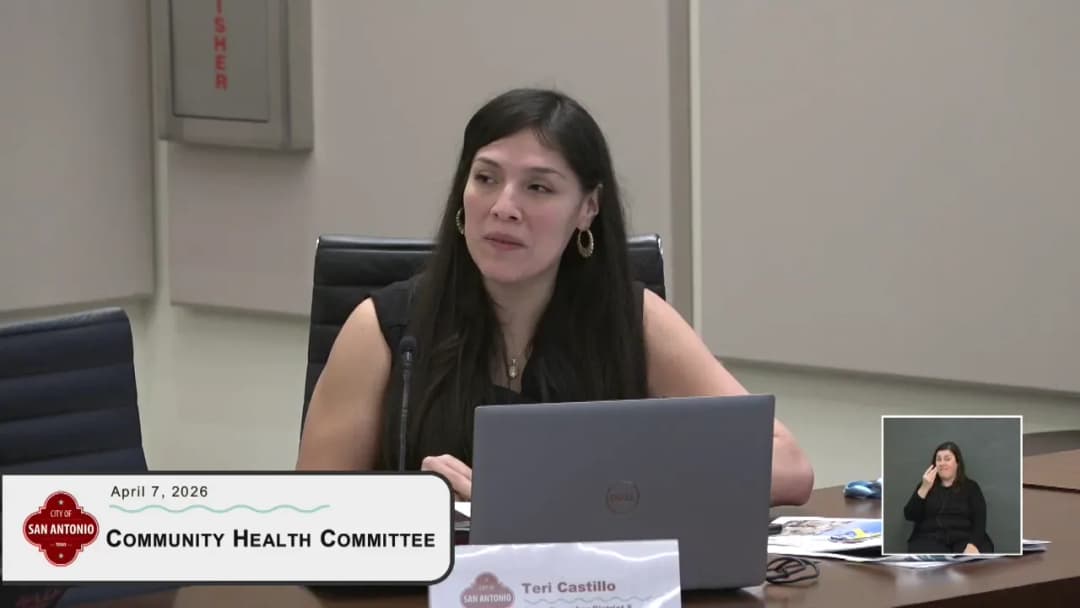
The Community Health Committee of the San Antonio City Council met on Tuesday, April 7, 2026, at 10:02 AM. The meeting included public comments, a presentation on the Healthy Bexar Community Health Improvement Plan (CHIP), an update on trauma-informed care, and a report on immigrant demographic and economic contributions. The meeting adjourned at 11:39 AM. Consent Calendar - The committee approved the minutes of the previous meeting unanimously with no corrections. Public Comments & Testimony - Frederick Courtois (Executive Director, San Antonio Nexus Connection) expressed full support for the Fast Track Cities Initiative and the city's investment in community health first responders through microgrants. He emphasized the need for continued data collection and policy improvements to sustain community health infrastructure. - Jack Finger expressed opposition to immigration in San Antonio, citing statistics: immigrants accounted for 21% of metro population growth from 2018-2023, 90% of asylum seekers fail to appear for hearings, and 23% of Bexar County jail inmates are undocumented. He argued that immigrants burden hospitals and schools without paying their fair share. - Mary Fisk (CEO, Ecumenical Center) expressed gratitude for the partnership with the city on trauma-informed care certification, noting the center developed three levels of certification and interest from other cities. - Elizabeth Lutz and Dr. Ursalazar (Bexar County Health Collaborative) provided written comments on the community health needs assessment and improvement plan, emphasizing cross-sector partnerships and shared stewardship. Discussion Items - Healthy Bexar Community Health Improvement Plan (CHIP): Dr. Claude Jacob (Metro Health director) and Dr. Wu presented the CHIP, a community-centered roadmap for health improvement with four priority areas: behavioral health, food insecurity, housing stability, and prenatal care. Metrics include reducing food insecurity and increasing prenatal care. The plan is updated every three to six years, with the next release in 2029. A dashboard will be available by fall 2026 to track progress. Councilmembers discussed the importance of driving to metrics, leveraging city funds strategically, and the need for long-term trends. Dr. Jacob noted that the Center for Policy and Health Improvement coordinates cross-sector efforts with funding from opioid settlement dollars, the health collaborative, and Medicaid 1115 waiver. - Trauma-Informed Care Update: Jesse Higgins (Chief Mental Health Officer, Metro Health) presented on adverse childhood experiences (ACEs) data for Bexar County: one in five adults experienced sexual abuse as a child, and one in three experienced three or more ACEs. The trauma-informed care certification program, developed with the Ecumenical Center, has certified six city departments (including police and fire, the first in the country for their fields) with 14 departments in the pipeline. Principles include safety, choice, collaboration, trustworthiness, and empowerment. Councilmembers discussed the need to compare ACEs data with peer counties and explore best practices, as well as measuring satisfaction and retention. - Impact of Immigrants on San Antonio’s Growth and Economy: Dr. Jennifer Matha (Director, Compliance Opportunity and Access) and Chelsea Kramer (American Immigration Council) presented data from the 2023 American Community Survey. Key findings: 344,000 immigrants (12.7% of metro population) contributed 21.6% of population growth, generated $12.6 billion in income, $9.6 billion in spending power, and nearly $3 billion in taxes. Immigrants are 78.2% working age, overrepresented in construction, manufacturing, hospitality, and professional services, and 72.5% more likely to be entrepreneurs. Over 60% own homes. Refugees from Afghanistan (64%) and other countries arrived between 2021-2024. Councilmembers discussed the economic contributions and the need for an immigrant inclusion plan to address barriers to services. Key Outcomes - The committee received the presentations and reports without formal votes. Metro Health will release an annual CHIP report by end of April 2026 and a public dashboard by fall 2026. - The Office of Compliance Opportunity and Access will continue developing an immigrant inclusion plan using the report data. - The committee directed staff to explore comparative ACEs data with peer counties and best practices for reducing adverse childhood experiences. - No further action was taken on items discussed.

PUBLIC HEALTH 70% · ECONOMIC DEVELOPMENT 13% · COMMUNITY ENGAGEMENT 10% · PERSONNEL MATTERS 2%
OPENPUBLICA · PUBLIC MEETING INDEXUPDATED DAILY · openpublica.com