Browse by city
Date range
Search help

Search titles, summaries, topics and stored transcripts together. Keywords may match separately; put the whole query in double quotes for a phrase. Matching follows word analysis, so punctuation is not exact. Both dates are included. Documents are not searched.

SHOWING 341–350 ENTRIES
341
APR 15, 2026 · SAN ANTONIO, TEXAS · COUNCIL COMMITTEES
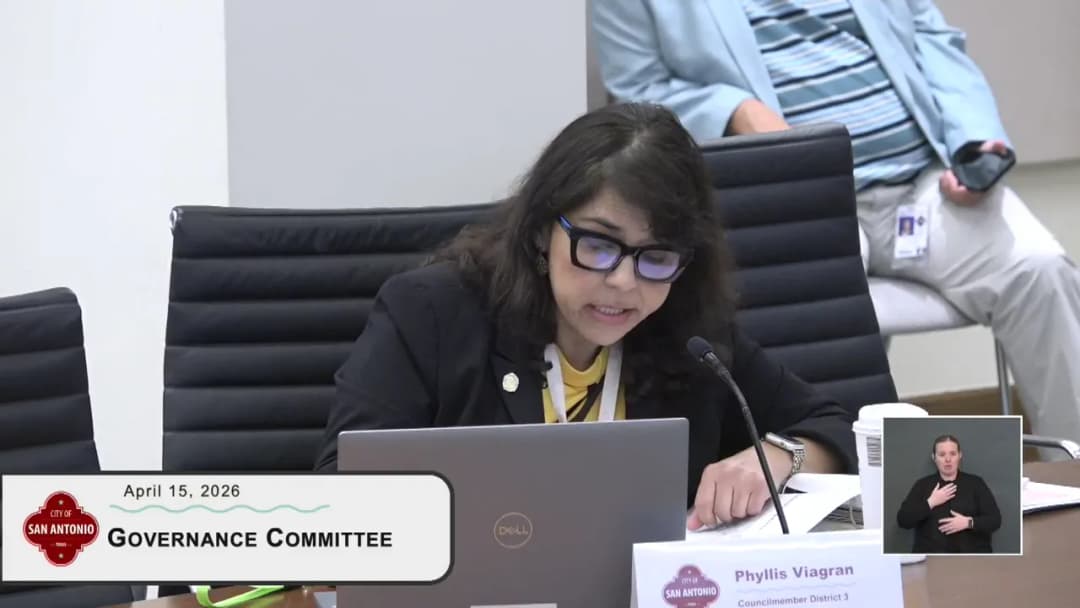
San Antonio Governance Committee Meeting: Youth Internships, City Hall Access, and Local Business Reporting – April 15, 2026

The Governance Committee of the San Antonio City Council met on April 15, 2026, at 10:06 AM to consider three council consideration requests (CCRs): (1) expanding the Ambassador Summer Internship Program to include opportunity youth, (2) a pilot to hold public comment meetings in community locations, and (3) improving reporting on city spending with local businesses. The meeting adjourned at 10:55 AM. Consent Calendar - Approval of Minutes: The committee unanimously approved the minutes of the previous meeting. Public Comments & Testimony - Angelica Cervantes (Chief Operating Officer, YWCA San Antonio) expressed support for expanding the Ambassador program to include opportunity youth, noting YWCA directly serves this population and has additional apprenticeship dollars through United Way that could complement the initiative. - Juan Ramos (Executive Director and Founder, R3 Student Outreach) voiced strong and unwavering support for the opportunity youth internship pilot program. He cited that Bexar County has over 36,000 disconnected youth, and the current Ambassador program excludes them by requiring a high school diploma and two years of college. He emphasized that such programs reduce recidivism, youth violence, and improve community safety, citing successful models in Chicago, Milwaukee, and Atlanta. - Jessica Palacios (Representing San Antonio Hispanic Chamber of Commerce) spoke in support of item 4, the reporting framework for city funds going to local businesses. She stated that improved transparency would help identify gaps in supplier networks, particularly in subcontracting, and strengthen procurement strategies. Discussion Items Item 2: Opportunity Youth Internship Pilot Program (CCR by Councilmember Castillo) - Melody Weasley (Human Services Director) presented the current Ambassador Summer Internship Program, which serves approximately 200 college students per summer with an eight-week paid internship at $18/hour (up to $4,300). Requirements include high school diploma, enrollment in college with at least one year completed, and a 2.5 GPA. The FY 2026 budget is $838,000. She cited research showing paid summer work reduces crime: Chicago (43% decrease in violent crime), Boston (35% decrease in violent crime, 57% decrease in property crime), and New York City (10% reduction in incarceration, 20% reduction in mortality). Staff recommended further research and return to the Educational Opportunities Committee. - Councilmember Viagran questioned why the item was referred to Educational Opportunities rather than the Economic and Workforce Development Committee (EWDC), arguing that workforce development is more appropriate for at-risk youth who may not be college-bound. She supported moving forward but expressed concern about the committee fit. - Councilmember Mungia supported the expansion, noting that mentorships and summer jobs reduce crime, and advocated for funding in the upcoming budget cycle. - Councilmember Viagran also noted the city can hire at age 16, and suggested that council members should commit to hiring at least one youth intern from their own budgets. Item 3: City Hall for All – Pilot for Community Public Comment Meetings (CCR by Councilmember Castillo) - The Director of Communications and Engagement presented the proposal to hold select public comment meetings (not B sessions) in community locations to increase accessibility. Key considerations: logistics, ADA compliance, language access, security, and cost. The current recommendation was to create a pilot program for public comment meetings only, and to return to the Governance Committee in 60 days with a detailed plan. - Councilmember Viagran expressed support for moving public comment meetings to districts but opposed moving B sessions. She stressed the need for a clear cost estimate and suggested that council members hosting such meetings should fund them from their own budgets. - Councilmember Mungia supported the pilot, noting that downtown parking and distance are barriers for residents in districts like District 4. He cited a past B session held at a city facility in 2019 but acknowledged current logistical standards. Item 4: Reporting on City Funds to Local Businesses (CCR by Councilmember Govito) - Troy Elliott (Chief Financial Officer) presented current programs: the Local Preference Program (based on city limits) and SBEDA (based on the San Antonio MSA). The CCR requests a standardized definition of “local,” department-level reporting, and use of data to identify gaps. He proposed taking the item to the Economic and Workforce Development Committee for further policy definition. - Councilmember Carrito (author of the CCR) emphasized that better data leads to better decisions and that the city currently lacks a clear picture of local spending. She cited the airport concessions model as an example of successful local focus. - Councilmember Viagran suggested that “local” should be defined more broadly, perhaps as Bexar County, and that the city should also consider a “Team Texas” perspective. She requested that council members be given maps of current definitions and provide input. - Councilmember Mungia supported the item, noting that small businesses often feel the city does not do enough to support them, and agreed that the definition should extend beyond city limits to include Bexar County. Key Outcomes - Item 2 (Opportunity Youth Internship Pilot): Motion to approve staff recommendation (further research and referral to Educational Opportunities Committee) passed unanimously. - Item 3 (City Hall for All): Motion to accept staff recommendation (develop a pilot program for public comment meetings in the community and return to Governance Committee in 60 days) passed unanimously. - Item 4 (Local Business Reporting): Motion to approve staff recommendation (develop framework with definition of “local” and bring to Economic and Workforce Development Committee) passed unanimously.
COMMUNITY ENGAGEMENT 33% · YOUTH PROGRAMS 27% · PROCUREMENT AND CONTRACTING 16% · ECONOMIC DEVELOPMENT 10%
342
APR 15, 2026 · SAN ANTONIO, TEXAS · CITY COUNCIL
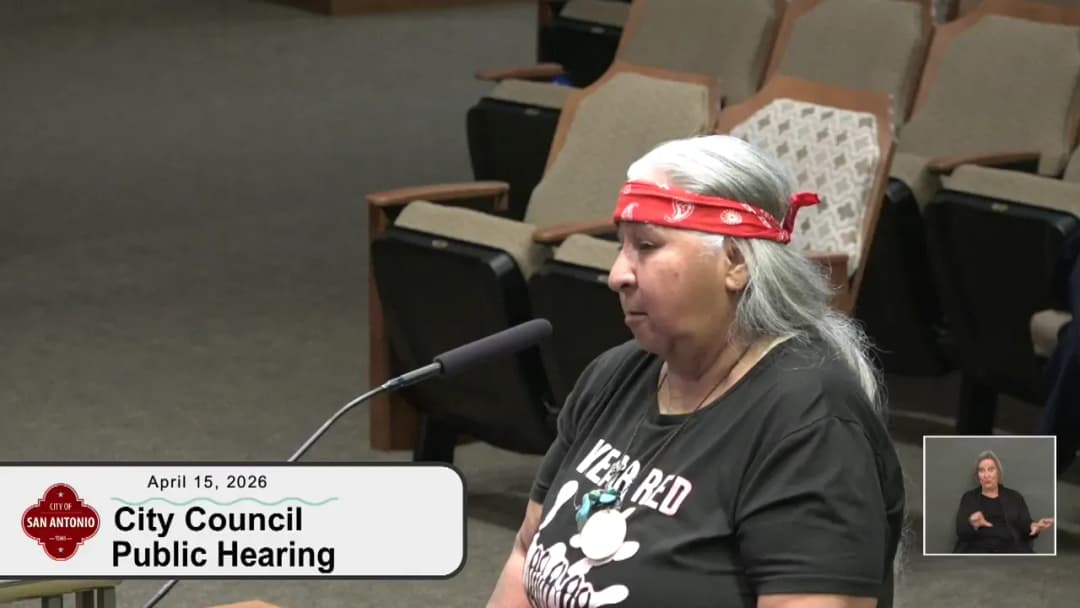
San Antonio City Council Public Hearing on FY2026 Affordable Housing Action Plan Amendment - April 15, 2026

The city council held a public hearing on April 15, 2026, beginning at 5:07 PM, to consider Amendment No. 1 to the FY2026 Action Plan and budget. The amendment proposed reprogramming $2,115,430 from the city's primary HUD grant for housing and urban development to support affordable housing activities. Quorum was present. The public hearing concluded at 5:14 PM, followed by the general public comment period. Public Hearing: Amendment No. 1 to FY2026 Action Plan Two speakers were registered: Antonio Díaz and Diana Flores Uriega. - Antonio Díaz expressed concerns about the reprogramming of funds, questioning why money originally designated for affordable housing was being moved and whether it would benefit low-income renters or property developers. He asked whether new developments would include affordable units (e.g., 10% of total units) for households earning $30,000 or less, and criticized developers for already being wealthy. He argued that the city should prioritize infrastructure—roads, flooding—over subsidizing developers and objected to a proposed $5 fee for entry to a city festival, stating it burdens poor residents. He urged council to consider the needs of San Antonio's poor citizens. - The final speaker (likely Diana Flores Uriega) addressed the council, though no further transcript of remarks is available. No council discussion or vote on the amendment is recorded in the transcript. Key Outcomes The public hearing was conducted and public comment was heard. No action, vote, or decision is documented in the provided transcript.

AFFORDABLE HOUSING 85% · FISCAL SUSTAINABILITY 15%
343
APR 15, 2026 · SAN ANTONIO, TEXAS · COUNCIL COMMITTEES
Government Committee Meeting - April 15, 2026: Youth Pilot Program, Community Meetings, and Local Business Reporting

The Government Committee of the San Antonio City Council met on April 15, 2026, at 10:06 AM. The meeting was presided over by Acting President Maki Rodríguez. Members present: Villagrán, Munguía, Spears, and Rodríguez (quorum established). The committee considered four agenda items: approval of minutes, a pilot program for opportunity youth (ages 16+), relocating council meetings to community venues (B sessions), and reporting on local business spending. Public comments were heard on items 2 and 4. Consent Calendar - Approval of Minutes: Motion made, seconded, and passed unanimously with a voice vote. Public Comments & Testimony - Angélica Cervantes (YWCA San Antonio): Expressed support for the opportunity youth pilot program, highlighting the need for job training opportunities for vulnerable youth and emphasized YWCA's partnership with United Way to expand the program's capacity. - Juan Ramos (Executive Director of Communication): Stated full support for the pilot program proposed by Councilwoman Castillo. Noted that Bexar County currently has 60,000 disconnected youth. Argued the program provides a legitimate pathway for youth to gain careers, reduce violence and isolation. Referenced successful models in Chicago and Atlanta, citing a 19% reduction in crime, 35% drop in violent crime, and 57% reduction in property crimes from similar programs. Emphasized need for such programs in 2026 given reduced mental health funding. - Jessica Palacios (Hispanic Chamber of Commerce): Spoke in support of item 4 (local business spending reporting), advocating for transparency and analysis of public dollar distribution. Noted that in industries like engineering and construction, large professional participation occurs but local subcontracting opportunities are limited. Supported efforts to strengthen local economy and business retention. Discussion Items - Item 2 – Pilot Program for Opportunity Youth (16+) Presentation by María Luzlis (Director of Human Services): Proposed pilot expands the existing Ambassador Program to include youth aged 16+ involved in the municipal court system. Current program: approx. 200 interns each summer, working 30 hours/week for 8 weeks at $18/hour, requiring high school graduation, 2 semesters college, and background check. Budget for FY 2026 is $838,660. Staff recommended next steps: include justice-impacted youth, adopt best practices, and develop cost estimates. Discussion: - Councilwoman Munguía supported expansion, citing data from Chicago that reduced incarceration by 10% and mortality by 19%. Noted difficulty for constituents to travel downtown (25-30 minutes from District 4) and that community meetings improve access. - Councilwoman Villagrán asked about minimum age; confirmed 16 is the youngest. Emphasized need for council commitment to hire interns from the pilot, possibly using council budget. - Motion to approve staff recommendation: passed with voice vote. - Item 3 – Moving Council Meetings to Community Venues (B Sessions) Presentation by Even (Director of Communications and Engagement): Proposed pilot to hold B sessions (public comment meetings) outside City Hall to increase access and participation. Current efforts include online streaming, TV broadcasts, and community budget meetings. Survey showed 58% positive response on participation opportunities. Key considerations: level of participation (informational vs. deliberative), production logistics (Wi-Fi, ADA compliance, Spanish/ASL, security), and need for additional resources. No dedicated budget. Staff recommended creating a pilot to determine impact and return with a report in 60 days, after consulting with legal, city secretary, police, and technology. Discussion: - Councilwoman Villagrán expressed support for public comment but not for B sessions; suggested if a council member wants a meeting in their district, they should fund it from their own budget. Raised concerns about technology security and logistics costs. - Councilwoman Munguía supported, noting that a 2019 B session at Pre-K 4 SA in east side was successful, with good participation and partnerships. Stressed that commuting downtown is a barrier for many residents. - Motion to accept staff recommendation (return in 60 days): seconded and passed with voice vote. - Item 4 – Reporting on Local Business Spending Presentation by Trey Elliott (Chief Financial Officer): Proposed developing standardized reporting on local business participation in city contracts, subcontracts, and spending. Currently multiple programs exist (local preference, SAMSA small business development) with definitions based on city limits or Bexar County (SAMSA). Goal: identify gaps and inform budget presentations. Recommended further dialogue with economic development and budget departments, and potential impact on EWDC (Economic Workforce Development Committee). Discussion: - Councilwoman Castillo (sponsor) supported regular reporting and noted successful model for airport concessions. Emphasized need for clear definition of 'local'. - Councilwoman Villagrán suggested reporting should include Bexar County as 'local', and urged expanding discussion to include state-level definitions and regional cooperation (seven Texas regions). She stressed the need for parallel conversations with council and purchasing departments. - Councilwoman Munguía agreed with expanding 'local' to include Bexar County, noting businesses near city limits should be counted. - Motion to approve staff recommendation: passed with voice vote. Key Outcomes - Item 2 (Youth Pilot Program): Approved staff recommendation to develop a pilot program for justice-impacted youth aged 16+. Next steps: adopt best practices, cost estimates. - Item 3 (Community Meetings): Approved staff recommendation to study a pilot for B sessions outside City Hall. Staff to return with a report and recommendation in 60 days. - Item 4 (Local Business Reporting): Approved staff recommendation to proceed with defining 'local' business and developing standardized reporting. Further discussion to be held at EWDC. The meeting adjourned at 10:54 AM.

YOUTH PROGRAMS 30% · PROCUREMENT AND CONTRACTING 21% · COMMUNITY ENGAGEMENT 21% · ECONOMIC DEVELOPMENT 10%
344
APR 15, 2026 · SAN ANTONIO, TEXAS · CITY COUNCIL
San Antonio City Council Public Comment Meeting – April 15, 2026

The City Council of San Antonio held a public comment meeting on Wednesday, April 15, 2026, at 5:06 p.m. The meeting included a public hearing on a proposed substantial amendment to the Fiscal Year 2026 Annual Action Plan and Budget to reprogram $2,114,424.68 in prior grant savings from HUD to support four affordable housing development activities. Following the public hearing, the meeting moved to general public comment. Public Hearing – Item 1: Reprogramming of HUD Grant Savings for Affordable Housing - The hearing addressed a proposal to transfer $2,114,424.68 from prior HUD grant savings to fund four affordable housing development activities. - Two members of the public spoke: Antonio Diaz and Diana Flores Uriegas. - Antonio Diaz expressed concerns about whether the reprogrammed funds would genuinely benefit low-income renters or primarily developers. He questioned the city's definition of affordable housing, stating that median-income levels around $50,000 are not affordable for San Antonio's working poor earning $8–$10 per hour. He requested that at least 10% of units in these developments be set aside for very low-income households. - Diana Flores Uriegas echoed concerns, arguing that the funds should instead be used for critical infrastructure such as street repairs and flood control. She also criticized the city for giving incentives to wealthy developers (specifically referencing "Marble") and for imposing new fees on Fiesta celebrations, which she said burden low-income residents. Key Outcomes - The public hearing was closed at 5:14 p.m. No further action or vote was taken during this portion of the meeting. The council then moved to general public comment (no additional transcript provided).

AFFORDABLE HOUSING 88% · INFRASTRUCTURE 12%
345
APR 15, 2026 · SAN ANTONIO, TEXAS · CITY COUNCIL
FY27 Budget Briefings for Pre-K for SA and Ready to Work - April 15, 2026

The San Antonio City Council B session on April 15, 2026, received briefings on the proposed FY27 budgets for Pre-K for SA and Ready to Work. Both programs operate on a July 1 to June 30 fiscal year and must have budgets finalized by July 1, 2026. The briefings covered program achievements, financial outlooks, and future considerations including reauthorization for Pre-K for SA and the sunset of Ready to Work in 2030. Discussion Items Pre-K for SA - Dr. Sarah Bray presented the FY27 proposed operating budget of $62.3 million in expenditures against $58.9 million in projected revenues, resulting in an ending fund balance of $3.6 million. The program is funded by a dedicated 1/8 cent sales tax, which is projected to generate $53.4 million in FY27. Sales tax collection ends March 31, 2029, with program funding through June 30, 2029. Reauthorization must be placed on the ballot by November 28, 2028, and may be for up to 20 years. - Dr. Bray highlighted program achievements: 5,000 free full-day pre-K seats created, 70% access for four-year-olds in Bexar County by 2019, 300 new early learning teachers credentialed, and a $57 million return on investment in eight years. The current authorization (2021) expanded to birth-to-three services, including an infant/toddler pilot at the South Education Center. - Council members expressed strong support for reauthorization, with some advocating for a sooner ballot measure (e.g., 2026 or 2027) and a 20-year renewal. Discussion focused on the cost per student (approximately $26,000-$27,000), which includes family support services, professional learning for 90 child care providers, and ecosystem-wide improvements. Dr. Bray noted that the program is not solely about education but also about transforming the early childhood system. - Questions were raised about military-affiliated families (17% of students), with clarification that the definition includes veterans and reservists, many of whom are low-income and do not have access to DOD child care. The Mayor requested a cost breakdown for active-duty vs. other military families. - Councilmember McKee Rodriguez asked about expanding the program to include night care and utilizing closed school district campuses. Dr. Bray confirmed that the authorization allows for such services. Ready to Work - Mike Ramsey presented the FY27 proposed budget of $42.8 million, the peak of the program. Total remaining funds are approximately $126 million. The program will cease enrollment in FY29, complete all trainings by January 2030, and fully expend sales tax funding by FY30. An ROI study by Dr. Niven found an $11.8 billion total impact over participants' working careers, with $7.5 billion in increased incomes and a $125 return per dollar invested. - As of March 30, 2026, over 15,000 individuals were enrolled in training, 6,502 had completed, and 4,358 were in approved jobs. Training completion rate is 62%, and job placement within six months is 60%. The program has seen a 166% increase in monthly completers and a 255% increase in monthly job placements over the last 12 months. - Council members discussed the need to focus on high-demand occupations, particularly trades (plumbers, electricians, welders) and healthcare. The Mayor questioned the 58 approved occupations and suggested narrowing to a dozen with the highest ROI. Councilmember Spears emphasized integrating AI and new technologies. - Concerns were raised about veterans using GI Bill benefits: the Mayor suggested exploring reimbursement or excluding veterans who have other funding sources. Councilmember McKee Rodriguez noted that many veterans have exhausted their GI Bill, and wraparound services are a key benefit. - The on-the-job training program (OJT) was not included in the FY27 budget after only $1 million of $6 million was spent in FY26 due to flat employer hiring. The city will shift focus to employer-led cohort training. - Councilmember Mungia stressed the importance of housing, workforce, and education as the cure to poverty. Councilmember Castillo highlighted success stories of participants with high barriers, including formerly incarcerated individuals. Key Outcomes - No formal votes were taken; the briefings were for discussion and direction. - Council directed staff to provide follow-up information including: a breakdown of pre-K for SA cost per student by category, data on veteran participation and potential GI Bill coordination, a list of occupations with zero placements in ready to work, and an analysis of the return on investment comparing pre-K for SA and ready to work. - Several council members expressed support for putting pre-K for SA reauthorization on the ballot as soon as possible, possibly before the 2028 deadline. - The city manager noted that planning for the post-2030 workforce development landscape should begin now, and council will need to decide on future offerings.

WORKFORCE DEVELOPMENT 67% · PUBLIC EDUCATION 23% · EARLY CHILDHOOD EDUCATION 4% · FISCAL SUSTAINABILITY 2%
346
APR 15, 2026 · SAN ANTONIO, TEXAS · BOARDS & COMMISSIONS
Historic and Design Review Commission Meeting – April 15, 2026

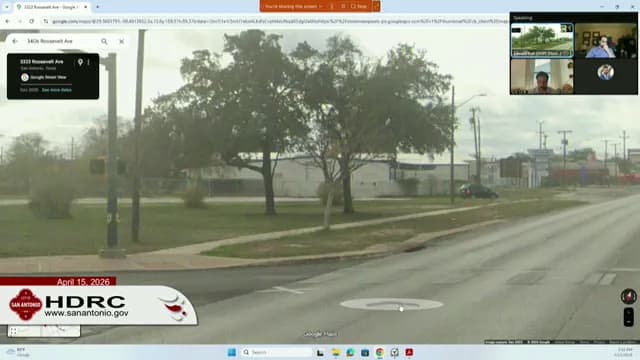
The Historic and Design Review Commission (HDRC) met on April 15, 2026, to consider a consent agenda and three contested items, including a controversial project near Mission San José. The meeting began with roll call and procedural announcements, followed by approval of the consent agenda and discussion of items pulled for further review. Public testimony was heard on Item 14, and the commission took votes on all agenda items. Consent Calendar - Items 1, 3, 4, 6, 9, 10, 11, 12, and 13 were approved with staff stipulations. (Item 7 was postponed by the applicant.) - The approved addresses included 1301 East Commerce, 331 West Commerce, 418 Florida, 1914 East Houston, 216 Lavaca, 320 East Courtland Place, 502 to North Zarzamora, 316 Army, and 201 West Linwood. Public Comments & Testimony - Item 14 (3406 Roosevelt): Multiple speakers addressed the commission: - Betty Boucher, First Vice President of the Conservation Society of San Antonio, noted that a productive meeting had been held between the applicant and the neighborhood association but requested that the commission conditionally move the process forward, as the architect needed more time to produce detailed drawings. - Jane Henry, President of the Mission San José Neighborhood Association, expressed strong concerns about the lack of an archaeological study, the presence of tall ventilation stacks (described as smokestacks) that compete with views of the mission, and requested a stipulation against electrified fencing. She noted that the owner had built additions without permits. - Brenda Pacheco, a community member of Native American heritage (Papopa Indian), emphasized the need for an archaeological dig before further construction, stating that artifacts (and potentially remains) may be present on the property. She requested that Native American representatives be allowed to observe any dig. - Brady Alexander, representing the Hot Wells Mission Reach Neighborhood Association, supported a continuance, criticized the city’s handling of the case, and argued that the project sets a poor precedent for development near the World Heritage Site. Discussion Items - Item 2 (1611 Broadway): Applicant Lordina Gomez (KPNJ Architects) presented plans for small utilitarian buildings on a vacant lot. Commissioners questioned the placement of a dumpster enclosure, generator, and transformer near Broadway and Newell, and the orientation of buildings away from the street. The applicant agreed to relocate an exhaust vent, upgrade lighting to decorative fixtures, and fence the generator/dumpster. Commissioner Velasquez moved to refer the item to a DRC (Development Review Committee) for further discussion with the owner. The motion passed unanimously. - Item 5 (312 West Courtland Place): Applicant Ronald Eccles (Texas Architecture Workshop) sought approval for a terrace railing and elevator tower. Commissioners asked about railing details and elevator height; the applicant confirmed the elevator would not exceed the ridge height. The item was approved with staff stipulations. - Item 8 (218 Adams Street): Applicant Nick Handel requested approval for exterior modifications. Commissioner Savino added a stipulation requiring a fully detailed and dimensioned site plan. The motion passed with the added stipulation. - Item 14 (3406 Roosevelt): This was the most debated item. Applicant Javier Gonzalez (representing Joel’s Collision Repair) described the case as an “unusual case” where the owner had built additions without permits. He requested approval for fencing, facade modifications, an addition, landscaping, and signage. Staff recommended approval with stipulations including an archaeological investigation. Public testimony raised concerns about the lack of drawings, the ventilation stacks, fencing height and type, and the need for archaeological study. Commissioner Velasquez moved to refer the item to a DRC, with a target hearing date of May 20, 2026 (within the 60-day review deadline). Commissioner Group noted that DRC meetings do not allow public comment but would allow the applicant to present updated drawings. The motion passed unanimously. Key Outcomes - Consent Calendar: Approved as listed. - Item 2 (1611 Broadway): Referred to DRC at the earliest available opportunity (target dates discussed: April 21 or 28, 2026). - Item 5 (312 West Courtland Place): Approved with staff stipulations. - Item 8 (218 Adams Street): Approved with an added stipulation for a detailed site plan. - Item 14 (3406 Roosevelt): Referred to DRC with a target hearing date of May 20, 2026. The archaeological investigation stipulation (requiring a qualified archaeologist and review by the city archaeologist) remains in effect. No decision on the applicant’s request for conceptual approval; the DRC will allow the architect to refine drawings in consultation with the community.

HISTORIC PRESERVATION 75% · PROCEDURAL 16% · ZONING AND LAND USE 6% · ECONOMIC DEVELOPMENT 2%
347
APR 14, 2026 · SAN ANTONIO, TEXAS · COUNCIL COMMITTEES
San Antonio Audit Committee Meeting on Downtown Mobility and Sports District Contracts - April 14, 2026

On April 14, 2026, the Audit Committee of the San Antonio City Council convened at 2:02 p.m. to approve minutes and receive briefings on three major contracts related to downtown mobility and the proposed Sports and Entertainment District. The meeting concluded at 3:07 p.m. Consent Calendar - Approval of Minutes: The minutes from the previous meeting were approved unanimously by voice vote. Pre-Solicitation Briefing: Downtown Accessibility and Mobility Study - Item 2 – Downtown Accessibility and Mobility Study: Staff presented a pre-solicitation briefing for a $500,000 contract (one-year term, one-year renewal option) to conduct a comprehensive downtown accessibility and mobility study. The study will evaluate vehicular and pedestrian traffic, transit, ride-share, micromobility, parking, and technology platforms, considering major developments including the proposed ballpark, sports and entertainment district, and convention center expansion. The goal is to produce actionable short- and long-term solutions. Funding would come from the parking enterprise fund. The solicitation (RFP) will be released by the end of the week, with proposals due May 18, 2026, and a target City Council consideration on June 18, 2026. - Committee Discussion: Chair Viegran emphasized the need to study on-street parking regulations, resident-only signage, and the use of trash cans to reserve spaces. She also urged exploring technology to monetize underutilized lots on weekends. Councilmember White expressed support for the study but stressed that the cost of the sports district should not fall on citizens. He asked about avoiding duplicate work with VIA and TxDOT. Staff confirmed stakeholders (VIA, TxDOT, Centro San Antonio) are engaged, and the study will leverage existing studies. Councilwoman Mesa Gonzalez asked about community engagement; staff noted the study is data-driven and technical, with public engagement handled separately through other planning efforts. Post-Solicitation Briefing: Sports and Entertainment District Cost-of-Service and Revenue Study - Item 3 – Cost-of-Service and Revenue Study: Staff presented a post-solicitation briefing on a $316,350 contract (with a $34,000 contingency, total estimated $350,000) for a study to model the cost of services (traffic control, security, emergency services, maintenance) and identify new revenue opportunities for the proposed Sports and Entertainment District. The contract would be funded by the Hotel Occupancy Tax (HOT) Redemption and Capital Fund. The evaluation committee recommended Vendor A, which scored 64.95 points (out of 100) based on experience, proposed plan, price, and local/SBE/veteran preference points. One of four responses was deemed non-responsive for failing to meet minimum requirements. The contract is expected to be presented to City Council on April 30, 2026. - Committee Decision: The committee voted to move the item to the full Council as an individual consideration item (not consent) due to its high profile and to allow full Council discussion of the evaluation, particularly the lack of local preference and SBE participation among top scorers. Councilmember White noted the study focuses only on cost-of-service impacts and new revenue opportunities, not pledged revenues already analyzed. Post-Solicitation Briefing: Executive Program Manager for Sports and Entertainment District - Item 4 – Executive Program Manager (EPM): Staff presented a post-solicitation briefing on a contract for an Executive Program Manager (EPM) to oversee and coordinate all components of the Sports and Entertainment District. The contract would have a five-year base term with five one-year renewal options (total up to 10 years). The initial phase (Phase 1, through March 2027) is estimated at $6 million. Funding would come from capital project funds (once projects are active) and the HOT Redemption and Capital Fund in the interim. Eight firms responded; Vendor A scored 68 points (out of 100), significantly ahead of other vendors, driven by broader leadership experience on comparable districts. The committee moved the item to full Council as an individual consideration item. - Committee Discussion: Chair Viegran requested a visual map of the EPM's responsibilities to avoid confusion about the district's boundaries (not including the Tower of the Americas). Councilmember White expressed concerns about the lack of local vendor participation and the need for a public dashboard tracking hiring, job creation, and contracts. He also questioned accountability, noting the EPM could avoid blame if issues arise. Staff explained the EPM reports to the city, establishes governance, and monitors contractors; the city retains decision-making authority and can terminate for poor performance. Councilwoman Mesa Gonzalez stressed the importance of community engagement, noting the projects are new (unlike the airport). Staff agreed the EPM will track engagement, not conduct it directly. Committee member Taino requested a broader roadmap showing how all the solicitations fit together, including timing, phasing, and future work. Key Outcomes - Minutes approved unanimously. - Downtown Accessibility and Mobility Study: Pre-solicitation briefing received; no vote required. - Cost-of-Service and Revenue Study: Approved to move to City Council as an individual consideration item (April 30, 2026 A session). - Executive Program Manager Contract: Approved to move to City Council as an individual consideration item (April 30, 2026 A session). - Staff will provide a visual map of the Sports and Entertainment District, a roadmap of all related contracts and studies, and a summary of future work to the full Council. - The full Council will discuss local vendor participation, the public dashboard, and accountability measures when considering these contracts.

PROCUREMENT AND CONTRACTING 34% · ENGINEERING AND INFRASTRUCTURE 26% · ECONOMIC DEVELOPMENT 24% · COMMUNITY ENGAGEMENT 6%
348
APR 14, 2026 · SAN ANTONIO, TEXAS · BOARDS & COMMISSIONS
San Antonio Committee Meeting: April 14, 2026 – SAWS SCP HCP, Vice Chair Nomination, Minutes Approval

The San Antonio City Committee met on April 14, 2026, with a quorum present. Committee members Nino, Garcia, Jordan, McGlamory, Simper, and Chair Sparrow attended. The meeting addressed three agenda items: enrollment of a San Antonio Water System project in the SCP HCP, nomination of a vice chair, and approval of the previous meeting's minutes. No public comments were made. Discussion Items - SCP HCP Enrollment for San Antonio Water System (Item 1): Senior Planner Valerie Rodriguez presented a proposal for San Antonio Water System to enroll in the SCP HCP to mitigate impacts for a water main replacement project. The project is located in a developed residential neighborhood northeast of North New Braunfels Avenue and Austin Highway in Council District 10. The project area is 0.96 acres, with zero acres of golden-cheeked warbler habitat, zero conservation credits required, and no critical habitat units or occupied features within 750 feet. The site lies within CAR Zone 2. Fees include a $960 participation fee, a $96 plan administration fee, and a $1,056 total mitigation fee (with the $2,500 application fee already paid). Staff recommended approval. - Vice Chair Nomination (Item 2): Chair Sparrow nominated Stan Jordan, the representative from Bexar County Environmental Services, to serve as vice chair, consistent with board practice. A voice vote was conducted. - Approval of Previous Meeting Minutes (Item 3): The committee considered and approved the minutes from the March 10, 2026 meeting. No corrections were offered. Key Outcomes - Item 1: Motion to approve the SCP HCP enrollment passed unanimously on a roll call vote: Committee members Nino, Jordan, Garcia, Simper, and Chair Sparrow each voted "yes." - Item 2: Stan Jordan was unanimously approved as vice chair via voice vote (all members voted yes). - Item 3: The minutes from the March 10, 2026 meeting were unanimously approved on a roll call vote (all members voted yes). The meeting adjourned at 3:05 PM.

ENVIRONMENTAL PROTECTION 64% · PROCEDURAL 36%
349
APR 14, 2026 · SAN ANTONIO, TEXAS · COUNCIL COMMITTEES
Audit Committee Meeting – April 14, 2026: Downtown Mobility Study and Sports District Contracts

The Audit Committee convened on April 14, 2026, at 2:00 PM with all members present (Concejal Mesa González, Concejal White, Citizens Channels and Pacheco, and President Villagran). The meeting covered three main agenda items: an information session on a downtown accessibility and mobility study RFP (estimated $500,000), and two contract approvals related to the proposed Sports and Entertainment District – a revenue opportunities study ($316,350–$350,000) and an executive program management (EPM) contract ($6 million for Phase One). No public testimony was heard. Consent Calendar - Approval of previous meeting minutes: The minutes from the prior meeting were approved unanimously by voice vote. Discussion Items - Item 2 – Downtown Accessibility & Mobility Study RFP (Information Only): Staff presented a proposed RFP for a one-year, $500,000 study to analyze pedestrian, vehicular, transit, and micromobility movement in and out of downtown, with a potential one-year renewal. The study is intended to inform infrastructure decisions tied to the new NBA arena, convention center expansion, and other downtown projects. Speakers emphasized coordination with VIA, TxDOT, and other partners. Key evaluation criteria: experience (30 points), proposed plan (35 points), price (10 points), and local preference (5 points). The committee expressed strong support for the study, with members asking about geographic scope, community engagement, and alignment with other initiatives. Staff expects to return to City Council with recommendations in late summer (August/September). No vote was taken. - Item 3 – Contract for Revenue Opportunities Study (Sports & Entertainment District): Chief Financial Officer Troy Elliott presented a post‑award report seeking approval to proceed with a contract for financial modeling and revenue analysis related to the proposed sports and entertainment district. The estimated value is $316,350 (with a contingency up to $350,000) from hotel occupancy tax funds. Four firms responded; one was disqualified for lacking cost analysis. Three were evaluated, with one scoring highest (64.95 after interviews). The committee discussed local preference points and the need for a full council presentation. President Villagran moved that the item be placed on the City Council agenda as an individual discussion item (not on the consent calendar) to allow for robust dialogue. The motion was seconded and passed unanimously. Several members also requested that the study be aligned with the mobility study from Item 2. - Item 4 – Contract for Executive Program Management (EPM) Services (Sports & Entertainment District): Staff presented a post‑award recommendation for a contract to provide executive program management oversight for the entire sports and entertainment district, including the new arena, convention center expansion, Alamodome improvements, and related infrastructure. The five‑year contract (with a possible five‑year extension) is valued at approximately $6 million for Phase One (through March 2027), funded by capital project and hotel occupancy tax funds. Eight firms responded; evaluations considered experience (50 points), SBE participation (10 points), local preference (10 points), and other criteria. After written and interview evaluations, one firm emerged as the highest scorer. Committee members questioned accountability, penalties for delays or cost overruns, local business inclusion, and transparency. Staff clarified that the EPM would oversee but not own project risks; city council would retain decision‑making. The committee again voted unanimously to recommend the contract as an individual agenda item at the April 30 City Council meeting, citing the high profile of the project. Key Outcomes - Item 2: No action required; committee expressed support and provided guidance for staff to return with a final RFP and recommendations to council in late summer. - Item 3: Motion passed to forward the revenue opportunities contract to City Council as an individual item (not consent). The finance department will prepare a detailed presentation including local preference information. - Item 4: Motion passed to forward the EPM contract to City Council as an individual item. Staff will produce a visual map showing all components, phases, and timelines of the district to aid council understanding. The meeting adjourned at 3:07 PM.

PROCUREMENT AND CONTRACTING 44% · ECONOMIC DEVELOPMENT 24% · COMMUNITY ENGAGEMENT 13% · PROCEDURAL 8%
350
APR 9, 2026 · SAN ANTONIO, TEXAS · CITY COUNCIL
San Antonio City Council Regular Meeting – April 9, 2026

The San Antonio City Council met on Thursday, April 9, 2026, at 9:07 AM, with Mayor Gina Ortiz Jones presiding and all council members present. The meeting concluded at 11:43 AM. It featured six Fiesta proclamations, a city manager’s report on immigration enforcement protections, a consent agenda with multiple approvals, and a contested public hearing and vote on a $5 entry fee for Fiesta de los Reyes at Market Square. Proclamations & Fiesta Celebrations - Mayor Jones read proclamations for the 2026 Fiesta season (April 16–26), King Antonio (Gardner MPV), Rey Feo (Dr. Damoso “Danny” Oliva Jr.), A Night in Old San Antonio (NIOSA, April 21–24), Battle of Flowers Parade (April 24), and Fiesta Flambeau Night Parade (April 25). Each organization’s representative spoke, highlighting charitable missions, scholarships, and economic impact (e.g., Fiesta generates over $400 million in tax revenue; Texas Cavaliers have given $25 million to children’s charities; NIOSA has generated over $5 million for the city). Council members shared personal Fiesta experiences and emphasized volunteerism and community service. City Manager’s Report – Immigration Enforcement Updates - City Manager Maria Villagómez provided an update on resolutions approved February 12, 2026, regarding protections for San Antonio residents against ICE activities. Key actions in progress include: training for city staff on response protocols when ICE enters city facilities; proposed Unified Development Code changes to regulate private for‑profit detention facilities (posted for April 16 agenda); a reporting mechanism for alleged rights violations (expected completion by April 15, though the city cannot act on those reports); exploration of a justice fund for legal services (to be discussed in FY27 budget process); public signage informing residents of their rights (evaluation by April 15); and procurement actions for five items to be presented to the Economic Workforce Development Committee in May. Mayor Jones noted she sent a letter to DHS Secretary Mullen opposing an ICE processing facility on the east side and stated the city has yet to receive any formal communication from DHS regarding the proposed facility. Consent Calendar - The council approved the consent agenda (items 4–20) minus item 17 by voice vote. Highlights included: item 7 – lease agreement with San Antonio Tennis Association for McFarland Tennis Center (the largest public tennis center in Southwest Texas); item 8 – temporary street closures for Fiesta and celebration of the full opening of South Alamo; item 9 – acceptance of a $12.5 million FAA grant for the new terminal at San Antonio International Airport, bringing total federal funding for the program to $91.5 million (terminal opening anticipated Q2 2028); item 20 – ordinance designating Loop 1604 as David G. Evans Memorial Highway to honor fallen SAPD Officer David G. Evans (37 years of service, died from injuries sustained in a 2022 shooting); items 14-15 – reappointment and appointment to the Building and Standards Board. Public Comments on Item 17 - Thelma Gonzalez (business owner, 35 years at Farmers Market Plaza): Opposed the $5 fee, stating Market Square has always been a free public space and the fee would fundamentally change its nature. She noted 54 tenants and over 100 local businesses in the area. - Yvette Ramirez (President, Farmers Market Plaza Association): Expressed concerns about lack of transparency, citing a February 25 meeting where they were told the fee was a “done deal.” Argued the fee restricts access to public space and called the process unjustifiable if buried in the consent agenda. - Veronica Sandoval: Continued, noting the organization has not submitted a map for expanded alcohol sales to TABC. Called the fee a dangerous precedent for privatizing public space and said Market Square belongs to the people. - Reverend Sylvia Vasquez: Opposed the fee, recalling her father never paid entry fees for Fiesta. Noted the economic burden on low-income families and asked the council to keep the event accessible. - Roman Pena (Nick Pena) (retired merchant, 50 years at Mercado): Warned against charging, referencing a past city council decision to keep the event free. Mentioned concerns about the proposed ICE detention center and urged the council to protect the “people’s place.” - Elaine de los Santos (Interim Executive Director, Rey Feo Consejo Education Foundation): Supported the fee. Explained that security enhancements after a debrief following Fiesta 2025 led to a $143,000 loss for the nonprofit. Outlined free hours (weekdays before 6 PM, weekends before 1 PM) and free admission for children 12 and under. - Henry Rodriguez (LULEC Concilio Zapatista): Opposed the fee, stating it targets low-income residents. Cited a racist comment about keeping “riffraff out” and asked the council to be heroes for the people. - Frank Garza (former chair of Fiesta de los Reyes): Supported the fee. Noted that security improvements were well-received, that 50% of all event revenue goes to the city, and that the fee is limited to certain hours. He asked for support to continue scholarships. Discussion on Item 17 – Fiesta de los Reyes Entry Fee - Councilmember Galvan pulled the item for individual consideration. Staff presentation by Shannon Miller (Chief Downtown Officer): The amendment allows a $5 gate fee during peak hours (after 6 PM weekdays, after 1 PM weekends) for Fiesta de los Reyes at Market Square (April 17–26). Children 12 and under are free. The fee offsets about $140,000 in private security costs for perimeter fencing and screening. The city spends approximately $730,000 on SAPD security for the event (up from $690,000 last year) and nets a loss of about $548,000 after receiving $190,000 in revenue from the event. Under the contract, the city receives 50% of net revenue and beverage surcharges. The Consejo organization grosses about $1 million and nets around $85,000 for scholarships. The $5 fee is expected to generate about $400,000; the Consejo would retain the first $250,000 to cover ticketing and security, and the city would receive 25% of anything above that (estimated $37,500). - Council debate: Councilmember Corr acknowledged the security necessity but expressed hope for a pilot program and suggested offering free tickets for low-income families. Councilmember McKee Rodriguez opposed the fee, calling it a slippery slope and pointing to racist and classist comments suggesting the fee would keep “undesirables” out. He argued the event should remain barrier‑free and suggested the city find other ways to fund security. Councilmember Castillo expressed concern about the impact on vendors and cautioned against linking a fee to crime prevention. Councilmember Mungia supported the item but said the process was poor and called for a budget discussion to potentially subsidize the event in the future. Councilmember Viagran supported, offering to help District 3 residents afford the fee, but argued against underwriting security for only this event when other neighborhoods also lack resources. Councilmember Galvan emphasized that public safety is paramount but that the council should have been more involved in the decision. - Staff confirmed that if the fee were not approved, the private security and scholarships would still be provided, but the Consejo would operate at a loss again. Key Outcomes - Consent agenda approved (minus item 17) by voice vote. - Item 17 approved (motion carried by voice vote; no roll call recorded). The ordinance amending the agreement with Rey Feo Consejo Educational Foundation to allow a $5 gate fee during specified peak hours, with free admission for children 12 and under and during daytime hours on weekdays and weekend mornings, was adopted. The city will share in revenue above $250,000 (25% to city, estimated $37,500). - City manager’s report noted ongoing progress on ICE protections; code changes to be considered at the April 16 council meeting. - Next council meeting scheduled for April 16, 2026.

PUBLIC SAFETY 25% · ARTS AND CULTURE 23% · ECONOMIC DEVELOPMENT 21% · PROCEDURAL 12%
OPENPUBLICA · PUBLIC MEETING INDEXUPDATED DAILY · openpublica.com