The San Antonio City Council convened on April 2, 2026, at 9:05 AM. The meeting began with an invocation, followed by several proclamations (Public Health Week, Fair Housing Month, National Poetry Month), a presentation on Bitcoin ATM fraud, a debate on hiring additional police officers, interviews for the Planning Commission, and a proposed commission to increase voter participation. The council also handled a consent calendar and public comments. Consent Calendar - The consent calendar (items 8–28) was approved unanimously after a motion and second. Councilmembers highlighted several items: item 19 (reappointment of Monica Sabino to the Historic and Design Review Commission), items 24–26 (ordinances supporting Metro Health and the UT Health San Antonio dental program), item 9 (park improvements for accessibility), item 18 (appointment to the Transportation Advisory Board), item 15 (TCEQ local air monitoring), item 20 (pet sterilization services), and item 8 (funding for the Easy Bell project). Item 23 was pulled for individual consideration (see below). Public Comments & Testimony - Herschel Boyd (opposition to item 12 – Edwards Aquifer Recharge Zone): Expressed strong opposition to the city taking his property via eminent domain for a roadway project. He stated the building is historic and he had plans to use it. He urged the council to communicate with affected property owners. - Jack Finger (on items 21–22, settlements for vehicle accidents): Questioned whether city employees (police officer and garbage truck driver) who caused accidents are ever disciplined. He requested a clear policy on such incidents. - Amanda Thomas (opposition to item 6 – hiring 65 officers): Argued against hiring more officers before a full budget audit, citing excessive overtime costs ($4.4 million in 2024) and a decrease in crime. She called for transparency and accountability. - Bianca Maldonado (support for item 6): President of the Monticello Neighborhood Association (District 7), spoke in favor of hiring more officers. She described slow police response times (15 minutes to 2.5 hours) and recent violent incidents in her neighborhood, including a shooting and a burglary. She urged the council to support the resolution. - Jack Finger (on item 6): Noted that crime statistics show a 13% overall decrease and 16% drop in property crime, but questioned whether all crimes are being reported. He supported hiring the officers promptly. - Jack Finger (on item 23 – voting commission): Expressed skepticism about the commission's intent, suggesting it might be used to increase voter turnout among certain political groups. He stated he would “get a good laugh” if the council claimed it was nonpartisan. Discussion Items - Item 5: Bitcoin ATM Fraud Awareness – Presentation by Councilmember Castillo and Sheriff Salazar. The city has documented 293 Bitcoin machine locations, with 625 fraud reports using cryptocurrency. 50% of victims are over 56 years old, and losses range from $500 to $33,000. The sheriff noted a successful signage campaign in Omaha and recommended a bilingual awareness campaign, warning signs on machines, a 72-hour transaction delay, and a police enforcement plan. Councilmembers expressed strong support, with some calling for zoning changes and a dedicated fraud unit. The item was for information only; a formal ordinance is expected in May. - Item 6: Resolution to Hire 65 Police Officers for FY2027 – Debate centered on the need for additional officers to achieve a 60/40 proactive-to-reactive patrol ratio. Councilmember White presented data from a 2022 independent study recommending 360 new officers over 3–5 years. Police Chief supported the 60/40 goal, stating it would reduce crime and improve officer morale. Councilmember Villagrán moved to postpone the item to the May 1 Public Safety Committee meeting for further discussion. The motion passed after a lengthy debate where some councilmembers stressed the need for fiscal responsibility and others urged immediate action. - Item 7: Planning Commission Interviews – 11 candidates were interviewed for 4 vacancies. The council selected Kevin Cooper, Brian Allen Lopez, Naomi Miller, and Barbara Walderston. Councilmember Maki Rodríguez urged the new commissioners to protect community plans and resist unwarranted amendments. - Item 23: Commission to Increase Voter Participation – Councilmember Castillo proposed a commission to identify barriers to voting, citing recent federal actions (SAFE Act, executive order on voter rolls). A motion to postpone to an April/May Session B meeting passed. Councilmember Villagrán requested clarity on the commission's scope and duration. Councilmember Munguía supported the idea but wanted more details. Key Outcomes - Consent Calendar approved unanimously. - Item 6 (Police Hiring) postponed to May 1, 2026, Public Safety Committee meeting. - Item 23 (Voting Commission) postponed to an April/May Session B meeting. - Planning Commission appointed: Kevin Cooper, Brian Allen Lopez, Naomi Miller, and Barbara Walderston. - Bitcoin Fraud – No vote; staff directed to return with a formal ordinance in May 2026. - Executive Sessions held (12:41 PM – 2:15 PM and 2:30 PM – 4:37 PM) on legal and economic development matters; no decisions were announced.
Public Meetings - San Antonio, Texas
Public Meetings - San Antonio, TexasThe City of San Antonio held a zoning and land use session on Thursday, April 2, 2026 at 2:16 PM. The meeting addressed consent agenda items, an alcohol variance, and a zoning change for an auto paint and body repair shop. Quorum was present, and items 3, 5, 8, and 14 were postponed. Consent Agenda - Items 1 and 6 were listed for individual consideration; the remaining items (2, 4, 7, 9, 10, 11, 12, 13, 15, 16, 17, 18, 19) were approved on consent. - Public speakers on consent agenda: - Brandon Raymond raised concern about his house becoming a business, stating, "I just want my house to stay a house and not be a business." - Jay Winger (from 7467 Timber Creek Drive, former president of Atonement Lutheran Church) described the church's effort to rezone one acre of its four-acre property to generate income. He stated the congregation has "struggled to keep our doors open, especially during the pandemic and after" and that the goal is to continue supporting the community, including Friendship House and local schools. The rezoning "should help us with our expenses." - Mark Gueretta requested conversion of an existing house to a small light office use, noting no exterior alterations and that they own adjacent property. - Mia Marie Pueg also signed up but did not provide substantive remarks. - Councilman White, speaking on behalf of Councilwoman Alderete Gavito, commented on items 16 and 17. He thanked the applicants and recognized the Village in the Woods HOA for voicing neighbors' concerns. He noted the applicant committed to restrictive covenants limiting hours of operation, restricting vape shops, liquor stores, and auto repair businesses, and received a letter of no opposition from the Braun Station West neighborhood. The restrictive covenant was requested to be reflected in the record. Discussion Items - Item 1 – Alcohol Variance (5520 West Military Drive): Applicant amended hours to Monday–Sunday 4 PM to 2 AM. Three notices were sent to schools and Lackland ISD, which supports the updated hours. The property is within 300 feet of Lackland Elementary School and Virginia Allred Stacy Junior Senior High School. - Public speaker Jack M. Finger opposed, arguing against placing alcohol sales within 300 feet of schools where "school kids play and walk to and from school," citing Texas Alcohol and Beverage Commission rules. - Councilman Mungia (District 4) noted the schools are on Lackland Air Force Base behind a large gate, so pedestrians cannot walk from the bar to the school. He commended the bar for agreeing to start at 4 PM after school lets out, and reported the school system signed off on the variance. - Vote: Motion to approve with conditions as read passed. - Item 6 – Change of Zoning (3000 block of City Base Landing): Request to change from C3 to C3NAS with a specific use authorization for auto paint and body repair with outside storage of vehicles and parts, permitted but totally screened from view. Staff recommended denial; Zoning Commission recommended approval. 12 notices mailed, zero returned in favor and zero opposed. No registered neighborhood association within 200 feet. - Public speaker Jack M. Finger opposed, quoting staff's statement: "It seems a heavy commercial presence hindering the transition to a vibrant mixed-use environment" and noted noise and odors from such a shop. - Councilwoman Viagrand (District 3) thanked the applicant for working with her office and stakeholders. She highlighted the no-alcohol restriction and additional screening requirements to maintain the aesthetic appeal of the Brooks Regional Center. - Vote: Motion to approve passed. Key Outcomes - Consent agenda approved for items 2, 4, 7, 9, 10, 11, 12, 13, 15, 16, 17, 18, and 19. - Item 1 (alcohol variance) approved with conditions. - Item 6 (zoning change for auto paint and body repair) approved over staff's denial recommendation. - Items 3, 5, 8, and 14 were postponed and not considered. - The meeting adjourned at 2:30 PM.
The San Antonio Zoning and Land Use Board met on Thursday, April 2, 2026 at 2:16 PM. The meeting included a consent agenda and individual hearings on two items: an alcohol variance for a bar near schools and a rezoning for an auto body shop. Public comment was heard on both items and the consent agenda. The board approved the consent agenda with several exceptions and approved both individual items with conditions. Consent Calendar - Items 1 and 6 were removed from the consent calendar to be heard individually. All other items (except items 3, 5, 8, 14, 16, and 17) were approved by consent. (Note: The transcript states items 3,5,8,14 were postponed and not considered; items 16 and 17 were commented on by Councilmember White but excluded from the consent approval.) - Councilmember White acknowledged the applicants for items 16 and 17, noting commitments to limit operating hours for liquor stores and auto repair shops, and a letter of non-position from the Brown neighborhood association. Public Comments & Testimony - Brandon Raymond: Spoke on a consent agenda item, stating he had nothing to say but was available for questions. - Jay Winger (7467 Timber Creek Drive): Expressed support for a rezoning of one acre of church property (Lutheran church) to help maintain the church's operations and community services like Friendship House and school supplies. He described struggles since the pandemic. - Mark Herrera: Spoke on a consent agenda item about converting an existing house to office use, stating the exterior would not be altered, only interior renovation. - Mia Marie Puig: Registered to speak but did not address the board. - Jack Finger: Opposed item 1 (alcohol variance within 300 feet of schools) and item 6 (auto body shop with outdoor storage, citing staff recommendation of denial due to harmful commercial presence). Discussion Items - Item 1: Alcohol variance for bar at 550 West Military Drive – The applicant sought to amend operating hours to 2 AM Sunday through Monday. Notice was sent to Lackland ISD, which supports the update. The property is within 300 feet of Lackland Elementary and Vignor Already Stacy Junior High. Councilmember Munguía (District 4) noted the schools are on the military base and children would not pass by, and congratulated the bar for starting work at 4 PM after school. He moved to approve with conditions as read, seconded, and passed. - Item 6: Rezoning for paint and body shop at 3000 City Base Landing – The request was for a specific use authorization for painting and body repair with outdoor vehicle storage. Staff recommended denial, noting a "highly damaging commercial presence" and conflicts with the mixed-use transition area regarding noise and odors. Twelve notices were sent; zero in favor, zero opposed. No neighborhood association registered within 200 feet. Councilmember Villagran (District 3) thanked the applicant for working with her office and participants in the area, noted no alcohol restrictions, and moved to approve. Motion seconded and passed. Key Outcomes - Consent Agenda Approved: Motion to approve the consent agenda except for items 3, 5, 8, 14, 16, and 17. Passed. - Item 1: Approved with conditions (operating hours amendment). Motion passed. - Item 6: Approved (rezoning and specific use authorization for auto body shop). Motion passed. - The meeting adjourned after completing the agenda. Note: The exact disposition of items 3,5,8,14,16,17 is unclear from the transcript; items 3,5,8,14 were stated as postponed and not considered. Items 16 and 17 were discussed but not voted on individually; they were excluded from the consent approval.
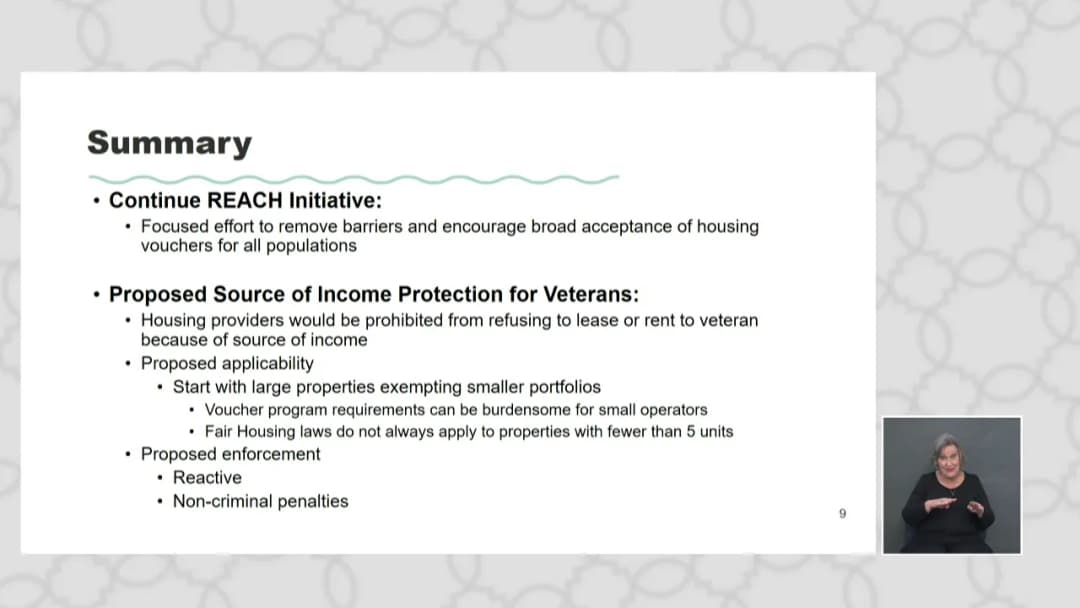
The San Antonio City Council convened on April 1, 2026, for a B session to discuss two major agenda items: the post-solicitation award recommendations for the Housing Bond (2022) and Community Land Trust (CLT) funds, and a proposed ordinance to protect veteran source-of-income (voucher) holders from housing discrimination. The meeting began at an unspecified time and included presentations by Veronica (Housing Department staff), comments from council members, and public testimony from two veterans. No votes were taken; the council directed the items to committee (PCDC) for further refinement. Consent Calendar - No consent calendar items were identified. Public Comments & Testimony - Two veterans spoke in favor of the source-of-income protection ordinance. One veteran, describing himself as a veteran with a traumatic injury, pleaded with the council to remove the barrier that allows landlords to reject vouchers, stating, "It's a simple barrier to get veterans off the street." He noted that veterans often hide their struggles out of pride and urged the council to pass the ordinance, referencing that Dallas and Fort Worth have already done so. - A second veteran emphasized that veterans need housing near transit, hospitals, and clinics, and that the current system forces them to accept whatever is available, even if it isolates them from services. Discussion Items - Post‑Solicitation Awards for Affordable Housing (Article 1, Item 1): - Veronica presented recommendations for awarding approximately $18.8 million from the 2022 Housing Bond (including $14.7 million from the Housing Trust Fund and $4.7 million from federal CDBG/Home funds) to seven rental and homeownership projects. - Rental projects recommended (4 projects, total $14.3 million): - Project 111 (Downtown, near Silver Line): $4.5 million – rehabilitation with relocation plan; residents not permanently displaced. - Judy Advita (District 4, near Texas A&M–San Antonio): 60 units for homeless/at‑risk individuals, including 14 units at 30% AMI; $5.6 million CDBG loan. - Aurora MLK (District 2, near St. Phillips College): 288 units (44 at 40% AMI), $1.7 million CDBG loan – located on Silver Line corridor. - Heritage en Medina (District 4): 86 units for seniors, targeting veterans, $2.5 million from Housing Trust Fund. - Homeownership projects recommended (2 projects, total $4.2 million): - Rancho Verano (Habitat for Humanity, District 4): 47 units, $4 million CDBG/Home; expected sale price $160,000 per unit. - Casita Project (District 5): small homes (2-bedroom, 1-bath) on small lots, serving households at/below 80% AMI; $200,000 in CDBG funds (total project cost $4.2 million). - Community Land Trust (CLT) awards (2 projects, total $2.18 million): - Silk Road CLT (Districts 1,5,6,7,8): $1.5 million to acquire and rehab homes near frequent transit (within 1 mile). - Esperanza CLT (District 7): $681,400 to rehabilitate existing properties; offers tenants the option to become homeowners. - Council members praised the transparency and strategic focus on transit‑oriented development (TOD), but Councilman Maky Rodriguez expressed concern about the scoring system and the high per‑unit cost of the West Travis project (rehab), urging leadership to review how costs and competitiveness are evaluated. - Source‑of‑Income Protection for Veterans (Article 2, Item 2): - Veronica explained the proposed ordinance would prohibit landlords from denying housing or disqualifying applicants solely because they use a veteran voucher (e.g., HUD‑VASH, Section 8). She noted that San Antonio has 90,474 veterans (2024 Census), 830 active HUD‑VASH vouchers, and 40 voucher holders currently searching for housing. - The ordinance builds on existing local protections (e.g., 2013 non‑discrimination ordinance, 2021 Housing Incentive Policy requiring all city‑funded projects to accept vouchers). - A working group (including property managers, landlords, veteran advocates, and city staff) has been meeting quarterly to address barriers: inspection delays, slow payments (30–60 days, now improved to 17 days), and lack of landlord participation (only 300 of 3,000 known landlords currently accept vouchers). - Council members debated whether to pass the ordinance immediately or send it back to committee (PCDC) alongside a planned Council Consideration Request (CCR) by Councilwoman Castillo that would address administrative burdens and landlord incentives. - Councilwoman Villagran cited Fort Worth’s similar ordinance (class D misdemeanor) and urged focusing on veteran‑specific needs, including proximity to VA clinics (only 14 clinics in the region, 13 north of Highway 90). - Councilwoman Spears expressed anxiety about military city reputation and wanted to ensure veterans are cared for, noting the importance of incentives and education for landlords. - Councilman White stated he supports veterans but argued the program has had “fallas en los procesos de inspección, retrasos de los pagos, y una carga administrativa,” and that requiring private landlords to accept vouchers without addressing those failures could be harmful. He supported sending the item back to PCDC. - Councilman Mungia emphasized the need to pair the ordinance with landlord incentives and a broader strategy to address credit/background history barriers. He supported the committee route to include Castillo’s CCR. - Councilwoman Rodríguez (Makki) insisted the council could move forward immediately with the ordinance as drafted while simultaneously advancing the CCR, saying, “Nada nos puede parar eso todavía pudiera suceder en la línea de tiempo que tenemos proyectada.” She urged colleagues to adopt the policy quickly because “el grupo de veteranos han estado pidiendo esto por años.” - Councilwoman Galván wanted data on how many units would be affected (small vs. large complexes) and suggested exploring connections with DHS or ACOG to expand case management support. - Councilwoman Cabello (District 7) supported the projects but agreed that the ordinance should go through PCDC with Castillo’s CCR to ensure “hagamos esto correctamente.” - Mayor Jones noted she is a VA user and has visited the Audie Murphy VA clinic, underscoring the practical challenges veterans face. She welcomed the direction to PCDC but stated, “No debería darle la bienvenida a retrasos… Ellos han estado rogando por esto los últimos dos años.” Key Outcomes - Housing Fund Awards (Article 1): No vote was taken. Council members expressed general support for the recommended projects and directed staff to continue with the awards process. Councilman Maky Rodríguez requested a detailed list of all prior Housing Bond awards with cost percentages. - Veteran Source‑of‑Income Protection (Article 2): The council did not vote on the proposed ordinance. The consensus (expressed by Councilwoman Villagran, White, Mungia, Cabello, and Galván) was to send the item back to the Planning, Community Development, and Culture (PCDC) committee for further review, to be combined with Councilwoman Castillo’s CCR addressing landlord incentives and administrative improvements. Councilwoman Rodríguez and Mayor Jones voiced support for moving forward immediately, but the majority direction was to the committee. Next steps: PCDC to discuss at its next meeting (presumably April 2025, as per presentation slide) and return to the full council with a revised ordinance.
The San Antonio City Council held a B session on Wednesday, April 1, 2026, from 2:02 PM to 3:52 PM. The meeting focused on two agenda items: a post-solicitation briefing on affordable housing gap funding awards and a discussion on source of income protections for veterans using housing vouchers. Council members reviewed proposed funding for eight projects totaling nearly $21 million and debated a potential ordinance to prohibit landlords from denying housing to veterans solely based on their use of a housing voucher. Public Comments & Testimony - Peter Brown (Bear County Commander, American GI Forum) urged the council to pass the veteran source of income ordinance, emphasizing that many veterans are too prideful to report discrimination and that they need the barrier removed. He described himself as a "grunt" and begged for passage, noting similar ordinances in Dallas and Fort Worth. - Cynthia (American GI Forum) stated that they have provided numbers of affected veterans to council members multiple times and argued that veterans deserve better treatment for their service. Discussion Items 1. Affordable Housing Gap Funding Post-Solicitation Briefing - Veronica Garcia (Director, Neighborhood and Housing Services Department) presented the results of the competitive procurement process for affordable housing funding. - The city allocated $21 million for eight projects from the 2022 voter-approved $150 million housing bond and federal CDBG/Home funds. Approximately $129.5 million of the bond has been committed to produce or preserve more than 5,000 units. - Rental housing: $14.4 million recommended for four projects creating or preserving 505 rental units, including 156 deeply affordable units (at or below 30% Area Median Income, about $26,000/year for a family of three). Projects include: - 11 West Travis (District 1): $4.5 million for rehab of 63 affordable units, including 13 at 30% AMI, with on-site services and a second elevator. Also up to $1.7 million in CDBG loan forgiveness. - Judy at Vita (District 4): $4.2 million for 68 supportive housing units for youth experiencing homelessness or aging out of foster care. - Aurora MLK (District 2): $1.75 million for 288 affordable units (44 at 30% AMI), 94% family-sized, near St. Philip's College. - Heritage Estates at Medina (District 4): $2.5 million for 86 units for older adults, focusing on veterans. This project already has 9% low-income housing tax credits. - Homeownership: $4.2 million for two projects creating 47 new affordable homes: - Habitat for Humanity (District 4): Homes sold for $160,000 with 0% interest mortgages. - Casitas Affordable Homes by Arcasas (District 5): Four infill units for families below 80% AMI. - Community Land Trust (CLT): $2.2 million for two CLT projects (Silk Road Cultural CLT and Esperanza CLT) supporting 20 affordable single-family homes with 99-year affordability. - Council members praised the rigorous scoring process but raised questions about the Wheatley Senior project (not funded due to missing needs assessment), universal design requirements, and the need for more market-rate housing along transit lines. 2. Veteran Source of Income Protections - Staff presented options to prohibit housing discrimination against veterans using VASH or Housing Choice Vouchers, as allowed by state law (preempts broader protections but allows for veterans and city-incentivized properties). - Current situation: San Antonio has 90,005 veterans (2024 census). Of those, 1,140 have Section 8 housing choice vouchers and 800 hold VASH vouchers. Combined, about 127 veterans with either type of voucher are currently seeking housing (40 VASH, 87 regular). Only about 300 of 3,000 rental listings on the MLS accept vouchers. - Staff noted that existing city-incentivized and federally funded properties already accept vouchers. A working group (REACH) has reduced payment delays from 30-60 days to as low as 17 days. - Councilmembers expressed mixed views: - Support for immediate ordinance: Mayor Jones, Councilmembers McKee Rodriguez, Galván, and Castillo (who also proposed a CCR for landlord incentives) argued that the ordinance is simple, urgent, and would give veterans more agency to live near VA healthcare facilities. Mayor Jones noted that only 3 of 13 VA clinics are south of Highway 90. - Prefer further study at PCDC: Councilmembers Viagran, White, Mungia, Elderete Gavito, Mesa Gonzalez, and Core supported sending the item to the Planning and Community Development Committee (PCDC) to couple with Councilwoman Castillo's CCR (for landlord incentives) and to address concerns about administrative burden, inspection failures, and potential unintended consequences (e.g., landlords converting units to short-term rentals). Councilwoman Core noted that the voucher success rate for regular vouchers is 68%, while VASH success rate is 90% due to case management. - The American GI Forum representatives reiterated the need for immediate action, stating veterans are reluctant to report discrimination. Key Outcomes - No formal vote was taken on either item. The affordable housing funding recommendations are expected to return for a council vote at a future meeting. - Veteran source of income protections: The council majority (as expressed by several members) favored sending the discussion and associated Council Consideration Request (CCR) to the PCDC committee for further refinement, with the goal of coupling an ordinance with incentive programs for landlords. The mayor acknowledged this consensus, stating the item would move to PCDC. No timeline was set, but Councilman Mungia suggested as early as next month. Note: The meeting did not adopt an ordinance; it was a briefing and discussion session. The final decisions on funding awards are pending council approval.
The Historic and Design Review Commission (HDRC) met on Wednesday, April 1, 2026, at 3:00 p.m. to consider a consent agenda and a pulled item (115 Main Plaza). The commission approved the minutes from the March 18, 2026 meeting, adopted the consent agenda (with one item pulled), and after discussion, approved the certificate of appropriateness for the Main Plaza Conservancy's proposed pavilion and food/beverage project with staff stipulations. Consent Calendar - Approval of Minutes – The March 18, 2026 HDRC meeting minutes were approved unanimously. - Consent Agenda Items – The following nine items were approved unanimously, with staff stipulations, after item 5 was pulled for separate discussion: North Frio from IH 10, West Houston 226 Bushnell, 40 5432 Lanhart, 2102 Broadway, 309 319 West Travis, 500 North Santa Rosa, 323 West Martin, 327 West Martin, and 526 Cameron. Public Comments & Testimony - No public comments were signed up, and no voicemails were received. The only speakers were the project representatives and the Main Plaza Conservancy chair. Discussion Items - 115 Main Plaza (Item 5) – The Main Plaza Conservancy, represented by Natalie Smith (chair), along with Alison Chambers (architect, Fort Pell and Carson) and Elaine Kearney (TBG Partners), presented a proposal for a permanent pavilion, catering kitchen, dining area, and stage on the historic plaza. Key elements included: - A 22-foot-4-inch-tall pavilion (double the height of the existing shade structure) to serve as a performance stage and provide shade. - A 1,200-square-foot food/beverage component (catering kitchen, not full commercial) to generate revenue for conservancy operations. - ADA accessibility improvements, including a gentle slope (<2%) from the cathedral toward the river. - Preservation of all heritage trees, new plantings, and artificial turf in shaded areas (noted as potentially high heat impact). - Lighting: smart system with dimming, pole-mounted lights, step lights, and stage lighting. - Plans for inlaid granite paving and a timeline component to tell the plaza's history, including the Canary Islands founding. - Power hookups for food trucks (but not for large events like Fiesta, which require 75 vendors). - Commissioner Questions and Concerns: - Several commissioners expressed concerns about the pavilion's height (22'4") and scale relative to the plaza, especially the view corridor from Commerce Street and the cathedral. Vice Chair Fetzer suggested studying a two-level roof to reduce mass. - Commissioner Velasquez emphasized restoring the historic "Plaza de las Islas" identity and requested more prominent acknowledgment of the cathedral's main doors and the view from Commerce Street. - Commissioner Savino asked about the commercial kitchen, dumpster location, and requested an elevation study from the north (Commerce Street) to show the cathedral's view. - Commissioner Group noted the height difference from the current shade structure (approximately double) and asked about tree placement. - Commissioner Holland questioned the transparency of the pavilion and the primary axis to the cathedral. - Commissioner Givata asked about pet-friendly areas and maintenance (day porter, storage). - The applicant responded that the Archdiocese supports the project, and the design intentionally preserves view corridors to the cathedral and courthouse, with the restaurant being largely glass to maintain transparency. - Commissioner Recommendations: The commission encouraged the applicant to return to the Design Review Committee (DRC) for further refinement, particularly on transparency, view corridors, paving design, and accessibility directly from the center of the plaza. Key Outcomes - Motion to Approve – A motion was made and seconded to approve the certificate of appropriateness for 115 Main Plaza with staff stipulations. The motion passed unanimously (8-0, with all commissioners voting aye, including Commissioner Holland after a brief audio issue). - Next Steps – The applicant will receive a certificate of appropriateness within 10 days. The commission requested further study on several design elements (transparency, view corridors, paving, accessibility) before final approval, but the project was approved as presented with staff conditions.
The Historical and Design Review Commission met on April 1, 2026, at 3:00 PM with a quorum present (Commissioners Memon, Sabino, Velázquez, Mizuka, Guevara, Krupp, Travieso, Fetzer, Gibbs, and Holland). The meeting opened with translation services announced for Spanish-speaking attendees. The commission approved the minutes from March 18, 2026, and then moved through the consent calendar, pulling only item 5 for discussion. Consent Calendar - All consent items were approved unanimously except for item 5, which was pulled by a commissioner. The approved consent items included certificates of appropriateness for properties at 309 West Travis, West Martin Street, and 326 West Martinton (among others). No public speakers were registered for these items. Discussion Items - Item 5 – Plaza Renovation (Applicant: Allison Chambers, Architect) The project involves a comprehensive renovation of a historic plaza (identified as Main Plaza) including a new pavilion, a small restaurant, shade structures, artificial turf areas, and improved accessibility. The applicant team (Elaine Kearney of EG Partners representing the owner, and Allison Chambers) presented the plans. Narley Smith, president of the conservation commission, explained that the organization has used the plaza for events for 20 years and needs a permanent structure to support free public programming, provide shade, and house kitchen and classroom space. Commissioner Comments and Concerns: - Commissioner Fetzer questioned the scale of the pavilion (22 feet 4 inches high) relative to the plaza and suggested exploring a two‑level roof design to reduce massing. - Commissioner Sabino raised concerns about transparency from Commerce Street and the view of the cathedral; he requested further study on how the pavilion and restaurant would affect sightlines. - Commissioner Velázquez asked about honoring the Canary Islands history (the plaza’s founding heritage) and was told that a commemorative marker and bronze elements would be included. - Commissioner Travieso asked about lighting design; the team described a smart system with elevated lamps, step lights, and theatrical lighting for performances. - Commissioner Krupp inquired about the difference in height between the existing shade structure and the proposed one; the new pavilion is taller to allow stage use but still situated below tree canopies. - Commissioner Galloway (or another?) asked about accessibility: the design includes a gentle slope (instead of many steps) to comply with ADA, though direct access from the center of the plaza to the pavilion may still require a detour. - Commissioner (Gibbs?) asked about artificial turf; the team explained it was chosen for durability and heat mitigation, with strategic placement under existing large trees to ensure shade. - Commissioner Holland’s audio was briefly lost but returned; he did not offer additional comments. The applicant team responded to all questions, noting that the restaurant will be largely glass to maintain transparency, and that the plaza design incorporates historic narrative elements, food truck parking, and electrical connections for events. Key Outcomes - Item 5 Approved with staff recommendations (motion by Commissioner Fetzer, seconded). The roll call vote was unanimous: all commissioners present voted in favor (Memon, Sabino, Velázquez, Mizuka, Guevara, Krupp, Travieso, Fetzer, Gibbs, and Holland). - The commission encouraged the applicant to return during the detailed design phase to address the commissioner’s suggestions regarding transparency from Commerce Street, direct accessibility to the pavilion, and further shade studies. - The meeting adjourned after the vote.
The Planning and Community Development Committee (PCDC) met on March 30, 2026, from 2:01 PM to 4:54 PM. The meeting included public comments, interviews for the Building Standards Board, a briefing on the Opportunity Home San Antonio Strategic Plan Framework, and a briefing on the Special Housing Supply Task Force report. The committee discussed the future of public housing, proposed lease changes, and recommendations to increase housing supply for vulnerable populations. Public Comments & Testimony - Tyler Ferguson (Executive Director, Blueprint Ministries) expressed support for the Special Housing Supply Task Force report and urged the committee to prioritize preserving and restoring existing housing stock, especially for low-income homeowners. He noted that over 60 homeowners his organization works with are severely cost-burdened and that investment in minor home repair programs is critical. - Isabel Galvan (read by Luis Hannah Santibanias, tenant advocate and voucher holder) opposed the Opportunity Home Moving to Work and RAD proposals, stating that canvassing 1,100 units showed residents were unaware of the programs. She argued that the changes would destabilize households, limit communication, and lead to privatization. She urged the committee to keep public housing public. - Leticia Sanchez (Historic West Side Residents Association) spoke against Opportunity Home’s proposed policy changes, stating they would remove protections for the lowest-income residents and shift the mission away from serving those at 30% AMI or below. She shared her personal experience living in public housing and raising children who became successful. - Jasmine Ededa (Coalition for Dignified Housing/Esperanza Peace and Justice Center) opposed the proposed restriction on door knocking, arguing it would harm community connections and the ability to share resources like the San Antonio Cove Neighborhood Project and community gardens. - Alejandro Lopez (President, San Antonio Alliance of Teachers and Support Personnel) drew parallels between privatization in public education and the proposed changes to public housing. He stated that declining enrollment in SAISD is partly due to lack of affordable housing and urged opposition to further privatization. - Melody Miranda (16-year-old resident of Alazan-Apache Courts) spoke against the proposed changes, including limiting negative rents, ending repayment agreements, and restricting solicitation. She expressed concern that RAD would privatize public land and lead to displacement, and asked the committee to protect public housing. - Aaron Hahn (Texas Housers) expressed concerns about the Opportunity Home strategic plan, particularly RAD conversion and lease changes. He noted that repositioning public housing could lead to increased privatization and risk of instability, and recommended safeguards such as one-for-one replacement, binding right to return, and transparent reporting. He also opposed the proposed solicitation and recording policies. Discussion Items - Building Standards Board Interviews: Four applicants were interviewed for three at-large seats: Robert Benke (realtor, general contractor, seeking reappointment), David Valtierra (licensed architect, community volunteer), Ann Hoffman Winer (retired nurse anesthetist, current board member seeking reappointment), and Faso Hussein (not present, written statement provided). Each applicant answered questions about their interpretation of demolition as a remedy of last resort and provided examples of when they would vote for demolition. - Opportunity Home San Antonio Strategic Plan Framework: Ayana Longoria (Chief Strategy, Data and Innovation Officer) presented the plan, which includes three goals: housing (preservation and expansion of 14,500 units), opportunities (resident services and partnerships), and innovation (staff development and technology). The presentation highlighted the deferred maintenance backlog of over $550 million, a $1.4 million monthly operating loss in public housing, and the need to reposition 6,000 public housing units through RAD (Rental Assistance Demonstration) to access more stable funding. The committee discussed lease changes, including a proposed solicitation policy that would require tenants to get permission from management before door-to-door activities. Opportunity Home officials clarified that the intent is to prevent predatory commercial solicitation and that community organizing and nonprofit outreach would still be allowed with property management notification. Council members expressed concerns about the broad language and its potential to chill organizing and civic engagement. The committee also discussed RAD conversion details, including that Opportunity Home intends to retain ownership, use project-based rental assistance (not vouchers), and commit to one-for-one replacement of units. Councilwoman Castillo noted that HUD rules allow up to a 5% unit reduction, but Opportunity Home stated they do not intend to reduce units. Councilman Galvan requested a breakdown of capital needs by property. Councilwoman Corr urged clearer commitments and more transparent communication. Councilwoman Mungia highlighted the importance of relocation plans and asked for a list of public housing properties by district. Opportunity Home agreed to provide a follow-up memo addressing these concerns. - Special Housing Supply Task Force Report: Veronica Garcia (Director, NHSD) presented the final report, which was developed by a task force launched by Mayor Jones in August 2025. The report recommends a new goal of 3,250 homes for four populations: veterans with housing vouchers (250 homes), people with disabilities (500 homes), older adults (2,400 homes), and LGBTQ+ unhoused youth (100 homes). The recommendations include updating the universal design ordinance, encouraging home sharing, and partnering with school districts and managed care organizations. The committee praised the report and noted that the results will be incorporated into the upcoming SHIP (Strategic Housing Implementation Plan) refresh in August 2026. Key Outcomes - Building Standards Board Appointments: The committee voted to recommend Robert Benke, Faso Hussein, and David Valtierra for appointment to the Building Standards Board through May 31, 2027. The recommendation will go to the full City Council. - Opportunity Home Follow-Up: The committee will work with Opportunity Home to provide a follow-up memo addressing concerns raised during the discussion, including details on lease changes, relocation plans, and a breakdown of capital needs by property. - Special Housing Supply Task Force: The report will be incorporated into the SHIP refresh, with final recommendations to be presented to City Council in August 2026.
The Community and Planning Development Board (PCDC) convened on March 30, 2026, at 2:01 PM. The meeting included public comments on housing policy, interviews for the Construction Standards Board, a presentation on Opportunity Home San Antonio's strategic framework, and an update on the Special Housing Supply Task Force. No formal votes were taken on the major agenda items; the board will forward recommendations to the City Council. Consent Calendar - The board approved the minutes of the previous meeting by a unanimous voice vote (all in favor, none opposed). Public Comments & Testimony - Tyler Ferguson (Executive Director, Blueprint Ministries): Expressed strong support for the housing report and the work reflected in it, emphasizing the importance of preserving and restoring existing housing for low-income homeowners. He noted that the housing crisis requires multifaceted solutions and that over 60 homeowners his organization serves face physical and mental health impacts from poor housing conditions. - Isabel Galván (written statement read by Luisa Santibáñez, due to Galván having the flu): Opposed the proposed changes to public housing under Opportunity Home's "Moving to Work" program, arguing that the changes would negatively affect residents, especially families with children and disabilities. She stated that the program would make an already complex system harder to navigate and could lead to loss of homes. - Leticia Sánchez (on behalf of the West Side Residents Association, including homeowners and renters): Opposed Opportunity Home's strategic plan and policy changes, asserting that the proposals would not help reduce the 30% housing deficit, would remove protections against homelessness, and would undermine the mission of the Housing Authority. - Olivia Cruz (former public housing resident): Opposed the proposed policy changes, describing the stress and uncertainty of potentially losing public housing, especially for mixed-status families and those without family or financial support. - Jasmine Herrera (Coalition for Dignified Housing, Centro Esperanza): Urged the board to oppose changes that would prohibit door-to-door communication by community organizers, arguing that such policies would break down community connections and prevent neighbors from sharing resources, including information about gardens, local organizations, and history. - Alejandra López (President, San Antonio Alliance of Teachers and Support Personnel): Opposed the proposed changes to public housing, connecting them to broader trends of privatization in public education. She noted that SAISD has seen declining enrollment due to lack of housing, leading to school closures, and warned that diverting city dollars to outside private entities would have negative impacts. - Melody Miranda (16-year-old resident of St. Patrick Courts, student): Opposed the proposed changes, stating that her generation's future is affected by housing insecurity. She argued that termination of payment agreements and prohibitions on door-to-door solicitation would create zero tolerance policies and increase homelessness. She called for protecting public housing and maintaining community connections. - Aaron Hahn (Texas Housen): Expressed concerns about repositioning public housing, warning that even with safeguards, private involvement could lead to instability for tenants. He opposed eliminating payment agreements and overly broad solicitation policies. Discussion Items - Construction Standards Board Interviews: The board reviewed applications for three at-large seats on the Construction Standards Board. Eight applications were received; four candidates were interviewed (Robert Banke, David Valtierra, Anne Hoffman Weiner, and Hassel Hussein, who submitted a written statement). Candidates answered questions about their interpretation that demolition should be a last resort. The board then went into executive session to deliberate. After returning, members nominated and voted to recommend Robert Banke, Hassel Hussein, and David Valtierra for appointment, with terms ending May 31, 2027. The motion passed unanimously. - Opportunity Home San Antonio Strategic Framework Presentation: Ayana Longoria (Chief of Strategic Framework), Lorraine Robles (Chief Operations Officer), and Malco Reyes (President & CEO) presented a 10-year strategic plan. Key elements included: - Three goals: housing preservation & expansion, resident services & advocacy, and innovation (technology, operational efficiency, employee development). - Plan to develop or preserve 14,500 units: modernize 6,000 public housing units, produce 5,500 new units (including transit-oriented), acquire 500 existing units as Class A affordable housing, and revitalize 2,500 homes. - Need for repositioning due to a $550 million capital infrastructure backlog, with HUD funding falling short by $16 million/year in 2025, projected to grow to a 50% negative margin by 2035 under moderate inflation. - Conversion of three pilot properties (District 7 high-need, District 1 easier-to-convert) using project-based vouchers (RAD), not tenant-based vouchers. Opportunity Home intends to retain ownership and property management. - Clarified that resident rent would remain at 30% of income; only the federal subsidy stream changes. - Discussed solicitation policies: door-to-door communication by outside entities should be coordinated with management, but neighbor-to-neighbor organizing and political canvassing are not prohibited. - Councilmember Questions and Concerns: - Councilmember Castillo: Raised concerns about the language in lease agreements regarding solicitation, asking for clarification that it does not ban resident organizing or campaign canvassing. Sought assurance that the city's bond funds (e.g., $16 million) could support Opportunity Home's financing. Asked about the calculation of income for student loans under Section 8. - Councilmember Galván: Asked how many units would be preserved post-RAD conversion (answer: all 6,000 units will be replaced; density may increase on existing land). Sought clarification on long-term financing and relocation plans, noting the importance of ensuring residents can return after any displacement. - Councilmember Cor: Emphasized the need for transparent metrics and community trust, especially regarding maintenance costs and contractor selection. Suggested creating a dashboard to track dollars invested per property and maintenance outcomes. - Councilmember Mesa González: Asked about relocation plans for the 6,000 units being modernized (answer: a physical relocation plan for each project, regardless of duration). Questioned the 5% reduction rule for vacancies over two years (HUD may reduce subsidy but Opportunity Home intends to replace units). Also asked for more information on MTW and other projects in District 8. - Councilmember Mungía (President): Emphasized the importance of transparency and collaboration, noting that many residents fear displacement. Asked about the current status of payment agreements (ongoing, case-by-case) and mixed-status family policies (a federal proposal that would apply to all federally assisted units). Stressed that Opportunity Home must commit to not displacing families and to providing clear relocation assistance. - Special Housing Supply Task Force Report: Verónica García (Interim Assistant City Manager, Neighborhood Services) presented final recommendations to increase housing for four populations: veterans, people with disabilities (vision/hearing), older adults, and LGBTQ+ youth. Key recommendations include: - Veterans (237 unhoused): Use existing vouchers; partner with VA and property managers; create housing near medical centers. - People with disabilities (500 homes needed): Provide accessible design incentives; update Universal Design Ordinance; increase proportion of units equipped for vision/hearing impairments. - Older adults (2,400 homes needed, goal already met): Encourage shared housing; partner with school districts to use vacant properties for senior housing. - LGBTQ+ youth (372 unhoused): Support master-leasing programs; reduce barriers to congregate living; work with nonprofits like Thrive Youth Center. - Next steps: Final recommendations expected in August 2026; full report will be available online; adjustments to SHIP plan will incorporate findings. Key Outcomes - Consent Calendar: Minutes approved unanimously. - Construction Standards Board: Recommended Robert Banke, Hassel Hussein, and David Valtierra for appointment (terms ending May 31, 2027); matter forwarded to City Council. - Opportunity Home Strategic Plan: No vote taken; board will provide a follow-up memo addressing committee questions and concerns. - Special Housing Supply Task Force: Received; final recommendations due August 2026; the board will incorporate feedback into the SHIP renewal process.
The San Antonio Planning Commission met on Wednesday, March 25, 2026, at 2:00 PM. The meeting included approval of a consent agenda and two individual hearing items: a sector plan amendment and an appeal of a certificate of determination denial. The meeting adjourned at 2:44 PM. Consent Calendar - The consent agenda (all items except 10 and 11) was approved unanimously by a roll-call vote of 7-0 (Commissioners Bustamante and Ulett recused themselves). Cases on consent were those where staff recommended approval, no detailed discussion was required, and no public speakers were signed up. Discussion Items Item 10: Resolution Amending the North Sector Plan - Staff Presentation (Arthur Gomez): Staff recommended denial of the request to change the North Sector Plan designation from suburban tier to regional center. Staff stated the designation is inconsistent with locational criteria and infrastructure requirements for regional centers, which are designed for large-scale uses. The property is adjacent to a residential neighborhood. The zoning commission recommended approval on March 17. - Applicant (John Cooley): Present to answer questions. No public speakers signed up. - Commission Questions: Several commissioners noted the use is consistent with development along Western Oak and expressed support for the applicant's request. - Motion and Vote: Commissioner Profit moved to approve the applicant's request; Commissioner Mylam seconded. The motion passed 9-0 (Commissioner DeSucci recused). Item 11: Appeal of Certificate of Determination Denial - Staff Presentation (Clayton Wallace): The appeal concerns a duplex at 439 Barrett Place, built in 1940 on two antiquated lots. The applicant sought new water, sewer, and electric service plus building permits. Staff found the property did not qualify for plat exemption under UDC Section 35430 C17 (requires a single lot) or C15 (requires proof of five years of electrical service, which was not provided). Staff also cited UDC 35515 A2B, which prohibits duplexes across lot lines without rezoning and platting. Staff recommended upholding the denial. - Applicant (Jamie Little, ADA Consulting Group): Represented the owner. Argued that the duplex is a legally existing building recognized by a 1992 City Council ordinance (rezoning to R7 with a supplemental use permit for a duplex). She contended that UDC 35702 protects existing lawful non-conforming structures, and that exceptions 15 and 16 of 35430 should apply, allowing repairs and maintenance without a plat. The need was to repair an electrical panel. She requested the commission issue a COD under exceptions 15 and 16. - CPS Representative: Confirmed there are two active electric meters at the address and stated CPS has no objection to the repair permit. - Staff Response: The original application clearly requested new utility connections and building permits, not just a trade permit for repairs. Staff did not have proof of five years of electrical service and noted that a new utility connection triggers compliance with current codes, including the prohibition on duplexes across lot lines. Staff reiterated that the applicant could submit a new application limited to a repair permit under exception 16. - Commission Discussion: Commissioners questioned the scope of the application and the burden of proof. Chair Peck noted the record before the commission is limited to the original application and staff's determination. Commissioner Lopez expressed that the issue was procedural: the application included requests that triggered broader code requirements, muddling the simpler need for an electrical repair. The commission advised the applicant to submit a new application focused solely on the repair permit. - Motion and Vote: Commissioner Profit moved to uphold staff's denial of the appeal; Commissioner Bustamante seconded. The motion passed 8-0 (Commissioner Orion recused). Key Outcomes - Consent Agenda: Approved unanimously (7-0). - Item 10 (North Sector Plan Amendment): Approved 9-0, reversing staff's recommendation of denial. - Item 11 (Appeal of COD Denial): Uphield staff's denial 8-0; the applicant was advised to submit a new application focused solely on the electrical repair permit. - Director's Report: Planning commission interviews for City Council appointments will be held on April 2, 2026, at 9:00 AM during the City Council A session.