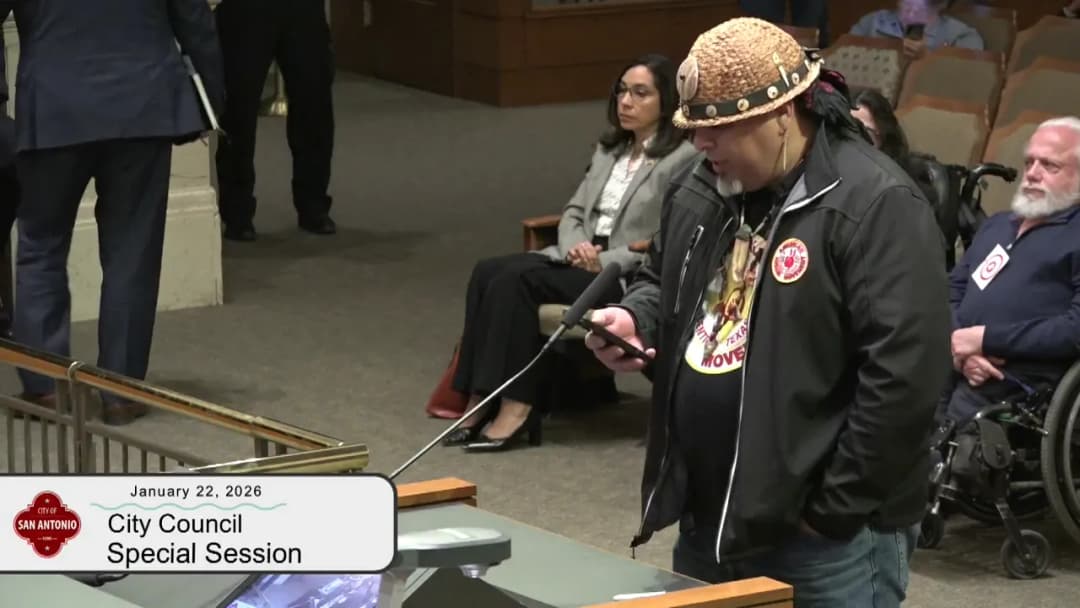
The San Antonio City Council held a special session on January 22, 2026, from 1:09 p.m. to 8:23 p.m., to discuss the city's legal obligations and policies regarding cooperation between the San Antonio Police Department (SAPD) and federal immigration enforcement agencies, particularly ICE. The meeting included a staff presentation, over 60 public comments, and council deliberation. No formal votes were taken, but multiple directives for follow-up actions were issued. Presentation and Staff Report - City Attorney Andy presented the legal framework, primarily Texas Senate Bill 4 (2017), which requires SAPD to cooperate with federal immigration enforcement, prohibits policies that interfere, and allows officers to inquire about immigration status. SB4 (2023) was also discussed but remains partially enjoined. - Chief McManus and Deputy City Manager Maria Villa Gomez detailed SAPD's involvement in 18 multi-jurisdictional task forces focused on serious crimes (e.g., narcotics, human trafficking), not immigration. In 2025, out of 2.1 million calls, only 66 referenced immigration, and 258 reports mentioned it. Of 51,000 arrests, ICE issued 11 detainers. ICE requested SAPD assistance only twice in 2025—both for perimeter security during planned operations. - SAPD officers are bound by department policies even when on task forces. Administrative warrants (issued by ICE without a judicial signature) do not authorize SAPD arrests; officers are trained to distinguish them and contact ICE if encountered. Public Comments & Testimony - Over 60 individuals and groups spoke, with the vast majority opposing cooperation with ICE. Speakers included community members, attorneys, educators, veterans, and representatives from organizations such as SA Stands, ACLU of Texas, and the San Antonio Alliance of Teachers. - Positions against cooperation: Many speakers argued that ICE engages in unlawful activities, including warrantless entries, racial profiling, and violence (citing the killing of Renee Good and deaths in detention). They expressed fear that cooperation erodes trust in local police, discourages reporting of crimes, and harms immigrant families and students. Several called for policies to limit cooperation, such as requiring judicial warrants, providing know-your-rights notifications, and increasing transparency. - Positions supporting cooperation: A few speakers (e.g., Commissioner Grant Moody, community members) supported cooperation, emphasizing public safety, the need to target dangerous criminals, and compliance with state and federal law. Some argued that limited cooperation prevents escalation and protects officers. Discussion Items - Council members asked clarifying questions about legal obligations, the nature of ICE requests, training on administrative warrants, and tracking of complaints. Chief McManus confirmed that SAPD does not enforce immigration law and does not arrest solely on administrative warrants. - Council debated the balance between legal compliance and moral responsibility. Some members (e.g., McKee Rodriguez, Castillo, Mungia, Corps) strongly condemned ICE actions and urged limiting cooperation, citing fear in communities and the impact on school attendance and public trust. Others (e.g., White, Spears) emphasized the rule of law, the professionalism of federal agents, and the need for Congress to reform immigration laws. - Several council members proposed actionable steps: creating a reporting system for constitutional violations, posting details of ICE operations online, requesting judicial warrants when ICE asks for assistance, exploring policies similar to Austin's Freedom City ordinance, and establishing a legal defense fund for victims of ICE raids. Key Outcomes - No formal resolutions or ordinances were adopted. The council directed staff to: - Develop a mechanism for residents to report alleged civil rights violations by ICE and refer them to the appropriate federal inspector general. - Research implementation of a policy similar to Austin's (requiring officers to inform individuals of their rights during encounters related to immigration). - Provide a timeline for posting ICE cooperation data (requests, costs, outcomes) on the city website. - Explore creating a fund (e.g., RFP) to support nonprofits providing legal aid to victims of ICE raids. - Report back to council within 30 days on these items. - The mayor emphasized continued transparency and encouraged civic engagement, noting the upcoming primary election on March 3, 2026.
Public Meetings - San Antonio, Texas
Public Meetings - San Antonio, TexasThe Building Standards Board (BSB) met on Thursday, January 22, 2026, at 10:31 a.m. to hear five cases concerning dangerous buildings. The meeting included emergency demolitions, board-up costs, and extensive public testimony. The board deliberated on repair timelines and demolition orders, with decisions varying by property. Emergency Demolitions (Staff Report) - The structure at 247 Heading Pest Street was demolished as an emergency on December 6, 2025, following a fire on December 2, 2025. No further board action was required. - The structure at 2106 East Crockett Street was demolished as an emergency on December 12, 2025, after a fire on December 8, 2025. No further board action was required. Public Comments & Testimony - Alex Kindrial (SAPD Safe Unit officer) testified regarding 150 Alendale Drive, describing years of drug activity, homeless encampments, and a lack of cooperation from the previous owner; he supported demolition. - Lydia Namigo (NHSD Navigator) testified about 215 Rulman Avenue, stating that the owners had been offered resources but the house was not ADA accessible and the owners had refused some assistance. - Rosendo Maldonado (owner of 215 Rulman), speaking through a translator, pleaded for more time to repair, claiming a stop-work order had hindered progress and that his wife uses a wheelchair and requires dialysis. He expressed fear of homelessness. - Guadalupe Maldonado (wife of owner) testified that she sells items at flea markets and that code enforcement took her property (air conditioner, wheelchair, oven) during a cleanup; she asked the board not to demolish. - Rose Hill (President, Government Hill Neighborhood Association) spoke for 215 Rulman, requesting 90 days for the association to organize volunteer cleanup and secure engineers; she stated the house was not beyond repair and that the couple needed community help. - Robert Macatee (neighbor and owner of 211 Rulman) testified that the property had been a problem for a decade, that the owners were unable to maintain it, and supported demolition for safety. - A daughter of the Maldonados (name not given) asked for time for the neighborhood association to help. - Troy Glenn Welch (owner of 1902 Farwell Drive) testified that he had multiple spinal surgeries, tried to sell the house after a fire, and requested 60 days to sell it; he presented a fire damage assessment report. - A granddaughter (name not given) testified for 1906 Texas Avenue, explaining that foundation work was done without permits, that they were waiting for Casa Verde and Blueprint to provide assistance, and that the accessory structures were sentimental. Discussion Items 150 Alendale Drive – Staff recommended demolition due to repeated board-ups ($1,800 + $1,000), a fire in 2025, and the property being within 1,000 feet of John F. Kennedy High School. The owner's representative (Oscar Lonel Larvarado and a contractor) requested 60 days to repair and secure the property, stating they planned to start work in February 2026. The board questioned the timeline and the lack of permits. 215 Rulman Avenue – Staff presented extensive structural issues: unlevel foundation, rotting joists, missing skirting, exposed wiring, and unsafe living conditions for an elderly couple. A notice to vacate had been issued but the occupants remained. The owners claimed they had been trying to repair, but code officer Cynthia Santana clarified that no permits were pulled, no stop-work order existed, and no progress was made during an eight-month hardship period. 1906 Texas Avenue – Staff documented a dilapidated main structure and two accessory structures. The owner's granddaughter stated that foundation work was done without permits and that Casa Verde and Blueprint were on the waiting list to provide financial assistance for repairs. The board discussed whether to allow time for documentation or order demolition of accessories. 1902 Farwell Drive – The structure had significant interior fire damage, missing siding, and charred roof decking. The owner, Troy Glenn Welch, explained he had spinal surgeries and was trying to sell the property. A letter from Council District 1 was read supporting the owner's cleanup efforts. The board considered allowing 60 days to sell. 2707 Morales Street – No one appeared for this case. Staff presented severe smoke and fire damage, missing roof sections, and a dilapidated accessory structure. The property is within 1,000 feet of Irving Dual Language Academy. Key Outcomes - 150 Alendale Drive: Motion passed (5-0) to allow 60 days for repair, with stipulations: secure the property, cut utilities until ready, report to code officer every 15 days. If not repaired within 60 days, demolition is automatic. - 215 Rulman Avenue: Motion passed (unanimous) to declare the property a public nuisance and order demolition within 30 days (vacate, cut utilities, secure). Vote: Ayes – Joel Solis, Ema Addison, John Nelson. - 1906 Texas Avenue: Main structure reset to the next available BSB date, requiring documentation (scope of work, cost estimate, engineer's report, and letters from Casa Verde and contractor). The two accessory structures were ordered demolished within 30 days. Vote: 5-2 in favor. - 1902 Farwell Drive: Motion passed (4-1) to allow 60 days to sell the property. If sold, the buyer must repair within 50 days; otherwise demolition proceeds. If not sold within 60 days, demolition (with utilities cut and property secured). - 2707 Morales Street: Motion passed (unanimous) to order demolition of the main structure and accessory structure as not feasible to repair.
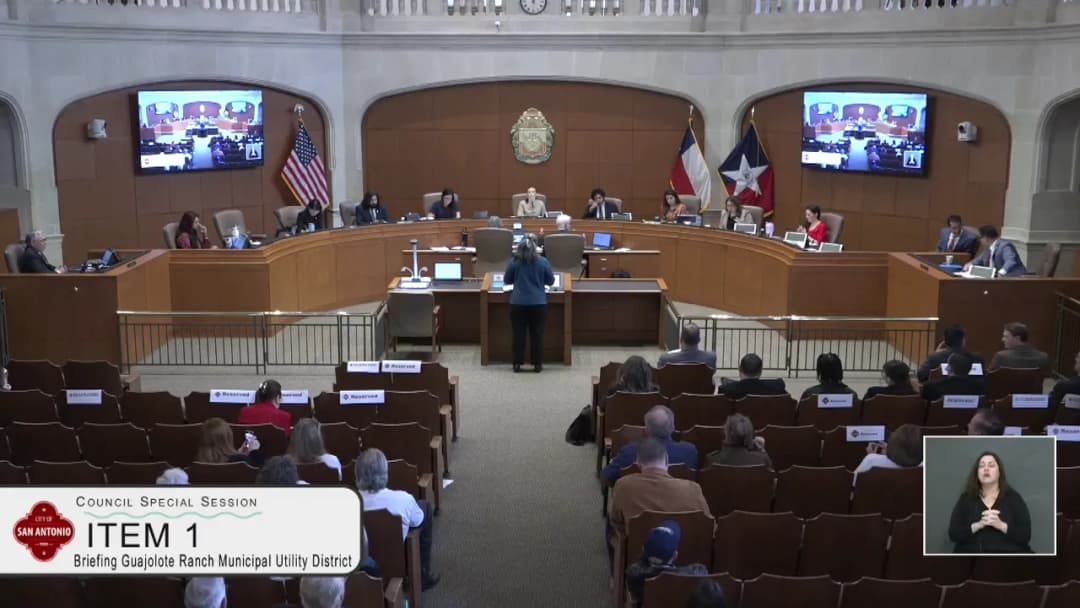
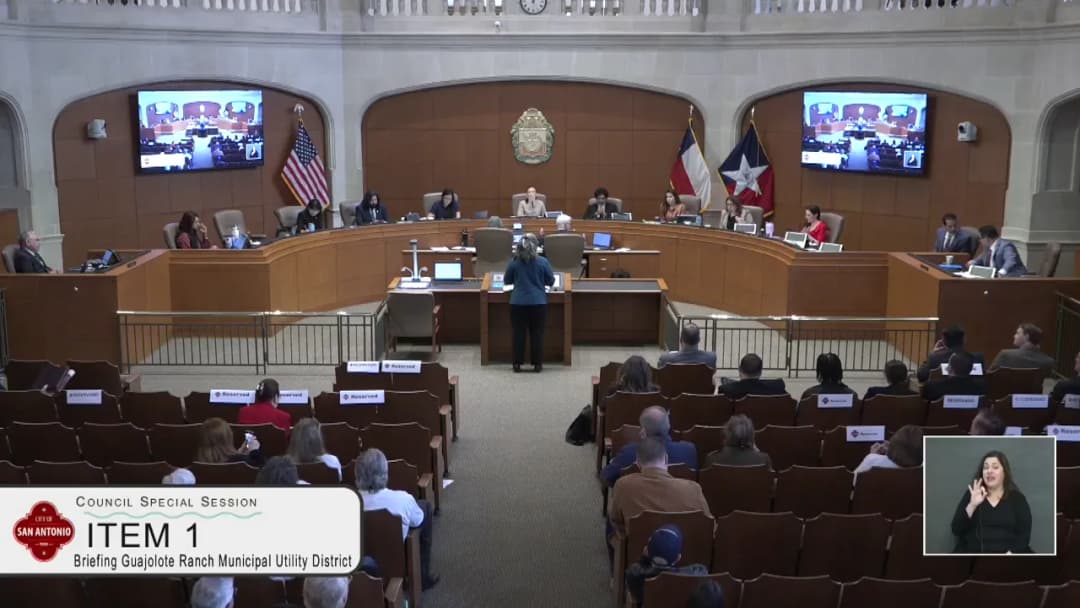
This was a special session of the San Antonio City Council held on January 22, 2026, at 9:06 AM to discuss a proposed Municipal Utility District (MUD) for the Guajolote Ranch development. The meeting was informational and included a staff presentation, extensive public testimony, and council deliberation. No formal vote was taken; a decision is scheduled for the February 5, 2026, regular council session. Public Comments & Testimony - Over 20 speakers addressed the council, the vast majority expressing opposition to the MUD request. Speakers included residents of adjacent communities (e.g., Great Forest, Canyon Sin Loop, Cedar Creek Alliance), representatives of the Cine Loop Alliance, a geologist, the mayor of a neighboring city, and others. Key concerns raised included: - Risk of contamination to the Edwards Aquifer and Trinity Aquifer, which supply drinking water to over 2.5 million people in the region. - Inadequate emergency access: only one two-lane road (Cine Loop Road) planned for 3,000 homes, with no contact from the developer to the fire chief or neighboring subdivisions for secondary access. - Traffic impacts: an estimated 30,000 additional vehicle trips per day on rural roads prone to flooding; existing flooding issues on Cine Loop Road and Sam Ranch Road. - Financial burdens on future homeowners: MUDs impose additional property taxes and fees, with examples cited of residents paying $3,000/year in MUD taxes plus $40,000 in back taxes, and monthly payments of $1,500 for 39 years. - Developer's track record: Lenar Homes was cited for violations of a TCEQ settlement agreement in 2019 and for causing flooding at a prior development (Forest Ranch). - Lack of community engagement: the developer did not reach out to neighbors or follow the city's North Sector Plan. - Several speakers submitted petitions and documentation, including a 2025 petition with 500+ signatures opposing the development. - One speaker, a geologist, provided detailed testimony about the porous limestone geology (karst) and the high risk of untreated wastewater entering the aquifer through fractures and conduits. - A few speakers noted that the Planning Commission had recommended denial of the MUD by a 5-4 vote on January 17, 2026. Discussion Items - Staff presentation by Eric (Development Services) described the project: 1,159 acres near the intersection of Cine Loop and Babcock Road, proposed by Lenar Homes and others for 3,000 residential lots. The request is for city consent to create Bear County MUD 2 to finance water, wastewater, stormwater, and park infrastructure at an estimated cost of $150 million, with anticipated profit of $106.5 million. - The timeline: petition submitted November 10, 2025; council must act within 90 days (by February 8, 2026). Currently at day 73. The item is scheduled for the February 5, 2026, council meeting. - If the council denies the MUD or takes no action, the developer can file a new petition, triggering a 120-day negotiation period with San Antonio Water System (SOS). If no agreement is reached, the developer can seek approval from the Texas Commission on Environmental Quality (TCEQ). - Council members discussed the legal implications and the possibility of losing leverage if the MUD is denied. City Attorney clarified that if the council denies consent on February 5, the developer can still pursue a petition and negotiate with SOS; the city would not be party to those negotiations. - Several council members expressed strong opposition to the MUD request, citing risks to the Edwards Aquifer, fiscal irresponsibility of MUDs, and the developer's lack of cooperation. Councilmembers Maki Rodríguez, Mesa González, Castillo, Spears, White, Galván, Munguía, and others indicated they would vote no on February 5. - Councilmember Spears raised questions about the MUD's governance: the developer controls the board initially, and residents may not gain full control for up to 12 years. The MUD can issue bonds and increase taxes without council approval. The MUD would also remove the property from city tax rolls, costing the city potential revenue. - Councilmember Villagrán emphasized the need for transparency and community engagement, noting that the developer had not been a good neighbor. - Councilmember Munguía stated that the city has a responsibility to protect the aquifer and that the risks of contamination are irreversible. - Councilmember Mesa González confirmed that she would not support the MUD on February 5, and urged colleagues to do the same. - The council received confirmation from SOS representative Keith Martin that the developer does not have a right to provide water service in the area and that SOS will participate in the 120-day negotiation if the MUD is denied. - Staff noted that some protections are already in place regardless of the MUD decision: 50% open space, 30% impervious cover limits, and other conditions from the 2022 SOS agreement and the 2023 development master plan. These would remain even if the MUD is denied. Key Outcomes - No formal vote was taken at this special session. The council will consider the MUD request at its regular meeting on February 5, 2026. - The council requested additional information on which specific protections (from the 15 proposed conditions) would survive if the MUD is denied, to be provided before the February 5 meeting. - Multiple council members stated their intention to vote against the MUD, signaling likely denial. However, the official decision is deferred. - The next steps: If the council denies consent on February 5, the developer can file a petition with SOS, initiating a 120-day negotiation period. If no agreement is reached, the developer can apply to TCEQ for a MUD creation. If the council approves, the MUD would proceed to TCEQ for final creation.
On January 22, 2026, the San Antonio City Council held a special session to receive a briefing on the proposed Wahalote Ranch Municipal Utility District (MUD). The meeting began at 9:06 AM and adjourned at 11:41 AM. The MUD would serve a 1,160-acre development in the city's extraterritorial jurisdiction (ETJ) near Scenic Loop and Babcock Roads, planned by Lenar Homes for 3,000 single-family homes. The developer submitted a petition on November 10, 2025, triggering a 90-day consideration period; the meeting was on day 73. The City Council must decide by February 5, 2026, whether to consent to the MUD creation, deny it, or take no action. The Planning Commission recommended denial on January 16, 2026, by a 5-4 vote. Public Comments & Testimony - Kate Hallfeist (Grey Forest resident, Scenic Loop Holotus Creek Alliance) urged denial, citing risks to the Edwards Aquifer, and noted that over 1,500 residents opposed the project at TCEQ and 150 opposed the MUD at the Planning Commission. She quoted Councilman Mungia's motion to deny. - Jane Sams (Sam's Ranch Road resident) described MUDs as a scheme that burdens homeowners with high taxes and fees, citing her sister's experience in a Katy MUD paying nearly $3,000/year in additional taxes, and a neighbor's shock at MUD taxes being half the mortgage. She argued it would not provide affordable housing. - Jim Burbiglia (MUD board member, MUD No. 1) spoke from personal experience, stating the developer borrowed $150 million at 9% interest, leaving residents paying for 39 years, and that MUD boards are autonomous, allowing self-dealing. - Diana Duncan (San Antonio resident) opposed the MUD, noting the city invested $50 million to protect the aquifer since 2000, and that 16 wastewater plants over the contributing zone have compliance issues; only four meet drinking water standards, and three of those were out of compliance in the last three years. - Stuart Burnbaum (UTSA geology professor, Trinity Glen Rose Groundwater Conservation District board member) provided expert testimony that the Trinity Glen Rose Aquifer recharges the Edwards Aquifer via faults and fractures, contradicting SAWS claims, and that the proposed plant would introduce contamination. - Steve Lee (Grey Forest area resident) stated the development would release 1 million gallons/day of treated sewage into the Holotus Creek watershed, which contributes up to 15% of Edwards Aquifer recharge. He cited EPA data showing half of the 14 wastewater plants in the contributing zone violated discharge limits in the past three years, and that Lenar's 4S Ranch development violated a settlement agreement with TCEQ in 2019. - Lynette Munson (Scenic Loop Holotus Creek community) reported that a public records request revealed the Bear County Fire Marshal had no contact with the developer, meaning no fire safety review for a single ingress/egress point for 3,000 units. - Austin Browning (Scenic Loop Holotus Creek Alliance treasurer) argued the developer's traffic study underestimates impacts, projecting 30,000 daily trips on a road designed for 5,500, and that the developer would not pay for road widening. - Michael Schick (Canyons at Scenic Loop resident) stated that the developer's claim of permanent emergency access through neighboring properties is false; the gated community to the north refuses access, and neighboring ranches also refuse. - Ken Kemp (Canyons at Scenic Loop board president) confirmed that no permission will be granted for Lenar to use private streets. - Michael Phillips (Grey Forest councilman) warned that doubling effective rainfall from the plant would increase flood risk, costing $10 million for one low-water crossing and $40 million for another, and that one-third of Grey Forest homes are at risk, with a history of near misses and loss of life. - Lisa Pack (Scenic Loop resident, Holotus Creek Alliance secretary) noted that the Edwards Aquifer Protection Program spent $50 million to protect the watershed, and that a 1996 Pape Dawson report (Lenar's engineers) called the area environmentally sensitive. She suggested a conservation easement instead. - Philip Manna (Alamo Farmsteads Babcock Road Neighborhood Association president) criticized Lenar for bypassing city review by using the ETJ, violating the North Sector Plan's recommendation of 1 lot per 10 acres, and noted that the City of Midlothian passed a resolution opposing all MUDs in their ETJ. - Randy Newman (speaker) highlighted the lawsuit filed against TCEQ's wastewater permit, argued that denial gives the city leverage, and that MUD board control remains with the developer for up to 12 years. He delivered a poetic appeal to "remember the aquifer." - Alan Montemayor (Sierra Club, Alamo Group chair) cited the Southwest Research Institute's finding that additional wastewater systems would significantly degrade the watershed, and urged applying the precautionary principle. - Isabel Hadetta opposed the MUD, noting the J17 well is 40 feet lower than normal, and that San Antonio has 11,000 vacant homes and 4,000 homeless, so the development is not needed. - Patricia Seidenberger stated that 14 legislators, Bear County Commissioners, Mayor Ron Nirenberg, and state senators oppose the project, and that the only egress is a two-lane road with no right-of-way for widening. - Paul Garrow (Grey Forest mayor) drew parallels to historical public health failures (DDT, Flint water crisis, Johnson County PFAS disaster), warning of forever chemicals and urging the council to vote no. Discussion Items - Staff Presentation: Bridget White presented the MUD request, including a $150 million infrastructure cost, $106.5 million in revenue, 3,000 lots, an on-site wastewater treatment plant, and a proposed development agreement with 15 development controls. The 90-day clock ends February 8, 2026. The city has three options: approve consent with development agreement, deny, or take no action. - Council Questions and Comments: - The Mayor noted that the city reached out to Southwest Research Institute for updated analysis, but they declined to engage further. - Councilmember Aldrete Gavito clarified the process: if the council denies or takes no action, the developer can submit a petition triggering a 120-day negotiation period with SAWS. She asked which development controls would survive if the MUD is denied. Staff will provide a list by the end of the week. - Councilmember Castillo expressed concerns about MUDs siphoning $12.7 billion from the state (per Texas Comptroller), and that homeowners in MUDs pay triple property taxes. He noted that neither option is favorable, but the city must protect the aquifer. - Councilmember Mesa Gonzalez stated she will not support the MUD. She noted the county took no action on a PID application submitted in 2023, and that the city has never approved a MUD consent request. - Councilmember Spears asked clarifying questions: MUDs levy separate ad valorem taxes, can continue indefinitely, can issue new bonds, and the developer controls the board for potentially 12 years. She highlighted that the city would assume MUD debt if annexed. - Councilmember Viagran noted the tension between local control and private property rights, but criticized the developer for lack of transparency. He said he does not want to preclude future MUDs but this project is not forthcoming. - Councilmember White stated he will not support the MUD due to aquifer contamination risks, despite supporting private property rights generally. - Councilmember Galvan noted the development contradicts the city's efforts to reduce suburban sprawl and environmental impacts. - Councilmember Mungia credited the advocacy and said he will vote no, citing concerns about long-term operation of the wastewater plant by an HOA and TCEQ's inability to enforce fines. - SAWS Comments: Donovan Burton stated SAWS takes no position on the MUD but believes water quality risks have been mitigated through conditions like impervious cover limits, enhanced nutrient removal, and monitoring. He acknowledged the geology is complex but asserted the drinking water source is protected. The enhanced treatment for nutrient removal is a first for such plants. Key Outcomes - No vote was taken; the briefing served to inform the council ahead of the February 5, 2026, meeting. - The council directed staff to provide: 1. A list of which of the 15 development controls would remain if the MUD is denied (i.e., those from the SAWS agreement and the settlement vs. those in the development agreement). 2. Information on TCEQ's track record with similar MUD applications after city denial. - Multiple council members indicated they will vote against the MUD on February 5. The Mayor acknowledged the city's limited leverage if the MUD is denied and the developer goes to TCEQ, but noted that denial preserves the option for SAWS negotiation and keeps some protections in place.
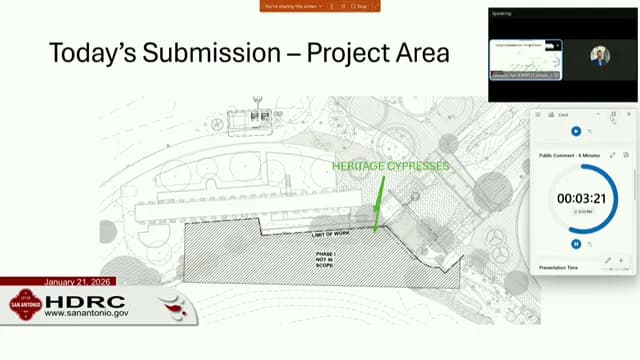
The Historic Design Review Commission met on January 21, 2026, starting at 3:01 PM, to handle officer elections, approve a consent agenda, and deliberate on several development proposals. The most substantial item was the Brackenridge Park Phase 2 improvements, which prompted extensive public testimony on tree removal, parking, picnic tables, and cultural significance. The commission also considered a church gate, a commercial sign, a multifamily building, and a residential garage and window screen replacement. Consent Calendar - Approved minutes from the December 17, 2025 meeting. - Approved items 2, 4, 6, 7, 8, 9, 10, 11, 12, 13, 14, and 15 with staff stipulations. Items 1, 3, and 5 were pulled for separate discussion. Public Comments & Testimony - Brackenridge Park (Item 16): Dozens of public speakers opposed the Phase 2 plan, citing the removal of heritage trees (especially two cypress trees near the pump house), loss of over 22 parking spaces and picnic tables, and the displacement of cultural traditions such as Easter celebrations, lowrider car culture, and family gatherings. Representatives of the Comanche and Apache nations stated the cypress trees are sacred and requested consultation, noting a current 30-day tribal review period. Some speakers supported the project, emphasizing ecological restoration and historical preservation. Voicemails echoed similar concerns about parking, picnic tables, and tree removal. - 502 New Street (Item 3): Rev. Toby Works, pastor of San Jones Church, explained the need for security gates but faced questions about the ornate design competing with historic stonework. - 1301 East Commerce (Item 5): The applicant presented alternative digital sign options (A, B, C) and explained their efforts to fit the existing building facade. - 1255 Crockett Street (Item 17): A voicemail from the King William Neighborhood Association opposed approval until all conceptual stipulations were met. - 525 Street (Item 18): Property owner Benjamin Anka stated that original wooden window screens were beyond repair (90% damaged) and proposed metal screens with a wood-like finish. He also requested a metal garage structure, citing similar examples in the neighborhood. Discussion Items - Election of Officers: The commission re-elected J. Gibbs as Chair and Jeffrey Setzer as Vice Chair by unanimous voice votes. - Item 16: Brackenridge Park Phase 2 (3700 North Mary Street): The city and design team presented a plan to rehabilitate the northern section of the park, including ecological restoration, removal of asphalt (10% impervious reduction), addition of 88 new trees and 177 understory plants, and relocation of a historic stone kiosk. Commissioners expressed concerns about the loss of picnic tables (over 10% removed) and parking, the protection of two cypress trees (determined to be in Phase 1, not Phase 2), and the impact on cultural uses. After lengthy debate and a failed motion to approve with additions, a successful substitute motion referred the project to the Design Review Committee (DRC) with a site visit to address tree protection, picnic tables, parking, kiosk relocation, and vehicular traffic. The vote was 8-1. - Item 3: 502 New Street (Church Gate): Commissioners discussed the gate design's complexity and its effect on historic stonework. After a motion to refer to a design committee was made but not voted on, a subsequent motion approved the project under staff stipulations with one point referred to the Design Review Committee (DRC). The motion passed unanimously. - Item 5: 1301 East Commerce (Signage): Three digital sign options were presented. The commission approved Option B (a smaller vertical sign at 20.5' x 15') with staff stipulations, noting it was the least obtrusive. The vote was 8-1. - Item 17: 1255 Crockett Street: A two-story multifamily residential project. Staff recommended approval with stipulations including window proportions (changed from square to rectangular) and porch columns. The applicant agreed to submit updated plans. Approved unanimously. - Item 18: 525 Street: A request for a new metal garage and replacement of window screens with metal screens. Staff recommended denial because metal screens do not match the historic wood character. The commission denied the request, allowing the owner to appeal or submit a revised design that better mimics wood screens. The vote was 6-0 (one commissioner absent). - Item 19 (Postponed): The last agenda item was postponed without discussion. Key Outcomes - Officer elections: J. Gibbs re-elected Chair; Jeffrey Setzer re-elected Vice Chair. - Consent Calendar: 15 items approved with staff stipulations. - Brackenridge Park (Item 16): Referred to the Design Review Committee (DRC) for a site visit and further study; no final approval granted. - 502 New Street (Item 3): Approved with staff stipulations and one detail referred to DRC. - 1301 East Commerce (Item 5): Approved Option B signage with staff stipulations. - 1255 Crockett Street (Item 17): Approved with applicant commitment to meet staff stipulations. - 525 Street (Item 18): Denied; owner may appeal or submit a revised proposal.
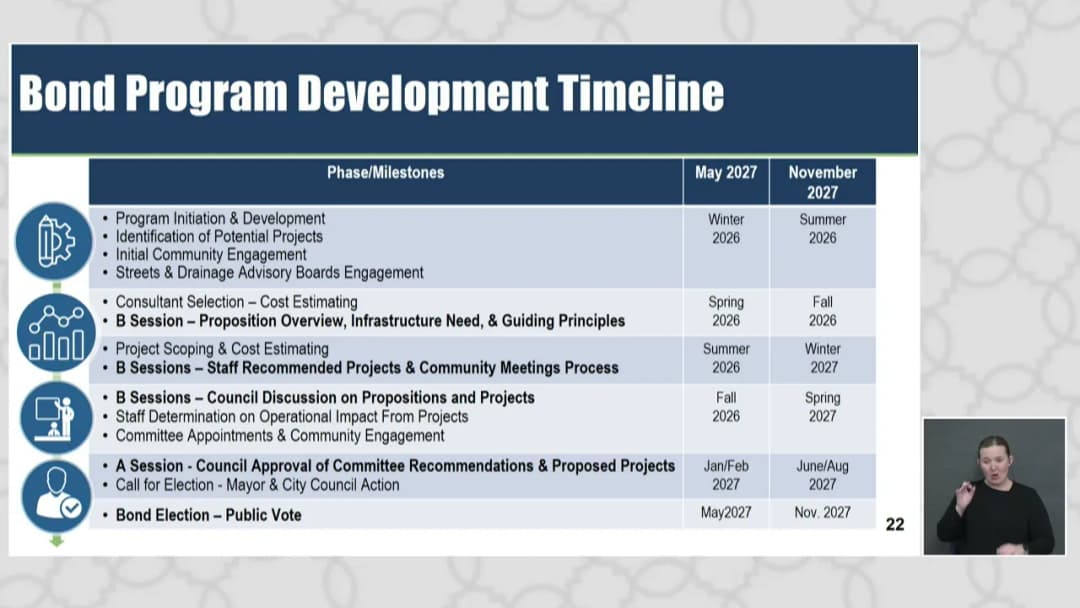
The San Antonio City Council met in B session on January 21, 2026, to discuss the city's debt management plan, bond capacity, stormwater revenue bonds, and airport revenue bonds. The meeting was called to order at 2:05 p.m. and adjourned at 6:27 p.m., with an executive session in between. No formal votes were taken; the session was focused on feedback and policy direction for future bond program. Discussion Items - Debt Management Plan and Bond Capacity: Chief Financial Officer Troy presented an overview of the city's debt management, noting that the debt service tax rate has remained at 21 cents since 2004. He explained that bonding capacity is driven by property values and the stable tax rate. Due to moderated property value growth, the city's bond capacity is projected at $500 million for the next cycle, down from $1.2 billion in 2022. Three scenarios for future bond programs were presented: Scenario 1 ($625 million with a May 2027 election and stable 21-cent tax rate), Scenario 2 ($1 billion targeting 3.25% property value growth starting 2028, with possible tax rate flexibility), and Scenario 3 ($1.2 billion targeting 3.5% growth, also with rate flexibility). Troy emphasized that the 21-cent rate is a target but could be adjusted under a new financial policy. - Stormwater Revenue Bonds: Troy presented options for stormwater rate increases to generate additional revenue for capital projects. Four scenarios were shown: no increase ($10 million in capacity), 2% annual increases for 5 years ($167 million capacity), 5% in first year then 2% ($140 million), and 5% in first two years then 2% ($174.3 million). The average residential tier 2 account currently pays $4.94/month. The increases would raise annual costs from $1.20 to $10.20 per year depending on scenario. Staff noted that stormwater operations also need funding for ongoing maintenance. - Airport Revenue Bonds: Troy informed the council that staff will request approval on April 2, 2026, to issue approximately $1-1.2 billion in revenue bonds for the Terminal Development Program and CIP at the airport, with closing expected July 15, 2026. - Council Feedback on Bond Capacity and Tax Rate: Councilmembers expressed a range of views: - Councilmember Viegadon (District 3) supported Scenario 2 or 3 for bonds and Scenario 2 or 3 for stormwater, stating that the city cannot afford to wait and must act responsibly. - Councilmember White (District 8) opposed any tax rate increases, arguing that the city should find efficiencies like in the budget cycle. He supported the $625 million scenario and questioned the likelihood of tax rate reductions in high-growth periods, stating, "You put three cookies in front of a kid, he's gonna eat all the cookies." - Councilmember McKee Rodriguez (District 2) supported Scenario 2 or 3, emphasizing that equity requires investment in underserved areas. He also urged prioritizing city-owned facilities and using vacant land for parks. - Councilmember Galvan (District 6) supported Scenario 2 and 3 for bonds and Scenario 2 or 3 for stormwater, stressing the need to address long-standing drainage and street safety issues. - Councilmember Castillo (District 5) supported Scenario 2, advocated for increasing the affordable housing bond from $150 million to $250 million focused on land banking, and requested that any sports district funding be a separate proposition for voter approval. - Councilmember Corr (District 1) supported Scenario 2 and potentially Scenario 3, noting that a half-cent increase in the debt service rate would cost a typical homestead owner about $11.70 annually. She emphasized data-driven prioritization and transparency. - Councilmember Mesa Gonzalez (District 7) supported Scenario 2 and Scenario 2 or 3 for stormwater, requesting a breakdown of stormwater revenue by district and consideration of commercial rate adjustments. - Councilmember Mungia (District 4) supported Scenario 2, favored a "back to basics" bond focused on streets and sidewalks, and asked for cost impact analysis on a $233,000 home. - Councilmember Alderete Camito (District 7) supported Scenario 2 or 3, citing the need to address long-deferred maintenance in historically neglected areas. - Mayor Jones expressed caution, favoring a November 2027 election to allow more time to assess the economic climate and utility rate increases. He requested a comparison of stormwater rates with other Texas cities and an analysis of property tax exemptions that reduce the taxable base. - Timeline and Process: Mike Shannon from Capital Delivery outlined the bond program development timeline, which takes about a year and includes community engagement, project scoping, council B sessions, and bond committee appointments. A May 2027 election would require starting immediately; a November 2027 election would shift the timeline. Key Outcomes - No formal decisions were made; the session was for feedback and policy direction. - Staff will return with additional data requested by councilmembers, including: - Average cost impact of a debt service tax rate increase on a typical homestead. - Breakdown of stormwater revenue and accounts by council district. - Analysis of potential non-residential stormwater rate increases without affecting residential rates. - Comparison of San Antonio's stormwater rate structure with other major Texas cities. - Impact of moving from a five-year bond cycle to shorter cycles. - The council will revisit the debt management plan and bond sizing in July 2026, when economic conditions may be clearer. - There was consensus to consider a separate proposition for sports/entertainment district infrastructure in the bond program. - Staff will develop a financial policy guide for managing the debt service tax rate if flexibility is pursued. - The next step is for the council to provide further direction on bond size and stormwater rate scenarios.
The San Antonio City Council held a work session on January 21, 2026, beginning at 2:05 p.m., to discuss the city's debt management plan, bond program capacity, stormwater fee structures, and airport revenue bonds. The meeting was led by Mayor Jones and included presentations from financial staff (Troy and Mike Shannon) and city council members. The council deliberated on three bond capacity scenarios (ranging from $625 million to $1.2 billion), potential property tax rate adjustments, and stormwater fee increases, with a focus on balancing infrastructure needs with fiscal responsibility. No formal votes were taken; the session concluded with a move to executive session at 4:45 p.m. Discussion Items - Debt Management Overview: Staff presented the city's current debt situation, noting that the property tax rate for debt service has remained at 21 cents per $100 valuation since 2004. The total assessed property value in 2026 is $159 billion, with projected growth of less than 1% in 2026, 0.5% in 2027, 1.75% in 2028, 2% in 2029, and 2.5% in 2030. The bond capacity has dropped from $1.2 billion in 2022 to approximately $500 million due to flat property values. The city's outstanding general obligation debt is $1.7 billion, with an average life of 6.7 years. - Bond Program Scenarios: Three bond capacity scenarios were presented: - Scenario 1: $625 million in capacity by May 2027, maintaining the 21-cent tax rate and assuming 2% growth. - Scenario 2: $1 billion capacity, requiring a growth target of 3.25% in 2028 and maintaining the 21-cent rate, with potential flexibility to adjust the rate. - Scenario 3: $1.2 billion capacity, requiring a growth target of 3.5% in 2028 and maintaining the 21-cent rate. Staff emphasized that these scenarios are projections and that the tax rate could be adjusted downward if growth exceeds targets. - Stormwater Fee Increases: Staff outlined four scenarios for stormwater fee adjustments: - Scenario 1: No increase, resulting in only $10 million in bond capacity over 25 years. - Scenario 2: 2% increase starting in 2027, generating $106.7 million in bond capacity. - Scenario 3: 5% increase in 2027 followed by 2% increases through 2031, generating $140 million. - Scenario 4: Higher increases leading to $174 million in capacity. Current monthly residential fees range from $3.75 (Level 1, under 2,750 sq ft) to $10.45 (Level 3, over 4,220 sq ft). Non-residential fees range from $0.31 to $0.73 per 1,000 sq ft. The stormwater fee has not been increased since fiscal year 2020. - Airport Revenue Bonds: Staff noted that the city approved $1.3 billion in airport revenue bonds on December 18, 2025, and requested council consideration on April 2, 2026, to support airport development. The bonds would be closed on July 15, 2026. - Council Member Positions: - Councilwoman Spears (via Councilman White) and Councilman White opposed any increase in property tax rates or stormwater fees, citing the city's 22-year history of not raising the property tax rate and the burden on residents. White argued that the city should focus on existing inefficiencies and not add more debt. - Councilman Villagran supported scenarios 2 and 3, emphasizing the need to meet infrastructure needs and noting that the city has historically been conservative. He expressed confidence in the city's growth. - Councilman Galvan asked about the ability to increase stormwater fees only for non-residential properties, noting that 80% of stormwater revenue comes from non-residential accounts. He supported scenarios 2 and 3 for bonds and scenario 3 for stormwater. - Councilman Mickey Rodriguez supported scenarios 2 and 3, advocating for strategic investment in districts with greater needs, such as street repairs and community centers. He emphasized that bond funds should be used for projects that directly benefit residents. - Councilman Gonzalez supported scenarios 2 and 3, stressing the need for intentional project selection, especially for parks, sidewalks, and drainage. He also supported a separate bond proposition for sports facilities. - Councilman Castillo supported scenarios 2 and 3 and asked about the possibility of adjusting stormwater rates for non-residential properties. He expressed concern about the cumulative impact of fee increases from various city services. - Councilman Gabito supported scenarios 2 and 3 for bonds and scenarios 3 and 4 for stormwater, citing the need to address flooding and safety issues. He emphasized that preserving life is paramount. - Councilman Aldarete supported scenario 2 for bonds and scenario 2 for stormwater, but also expressed openness to scenario 3. He stressed the importance of prioritizing community needs. - Councilman Munguia supported scenario 2 and asked for more data on the impact of tax rate increases on homeowners. - Councilwoman Viagran supported scenarios 2 and 3 and urged strategic investment rather than equal distribution across districts. She also called for intentional funding choices, avoiding projects like a gymnasium for a university. - Councilman Cor echoed support for scenarios 2 and 3 and emphasized the need for a robust bond program to address deferred maintenance. Key Outcomes - No formal votes were taken. The council provided feedback to staff on bond scenarios and stormwater fee options. - Staff will return with additional analysis, including the impact of a $11.07 annual tax increase under scenario 2, and a breakdown of stormwater needs by district. - The council will continue discussions on bond program timelines, with a preference for either a May 2027 or November 2027 election. Some members favored a later date to allow more economic clarity. - Staff will explore the possibility of adjusting stormwater fees for non-residential properties only, as suggested by Councilman Galvan. - The council will hold a future session to discuss project prioritization and the creation of a citizen bond committee. - The meeting recessed into executive session at 4:45 p.m. to discuss economic development negotiations and real estate purchases.
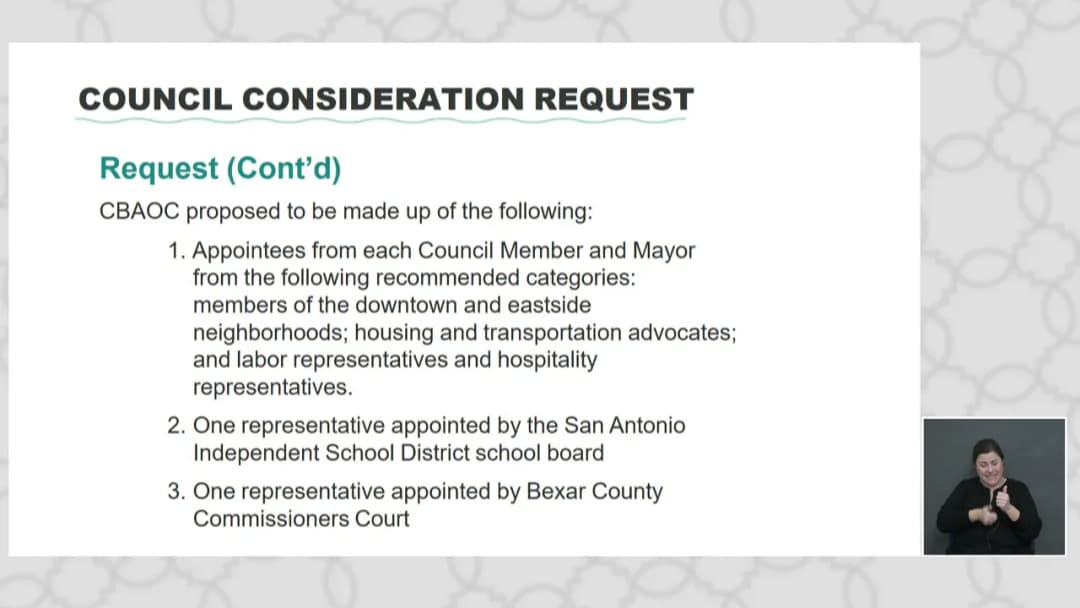
The Governance Committee of the San Antonio City Council met on Wednesday, January 21, 2026, at 10:03 AM. The meeting was called to order by Mayor Jones and included roll call, approval of minutes, public comment, and three action items related to senior protection, a community benefits agreement oversight commission, and a Spurs arena project accountability dashboard. The meeting adjourned at 11:10 AM. Consent Calendar - Approval of Minutes: The minutes from the December 11, 2025 meeting were approved unanimously with a motion and second, no corrections or amendments. Public Comments & Testimony - Darrell Greer (AARP Regional Program Manager, South Texas Adult Protective Services Community Board): Expressed full support for Councilwoman Castillo’s policy proposal to enhance senior protection. Cited national scam losses of $16.6 billion (FBI), with Texas ranking second at $1.3 billion. Offered AARP’s resources and programming to further protect older adults. Discussion Items - Item 2: Council Consideration Request on Enhancing Senior Protection (Councilmember Castillo, District 5) - Staff (Melody Woosley, Human Services Director) presented current initiatives: enrollment in Do Not Call registries, legal referrals, fraud awareness campaigns, partnerships with Bear County’s Elder Fraud Task Force and Senior Justice Assessment Center, and a forthcoming status of older adults report. Recommended forwarding actions to the Public Safety Committee’s Elder Abuse Subcommittee, implementing enhancements within FY26 resources, and developing cost estimates for expanded services. - Councilmembers discussed the need for metrics to measure impact, better utilization of the Joint Commission on Elderly Affairs, and legislative advocacy at the state level. Councilmember McKee Rodriguez supported staff’s recommendation, Councilmember Viagran expressed frustration with slow progress, and Councilmember Mungia emphasized mobilizing resources and leveraging partners like AARP. The motion to approve the staff recommendation passed unanimously. - Item 3: Council Consideration Request on Community Benefits Agreement Oversight Commission (Councilmember Core, District 1) - Staff presented a proposal to create a commission to oversee the $75 million (2.5 million/year for 30 years) community benefits fund from the Spurs arena term sheet. The commission would include appointments from each council member, mayor, SAISD, Bear County, and advisory reps from the city, county, and Spurs. - Councilmember Core explained the need for genuine community engagement after prior surveys. Councilmembers raised concerns: the small annual amount ($2.5M), potential duplication of council authority, representation of the east side, and whether the county should have a vote without contributing. Several councilmembers suggested alternatives like a revenue bond or leveraging partners. The item was continued to the next Governance Committee meeting (motion passed). - Item 4: Council Consideration Request on Spurs Arena Project Accountability Dashboard (Councilmembers Castillo and White) - Staff recommended creating a dashboard for the entire Sports & Entertainment District (including the arena, convention center expansion, and potentially the Missions baseball stadium) rather than just the arena. The dashboard would be public-facing, tracking project milestones, financial commitments, and community benefits. The city issued an RFQ for an executive program manager (EPM) to help design the dashboard, expected contract approval by mid-April. - Councilmembers supported the dashboard but requested it be easy to use, include public meeting notices, and show PFC revenue distribution. The motion was amended to include the entire district and the Missions baseball project. The amended motion passed unanimously. Key Outcomes - Item 2 (Senior Protection): Approved staff recommendation to forward actions to the Elder Abuse Subcommittee, implement enhancements within FY26 resources, and develop cost estimates. All councilmembers voted in favor. - Item 3 (CBA Oversight Commission): Continued to the next Governance Committee meeting for further discussion on structure, funding, and county involvement. Motion passed with no opposition. - Item 4 (Dashboard): Approved as amended to include the Sports & Entertainment District and Missions baseball project. The EPM will design the dashboard, with a B session presentation to council before finalization. Motion passed unanimously.
The Historic and Design Review Commission (HDRC) met in a marathon session on January 21, 2026, spanning from the afternoon into the evening, to consider a packed agenda. Key items included the contentious Brackenridge Park Phase II bond project, an airport terminal connector commemoration, a church security project, and several residential cases. Consent Calendar - The commission approved the December 17, 2025, meeting minutes. - The balance of the consent agenda (Items 2, 4, 6-15) was approved with all staff stipulations. Item 16 (Brackenridge Park) was pulled for extensive public comment, and Items 1, 3, and 5 were pulled by commissioners. Public Comments & Testimony - Brackenridge Park (Item 16): This item drew the most extensive public input, with over 20 in-person speakers and dozens of recorded voicemails. - Support: Chris Maitre (Brackenridge Park Conservancy) urged approval, stating the current area is a sea of broken asphalt suffering from ecological distress, and the project restores critical history and the natural environment. - Religious & Indigenous Opposition: John Griel (attorney for Gary Perez and Matilda Torres) argued the removal of two cypress trees adjacent to the pump house violates the Religious Freedom Restoration Act and that the city has not explored alternatives. A Comanche Nation representative formally opposed any tree removal until consultation is complete. Sabrina Chapa and Norma Santos requested indigenous Free, Prior, and Informed Consent (FPIC), calling the trees sacred relatives. - Cultural & Community Opposition: Many speakers (Aida Ayala, Antonia Castaneda, Susan Strawn of River Road NA, Cecilia Black, Alicia Garlock, and others) opposed the removal of 22 parking spaces, 10% of the park's picnic tables (including WPA replicas), and the historic stone kiosk. They argued the plan would eliminate traditional working-class family uses like Easter camping, lowrider cruising, and Sunday gatherings. - Other Items: Ray Herbert spoke in favor of security fencing at St. John's Lutheran Church (Item 3) to protect 94-year-old historic doors. Lulu Francois (Dignity Hill HDRC) provided comments on a new construction project (Item 17). The King William Association provided comments on several consent items and Item 18. Discussion Items - Election of Officers: Jay Gibbs was re-elected as Chair. Jeffrey Fetzer was elected as Vice Chair. - Item 1: Airport Terminal Connector / Building 1322 Commemoration: The applicant presented a mitigation plan using a shadow landscape, salvaged Y-column benches, and travertine. Commissioners Fetzer, Mazuka, and Cervantes argued the design lacked visible homage to the historic building. A motion by Commissioner Group to approve the design as submitted carried 8-3, with the majority finding it complied with mitigation stipulations. - Item 3: St. John's Lutheran Church (502 East Nueva): The commission discussed proposed security gates and windows. Concern was raised that the ornate front gate design would detract from the historic limestone facade. The item was split; the front gate was referred to a Design Review Committee (DRC), while the remaining scope was approved with staff stipulations. - Item 5: 1301 East Commerce (Signage): The applicant presented three sign options. Commissioner Fetzer preferred Option B, the smallest and most architecturally compatible. The commission approved Option B. - Item 16: Brackenridge Park Phase II: After over two hours of testimony and deliberation, Commissioner Savino moved to refer the project to a DRC and a site visit to address tree removal, parking, picnic tables, and the historic kiosk. A substitute motion to approve was discussed but did not gain traction. Many commissioners felt the plan radically altered the cultural use of the space and required more public scrutiny. The motion for a DRC and site visit carried. - Item 17: 153/155 East Crockett: The applicant stated updated plans met all staff stipulations, though the new documents had not been officially received. The project was approved conditioned on meeting all staff stipulations. - Item 18: 525 Mission (King William): The applicant requested approval for metal window screens and a metal carport. Staff recommended denial, advocating for wood materials to match the historic character. The King William Association concurred with staff. The commission voted to deny the request. Key Outcomes - Airport Terminal (Item 1): Approved 8-3. - St. John's Church (Item 3): Partial approval; front gate design sent to DRC. - Signage (Item 5): Approved (Option B). - Brackenridge Park (Item 16): Referred to DRC and site visit. - E. Crockett (Item 17): Approved with stipulations. - King William Screens/Carport (Item 18): Denied. - Consent Agenda: Approved.
The San Antonio Government Committee met on Wednesday, January 21, 2026, at 10:03 AM. The meeting was chaired by Mayor Jones, with council members present including Vicky Rodríguez, Via Gran, and Mungia. The committee addressed several agenda items, including the approval of previous meeting minutes, a council consideration request (CCR) to enhance protections for seniors against exploitation, a CCR to establish a community benefits oversight committee for the new Spurs arena, and a CCR to create an accountability dashboard for the arena project and other developments. Public testimony was heard, and amendments were made to several proposals. Consent Calendar - Approval of Minutes (December 11, 2025): The minutes from the December 11, 2025 meeting were approved by a unanimous voice vote. (Moved by a council member, seconded, with no objections or abstentions.) Public Comments & Testimony - Derrick Reer (Director of Protection Program): Spoke in support of the CCR to protect senior citizens from exploitation. He stated that nationally, $16.6 billion is lost to financial exploitation of seniors, and Texas ranks second in the nation with $1.3 billion in losses (citing FBI data). He urged continued community education and collaboration to better protect seniors. Discussion Items - CCR for Elder Protection (Council Member Tere Castillo): The committee discussed a CCR submitted on December 3, 2025, by Council Member Castillo, also signed by Council Members Villegran Galván and Messi Pesa González. The CCR aims to enhance protections for seniors against exploitation, fraud, and abuse. Melo de Guzle, Director of Human Services, presented the city's current initiatives: senior center campaigns to register for the Do Not Call list, partnerships with Mary's Law School, Texas RioGrande Legal Aid, Catholic Charities, and SAPD; educational classes via OASIS and OATS; and expansion of the Senior Exploitation and Fraud Protection Working Group with Bexar County. The presentation noted that Dallas has already implemented a similar “Do Not Solicit” code. The committee recommended moving the CCR forward with a focus on establishing measurable metrics to track effectiveness, improving communication channels for resources, and identifying alternative funding sources (not from the general fund). Council Member Mickey Rodríguez expressed support, noting the need to avoid duplicating existing efforts. Council Member Villegrán emphasized the urgency of action, stating “we need to see action” and that the issue should be brought to the state legislature. Council Member Mungia stressed the importance of metrics to understand what interventions work best. The motion to approve the staff recommendation passed with a voice vote. - CCR for Arena Community Benefits Oversight Committee (Council Member Kore, District 1): The committee considered a CCR to create a community benefits oversight committee for the new Spurs arena, to which the Spurs have contributed $275 million. The staff recommendation included forming a committee with members appointed by the council and mayor, including representatives from neighborhoods, labor, hospitality, schools, and the county. The committee would provide recommendations on how community benefits funds (estimated at $2.5 million annually for 10 years, totaling $75 million) should be allocated. Council Member Kore (sponsor) stated the request came from the community, noting that previous community feedback sessions lacked sufficient information. Council Member Mungia supported the CCR, emphasizing community involvement and the desire for organic growth of decisions. Multiple council members expressed concerns: Council Member Villagrán questioned the county’s role and the small annual amount ($2.5 million), fearing it might be diluted by consulting fees. Council Member Mickey Rodríguez warned that once funds are given, it’s hard to renegotiate without a binding CBA. A motion was made to postpone the item to the next committee meeting to allow for further discussion on the committee’s scope, funding sources, and potential for leveraging additional private funds. The motion to postpone passed by a voice vote. Council Member Mungia later suggested that the city explore creative financing and potential matching funds. - CCR for Arena Project Accountability Dashboard (Council Members Castillo and White): The committee reviewed a CCR to create a public dashboard for the Spurs arena project, providing transparency on project progress, spending, and contracts. The staff presentation detailed that the dashboard would be part of an Executive Project Management (EPM) program and would include the arena, the convention center expansion, and other developments in the sports and entertainment district. The dashboard would be publicly accessible and updated regularly. Council members requested that the dashboard be easy for the public to understand, not require a code, and include community benefits and reporting on workforce development. The recommendation was amended to expand the dashboard’s scope to include the entire sports and entertainment district and the Missions baseball stadium project. The amended motion passed by a voice vote. The committee also noted that an RFQ for the project would be issued on Friday, and the contract would be brought to the council for consideration. Key Outcomes - Elder Protection CCR Approved: The staff recommendation to move forward with enhanced elder protection measures was approved, with direction to develop measurable metrics and explore alternative funding sources. - Arena Community Benefits Oversight Committee Postponed: The item was postponed to the next Government Committee meeting for further discussion on scope, funding, and inclusion of other school districts and community input. - Accountability Dashboard CCR Approved with Amendments: The dashboard was approved to cover the arena, the entire sports and entertainment district, and the Missions baseball stadium, with a focus on public transparency and easy access. The RFQ is expected to be released Friday, January 23, 2026. - Meeting Adjourned: The meeting was adjourned at 11:10 AM.